
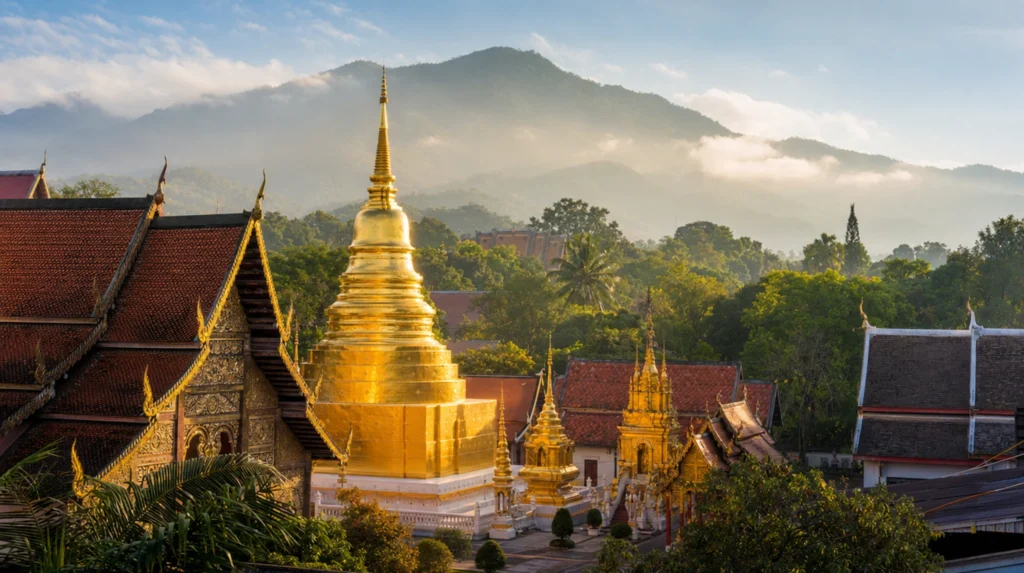
Chiang Mai, Thailand: Lanna Capital of Temples, Noodles, and Lanterns
Part of our Thailand travel guide.
Chiang Mai City Guide
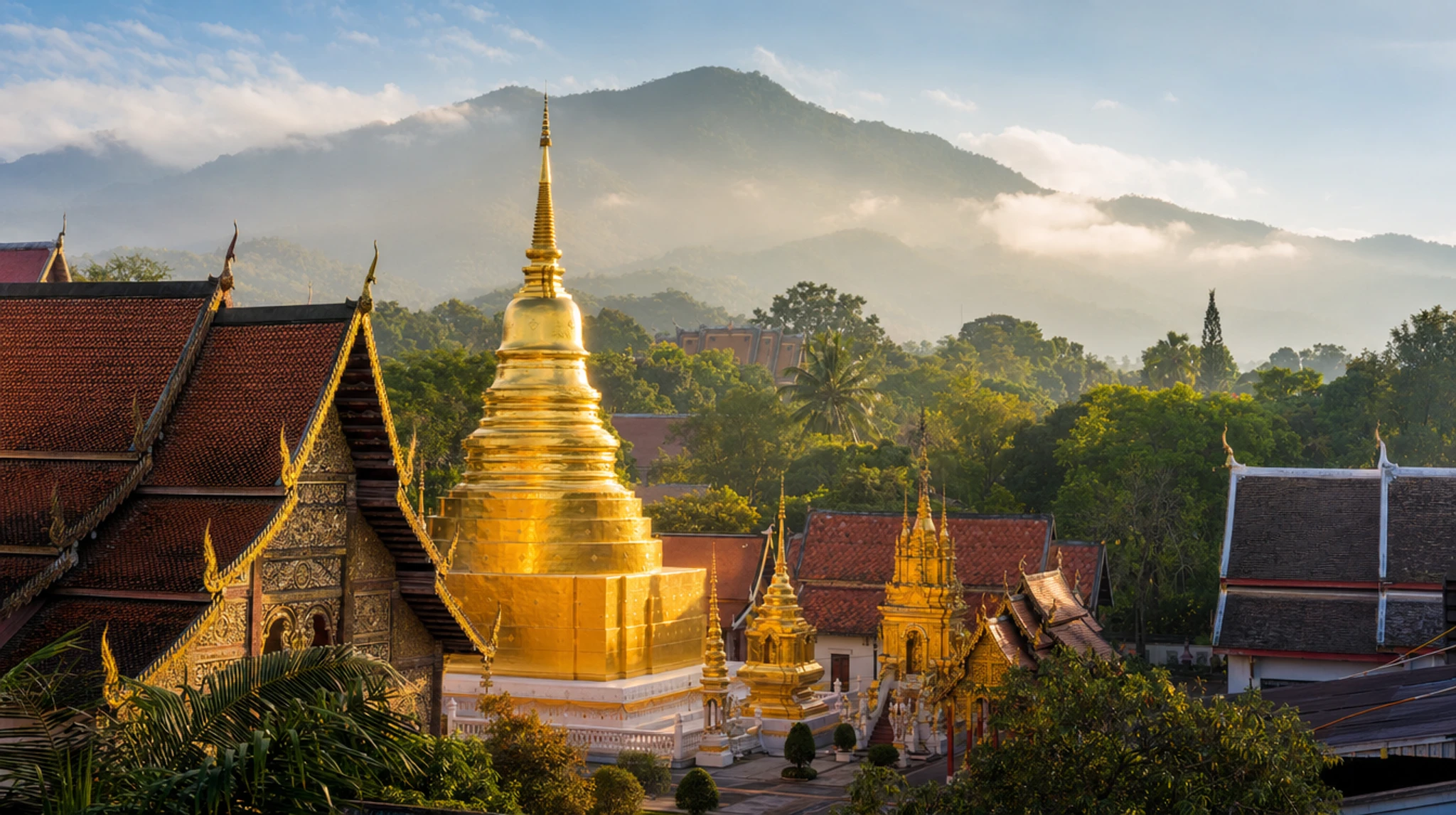
Table of Contents
Why Chiang Mai?
Chiang Mai is northern Thailand’s cultural anchor — a 730-year-old former Lanna royal capital whose moated old city still sits almost exactly where King Mangrai founded it in 1296 . The modern city of roughly 130,000 people inside an urban area closer to one million spreads outward from that square grid into cafe-heavy Nimman, the handicraft suburbs of Hang Dong, and the forested Mae Rim valley, all cradled by the Doi Suthep-Pui massif to the west . The elevation of about 310 metres keeps it noticeably cooler than Bangkok for much of the year, and the ring of mountains funnels the kind of mist-heavy mornings and crisp December nights that feel almost out of place in tropical Thailand.
It is also a city of contradictions. Chiang Mai holds more than three hundred active Buddhist temples — the densest concentration in Thailand — while simultaneously ranking at the top of most global digital-nomad surveys for the past decade . Morning alms rounds past teak-fronted guesthouses run alongside co-working floors full of remote engineers; the language of the radio in one block shifts from Lanna sermonising to specialty-coffee playlists in the next. Few cities of this size juggle the heritage economy and the new economy so visibly, and the fact that they coexist without much visible friction is part of the reason long-stayers keep renewing their leases month after month.
Travellers come for three overlapping reasons. First, the temples — from the gilded hilltop reliquary of Wat Phra That Doi Suthep down to the partially ruined brick chedi of Wat Chedi Luang in the Old City core, and the quieter forest monasteries at Wat Umong and Wat Suan Dok. Second, Lanna food — khao soi coconut-curry noodles, sai ua herb sausage, nam prik chilli dips, khanom jeen noodles drowned in fermented pork broth — a regional kitchen that sits between central-Thai, Burmese, and Yunnanese cooking and is still rare to find abroad. Third, the festivals: Songkran fills the moat with waterfight crowds every 13–15 April, and the Yi Peng Lantern Festival on 4–5 November 2026 releases thousands of paper khom loi lanterns into the night sky above the Ping River. Those three threads — temples, northern food, and lanterns — structure the rest of this guide, and any one of them is reason enough for a first trip.
Chiang Mai also operates as the practical hub for a wider northern-Thai itinerary. Doi Inthanon — Thailand’s highest peak at 2,565 metres — is a day trip away; the backpacker mountain valley of Pai lies three hours north on a famously winding road; the White Temple and the Blue Temple in Chiang Rai sit three hours to the east; and the ethical elephant sanctuaries along the Mae Taeng valley are all reachable inside a morning’s drive. In an overland trip through mainland Southeast Asia, Chiang Mai is the node that makes everything else accessible.
Neighborhoods: Finding Your Chiang Mai
📍 Chiang Mai Map: Every Place in This Guide
Chiang Mai’s central zone is small enough that a fit walker can cross from Wat Phra Singh in the western Old City to Nimman’s soi grid in under thirty minutes. But the texture of each district shifts dramatically inside that compact footprint, and where you base yourself determines what your days look like. The Old City is temples, walking streets, and guesthouses; Nimman is cafes, co-working, and dessert bars; Santitham is the long-stay quiet-residential option; Chang Moi and Warorot hold the working market economy; Wat Gate is the slow riverside quarter; Chang Phueak is night-food and muay thai; and the suburbs of Mae Rim and Hang Dong round out the resort-and-handicraft fringe. A first-time visitor on a short stay should plant inside the Old City; a returning traveller or a long-stayer should consider Nimman or Santitham. Budget roughly as follows: Old City and Nimman guesthouses from ฿500–1,500 per night, Santitham long-stay rooms from ฿9,000 per month, Wat Gate boutique hotels from ฿2,500 per night, Mae Rim resorts from ฿3,500 per night.
Old City (Square)
The moated and walled historic Lanna core — a roughly one-and-a-half-kilometre square bounded by crumbling brick walls and a water-filled moat — is still the ritual and tourist heart of the city. Almost every first visit to Chiang Mai begins here, and the compact grid means you can cover the headline temples on foot in a single morning. Guesthouses, vegan cafes, massage studios, and tour agencies cluster along the inner streets, while the four gates (Tha Phae in the east, Suan Dok to the west, Chang Phueak to the north, and Chiang Mai Gate to the south) funnel songthaew traffic in and out. Mornings smell like incense and jasmine; evenings smell like charcoal grills and frying garlic. Inside the walls, traffic is slower, buildings are capped at three storeys by local ordinance, and the pace is set by the rhythm of the temples.
- Wat Chedi Luang — the partially ruined fifteenth-century brick chedi at the geographic centre of the Old City, once around 80 metres tall before a 1545 earthquake.
- Wat Phra Singh — Lanna royal temple on the west side of the square, centre of the Songkran Buddha procession every April.
- Tha Phae Gate — the eastern entrance and default meeting point for walking tours, running clubs, and free-walking groups.
- Ratchadamnoen Road Sunday Walking Street — one kilometre of vendor stalls every Sunday 16:00–22:00.
Best for: first-timers, temple hoppers, walkers. Access: songthaew rank at Tha Phae Gate; Grab anywhere inside the grid .
Nimmanhaemin (Nimman)
Cafes, co-working floors, design shops, and dessert bars stack along twenty numbered sois (side streets) west of the Old City, bounded by Huay Kaew Road to the north and Suthep Road to the south. Nimman is ground zero for Chiang Mai’s digital-nomad scene — it is the reason Chiang Mai has topped global nomad rankings almost every year since 2014 — and you feel it on arrival. Every second storefront is a specialty-coffee counter, a vegan lunch bowl, or a laptop-friendly workspace, and rents around One Nimman and Maya Mall now track Bangkok rather than the rest of the province. The scene is young, internationalised, and thinner on Lanna character than anywhere else in the city, but it is also where you will find the best espresso and the only reliably fast wi-fi outside the hotels.
- Maya Lifestyle Shopping Center — air-conditioned mall at the Huay Kaew Road junction with a cinema and food court.
- One Nimman — a faux-Lanna open-air plaza of restaurants, galleries, and weekend craft markets.
- Ristr8to specialty coffee — routinely cited as the city’s best espresso bar and the launch pad for Thailand’s coffee-competition circuit.
- Salad Concept, Rustic & Blue, and Graph Cafe — the anchor brunch and workspace strip along Nimmanhaemin Road Soi 3 through Soi 7.
Best for: digital nomads, cafe crawlers, young travellers. Access: songthaew from Old City ฿30–40; 10 minutes by Grab .
Santitham
Locals-first residential grid immediately north of Nimman, bounded by Huay Kaew Road to the south and the Super Highway to the north. Santitham is where long-stay travellers decamp after a month or two in the Old City — rents run twenty to thirty percent lower than Nimman, the street-noodle density is higher, and the guesthouse scene along Si Phum and Inthawarorot roads is built for monthly stays rather than weekend tourists. There are fewer tourist-facing restaurants, which is the point: you eat where the university students and hospital nurses eat, and you pick up conversational Thai faster than in the Old City guesthouse bubble. Fresh fruit and khao soi stalls open at dawn and stay open past dark.
- Santitham fresh market — a no-frills neighbourhood market for produce, grilled fish, and khanom jeen noodles.
- Kaomao Kaofang cafe and the cluster of quieter workspace cafes along Soi Santitham 4.
- Su Casa and the long-stay guesthouse strip along Inthawarorot Road at ฿400–700 per night on monthly rates.
Best for: long-stay travellers on a budget. Access: 15 minute walk to Nimman; songthaew along Huay Kaew Road .
Chang Moi
The old Chinese-Thai trading quarter east of Tha Phae Gate bleeds into the Warorot market zone along the Ping River. This is working-Chiang-Mai — gold shops, dried-goods wholesalers, textile stalls, and tea rooms that have been in the same family for three generations. The streets are noisier and the pavements narrower than in the Old City, but no district better captures the pre-tourism economy of the town. Chang Moi is also where the overnight train from Bangkok first meets the city by proxy — many of the guesthouses clustered along the eastern moat road cater to the sleeper-train arrival rhythm, and the songthaew network funnels outbound travellers from here up toward the Old City temples.
- Warorot Market (Kad Luang) — two vertical floors of dried goods, northern sausages, and textiles; open 06:00–17:00 daily.
- Ton Lam Yai flower market — open around the clock with wholesale jasmine, lotus, and orchid garlands for the temple trade.
- Chinatown along Chang Moi Road — small temples, Chinese sweet shops, and the city’s oldest tea houses.
Best for: market shoppers, photographers. Access: walk from Tha Phae Gate; songthaew to Warorot ฿30.
Wat Gate
Quiet riverside community across the Iron Bridge on the east bank of the Ping River. Wat Gate (also written Wat Ket) retains more of the colonial-era teakwood house stock than any other part of central Chiang Mai — the strip along Charoenrat Road has been quietly taken over by boutique hotels, art galleries, and slow-food restaurants without ever feeling over-developed. Teak warehouses that once handled the logging trade down from the hills have been converted into design studios. This is the slow-travel quarter and the right base if you want a riverside walk at dawn and a wine bar at dusk without the density of Nimman.
- Wat Ket Karam and its small community museum of donated family heirlooms, open 09:00–17:00 by donation.
- The Riverside and Good View restaurants — classic Ping-River terraces with live bands from 19:00 to midnight.
- Woo Cafe — art-gallery-boutique hybrid that functions as an afternoon living room for the district.
Best for: slow travellers, design and craft seekers. Access: Iron Bridge (Saphan Lek) walk from the Old City; songthaew ฿30.
Chang Phueak
North-of-the-moat district built around the famous stewed-pork vendor and Chiang Mai Rajabhat University dorms. By day Chang Phueak is a low-key residential neighbourhood; by night the strip around the north gate transforms into one of the city’s best street-food markets, anchored by the khao kha moo stall whose cowboy-hatted owner has become a minor national celebrity after a Netflix documentary in the late 2010s. Budget guesthouses, muay thai gyms, and low-rise condominium blocks make Chang Phueak the quiet alternative to Nimman for long-stay travellers who want to eat Thai three meals a day.
- Chang Phueak Gate night food market — open 17:00 onwards with grilled skewers, rice bowls, and sai ua herb sausage.
- Cowboy Hat Lady khao kha moo stall — ฿50 plates of stewed pork leg from about 17:00 until sold out, usually by 21:00.
- Rajabhat University area — cheap student canteens, late-night chicken rice joints, and a dense cluster of boxing gyms.
Best for: night-eaters, budget stays. Access: walk from north gate; songthaew ฿30 from Old City.
Mae Rim (north)
Forested valley suburb thirty to forty minutes north of the city centre along Route 107 and Route 1096. Mae Rim is where Chiang Mai’s resort and wellness economy lives — teak villa retreats, organic coffee estates, and the big-name wildlife parks. You do not base yourself here for a short trip; you come out for a day, or for a week-long reset, but not for a city-break weekend. The valley floor sits a couple of hundred metres higher than the Old City, which means cooler nights in the cool season and genuinely cold mornings in December.
- Queen Sirikit Botanic Garden — 560-acre botanic reserve with a canopy walkway and a glasshouse complex.
- Mae Sa Waterfall — ten-tier cascade inside the Doi Suthep-Pui National Park boundary.
- Tiger Kingdom and Elephant Nature Park shuttle access — most sanctuaries pick up clients in this corridor.
Best for: day trippers, resort stays, families. Access: Route 107 / Route 1096; Grab 30–40 minutes, about ฿300–400 .
Hang Dong (south)
Leafy southern district along Route 108 known for Thailand’s densest concentration of handicraft villages. Hang Dong and its offshoot Baan Tawai have long supplied Chiang Mai’s night-bazaar furniture wholesalers; if you want teakwood carvings, lacquerware, or celadon direct from the workshop floor, this is the detour. The Grand Canyon Water Park and a run of resort-style spas have turned it into a weekend destination for Bangkok day-trippers too. Roads are wider, traffic is faster, and the landscape opens out into rice paddies within a couple of kilometres of the main road.
- Baan Tawai handicraft village — several hundred woodcarving and lacquerware ateliers along a single lane.
- Grand Canyon Water Park — former quarry turned swim park on the Route 108 corridor.
- Ban Rak Thai and the cluster of local pottery studios — small-batch celadon production open to visitors.
Best for: shoppers, families. Access: Route 108 south; Grab 25–30 minutes, about ฿250–300 .
Night Bazaar Area
The commercial strip along Chang Klan Road, one block east of the moat, transforms into a sprawling market from about 18:00 every evening. The Night Bazaar proper is the most tourist-heavy retail environment in the city — t-shirts, imitation watches, Lanna-print bags — but the adjacent food courts (Anusarn and Kalare) are a fair introduction to northern street food if you have only one evening. The daytime face of the district is subdued: hotels, tour agencies, and a handful of cafes. Everything pivots at sundown.
- Chiang Mai Night Bazaar — the covered and open-air stalls along Chang Klan Road, open 18:00–23:00.
- Anusarn Market food court — ringed with beer gardens and a small cabaret stage.
- Kalare Night Bazaar food stage — live Lanna dance and dinner packages from 19:30 nightly.
Best for: evening shoppers, souvenir hunters. Access: 10 minute walk from Tha Phae Gate; songthaew ฿30 .
The Food
Lanna cooking is one of Thailand’s four regional kitchens and its least replicated abroad. Because Chiang Mai sat on the overland trade route between Yunnan, Burma, and the central Thai plain for six centuries, the pantry absorbed ginger, turmeric, and cumin from the north; coconut and lemongrass from the south; and a fermentation tradition — pork sausage, rice noodles, chilli pastes — that runs closer to Shan State than to Bangkok. The result is a cuisine built on sticky rice rather than steamed rice, on grilled meats rather than fried, on chilli dips and dipping vegetables rather than stir-fries, and on coconut-curry noodles rather than the seafood-forward plates of the southern peninsula. Eating in Chiang Mai, in other words, is not eating a regional version of a cuisine you already know from a Bangkok menu — it is eating something distinct.
Khao Soi and Lanna Curries
Khao soi — egg noodles in a coconut-curry broth, topped with crispy fried noodles, pickled mustard greens, shallots, and lime — is Chiang Mai’s signature bowl and a direct inheritance of the Yunnanese-Burmese trade route through the Lanna kingdom. Every Chiang Mai resident has a favourite stall; the debate is essentially sectarian. A proper khao soi costs ฿50–80 off the street and up to ฿150 in an air-conditioned restaurant, and it is almost always eaten at lunch rather than dinner. The broth base is a dry spice paste of dried chilli, turmeric, coriander seed, and cardamom bloomed in oil and then loosened with coconut milk; the garnishes are fixed and non-negotiable — you will always get pickled mustard greens, shallots, chilli oil, and a wedge of lime, and the waiter will always bring them separately so you can build the bowl to your own balance. Chiang Mai’s Muslim-Yunnanese community runs a parallel khao soi tradition using halal beef instead of chicken, served alongside roti; those stalls cluster behind the Ban Haw mosque and are worth seeking out as a point of comparison.
- Khao Soi Khun Yai — chicken khao soi (฿60, ~$1.75)
- Khao Soi Mae Sai — beef khao soi (฿70, ~$2.00)
- Khao Soi Lamduan Faham — classic chicken khao soi, operating since 1954 (฿60, ~$1.75)
- SP Chicken — rotisserie gai yang with a khao soi side (฿180, ~$5.20)
- Khao Soi Islam — halal beef khao soi with roti on the side (฿120, ~$3.45)
Sai Ua and Northern Lanna Plates
Beyond the noodle bowl, Lanna cooking centres on grilled sai ua — a coiled pork sausage shot through with lemongrass, kaffir lime leaf, galangal, dried red chilli, and turmeric — eaten alongside larb muang (a northern, dry-style pork larb built on a toasted-spice paste rather than the lime-and-fish-sauce dressing of the Isan version), gaeng hang lay (a Burmese-inflected pork-belly curry braised with ginger, tamarind, peanuts, and a distinctive masala-style spice blend), and a rotating cast of chilli dips known as nam prik. Everything is served with sticky rice balled up in the fingers and eaten alongside raw or briefly blanched vegetables, a hard-boiled egg, and a small pile of pork rinds. A full Lanna set meal at a sit-down restaurant runs ฿200–350 per person, and the best versions are in the courtyard restaurants tucked behind the Old City wats, not in the walking-street stalls.
- Huen Phen — sai ua set with nam prik ong (฿250, ~$7.20)
- Tong Tem Toh — Lanna platter with larb muang (฿280, ~$8.00)
- SP Chicken Market stall near Wat Phra Singh — sai ua sold by weight (฿80 per 100g, ~$2.30)
- Ginger Farm Kitchen — modern Lanna tasting menu in Nimman (฿550, ~$15.80)
- Khao Soi Islam — halal beef khao soi plus sai ua plate (฿180, ~$5.20)
Beyond Khao Soi and Sai Ua
Outside the headline pair, Chiang Mai’s pantry runs deep. Chilli dips (nam prik) are a northern obsession, served with steamed vegetables, pork rinds, and sticky rice as a full course in their own right; fermented rice noodle dishes (khanom jeen) appear at almost every lunch market and at every wedding; and Burmese-Shan crossover plates like gaeng hang lay and khao soi gai show up on most Lanna menus as a reminder that the border is less than two hundred kilometres away. The city’s sweet tradition leans on sticky rice, palm sugar, coconut cream, and seasonal fruit, with fresh mango sticky rice flooding the walking-street stalls from April through July and preserved-fruit sweets — tamarind, guava, mango — sold year-round from the Warorot market stalls.
- Nam Prik Ong — tomato-pork chilli dip served with sticky rice and raw vegetables (฿80)
- Nam Prik Num — roasted green-chilli dip with pork rind (฿60)
- Gaeng Hang Lay — Burmese-style pork belly curry with ginger and tamarind (฿120)
- Khanom Jeen Nam Ngiao — fermented rice noodles in tomato-pork-blood broth (฿50)
- Khao Kha Moo Chang Phueak — stewed pork leg over rice from the Cowboy Hat Lady (฿50)
- Mango Sticky Rice — from April through July at Sunday Walking Street stalls (฿60)
Food Experiences You Can’t Miss
Chiang Mai has more cooking schools per capita than any other city in Thailand, and its walking-street markets are structured for grazing rather than sit-down meals. The two Sunday and Saturday walking streets — Ratchadamnoen in the Old City and Wualai in the silver-smithing district respectively — are the highest-signal introductions to the city’s eating rhythm, and every neighbourhood has a smaller evening market of its own. Block out two of your evenings for a market and a class, and you will leave Chiang Mai cooking northern Thai at home; block out a Sunday afternoon for the walking street and you will eat more regional specialities in three hours than a week of sit-down meals will give you. Most cooking schools pick up from Old City and Nimman accommodations and include the market tour, a full day of recipes, and a cookbook in the price.
- Sunday Walking Street on Ratchadamnoen Road — one kilometre of vendor stalls every Sunday 16:00–22:00 with Lanna snacks, khanom jeen bowls, and herb sausage by the skewer.
- Cooking class at Thai Farm Cooking School or Asia Scenic — full-day Lanna menu with a morning market tour, around ฿1,200 per person including transport and a recipe book.
- Saturday Walking Street on Wualai Road (silver district) — smaller and less packed than Sunday, with the city’s silversmith workshops still open until 21:00.
- Chang Phueak Gate food night market — roadside tables every evening from 17:00 with grilled meats and rice bowls under ฿100.
- Michelin-recommended counters — Huen Phen, Khao Soi Khun Yai, and Khao Soi Mae Sai all carry Michelin Guide Thailand Bib Gourmand recognition for 2024.
- Warorot Market breakfast stalls — khao soi, khanom jeen, and grilled pork skewers from 06:00 along the Ping-river edge of the market.
Markets and Grocery Shopping
Beyond the walking streets and the restaurants, Chiang Mai’s wholesale and neighbourhood markets are destinations in their own right. Warorot Market (Kad Luang) along the Ping River is the historic anchor — two vertical floors of dried goods, northern sausages, tea, textiles, and a packed ground-floor food court that serves khao soi, khanom jeen nam ngiao, and grilled pork skewers from dawn onwards. The adjacent Ton Lam Yai flower market runs around the clock, supplying jasmine garlands, lotus, and orchid offerings to the city’s temples. Somphet Market on the north side of the Old City is the district’s everyday fruit-and-vegetable market — smaller, less touristed, and open from dawn until mid-afternoon. Tanin Market on the west side serves the residential neighbourhoods around Wat Suan Dok and Nimman and is the quietest of the three for a morning coffee and a breakfast bowl. For supermarket-style groceries, Tops Daily (inside Kad Suan Kaew on Huay Kaew Road) and Rimping Supermarket (multiple central locations) stock imported goods alongside Thai staples; Makro near the airport is the go-to bulk wholesaler if you are self-catering for a long stay.
Vegetarian and Vegan Chiang Mai
Chiang Mai has one of the densest vegetarian and vegan restaurant scenes in Southeast Asia, thanks to a combination of Buddhist vegetarian tradition (jay, the annual October vegetarian festival), the hill-tribe produce network feeding in from Mae Rim, and the Nimman digital-nomad demand for plant-forward menus. Reforest Cafe in Nimman, Pun Pun inside the Wat Suan Dok grounds, and Taste From Heaven on the east side of the Old City are the three establishments most frequently named as the city’s best vegetarian restaurants. Pun Pun is the standout — a farm-to-table vegetarian kitchen that grows its own produce on an organic farm in Mae Taeng and runs a small seed-saving nonprofit on the side. Expect to pay ฿80–150 per plant-based main course across the category, with full meals including drinks and desserts under ฿350 per person at almost every venue.
Coffee and Specialty Drinks
Chiang Mai’s third-wave coffee scene is disproportionate to its size, built on a direct trade relationship with the highland Arabica farms in Doi Chaang, Doi Saket, and the hill-tribe cooperatives around Mae Jantai. Ristr8to on Nimmanhaemin Road has been the reference bar for a decade; Graph Cafe in the Old City won a string of Thailand National Barista Championship titles in the late 2010s; Akha Ama at the north edge of the Old City sources exclusively from its own Akha-community producers in Chiang Rai and donates a share of profits back to the village cooperative. Expect ฿80–150 for a flat white, ฿120–220 for signature pour-overs, and a surprisingly deep menu of cold-brew, nitro, and espresso-tonic drinks. Thai bubble-tea chains (ChaTraMue, Koi) round out the non-alcoholic drinks menu, the Nimman weekend brunch crowd has built a small but established kombucha scene too, and a wave of craft-beer taprooms (Beer Lab, The Barrel) has opened along the northern edge of the Old City in the last three years.
Philosophy: Eating Like a Local
The unstated rule of eating well in Chiang Mai is the same across every price point: follow the locals at lunch. Sai ua stalls with queues of uniformed office workers at 11:30 are almost always better than the empty air-conditioned restaurant two doors down. Khao soi places that close at 15:00 are serving the day’s single batch; the ones open until 22:00 are serving a steam-table rotation. Markets beat sit-down restaurants on price, freshness, and authenticity, almost without exception. And the Sunday walking street is not a tourist trap masquerading as a local event — it is a local event that tourists have been invited to, which is a materially different thing.
Cultural Sights
Chiang Mai’s cultural fabric is still anchored in its wats. The city has more than three hundred active temples inside and around the urban area, of which perhaps a dozen are genuinely worth an unhurried visit and perhaps five are structural to understanding what Lanna civilisation actually was. The list below prioritises the royal Lanna wats of the Old City, the hilltop reliquary of Doi Suthep, the quieter forest monasteries on the urban fringe, and the tentative UNESCO cultural-landscape nomination that binds them together. Admission prices are small — rarely over ฿50 — and the pattern for respectful visiting is the same across every temple in the city: shoulders and knees covered, shoes off before you enter any main hall, no pointing your feet at the Buddha.
Wat Phra That Doi Suthep
The gilded chedi atop Doi Suthep mountain, fifteen kilometres west of the Old City at 1,073 metres elevation, is Chiang Mai’s defining skyline landmark. A 306-step naga staircase leads to a central reliquary said to house a fragment of the Buddha’s shoulder bone, installed by King Keu Naone in 1383 after, legend has it, a white elephant carried the relic to the summit and died on the spot to mark it. Admission is ฿50 for foreigners. The temple is open daily 06:00–18:00, and the sunrise ceremony beginning at 05:30 is the quietest and most atmospheric moment to climb — the chedi is floodlit at dawn and the valley mist below makes the staircase feel like it leads through cloud .
Wat Chedi Luang
A partially ruined brick chedi in the geographic centre of the Old City that once stood around eighty metres tall before a 1545 earthquake knocked the top third off and left the silhouette it wears today. The compound hosts the popular Monk Chat programme — an informal multilingual Q&A with novice monks from the adjoining monastery — on most weekday afternoons, and a small Lanna manuscript museum in the outer courtyard. Admission is ฿40 for foreigners. Open daily 06:00–18:00, and most beautifully lit in the hour before closing when the setting sun warms the brick. The Emerald Buddha, now in Bangkok’s Wat Phra Kaew, spent most of the fifteenth century inside this chedi.
Wat Phra Singh
The royal Lanna temple on the west side of the Old City, founded in 1345 and home to the Phra Singh Buddha image — a seated bronze in late-Chiang-Saen style that is one of the three most venerated Buddha images in northern Thailand. Wat Phra Singh is the centre of Songkran processions every April, when the image is paraded through the Old City streets and ritually bathed with lustral water by pilgrims lining the route. Admission ฿40. Open daily 06:00–20:00 — the evening illumination of the white-washed viharn and chedi is a classic late photograph.
Wat Umong
A forest-monastery with a tunnel shrine complex dug into a low hill west of the Old City, founded in 1297 for a Sri Lankan-trained monk who needed silence for meditation. The walled grounds contain the ruined tunnels (you can walk through, with working electric lamps inside), a small Buddhist museum, a library of translated Pali texts, and a reservoir populated by turtles, catfish, and the occasional foraging rooster. Admission is by donation. Open daily 06:00–17:00. The English-language meditation retreats run here monthly in the cool season and book out weeks ahead.
Wat Suan Dok
A walled cluster of whitewashed royal chedi that hold the ashes of the Lanna ruling dynasty, founded in 1370 by King Kue Na on the site of a Sri Lankan monk’s retreat garden. The chedi row is a classic late-afternoon photography subject when the setting sun turns the whitewash orange against the silhouette of Doi Suthep directly behind. A separate viharn houses a large bronze Buddha and the largest metal Buddha image cast in Thailand. Admission is by donation. Open daily 06:00–18:00.
Chiang Mai and its Cultural Landscape (UNESCO tentative list)
Submitted to the UNESCO tentative list in 2015, the nomination bundles the moated Old City, its fourteenth-century royal wats, and the Doi Suthep-Pui sacred landscape into a single cultural property under the banner of Lanna urban-religious integration. Inscription is still pending as of early 2026, but the nomination documents are the clearest single statement of what makes Chiang Mai structurally distinctive as a former Lanna royal capital — the moat, the four gates, the axial alignment toward the mountain reliquary, and the surviving royal wats are read as a unified work of sacred urbanism rather than as individual monuments. Free to experience — the entire Old City is the site .
Chiang Mai National Museum
The regional branch of Thailand’s National Museum network, founded in 1954, traces Lanna history from the Hariphunchai kingdom through the Burmese occupation of 1558–1774 to Siamese annexation under Chulalongkorn and into the modern era. Admission ฿100. Open Wednesday through Sunday, 09:00–16:00. Plan about ninety minutes if you are coming cold to Lanna history; the exhibit chronology makes the rest of the city’s sights noticeably more legible.
Entertainment
Chiang Mai’s nightlife is smaller and quieter than Bangkok’s or Phuket’s, and that is part of the appeal. The city has a well-developed jazz and indie live-music circuit, a working muay thai stadium, a pair of riverside dining-with-bands venues, a drag-cabaret scene tucked inside the Anusarn Market compound, and the walking-street performance culture that comes free with a Sunday evening stroll through the Old City. Closing time is typically midnight — later than in Luang Prabang, earlier than in Bangkok — and most venues cluster in the Old City and Nimman, with the riverside strip across the Iron Bridge as the third anchor. Entertainment is split between tourist-oriented shows (cabaret, khantoke) and locally embedded venues (jazz, muay thai, rooftop bars); both have a place in a well-planned evening.
Sunday Walking Street Performances
Every Sunday from 16:00 to 22:00, stages of Lanna classical dance, hill-tribe music, and school drum lines pop up every few hundred metres along the full length of Ratchadamnoen Road from Tha Phae Gate to the Three Kings Monument. Typical cost: free; a ฿20 tip in the offering box is customary if you stop to watch. Turn up before 18:00 to catch the school ensembles before the tourist crowds peak and the heat of the late afternoon gives way to the more pleasant evening temperature.
Muay Thai at Thapae Stadium
Chiang Mai’s working muay thai gym-and-stadium hybrid runs fight cards on Monday, Wednesday, Friday, and Saturday nights from around 21:00 until midnight, with typically six to eight bouts on a full card including a children’s bout opener. Lower-tier tickets ฿400, ringside ฿900; booking online via the venue website knocks about 10% off. Walk-in tickets are fine outside major title cards, and the stadium is five minutes on foot from Tha Phae Gate. The card ends with live traditional sarama music during the bouts, which is a specific pleasure you will not get from streaming the fight at home.
Rooftop and Riverside Bars
The Ping River strip around Wat Gate hosts the city’s best-established riverside dining-with-music venues, while a handful of low-rise rooftops along the moat and inside the Nimman condominiums cater to sunset drinks. Expect cocktails in the ฿180–280 range and an unhurried pace — nobody rushes you off a table here. Live bands at The Riverside and Good View play classic Thai and Western covers from around 19:00 to midnight, and the bigger venues run a small cover charge only on weekend nights when a headlining local band is booked.
Live Jazz and Indie Venues
North Gate Jazz Co-op, just outside Chang Phueak Gate, runs a free-entry live jazz programme 365 days a year; its Tuesday jam is the longest-running open-mic night in the city and still attracts touring professionals passing through. Boy Blues Bar inside the Kalare compound books blues and Thai-rock acts in a smaller, sweatier room that is particularly good in the cool season. No cover at either venue; drinks ฿120–200. Both are good late-first-set choices after a sit-down dinner.
Night Bazaar Cabaret
Chiang Mai Cabaret Show, tucked inside the Anusarn Market compound, runs two nightly drag-cabaret performances at 21:15 and 22:45, with the later show running slightly looser in style. Ticket ฿500–800 including one drink. Booking online via the venue website typically knocks twenty percent off the gate rate. The show is tourist-oriented and well-staged; it is the single best on-ramp to Thailand’s long-standing drag and ladyboy performance tradition for travellers who do not speak Thai.
Lanna Khantoke Dinner Show
The Old Chiang Mai Cultural Centre in Wua Lai runs a nightly khantoke — a Lanna set-menu served on a low round wooden table — paired with northern Lanna dance performances and hill-tribe music from the Karen, Hmong, and Akha communities. Dinner plus show runs ฿550–700 per person, and the package includes hotel pickup inside the central zone. Touristic but well-staged; the most efficient single-evening introduction to Lanna performing arts and a reasonable choice for travellers with only a night or two in town.
Cinema and Film
Chiang Mai has a compact but committed independent cinema scene. SF Cinema at Maya Mall and Major Cineplex at Central Festival handle the mainstream Hollywood and Thai releases with English subtitles; tickets run ฿200–280 including a complimentary bottle of water. Thapae Palace screens art-house and festival films in its basement theatre, and the Chiang Mai Film Festival each December brings a week of international programming to the Old City. Tickets across all venues are 30–50% cheaper than the Bangkok equivalents and bookings are rarely full outside of major Thai premieres.
Day Trips
Chiang Mai is the best day-trip base in mainland Southeast Asia. Five destinations cover the practical range — a national-park summit, a backpacker mountain town, an ethical elephant sanctuary, a famous contemporary temple cluster, and a nearby valley of waterfalls and gardens. All can be booked as minivan tours from any Old City or Nimman agency for ฿600–2,500 per person depending on destination; all can also be done independently with a scooter, a rental car, or a private Grab booking for the day. Most tours pick up from central accommodations between 07:00 and 08:00 and return by 19:00.
Doi Inthanon National Park (2 hr by minivan)
Thailand’s highest peak at 2,565 metres sits inside a park famous for the twin King and Queen pagodas built for Their Majesties’ 60th birthdays, Wachirathan Waterfall, a small summit boardwalk through a primary cloud-forest ecosystem rare this far south, and a handful of Karen hill-tribe villages growing coffee along the slopes. Park entry ฿300 for foreigners; most travellers book a full-day minivan tour for ฿1,200–1,500 including lunch and a village visit. Best visited November–February when the summit is clearest; mornings can drop below 10 °C at the summit and warm jackets are rented at the visitor centre .
Pai (3 hr by minivan)
A backpacker mountain town 130 kilometres northwest on the winding 762-curve Route 1095 that climbs out of Chiang Mai and drops into a highland valley. Hot springs, canyon viewpoints, a reproduction Memorial Bridge, and a walking-street night market draw long-stayers. Go for two nights if you can — the minivan up is notoriously queasy (most travellers take motion-sickness tablets an hour before departure), and Pai is better used as an overnight retreat than as a same-day round trip. Minivans leave the Arcade bus terminal hourly between 07:00 and 17:30 at ฿150 one-way per passenger.
Elephant Nature Park (60 min by park shuttle)
A rescue sanctuary in Mae Taeng founded by Lek Chailert in 1996, the park pioneered the no-riding, no-bathing model for ethical elephant tourism in Thailand and remains the benchmark operator against which other sanctuaries are measured. Day visits at around ฿2,500 include transport, lunch, and a structured afternoon of observation, feeding, and park history; observation-only programmes (no feeding, no contact) are the recommended option and book up two to three weeks ahead in peak season. Bathing packages offered by other operators in the Mae Taeng valley are explicitly not ethical — elephants are habituated through negative reinforcement to tolerate repeated human bathing, and reputable animal-welfare organisations discourage them.
Chiang Rai and the White Temple (3 hr by bus)
Artist Chalermchai Kositpipat’s glittering white-and-mirror-glass temple, Wat Rong Khun, sits fifteen kilometres outside Chiang Rai city and is the iconic stop — an idiosyncratic contemporary Buddhist art project rather than a historical temple, but one of the most photographed buildings in Thailand. Round out the day with the Blue Temple (Wat Rong Suea Ten) on the city’s northern edge and the Black House art complex (Baan Dam Museum) twenty minutes further north. Day tours run ฿1,500–2,000 from Chiang Mai and depart around 06:30 and return around 20:00 — long days, but the temple trio is genuinely worth the driving.
Mae Sa Valley (45 min by car)
A cluster of attractions along Route 1096 including the Queen Sirikit Botanic Garden with its canopy walkway, Mae Sa Waterfall’s ten-tier cascade, and orchid and butterfly farms near the village of Pong Yaeng. Easy half-day option by Grab or rented scooter from the city — and the best choice when you have only a morning free and do not want to commit to a full-day minivan. The valley is also a good shakedown drive if you have rented a scooter and want to practice Thai riding before committing to the bigger Pai round trip.
Seasonal Guide
Spring (March – May)
Hottest and haziest months. Daytime highs climb from 33 °C in early March to 36 °C and occasionally 38 °C through April , and the agricultural burning season from March into early April routinely pushes Chiang Mai to the top of global air-quality indices with PM2.5 readings frequently above 150 and occasionally above 300. Songkran — Thai New Year — fills the moat with waterfight crowds on 13–15 April 2026 and is the city’s biggest single event, but the air remains the headline concern for travellers with respiratory conditions. Hotel rates dip twenty to thirty percent off the November peak despite the festival, which is the silver lining. This is also the window when Wat Phra Singh becomes the centre of the Songkran procession circuit; the Phra Singh Buddha image is paraded down Ratchadamnoen Road and ritually bathed by pilgrims lining the street, a ceremony that pre-dates the modern water-fight tradition by several centuries.
Summer (June – August)
Green season with short, heavy afternoon storms and daytime highs of 31–33 °C . Air quality clears decisively in the first week of May, waterfalls run full through the monsoon, and hotel rates drop to the annual low. A good window for cooking classes, temple visits without crowds, and waterfall day trips to Mae Sa or Doi Inthanon; a weaker window for Doi Suthep summit views, which cloud over most afternoons, and for the very long Pai drive, which gets slippery on the descent sections. Green-season travellers often rate this as the best time to visit if they are not bothered by the afternoon rain — fewer tour groups, lower rates, and a visibly greener landscape from Nimman all the way out to Doi Inthanon.
Autumn (September – November)
Rains taper through September; by late October mornings cool to 20 °C and humidity drops noticeably . Loy Krathong and the Yi Peng Lantern Festival fall on the full moon of the twelfth Thai lunar month — in 2026 the festival dates are 4–5 November — and this is Chiang Mai’s iconic week, with thousands of khom loi paper lanterns released over the Ping River and the moat ringed with candle boats . Hotel rates triple for the festival and the best lantern-release venues (CAD Khomloy, Mae Jo) book three months out. The week immediately after Yi Peng is a quiet sweet spot: weather is still dry, the international tourist wave has not yet arrived, and rates settle back to roughly twice the green-season baseline.
Winter (December – February)
Dry, cool, and the peak tourist window. Daytime highs of 28–30 °C and nights down to 14 °C in the hills and even cooler at Doi Inthanon . Blue skies, clear Doi Suthep views, and the best month for cloud-forest hikes, early-morning alms walks, and outdoor rooftop dinners. Book accommodation two months ahead for December and January; the first week of January is the single busiest period of the year alongside Yi Peng. Bring a light jacket for evenings and any trips above 1,000 metres, and budget for slightly longer Grab waits in the peak week — driver supply does not quite keep up with demand between Christmas and Thai New Year.
Getting Around
Chiang Mai is compact enough that most visitors walk across the Old City in twenty minutes and only reach for transit to get out to Nimman, Chang Phueak, the riverside, or the airport. There is no metro and no commuter rail inside the city itself; an elevated light-rail line has been proposed for a decade without breaking ground. The practical modes are shared songthaew pickup trucks, tuk-tuks, ride-hail apps (Grab and Bolt), rented bicycles and scooters, and feet. Almost nobody rents a car inside the city because parking is scarce and driving inside the moat is slower than walking.
Songthaew (Red Truck Shared Rides)
The red shared songthaew pickups are Chiang Mai’s default public transport and have been for decades. Flag one down anywhere in the urban area and name your destination through the driver’s window; if the driver nods, climb into the bench seats in the back. The flat fare is ฿30 inside the Old City / Nimman zone; ฿40–50 out to Chang Phueak, the night bazaar, or across the Iron Bridge to Wat Gate; and always agree the fare before you step in. There are no fixed routes — the drivers improvise based on who else is already on board and where their combined destinations point — which makes songthaews unpredictable but cheap.
Tuk-Tuk
Three-wheel tuk-tuks run ฿80–150 for short hops within the moat and a little more for longer runs to the airport or the night bazaar. Fares are always negotiated up front; expect to pay about double the equivalent songthaew trip. Tuk-tuks make sense late at night when songthaews thin out, with heavy luggage that will not fit in a Grab sedan, and for the novelty of one or two rides during a trip; they are more atmospheric than useful during the day and drivers do commission-chase to gem shops and tailor shops for an offered shopping detour.
Grab and Bolt (Ride-Hail)
Grab and the newer local Bolt operate across the city and as far out as Mae Rim and Hang Dong. Typical Old City ↔ Nimman run ฿70–90; airport ↔ Old City ฿150–180; Mae Rim day trip ฿300–400 one way. Ride-hail is the simplest option if you do not want to negotiate and is almost always cheaper than a tuk-tuk for longer hops; the drivers are metered and non-negotiable, and the app handles fare disputes. Bolt tends to run slightly cheaper than Grab but with a smaller driver pool outside peak hours.
Airport Access
Chiang Mai International (CNX) sits four kilometres south-west of the Old City — the shortest city-to-terminal distance of any major Thai airport and the reason you can land at 06:00 and be eating khao soi inside the moat by 07:30 .
- Grab or metered taxi — 10–15 minutes, ฿150–200 (meter ฿150 from the terminal)
- Airport bus R3 to Warorot Market via the Old City — 30 minutes, ฿20
Scooter and Bicycle Rental
Bicycle rental runs ฿50–80 per day from most Old City guesthouses and is a comfortable way to cover the moat and Nimman in the cool season. Scooter rental is ฿200–300 per day from the agencies along Moon Muang Road inside the Old City. An international driving permit is legally required to ride a scooter; police spot-checks along the Nimman strip and near Tha Phae Gate routinely fine tourists without one ฿500 on the spot. Helmets are compulsory and the rule is enforced. Do not ride after drinking — the penalties are severe and travel-insurance coverage routinely lapses.
Walking and Navigation
The Old City is one-and-a-half kilometres square and walkable end-to-end in twenty minutes. Footpaths are uneven in places; night lighting is patchy outside the main streets. Google Maps handles Chiang Mai well but mislabels some songthaew stops and occasionally routes you down alleys closed to through traffic. Install Grab, Bolt, and Google Maps on arrival and set up a data-only SIM at CNX before leaving the terminal.
Budget Breakdown: Making Your Baht Count
Chiang Mai is the cheapest of Thailand’s big tourist cities by some margin. A comfortable mid-range day — private boutique room inside the Old City, two sit-down meals, a temple admission or two, and Grab transfers between neighbourhoods — still clears well under ฿4,000 per day at April 2026 exchange rates of about 34.8 Thai baht to the US dollar . The budget and luxury tiers are a meaningful step apart, and the gap mostly goes to accommodation rather than food or experiences.
| Tier | Daily | Sleep | Eat | Transport | Activities | Extras |
|---|---|---|---|---|---|---|
| Budget | ฿1,200 (~$35) | ฿400 hostel (~$11) | ฿250 street (~$7) | ฿100 songthaew (~$3) | ฿300 temples (~$9) | ฿150 (~$4) |
| Mid-Range | ฿3,500 (~$100) | ฿1,500 boutique (~$43) | ฿800 cafes (~$23) | ฿300 Grab (~$9) | ฿600 class/tour (~$17) | ฿300 (~$9) |
| Luxury | ฿10,000+ (~$287+) | ฿6,000 resort (~$172) | ฿2,000 fine dining (~$57) | ฿800 private car (~$23) | ฿1,000 spa/tour (~$29) | ฿1,000 (~$29) |
Where Your Money Goes
Accommodation is the single biggest line item and also the one most responsive to season. An Old City guesthouse that lists at ฿600 in June quotes ฿1,200 during Yi Peng and ฿2,500 over New Year. Food, transport, and temple admissions are remarkably stable year-round — expect to spend under ฿100 per street-food meal and under ฿200 per day on songthaews if you stick to the city centre. Cooking classes, day trips, and muay thai tickets are the bigger discretionary items, and together they typically run ฿2,000–4,000 across a week-long trip for the average mid-range traveller.
Money-Saving Tips
- Eat lunch at talat (fresh markets) — a full northern plate at Warorot or Chang Phueak runs ฿50–70 against ฿250+ in a tourist-facing restaurant, with no drop in quality.
- Buy a three-day Grab credit pack and skip the tuk-tuk markup on short hops — easily ฿200 saved over a long weekend, and no negotiating involved.
- Book Yi Peng lantern releases and Doi Inthanon minivans at least a month out — November prices climb sharply inside four weeks of arrival, and hotels can double inside two weeks.
- Travel in the green season (June–August) for a twenty to thirty percent cut across accommodation and tour pricing — the rain is brief and localised.
- Use the Saturday walking street on Wualai Road rather than the tourist-pricier Sunday walking street when buying silver — the smiths are the same, the retail is cheaper, and the stalls are less packed.
- Skip the fixed-price tuk-tuk “temple tour” package (฿600–1,000) and self-guide the Old City on foot — the headline wats sit within a ten-minute walk of each other and admission totals under ฿150.
Splurge Worth the Money
If you are going to spend above the budget tier anywhere in Chiang Mai, spend it on a cooking class at a working rural farm (Thai Farm, Baan Thai, or Asia Scenic) — ฿1,200–1,800 per person buys a half-day in the rice paddies, a market tour, hands-on preparation of five to eight Lanna dishes, and a cookbook. The Lanna khantoke dinner at the Cultural Centre and a ringside ticket at Thapae Boxing Stadium are the other two splurges that consistently outperform their price.
Practical Tips
Language
Thai is the working language of government, business, and signage; northern Thai (Kham Mueang) is the regional dialect still spoken among older residents, in rural markets, and on local-language radio. English is widely understood inside the Old City, across Nimman, and at all major tourist attractions, but it fades fast in neighbourhood markets, songthaew cabs, and in any medical or bureaucratic context. Google Translate’s photo mode handles Thai menus well and is the highest-value single app to install before arrival.
Cash vs. Cards
Carry cash for markets, street food, temple donations, songthaews, and most tuk-tuks — ฿100 and ฿500 notes cover almost all transactions. Cards are accepted at cafes, malls, mid-range restaurants, and all hotels above the guesthouse tier. Thai ATMs charge a ฿220 foreign-card fee per withdrawal on top of your home bank’s fees, so take out larger amounts less often to minimise the cumulative bite; ฿10,000 in notes will typically last a mid-range traveller two to three days.
Safety
Chiang Mai is one of the safer large cities in Thailand; violent crime against tourists is rare and street harassment is uncommon even at night. Petty scams — tuk-tuk detours to gem shops, tailor-shop commission traps around Tha Phae Gate, scooter-damage deposit-withholding from marginal rental agencies — are the usual issues. The tourist police hotline is 1155 and operates in English twenty-four hours a day. Thailand’s lèse-majesté law (Section 112 of the Criminal Code) criminalises insulting the monarchy with penalties of three to fifteen years’ imprisonment per offence; do not joke about the royal family in any context .
What to Wear
Temple dress code: shoulders and knees covered at all wats, and shoes removed before entering any main hall. Doi Suthep and Wat Phra Singh rent sarongs at the entrance for ฿20 if you arrive underdressed. Outside temples, shorts and t-shirts are the local norm year-round; cool-season mornings in December and January warrant a light layer for the 14 °C lows, and a proper fleece for the Doi Inthanon summit. Waterproof sandals are useful in the June–August green season.
Cultural Etiquette
Remove shoes before entering temple halls and most private homes. Do not point the soles of your feet at a Buddha image or at another person, and do not step on thresholds at temples. Never touch anyone’s head — it is considered the most sacred part of the body in Thai Buddhist culture. The traditional wai greeting (palms pressed together at the chest, with a slight bow) is returned if offered to you, but travellers do not need to initiate it; a polite nod and a “khop khun khrap” (male) or “khop khun kha” (female) works in most situations.
Connectivity
AIS, TrueMove, and dtac all sell eight to ten day tourist SIMs at CNX airport for ฿300–500 with fifteen to thirty gigabytes of data plus unlimited in-app social media. Coffee-shop wi-fi in Nimman and the Old City is fast enough for video calls and is part of the reason Chiang Mai’s designation as a global digital-nomad capital is underwritten by genuinely good infrastructure rather than pure marketing.
Health & Medications
Mosquito-borne dengue risk peaks in the green season (June–September); pack DEET-based repellent and wear long sleeves at dawn and dusk. Tap water is not potable anywhere in Thailand — stick to bottled or filtered water even for brushing teeth in budget guesthouses. March–April burning season brings PM2.5 advisories — bring an N95-rated respirator if you have any respiratory vulnerability. Chiang Mai’s private hospitals (Bangkok Hospital Chiang Mai, Chiangmai Ram) are well-regarded internationally and accept most travel-insurance policies directly.
Luggage & Storage
Most Old City guesthouses store bags free between nights for existing guests. Dedicated luggage-storage counters at CNX airport run ฿100 per piece per day. Nimman’s bigger co-working spaces often include day-storage lockers if you are flying out after a final work session, and the sleeper-train station has a small left-luggage counter at ฿50 per piece per day.
Elephant Ethics and Songkran
Ethical elephant interaction in Thailand means observation only — no riding, no bathing, no circus-style performances. Parks that advertise bathing with elephants train the animals through negative reinforcement to tolerate repeated human contact, and the Tourism Authority of Thailand now explicitly discourages those operators. Songkran (13–15 April) is a full-on citywide waterfight — plan for ruined electronics, soaked clothes, and a permanently damp wallet, or stay indoors for the three days and walk around in the early mornings before the water starts.
Frequently Asked Questions
How many days do I need in Chiang Mai?
Three full days is the comfortable minimum for first-time visitors. Day one covers the Old City temple circuit — Wat Chedi Luang, Wat Phra Singh, Wat Pan Tao — with an evening on Ratchadamnoen Road’s Sunday Walking Street if your visit coincides. Day two is Nimman — a cafe morning, a cooking class in the afternoon, and a Ping River riverside dinner. Day three is out of town — either Doi Inthanon National Park for the landscape, or a sunrise at Doi Suthep combined with a half-day at Mae Sa Valley. Add a fourth day for either Chiang Rai on a structured tour or a two-night overnight to Pai; add a full week if you want to settle into a co-working rhythm and sample the Nimman espresso circuit properly.
Is Chiang Mai good for solo travellers?
Yes — Chiang Mai is one of the easiest cities in Southeast Asia for solo travel. The compact Old City, the visible and welcoming digital-nomad community in Nimman, and the co-working cafes all make casual socialising straightforward without being pushy. Walking tours, cooking classes, meditation retreats at Wat Umong, and Monk Chat at Wat Chedi Luang are all structured specifically to let solo travellers plug into a group for a few hours and then peel off again. Solo female travellers report Chiang Mai as one of Thailand’s more comfortable destinations thanks to even street-light coverage in the central neighbourhoods and low rates of reported harassment.
Do I need to rent a scooter?
No. Songthaews, Grab, and your own feet cover the Old City, Nimman, Chang Phueak, and Wat Gate comfortably and quickly. Rent a scooter only if you plan to explore Mae Rim, Mae Sa, or Hang Dong independently — and only if you hold a valid international driving permit and are confident on two wheels in Southeast Asian traffic. Spot fines for unlicensed riders are ฿500 and travel-insurance policies routinely refuse claims from uninsured or unlicensed riders. If you are not confident on a scooter, hiring a Grab driver for the day (฿1,500–2,000) covers the same routes at roughly the same cost and without the liability.
What about the language barrier?
English is understood at most hotels, cafes, major attractions, tour desks, and pharmacies in the central zone. Outside those circles — market stalls, songthaew drivers, neighbourhood restaurants, village shops on a day trip — a phrasebook or Google Translate’s camera mode closes the gap quickly. Learning three phrases makes a disproportionate difference: sawadee khrap or kha for hello, khop khun khrap or kha for thank you, and mai phet for “not spicy”. Menus at sit-down Lanna restaurants almost all include English translations; menus at Sunday Walking Street stalls mostly do not.
When is the Yi Peng Lantern Festival?
Yi Peng and Loy Krathong fall together on the full moon of the twelfth month of the Thai lunar calendar. In 2026 the festival dates are 4–5 November, with satellite events running from around 1 November through 6 November. Paid lantern-release venues (CAD Khomloy, Mae Jo, Doi Saket) sell tickets from around ฿3,500–7,000 and sell out two to three months in advance; free and informal releases happen throughout the city but are increasingly restricted on aviation-safety grounds near the CNX flight path. This is Chiang Mai’s single most photographed event and is the reason hotel rates triple in early November .
Can I use credit cards everywhere?
Cards work at hotels, malls, cafes, most sit-down restaurants, cinemas, and the bigger attractions and museums. Markets, songthaews, food carts, tuk-tuks, small wats, and smaller guesthouses remain cash-only. Plan on at least ฿500–1,000 in notes for any half-day out of the hotel and pull larger amounts less often to minimise the ฿220 ATM fee that Thai banks charge on every foreign-card withdrawal — the fee is fixed, not percentage-based, so a ฿10,000 withdrawal costs the same as a ฿500 one.
Is Chiang Mai safe during the burning season?
Air quality is the headline concern during the burning window, not physical safety. From early March to mid-April, PM2.5 levels routinely exceed 150 on the AQI scale and occasionally spike past 300 in the worst weeks. Travellers with asthma, COPD, or cardiac conditions should plan around the window or pack N95-grade masks and avoid outdoor sports. Hotel-room air purifiers are now standard in mid-range and luxury properties in Chiang Mai specifically because of the burning season — it is a reasonable and expected question to ask at booking.
How does Chiang Mai compare to Bangkok?
Slower, smaller, cheaper, cooler in winter, and more culture-forward. Bangkok is the capital and the country’s commercial and culinary heart, with the scale and nightlife to match; Chiang Mai is a former royal city that has retained more visible heritage, a lower cost of living, and a more walkable central zone. Most travellers pair the two — three to four days in Bangkok, three to four in Chiang Mai, and sometimes a southern-island stretch to close — which is why the overnight sleeper train between them remains one of Southeast Asia’s iconic overland journeys.
Ready to Experience Chiang Mai?
From Lanna khao soi bowls and teakwood wats to the Yi Peng paper lanterns over the Ping River, Chiang Mai rewards travellers who slow down long enough to actually taste it. For the full country context — visa rules, national festivals, onward travel to the islands, and the overnight sleeper train from Bangkok — read the Thailand Travel Guide.
Explore More City Guides
Where to Stay
Alex the Travel Guru
Alex is Facts From Upstairs’ resident travel guru. After a decade of long-stay research across Southeast Asia — including three winters based in Chiang Mai’s Santitham district with a Nimman co-working membership and a well-worn motorbike — Alex writes FFU’s city and country guides with a focus on neutral prose, cited sources, and the practical detail that actually changes how a trip goes. Follow along at factsfromupstairs.com/about.
More city guides you might like

Plan your trip to Chiang Mai
The booking tools we use ourselves. FFU may earn a commission at no extra cost to you.
Plan & book your trip to Chiang Mai
Booking through these searches supports our guides at no extra cost to you.