
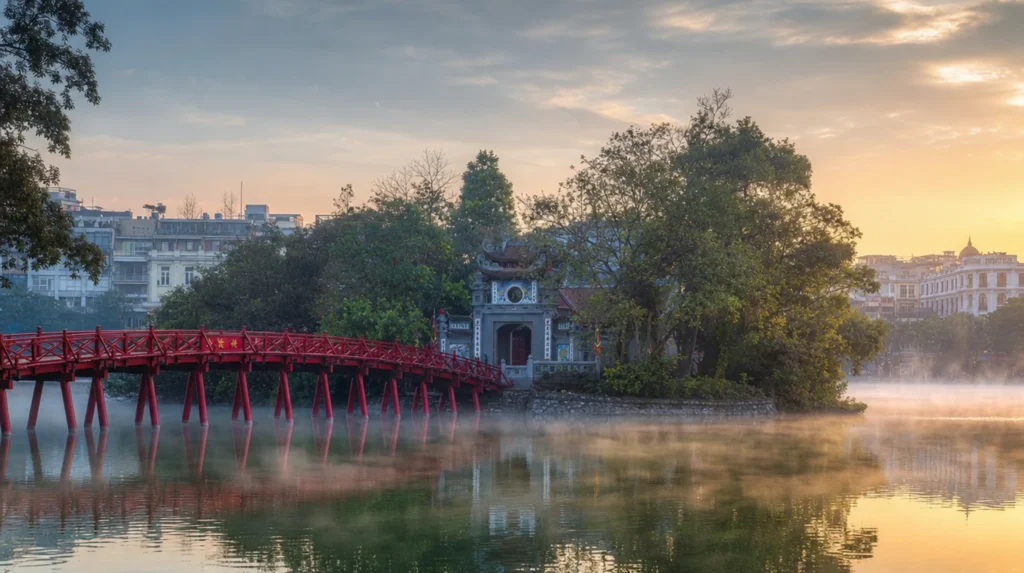
Vietnam · Old Quarter pho, Hoan Kiem dawn
Hanoi, Vietnam: Old-Quarter Capital, Phở Headquarters, French-Colonial Vietnam
Part of our Vietnam travel guide.
I have been coming to Hanoi for fifteen years and I still get lost on Hàng Gai every time I leave the hotel — the city’s thirty-six guild streets bend like a knotted river, and the only reliable rule is that you turn left where the cyclo drivers are eating phở. We tell first-time travellers that Hanoi is the half of Vietnam you cannot rush. My favourite ritual is a 6 a.m. lap of Hồ Hoàn Kiếm watching the tai-chi shift, a bowl of phở bò at Phở 10 Lý Quốc Sư, and a Vietnamese coffee at Café Giảng with the egg-yolk foam still warm. Treat this guide as the brief I would hand my own family before they boarded the Nội Bài airport bus at the international terminal.

Table of Contents
Why Hanoi?
Hanoi is Vietnam’s thousand-year-old capital — founded as Thăng Long (“Ascending Dragon”) in 1010 by the Lý dynasty, reset as Hanoi (Hà Nội, “between rivers”) in 1831 by the Nguyễn, run as French Indochina’s capital from 1902 to 1954, and re-established as the capital of unified Vietnam in 1976. The city’s metropolitan area holds about 8.4 million people across nine inner districts and twenty-three outer townships — second only to Ho Chi Minh City in scale, but ahead of every other ASEAN capital in continuous civic history. The result is a capital where French villas, Soviet apartment blocks, Lý-dynasty temples and twenty-first-century glass towers sit on the same block, and where the Old Quarter’s thirty-six guild streets still carry the trade names they held in the fifteenth century.
What makes Hanoi feel bigger than its skyline is the layered street life. The Old Quarter (Hoàn Kiếm District) is the postcard core — narrow tube houses, low-stool phở stalls, motorbike chaos and the lake at its centre. The French Quarter immediately south holds the Opera House, the Sofitel Metropole, the Hỏa Lò Prison museum and the wide tree-lined avenues that survive from 1900. West Lake (Hồ Tây) twenty minutes north is the expat-and-affluent zone with lakeside cafés and the Trấn Quốc Pagoda. Ba Đình District west of the lake is the political centre — Ho Chi Minh’s mausoleum, the One-Pillar Pagoda and the Imperial Citadel UNESCO site. Most travellers stay in the Old Quarter and walk; the streets are too narrow for taxis to be quicker than feet.
The city is also northern Vietnam’s transport hub. Nội Bài International Airport (HAN) is 35 km north-west, with the Express Bus 86 running to Hoàn Kiếm in 50 minutes for 35,000 VND. The Hanoi-Lao Cai overnight train reaches Sa Pa in eight hours; the Hanoi-Hue and Hanoi-Saigon Reunification Express trains depart Long Biên / Gia Lâm Station nightly. Hanoi is the natural starting point for a north-Vietnam loop: three days in the city, two in Halong Bay (or its quieter Lan Ha Bay sibling), two in Ninh Bình, and a sleeper train to Sa Pa. Vietnam’s e-visa system covers 80-plus nationalities for stays up to 90 days.
The other layer that elevates Hanoi above its peers is the calendar of festivals and the depth of the food culture. Tết (Lunar New Year), the country’s biggest holiday, falls February 17 in 2026; the Old Quarter clears out for a week and the kumquat-tree market on Hàng Lược is the city’s most photogenic moment of the year. The Mid-Autumn Festival in late September fills Hàng Mã with paper lanterns. National Day is September 2 (the date Hồ Chí Minh declared Vietnamese independence at Ba Đình Square in 1945). Plan around any of these and the cultural payoff doubles for the same flight cost.
Neighborhoods: Finding Your Hanoi
📍 Hanoi Map: Every Place in This Guide


The Old Quarter (Hoàn Kiếm District)
The thirty-six guild streets of the medieval merchant quarter — each named for the trade once practised on it (Hàng Bạc = silver, Hàng Gai = silk, Hàng Mã = paper, Hàng Đường = sugar). The streets still cluster by specialty in many cases. Centred on Hồ Hoàn Kiếm Lake (the Lake of the Restored Sword), with the iconic red Huc Bridge leading to the Ngọc Sơn Temple on its northern islet. The weekend night market on Hàng Đào runs Friday-to-Sunday evenings. No metro yet — walk or take Grab Bike.
- Hồ Hoàn Kiếm Lake (free, lit until 23:00, the city’s social spine)
- Ngọc Sơn Temple on Jade Island (admission 30,000 VND)
- Bia Hơi Junction (Tạ Hiện × Lương Ngọc Quyến) for fresh draft beer at 5,000–10,000 VND a glass
Best for: first-time visitors, Old Quarter atmosphere, walkable food culture. Access: Walk from any Hoàn Kiếm hotel; Grab Bike for outer reaches.
The French Quarter (Hoàn Kiếm District South)
The colonial-era boulevard district immediately south of Hồ Hoàn Kiếm — built between 1885 and 1954 as the administrative core of French Indochina. The 1911 Opera House (modelled on Paris’s Palais Garnier) anchors the district; the Sofitel Legend Metropole (1901) is the city’s grand colonial hotel. Wide pavements, intact yellow-stucco villas, and the country’s oldest tree-lined boulevards.
- Hanoi Opera House (Tràng Tiền) — guided morning tours 120,000 VND
- Sofitel Legend Metropole — Graham Greene’s haunt, the bunker tour is open to non-guests
- Hỏa Lò Prison Museum — the “Hanoi Hilton” of the American War (admission 30,000 VND)
Best for: colonial-architecture walks, mid-range to luxury hotels, expense-account dining. Access: Walk from Hoàn Kiếm Lake.
Ba Đình District (the Political Centre)
The wide-avenue district west of the Old Quarter that holds the political and ceremonial heart of the country. Ho Chi Minh’s Mausoleum on Ba Đình Square (where Hồ declared independence on 2 September 1945), the One-Pillar Pagoda (1049), the Presidential Palace gardens, and the UNESCO-listed Imperial Citadel of Thăng Long all sit within walking distance. The Vietnam Museum of Ethnology is fifteen minutes farther north-west.
- Ho Chi Minh Mausoleum (free; closed Mon, Fri; 07:30–10:30 only)
- Imperial Citadel of Thăng Long (admission 70,000 VND, UNESCO 2010)
- One-Pillar Pagoda (free, 1049 founding)
Best for: political history, museums, half-day walking circuits. Access: Grab car from Old Quarter, fifteen minutes.
West Lake (Hồ Tây / Tây Hồ District)
The largest lake in central Hanoi (about five-square-kilometre surface) and the city’s affluent-and-expat residential district. The lakeside Đặng Thai Mai and Quảng An roads hold the city’s third-wave coffee scene, the Sunday brunch culture, and most of the international hotel chains’ Hanoi properties. Trấn Quốc Pagoda — Hanoi’s oldest Buddhist temple, founded 541 — sits on a small islet on the south-east shore. The 17 km lake-shore loop is the city’s best running route.
- Trấn Quốc Pagoda (free, lakeside islet)
- Quán Thánh Temple (free, Daoist, 1010-era)
- Sunday brunch on Đặng Thai Mai (Maison de Tet Décor, Hanoi Cooking Centre)
Best for: brunch culture, expat-tier hotels, lakeside walks. Access: Grab car from Old Quarter, fifteen minutes.
Đống Đa & Ba Mẫu (the Local Districts)
The residential districts west and south of the Old Quarter where most Hanoians actually live. Tourist density drops to near-zero. The Temple of Literature (Văn Miếu) — Vietnam’s first national university, founded 1070 — sits on the western edge of Đống Đa and is the headline sight in the area. The Bảy Mẫu lake area holds the Ba Mẫu temple complex and a quieter local-park scene.
- Temple of Literature (admission 70,000 VND)
- Vietnam Military History Museum (admission 40,000 VND)
- Bảy Mẫu Lake — the local-life park
Best for: repeat visitors, half-day temple-museum sweeps, local-life walking. Access: Grab car twelve minutes from Old Quarter.
Long Biên / Gia Lâm (East Bank)
The east bank of the Red River, reached via the 1903 Eiffel-designed Long Biên Bridge or the newer Chương Dương / Vĩnh Tuy bridges. The east bank is the working-class fruit-and-flower market hub — Long Biên Market runs all night and the produce-seller cyclos returning at dawn are one of the city’s signature photographs. Bát Tràng, the eight-hundred-year-old pottery village, is fifteen kilometres south-east on the east bank — the most accessible craft-village day trip from Hanoi.
- Long Biên Bridge (free, walk or motorbike)
- Long Biên Wholesale Market (overnight, peak 02:00–05:00)
- Bát Tràng pottery village (15 km south-east)
Best for: photography, market walks, half-day craft-village trips. Access: Grab car or motorbike across the bridge.
Tay Ho (West Lake) Tip Note
Hanoi’s mid-2020s metro debut — Line 2A from Cát Linh to Hà Đông opened in late 2021 and Line 3 from Nhổn to Hà Nội Station is opening in phased segments through 2025–2026. Neither line yet reaches the Old Quarter directly, so for a tourist visit they remain a curiosity rather than a primary transport mode. Walking, Grab Bike and the public bus network are still the practical tools.
The Food

Phở & the Hanoi Noodle Lineage
Phở (pronounced roughly “fuh”) was born in Nam Định province south of Hanoi at the turn of the twentieth century and reached the capital with the early Nguyễn-dynasty migration. The Hanoi version is the canonical original — a clear long-simmered beef bone broth, flat rice noodles, thin slices of rare beef (phở bò tái) or well-done brisket (phở bò chín), spring onion, coriander stems and a single squeeze of lime; chilli on the side. The Saigon version, which most Western diners encounter first, adds bean sprouts, basil and a spicier sauce profile — historically a wartime adaptation. The headline phở addresses in Hanoi:
- Phở 10 Lý Quốc Sư (Lý Quốc Sư, Old Quarter) — the most-cited phở bò in the country (50,000–80,000 VND)
- Phở Gia Truyền (49 Bát Đàn) — the long-queued, cash-only phở bò chín shop in the Old Quarter (50,000 VND)
- Phở Thìn Lò Đúc (13 Lò Đúc) — the stir-fried beef variant; opened 1979 (60,000 VND)
Beyond Phở — the Hanoi Bench
Hanoi’s full bench of regional specialties is broader than the international phở reputation suggests. The everyday Hanoian meal rotation includes:
- Bún chả — grilled pork patties with cold rice noodles and herb plate, the lunchtime king. Bún Chả Hương Liên on Lê Văn Hưu is “the Obama bún chả shop” since President Obama and Anthony Bourdain ate there in 2016 (50,000–90,000 VND)
- Chả cá Lã Vọng — turmeric-marinated catfish stir-fried with dill at the table; a 150-year-old Hanoi specialty served at the eponymous restaurant on Chả Cá Street (~250,000–400,000 VND per person)
- Bún bò Nam Bộ — southern-style noodle salad with stir-fried beef, bean sprouts and crushed peanuts (Bún Bò Nam Bộ Bách Phương at 67 Hàng Điếu, 65,000 VND)
- Bánh mì — the Vietnamese baguette sandwich; Bánh Mì 25 on Hàng Cá and Bánh Mì P at the corner of Hàng Trống are the Old Quarter benchmarks (25,000–40,000 VND)
- Phở cuốn — phở-noodle wraps with grilled beef and herbs; the Trúc Bạch lakeside is the original neighborhood (15,000 VND per roll)
Egg Coffee & the Coffee Culture
Vietnamese coffee is the country’s third great export after rice and seafood; Vietnam is the world’s second-largest coffee producer after Brazil and the largest robusta producer globally. Hanoi’s signature is cà phê trứng (egg coffee) — invented at Café Giảng on Nguyễn Hữu Huân in 1946 as a wartime substitute when fresh milk was scarce. The recipe: dense Vietnamese drip coffee with a whipped egg-yolk-and-condensed-milk foam on top, served warm in a glass. The original Café Giảng still operates at 39 Nguyễn Hữu Huân (35,000 VND, cash only). Café Đinh on the second floor of 13 Đinh Tiên Hoàng (over Hồ Hoàn Kiếm) is the lake-view alternative.
- Café Giảng — the original 1946 egg-coffee shop (35,000 VND)
- Café Đinh — the second-floor lake-view egg-coffee café (40,000 VND)
- Reaching Out Tea House — fair-trade Vietnamese tea, employs deaf staff, on Hàng Bè (60,000–120,000 VND)
Food Experiences You Can’t Miss
- A 6 a.m. phở-bò breakfast at Phở Gia Truyền (49 Bát Đàn) before the queue forms
- A 5 p.m. fresh-draft-beer (bia hơi) glass on the Tạ Hiện × Lương Ngọc Quyến corner — the city’s most photographed cheap-beer junction
- An evening at Hà Nội Old Quarter Food Tour (~$25–35) — the small-group pho-cuon-bun-cha-egg-coffee circuit is the easiest way to taste seven dishes in three hours
- A Bún chả lunch at Bún Chả Hương Liên (the Obama set is a flat 85,000 VND including the spring rolls and the beer Bourdain drank)
Cultural Sights

Temple of Literature (Văn Miếu)
Vietnam’s first national university and the country’s most important Confucian temple — founded 1070 by King Lý Thánh Tông to honour Confucius and to train the imperial mandarin class. The complex unfolds across five courtyards in classic Confucian symmetry, with the Khuê Văn pavilion (the symbol on the 100,000-VND banknote) at the centre. The eighty-two doctorate stelae mounted on stone tortoises in the third courtyard list the names of every doctorate laureate from the 1442–1779 imperial examinations and were inscribed by UNESCO on the Memory of the World Register in 2010. Admission 70,000 VND. Open 08:00–17:00 daily. The complex is busiest with student-graduation visits on Saturdays — visit weekday mornings.
Hồ Hoàn Kiếm Lake & Ngọc Sơn Temple
The spiritual centre of Hanoi — a small lake (about twelve hectares) with the eighteenth-century Turtle Tower (Tháp Rùa) on a central islet and the red Huc Bridge crossing to the Ngọc Sơn Temple on Jade Island. The lake is named for the legendary fifteenth-century moment when Lê Lợi, who had used a magical sword to drive out the Ming, returned the sword to the lake’s golden tortoise. The lake-shore loop is car-free on weekends (Friday 19:00 to Sunday 23:00) and becomes the city’s largest public square. Ngọc Sơn Temple admission 30,000 VND.
Imperial Citadel of Thăng Long (UNESCO)
The seat of Vietnamese political power for nearly thirteen centuries — used continuously from the seventh-century Tang-dynasty fortress through the Lý (1010–1225), Trần, Lê, Mạc and Nguyễn dynasties, then by the French Indochina military command, and finally as the General Staff bunker of the People’s Army of Vietnam during the American War. Inscribed by UNESCO in 2010. Admission 70,000 VND. Open Tue–Sun 08:00–17:00 (closed Mon). The D67 Operations Bunker — where the Vietnam People’s Army planned the 1975 Hồ Chí Minh Campaign — is on the same site and is included in the ticket.
Ho Chi Minh Mausoleum & Complex (Ba Đình Square)
The marble mausoleum holding the embalmed body of Hồ Chí Minh, set on Ba Đình Square where Hồ proclaimed Vietnamese independence on 2 September 1945. Admission free. Open Tue–Thu and Sat–Sun 07:30–10:30 only; closed Mon and Fri; closed entirely September–October for annual maintenance. Strict dress code (covered shoulders, no shorts, no hats inside, hands out of pockets). Cameras and phones must be checked at the security desk. The Hồ Chí Minh Museum, the Presidential Palace gardens (where Hồ lived in a wooden stilt house rather than the colonial palace) and the One-Pillar Pagoda all sit within the same complex.
Hỏa Lò Prison Museum
The “Hanoi Hilton” of American-prisoner-of-war fame — but predominantly a museum of French-colonial torture of Vietnamese revolutionaries from 1896 to 1954. The American POW exhibit is one wing; the Vietnamese-revolutionary memorial is much larger and is the more historically significant section. Admission 50,000 VND. Open daily 08:00–17:00. The original prison covered most of what is now the Hilton Hanoi Opera site; only the eastern third was preserved as the museum.
Vietnam Museum of Ethnology
The country’s best museum of its fifty-four officially recognised ethnic groups — the indoor pavilions hold textiles, ritual objects and house-models, and the outdoor architectural park reconstructs full-scale traditional houses (Tay stilt house, Bana communal house, Cham temple). Located fifteen minutes north-west of the Old Quarter in Cầu Giấy District. Admission 40,000 VND. Open Tue–Sun 08:30–17:30 (closed Mon).
Vietnam Fine Arts Museum
The national art museum, in a 1937 Beaux-Arts villa that was originally the French Catholic École des Saintes Familles. Strong sections on Đông Sơn bronze drums (3rd century BC), Lý-Trần-Lê dynasty Buddhist sculpture, and twentieth-century lacquer painting (Vietnam’s national fine-art form). Admission 40,000 VND. Open daily 08:30–17:00. The English-language audio guide is included.
Thăng Long Water Puppet Theatre
The thousand-year-old north-Vietnamese tradition of water-stage puppetry — the puppets are operated below the water by puppeteers standing waist-deep behind a bamboo screen, accompanied by a traditional music ensemble (đàn bầu, đàn tranh, percussion). The show runs forty-five minutes with rotating folk-tale segments; the international tourist crowd makes the 18:30 and 20:00 shows the headline-show times. Tickets 100,000–200,000 VND depending on seat row.
Entertainment

Bia Hơi (Fresh Draft Beer)
Hanoi’s signature evening — fresh-draft beer (bia hơi) served unfiltered, unpasteurised and brewed for same-day consumption, sold from plastic stools on the Tạ Hiện × Lương Ngọc Quyến corner of the Old Quarter from about 17:00 to 23:00 nightly. A glass costs 5,000–10,000 VND (under fifty US cents); a plate of fried peanuts is 20,000 VND. The Bia Hà Nội brewery (state-owned, 1890 founding) is the heritage producer; smaller craft brewers like Pasteur Street Brewing (originally Saigon, expanded to Hanoi 2018) have a parallel modern scene. Cost 100,000–200,000 VND for an evening of beer-and-snacks per person.
Water Puppet Show (Múa Rối Nước)
The Thăng Long Water Puppet Theatre on Đinh Tiên Hoàng (north shore of Hồ Hoàn Kiếm) runs four to five shows daily — the 18:30 and 20:00 shows are the international-tourist headlines. Forty-five-minute performance, traditional live music ensemble, fifteen vignettes drawn from rural-northern folk tales. Tickets 100,000–200,000 VND. Book ahead in cool season — the popular evening shows sell out two to three days out. Lotus Water Puppet (a smaller theatre on Hàng Tre) is the alternative if Thăng Long is full.
Hanoi Opera House — Live Programme
The 1911 Hanoi Opera House (modelled on the Palais Garnier) runs the city’s classical music and ballet calendar, plus traditional Vietnamese opera (tuồng) and the contemporary “À Ố Show” — a bamboo-and-acrobatics theatre piece that runs Friday-and-Saturday evenings throughout the year. Tickets 600,000–1,500,000 VND for the headline shows. Daytime guided tours of the building (90 minutes, 400,000 VND) run twice weekly and are the only way to see the marble-and-gilt grand staircase and the rooftop terrace.
Train Street Cafés
The narrow rail line between Hanoi Station and Long Biên Bridge runs through a residential corridor where cafés have set tables inches from the working track. The trains pass at scheduled times (typically 15:30, 18:00 and 20:00); the cafés clear the tables for two minutes as the engine slides through, then reset. The Phùng Hưng segment (near Lê Duẩn) has been periodically closed by Hanoi Public Security for safety reasons; the Trần Phú segment further south has remained more reliably accessible. Vietnamese coffee 40,000–60,000 VND. Check current opening status with your hotel before the visit.
Tết Lunar New Year (February 17, 2026)
The country’s biggest holiday — the Lunar New Year, called Tết Nguyên Đán in Vietnamese (or simply Tết). Tết 2026 falls on February 17 (Year of the Horse). The Old Quarter empties for a week as Hanoians return to their family hometowns; many restaurants close for three to seven days; the kumquat-tree-and-peach-blossom market on Hàng Lược takes over the street for the ten days before New Year and is one of the city’s most photogenic moments of the year. Honest assessment: Tết is a bad time to visit Hanoi for sights and food (most everything is closed) and a great time to visit Hanoi for atmosphere (the empty streets are surreal). Hotel rates are flat or below normal during the Tết week itself but spike in the four to five days before.
Day Trips

Halong Bay (UNESCO, three hours by road)
The seven-hundred-and-thirty-square-kilometre limestone-karst archipelago of more than 1,600 islands and islets in the Gulf of Tonkin — UNESCO inscribed it in 1994 and again as a “natural wonder” in 2011. Most travellers do an overnight cruise (one or two nights on a traditional wooden junk) rather than a day trip — the day-trip option exists but skips the kayaking, the cave visits and the sunrise tai-chi-on-deck moments that make the bay famous. Two-day-one-night cruises run $130–280 per person; three-day-two-night $230–500. Book through Indochina Junk, Bhaya Cruises or Paradise Cruises (the three with the most consistent international reviews). The Halong Bay Express to Hanoi is now serviced by a fast new highway — three hours road transfer rather than the four-and-a-half it took before 2018.
Lan Ha Bay & Cát Bà Island (alternative to Halong)
Lan Ha Bay is the southern, less-touristed extension of Halong Bay, accessed via Cát Bà Island and the new Hải Phòng-Cát Bà cable car. The same karst-and-junk landscape with roughly half the tour-boat density. Three-hour transfer from Hanoi via the new Hải Phòng highway, then a fifteen-minute cable car. Two-night cruises $200–400. Recommended over the headline Halong Bay if you have visited South-East Asia before and value lower crowds.
Ninh Bình & the “Halong Bay on Land” (one-and-a-half hours by road or train)
The same limestone-karst geology as Halong Bay, but inland — emerald rice paddies between vertical karst peaks, traversed by traditional rowboat. The Tam Cốc–Bích Động river-cave route (two hours rowing the Ngô Đồng River through three river caves) and the Tràng An UNESCO complex (three hours rowing through nine caves) are the two competing routes; Tràng An is the larger and the more dramatic. Hoa Lư (the tenth-century capital of Vietnam under the Đinh and early Lê dynasties) and the Mua Cave (ten-minute climb to a karst-summit pagoda) round out the day. Day-trip vans from the Old Quarter run 600,000–900,000 VND including lunch.
Mai Châu Valley (three-and-a-half hours by road)
The Tay-and-White-Thai ethnic-minority valley in Hòa Bình province — wooden stilt houses, rice terraces, and a cooler hill-country climate (200 m elevation). The standard day or overnight trip pairs Mai Châu with the Mua Cave or Ninh Bình; the full-day trip is rushed and the overnight homestay (~$25 per person, dinner and breakfast included) is the better experience. Mai Châu Eco-Lodge and Mai Châu Hideaway are the two upmarket alternatives.
Sa Pa & the Northern Hill Country (overnight train)
Vietnam’s headline northern-hill-country destination, a former French hill station at 1,500 m altitude in Lào Cai province near the Chinese border. The eight-hour overnight Hanoi–Lào Cai train (around $30–60 per berth in soft-sleeper) is the iconic approach; the new highway makes a five-hour van transfer the alternative. Two-day-one-night Sa Pa packages from Hanoi run $80–150 including transport, homestay and a Hmong-village trek. The Mount Fansipan cable car (the highest peak in mainland South-East Asia, 3,143 m) is the sub-headline. Best in March–May (rice-terrace planting) and September–October (rice-terrace harvest, the postcard window).
Bát Tràng Pottery Village (forty-five minutes by bus or motorbike)
The eight-hundred-year-old pottery village fifteen kilometres south-east of Hanoi on the east bank of the Red River — the easiest craft-village half-day from the Old Quarter. Bus 47A from Long Biên station (8,000 VND, forty-five minutes) or a Grab car (~150,000 VND). The market-and-workshop streets behind the main entrance are where the genuine wares are made; the highway-front shops are tourist-tier. A pottery-throwing-and-painting class runs about 100,000–200,000 VND per person.
Seasonal Guide
Spring (March – May)
The first peak window — daytime highs of twenty-three to twenty-eight degrees Celsius, low humidity, occasional drizzle (mưa phùn) in March, dry by May. The rice-terrace-planting season in Sa Pa makes April–May the photographer’s window for any hill-country side-trip. Hanoi itself is at its most pleasant — the 26-degree daytime temperatures invite the long Old Quarter walks that the summer makes brutal. Hotel rates climb gradually through the spring; book three to four weeks ahead.
Summer (June – August)
The hardest weather — daytime highs reach thirty-four to thirty-eight degrees with humidity above eighty per cent, and the south-west monsoon delivers afternoon thunderstorms most days. Outdoor sightseeing is genuinely punishing without a midday break; most Hanoians retreat indoors between 12:00 and 15:00. The trade-off is the lowest hotel rates of the year — June is roughly thirty per cent below the October peak — and the rice-terrace planting in the hills if you head north.
Autumn (September – November)
The unambiguous best season — daytime highs of twenty-five to thirty degrees, low humidity, mostly clear skies, the colour palette at its sharpest. October and November are the cool-season peak; book six weeks ahead. The Mid-Autumn Festival (Tết Trung Thu) in late September fills the Hàng Mã street with paper lanterns. National Day on September 2 marks the date Hồ Chí Minh declared Vietnamese independence at Ba Đình Square in 1945 — the city stages a large parade and most government buildings are closed.
Winter (December – February)
Hanoi’s cool-and-grey season — daytime highs of fifteen to twenty degrees, occasional drizzle, low cloud, no actual frost. The temperature drops to ten to twelve degrees on the coldest January nights; hotel rooms genuinely need their heaters. Tết (Lunar New Year) falls February 17 in 2026 — the city empties for a week, restaurants close, but the kumquat-tree market on Hàng Lược is the most photogenic moment of the year. Hotel rates are the year’s lowest in late January and February (excluding the Tết week itself).
Air Quality & PM2.5
Hanoi’s worst air-quality window runs December through early March, when post-harvest agricultural burning combines with low-wind temperature inversions to push PM2.5 into “unhealthy” range (US AQI 150–250) on individual days. The IQAir AirVisual app and the Vietnam-government air4Vietnam network publish hourly readings. Travellers with asthma or respiratory conditions should pack KF94 or N95 masks for January–February travel; the autumn window has noticeably cleaner air.
Getting Around
Walking the Old Quarter
The Old Quarter is genuinely walkable — most streets are too narrow for taxis to be quicker than feet during daylight hours, and the thirty-six-guild-street layout is the headline experience. The pavement is unreliable (parked motorbikes occupy most of it), so expect to walk in the gutter as Hanoians do. Cross the road by stepping confidently into the motorbike flow at a steady pace — the bikes adjust around you. Attempting to wait for a gap will leave you stranded indefinitely.
Grab & the Ride-Hail Apps
Grab dominates ride-hail in Hanoi, with Be (Vietnamese-owned) as the local competitor and Bolt expanding from 2024. Grab Bike (xe ôm) is the local-favourite option — a motorbike taxi where you ride pillion behind the driver, helmet provided, GPS-tracked. A Grab Bike trip across the Old Quarter runs 15,000–25,000 VND (~one US dollar); a Grab car for the same distance runs 40,000–80,000 VND. Both apps accept credit cards.
Hanoi Metro (Limited Coverage in 2026)
Hanoi’s metro network is in early-stage construction. Line 2A (Cát Linh–Hà Đông), the first to open, has been running since November 2021 — twelve stations across thirteen kilometres connecting western suburbs to the Đống Đa edge of the Old Quarter. Line 3 (Nhổn–Hà Nội Station) is opening in phased segments through 2025 and 2026. Neither line yet reaches the Old Quarter directly. Fares 8,000–15,000 VND. For a tourist visit the metro remains a curiosity; walking, Grab Bike and the public bus network are the practical tools.
Public Bus (Xe Buýt)
Hanoi runs a comprehensive public bus network — over 130 routes covering the metropolitan area — and the system is genuinely useful for the airport transfer (Bus 86) and the Bát Tràng day trip (Bus 47A). Fare 7,000–9,000 VND per ride; pay the conductor in cash. Routes are mapped on Google Maps and on the BusMap mobile app. Avoid rush hour (07:30–08:30 and 17:00–18:30) when buses run standing-room-only.
Cyclos & Tourist Tuk-Tuks
The Old Quarter’s three-wheeled cyclos (xích lô) are now exclusively a tourist novelty rather than a real transport option. A circuit-of-the-Old-Quarter cyclo ride costs 100,000–200,000 VND for forty-five minutes; agree the price before boarding. Avoid the touts on Đinh Liệt who quote in dollars — the genuine drivers operate in dong only.
Airport Access
- Nội Bài International (HAN): Express Bus 86 from Hoàn Kiếm to the airport — fifty minutes, 35,000 VND, runs every fifteen minutes from 05:00 to 22:30. Grab car ~250,000–350,000 VND, forty-five minutes. The airport is 27 km north-west via the Nhật Tân Bridge.
Taxis
Mai Linh (green) and Taxi Group (white-and-red) are the two reliable metered companies. Flag-fall is 10,000–13,000 VND; the meter ticks up roughly 14,000 VND per kilometre. Always insist on the meter (“đi mét, anh oi” / “đi mét, chị ơi”). Avoid unmarked white taxis at the airport rank — they are the source of the city’s most-cited taxi-fraud complaints. Grab is genuinely cheaper and removes the meter-bypass problem.
Navigation Tips
Apps: Google Maps for walking and driving, Grab and Be for rides, BusMap for the bus network. Hanoi addresses use a “số nhà / phố” format (house number / street) — for example, “39 Nguyễn Hữu Huân” means number 39 on Nguyễn Hữu Huân Street. Many Old Quarter streets have inconsistent house-numbering, so cross-check with a landmark when arranging meetings. Vietnamese tonal marks matter for typing place names — Đặng Thai Mai is a different street from Đăng Thai Mai.
Budget Breakdown: Making Your Đồng Count
| Tier | Daily | Sleep | Eat | Transport | Activities | Extras |
|---|---|---|---|---|---|---|
| Budget | 600,000–1,100,000 VND ($25–45) | Hostel dorm 200,000–350,000 | Street food 30,000–80,000/meal | Walk + Grab Bike 100,000 | Temple 70,000 + free lake | Bia hơi 50,000 |
| Mid-Range | 1,700,000–3,200,000 VND ($70–130) | Boutique 1,200,000–2,400,000 | Sit-down 200,000–400,000/meal | Grab car 150,000/day | Water-puppet 200,000 + sights 200,000 | Cocktail 250,000 + spa 600,000 |
| Luxury | 6,000,000+ VND ($250+) | Sofitel Metropole 8,000,000+ | Tasting 2,500,000–4,500,000 | Private car 3,000,000/day | Spa + tour 3,000,000 | Halong overnight cruise 5,500,000 |
Where Your Money Goes
The Hanoi cost stack is even more bottom-heavy than Bangkok’s — sleeping and eating are extraordinarily cheap by global-capital standards, and the headline cultural sights (Temple of Literature 70,000 VND, Hồ Hoàn Kiếm free, Imperial Citadel 70,000 VND) are state-subsidised. The luxury tier diverges sharply: a Sofitel Legend Metropole heritage suite, a Le Beaulieu tasting menu and a Bamboo Bar nightcap can crack 10,000,000 VND in a single evening, but the same district holds 50,000-VND phở shops across the street. Vietnam’s standard VAT is ten per cent and is included in marked prices; tourist-priced restaurants add a five-to-ten per cent service charge on top, and most international hotel chains add an additional five-per-cent service plus the ten-per-cent VAT for a fifteen-to-eighteen-per-cent total surcharge.
Money-Saving Tips
- Eat at street-stall phở shops, bún chả lunchrooms and bánh mì carts — the prices are roughly one-tenth of mall sit-down restaurants and the food is the genuine reason to visit.
- Use Grab Bike rather than Grab car for short trips — the price is roughly one-third and the experience is genuinely Hanoian.
- Take the Express Bus 86 to and from Nội Bài Airport (35,000 VND) rather than a 250,000-VND Grab car — the journey time is similar and the bus is comfortable.
- Drink bia hơi rather than bottled craft beer if you want the cheap-cold-beer experience; the bottled-craft-beer scene is genuinely good but is bottled-beer-pricing.
- Do an overnight homestay in Mai Châu or Sa Pa for $20–30 rather than the $80–150 hotel — the experience is closer to the actual culture.
- Visit the Imperial Citadel and the Temple of Literature on the same morning — they sit four kilometres apart and both close at 17:00, so a two-sight morning sweep amortises the Grab fare.
Currency & Exchange
The Vietnamese đồng (₫, VND) trades around 24,500–25,500 to the US dollar through 2026 — current rates are published daily by the State Bank of Vietnam. Gold-shop money-changers on Hà Trung Street (“Money Changer Street”) consistently beat airport and bank rates by 100–300 VND per dollar; the Hà Trung shops accept clean, unfolded US notes only and the rate drops sharply for ten-and-twenty notes versus fifty-and-hundred notes. ATMs are reliable but charge a flat 30,000–50,000 VND foreign-card fee per withdrawal, so withdraw 3,000,000–5,000,000 VND at a time to amortise. The denomination jumps in Vietnamese đồng catch many travellers off guard — the 500,000 note (~$20 USD) and the 20,000 note (~$0.80) are similar sizes; double-check before paying.
Practical Tips
Language
Vietnamese is the official language. English is functional in mid-range-and-up hotels, the Old Quarter’s tourist-zone restaurants, the international-airline check-in desks, and most of the 25-and-under generation; it falls off quickly in residential neighborhoods and at street stalls. Vietnamese is a tonal language with six distinct tones — pronunciation differences that look minor in writing change the meaning entirely. Learn five phrases: xin chào (hello), cảm ơn (thanks), không cay (not spicy), bao nhiêu (how much), không dùng túi (no bag). Older Hanoians often speak French as a second language; English-French code-switching works in the French Quarter.
Cash vs. Cards
Hanoi is more cash-dependent than Bangkok — cards work at every hotel, mall, mid-range-up restaurant and chain café; cash is mandatory at street stalls, motorbike-taxis, traditional markets, temple admission counters, and most independent restaurants outside the Old Quarter. Carry 500,000–1,500,000 VND in cash for any given day. ATMs charge a 30,000–50,000 VND foreign-card fee per withdrawal. Visa and Mastercard work everywhere; Amex acceptance is mid-range hotels and up only. The 500,000-VND note is the largest in circulation; many shops will refuse it for small purchases.
Safety
Hanoi is statistically among the safer Asian capitals for tourists — violent crime is rare and the city’s overall risk profile sits below most Western European capitals. The real risks are scams (cyclo over-charging, “free” donuts that turn out to cost 200,000 VND, the gem-shop Grab driver routine) and traffic accidents. The U.S. State Department maintains Vietnam at travel advisory Level 1 (exercise normal precautions). Emergency numbers: 113 (police), 115 (ambulance), 114 (fire), Tourist Police at the Hoàn Kiếm District police station.
What to Wear
Temple dress code is enforced at the Temple of Literature, Trấn Quốc Pagoda, the Ho Chi Minh Mausoleum and One-Pillar Pagoda — covered shoulders, long pants/skirt below the knee, no see-through fabrics. The mausoleum is the strictest (no shorts, hat off inside, hands out of pockets, no photography). Outside temples, light cotton, sandals and a sun hat are the year-round defaults; pack a light fleece for the December-February cool season and a rain shell for the May-September monsoon. The standard Hanoian dress code is mid-conservative — no swimwear off the lake-shore, modest neckline at restaurants.
Cultural Etiquette
Three rules: (1) the head is the highest part of the body and the feet the lowest — never touch a Vietnamese person’s head, never point feet at a Buddha image or a person, especially elders. (2) The country’s revolutionary founders (Hồ Chí Minh, Võ Nguyên Giáp) and the Vietnam Communist Party retain near-sacred status; avoid joking about either, and never deface, sit on, or photograph in disrespectful poses with the national flag, party flag or Hồ portraits. (3) Remove shoes before entering a temple, a private home, and most traditional-house museums. The American War is called “the American War” or “the Resistance War Against America” in Vietnam, never “the Vietnam War” — that phrasing is both inaccurate and culturally weighted.
Connectivity
Vietnamese SIM cards are the cheapest in the region — Viettel Tourist SIM at the airport offers 20 GB for fifteen days at 200,000 VND; Mobifone and Vinaphone offer comparable packages. eSIM activations (Airalo, Holafly) work fine throughout urban Vietnam. Hotel Wi-Fi is universal and generally fast; Old Quarter café Wi-Fi is excellent and ubiquitous. 4G coverage outside Hanoi is good but drops in Sa Pa and on rural day trips.
Health & Medications
Hanoi’s private hospitals (Hanoi French Hospital / FV Hospital, Vinmec International, Family Medical Practice) operate to international standards and run English-speaking clinics. Tap water is not potable; bottled water is sold at every corner shop for 8,000–10,000 VND. Travel insurance is strongly advised — minor traffic incidents involving motorbike-taxis are the leading hospitalisation cause for foreign tourists, and treatment costs at private hospitals can run into the millions of dong without insurance. Pack motion-sickness tablets if you plan a Halong cruise (the bay can be choppy in winter), antihistamines for the late-summer mosquito spike, and a basic stomach-upset kit (Imodium plus rehydration salts) for the inevitable initial gastric adjustment.
Luggage & Storage
Nội Bài Airport has twenty-four-hour left-luggage at Terminal 2 (50,000–100,000 VND per piece per day). Hanoi Train Station offers a similar service for sleeper-train transfers. Most BTS-equivalent transit hubs do NOT have lockers; most mid-range Old Quarter hotels will hold luggage for free between checkout and an evening flight or train.
Tipping
Tipping is not strictly required in Vietnam but is increasingly expected at tourist-priced venues. Restaurants: round up to the nearest 10,000 VND at street stalls; leave the small change at sit-down restaurants if no service charge is included. Hotel porters: 20,000–50,000 VND per bag. Grab and motorbike-taxi drivers: round up to the nearest 5,000 VND. Spa therapists: 50,000–100,000 VND per hour of treatment. Tour guides on full-day trips: 100,000–300,000 VND per group is the convention.
Frequently Asked Questions
How many days do I need in Hanoi?
Three full days is the sweet spot for the city itself. Day 1: Old Quarter walk + Hồ Hoàn Kiếm sunset + water-puppet show. Day 2: Temple of Literature + Imperial Citadel + Hỏa Lò Prison + Bia Hơi corner. Day 3: West Lake + Trấn Quốc Pagoda + a Vietnamese Museum of Ethnology afternoon + egg coffee at Café Giảng. Two days is enough for the headline sights but feels rushed; three is the genuine minimum. Add one day for Ninh Bình or Bát Tràng, and a full overnight (or two) for Halong Bay if it is on your itinerary.
Is Hanoi good for solo travellers?
Yes — Vietnam consistently ranks among the world’s most solo-traveller-friendly destinations, and Hanoi’s Old Quarter is the easiest base in the country. The Old Quarter holds the highest density of English-speaking hostels and capsule hotels, the violent-crime rate is very low, and the hospitality culture does not stigmatise dining alone (low-stool phở shops are explicitly designed for solo eating). Female solo travellers report Hanoi as one of the easiest Asian capitals; stick to Grab Bike or Grab car after midnight rather than walking through quieter outer streets, and avoid the late-night bia hơi crowds on Tạ Hiện if you are uncomfortable with aggressive touts.
Is the Hanoi Tourist Card worth it?
Probably not for a typical short visit. The Hanoi Tourist Card (introduced 2023) bundles entry to about a dozen sights and unlimited bus transit for 24/48/72 hours — but several of the best sights (Hồ Hoàn Kiếm Lake, the Old Quarter walks, Bia Hơi corner) are free, and the paid sights are individually cheap (most under 100,000 VND). Buy individual tickets unless you are planning to visit five or more museums in 24 hours.
What about the language barrier?
It exists but rarely blocks travel in the Old Quarter. Hotel reception, mid-range-and-up restaurants, the Old Quarter food tours, and the international-airline desks all operate in English. Where it matters: addressing a Grab Bike driver (the app translates the address, so you do not need to speak it), ordering at street stalls (point at what the next-table customer is eating, or use the Google Translate camera-mode on Vietnamese menus), and any interaction with the Tourist Police at the Hoàn Kiếm District police station, who are explicitly English-speaking. Older Hanoians often speak French as a second language.
When are the busiest weeks?
October and early November (the cool-and-clear peak) and the four-to-five days before Tết (Lunar New Year, February 17 in 2026) are the two unambiguous peaks; hotel rates spike thirty to fifty per cent in October and book up four to six weeks ahead. The actual Tết week itself sees most restaurants close and the Old Quarter empty out — surreal atmospherically, but bad for sightseeing. National Day on September 2 brings a small surge. The June–August summer is the cheapest window with the lowest crowds, at the cost of significantly worse weather.
Can I use credit cards everywhere?
No — Hanoi is more cash-dependent than Bangkok. Cards (Visa, Mastercard) work at every hotel, mall, mid-range-and-up restaurant and chain café. Cash is mandatory at street stalls, motorbike taxis, traditional markets, temple admission counters, and most independent restaurants outside the Old Quarter. Plan to carry 500,000–1,500,000 VND in cash for any given day. ATMs charge 30,000–50,000 VND per foreign-card withdrawal, so withdraw in 3,000,000–5,000,000 VND chunks.
Tết 2026 — should I visit during the Lunar New Year or avoid it?
It depends. Tết 2026 falls February 17 and the city’s “Tết week” runs roughly February 14–22. Avoid if you want a normal sightseeing trip — most restaurants close, many sights run on holiday timetables, and the Old Quarter empties out as Hanoians return to family hometowns. Visit if you specifically want the cultural experience: the kumquat-tree-and-peach-blossom market on Hàng Lược in the ten days before Tết is the city’s most photogenic moment of the year, the empty post-Tết streets are surreal, and the family-temple visits across the city are genuinely moving. Hotel rates are flat or below normal during the Tết week itself but spike in the four-to-five days before.
Hanoi or Ho Chi Minh City for a first-time Vietnam trip?
Both, ideally. The classic two-city Vietnam starter is three nights in Hanoi plus three nights in Ho Chi Minh City — a two-hour Vietnam Airlines or VietJet flight links them for around $40–80. Hanoi is the older, more atmospheric, more food-driven half — Old Quarter, Tết, French-colonial heritage, and the gateway to Halong, Sa Pa and Ninh Bình. Ho Chi Minh City is the newer, faster, more business-driven half — the War Remnants Museum, the Cu Chi Tunnels, the Mekong Delta day trips, and the better international flight connections. If forced to pick one, Hanoi is the better single-week base for first-time North Asia / South-East Asia travellers because of the cultural depth and the day-trip range.
Is Halong Bay worth the overnight cruise, or is a day trip enough?
The overnight is genuinely the point. The day-trip option exists — three-and-a-half hours by road each way, four hours on the bay — but it skips the kayaking, the cave visits, and the sunrise tai-chi-on-deck moments that make Halong Bay famous. The two-night cruise is the higher-value option; the one-night cruise is the time-pressed compromise. Lan Ha Bay is the lower-tourist-density alternative with the same karst-and-junk landscape. Skip the day trip; go overnight or skip Halong altogether.
Ready to Experience Hanoi?
Three days, two phở breakfasts, one bia hơi evening on the Tạ Hiện corner and a sunrise lap of Hồ Hoàn Kiếm — that is the Hanoi rhythm. For the full country context, read the Vietnam Travel Guide; if you are looping south, see our Ho Chi Minh City Guide.
Explore More City Guides
Where to Stay
- Ho Chi Minh City Guide — Vietnam’s southern megacity, Saigon-era heritage and the Mekong Delta gateway
- Da Nang City Guide — central-coast beach city and the Marble Mountains base
- Hoi An City Guide — UNESCO-listed lantern-lit central-Vietnam riverside
- Bangkok City Guide — regional sibling capital across the Mekong sub-region
- Vietnam Country Guide
- All City Guides
Alex the Travel Guru
Alex has been writing destination guides for FFU since 2019, with nine Vietnam trips on the docket and a long-running Hanoi-as-base habit on the northern loop. The city is Alex’s favourite atmospheric capital in mainland South-East Asia — Old Quarter walks, phở-bò mornings, and a 6 p.m. fresh-draft beer on the Tạ Hiện corner are the unchanging anchors of every visit. For the full country context, read the Vietnam Travel Guide.
More city guides you might like
Plan your trip to Hanoi
The booking tools we use ourselves. FFU may earn a commission at no extra cost to you.
Plan & book your trip to Hanoi
Booking through these searches supports our guides at no extra cost to you.