
Bergen Travel Guide — Fjords, Fish Markets & Norway’s Most Beautiful Rainy City
I packed one umbrella for Bergen and used it exactly once, because after the third downpour in a single afternoon I stopped bothering and just bought a wool sweater like everyone else. Bergen gets roughly 200 rainy days a year, and instead of hiding that fact, the city has built its entire personality around it. This is Norway’s second city, wedged onto a peninsula between seven mountains and the mouth of the fjords, with a UNESCO-listed medieval wharf on one side of the harbor and a funicular hauling you above the clouds on the other. It is compact enough to walk across in an afternoon and scenic enough that you won’t want to. If you’re using Bergen as the gateway to the fjords — and most people should — give the city itself at least two full days before you get on a boat.
In This Guide
- Overview — Why Bergen Is Norway’s Most Lovable City
- Festival Season — Festspillene, Bergenfest & Nattjazz
- Best Time to Visit Bergen (Season by Season)
- Getting There — Flesland Airport & the Bergen Line
- Getting Around — Bybanen, Buses & Walking
- Neighborhoods — Bryggen, Nordnes & Beyond
- Culture & People
- A Food Lover’s Guide to Bergen
- Off the Beaten Path
- Day Trips — Fjords, Waterfalls & Villages
- Practical Information
- Budget Breakdown — What Bergen Actually Costs in 2026
- Frequently Asked Questions
Overview — Why Bergen Is Norway’s Most Lovable City
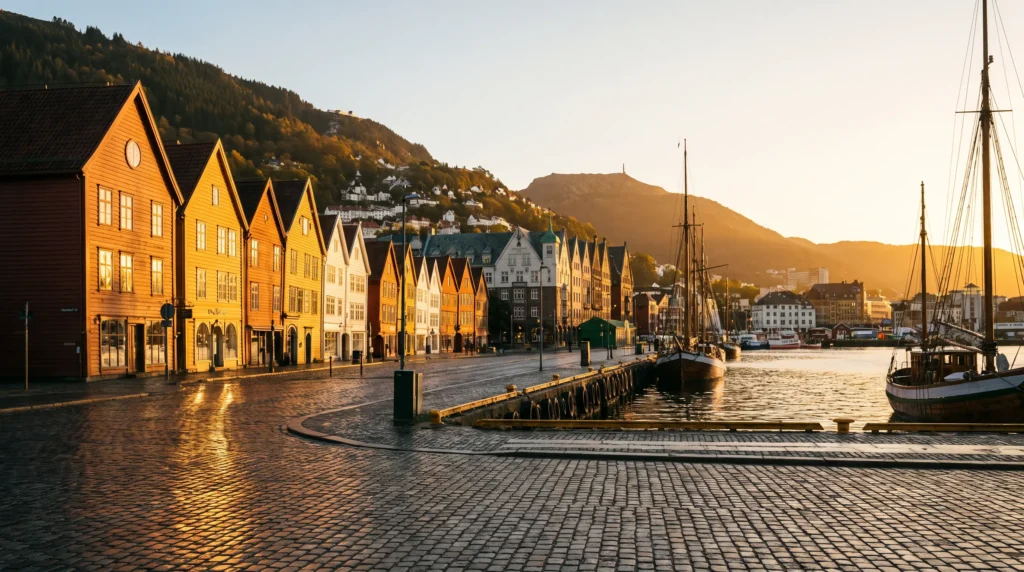
Bergen sits on the Bergenshalvøyen peninsula in Vestland county, on the western coast of Norway, ringed so tightly by mountains that locals call it the “city of seven mountains.” Founded, by tradition, around 1070 by King Olav Kyrre, it spent centuries as a Hanseatic League trading hub — German merchants ran the stockfish trade out of the wharf here from around 1350 until 1754, and the wooden warehouses they left behind are now the single most photographed thing in the city.
That wharf, Bryggen, became a UNESCO World Heritage Site in 1979, and it’s worth understanding what you’re actually looking at: after fires in 1702 and 1955 gutted the district, what stands today is a patchwork of rebuilt structures on medieval foundations, some resting on 15th-century stone cellars, all still following the original narrow-lot layout. It now holds shops, restaurants, and two excellent museums instead of dried cod, but the bones are real.
Beyond Bryggen, Bergen’s real draw is how easily it turns into wilderness. Ride the Fløibanen funicular for six minutes and you’re standing above the rooftops with a hiking trail at your feet; drive an hour and you’re at the mouth of a fjord. Norway isn’t cheap and Bergen isn’t sunny, but almost nowhere else packs Nordic city culture and fjord-country nature onto the same afternoon.
Festival Season — Bergen’s Busiest, Best Month
Time a late-May or early-June trip around Festspillene i Bergen (the Bergen International Festival), the city’s flagship arts event, running roughly two and a half weeks of classical music, opera, dance, and theater across venues from Grieg Hall to the medieval Håkonshallen fortress. It overlaps with the tail end of spring and the start of Bergen’s long, pale-lit summer evenings.
Come July and August, the baton passes to Bergenfest, a multi-day rock and pop festival, and Bergen Spillfestival, a gaming and interactive-media event that fills the same summer stretch with a younger, louder crowd. Between the two, Bergen runs something like 60-plus festivals and cultural events across the year, so checking the local calendar before you book is genuinely worth ten minutes — you may land in the middle of one without even planning it.
Best Time to Visit Bergen (Season by Season)
Late May – August · Peak season
Long daylight (June evenings barely darken), festival season in full swing, and your best statistical odds against the rain — though “best odds” in Bergen still means an umbrella in your day bag. This is also when fjord cruises, Norway in a Nutshell tours, and Bryggen’s museums run full daytime hours and full crowds. Book central hotels well ahead.
April – May & September · Shoulder season
Cooler, quieter, noticeably cheaper, and — locals will tell you — often just as scenic, with apple blossoms in the Hardanger orchards in spring and turning leaves on the Seven Mountains in autumn. Fewer cruise-ship days in the harbor too.
October – March · Winter
Short days, real cold, and a genuine coziness the Norwegians have a word for (koselig). Christmas markets take over Torgallmenningen in December, ice bathing (“isbading”) becomes a local ritual, and the Fløibanen still runs, just into an earlier sunset. This is also when Bergen sees its heaviest rain and occasional snow, so pack layers and waterproof boots rather than a stylish coat.
Getting There — Flesland Airport & the Bergen Line
Bergen Airport, Flesland (BGO), sits about 20 kilometers south of the city center, roughly a 30-minute drive, and is Norway’s second-busiest airport, with direct flights from London, Copenhagen, Amsterdam, Frankfurt, and Paris alongside a heavy domestic schedule to Oslo. From the terminal, the Bybanen light rail and the Flybussen airport coach both run into the city center in about 30–45 minutes; taxis and private transfers cover the same ground faster and pricier.
The overland alternative is one of the great train rides in Europe: the Bergen Line (Bergensbanen) crosses the mountain plateau from Oslo in around seven hours, cresting near 1,200 meters with genuinely dramatic high-altitude scenery — book a window seat and treat it as a destination in itself, not just a transfer. There’s no international rail or ferry link directly into Bergen; most visitors arrive by air or by connecting through Oslo.
Getting Around — Bybanen, Buses & Walking
Bergen’s center is small enough to walk end to end in well under an hour, and most first-timers barely need transit inside the Bryggen–Torgallmenningen–Nordnes triangle. For anything farther — the airport, Fantoft, the university district — Skyss runs the region’s buses and the Bybanen light rail, which is fast, modern, and easy to use with a contactless card or the Skyss app.
The Bergen Card, sold for 24, 48, or 72 hours, bundles free Bybanen and bus travel with free or discounted entry to Bryggen’s museums, Fløibanen, and other attractions — worth doing the math on if you’re museum-hopping. Hilly cobbled streets around Fjellsiden and Nordnes make for charming but occasionally strenuous walking; flat shoes over anything with a heel.
Neighborhoods — Bryggen, Nordnes & Beyond
Bryggen
The UNESCO wharf and the reason most people book the trip: a row of tilted, brightly painted wooden gables housing the Hanseatic Museum and Schøtstuene, the Bryggens Museum built over the archaeological dig, and a warren of narrow passages, galleries, and shops behind the street-facing facades. Come early morning or after the tour groups clear out for the golden-hour version of the postcard shot.
Sentrum & Torgallmenningen
The modern city center, anchored by the open pedestrian square of Torgallmenningen, department stores, and the main shopping streets. This is also where the Christmas markets and much of Festspillene’s street-level programming lands.
Fisketorget (the Fish Market)
Right on the harbor between Bryggen and Sentrum — stalls selling fresh and cooked seafood, king crab, whale meat (a local, controversial specialty worth knowing about before you order), and salmon sandwiches. It’s touristy and priced accordingly, but still the easiest first taste of Bergen’s seafood culture.
Nordnes
A quiet peninsula of narrow lanes and pastel wooden houses jutting out toward the harbor mouth, home to the Bergen Aquarium and Nordnes Sjøbad, an outdoor seawater pool. One of the best places in the city for an evening walk with a picnic and a view of ships heading out to the fjords.
Fjellsiden
The steep hillside neighborhood climbing toward Fløyen, all wooden houses and stepped lanes — genuinely residential, genuinely photogenic, and a good antidote to Bryggen’s crowds.
Skostredet
Bergen’s dining and nightlife street: a compact strip of cafés, cocktail bars, and restaurants that fills up on weekend evenings, a short walk from Sentrum.
Sandviken
A former shipping and industrial district north of Bryggen, now dotted with converted warehouses, cafés, and Bergenhus Fortress — the old citadel guarding the harbor entrance, still one of Bergen’s most-used public parks.
Culture & People
Bergensers speak their own dialect, Bergensk, distinct enough from standard Norwegian that other Norwegians notice it immediately — a mark of civic pride in a city that has always seen itself as culturally separate from, and a little more cosmopolitan than, Oslo. That self-image comes partly from Bergen’s Hanseatic past as an international trading port and partly from its outsized musical legacy: composer Edvard Grieg was born here and his home, Troldhaugen, is now a museum and concert venue just outside the city.
The city carries that musical identity into the present through Festspillene, Bergenfest, and Nattjazz, plus a lively student population from the University of Bergen that keeps Skostredet’s bars busy year-round. Norwegians generally are reserved with strangers at first and direct once you’re talking; small talk isn’t the default mode, and that’s normal, not unfriendly.
A Food Lover’s Guide to Bergen
Bergen’s signature dish is fiskesuppe, a creamy, mildly sweet fish soup built on a fond of white fish, cream, and root vegetables — every restaurant has a version, and the differences are worth arguing over. Also look for raspeball (grated-potato dumplings, usually served with salted meat and swede), and skillingsbolle, an oversized cinnamon bun that’s Bergen’s answer to the Swedish kanelbulle.
The Fish Market is the obvious seafood stop, but for a better ratio of quality to price, book a table at one of the harborfront restaurants along Bryggen or Bontelabo instead. Norway runs on strong coffee and open-faced sandwiches; brunost (brown, caramelized whey cheese) on waffles is a genuinely polarizing local staple worth trying once. Alcohol is expensive everywhere thanks to Norway’s high taxes and state-controlled Vinmonopolet liquor stores — budget for it or lean into the coffee culture instead.
Off the Beaten Path
Fantoft Stave Church
A striking wooden stave church on the city’s outskirts — the original 12th-century structure burned in 1992 and was rebuilt as a faithful replica, but it remains one of the most atmospheric stops in greater Bergen and draws only a fraction of Bryggen’s foot traffic.
Troldhaugen
Composer Edvard Grieg’s lakeside home and composing hut, a short bus or Bybanen ride south of the center, with regular chamber concerts in the adjoining recital hall for those who want Grieg’s music in the room where he wrote it.
Nordnes Sjøbad and the harbor mouth walk
Skip the crowded Bryggen waterfront in favor of the walking path around Nordnes peninsula’s tip — locals swim here even when the water is bracingly cold, and the view back toward the city and out to the islands is one of the best free things to do in Bergen.
Ulriken via cable car or on foot
Fløyen gets the tour buses; Ulriken, the tallest of the seven mountains, gets a cable car (Ulriksbanen) and a genuinely rugged hiking network with far fewer people on the trail once you’re fifteen minutes past the top station.
Day Trips — Fjords, Waterfalls & Villages
Bergen’s real advantage over Oslo as a fjord base is proximity. A three-hour fjord cruise up Mostraumen, part of the Osterfjord system, is the easiest half-day version of the fjord experience without a long drive. For the full “Norway in a Nutshell” style route, combine a train to Voss or Myrdal, the famously steep Flåm Railway down to the Aurlandsfjord arm of Sognefjord, and a fjord cruise back — doable as a very long day trip or a much more relaxed overnight.
Farther afield, the Hardangerfjord region is Norway’s orchard country each spring, and the launch point for hikes toward Trolltunga, the cliff-edge rock ledge that has become one of Norway’s most photographed (and most strenuous — plan a full day and good boots) hikes. The town of Voss, about an hour east by train, packs paragliding, whitewater rafting, and lake scenery into an easy rail day trip. None of these require a car; Bergen’s train and cruise operators run them as scheduled day tours from the city center.
Practical Information
Money. The Norwegian krone (NOK) floats freely against other currencies and has traded around 10 NOK to the US dollar through mid-2026, though it moves with oil prices and interest rates — check a live rate before you go. Norway is close to cashless; cards (and phone-tap payments) work almost everywhere, including small shops and public transit, so carrying much cash is rarely necessary.
Visa. US, UK, Canadian, Australian, and most Latin American and East Asian passport holders enter visa-free for stays up to 90 days in any 180-day period under the Schengen rules; from late 2026 an ETIAS travel authorization is expected to become mandatory for visa-exempt visitors, so check the current requirement before booking.
Safety. Norway carries the US State Department’s lowest advisory tier, “Exercise Normal Precautions,” with violent crime uncommon and petty theft the main concern in busy tourist spots. The UK FCDO gives similarly routine guidance, with its most recent update (May 2026) covering drone rules rather than any elevated risk. If you’re hiking Ulriken, Fløyen, or venturing toward Trolltunga, check weather and trail conditions first — mountain weather changes fast even when Bergen itself looks calm.
Health. No special vaccines are required for entry; the CDC recommends routine vaccines be current and suggests Hepatitis A for travelers eating widely and using strong tick protection (20%+ DEET) for anyone hiking or camping in rural areas. Tap water is excellent and safe to drink everywhere.
Connectivity & practicalities. An EU-roaming plan or local eSIM covers Bergen easily; free Wi-Fi is common in cafés and hotels. Plugs: European two-pin (Type C/F), 230V. Time zone: Central European Time (UTC+1), UTC+2 with daylight saving in summer.
Budget Breakdown — What Bergen Actually Costs in 2026
Norway is one of the more expensive countries in Europe to visit, and Bergen is no exception — budget accordingly, especially for food and alcohol.
Budget (US$90–150/day): Hostel dorm or budget guesthouse, grocery-store or bakery meals supplemented with one restaurant meal, Bergen Card or single transit tickets, free hikes on Fløyen or Ulriken instead of the cable cars.
Mid-range (US$200–350/day): Central hotel, a mix of café and sit-down restaurant meals, Fløibanen and Ulriksbanen round trips, one fjord cruise (roughly US$60–120 for a half-day tour), museum entries at Bryggen.
Luxury (US$500+/day): Harborview hotel, tasting-menu dinners, a private fjord charter or a Flåm Railway–anchored “Norway in a Nutshell” day, front-row Festspillene tickets in season.
Fixed costs to expect: Norway’s 25% VAT is baked into displayed prices, alcohol carries steep additional taxes, and most museums and cable cars charge separately unless you buy a Bergen Card. Tipping isn’t obligatory — service is included by law — though rounding up or leaving 5–10% for excellent service is appreciated.
Planning Your First Trip to Bergen
The classic first-timer split is city + fjord: land at Flesland, spend two nights in Bergen covering Bryggen, the Fish Market, and Fløyen, then head out for one or two nights combining a fjord cruise with the Flåm Railway before looping back for a flight home or a train on to Oslo. Four nights covers the essentials without rushing; a week lets you add Hardangerfjord or Voss. Pair it with our Copenhagen guide or Stockholm guide for a wider Scandinavian loop, or continue west across the North Sea to our Edinburgh guide — Bergen and Scotland share more fishing and maritime history than most itineraries give them credit for.
Frequently Asked Questions
Is Bergen expensive?
Yes — Norway is consistently one of Europe’s priciest countries, and Bergen’s restaurant and alcohol prices reflect that. Groceries, free hikes, and the Bergen Card for transit and museums are the main ways to soften the cost.
Do I need a visa?
US, UK, Canadian, and Australian passport holders (among many others) can enter visa-free for up to 90 days in any 180-day period under Schengen rules; from late 2026 travelers should expect to need an ETIAS authorization in advance, so check the current requirement close to your travel date.
How many days do I need in Bergen?
Two full days covers the city itself — Bryggen, the Fish Market, Fløyen, and a wander through Nordnes — comfortably. Add at least one more day (ideally two) if you want a fjord cruise or the Flåm Railway without feeling rushed.
Will it rain the whole time?
Probably some of it — Bergen sees rain roughly 200 days a year, more than almost any other European city. Pack a real rain shell rather than an umbrella (the wind makes umbrellas useless half the time) and plan indoor museum time as a rainy-day backup rather than an afterthought.
Bergen or Oslo?
Choose Bergen for fjord access, UNESCO history, and mountain scenery inside the city limits; choose Oslo for a bigger capital-city mix of museums, design, and nightlife. Many itineraries do both, connected by the scenic Bergen Line train.
Is the fish market worth it?
Worth a visit for the atmosphere and a quick bite, but it’s priced for tourists — treat it as an appetizer or a photo stop, and eat your main seafood meal at one of the sit-down restaurants along the harbor instead.
Ready to Explore Bergen?
Seven mountains, one UNESCO wharf, a funicular that puts a hiking trail six minutes from the harbor, and fjords close enough to visit before dinner — Bergen packs an outsized amount of Norway into a city you can walk across. Bring a proper rain shell, book the fjord cruise a day ahead in summer, and go.
Explore More
- Copenhagen City Guide — Scandinavia’s design capital, a short flight away
- Stockholm City Guide — the Nordic archipelago city
- Reykjavik City Guide — more North Atlantic landscapes and geothermal drama
- Edinburgh City Guide — a fellow harbor-and-hills city across the North Sea
How this guide was built
Published as part of Facts From Upstairs’ city guide series. Built from authoritative sources — Wikipedia’s entity pages for Bergen, Bryggen, Bergen Airport Flesland, the Norwegian krone, and the Fløibanen funicular; VisitBergen.com, the official destination tourism site; visitnorway.com’s official visa guidance; the US State Department and UK FCDO Norway travel advisories; the US CDC traveler page for Norway; and Trading Economics for current krone exchange-rate context. Numeric claims carry inline citations.
Sources cited on this page
- Wikipedia — Bergen
- Wikipedia — Bryggen
- Wikipedia — Bergen Airport, Flesland
- Wikipedia — Norwegian krone
- Wikipedia — Fløibanen
- VisitBergen — official Bergen tourism site
- Visit Norway — visa requirements
- US State Department — Norway
- UK FCDO — Norway
- US CDC — Norway traveler page
- Trading Economics — Norwegian krone
More city guides you might like
Plan your trip to Bergen
The booking tools we use ourselves. FFU may earn a commission at no extra cost to you.
Plan & book your trip to Bergen
Booking through these searches supports our guides at no extra cost to you.