
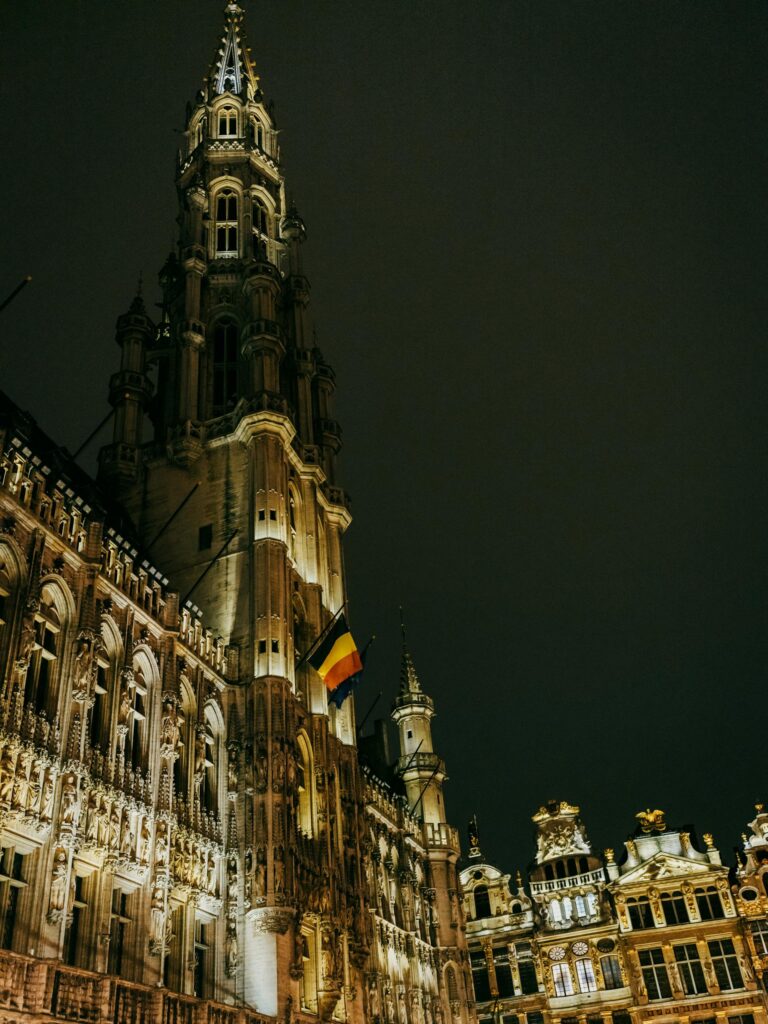
Brussels, Belgium: The EU’s Working Capital, Comic-Book City & Best Beer List in Europe
Part of our Belgium travel guide.
I have arrived in Brussels by Eurostar, by Thalys, by overnight from Amsterdam, and by a Ryanair turn from Stansted — and the first sensation is always the same low-key surprise: a city the size of Glasgow that quietly runs the European Union from one quarter and bakes the world’s best chocolates in another. We tell first-time travellers that Brussels is not Paris’ little brother — it’s a working bilingual capital with the gilded Grand Place at its heart, an Art Nouveau-rich south-west, an EU institutional quarter to its east, and a comic-strip mural trail you can walk in an afternoon. My favourite hour is sundown at Mont des Arts looking down across the gilded façades. Treat this guide as the brief I would hand my own family before they cleared customs at Brussels-Midi.

Table of Contents
Why Brussels?
Brussels is the capital of Belgium and the working capital of the European Union — the de-facto seat of the European Commission, the European Council, and (one of three) seats of the European Parliament. The Brussels-Capital Region holds about 1.25 million people across 19 officially bilingual communes, with French as the everyday street language and Dutch (Flemish) on equal legal footing.
The city’s pitch is the unusual combination: a gilded UNESCO core (the 1695 Grand Place is one of Europe’s great squares ), an Art Nouveau quarter where Victor Horta invented the style in 1893, the densest comic-mural trail in Europe, and beer halls pouring 1,500-plus distinct Belgian beers. All of it walkable in two days, and all of it cheaper than Paris by 25–35%.
Practically, Brussels is the best base for the Flemish triangle: Bruges is 60 minutes by train, Ghent is 35 minutes, Antwerp is 45 minutes, and Liège is 80 minutes. Eurostar reaches London in 1h55, Thalys hits Paris in 1h22 and Amsterdam in 1h50. Plan two to three days here as your Belgium anchor; the Flemish day-trips multiply quickly.
Neighborhoods: Finding Your Brussels
📍 Brussels Map: Every Place in This Guide


Îlot Sacré (Grand Place)
The medieval pedestrianised core radiating from the Grand Place — gilded baroque guildhalls, the 96m Hôtel de Ville spire, and the 1847 Galeries Royales Saint-Hubert glass-roof arcade leading north to Sainte-Catherine. Tourist-restaurant central along Rue des Bouchers; ignore the touts and head two blocks west.
- Grand Place — UNESCO Heritage square since 1998, the rebuilt-1695 baroque guildhalls
- Hôtel de Ville — the 1402 Brabantine Gothic city hall, 96m spire, guided tours by appointment
- Maison du Roi (Brussels City Museum) — on the Grand Place, the Manneken Pis costume archive lives here
- Galeries Royales Saint-Hubert — 1847 glass arcade by Cluysenaer, the Neuhaus chocolate flagship at the south end
- Manneken Pis — 1619 fountain statue, three blocks south-west of Grand Place; the ‘dressed up’ rota changes weekly
Best for: first-day orientation, photography, the Christmas market in December. Access: Metro Gare Centrale (Lines 1, 5) or Bourse premetro (Lines 3, 4).
Sainte-Catherine & Dansaert
Two blocks north-west of Grand Place — the former fish-port basin (now a piazza), the city’s best seafood restaurants around place Sainte-Catherine, and the design-and-fashion stretch of rue Antoine Dansaert. The locals’ quarter for an evening drink, with the canal and the trendy Quai aux Briques behind.
- Place Sainte-Catherine — the former fish dock, now a square with the Eglise Sainte-Catherine and weekly Christmas market
- Mer du Nord (Noordzee) — the legendary stand-up fish bar at place Sainte-Catherine, lunch institution since 1969
- Rue Antoine Dansaert — the boutique-fashion street of the Antwerp Six diaspora
- Canal Bruxelles-Charleroi — protected cycle path, weekend brunches at Mima museum
Best for: first-time base, seafood dinners, fashion shopping. Access: Metro Sainte-Catherine (Line 1).
Mont des Arts & Sablon
The cultural high ground east of Grand Place — the Mont des Arts garden with Brussels’ best skyline view, the Royal Museums of Fine Arts, the Magritte Museum, and the BOZAR concert hall. Continue south to Sablon for antiques, chocolate (Pierre Marcolini and Wittamer) and the 15th-century Notre-Dame du Sablon church.
- Royal Museums of Fine Arts — the Old Masters and Bruegel collection, the Magritte Museum is a separate ticket
- Magritte Museum — the world’s largest Magritte holdings (200+ works)
- BOZAR — 1929 Victor Horta concert hall, the Centre for Fine Arts
- Place du Grand Sablon — antique market Sat & Sun; chocolate boutiques (Marcolini, Wittamer, Neuhaus)
- Notre-Dame du Sablon — 15th-century Brabantine Gothic church
Best for: museums, antiques, chocolate hunting. Access: Metro Gare Centrale (Lines 1, 5) or tram 92.
Marolles (Working-Class & Comic Trail)
The traditional working-class district south of Sablon — the Marolles flea market on place du Jeu de Balle (daily 6am–2pm, the city’s oldest), the rue Haute and rue Blaes antique strip, and the heart of the comic-mural trail. The Tintin and Quick & Flupke murals start here.
- Marché aux Puces du Jeu de Balle — daily flea market since 1873, 7am earliest
- Rue Blaes & Rue Haute — antique-shop strip running south to Porte de Hal
- Tintin mural at rue de l’Étuve 19 — Hergé’s schoolboy detective and Captain Haddock
- Belgian Comic Strip Center — in a 1906 Horta building, Tintin/Smurfs/Asterix archives
Best for: antique-hunting, comic murals, weekend brunch. Access: Metro Porte de Hal (Lines 2, 6) or tram 92.
European Quarter (Schuman, Léopold)
The EU institutional district east of the centre — the European Commission’s Berlaymont, the European Parliament hemicycle, the Council building, and the ring of supranational buildings around Schuman. The 1880 Cinquantenaire park anchors the south side with its triumphal arch and the Royal Museums of Art and History.
- European Parliament Hemicycle — free 60-minute self-guided audio tour, weekdays plus Mon mornings
- Parlamentarium — free EU-history visitor centre, the most engaging EU museum
- House of European History — in Léopold Park, free, deep dive into 20th-century Europe
- Cinquantenaire — 1880 Belgian-independence triumphal arch and park, Royal Museums on each wing
Best for: a half-day EU-institutions visit. Access: Metro Schuman (Lines 1, 5) or Maelbeek.
Saint-Gilles & Ixelles (Art Nouveau)
The southern leafy communes — Saint-Gilles is the Art Nouveau showcase (Horta, Hankar, Strauven), Ixelles is the café-and-park district with the Étangs d’Ixelles ponds and the African Matonge quarter. Together the boho/foodie heart of the city.
- Horta Museum — Victor Horta’s 1898 home and studio in Saint-Gilles, the Art Nouveau pilgrimage
- Maison Saint-Cyr (square Ambiorix) — the wildest Art Nouveau facade in the city, by Strauven 1903
- Étangs d’Ixelles — the two duck-pond squares, a Sunday-walking institution
- Matonge (chaussée d’Ixelles) — the Congolese-Belgian quarter, music-bar and Africa-food cluster
Best for: Art Nouveau pilgrimage, slower second day, weekend brunch. Access: Metro Porte de Namur (Lines 2, 6) or tram 81/97.
The Food

The Brussels Anchors
Moules frites (mussels with frites), carbonnade flamande (beer-and-beef stew), waterzooi (poultry-or-fish creamy broth), stoemp (mashed potato with vegetables), and the city’s frites stalls (best frites are double-fried in beef tallow). Lunch is the easy meal — a moules-frites bistro lunch lands at €22–30.
- Mer du Nord / Noordzee (Sainte-Catherine) — the stand-up seafood bar institution since 1969, fish soup & calamari at €7–14
- Aux Armes de Bruxelles (Îlot Sacré) — the 1921 brasserie that does the textbook moules-frites
- Maison Antoine (Place Jourdan) — the city’s most-loved frites stand, 30 sauces, lunch only
- La Roue d’Or (off rue des Bouchers) — old-school carbonnade and waterzooi, no-tourist-trap zone
Belgian Beer
Belgium has 1,500-plus distinct beers and Brussels has the bars to pour them. Lambic and gueuze (the spontaneously fermented Senne-valley sours) are the city’s native style; Trappist Westvleteren, Rochefort and Chimay are widely poured.
- Delirium Café (Impasse de la Fidélité) — the Guinness-record 2,500-beer-list bar, three floors, tourist but excellent
- À la Mort Subite (rue Montagne aux Herbes) — the 1928 Art Deco gueuze hall, a literary haunt
- Moeder Lambic (Saint-Gilles & Fontainas) — 40+ taps, the lambic and craft showcase
- Cantillon Brewery (Anderlecht) — the family-run lambic brewery, free-with-tasting tour
Chocolate (the Sablon Strip)
- Pierre Marcolini (Place du Grand Sablon) — the bean-to-bar pioneer
- Wittamer (Place du Grand Sablon) — royal warrant since 1910
- Neuhaus (Galeries Royales Saint-Hubert) — invented the praline in 1912
- Mary — royal warrant, the truffle specialist
Waffles & Snacks
- Maison Dandoy (rue au Beurre) — the 1829 waffle and speculoos bakery
- Chez Vincent (rue des Dominicains) — old-school no-tourist trap waffle and steak
Cultural Sights
Atomium & Mini-Europe
The 102-metre 1958 World’s Fair landmark in Heysel — nine stainless-steel-clad spheres connected by tubes, modelled on an iron crystal magnified 165 billion times. Adult ticket €16, viewing platform plus exhibition spheres. Combine with Mini-Europe (350 scale models of European landmarks) next door.
Magritte & Royal Museums
The Royal Museums of Fine Arts (Old Masters wing) hold the country’s greatest Bruegel collection — the ‘Fall of the Rebel Angels’, ‘Winter Landscape’, and ‘Census at Bethlehem’. The adjacent Magritte Museum is the largest holding of his work in the world (200+ paintings).
Comic-Mural Trail
Brussels has 60+ commissioned comic murals across the city centre, each 4–15 metres high. Pick up the free Comic Strip Route map from Visit Brussels at Grand Place or download the BD Bruxelles app. Highlights: Tintin (rue de l’Étuve), Asterix (rue de la Buanderie), Lucky Luke (rue de la Buanderie), Quick & Flupke (rue Notre-Dame du Sommeil).
Cantillon Brewery (Anderlecht)
The last working family-run lambic brewery inside Brussels city limits, brewing in the same Anderlecht buildings since 1900. Free-with-tasting self-guided tour, Mon–Sat, €10 entry includes 2 lambic tastings.
Entertainment
Brussels nightlife clusters in three zones: place Saint-Géry and Sainte-Catherine for the inner-ring bars, Saint-Gilles and Ixelles for the late-night cocktail scene, and the European Quarter for the after-work expat circuit. The city is quieter than Amsterdam or Berlin but the bar selection is unmatched.
Live Music & Theatre
- BOZAR — Horta’s 1929 concert hall, Belgian National Orchestra resident
- Ancienne Belgique (AB) — the legendary indie-rock venue on boulevard Anspach
- La Monnaie — the royal opera house, where the 1830 revolution started during a performance of La Muette de Portici
- Brussels Jazz Marathon — free city-wide festival, last weekend of May
Bars & Late Drinks
- Le Coq (Saint-Géry) — the legendary tiny corner bar, no menu, the question is ‘blonde or brune?’
- Goupil le Fol (Marolles) — surreal-decor fruit-wine bar, the most photographed bar in Brussels
- Brasserie Surréaliste — modern craft brewery taproom in Forest
Day Trips
Bruges (60 min train)
The medieval canal city of Bruges is the easiest day-trip — SNCB direct trains run every 30 minutes, €15 single in 2026 (verify on site). The Markt belfry, the Begijnhof, the Groeningemuseum’s Van Eyck and Memling primitives, and a canal boat are doable in a long day.
Ghent (35 min train)
Ghent is closer than Bruges and arguably more lived-in — the 12th-century Gravensteen castle, the Van Eyck brothers’ 1432 ‘Adoration of the Mystic Lamb’ in Saint-Bavo’s Cathedral, and the Korenmarkt waterfront. The university student energy keeps the bars open later than Bruges.
Antwerp (45 min train)
Antwerp is the Flemish style capital — Rubenshuis, the world’s most beautiful train station (Antwerpen-Centraal), the MAS museum, and the Zuid art-and-bar district. Combine with the diamond quarter for an afternoon.
Waterloo Battlefield (30 min)
The Mémorial 1815 visitor centre at Braine-l’Alleud sits at the heart of the 1815 Wellington-vs-Napoleon battlefield — the 226-step Lion’s Mound mound for the panoramic view, plus 4D film and historical recreation.
Leuven & Mechelen
University-town Leuven (25 min train, the Stella Artois brewery and the Catholic University) and the smaller Mechelen (20 min train, six UNESCO belfries on the Brabant skyline) make easy half-day adds.
Seasonal Guide
Brussels has a temperate maritime climate — cool wet winters, mild summers, frequent light rain year-round. The best months are May, June and September; the worst is rainy November.
Spring (Mar–May)
Daytime highs 10–19°C, magnolia and cherry blossoms in Cinquantenaire and the royal greenhouses (Serres Royales de Laeken) open three weeks in late April. May is the photographer’s month.
Summer (Jun–Aug)
Daytime highs 21–25°C; long evenings, terraces packed. EU institutions empty in August (the ‘Brussels-empties’ window) but tourist Brussels stays busy. Brussels Summer Festival in mid-August is the city’s biggest free music event.
Autumn (Sep–Nov)
Daytime highs 12–19°C, golden Sonian Forest weekends, the Brussels Comic Strip Festival in early September. November is rainy and grey — the only month to genuinely avoid.
Winter (Dec–Feb)
Daytime highs 4–7°C, occasional snow flurries. Plaisirs d’Hiver Christmas market (late Nov to early Jan) covers Sainte-Catherine, place de la Bourse and rue Marché aux Herbes — Belgium’s biggest. The lambic-and-gueuze bar season is at its peak.
Getting Around
STIB-MIVB runs the Metro, tram and bus network. Four Metro lines (1, 2, 5, 6), 17 tram lines and 50+ buses; flat fare €2.60 in 2026 for a one-hour pass on any combination. The MOBIB contactless card (€5 deposit) is the right purchase; foreign Visa/Mastercard contactless also tap directly at gates as of 2024.
From Brussels Airport (BRU) & Charleroi (CRL)
- Brussels Airport Express train — €13 single from BRU to Brussels-Centraal, every 15 minutes
- Brussels Airport line 12 bus — €7 from BRU to Schuman/Luxembourg, useful for European Quarter hotels
- Charleroi (Ryanair hub) — the Flibco shuttle bus is €19 to Brussels-Midi, 60 minutes
Trains, Trams & Eurostar
Brussels-Midi (Bruxelles-Zuid) is the main international station — Eurostar to London (1h55), Thalys to Paris (1h22) and Amsterdam (1h50), ICE to Cologne (1h50). SNCB regional trains link Bruges, Ghent, Antwerp and Leuven from all three Brussels stations (Centraal, Midi, Nord). Villo! city bikes have 360+ docks; the city is reasonably flat north of Sablon.
Budget Breakdown
Brussels is roughly 25–35% cheaper than Paris and Amsterdam at the mid-range, broadly on par with Madrid. The city’s bargains are food and beer; hotels charge a Paris premium during EU Council weeks.
Daily Budgets (per person)
- Hostel / shoestring: EUR €75–110 (dorm bed, frites & beer, Metro, one museum)
- Mid-range: EUR €160–240 (3-star Sainte-Catherine hotel, moules-frites bistro, Magritte ticket, Atomium)
- Luxury: EUR €380+ (5-star near Grand Place, Comme Chez Soi tasting, Cantillon private brewery tour)
Sample Costs (2026)
- Metro/tram/bus 1-hour pass: €2.60
- Coffee in a café: €3.00–4.50
- Belgian frites cone: €4.50–6.00
- Moules-frites lunch: €22–30 per person
- Strong Belgian beer at a bar: €5–9 (75cl bottle of Trappist: €15)
- Magritte Museum adult ticket: €13 (combined with Royal Museums €18)
- Atomium adult ticket: €16
Practical Tips
Languages: French, Dutch & English
Brussels is officially bilingual French–Dutch and English is near-universal in tourism. French is the everyday street language; train and metro signs are bilingual (French/Dutch); some communes (Anderlecht, Schaerbeek) lean French, others (Sint-Pieters-Woluwe, Sint-Jans-Molenbeek) more Dutch. A ‘merci’ or ‘dank u’ works fine.
Money & Tipping
Currency is the euro. Service is included by Belgian law (‘service compris’); rounding up or 5–10% for table service is the local norm, not 18–20% American style. Card payment is universal — Bancontact (the local card network) accepts all Visa and Mastercard chip-and-PIN.
Safety
Brussels is statistically safer than Paris or Rome but pickpockets work the Metro Lines 2 and 6 and the area around Brussels-Midi station. Avoid the immediate streets around Brussels-Midi at night; the centre, Sablon, Saint-Gilles, Ixelles and the European Quarter are walkable any hour.
SIM & Connectivity
Proximus, Orange and BASE all sell prepaid SIMs at Brussels Airport (Travel SIM €15 for 10 GB). EU roaming for any EU SIM works at no extra cost. Free public wifi at Brussels Airport, Brussels-Midi and most cafés.
Frequently Asked Questions
How many days do I need in Brussels?
Two to three days — one for Grand Place + Sainte-Catherine + Mont des Arts, one for Atomium + comic murals + a museum, and one for either Bruges or Ghent as a day-trip.
Is Brussels worth visiting if I’m doing Bruges?
Yes — the cities have nothing in common. Bruges is preserved medieval; Brussels is gilded baroque core, working European capital, Art Nouveau, and the comic-strip and beer cultures. The two together are the Belgium first-timer’s minimum.
Is Brussels safe for solo travellers?
Yes, with normal big-city precautions. Avoid the immediate streets around Brussels-Midi station at night; the centre, Sablon, Saint-Gilles and Ixelles are walkable at any hour.
Do I need to speak French?
No — Brussels is officially bilingual French/Dutch but English is universal in tourism, hotels and restaurants. A ‘merci’ or ‘dank u’ goes a long way.
Can I drink the tap water?
Yes city-wide. Brussels tap water is sourced from the Bois de la Cambre filter station and meets EU drinking-water standards everywhere.
What about the Brussels Card?
Worth it for 2–3 day trips. The 24h Brussels Card is €38 (free entry to 49 museums plus public transit add-on for €9 extra). Pays back if you visit three or more museums.
Eurostar from London — do I need to clear customs in Brussels?
UK passport control happens at London St Pancras before boarding (juxtaposed-controls). On arrival in Brussels-Midi you walk straight off the platform — no further checks for non-EU passports of visa-exempt nationalities.
Map
More city guides you might like
Plan your trip to Brussels
The booking tools we use ourselves. FFU may earn a commission at no extra cost to you.
Plan & book your trip to Brussels
Booking through these searches supports our guides at no extra cost to you.