
☰ On this page
- 📋 In This Guide
- Overview — Why Stockholm Belongs on Every Bucket List
- 🌷 Late-April / Early-May 2026 — Why You’re Right in the Window
- Best Time to Visit Stockholm (Season by Season)
- Getting There — Flights & Arrival
- Getting Around — Tunnelbana, Ferries, Walking & Cycling
- Top Islands & Districts
- 🗓️ Sample Itineraries
- Swedish Culture & Etiquette
- A Food Lover’s Guide to Stockholm
- 📸 Photography Notes
- Off the Beaten Path — Stockholm Beyond the City Centre
- Practical Information
- Budget Breakdown — What Stockholm Actually Costs
- ✅ Pre-Trip Checklist
- 🤔 What Surprises First-Timers
- Frequently Asked Questions
- Ready to Explore Stockholm?
- Explore More
Stockholm, Sweden — Archipelago Capital, Nobel Heritage & 14 Islands of Swedish Design
Part of our Sweden travel guide.
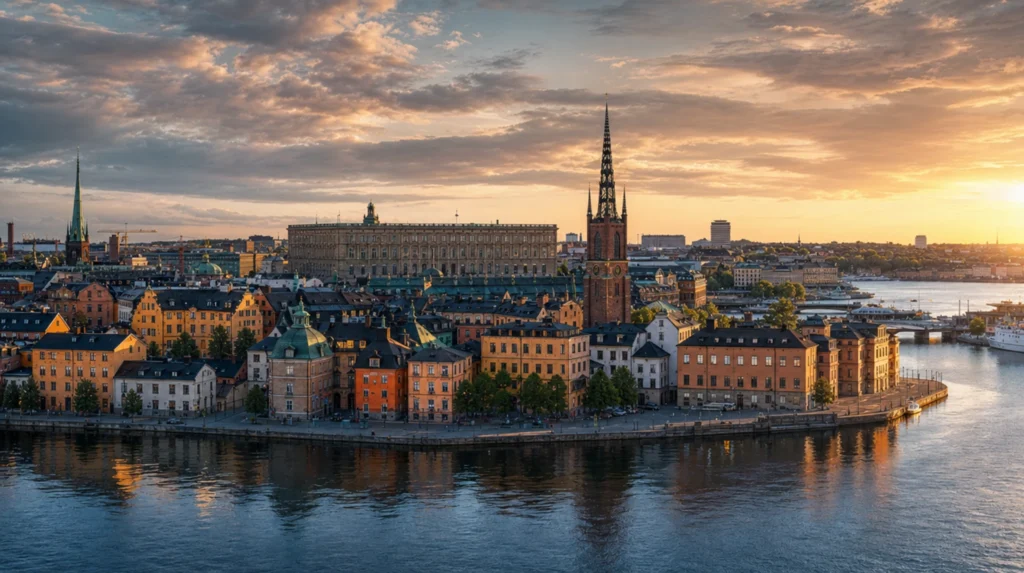
Stockholm is the only European capital built across an archipelago — fourteen islands stitched together by 57 bridges, where the Baltic Sea meets Lake Mälaren in a freshwater-saltwater handshake that produces some of the cleanest urban water in the world. You can swim from the steps of City Hall in July (the same building where Nobel laureates collect their medals each December), watch a public-transit ferry crossing where Vikings rowed in the 8th century, and eat a Michelin lunch in a 13th-century cellar five minutes’ walk from a Royal Palace where the king answers his own front door. The city is small by capital standards (978,000 in the inner city, 2.4 million in the metropolitan region) but spread across a dramatic geography that makes every walking commute feel like a postcard. Sweden’s largest city sits at 59.3°N — roughly the same latitude as southern Alaska — but the Gulf Stream and a defensive-minded medieval town plan have made it warmer, denser and more liveable than its coordinates suggest.
What makes Stockholm different is the relationship to water. You don’t sightsee around the lakes and bays — you sightsee across them, by ferry, by kayak, by inter-island commuter boat, and increasingly by SL public-transit catamaran (the city’s metro card is also a ferry pass on routes 80, 82 and 89). Stockholm’s archipelago beyond the city extends 60 kilometres east into the Baltic — 30,000 islands, islets and skerries, the largest archipelago in Sweden — and you can be on any of them for the price of a metro card. The compression is the point: a city that operates as part-Nordic-capital, part-island-summer-cottage, with a calendar that swings between the 18-hour daylight of midsummer and the 6-hour twilight of December. Locals call this “lagom” — the famously untranslatable concept of “just right” — and it shapes everything from queue etiquette to architecture.
This guide covers Stockholm island by island — from medieval Gamla Stan to the design-district islands of Södermalm and Östermalm, plus the green-island and archipelago day-trips that complete the city’s geography. If you’re pairing Stockholm with the rest of the country, see our Sweden travel guide for Gothenburg, the Lapland and Kiruna. The natural Nordic city pairings are our Copenhagen city guide (3 hours by direct train, the Hanseatic-Lutheran cousin) and our Reykjavik city guide (the Atlantic outlier, 3-hour direct flight on SAS or Icelandair).
📋 In This Guide
- Overview — Why Stockholm Belongs on Every Bucket List
- 🌷 Late-April / Early-May 2026 — Why You’re Right in the Window
- Best Time to Visit Stockholm (Season by Season)
- Getting There — Flights & Arrival
- Getting Around — Tunnelbana, Ferries, Walking & Cycling
- Top Islands & Districts
- 🗓️ Sample Itineraries — 2, 4, 6 and 8 Days
- Swedish Culture & Etiquette
- A Food Lover’s Guide to Stockholm
- 📸 Photography Notes
- Off the Beaten Path — Stockholm Beyond the City Centre
- Practical Information
- Budget Breakdown — What Stockholm Actually Costs
- ✅ Pre-Trip Checklist
- 🤔 What Surprises First-Timers
- Frequently Asked Questions
- Ready to Explore Stockholm?
Overview — Why Stockholm Belongs on Every Bucket List
Stockholm sits at the precise meeting point of saltwater and freshwater — the Baltic Sea pushes west into the city, Lake Mälaren pushes east, and the two meet at a series of locks beneath Gamla Stan. The city was founded in 1252 by Birger Jarl as a defensive port (the medieval Swedish word “stock” means a wooden palisade, “holm” means islet — literally “the palisade island”), and stayed a regional Hanseatic outpost of 6,000 people until Gustav Vasa’s 1523 nationalist consolidation made it the Swedish capital. The city’s transformation from medieval port to industrial-modern capital happened twice — first in the 1880s with the railroad and electrification, then again in the 1950s and 60s when the social-democratic state carved an entire new commercial centre out of the old Klara district.
The modern city is a study in contradictions handled with characteristic Swedish understatement. It has the highest startup density per capita of any city outside Silicon Valley (Spotify, Klarna, Skype, Mojang/Minecraft, King/Candy Crush all came out of greater Stockholm), the cleanest urban water of any major European capital (the city’s swimmable in 11 designated central locations), and a public transit ferry system woven into the metro pass. The Tunnelbana metro stations are themselves a cultural attraction — frequently called “the world’s longest art gallery,” with 90 of the 100 stations decorated by 150+ commissioned artists between 1957 and the present. The economy runs on knowledge work and design exports: IKEA, H&M, Acne Studios, Filippa K, Spotify, Klarna and the Stockholm Design Lab all use the city as a creative base, and the Stockholm Design Week each February pulls 60,000 industry visitors.
For a traveller, Stockholm is the most walkable Nordic capital and the most architecturally complete — the Old Town survived two world wars intact, the 19th-century Östermalm neighbourhoods remain a textbook of Swedish-Hanseatic apartment design, and the social-democratic mid-century housing of Hammarby Sjöstad and Skarpnäck remains one of the world’s better experiments in beautiful affordable housing. Show up with a metro card, comfortable shoes, and patience for the locals’ famously polite queueing — the rest is a 14-island archipelago waiting to be walked.
🏛️ Historical Context
The Riksdag — the Swedish parliament — has met continuously since 1435, making it one of the world’s oldest still-functioning national legislatures, second only to Iceland’s Alþingi (930) and the Tynwald in the Isle of Man (979). The current Riksdag building on Helgeandsholmen island was completed in 1905 and reconstructed after a 1971 reform that abolished the upper chamber. Sweden has not been at war since 1814 — the longest period of continuous peace in Europe — and the country joined NATO only in 2024 after Russia’s invasion of Ukraine ended a 200-year tradition of armed neutrality. The Royal Palace next door, Kungliga Slottet, has been the official residence since 1697 (when the medieval Tre Kronor castle burned) and remains the largest functional royal palace in Europe — 600 rooms, none of which the king actually sleeps in (the family lives at Drottningholm 11 km west, also UNESCO listed).
🎌 Did You Know?
Stockholm has the deepest concentration of Nobel Prize history of any city — Alfred Nobel was born in Stockholm in 1833 and the Nobel Foundation has been headquartered here since 1900. The Nobel Prize ceremonies (excluding the Peace Prize, which is awarded in Oslo) take place every December 10 at the Stockholm Concert Hall, followed by a 1,300-person banquet in Stockholm City Hall’s Blue Hall. The city also produced one Nobel laureate per ~145,000 residents over the 20th century — the highest per-capita rate of any major capital outside Switzerland. The Nobel Prize Museum on Stortorget in Gamla Stan (SEK 140 admission) keeps the cultural lineage continuously visible.
🌷 Late-April / Early-May 2026 — Why You’re Right in the Window
Late April through mid-May is the most underrated three-week window in the Stockholm calendar — the city’s spring arrives compressed and dramatic. Daytime highs climb from 9°C in early April to 16°C by late May, the daylight curve climbs from 14 hours toward 17 hours by mid-May, and the city’s tree canopy goes from skeletal to luminescent green in roughly 10 days at the end of April. Cherry trees in Kungsträdgården park (the gift of Tokyo to Stockholm in 1998) bloom for one week between April 20 and May 5 every year, drawing the entire city in for hanami picnics on the lawn. The April 30 Walpurgis Night (“Valborg”) sees public bonfires across the city — Riddarholmen island is the central Stockholm gathering, but every neighbourhood has its own.
This is also the window when the Stockholm archipelago ferries restart full schedules. Waxholmsbolaget, the regional ferry operator, gradually expands its outer-archipelago routes through April and runs full summer schedules to Sandhamn, Vaxholm, Möja, and Grinda by May 1. The April-May archipelago has the islands genuinely empty — outer islands like Möja and Finnhamn see perhaps 50 day-visitors per day, vs. 1,500+ at peak July. Restaurant patios reopen across the city in the second half of April, the late-evening sky stays luminous past 9 p.m. by the end of the month, and Sweden’s national parks and reserves lift their seasonal access restrictions on May 1.
One important caveat for spring 2026: Sweden’s NATO membership and the Baltic security context have changed the rhythm of the city’s May 1 (International Workers’ Day) demonstrations and June 6 National Day events; both remain peaceful but heavily policed. Entry requirements for non-EU travellers also begin shifting in late 2026 with the EU’s ETIAS authorisation (€7 online application) coming into enforcement — UK, US, Canadian, Australian, NZ visitors will need to register before flying. Check travel-europe.europa.eu the week before booking.
⚠️ Important — Daylight & Mosquito Season Onset
Stockholm’s daylight in late April to mid-May is genuinely useful (sunrise around 5:00 a.m., sunset around 8:50 p.m. by April 30, climbing to 9:30 p.m. by mid-May), but the city is not yet in midnight-sun territory — a sleep mask is helpful but not essential until June. Mosquitoes return to the archipelago from mid-May onward; the mainland city centre stays mostly mosquito-free thanks to brackish-water dilution, but anyone heading to the outer islands (Möja, Sandhamn, Finnhamn) should pack a DEET-based repellent from May 15 onward. Tick activity also begins in May; if you’re hiking on the islands or in the mainland forests, conduct tick checks daily — Borrelia rates in central Sweden are among Europe’s higher.
Best Time to Visit Stockholm (Season by Season)
Stockholm has four genuine seasons compressed into a high-latitude calendar. The Gulf Stream keeps the city warmer than its 59.3°N latitude suggests; January average is -2°C, warmer than Moscow at the same latitude. But the daylight swing is enormous — 18 hours on June 21 vs. 6 hours on December 21 — and the city’s character shifts radically with the light.
Spring (April – May)
The shoulder window described above. Daytime highs climb from 9°C in early April to 16°C by late May, the city’s tree canopy and daylight both extend rapidly, and crowds remain 40% lower than July. Hotel prices are 30% below July peak. The cherry blossoms in Kungsträdgården, the Walpurgis bonfires on April 30, and the May 1 Workers’ Day are the cultural highlights. Restaurant patios reopen in mid-April, and the city’s running-and-cycling culture restarts in earnest. This is the best time to visit if you want Stockholm at its most photogenic with manageable crowds.
Summer (June – August)
The high season and the only time the Swedish summer myth genuinely earns the hype. June 21 brings Midsummer (Midsommar) — the country’s most important non-religious holiday — with maypole-dancing and herring-feasting at every island summer cottage. Stockholm is briefly half-empty as locals decamp to country cottages; the city itself stays hot and bright, with daytime highs of 22–24°C and 18-19 hours of useable daylight. The archipelago ferries run their full summer schedules; outdoor concerts at Skansen and Hagaparken, midnight music festivals on Skeppsholmen, and the Way Out West and Stockholm Pride festivals fill the calendar. The trade-off is crowding at the headline sites — Vasa Museum, ABBA Museum, Skansen — and prices roughly 40% above shoulder season. Book hotels two months ahead.
Autumn (September – October)
The other golden window. By the autumnal equinox the daylight is still 12+ hours, the city’s tree canopy goes through a 10-day red-yellow flush in early October, and the Stockholm cultural season — opera, theatre, jazz festival, dance festival — restarts in full force. Daytime highs drop from 17°C in early September to 8°C by late October. Crowds drop sharply after the August 25 weekend; hotel prices fall 30%. Stockholm Jazz Festival in late September is the cultural anchor; the Royal Dramatic Theatre’s main season opens; and the archipelago ferries continue partial schedules until mid-October. This is the shoulder season for foodies — restaurant reservations open up, and the autumn game and mushroom seasons hit Swedish menus.
Winter (November – March)
Six hours of daylight in late December, ice on the harbour by mid-January in cold years, and a Christmas market season that runs from late November through early January. The Skansen Christmas market (the country’s oldest, since 1903) and the Old Town’s Stortorget market are the headline events. Daytime highs sit at -1 to 3°C; overnight lows drop to -5 to -10°C and occasionally below. Stockholm rarely has guaranteed snow cover (the Baltic moderates the climate) — December 2024 was largely brown — but a five-day cold snap can transform the city into a textbook winter scene. The cultural calendar peaks at Nobel Prize Day (December 10) and the December 13 Lucia Day (white-robed processions in every church and concert hall). Winter is also the cheapest season; hotel rates dip 35% off summer peak. Pack proper layers; a Stockholm wind chill at -8°C and 6 m/s requires merino wool, not autumn cotton.
🧳 Travel Guru Tip
If you have one week and want Stockholm at its most distinctively Swedish with the smallest crowds, aim for the second or third week of June, just before Midsummer. The daylight is at maximum (18+ hours), the archipelago ferries are running full schedules, restaurant patios are open, the locals haven’t yet decamped to country cottages, and prices are 15-20% below the late-July peak. The window between June 8 and June 18 is the shoulder before Midsummer that international guides routinely undervalue.
| Experience | Best months | Best islands/districts | Notes |
|---|---|---|---|
| Archipelago day-trips | May – Sep (peak Jun – Aug) | Sandhamn, Vaxholm, Möja, Finnhamn | Waxholmsbolaget ferries; SL pass on inner routes |
| Cherry blossoms (Kungsträdgården) | Apr 20 – May 5 | Kungsträdgården park | One-week window; weather-dependent |
| Midsummer (Midsommar) | Late June (Friday closest to 21st) | Skansen, Drottningholm, archipelago | Most restaurants closed; locals at cottages |
| Christmas markets | Late Nov – early Jan | Skansen, Stortorget (Gamla Stan) | Skansen is country’s oldest, since 1903 |
| Nobel Day | December 10 | Stockholm Concert Hall, City Hall | Public can watch ceremony arrival |
| Stockholm Pride | Late July / early Aug | Östermalm, Södermalm, Pride Park | Largest LGBTQ event in Nordics |
Getting There — Flights & Arrival
Stockholm has one international airport that matters: Arlanda (ARN), 40 km north of the city. It handles roughly 25 million passengers a year as the largest airport in Sweden and a major SAS hub for transatlantic and Asia-Europe routes. A second airport, Bromma (BMA), 8 km from downtown, handles small domestic and a handful of regional flights but is being phased out by 2038. Skavsta (NYO), 100 km southwest, is the budget-airline backup (Ryanair, some Wizz Air); ignore for non-budget itineraries.
From North America, direct flights run year-round from New York (Newark, 7h45m, SAS and United), seasonally from Boston (7h with SAS), Chicago (8h with SAS), and Los Angeles (10h45m with SAS, summer only). From Europe, expect 2h30m from London Heathrow, 2h30m from Paris CDG, 1h45m from Frankfurt, 1h15m from Copenhagen and 3h30m from Madrid. From Asia, Beijing and Tokyo run 9-11 hour direct flights with Air China and ANA. Round-trip fares from London or New York in shoulder season typically land between £180–280 / $480–720 if booked 6–10 weeks ahead.
Arlanda arrival is fast and modern. Passport control runs Schengen and non-Schengen lanes; from gate to ground transport is rarely more than 30 minutes. Three options into Stockholm: the Arlanda Express train runs every 15 minutes, SEK 320 one-way to Stockholm Central (18 minutes); the Flygbussarna airport coach is SEK 159 one-way (45 minutes, drops at Cityterminalen next to Stockholm Central); the SL commuter train (Pendeltåg) is SEK 153 with the Arlanda passage fee included (38 minutes, slightly slower but adds value if you have a multi-day SL pass). Taxi is SEK 650–795 fixed-fare from the airport to downtown — agree the price at the rank, never get into a non-fixed-fare taxi.
✨ Pro Tip
If you’re arriving with luggage and not in a rush, the SL commuter train (Pendeltåg) is the smart-budget option — SEK 153 vs. SEK 320 for the Arlanda Express, only 20 minutes slower, and the SL pass you’ll buy anyway covers the rest of the trip. Just be aware that Arlanda’s Pendeltåg station charges a SEK 130 “Arlanda passage fee” on top of the SL transit pass — that’s already included in the SEK 153 quoted above. The Express is faster and cleaner; Pendeltåg is cheaper and the practical local choice.
Getting Around — Tunnelbana, Ferries, Walking & Cycling
Stockholm is the most walkable major Nordic capital. The downtown islands of Gamla Stan, Norrmalm, Östermalm, Riddarholmen and parts of Södermalm connect on foot in 25-minute strolls across the city’s 57 bridges. The Royal Palace to the Vasa Museum on Djurgården is a 25-minute walk; Hötorget central station to the south side of Södermalm is 20 minutes. Stockholm is also one of the world’s flattest major capitals — the highest natural point of central Stockholm is 53 metres on Södermalm.
The Tunnelbana metro is the workhorse for distances over 25 blocks and the secondary cultural attraction. Three lines (red, green, blue) cover the city in radials from T-Centralen, fares are SEK 39 per ride or SEK 175 for a 24-hour pass paid by SL Access card or credit card tap (since 2023, contactless cards work directly at the gates). Trains run every 4–8 minutes from 5 a.m. to midnight on weekdays, with night service on weekend nights. The metro stations themselves are decorated in commissioned art — T-Centralen (blue line, organic-feel cave murals by Per-Olof Ultvedt, 1975), Solna Centrum (red, Karl Marx-and-fjord murals by Anders Åberg, 1975), Stadion (red, blue-and-white rainbow grotto by Enno Hallek, 1973), and Tekniska Högskolan (red, geological-cross-section themed) are the most-photographed stops. The free SL-curated walking tour of the metro art runs daily 11 a.m. and 2 p.m. from T-Centralen platforms in summer.
Public-transit ferries are the rare urban surprise. SL routes 80 (Nybroplan to Gröna Lund), 82 (Nybroplan to Lidingö), and 89 (Nybroplan to Frihamnen) accept the same SL pass and treat Stockholm’s bays as bus routes. Route 80 is the standard tourist usage — it stops at Skeppsholmen, Djurgården (for Vasa, Skansen, ABBA Museum) and Allmänna Gränd. The cycle-hire system Citybikes is excellent for the central districts (SEK 175/3 days), and Stockholm has 760 km of dedicated cycle paths.
⚠️ Important — Cashless Sweden & SL Card Setup
Sweden is effectively cashless — under 1% of transactions are cash and many shops, restaurants, and museums no longer accept cash at all (signs say “Vi tar inte kontanter” / “We don’t take cash”). Plan accordingly — every Visa/Mastercard tap works seamlessly, but cash exchange is largely useless for daily spending. The exception is some open-air markets and a handful of older taxis. Buy your SL Access card at any station ticket machine (SEK 50 deposit) or use the SL app (free, top up by card). The SL app’s QR-code ticket option works on phones without a physical card. Single-ride tap-to-pay at metro gates is convenient but slightly more expensive than the 24-hour pass at SEK 175.
Top Islands & Districts
📍 Stockholm Map: Every Place in This Guide
Stockholm’s 14 islands divide into roughly seven distinct districts for travellers. Below are the bases worth building an itinerary around, ordered roughly from the medieval centre outward.
🏰 Gamla Stan — The 13th-Century Old Town
The medieval island core where Stockholm was founded in 1252. Gamla Stan (“Old Town”) covers a single narrow island — Stadsholmen — between Norrmalm and Södermalm, and preserves the city’s only fully medieval streetscape. The skyline is dominated by Storkyrkan (the Stockholm Cathedral, completed 1306, where Swedish kings have been crowned since the 14th century) and the Royal Palace (Kungliga Slottet, 600 rooms, built 1697-1754 after the medieval Tre Kronor castle burned). Tour Storkyrkan for the wooden Sankt Göran och draken (Saint George and the Dragon) sculpture commissioned by regent Sten Sture the Elder in 1489.
The island’s main commercial street, Västerlånggatan, runs north-south and is dense with souvenir shops in summer; locals avoid it. The far better backstreet experience is along Prästgatan, Kindstugatan and Köpmangatan — narrow medieval lanes with original cobblestones, gables and the country’s oldest pub (Den Gyldene Freden, opened 1722, owned by the Swedish Academy that awards the Nobel Prize in Literature). The Nobel Prize Museum on Stortorget — the medieval main square where the 1520 “Stockholm Bloodbath” massacre saw 82 Swedish nobles executed — runs daily 10 a.m. to 6 p.m., SEK 140. The Royal Palace’s changing of the guard happens daily at 12:15 p.m. (1:15 p.m. on Sundays) and is worth 15 minutes.
- What to do: Royal Palace state apartments tour (SEK 200, allows access to State Apartments, Treasury and Tre Kronor museum); Storkyrkan; Nobel Prize Museum; coffee at Chokladkoppen on Stortorget.
- Signature eats: Pan-fried herring and lingonberries at Den Gyldene Freden (the academy pub, SEK 350); Swedish meatballs (köttbullar) at Pelikan in Södermalm or Kvarnen in the Old Town.
- Access: Tunnelbana red and green lines to Gamla Stan station; or walk 8 minutes from T-Centralen.
🌳 Djurgården — The Royal Park & Museum Island
The 4 km² royal hunting park (since 1452) that became the city’s museum island. Djurgården is car-free along most of its central strip and contains the highest density of cultural attractions in Stockholm: the Vasa Museum (the 1628 warship that sank on its maiden voyage and was raised intact in 1961, the most-visited museum in Scandinavia at 1.5 million annual visitors), Skansen (the world’s first open-air museum, founded 1891, with traditional Swedish farms, log churches and a small zoo), the ABBA Museum (the band’s official museum, with karaoke booths, original costumes, and a video-call room with surviving members), the Nordic Museum (the country’s largest cultural-history museum), and the Junibacken children’s museum dedicated to Astrid Lindgren’s Pippi Longstocking and other characters.
The Vasa Museum is the unmissable site of any Stockholm trip — the warship was built oversized and top-heavy, capsized 1,300 metres into its 1628 maiden voyage, lay preserved in Stockholm harbour mud for 333 years, and was raised in 1961 for what became one of the world’s great archaeological projects. The ship is 98% original, displayed in a darkened humidity-controlled hall on six levels. SEK 220 admission, allow 90 minutes; book online ahead in summer to skip the queue.
Beyond the museums, Djurgården’s parkland is the city’s running and cycling backbone. The Royal Djurgården Trail (8 km loop) circles the island; the Rosendal botanical garden runs free; and the Gröna Lund amusement park (since 1883) hosts open-air concerts in summer.
- What to do: Vasa Museum (90 min); Skansen open-air museum (3 hrs); ABBA Museum (90 min); walk or cycle the Royal Djurgården Trail.
- Signature eats: Lunch at Rosendals Trädgård garden cafe (SEK 220 buffet, organic and seasonal); the kanelbullar (cinnamon buns) at Wallmans Salonger pre-show.
- Access: Tram line 7 from T-Centralen; or ferry 80 from Nybroplan; or 25-minute walk from Old Town.
🛍️ Östermalm — Belle-Époque Shopping & Saluhall
Stockholm’s most Parisian district — the late-19th-century neighbourhood east of Central Station, with broad tree-lined streets, designer flagships, the Royal Dramatic Theatre, and the Östermalm Saluhall food market. The district was built between 1880 and 1910 on a grid plan modelled on Haussmann’s Paris, and remains one of Europe’s most architecturally cohesive Belle-Époque neighbourhoods.
The Östermalm Saluhall, the city’s premier indoor food market since 1888, was renovated in 2020 and now houses 30 stalls — fresh seafood, charcuterie, cheese, smörgåsbord counters, and a half-dozen sit-down restaurants embedded in the brick-arch market. Lunch at Lisa Elmqvist (the seafood institution founded 1926) or at Tysta Mari for the smörgåsbord experience. SEK 280-450 for a substantial market lunch.
The shopping centre is around Stureplan and the elegant Birger Jarlsgatan and Biblioteksgatan. The Royal Dramatic Theatre on Nybroplan — where Greta Garbo was discovered as a student in 1922 — is the country’s national stage and runs evening performances year-round (SEK 180-380, English supertitles for some productions). The Hallwyl Museum on Hamngatan, a perfectly preserved 1898 mansion of a Swedish industrialist countess, is one of the city’s strongest small museums (SEK 130).
- What to do: Östermalm Saluhall lunch; Hallwyl Museum; Royal Dramatic Theatre evening; window-shopping on Biblioteksgatan.
- Signature eats: Toast Skagen (shrimp on toast, the city’s signature lunch) at Lisa Elmqvist; cardamom buns at Vete-Katten on Kungsgatan.
- Access: Tunnelbana red line to Östermalmstorg; or walk 12 minutes from T-Centralen.
🎨 Södermalm — The Brooklyn-Like South Island
The largest central Stockholm island and the city’s hippest neighbourhood. Södermalm — universally known as Söder — was working-class until the 1990s and is now Stockholm’s design-and-creative core, with the highest concentration of independent boutiques, vinyl shops, vintage clothing, and small bars in the city. The skyline cliff-edge of Söder, particularly the Monteliusvägen walkway and the Skinnarviksberget rocks, gives the city’s best free panoramic view across the Old Town and the harbour.
The SoFo district (south of Folkungagatan) is the design quarter — Acne Studios, Filippa K, Grandpa, and Nudie Jeans all run flagship or origin shops here. The Tjärhovsgatan and Götgatan streets host most of the indie boutiques. Vinyl shops Pet Sounds Records (Skånegatan), Snickars (Östgötagatan), and Råd Och Tärm carry second-hand and Swedish indie pressings.
Stieg Larsson set the Millennium Trilogy here — the apartment of fictional journalist Mikael Blomkvist is at Bellmansgatan 1; the actual former office of Larsson’s publisher Expo Magazine is at Götgatan 22. The Stockholm City Museum’s Millennium Tour walks the locations daily in summer (SEK 200, 2 hours, English departures at 11 a.m. and 1:30 p.m.).
- What to do: Walk the Monteliusvägen panoramic path; SoFo design boutique circuit; Stieg Larsson’s Millennium Tour; sunset at Skinnarviksberget rocks.
- Signature eats: Modern Swedish cuisine at Babette (Roslagsgatan, SEK 700-1,200 prix-fixe); the cinnamon-bun standard at Drop Coffee on Wollmar Yxkullsgatan.
- Access: Tunnelbana red and green lines to Slussen, Mariatorget, or Medborgarplatsen; or walk 15 minutes from Gamla Stan.
🏛️ Norrmalm & Vasastan — The Modern Centre
The 1960s reconstructed central business district plus the older 19th-century neighbourhood north of it. Norrmalm contains Stockholm Central station, the Cityterminalen bus hub, and the much-debated 1960s urban renewal of the Klarakvarteren — the area around Hötorget, Sergels Torg and the central pedestrianised shopping streets. Stockholm City Hall (Stadshuset) on Kungsholmen island just west — where the Nobel banquet is held every December 10 — is technically Norrmalm-adjacent and worth the 25-minute walk; the tower view from the 106-metre tower (SEK 80, summer only) is the city’s classic postcard angle.
Vasastan, immediately north, is the late-19th-century residential district where the Swedish authors Astrid Lindgren and August Strindberg both lived (Lindgren’s house at Dalagatan 46 is preserved as a small museum; Strindberg’s flat at Drottninggatan 85 is the Strindberg Museum). The Stadsbiblioteket, Gunnar Asplund’s 1928 yellow-rotunda public library, is the modernist architectural highlight of Vasastan — a textbook of Swedish functionalism, free entry.
- What to do: City Hall tower (summer only, SEK 80); Asplund Public Library; Astrid Lindgren’s Apartment Museum; coffee at Vete-Katten on Kungsgatan.
- Signature eats: Cardamom buns at Vete-Katten (since 1928); modern Scandinavian dinner at Operakällaren (the Royal Opera’s restaurant, SEK 1,800 tasting menu).
- Access: Tunnelbana T-Centralen, Hötorget, or Rådmansgatan stations.
🛥️ Skeppsholmen & Kastellholmen — The Museum Islands
The two small islands east of Gamla Stan, connected by a footbridge from Blasieholmen. Skeppsholmen houses the Moderna Museet (Sweden’s national modern art collection, SEK 180, with strong Picasso and 20th-century Nordic holdings) and the Asian art-focused Museum of Far Eastern Antiquities. Kastellholmen, a smaller adjacent islet, has the city’s lighthouse and a small naval citadel from 1672.
The walk along Skeppsholmsbron (the bridge to the islands) at sunset is one of the best free views in Stockholm — the Royal Palace and Old Town to the west, the Strandvägen Belle-Époque facades to the north, and the Vasa Museum’s distinctive masts to the east. Open daily, lit at night.
- What to do: Moderna Museet (90 min); Skeppsholmsbron sunset walk; ferry 80 northwest to Lidingö island for a half-day escape.
- Signature eats: Lunch buffet at Moderna Museet’s restaurant (SEK 220, garden views); fika at Café Blom in the Royal Garden.
- Access: 5-minute walk east of Old Town; ferry 80 stops at Skeppsholmen.
🌊 The Archipelago — Sandhamn, Vaxholm & Möja
The 30,000 islands of Stockholm’s archipelago extend 60 kilometres east into the Baltic. The three accessible day-trip bases for first-time visitors are Vaxholm (the inner-archipelago capital, 1 hour by ferry, with the 16th-century Vaxholm Fortress), Sandhamn (the outer-archipelago yachting capital, 2.5 hours by ferry, the country’s regatta hub since 1879), and Möja (the middle-archipelago “real” island with herring smokehouses and 250 year-round residents, 2 hours by ferry).
Day trips run May-September from Strömkajen (in front of the Grand Hôtel) on Waxholmsbolaget ferries. The “Thousand Island Cruise” combo ticket (SEK 250) lets you hop between three islands in a single day. Multi-day archipelago hopping is the long-game — the STF-affiliated youth hostels at Finnhamn, Möja and Stora Kalholmen book out 3-4 weeks ahead in summer.
- What to do: Vaxholm fortress and harbour walk; Sandhamn Royal Yacht Club afternoon; Möja smoked herring at the harbour smokehouse.
- Signature eats: Pickled herring sampler at Vaxholms Hotell; smoked herring on rye at the Möja Bod (the working smokehouse, SEK 150).
- Access: Waxholmsbolaget ferries from Strömkajen, summer schedule.
“Don’t let them get you down. Be cheeky. Be wild. Be wonderful!”
— Astrid Lindgren, Pippi Longstocking (1945)
🗓️ Sample Itineraries
Stockholm rewards trips that don’t try to do everything — the city’s island geography means that two efficient days will see less than half of the headline sites. Below are four templates that have worked for thousands of travellers; pick the one that matches your time, then adjust by district. All distances assume Tunnelbana and walking; add 25% to time for an archipelago day-trip.
2 Days — Quick Stop
Day 1: Arrive Arlanda, Arlanda Express to Stockholm Central, drop bags at Gamla Stan or Norrmalm hotel. Walk Gamla Stan: Stortorget, Royal Palace exterior, Storkyrkan, lunch at Den Gyldene Freden. Afternoon Vasa Museum on Djurgården (90 min), back via ferry 80, dinner at Operakällaren or Pelikan. Day 2: City Hall tower morning (climb at 9:30 a.m.), walk to Östermalm Saluhall for lunch. Afternoon Moderna Museet on Skeppsholmen, sunset walk on Monteliusvägen (Söder), dinner at Babette. Late departure or overnight to airport. This is BA-as-stopover; you’ll see the headlines but not feel the rhythm.
4 Days — The Standard Visit
Day 1: Arrive, Gamla Stan walk, Royal Palace tour, Vasa Museum, dinner at Den Gyldene Freden. Day 2: Skansen open-air museum (full morning), ABBA Museum afternoon, Djurgården bike loop at sunset, dinner at Rosendals Trädgård. Day 3: Östermalm Saluhall morning, Hallwyl Museum, afternoon Moderna Museet, evening at Royal Dramatic Theatre or jazz at Stampen pub in Old Town. Day 4: Södermalm full day — SoFo design boutique walk, Monteliusvägen panorama, Stieg Larsson’s Millennium Tour, dinner at Babette. This is the best four-day balance of headlines and atmosphere.
6 Days — Stockholm + Archipelago
The classic week. Days 1–4: The standard 4-day above. Day 5: Vaxholm and inner archipelago day-trip — Waxholmsbolaget ferry from Strömkajen 9:30 a.m., Vaxholm fortress and lunch, return 4:30 p.m., evening at Stockholm Concert Hall or Operakällaren. Day 6: Drottningholm Palace day-trip (1-hour boat from Stadshuskajen, UNESCO-listed royal residence, 10 a.m. departure, return mid-afternoon), late afternoon shopping in Östermalm, evening dinner at Frantzén (book 3 months ahead) or its sibling Frantzén Sentralen.
8 Days — Plus Uppsala or Outer Archipelago
For travellers willing to commit to a longer day-trip. Use the 6-day template above as the spine, then add: Days 7–8: Either an Uppsala day-trip (40-minute train, the country’s oldest university and Carl Linnaeus’s botanic garden, half-day plus afternoon at the cathedral) plus a night back in Stockholm; or commit to two days in the outer archipelago at Sandhamn — overnight at Sands Hotel (book 6 weeks ahead), one full day kayaking around the islets, ferry back day 8. The outer-archipelago option is the only one worth doing if you’ve been to Stockholm before.
🎯 Strategy
If you only have one trip to Sweden, do the 6-day Stockholm + Archipelago template — that puts you in the city long enough to walk all 14 central islands at a reasonable pace, then unlocks one inner-archipelago day-trip (Vaxholm) and one royal-palace day-trip (Drottningholm) on the back half. Don’t compress the archipelago into 4 hours — Vaxholm needs at least 6 to do justice. The 8-day version with Uppsala is the academic-history extension; the version with Sandhamn is the rugged-outer-island alternative.
Swedish Culture & Etiquette
Swedes are reserved without being cold, polite without being formal, and operate on a social code of practical equality that takes most foreigners 48 hours to recalibrate to. The country runs on a quiet egalitarian assumption — first names only, no honorifics, the bus driver is addressed the same way as the prime minister — that can feel breezy until you realise it’s actually rigid. Loud-on-arrival energy reads as American or Italian and is the single most-mocked tourist behaviour after asking why nobody at the bus stop is making eye contact.
The single mandatory ritual is fika — the Swedish coffee-and-pastry break, taken twice daily in offices, scheduled into school timetables, and treated as a non-optional social event. Fika is not just having coffee; it’s the act of stopping, sitting, and deliberately disengaging from work or hurry. The standard fika order is a strong filter coffee plus a kanelbulle (cinnamon bun) or a kardemummabulle (cardamom bun); sweden gets through 18 kg of coffee per person per year (the third-highest per-capita rate on Earth) and most of it happens at fika. Tourists who learn to order “en bulle och en kaffe, tack” with a moment of unhurried sitting earn instant local rapport.
The concept of lagom — “just right” — shapes everything from architecture to social interaction. It’s the cultural rejection of excess, the preference for moderation over abundance, and the reason Swedish design tends toward the simple and functional rather than the ornate. The opposite, “too much” (för mycket), is a casual social criticism. Loud restaurants, ostentatious dress, aggressive negotiation, large gestures — all read as för mycket. Travellers who calibrate down by about 30% on volume, gesture and speech speed will find Stockholm warmer.
💬 The Saying
“Lagom är bäst.” Roughly: “Just right is best.” Swedes use this phrase constantly — about food portions, about thermostat temperatures, about coffee strength, about the right number of guests at a dinner party. It’s the national philosophical concept, a 1,000-year-old practical theology earned by surviving on long winters and limited resources. Travellers who learn to deploy it correctly (with quiet approval, never enthusiasm) earn instant rapport. The phrase derives from “laget om” — Old Norse for “around the team” or “around the company” — meaning the right amount for everyone to share.
A Food Lover’s Guide to Stockholm
Stockholm has one of the most distinctive food cultures in northern Europe — Hanseatic-Lutheran at its base, archipelago-fish-saturated at its core, and increasingly cosmopolitan in its high-end refinements. The country’s exceptional raw materials (Baltic herring, reindeer, lingonberries, root vegetables, dairy from grass-fed summer pasture) and Stockholm’s position as a New Nordic cuisine capital have produced a food scene that’s the equal of Copenhagen and stronger per capita than any other Nordic city.
Smörgåsbord is the country’s iconic format — a multi-stage cold-and-hot buffet served at lunch in traditional restaurants. The standard sequence: pickled herring (3-5 varieties), gravlax (cured salmon), boiled potatoes with dill, smoked fish, cold meats, then warm dishes (Swedish meatballs, jansson’s temptation potato gratin, sausages), then cheese, then dessert. Operakällaren and Ulriksdals Värdshus run the prestige weekend smörgåsbord at SEK 800–1,100; Östermalm Saluhall’s Tysta Mari runs a strong weekday version at SEK 380.
Köttbullar (Swedish meatballs) are the national comfort dish — small beef-and-pork balls served with cream sauce, lingonberry jam, mashed potato, and pickled cucumber. The IKEA cafeteria popularised them globally; the originals are different. Pelikan in Söder (since 1733) serves the city’s institutional version, SEK 175. Kvarnen, also Södermalm, runs a classic alternative.
Herring (sill) is the country’s defining fish — pickled in dozens of styles (mustard, garlic, dill, sour cream, glasmästarsill “glassmaker’s herring,” and the bewildering surströmming fermented herring eaten only in northern Sweden). The Östermalm Saluhall’s Lisa Elmqvist counter does a 5-style herring tasting platter at SEK 280; the version at Bakfickan in the Royal Opera complex is the upscale alternative.
Toast Skagen is Stockholm’s lunch standard — small shrimp tossed with mayonnaise and dill, piled on fried bread, topped with bleak roe and fresh dill. Invented in 1958 by chef Tore Wretman aboard a Stockholm-Skagen ferry. SEK 220-380 at any cafe; the Lisa Elmqvist counter version is the city benchmark.
The kanelbulle — Swedish cinnamon bun — is the national pastry and the centerpiece of fika. Soft, cardamom-spiced dough rolled with butter and cinnamon, finished with pearl sugar. Vete-Katten on Kungsgatan (since 1928) is the city benchmark; Cafe Pascal in Vasastan and Drop Coffee in Söder are the modern alternatives. SEK 38-55 each. The kardemummabulle (cardamom version) is the connoisseur’s pick.
New Nordic at the top — Stockholm has three Michelin-starred restaurants worth the budget: Frantzén (3 stars, USD 600+ per person tasting menu, book 3 months ahead), Ekstedt (1 star, fire-only cooking — no electricity or gas — SEK 1,950 tasting), and Aloë (1 star, 12-seat counter, SEK 1,800). Frantzén is the country’s only 3-star restaurant and consistently ranks in the World’s 50 Best.
Surströmming is the bucket-list dare — fermented Baltic herring, opened only outdoors because the smell can clear a building. Almost no Stockholm restaurant serves it (it’s a northern Sweden specialty); the only practical access is the Östermalm Saluhall’s tinned counter, where you can buy a can to open in your hotel garden at peril to your relationship with the cleaning staff. Swedes consume an average of 30 grams per person per year; tourists usually go through one experience and never repeat.
📸 Photography Notes
Stockholm is one of the most photogenic capitals in Europe and the light is the secret. The city’s reflective water surfaces, low-angle northern light, and architectural variety produce constant frame opportunities. From late April to mid-August the city has 3-5 hours of “blue hour” every evening — the sun dips below the horizon but never far enough to produce true darkness — and that low, sideways, unending light is the look that defines Stockholm photography.
Best light by month: April-May 8:30 p.m.–9:30 p.m. for golden-hour-into-blue; June-July 11 p.m.–2 a.m. for the genuine midnight-light look (sun never fully sets); September-October 5 p.m.–7 p.m. for warm autumn light against fresh tree colour; November-March 11 a.m.–2 p.m. for the entire useful daylight window.
Five locations worth the detour:
- Monteliusvägen, Södermalm (59.3198°N, 18.0699°E) — the cliff-edge walkway with Stockholm’s best free panorama of the Old Town and harbour. Best at 9 p.m. in summer, 4 p.m. in winter.
- Skinnarviksberget Rocks, Södermalm (59.3179°N, 18.0612°E) — the granite outcrop above Reimersholme, offering the city’s most dramatic sunset spot. Locals bring picnic blankets; bring layers.
- Skeppsholmsbron Bridge (59.3266°N, 18.0790°E) — the bridge to Skeppsholmen with a clear sightline to the Royal Palace and Strandvägen Belle-Époque facades. Best at blue-hour twilight.
- Kungliga Slottet from Stadshuset Tower (59.3275°N, 18.0540°E) — the Stadshuset (City Hall) tower, summer only, gives the Royal Palace view from above. Climb at 4 p.m. for the late-afternoon angle.
- T-Centralen Metro Station (59.3308°N, 18.0594°E) — the blue line cave-mural by Per-Olof Ultvedt, the country’s most-photographed metro stop. Best in early morning before commuter rush; tripods tolerated mid-platform.
Drone rules: Sweden enforces EASA Open Category rules. Drones under 250g (DJI Mini class) require online operator registration and basic A1/A3 theory test. Drones 250g+ require an A1/A3 certificate. Stockholm’s central archipelago is restricted airspace within 5 km of Bromma airport; the Royal Palace, Drottningholm, and Skansen all prohibit drones outright without a permit you must apply for 21 days in advance via Transportstyrelsen. Bird-cliff overflights in the archipelago between April 1 and August 15 are illegal countrywide. Fines start at SEK 4,000.
✨ Pro Tip — Metro Art Photography
The Tunnelbana metro art tour is genuinely one of the city’s most undervalued photographic opportunities. The free SL-curated walking tour leaves T-Centralen daily at 11 a.m. and 2 p.m. in summer (English commentary available); the alternative is a self-guided ride with a SL day pass for SEK 175. The most-photographed stations — T-Centralen blue line, Solna Centrum red, Stadion red, Kungsträdgården blue, and Tekniska Högskolan red — are all within 30 minutes of T-Centralen. Avoid weekday rush hours (7-9 a.m., 4-6 p.m.) and weekend evenings; midday weekdays are emptiest. Tripods are tolerated on platforms outside rush hours.
Off the Beaten Path — Stockholm Beyond the City Centre
The standard tourist circuit (Gamla Stan + Djurgården + Söder + Östermalm) accounts for roughly 80% of foreign visits to roughly 20% of the city’s surface. The remaining 80% is harder to reach in English-language guides, less Instagrammed, and much closer to the Stockholm Stockholmers actually use.
🌳 Hagaparken & the Royal Suburbs
The 18th-century English-style royal landscape park 4 km north of Stockholm Central, where King Gustav III commissioned a series of pavilions, follies, and a never-completed palace in the 1780s. The park is now public and one of the city’s most beautiful escapes — meadows, lake-edge walking, the Echo Temple, the Chinese Pavilion, and the Royal Cemetery containing recent Swedish royals. The Haga Forum and Haga Park Museum on Hagaparken’s eastern side run free exhibitions on the park’s design history. 25-minute SL bus 515 from Odenplan, or a 1-hour walk along the canal from Vasaparken.
⚓ Långholmen — The Prison Island
The small island west of Söder, formerly the site of Stockholm’s central prison (operating 1880-1975) and now converted into a youth hostel and restaurant in the original prison cell-blocks. The walking trails around the island, the small beaches at Långholmen Klippbad, and the prison museum (Långholmens Fängelsemuseum, SEK 80) are all underrated. The island also hosts open-air swimming in Lake Mälaren in summer; the water is officially clean enough to drink, though most visitors don’t.
🏛️ Drottningholm Palace
The actual residence of the Swedish royal family, 11 kilometres west of central Stockholm on a small island in Lake Mälaren. The 1660s palace and grounds are UNESCO listed (since 1991), the gardens and Chinese Pavilion are open to the public, and the 1766 Court Theatre is the only unaltered 18th-century opera house in the world (SEK 200 for the guided tour and a possible summer performance in original costumes and machinery). 1-hour boat from Stadshuskajen (downtown) summer only, or 30-minute Tunnelbana + bus combination year-round. SEK 200 entry to the palace.
🛻 Hammarby Sjöstad — The Sustainable Suburb
The early-2000s ecological-design district built on a reclaimed industrial site 3 km southeast of central Söder. Hammarby Sjöstad is one of the world’s most-studied sustainability suburbs — closed-loop water recycling, district heating from sewage waste-heat, an automated underground waste-collection system that uses vacuum-pneumatic tubes, and 100% public-transit access via Tvärbanan tram line 22. The district is also genuinely good urbanism — walking-friendly, water-edge boulevards, and a planned 30,000 residents in townhouse-and-mid-rise blocks. Tour guides at Glashusett (the on-site visitor centre) run 90-minute walking tours in English on summer Saturdays for SEK 250.
🏃 Nacka Reserve & Boulder Trails
The 800-hectare nature reserve east of Stockholm at Nacka, accessible by Tunnelbana red line to Slussen and bus 471. The reserve has 60 km of marked walking and trail-running paths through pine forest, lakes, and granite-boulder slopes; the 8 km Nyckelviken loop is the popular introduction. Locals call this “the Stockholm marathon training ground” — Olympic marathon medalist Magdalena Forsberg trained here. Open dawn-to-dusk year-round; bring water and a paper trail map (Naturkartan app available).
Stockholm by Numbers
- 978,000 — inner city population (2024)
- 14 — islands of central Stockholm
- 57 — bridges connecting the islands
- 30,000 — islands and skerries in the archipelago
- 11 — designated swimming locations within central city
- 1 in 145,000 — Stockholm’s per-capita Nobel laureate rate (20th century)
Practical Information
Currency: Swedish krona (SEK). Sweden is effectively cashless — credit and debit cards are accepted everywhere including the smallest village shop, and over 99% of transactions are card-based. Foreign cards work seamlessly; PIN-and-chip and contactless tap are universal. Tipping is not expected; round up to the nearest 10 SEK if service was outstanding (10-12% in upscale restaurants is appreciated but not required).
Visa & entry: Sweden is in the Schengen Area and the EU. US, UK, Canadian, Australian, NZ and most other passport-holders enter visa-free for 90 days within any 180-day period. The EU’s ETIAS authorisation, originally scheduled for 2025, is now expected to begin enforcement in late 2026 and will require non-EU travellers to register online (€7) before flying. Check the latest at travel-europe.europa.eu before booking.
Language: Swedish is the official language. English fluency is universal — Sweden ranks #2 in the world for non-native English proficiency (EF EPI Index 2024). Older speakers may default to German or Finnish in some pockets. Learn “tack” (thanks), “hej” (hi), “ursäkta” (excuse me), and you’ll get by; everyone you meet will likely switch to English on hearing your accent.
Connectivity: 5G covers central Stockholm and most of the suburbs. 4G covers 99% of the country. eSIMs from Telia, Telenor or Comviq cost SEK 99–199 for 10–30 GB and work instantly on arrival. Free Wi-Fi is universal in cafés, hotels, museums and the Tunnelbana stations.
Tap water: Among the purest in the world. Stockholm’s water comes from Lake Mälaren and is treated to a level the WHO repeatedly classifies as “exemplary.” The city sells bottled tap water at premium prices in cafes and supermarkets (the brand “Stockholm Vatten”) — locals view buying imported bottled water as both eccentric and environmentally embarrassing. Refill from any tap.
Plug type: Type F (European, two round pins, 230V/50Hz). North American travellers need a simple adapter; UK travellers also.
Budget Breakdown — What Stockholm Actually Costs
Stockholm is among the most expensive cities in Europe — restaurant meals, alcohol, and accommodation all run 25-40% above EU averages. The structural reasons are similar to Iceland’s: high labour costs, a small currency, and most consumer goods imported. The good news is that the things that matter most to a traveller — museums, public art, swimming, walking, the metro art galleries — are free or modestly priced. The bad news is the wine.
💚 Budget Traveller — $80–130 / day
Hostels, supermarket cooking, public transport. Hostel dorm bed SEK 350–650. ICA or Coop supermarket dinner with smoked salmon, rye bread and cheese SEK 150. SL 24-hour pass SEK 175. Free metro art tour. The trick is to use the SL pass aggressively — it covers all metro, bus, tram, and ferry routes including to Djurgården.
💙 Mid-Range — $190–290 / day
Three-star hotel or boutique double SEK 1,800–2,800. Restaurant dinner with wine SEK 750–1,200. Daily transport SEK 175 (SL pass). One major museum or activity per day (Vasa SEK 220, Skansen SEK 250, ABBA SEK 300). This is the realistic shoulder-season cost for a couple.
💜 Luxury — $560+ / day
Stockholm’s high-end — Grand Hôtel, Bank Hotel, Ett Hem, Berns, Lydmar Hotel — runs SEK 5,500–18,000+ per night. Tasting menu at Frantzén SEK 5,500 plus wine pairing SEK 4,000. Private archipelago boat charter SEK 18,000 / day. Spa morning at Centralbadet 1904 SEK 1,200. Stockholm scales beautifully at the top end if you have the budget; Frantzén alone is worth the trip for serious food travellers.
| Item | Budget (SEK) | Mid-range (SEK) | Luxury (SEK) |
|---|---|---|---|
| Bed (per night) | 350–650 | 1,800–2,800 | 5,500–18,000+ |
| Dinner | 150 (groceries) | 750–1,200 | 2,500–5,500 (tasting + wine) |
| Daily transport | 175 (SL pass) | 175 (SL pass) | 2,500 (taxi/private) |
| One activity | 0–80 (free or low-cost) | 220–300 (museum) | 3,000+ (private boat / spa) |
| USD daily | $80–130 | $190–290 | $560+ |
🧳 Travel Guru Tip — Free Stockholm
Stockholm is one of the few major capitals where a serious tourist visit can be done largely for free. The metro art (free with any SL pass), most parks (Djurgården, Hagaparken, Långholmen, Skinnarviksberget), the Royal Palace inner courtyard and changing of the guard, the Stadsbiblioteket library, the daily 11 a.m. SL metro art walking tour, and many smaller museums on certain days (Moderna Museet free Thursday evenings) all cost nothing. A 4-day trip with SL pass, supermarket lunches, and a single SEK 220 Vasa Museum splurge runs under USD 250 in transport-and-attractions cost. Stockholm rewards “use the city” budgeting more than almost any peer capital.
✅ Pre-Trip Checklist
The minimum kit and admin to have sorted before you fly. Stockholm is a forgiving city for unprepared travellers (cashless, English-fluent, walkable, safe), but a few items genuinely change the trip’s flow.
- Documents: Passport valid 3 months past return date. Register ETIAS (from late 2026 onwards if non-EU). Save offline copies of bookings to your phone.
- Insurance: Travel insurance with European coverage and SEK 1m medical evacuation. World Nomads, SafetyWing and IMG Patriot are the standard options.
- Layers: Even in summer, Stockholm evenings cool 8-10°C below the daytime high, and the breeze off the Baltic adds another 3-5°C of wind chill. A light fleece and a windproof shell are essential year-round; merino wool base layer non-negotiable November-March.
- Footwear: Comfortable walking shoes with traction (Söder cobblestones can slick up after rain). Waterproof leather boots November-March.
- Swimsuit: Mandatory year-round if you want to swim in Lake Mälaren or use Centralbadet, the 1904 Art Nouveau swimming pool downtown.
- Eye mask: Essential for May-July — the sun never fully sets and most hotel curtains are not blackout-rated.
- Reusable bottle: Tap water is excellent and free; bottled water is environmentally and economically punishing.
- Apps to download: SL (transit tickets, journey planner), Klarna or Swish (Swedish payment apps, useful in some shops), Google Maps (offline Stockholm map), Naturkartan (hiking trails), Waxholmsbolaget (archipelago ferry schedules), SMHI Väder (weather forecasts).
- Cash: Effectively unnecessary. SEK 200 in small notes for the rare cash-only stall is plenty; many travellers leave Stockholm without using any.
- Credit card: Visa or Mastercard with no foreign-transaction fee. Amex acceptance has improved but is still patchy outside hotels and major restaurants.
🤔 What Surprises First-Timers
- Cash is genuinely useless. Many Stockholm shops and restaurants no longer accept cash at all — signs reading “Vi tar inte kontanter” (we don’t take cash) are common. Bring a contactless Visa or Mastercard; you may not use a single Krona note in a 5-day trip.
- The Tunnelbana stations are a free art gallery. Travellers spend SEK 220 on the ABBA Museum and skip the SEK 175 SL pass that gets them into 90 commissioned art installations. The blue line in particular is one of the world’s underrated cultural attractions.
- Swedes will switch to English in 0.4 seconds. Locals are famously polite about language — say “tack” with any non-Swedish accent and they’ll typically reply in English. Don’t take it personally; it’s not a rejection of your Swedish, it’s a default to efficiency.
- Restaurants close their kitchens by 9:30 p.m. Stockholm’s dinner rhythm is the opposite of Buenos Aires or Madrid — kitchens shut at 9:30 p.m. on weeknights, slightly later on weekends. Plan for an 8 p.m. dinner reservation, not a 10 p.m. one. The bar scene continues, but the food window is European-early.
- Alcohol is sold only at Systembolaget. Sweden’s state alcohol monopoly Systembolaget has limited hours (typically 10 a.m.–7 p.m. weekdays, shorter Saturdays, closed Sundays), and beer above 3.5% ABV cannot be bought at supermarkets. The duty-free at Arlanda on arrival is the only practical loophole.
- Sundays are quieter than expected. Many shops and some restaurants close Sundays in residential neighbourhoods. The central tourist islands (Gamla Stan, Djurgården) operate normally; Söder and Östermalm slow down considerably.
- Tipping is genuinely awkward to over-do. 10% on a bill is generous; 15-20% confuses the waiter. Card terminals don’t typically prompt for tip; round up the cash if you absolutely must.
Frequently Asked Questions
Is Stockholm really as expensive as people say?
Yes, but predictably so. Restaurant dinners run SEK 750–1,200 mid-range, hotels SEK 1,800–2,800 in shoulder season, and a beer at a bar SEK 90–120. Self-catering, free museum days, and aggressive use of the SL pass cut a couple’s daily spend to under USD 200. Compared to peers, Stockholm runs roughly 15% above Copenhagen, similar to Oslo, and 30% above mainland Spain.
When is the best time for Northern Lights or Midnight Sun?
Stockholm itself is too far south (59.3°N) for reliable Northern Lights — sightings happen 3-5 nights per year during major geomagnetic storms, mostly visible from Hagaparken or the outer archipelago. For lights, fly to Kiruna (1h45m) in February-March. For midnight sun (sun never sets), Stockholm has 18-19 hour days in late June but not the true non-setting sun; for that, you also need Lapland.
Do I need to book Vasa Museum tickets ahead?
In summer (June-August), yes — book online at vasamuseet.se 2-3 days ahead to skip the queue, which can run 90 minutes at peak. Off-season (October-April), walk-in is fine. Allow 90 minutes inside the museum; the audioguide is included with admission.
Is Stockholm safe for solo travellers?
Yes — Sweden has one of the lowest violent crime rates in Europe and Stockholm consistently ranks in the top 20 of the Global Peace Index. The genuine safety considerations are environmental: cold-water swimming risks, ice on winter streets, and the rare archipelago boating accident. Solo female travellers report Stockholm as one of the most comfortable destinations in Europe. Pickpocketing in the Old Town has increased slightly post-pandemic but remains rare.
Can I drink the tap water?
Yes — and you should. Stockholm tap water from Lake Mälaren is among the purest urban water in Europe. Bottled water is sold widely for tourists; locals view buying it as eccentric.
How long should I stay?
Four full days is the realistic minimum — Stockholm’s island geography means efficient touring takes longer than peer capitals. Six days lets you add an archipelago day-trip and Drottningholm. Eight days lets you add Uppsala or commit to two outer-archipelago days.
Is the Stockholm Pass worth it?
The Go City Stockholm Pass at SEK 845 / day is worth it only if you’re packing 4+ paid attractions per day, including the Vasa, Skansen and the ABBA Museum. For most visitors, individual tickets plus a SL day pass (SEK 175) is cheaper. The free walking tours, metro art, and parkland make Stockholm reward a slower, more selective itinerary.
What about archipelago day-trips?
Vaxholm is the easiest first archipelago day-trip — 1 hour by ferry, full schedule May-September, SEK 145 round-trip. Sandhamn is the prestige outer-island choice (2.5 hours, SEK 280). Both are achievable in a single day; for the genuine outer-archipelago experience, overnight at Sands Hotel Sandhamn (book 6 weeks ahead) or the STF hostel at Finnhamn (book 4 weeks ahead).
Can I swim in the city?
Yes — Stockholm has 11 designated swimming spots within the central city, including Långholmen Klippbad (south Söder), Smedsuddsbadet (Kungsholmen), and Tantolunden (south Söder). Water quality is monitored monthly and consistently meets EU bathing standards. June through August is the realistic swimming window; the water hits 18°C by mid-July. Polar-bear plunge culture from Centralbadet 1904 (SEK 1,200) is the year-round indoor alternative.
Ready to Explore Stockholm?
Stockholm rewards travellers who walk a lot, ride the ferries, and accept the lagom rhythm. The 14 islands, the metro art, the Vasa, the archipelago, the cinnamon buns and the cherry trees — they will be there. The light, the season, and your willingness to take the slow ferry decide the order. Build the itinerary, then let lagom take over.
For a tailored Stockholm trip — including 2026 archipelago routing, Frantzén reservation strategy, midsummer planning, or a Stockholm + Lapland Northern Lights two-week design — start with our trip-planning team. We can match you with the right island base, hot-table reservations, and ferry schedule.
Explore More
🇸🇪 Sweden travel guide
Country-wide guide covering Gothenburg, the Lapland and Kiruna Northern Lights, plus Skåne and the south. The natural Stockholm extension.
🇩🇰 Copenhagen city guide
The Hanseatic-Lutheran cousin — 3 hours by direct train across the Øresund bridge. Pair Stockholm with Copenhagen for the classic Scandinavian capital combo.
🇮🇸 Reykjavik city guide
The Atlantic outlier — 3-hour direct flight on SAS or Icelandair. The natural Nordic-pair extension for travellers wanting wilderness.
🇳🇴 Oslo city guide
Norway’s fjord capital — 1-hour flight or 6-hour scenic train. The natural three-capital Scandinavian itinerary completion.
🏝️ Stockholm Archipelago
The 30,000 islands beyond the city — Vaxholm, Sandhamn, Möja and Finnhamn. The day-trip and overnight extension.
🗺️ Plan a custom trip
Tell us when you’re going and we’ll design a day-by-day Stockholm itinerary that respects the lagom rhythm and the archipelago weather.
More city guides you might like

Plan your trip to Stockholm
The booking tools we use ourselves. FFU may earn a commission at no extra cost to you.
Plan & book your trip to Stockholm
Booking through these searches supports our guides at no extra cost to you.