
Languages of Sweden
All languages of Northern Europe →fluent beta classical · classes by phone with Maya at ranas.ai/maya
Sweden Travel Guide — Midnight Sun, Archipelagos & the Soul of Lagom
Sweden Travel Guide
📋 In This Guide
- Overview — Why Sweden Belongs on Every Bucket List
- 🌼 Midsummer 2026 — Sweden’s Biggest Weekend
- Best Time to Visit Sweden (Season by Season)
- Getting There — Flights & Arrival
- Getting Around — SJ Rail, Island Ferries & the Arctic Train
- Top Cities & Regions
- Swedish Culture & Etiquette
- A Food Lover’s Guide to Sweden
- Off the Beaten Path
- Practical Information
- Budget Breakdown
- Planning Your First Trip to Sweden
- Frequently Asked Questions
Overview — Why Sweden Belongs on Every Bucket List
Sweden is a long, narrow country that reaches from Baltic beaches almost to the top of Europe, and the people who live in it have quietly built what may be the most functional society on the continent. It stretches roughly 1,572 kilometres from Smygehuk in the south to Treriksröset at the Finnish-Norwegian border in the Arctic north, covers 450,295 square kilometres — larger than California — and holds just 10.58 million people, giving it one of Europe’s lowest population densities. Roughly 68% of the landscape is forest, and there are close to 100,000 lakes.
The geography explains most of the rest. Sweden’s south (Skåne, Blekinge) is flat farmland with a Danish lilt; the middle (Svealand, around Stockholm) is lakes, archipelago and pine; the north (Norrland) is taiga, tundra, reindeer and the traditional homeland of the Sami people, Europe’s only recognised indigenous nation, whose language and livelihoods long predate the modern Swedish state. The highest point, Kebnekaise’s southern peak, has been losing glacier height for decades and now sits at roughly 2,097 metres. Inside those borders sit 21 counties and a national sensibility — restrained, egalitarian, slightly wry — that the Swedes themselves sum up in one untranslatable word: lagom.
Culturally, Sweden runs on trust and small-t equality. It is a monarchy with a genuinely beloved royal family and a prime minister who takes the tunnelbana home; it is deeply committed to both capitalism and a welfare state that pays parents 480 days of leave per child. Swedes tend toward quiet on public transit, precise on the clock, blunt when asked for opinions and extremely warm once the second fika is poured. The country is a member of the European Union and the Schengen Area — yet it held onto the krona rather than adopt the euro, and a traveller quickly learns that the krona circulates almost entirely as contactless card or Swish mobile-payment taps, not cash.
Practically, Sweden is one of the easiest countries in Europe to travel. Near-universal English — Swedes rank in the top five of the EF English Proficiency Index year after year — makes the language barrier essentially nonexistent; SJ trains connect the three biggest cities in under four and a half hours; and the Right of Public Access (Allemansrätten) gives every visitor the legal freedom to walk, swim and camp across most private land. A day out can take in the Vasa Museum, an archipelago ferry to Vaxholm, and a Stockholm meatball dinner for under 700 SEK — with a strong kanelbulle and a slow fika in between.
🌼 Midsummer 2026 — Sweden’s Biggest Weekend
Midsummer is Sweden’s unofficial national holiday and the single weekend the entire country stops. In 2026 it falls at the latest possible calendar slot — Midsummer’s Eve on Friday, June 19 and Midsummer’s Day on Saturday, June 20 — which means maximum daylight, and in Kiruna 200 km above the Arctic Circle the sun literally does not set. Expect Stockholm and Gothenburg to empty by Thursday afternoon as Swedes escape to rented summer cottages (sommarstugor), to the archipelagos and to family farms in Dalarna and Gotland.
- Midsummer’s Eve 2026: Friday, June 19 — flower crowns in the morning, maypole-raising (majstång) at lunch, dancing until late
- Midsummer’s Day 2026: Saturday, June 20 — family lunch, pickled herring and new potatoes, strawberries and cream, schnapps and drinking songs
- Peak duration: the traditional holiday runs 2 days; many Swedes take the full week off
- Dalarna (Leksand, Rättvik): the most traditional Midsummer celebrations in Sweden — folk costumes, fiddlers, maypole ceremonies
- Skansen, Stockholm: the largest public Midsummer in the capital, held at the open-air museum on Djurgården
- Stockholm Archipelago (Sandhamn, Vaxholm) & Gotland: boat-access island parties and the country’s sunniest Midsummer averages
Best Time to Visit Sweden (Season by Season)
Spring (Mar–May)
The awakening season. Southern Sweden climbs from 3°C to 15°C through the three months, daylight stretches rapidly (by late May it is light past 22:00 in Stockholm), and the magnolias bloom in Kungsträdgården in late April. Walpurgis Night (Valborgsmässoafton) on April 30 fills Uppsala and Lund with student bonfires and choral singing — genuinely one of Sweden’s best traditional moments. Up north, spring arrives weeks later and aurora-hunting season tapers off by late March. Downside: a patchy shoulder season with occasional snow, closed summer cabins and limited archipelago ferry schedules.
Summer (Jun–Aug)
The main event. Stockholm runs 17–23°C, occasionally spiking to 30°C, with 18+ hours of daylight in June; Kiruna sees the Midnight Sun with continuous daylight late May through mid-July. Midsummer (June 19–20, 2026), Stockholm Pride in early August, and the full Gotland Medieval Week cluster in August. Archipelago ferries (Waxholmsbolaget) run full schedules; Icehotel has melted; every lake town is swimming. Warnings: Stockholm and Gothenburg are genuinely quiet in July when most Swedes take four weeks off; pre-book Midsummer and Gotland ferries months ahead; mosquitoes in the north are serious.
Autumn (Sep–Nov)
A short, golden season — and the start of the aurora window. Temperatures drop from 15°C in early September to 0°C by late November; Swedish forests turn copper through early October, and Abisko’s Aurora Sky Station reopens in September with aurora viewing through March. Kräftskiva crayfish parties dominate August–September evenings, and Surströmming premiere (third Thursday of August) runs into September in the north. September is arguably the country’s best-value travel window — summer-perfect daylight, halved hotel rates, and no Midsummer crowding.
Winter (Dec–Feb)
Dark and dramatic — and the heart of the Lapland season. Stockholm runs -4°C to 2°C with 6 hours of daylight; Kiruna drops to -20°C with 20 hours of darkness. Advent begins the last weekend of November with Skansen’s and Liseberg’s Christmas markets; Lucia Day (December 13) fills every church with candle-crowned choirs at dawn; Icehotel rebuilds from Torne River ice each December. The aurora is most active December through February. Northern and central Sweden light up for skiing (Åre, Sälen), dog-sledding and Sami winter traditions.
Shoulder-season tip: Early September for the archipelago with summer weather and half the crowds, and early March for aurora hunting with lengthening daylight and rebuilt Icehotel suites still open — these are the two underrated windows most travellers overlook.
Getting There — Flights & Arrival
Stockholm Arlanda dominates arrivals for most visitors, but southern Sweden is often best accessed via Copenhagen, and the Arctic has its own direct flights from Stockholm in season. Pick your entry by route.
- Stockholm Arlanda (ARN) — Sweden’s main international gateway; 25.7 million passengers in 2024. The Arlanda Express train reaches Stockholm Central in 20 minutes for 340 SEK, or SL commuter train in 40 minutes for 175 SEK.
- Göteborg Landvetter (GOT) — the second-largest airport, serving Gothenburg and western Sweden; Flygbussarna airport coach to Gothenburg centre in about 30 minutes.
- Malmö Airport (MMX) & Copenhagen (CPH) — MMX is the budget gateway for southern Sweden, but most travellers fly into Copenhagen Airport and cross the Öresund Bridge into Malmö by direct train in 35 minutes.
- Kiruna (KRN) — Arctic gateway for the Icehotel, Abisko and Swedish Lapland, with direct SAS and Norwegian service from Stockholm in 90 minutes.
Flight times: New York–Stockholm 8 hours; London–Stockholm 2 hours 30 minutes; Toronto–Stockholm 9 hours; Tokyo–Stockholm 10 hours 30 minutes.
Flag carriers: SAS (Scandinavian Airlines), Norwegian, BRA (Braathens Regional).
Visa / entry: Schengen rules apply — citizens of the US, UK, Canada, Australia, Japan, South Korea and 60+ other countries enter visa-free for up to 90 days in any 180-day window. Beginning late 2026, visa-exempt travellers will need an ETIAS pre-authorisation (~€7, online).
Getting Around — SJ Rail, Island Ferries & the Arctic Train
Sweden is a long country but a well-connected one. The national rail operator SJ runs the three-city spine of Stockholm–Gothenburg–Malmö under high-speed X2000 (X2) service, archipelago ferries (Waxholmsbolaget in Stockholm, Styrsöbolaget in Gothenburg) handle island transit, and overnight trains reach the Arctic. Cars are useful for Lapland, Gotland and Österlen but unnecessary — and expensive to park — in the big cities.
- SJ X2000 high-speed rail: top speed 200 km/h on the Stockholm–Gothenburg spine.
- Stockholm → Gothenburg: 3 hours 0 minutes by SJ X2000.
- Stockholm → Malmö: 4 hours 30 minutes by SJ high-speed.
- Gothenburg → Malmö: 2 hours 40 minutes by Öresundståg.
- Stockholm → Kiruna (overnight): 17 hours on the Norrlandståget, berths and cabins bookable.
Rail pass: the Eurail Sweden Pass — 3 days in 1 month — runs around €171 for an adult in 2nd class, while individual SJ tickets booked 60 days ahead are often cheaper on popular Stockholm–Gothenburg and Stockholm–Malmö routes.
City transit cards: SL Access (Stockholm region), Västtrafik (Gothenburg), Skånetrafiken (Malmö and Skåne). All three accept contactless Visa, Mastercard and Apple Pay tap-and-go at every gate — no reloadable card needed.
Archipelago ferries: Waxholmsbolaget connects the Stockholm Archipelago year-round (summer every 30–60 minutes to Vaxholm); Styrsöbolaget covers the Gothenburg archipelago on city-transit cards.
Apps: SJ (rail booking), SL (Stockholm transit), Google Maps (reliable countrywide for every mode).
Top Cities & Regions
📍 Map of Sweden: Every Place in This Guide
🏛️ Stockholm
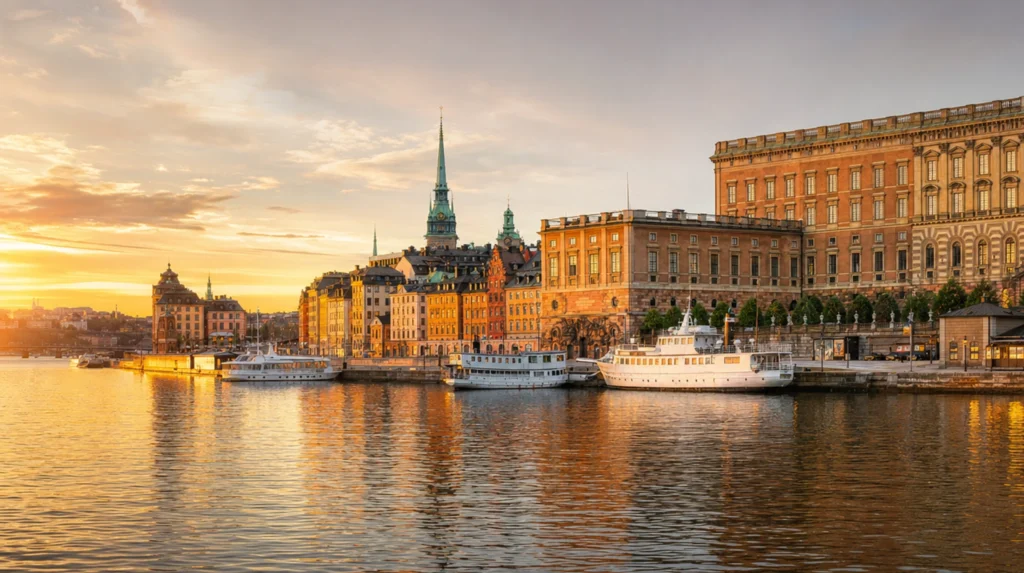
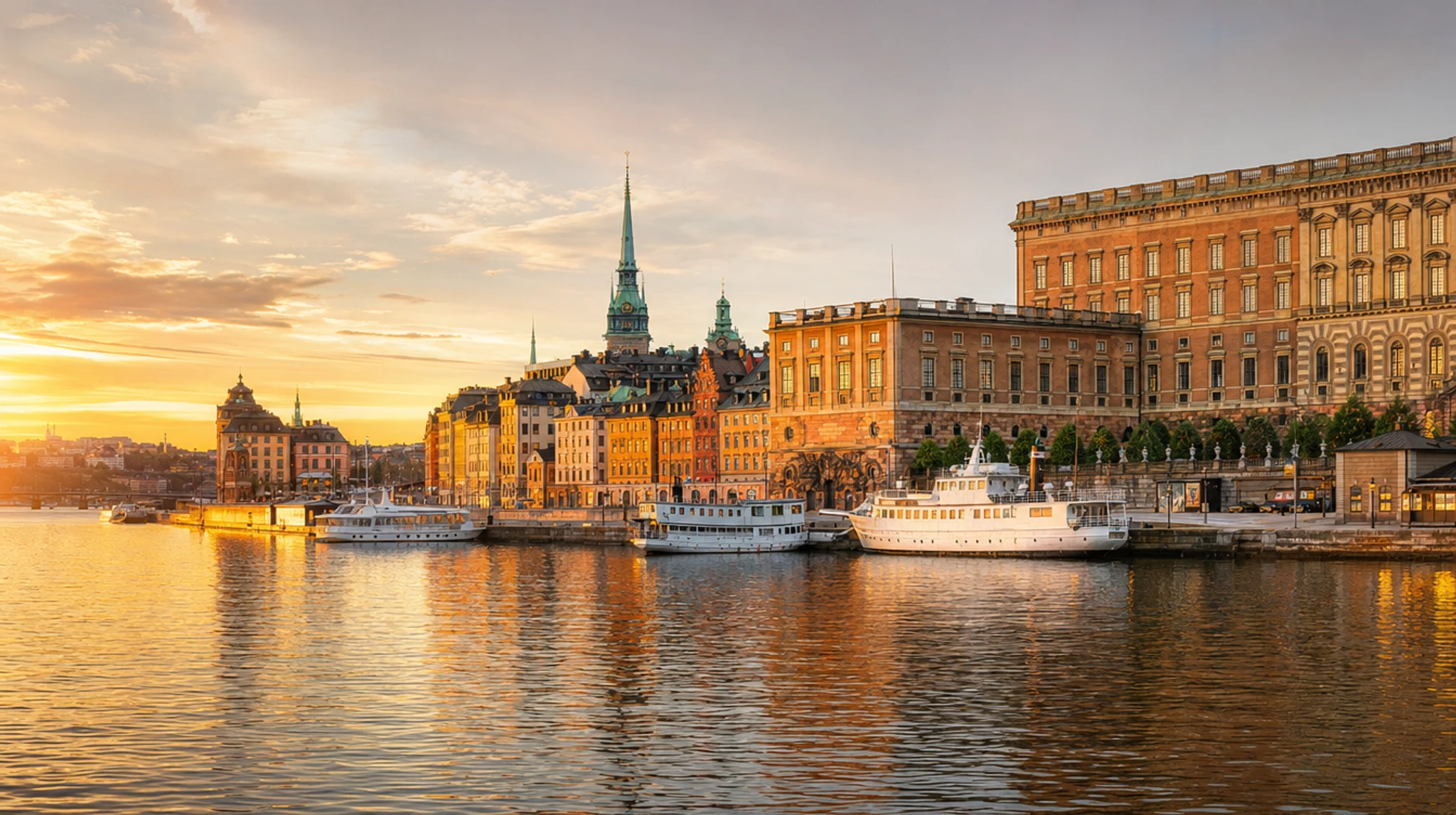
Sweden’s capital is spread across 14 islands at the mouth of Lake Mälaren — the self-styled “Venice of the North”, with Gamla Stan’s cobbled 13th-century core, a royal palace still in daily use, and archipelago ferries leaving from the city centre. A 3-day SL Access card reaches every neighbourhood, museum and island.
- Gamla Stan and the Royal Palace — the largest European royal residence still in official use, with over 600 rooms
- Vasa Museum — a 1628 warship that sank in Stockholm harbour on its maiden voyage and was raised intact in 1961
- Skansen open-air museum, Djurgården island park cluster and the archipelago ferry to Vaxholm
Signature eats: Swedish meatballs (köttbullar) with lingonberry jam at Pelikan, gravlax on dense rye, fika at Vete-Katten (est. 1928), pickled herring platters at Östermalms Saluhall.
⚓ Gothenburg
Sweden’s west-coast port and second city — quieter, funnier and noticeably friendlier than Stockholm, with a concentration of seafood restaurants on the Nordic Sea’s oyster coast and the Liseberg amusement park at its heart. Canals laid out by 17th-century Dutch engineers still thread the old town.
- Liseberg — Scandinavia’s largest amusement park in summer, reborn as Sweden’s biggest Christmas market November–December
- Haga district — 19th-century wooden houses, cobbled streets and cinnamon buns the size of dinner plates (haga bulle)
- Feskekôrka “the fish church” seafood market hall and a harbour boat tour past the Eriksberg cranes
Signature eats: west-coast oysters, Gothenburg prawn sandwich (räksmörgås) piled high, kanelbullar the size of your fist with strong filter coffee.
🌉 Malmö
Sweden’s third city and its most multicultural — connected to Copenhagen by the 16-km Öresund Bridge (the Nordic Noir one from the television series), with a skyline anchored by the 190-metre twisting Turning Torso tower and the historic Stortorget square at its old heart.
- Turning Torso (2005) by Santiago Calatrava — the tallest building in the Nordics when completed
- Stortorget and Lilla Torg — the medieval main squares of Gamla Staden
- Malmöhus Slott (castle) and the regenerated Västra Hamnen waterfront district
Signature eats: Skånsk äggakaka (thick pancake with pork and lingonberry), Middle Eastern-Swedish falafel (Malmö’s unofficial street food), gravlax, plus a 35-minute train to Copenhagen for a smørrebrød lunch.
📚 Uppsala
Sweden’s oldest university town and its historical religious capital — Uppsala University was founded in 1477, Uppsala Cathedral is the largest in Scandinavia, and the Gamla Uppsala royal burial mounds predate the Vikings by centuries. A 35-minute train from Stockholm makes it the country’s easiest day trip.
- Uppsala Cathedral (Domkyrkan) — at 118.7 metres the tallest church in the Nordic countries
- Gamla Uppsala — 5th-century royal burial mounds and a reconstructed pre-Christian temple site
- Gustavianum museum with its 17th-century anatomical theatre and Linnaeus’s university botanical garden
Signature eats: semla (cardamom bun with almond paste and cream, Fat Tuesday staple), student-pub herring platters, strong coffee at Ofvandahls Hovkonditori (est. 1878), kanelbullar and smörgåsbord spreads.
❄️ Kiruna & Abisko (Swedish Lapland)
200 km above the Arctic Circle — Sweden’s northernmost city, currently being physically relocated 3 km east as the world’s largest underground iron-ore mine swallows the old centre. Abisko National Park, an hour west, is one of the best places on Earth for the northern lights.
- Abisko Aurora Sky Station — chairlift to a purpose-built aurora viewing deck, September through March
- Icehotel in Jukkasjärvi — rebuilt every December from Torne River ice, melts every May
- Sápmi cultural experiences with reindeer herders and the Ájtte Sami museum in Jokkmokk
Signature eats: reindeer stew (renskav), Arctic char, cloudberries (hjortron) with cream, gahkku Sami flatbread, smoked meats and husmanskost at Camp Ripan.
🏝️ Gotland
Sweden’s largest Baltic island and the country’s sunniest destination — a 3-hour ferry from Nynäshamn opens onto a medieval walled town (Visby), truffle-growing limestone farmland and Ingmar Bergman’s windswept Fårö cliffs.
- Visby — a UNESCO-listed 13th-century Hanseatic town inside a 3.4-km ring wall with 27 defensive towers
- Medieval Week (Medeltidsveckan) every August — Sweden’s largest reenactment festival
- Fårö island — Bergman’s home, raukar limestone sea-stacks and dramatic Baltic coastline
Signature eats: saffranspannkaka (saffron pancake with salmbärssylt), Gotland-raised lamb, local truffle, sheep-milk cheese, and smoked herring at Visby harbour stalls.
Swedish Culture & Etiquette — What to Know Before You Go
Swedish culture runs on quiet egalitarianism, precise punctuality, and a deep national comfort with silence. There is almost no social hierarchy on display: the company’s chief executive and the summer intern take the same tunnelbana, use the same first names, and queue in the same order at the same coffee counter. Swedes are often described by outsiders as “reserved” — and they are, on first contact — but the warmth arrives reliably by the second fika. Most social mis-steps in Sweden come from being loud, being late, or attempting small talk with strangers who had not expected it.
The Essentials
- Remove shoes at the door. Swedish homes almost universally expect shoes off — when you arrive, watch the hosts and do the same. This applies to many countryside B&Bs too.
- Arrive on the minute. For a 19:00 dinner, 19:00 means 19:00 — not 19:05. Swedish punctuality is near-Swiss, and lateness without advance warning reads as disrespectful.
- Say “tack” constantly. Thanking for coffee, for meals, and for the last party (“tack för senast”) is a real Swedish social ritual, not empty courtesy.
- Quiet voices on public transit. Phone calls and loud conversations on the tunnelbana or SJ train mark you out as the rude tourist — Swedes keep transit noticeably hushed.
- Queue seriously. Never, ever skip ahead. Numbered deli tickets are everywhere — at the bakery, post office, Systembolaget and even the unemployment office. Take one the moment you walk in.
Fika Etiquette
- Fika is the coffee-and-pastry pause — institutional, scheduled, and non-negotiable. Most Swedish workplaces stop twice daily for it at 10:00 and 15:00.
- A proper fika needs strong coffee, something sweet (kanelbulle, semla or kladdkaka), and another human being. Eating alone at a desk does not count as fika.
- The “hembakat” (homemade) rule: cafés specifying hembakat bake on-site and are what you want. Supermarket pastries are not considered real fika.
- Seven-variety tradition: at a proper old-style fika invitation (bjudfika), the host sets out seven kinds of biscuits and cakes. Refusing at least three is read as a soft insult.
A Food Lover’s Guide to Sweden
Swedish food has quietly become one of Europe’s most interesting cuisines. The traditional husmanskost canon — meatballs, herring, gravlax, cinnamon buns — sits alongside a Copenhagen-influenced New Nordic restaurant scene that gave Stockholm 30+ Michelin-starred restaurants, led by Björn Frantzén’s three-star Frantzén. West-coast oysters, Arctic char, foraged berries and Gotland cheese flow into kitchens that take seasonality seriously; the fika ritual ties everything together.
Must-Try Dishes
| Dish | Description |
|---|---|
| Köttbullar (Swedish Meatballs) | Beef-and-pork meatballs in cream gravy with lingonberry jam and boiled or mashed potatoes — the national dish. Pressgurka (pressed cucumber) on the side. IKEA sells the tourist version worldwide; the real thing is at a Stockholm husmanskost restaurant like Pelikan (est. 1904) or Tennstopet. Expect 165–215 SEK per plate. |
| Gravlax | Raw salmon cured 48–72 hours in salt, sugar and dill (never smoked — that’s röklax), sliced paper-thin and served on dense rye with hovmästarsås mustard-dill sauce. The word means “buried salmon”: medieval Swedish fishermen buried it in sand above the tide line to ferment. Appears on every Midsummer, Christmas and Easter julbord. |
| Sill & Herring Platters | Pickled herring in dozens of preparations — senapssill (mustard), glasmästarsill (“glassblower’s”: onion, carrot, allspice), löksill (onion), matjessill (sweet-spiced, the Midsummer classic). Eaten on knäckebröd with new potatoes, sour cream, chopped chives, hard-boiled egg and — always — a shot of ice-cold akvavit. |
| Kanelbulle (Cinnamon Bun) | Cardamom-scented yeasted buns with butter, cinnamon and pearl sugar — the signature fika pastry. Gothenburg’s Haga district bakes them dinner-plate-sized (haga bulle). Sweden genuinely celebrates Kanelbullens Dag on October 4 every year, a national food holiday that originated with bakeries in 1999. Best with strong brewed coffee — never a cappuccino. |
| Toast Skagen | Stockholm-invented prawn salad in dill, mayonnaise and lemon, piled onto butter-fried white bread and topped with bleak roe (löjrom from Kalix, a protected designation). Invented by restaurateur Tore Wretman in 1958 and now on every archipelago restaurant menu as a starter. 145–220 SEK at most places. |
| Semla (Lenten Bun) | Cardamom bun cut open, hollowed out, filled with almond paste and whipped cream, then lid replaced and dusted with powdered sugar — eaten only between Christmas and Fat Tuesday (Fettisdagen). King Adolf Frederick reportedly died of consuming 14 semlor in one sitting in 1771. A national anxiety made edible; a Vete-Katten or Ofvandahls semla is the benchmark. |
| Surströmming | Fermented Baltic herring — the legendarily pungent northern-Swedish delicacy, opened outdoors and served on tunnbröd (soft thin flatbread) with almond potatoes, red onion and sour cream, washed down with schnapps. Premiere date (surströmmingspremiär) is the third Thursday of August. Optional for tourists; a real experience for the brave. |
Systembolaget & Konditori Culture
Sweden does not have konbini, but it has two quirks foreign visitors notice immediately. First: Systembolaget, the state-run alcohol monopoly — the only place to buy any drink stronger than 3.5% ABV, closed Sundays, closed early Saturdays, and the single most important shop to learn the hours of before you travel. Second: the konditori, the traditional pastry-shop café (many are a century old) where fika actually happens. Between 7-Eleven, Pressbyrån and ICA/Coop supermarkets, groceries are fine but uninspired; coffee and pastry is where Swedish food culture shines.
- Chains: Pressbyrån (kiosk), 7-Eleven, ICA (supermarket), Espresso House (national coffee chain), Systembolaget (government alcohol monopoly).
- Signature items: kanelbullar, semlor (seasonal), chokladbollar (chocolate oat balls), prinsesstårta (green marzipan princess cake), kladdkaka (gooey chocolate cake), smörgåsbord cold cuts, akvavit, Swedish punsch.
Off the Beaten Path — Sweden Beyond the Guidebook
Icehotel — Jukkasjärvi, Lapland
Rebuilt every December from 2,500 tonnes of Torne River ice and snow-ice, hand-carved by 40 invited international artists, and melted back into the river by early May — and then repeated. The original Icehotel opened in 1989 as the world’s first, and remains the benchmark. Rooms run -5°C year-round; the insulated Icehotel 365 suites offer aurora viewing from a heated bed. Combine with a reindeer-sled tour or a Sami tent (kåta) stay on surrounding Sápmi ancestral land.
High Coast (Höga Kusten), Västernorrland
A UNESCO-listed stretch of Baltic coastline where the land is still rising out of the sea at roughly 8 mm per year — the fastest post-glacial rebound on Earth. Fjord-like inlets, the Höga Kusten suspension bridge (1997, at opening one of the world’s longest), and small fishing villages serving surströmming in season. The 130-kilometre Höga Kustenleden hiking trail threads the whole coast through granite cliffs and coastal forest.
Visby, Gotland
A perfectly preserved 13th-century Hanseatic trading town inside a 3.4-km ring wall with 27 defensive towers still standing, on an island 100 km off the Swedish east coast. UNESCO-listed in 1995. Medieval Week (early August) turns the whole town into a costumed reenactment; the rest of the summer is limestone-and-roses quiet. Reach it via a 3-hour car ferry from Nynäshamn or a 35-minute flight from Stockholm-Bromma.
Sarek National Park, Lapland
Sweden’s wildest interior — roughly 1,970 square kilometres of glacier, peak and tundra with zero marked trails, zero bridges and zero cabins. Sarek is one of Europe’s largest wilderness areas and is intended only for experienced backcountry hikers; more than 100 peaks above 1,800 metres. The best jumping-off point is the Kvikkjokk STF mountain station. The adjoining Padjelanta park is gentler and shares the UNESCO-listed Laponian Area with Sarek.
Österlen, Skåne
Sweden’s southeastern tip — rolling wheat fields, apple orchards, white-sand Baltic beaches and the Ales Stenar stone ship (59 granite boulders arranged as a 67-metre Viking longship, dated to around 600 CE). Kivik is the apple and cider capital; Simrishamn is the harbour town with an unmistakable Nordic Noir feel. The region’s art galleries, farm-to-table lunches and rural B&Bs make it the closest thing Sweden has to Provence — genuinely Swedish, noticeably quieter than the west coast.
Practical Information
| Currency | Swedish Krona (kr / SEK); 1 USD ≈ 10.5 SEK (April 19, 2026). Sweden kept the krona rather than joining the euro. |
| Cash needs | Near-zero. Sweden is the most cashless economy on Earth — many shops, museums, cafés and even public toilets refuse cash entirely. Carry one contactless Visa or Mastercard plus a backup card. |
| ATMs | Bankomat ATMs are widespread in cities but increasingly rare in the countryside, and accept most foreign Visa/Mastercard. Many kiosks and cafés are card-only by policy — and it is legal for them to refuse cash under Swedish law. |
| Tipping | Not expected. Service is included by law. Rounding up to the nearest 10 SEK at a café or adding 5–10% at a sit-down restaurant is appreciated, never obligatory. |
| Language | Swedish is the national language; Sami, Finnish, Meänkieli, Romani and Yiddish are recognised minority languages. English proficiency is near-universal — Sweden ranks in the top 5 of the EF English Proficiency Index year after year. |
| Safety | Very safe — Sweden ranked 21st in the 2024 Global Peace Index and violent crime against visitors is rare. Pickpocketing at Stockholm Central Station, around Gamla Stan and on the tunnelbana green line is the main tourist-facing risk. |
| Connectivity | Nationwide 4G/5G on Telia, Tele2 and Telenor. eSIMs (Airalo, Holafly) work from landing. Free WiFi on SJ trains, in airports, libraries and most cafés. |
| Power | Type C and Type F (Schuko) plugs; 230V / 50 Hz. |
| Tap water | Safe and excellent — among the cleanest on Earth and served free at every Swedish restaurant on request. |
| Healthcare | Universal public system; EU visitors use EHIC, others need travel insurance. Vårdcentralen is the first-contact clinic; the national after-hours advice line is 1177. |
Budget Breakdown — What Sweden Actually Costs
💚 Budget Traveller
Hostels (STF chain, Generator Stockholm), ICA supermarket runs, SJ off-peak Intercity tickets booked 60+ days out, and free city walking plus the Right of Public Access for rural nights. Doable at 900–1,400 SEK per day (~US$85–135), with Gothenburg and Malmö roughly 20% cheaper than Stockholm. A supermarket lunch under 50 SEK, an Espresso House kanelbulle plus coffee around 45 SEK, and a hostel dorm 300–500 SEK.
💙 Mid-Range
3-star central hotel or a trusted Airbnb, one sit-down restaurant meal and one café meal a day, SJ high-speed bookings, and two to three paid sights daily (Vasa Museum around 220 SEK; Royal Palace 210 SEK). Plan 1,900–3,200 SEK per day (~US$180–305). Stockholm during the Midsummer weekend hits the top of that range; everywhere else and most of the year settles 20–30% lower.
💜 Luxury
5-star hotels (Grand Hôtel Stockholm, Ett Hem, Treehotel in Harads), SJ first class, Michelin-starred tasting menus (Sweden has 30+ Michelin restaurants) with wine pairings, and private archipelago charters. Plan 5,000+ SEK per day (~US$475+). A one-star Michelin dinner in Stockholm with paired wines runs around 2,500 SEK; a two-star tasting at Frantzén runs 5,000–7,500 SEK per person; a private Waxholmsbolaget charter for a small group runs 4,000–8,000 SEK for a half-day archipelago run.
| Tier | Daily (USD) | Accommodation | Food | Transport |
|---|---|---|---|---|
| Budget | $85–135 | Hostel 300–500 SEK / budget hotel 900–1,300 SEK | 200–400 SEK/day | SL day pass 175 SEK |
| Mid-Range | $180–305 | 3-star hotel 1,500–2,400 SEK | 600–1,000 SEK/day | SJ Intercity 400–800 SEK |
| Luxury | $475+ | 5-star hotel 3,800–8,000 SEK+ | 1,500–3,000 SEK/day | SJ first class / private transfers 1,500–3,000 SEK/day |
Planning Your First Trip to Sweden
- Pick your season deliberately. Midsummer (June 19–20, 2026) is Sweden’s biggest weekend, with everything booked out months ahead; September–March is aurora season in Abisko; late November–December is Christmas markets and Lucia.
- Base yourself in one city, day-trip the rest. Stockholm and Uppsala are 35 minutes apart by SJ; Gothenburg and Malmö are 2 hours 40 minutes; Visby is a 3-hour ferry from Nynäshamn. One base plus day returns beats chasing hotel check-ins.
- Pre-book the Vasa Museum, Icehotel and archipelago ferries. Vasa is timed-entry in summer; Icehotel rooms sell out 4–6 months ahead; Waxholmsbolaget’s summer archipelago ferries fill on Midsummer weekend specifically.
- Carry a contactless bank card — nothing else. Swedish shops, transit, museums and even some public toilets refuse cash. One Visa or Mastercard on your phone covers everything, including SL, SJ and Systembolaget.
- Learn the Systembolaget hours before you fly. State-monopoly liquor stores close Saturday afternoon and all day Sunday, and shutter early the Thursday before Midsummer. Plan Friday-morning runs or go without.
Classic 10-Day Itinerary: Days 1–3 Stockholm (Gamla Stan, Vasa, Skansen, Vaxholm ferry) · Day 4 Uppsala day trip · Days 5–6 SJ X2000 to Gothenburg (Liseberg, Haga, Feskekôrka) · Day 7 Öresundståg to Malmö plus Copenhagen lunch · Days 8–10 overnight train to Kiruna for Abisko aurora or summer Midnight Sun before flying home.
Frequently Asked Questions
Is Sweden expensive to visit?
More expensive than Southern Europe, roughly on par with Germany, and cheaper than Norway, Switzerland or Iceland. Budget travellers manage 900–1,400 SEK per day with hostels and supermarket food; mid-range travellers should plan 1,900–3,200 SEK per day. Stockholm is the priciest base; Gothenburg, Malmö and Uppsala run 15–25% lower year-round.
Do I need to speak Swedish?
No. Sweden ranks in the top 5 of the EF English Proficiency Index every year and English is near-universal, especially among Swedes under 60. Learning “hej” (hi), “tack” (thanks) and “ursäkta” (excuse me) softens every interaction; the rest takes care of itself.
Is the Eurail Sweden Pass worth it?
For a single-city visit, no — urban transit cards (SL Access in Stockholm, Västtrafik in Gothenburg) are better value. For a multi-city itinerary covering Stockholm–Gothenburg–Malmö or venturing north to Lapland, the Eurail Sweden Pass (3 days in 1 month, around €171) can save money, especially when advance SJ tickets have already sold out.
Is Sweden safe for solo travellers?
Yes — Sweden ranks 21st in the 2024 Global Peace Index and violent crime against visitors is rare. Solo women consistently report feeling comfortable on late-night public transit in most Swedish cities. The main tourist risks are pickpocketing at Stockholm Central Station and around Gamla Stan.
When is Midsummer 2026?
Midsummer’s Eve falls on Friday, June 19, 2026 and Midsummer’s Day on Saturday, June 20, 2026 — the latest possible calendar slot, which means maximum daylight across the country and true Midnight Sun above the Arctic Circle. Book hotels, archipelago ferries and rural trains 3–4 months ahead.
Can I get by as a vegetarian or vegan?
Easily in cities — Stockholm has been one of Europe’s strongest vegan scenes for a decade, with dedicated restaurants (Hermans on Södermalm, Mahalo) and supermarket plant-based shelves that rival the Netherlands. Rural Sweden is harder; expect 1–2 vegan options per menu and stock up at ICA supermarkets before venturing north.
What about Systembolaget and drinking in Sweden?
Any drink over 3.5% ABV is sold only at Systembolaget, the state-run alcohol monopoly. Opening hours are shorter than normal shops (weekdays 10:00–18:00 or 20:00, Saturday 10:00–15:00, closed Sunday), and you need ID proving you are 20 or older to buy there — though 18 is the legal drinking age in licensed bars and restaurants.
Ready to Explore Sweden?
Sweden rewards travellers who let the trains, the ferries and the long light do the work — pick a city base, book the Vasa Museum and Midsummer hotels four months ahead, learn five Swedish words, and let lagom take care of the rest. Start in Stockholm for the archipelago, Gothenburg for the seafood, or head above the Arctic Circle to Kiruna for the aurora.
Explore More
Cities we cover in Sweden
More country guides you might like
Plan your trip to Sweden
The booking tools we use ourselves. FFU may earn a commission at no extra cost to you.
Plan & book your trip to Sweden
Booking through these searches supports our guides at no extra cost to you.