
☰ On this page
- 📋 In This Guide
- Overview — Why Oslo Belongs on Every Bucket List
- 🌳 Late-April / Early-May 2026 — Why You’re Right in the Window
- Best Time to Visit Oslo (Season by Season)
- Getting There — Flights & Arrival
- Getting Around — T-bane, Trams, Walking & Ferries
- Top Neighbourhoods & Districts
- 🗓️ Sample Itineraries
- Norwegian Culture & Etiquette
- A Food Lover’s Guide to Oslo
- 📸 Photography Notes
- Off the Beaten Path — Oslo Beyond the Tourist Trail
- Practical Information
- Budget Breakdown — What Oslo Actually Costs
- ✅ Pre-Trip Checklist
- 🤔 What Surprises First-Timers
- Frequently Asked Questions
- Ready to Explore Oslo?
- Explore More
Oslo, Norway — Fjord Capital, Viking Heritage & Scandinavia’s Greenest City
Part of our Norway travel guide.
Oslo is the only major European capital where you can finish work in a fjord-front office, take a 12-minute metro ride to a forest, ski cross-country under floodlights for 90 minutes, and be home in time to drink a glass of cold-water cod broth at a 2-Michelin-star restaurant. The city is dramatically small for a national capital (713,000 in the central municipality, 1.6 million in the metropolitan region) but spread across a basin where the Oslofjord meets a perimeter of densely forested hills called the Marka — a 1,700 km² nature reserve genuinely larger than the city itself, accessible by metro, and used by 80% of Oslo residents at least once a month. The geography defines everything. Where Stockholm spreads across an archipelago, Oslo nestles in a single bowl: water at the centre, forest on every horizon, and a city that doesn’t try to escape either.
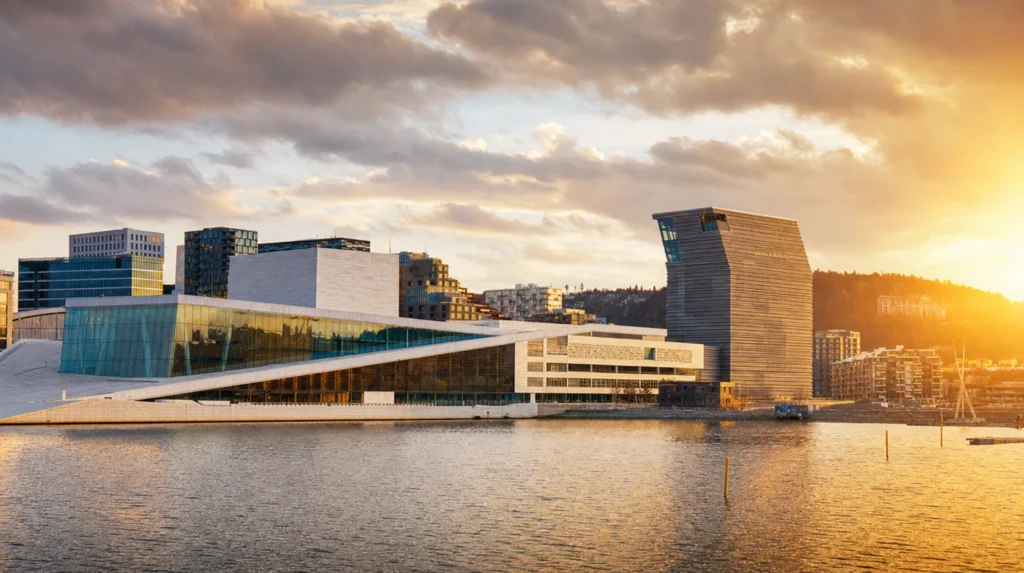
What makes Oslo different is the balance. The city has been quietly transformed in the last 25 years from a slightly stiff, Lutheran administrative capital into one of Europe’s most architecturally ambitious harbour cities — Renzo Piano’s Astrup Fearnley Museum, Snøhetta’s Opera House (the white marble roof you can walk up), the new Munch Museum, the Deichman Bjørvika public library, and the wholesale reinvention of the Aker Brygge and Tjuvholmen waterfront. Oslo is also Scandinavia’s greenest city by almost every measure — 99% of public transport runs on renewables, 95% of electric-vehicle market share for new car sales (the world’s highest), and a density of cycling lanes per capita that surpassed Copenhagen in 2022. The country runs on the Oil Fund (the world’s largest sovereign wealth fund, currently NOK 18 trillion / USD 1.6 trillion), but the capital itself is genuinely committed to a post-oil future.
This guide covers Oslo neighbourhood by neighbourhood — from medieval Akershus Fortress to the brand-new Bjørvika harbour district, plus the fjord and Marka day-trips that complete the city’s geography. If you’re pairing Oslo with the rest of the country, see our Norway travel guide for Bergen, the western fjords, Lofoten and the North Cape. The natural Nordic city pairings are our Stockholm city guide (1-hour flight, the archipelago counterpoint) and our Copenhagen city guide (the southerly Hanseatic-Lutheran cousin).
📋 In This Guide
- Overview — Why Oslo Belongs on Every Bucket List
- 🌳 Late-April / Early-May 2026 — Why You’re Right in the Window
- Best Time to Visit Oslo (Season by Season)
- Getting There — Flights & Arrival
- Getting Around — T-bane, Trams, Walking & Ferries
- Top Neighbourhoods & Districts
- 🗓️ Sample Itineraries — 2, 4, 6 and 8 Days
- Norwegian Culture & Etiquette
- A Food Lover’s Guide to Oslo
- 📸 Photography Notes
- Off the Beaten Path — Oslo Beyond the Tourist Trail
- Practical Information
- Budget Breakdown — What Oslo Actually Costs
- ✅ Pre-Trip Checklist
- 🤔 What Surprises First-Timers
- Frequently Asked Questions
- Ready to Explore Oslo?
Overview — Why Oslo Belongs on Every Bucket List
Oslo sits at the head of the 100-kilometre Oslofjord on Norway’s southeastern Skagerrak coast — the only Scandinavian capital located inland on a fjord rather than on the open sea. The city was founded in 1040 as a Viking trading post, was Christianised under Olaf III, and remained a regional Hanseatic outpost of about 3,000 people until a 1624 fire destroyed the medieval town. King Christian IV of Denmark-Norway ordered the city rebuilt under the new name Christiania (a position it held until 1925, when it was finally restored to Oslo), and laid out the still-visible quadratic street grid of the Kvadraturen quarter. The Norwegian capital was Bergen until 1299, then alternated between Oslo and Copenhagen during the Danish union (1380-1814), and only became a definitive permanent capital after the 1814 Norwegian constitution and 1905 dissolution of the Norway-Sweden union.
The modern city is a study in well-funded contradictions. It runs on the proceeds of a 50-year-old oil-and-gas industry but has the highest electric-vehicle share in the world (95% of new car sales in 2024), one of the highest renewable-energy mixes in Europe (98% hydroelectric), and a public-transport infrastructure that’s almost entirely electrified. It has the world’s largest sovereign wealth fund relative to population (NOK 18 trillion / approximately USD 1.6 trillion, which works out to roughly USD 280,000 per Norwegian citizen), and the discipline to spend only the real returns rather than the principal — the famous “Norwegian model” of fiscal restraint. The capital itself is small enough to walk corner to corner in 90 minutes and dense enough to feel like a proper city once you’re in it.
For a traveller, Oslo is the most architecturally surprising Nordic capital — the Opera House (Snøhetta, 2008, the white marble roof you walk up), the Astrup Fearnley Museum (Renzo Piano, 2012), the Munch Museum (Estudio Herreros, 2021), and the Deichman Bjørvika public library (Lund Hagem, 2020) are all genuinely first-rate buildings that have transformed the harbour-front skyline in 15 years. The city is also the gateway to two of Europe’s most spectacular landscape destinations — the western fjords (4 hours by train to Bergen on the Bergensbanen) and the Lofoten Islands (2-hour flight north). Show up with a metro card, comfortable shoes, and respect for the locals’ famously direct conversational style — the rest is hours of walking, swimming, and skiing within an hour’s reach.
🏛️ Historical Context
Norway’s Storting parliament has met continuously since 1814, but the country’s deeper political tradition reaches back to the Viking-era Allting assemblies of the 9th and 10th centuries — democratic gatherings where free farmers and chieftains debated law and disputes. The 1814 Norwegian Constitution was the most progressive in Europe at the time (universal male suffrage among landowners, no nobility, freedom of religion in 1851 and freedom of the press) and remains one of the world’s oldest still-functioning constitutions. Norway then spent 91 years in a forced union with Sweden (1814-1905) before peacefully dissolving the partnership through a national referendum in which 99.95% voted for independence. The current royal family — Haakon VII (1905), Olav V (1957-1991), Harald V (1991-present) — was imported from Denmark and the line has remained steadily popular through 120 years of constitutional monarchy.
🎌 Did You Know?
Oslo is the only major European capital where you can ski to and from the city centre via a metro line. The T-banen line 1 (Frognerseteren) climbs from the central station to 469 metres above sea level in 30 minutes, depositing skiers at the top of the Oslomarka ski terrain — over 2,600 km of cross-country trails, 200 km of which are illuminated for night skiing through the Marka forest. From late November through early April, locals commute home from work, change at home, take the metro up, ski for 90 minutes under stadium-style floodlighting on the Sognsvann or Kobberhaughytta loops, and return on the same metro card. The system is unique in Europe and partly explains why 80% of Oslo residents own at least one pair of cross-country skis.
🌳 Late-April / Early-May 2026 — Why You’re Right in the Window
Late April through mid-May is the most underrated three-week window on the Oslo calendar. The city’s spring arrives compressed and dramatic — daytime highs climb from 9°C in early April to 16°C by mid-May, the daylight curve climbs from 14 hours toward 17 hours, and the city’s tree canopy goes from skeletal to luminescent green in a single explosive week at the end of April. The Vigeland Sculpture Park comes alive with locals having their first picnic of the year, the harbour-front promenade fills with Oslovians on bicycles, and the Marka forest’s last winter-ski tracks give way to mountain-biking and trail-running.
The window is bookended by two of the city’s biggest events. April 30 is Walpurgis Night (“Valborg”) with public bonfires; May 17 is Norwegian Constitution Day (Syttende Mai), the country’s biggest celebration — a parade of 100,000 children in traditional bunad costume marches up Karl Johans gate to the Royal Palace where the royal family waves from the balcony, all of Oslo wears national dress, and the country effectively shuts down for street parties and herring lunches. The festival rivals Brazilian Carnival and Spanish Sant Joan as one of Europe’s most extraordinary public celebrations. If your trip can include May 17, do everything to be in Oslo that day.
This is also the precise window when the western fjords reopen in earnest. The Bergensbanen train (Oslo-Bergen, the country’s most scenic rail journey) operates year-round, but the snow-line drops below the Hardangervidda plateau and the views from the train improve dramatically through April and May. The Flåmsbana branch line (one of the world’s most famous railway journeys) reopens in May, and the Sognefjord and Hardangerfjord ferries return to full schedule. A Bergen day-trip from Oslo on the train (7 hours each way) is spectacular in late April; the better itinerary commits 2-3 days to the round trip with an overnight in Flåm or Bergen.
⚠️ Important — May 17 Booking & Logistics
If you’re visiting Oslo over Norwegian Constitution Day (May 17), book hotels 4-6 months ahead — Oslo accommodation sells out faster for May 17 than for any other date on the calendar except Christmas. Book Karl Johans gate or Aker Brygge restaurants 6-8 weeks ahead. The parade route closes from 8 a.m. to 2 p.m. and central Oslo is mostly pedestrianised; rideshare and taxi services are heavily delayed. The day-of weather forecast is national news. Bring a raincoat — May 17 in Norway is the equivalent of England’s Royal Wedding in terms of weather hopes-vs-reality. If you’re not in bunad (national costume), wear a red, white, and blue ribbon or rosette — they’re sold everywhere from May 1 onward. Most museums are closed on the day; the parade itself is the attraction.
Best Time to Visit Oslo (Season by Season)
Oslo has four genuine seasons compressed into a high-latitude calendar. The Gulf Stream and the inland fjord position keep the city warmer than the latitude (59.9°N) suggests; January average is -3°C, similar to Stockholm but slightly colder than Copenhagen. The daylight swing is enormous — 18 hours on June 21 vs. 6 hours on December 21 — and the city’s rhythm shifts radically with the seasons.
Spring (April – May)
The shoulder window described above. Daytime highs climb from 9°C in early April to 16°C by late May, the city’s tree canopy and daylight extend rapidly, and crowds remain 40% lower than July. Hotel prices are 30% below July peak (except over Constitution Day, May 17, when they spike). The May 17 celebrations, the reopening of the Marka mountain-bike trails, and the Bergensbanen train scenery upgrade are the cultural and landscape highlights. Restaurant patios reopen in mid-April, and the Oslo running and cycling culture restarts in earnest. This is the best time to visit if you want Oslo at its most photogenic with manageable crowds — except you should aim for May 17 if you can possibly arrange it.
Summer (June – August)
The high season. June 21 brings extended daylight (18 hours in Oslo, 24 hours in northern Norway), temperatures climb to 22-25°C daytime, and the harbour-front comes into its own. The Bygdøy beaches, the Sørenga sea pool (a free saltwater swimming complex on the harbour), and the islands of the inner Oslofjord all become genuinely usable. The Øya music festival (mid-August) is the country’s biggest, drawing 75,000 people to Tøyen Park. The Oslo Jazz Festival (mid-August) and Mela cultural festival round out the summer. The trade-off is crowding at headline sites (Vigeland Park, the Munch Museum, the Viking Ship Museum) and prices roughly 35% above shoulder season. Locals decamp to summer cottages from mid-July through early August; the city itself is genuinely quieter in late July.
Autumn (September – October)
The other golden window. By the autumnal equinox the daylight is still 12+ hours, the Marka forest goes through a 10-day red-yellow flush in early October, and the cultural season — opera, theatre, Oslo World Music Festival — restarts in full force. Daytime highs drop from 17°C in early September to 8°C by late October. Crowds drop sharply; hotel prices fall 30%. Norwegian Wood (the literary festival, late September) is the cultural anchor for English-speaking visitors. The autumn brings the country’s strongest food season — wild mushrooms, lingonberries, cloudberries from the Hardangervidda, and the country’s salmon-and-trout-fishing peak.
Winter (November – March)
Six hours of daylight in late December, snow on the Marka forest by mid-November, and the city’s defining seasonal experience: cross-country skiing accessible by metro. The Oslo Christmas market on Spikersuppa (since 2002) and the Vinterland market at Spikersuppa run from mid-November through New Year’s. Daytime highs sit at -1 to 3°C; overnight lows drop to -5 to -10°C and occasionally below. The Holmenkollen ski jump (the country’s biggest, hosting the FIS Ski Jumping World Cup every March) becomes the sky-line marker visible from the central city. The cultural calendar peaks at Nobel Peace Prize Day (December 10, the only Nobel awarded in Oslo rather than Stockholm) and the December 13 Lucia Day. Winter is the cheapest season; hotel rates dip 35% off summer peak. Pack proper layers; an Oslo wind chill at -10°C and 5 m/s requires merino wool, not autumn cotton.
🧳 Travel Guru Tip
If you have one week and want Oslo at its most distinctively Norwegian, aim for the week of May 17 (Norwegian Constitution Day). The daylight is extending, the parade is one of Europe’s most extraordinary public celebrations, the western-fjord routes are open, and the post-festival shoulder week (May 18-25) sees prices drop 25% as Oslovians return to work. Most international guides default to mid-July; the May 17 window is the under-promoted superlative.
| Experience | Best months | Best locations | Notes |
|---|---|---|---|
| Norwegian Constitution Day (Syttende Mai) | May 17 | Karl Johans gate, Royal Palace | Book hotels 4-6 months ahead |
| Cross-country skiing | Late Nov – early Apr | Sognsvann, Tryvann, Frognerseteren | 200 km illuminated trails |
| Bergensbanen train (Oslo-Bergen) | Year-round (peak May–Sep) | Hardangervidda plateau crossing | 7 hours each way; book NSB online |
| Holmenkollen Ski Jump World Cup | Early March | Holmenkollen | Tickets NOK 350-1,200 |
| Sørenga sea pool | Mid-Jun – mid-Sep | Bjørvika harbour | Free, harbour saltwater 18-22°C |
| Nobel Peace Prize Day | December 10 | Oslo City Hall | Public can watch ceremony arrival |
Getting There — Flights & Arrival
Oslo has one international airport that matters: Oslo Gardermoen (OSL), 47 km north of the city. It handles roughly 28 million passengers a year as Norway’s largest airport and a SAS / Norwegian / Wideroe hub for transatlantic and intra-European routes. A second smaller airport, Sandefjord Torp (TRF), 110 km southwest, handles some Ryanair and Wizz Air budget routes; ignore for non-budget itineraries.
From North America, direct flights run year-round from New York (JFK and Newark, 7h45m, SAS and United), seasonally from Boston (7h, SAS), Chicago (8h, SAS), Miami (10h, SAS) and Los Angeles (11h, SAS). From Europe, expect 2h from London Heathrow, 2h15m from Paris CDG, 1h45m from Frankfurt, 1h15m from Stockholm, 1h from Copenhagen and 3h from Madrid. Round-trip fares from London or New York in shoulder season typically land between £180–280 / $480–720 if booked 6–10 weeks ahead.
Gardermoen arrival is fast and modern. Passport control runs Schengen and non-Schengen lanes; from gate to ground transport is rarely more than 30 minutes. Three options into Oslo: the Flytoget (Airport Express Train) runs every 10 minutes, NOK 240 one-way to Oslo Central (19 minutes); the Vy regional train is NOK 132 (24 minutes, slightly slower but on the same track); the Vy 545 airport bus is NOK 190 (50 minutes, drops at Oslo Bussterminal). Taxi is NOK 1,200–1,400 fixed-fare from the airport rank — agree the price at the rank, never get into a non-fixed-fare taxi.
✨ Pro Tip
The Vy regional train at NOK 132 is the smart-budget option — same track as the NOK 240 Flytoget, only 5 minutes slower, and the price gets you to Oslo Central. The Flytoget is faster, cleaner and runs more frequently, but the Vy is the practical local choice. Both trains use platform 1-3 at the airport; buy tickets at the touchscreen machines or the Vy app. The Flytoget (white-and-grey livery) and Vy (red-and-grey livery) are visibly different — get on the right one.
Getting Around — T-bane, Trams, Walking & Ferries
Oslo is one of the most walkable major Nordic capitals. The downtown areas of Sentrum, Aker Brygge, Bjørvika, and the Karl Johans gate axis from Oslo Central to the Royal Palace connect on foot in 25-minute strolls. The harbour front from the Opera House to the Astrup Fearnley museum is a 35-minute walk. Oslo is hillier than Stockholm or Copenhagen but flatter than Bergen — the central streets rarely climb more than 30 metres, though the inner suburbs (Frogner, Majorstuen) sit on a gentle slope toward the Marka.
The T-bane (metro) is the workhorse for distances over 25 blocks and the practical link to the Marka forest. Five lines (1 to 5) cover the city plus the Holmenkollen, Sognsvann and Frognerseteren ski terrain to the north, fares are NOK 42 single-ride or NOK 121 for a 24-hour pass paid by Ruter app or NSR/Reise card. Trains run every 5–10 minutes from 5:30 a.m. to past midnight. The system is fully accessible and signage is in Norwegian and English. Line 1 to Frognerseteren (the highest point at 469 metres) is the must-ride for visitors — it climbs from sentrum to a panoramic viewpoint over Oslo and the Oslofjord in 30 minutes, with the Holmenkollen ski jump and the Marka forest as the destinations.
Trams (Trikken) cover the inner-city neighbourhoods the metro doesn’t reach. Ten lines, fares included on the Ruter pass, frequent service — useful for connecting Frogner, Majorstuen, Grünerløkka and the eastern districts. Public ferries to the Oslofjord islands (Hovedøya, Lindøya, Bleikøya, Gressholmen) run from Aker Brygge as part of the Ruter system from May through September, NOK 42 per leg, included on the day pass. The cycle-hire system Oslo Bysykkel is excellent for the central districts (NOK 49/day, free for first 60 minutes per ride).
⚠️ Important — Cashless Norway & Ruter App
Norway is effectively cashless — under 4% of transactions are cash, and many shops, restaurants, and museums refuse cash entirely. Plan accordingly — every Visa/Mastercard tap works seamlessly, but cash exchange is largely useless for daily spending. Buy your transit tickets via the Ruter app (free, top up by card) — the app’s QR-code ticket option works on phones without a physical card. Inspectors check tickets randomly on the metro and trams; the fine for travelling without a ticket is NOK 1,300 and applies even to confused tourists. The app’s automatic-validation feature requires you to actively press “Activate” on the ticket before boarding.
Top Neighbourhoods & Districts
📍 Oslo Map: Every Place in This Guide
Oslo divides into roughly seven distinct districts for travellers. Below are the bases worth building an itinerary around, ordered roughly from the medieval centre outward.
🏰 Sentrum & Karl Johans Gate — The Royal Spine
The medieval-and-19th-century city centre, organised around Karl Johans gate — the country’s main ceremonial street running from Oslo Central railway station east-to-west to the Royal Palace at its western end. The street takes its name from King Carl Johan (Bernadotte, formerly a French marshal under Napoleon, who became king of Sweden-Norway in 1818) and remains the parade route for May 17 and other state ceremonies.
Walking west from Oslo Central: the Vy commuter rail station and the Spikersuppa skating rink/Christmas market in winter and summer fountain plaza, the Storting (Norwegian Parliament, 1866, free guided tours Saturdays at 11 a.m. and 12:30 p.m.), the Grand Hotel where the Nobel Peace Prize Laureates traditionally stay, the Eidsvolls plass square, the Nationaltheatret station, and finally the Royal Palace at the avenue’s western terminus. The Royal Palace is open to the public for guided tours in summer (NOK 200, late June through mid-August only); the changing of the guard happens at 1:30 p.m. daily and is worth 10 minutes.
Around Karl Johans gate, the Oslo Cathedral (1697, the country’s main Lutheran cathedral and the venue for state weddings and funerals) and the National Theatre (1899, the country’s main stage and where Henrik Ibsen’s plays premiered) are the cultural anchors. The new Nationalmuseet on Brynjulf Bulls plass — Norway’s national art museum, opened 2022, the largest art museum in the Nordics — holds Edvard Munch’s “The Scream” (one of four versions; another is at the Munch Museum in Bjørvika), as well as the country’s strongest historical collection. NOK 200 admission, allow 2-3 hours.
- What to do: Walk Karl Johans gate west to east; Nationalmuseet (allow 3 hours); Storting parliament tour (Saturdays); Royal Palace summer tour or daily guard-change.
- Signature eats: Open-faced shrimp sandwich (rekesmørbrød) at Theatercafeen in the Hotel Continental; modern Nordic at Mathallen on the harbour.
- Access: Oslo Central station, Stortinget T-bane, Nationaltheatret T-bane all serve different ends of the avenue.
🌊 Bjørvika & the Opera District — The Harbour Reinvention
The post-2008 reinvention of Oslo’s eastern harbour — formerly an industrial dock, now the most architecturally ambitious quarter in the Nordics. The transformation began with Snøhetta’s Oslo Opera House (2008), continued with the Deichman Bjørvika public library (2020, Lund Hagem and Atelier Oslo), and culminated with the new Munch Museum (2021, Estudio Herreros — a 13-storey leaning tower clad in perforated aluminium that holds 26,000 Munch works including all four versions of “The Scream”).
The Opera House is the unmissable site. The white Carrara marble roof slopes from the harbour up to a 14-metre summit and is fully walkable — visitors climb the roof for the panoramic harbour view, take photos, picnic in summer, and the building has become Oslo’s de facto town square. Inside, the main auditorium hosts the Norwegian National Opera and Ballet (the country’s premier ensemble, with seats from NOK 250). Free 50-minute guided tours run daily at 1 p.m.; NOK 100.
The Munch Museum a 5-minute walk east on the harbour holds the world’s largest collection of Edvard Munch’s work — 26,000 paintings, drawings and prints, including “The Scream,” “Madonna,” “Vampire,” and “The Sick Child” rotating between the museum and the Nationalmuseet. NOK 200 admission, allow 2 hours. The 13-storey tower’s top-floor café has the city’s best view of the Oslofjord.
The Sørenga seapool, immediately east of the Munch Museum, is a free public swimming complex on the harbour — saltwater, with a sauna, a deep-water diving platform, and water temperatures of 18-22°C in mid-summer. June through mid-September is the realistic swimming window; the harbour water is officially clean and tested weekly.
- What to do: Walk the Opera House roof; Munch Museum (2 hrs); Deichman Bjørvika library (free, 1 hr); Sørenga sea pool (summer); evening opera or ballet (book 4-6 weeks ahead).
- Signature eats: Open-faced sandwich lunch at the Opera Café; modern Nordic dinner at Maaemo (3 Michelin stars, Oslo’s culinary peak — book 3 months ahead, NOK 4,500 tasting menu).
- Access: 5-minute walk east of Oslo Central station.
⚓ Aker Brygge & Tjuvholmen — The Western Waterfront
The reclaimed shipyard west of Oslo Central, redeveloped in the 1990s and 2000s into a glass-and-steel harbour-front district. Aker Brygge proper is a pedestrian boardwalk with restaurants, designer flagships, and the Nobel Peace Center — a museum dedicated to the laureates of the Nobel Peace Prize, housed in a converted 1872 train station (NOK 130, allow 90 minutes).
Tjuvholmen, the island west of Aker Brygge connected by a footbridge, was redeveloped in the 2010s and houses the Astrup Fearnley Museum of Modern Art (Renzo Piano, 2012 — a glass-and-timber building with three pavilions and a sculpture park, NOK 150). The museum’s permanent collection runs from Andy Warhol to Jeff Koons to contemporary Nordic artists; rotating exhibitions are consistently the strongest contemporary art in Oslo.
The harbour-front promenade from Akershus Fortress west to Tjuvholmen — the Havnepromenaden — runs 9 km in total and is fully walkable in 90 minutes. It links the Opera House, the Aker Brygge restaurants, the Nobel Peace Center, and the Astrup Fearnley Museum into a single panoramic walking route. Free, lit at night.
- What to do: Akershus Fortress (free); Nobel Peace Center; Astrup Fearnley Museum; Havnepromenaden harbour walk; sunset cocktail at Vingen rooftop bar.
- Signature eats: Fish soup (fiskesuppe) at Lofoten Fiskerestaurant; Norwegian salmon at Solsiden in summer (the boardwalk seafood restaurant, NOK 600+ per person).
- Access: Aker Brygge tram or 12-minute walk west of Oslo Central.
🎨 Grünerløkka — The Bohemian Eastern District
Oslo’s hippest neighbourhood and the city’s Brooklyn equivalent. Grünerløkka — universally known as Løkka — was working-class until the 1990s and is now Oslo’s design-and-creative core, with the highest concentration of independent boutiques, vinyl shops, vintage clothing, and small bars in the city. The neighbourhood is built on the south bank of the Akerselva river, which runs through the city and was the original industrial corridor.
The Birkelunden and Olaf Ryes plass squares are the social anchors — surrounded by café terraces, with Sunday flea markets in summer. Mathallen Oslo (the city’s main food market, opened 2012, in a converted brewery) is on the Akerselva north of Birkelunden — 30+ stalls of Norwegian charcuterie, smoked salmon, cheese, fish, and a half-dozen sit-down restaurants embedded in the brick-vaulted hall. Lunch at Vulkanfisk for the seafood platter, NOK 350; the Saturday lunch run is the local favourite.
Grünerløkka’s main commercial streets are Markveien and Thorvald Meyers gate — dense with independent boutiques (Nudie Jeans, Acne Studios outlet, the Norwegian designer brand Nor-Way), record shops (Big Dipper, Moldejazz), and the country’s strongest natural-wine bar circuit (Pjoltergeist, Smalhans, Hej Verden). The neighbourhood’s Sunday brunch culture is the strongest in the city; book Liebling or Tim Wendelboe a day ahead.
- What to do: Mathallen food market lunch; Akerselva river walk; Sunday brunch at Liebling; design shopping on Markveien.
- Signature eats: Smoked salmon platter at Mathallen; the legendary cinnamon bun (kanelbolle) at Åpent Bakeri on Inkognito gate.
- Access: Tram 11, 12, or 13 to Birkelunden; or 25-minute walk from Oslo Central.
🌳 Frogner & Majorstuen — Vigeland Park & Ambassadorial Oslo
The wealthy western district between the Royal Palace and the Marka forest, organised around Frogner Park (Frognerparken) — the country’s most-visited public park (3 million annual visitors) and home to the Vigeland Sculpture Installation. Sculptor Gustav Vigeland spent 40 years (1924-1943) creating 212 bronze and granite sculptures arranged across 80 acres in a deliberate study of the human condition; the central Monolith — a 14-metre granite column carved with 121 intertwined human figures — is one of the most extraordinary public sculptures in Europe. Free 24/7 entry; the park is open year-round and is genuinely best visited at golden hour.
Majorstuen, the commercial district north of Frogner Park around the T-bane interchange, is the residential-shopping heart of west Oslo — designer flagships, the Bogstadveien shopping street, and the Bislett Stadium where Oslo’s marathon and athletics meets are held. Cafés like Java and Tim Wendelboe (the third-wave coffee pioneer) anchor the casual scene.
- What to do: Vigeland Sculpture Park (allow 90 minutes); Vigeland Museum (Vigeland’s studio, NOK 150); Bogstadveien shopping; coffee at Tim Wendelboe.
- Signature eats: Norwegian breakfast at Frognerseteren restaurant (the 1891 mountain-lodge above the city, NOK 400); modern Norwegian dinner at Brutus (Bislett area).
- Access: T-bane line 3 to Majorstuen, then 8-minute walk to Frogner Park.
🛻 Bygdøy — The Museum Peninsula
The peninsula across the harbour from Aker Brygge that holds Oslo’s strongest concentration of historical museums. The 91 ferry from Aker Brygge takes 15 minutes (NOK 42, included in Ruter pass) and lands at the Bygdøy ferry terminal where four major museums cluster within a 20-minute walk: the Viking Ship Museum (currently closed for renovation through 2027 — the “new” Museum of the Viking Age opens 2027, the previous wooden Oseberg, Gokstad, and Tune ships have been moved into climate-controlled storage), the Norwegian Folk Museum (open-air museum of traditional buildings, 160 historical houses including a 1200s stave church, NOK 200), the Fram Museum (the polar ship Fram used by Nansen and Amundsen, plus the Gjøa from Amundsen’s Northwest Passage, NOK 140), and the Kon-Tiki Museum (Thor Heyerdahl’s balsa raft from his 1947 Pacific voyage, plus the papyrus Ra II, NOK 140).
The Bygdøy beaches — Huk Beach and Paradisbukta — are Oslo’s central swimming beaches in summer, 15 minutes’ walk from the museums. Free, busy on warm weekends, with the small kiosk Strandkiosken serving open-faced shrimp sandwiches.
- What to do: Norwegian Folk Museum (allow 2 hrs); Fram Museum; Kon-Tiki Museum; Huk beach walk.
- Signature eats: Open-faced shrimp at Strandkiosken (Huk beach kiosk, NOK 130); modern Norwegian at Lille Herbern (the historic harbour-side restaurant on Bygdøy, NOK 600+ per person).
- Access: Ferry 91 from Aker Brygge (May-Sep) or bus 30 from Sentrum (year-round).
🏔️ The Marka & Holmenkollen — Oslo’s Forest
The 1,700 km² nature reserve that surrounds Oslo on three sides, accessible by metro, and used by 80% of Oslovians at least once a month. The Marka is genuinely larger than Oslo itself and contains 2,600 km of cross-country ski trails (200 km illuminated), thousands of summer hiking trails, 343 lakes (most swimmable in summer), and a network of 17 sleeping huts run by the Norwegian Trekking Association (DNT, membership NOK 945/year).
The two accessible bases for first-time visitors are the Sognsvann lake (T-bane line 5 to Sognsvann, 20 minutes from Oslo Central, free swimming and the easiest 3 km lake-loop walk) and Holmenkollen (T-bane line 1 to Holmenkollen station, 30 minutes from Oslo Central, the country’s biggest ski jump and the venue for the 1952 Winter Olympics). The Holmenkollen Ski Museum (the world’s oldest ski museum, since 1923, with skis from the Viking era and the country’s strongest collection of polar exploration history) and the Holmenkollbakken ski jump tower (open year-round for tower-top viewing) cost a combined NOK 200.
Frognerseteren station, two stops further than Holmenkollen on T-bane line 1, is the highest metro station in northern Europe (469 metres above sea level) and the trailhead for serious cross-country trails in winter and 30+ km of summer hiking. The Frognerseteren restaurant (since 1891) at the trailhead is a working mountain lodge with a fireplace and Norwegian comfort food (NOK 400 per person).
- What to do: Holmenkollen Ski Museum; ski jump tower viewing; Sognsvann lake walk (3 km); Frognerseteren mountain lodge lunch; cross-country skiing under floodlights (winter, equipment rental at Sognsvann).
- Signature eats: Heart-shaped waffles with sour cream and brown cheese at Frognerseteren restaurant (the country’s iconic comfort dish, NOK 95).
- Access: T-bane line 1 to Holmenkollen or Frognerseteren; line 5 to Sognsvann.
“A thousand words leave not the same deep impression as does a single deed.”
— Henrik Ibsen, Brand (1865)
🗓️ Sample Itineraries
Oslo rewards trips that include the city’s geographic context — at least one Marka or Bygdøy half-day, ideally a fjord excursion. Below are four templates that have worked for thousands of travellers; pick the one that matches your time, then adjust by district. All distances assume Ruter and walking; add 25% for any winter cross-country skiing day.
2 Days — Quick Stop
Day 1: Arrive Gardermoen, Flytoget to Oslo Central, drop bags at Sentrum hotel. Walk Karl Johans gate west to Royal Palace. Lunch at Theatercafeen. Afternoon Nationalmuseet (allow 3 hrs); evening at the Opera House — climb the roof at sunset, dinner at Mathallen. Day 2: Bjørvika morning — Munch Museum (2 hrs), Deichman library, Sørenga sea pool if summer. Afternoon ferry 91 to Bygdøy for Folk Museum and Fram Museum (combined 3 hrs); ferry back at sunset. Dinner Aker Brygge boardwalk. Late departure or overnight to airport. This is Oslo-as-stopover; you’ll see the headlines but miss the Marka.
4 Days — The Standard Visit
Day 1: Arrive, Karl Johans gate walk, Nationalmuseet, dinner at Theatercafeen. Day 2: Bjørvika and Opera House full day — Opera roof, Munch Museum, Deichman library, dinner at Maaemo (book 3 months ahead) or Hot Shop on Tjuvholmen. Day 3: Bygdøy peninsula full day — Folk Museum, Fram Museum, Kon-Tiki Museum, Huk beach if summer. Evening Aker Brygge dinner and Astrup Fearnley sunset visit. Day 4: Marka half-day — T-bane to Holmenkollen, Ski Museum and ski jump tower, Frognerseteren waffles, return Vigeland Park sunset, dinner Grünerløkka at Mathallen or Liebling. This is the best four-day balance of headlines and atmosphere.
6 Days — Oslo + Bergensbanen Round Trip
The classic week. Days 1–4: The standard 4-day above. Day 5: Bergensbanen (Oslo-Bergen train, 7 hours, NOK 700-1,400 depending on class) — depart Oslo Central 8:25 a.m., arrive Bergen 14:50, afternoon walk Bryggen (UNESCO Hanseatic wharf), overnight Bergen at Hotel Augustin. Day 6: Bergen morning at Bryggen and the Fish Market, return Bergensbanen 14:50 with stop at Voss for the Flåmsbana branch line down to Flåm fjord (one of the world’s most scenic railways), back to Oslo by 22:30. The fjord component is the headline; book Bergensbanen 2-3 weeks ahead for the best window seats.
8 Days — Oslo + Norway in a Nutshell
For travellers willing to commit to a longer fjord itinerary. Use the 4-day Oslo template, then add: Days 5–8: Norway in a Nutshell — the standard fjord package: train Oslo to Myrdal, Flåmsbana to Flåm, ferry Flåm to Gudvangen through Nærøyfjord (UNESCO), bus to Voss, train to Bergen. Two nights in Bergen for the city and Mount Fløyen funicular, then fly back to Oslo on day 8 (1-hour SAS or Norwegian flight). The Norway in a Nutshell package is operated by Fjord Tours and runs year-round (NOK 2,200 per person for the train-and-ferry combination).
🎯 Strategy
If you only have one trip to Norway, do the 8-day Oslo + Norway in a Nutshell template — that puts you in the capital for 3-4 days (long enough to feel the city’s rhythm) before unlocking the western fjord landscapes that are the country’s natural drawcard. The 6-day Bergensbanen-only version is the rushed alternative; the 4-day Oslo-only version is the executive stopover. Don’t try to do Lofoten in 8 days from Oslo — the islands are 1,200 km north and need their own week.
Norwegian Culture & Etiquette
Norwegians are direct without being abrupt, reserved without being cold, and operate on a code of practical equality that takes most foreigners 48 hours to recalibrate to. The country runs on Janteloven — the unwritten “Law of Jante,” a set of 10 social principles articulated by the Danish-Norwegian author Aksel Sandemose in 1933 — which broadly states “you shall not believe you are anyone special, you shall not boast, you shall not stand out.” The cultural posture is one of cheerful equality with a sharp edge against ostentation. Loud-on-arrival energy reads as American or Italian and is the single most-mocked tourist behaviour after asking why milk costs USD 4.
The single mandatory ritual is the friluftsliv — the Norwegian concept of “open-air life,” roughly translated as the assumption that nature is a regular daily part of life rather than a vacation activity. Norwegians genuinely use the Marka or the fjord weekly, regardless of weather; the saying “there’s no bad weather, only bad clothing” (det finnes ikke dårlig vær, bare dårlige klær) is the national motto and effectively true. Tourists who learn to say yes to a Marka walk or a swim in the Sørenga seapool earn instant local respect.
Oslo is also a quietly proud city. Norwegians have spent the last 50 years getting steadily wealthier — the country was poor in the 1960s, average in the 1980s, and is now per-capita among the world’s three richest — and the social-democratic egalitarian inheritance from the post-war period is genuinely lived. Free university education (including for foreigners until 2023), high taxes (most middle-class incomes pay 35-45%), generous parental leave, and a low Gini coefficient. Tourists who acknowledge this rather than dismissing it earn the conversation; tourists who pre-judge will be quietly excluded.
💬 The Saying
“Det finnes ikke dårlig vær, bare dårlige klær.” Roughly: “There’s no bad weather, only bad clothing.” Norwegians use this phrase constantly — about a January cross-country ski day, about a March drizzle in Sentrum, about a November wind on the Holmenkollen. It’s the national fatalistic optimism, a 1,000-year-old practical theology earned by surviving on a sub-Arctic peninsula. Travellers who learn to deploy it correctly (with a shrug, not a sigh) earn instant rapport — and the implicit suggestion is that you should buy proper outdoor gear before complaining about the climate.
A Food Lover’s Guide to Oslo
Oslo has gone from a culinary backwater (the cliché of boiled cod and overcooked lamb was earned through the 1990s) to one of the most exciting food capitals in the Nordics in 20 years. The transformation happened simultaneously with Copenhagen and Stockholm — a generation of chefs trained at Noma and others returned to Norway with a New Nordic ethos and the country’s exceptional raw materials (cold-water fish, free-range Arctic lamb, wild-foraged berries from Hardangervidda, dairy from the smallholder Heidalsosten cheesemakers). The current Oslo tasting-menu standard is held by Maaemo (the country’s only 3-Michelin-star restaurant), Hyde, and Statholdergaarden.
Cold-water fish is the country’s flagship category. The Skagerrak coast and the deeper Atlantic produce some of the world’s best wild-caught cod, halibut, salmon, mackerel and herring. Oslo’s seafood standard is held by Lofoten Fiskerestaurant on Aker Brygge (since 1959, the cod and the fish soup are institutional, NOK 380 fish soup) and Fjord on Bygdøy (NOK 1,200 tasting menu). Pair with the white aquavit (Linie Aquavit, the caraway-flavoured spirit aged in oak casks aboard ships crossing the equator twice).
Lamb is the country’s defining red meat. Norwegian lamb (norsk lammekjøtt) grazes wild on Arctic herbs and salt-marsh grasses; the slow-roasted shoulder (lammeskank) and the cured-and-dried fenalår (Norwegian prosciutto from leg of lamb) are the iconic preparations. Try fenalår and brown cheese (brunost) on a slice of crisp lefse bread at any Mathallen counter, NOK 95.
Brunost deserves its own paragraph. Norway’s national cheese is a caramelised whey cheese made by simmering milk whey for 8-10 hours until it reduces to a thick brown paste. The flavour is sweet-savoury, faintly caramel, faintly tangy. Eaten on a fresh waffle with sour cream (rømme) or on a slice of dark rye, brunost is the country’s defining breakfast. Skiers eat it on the Marka trails. The Tine cheese co-operative produces the standard Gudbrandsdalsost; the artisanal Fjellbrunost from the Tine farms is the elevated version.
The waffle (vaffel) is Oslo’s defining sweet snack. Heart-shaped, crisp on the outside, soft inside, served with sour cream and brown cheese (the savoury option) or with strawberry jam and sour cream (the sweet option). Frognerseteren restaurant on Holmenkollen is the iconic location — eaten by 100,000 cross-country skiers a year — and Texas Burger in Grünerløkka does the modern reinvention. NOK 95 per waffle.
The Norwegian breakfast is a thing — open-faced sandwiches on dark rye (rugbrød), with smoked salmon, gravlax, mackerel, brown cheese, and Norwegian shrimp (rekesmørbrød). Theatercafeen at the Hotel Continental serves the city’s institutional version; the Mathallen counters do the modern alternative. NOK 280-450 for a substantial breakfast.
New Nordic at the top — Maaemo (3 stars, NOK 4,500 tasting menu, book 3 months ahead, considered the country’s culinary peak), Hyde (1 star, modern Nordic on Tjuvholmen), and Plates (1 star, intimate counter dining in Bislett). Maaemo’s tasting menu is among the world’s most-photographed and consistently appears in the World’s 50 Best.
Coffee (kaffi) is taken seriously. Per-capita coffee consumption in Norway is the second-highest in the world (after Finland), and Oslo’s third-wave coffee scene — Tim Wendelboe (the pioneer, since 2007), Fuglen, Kaffemisjonen — is the equal of any small-city scene in Europe. Refills are not free; coffee is NOK 55-75 in central locations.
📸 Photography Notes
Oslo is one of the most photogenic capitals in northern Europe and the architecture is the secret. The post-2008 harbour reinvention has produced a half-dozen genuinely first-rate buildings (Opera House, Munch Museum, Deichman library, Astrup Fearnley) within a 15-minute walk of each other, and the natural light of southern Norway — clear, low-angle, and luminous through the long autumn — produces constant frame opportunities. From late April to mid-August the city has 3-5 hours of “blue hour” every evening, and that low, sideways, unending light is the look that defines Oslo photography.
Best light by month: April-May 8:30 p.m.–9:30 p.m. for golden-hour-into-blue; June-July 11 p.m.–2 a.m. for the genuine midnight-light look (sun never fully sets); September-October 5 p.m.–7 p.m. for warm autumn light against the Marka tree colour; November-March 11 a.m.–2 p.m. for the entire useful daylight window.
Five locations worth the detour:
- Opera House Roof (59.9075°N, 10.7530°E) — the Snøhetta marble roof at sunset, with the new Munch Museum visible to the east. Best at golden hour; tripods tolerated outside concert hours.
- Holmenkollen Ski Jump Tower (59.9636°N, 10.6675°E) — the panoramic view from the top of the 60-metre ski jump, with the entire city and Oslofjord laid out below. NOK 200 entry, open year-round.
- Vigeland Park Monolith (59.9272°N, 10.7000°E) — the 14-metre granite column at the centre of the sculpture park. Best at golden hour with low autumn or spring light.
- Akershus Fortress (59.9075°N, 10.7368°E) — the 14th-century castle on the harbour, with sightlines to the Opera House and Aker Brygge. Best at blue-hour twilight in winter, midnight light in summer.
- Frognerseteren Viewpoint (59.9856°N, 10.6716°E) — the 469-metre summit at the top of T-bane line 1, with the entire Oslo basin and Oslofjord. Best at sunset year-round; in winter, the cross-country skiers add a foreground element.
Drone rules: Norway enforces EASA Open Category rules. Drones under 250g (DJI Mini class) require online operator registration. Drones 250g+ require an A1/A3 certificate. Oslo’s central airport buffer zone covers the entire harbour and central city; the Royal Palace, Akershus Fortress, and the Storting are restricted airspace and require advance permits (15-day lead) via Luftfartstilsynet (Civil Aviation Authority). Bird-cliff overflights and Marka forest reserves between April 15 and August 1 (nesting season) require additional clearance. Fines start at NOK 5,000.
✨ Pro Tip — Architecture Sequencing
The Bjørvika harbour district is genuinely walkable as a single architectural sequence. Start at the Oslo Opera House (Snøhetta, 2008) — climb the marble roof at golden hour. Walk 5 minutes east to the Deichman Bjørvika library (Lund Hagem and Atelier Oslo, 2020) for the dramatic atrium. Continue 5 more minutes to the Munch Museum (Estudio Herreros, 2021) for the leaning aluminium-clad tower. Three world-class buildings, three architects, 13 years of harbour reinvention, all in a 600-metre walk. The full sequence takes 90 minutes plus the museum visit. Photograph all three from the Akrobaten footbridge for the cohesive harbour-skyline frame.
Off the Beaten Path — Oslo Beyond the Tourist Trail
The standard tourist circuit (Sentrum + Bjørvika + Bygdøy + Vigeland Park) accounts for roughly 80% of foreign visits to roughly 25% of the city’s surface. The remaining 75% is harder to find in English-language guides, less Instagrammed, and much closer to the Oslo Oslovians actually use.
🏝️ Oslofjord Inner Islands
The four small islands in the inner Oslofjord — Hovedøya, Lindøya, Bleikøya, and Gressholmen — accessible by Ruter ferry from Vippetangen pier next to Akershus Fortress. The 91 ferry runs every 30 minutes from May through September, NOK 42 included on the Ruter day pass. Hovedøya has the ruins of an 1147 Cistercian monastery and the city’s most popular swimming beach; Lindøya has 250 traditional summer cottages and a small café; Gressholmen has wildlife reserve status with rare bird species. A four-island day-trip with packed lunch and a swim stop is the classic Oslo summer weekend.
🎨 Ekebergparken Sculpture Park
The 26-hectare hillside sculpture park east of Bjørvika, opened 2013 by Norwegian property tycoon Christian Ringnes. The park holds 35 sculptures by international artists (Salvador Dalí, Sarah Lucas, Marina Abramović, James Turrell), with a free-entry policy and panoramic views back across the city. The walking path follows the same hillside where Edvard Munch painted “The Scream” in 1893 — a small viewpoint marker confirms the spot. Free, open 24/7, lit at night. 15-minute walk east of the Opera House, or tram 19 to Sjømannskolen.
🏛️ Akerselva River Walk
The 8-kilometre walking path along the Akerselva river that runs through Oslo’s industrial heart from Maridalsvannet lake (north of the city) to the harbour at Bjørvika. The river was the original 19th-century industrial corridor and still has 18 working hydroelectric dams; the path passes converted brick mills (now apartment blocks and the Mathallen food hall), the Hjula weaving mill, the Beyer breweries, and the Foss waterfall in central Grünerløkka. The full walk takes 2.5 hours; the Grünerløkka-to-Bjørvika section is the most scenic 90 minutes. Free, signposted as the “Akerselva miljøpark.”
🛶 Sognsvann Lake Loop
The most accessible Marka destination — T-bane line 5 to Sognsvann (20 minutes from Oslo Central, end of line) lands you at a 0.7 km² forest lake with a 3.4 km flat loop trail, summer swimming, and access to longer Marka trails (the 8 km loop to Skjennungen mountain hut, the 12 km loop to Holmenkollen). The lake is 80% surrounded by old-growth pine forest; in winter it’s the most-used cross-country ski trailhead in Oslo. Free, open year-round; bring swimwear in summer.
🎭 Tøyen — The Eastern Working-Class District
The historically working-class district east of Grünerløkka, undergoing rapid gentrification but still with a strong immigrant-Norwegian character. Tøyen Park hosts the Øya Music Festival in mid-August (the country’s biggest, 75,000 attendees). The Botanical Garden in Tøyen is free and one of Oslo’s underused parks (open daily, 165 acres of plant collections). The Munch Museum’s predecessor is here on Tøyengata — now closed since the new Bjørvika museum opened in 2021, but the building remains an architectural marker. The eastern restaurants on Hagegata (Pjoltergeist, Hej Verden, Nighthawk Diner) are the country’s strongest natural-wine and craft-beer scene.
Oslo by Numbers
- 713,000 — central Oslo population (2024)
- 1,700 km² — Marka forest reserve (larger than Oslo itself)
- 2,600 km — cross-country ski trails in Oslomarka
- 200 km — illuminated for night skiing
- 95% — electric-vehicle share of new car sales (world’s highest)
- USD 1.6 trillion — Norwegian Sovereign Wealth Fund (world’s largest)
Practical Information
Currency: Norwegian krone (NOK). Norway is effectively cashless — credit and debit cards are accepted everywhere including small village shops, and over 96% of transactions are card-based. Foreign cards work seamlessly; PIN-and-chip and contactless tap are universal. Tipping is not expected; round up to the nearest 10 NOK if service was outstanding (10% in upscale restaurants is appreciated but not required). Norwegians use Vipps (the local payment app) for peer-to-peer payments; tourists can use it but it requires a Norwegian SSN.
Visa & entry: Norway is in the Schengen Area but not the EU. US, UK, Canadian, Australian, NZ and most other passport-holders enter visa-free for 90 days within any 180-day period. The EU’s ETIAS authorisation, originally scheduled for 2025, is now expected to begin enforcement in late 2026 and will require non-EU travellers to register online (€7) before flying. Check the latest at travel-europe.europa.eu before booking.
Language: Norwegian is the official language (in two written forms — Bokmål and Nynorsk — both intelligible to native speakers). English fluency is universal — Norway ranks #5 in the world for non-native English proficiency (EF EPI Index 2024). Older speakers may default to German in some pockets. Learn “takk” (thanks), “hei” (hi), “unnskyld” (excuse me), and you’ll get by; everyone you meet will likely switch to English on hearing your accent.
Connectivity: 5G covers central Oslo and most of the suburbs. 4G covers 99% of populated Norway. eSIMs from Telia, Telenor or Ice cost NOK 99–199 for 10–30 GB and work instantly on arrival. Free Wi-Fi is universal in cafés, hotels, museums, and the T-bane stations.
Tap water: Among the purest in the world. Oslo’s water comes from Lake Maridalsvannet (the city’s primary source) and is treated to a level the WHO repeatedly classifies as “exemplary.” Locals view buying bottled water as eccentric and environmentally embarrassing. Refill from any tap.
Plug type: Type F (European, two round pins, 230V/50Hz). North American travellers need a simple adapter; UK travellers also.
Budget Breakdown — What Oslo Actually Costs
Oslo is among the most expensive cities in Europe — restaurant meals, alcohol, and accommodation all run 30-45% above EU averages, and structurally so. Almost all consumer goods are imported, the krone is small and volatile, and the labour market floor is very high (minimum wage in Norway is governed by sector-specific collective agreements, not a national minimum, but the de facto floor is roughly NOK 240/hour or USD 25 — among the world’s highest). The good news is that the things that matter most to a traveller — the Marka, the museums-on-discount-days, the Sørenga sea pool, the harbour walks — are free or modestly priced. The bad news is the wine.
💚 Budget Traveller — $90–150 / day
Hostels, supermarket cooking, public transport. Hostel dorm bed NOK 380–650. Rema 1000 or Kiwi supermarket dinner with smoked salmon, brown cheese, rye bread NOK 150. Ruter 24-hour pass NOK 121. Free Marka access. The trick is to use the Ruter pass aggressively — it covers metro, tram, bus, and harbour ferry routes including Bygdøy.
💙 Mid-Range — $200–310 / day
Three-star hotel or boutique double NOK 1,800–2,800. Restaurant dinner with wine NOK 750–1,200. Daily transport NOK 121 (Ruter pass). One major museum or activity per day (Munch NOK 200, Folk Museum NOK 200, Holmenkollen Ski Museum NOK 200). This is the realistic shoulder-season cost for a couple.
💜 Luxury — $580+ / day
Oslo’s high-end — The Thief, Hotel Continental, Grand Hotel, Amerikalinjen — runs NOK 5,500–18,000+ per night. Tasting menu at Maaemo NOK 4,500 plus wine pairing NOK 4,000. Private fjord boat charter NOK 18,000 / day. Holmenkollen Park Hotel mountain spa NOK 1,200 per session. Oslo scales beautifully at the top end if you have the budget; Maaemo alone is worth the trip for serious food travellers.
| Item | Budget (NOK) | Mid-range (NOK) | Luxury (NOK) |
|---|---|---|---|
| Bed (per night) | 380–650 | 1,800–2,800 | 5,500–18,000+ |
| Dinner | 150 (groceries) | 750–1,200 | 2,500–4,500 (tasting + wine) |
| Daily transport | 121 (Ruter pass) | 121 (Ruter pass) | 2,500 (taxi/private) |
| One activity | 0–50 (free walks/parks) | 200 (museum) | 3,000+ (private boat / spa) |
| USD daily | $90–150 | $200–310 | $580+ |
🧳 Travel Guru Tip — The Oslo Pass
The Oslo Pass at NOK 595 / 24 hours, NOK 875 / 48 hours, NOK 1,095 / 72 hours is the genuine value calculation for most visitors. It covers all Ruter transit (otherwise NOK 121/day), free entry to 30+ museums (Munch, Nationalmuseet, Folk Museum, Fram Museum, Kon-Tiki, Astrup Fearnley, Vigeland — total cost without pass roughly NOK 1,400 over 3 days), and discounts at restaurants. For a 3-day visit hitting 6+ museums, the pass saves NOK 700-1,000 vs. paying à la carte. Buy at Visit Oslo on Aker Brygge, Oslo Central station, or via the Visit Oslo app. Activate by tapping the QR code on the first ticket-machine entry; the clock starts then.
✅ Pre-Trip Checklist
The minimum kit and admin to have sorted before you fly. Oslo is a forgiving city for unprepared travellers (cashless, English-fluent, walkable, safe), but a few items genuinely change the trip’s flow.
- Documents: Passport valid 3 months past return date. Register ETIAS (from late 2026 onwards if non-EU). Save offline copies of bookings to your phone.
- Insurance: Travel insurance with European coverage and NOK 1m medical evacuation. Activity coverage (cross-country skiing, fjord hiking) for winter visits. World Nomads, SafetyWing and IMG Patriot are the standard options.
- Layers: Even in summer, Oslo evenings cool 8-10°C below daytime highs, and the Marka can be 5°C cooler than Sentrum. A light fleece and a waterproof shell are essential year-round; merino wool base layer non-negotiable November-March, smart even in shoulder season.
- Footwear: Waterproof walking shoes with grip year-round (Oslo cobblestones can be slick after rain). Proper insulated boots November-March.
- Swimsuit: Mandatory year-round if you want to use the Sørenga seapool, the Oslofjord beaches in summer, or the Holmenkollen Park spa in winter.
- Eye mask: Essential for May-July — the sun never fully sets and most hotel curtains are not blackout-rated.
- Reusable bottle: Tap water is excellent and free; bottled water is environmentally and economically punishing.
- Apps to download: Ruter (transit tickets, journey planner), Vy (national rail, Bergensbanen booking), Visit Oslo (Oslo Pass, walking tour audio), NRK Vær (national weather), UT.no (Norwegian Trekking Association — Marka trails), Google Maps with offline Oslo download.
- Cash: Effectively unnecessary. NOK 200 in small notes for the rare cash-only stall; many travellers leave Oslo without using any.
- Credit card: A no-foreign-transaction-fee Visa or Mastercard. Amex acceptance has improved but is still patchy outside hotels and major restaurants.
🤔 What Surprises First-Timers
- Cash is genuinely useless. Many Oslo shops and restaurants no longer accept cash at all — signs reading “Vi tar ikke kontanter” are common. Bring a contactless Visa or Mastercard; you may not use a single Krone note in a 4-day trip.
- The Marka is a 12-minute metro ride from the city centre. Travellers spend NOK 200 on the Munch Museum and skip the NOK 121 Ruter pass that gets them to Frognerseteren and a 469-metre forest viewpoint. Oslo is the only major capital where this is true.
- Norwegians will switch to English in 0.4 seconds. Locals are famously polite about language — say “takk” with any non-Norwegian accent and they’ll typically reply in English. Don’t take it personally.
- Restaurants close their kitchens by 9:30 p.m. Oslo’s dinner rhythm is the opposite of Buenos Aires or Madrid — kitchens shut at 9:30 p.m. on weeknights, slightly later on weekends. Plan for an 8 p.m. dinner reservation, not a 10 p.m. one.
- Alcohol is sold only at Vinmonopolet. Norway’s state alcohol monopoly Vinmonopolet has limited hours (typically 10 a.m.–6 p.m. weekdays, shorter Saturdays, closed Sundays), and beer above 4.7% ABV cannot be bought at supermarkets. The duty-free at Gardermoen on arrival is the only practical loophole — you can buy 2 litres tax-free.
- The fjord is right there. First-time visitors often plan elaborate fjord excursions to Bergen and miss that the Oslofjord itself runs into the city. The Bygdøy peninsula, the Sørenga seapool, and the four-island ferry tour from Vippetangen all give you the fjord experience without leaving Oslo.
- Tipping is genuinely awkward to over-do. 10% on a bill is generous; 15-20% confuses the waiter. Card terminals don’t typically prompt for tip; round up the cash if you absolutely must.
Frequently Asked Questions
Is Oslo really as expensive as people say?
Yes, but predictably so. Restaurant dinners run NOK 750–1,200 mid-range, hotels NOK 1,800–2,800 in shoulder season, and a beer at a bar NOK 110–140. Self-catering, free Marka access, and aggressive use of the Oslo Pass cut a couple’s daily spend to under USD 200. Compared to peers, Oslo runs roughly 5% above Stockholm, similar to Copenhagen, and 30% above mainland Spain.
Can I see Northern Lights in Oslo?
Rarely — Oslo is too far south (59.9°N) for reliable Northern Lights, with sightings only during major geomagnetic storms (3-5 nights per year). For lights, fly to Tromsø (1h45m) in November-March or take the Hurtigruten coastal ferry north. The Marka does occasionally see auroras during strong KP-index events; the Sognsvann lake is the city’s accessible dark-sky location.
Should I visit Bergen as a day-trip?
Not as a single-day round-trip — the Bergensbanen takes 7 hours each way, which means a Bergen day-trip is 14 hours of train for 3 hours in Bergen. The minimum sensible excursion is 2 days (overnight in Bergen), and the standard recommendation is 3 days (Bergen + Flåmsbana + Nærøyfjord). The Norway in a Nutshell package is the streamlined option (4-5 days, NOK 2,200 for the train-and-ferry combination).
Is Oslo safe for solo travellers?
Yes — Norway has one of the lowest violent crime rates in Europe and Oslo consistently ranks in the top 25 of the Global Peace Index. The genuine safety considerations are environmental: cold-water swimming risks, ice on winter streets, and the rare Marka incident (always carry a phone and tell someone your trail plan). Solo female travellers report Oslo as one of the most comfortable destinations in Europe. Pickpocketing remains rare; the Karl Johans gate after midnight is the most common incident location.
Can I drink the tap water?
Yes — and you should. Oslo tap water from Lake Maridalsvannet is among the purest urban water in Europe. Bottled water is sold widely for tourists; locals view buying it as eccentric.
How long should I stay?
Three full days is the realistic minimum to see the Bjørvika harbour, Bygdøy peninsula, Vigeland Park, and at least one Marka half-day. Four days lets you add Grünerløkka and the Akerselva walk. Six days lets you add a Bergen overnight or a 2-day Norway in a Nutshell. Eight days is the standard fjord-extension trip.
Is the Oslo Pass worth it?
Yes for most visitors. The 72-hour pass at NOK 1,095 covers all transit, 30+ museums (otherwise roughly NOK 1,400 in à la carte tickets), and includes Bygdøy ferry. The break-even point is roughly 5 museum visits over 3 days — easy to hit. Skip the pass only if you’re committing to mostly free attractions (Vigeland Park, Marka walks, harbour walks).
What about active fjord cruises?
The Oslofjord itself is genuinely cruise-able — the Ruter ferry 91 to the inner islands and the Bygdøy ferry both give the fjord experience for NOK 42 per leg (Ruter pass). For the dramatic western fjords, you need to leave Oslo: the standard package is the Norway in a Nutshell ferry between Flåm and Gudvangen through Nærøyfjord (UNESCO listed since 2005). Hurtigruten coastal voyages from Bergen north are the longer commitment (6-12 days).
Can I cross-country ski as a beginner?
Yes — Oslo is one of the world’s best places to learn. The Sognsvann lake loop is flat, well-groomed, and forgiving. Equipment rental at Skiservice on Sognsvann (NOK 350/day) and basic instruction at Tryvann Vinterpark (NOK 850 / 90-min group lesson) are both walk-in friendly. The illuminated trails make evening skiing accessible to first-time visitors who’d struggle in pure dark conditions.
Ready to Explore Oslo?
Oslo rewards travellers who balance the architectural harbour with the Marka forest, the Munch Museum with the Vigeland sculptures, the Karl Johans gate parade with the Sognsvann lake walk. The Opera House, the Holmenkollen jump, the Bergensbanen train and the four-island ferry — they will be there. The light, the season, and your willingness to take the slow Marka trail decide the order. Build the itinerary, then let friluftsliv take over.
For a tailored Oslo trip — including 2026 Constitution Day logistics, Maaemo reservation strategy, Norway in a Nutshell routing, or an Oslo + Lofoten Northern Lights two-week design — start with our trip-planning team. We can match you with the right harbour-front base, hot-table reservations, and the cross-country ski-rental schedule.
Explore More
🇳🇴 Norway travel guide
Country-wide guide covering Bergen, the western fjords, Lofoten, and the North Cape. The natural Oslo extension.
🇸🇪 Stockholm city guide
The archipelago counterpoint — 1-hour SAS flight east. Pair Oslo with Stockholm for the classic Scandinavian capital combo.
🇩🇰 Copenhagen city guide
The southerly Hanseatic-Lutheran cousin — 1-hour flight south. The natural three-capital Scandinavian itinerary completion.
🚂 Bergensbanen Train
The 7-hour scenic train Oslo to Bergen across the Hardangervidda plateau. The classic Norwegian rail experience.
🏔️ Lofoten Islands
The Arctic archipelago 2-hour flight north — peaks, fishing villages, and the only place in Europe where the sun rises and sets in the same hour in midwinter.
🗺️ Plan a custom trip
Tell us when you’re going and we’ll design a day-by-day Oslo itinerary that respects the friluftsliv rhythm and the fjord weather.
More city guides you might like
Plan your trip to Oslo
The booking tools we use ourselves. FFU may earn a commission at no extra cost to you.
Plan & book your trip to Oslo
Booking through these searches supports our guides at no extra cost to you.