
Languages of Norway
All languages of Northern Europe →fluent beta classical · classes by phone with Maya at ranas.ai/maya
Norway Travel Guide — Fjords, Northern Lights & Midnight Sun at the Top of Europe
Norway Travel Guide
📋 In This Guide
- Overview — Why Norway Belongs on Every Bucket List
- 🌌 Northern Lights Season 2026
- Best Time to Visit Norway (Season by Season)
- Getting There — Flights & Arrival
- Getting Around — Vy Rail, Fjord Ferries & Hurtigruten
- Top Cities & Regions
- Norwegian Culture & Etiquette
- A Food Lover’s Guide to Norway
- Off the Beaten Path
- Practical Information
- Budget Breakdown
- Planning Your First Trip to Norway
- Frequently Asked Questions
Overview — Why Norway Belongs on Every Bucket List
Norway is a long, narrow, almost improbably beautiful country that stretches 1,750 km from the North Sea to the Russian border, ending at 71° north — further from the equator than any mainland point in Europe. It covers 385,207 square kilometres but holds only about 5.6 million people, which means you can drive a full day along a fjord road and see more sheep than humans. The coastline, officially 25,148 km of open sea, balloons to roughly 103,000 km once you trace every fjord and islet — the second-longest coastline in the world after Canada’s.
Geography is the whole show. The Scandinavian mountain chain (Kjølen, ‘the keel’) runs the country’s length; 250+ peaks top 2,000 metres, crowned by Galdhøpiggen at 2,469 m in the Jotunheimen range. The Sognefjord reaches 204 km inland and plunges to 1,308 m below sea level — Europe’s deepest. Glaciers still grind through the interior: Jostedalsbreen is continental Europe’s largest, at 487 km². And the latitude gives Norway its two signature experiences: from late May to mid-July the sun does not set north of the Arctic Circle, and from late September to late March the night skies above Tromsø and Alta fill with green-and-pink auroral light.
Culturally, Norway sits at an interesting distance from the European mainland. Twice — in 1972 and 1994 — voters rejected EU membership, and Norway remains outside the bloc while inside the Schengen Area and the EEA. The krone floats, Vipps rules digital payments, alcohol is taxed fiercely, and the state owns a sovereign wealth fund (Statens pensjonsfond utland) worth over USD 1.8 trillion — built on North Sea oil since 1969 and funding one of the world’s most generous welfare states. The indigenous Sami people of the Arctic, the Viking inheritance of the medieval cathedrals, and the 19th-century national-romantic movement of Ibsen, Grieg and Munch all remain visibly present.
Practically, Norway is outstanding and expensive. Trains and coastal ferries knit the country together; English is near-universal under 50; tap water is free and excellent; and cards plus Vipps work everywhere — cash has genuinely disappeared in many rural shops. The price tag is the headline complication: a half-litre of beer at an Oslo pub lands around NOK 120 (about USD 11), a restaurant main is NOK 300+, and a Flytoget airport express ticket is NOK 250 one-way. The pay-off is the view from a cabin window at midnight in June, or from a snow-packed fjell at 11pm in February with the aurora overhead.
🌌 Northern Lights Season 2026 — Solar Maximum Is Now
The aurora borealis runs on an eleven-year solar cycle, and Solar Cycle 25 has reached its peak intensity window in 2024–2026 — the best aurora-viewing conditions in more than two decades. Visit Norway’s central booking page confirms the practical season runs late September 2025 through late March 2026, with peak statistical probability in the dark weeks of December, January and February when the auroral oval sits directly over northern Norway. Clear skies and patience, not latitude alone, decide the show.
- Peak window: 21 September 2025 through 23 March 2026, strongest December–February
- Tromsø (69°N): the flagship aurora city — direct 2-hour flights from Oslo, four to six guided aurora-chase operators running nightly November–March
- Alta: the self-styled ‘City of the Northern Lights’ — the world’s first permanent aurora observatory opened here in 1899; drier inland microclimate than coastal Tromsø
- Senja & the Lofoten Islands: mountain-backdrop aurora on the Vesterålen and Lofoten coast; fewer crowds than Tromsø
- Svalbard (78°N): Polar Night runs late October through mid-February — aurora visible in daylight hours as well as night
- Kirkenes & Finnmark interior: often −20°C to −30°C in January, but the clearest dark skies in the country
Best Time to Visit Norway (Season by Season)
Spring (Mar–May)
A country waking up slowly. Southern valleys climb from −2°C in early March to 15°C by late May; high passes and the Trollstigen mountain road only open around 15 May; and fjord waterfalls run at full thaw volume. The national day — Syttende Mai on 17 May — is the single biggest date on the Norwegian calendar: children’s parades in bunad (folk costume), brass bands, ice cream and pølse (hot dogs), and an absolute must if you happen to be in Oslo, Bergen or any village. Aurora season ends around 21 March as the sky stays too bright to see it.
Summer (Jun–Aug)
The classic fjord and Midnight Sun season and the busiest months. Fjord-country temperatures run 13–22°C with occasional 28°C hot days; north of the Arctic Circle the sun does not set from roughly 20 May to 22 July. Hurtigruten and Havila coastal ships run at full capacity; Geirangerfjord cruise ships disgorge 5,000-passenger loads daily; and the Flåm Railway sells out two weeks in advance. Reserve trains, ferries and the big cabins (rorbuer in Lofoten) three to six months ahead. The Bergen International Festival runs late May into early June with classical music, theatre and Edvard Grieg’s former home Troldhaugen as a concert venue.
Autumn (Sep–Nov)
Arguably the best-value shoulder window. Temperatures fall from 15°C in early September to near zero by November; autumn colours peak in the Jotunheimen larch forests in late September and along Oslo’s Akerselva river in mid-October. Crowds evaporate after mid-August, cabin rates fall 30–40%, and the cloudberry (multer) and lingonberry (tyttebær) harvests fill market stalls. Best of all: aurora season returns on 21 September. Downside — many mountain roads, sidetrack ferries and summer-only museums close for winter in late October.
Winter (Dec–Feb)
The aurora, dog-sledding, ice-hotel season. Lowland Oslo and Bergen sit around −5°C to 2°C; inland Finnmark regularly drops to −30°C; the Polar Night (sun never rising) runs from around 27 November to 15 January in Tromsø. Christmas markets in Oslo and Røros run late November through late December; the Sorrisniva Igloo Hotel near Alta rebuilds itself every January from river ice; and snow cover is guaranteed north of the Arctic Circle and above 800 m from mid-December. Pack a base layer, a mid-layer and a real down or wool shell — Norwegians are right that there is no bad weather, only bad clothing.
Shoulder-season tip: Late September through mid-October and late February into mid-March are the two windows most first-timers miss — aurora viewing is live in both, cabin prices are 30% off the summer peak, and the mountains hold just enough snow (or shoulder autumn colour) to photograph beautifully.
Getting There — Flights & Arrival
Norway has one major international hub (Oslo) and four regional airports that are often smarter entry points depending on your destination: Bergen for fjords, Stavanger for Pulpit Rock, Tromsø for the Arctic, Trondheim for central Norway.
- Oslo Airport Gardermoen (OSL) — Norway’s main hub, 27.8 million passengers in 2024. The Flytoget airport express train reaches Oslo Central Station (Oslo S) in 19 minutes at up to 210 km/h.
- Bergen Airport Flesland (BGO) — the fjord gateway. Bybanen light-rail (line 1) reaches the city centre in 45 minutes for NOK 42.
- Tromsø Airport Langnes (TOS) — the Arctic and Northern Lights gateway; Flybussen coach reaches the city in 10–15 minutes for NOK 130.
- Stavanger Airport Sola (SVG) — Pulpit Rock and Lysefjord access; Flybussen to town in 25–30 minutes.
- Trondheim Airport Værnes (TRD) — central Norway; regional trains reach Trondheim S in 35 minutes.
Flight times: New York–Oslo 7h 30min non-stop on SAS; London–Oslo 2h; Tokyo–Oslo 10h 45min via Helsinki on Finnair; Dubai–Oslo 7h.
Flag carriers: Scandinavian Airlines (SAS), Norwegian Air Shuttle, Widerøe for the short-strip regional routes.
Visa / entry: Norway is NOT in the EU but IS a Schengen member — citizens of 60+ countries (US, UK, Canada, Australia, Japan) enter visa-free for up to 90 days in any 180-day window. ETIAS pre-authorisation will be required for visa-exempt travellers after its expected late-2026 launch.
Getting Around — Vy Rail, Fjord Ferries & Hurtigruten
Norway runs on three parallel transport systems that you’ll mix and match on any real trip: Vy’s national rail network for the long scenic hauls, a fleet of car ferries and express catamarans for the fjord crossings, and the 124-year-old Hurtigruten coastal line that has linked Bergen to Kirkenes daily since 1893. Internal flights with Widerøe fill in the far-north gaps where the railway ends.
- Flytoget airport express: max speed 210 km/h between Oslo Airport and Oslo Central — Norway’s fastest regular train
- Oslo → Bergen: 6h 30min on the Bergen Line (Bergensbanen), crossing the Hardangervidda plateau at 1,237 m — one of Europe’s highest mainline rail crossings
- Oslo → Trondheim: 6h 45min on the Dovre Line (Dovrebanen)
- Trondheim → Bodø: 9h 45min on the Nordland Line (Nordlandsbanen), terminus of the Norwegian rail network
- Myrdal → Flåm: 55 minutes on the Flåm Railway, 20 km at a 5.5% gradient — one of the world’s steepest adhesion rail lines
Rail pricing: Vy’s Minipris fares start at NOK 249 for intercity journeys booked early; walk-up fares can triple that. There is no single national rail pass; the Interrail Norway Pass (3/4/5/6/8 days) starts around EUR 195 for 3 days.
Hurtigruten / Havila coastal voyage: Bergen ↔ Kirkenes, 12 days northbound with 34 ports of call — point-to-point short-hop tickets also exist for travellers using the ship as a ferry between towns.
Norway in a Nutshell: the classic Oslo–Bergen round trip combines the Bergen Line, Flåm Railway, Nærøyfjord cruise and Stalheim pass; round trip from about NOK 2,390.
Apps: Entur (national planner), Vy (tickets), Ruter (Oslo region).
Top Cities & Regions
📍 Map of Norway: Every Place in This Guide
🏛️ Oslo
Norway’s capital at the head of the Oslofjord — a compact, water-ringed city where forested hills (the Marka) begin at the tram stops, a new white-marble Munch Museum rises on the waterfront, and the Nobel Peace Prize is awarded at the City Hall every 10 December.
- Vigeland Sculpture Park (Frognerparken) — 200+ bronze, granite and cast-iron figures by Gustav Vigeland, free entry year-round
- Opera House (Snøhetta, 2008) — sloping white-marble roof you walk up for a harbour-and-fjord view
- Viking Ship Museum / Museum of the Viking Age on Bygdøy (reopening 2027) and the Holmenkollen ski jump and museum above the city
Signature eats: kjøttkaker (Norwegian meatballs in brown sauce) at Lorry, gravlaks (cured salmon) on dark rye, brunost-topped waffles at Haralds Vaffel.
🌧️ Bergen
Gateway to the fjords and Norway’s rainy second city — a UNESCO-listed Hanseatic wharf (Bryggen) of 62 tilted wooden warehouses, seven surrounding mountains, and the Bergen Line terminus from Oslo. The base for Sognefjord, Hardangerfjord and the Flåm Railway.
- Bryggen wharf — UNESCO listed 1979; the Hanseatic Museum inside explains the 400-year German trading monopoly
- Fløibanen funicular up Mount Fløyen (320 m) — Norway’s most-ridden mountain railway, 8 minutes from the fish market to the summit view
- Fish Market (Torget) and the Bergen Line day-trip circuit via Myrdal, the Flåm Railway, and the Nærøyfjord cruise
Signature eats: fiskesuppe (creamy fish soup), fiskeboller (fish dumplings in béchamel), skillingsbolle (Bergen cinnamon bun).
❄️ Tromsø
The ‘Paris of the North’ at 69°N — Norway’s Arctic capital, 350 km inside the Arctic Circle, and headquarters for Northern Lights chasing September–March and Midnight Sun watching late May through mid-July. A university town with a deep Sami hinterland.
- Arctic Cathedral (Ishavskatedralen, 1965) and the Fjellheisen cable car to Storsteinen (421 m) for a panorama over the strait
- Polaria Arctic aquarium and the Polar Museum on Roald Amundsen and 19th-century polar whaling
- Aurora-chasing mini-bus tours and reindeer-sledding with Sami guides at Tromsø Villmarkssenter
Signature eats: reinsdyr (reindeer stew — a Sami staple), bacalao (salt-cod casserole), boknafisk (semi-dried cod).
⛰️ Stavanger
Norway’s oil capital on the south-west coast — the Old Town (Gamle Stavanger) of 173 whitewashed 18th-century wooden houses, a strong restaurant scene led by Michelin-starred Re-Naa, and the jumping-off point for the 604-metre Preikestolen (Pulpit Rock) cliff and the Lysefjord.
- Preikestolen (Pulpit Rock) — a flat 25 × 25 m cliff-top 604 m above the Lysefjord; a 4-hour 8 km return hike from Preikestolen parking
- Gamle Stavanger — Europe’s best-preserved collection of wooden houses (173 buildings, mostly 18th-century)
- Norwegian Petroleum Museum on the harbour — the concrete-and-steel story of North Sea oil since 1969
Signature eats: fårikål (mutton-and-cabbage stew — Norway’s national dish), kjøttkaker, kneippbrød (rye-sourdough bread).
🏝️ Lofoten Islands
An archipelago of jagged granite peaks rising straight from the sea above the Arctic Circle — red-and-ochre fishermen’s cabins (rorbuer) on stilts, the world’s largest cod fishery from January through April (skrei season), and Midnight Sun above the peaks from late May to mid-July. The signature Norwegian landscape.
- The villages of Reine, Hamnøy and Å — postcard red rorbuer against vertical granite
- Hiking Reinebringen (448 m, 1,566 wooden steps, 1.5–2 hours return) for the signature Lofoten viewpoint
- Lofotr Viking Museum at Borg — the world’s largest reconstructed Viking longhouse (83 m)
Signature eats: tørrfisk / stockfish (air-dried cod — the Viking superfood that underwrote Atlantic trade), lutefisk (lye-cured cod, a Christmas dish), fresh skrei with liver and roe in season.
⛪ Trondheim
Norway’s medieval capital and the country’s third city — a university town on the Nidelva river wrapped around the 1,000-year-old Nidaros Cathedral, the pilgrimage end-point of the 643 km St. Olav Way from Oslo, and the northernmost medieval cathedral in the world.
- Nidaros Cathedral (Nidarosdomen, built 1070–1300) — coronation church of Norwegian kings
- Bakklandet — a pastel-coloured wooden neighbourhood on the east bank of the Nidelva, home to the world’s only bicycle lift (Trampe)
- Rockheim, the National Museum of Popular Music, on the harbour with a glowing red-girdered cantilever
Signature eats: kjøttkaker, sodd (a meat-and-root-vegetable soup), brunost (brown cheese, invented in Gudbrandsdalen south of Trondheim in 1863).
Norwegian Culture & Etiquette — What to Know Before You Go
Norwegian culture is quiet, outdoors-oriented and egalitarian. Personal space is large, small talk rare, punctuality assumed. But once through the door of a home or hytte (cabin), reserve softens into the candle-lit, coffee-and-waffles warmth Norwegians call kos. Two inheritances shape everything: the Viking-and-medieval past in the stave churches and Nidaros Cathedral, and the Sami indigenous presence in the Arctic north — a culture that has herded reindeer across Finnmark for at least 2,000 years and gained its own Sámediggi (Sami Parliament) in Karasjok in 1989.
The Essentials
- Punctuality is expected. ‘Norsk tid’ (Norwegian time) is the same as actual time — show up on the minute for trains, dinner and meetings.
- Greet with a firm handshake and direct eye contact. Norwegians value personal space; hugging is reserved for close friends.
- Tipping is not expected — service is included by law. Rounding up 5–10% at a proper restaurant for excellent service is the polite maximum.
- Shoes come off indoors in almost every Norwegian home, and at many cabins and some museums. Bring socks without holes.
- Allemannsretten — the ‘Right to Roam’ — gives everyone free access to uncultivated land for hiking, camping and foraging. With it comes responsibility: close gates, carry out all trash, and camp at least 150 m from any inhabited house.
Dugnad, Friluftsliv & Respecting Sami Culture
- Dugnad is the cultural expectation that neighbours gather for unpaid communal work — cleaning a shared yard, repainting a cabin, or shovelling a path. You won’t be drafted in as a visitor, but you’ll hear the word often.
- Friluftsliv (‘free-air-life’) is the national religion — get outdoors whatever the weather. ‘Det finnes ikke dårlig vær, bare dårlige klær’ — there is no bad weather, only bad clothing.
- Visit Sami culture respectfully: ask before taking photos of people or reindeer, buy craft duodji directly from Sami artisans where possible, and at joik performances do not clap between songs until the singer finishes the full cycle.
- Skål is the toast — make eye contact with everyone around the table before drinking, and again after setting the glass down.
A Food Lover’s Guide to Norway
Norwegian food is coast-defined and seasonal. The Atlantic delivers salmon and cod at an industrial scale — Norway is the world’s largest Atlantic salmon producer, with roughly 1.5 million tonnes farmed per year from fjord-water sea pens. Inland, the mountains give you lamb, reindeer, game, cloudberries and the slow-dairy traditions that produced brunost. And the long dark winter means preserved food — salt, smoke, lye and air-drying — still shapes the calendar: skrei arrives in Lofoten in January, fårikål tops every menu on the last Thursday of September, and lutefisk is an Advent ritual Norwegians either love or endure.
Must-Try Dishes
| Dish | Description |
|---|---|
| Laks & Gravlaks | Salmon is Norway’s edible national flag. Served fresh-seared, smoked (røkelaks), or salt-and-sugar cured with dill as gravlaks and eaten on dark rye with a sweet-mustard sauce (sennepssaus). Norway produces about 1.5 million tonnes of farmed salmon per year, the world’s largest output. |
| Brunost | A caramel-brown whey cheese slow-cooked until the milk sugars caramelise — invented in 1863 by dairymaid Anne Hov in the Gudbrandsdalen valley. Sliced paper-thin with an ostehøvel (cheese slicer, another Norwegian invention patented 1925) onto dark bread, waffles or thin potato lefse. |
| Lutefisk | Dried whitefish (usually cod or ling) rehydrated in a lye solution until translucent-jellyish, then baked and served with bacon, mushy peas and mustard. A December and Advent dish with Viking-era roots — polarising to outsiders, sentimental to Norwegians. |
| Kjøttkaker | Beef-and-pork meatballs — larger and denser than Swedish köttbullar — served with brown gravy, boiled potatoes, lingonberry jam and stewed cabbage. The Sunday-lunch institution of Norwegian home cooking. |
| Fiskeboller | Poached fish dumplings in a delicate béchamel white sauce, usually from cod or pollock. A working-week dinner staple, sold in tins at every Coop, Rema 1000 or Kiwi supermarket and warmed through in ten minutes. |
| Fårikål | Mutton and whole cabbage leaves layered with whole black peppercorns, salt and a little water, slow-cooked for two hours — Norway’s national dish since an NRK listeners’ poll in 1972, eaten on the last Thursday of September (Fårikålens Festdag). |
| Skrei | Migratory Arctic cod that swims from the Barents Sea to Lofoten to spawn January through April — a 1,000-year seasonal tradition that underwrote Viking trade. Eaten fresh-boiled with liver and roe (mølje), or air-dried into tørrfisk (stockfish) and exported for centuries. |
Bakery & Bolle Culture
Norway does not have Japanese-style konbini, but every town has a bakeri opening at 6am, and the national coffee habit is among the highest per capita in the world — roughly 7.2 kg of coffee consumed per person per year. The national bolle (sweet-dough bun) rotates by region: the skillingsbolle (cinnamon bun) dominates Bergen, the skolebrød (schoolbread — egg custard and desiccated coconut) dominates the east, and the kanelbolle with cardamom dominates Oslo. Pair with a kaffe or a freshly-griddled hjertevaffel (heart-shaped waffle) topped with brunost and strawberry jam.
- Chains: Godt Brød (Bergen-founded organic-bread chain), United Bakeries (Oslo), Åpent Bakeri (Oslo), and supermarket in-store bakeries at Coop, Rema 1000 and Kiwi.
- Signature items: skillingsbolle (Bergen cinnamon bun), skolebrød (custard-and-coconut bun), kanelbolle (cardamom cinnamon bun), hjertevaffel (heart waffle with brunost), solbolle (saffron bun at Christmas).
Off the Beaten Path — Norway Beyond the Guidebook
Røros
A 17th-century copper-mining town at 628 metres in the central Norwegian mountains — UNESCO-listed in 1980, with wooden houses coated in mineral slag and a surviving 1784 church of octagonal sandstone. Winter temperatures routinely drop below −30°C; the Rørosmartnan winter market in the third week of February has run every year since 1854 and is the purest, least-touristic expression of old rural Norway. Three hours by train from Trondheim on the Rørosbanen.
Senja
Norway’s second-largest island, immediately south of Tromsø and often referred to as ‘Norway in miniature’ — the western coast runs a 102 km National Tourist Route corniche past granite teeth that rise straight from the sea like a quieter, emptier Lofoten. The hike up Segla (640 m) is one of the country’s best single-mountain payoffs, and Bergsbotn’s cantilevered viewing platform juts 44 metres into thin air above the fjord.
Svalbard
A Norwegian Arctic archipelago at 78°N — 2,900 residents and roughly 3,000 polar bears. A 3-hour flight from Oslo to Longyearbyen. Polar Night lasts late October through mid-February; Midnight Sun from late April through late August. The 1920 Svalbard Treaty opens the archipelago to all 46 signatory countries without visa, making it legally the easiest Arctic destination to reach on Earth — bring serious insulation and a guide armed against the bears if you plan to leave town limits.
Jotunheimen & the Besseggen Ridge
Norway’s highest mountains — 250+ peaks above 2,000 m, including Galdhøpiggen (2,469 m) and Glittertind (2,464 m). The Besseggen Ridge day hike above the turquoise Gjende lake is the most famous day walk in Norway — 14 km, 6–8 hours, with a knife-edge 200 m scramble between two lakes of radically different colour (Gjende is emerald, Bessvatnet is cobalt).
Geirangerfjord & the Trollstigen Road
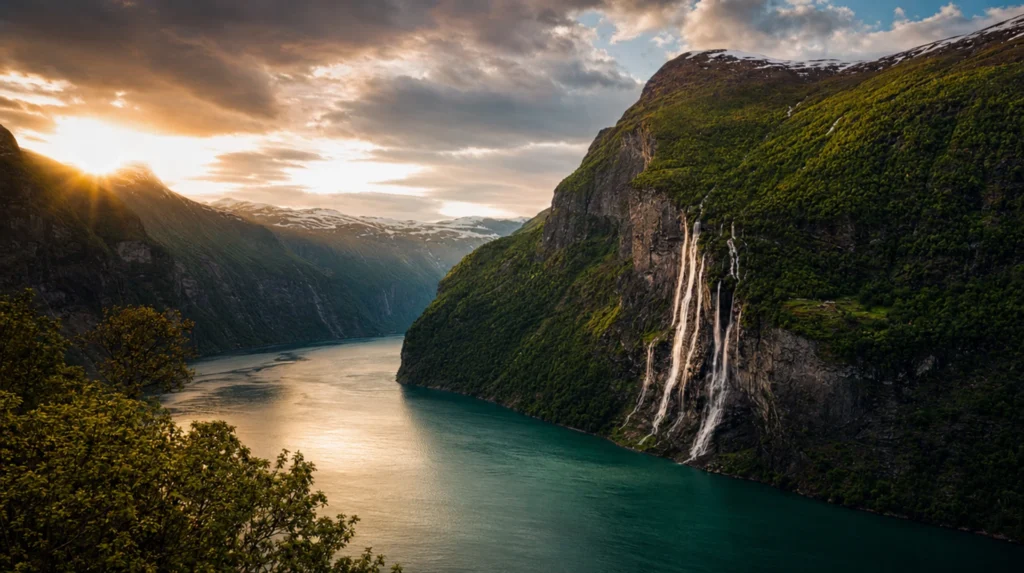
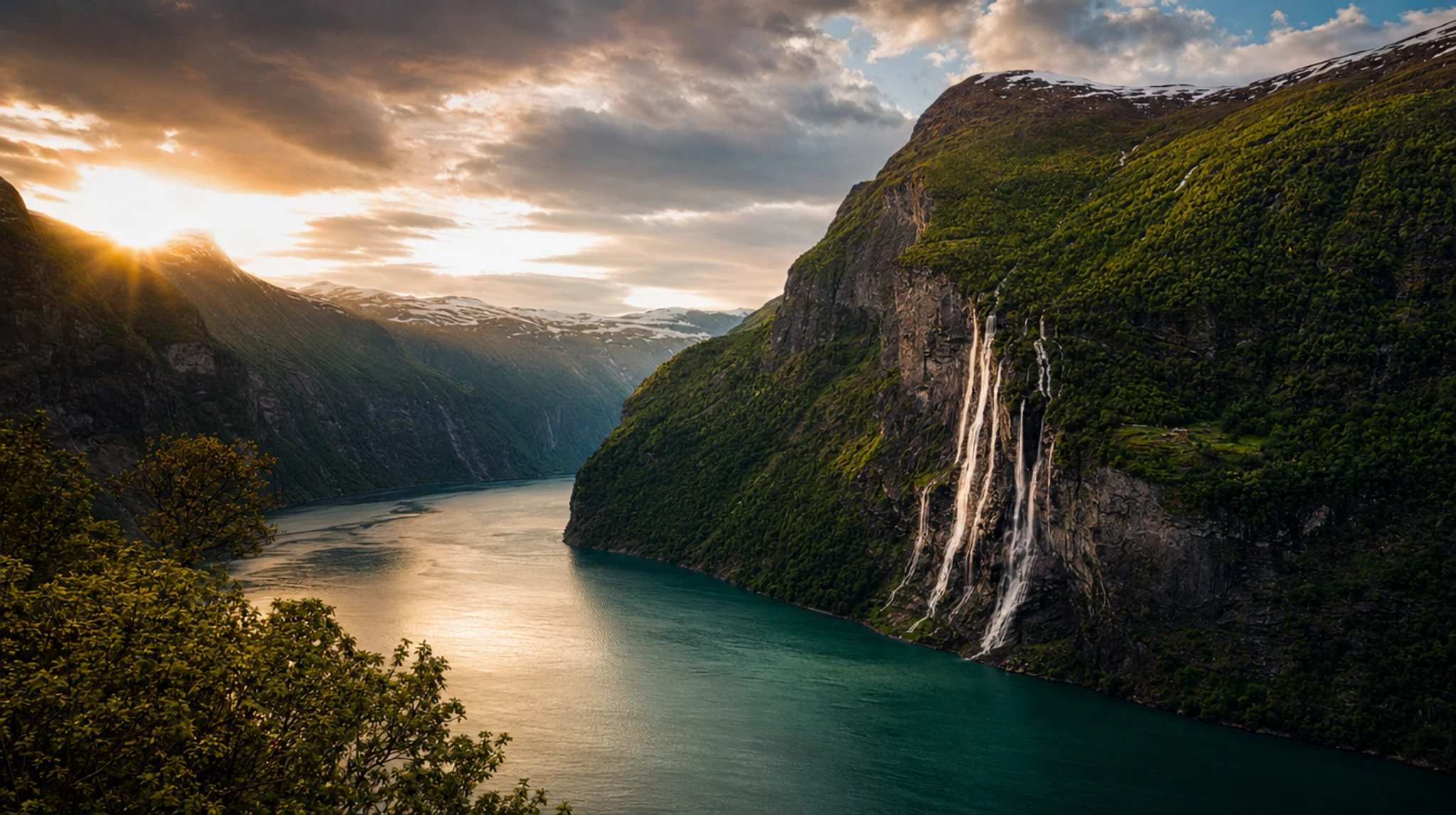
A UNESCO World Heritage fjord since 2005, with the Seven Sisters (De syv søstre) waterfall cascading 250 m straight into green water. The adjacent Trollstigen mountain road climbs 11 hairpin bends from sea level to the 858 m plateau and is open mid-May through early October only. Arrive on an early ferry from Hellesylt to avoid the cruise-ship wave that reaches the village around 10am.
Practical Information
| Currency | Norwegian Krone (kr / NOK); 1 USD ≈ 10.8 NOK (April 19, 2026). Norway does NOT use the euro and is NOT in the EU — tourist shops rarely accept euros. |
| Cash needs | Minimal. Norway is one of the world’s most cashless economies — cards and Vipps work everywhere, including at unattended ferry turnstiles and farm-stand honesty boxes. Carry NOK 200–500 as a fallback only. |
| ATMs | Minibank machines are at major Vy stations and bank branches (DNB, SpareBank 1). Decline dynamic currency conversion — choose NOK. |
| Tipping | Not required — service is included by law. Rounding up 5–10% for excellent table service is polite; American-style 15–20% is unnecessary. |
| Language | Norwegian (Norsk), two written forms: Bokmål (90%) and Nynorsk (10%). Sami languages are co-official in parts of Finnmark. English fluency is near-universal among under-50s. |
| Safety | Among the world’s safest countries — Global Peace Index rank 14 (2024). Main risks are pickpocketing in central Oslo and mountain/weather misadventure. |
| Connectivity | 4G/5G blanket coverage from Telenor, Telia and Ice; free WiFi on Vy InterCity trains, Flytoget and at airports. eSIMs (Airalo, Holafly) work nationwide. |
| Power | Type F plugs (Schuko, 2-pin with side earth), 230 V / 50 Hz — standard continental European. |
| Tap water | Excellent and free — among the cleanest in the world. Ask for ‘springvann’ at cafés; carry a refill bottle. |
| Healthcare | High-quality public system. EEA/UK visitors covered via EHIC/GHIC; others should carry comprehensive insurance. Emergencies: 112 police, 113 ambulance, 110 fire. |
Budget Breakdown — What Norway Actually Costs
💚 Budget Traveller
Norway’s budget floor is another country’s mid-range ceiling. Hostel dorms (Anker Hostel Oslo, Bergen YMCA, Tromsø Activities Hostel), grocery meals from Rema 1000, Kiwi and Coop Extra (the three discount chains that set Norway’s grocery prices), and a combination of Vy Minipris rail tickets plus urban 24-hour transit cards keep you at NOK 1,200–1,900 per day (roughly USD 115–180). A Rema 1000 take-away dinner runs NOK 90–120, a pølse (hot dog) at 7-Eleven is NOK 45, and free hiking with Allemannsretten covers the entertainment budget.
💙 Mid-Range
3-star hotel or Scandic, one proper sit-down meal a day, a couple of paid attractions per city (Flåm Railway round trip, Fløibanen funicular, a fjord cruise), and an Oslo Pass or Bergen Pass that bundles city museums and transit. Plan NOK 2,500–4,100 per day (roughly USD 235–380). The Oslo Pass 24-hour costs NOK 545 and covers all public transit plus 30+ museums. A Norway in a Nutshell round trip from Oslo is about NOK 2,390.
💜 Luxury
5-star hotels (The Thief Oslo, Britannia Hotel Trondheim, Opus XVI Bergen, Sorrisniva Igloo Hotel Alta), Hurtigruten or Havila suites, Michelin-starred tasting menus (Maaemo and Kontrast in Oslo, Re-Naa in Stavanger — a three-Michelin-star, two-Michelin-star and two-Michelin-star respectively), and private fjord charters. Plan NOK 6,500+ per day (USD 600+). A 12-day northbound Hurtigruten voyage Bergen–Kirkenes starts around NOK 18,000 in a standard outside cabin; suite fares triple that. Maaemo dinner with the full wine pairing lands around NOK 4,800 per person.
| Tier | Daily (USD) | Accommodation | Food | Transport |
|---|---|---|---|---|
| Budget | $115–180 | Hostel NOK 350–650 / budget cabin NOK 900–1,500 | NOK 250–400/day (Rema 1000 + street food) | Vy Minipris NOK 249 intercity / Oslo 24h NOK 127 |
| Mid-Range | $235–380 | 3-star hotel NOK 1,600–2,800 | NOK 500–1,000/day | Oslo Pass 24h NOK 545 / Norway in a Nutshell ~NOK 2,390 |
| Luxury | $600+ | 5-star hotel NOK 3,500–8,000+ | NOK 1,500–3,000/day | Hurtigruten Bergen–Kirkenes from NOK 18,000 / 12 days |
Planning Your First Trip to Norway
- Pick your season first. Aurora and winter sports run late September–March; Midnight Sun and fjord cruising peak June–August; 17 May is the biggest cultural date. Midnight Sun and Northern Lights are mutually exclusive.
- Book Vy Minipris 90 days out. Intercity fares start at NOK 249; walk-up fares can exceed NOK 900 on the same seat.
- Mix train, ferry and one flight. A classic first trip is Oslo + Bergen + Lofoten or Tromsø — Bergen Line, Norway in a Nutshell, then fly to the Arctic.
- Install Entur. The national journey planner combines trains, ferries, coaches and urban transit. Contactless cards work everywhere, so Vipps is optional for visitors.
- Pack for four seasons even in summer. Expect rain in Bergen, near-freezing nights at altitude, and glacier-bright sun. Wool or down shell, base layer, hiking boots — no city runners on Preikestolen.
Classic 10-Day Itinerary: Days 1–2 Oslo · Day 3 Bergen Line to Bergen · Day 4 Norway in a Nutshell (Flåm Railway + Nærøyfjord cruise) · Days 5–6 Bergen & Hardangerfjord · Day 7 fly Bergen → Tromsø · Days 8–9 Tromsø (aurora + Fjellheisen) · Day 10 fly home via Oslo.
Frequently Asked Questions
Is Norway expensive to visit?
Yes — consistently among the top-5 most expensive countries in the world. Alcohol is the notorious line item (NOK 120 for a half-litre of beer in Oslo), restaurants are NOK 250–400 for a main, and the budget floor is USD 115–180 per day with hostels and supermarket meals. Offset with early Vy Minipris tickets, an Oslo or Bergen Pass, and free hiking under Allemannsretten.
Do I need to speak Norwegian?
No. English fluency is near-universal among Norwegians under 50, and almost all signage, menus, transit announcements and museum labels appear in English as well as Norwegian. A few pleasantries — ‘takk’ (thanks), ‘hei’ (hi), ‘skål’ (cheers) — go a long way, but you will not need any Norwegian to travel confidently from Oslo to Tromsø.
Is the Oslo Pass / Norway in a Nutshell worth it?
For most travellers, yes. The Oslo Pass 24-hour (NOK 545) bundles all city transit plus free entry to 30+ museums including the Viking Ship, Munch and Vigeland — break-even is 3 museum visits. Norway in a Nutshell (Oslo–Bergen round trip with the Flåm Railway and Nærøyfjord cruise) costs about NOK 2,390 and is genuinely the most efficient way to see a fjord on a short visit.
Is Norway safe for solo travellers?
Extremely. Norway ranks 14th in the 2024 Global Peace Index; violent crime against visitors is very rare. The real risks are weather and terrain — hypothermia, sudden blizzards on Hardangervidda, or ice on an Oslo pavement. Emergency: 112 police, 113 ambulance, 110 fire. Check yr.no every morning before hiking.
When is Northern Lights season, and when is Midnight Sun?
Northern Lights run 21 September through 23 March, peaking December–February — the sky has to be dark, so both periods are mutually exclusive. Midnight Sun (the sun never sets) runs roughly 20 May through 22 July above the Arctic Circle and lasts slightly longer the further north you go.
Can I get by as a vegetarian or vegan?
Easily in Oslo, Bergen, Stavanger and Trondheim — every major city has several dedicated vegan restaurants and all supermarket chains stock Oatly and plant-based ready meals. In the rural north and on Hurtigruten, options thin — phone ahead or stock up at a Coop before a remote leg.
Is it really dark all winter, or light all summer?
Yes — but only above the Arctic Circle (66°34′ N). Tromsø’s Polar Night runs 27 November to 15 January (sun never rises, though there are hours of blue twilight); Midnight Sun there runs 20 May to 22 July. Oslo and Bergen have long dark winter days (5–6 hours of light in December) and long bright summer days (17–19 hours) but never full polar night or midnight sun.
Ready to Explore Norway?
Norway rewards travellers who respect its two big rhythms — the light cycle and the weather. Pick your season (aurora or Midnight Sun), book Vy Minipris tickets ninety days out, pack wool, and let the trains, ferries and coastal ships do the rest. Start in Oslo for culture, Bergen for the fjords, or Tromsø for the Arctic.
Explore More
Cities we cover in Norway
More country guides you might like
Plan your trip to Norway
The booking tools we use ourselves. FFU may earn a commission at no extra cost to you.
Plan & book your trip to Norway
Booking through these searches supports our guides at no extra cost to you.