
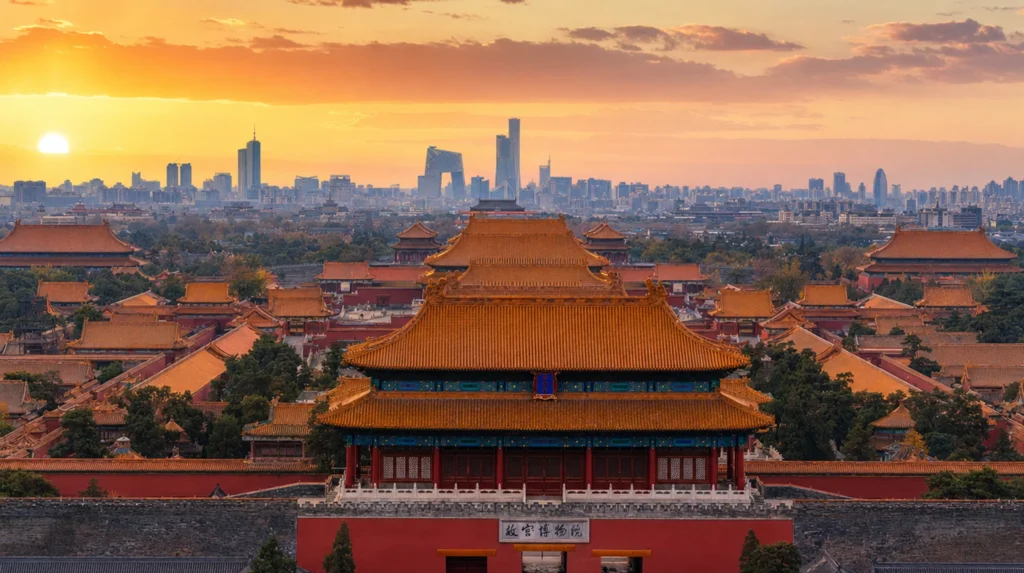
China · Forbidden City, Great Wall, hutongs
Beijing, China: Imperial Capital, Hutong Maze, Great Wall Base Camp
Part of our China travel guide.
I have lost more autumn afternoons in Beijing’s hutongs than I can count, and we keep coming back. The city is two cities — the imperial Beijing of the Forbidden City, the Temple of Heaven and the 13.4 km Ming city wall, and the modern Beijing of the CBD, the 798 art district and the Olympic Park. My favourite ritual is a 7am bowl of douzhi (mung-bean porridge) at Yao Ji Chao Gan in Gulou, then a slow walk through Nanluoguxiang’s grey-tile alleys before tour buses arrive at 9. This guide is the brief I would hand my own family before they boarded the airport express from PEK or PKX.

Table of Contents
Why Beijing?
Beijing has been a national capital, on and off, for more than a thousand years — capital of the Liao (938 CE), the Jin (1153), the Yuan (1271), the Ming (1421), the Qing (1644), and the People’s Republic since October 1949. The 21.8 million residents of the present-day municipality (NBS 2024 figures) live across 16,410 km² stretching from the Mutianyu mountains in the north to the Daxing plains south of PKX airport.
What makes Beijing different from any other Asian capital is the imperial-grid spine. The Forbidden City (1420 CE, the world’s largest preserved palace complex) sits at the centre. A single 7.8 km north–south axis, listed by UNESCO in 2024, runs from the Drum and Bell Towers in the north through Tiananmen Square to the Yongdingmen Gate in the south. The Temple of Heaven (1420), the Summer Palace (1750/1888), and the Ming Tombs are listed UNESCO sites along it.
Beijing’s two airports are PEK (Capital, north-east) and PKX (Daxing, south, 2019, the largest single-terminal airport when it opened). Both connect to downtown via Airport Express in 25–35 minutes. Plan five days minimum.
Neighborhoods: Finding Your Beijing
📍 Beijing Map: Every Place in This Guide


Dongcheng (Imperial Core)
The eastern half of the old city — Forbidden City, Tiananmen Square, the National Museum of China, Wangfujing shopping street, and the Drum and Bell Towers at the north end of the imperial axis. Most first-time visitors base here. The hutongs around Nanluoguxiang and Beiluoguxiang are the most photogenic alley clusters and the easiest to walk on a first morning.
- Forbidden City (Palace Museum) — 1420 CE, 980 surviving buildings, 8,704 rooms
- Tiananmen Square — world’s largest central public square, opened 1958
- Nanluoguxiang — restored hutong shopping street running 786 m north–south
Best for: first-time arrivals, monument density. Access: Subway L1 to Tiananmen East/West, L8 to Shichahai or Drum Tower.
Xicheng (Western Imperial)
The western half of the old city — Beihai Park (the Yuan-dynasty imperial garden, 1179), Houhai and Qianhai lakes, Shichahai’s hutong-and-bar district, the National Centre for the Performing Arts (the Paul Andreu ‘egg’, 2007), and the Ministry quarter. Slightly quieter than Dongcheng; the lakes anchor most evenings.
- Beihai Park — Yuan-dynasty imperial garden with the white Buddhist stupa
- Houhai Lake — winter ice-skating, summer rowboats, hutong-fringe bars
- National Centre for the Performing Arts (NCPA / ‘the Egg’)
Best for: lakeside walks, quieter hutongs, NCPA opera. Access: L1 to Tiananmen West then walk; L4 to Xidan.
Chaoyang (CBD & Embassy Quarter)
The eastern modern Beijing — CBD with the OMA-designed CCTV Tower (2012), Sanlitun’s bar-and-restaurant streets, the Embassy quarter, the 798 art district, and the Workers’ Stadium (rebuilt 2023). Where most expat residents live and where most international restaurants concentrate.
- 798 Art District (Dashanzi) — repurposed Bauhaus factory shells, 100+ galleries
- Sanlitun Taikoo Li — luxury-and-cafe shopping cluster
- CCTV Headquarters tower — OMA / Rem Koolhaas, 234 m
Best for: contemporary art, dinner, expat-friendly bars. Access: L10 to Tuanjiehu or Liangmaqiao.
Haidian (University & Summer Palace)
The university quarter in the north-west — Peking University and Tsinghua University campuses, the Summer Palace, the Old Summer Palace ruins (Yuanmingyuan), and the Zhongguancun tech-campus cluster. The Summer Palace alone is a half-day; combine with the universities for a full day.
- Summer Palace (Yiheyuan) — Qing-dynasty imperial garden, UNESCO 1998
- Old Summer Palace (Yuanmingyuan) — destroyed 1860, ruins as memorial site
- Peking University — historic Yenching campus, founded 1898
Best for: imperial gardens, photography, half-day excursion. Access: L4 to Beigongmen (Summer Palace north gate).
Olympic Park & the Northern Axis
The 2008-and-2022 Olympic legacy zone — Bird’s Nest stadium, the Water Cube (now an indoor water park), the National Speed Skating Oval (‘Ice Ribbon’, 2022), and Olympic Park itself. Walk-friendly on a clear afternoon; the kid-friendly anchor of north Beijing.
- Bird’s Nest (National Stadium) — Herzog & de Meuron + Ai Weiwei, 80,000 seats
- Water Cube / Ice Cube — 2008 Olympic swimming venue, now indoor water park
- Olympic Park — 11.59 km² landscaped park anchoring the northern axis
Best for: 2008/2022 Olympic photography, families. Access: L8 to Olympic Sports Centre or Forest Park South Gate.
Qianmen & Dashilan (South of Tiananmen)
The restored historic-commerce strip immediately south of Tiananmen — Qianmen Street’s pedestrian shopping run, the Dashilan hutong cluster, Liulichang antiques street, and the Qianmen rebuilt arrow tower. Touristy but well-curated; the hutongs immediately east and west of Qianmen are the genuine ones.
- Qianmen Street — restored late-Qing pedestrian shopping street
- Liulichang — antique-books and traditional-painting alley
- Dashilan Old Brand Cluster — Tongrentang pharmacy (1669), Liubiju pickles (1530)
Best for: traditional brands, ground-level history walking. Access: L2 / L7 / L8 to Qianmen.
Gulou & Jiaodaokou
The Drum-Tower hutong neighbourhood north of Jingshan Park — increasingly the city’s craft-beer, indie-coffee and small-restaurant hub since 2018. The southern axis of the UNESCO 2024 inscription ends here at the Drum and Bell Towers (Yuan-Ming era; the Bell Tower drum signalled the closing of the city gates each evening).
- Drum and Bell Towers (Gulou and Zhonglou) — Yuan-Ming axis terminus
- Yandai Xiejie — pipe-tobacco-shop alley off Houhai
- Modernista, Slow Boat Brewery, Great Leap Brewing — anchor evening venues
Best for: craft beer, hutong evenings, indie coffee. Access: L8 to Shichahai or Drum Tower.
Mutianyu / Huanghuacheng (Wall Bases)
Two of the most accessible sections of the Great Wall, both in Huairou district 70–90 minutes north-east of downtown. Mutianyu (about 70 km from city centre) is the restored, family-friendly section with cable car and toboggan; Huanghuacheng (90 km) is the ‘lakeside Great Wall’, semi-restored, much quieter. The Badaling section closer to PEK airport is more crowded and less photogenic.
- Mutianyu — restored 5.4 km section, cable car + chair lift + toboggan
- Huanghuacheng — partially submerged ‘lakeside’ Great Wall
- Badaling — 1957-restored, easiest from city via S2 train; weekday only
Best for: Great Wall day-trip base. Access: Mutianyu — Bus 916 to Huairou + minibus, or DiDi (~¥350 round-trip).
The Food

Beijing Classics, Done Properly
Beijing food is the imperial-court repertoire plus the northern-Chinese pantry — Peking duck is the headline, but jiaozi (boiled dumplings), zhajiangmian (Beijing fried-sauce noodles), shuanyangrou (lamb hotpot), jianbing (savoury crepe) and luzhuhuoshao (offal stew) all anchor the local table.
- Quanjude (Qianmen, since 1864) — original Peking-duck restaurant, set duck dinner ¥600–900 per person
- Da Dong Roast Duck (multiple branches) — modern Beijing-duck pioneer, lean roasted bird, ¥400–600
- Siji Minfu (multiple branches) — locals’ best-value duck destination, ¥300–450
Hutong & Hot Pot
The everyday Beijing dinner is hotpot — lamb-broth shuanyangrou in winter, mala (Sichuan-spicy) hotpot in summer — and a hutong noodle bowl any time. Houhai and Gulou neighbourhoods hold the highest hotpot density.
- Donglaishun (Wangfujing, since 1903) — copper-pot lamb hotpot, the original Beijing shuanyangrou.
- Yao Ji Chao Gan (Gulou) — offal stew (luzhuhuoshao) and douzhi (mung-bean porridge), ¥30–60. The breakfast Beijing eats.
- Old Beijing Zhajiangmian Royal Restaurant (Wangfujing) — fried-sauce noodles, ¥50–80.
Modern Beijing & Michelin
The Michelin Guide arrived in Beijing in 2020; the city has a dense modern-Chinese fine-dining scene that did not exist a decade ago. Reservations open four to six weeks ahead at the busiest tables; menus shift seasonally.
- King’s Joy (Yonghegong, 3 stars) — vegetarian Buddhist fine dining, around ¥1,800.
- Xin Rong Ji (Xinyuanli, 3 stars) — Taizhou seafood, ¥1,500–2,500.
- Mio (Four Seasons CBD) — Italian fine dining, the Sanlitun benchmark.
- TRB Hutong (Beichizi) — French in a converted Buddhist temple courtyard, ¥1,200 tasting menu.
Food Experiences You Cannot Miss
- A Donghuamen-style street-food crawl at Wangfujing Snack Street — jianbing (savoury crepe), tanghulu (candied-haw skewers), chuan’r (lamb skewers)
- A morning douzhi-and-jiaoquan breakfast at any Gulou hutong stall, ¥15
- A weekend brunch at Sanlitun followed by 798 gallery hopping — the modern half of Beijing’s food scene
Cultural Sights

Forbidden City (Palace Museum)
The Ming-Qing imperial palace 1420–1912 — 980 surviving buildings, 8,704 rooms, the largest preserved palace complex on Earth. UNESCO World Heritage 1987. Adult ticket ¥60 (Apr–Oct) / ¥40 (Nov–Mar) in 2026, plus separate ¥10 ticket for the Treasure Gallery and ¥10 for the Clock Gallery (verify on official site). Tickets sold online only via the Palace Museum app or website; pre-book three to seven days ahead in shoulder season, two weeks ahead in October’s first week.
Great Wall — Mutianyu Section
The most accessible restored section, 70 km north-east of city centre in Huairou district. Cable car or chair lift up; toboggan or chair lift down. Adult ticket ¥45 plus cable car ¥120 round-trip in 2026 (verify on site). The Wall section runs along a forested ridge; autumn (mid-October) and spring (April) are the photogenic windows. UNESCO 1987.
Temple of Heaven (Tiantan)
The Ming-Qing imperial sacrificial complex south of Tiananmen — Hall of Prayer for Good Harvests (1420, the round triple-eaved tower), the Echo Wall, and the Circular Mound Altar. UNESCO 1998. Adult through-ticket ¥34 in 2026 (verify on site). Best in early morning when locals come for taiji and ballroom dancing in the surrounding park.
Summer Palace (Yiheyuan)
The Qing imperial garden in the north-west — 2.9 km² of designed landscape around Kunming Lake, the Long Corridor (728 m), the Marble Boat (1755), the Tower of Buddhist Incense, and Empress Dowager Cixi’s residence. UNESCO 1998. Adult through-ticket ¥30 in summer / ¥20 in winter (verify on site). Plan four hours.
Tiananmen Square & National Museum of China
The 880 m × 500 m central square is the world’s largest, anchored by the 38 m Monument to the People’s Heroes (1958), the Mao Memorial Hall (1977), the Great Hall of the People, and the National Museum of China on the east side. National Museum free admission with passport reservation (book 7 days ahead). The Square requires a passport scan and security check at any entrance.
Lama Temple (Yonghegong)
The most active Tibetan-Buddhist temple in Beijing — Qing-era former princely residence converted to a Gelug-school monastery in 1744. The Wanfu Pavilion holds an 18 m statue of Maitreya carved from a single sandalwood log. Adult ticket ¥25; passport required at entrance.
798 Art District (Dashanzi)
The 1950s East-German Bauhaus factory complex in north-east Chaoyang, repurposed since 2002 as Beijing’s contemporary-art quarter — 100+ galleries, the UCCA Center for Contemporary Art (2007), the Pace Gallery, and Galleria Continua’s Beijing space. Free entry to the district; individual gallery shows ¥0–80. Allow half a day; combine with Sanlitun dinner.
Hutong Walking Tour (Houhai & Nanluoguxiang)
Beijing’s old courtyard-house alleys — around 4,000 named hutongs once, perhaps 1,000 surviving in something resembling traditional form. Houhai’s lake-fringing alleys and the Nanluoguxiang–Beiluoguxiang grid are the most-walked, but Wudaoying, Fangjia and Banchang hutongs (south of Yonghegong) are the quieter, more residential alternative. Free; bring comfortable shoes.
Beijing Capital Museum (Shoudu Bowuguan)
The municipal history museum at Fuxingmen — 5,000 years of Beijing-area artefacts including the Yuan-dynasty blue-and-white porcelain hoard discovered at Fuxingmen in 1970. Free with passport reservation (book 3–7 days ahead).
Entertainment

Beijing Opera (Jingju)
UNESCO Intangible Cultural Heritage since 2010. Liyuan Theatre at the Qianmen Hotel runs the most tourist-friendly evening performances (with English supertitles, ¥180–680). NCPA stages the opera in its main hall on selected weekends; the Beijing People’s Art Theatre (Wangfujing) is the home of contemporary spoken theatre.
NCPA (the ‘Egg’)
The Paul Andreu titanium-and-glass dome opposite the Great Hall of the People — Beijing’s flagship classical-music, opera and ballet venue, 2007. Three halls (Opera House, Concert Hall, Theatre); tickets ¥80–1,800. The architecture alone justifies the visit; the underwater entrance corridor is a small theatrical event.
Bars & Live Music
Sanlitun is the bar headline strip — Migas Mercado, Janes & Hooch and Mokihi anchor the cocktail scene; the basement-level Modernsky Lab (Sanlitun) and Yugong Yishan (Gulou) are the indie-music live venues. Hutong-side, Slow Boat Brewery (Dongcheng) and Great Leap Brewing (Beixinqiao) anchor craft beer.
Beijing International Film Festival (April)
The annual ten-day BJIFF runs every April across Beijing screens — opening at the Yanqi Lake Convention Centre and screening across UME, Wanda and Stellar cinema clusters. 2026 dates: 18–26 April. Programme posted mid-March; tickets via Maoyan and Damai.
Beijing Winter Snow Festival (January–February)
Annual winter festival across Beijing’s parks during late-January / mid-February — ice sculptures at Longqing Gorge, snow play and ice-curtain installations at Yuyuantan Park, and traditional snow-and-ice activities (sledding, ice bicycles) at Beihai and Houhai. 2026 main programme runs 17 January through 22 February (verify on Visit Beijing). Free entry; individual park admissions ¥10–40.
Workers’ Stadium & Football
Beijing Guoan plays at the rebuilt Workers’ Stadium (2023, 68,000 seats) — Chinese Super League fixtures March through November, tickets ¥80–500 via Damai.
Day Trips

Mutianyu Great Wall (Full day, by car or bus)
The most accessible restored Great Wall section, 70 km from city centre in Huairou. Cable car up, toboggan or chair lift down; 5.4 km of restored wall along a forested ridge. Bus 916 from Dongzhimen (¥12) plus a Huairou minibus, or DiDi/private car around ¥350 round-trip. Arrive by 09:00 to clear the 09:30 tour-bus wave.
Ming Tombs (Half day, 50 km north)
The Sacred Way and 13 Ming-dynasty imperial mausoleums in Changping district — Changling (Yongle’s, 1424) and Dingling (Wanli’s, opened to visitors after 1956 excavation) are the two visitor-accessible tombs. UNESCO 2003 (Imperial Tombs of the Ming and Qing). Through-ticket ¥130 in 2026 (verify on site).
Chengde & the Mountain Resort (Full day, 230 km, by high-speed rail)
The Qing summer-retreat compound — 5.6 km² walled imperial garden with Tibetan-Buddhist outer temples (the ‘Eight Outer Temples’) and the Mountain Resort palace. UNESCO 1994. 1.5 hours from Beijing by high-speed rail (G-train) from Beijing North; through-ticket ¥130. Long day; an overnight is the better version.
Tianjin (Half day, 130 km, by high-speed rail)
30 minutes from Beijing South via the Beijing–Tianjin intercity rail (¥55 second class). Italian Concession quarter, Tianjin Eye observation wheel, and goubuli baozi (steamed pork buns) at the original Wuda Dao address. The easiest second-city add-on for a Beijing trip.
Sidaoli & Jiankou (For experienced hikers, full day)
The unrestored ‘wild’ Great Wall section north of Mutianyu — Jiankou’s collapsed watchtowers and the Jiankou-to-Mutianyu hiking traverse (3–4 hours, scrambling required). Hire a local guide; do not attempt in rain or after October snowfall.
Seasonal Guide

Spring (Mar–May)
Photogenic blossom and clear skies but punctuated by occasional yellow-sand storms blowing south from Inner Mongolia. Average temperatures climb 8°C → 22°C; cherry blossom in Yuyuantan Park (early April), peony at Jingshan Park (mid-April). The Beijing International Film Festival lands late April. Hotel rates 25–35% above winter.
Summer (Jun–Aug)
Hot and humid; July averages 27°C with peaks above 35°C and sticky afternoons. Compensation: 14-hour daylight and the full Beijing-2008 outdoor-pool circuit. The Forbidden City is least pleasant in July; arrive 08:30 sharp. Hotel rates remain elevated through the school-holiday peak.
Autumn (Sep–Nov)
The best window. September–October bring crystalline skies, 20°C → 8°C temperatures and the most photogenic cityscape of the year — autumn maples at Mutianyu and Fragrant Hills (Xiangshan), the Forbidden City courtyards in low gold light. October’s first week (National Day Golden Week, 1–7 October) is the single worst week for crowds; avoid.
Winter (Dec–Feb)
Cold and dry; January averages −4°C with overnight lows around −10°C. The Beijing Winter Snow Festival runs late January through mid-February — ice sculptures at Longqing Gorge, ice-skating at Houhai. Air-quality advisories more frequent in winter; pack a KN95 mask. Hotel rates 30–40% below summer.
Getting Around
Walking
Inside the Forbidden City – Tiananmen – Wangfujing core, walking works. The imperial city is bigger than it looks on a map; Forbidden City north gate to Drum Tower is 1.6 km, Tiananmen to Temple of Heaven is 3 km. The city’s grid and ring-road geometry mean walking outside the second ring is rarely worthwhile.
Beijing Subway (27 lines)
The world’s busiest metro by annual ridership, 836 km of track and 27 lines as of 2025 — Lines 1, 2, 4, 5, 8, 10 cover almost every visitor destination. Single fare ¥3–10 distance-based in 2026 (verify on site). Security check at every entry; passport accepted as ID. The Airport Express (¥25) connects PEK to Sanyuanqiao (L10) and Dongzhimen (L2).
Yikatong (IC Card) / WeChat & Alipay
The Yikatong is the all-in-one transit card — works on metro, bus, and the Airport Express. ¥20 deposit + load via cash at any metro service centre. Alternative: WeChat Pay or Alipay ‘transit code’ once your wallet is set up — scan at the gate, fare deducted automatically. Both are now active for foreign-card users (since 2024).
Airport Access
- PEK → Dongzhimen: Capital Airport Express, 21 minutes, ¥25.
- PKX → Caoqiao (L19): Daxing Airport Express, 19 minutes, ¥35.
- Either airport → downtown by DiDi: ¥150–250, 45–80 minutes depending on traffic.
Taxis & DiDi
Yellow city taxis are metered (drop ¥13, then ¥2.3/km). DiDi (the dominant ride-hail app) accepts foreign cards via the DiDi-International app. Sanlitun → Tiananmen around ¥40–60. Friday afternoon peak adds 50–80% to journey times; switch to subway between 16:30 and 19:30.
Bicycles & Mobikes
Beijing has 3,200 km of bicycle lanes and a thick fleet of dock-less Meituan/Hello bikes — ¥1.5 per 30 minutes. Bike from Houhai to the Forbidden City through the hutong grid in 15 minutes; the city is flat and the cycle infrastructure post-2018 is genuine.
Navigation Tips
Apps: Amap (Gaode) or Baidu Maps for accurate Beijing routing — Google Maps shows incorrect location offsets in mainland China. WeChat for messaging and payments. A working VPN (set up before arrival) is needed for Google services, Instagram and most international news.
Budget Breakdown: Making Your Yuan Count
| Tier | Daily | Sleep | Eat | Transport | Activities | Extras |
|---|---|---|---|---|---|---|
| Budget | USD $50–80 | Hostel dorm ¥120–250 | Hutong noodles ¥40–80 | Subway ¥3–10/ride | Forbidden City ¥60, Temple of Heaven ¥34 | Jianbing breakfast ¥10, baijiu ¥40 a glass |
| Mid-Range | USD $130–220 | 4-star hotel ¥600–1,400 | Sit-down dinner ¥150–350 | Subway + DiDi | Mutianyu ¥165 (entry + cable car), 798 free | Quanjude duck ¥600, hutong tour ¥250 |
| Luxury | USD $400+ | 5-star hotel ¥2,000–8,000+ | King’s Joy / Da Dong ¥1,800 | Private driver ¥1,500/day | Private Mutianyu hike + chef ¥4,500 | Aman Summer Palace ¥6,000+ |
Where Your Money Goes
Beijing is much cheaper than Shanghai and dramatically cheaper than Tokyo or Seoul for the same level of comfort. The biggest line item for most mid-range travellers is the Great Wall trip — DiDi round-trip plus tickets and cable car runs ¥500–800; a private driver-and-guide is ¥1,200–1,800. Restaurant prices have crept up since 2020 but mid-range hutong dinners still come in around ¥200/head with drinks.
Money-Saving Tips
- Book Forbidden City and major temple tickets directly through the Palace Museum app/website — ¥60 vs ¥220 ‘skip-the-line’ tour pricing.
- Eat hutong stalls and Wangfujing snack street for ¥40 lunches; save the Quanjude / Da Dong duck dinners for one big meal.
- Use the subway end-to-end; a five-day Yikatong stay rarely tops ¥80 in fares.
- Avoid National Day Golden Week (1–7 October) and Spring Festival (mid-Feb 2026) — both 2× normal hotel rates.
Practical Tips
Language
Mandarin (Putonghua) is the working language; signs in central Beijing are bilingual at major sights and on the subway, but English fluency is limited outside top hotels and the diplomatic district. Pinyin transliteration on phone keyboards is the fastest tool. Learn ‘nǐ hǎo’ (hello), ‘xiè xiè’ (thank you), ‘duō shǎo qián’ (how much), ‘wǒ bù yào’ (I don’t want).
Cash vs. Cards / WeChat & Alipay
Beijing is essentially cash-light and increasingly QR-only. Both WeChat Pay and Alipay accept foreign Visa/Mastercard since November 2023. Set both up before arrival. Top hotels, Wangfujing tourist restaurants and the Capital Airport accept foreign cards directly; everywhere else expects QR. ATMs at Bank of China, ICBC and Bank of Communications dispense ¥3,000 per withdrawal.
Safety
Beijing is among the safest world capitals — petty theft is rare, violent crime against tourists almost unknown. The genuine risks are scams aimed at tourists (the ‘tea ceremony’ scam at Wangfujing, art-student gallery scams near 798, fake taxi drivers at PEK). Always insist on a metered yellow taxi or a DiDi confirmation. Emergency 110 (police), 120 (medical).
Visa & the 240-hour Transit
54 nationalities (including US, UK, Australia, EU, Canada) qualify for a 240-hour (10-day) transit visa-free entry as of December 2024, valid for travel between mainland Chinese cities and onward to a third country. For longer or non-transit visits, a standard L tourist visa is required from a Chinese consulate before arrival. Carry your passport at all times.
Connectivity & the Great Firewall
4G/5G is excellent across central Beijing; international roaming or a China Unicom prepaid SIM works fine. The Great Firewall blocks Google, YouTube, Instagram, Facebook, WhatsApp, Twitter/X, Discord, Reddit, the BBC and most international news; you need a working VPN to use any of them. Set up the VPN before you arrive. Hotel WiFi is slow but unfiltered for some Western platforms in higher-end hotels.
Health & Medications
Public hospitals are inexpensive but Mandarin-only at intake; Beijing United Family Hospital (Lido) and Vista Medical Center (Kerry Centre) are the international expat clinics. Pharmacies (yàofáng) carry Western and Chinese medications. Travel insurance recommended; carry prescription medications in original packaging.
Air Quality
Beijing’s PM2.5 is dramatically improved versus the 2013–2015 ‘airpocalypse’ years but still occasionally spikes in winter (especially January). Carry a KN95 mask and check AQI on the U.S. Embassy app or AirVisual before booking outdoor activities. AQI >150 is a sensitive-group warning; AQI >200 is reduce-outdoors-time territory.
Cultural Etiquette
Do not place chopsticks vertically in rice (associated with funerary offerings). Tipping is uncommon and many restaurants will refuse a tip. Don’t discuss politics with strangers; topics like Tiananmen Square 1989, Tibet, Xinjiang and Taiwan are sensitive in any public conversation. Photographing soldiers, police and government buildings is restricted.
Frequently Asked Questions
How many days do I need in Beijing?
Five days minimum. Allocate two to the Forbidden City, Temple of Heaven and the central hutong grid; one to the Great Wall (Mutianyu); one to the Summer Palace and 798; one floating day for hutong walking, food, or a Tianjin half-day. Seven days lets you add Chengde or a deeper Wall hike without rushing.
Is Beijing good for solo travellers?
Yes — petty crime is rare and the city is straightforward to navigate solo. The genuine challenge is the language barrier outside top hotels; Pinyin keyboards, Pleco dictionary, and Google Translate (over a VPN) solve most of it. Female solo travellers report Beijing as one of the safer Asian capitals; standard precautions apply.
Do I need a visa for Beijing?
Probably not, if you’re from one of the 54 qualifying nationalities and transiting onward to a third country within 240 hours (10 days). For longer stays, returning to your origin, or visiting non-listed cities, you need a standard L tourist visa from a Chinese consulate.
What about the Great Firewall — can I still use my phone?
Yes, but with caveats. International roaming (e.g. AT&T, EE, Vodafone) on most foreign carriers works without filtering — your usual apps run as if you were at home. Local SIMs and hotel WiFi are filtered. Set up a paid VPN (ExpressVPN, NordVPN, Astrill — install before arrival) for filtered networks.
When are the busiest weeks?
National Day Golden Week (1–7 October) is the single worst week of the year — domestic crowds peak at every monument, hotel rates double. Spring Festival (Chinese New Year, mid-February 2026) is the second-busiest. Avoid both; September and late-October are the dream windows.
Can I use credit cards everywhere?
No. Top hotels, Capital Airport and Wangfujing tourist restaurants accept Visa/Mastercard. Hutong addresses, taxis, mid-range restaurants and metro stations are essentially QR-only — set up WeChat Pay or Alipay (both accept foreign cards since November 2023) before arrival.
Is the Forbidden City worth the queues, or should I skip it?
Worth it but you must pre-book online (Palace Museum app or website, 7 days ahead in shoulder season, 14 days ahead in October). Day-of walk-up tickets do not exist. Arrive at 08:30 sharp, enter via the Meridian Gate (south), exit via the Gate of Divine Prowess (north) toward Jingshan Park. Plan three to four hours; allow another hour for the Treasure Gallery (separate ¥10 ticket).
Ready to Experience Beijing?
Five days in the imperial-grid capital, two hutong evenings, one Mutianyu sunrise — that is the Beijing rhythm. For the full country context, read the China Travel Guide (forthcoming).
Explore More City Guides
Where to Stay
- Shanghai City Guide — China’s east-coast economic capital and Bund waterfront
- Xi’an City Guide — Tang dynasty capital and Terracotta Army gateway
- Hong Kong City Guide — Pearl River Delta SAR and Victoria Harbour skyline
- Taipei City Guide — Taiwan’s capital and night-market headquarters
- China Country Guide
- All City Guides
Alex the Travel Guru
Alex has been writing destination guides for FFU since 2019, with eight Beijing trips on the docket and one annual mid-October hutong-and-Wall week. Beijing is the city Alex most often recommends to travellers wanting an imperial-Asian capital with the historical density of Rome — five days in Beijing covers more dynastic monuments than a week in any European capital. For the full country context, read the China Travel Guide (forthcoming).
More city guides you might like
Plan your trip to Beijing
The booking tools we use ourselves. FFU may earn a commission at no extra cost to you.
Plan & book your trip to Beijing
Booking through these searches supports our guides at no extra cost to you.