
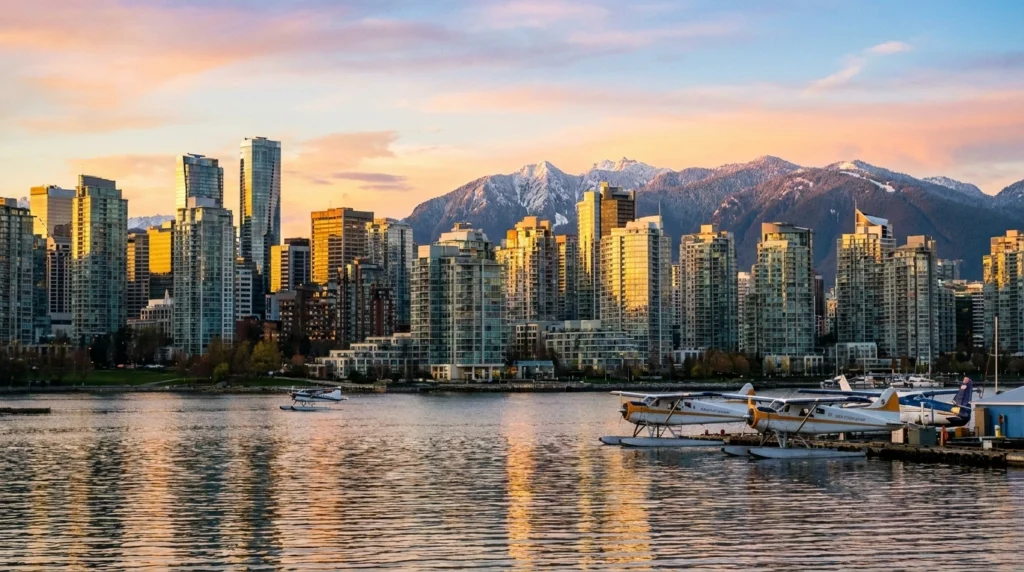
Vancouver, Canada: Where Rainforest, Ocean and Ski Slopes Meet Downtown
Part of our Canada travel guide.
Vancouver City Guide
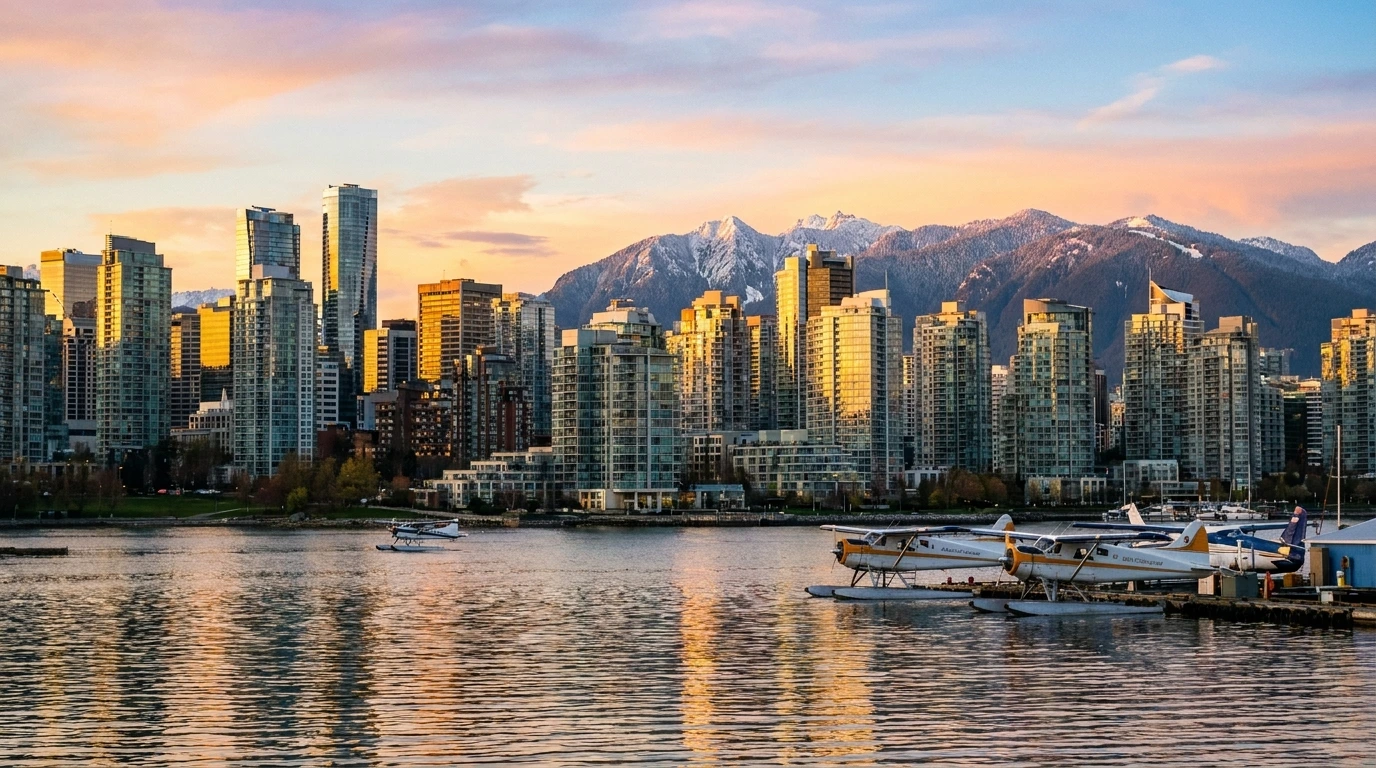
Table of Contents
Why Vancouver?
Vancouver is Canada’s Pacific gateway and the third-largest metro in the country, with roughly 2.6 million residents spread across 21 municipalities wedged between the saltwater of Burrard Inlet and the Strait of Georgia and the 1,500-metre wall of the Coast Mountain range. The City of Vancouver proper covers just 115 square kilometres and holds about 675,000 people, but the physical geography — ocean on three sides, mountains visible from almost every downtown intersection, 180 parks inside city limits — is what most visitors remember a year later.
The contrasts are built into the rhythm of a single day. A local can ski at Cypress Mountain in the morning, paddleboard False Creek at lunch, and eat Michelin-starred sushi in Chinatown by 8 p.m. — all without leaving the metro region. The city hosted the 2010 Winter Olympics, pushing the 2,000-kilometre Sea-to-Sky Highway upgrade and legacy venues at Richmond Oval, Whistler Olympic Park, and the freestyle hill at Cypress into permanent tourist infrastructure.
Vancouver is also demographically a Pacific-Rim city. Approximately 55% of City of Vancouver residents speak a language other than English at home, and neighbouring Richmond is about 55% ethnic Chinese — the highest proportion of any Canadian municipality. That density shows up directly in the food: North America’s deepest Cantonese dim sum scene outside Hong Kong, a Vietnamese strip on Kingsway that runs for 8 kilometres, 200+ restaurants on three blocks of Richmond’s Alexandra Road, and a dedicated Michelin Guide that launched in 2022 and named 8 starred restaurants by its 2024 edition.
The scale runs in unusual directions. Stanley Park covers 405 hectares — larger than New York’s Central Park — and its 10-kilometre seawall is the longest continuous uninterrupted waterfront path in North America. The city has planted roughly 43,000 ornamental cherry trees across public streets and parks, so that for three weeks every April the residential grid from Queen Elizabeth Park to East Vancouver turns pink. And despite being Canada’s rainiest major city (roughly 1,457 mm per year, 161 rainy days), it also records the mildest winters of any major Canadian city — January average 3°C / 37°F.
This guide covers the ten neighborhoods that define the city, the restaurants and markets behind its Pacific-Rim food reputation, the sights that anchor its cultural calendar, the day trips that unlock Whistler and Victoria, and the transit, budget, weather, and Compass-card details that make a first trip run smoothly on arrival from YVR.
Neighborhoods: Finding Your Vancouver
📍 Vancouver Map: Every Place in This Guide
Vancouver’s character changes sharply over short distances. Gastown’s cobblestones sit 1.5 kilometres east of the glass canyons of Yaletown; Kitsilano’s beach bungalows are a 15-minute bus ride but a different climate of mood from Commercial Drive’s eastside grit. A base downtown (Coal Harbour, West End, or Yaletown) puts eight of these ten neighborhoods within 25 minutes by SkyTrain, SeaBus, or Aquabus; the North Shore and Richmond sit further afield but are worth the travel.
Gastown
Gastown is Vancouver’s oldest neighborhood, founded in 1867 around John “Gassy Jack” Deighton’s saloon on the south shore of Burrard Inlet. Two decades of neglect after World War II gave way to a heritage preservation campaign in the 1970s that saved the Victorian warehouses and cobblestone streets; today the district holds design shops, craft cocktail bars, Indigenous art galleries, and a dense restaurant strip along Water Street. The Steam Clock at Water and Cambie — built in 1977 and one of the only working steam clocks in the world — sounds on the quarter hour. Blood Alley and Trounce Alley, restored laneway pockets, hold speakeasy-style bars including The Diamond and Pourhouse. The Inuit Gallery of Vancouver, operating since 1979, is one of the foremost authorities on Inuit sculpture in Canada.
- Steam Clock at Water and Cambie (1977; sounds every 15 minutes)
- Gassy Jack statue at Maple Tree Square
- L’Abattoir, Pourhouse, The Diamond (cocktail bars)
- Inuit Gallery of Vancouver (Indigenous art)
- Blood Alley and Trounce Alley (restored laneways)
Best for: cocktail bars and design shopping. Access: Waterfront Station (Expo, Canada, Millennium lines; SeaBus terminus).
Yaletown
Yaletown was the Canadian Pacific Railway’s main-line industrial rail yard and warehouse district through most of the 20th century; the 1986 World Exposition — Expo 86, held on adjacent False Creek — triggered the redevelopment that turned brick-and-beam warehouses into loft condos and patio restaurants. The neighborhood now fits into a compact 12-block grid between Homer, Nelson, Pacific, and Drake, with the False Creek seawall on its south edge and BC Place Stadium at its east. The Roundhouse Community Arts Centre, a converted CPR locomotive shed, houses Engine 374 — the steam locomotive that pulled the first transcontinental passenger train into Vancouver on May 23, 1887. Blue Water Cafe and Homer Street Cafe anchor the dining strip; the seaplane terminal at Coal Harbour (five minutes by Aquabus) runs Harbour Air flights to Victoria and the Gulf Islands.
- Roundhouse Community Arts Centre and Engine 374 Pavilion
- BC Place Stadium (54,500 seats; BC Lions CFL + Whitecaps MLS)
- David Lam Park seawall and Coopers’ Park
- Blue Water Cafe, Homer Street Cafe
- Aquabus and False Creek Ferries to Granville Island
Best for: waterfront dining and young-professional nightlife. Access: Yaletown-Roundhouse Station (Canada Line).
Kitsilano
Kitsilano (“Kits” to locals) is the city’s westside beach neighborhood, stretching along the south shore of English Bay from Burrard Bridge west to Jericho. It is also the birthplace of Lululemon, which opened its first store at 2113 West 4th Avenue in 1998. Kitsilano Beach frames postcard views of the downtown skyline with the North Shore Mountains behind; the 137-metre Kitsilano Pool — the longest pool in Canada — runs alongside the beach and is heated saltwater from late May through September. Vanier Park, immediately east of Kits Beach, is a single cluster holding the Museum of Vancouver, the H.R. MacMillan Space Centre (with its conical roof inspired by a Haida woven-cedar hat), and the Vancouver Maritime Museum. West 4th Avenue between Burrard and Balsam holds the surf shops, brunch spots, and yoga studios that give the neighborhood its reputation.
- Kitsilano Beach and Kitsilano Pool (137 m, longest pool in Canada)
- Vanier Park cluster (Museum of Vancouver, Space Centre, Maritime Museum)
- West 4th Avenue shops, cafes, yoga studios
- Jericho Beach, Locarno Beach, Spanish Banks
- Lululemon original store at 2113 West 4th
Best for: beach days and westside brunch. Access: Bus 2 or 22 via Burrard/Granville Bridge; no direct SkyTrain service.
Commercial Drive
Commercial Drive — “The Drive” in local shorthand — is the 1-kilometre stretch between Venables and East 1st Avenue on the eastside, historically the centre of Italian Vancouver and still home to Italian coffee bars and delis. Successive waves of Ethiopian, Vietnamese, Salvadoran, and Portuguese migration added to the mix; today the strip holds Havana (Cuban restaurant since 1996), Turks Coffee Bar, JJ Bean Coffee’s original 1996 location, the Wallflower Modern Diner, and Grandview Park’s Saturday farmers market from May through October. Nearby Trout Lake, at the east end of Grandview Park, hosts the city’s largest midweek farmers market. The neighborhood’s politics and independent retail have stayed more resistant to Vancouver’s condo-tower boom than most other eastside districts.
- Havana (Cuban, operating since 1996)
- JJ Bean Coffee Roasters (first location, 1996)
- Turks Coffee Bar and Continental Coffee
- Grandview Park farmers market (Saturdays May-Oct)
- The Wallflower Modern Diner and Licorice Parlour
Best for: multicultural dining and indie shopping. Access: Commercial-Broadway Station (Expo and Millennium lines).
Chinatown
Vancouver’s Chinatown is the third-largest in North America after San Francisco and New York, centred on Pender and Keefer Streets directly east of downtown. The Chinatown Millennium Gate at Pender and Taylor, erected in 2002, marks its western edge; the Dr. Sun Yat-Sen Classical Chinese Garden — the first authentic Ming Dynasty scholar’s garden built outside China — occupies a walled 1,400-square-metre courtyard a block away. The garden was built for Expo 86 by 52 artisans from Suzhou using lime mortar, hand-fired tiles, and rock shipped from Taihu Lake. Modern restaurants including Bao Bei and Sai Woo have joined century-old herbalists, barbecue-meat shops, and dry-goods stores on Pender and Keefer. The Keefer Bar, consistently ranked among Canada’s top 50 cocktail bars, operates in the neighborhood’s southwest corner. Chinatown Night Market runs Friday and Saturday evenings from mid-July to early September.
- Dr. Sun Yat-Sen Classical Chinese Garden (C$16 / ~$11.60)
- Chinatown Millennium Gate at Pender and Taylor
- Bao Bei, Sai Woo, Kissa Tanto (modern restaurants)
- The Keefer Bar and Fortune Sound Club
- Chinatown Night Market (Friday-Saturday, mid-Jul to early Sep)
Best for: historic sites and evening food. Access: Stadium-Chinatown Station (Expo Line).
Mount Pleasant
Mount Pleasant runs along Main Street roughly from Broadway to 33rd Avenue and is the city’s craft beer and independent-retail spine. Within a five-block stretch near 7th Avenue, four of Vancouver’s top breweries share parking lots: 33 Acres Brewing Company, Brassneck Brewery, Main Street Brewing, and R&B Brewing. Anh and Chi, consistently cited as the best Vietnamese restaurant in Canada and a Michelin Bib Gourmand designee, sits further south on Main. Kingyo Izakaya’s second location, Sun Wah food court, and the Old Faithful Shop (Vancouver-made homewares) cluster within the same stretch. The Mount Pleasant Murals Festival every August paints roughly 40 new large-scale murals across the neighborhood’s laneways and shopfronts.
- Main Street Brewing District (33 Acres, Brassneck, R&B, Main Street Brewing)
- Anh and Chi (Michelin Bib Gourmand Vietnamese)
- Kingyo Izakaya second location
- Sun Wah Centre food court
- Old Faithful Shop, Neighbour (independent retail)
Best for: craft beer and Vietnamese food. Access: Main Street-Science World Station (Expo Line) plus the Main Street bus 3.
West End
The West End is the densest residential neighborhood in Canada, with some blocks approaching 45,000 people per square kilometre, and it sits on a peninsula wedged between Stanley Park to the north, English Bay to the west, and downtown to the east. It is a 10-minute walk from anywhere in the West End to a saltwater beach. Denman Street holds the neighborhood’s restaurant strip (Japanese, Persian, Greek, and casual seafood). Davie Village, roughly between Burrard and Jervis on Davie Street, is the historic gay district with rainbow crosswalks painted at the Davie and Bute intersection since 2013 and the annual Pride Parade running through it on the first Sunday of August with roughly 600,000 spectators. English Bay Beach, at the southwest corner, frames the summer fireworks sightlines for the Honda Celebration of Light.
- English Bay Beach and Sunset Beach
- Davie Village rainbow crosswalks and Pride route
- Denman Street restaurant strip
- Robson Street flagship retail (east end of West End)
- Inukshuk sculpture at Sunset Beach (2010 Olympics legacy)
Best for: walkable urban stays and beach access. Access: Burrard or Granville Station plus any bus along Robson or Davie.
Granville Island
Granville Island is a 15-hectare peninsula beneath the south end of the Granville Bridge, reshaped in the 1970s from a post-industrial foundry yard into one of North America’s most-copied public-market districts. The Public Market opened in 1979 and holds roughly 50 permanent food vendors — Benton Brothers Fine Cheese, Terra Breads, Oyama Sausage Company, Siegel’s Bagels — plus 40-odd produce and prepared-food stalls. Emily Carr University of Art + Design (founded 1925, relocated to Great Northern Way in 2017) kept its Granville Island buildings, which now host the Arts Club Theatre and the Granville Island Stage. Granville Island Brewing, opened in 1984 as the first microbrewery in Canada, still runs a tasting room on-site. The Aquabus and False Creek Ferries (small rainbow-painted craft, C$3.50-6.50 per ride) cross every 10-15 minutes from downtown.
- Granville Island Public Market (50+ food vendors; 9 am-6 pm daily)
- Net Loft craft and jewellery shops
- Granville Island Brewing tasting room (since 1984)
- Arts Club Theatre and Granville Island Stage
- Aquabus and False Creek Ferries (C$3.50-6.50)
Best for: public market food and waterfront crafts. Access: Aquabus from Yaletown, False Creek Ferries from Burrard Bridge, or the 50 bus from Gastown; no direct SkyTrain.
Richmond
Richmond is a municipality of roughly 220,000 people immediately south of the Vancouver airport and reachable in 22 minutes by Canada Line SkyTrain from downtown. It is approximately 55% ethnic Chinese, the highest proportion of any Canadian municipality, and holds North America’s densest concentration of authentic Chinese restaurants, Asian malls, and regional-Chinese specialists. Alexandra Road between No. 3 Road and Cooney Road is colloquially called “Food Street” and packs more than 200 restaurants into three blocks — Sichuan hot-pot specialists, Taiwanese bubble tea, Shanghainese xiao long bao, Japanese ramen, Cantonese roast meats. Aberdeen Centre, Yaohan Centre, Parker Place, and President Plaza are the major indoor Asian malls. The Richmond Night Market (May through October, Friday-Sunday, C$5 adult admission) holds 100+ food stalls on a waterfront lot next to Bridgeport SkyTrain Station. The International Buddhist Temple, one of the largest Chinese Buddhist temples in North America, is in the city’s east.
- Alexandra Road “Food Street” (200+ restaurants on 3 blocks)
- Richmond Night Market (May-Oct; Fri-Sun; entry C$5)
- Aberdeen Centre, Yaohan Centre, Parker Place, President Plaza
- HK BBQ Master, Suhang Restaurant, Dinesty Dumpling House
- International Buddhist Temple
Best for: serious Chinese-food pilgrimage. Access: Canada Line to Brighouse, Aberdeen, or Lansdowne (22 minutes from Waterfront).
North Vancouver
North Vancouver sits directly across Burrard Inlet from downtown, reached in 12 minutes by the SeaBus passenger ferry from Waterfront Station to Lonsdale Quay. The North Shore is the base for most of Vancouver’s mountain adventure — Grouse Mountain (reached by bus 236 from Lonsdale Quay, then the 8-minute Skyride aerial tram), Capilano Suspension Bridge Park, Lynn Canyon (free suspension bridge and hiking trails), and Mount Seymour Provincial Park. Deep Cove, at the east end of the district, is a quiet village at the foot of Indian Arm with kayak rentals (Deep Cove Kayak, from C$44 for two hours) and the 3.8-kilometre Quarry Rock hike. Lonsdale Quay Market holds food vendors and craft stalls; The Shipyards next door runs night markets every Friday from May through September.
- Grouse Mountain Skyride and grizzly habitat
- Capilano Suspension Bridge Park (137 m long, 70 m high)
- Lynn Canyon Park (free suspension bridge)
- Lonsdale Quay Market and The Shipyards
- Deep Cove village (kayak rentals; Quarry Rock trail)
Best for: mountain adventure and North Shore hiking. Access: SeaBus from Waterfront Station to Lonsdale Quay (12 minutes), then bus 236 or 228.
The Food
Vancouver’s food identity is built on three pillars: deep Asian cuisine across Cantonese, Vietnamese, Japanese and Korean; the Pacific Northwest wild-seafood bounty that arrives daily at False Creek and Steveston; and a farm-to-table ethos that has shaped high-end dining since the first Slow Food chapter in BC in the late 1990s. The city received its own dedicated Michelin Guide in 2022, with the first edition recognising 60 restaurants and awarding 8 one-star designations; by the 2024 edition, the Guide had expanded to roughly 80 recognised restaurants while maintaining 8 one-stars and no two- or three-star venues. The sections below cover the two headline categories (Asian and Pacific Northwest seafood), a broader sample across other cuisines, and the experiences that define eating in Vancouver beyond individual restaurants.
Asian Cuisine: Cantonese, Vietnamese, Japanese, Korean
With roughly 55% of City of Vancouver residents speaking a non-English language at home and neighbouring Richmond the most ethnically Chinese city in Canada, Metro Vancouver serves Asian cuisine at a depth rarely found outside Asia itself. The dim sum pressure is high: Richmond restaurants operate a push-cart service that rivals Hong Kong for authenticity, and chefs move directly between Hong Kong and Vancouver kitchens. Vietnamese spans Kingsway from downtown east for roughly 8 kilometres with dozens of pho specialists; Korean KBBQ and Japanese izakaya cluster on Robson Street between Thurlow and Bute.
- Kissa Tanto (Chinatown) — Michelin-starred Japanese-Italian fusion, named Canada’s Best New Restaurant by Air Canada enRoute in 2016. Omakase-style tasting C$80-120 (~$58-87).
- HK BBQ Master (Richmond) — Michelin Bib Gourmand. Family-run Cantonese barbecue beneath a Superstore parking lot; roast pork, BBQ duck, soy chicken over rice C$15-25 (~$11-18). Often a 30-45 minute lunch queue.
- Anh and Chi (Mount Pleasant) — Michelin Bib Gourmand Vietnamese, run by a sister-brother team. Pho, grilled chicken com tam, and banh xeo at C$25-45 (~$18-33) per dish. Regularly cited as the best Vietnamese in Canada.
- Suhang Restaurant (Richmond) — Michelin Bib Gourmand Shanghainese specialist; xiao long bao soup dumplings at C$9.95 for 8 pieces; other dishes C$15-30 (~$11-22).
- Sushi Masuda (West Pender) — Edomae sushi omakase in the Tokyo tradition, chef trained under Hidekazu Tojo lineage; C$200-300 (~$145-217) per person; reservations 1-2 months ahead.
- Kingyo Izakaya (West End, Denman) — 20-year-old izakaya with sake-paired small plates, grilled skewers, and kaiseki-style seasonal menus at C$40-70 (~$29-51) per person.
- Sun Sui Wah (Main Street) — large-format Cantonese banquet hall with push-cart dim sum 10:30 am-3 pm; dim sum dishes C$4.50-10 (~$3.25-7.25) each; signature king crab C$120-220 (~$87-159) depending on market price.
Pacific Northwest Seafood
BC’s cold-water coast produces wild sockeye and chinook salmon (peak July-August), spot prawns (short May-June season landed daily off Steveston), Dungeness crab, Fanny Bay and Kusshi oysters from Vancouver Island’s east coast, and sablefish (black cod). The Ocean Wise sustainable-seafood program was founded at the Vancouver Aquarium in 2005 and now certifies more than 600 restaurants; most high-end Vancouver venues source by the Ocean Wise sustainability list.
- Blue Water Cafe (Yaletown) — reference seafood restaurant with a raw bar, annual Unsung Heroes menu featuring overlooked BC species, and a full oyster list. Three-course dinner C$80-150 (~$58-109).
- Boulevard Kitchen & Oyster Bar (Sutton Place Hotel) — Michelin-starred seafood tasting menu since the Vancouver Guide debut; eight-course tasting C$160 (~$116) plus pairings.
- Joe Fortes Seafood & Chop House (downtown) — classic seafood house since 1985, named for legendary English Bay lifeguard Joe Fortes; two-pound Dungeness crab C$85 (~$61.60).
- The Fish Counter (Main Street) — sustainable fish-and-chips and fresh market counter owned by chef Robert Clark; halibut-and-chips C$22 (~$16), whole roasted Dungeness crab C$40-55 (~$29-40).
- Miku Restaurant (Waterfront) — flagship aburi-sushi restaurant with flame-seared salmon oshi and harbour views; dinner C$60-110 (~$43-80) per person.
- Rodney’s Oyster House (Yaletown) — Atlantic and Pacific oyster bar with the largest selection in the city; oysters C$3.50-4.50 each (~$2.50-3.25); whole seafood tower C$190 (~$138).
Beyond Dim Sum and Salmon
Vancouver’s food landscape extends well past its headline cuisines. The dishes below represent the most distinctive specialities a visitor is likely to encounter, several of which were either invented in Vancouver or are locally defining.
- Japadog — Japanese-topped hot dogs (teriyaki mayo, okonomi, ume shiso) born at a Burrard and Smithe cart in 2005 and now a chain. Single dog C$7-11 (~$5-8); the original cart still operates downtown.
- BC spot prawns — sweet, short-season prawns landed between early May and mid-June; most local seafood restaurants build tasting menus around the annual Spot Prawn Festival held at Fisherman’s Wharf on False Creek, with whole live prawns at C$25-40 per pound (~$18-29).
- Nanaimo Bar — the three-layer BC-origin dessert (custard-icing centre, chocolate ganache top, graham-and-coconut base), found at every bakery; C$3-5 (~$2-4) per square.
- California Roll — invented in Vancouver in 1974 by chef Hidekazu Tojo at his original restaurant as a palatable sushi introduction for North American diners; Tojo’s omakase still runs at C$120-250 (~$87-181).
- Fanny Bay and Kusshi oysters — two BC-defining Pacific oyster varieties from Vancouver Island’s east coast; typically C$3.50-4.50 each on the half-shell.
- Bannock and Indigenous cuisine — Salmon n’ Bannock Bistro (West Broadway) is Vancouver’s leading Indigenous restaurant; wild game, bison short rib, and smoked salmon at C$28-42 (~$20-30) per plate.
Markets and Food Halls
Granville Island Public Market is Vancouver’s reference food hall, open 9 am to 6 pm daily (closed Mondays in January and February). Roughly 50 permanent food stalls concentrate cheese, charcuterie, fresh seafood, bakery, and prepared meals, with day stalls for artisan producers. Best arrival is 10 am on a weekday; weekends draw heavy cruise-ship and tour-bus traffic. Standout vendors include Oyama Sausage Company (300+ cured meats across European traditions), Benton Brothers Fine Cheese (500+ cheeses with heavy BC and Quebec representation), Lee’s Donuts (daily hand-cut since 1979), Siegel’s Bagels (Montreal-style wood-fired), and Longliner Seafoods (sustainable Ocean Wise counter with BC sockeye, halibut, and spot prawns in season). Besides Granville Island, Lonsdale Quay Market on the North Shore (reached by SeaBus) is a smaller equivalent with a rooftop playground and harbour views back toward downtown. The Richmond Night Market at Bridgeport Station runs May through October, Friday to Sunday 7 pm to midnight, with 100+ food stalls and C$5 entry; expect a 20-30 minute queue at peak on summer Saturdays and go at 6:50 pm or after 10 pm for the shortest lines. The Vancouver Farmers Market network runs year-round at Trout Lake (Saturdays), Kitsilano (Sundays, May-Oct), West End (Saturdays, May-Oct), and Riley Park Winter Market (Saturdays, Nov-Apr). Trout Lake, the region’s largest, draws 40-60 farm vendors and typically includes Klippers Organics (Cawston), Cropthorne Farm (Delta), and Ice Cap Organics (Pemberton) among the regulars.
Coffee, Cafes, and Bakeries
Vancouver’s specialty coffee scene is dense and internationally respected, anchored by roasters including 49th Parallel (original Kitsilano store at 2198 West 4th; Lucky’s Doughnuts next door), Revolver (Gastown; single-origin rotating menu), Timbertrain (Main Street; Slayer espresso bar), Pallet Coffee Roasters (four locations), Prototype Coffee (Mount Pleasant), and Matchstick Coffee (Chinatown flagship). Flat whites typically run C$5-6 (~$3.60-4.35), pour-overs C$6-8 (~$4.35-5.80). Breville Barista-branded home equipment is manufactured locally and both 49th Parallel and Timbertrain also sell beans by the 340 g bag at C$19-25 (~$14-18). On the bakery side, Purebread (Whistler origin, with three Vancouver locations) is the reference for loaves, sourdough, and dense fruit slices; Beaucoup Bakery (South Granville) focuses on French viennoiserie; Livia Sweets (East Vancouver) produces Italian pastries; Nero Belgian Waffle Bar is the go-to for Liege-style waffles.
High-End and Tasting Menus
Vancouver’s high-end scene is compact but internationally credible. St. Lawrence (Railtown) is a Quebecois-inflected bistro widely considered the city’s best fine-dining room; tasting menu C$110 (~$80) plus optional Quebec wine pairing C$90 (~$65). Published on, at the Loden Hotel, is a small-plates and wine-focused room with a C$120-160 (~$87-116) tasting menu. AnnaLena in Kitsilano runs a Canadian-terroir tasting menu at C$125 (~$91). Hawksworth Restaurant, at Rosewood Hotel Georgia, holds the city’s most formal dining room with a la carte mains at C$50-85 (~$36-62). For wine, the BC VQA program covers Okanagan and Vancouver Island producers — Mission Hill, Burrowing Owl, Blue Mountain, Nk’Mip Cellars — and nearly every high-end Vancouver list pairs with BC by preference.
Food Experiences You Can’t Miss
Several formats are either distinctive to Vancouver or best-executed here. The five below are the most frequently recommended and the ones most likely to anchor a traveller’s food memories of the city.
- Dine Out Vancouver Festival (mid-January to early February) — Canada’s largest food festival, running 17 days with 300+ participating restaurants offering fixed-price multi-course menus at five tiers: C$25, C$35, C$45, C$55, and C$65 per person. Roughly half the city’s Michelin-listed rooms participate at the upper tiers; reservations open December and book quickly.
- Richmond Night Market — 100+ food stalls clustered around a waterfront lot next to Bridgeport Canada Line station; May-Oct Fri-Sun; rotating specialities include Hong Kong egg waffles, takoyaki, BBQ squid, bubble tea towers, Filipino halo-halo. Dishes C$5-15 (~$4-11); admission C$5 adult.
- Spot Prawn Festival (mid-May) — held at Fisherman’s Wharf on False Creek, direct from the prawn boats with live prawns by the bag. Chef demos, sample plates at C$8-15.
- Granville Island Public Market — 9 am-6 pm daily (closed Mondays in winter). Go 10 am on a weekday; circle the perimeter first for prepared-food stalls (Oyama sausage, Benton Brothers cheese, Siegel’s Bagels), then the produce and seafood counters. Full market meal including an oyster stop C$25-40 (~$18-29).
- Craft beer flight at the Main Street Brewing District — a single afternoon can cover four breweries inside a 10-minute walking radius (33 Acres, Brassneck, R&B, Main Street). Flights of four small tasters C$10-15 (~$7-11); by-the-pint C$7-10 (~$5-7). Most breweries serve food trucks or small kitchen menus.
Cultural Sights
Vancouver’s cultural sights skew outdoor and landscape-oriented rather than monument-dense, reflecting the city’s relative youth (incorporated 1886) and its position on unceded Coast Salish territory. The eight below anchor the most common first-time itineraries, from the 405-hectare Stanley Park to the Herzog & de Meuron-designed Vancouver Art Gallery; most are free or under C$30 admission, and almost all are reachable by SkyTrain plus a short walk.
Stanley Park
Stanley Park covers 405 hectares (1,001 acres) on a peninsula north of the West End and is the most-visited urban park in Canada, with roughly 8 million visitors per year. The 10-kilometre seawall loop, completed in 1980 after 32 years of construction under master stonemason James “Jimmy” Cunningham, is the longest uninterrupted waterfront path in North America. Features include Siwash Rock (a 15-metre basalt sea stack with a Squamish legend), nine totem poles at Brockton Point (the most photographed tourist attraction in BC), the Hollow Tree, Prospect Point (highest viewpoint on the peninsula), and Third Beach (the park’s quietest swim spot). The interior contains 27 kilometres of trails through old-growth Douglas fir and western red cedar. Free admission; seawall open 24 hours.
Vancouver Art Gallery (VAG)
The Vancouver Art Gallery is Western Canada’s largest visual arts institution, housed in the 1906 neoclassical former provincial courthouse at Hornby and Robson. The permanent collection holds one of the world’s largest bodies of work by Emily Carr (1871-1945) plus major collections of Jeff Wall, Rodney Graham, Stan Douglas, Ian Wallace, and the Vancouver School of photoconceptualism. General admission C$29 (~$21); Tuesday evenings 5-8 pm are by-donation. Open 10 am-5 pm daily with Tuesday until 8 pm. A new Herzog & de Meuron-designed building at Larwill Park has been delayed multiple times but is expected to open in the late 2020s.
Museum of Anthropology at UBC
The Museum of Anthropology (MOA) is internationally ranked for its Pacific Northwest Coast First Nations collection, housed in Arthur Erickson’s 1976 cliff-top concrete-and-glass building at Point Grey overlooking the Strait of Georgia. Centrepieces include Bill Reid’s monumental yellow-cedar carving “The Raven and the First Men” (1980), Great Hall totem poles from the Haida, Kwakwaka’wakw, and Tsimshian nations, and the Bill Reid Rotunda. The museum was closed through 2023-24 for a seismic retrofit and reopened in June 2024. Adult admission C$18 (~$13); open Thursday-Sunday 10 am-5 pm, closed Monday through Wednesday.
Capilano Suspension Bridge Park
Capilano Suspension Bridge spans 137 metres across the Capilano River canyon at 70 metres above the riverbed, making it the longest and highest pedestrian suspension bridge in the Vancouver region. The park, operating as a private tourism attraction since 1889, adds Treetops Adventure (seven elevated bridges through 250-year-old Douglas firs) and Cliffwalk (a cantilevered walkway bolted to the granite cliff). Adult admission C$69.95 (~$50.70) and rising in peak season. The Nancy Greene Way free shuttle runs from Canada Place downtown every 15 minutes. Lynn Canyon Park, 15 minutes further east, offers a shorter free suspension bridge and is the locals’ preferred alternative.
Grouse Mountain
Grouse Mountain’s base sits at 290 metres above the North Vancouver waterfront and its peak reaches 1,100 metres, connected by the 8-minute Skyride aerial tram. Summer operation runs the Grizzly Refuge (two orphaned grizzlies, Grinder and Coola, resident since 2001), the Lumberjack Show, a zipline circuit, a peak chairlift (summer scenic ride), and the Eye of the Wind turbine observation pod (C$25 add-on). Winter operation is Vancouver’s most accessible ski resort, with 33 runs, night skiing until 10 pm on weekdays, and lift tickets from C$79 (~$57). The Grouse Grind hiking trail (2.9 km, 853 m of elevation gain, called “Mother Nature’s Stairmaster”) climbs from the base to the peak in 1.5-2 hours on average. Skyride with summer attractions C$66 (~$47.80); open 9 am-10 pm daily.
Dr. Sun Yat-Sen Classical Chinese Garden
Opened in 1986 for Expo 86, the Dr. Sun Yat-Sen Classical Chinese Garden in Chinatown is the first authentic Ming Dynasty scholar’s garden ever built outside of China. Fifty-two artisans from Suzhou built it over a year using traditional techniques — no nails, no power tools, no glue — and imported materials including limestone from Taihu Lake, hand-fired tiles, and heritage plant species. National Geographic later named it one of the world’s top city gardens. Admission C$16 (~$11.60); open approximately 10 am-6 pm daily with shorter hours in winter and closed Mondays from November through April. Allow 45-60 minutes plus a guided-tour option at no extra cost on the hour.
Science World
Science World occupies the 47-metre-diameter geodesic dome at the east end of False Creek, designed by Bruno Freschi for Expo 86 as the fair’s central landmark. The exterior was fitted with 3,900 colour-programmable LEDs in 2014, making the dome one of Vancouver’s most-photographed nighttime skyline elements. The interior is a family-oriented science centre with rotating exhibitions, permanent galleries on body science and puzzles, and an Omnimax dome theatre (one of North America’s largest). Adult admission C$35.75 (~$25.90); open 10 am-5 pm daily. The outdoor dome balcony has the city’s best false-horizon skyline shot.
Museum of Vancouver and Space Centre
The Museum of Vancouver (founded 1894) is Canada’s oldest and largest civic museum, and sits beside the H.R. MacMillan Space Centre (founded 1968) in Vanier Park on Kitsilano Point. The Space Centre’s conical roof was inspired by a Haida woven-cedar hat and is a Vanier Park landmark. Museum of Vancouver’s permanent galleries cover Coast Salish history, gold rush migration, 20th-century activism, and the 1960s counterculture. Space Centre runs planetarium shows daily with Cosmic Nights adult-focused events on select Saturdays. Museum of Vancouver admission C$20.50 (~$14.85); Space Centre C$22 (~$15.95); both open 10 am-5 pm Tuesday through Sunday, closed Mondays.
Entertainment
Vancouver’s entertainment scene leans outdoor-active and sports-heavy, with two major-league teams downtown, a craft-beer culture concentrated in the eastside and North Vancouver, and a mid-size concert circuit built around the legendary Commodore Ballroom. The city’s film industry — the third-largest in North America by volume, after Los Angeles and New York — means visitors often stumble into active production sets; Stanley Park, Gastown, and the downtown financial district double most frequently for New York and Seattle in American productions.
Vancouver Canucks at Rogers Arena
The Vancouver Canucks play in the NHL’s Western Conference and call the 18,910-seat Rogers Arena home from October through April regular season. Upper-bowl seats start around C$50 (~$36) for weekday games and rise to C$250+ (~$181+) for weekend matches against Original Six rivals (Toronto, Montreal, Boston, Chicago, Detroit, New York Rangers). Playoff hockey, when the Canucks make the post-season, pushes lower-bowl prices into four figures. Rogers Arena also hosts major touring concerts (Taylor Swift, Drake, U2) and the Vancouver Canucks Alumni charity games.
Whitecaps FC and BC Lions at BC Place
BC Place Stadium in Yaletown is a 54,500-seat retractable-roof venue that hosts the Vancouver Whitecaps FC of Major League Soccer (season March-October) and the BC Lions of the Canadian Football League (season June-November). Whitecaps tickets C$30-120 (~$22-87), BC Lions tickets C$30-100 (~$22-72); the stadium was the main venue for the 2010 Winter Olympics opening and closing ceremonies and will co-host FIFA World Cup 2026 matches along with Toronto. The roof — the world’s largest cable-supported retractable — opens or closes in about 20 minutes depending on weather.
Granville Street Entertainment District
Granville Street between Robson and Helmcken was Vancouver’s century-old theatre row (the Orpheum, Vogue, and Commodore all sit on or one block off the strip) and is now the city’s main nightclub district, pedestrianised in the evenings. Venues include The Roxy (live rock covers), Venue Nightclub, Caprice, and Granville Room. Cover charges run C$0-25 (~$0-18); Friday and Saturday lines at the major clubs form 11 pm onward. The Orpheum Theatre (1927) is home of the Vancouver Symphony Orchestra and holds 2,780 seats under a preserved Spanish Renaissance Revival interior. Symphony tickets C$30-120 (~$22-87).
Craft Beer and Cider Scene
British Columbia has 220+ breweries and Metro Vancouver alone holds roughly 70 of them, with the highest density in the Main Street Brewing District (Mount Pleasant) and Brewers Row in Port Moody. Vancouver Craft Beer Week, held every late May to early June, is North America’s largest beer festival by number of participating breweries. Tasting flights at four small glasses run C$10-15 (~$7-11); pints C$7-10 (~$5-7). Notable breweries include 33 Acres Brewing, Brassneck, Strange Fellows, Callister, Parallel 49, and Main Street Brewing. Most tasting rooms open until 10 pm or 11 pm with food trucks on weekends. Cider makers (Sea Cider, Dominion Cider) have grown into a secondary scene based on BC apple harvests.
Live Music: Commodore, Orpheum, Rogers Arena
The Commodore Ballroom (1929) is Vancouver’s legendary mid-size music venue, capacity 990, with a sprung dance floor suspended on rubber tires that flexes during performances. Rolling Stone has repeatedly ranked it among North America’s top concert venues of its size. Tickets typically C$35-85 (~$25-62). The Vogue Theatre across the street holds about 1,200 and programs mid-size rock, indie, and electronic acts at C$40-90 (~$29-65). The Orpheum handles classical, opera, and acoustic acts. Arena-scale shows go to Rogers Arena or the Pacific Coliseum at the PNE grounds (15,000 seats).
Comedy, Theatre, and the PNE
The Arts Club Theatre Company is Western Canada’s largest non-profit theatre (founded 1964) and operates three stages: the Stanley Industrial Alliance Stage (800 seats), the Granville Island Stage (440 seats), and the Goldcorp Stage at the BMO Theatre Centre. Tickets C$30-75 (~$22-54). Bard on the Beach, Canada’s largest professional Shakespeare festival, runs four productions in open-sided tents on Vanier Park from early June through late September; tickets C$25-68 (~$18-49). The Pacific National Exhibition (PNE) — Canada’s second-largest annual fair — runs mid-August through Labour Day with concerts, rides, fireworks, and agricultural shows, drawing around 800,000 visitors across 16 days. Yuk Yuk’s Gastown and The Comedy MIX host touring Canadian and American comics.
Day Trips
Vancouver’s position at the southern edge of the BC coastal mainland puts several of North America’s best mountain and marine destinations inside a day’s round trip. The Sea-to-Sky Highway (Highway 99) climbs north along Howe Sound toward Whistler; BC Ferries runs the route to Vancouver Island and the Gulf Islands; and the North Shore Mountains are within the city itself. The five below are the most practical as same-day trips, each with a named anchor sight and at least one scheduled transit option for travellers without a car.
Whistler (1.5 hours by Sea-to-Sky Highway)
Whistler sits 125 kilometres north of Vancouver along the Sea-to-Sky Highway, reached in about 1 hour 45 minutes by car or 2-2.5 hours by coach. Whistler Blackcomb is North America’s largest ski resort (8,171 acres across two mountains connected by the Peak 2 Peak Gondola). The Peak 2 Peak is the world’s longest free-span gondola between mountains (3.024 km, 436 m above the valley floor); sightseeing day pass C$76 (~$55). Whistler Village was the 2010 Olympic athlete village. Single-day lift tickets C$219 (~$159) peak; Epic Pass holders ski free. Roadside stops include Shannon Falls (335 m), Porteau Cove, and Brandywine Falls. Epic Rides and YVR-Skylynx coaches run ~8 times daily at C$40-50 one way.
Victoria (2.5 hours by BC Ferries plus drive)
Victoria, BC’s provincial capital, sits on the southern tip of Vancouver Island. Standard routing is BC Ferries Tsawwassen-Swartz Bay (1 hour 35 minute crossing at C$19.25 passenger / C$69 vehicle) plus a 25-minute drive on each side — total 2.5-3 hours door-to-door. Core sights: the 1898 British Columbia Parliament Buildings (illuminated with 3,300 exterior lights at night), the Fairmont Empress Hotel (afternoon tea C$105 / ~$76), Butchart Gardens (55 acres of themed gardens; C$40 / ~$29 adult peak season), and the Royal BC Museum. Alternative transit: Harbour Air runs a 35-minute floatplane from the downtown Vancouver Harbour terminal to the Victoria Inner Harbour for C$189-249 (~$137-181) one way. Day trip is feasible with a 7 am ferry but tight; many travellers stretch to one overnight to catch the Parliament night illumination.
Squamish (1 hour by Sea-to-Sky Highway)
Squamish is halfway between Vancouver and Whistler along the Sea-to-Sky Highway, approximately 60 km north of Vancouver and reachable in 1 hour by car. The Sea to Sky Gondola climbs 885 metres from the highway to a viewing platform with a 100-metre suspension bridge and extensive mountain views over Howe Sound; adult gondola fare C$69.95 (~$50.70). Stawamus Chief Provincial Park — the second-largest granite monolith in the world after Yosemite’s El Capitan — offers three peaks reached by 3-11 hour hiking loops; free. Shannon Falls Provincial Park sits directly beside the gondola. Brackendale, immediately north of Squamish town, is the world bald-eagle-count capital: November through early February sees 500-1,500 bald eagles fishing the Squamish River spawning salmon, with the world record count of 3,769 eagles recorded here in January 1994. Epic Rides and Skylynx coaches stop in Squamish en route to Whistler.
Grouse Mountain (30 minutes, in-city)
Grouse Mountain is a full-day destination reached entirely by public transit within 30 minutes of downtown: SeaBus to Lonsdale Quay (12 min) plus bus 236 (20 min) to the base of the Skyride. The 8-minute aerial tram climbs from 290 m to 1,100 m and delivers the best mountain-and-ocean panorama available without leaving the city. Summer attractions (Skyride + Grizzly Refuge + lumberjack show + peak chairlift) are bundled at C$66 (~$47.80); the Eye of the Wind turbine viewing pod is a C$25 (~$18) add-on. Winter operation is the most accessible ski resort from downtown, with 33 runs, lift tickets from C$79 (~$57) weekdays, and night skiing until 10 pm. The Grouse Grind hiking trail (2.9 km, 853 m elevation gain) is the ascent shortcut; free to hike but C$20 for a one-way Skyride down. Record climb: 23 minutes 48 seconds (trail-running competition).
Galiano and the Southern Gulf Islands (1 hour ferry)
The Southern Gulf Islands (Galiano, Mayne, Pender, Salt Spring, Saturna) sit in the Strait of Georgia between Vancouver and Victoria and are reached by BC Ferries from Tsawwassen in roughly 1 hour (Galiano, Mayne) to 1 hour 45 minutes (Salt Spring). Passenger fare C$13 (~$9.40), vehicle C$41 (~$29.70). Salt Spring Island, the largest and most populated, runs a 150-vendor Saturday market from April through October that draws day-trippers from Vancouver and Victoria. Galiano Island offers Montague Harbour Provincial Park (kayak rentals from C$55 for two hours) and the Hummingbird Pub. Mayne Island holds the historic Japanese internment site at Dinner Bay Park and the Mt Parke hike. Ferry reservation systems open online 2 weeks to 2 months ahead; summer weekend sailings and the Salt Spring Saturday crossings sell out — vehicle reservation is essential.
Seasonal Guide
Vancouver has four mild seasons shaped by Pacific maritime airflow. Winters are the mildest of any major Canadian city (January avg 3°C / 37°F) but the rainiest; summers are dry and temperate (July avg 18°C / 64°F). Hotel rates and flight demand track weather — peak in July-August and cherry-blossom April; cheapest in November, January, and early February.
Spring (March – May)
Daytime highs climb from about 9°C in early March to 18°C by late May (48–64°F), with rainfall tapering from 115 mm in March to about 65 mm in May. Cherry blossom peak in Vancouver typically falls between April 10 and April 30, when the city’s 43,000 ornamental cherry trees — planted in 89 varieties — turn residential streets in Kitsilano, Queen Elizabeth Park, VanDusen Botanical Garden, Burrard Station, and residential East Vancouver pink. For 2026 the Vancouver Cherry Blossom Festival runs from late March through late April with events including the Big Picnic at David Lam Park, Sakura Days Japan Fair at VanDusen, and free Blossoms After Dark walking tours. Hotel rates during peak bloom rise 15-25%, but supply remains decent — this is a much easier booking window than Japan’s sakura season. Other spring events: the BMO Vancouver Marathon (early May) and Vancouver Craft Beer Week (late May).
Summer (June – August)
July and August are dry, mild, and bright: daytime highs 21-23°C / 70-73°F, rainfall under 40 mm per month, and sunset as late as 9:22 pm at the June solstice. The Honda Celebration of Light, North America’s largest offshore fireworks competition, runs three nights in late July through early August on English Bay with 2 million cumulative spectators. Bard on the Beach Shakespeare Festival runs in Vanier Park tents from early June through late September. The PNE Fair runs mid-August through Labour Day at Hastings Park. Vancouver Pride Parade is the first Sunday of August in the West End with roughly 600,000 spectators. Summer hotel rates rise 25-40% over shoulder season; booking 2-3 months ahead is advisable, especially for weekends.
Autumn (September – November)
September keeps summer warmth through mid-month, with highs around 19°C / 66°F; October and November see the weather shift toward rain, with November averaging 180 mm of rainfall (the wettest month of the year). The Vancouver International Film Festival (VIFF) runs late September through early October with 200+ films across seven downtown screens. Fall foliage peaks mid-October at Queen Elizabeth Park, VanDusen Botanical Garden (a ticketed experience), and the Cambie Heritage Boulevard maple tunnel. The Vancouver Whitecaps MLS season runs through October; BC Lions CFL season through November. Shoulder-season hotel rates drop 20-35% from summer peak. Autumn is when locals still say Vancouver looks its best.
Winter (December – February)
Winter highs range 7-10°C / 45-50°F; lows 1-4°C / 34-39°F; Vancouver averages only 2-3 snow days per winter, and the snow usually melts within a day. What defines winter is rain: November 180 mm, December 170 mm, January 155 mm. Three in-city ski resorts — Cypress, Grouse, and Mount Seymour — open December through April. Dine Out Vancouver Festival, the city’s largest food festival, runs 17 days in mid-January through early February with 300+ restaurants offering fixed-price menus at C$25, C$35, C$45, C$55, and C$65 tiers. The Vancouver Christmas Market at Jack Poole Plaza runs mid-November through Christmas Eve. Late January and February are the year’s cheapest windows for hotels and flights, often 40-50% below summer peak.
Getting Around
TransLink, the regional transit authority, operates an integrated rail, bus, SeaBus, and commuter-rail network across Metro Vancouver under a single fare system. The core system — SkyTrain’s three lines, the SeaBus passenger ferry, and the bus network — is the primary mode of transport for most visitors and makes car rental unnecessary for downtown stays. A rechargeable Compass Card, a standard contactless credit card, or Apple Pay/Google Pay tap all work interchangeably at gates and bus readers. Total SkyTrain route length is 79.6 kilometres across 53 stations.
SkyTrain (Expo, Millennium, Canada Lines)
The SkyTrain runs three automated driverless metro lines: Expo (since 1985, originally the world’s longest automated rail line on opening), Millennium (2002, with a Broadway Subway extension opening 2026), and Canada (2009, running YVR airport to downtown). Trains run every 3-10 minutes from roughly 5 am to 1:30 am. Single-ride fares depend on zones crossed: 1-zone C$3.20 (~$2.32), 2-zone C$4.65 (~$3.37), 3-zone C$6.35 (~$4.60). Weekday after 6:30 pm and all weekend, all trips are charged at 1-zone regardless of distance. Fares are capped by DayPass at C$11.85.
SeaBus and Buses
The SeaBus is a 12-minute passenger-ferry crossing of Burrard Inlet between Waterfront Station (downtown) and Lonsdale Quay (North Vancouver), operating every 15-30 minutes from 6 am until 1 am weekdays. SeaBus is included in the 2-zone fare (C$4.65) and carries roughly 6 million passengers per year. The TransLink bus network covers neighborhoods not reached by SkyTrain, most critically Kitsilano (buses 2 and 22 via Burrard Bridge), Commercial Drive (bus 20), and the North Shore from Lonsdale Quay (buses 228, 236, 250 to Grouse, Lynn Canyon, Horseshoe Bay).
Compass Card and Contactless Payment
The Compass Card is the region’s stored-value transit card, purchased at SkyTrain station machines or Compass retailers with a C$6 refundable deposit plus load amount. Since August 2023, standard Visa, Mastercard, American Express, Interac Debit, and Apple Pay / Google Pay all work directly on SkyTrain gates and bus readers at identical fares to a Compass Card. For a visitor under a week, contactless credit tap is simpler and skips the C$6 deposit. Compass Cards remain useful for longer stays and for the DayPass product (C$11.85, covering unlimited zones for one calendar day) which contactless credit does not offer.
Airport Access from YVR
Vancouver International Airport (YVR) sits 12 kilometres south of downtown on Sea Island in Richmond, connected to downtown by the Canada Line SkyTrain.
- Canada Line SkyTrain YVR to Waterfront — 26 minutes, C$10.25 / ~$7.43 (including C$5 YVR AddFare).
- Taxi YVR to downtown — 25-40 minutes, C$35-45 flat-rate / ~$25-33. Uber and Lyft run from the designated pickup zone outside Level 2 Arrivals.
Taxis and Rideshare
Flag-fall for Vancouver taxis is C$3.50 plus C$2.04 per kilometre. Uber and Lyft have operated in Vancouver since January 2020 and both cover the full Metro Vancouver region; Lyft typically runs 10-20% cheaper than Uber on matched routes, and Kater (a local BC-licensed competitor) is usually the cheapest. Apps work identically to other North American markets. Typical downtown-to-Kitsilano fare C$15-22 (~$11-16); downtown to YVR C$30-40 (~$22-29).
Navigation and Cycling
Google Maps and Apple Maps both handle Vancouver SkyTrain, SeaBus, and bus connections accurately; Transit (the app) is the local favourite for real-time bus arrivals. Vancouver has built 350+ kilometres of dedicated bike routes including the Stanley Park seawall and the 28-kilometre Central Valley Greenway; Mobi by Shaw Go is the city’s docked bike-share system with 250+ stations and a C$12 / 24-hour pass. False Creek Ferries (Aquabus and False Creek Ferries) shuttle between Yaletown, Granville Island, Hornby Street, and Science World roughly every 10-15 minutes at C$3.50-6.50 per crossing.
Budget Breakdown: Making Your Canadian Dollar Count
Daily costs in Vancouver vary by roughly 5-7x between budget and luxury tiers. USD conversions below use 1 USD = 1.38 CAD (FX_DATE 2026-04-19). The table is per person, per day, for a solo traveller; shared rooms reduce per-person sleep costs by 30-50%. Vancouver has ranked among Canada’s most expensive cities for accommodation, sitting roughly 15% above Toronto on rent-adjusted cost-of-living indices; food and transit are in line with other North American gateway cities.
| Tier | Daily | Sleep | Eat | Transport | Activities | Extras |
|---|---|---|---|---|---|---|
| Budget | C$110-160 (~$80-116) | C$45-80 (~$33-58) HI hostel dorm | C$30-50 (~$22-36) food trucks, market | C$11.85 (~$8.60) DayPass | C$15-30 (~$11-22) Stanley Park + 1 paid sight | C$10 (~$7) coffee, happy-hour pints |
| Mid-Range | C$240-380 (~$174-275) | C$160-260 (~$116-188) 3-4 star downtown | C$70-110 (~$51-80) brunch + dinner with drinks | C$25-45 (~$18-33) SkyTrain + Uber | C$50-90 (~$36-65) 2-3 paid sights + Capilano | C$30-60 (~$22-43) craft beer, boutique shopping |
| Luxury | C$600-1,100+ (~$435-797+) | C$450-900+ (~$326-652+) Rosewood, Shangri-La, Fairmont | C$200-400 (~$145-290) tasting menu + wine pairing | C$80-150 (~$58-109) private car, Evo + Uber Black | C$100-250 (~$72-181) Harbour Air, Grouse helicopter | C$60-150 (~$43-109) spa, rooftop cocktails |
Where Your Money Goes
Accommodation is the single largest line item and the main lever for total cost. HI Vancouver Downtown and Samesun Backpackers dorm beds run C$45-80 (~$33-58) per night; a mid-tier downtown property (Century Plaza, Coast Plaza, Sandman Suites) runs C$180-260 (~$130-188); a 5-star property (Rosewood Hotel Georgia, Shangri-La Vancouver, Fairmont Pacific Rim) starts at C$500+ (~$362+) per night and peaks above C$1,000 on summer weekends. Food costs scale sharply because Vancouver’s high-end dining is genuinely at international prices (Boulevard’s 8-course tasting menu is C$160 / ~$116 before pairings), while budget eaters can sustain themselves on Granville Island Market meals, food trucks, and food-court plates under C$15 (~$11). Transit is inexpensive and predictable: a DayPass at C$11.85 covers most visitor itineraries.
Seasonal variation compounds these levers significantly. Peak summer (July-August) and cherry-blossom week (mid-April) push mid-range hotel rates up by 30-40% versus shoulder season; late January, February, and early November are the year’s cheapest windows and often see rates 40-50% below summer peak. Advance booking (2-3 months) on flights and 1-2 months on hotels produces the single largest cost reduction. For a 5-day mid-range Vancouver trip excluding international flights, a budget of C$1,700-2,400 (~$1,230-1,740) per person covers accommodation, meals, transit, 4-5 paid attractions, and one day trip.
Money-Saving Tips
- Dine Out Vancouver (mid-January to early February) prices Michelin-listed rooms at C$65 for 3 courses — a C$75-100 discount on regular dinner pricing.
- Tuesday evenings at the Vancouver Art Gallery are by-donation from 5 to 8 pm — saves the C$29 adult admission.
- The 10 km Stanley Park Seawall is free and arguably the city’s best experience; bike rental from Bayshore at C$10-15 per hour.
- Granville Island Market meals (Lee’s Donuts, Siegel’s Bagels, Oyama Sausage) under C$15 sit alongside C$60 seafood platters at sit-down restaurants.
- Compass DayPass caps daily transit at C$11.85 — pays for itself after 3 zone-2 trips.
- Happy hour is legally regulated: restaurants can offer discounted food/drink from 2 pm to 6 pm; craft beer pints C$4-5 (~$3-4) at 33 Acres, Brassneck, and most breweries.
- HI Vancouver Downtown dorm beds from C$45 put total sleep under C$315/week for solo budget travellers.
- Tickets Tonight (200 Burrard St) sells same-day theatre, symphony and concert tickets at 20-50% off face value.
- Most BC Ferries foot-passenger trips are half to one-third the cost of taking a rental car across; for Victoria or the Gulf Islands without vehicle needs, walk on.
Practical Tips
The items below cover concerns specific to Vancouver rather than Canada at large; country-level guidance on visa rules, national holidays, and inter-provincial VIA Rail travel lives in the Canada country guide. Vancouver is comparatively easy for first-time North America visitors thanks to English-first signage, a compact downtown core, and strong transit; the city-specific norms most likely to catch a traveller off guard are the rain reality (Nov-Mar), cannabis-use rules, and the cashless-cards-first culture.
Language
English is the primary language of business, signage, and transit. French appears at federal facilities (YVR, Canada Post) by the Official Languages Act but is not widely spoken. Approximately 55% of City of Vancouver residents speak a language other than English at home — most commonly Cantonese, Mandarin, Tagalog, Punjabi, Korean, and Spanish. English-only visitors will not encounter a barrier; in Richmond, bilingual English-Chinese signage is common but all transactions can be completed in English.
Cash vs. Cards
Canada is effectively cashless in cities; tap-to-pay Visa, Mastercard, Amex, and Interac Debit work universally — coffee carts, food trucks, SkyTrain, small retailers. Carry C$20-40 in small bills for tip envelopes and the rare cash-only vendor. Foreign cards work at ATMs with a C$3-5 out-of-network fee. Decline DCC (dynamic currency conversion) at POS terminals and pay in CAD for better FX.
Safety
Vancouver is very safe by world-city standards. The main concern is property crime: car break-ins at Stanley Park trailhead lots, Granville Island, and Pacific Spirit Park are common — leave nothing visible in a rental car. Bike theft downtown is significant; lock two frame points. East Hastings Street between Main and Abbott (Downtown Eastside) has visible homelessness and open drug use — safe in daylight, best avoided after dark.
What to Wear
Casual and outdoorsy. Gore-Tex rain shells (Arc’teryx was founded in Vancouver in 1989) are essential November through March. Layering is key: a fleece plus waterproof shell covers most conditions. Summer dress is light with a jacket for evening; winter is mild (mid-weight coat, scarf, light gloves) — heavy parkas are unnecessary. Comfortable walking shoes are essential — typical visitor days log 12,000-20,000 steps. No dress codes at most restaurants.
Cultural Etiquette
Tipping is standard: 15-20% at restaurants and bars (machine prompts default to 18-20%), C$1-2 per drink, C$2-5 per bag for hotel porters, 10-15% at taxis. Canadians apologize reflexively and queuing is respected strictly. Holding the door is universal. Land acknowledgements (recognising traditional Indigenous territory) open most civic and cultural events; visitors are not expected to give one but should expect to hear them.
Connectivity
Free Wi-Fi is reliable at cafes, libraries, SkyTrain stations (#VanWiFi), and hotels. Prepaid SIMs from Rogers, Telus, Bell, or MVNOs (Public Mobile, Chatr, Lucky) run C$25-50 per month. eSIMs from Airalo, Nomad, and Ubigi activate on arrival at C$10-25 for 5-10 GB over 7 days. Pocket Wi-Fi rental is rare and usually more expensive than a prepaid SIM.
Cannabis
Recreational cannabis has been legal nationally since October 17, 2018, sold through provincially-regulated retailers (BC Cannabis Stores and licensed private shops; age 19+). Consumption is prohibited in parks, on beaches, on patios, and within 6 metres of any building entrance or air-intake. Many downtown hotels are strict non-smoking. Crossing the US-Canada border with cannabis is a federal offence in both countries and can result in a lifetime travel ban.
Weather and Rain Reality
Vancouver averages 1,457 mm of rainfall across 161 rainy days per year, with ~85% falling October through April; November is the wettest month at 180 mm. Summers (June-August) are dry; the typical winter pattern is persistent light drizzle rather than thunderstorms. Locals use Gore-Tex hooded shells rather than umbrellas. Vancouver rarely drops below freezing and sees snow on only 2-3 days per winter.
Health and Pharmacies
Tap water is safe to drink and among the best-tasting in North America (Capilano, Seymour, and Coquitlam watersheds). Pharmacies (Shoppers Drug Mart, London Drugs, Rexall) operate 8 am-10 pm or 24/7 at flagships. Walk-in clinics charge visitors C$100-250 (~$72-181); ER visits for non-residents can run C$600-1,500+. Travel insurance is strongly advised.
Frequently Asked Questions
How many days do I need in Vancouver?
A minimum of 3 full days to cover the core neighborhoods (Downtown/West End, Gastown, Yaletown, and at least one of Kitsilano or Commercial Drive), Stanley Park, Granville Island, and either Capilano Suspension Bridge or Grouse Mountain. 4-5 days adds Richmond for a serious dim sum outing and one day trip (most commonly Whistler, Victoria, or Squamish). 7+ days is the classic window for combining Vancouver with the Canadian Rockies — fly to Calgary after your Vancouver stay and drive Banff-Lake Louise-Icefields Parkway-Jasper. Travelers who love hiking or skiing can easily fill two weeks using Vancouver as a base with day trips to Whistler, Squamish, Victoria, and the Gulf Islands.
Is Vancouver good for solo travellers?
Yes, one of the best in North America. The city is compact and very walkable; SkyTrain and SeaBus are safe at all hours; and hostels like HI Vancouver Downtown and Samesun Backpackers run community dinners, neighborhood tours, and pub crawls that make it easy to meet other travellers. Craft-beer culture makes casual solo dining normal — sitting at a brewery tasting room is socially expected. Stanley Park seawall, Granville Island, the Aquabus, Grouse Mountain, and most day trips all work equally well alone. Vancouver’s outdoor culture also makes group activities (kayaking, hiking, skiing) easy to join on short notice.
Do I need the Compass Card or can I just tap credit?
For visits under a week, tap-to-pay credit card is the simplest option. TransLink has accepted standard Visa, Mastercard, Amex, Apple Pay, and Google Pay at SkyTrain gates and bus readers since August 2023 at identical fares to a Compass Card. A physical Compass Card is worthwhile for longer stays or if you specifically want the DayPass product (C$11.85 unlimited daily) — which contactless credit does not currently offer. The C$6 Compass deposit is refundable but easiest to avoid for short trips.
Do I need an ETA or visa for Canada?
US citizens need only a valid passport. Most other visa-exempt nationalities — UK, EU, Japan, Korea, Australia, New Zealand — need a C$7 electronic Travel Authorization (eTA) applied online at canada.ca, usually approved within minutes (occasionally up to 72 hours). A full visitor visa is required from some 140 other nationalities; the Canada country guide has the complete list. Apply from a desktop rather than mobile for fewer validation errors, and ensure the passport you use for the eTA is the passport you’ll travel on — the eTA is electronically tied to the passport number.
When do the cherry blossoms peak in Vancouver 2026?
Peak bloom for 2026 is expected April 10-30, with the earliest Akebono and Whitcomb varieties opening in late March and the later Kanzan cultivars lingering into mid-May. The city maintains approximately 43,000 ornamental cherry trees across 89 cultivars, so there is always something in bloom during a 6-week window rather than a single narrow peak. The Vancouver Cherry Blossom Festival runs mid-March through mid-April with events including the Big Picnic at David Lam Park, Sakura Days Japan Fair at VanDusen Botanical Garden, and the free Blossoms After Dark walking tours. Best viewing: Queen Elizabeth Park, VanDusen Botanical Garden, Burrard SkyTrain Station (a signature pink tunnel), Stanley Park, and residential East Vancouver (Graveley Street, East 22nd Avenue, and Commercial Drive side streets).
Is it really going to rain the whole trip if I visit October through March?
Most days, yes — but rarely all day and rarely heavy. Vancouver averages 161 rainy days per year and 1,457 mm of rainfall, with ~85% concentrated October through April. November averages 180 mm (the wettest month); December 170 mm; January 155 mm. The typical pattern is persistent light drizzle rather than thunderstorms, and locals use waterproof hooded jackets rather than umbrellas. The upside of winter travel: in-city skiing at Cypress, Grouse, and Mount Seymour within 30 minutes of downtown ; peak bald eagle counts in Brackendale (January); and the cheapest hotel and flight rates of the year. Rainforest scenery at Lynn Canyon and Capilano is actually most atmospheric in the mist.
Can I actually ski within the city?
Yes — at three separate resorts, all within 30-40 minutes of downtown. Cypress Mountain hosted the 2010 Olympics freestyle and snowboarding events and is the largest of the three with night skiing until 10 pm on weekdays. Grouse Mountain is reachable by public transit (SeaBus to Lonsdale Quay + bus 236) and has 33 runs plus night skiing. Mount Seymour is the most beginner-friendly and cheapest. The season runs roughly early December through early April depending on snowpack; single ski day tickets run C$79-110 (~$57-80) with weekday rates cheaper. Whistler Blackcomb (1.5 hours by Sea-to-Sky coach) is the full-day destination for serious skiers with 8,171 acres and lift tickets from C$219 (~$159) peak. All four resorts rent equipment and run lessons.
Is the food scene actually as good as people say?
Yes, particularly for Asian cuisine, Pacific seafood, and farm-to-table Pacific Northwest. Vancouver’s dedicated Michelin Guide launched in October 2022 and named 8 one-star restaurants in its first edition; the 2024 edition maintains 8 one-stars across Kissa Tanto, Masayoshi, St. Lawrence, Boulevard, Sushi Masuda, Published on, AnnaLena, and Barbara. Richmond’s dim sum scene rivals Hong Kong for authenticity, and Vancouver chefs are responsible for both the California Roll (invented by Hidekazu Tojo in 1974) and the Japadog. For a single-day food strategy, combine Richmond dim sum, a Granville Island market lunch, a Mount Pleasant brewery flight, and a Chinatown dinner at Kissa Tanto or Bao Bei — a loop that covers four distinct culinary strengths in under 12 hours.
Ready to Experience Vancouver?
Vancouver rewards both tightly scheduled first-time trips and open-ended return visits. The mountains-and-ocean geography, neighborhood diversity, Asian-food depth, and mild climate combine to make it one of the most livable major cities in the world to travel through. For the broader national context — visa rules, the Rockies, the Quebec-Windsor corridor, and the 7,000-kilometre transcontinental scale of Canada — read the Canada Travel Guide before booking. Cherry-blossom week (April 10-30, 2026) and the Honda Celebration of Light fireworks (late July-early August) are the two hardest windows to book on short notice; most other experiences, including Whistler and Victoria day trips, can be arranged 1-2 weeks ahead.
Explore More City Guides
Where to Stay
Vancouver hotels guide — best neighborhoods for first-time visitors (downtown, Coal Harbour, Yaletown), mid-range properties, and the signature 5-star rooms at Rosewood Hotel Georgia, Shangri-La, and Fairmont Pacific Rim.
Alex the Travel Guru
Alex is the lead author behind the Facts From Upstairs city and country guides. The FFU editorial desk researches each destination through provincial tourism boards (Destination Vancouver, Destination BC), transit authorities (TransLink, BC Ferries), airport statistics (YVR), Statistics Canada population data, and independent in-city reporting, then publishes neutral informational guides updated on a rolling schedule. All prices, opening hours, and transit rules in this Vancouver guide were verified against the City of Vancouver, TransLink, BC Ferries, the Vancouver Cherry Blossom Festival, Michelin Guide Vancouver 2024, and Environment Canada climate normals current at the time of writing.
More city guides you might like
Plan your trip to Vancouver
The booking tools we use ourselves. FFU may earn a commission at no extra cost to you.
Plan & book your trip to Vancouver
Booking through these searches supports our guides at no extra cost to you.