Languages of Canada
All languages of Northern America →fluent beta classical · classes by phone with Maya at ranas.ai/maya
Canada Travel Guide — Mountains, Maple & a Continent of Wilderness
I have flown across Canada in both directions more times than I can count, and the line I keep coming back to is that this isn’t a country, it’s a continent with one flag on it. We tell first-time visitors to pick a slice and go deep — drive Banff to Jasper on the Icefields Parkway, chase the Cabot Trail in October, hop the Rocky Mountaineer through the Fraser Canyon — because trying to “do Canada” in two weeks is the most expensive way to see almost none of it. My favourite hour in this country is the first beer at a Calgary patio in late June; my hottest take is that the Maritimes outpunch every list they’re left off; and the practical brief below is the one I’d hand my own family before they boarded their flight north.

In This Guide
- Overview — Why Canada Belongs on Every Bucket List
- Cherry Blossoms & Wildfire Smoke 2026 — The Spring Window You Can Still Catch
- Best Time to Visit Canada (Season by Season)
- Getting There — Flights & Arrival
- Getting Around — Trains, Air & the Trans-Canada
- Top Cities & Regions
- Canadian Culture & Etiquette
- A Food Lover’s Guide to Canada
- Off the Beaten Path — Yukon, Newfoundland & the Maritimes
- Practical Information
- Budget Breakdown
- Planning Your First Trip to Canada
- Frequently Asked Questions
Overview — Why Canada Belongs on Every Bucket List
Canada is the second-largest country on Earth — 9.98 million km² of mountain, prairie, lake, boreal forest and tundra spread across six time zones from Newfoundland’s Cape Spear to the Yukon–Alaska border. Roughly 41.5 million people live here as of 2024, and about three-quarters of them sit within 150 km of the United States border, which leaves the upper 80% of the landmass dominated by lakes, granite shield and roughly 396 million hectares of forest. Canada also holds about 20% of the world’s surface fresh water — more lakes than the rest of the planet combined — which is the single best frame for understanding what you’re flying into.
The geography is the trip-planning lens. The west is Pacific rainforest, the Coast Mountains and the Rockies — Banff was created in 1885 as Canada’s first national park and the model the country now spreads across 37 national parks and 11 reserves managed by Parks Canada. The Prairies stretch from the Alberta foothills out across Saskatchewan and Manitoba, where the sky genuinely is bigger and the night sky over Wood Buffalo or Grasslands National Park is among the darkest left in North America. Central Canada is the Great Lakes economy — Toronto, Ottawa, Montréal, Quebec City — the country’s most populous corridor and where most international itineraries start. The Atlantic provinces are a different rhythm again: tidal Bay of Fundy, the Cabot Trail, fishing outports and Newfoundland’s clock that runs 30 minutes off everyone else’s. North of all of it sit the three territories — Yukon, Northwest Territories, Nunavut — where the road network thins and the aurora kicks in.
Culturally, Canada is the post-1971 official multicultural project plus 50+ Indigenous nations whose territories pre-date the country itself. English and French are both official federal languages; French dominates Quebec and most of New Brunswick. About 23% of the population is foreign-born, the highest share in the G7, and that’s why Toronto’s Eaton Centre food court has eight cuisines from eight regions of Asia and the closest pho to your downtown Vancouver hotel is probably better than what you’d get in Hanoi. Canada has ranked consistently in the top 12 of the Global Peace Index, gay marriage was federally legal from 2005, and the legal framework around Indigenous land and treaty rights has been undergoing serious public reckoning since the 2015 Truth and Reconciliation Commission report.
Practically, Canada is a country built for distance. There’s one transcontinental rail line (VIA Rail), one mostly-paved transcontinental highway (the 7,821 km Trans-Canada), and the realistic way most travellers move between regions is to fly Air Canada, WestJet, Porter or Flair. Toronto Pearson handled around 50.5 million passengers in 2024 and is the air hub most people land in; Vancouver and Montréal sit second and third. Tap water is excellent everywhere, healthcare is universal but tourist-priced if you don’t have travel insurance, the country is extremely safe by world standards, and the pay-off for the distance is the wilderness itself: Banff, Jasper, Pacific Rim, Gros Morne, Wood Buffalo, plus 22 UNESCO World Heritage sites stacked across landscapes you simply cannot replicate anywhere else.

Cherry Blossoms & Wildfire Smoke 2026 — The Spring Window You Can Still Catch
The trip-planning fact most travellers miss is that Canadian spring runs on two clocks — Pacific cherry blossoms peak in Vancouver from mid-March through late April, while inland and northern wildfire season has been creeping forward each year and now meaningfully overlaps with summer travel from late April onwards. Vancouver hosts the Vancouver Cherry Blossom Festival each spring around 43,000 cherry trees planted across the city, with the biggest displays at Queen Elizabeth Park, Stanley Park and along the residential streets of the West End. 2026’s bloom is forecast to track close to the long-term average, with most varieties peaking around the first ten days of April — the genuine sweet-spot week to be on a YVR-bound flight.
The wildfire-season story is the necessary counterweight. Following the record 2023 and 2024 fire seasons, Natural Resources Canada and the provincial wildfire agencies have started the official wildfire season as early as 1 April in BC and Alberta, with peak smoke risk running June through early September across the western interior. The practical impact for visitors: Banff/Jasper itineraries in July–August now carry a non-trivial chance of a smoke-haze day at Lake Louise or Maligne; check the Canadian Wildland Fire Information System and the Government of Canada air-quality index the morning of your drive, and have a backup indoor day planned. None of this is a reason to skip the Rockies — it’s a reason to book early-June or mid-September instead of peak July.
- Vancouver cherry-blossom peak: approximately 28 March through 18 April 2026, varies by cultivar; festival programming runs early March through late April
- Queen Elizabeth Park & Stanley Park: the two highest-density blossom walks in the city
- Wildfire season window: 1 April through 31 October formally; peak smoke risk Jun–early Sep across BC, Alberta, Saskatchewan, NWT
- Aurora bonus: Yukon and Northwest Territories aurora season runs late August through mid-April; Solar Cycle 25 is still riding the descent from October 2024’s maximum, so 2026’s winter aurora is a once-in-a-decade window
- Quebec autumn colour: Charlevoix and the Laurentians peak around 28 September through 12 October — same shoulder-season principle, lower smoke risk than the western Rockies

Best Time to Visit Canada (Season by Season)
Spring (Apr–May)
The country’s most variable season and, paradoxically, its best value. Vancouver hits 12–17°C and the cherry blossoms peak from late March through mid-April; Toronto and Montréal climb from near-zero in early April to about 18°C by late May; the Rockies are still in late-snow shoulder, with Lake Louise frozen well into May. Banff and Jasper hotel rates fall around 30–40% off July prices, and quieter parks make for the best wildlife viewing of the year as bears emerge from hibernation onto the open meadows. Many higher-elevation hiking trails stay snowbound through May; the Icefields Parkway is open year-round but plowed only.
Summer (Jun–Aug)
Peak Canadian travel and the months you’ll fight for park reservations. Toronto and Montréal sit around 22–28°C with humidex highs in July; Vancouver runs cooler at 18–24°C ; the Rockies are crowded but glorious, with Lake Louise teal under full sun. The Calgary Stampede takes over the city for ten days in early-to-mid July, drawing about 1.4 million attendees to the world’s largest rodeo. The Festival International de Jazz de Montréal — the world’s largest jazz festival by attendance — runs late June into early July across downtown stages. Book Banff and Jasper accommodation 4–6 months ahead; Parks Canada now caps day-use parking at Lake Louise, Moraine Lake and Cavell with a shuttle and reservation system.
Autumn (Sep–Oct)
The shoulder season that travellers in the know choose first. Mid-September through mid-October is peak autumn foliage in eastern Canada — the Laurentians, Charlevoix, the Gatineau Hills, Algonquin Park and Cape Breton’s Cabot Trail all hit photo-grade colour for roughly two weeks. Temperatures are 8–18°C across most of the populated south; the Rockies are quieter than summer with the larches turning gold around Lake Louise and Larch Valley in the third week of September. Wildfire smoke risk drops sharply after Labour Day. Hotel rates fall 25–35% off summer peak across most of the country.
Winter (Nov–Mar)
The serious-cold season, and a different country than summer Canada. Coastal Vancouver stays 1–7°C and rainy; Toronto, Montréal and Ottawa average −5°C to −12°C with regular snowfall; the Prairies and Yukon can drop below −30°C in January. The aurora season runs late August through mid-April with peak viewing windows in Whitehorse, Yellowknife and Churchill, MB — Solar Cycle 25 means 2026’s winter is among the strongest aurora seasons in two decades. Ottawa’s Winterlude festival turns the Rideau Canal into the world’s longest skating rink for three weekends in early February. Whistler, Banff Sunshine, Mont-Tremblant and Le Massif open from late November and run through April; expect skiable snow through May at higher elevations.
Shoulder-season tip: Late May into early June and the second week of September through Canadian Thanksgiving (mid-October) hit the sweet spot — full park access, low-to-moderate fire risk, hotel rates 25–40% off peak, and the country’s best light for landscape photography.
Getting There — Flights, YYZ/YVR/YUL & eTA
Most international visitors land at one of three hubs — Toronto Pearson (YYZ), Vancouver International (YVR) or Montréal-Trudeau (YUL). Air Canada is the flag carrier with the deepest international network; WestJet, Porter, Flair Airlines and Lynx run additional capacity. Flag-carrier alliance is Star Alliance.
- Toronto Pearson International Airport (YYZ) — Canada’s busiest, around 50.5 million passengers in 2024; UP Express train links Pearson Terminal 1 to Union Station downtown in 25 minutes.
- Vancouver International Airport (YVR) — around 26 million passengers in 2024; SkyTrain Canada Line reaches downtown Vancouver in 25 minutes for CAD $9.55 with the airport surcharge.
- Montréal-Trudeau International Airport (YUL) — Quebec’s main gateway and Canada’s third-busiest hub; the 747 express bus runs to downtown Montréal 24/7 for CAD $11.
- Calgary International (YYC) — the practical gateway for Banff/Jasper itineraries; Banff Airporter coach reaches Banff townsite in roughly 2 hours.
Flight times: London–Toronto around 7h 30min; New York–Toronto roughly 1h 30min; Frankfurt–Toronto around 8h 30min; Sydney–Vancouver around 14h 30min; Tokyo–Vancouver around 9h 30min.
Visa / entry — eTA: Most visa-exempt air travellers (UK, EU, Australia, Japan, etc.) need a CAD $7 Electronic Travel Authorization before boarding, valid for up to 5 years or until the linked passport expires. US citizens are exempt and need only a passport. Apply via the official Government of Canada portal — never through a third-party site charging more.
Getting Around — Trains, Air, Driving Distances
Canada’s scale is the through-line of every itinerary. The country runs on three parallel systems: VIA Rail’s transcontinental and corridor trains; the Trans-Canada Highway plus the provincial network for self-drives and coach; and a domestic flight grid (Air Canada, WestJet, Porter, Flair) that you’ll lean on for any cross-country jump. There is no single national rail or bus pass that solves everything.
- Trans-Canada Highway: 7,821 km coast-to-coast from St. John’s, NL to Victoria, BC — the world’s longest national highway, designated 1962
- Toronto → Montréal: 540 km, about 5h 30min by car or 5h on VIA’s Corridor train; 1h flight
- Montréal → Quebec City: 250 km, 3h drive or 3h 15min on VIA Rail
- Calgary → Banff: 130 km, 1h 30min on Highway 1; Banff Airporter coach runs every 60–90 minutes
- Vancouver → Banff: 850 km, 10–11h drive via Hwy 1; or two-day Rocky Mountaineer scenic train
- Toronto → Vancouver by rail: 4,466 km on VIA’s The Canadian, four nights, departs twice weekly
Rail passes: The VIA Rail Canrailpass — Economy class, 7 trips in 21 days for CAD $899 (peak), CAD $649 (off-peak) — is excellent value if you’re committed to overland travel.
Driving rules: Right-hand drive, 100 km/h on most highways (110 km/h in BC and parts of the Maritimes), zero-tolerance impaired driving, mandatory seatbelts, winter tires legally required in Quebec from 1 December to 15 March and on most BC highways from 1 October to 30 April. Most rentals are automatic; book ahead in summer when the major lots in Calgary and Vancouver routinely sell out.
Apps: Transit (urban transit across Canada), Triposo or Maps.me for offline park navigation, Parks Canada Reservation for Lake Louise / Moraine shuttle bookings, the Canadian Wildland Fire Information System for daily smoke checks.
Top Cities & Regions
📍 Map of Canada: Every Place in This Guide
Toronto
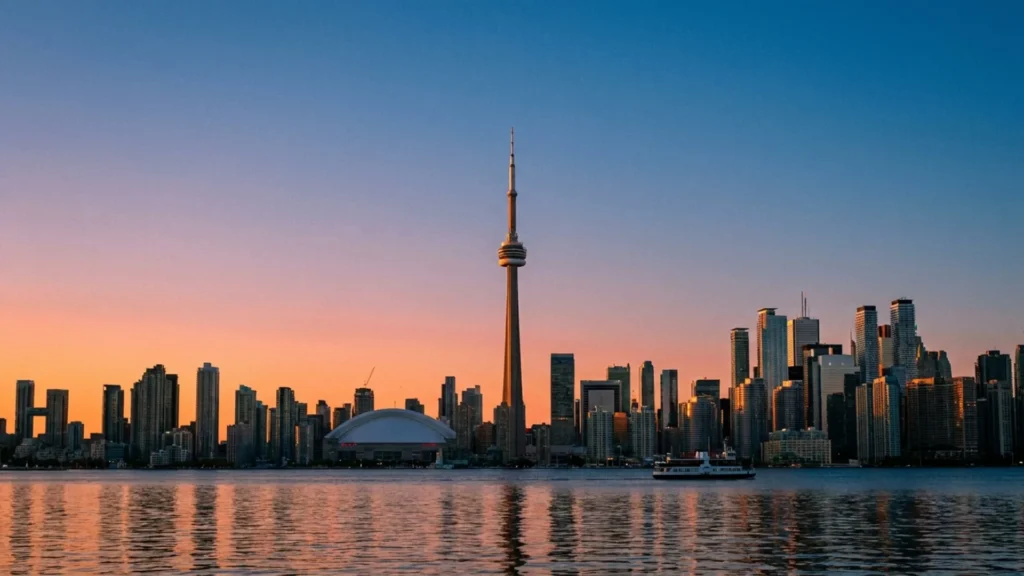
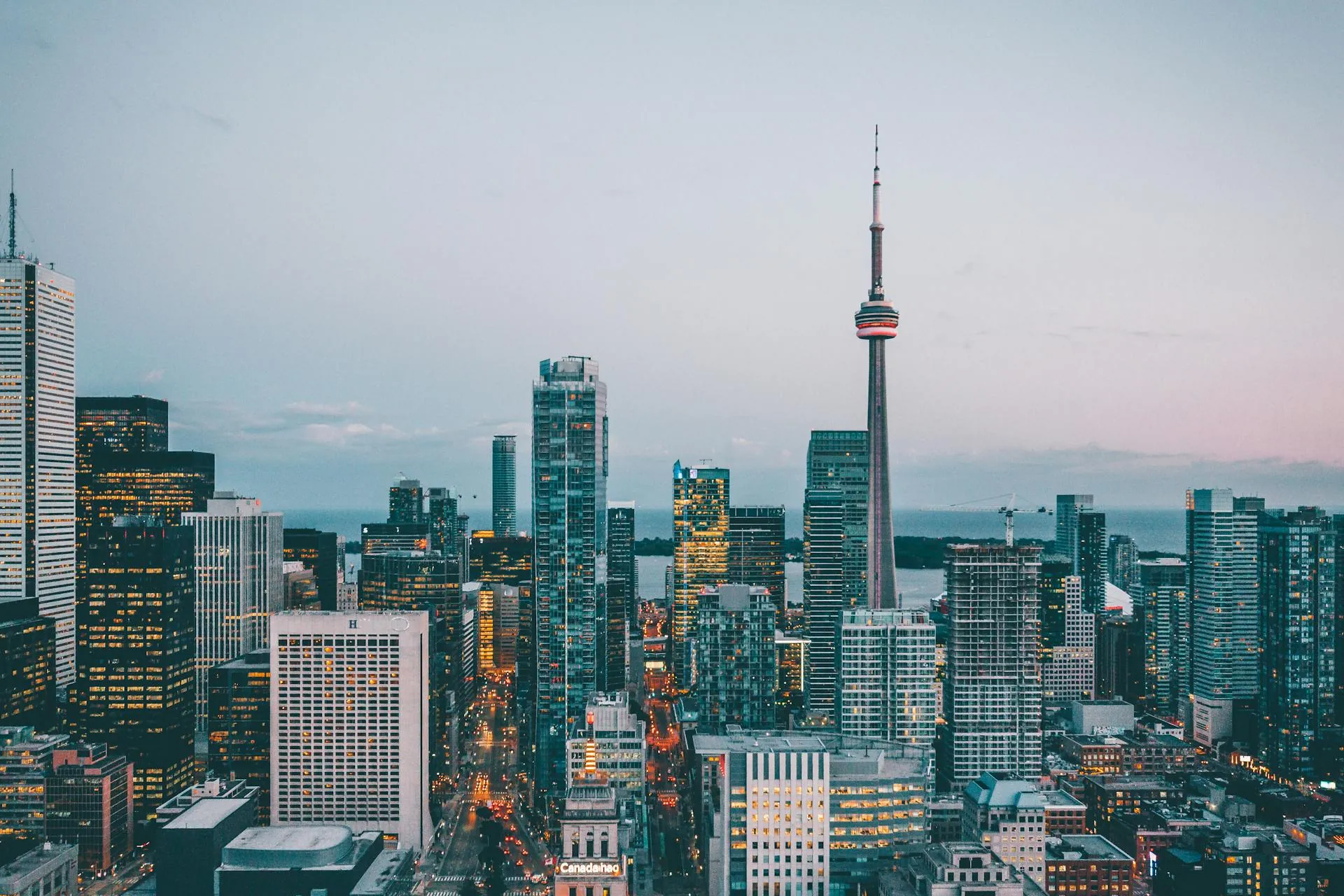
Canada’s largest city — about 6.4 million in the GTA — and the country’s financial, media and cultural capital. Defined by the 553 m CN Tower (the tallest free-standing structure in the Western Hemisphere from 1976 to 2007), the lakefront Harbourfront, and 240+ neighbourhood “villages” that make Toronto one of the most ethnically diverse cities on Earth.
- CN Tower — the EdgeWalk hands-free 356 m walk on the outside of the Tower’s main pod is the headline thrill
- Distillery District — pedestrian-only Victorian industrial quarter, restaurants, the Christmas Market in November–December
- St. Lawrence Market — the city’s century-and-a-bit-old food market, peameal-bacon sandwich is the canonical order
Signature eats: peameal bacon at St. Lawrence, Hong Kong-style dim sum on Spadina, butter tarts at Wanda’s Pie in the Sky.
Vancouver
The Pacific gateway — about 2.7 million in metro Vancouver, hemmed between the Coast Mountains and the Salish Sea. Stanley Park alone is 405 hectares wrapped in a 10 km seawall; Granville Island, Gastown, the Downtown Eastside galleries and Kitsilano give the city its texture.
- Stanley Park & the seawall — bike loop, totem-pole site at Brockton Point, Lions Gate Bridge views
- Capilano Suspension Bridge or the free Lynn Canyon Suspension Bridge for North Shore rainforest
- Granville Island Public Market and the False Creek ferries
Signature eats: wild salmon at any harbourfront restaurant, Vietnamese pho on Kingsway, Japadog street food downtown.
Montréal
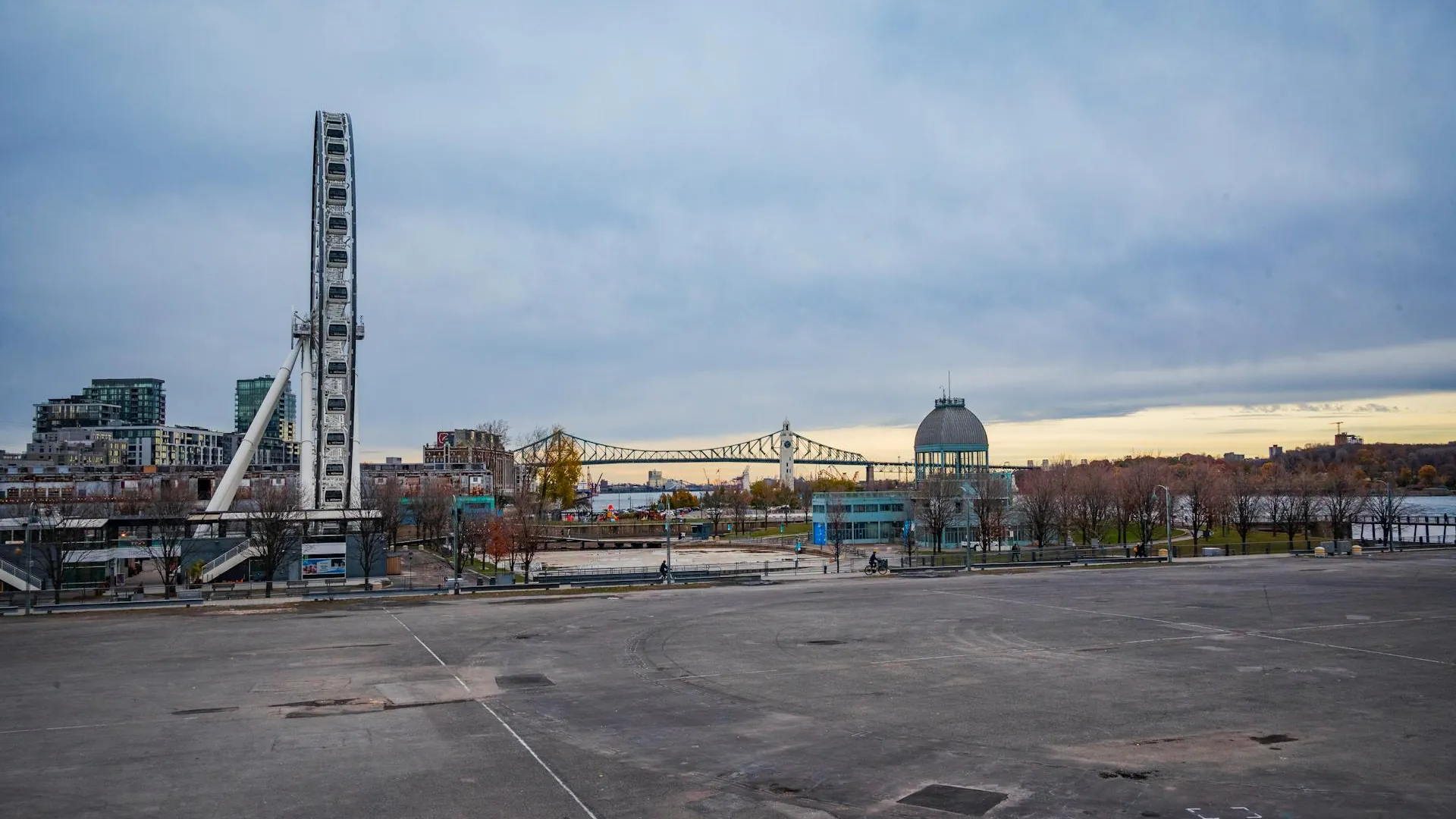
French Canada’s largest city — about 4.4 million in the metro area, the second-largest French-speaking city in the world after Paris. Built on a hill (Mont Royal) above the St. Lawrence, with cobblestone Vieux-Montréal at the river, the Plateau and Mile End above, and a serious music and food culture year-round. The Festival International de Jazz de Montréal in late June/early July is the world’s largest jazz festival by attendance.
- Mont Royal — Olmsted-designed park atop the city, panorama from the Kondiaronk Belvedere
- Notre-Dame Basilica in Vieux-Montréal — the AURA evening light show inside the basilica is the unexpected hit
- Jean-Talon Market in Little Italy; Mile End for the bagel showdown (St-Viateur vs Fairmount, both 24/7)
Signature eats: smoked meat at Schwartz’s, poutine at La Banquise, Montréal-style bagels with cream cheese and lox.
Quebec City
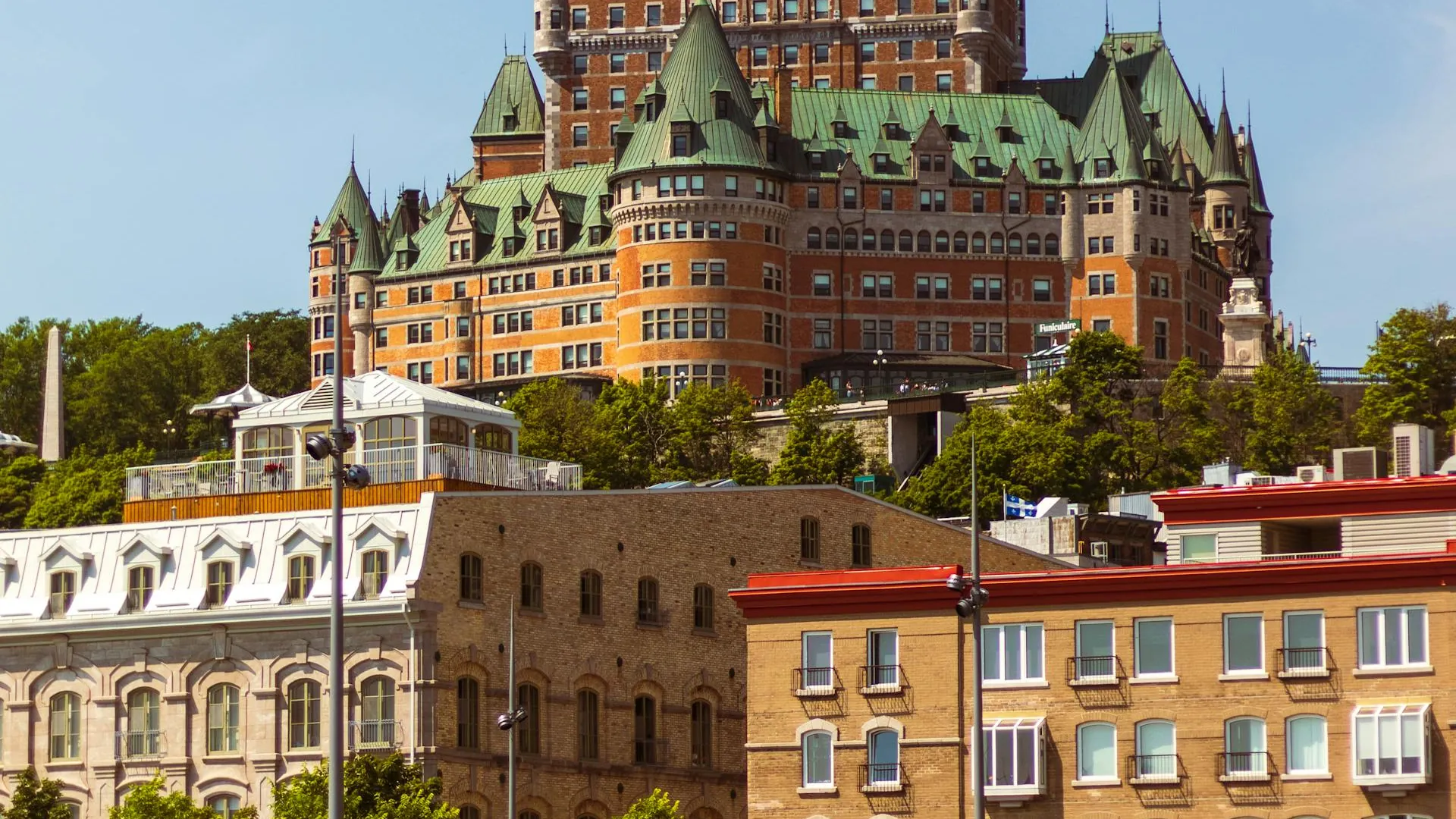
The walled UNESCO old town — the only fortified city north of Mexico — with the 1893 Château Frontenac dominating the skyline above the St. Lawrence. Population around 800,000, but the historic core is small enough to walk in a day. The Winter Carnival (Carnaval de Québec) in the first three weekends of February is the largest winter festival in the world by attendance.
- The Plains of Abraham — site of the 1759 battle, now a 98-hectare urban park
- Petit-Champlain quarter — Lower Town’s restored 17th-century streets, accessible by funicular
- Île d’Orléans & Montmorency Falls (84 m, taller than Niagara) — both 30 minutes from downtown
Signature eats: tourtière, poutine with smoked meat, sugar pie (tarte au sucre), maple-everything in late winter.
Banff & the Canadian Rockies
The Rocky Mountain heartland — Banff National Park (UNESCO Canadian Rocky Mountain Parks, 1984), Jasper National Park to the north, joined by the 232 km Icefields Parkway, plus Lake Louise, Moraine Lake, the Columbia Icefield and the wildlife corridor that runs the spine of Alberta.
- Lake Louise & Moraine Lake — book the Parks Canada shuttle in advance; private vehicles are restricted in summer
- Banff Gondola to Sulphur Mountain summit and the Icefields Parkway day drive — the Athabasca Glacier Skywalk is the marker stop
- Maligne Lake / Spirit Island in Jasper — boat-only access, Canada’s most photographed lake island
Signature eats: AAA Alberta beef, elk burger at the Banff townsite breweries, bannock at Indigenous-owned operators.
Calgary
Alberta’s biggest city — about 1.6 million metro — and the practical jumping-off point for Banff and the Rockies. The Calgary Stampede in early-to-mid July (“the greatest outdoor show on Earth”) draws around 1.4 million attendees over ten days, with chuckwagon racing, rodeo, and the entire downtown putting on western boots.
- Calgary Stampede — chuckwagon races at the Stampede Park grandstand, free pancake breakfasts citywide each morning
- Calgary Tower (190 m) and the Glenbow Museum for prairie + First Nations history
- Banff day-trip on Highway 1 — 1h 30min direct, with a side stop at Canmore
Signature eats: Alberta beef ribeye, Korean fried chicken in Marda Loop, Caesars at any patio (the cocktail was invented here in 1969).
Halifax & Atlantic Canada
The Maritimes capital — Halifax, Nova Scotia, on the world’s second-largest natural harbour. Population around 480,000, walkable downtown, Citadel Hill above, and the Cabot Trail in Cape Breton 4 hours north. The under-rated quarter of the country: lobster suppers, Peggy’s Cove lighthouse, and the gateway to Newfoundland and PEI.
- Halifax Waterfront Boardwalk and the Maritime Museum of the Atlantic (Titanic and Halifax Explosion exhibits)
- Peggy’s Cove lighthouse — 45 minutes south-west, the most-photographed lighthouse in the country
- Cabot Trail in Cape Breton Highlands NP — 298 km loop, peak in early October
Signature eats: lobster roll on the waterfront, Nova Scotia mussels, donair (the Halifax late-night staple).
Canadian Culture & Etiquette — What to Know Before You Go

The Essentials
- Bilingualism is real. English and French are both official federal languages — federal services, road signs in national parks, and product labels appear in both. In Quebec, French is the working language; signage law (Bill 101 / the Charter of the French Language) requires French to be predominant on commercial signage. Outside the Anglophone Westmount and downtown tourist core of Montréal, “Bonjour” first goes a long way.
- Tipping is built in. 15–20% on restaurant bills, 15% on taxis and rideshare, CAD $2–5 per round on bar tabs, and CAD $2–5 per bag for hotel porters. Many card terminals now prompt with default 18/20/22% — anything in that range is fine.
- Politeness norms. “Sorry” is reflexive — Canadians genuinely do apologise when bumped into. Holding doors, queueing without comment and waiting your turn at the four-way stop are the social baseline. Expect drivers to wave you across at unmarked intersections.
- Sales tax shows up at checkout. Listed prices almost never include tax: the federal GST is 5%, provincial sales tax adds 0–10%, totalling 5–15% depending on the province. Quebec stacks a 9.975% QST on top of GST; Alberta adds nothing.
- Indigenous land acknowledgements. Most public events, university lectures and museum exhibits open with an acknowledgement of the traditional territory. Read the room — if you’re at a Truth and Reconciliation event or visiting a residential school site, dress and behave as you would at a memorial.
National Parks Etiquette
- Bear safety is not optional. Carry bear spray in the Rockies and the BC backcountry, store food in vehicle or bear-proof lockers, never approach wildlife, keep at least 100 m from bears and 30 m from elk and bison. Parks Canada keeps the official guidance updated.
- Fire bans are real. In summer, most national and provincial parks impose campfire bans during high-risk wildfire days — check the daily status before you light anything.
- Drone use: drones are banned in all national parks without a permit; almost all permits are denied for tourist photography.
- Pack-out rule. Backcountry sites are pack-in/pack-out — you carry your trash, including organic waste, back to the trailhead.
A Food Lover’s Guide to Canada

Canadian food is regional before it is national. The Pacific gives you wild salmon, spot prawns and Vancouver’s pho-and-sushi parallel cuisine; the Prairies give you AAA Alberta beef and grain-belt baking; Ontario gives you the multicultural Toronto food court that is honestly hard to beat anywhere; Quebec gives you smoked meat, bagels, tourtière and the entire poutine canon; the Maritimes give you lobster suppers and dulse from the Bay of Fundy. None of this fits on one plate, which is why “Canadian food” as a single thing is the wrong question.
Must-Try Dishes
| Dish | Description |
|---|---|
| Poutine | Fries, fresh cheese curds, hot brown gravy. Quebec origin (late 1950s); national religion. Best at La Banquise (Montréal) or any rural Quebec casse-croûte. |
| Butter tarts | Pastry shells filled with butter, sugar, syrup and egg — runny vs firm centre is a denominational debate. Ontario birthright. |
| Tourtière | Quebec meat pie of spiced minced pork (sometimes beef or game), traditionally served at Réveillon on Christmas Eve. |
| Nanaimo bars | No-bake three-layer dessert bar (graham-coconut crumb, custard buttercream, chocolate top) named for Nanaimo, BC. |
| Peameal bacon sandwich | Toronto’s signature — wet-cured pork loin rolled in cornmeal, served on a kaiser bun. St. Lawrence Market is the canonical address. |
| Montréal smoked meat | Brined, spiced, smoked beef brisket, hand-sliced, on rye with mustard. Schwartz’s on St-Laurent since 1928. |
| Atlantic lobster roll | Cold-pack lobster with light mayo on a top-split bun. PEI, Nova Scotia and New Brunswick all claim a version. |
| Bannock | Indigenous flatbread — pan-fried or oven-baked, often served with stew. Many Indigenous-owned restaurants list it. |
| BeaverTails | Fried whole-wheat dough pastry, hand-stretched into a tail shape, topped with cinnamon sugar (or Nutella, or maple). Skating-rink staple in Ottawa. |
Maple Syrup — The Liquid Background to Everything
Canada produces around 75–80% of the world’s maple syrup, with Quebec alone producing roughly 72% of the global supply through about 13,500 sugar bush operations. March and early April is sugaring season — the brief window when daytime thaws and overnight freezes pull sap up the trunk. Sugar shacks (cabanes à sucre) across Quebec open for syrup-on-snow, baked beans and live folk music; the experience is a non-negotiable spring visit if you’re in Montréal in late winter. Grade A “Amber” is the all-purpose; “Very Dark” carries the deepest maple flavour and is the better baking syrup.
The Tim Hortons Layer
Tim Hortons is so woven into Canadian daily routine that it’s a cultural artifact more than a coffee chain — about 4,000 Canadian locations, founded in 1964 in Hamilton by NHL defenceman Tim Horton, and the official supplier of “double-double” (two creams, two sugars) in roughly half the country’s commuter cars. Order options to know: a “double-double” coffee, a 10-pack of Timbits (donut holes), an Iced Capp (frozen coffee drink), and a chili (the country-wide hangover cure).
- Other chains worth knowing: Second Cup, Country Style, Blenz Coffee (BC), Van Houtte (Quebec)
- Signature items: double-double coffee, Iced Capp, Timbits, sausage farmer’s wrap, chili
- Indigenous food: Salmon n’ Bannock (Vancouver), Kūkŭm Kitchen (Toronto), Tea-N-Bannock (Toronto), Wabanaki Maple (NB) — all worth seeking out for traditional ingredients done at restaurant level
Off the Beaten Path — Yukon, Newfoundland & the Maritimes

Tofino, Vancouver Island
The west coast of Vancouver Island, four hours by car from Nanaimo or a 90-minute Pacific Coastal flight from Vancouver. Pacific Rim National Park Reserve runs along the coast — Long Beach is 16 km of unbroken sand, and storm-watching season from November through February has become its own peak tourism category. Surf rentals and lessons run year-round (the water sits around 10°C — wetsuits are mandatory), and the seaplane scenic over Clayoquot Sound is the regional must-do.
Cape Breton Island, Nova Scotia
The Cabot Trail loops 298 km around the highlands of northern Cape Breton, peaking in the first two weeks of October when the maple-and-birch hardwoods turn. Cape Breton Highlands National Park covers the wildest middle stretch — moose, eagles, the occasional pilot whale offshore — and the Celtic music heritage of Cheticamp and Baddeck means there’s a kitchen ceilidh somewhere within 45 minutes most evenings of the year. Drive the loop counter-clockwise from Baddeck for the best Atlantic-side ocean views.
Churchill, Manitoba
The “Polar Bear Capital of the World” — a sub-Arctic outpost on Hudson Bay reachable only by VIA Rail (two-night train from Winnipeg) or charter flight. Polar bears congregate on the shore from late October through mid-November waiting for the bay to freeze; tundra-buggy operators run viewing trips during that window. Beluga whale watching by zodiac runs in July–August, and the aurora season is a serious second draw — Churchill sits beneath the auroral oval and gets clear-sky aurora 200+ nights a year.
Gros Morne National Park, Newfoundland
UNESCO World Heritage Site (1987) on Newfoundland’s west coast, the park preserves the Tablelands — exposed Earth-mantle peridotite that was geological evidence-piece-one for plate tectonics. Western Brook Pond is a freshwater fjord (technically not a fjord any longer because it’s no longer connected to the sea, but the cliffs are 600 m high and the boat tour is the calling card). Allow 4 days minimum and rent in Rocky Harbour or Norris Point.
Haida Gwaii, British Columbia
The “islands of the people” — an archipelago 130 km off the BC north coast, ferry from Prince Rupert or short flight from Vancouver. Home of the Haida Nation, with SGang Gwaay (Anthony Island) UNESCO-listed for its surviving 19th-century longhouses and mortuary poles. Gwaii Haanas National Park Reserve — co-managed by Parks Canada and the Council of the Haida Nation — is accessible only by boat or floatplane, with mandatory orientation. The most authentically Indigenous-led park experience available to Canadian visitors.
Practical Information
| Currency | Canadian Dollar (CAD, $); 1 USD ≈ CAD $1.36 as of May 2026 — float against the USD has run a CAD $1.30–1.42 band over 2024–2026 |
| Cash needs | Cards (Visa, Mastercard, contactless) work everywhere; carry CAD $50–100 for small-town parking, tipping and farmers’ markets |
| ATMs | Bank-branded ATMs (RBC, TD, Scotiabank, BMO, CIBC) charge CAD $3–5 per withdrawal; non-bank “white-label” ATMs in convenience stores can charge CAD $5–8 — avoid where possible |
| Tipping | 15–20% restaurants, 15% taxi/Uber, CAD $2–5 per drink at the bar, CAD $2–5 per bag for porters |
| Language | English nationwide; French in Quebec and most of New Brunswick; bilingual federal services and signage in national parks |
| Safety | Among the world’s safest travel destinations; Government of Canada strongly recommends travel insurance for visitors as healthcare is universally tourist-priced |
| Connectivity | 4G/5G coverage strong in cities and along the Trans-Canada; spotty in the Rockies, Yukon and remote Newfoundland — download offline maps; eSIM via Bell, Rogers, Telus, Public Mobile, Lucky Mobile |
| Power | Type A & B plugs, 120 V / 60 Hz (same as USA — no adapter needed for North-American devices) |
| Tap water | Excellent and free nationwide — among the cleanest in the world per CDC guidance; bring a refillable bottle |
| Healthcare | Universal for residents; tourist visits are billed at full cost — a single ER visit can run CAD $1,000–3,000+. Travel insurance is essential |
| Emergency | 911 nationwide for police, fire and ambulance |
Budget Breakdown — What Canada Actually Costs in 2026
💚 Budget Traveller
Hostels in Toronto, Vancouver and Montréal sit at CAD $40–70 a bed; in Banff townsite expect CAD $55–80 for the same. Cook from a Loblaws or Save-On-Foods grocery, ride city transit (CAD $3.35 single in Toronto and Vancouver), and use VIA Rail’s Economy class plus the Canrailpass for cross-country movement. Realistic floor: CAD $90–140 a day on hostel stays plus park entry, with some splurges. Numbeo ranks Canada in the top 30% globally for cost of living.
💙 Mid-Range
Three-star downtown hotels run CAD $180–280 per night in Toronto, Vancouver and Montréal; Banff townsite is more like CAD $220–360 in summer. Restaurant mains land at CAD $24–38, mid-range bottle of wine CAD $50–70. Compact rental car runs CAD $65–95 per day off-peak, CAD $120–180 in summer, plus fuel at roughly CAD $1.55–1.80 per litre. Realistic mid-range: CAD $180–300 per day per person, more in the Rockies in July.
💜 Luxury
Fairmont Banff Springs, Fairmont Château Frontenac, the Four Seasons Toronto and the Wickaninnish Inn at Tofino sit comfortably above CAD $700 per night in season; helicopter glacier tours add CAD $400–700 per person. Rocky Mountaineer’s GoldLeaf service from Vancouver to Banff is around CAD $2,200 per person for two days. Floor: CAD $500+ per day, easily CAD $1,000+ in the parks.
| Tier | Daily (USD) | Accommodation | Food | Transport |
|---|---|---|---|---|
| Budget | $66–103 | Hostel CAD $40–70 | Grocery + cafés CAD $30–45 | Transit + occasional intercity coach |
| Mid-Range | $132–220 | 3★ hotel CAD $180–280 | Restaurants CAD $50–90 | Compact rental + fuel |
| Luxury | $370+ | 4–5★ CAD $400–800+ | Fine dining CAD $120+ | Premium rental + experiences |
2026 inflation context: Statistics Canada CPI year-on-year sat around 2.0–2.5% through Q1 2026, well below the 2022–23 peaks; hotel and restaurant prices in the major cities have largely caught up to international parity.
Planning Your First Trip to Canada
- Pick one region, not the whole country. The realistic two-week itineraries are: (a) Toronto–Niagara–Montréal–Quebec City; (b) Calgary–Banff–Jasper–Vancouver; (c) Vancouver–Tofino–Whistler. Trying to combine east and west in two weeks burns three days of your trip on flying and jet lag.
- Apply for the eTA before you book. CAD $7, online, usually approved in minutes — but build 72 hours of slack in case you’re flagged for review.
- Book Banff/Lake Louise/Moraine 4–6 months ahead in summer. Parks Canada’s reservation system for Lake Louise and Moraine shuttle access fills weeks in advance from June through September.
- Buy travel insurance with medical coverage. Canadian healthcare is universal for residents only — visitor billing is at full cost. The Government of Canada is explicit on this point.
- Decide trains vs flights vs car early. A 2-week east-west by train is romantic but burns 4 nights on board; flying YYZ to YVR saves 2 days for the same money on a midweek booking; renting a car only makes sense once you reach the Rockies or Vancouver Island.
Classic 14-Day Itinerary (East–West Split): Day 1–3 Toronto (Niagara day-trip); Day 4–6 Montréal; Day 7 Quebec City; Day 8 fly to Calgary; Day 9–11 Banff (Moraine, Lake Louise, Sulphur Mountain); Day 12 Icefields Parkway drive to Jasper; Day 13–14 fly Calgary→Vancouver, Stanley Park, Granville Island. For a Rockies-only focus, swap days 1–7 for Vancouver Island and Whistler.
Frequently Asked Questions
Is Canada expensive to visit?
Mid-priced for an OECD country, with sharp regional spikes. A grocery-and-hostels backpacker week clears CAD $90–140 a day; a downtown-hotel-and-restaurants couple lands at CAD $400–600 a day combined; the Rockies in July push 30% above national averages. The single biggest cost lever is when you go — late September shaves 30% off summer rates with most park access still live.
Do I need to speak French?
No, but it helps in Quebec. English is universal in Toronto, Vancouver, the Rockies, the Maritimes and most of Montréal’s downtown. In Quebec City, rural Quebec, and Acadian New Brunswick, French is the working language and a “Bonjour” first goes a long way. Service staff outside the tourist core may default to French; a polite “Désolé, mon français est limité — parlez-vous anglais?” usually solves it.
Is the VIA Rail Canrailpass worth it?
Yes if you’re committed to overland travel and have at least three weeks. The CAD $899 (peak) Canrailpass — Economy, 7 trips in 21 days — is excellent value if you stitch together Toronto–Montréal–Quebec City and then commit to The Canadian across to Vancouver. If you’re flying coast-to-coast or doing a single regional trip, point-to-point fares win.
Is Canada safe for solo travellers?
Among the safest in the world. Canada ranks consistently in the top 12 of the Global Peace Index; violent crime against tourists is exceptionally rare. Real risks for visitors are weather and wildlife rather than human — black-ice driving, bear and elk encounters in the parks, hypothermia in winter backcountry. Emergency 911 covers the country.
When is the best time to see the Northern Lights?
Late August through mid-April, with peak conditions December through February. Whitehorse (Yukon), Yellowknife (NWT) and Churchill (Manitoba) sit beneath the auroral oval and get clear-sky aurora 200+ nights a year. Solar Cycle 25 is still descending from October 2024’s maximum, which makes 2026’s winter aurora a genuinely once-a-decade window for Yukon and NWT trips.
Can I get by as a vegetarian or vegan?
Easily in Toronto, Montréal, Vancouver and Calgary — all have dedicated vegan restaurants and grocery aisles stocked with plant-based options. In rural Quebec, the Maritimes and small-town Prairie towns the menu thins to “vegetable side and bread” — eat in the cities or stock up at a Loblaws or Sobeys before remote stretches.
Do I need an eTA or visa to visit Canada?
Citizens of the US, UK, EU, Australia, Japan, New Zealand and most other visa-exempt countries need an Electronic Travel Authorization (eTA) — CAD $7, online, valid up to 5 years. US citizens need only a passport. Citizens of countries not on the visa-exempt list need a Temporary Resident Visa (TRV) — apply through the same Government of Canada portal.
Banff or Jasper — which should I prioritize?
Banff first if you only have one stop — the iconic lakes (Louise, Moraine), the gondolas, the townsite, and the closer access from Calgary. Jasper for a quieter, larger park with darker night skies (a designated Dark Sky Preserve) and the Maligne Lake / Spirit Island circuit. The 232 km Icefields Parkway between them is the answer if you have 5+ days and a rental car.
Ready to Explore Canada?
Canada rewards travellers who pick a slice and stay long enough to actually feel it — east or west, but not both in two weeks. Apply for the eTA early, book Banff or the Cabot Trail months ahead in season, lean on VIA Rail or Air Canada to skip the long drives, and pack a layer for whatever the country wants to throw at you. Start in Toronto or Vancouver for the city baseline, then drive (or train) into the wilderness — that’s where Canada actually lives.