
Halifax, Nova Scotia: Atlantic Canada’s Harbour Capital, Donair Town & Citadel City
Part of our Canada travel guide.
Halifax City Guide

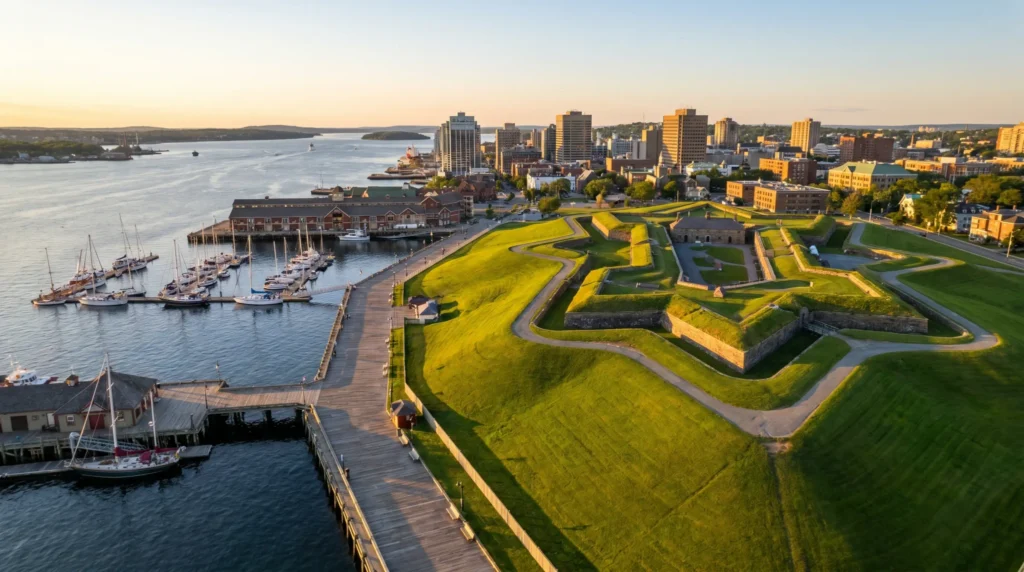
Photo: Karly Barker / Pexels (free license) — halifax-waterfront-skyline-hero
Table of Contents
Why Halifax?
Halifax is Atlantic Canada’s capital city, the country’s second-largest natural harbour, and the only major Canadian metropolis where you can walk from a star-shaped 18th-century British fortress to a working container terminal to a wood-fired lobster shack inside a single afternoon. The 2021 census placed the city proper at 348,634 residents and the surrounding Halifax Census Metropolitan Area at 480,582 — small enough that a four-day visit covers the city plus two day trips, but dense enough that the downtown packs three national historic sites, two world-class museums, a still-functional 1803 town clock, and a 4-kilometre boardwalk along the harbour edge into roughly twenty walkable blocks.
The city was founded in 1749 as Chebucto by Governor Edward Cornwallis on what is the unceded traditional territory of the Mi’kmaq Nation, and grew through three centuries as British North America’s primary North Atlantic naval base — a role the harbour still fills today as the home port of the Royal Canadian Navy’s Atlantic fleet at CFB Halifax. The military origin shapes nearly everything visitors notice: the Halifax Citadel National Historic Site sits at 75.6 metres on a glacier-formed drumlin in the geographic centre of downtown, with the Old Town Clock (built 1803) on its eastern slope still keeping time on the hour above Brunswick Street.
Halifax’s defining contradictions are productive ones. It is a Canadian provincial capital with a strong British naval atmosphere; a salt-water port whose signature dish (the donair) is a 1970s Lebanese-Canadian invention; a four-season Atlantic city whose summer pulls more visitors than its lobster-supper-and-lighthouse winter shoulders; a former Pier 21 immigration gateway through which an estimated 1.5 million arrivals reached Canada between 1928 and 1971, an arrival number that rivals New York’s Ellis Island for Canadian relevance.
The superlatives matter. Halifax Harbour is the second-largest natural harbour in the world after Sydney, Australia, deep enough at low tide to berth a Halifax-class frigate at the Naval Dockyard. The Halifax Public Gardens, opened in 1867, are among the finest surviving Victorian formal gardens in North America. Peggy’s Cove, 45 minutes by car along Highway 333 down the Lighthouse Route, is the most-photographed lighthouse on the continent. Lunenburg, 90 minutes south, is a UNESCO World Heritage town for its near-complete preservation of an original 1753 British colonial settlement plan.
This guide covers eight neighbourhoods that frame an in-town stay, the donair-lobster-craft-beer triangle that defines Halifax eating, the Citadel-Pier 21-Maritime Museum cultural core, five day trips that turn Halifax into a regional base camp from Peggy’s Cove to Cabot Trail, and the YHZ-airport, harbour-ferry, and tipping-and-eTA practicalities that make a first trip land smoothly the moment your Boeing 737 touches down at Stanfield International.
Neighbourhoods: Finding Your Halifax
Halifax sits on the western shore of Halifax Harbour, with Dartmouth on the eastern shore connected by two suspension bridges (the Macdonald and the MacKay) and the country’s oldest continuously running saltwater ferry service. The downtown core is small — roughly 12 walkable blocks running from Pier 21 in the south to the Hydrostone in the north, hemmed by the harbour to the east and the Citadel slope to the west. The eight neighbourhoods below cover the widest range of traveller priorities, from first-timer waterfront stays to indie-music North End to leafy Public Gardens-adjacent South End. Halifax Transit’s base bus fare is C$2.75 cash and the harbour ferry to Dartmouth is the same price — making cross-harbour exploration trivially cheap.
Downtown & Halifax Waterfront
The Halifax Waterfront Boardwalk runs roughly 4 kilometres from Pier 21 in the south, past the Maritime Museum of the Atlantic, past Bishop’s Landing condos and the Cable Wharf, all the way to Casino Nova Scotia and the Seaport Farmers’ Market at Pier 20 — one of the longest continuous urban waterfront walks in North America. Restored 19th-century stone warehouses on Lower Water Street and Upper Water Street house seafood restaurants, the Halifax Brewery Market on weekends, and dozens of patios that flip from lobster lunches to live-music venues after sundown. The downtown grid sits between the harbour and Citadel Hill, with Spring Garden Road climbing west off Barrington Street into the city’s busiest commercial strip.
- Halifax Waterfront Boardwalk (4 km, Pier 21 to Casino NS)
- Maritime Museum of the Atlantic (1675 Lower Water Street)
- Halifax Seaport Farmers’ Market (Pier 20, Saturday mornings)
- Bishop’s Landing condo + restaurant complex
- Cable Wharf, Tall Ship Silva, Theodore Tugboat dock
Best for: first-timers, museum visits, harbour views, walkable hotels. Access: downtown is walkable end-to-end in 25 minutes; nearest major hotels cluster on Lower Water and Hollis Streets.
Spring Garden Road
Spring Garden Road runs east-west from Barrington Street up to South Park Street, anchored by the Halifax Public Library’s award-winning 2014 building (a five-storey glass cube with a roof terrace) at 5440 Spring Garden Road. The strip is the city’s densest commercial promenade — independent boutiques, the Spring Garden Place mall, the city’s best-known indie bookstore (Bookmark, since 1979), and a constant procession of cafés that serves as the warm-weather social spine of downtown Halifax. The Halifax Public Gardens (opened 1867 as a Victorian pleasure ground for the Nova Scotia Horticultural Society) sit at the western end, with the historic Lord Nelson Hotel directly opposite.
- Halifax Central Library (5440 Spring Garden Road, opened 2014)
- Halifax Public Gardens (16 acres, opened 1867)
- Lord Nelson Hotel (since 1928, opposite the Gardens)
- Spring Garden Place mall and the Bookmark indie bookshop
- Park Lane shopping centre and adjacent café strip
Best for: shopping, café culture, garden walks, library day, walking from a downtown hotel. Access: 8–12 minute walk from any waterfront hotel.
North End (Agricola, Gottingen, Hydrostone)
The North End begins roughly at Cogswell Street and runs north past the Halifax Common, encompassing Agricola Street’s coffee-and-cocktail strip, Gottingen Street’s arts-and-music corridor, and the Hydrostone Market — a charmingly preserved Tudor-revival shopping arcade rebuilt after the 1917 Halifax Explosion levelled the original neighbourhood. The North End has been the city’s creative engine for two decades; this is where you’ll find the most-talked-about new restaurants (Field Guide, EDNA, The Canteen on Portland), the city’s independent-label record stores, the largest concentration of indie tattoo studios, and an Africville Park (and small museum) commemorating the Black community displaced by the city in the 1960s.
- Hydrostone Market (Tudor-revival blocks, 1920s post-Explosion rebuild)
- Agricola Street commercial strip (cafés, third-wave coffee, cocktail bars)
- Gottingen Street arts corridor and Khyber Centre for the Arts
- Halifax Common (75-acre central park since 1763)
- Africville Museum and Africville Park (Bedford Basin shoreline)
Best for: indie food, residential character, music scene, design-led shops. Access: 20–30 minute walk from downtown or a 10-minute Halifax Transit bus ride on routes 1 / 2 / 7.
South End & Point Pleasant Park
The South End is Halifax’s leafy university-and-grand-houses quarter, anchored by Dalhousie University’s 1818-founded main campus on University Avenue and ending at the 75-hectare Point Pleasant Park — a coastal forest at the southern tip of the Halifax peninsula leased from the British Crown for one shilling per year on a 999-year lease starting 1866. The park has 39 km of forested walking and cycling trails, a 1796 Prince of Wales Tower (the first Martello tower in North America), the seasonal Tower Road beach, and direct views across the harbour mouth to the lighthouse on Devil’s Island. The neighbourhood between Dalhousie and the park is the city’s most architecturally imposing — mansions on Young Avenue and Inglis Street, the converted Old Halifax Memorial Library, and the residential blocks where many South End families have lived for three generations.
- Point Pleasant Park (75 hectares, 39 km of trails)
- Prince of Wales Tower (1796, North America’s first Martello tower)
- Dalhousie University (founded 1818, main campus)
- Saint Mary’s University (founded 1802, Robie Street campus)
- Young Avenue mansion strip
Best for: long walks, university visits, summer beach swims, photography. Access: 25–35 minutes’ walk from downtown, or Halifax Transit route 9 along Robie Street.
West End & Quinpool Road
Quinpool Road is Halifax’s western commercial spine, running east-west from the Halifax Common to the Armdale Rotary on the Northwest Arm. The strip is a working-class-meets-middle-class neighbourhood retail belt — family pizza-and-donair counters that have been frying since the 1980s, casual diners, hardware stores, and the city’s densest concentration of donair shops including Pizza Corner’s Greek-Lebanese Halifax-style donair archetype. The Northwest Arm, the long sea inlet that defines the western edge of the Halifax peninsula, is lined with old yacht clubs, the Royal Nova Scotia Yacht Squadron, and Sir Sandford Fleming Park (Dingle Park) on the western shore.
- Quinpool Road commercial strip (donair, pizza, hardware)
- Halifax Forum (1927-built indoor arena and farmers’ market venue)
- Sir Sandford Fleming Park (Dingle Tower since 1912)
- Armdale Rotary (the city’s busiest five-way intersection)
- Royal Nova Scotia Yacht Squadron (founded 1837, North America’s oldest yacht club)
Best for: donair-trail eating, residential walks, yacht-club views, value-priced lodging. Access: Halifax Transit routes 14 and 15 along Quinpool Road from downtown.
Dartmouth Waterfront
Dartmouth sits across the harbour on the eastern shore, reachable by the Halifax Transit Ferry — a 12-minute crossing every 15–30 minutes that has run continuously since 1752, making it one of the oldest saltwater ferry services in North America. The Dartmouth waterfront has been quietly reinvented in the past decade with breweries (New Scotland Brewing, Big Spruce, Brightwood), the King’s Wharf condo development, and cafés along Alderney Drive. Lake Banook (immediately east of the ferry terminal) is the country’s premier flatwater paddling venue, a former site for the Canoe Sprint World Championships. The Shubenacadie Canal, an early-19th-century engineering project linking the harbour to the Bay of Fundy, has its surviving stone locks scattered through Dartmouth parkland.
- Halifax Transit Ferry to Alderney Landing (continuous since 1752)
- Alderney Drive waterfront walk and Saturday outdoor market
- Lake Banook (national flatwater paddling course)
- New Scotland Brewing, Big Spruce, Brightwood Brewery taprooms
- Shubenacadie Canal Greenway (heritage canal locks)
Best for: breweries, calmer waterfront walks, paddling, harbour-skyline photos. Access: Halifax Transit Ferry from the downtown ferry terminal at Cable Wharf, every 15–30 minutes.
Bedford Basin & the Suburbs
Bedford Basin is the inner section of Halifax Harbour, a 17-square-kilometre sheltered anchorage that served as the wartime convoy assembly point during World War II, hosting more than 17,000 merchant ships in convoys bound for Britain between 1939 and 1945. The basin is now ringed by the suburban communities of Bedford and Sackville, and at its head lies the Africville Park memorial. The shoreline drive on the Bedford Highway (Highway 7) provides the city’s most scenic suburban commute — ocean on one side, retail strips on the other. For visitors, Bedford Basin matters most as the gateway northbound to Truro and the Cobequid Pass on the way to Cape Breton, and as the location of the Hemlock Ravine Park (an old-growth conservation forest with a rare heart-shaped lake created in 1796 for Prince Edward, Duke of Kent).
- Hemlock Ravine Park (heart-shaped Julie’s Pond, 1796)
- Bedford Highway scenic basin drive
- Bedford Place Mall and DeWolf Park boardwalk
- Mic Mac Mall and the Penhorn Lake recreation area
- WWII convoy memorial markers along the Bedford shoreline
Best for: drivers, day-base for Cape Breton onward trips, suburban hotel value. Access: 15–25 minute drive from downtown via Highway 7 or 102.
Halifax Common & Citadel Slope
The Halifax Common is North America’s oldest public common (granted in 1763 by King George III to the people of Halifax for shared grazing and military drill use), now a 75-acre public sports-field-and-park grid wedged between the South End and the North End. The Citadel slope rises immediately to the west, with Brunswick Street running along the foot of the hill and the Old Town Clock perched on the eastern slope. The Common hosts free Sunday-morning soccer pickup games, large summer festival main stages (the Halifax Jazz Festival’s mainstage waterfront is the seasonal counterpoint), and the Halifax Forum’s Saturday farmers’ market on the western edge. This is the practical gap between residential South End and indie North End — not where you stay, but the green corridor that ties the city peninsula together.
- Halifax Common (75 acres, granted 1763)
- Citadel Hill slope (75.6 m drumlin, glaciation legacy)
- Halifax Forum (1927 indoor arena and weekend farmers’ market)
- Wanderers Grounds (semi-pro Halifax Wanderers FC, capacity 6,500)
- QEII Health Sciences Centre (Camp Hill / Victoria sites, on the Common’s eastern edge)
Best for: sports-event-day stays, festival access, hospital-adjacent practical needs. Access: 10–15 minute walk from downtown or a Halifax Transit ride on routes 1, 2, or 7.
The Food
Halifax eats in three distinct registers: the cheap-and-fast late-night donair-and-pizza counters that defined the city’s post-1970s working-class palate, the working-harbour seafood scene where lobster and Digby scallops travel the smallest possible distance from boat to plate, and a craft-beer-and-third-wave-coffee renaissance that has filled Agricola Street, Argyle Street, and Lower Water Street with new openings every season. The Halifax dining grid is small — nearly every restaurant worth a destination meal sits within a 25-minute walk of the Halifax Waterfront Boardwalk.
The Halifax Donair (City’s Official Food)
The Halifax donair is the city’s defining street food and was officially declared the Official Food of Halifax by Halifax Regional Council in 2015. It is a Lebanese-Canadian invention attributed to brothers Peter and John Kamoulakos, who began serving a sweet-sauced gyro variant in the early 1970s at their King of Donair shop on Quinpool Road and Pizza Corner (the Blowers Street / Grafton Street intersection downtown). The defining components are spiced ground-beef cone-meat shaved off a vertical rotisserie, a soft pita, diced tomato, raw onion, and the all-important sweet sauce — condensed milk, garlic, sugar, and vinegar whisked into a thick, creamy white drizzle. A small donair runs C$10–13 (~US$7–9), a large C$14–17 (~US$10–12). The four canonical operators are King of Donair (multiple locations), Tony’s Donair, Tony’s Famous Donair, and Sicilian Pizza on Quinpool, but every neighbourhood pizza-and-donair shop in the city sells a credible version. The tradition is to order a donair after midnight on a Saturday on the way home from Argyle Street.
Lobster, Digby Scallops & Atlantic Seafood
Nova Scotia is Canada’s largest lobster-producing region, with the spring lobster fishing season (LFA 33 / 34, late November through May) feeding restaurants across Halifax for most of the year. Boil-in-the-shell lobster runs C$28–48 (~US$20–35) for a 1.25-pound at restaurants depending on season; lobster rolls run C$22–32 (~US$16–23). The classic Halifax order is a hot-buttered Atlantic-style lobster roll on a split-top bun, available at Shuck Seafood + Raw Bar (Lower Water Street), The Five Fishermen (1740 Argyle, in an 1816 stone building), Salty’s on the boardwalk, and the Wooden Monkey on Grafton Street.
- Shuck Seafood + Raw Bar (Lower Water Street, oysters from C$3 each)
- The Five Fishermen (1740 Argyle Street, since 1975 in an 1816 building)
- Salty’s (Lower Water Street boardwalk, harbour-front patio)
- The Wooden Monkey (1707 Grafton, locally sourced fish-and-chips)
- The Bicycle Thief (1475 Lower Water Street, modern Italian-Atlantic)
Digby scallops — the giant cold-water sea scallops harvested off Digby in the Bay of Fundy — are the second signature seafood. Pan-seared Digby scallops appear on menus at C$32–46 (~US$23–33) for an entrée and C$18–24 (~US$13–17) for an appetiser portion. Fresh haddock, halibut, and Atlantic salmon round out the catch.
Halifax Beer & Pubs (Alexander Keith’s, Garrison, Propeller)
Halifax has Canada’s longest continuously operating brewery in Alexander Keith’s Nova Scotia Brewery, founded in 1820 by Scottish-born Alexander Keith on Lower Water Street — the original 19th-century stone brewery building still operates as a heritage tour and tasting venue at 1496 Lower Water Street. Keith’s India Pale Ale is the brand most associated with the city, but the contemporary craft scene is far broader: Garrison Brewing (1149 Marginal Road, in the Halifax Seaport), Propeller Brewing (Gottingen Street + Windsor Street locations), Good Robot, Stillwell, and Unfiltered Brewing each run their own taprooms. A pint of craft beer downtown runs C$8–11 (~US$6–8); a flight of four 5-ounce tasters at a brewery taproom is typically C$12–16 (~US$9–12). Argyle Street between Sackville and Prince Streets — particularly the rooftop patio at the Argyle Bar & Grill — is the city’s densest pub strip in summer.
- Alexander Keith’s Nova Scotia Brewery (1496 Lower Water, since 1820)
- Garrison Brewing Co. (1149 Marginal Road, Halifax Seaport)
- Propeller Brewing Co. (Gottingen Street + Windsor Street)
- Good Robot Brewing (2736 Robie Street, North End)
- Stillwell Beer Bar (1672 Barrington Street, 60+ taps)
- The Old Triangle Irish Alehouse (5136 Prince Street, traditional Maritime sessions)
Beyond the Headlines (Coffee, Brunch, Modern Atlantic)
The city’s independent coffee scene runs through Java Blend Coffee (1592 Barrington, roasting since 1938), Two If By Sea Café (in Dartmouth at the ferry terminal — their oversized croissants are a Halifax landmark), Dilly Dally Coffee Café (Agricola Street), and Glitter Bean Café (5896 Spring Garden Road, worker-owned cooperative since 2018). For brunch, EDNA on Gottingen Street (since 2013, chef Jenner Cormier) is the city’s most-cited modern Atlantic restaurant, and Studio East Food + Drink (5687 Charles Street in the North End) has been steadily collecting national press for its Asian-fusion-meets-Atlantic-seafood plates. A donair-shop-counter alternative for late nights is Pizza Corner’s King of Donair / Sicilian Pizza / European Food intersection at Blowers and Grafton, where every operator stays open past 3am on Friday and Saturday.
- Java Blend Coffee (1592 Barrington Street, since 1938)
- Two If By Sea Café (Dartmouth ferry terminal, oversized croissants)
- EDNA (2053 Gottingen Street, modern Atlantic)
- Studio East Food + Drink (5687 Charles Street, Asian-Atlantic fusion)
- Field Guide (2076 Gottingen Street, no-reservations small-plates)
- Pizza Corner late-night counter cluster (Blowers + Grafton)
Markets & Food Halls
The Halifax Seaport Farmers’ Market is the oldest continuously operating farmers’ market in North America, founded in 1750 just one year after the city itself, and now operating year-round at Pier 20 in the Halifax Seaport — Saturday morning is the canonical day, with 250 vendors selling Annapolis Valley apples, South Shore lobster, Acadian rappie pie, Annapolis Valley wines and ciders, and prepared foods from across Nova Scotia. The Halifax Brewery Market (1496 Lower Water Street, in the original Alexander Keith’s brewery courtyard) runs Saturday mornings and is the smaller, more food-stall-focused alternative. The Hydrostone Market in the North End and the Alderney Landing Market in Dartmouth round out the farmers’-market grid — each running Saturday mornings with overlapping vendor rosters.
- Halifax Seaport Farmers’ Market (Pier 20, founded 1750, 250 vendors)
- Halifax Brewery Market (1496 Lower Water, Saturday morning)
- Hydrostone Market (Young + Robie Streets, Saturday morning)
- Alderney Landing Market (Dartmouth, Saturday morning)
- Halifax Forum Market (Windsor Street, Saturday morning)
Cultural Sights
Halifax’s cultural sights cluster tightly around the harbour and Citadel Hill — the city packs three national historic sites, two world-class museums, North America’s oldest continuously operating Anglican parish, and the country’s most-photographed Victorian public garden into roughly one walkable square kilometre. Most are open year-round; the outdoor military-history attractions (Citadel re-enactments, the harbour boardwalk pieces) shrink their hours from October through May.
Halifax Citadel National Historic Site
The Halifax Citadel is a star-shaped masonry fortress built between 1828 and 1856, the fourth fortification on the same hilltop site since 1749 and the most defensible British naval fortress in North America during the late Victorian era. The Citadel sits at 75.6 metres above the harbour on a glacier-formed drumlin, with sight lines straight down George Street to the waterfront. Today the site is operated by Parks Canada with a Halifax Citadel Society interpretive program: every day at 12:00 noon (year-round), a Royal Artillery gunner in full 1869 78th Highlanders kilt-and-feathered-bonnet uniform fires the Noon Gun, a tradition unbroken since the 1850s and audible across most of downtown. Adult admission is C$12.50–14.50 (~US$9–10.50) in peak season; the site is open daily May through October with reduced winter access. Allow 90 minutes for the self-guided fortification walk plus the army museum exhibits and an hour more for a guided tour.
Pier 21 — Canadian Museum of Immigration
Pier 21 is the second of Halifax’s two great national museums and the Canadian counterpart to New York’s Ellis Island. Between 1928 and 1971 an estimated 1.5 million immigrants, war brides, refugees, and displaced persons arrived in Canada through this one ocean-liner shed at 1055 Marginal Road. The site reopened in 1999 as a national museum, was elevated to national-museum status in 2011 (one of only two national museums outside of Ottawa-Gatineau), and houses the Scotiabank Family History Centre with searchable arrival records, oral-history galleries, and the original ocean-liner gangway. Adult admission is C$15–19 (~US$11–14); the site is open daily year-round. The architecture — a brick warehouse on the working waterfront, with the Halifax Seaport farmers’ market and Garrison Brewing both directly adjacent — means a Pier 21 morning pairs naturally with farmers’-market lunch and a brewery-tour afternoon.
Maritime Museum of the Atlantic
The Maritime Museum of the Atlantic at 1675 Lower Water Street is the largest maritime museum in Canada, with more than 30,000 artifacts spanning the Halifax Explosion, the Titanic recovery, the age of sail, and Atlantic Canadian shipbuilding. The Titanic gallery is the museum’s headline draw — Halifax was the closest major city to the 1912 sinking and recovered roughly 150 bodies, including 121 buried at the Fairview Lawn Cemetery in north Halifax (the largest single burial ground for Titanic victims). The Halifax Explosion exhibit is the country’s definitive treatment of the 1917 disaster, with a working scale model and survivor testimony recordings. The CSS Acadia, a 1913 hydrographic survey vessel that worked in the Halifax Approaches for 56 years, is permanently moored alongside the museum and is included in the admission ticket. Adult admission C$9.55–13 (~US$7–9); open daily year-round.
Halifax Public Gardens
The Halifax Public Gardens are a 16-acre Victorian formal garden bounded by Spring Garden Road, South Park Street, Sackville Street, and Summer Street, opened to the public in 1867 (the year of Canadian Confederation) and designated a National Historic Site of Canada in 1984. The Gardens are among the finest surviving Victorian formal gardens in North America — original 1875 wrought-iron entrance gates, the 1887 octagonal bandstand still hosting Sunday-afternoon brass-band concerts in summer, the Titanic Memorial Bandstand fountain, formal Italianate carpet beds with seasonal annual displays, a tropical greenhouse, and a duck pond at the centre. The Gardens are free and open from roughly 8am to dusk daily, May through November (closed in winter except for occasional ice-storm storm-recovery events). Bring a coffee and a Two If By Sea croissant for the bandstand benches.
Old Town Clock
The Old Town Clock is a three-tier Palladian-proportioned octagonal clock tower built into the eastern slope of Citadel Hill above Brunswick Street, ordered by Prince Edward, Duke of Kent (Queen Victoria’s father, then commander of British forces in Halifax) and completed on 20 October 1803 — making it one of the oldest functioning clock towers in North America. The clock mechanism was crafted by Benjamin Vulliamy, the King’s Clockmaker to George III, in London for £339 sterling and shipped to Halifax in 1803; it has chimed nearly continuously ever since. The clock face is visible from much of downtown and figured as the character “Chimey” on the children’s television show Theodore Tugboat filmed in Halifax in the 1990s. The interior is not open to the public, but the exterior viewing platform on Brunswick Street and the Citadel slope make this a 5-minute photography stop on the climb to the Citadel proper.
St. Paul’s Anglican Church
St. Paul’s, on the Grand Parade at 1749 Argyle Street directly opposite Halifax City Hall, is the oldest building in Halifax and the oldest surviving Protestant place of worship in Canada — consecrated 2 September 1750, just one year after the city’s founding. The church was constructed using timbers shipped from Boston and Maine, in a deliberate New England Georgian style that anchored Halifax architecturally to the British Atlantic coast. The church holds two famous physical traces of the 1917 Halifax Explosion: a fragment of metal from the SS Mont-Blanc still lodged in the second-storey Argyle Street wall, and the “Explosion Window” on the north wall (where a flying-fragment silhouette of a human profile is permanently etched in the stained glass). Free admission, open weekdays 9am–4:30pm and Sunday for services.
Entertainment
Halifax punches above its 480,000-person metro size for live music, theatre, and minor-league sport. The city has anchored the Canadian indie-music scene since Sloan, the Tragically Hip’s East Coast hub, Joel Plaskett, Buck 65, and Sarah McLachlan all came up through the same Marquee Club / Carleton scene, and the indie infrastructure remains intact through Halifax Pop Explosion, the Stillwell beer-and-music venues, and the Carleton Music Bar. The Argyle Street pub strip, the Lower Water Street boardwalk patios, and the Neptune Theatre on Argyle Street form the traditional downtown evening triangle.
Halifax Pop Explosion (HPX)
Halifax Pop Explosion is the city’s flagship indie-music festival, running annually since 1993 over five days in mid-October, with around 100 bands across roughly a dozen downtown venues including the Marquee Ballroom, the Seahorse Tavern, the Carleton Music Bar, and the Olympic Community Hall. A festival wristband (around C$130–160 for the full week) gets you into all venues for all five nights; single-night tickets are typically C$20–35. HPX has historically broken Canadian indie acts onto national audiences (Arcade Fire, Wolf Parade, and Metric all played early-career HPX sets), and remains a critical-press week each fall. Time a Halifax visit to mid-October if live music is the organising principle of your trip.
Halifax Jazz Festival & Halifax Busker Festival
The Halifax Jazz Festival is the largest and oldest jazz festival in Atlantic Canada, running each July on a temporary main stage at the Halifax Waterfront, with concurrent club shows across downtown. The festival typically runs eight days in mid-July, with around 50 acts mixing international jazz headliners, Canadian touring acts, and Atlantic Canadian players. Mainstage tickets run C$45–90 (~US$33–65) per night; many fringe shows at smaller venues are free or pay-what-you-want. The complementary Halifax International Busker Festival runs four days in early August along the same Waterfront Boardwalk, with circle-act street performers from a dozen countries (acrobats, fire-jugglers, comedians) drawing pay-what-you-feel hat collections in front of crowds of several hundred. Both events are walk-up-friendly and require no advance ticketing for the free fringe content.
Halifax Mooseheads (QMJHL Hockey)
The Halifax Mooseheads are Halifax’s major junior hockey team in the Quebec Major Junior Hockey League (QMJHL), playing at Scotiabank Centre downtown (1800 Argyle Street, capacity 10,595). The Mooseheads have been a feeder for NHL stars including Sidney Crosby (the Cole Harbour native who played his draft year with the Rimouski Océanic but trained in Halifax), Nathan MacKinnon, and Nico Hischier. Regular-season tickets run C$22–55 (~US$16–40), well below NHL pricing, and the season runs September through March with playoffs into April. Game-night downtown is a real Halifax experience — Argyle Street fills with red-and-white jerseys, and the Old Triangle a block from the arena is the canonical pre- and post-game pub.
Neptune Theatre & The Carleton
Neptune Theatre at 1593 Argyle Street is Halifax’s flagship year-round professional theatre, founded in 1963 in the converted 1915 Strand Theatre cinema and operating two stages: a 478-seat main stage and a 200-seat studio. The season runs September through May, with around eight productions ranging from contemporary Canadian playwrights to musical-theatre revivals; ticket prices typically run C$35–75 (~US$25–55). The Carleton Music Bar & Grill at 1685 Argyle is the city’s most-storied small-room music venue, where Joel Plaskett, Old Man Luedecke, Mo Kenney, and Matt Mays have all played hometown shows; capacity is around 100, ticketed shows run C$20–40, and a Tuesday-night open-mic remains a fixture.
Comedy, Casino & Late-Night Bars
Halifax has a small-but-active stand-up scene anchored by Yuk Yuk’s Halifax (1181 Hollis Street), the Halifax Comedy Festival each February (a CBC-affiliated week of recorded specials taped at the Casino Nova Scotia ballroom), and weekly stand-up nights at The Foggy Goggle on Argyle Street. Casino Nova Scotia (1983 Upper Water Street) is the only major commercial casino in the metro, on the harbour boardwalk a five-minute walk from the Cable Wharf, with the casino floor open daily and a 700-seat Schooner Showroom for live music and comedy bookings. Late-night bars on Argyle Street stay open to 2am Sunday through Wednesday and 3:30am Thursday through Saturday; the strip from Sackville to Prince Streets is the densest run of patios, sports bars, and live-music pubs in Atlantic Canada.
Day Trips
Halifax is the natural day-trip base for the Lighthouse Route along Nova Scotia’s South Shore, the Annapolis Valley wine country, and the Bay of Fundy — with Cape Breton Highlands feasible as an overnight or aggressive day trip if you’re willing to commit to a full ten hours of driving. A rental car is essentially required: there is no rail service in Atlantic Canada and no scheduled bus service to Peggy’s Cove or the Cabot Trail. Compact-car rentals from Halifax Stanfield Airport run C$60–110 per day in summer (~US$45–80).
Peggy’s Cove (45 minutes by car)
Peggy’s Cove is the most-photographed lighthouse in Canada and the canonical first day trip for any Halifax visitor. The drive is 43 kilometres along Highway 333 (the “Lighthouse Route” as locally signposted), passing through tiny fishing communities at Indian Harbour, Glen Margaret, and Hackett’s Cove on the way. The village itself has a permanent population of around 30 people, a working lobster fishery, the white-and-red 1914 Peggy’s Point Lighthouse standing on a glacier-deposited granite headland, and a small craft shop and ice-cream stand. The granite shoreline is dangerous — the smooth black wave-washed bands are unsurvivable to fall on a high-tide swell, and people drown here every few years; stay on the dry, lighter-coloured granite. The Swissair Flight 111 Memorial at the Whalesback (5 km east) commemorates the 229 people lost when SR111 crashed offshore in 1998. Allow 3–4 hours round trip from Halifax.
Lunenburg (1.5 hours by car)
Lunenburg is a UNESCO World Heritage town designated in 1995 for its near-complete preservation of an original 1753 British colonial settlement plan — a strict grid of brightly painted timber-framed merchants’ houses descending from a hilltop Anglican church to a working harbour. The town is 100 kilometres south-west of Halifax along Highway 103. Highlights are the Fisheries Museum of the Atlantic on the waterfront (with the original Bluenose II schooner moored alongside when in port; the Bluenose appears on the back of the Canadian dime), the colourful Bluenose Drive working dockfront, the 1754 St. John’s Anglican Church (rebuilt after a 2001 fire), and the Lunenburg Foundry where Atlantic schooners were built for nearly 200 years. Allow a full day — six hours of round-trip drive plus 4–5 hours in town for the museum, lunch on the harbour, and a walking loop of the historic district.
Annapolis Valley & Wolfville (1 hour by car)
The Annapolis Valley runs roughly 100 kilometres west from the Bay of Fundy basin north of Halifax through Wolfville, Kentville, and on to Digby and Annapolis Royal. The valley is Canada’s eastern wine country — the Tidal Bay appellation (Nova Scotia’s only legally protected white-wine appellation) covers around 20 wineries, with Benjamin Bridge, Domaine de Grand Pré, Lightfoot & Wolfville, and Avondale Sky among the most-visited tasting rooms. Wolfville (population ~5,000, home of Acadia University since 1838) is the canonical overnight base — its Main Street is a one-block walk from end to end with a half-dozen good restaurants and three boutique inns. The Grand-Pré National Historic Site (UNESCO since 2012) commemorates the 1755 expulsion of the Acadian people. Allow 8–10 hours from Halifax for two winery tastings + Wolfville lunch + Grand-Pré visit.
Bay of Fundy & Cape Split (2.5 hours by car)
The Bay of Fundy has the highest tides in the world — up to 16 metres difference between low and high tide, with around 160 billion tonnes of seawater entering and leaving the bay every six hours, more than the combined flow of every river on Earth. From Halifax, the closest worthwhile Fundy destinations are Cape Split (a 13 km return hike on a narrow basalt headland 240 metres above the Minas Channel, with one of the best ocean panoramas in eastern Canada) and Burntcoat Head Park (the Guinness-recorded site of the world’s highest tide measurements at 16.3 metres). Cape Split takes 4–5 hours of hiking on top of a 2.5-hour drive each way; Burntcoat Head is 90 minutes from Halifax and ideal for a tide-out beach walk on the ocean floor at low tide. Check weather.gc.ca for tide tables before driving — the timing matters.
Cape Breton Highlands (4.5 hours by car)
Cape Breton Highlands National Park is Atlantic Canada’s flagship wilderness park, occupying the northern third of Cape Breton Island and traversed by the 298-kilometre Cabot Trail loop — consistently ranked among the world’s most scenic drives. From Halifax it’s 4.5 hours by car to the park’s southern entrance at Chéticamp via Highway 102 to Truro, then Highway 104 (the Trans-Canada) east through Antigonish and over the Canso Causeway. As a true day trip this is brutal — 9 hours of driving plus the trail loop is 5–6 hours of driving in itself — but it’s feasible as a 2-night overnight, sleeping in Baddeck or Ingonish. The Skyline Trail (8.2 km return, 2–3 hours) is the most-photographed walk on the park; Celtic Colours International Festival (mid-October, nine days) is when the trail is at its peak.
Seasonal Guide
Halifax has a true four-season Atlantic climate — cool wet springs, warm humid summers, brilliantly photogenic Octobers, and snowy windy winters where the harbour rarely freezes but the wind off the Atlantic makes -10°C feel substantially colder. Each season delivers a markedly different visit.
Spring (March–May)
Spring in Halifax is slow to arrive. March is functionally winter — average highs around 1°C, snow on the ground, ice on the harbour edges. April warms to 7°C average highs but rain is the dominant weather (the “mud season” locals refer to). May is when the city returns — average highs 13°C, the Public Gardens reopen for the season around 1 May, the Halifax Mooseheads finish their playoff run, and the Saturday Halifax Seaport Farmers’ Market hits full vendor counts. Hotels run 25–40% below summer rates through April and the first half of May; this is the quiet smart-traveller window.
Summer (June–August)
Summer is Halifax at its peak: average highs 21–24°C, humidex occasionally reaching 30°C, long Atlantic daylight (sunset at 9:05pm at the summer solstice). The Halifax Jazz Festival (mid-July), the Halifax International Busker Festival (early August), the Halifax Fringe Festival (early September), and a dozen smaller events fill the Waterfront Boardwalk every weekend. Lobster is at its peak season, the Lighthouse Route is in full swing, the Annapolis Valley wineries open their patios, and every Argyle Street pub puts patio tables on the closed pedestrian street. This is also the cruise-ship season — over 200 cruise ships dock at the Halifax Seaport between June and October, peaking in late September and early October. Book accommodation 3–4 months ahead for July weekends.
Autumn (September–November)
Autumn is arguably the most photogenic season — the Atlantic Maritime forest turns through orange, red, and yellow from late September through mid-October, and Cabot Trail and the Annapolis Valley become drive-the-foliage destinations. Halifax averages 17°C in September, 11°C in October, and 6°C in November. Halifax Pop Explosion runs in mid-October, and the cruise-ship season peaks at 18–22 ship arrivals per week through late September. By late October the lobster fall season opens (LFA 33 / 34, late November) and prices on prepared lobster meals across Halifax restaurants drop noticeably. November is the hardest month — cool, grey, end of foliage, before snow. Skip the first two weeks of November if you can.
Winter (December–February)
Winter is the genuine Atlantic experience — average highs -1°C in December, -3°C in January and February, with snowstorms (“nor’easters”) capable of dropping 30–50 cm overnight. The harbour rarely freezes (the salinity and tidal flow keep it mostly open) but Bedford Basin and Halifax Harbour edges ice over routinely in deep cold snaps. The downtown stays open for business: Argyle Street pubs run year-round, Neptune Theatre’s mainstage runs through May, the Halifax Mooseheads play 30+ home games, and the Halifax Citadel runs reduced winter hours. Halifax’s annual Christmas tree to Boston (the 1917-Explosion thank-you) is cut in late November and shipped early December — a visible municipal tradition. Winter rates at downtown hotels run 30–50% below summer; if you don’t mind cold and are willing to dress for it (down coat, insulated boots, hat, gloves), January is genuinely cheap. Halifax Comedy Festival fills a week each February.
Getting Around
Halifax is a walkable downtown city that becomes car-dependent the moment you leave the peninsula. The Halifax Transit bus network covers the city plus Dartmouth and the major suburbs, the Halifax Transit Ferry crosses the harbour every 15–30 minutes (one of the oldest saltwater ferries in North America), and the Halifax Stanfield International Airport is a 35-minute drive northeast of downtown. Day trips and any travel beyond the metro require a rental car.
Halifax Transit (Bus Network)
Halifax Transit operates around 60 bus routes covering the Halifax peninsula, Dartmouth, Bedford, Sackville, and the northern suburbs. The base cash fare is C$2.75 per ride; a 30-day MetroPass is C$82.50; a 10-ride paper ticket bundle is C$22.50; and the U-Pass (university-student) and EPass (employer-paid) products serve regular riders. Tap-to-pay with credit card and Apple Pay / Google Pay are not yet supported on Halifax Transit (a notable gap compared to Montreal’s STM); cash and paper passes are still the only fare options as of 2026. The peak-frequency routes are the 1 (Spring Garden), 2 (Wedgewood), 7 (Robie), and 9 (Barrington) along the peninsula spine. Late-night service ends around midnight on most routes; the LINK premium-bus service to the Bedford suburbs ends earlier.
Halifax Transit Ferry (Dartmouth Crossing)
The Halifax Transit Ferry has been crossing Halifax Harbour to Dartmouth continuously since 1752, making it one of the oldest saltwater ferry services in North America. There are two routes: the Dartmouth route (downtown ferry terminal at Cable Wharf to Alderney Landing in Dartmouth, 12 minutes, every 15–30 minutes during peak hours) and the Woodside route (downtown to Woodside in Dartmouth, 15 minutes, weekday rush-hour only). The fare is the same C$2.75 cash as Halifax Transit buses, with free transfers to and from connecting buses. The first sailing of the morning is around 6:15am Monday–Friday and 10am weekends; the last sailing is around 11:45pm. The crossing is the cheapest way to get the picture-perfect “Halifax skyline from the water” postcard photo — pay C$2.75, ride out, get off in Dartmouth, walk Alderney Drive, ride back. Allow 90 minutes including a coffee at Two If By Sea Café in the Alderney Landing terminal building.
Halifax Stanfield International Airport (YHZ)
Halifax Stanfield International Airport (IATA: YHZ) is the largest airport in Atlantic Canada, opened 1960 in Enfield and located 35 kilometres northeast of downtown along Highway 102. Air Canada and WestJet operate the bulk of domestic and US-transborder flights; PAL Airlines runs Atlantic-region regional service; Air Canada operates the only direct Halifax-to-Europe routes (Halifax-London Heathrow seasonal). Ground transportation options from YHZ to downtown are: MetroX bus route 320 (C$4.25, 50–65 minutes, every 30–60 minutes), flat-rate taxi (C$66, 35–45 minutes), Uber and Lyft (C$45–75 surge-dependent, 35 minutes), or rental car (C$60–110/day pickup at the airport). There is no rail service to YHZ. The MetroX 320 is the budget option and runs from roughly 5am to 12:30am.
Walking & Cycling
Downtown Halifax is one of the easiest walking cities in Canada — the Halifax Waterfront Boardwalk is a 4-kilometre flat unbroken pedestrian-and-cyclist route from Pier 21 to the Casino Nova Scotia, and the downtown grid (roughly Cogswell Street to South Park Street, harbour to Brunswick Street) is 12 walkable blocks across in any direction. Spring Garden Road, Argyle Street, and Lower Water Street are all closed or partially-pedestrianised in summer for festival weekends. Cycling infrastructure is improving but still patchy: protected bike lanes run the length of the Hollis Street and Lower Water Street corridor and a network of trails in Point Pleasant Park, but cycling on Quinpool Road or Robie Street is mostly unprotected. The Halifax Greenway and the Macdonald Bridge cycle path connect downtown to Dartmouth via the bridge’s pedestrian-and-cyclist deck (no fee).
Taxis & Ride-Share
Casino Taxi (902-429-6666), Yellow Cab Halifax (902-420-0000), and Bob’s Taxi run the bulk of metered taxi service. Flag-fall is C$3.20 with C$0.20 per 145 metres; an average downtown-to-airport taxi is C$66 flat rate. Uber launched in Halifax in 2017 and Lyft followed; both run reliably across the metro and the airport, with surge pricing on weekend nights and during cruise-ship arrivals. The downtown-Dartmouth taxi via the Macdonald Bridge is C$15–25 (the bridge toll is C$1.25 paid by the driver and added to the fare). For day trips or the airport, the rule is: if you’re solo or a couple, ride-share or taxi; if you’re three or more people or staying multiple days, rent a car.
Budget Breakdown: Making Your Canadian Dollar Count
Halifax is the most affordable major Canadian city of the four (Toronto, Montreal, Vancouver, Halifax) on a per-day visitor-spend basis — primarily because hotel rates are 30–50% below Toronto and Vancouver, restaurants are smaller and cheaper, and the public transit fare is among the lowest of any Canadian metropolis at C$2.75. The exception is car rental: because day trips effectively require a car, the rental and parking line items push budgets up. Plan in Canadian dollars; conversions below assume C$1 = US$0.73 (FX_DATE 2026-05-05).
| Tier | Daily Total | Sleep | Eat | Transport | Activities | Extras |
|---|---|---|---|---|---|---|
| Budget | C$95–140 (~US$70–100) | C$45–75 hostel dorm or motel | C$25–35 (donair, pizza, market food) | C$5–10 (Halifax Transit + ferry) | C$15–20 (1 museum) | C$5–10 coffee + tip |
| Mid-Range | C$160–260 (~US$120–190) | C$110–180 boutique hotel or B&B | C$45–65 (lobster roll lunch + dinner mains) | C$8–15 (transit + occasional taxi) | C$25–45 (Citadel + Maritime Museum) | C$15–25 craft-beer flight + tips |
| Luxury | C$420–750 (~US$310–550) | C$280–500 luxury harbour-view hotel | C$110–180 (tasting menu + wine pairing) | C$30–60 (taxi + private car) | C$50–80 (private museum tour + harbour cruise) | C$40–80 cocktail + tips |
Budget (C$95–140 per day)
HI Halifax (1253 Barrington Street) operates 70 dorm beds in a downtown 1860s heritage building at C$45–65 per night. Halifax Backpackers Hostel in the North End is the alternative at similar rates. Eating from Halifax Seaport Farmers’ Market and the donair counters keeps food at C$25–35 per day. Transit is trivially cheap. Free attractions — Halifax Public Gardens, Point Pleasant Park, the entire Halifax Waterfront Boardwalk — substitute for paid museum days. The single biggest budget compromise is skipping a rental car for day trips; without one, you stay city-bound.
Mid-Range (C$160–260 per day)
The mid-range Halifax stay is a boutique downtown hotel (the Lord Nelson Hotel on Spring Garden Road since 1928, the Cambridge Suites on Brunswick, the Prince George Hotel on Market Street, or the Halifax Marriott Harbourfront) at C$170–220 per night summer (with shoulder rates 30% lower). Lobster-roll lunch + sit-down seafood dinner runs C$45–65. Two Halifax museums per day at C$25–35 each is the cultural pacing the Citadel + Maritime Museum + Pier 21 trio supports. This tier comfortably absorbs car-rental costs for a Lighthouse-Route or Annapolis-Valley day.
Luxury (C$420–750 per day)
The luxury Halifax stay is a harbour-view suite at the Halliburton (an 1809 town-house hotel at 5184 Morris Street), the Muir (a Marriott Autograph Collection property in the King’s Wharf marina), or the Sutton Place Halifax (Spring Garden Road) at C$280–500 per night summer. Dining shifts to tasting-menu venues including The Bicycle Thief, Stories Fine Dining at the Halliburton, and Field Guide for the Atlantic-creative tasting flight. A private 90-minute Tall Ship Silva harbour-sail (around C$80 per person) and a private guided Citadel tour add the experience layer. The luxury tier in Halifax delivers what would cost twice as much in Toronto or Vancouver for an equivalent room and food experience.
One-time tip: Halifax visitor sales tax is the 15% Harmonised Sales Tax (HST) applied at point of sale to almost all goods and services. Hotel quotes are typically published pre-tax; menu prices are pre-tax; expect the bill to be approximately 15% higher than the listed price plus 18–20% tip on dine-in service.
Practical Tips
Language
English is universal in Halifax — nearly 100% of the metro is English-first, and visitors will not encounter language friction in any service-industry context. Acadian French communities exist along the South Shore (Pubnico) and the Acadian Shore (between Yarmouth and Digby), and at small Mi’kmaq community signage at Africville and along the Bay of Fundy, but Halifax itself functions almost entirely in English. The Maritime accent is real but easily comprehensible; older Cape Breton islanders carry a distinct lilt that visitors sometimes find takes a few minutes to tune into. There is no equivalent to Quebec’s language-policy environment in Nova Scotia.
Cash vs. Cards
Halifax is functionally cashless. Contactless tap with Visa, Mastercard, Interac, Apple Pay, and Google Pay works at essentially every restaurant, bar, café, taxi, and major attraction. American Express is accepted at chains and hotels but less reliably at independent restaurants in the North End or on Spring Garden. Halifax Transit is the major exception: as of 2026 the bus and ferry network does not yet support tap-to-pay credit cards or Apple/Google Pay — you need C$2.75 cash exact-fare per ride or a paper pass. Keep C$30–50 in cash for transit, the occasional small market vendor, and tips. ATMs at Scotia, RBC, BMO, TD, and CIBC bank branches are free for visitor use; third-party convenience-store ATMs charge C$3–5 per withdrawal.
Safety
Halifax is consistently among the safest major Canadian cities — Statistics Canada’s 2023 Crime Severity Index placed the Halifax Census Metropolitan Area below Vancouver, Toronto, and Calgary for violent crime per capita. Standard urban caution applies on Argyle Street late on weekend nights and around the Halifax Common after midnight. Emergency services are on 911. Halifax Regional Police non-emergency line is 902-490-5020. Personal-property theft from cars (smash-and-grab) does happen at Citadel Hill parking, Point Pleasant Park parking, and along the Bedford Highway commuter pull-offs — do not leave valuables visible in a parked car. The Halifax granite shoreline at Peggy’s Cove is the single most dangerous tourist location in the metro — people drown there every few years; stay on the dry, lighter-coloured granite well back from the water.
What to Wear
Layer, year-round. Halifax weather can swing 12°C in a single spring day, the Atlantic wind makes still-air temperatures feel substantially colder, and summer humidity can sit at 30°C in the afternoon and drop to 15°C by 10pm. In summer (June–September) carry a light rain shell on every day — sudden Atlantic squalls are routine. In winter (December through March) a proper down winter coat rated to -15°C or colder, waterproof insulated boots, a wool toque, and gloves are non-negotiable; the wind off the harbour can take the wind-chill to -25°C in January. Spring and autumn require a warm mid-layer plus a rain shell. Sturdy walking shoes are essential year-round — Halifax pavement is uneven and the boardwalk is wet often.
Cultural Etiquette
Maritimers are warm and direct; the friendly stranger-conversation in line at Tim Hortons is real, not performative. The greeting default is “Hi” or “How are you?”, and the response is expected to be short and friendly. Tipping is standard 18–20% on restaurant service, 15% on taxis, and C$2–5 per drink at bars. Halifax has a strong working-class harbour identity; affecting upper-middle-class big-city manners can come across as cold. Land acknowledgements note that Halifax is on the unceded traditional territory of the Mi’kmaq Nation; signage at the Citadel and Pier 21 reflects this. Discussion of the 2020 Portapique mass-casualty event is sensitive — the perpetrator killed 22 people across the rural Halifax exurbs; locals will discuss it but visitors should listen rather than ask leading questions.
Connectivity
4G/5G coverage is universal in Halifax from Bell, Rogers, Telus, and their resellers Fido, Virgin Plus, and Public Mobile. Prepaid SIM plans from the resellers run C$45–55 per month for 20–50GB; for visits under two weeks an Airalo or Holafly eSIM is cheaper and more convenient. Free public Wi-Fi is available at the Halifax Central Library on Spring Garden Road, at Pier 21, at Halifax Stanfield Airport, and at most cafés. Cellular signal drops noticeably along the Cabot Trail, in parts of the Annapolis Valley away from the Highway 101 corridor, and in pockets of the Lighthouse Route between Peggy’s Cove and Lunenburg — download offline maps before driving day trips.
Health & Medications
Halifax’s major hospitals are the QEII Health Sciences Centre (the largest adult hospital in Atlantic Canada, on the Halifax Common), the IWK Health Centre (women’s and children’s, also on the peninsula), and the Dartmouth General Hospital (across the harbour). Non-resident visitors pay out-of-pocket; an emergency-room visit runs C$1,000–2,500 without insurance, and a walk-in clinic consult runs C$120–200. Travel insurance is effectively mandatory for any non-Canadian visitor. Pharmacies — Shoppers Drug Mart, Lawtons Drugs, Sobeys Pharmacy — are widespread and most locations are open until 9 or 10pm. The Shoppers Drug Mart at Park Lane on Spring Garden Road is open until midnight. US prescriptions can usually be filled short-term with a call-ahead from the prescribing physician.
Luggage & Storage
Halifax Stanfield Airport (YHZ) has a paid baggage-storage desk in the terminal at C$10–20 per day. Halifax VIA Rail station (1161 Hollis Street) and the Maritime Bus terminal at the airport have lockers at C$8–12 per day. Most downtown boutique hotels hold bags before check-in and after checkout at no charge — a useful trick for the tail end of a trip when you want to fit one more day on the Waterfront Boardwalk before catching an evening flight. Bounce and Stasher are not yet operational in Halifax (as of 2026) so the airport, train station, and hotel-lobby options are the realistic luggage-storage triangle.
Frequently Asked Questions
How many days do I need in Halifax?
Three full days covers the essentials. Day 1: Halifax Citadel National Historic Site (allow 2 hours), the Old Town Clock viewpoint, lunch on the Halifax Waterfront Boardwalk, Maritime Museum of the Atlantic, dinner at one of the Argyle Street pubs. Day 2: Pier 21 Canadian Museum of Immigration in the morning, Halifax Public Gardens for an afternoon stroll, the Halifax Transit Ferry to Dartmouth at sunset for the harbour-skyline photo and a brewery pint at New Scotland Brewing. Day 3: Peggy’s Cove (45 minutes by car) in the morning, lunch in the village, drive on to Lunenburg (another 45 minutes south) for the UNESCO old town in the afternoon. A fourth and fifth day let you add the Annapolis Valley wine country (Wolfville lunch + two wineries + Grand-Pré National Historic Site) and Cape Breton Highlands (overnight required — not a day trip).
Where should I stay in Halifax?
For a first visit, stay downtown within a 10-minute walk of the Halifax Waterfront Boardwalk. Lower Water Street and Hollis Street are the canonical streets; the Halifax Marriott Harbourfront, the Cambridge Suites on Brunswick, the Prince George Hotel on Market, and the Lord Nelson Hotel on Spring Garden Road are the most-cited downtown bases at C$170–240 per night summer (mid-range). Boutique-luxury picks include the Halliburton (5184 Morris Street, an 1809 town-house) and the Muir at King’s Wharf marina. Budget travellers head to HI Halifax (1253 Barrington Street) or Halifax Backpackers Hostel in the North End at C$45–75 per dorm bed. Avoid airport-area hotels unless you have an early flight — the airport is 35 km from downtown and there is no commuter-friendly transit beyond MetroX 320.
Is the donair really better than a Greek gyro?
Different dish, fair comparison difficult. The Halifax donair (officially declared the city’s Official Food in 2015) is a Lebanese-Canadian invention from the early 1970s; the canonical components are spiced ground-beef cone-meat shaved off a vertical rotisserie, soft pita, diced tomato, raw onion, and the city’s signature sweet sauce of condensed milk, garlic, sugar, and vinegar. A traditional Greek gyro uses tzatziki (cucumber-yoghurt-garlic) instead of the sweet sauce, and the meat is typically lamb-and-beef rather than seasoned ground beef. Most Halifax visitors find the sweet sauce surprising on first bite and converted by the third. If you want tzatziki on your meat-pita, ask for a “Greek-style gyro” at a Greek restaurant, not at a donair counter. Both styles exist in Halifax; they are not interchangeable.
When’s the best time to visit Peggy’s Cove?
Sunrise on a weekday in the shoulder season (May, early June, late September, early October). The lighthouse parking lot is empty before 7:30am, the light on the white-and-red lighthouse is at its best in the first 90 minutes after sunrise, and the cruise-ship tour buses don’t arrive until around 10am. By mid-day in July or August the village holds 800–1,500 day-trippers and the parking lot is full. The 45-minute drive from Halifax means leaving downtown at 6am for sunrise; coffee at the village before driving is the only required preparation. Avoid the “black granite” rocks — the smooth wave-darkened bands are slick and high tides plus rogue waves have killed visitors who walked too close.
Should I drive or fly between Halifax and Toronto / Boston?
Fly. Halifax-Toronto by car is 1,800 kilometres and 18–20 driving hours via the Trans-Canada Highway through New Brunswick and Quebec; Halifax-Boston is 1,200 km and 12–14 driving hours via the international border at Calais, Maine. Either drive eats two full vacation days each way. By air, Halifax-Toronto on Air Canada or WestJet is around 2 hours non-stop, multiple daily departures, typical published fares C$280–450 round-trip; Halifax-Boston on Air Canada Express or Porter is around 1.5 hours, fewer daily departures, typical fares C$320–520 round-trip. The drive only makes sense if you want to actively road-trip the Maritimes and Quebec en route — in which case give it a full week and stop at Quebec City.
Can I do the Cabot Trail as a day trip from Halifax?
No. The Cabot Trail is a 298-kilometre loop on northern Cape Breton Island, with the trailhead at Chéticamp, a 4.5-hour drive from Halifax via Highways 102, 104, and the Canso Causeway. A round trip with the loop drive comes to roughly 14 hours of driving in a single day — not feasible if you actually want to stop, eat, and hike. Plan a 3-day Cape Breton trip: Day 1 drive Halifax to Baddeck (4 hours, lunch in Antigonish, dinner at the Bras d’Or Lakes), Day 2 drive the Cabot Trail counterclockwise from Baddeck through Ingonish, Pleasant Bay, Chéticamp (allow 7–8 hours with stops at the Skyline Trail and the Acadian fishing villages), and Day 3 drive back to Halifax. If your Halifax trip is short and you can’t add three days, save Cape Breton for a return visit.
What’s the best month for whale-watching from Halifax?
Late June through mid-September. Atlantic minke whales, fin whales, humpbacks, and the rare endangered North Atlantic right whale are most reliably sighted in the Bay of Fundy and along the Eastern Shore during the summer feeding season. The closest whale-watching tours to Halifax depart from Brier Island, Long Island, and Tiverton on Digby Neck (3 hours southwest of Halifax) and from the Eastern Shore at Murphy’s Whale Watching out of Pleasant Harbour (90 minutes east). A 3-hour Bay of Fundy zodiac tour runs C$75–120 (~US$55–90) per adult; tours run rain-or-shine but cancel for high winds. August generally offers the most consistent humpback sightings; July is best for fin and minke. The harbour cruises departing directly from the Halifax Waterfront see harbour seals and the occasional minke but are not whale-focused.
Ready to Experience Halifax?
Halifax rewards travellers who arrive with rain shells, an appetite, and a willingness to drive a rental car along Highway 333 to a 110-year-old lighthouse on a granite headland. From a wood-fired pita donair on Pizza Corner at 1am to a hot-buttered Atlantic lobster roll at Salty’s on the boardwalk at sunset, from the Noon Gun firing across the Citadel parade ground to the Halifax Transit Ferry chugging across the harbour to Dartmouth, this is Atlantic Canada’s harbour capital working in three centuries simultaneously — British military fort above the working naval dockyard above the immigration shed where 1.5 million Canadians first stepped ashore. For the full country context before you land, read the Canada Travel Guide — including the Rockies, the Trans-Canada Highway, and the Toronto-Montreal corridor that pairs naturally with a Halifax trip via Air Canada or WestJet. Visit the Canada country guide for the eTA process, currency exchange, and four-season packing guidance that applies coast-to-coast.
Explore More City Guides
Where to Stay
Halifax hotels guide — our full accommodation breakdown by neighbourhood, with downtown waterfront hotels, Spring Garden boutique stays, North End indie B&Bs, and budget hostel options.
- Montreal City Guide — bilingual island city, jazz festival capital, bagel-and-smoked-meat north of the border
- Toronto City Guide — Canada’s largest city and English-Canadian cultural capital
- Vancouver City Guide — Pacific-rainforest seawall city on Canada’s west coast
- Quebec City Guide — the only walled city north of Mexico, UNESCO old town three hours east of Montreal
- Canada Country Guide — coast-to-coast travel context for planning
- All City Guides — browse our full city-guide index
Alex the Travel Guru
Alex the Travel Guru has crossed 60+ countries chasing the world’s best food cities, the biggest music festivals, and the rail routes that connect them. Halifax is Alex’s pick for the most surprisingly excellent small-metro food city in Canada — the place where a 1970s Lebanese-Canadian donair, a Bay of Fundy lobster, and an Annapolis Valley Tidal Bay white wine are all within 90 minutes of the same downtown hotel above the Halifax Waterfront Boardwalk. Alex spent three Octobers covering Halifax Pop Explosion, has eaten at every donair counter on Quinpool Road, and has driven the Cabot Trail counterclockwise from Baddeck enough times to know which Acadian fishing village in Chéticamp serves the best second-breakfast lobster roll on the way through.
More city guides you might like


Plan your trip to Halifax
The booking tools we use ourselves. FFU may earn a commission at no extra cost to you.
Plan & book your trip to Halifax
Booking through these searches supports our guides at no extra cost to you.