
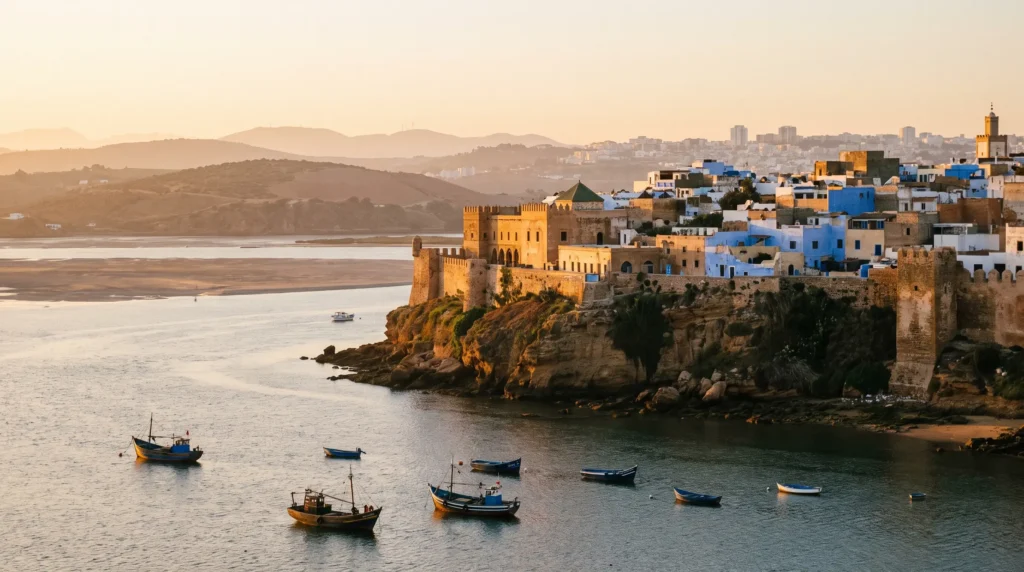
Rabat Travel Guide — Morocco’s Quiet Capital Where Two Eras Share One Skyline
Everyone I know who has been to Morocco has been to Marrakech. Almost nobody I know has been to Rabat, and that gap is the whole reason to go. Morocco’s capital since independence in 1956 sits quietly on the Atlantic where the Bou Regreg river meets the sea, carrying a UNESCO World Heritage listing that most travelers have never heard of because it doesn’t have a single headline monument — it has an entire city planned and layered instead. You get a 12th-century unfinished minaret standing over royal tombs, a fortified kasbah with cats sleeping in blue-and-white alleys, wide French-era boulevards with jacaranda trees, and a functioning royal palace with actual guards in actual uniforms, all within a twenty-minute tram ride of each other. Rabat won’t overwhelm you the way Fez or Marrakech can. It’s calmer, cleaner, safer-feeling, and — because it’s a working capital rather than a tourism machine — it’s one of the few places left in Morocco where you can wander the medina without someone trying to sell you a “free” mint tea tour. That’s not a knock on Marrakech. It’s just a different trip, and I think more people should take it.
In This Guide
- Overview — Why Rabat Is Morocco’s Best-Kept Capital
- Mawazine — Africa’s Biggest Music Festival Takes Over Rabat
- Best Time to Visit Rabat (Season by Season)
- Getting There — RBA Airport, Rail & the Road from Casablanca
- Getting Around — Tramway, Petit Taxis & Walking
- Neighborhoods — Medina, Oudayas, Agdal & Hassan
- Culture & People — A Capital, Not a Postcard
- A Food Lover’s Guide to Rabat
- Off the Beaten Path
- Day Trips from Rabat
- Practical Information
- Budget Breakdown — What Rabat Actually Costs in 2026
- Frequently Asked Questions
Overview — Why Rabat Is Morocco’s Best-Kept Capital
Rabat was founded by the Almohads in the 12th century as a fortified base, drifted into obscurity for a few centuries, briefly became a haven for Barbary corsairs and English and Dutch pirates in the 17th century, and was finally elevated to capital status when France took administrative control of Morocco in 1912 — a status it kept after independence in 1956. That layered history is exactly what UNESCO recognized in 2012 when it inscribed “Rabat, Modern Capital and Historic City: a Shared Heritage” — not a single monument, but the whole dialogue between the 12th-century medina and kasbah and the French Protectorate-era new town built between 1912 and the 1930s, with its royal and administrative quarters and the Jardins d’Essais botanical gardens. UNESCO calls it one of the most complete and ambitious modern urban projects built anywhere in Africa in the 20th century.
Practically, that means you get variety in a small footprint: the unfinished 12th-century Hassan Tower and the mausoleum of Mohammed V and Hassan II standing together on the same plaza, the whitewashed Kasbah of the Udayas on its Atlantic bluff, wide tree-lined boulevards from the French era running through Agdal and Hassan, and a functioning Royal Palace complex that’s still very much in use. Rabat is Morocco’s seventh-largest city, with roughly 516,000 people in the city proper and about 2.1 million across the wider Rabat-Salé-Kénitra metro area.
What Rabat doesn’t have is the tourist saturation of Marrakech or the medieval maze intensity of Fez. It’s an administrative city first — government ministries, embassies, universities — and a tourist destination second. That trade-off is the whole pitch: less hassle, less haggling pressure, more room to actually look at what you came to see.
Mawazine — Africa’s Biggest Music Festival Takes Over Rabat
If you can time a visit around late May or June, do it for Mawazine, the “Rhythms of the World” festival that has grown into one of the largest music festivals on the planet — organizers reported roughly 3.75 million attendees at the 2025 edition, spread across around 90 acts on seven stages. The genuinely remarkable part is that about 90% of the shows are free, which turns much of the capital — especially the Souissi and OLM Souissi grounds — into a week-long open-air party. International headliners rotate with Moroccan stars, and the festival has hosted names like Rihanna, Shakira and Bruno Mars in past years alongside Egyptian, Gulf and West African acts.
The catch: book accommodation months ahead if your dates overlap, because hotel rooms across the city sell out and prices climb. If big free crowds aren’t your thing, treat Mawazine week as a reason to avoid Rabat rather than visit — the rest of the year is far calmer.
Best Time to Visit Rabat (Season by Season)
March – May · Spring (peak comfort)
Warm, mild days, jacaranda and gardens in bloom along the French-era boulevards, and the build-up to Mawazine at the tail end of the season. This is the sweet spot most seasoned Morocco travelers pick.
June – August · Summer
Rabat’s Atlantic-facing position keeps it noticeably cooler than inland cities like Fez or Marrakech, with average highs around 28°C (82°F) even in August, tempered by a steady sea breeze. Mawazine falls in this window most years. It’s the driest stretch but also the busiest and priciest for hotels.
September – November · Autumn
The other sweet spot: warm without being harsh, fewer crowds than spring, good light for the kasbah and the river. Rain starts creeping back in by late November.
December – February · Winter
Mild by European standards but genuinely rainy and occasionally chilly in the evenings — riads and older buildings are not always well heated. Cheapest hotel rates of the year and a medina you’ll mostly have to yourself.
Getting There — RBA Airport, Rail & the Road from Casablanca
Rabat–Salé Airport (RBA) sits about 8 kilometres northeast of the city center and is served mainly by regional and European routes on Royal Air Maroc, Ryanair, easyJet, Air Arabia Maroc and Air France, with Paris as the single busiest connection. It is not Morocco’s main intercontinental gateway — most long-haul travelers fly into Casablanca’s Mohammed V International Airport instead and continue to Rabat from there.
That onward leg is easy: Morocco’s ONCF rail network runs frequent, comfortable trains directly between Casablanca (both the airport and Casa-Voyageurs station) and Rabat Ville, a journey of roughly an hour, and the same line continues north to Kenitra and south to Marrakech. High-speed Al Boraq trains also link Rabat to Tangier in about an hour and a half, one of the fastest rail corridors in Africa. Renting a car and self-driving the Casablanca–Rabat autoroute (about an hour) is straightforward too, though most visitors find the train less stressful given city-center parking in Rabat.
Getting Around — Tramway, Petit Taxis & Walking
Rabat is genuinely one of the most walkable and easiest-to-navigate capitals in North Africa, thanks largely to the Rabat–Salé tramway: two lines covering about 26 kilometres and 42 stops, linking central Rabat with Salé across the Bou Regreg, with trams running roughly every 6–8 minutes at peak times and a single ticket costing around 6 dirhams (well under a dollar). It’s air-conditioned, clean and genuinely useful for tourists, connecting the medina area, the train station, Agdal and Salé’s own historic core.
For anything the tram doesn’t reach, Rabat’s small blue “petit taxis” are metered and cheap for in-city hops — insist on the meter or agree a price before getting in. Ride-hailing apps operate in the city and remove the negotiation entirely. Buses fill in gaps but run less predictably. The medina, kasbah and Hassan Tower area are all comfortably walkable from each other, and the wide, arcaded Avenue Mohammed V through the new town is one of the more pleasant capital-city walks in the region.
Neighborhoods — Medina, Oudayas, Agdal & Hassan
The Medina
Rabat’s old walled town is smaller and noticeably calmer than Fez’s or Marrakech’s, with whitewashed lanes, the Rue des Consuls’ carpet and jewelry shops, and food alleys where sardines grill and harira simmers from mid-afternoon into the evening. It’s a working neighborhood, not purely a tourist set piece, which is part of the appeal.
Kasbah of the Udayas
A 12th-century fortified citadel of blue-and-white lanes perched on a cliff above where the Bou Regreg meets the Atlantic, with formal Andalusian-style gardens added during the French Protectorate and sweeping ocean views from the ramparts. Come for golden hour; the light off the water is the best free thing in the city.
Hassan District
Rabat’s monumental core: the unfinished 12th-century Hassan Tower and its forest of stone columns, the Mausoleum of Mohammed V housing the remains of King Mohammed V and King Hassan II, the Moroccan Parliament, and the tranquil Andalusian Garden nearby. This is the postcard cluster most visitors come for first.
Agdal
The modern, upscale district built up mainly during and after the French Protectorate — tree-lined avenues, cafés, patisseries and international restaurants along Avenue de France, with a cosmopolitan, almost Mediterranean feel. Good base for comfortable mid-range hotels.
Souissi
An affluent, leafy residential district of villas and parks, home to the Mawazine festival grounds and several embassies — quiet, green, and family-friendly rather than a sightseeing draw in its own right.
Salé
Across the river via the tram, Rabat’s historic twin city has its own medina, the Great Mosque, and a quieter, more local pace — a short, worthwhile crossing that most visitors staying only a day or two skip entirely.
Culture & People — A Capital, Not a Postcard
Rabat’s identity is shaped by being a seat of government and diplomacy rather than a tourism economy — Morocco’s constitution designates Arabic and Tamazight (Berber) as official languages, while French remains the working language of much business, higher education and government, a direct legacy of the Protectorate era. That mix shows up everywhere: street signs in Arabic and French, government buildings that could pass for Paris, and a medina soundtrack that’s pure Darija (Moroccan Arabic).
Beyond Mawazine, look for smaller cultural threads: the Mohammed VI Museum of Modern and Contemporary Art near the medina showcases 20th- and 21st-century Moroccan artists, and the Oudayas’ Andalusian Garden reflects the Muslim refugees who arrived from Spain after the Reconquista and shaped much of the kasbah’s architecture and craft traditions. As the seat of government, Rabat also tends to be more conservative in everyday public behavior than beach or tourist-zone cities — modest dress in non-touristy areas and discretion around public displays of affection are appreciated.
A Food Lover’s Guide to Rabat
Rabat’s coastal position gives its Moroccan classics a seafood twist you won’t find inland: the city’s take on pastilla — traditionally a sweet-savory pigeon or chicken pie under cinnamon-dusted pastry — often appears here with crab or other seafood folded in instead. Tajine and couscous are everywhere, and the medina’s food alleys near the Grand Mosque and Rue des Consuls fill from mid-afternoon with grilling sardines, bubbling pots of harira soup, and bessara (fava bean soup) served at dawn near Bab El Had for early risers and market workers.
For a sit-down meal, the medina and the Hassan district both have long-running spots doing tajine with preserved lemon and olives, tanjia and pastilla; Agdal’s Avenue de France is the place for patisseries, juice bars and a more contemporary café scene. Mint tea — poured from height, sweet, ceremonial — is the constant thread through all of it, and a proper glass costs next to nothing at a hole-in-the-wall café. Alcohol is legally available only in licensed restaurants, hotel bars and specific shops, not casually on the street.
Off the Beaten Path
Chellah Necropolis
A walled complex just south of the city center layering Roman ruins (ancient Sala Colonia) beneath a Marinid-era royal necropolis, complete with storks nesting on the minaret ruins and a genuinely peaceful, half-overgrown garden atmosphere most Marrakech-only visitors never see.
Salé’s Medina
Rabat’s twin city across the Bou Regreg has its own walled old town, artisan workshops and the Great Mosque — a ten-minute tram ride for a completely different, far less touristed medina experience.
The Fishing Port at Kasbah des Oudayas
Below the kasbah, the working fishing harbor where boats unload the day’s catch is unglamorous and completely real — worth a look for anyone tired of curated experiences.
Mohammed VI Museum of Modern and Contemporary Art
A well-designed, under-visited museum of 20th- and 21st-century Moroccan art near Bab El Had — a useful counterpoint to the historic-monument-heavy itinerary most visitors default to.
Day Trips from Rabat
Rabat’s rail position makes it a strong day-trip base. Casablanca is about an hour away by frequent ONCF train, home to the Hassan II Mosque and Morocco’s main business district — most visitors do it as an easy there-and-back. Kenitra, a short hop north, offers the Sidi Bouknadel gardens and quieter beach towns. Meknes and Fez, both roughly two to three hours by train, make for a longer but manageable single day if you start early, though an overnight does either city more justice — our Fez guide covers that in depth.
Closer to home, the Atlantic beach towns north and south of the city — Skhirat and Temara — are popular weekend escapes for Rabat residents and easy taxi or grand-taxi rides for a half-day at the coast.
Practical Information
Money. The Moroccan dirham (MAD) is a closed, non-convertible currency obtainable only inside Morocco, officially managed against a euro/dollar currency basket by Bank Al-Maghrib. ATMs are widely available and generally offer the best rates; expect a per-transaction fee. You may bring in or take out only a limited amount of dirham (around 2,000 MAD) across the border.
Visa. US, UK, EU and most Commonwealth passport holders enter visa-free for up to 90 days; passports should be valid at least three months beyond your arrival date.
Safety. The US State Department rates Morocco a Level 2 advisory (“Exercise Increased Caution”), citing the potential for terrorism targeting tourist sites, transport hubs and markets — the same baseline risk level applied to much of Western Europe, not a sign of everyday danger in Rabat specifically. UK guidance flags occasional protests in large cities and reminds travelers that same-sex relations and public drinking outside licensed venues are illegal. Check current advisories before you travel.
Health. No routine vaccinations are required for most Western travelers; the CDC’s Morocco traveler page is the place to check current notices, including occasional rabies alerts tied to stray animal contact. Stick to bottled or filtered water outside hotels.
Connectivity & practicalities. A local SIM or eSIM is cheap and easy to arrange on arrival. Plugs: European two-pin (Type C/E), 220V. Time zone: generally UTC+1, aligned with much of Western Europe.
Budget Breakdown — What Rabat Actually Costs in 2026
Rabat runs noticeably cheaper than European capitals and is broadly on par with, or slightly above, Fez and Marrakech’s non-touristy prices, since it isn’t built around a tourist economy.
Budget (US$35–60/day): Guesthouse or budget hotel room, medina street food and small restaurants, tramway and petit taxis for transport.
Mid-range (US$80–160/day): Comfortable riad or 3–4 star hotel in Agdal or near the medina, sit-down restaurant meals, museum entries, a day-trip train ticket to Casablanca or Meknes.
Luxury (US$250+/day): High-end riads and international hotel brands, private guided tours of the kasbah and Chellah, fine dining, driver-guided day trips.
Tipping 10% is customary at restaurants where service isn’t included; small tips for guides, porters and taxi drivers are expected but modest. Bargaining is normal in medina souks but far less aggressive here than in Marrakech’s.
Planning Your First Trip to Rabat
Two to three nights covers Rabat comfortably: a day for the Hassan Tower, Mausoleum and Chellah; a day for the Kasbah of the Udayas, medina and river; and, if time allows, a half-day crossing to Salé or a day trip to Casablanca. Most travelers pair Rabat with a wider Moroccan circuit — our Morocco travel guide lays out the bigger picture, and Rabat slots naturally between Fez to the east and Marrakech further south on a rail-based itinerary.
Frequently Asked Questions
Is Rabat worth visiting if I’ve already seen Marrakech and Fez?
Yes — it’s a genuinely different experience. Rabat is calmer, less touristed, and pairs 12th-century monuments with French colonial-era planning in a way no other Moroccan city does, all recognized in its 2012 UNESCO listing.
Is Rabat safe for tourists in 2026?
Generally yes — it’s Morocco’s administrative capital and tends to feel orderly and low-key. The US State Department’s Level 2 advisory reflects a regional terrorism baseline rather than city-specific danger; use normal precautions, stick to licensed taxis, and check current advisories before you go.
Do I need a visa to visit Rabat?
US, UK, EU, Canadian and most Commonwealth passport holders can enter Morocco visa-free for stays of up to 90 days, provided the passport is valid at least three months beyond arrival.
How many days do I need in Rabat?
Two full days covers the main sights comfortably; three lets you add Chellah, Salé’s medina and a slower pace without rushing.
Rabat or Casablanca as a base?
Rabat, generally — it’s calmer, has more historic character, and is only about an hour from Casablanca by frequent train, so you can day-trip in either direction without switching hotels.
What’s the easiest way to get from Casablanca airport to Rabat?
The ONCF train direct from Mohammed V International Airport to Rabat Ville is the simplest option — no transfers, comfortable seating, and roughly an hour door to door.
Ready to Explore Rabat?
A 12th-century minaret standing over royal tombs, a whitewashed kasbah with Atlantic views, a tram that gets you between all of it for less than a dollar, and — outside one loud week in June — some of the calmest medina streets left in Morocco. Rabat isn’t trying to be Marrakech, and that’s exactly why it’s worth the detour.
Explore More
- Morocco Travel Guide — the full country picture beyond the capital
- Fez City Guide — Morocco’s medieval imperial city, a train ride east
- Marrakech City Guide — the souks, the Atlas foothills and the busier south
- Spain Travel Guide — continue north across the Strait of Gibraltar
How this guide was built
Published as part of Facts From Upstairs’ city guide series. Built from authoritative sources — UNESCO’s World Heritage inscription for Rabat, Bank Al-Maghrib (Morocco’s central bank), the US State Department and UK FCDO Morocco pages, the US CDC traveler page for Morocco, Morocco’s official visa policy entry on Wikipedia, and Wikipedia entity pages for Rabat, Rabat–Salé Airport, the Rabat–Salé tramway and the Mawazine festival. Numeric and checkable claims carry inline citations.
Sources cited on this page
- Wikipedia — Rabat
- UNESCO — Rabat, Modern Capital and Historic City: a Shared Heritage
- Wikipedia — Visa Policy of Morocco
- US State Department — Morocco Travel Advisory
- UK FCDO — Morocco Travel Advice
- US CDC — Morocco Traveler Page
- Wikipedia — Rabat–Salé Airport
- Wikipedia — Rabat–Salé Tramway
- Bank Al-Maghrib — Reform of the Exchange Rate Regime
- Moroccan National Tourist Office — Getting Around Morocco
- Wikipedia — Mawazine Festival
More city guides you might like
Plan your trip to Rabat
The booking tools we use ourselves. FFU may earn a commission at no extra cost to you.
Plan & book your trip to Rabat
Booking through these searches supports our guides at no extra cost to you.