
Fez, Morocco: The Living Medieval Medina Where Scholars, Tanners and Sufis Still Walk
I have wandered a lot of old cities, but nothing prepared me for my first morning lost inside Fes el Bali. We turned off a main lane to follow the smell of fresh bread and within minutes I had no idea which way was out — and that, I learned, is the whole point. Fez does not perform for visitors the way Marrakech sometimes does; it simply keeps doing what it has done for twelve centuries, with donkeys hauling propane past a Quranic school founded before most European capitals existed. This guide is the one I wish I had carried: where to sleep, what the tanneries actually cost, how not to get fleeced, and why you should give this labyrinth at least three unhurried days.

Table of Contents
Why Fez?
Marrakech gets the Instagram traffic, but Fez is where Morocco keeps its soul. Founded in 789 CE under Idris I and built up over the following century by waves of Andalusian refugees from Cordoba and Arab families from Kairouan in Tunisia, it became the spiritual and intellectual capital of the western Islamic world — a role it has never entirely surrendered. Those two founding communities still echo in the city’s two oldest mosques, the Qarawiyyin and the Andalusiyyin, which face each other across the river that splits the old town.
The scale is what undoes most first-timers. Fes el Bali, the older of the two walled medinas, holds more than 9,000 lanes inside roughly 280 hectares, and almost none of them admit a car — making it one of the largest contiguous car-free urban areas on the planet. UNESCO inscribed it as a World Heritage Site in 1981, calling it one of the most extensive and best-preserved medieval towns in the Arab world, an essentially intact medieval city whose human scale and traditional crafts survive largely unchanged. With a metropolitan population of about 1.26 million counted in the 2024 census, this is a living, working city of artisans, students and traders, not a museum frozen for tourists.
And then there is the superlative that stops conversations: the University of al-Qarawiyyin, founded by the merchant’s daughter Fatima al-Fihri in 857 CE, is recognised by UNESCO and Guinness World Records as the oldest existing, continually operating, degree-granting university on Earth — older than Oxford, Bologna or the Sorbonne by centuries. That a woman founded the world’s first university, in a city most travellers skip, tells you everything about how much Fez has to offer the patient visitor.
What separates Fez from Morocco’s other imperial cities is its refusal to be tamed. There is no central square performing for cameras the way Marrakech’s Jemaa el-Fnaa does; instead the drama is dispersed across thousands of workshops, where you stumble on a coppersmith hammering a tray, a weaver at a pit loom, or a tannery whose methods have not meaningfully changed since the Middle Ages. The reward structure of the city is simple: the more you slow down and the deeper you wander, the more it gives back. Come for the headline university; stay because Fez rewards the traveller who gets lost on purpose.

Neighborhoods: Finding Your Fez
📍 Fez Map: Every Place in This Guide
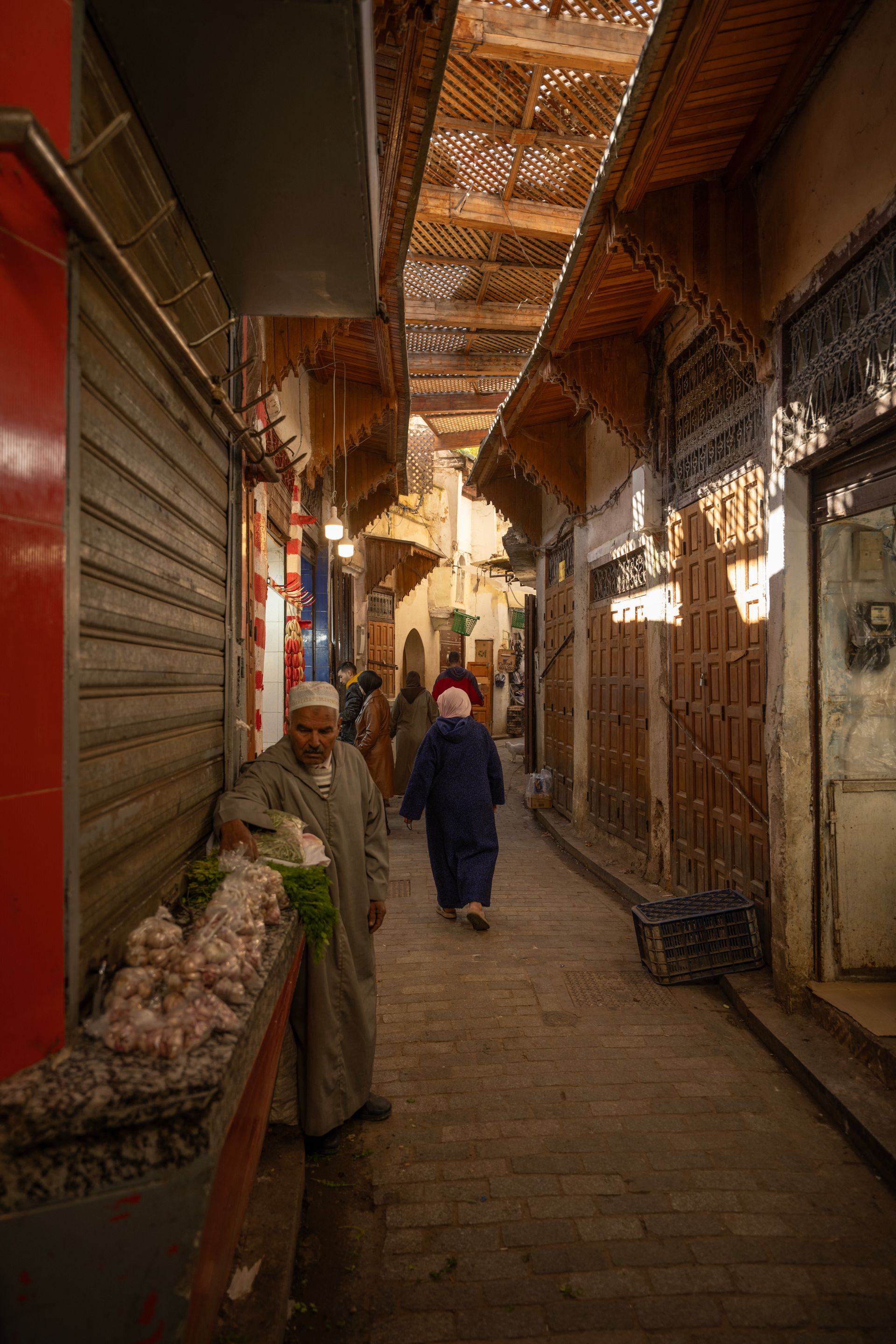
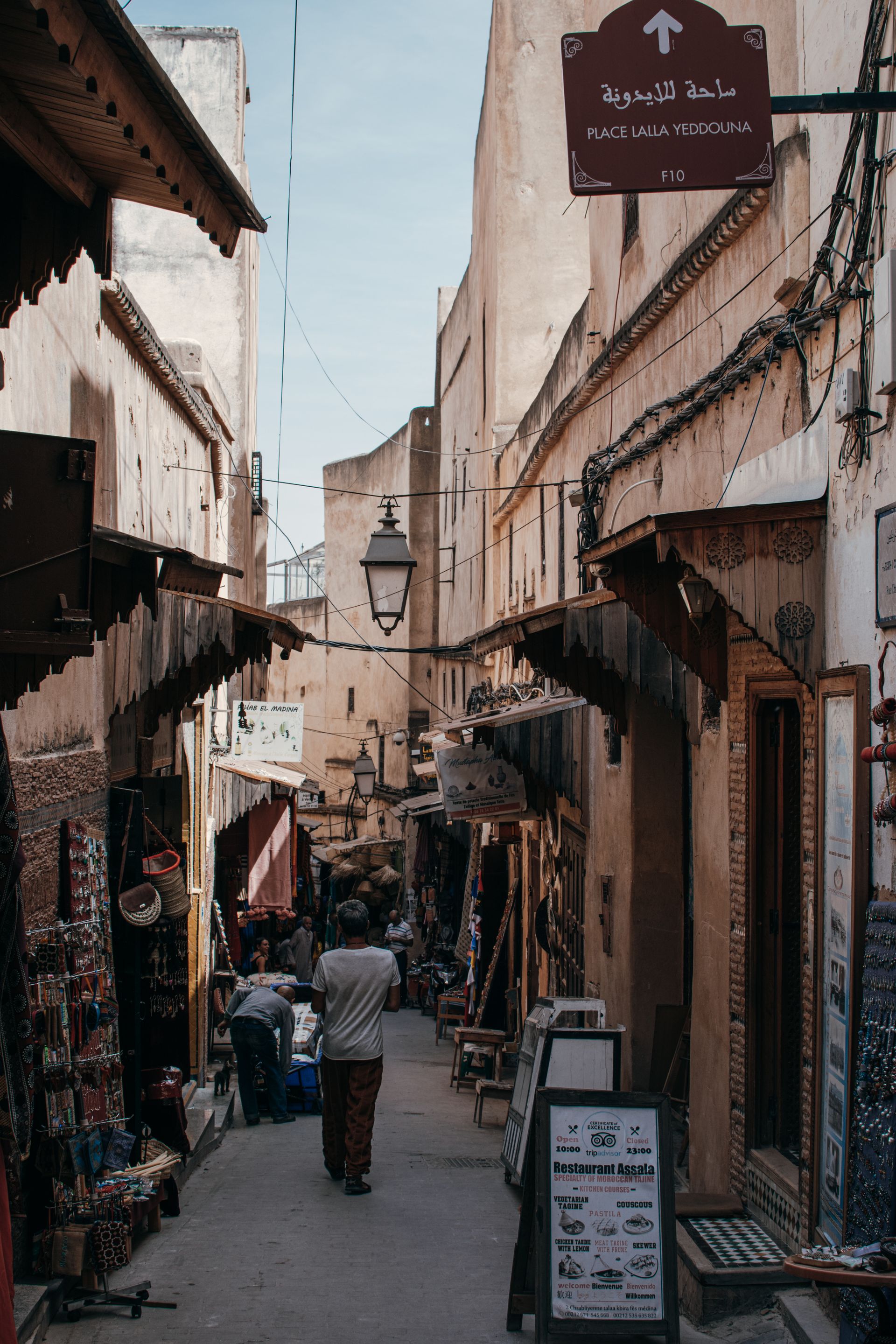
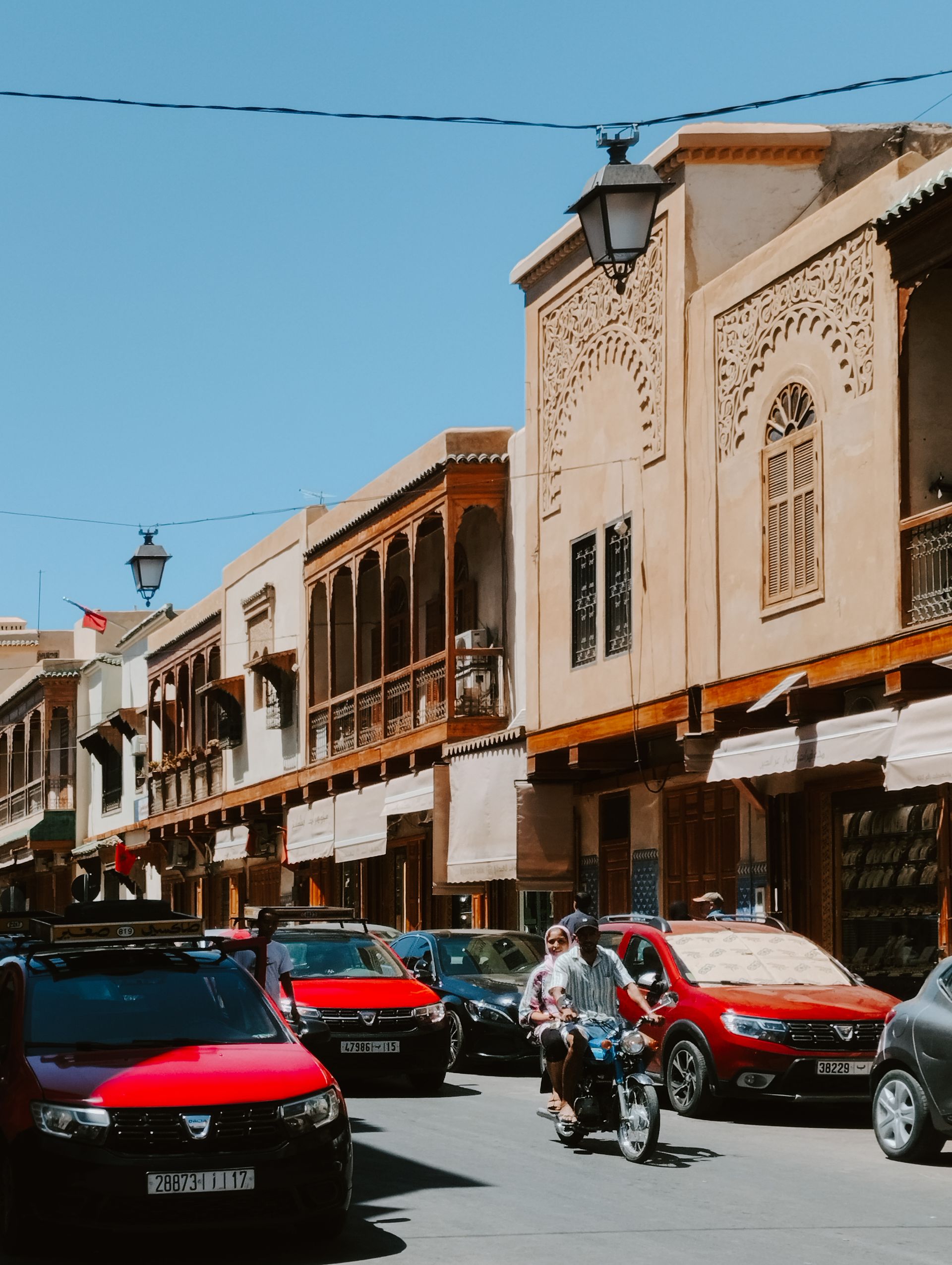
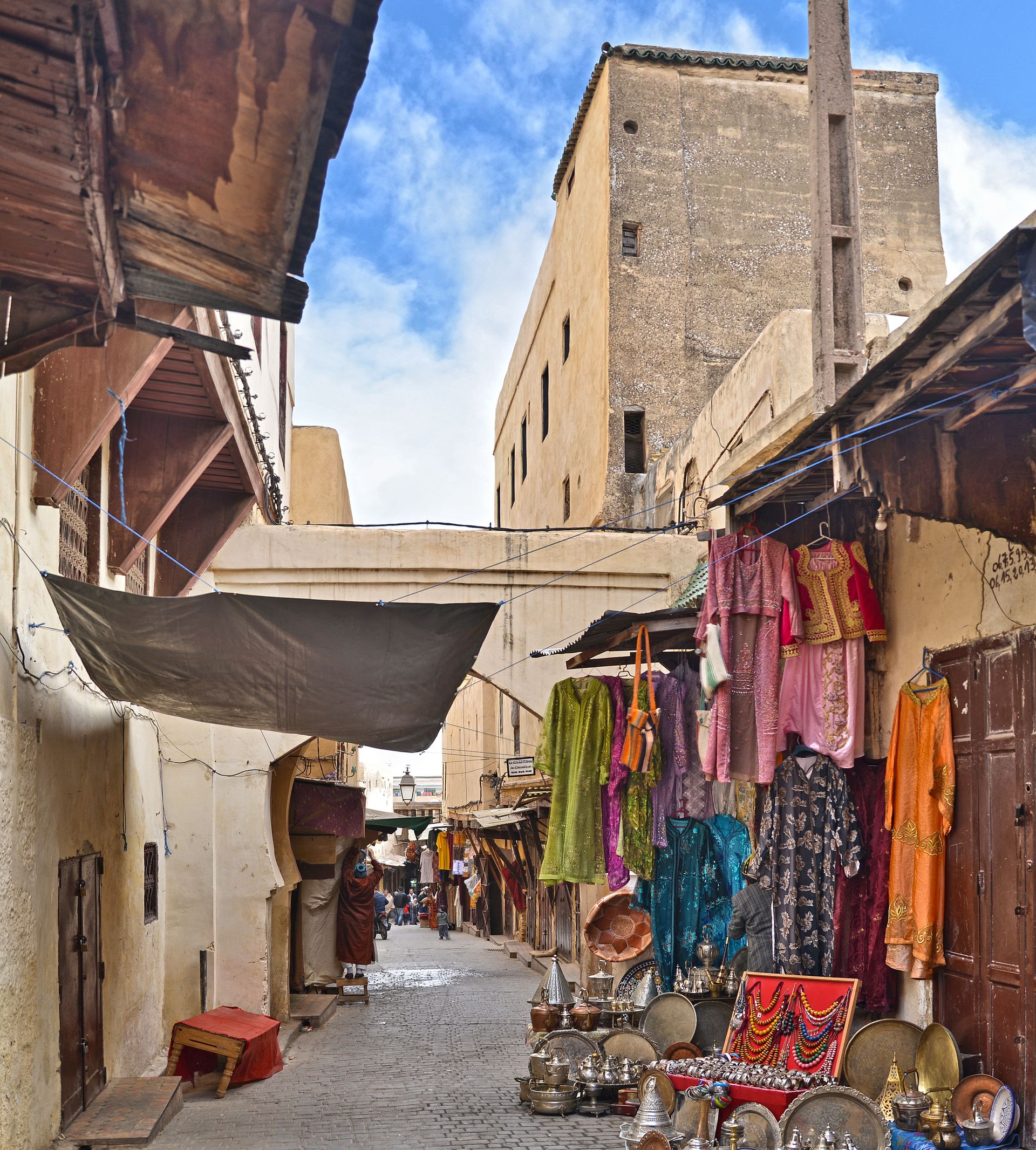
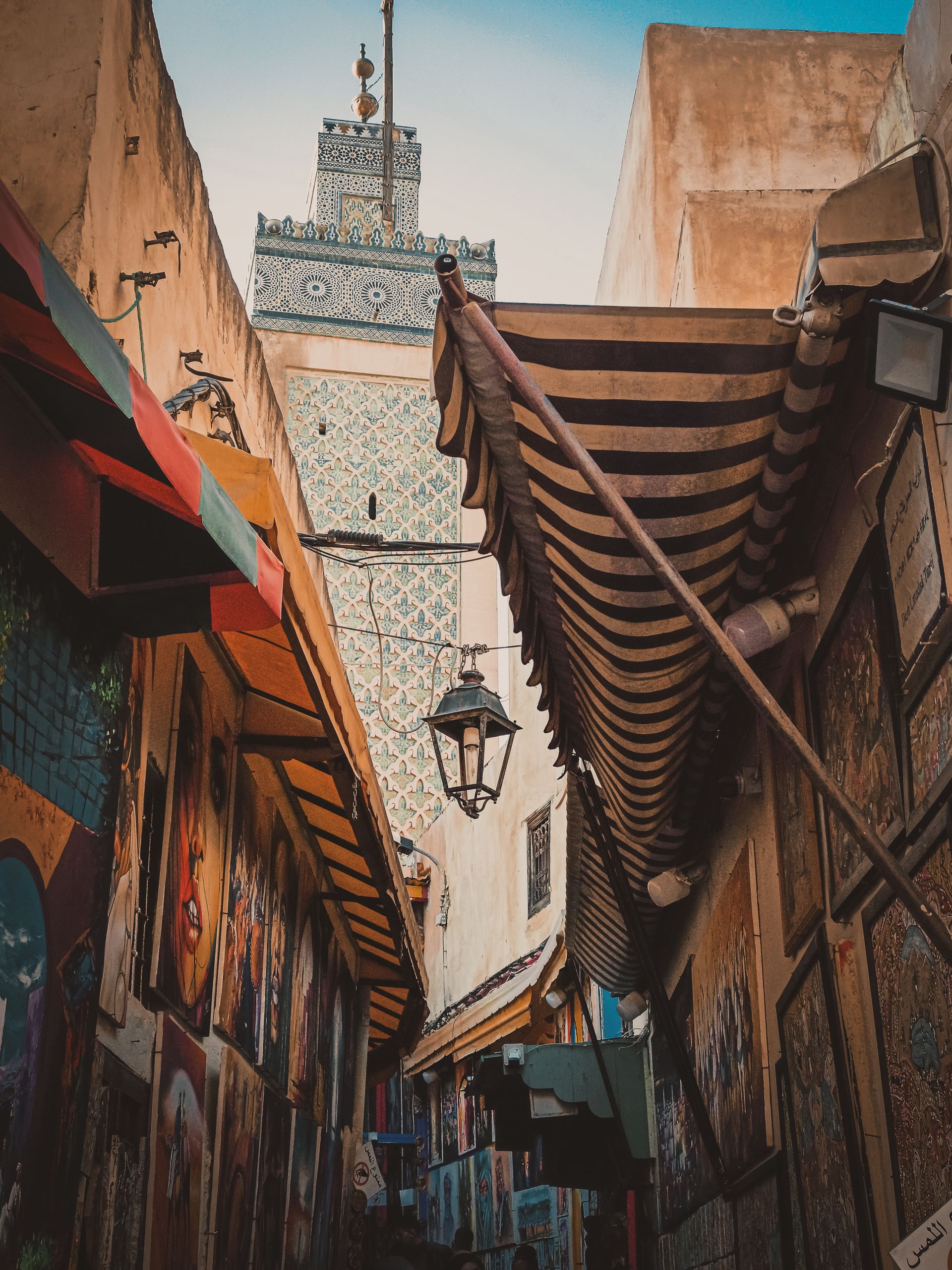
Fez is really several cities stacked on top of each other in time. The two walled medinas — ancient Fes el Bali and “new” Fes el Jdid — sit side by side, while the French-era Ville Nouvelle sprawls downhill to the south. Knowing which is which, and where to base yourself, is the difference between a magical trip and a stressful one. Below is how I’d carve up the city for a first visit.
A quick mental map helps enormously. Picture the old medina, Fes el Bali, as a bowl: the main gates — the famous Blue Gate (Bab Bou Jeloud) at the top, Rcif and Guerniz lower down — sit around the rim, and the two great descending streets, Talaa Kebira and Talaa Sghira, funnel everyone downhill toward the Qarawiyyin and the river at the bottom. Almost everything you want to see is strung along or just off those two arteries. When you feel lost — and you will — the rule is simple: keep heading downhill and you’ll hit the Qarawiyyin and Rcif area; keep heading uphill and you’ll pop out at the Blue Gate. Once that geography clicks, the “impossible” labyrinth becomes surprisingly legible.
Fes el Bali
This is the medieval core and the reason you came — a UNESCO-listed warren of tanneries, madrasas, mosques and souks where the call to prayer ricochets off thousand-year-old walls and the loudest sound is usually a mule driver shouting “balak!” to clear the lane. It is organised, loosely, by trade: the coppersmiths cluster at Place Seffarine, the dyers near the river, the spice and perfume sellers on the Attarine. Stay inside it in a converted riad and you will never quite get your bearings, which is exactly the experience to chase. Talaa Kebira and Talaa Sghira are the two main descending arteries from the Blue Gate; learn those and you can always find your way back to daylight.
- Bab Bou Jeloud (the Blue Gate)
- Talaa Kebira, the main artery
- Place Seffarine, the coppersmiths’ square
Best for: first-time visitors, history obsessives, riad stays. Access: on foot only; petit taxis drop you at the gates.
Fes el Jdid
“New Fez” is only new by Fassi standards — it was laid out in the 13th century by the Marinid dynasty as a royal and administrative district, complete with palaces, gardens and barracks. It holds the dazzling golden gates of the royal palace, the old Jewish quarter, and a calmer, more linear feel than the glorious chaos of the old medina next door. The main thoroughfare runs more or less straight, so it is a gentler place to find your feet on your first afternoon before plunging into Fes el Bali. The Grand Mechouar and the green-tiled Dar al-Makhzen gates are the showpiece.
- Dar al-Makhzen golden palace gates
- The Mellah (Jewish quarter)
- Bou Jeloud Gardens
Best for: palace photography, a gentler first walk, the Mellah’s history. Access: walkable from Fes el Bali in 15 minutes.
The Mellah
Established in the 15th century within Fes el Jdid, Fez’s Jewish quarter is one of the oldest in Morocco and has a distinct architecture all its own: tall houses with carved wooden balconies that face outward onto the street, a deliberate contrast to the inward-facing, courtyard-centred Muslim homes of the old medina. Once home to a thriving community of goldsmiths, the Mellah today is quiet and contemplative. The beautifully restored Ibn Danan Synagogue and the white-domed hillside Jewish cemetery are moving, crowd-free stops that round out the city’s layered story of coexistence.
- Ibn Danan Synagogue
- The Jewish cemetery
- Goldsmiths’ lane
Best for: layered history, fewer crowds. Access: adjoins Fes el Jdid.
Ville Nouvelle
The French-built new town is where modern Fez actually lives, shops, banks and eats. Wide boulevards, pavement cafes, the train station, cinemas and reliable ATMs make it a practical base if the medina’s intensity overwhelms you — though you trade atmosphere for convenience, and you’ll be commuting in by taxi each morning. It’s also where you’ll find the city’s only real bar-and-lounge nightlife, plus the best pharmacies and supermarkets. Many travellers split the difference: a night or two here to decompress, the rest in a medina riad.
- Avenue Hassan II cafes
- Fez train station
- Boulevard Mohammed V
Best for: longer stays, nervous first-timers, nightlife. Access: petit taxi or 25-minute walk from the medina.
Borj Nord & the Merinid Tombs
Climb the hill on the northern edge of the medina in the late afternoon for the single best panorama of Fez. The ruined Merinid Tombs — the crumbling resting place of the dynasty that gave Fez its golden age — and the 16th-century Borj Nord fortress (now an arms museum) overlook the entire amber sea of medina rooftops. As the sun drops and the muezzins begin the sunset call to prayer in overlapping waves across the valley, it is one of the most atmospheric free experiences in Morocco. Bring water, comfortable shoes and a camera.
- Merinid Tombs viewpoint
- Borj Nord fortress
- Sunset photography ridge
Best for: sunset panoramas, photographers. Access: petit taxi up, walk down.
Ain Azliten & the Tanners’ Quarter
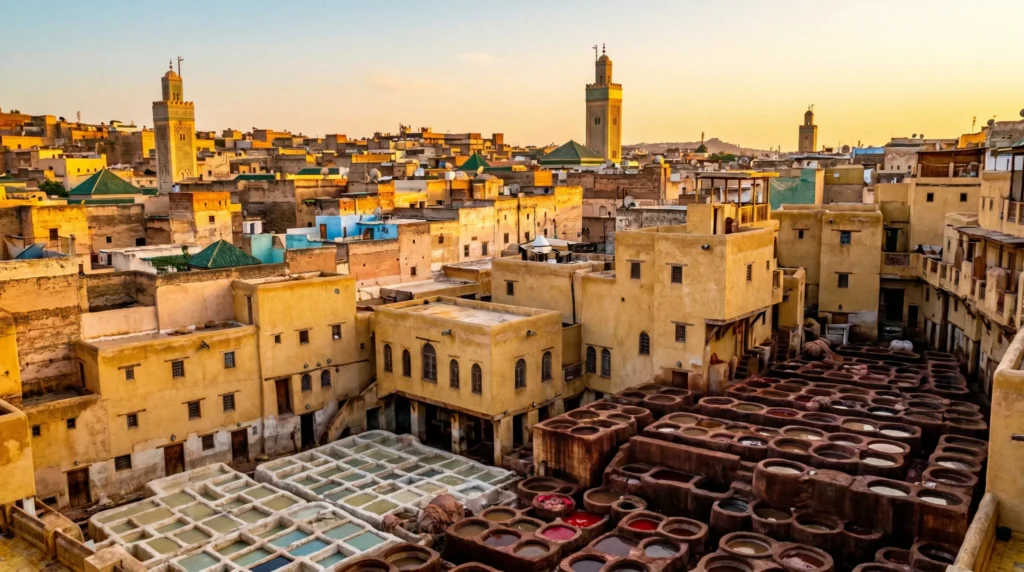
The northeast pocket of the old medina around the Chouara tanneries is the most sensory corner of the entire city. Here, stone dye pits filled with pigeon-dropping ammonia, lime, cow urine and natural dyes — saffron yellow, poppy red, mint green, indigo blue — sit in a honeycomb worked entirely by hand. Drying hides drape the surrounding terraces and the smell hits before you arrive (hence the customary sprig of mint). The leather cooperatives that ring the pits let you watch from their upper terraces, and this is the place to buy a genuine, if pungent, Fassi leather bag or babouche slippers.
- Chouara Tannery terraces
- Leather cooperatives
- Sidi Moussa lane
Best for: photography, leather shopping. Access: deep in Fes el Bali; follow the smell or a guide.
The Souks, Organised by Trade
One thing that makes navigating Fes el Bali easier — and far more interesting — is understanding that the medina is still loosely organised by craft, exactly as it was in the Middle Ages. Following the trades is itself a route. Near Bab Bou Jeloud and along Talaa Kebira you pass the food and produce sellers; deeper in lies the Attarine, the spice and perfume market, its lanes heaped with saffron, cumin, dried roses and pyramids of olives. Beyond it, the Henna Souk sits in a quiet little square shaded by a tree, selling cosmetics and pottery. The metalworkers cluster at Place Seffarine, where the ring of hammers on brass and copper trays is constant, and the dyers and tanners occupy the riverside fringe. Knowing roughly where each trade lives turns the “maze” into something you can read.
Shopping the souks is a sport in itself. The big-ticket buys are leather (bags, poufs, babouche slippers) from the tanneries, brass and copper from Seffarine, hand-knotted Berber rugs, blue-and-white Fassi ceramics, and carved cedar. Prices are never fixed: expect to haggle hard, start at roughly a third of the opening ask, and never show desperation for a particular piece. The quality genuinely varies, so buy with your eye rather than the seller’s patter, and remember that a “cooperative” or “Berber museum” a guide steers you to is usually a shop paying him commission.
Fez is also one of the last great centres of living craft, and watching artisans at work is as rewarding as buying. The blue-and-white pottery and zellij mosaic for which the city is famous is still cut and fired in workshops on the medina’s edge; you can visit a ceramics cooperative to watch tilemakers chip individual tesserae by hand from glazed sheets, an astonishingly skilled and slow process. Weavers work pit looms producing cactus-silk and cotton scarves, and the coppersmiths of Seffarine hammer trays and lamps to a rhythm that has filled that little square for a thousand years. These are the souvenirs worth carrying home: things made by hand, in front of you, in a tradition that predates almost everything else you own.
A practical word on orientation, because it shapes how you experience every one of these quarters. Fes el Bali essentially funnels downhill from the western gate of Bab Bou Jeloud toward the river and the tanneries in the east, so a reliable trick when you feel lost is simply to walk uphill to climb back toward the main gate, or downhill to reach the Qarawiyyin and the tanneries. The two great spinal arteries, Talaa Kebira and Talaa Seghira, both run from Bab Bou Jeloud down toward the mosque, and almost everything of interest hangs off them. Save offline maps before you go in, since signal is patchy in the deeper lanes, but don’t be a slave to the blue dot — getting briefly, happily lost between these neighbourhoods, then finding your own way out, is the single best thing you can do in Fez.
Staying in a Riad: What to Expect
The single best decision you can make in Fez is to sleep in a riad — a traditional house built inward around a central courtyard or small garden, often centuries old and lavishly restored with zellij tile, carved plaster and a rooftop terrace. From the blank, unassuming door on the lane you’d never guess at the cool, fountain-centred calm inside. A good riad is an oasis from the medina’s sensory overload: you step out into the chaos by day and retreat to silence, mint tea and a courtyard sky at night. Most include a generous Moroccan breakfast, can arrange airport pickup, guides and dinners, and — crucially — will send a porter to meet you at the nearest gate, because you will never find the place on your own the first time.
A few realities to set expectations: rooms vary wildly even within one riad, courtyard sound carries (light sleepers should ask for an upper room), and the lanes outside are too narrow for cars, so you walk in. Prices span an enormous range, from simple guesthouses to palatial conversions with plunge pools, but even mid-range riads here feel special for the money. Book one inside Fes el Bali for atmosphere; pick one near a major gate if you’re worried about the walk in with luggage.
The Food

Ask a Moroccan where the country’s best cooking is and the answer, grudgingly even from Marrakshis, is usually Fez. As the old imperial capital with a refined Andalusian heritage, the city developed an elaborate haute cuisine for its merchant and scholarly elite — the kind of slow, spice-layered dishes that take a day to prepare. You can eat that ceremony in a restored riad, or you can eat brilliantly and cheaply standing up in the souk; Fez does both extremes better than almost anywhere. Here’s how I’d structure a few days of eating.
A little history explains why Fassi food is so distinctive. When Andalusian Muslims and Jews were expelled from Spain, many of the most cultured families settled in Fez, bringing with them sophisticated techniques, a love of sweet-savoury combinations, and ingredients like almonds, oranges and elaborate pastries. Layered onto the existing Amazigh and Arab traditions, and refined over centuries in the kitchens of a wealthy court city, the result is a cuisine that prizes complexity and ceremony — pastilla wrapped in dozens of paper-thin pastry sheets, tagines slow-braised with preserved lemon and forty spices, sweets perfumed with orange-flower water. Even the everyday street food carries echoes of that refinement.
Fassi Classics
Fez is considered the birthplace of Morocco’s most refined cooking, and the city guards a few dishes you will struggle to find done as well anywhere else. The grand sit-down dinners happen inside restored riads, where a meal is an evening-long ritual of salads, a main tagine or pastilla, fruit and endless mint tea, often with live oud music. It isn’t cheap by Moroccan standards, but it is theatre as much as dinner.
- The Ruined Garden — slow-cooked lamb tangia and seasonal mezze in a leafy courtyard (~120–180 DH, ~$12–18)
- Nur — ambitious tasting-menu fine dining built on local Fassi ingredients (~600 DH, ~$60)
- Cafe Clock — the famous camel burger plus a good pastilla and a young, social crowd (~85–120 DH, ~$8–12)
For the full riad-dinner experience, book a day ahead and go hungry — portions are generous and refusing a course can cause genuine offence. Many riads will cook a set menu for guests on request, which is often the single best meal you’ll have in the city.
Street & Market Bites
The cheapest, most memorable eating in Fez happens standing up in the souks, elbow to elbow with locals. Follow Fassi office workers at lunchtime and you will eat brilliantly for the price of a coffee back home. The food stalls clustered just inside Bab Bou Jeloud are the easiest introduction, but the deeper market lanes reward the brave.
- Bab Bou Jeloud stalls — steaming bowls of harira soup, especially at dusk (5–10 DH)
- Snail carts (babbouche) — a paper cup of snails in spiced broth, a beloved Fassi street snack (10–15 DH)
- Sfenj stands — fresh, chewy Moroccan doughnuts fried to order in the morning (3–5 DH)
- Maakouda — fried potato cakes stuffed into bread with harissa (8–12 DH)
Beyond Tagine and Couscous
The famous dishes are only the start. Fez has its own specialities and sweets, some of them genuinely unusual, that reward the curious eater willing to point at something they can’t name. A few are tied to ritual — sellou and harira appear at Ramadan, sfenj on Friday mornings — so what’s available shifts with the calendar.
- Pastilla — the signature sweet-savoury pigeon (now often chicken) pie in crackly warqa pastry, dusted with cinnamon and icing sugar (60–90 DH)
- Khlea — preserved spiced and fat-cured beef, a distinctly Fassi pantry staple, fried with eggs for breakfast (40–60 DH)
- Sellou (sfouf) — a dense, energy-rich sweet of toasted flour, ground almonds, sesame and honey (per portion 20–30 DH)
- Mint tea — “Moroccan whisky”, poured theatrically from a height, free-flowing in every shop and cafe (10–20 DH)
The sweet shops near the Attarine are worth a detour of their own — pyramids of honey-soaked chebakia, almond-stuffed gazelle horns and pistachio briouats glow in the windows, sold by weight for a handful of dirhams.
Don’t overlook the everyday staples that hold the whole cuisine together, either. Bread (khobz) is sacred and present at every meal, used as much as a utensil as a food; a stack of warm rounds arrives unbidden and you scoop with your right hand. Couscous is traditionally a Friday lunch dish, mounded with vegetables and meat and a fragrant broth, so time your week to catch it done properly. And the humble breakfast spread — msemen and baghrir pancakes, fresh honey and amlou (an argan-almond spread like Moroccan Nutella), olives, soft cheese and mint tea — is one of the quiet joys of any riad stay, worth lingering over before you plunge back into the lanes.
Vegetarians, Vegans & Dietary Needs
Fez is easier for vegetarians than its meat-heavy reputation suggests, though you’ll need to be a little proactive. Vegetable tagines, lentil and chickpea dishes, the ubiquitous salads, zaalouk (smoky aubergine dip), bessara (fava-bean soup) and endless bread make for satisfying meat-free eating, and the trendier riad restaurants and cafe-culture spots like Cafe Clock cater knowingly to vegetarians and vegans. The main traps are hidden meat stock in soups and couscous, so ask. Vegans should specify no butter or eggs in pastries and breads. Gluten-free is harder in a bread-and-couscous culture but not impossible at the better restaurants. As ever, your riad is your best ally — tell them your needs and they’ll steer or cook accordingly.
Where to Eat: Riad Dinners vs. Hole-in-the-Wall
One thing that surprises first-time visitors is how stark the divide is between Fez’s two dining worlds. There is very little in the middle. On one side sit the restored-riad restaurants — gorgeous, candlelit, multi-course affairs in tiled courtyards, often with live Andalusian music, where you’ll spend an evening and a fair bit of money on the full ceremonial Fassi feast. On the other are the tiny, often unnamed holes-in-the-wall and market stalls, where a plastic stool, a bowl of something delicious and a flatbread cost almost nothing. My advice is to do both deliberately: one grand riad dinner to understand what Fassi haute cuisine aspires to, and the rest of your meals grazing the souks where the city actually eats. Note that most medina restaurants don’t serve alcohol; if wine with dinner matters to you, ask ahead or save it for the Ville Nouvelle.
A practical rhythm that works well: a light breakfast of msemen (flaky pancakes) and mint tea at your riad, a cheap standing lunch in the souk when hunger hits, an afternoon pause for pastries and tea on a rooftop, then either a big riad dinner or a string of street snacks in the evening. Eating is unhurried here, so don’t over-schedule it.
A word on hygiene, since it’s the question everyone has: eat where it’s busy. A stall with a constant queue of locals turns its ingredients over fast and fresh, which is the single best guarantee of a safe, delicious meal. Watch food being cooked to order rather than sitting out, peel your own fruit, stick to bottled or filtered water and you can eat adventurously with confidence. Most travellers’ stomach troubles in Morocco come from the unfamiliar richness and spicing rather than anything sinister, so ease in over the first day or two and your gut will adjust. Carrying a few sachets of rehydration salts is sensible insurance, but with a little common sense the street food of Fez is one of the trip’s genuine highlights rather than a hazard to be avoided.
Food Experiences You Can’t Miss
Beyond simply eating, Fez offers a handful of food experiences that double as the best window onto how the medina actually works. These are the things I’d build a day around.
- A half-day Fassi cooking class that starts with a guided shop through the souk for produce, spices and meat before you cook a tagine and pastilla yourself
- A rooftop dinner overlooking the medina at golden hour, as the lights flicker on across the rooftops and the calls to prayer overlap
- An early-morning bakery crawl, following neighbours carrying trays of risen dough to the communal wood-fired ferran oven
- A mint-tea pause in a tiled cafe courtyard, watching the souk go by — the most Moroccan activity of all
Drinks, Sweets and the Tea Ritual
You won’t find much alcohol in the medina, and you won’t miss it once you’ve fallen into the rhythm of Moroccan mint tea. Made with gunpowder green tea, fistfuls of fresh spearmint and a frankly alarming amount of sugar, it is poured theatrically from a height to aerate it, and it punctuates the entire day — offered the moment you sit in a shop, sipped on every rooftop, the social glue of the whole city. Freshly squeezed orange juice is everywhere and cheap, and strong, sweet coffee fuels the cafes of the new town. For something different, seek out a glass of almond milk or a thick avocado-and-fruit smoothie from a juice stand.
The sweet tooth here is serious. Beyond the pastries already mentioned, look for makroud (date-stuffed semolina), m’hanncha (the coiled “snake” of almond paste), and seasonal treats during Ramadan when the whole city stays up late eating. The patisseries of the Ville Nouvelle blend French technique with Moroccan flavours to delicious effect — a croissant in Fez is often a very good croissant indeed.

Finally, a note on timing your eating around the city’s rhythms. Fridays bring couscous and a slower pace as families gather for the main weekly meal; mornings are for fresh bread and pancakes; and the magic hour for street food is dusk, when the harira pots come out and the stalls around Bab Bou Jeloud fill with locals breaking the day. Go hungry, go curious, and let the souk feed you.
Cultural Sights

Fez packs more world-class monuments into one square kilometre than almost any city in Africa, and the great pleasure is that most of them are still working religious or civic spaces rather than ticketed attractions. A note on access: as in much of Morocco, active mosques are closed to non-Muslims, so the madrasas (Quranic colleges) are where you go to see the famous Marinid craftsmanship up close. Here are the ones worth your time.
University of al-Qarawiyyin & Mosque
The beating heart of intellectual Fez and, per UNESCO and Guinness World Records, the oldest existing, continually operating degree-granting university on Earth, founded by Fatima al-Fihri in 857 CE. Its library, restored and reopened in recent years, holds manuscripts more than a thousand years old. Non-Muslims cannot enter the mosque itself but can glimpse the dazzling tiled courtyard and the green-roofed prayer hall through several ornate gateways along the surrounding lanes. Admission is free to view from outside; visit early in the morning before the lanes clog with tour groups.
Bou Inania Madrasa
The grandest of Fez’s Marinid religious colleges, built in the 1350s by Sultan Abu Inan Faris, and the only madrasa in the city that also functioned as a congregational mosque — which is why, unusually, non-Muslims may visit. Every surface is worked: carved cedar, sculpted stucco, marble and zellij mosaic, plus a famous (long-stopped) medieval water clock on the lane outside. Admission around 70 DH (~$7). Go mid-morning when the high courtyard light hits the cedar and tile.
Al-Attarine Madrasa
Smaller than the Bou Inania but arguably even more exquisite, this 1320s college sits at the edge of the spice-and-perfume market (the Attarine) that gives it its name. It is a jewel box of carved plaster, cedar lattice and some of the finest zellij in Morocco, built around a tiny marble courtyard and fountain. Admission around 70 DH (~$7). It’s quietest just after opening, when the morning light is best for photographs.
Chouara Tannery
The iconic honeycomb of stone dye pits, worked entirely by hand using methods largely unchanged since medieval times. You view it free from the terraces of the surrounding leather shops, who hand you a sprig of mint to mask the ammonia and expect a small tip (10–20 DH) or a polite browse in return. Best light is late morning when the sun fills the pits with colour; aim to arrive before the midday tour crush.
Nejjarine Museum of Wooden Arts & Crafts
Housed in a beautifully restored 18th-century funduq (a caravanserai where merchants once lodged and stored goods), this museum is worth visiting as much for the building and its rooftop cafe as for the carved-wood collection inside. The fountain in the square out front is itself a masterpiece of tilework. Admission around 30 DH (~$3); climb to the rooftop terrace for one of the best in-medina views.
Royal Palace Gates (Dar al-Makhzen)
You can’t go inside — it’s a working royal residence — but the seven monumental brass, bronze and zellij gates facing the wide square in Fes el Jdid are a free and genuinely dazzling photo stop, gleaming gold against blue-and-green tile. Come in late-afternoon light when the brass glows.
Borj Nord & Merinid Tombs
The 16th-century hilltop fortress (now an arms museum) and the ruined royal Merinid tombs above the medina deliver the city’s single best panorama. Borj Nord admission is around 20 DH (~$2); the tombs and the ridge viewpoint are free. Come for sunset, when the whole medina turns amber and the calls to prayer roll across the valley in waves.
How to Visit the Sights Without Burning Out
The temptation is to tick everything off in a frantic day, but the sights of Fez reward a gentler approach. The madrasas are small and close together in the old medina, so cluster them: do the Bou Inania near the Blue Gate, then work downhill toward the Attarine and the Qarawiyyin gates, ending near the tanneries. Mornings are best — cooler, quieter and better-lit for the courtyards — before the tour groups and midday heat arrive. Many sites close or empty out around Friday midday prayers, so plan that into your week. And resist the urge to rush: half the wonder of Fez is the carved doorway, fountain or workshop you stumble on between the headline monuments, none of which charge admission.
It’s also worth understanding what you’re looking at, because the craftsmanship has a grammar. Three elements recur across every great Fassi building: zellij, the geometric mosaic of hand-cut glazed tiles; carved gebs, the lacy white plasterwork above it; and sculpted cedar, often painted, crowning the walls. The geometry is never random — it reflects an Islamic aesthetic of infinite, mathematical pattern standing in for the divine. Once you start reading the layers, even a humble fountain or a riad doorway becomes a small masterpiece, and the famous madrasas reveal themselves as the showpieces of a craft tradition the whole city still practises.
Entertainment

Set your expectations correctly: this is not a party town. Fez is a deeply religious, conservative city, and its “entertainment” is intimate and cultural rather than loud and boozy. Evenings here mean music, tea, hammams and rooftops, not bars and clubs — and that, frankly, is part of the charm. Here’s how Fassis and savvy travellers spend a night.
The shift from day to night in Fez is one of its great pleasures. As the heat drops and the last of the day’s commerce winds down, the medina softens: lamps glow in the lanes, families promenade, the food stalls fill, and the calls to prayer thread the dusk together. It isn’t nightlife in the Western sense so much as a gentle, sociable unwinding, and the best thing you can do is simply join it — walk the cooling lanes, climb to a rooftop, order tea and watch the city exhale. Below are the more structured options when you want them.
Sacred Music & Sufi Evenings
Fez is the spiritual capital of Morocco and its nightlife reflects that. The famous Fes Festival of World Sacred Music draws acclaimed acts from across the globe each June, transforming squares and palaces into open-air concert halls. Year-round, you can find Sufi hadra gatherings, where brotherhoods chant and drum into a trance, and Andalusian-music dinners in the grander riads. Typical cost runs from free (square concerts) up to about 200 DH for a ticketed riad evening. Book festival passes months ahead, as the headline venues sell out.
Rooftop Cafes & Terraces
The medina has essentially no bar scene, so evenings revolve around the rooftop terraces of riads and cafes, where you nurse a pot of mint tea and watch the lamps flicker on across the lamplit rooftops while the calls to prayer overlap. It is one of the most relaxing ways to end a day of medina overload. Typical cost is just 20–60 DH for tea and a plate of Moroccan pastries.
Hammam & Wellness
A traditional hammam (steam-bath scrub) is the classic Fassi evening wind-down and a genuine cultural experience. At one end are the neighbourhood hammams locals use, costing only a few dirhams plus a small fee for a scrubbing; at the other are the candlelit spa hammams inside boutique riads, with argan-oil massages and the full pampering ritual. Typical cost ranges from 30 DH for the local version up to around 400 DH for a luxury riad treatment.
Ville Nouvelle Bars & Lounges
For an actual alcoholic drink, you’ll need to head to the new town, where a handful of hotel bars and lounges constitute Fez’s only reliable nightlife. It’s low-key — a glass of wine or a beer with a view rather than a dance floor. Typical cost is 50–100 DH a drink. Note that alcohol is not sold in the medina and drinking in public is frowned upon.
Cultural Shows & Artisan Workshops
A growing number of riads and cultural centres put on evening programmes that blend entertainment with learning: calligraphy demonstrations, traditional music recitals, henna evenings, or storytelling sessions reviving the old hikayat (oral-tale) tradition. Cafe Clock in particular runs a well-regarded calendar of cultural events, from Sufi nights to language exchanges. Typical cost is free to around 150 DH. These are a relaxed, low-key way to spend an evening and meet both travellers and locals.
Cinema & the Everyday Evening
For a glimpse of how young Fassis actually spend their nights, the Ville Nouvelle has cinemas, shisha cafes and lively pavement terraces where the city comes out to see and be seen after dark, especially in the warm months. Football is close to a religion, so catching a big match in a packed cafe — everyone glued to a single screen over endless glasses of tea — is its own kind of entertainment. Typical cost is the price of a tea or a cinema ticket, a handful of dirhams. The contrast with the medina is striking: where the old city goes quiet and inward after dark, the new town stays out late, the boulevards busy with families, students and couples strolling, eating ice cream and people-watching until well past midnight in summer. Spending one evening in each gives you the full picture of how this city actually lives.
Day Trips

Fez sits at the heart of Morocco’s northern interior, which makes it a superb base for day trips into the Middle Atlas, the Roman past and even the blue-washed Rif. Distances below are approximate door-to-door times by the mode noted; trains run frequently on the Fez–Meknes line, while the Roman and mountain sites are easiest with a hired driver for the day. The pleasant surprise for many visitors is how much variety sits within easy reach: a Roman city, a sacred town, an alpine forest and a blue mountain village are all day-trip distance, so even a Fez-only base can deliver a remarkably broad slice of Morocco. If your time is short, prioritise the Meknes–Volubilis loop, which packs the most history into a single day.
Meknes (1 hour by train)
The quietest and most underrated of Morocco’s four imperial cities, built up by the formidable 17th-century sultan Moulay Ismail. The monumental Bab Mansour gate, the vast royal granaries and stables (the Heri es-Souani), and a far more relaxed, hassle-free medina make it an easy and rewarding half-day by the frequent, cheap train.
Volubilis (1.5 hours by car)
Morocco’s finest Roman ruins and a UNESCO World Heritage Site, with standing triumphal arches, columns and remarkably intact floor mosaics spread across a hillside of olive groves. It’s usually combined with Meknes and Moulay Idriss into one classic loop — go early or late to dodge the midday heat, which is fierce in summer on the exposed site.
Moulay Idriss Zerhoun (1.5 hours by car)
Morocco’s holiest town, draped picturesquely over two green hills around the tomb of Moulay Idriss I, founder of the first Moroccan dynasty. Long closed to non-Muslims overnight, it is now welcoming and refreshingly untouristed — climb to a terrace cafe for the postcard view over the whitewashed town and the surrounding farmland.
Ifrane & the Cedar Forests (1.5 hours by car)
An almost surreal alpine resort town in the Middle Atlas, nicknamed “the Switzerland of Morocco” for its steep-roofed chalets and tidy parks. It’s the gateway to the cedar forests around Azrou, where troops of endangered Barbary macaques roam wild — a cool-air, green escape that feels a world away from the medina, especially welcome in the summer heat.
Chefchaouen (3.5 hours by car)
The famous blue-washed mountain town of the Rif, where every wall, step and doorway is painted a hundred shades of indigo. It’s a long day trip and doable as a there-and-back, but an overnight is far better — the town empties of tour groups by evening and the blue lanes glow at dawn.
Sefrou & the Cherry Country (45 minutes by car)
The closest and most underrated escape: a small, walled medina in the foothills, historically home to a large Jewish community and famous for its June cherry festival. A nearby waterfall and easy hill walks make it a gentle half-day, and you’ll likely have the place almost to yourself — few tour buses bother to come.
How you reach these depends on the destination. Meknes is the no-brainer DIY trip: cheap, frequent trains make it effortless without a guide. For Volubilis, Moulay Idriss and the cedar forests, you’ll want a hired driver or an organised tour, since public transport is awkward and the sites are spread out. Chefchaouen is far enough that a shared grand taxi or a tour is the practical option, and as noted, really merits a night. Agree all driver prices in advance and confirm exactly which stops are included. A full-day car with a driver to the Meknes–Volubilis–Moulay Idriss loop typically runs in the region of 700–1,000 DH split between your group, which is excellent value once shared, while the Meknes train costs only a handful of dirhams each way and leaves roughly hourly. Whichever you choose, set off early: the light is better, the sites are cooler and emptier in the morning, and you will be back in Fez in time for a rooftop sunset.
Seasonal Guide
Fez sits inland at around 400 metres, ringed by hills, which gives it a continental climate with real seasons — hot, dry summers and genuinely cold winters, unlike the milder coast. That matters more here than in most Moroccan cities because the medina is something you walk for hours, so comfort underfoot and overhead shapes the whole trip. Here’s what to expect.
Spring (March – May)
The sweet spot, and my favourite time to visit. Mild, sunny days, wildflowers carpeting the surrounding hills and a medina that’s at its most comfortable for the long, looping walks the city demands. Book accommodation well ahead — this is peak season for good reason, and as the June Festival of World Sacred Music approaches the better riads fill fast.
Summer (June – August)
Hot and bone dry, frequently topping 35°C and sometimes pushing 40°C in the medina’s narrow, airless lanes. The trick is to live like a Fassi: be out early, retreat to a shaded courtyard or rooftop with mint tea through the fierce midday hours, and re-emerge in the cooler evening. A day trip up to Ifrane and the cedar forests is a blessed cool-air escape.
Autumn (September – November)
The second prime window and arguably as good as spring — warm, dry and golden, with crowds thinning noticeably after the European summer holidays end. The low autumn light is gorgeous for the rooftop and hilltop panoramas, and walking weather is close to perfect. Prices ease off peak too.
Winter (December – February)
Cold, crisp and occasionally rainy, with chilly nights that surprise visitors who expected “Africa” to mean warm. Thick-walled riads can be draughty, so confirm there’s heating before you book. The trade-off is wonderful: the fewest tourists of the year, the lowest prices, and madrasas and tanneries you’ll have nearly to yourself. Pack proper layers and a warm coat.
Two calendar notes worth planning around. The Fes Festival of World Sacred Music falls in June and is the city’s marquee event — magical to catch, but book accommodation far ahead as rooms vanish. And the dates of Ramadan shift earlier each year; visiting during the holy month is fascinating, with the city coming alive after sunset, but many daytime eateries close and the pace changes, so go in knowing what to expect. Whatever the season, pack layers: the contrast between a sunny lane and a cold, shaded one, or a hot afternoon and a chilly evening, can be sharp. If you can only travel in summer, don’t be put off — just adjust your rhythm to the locals’ and you’ll be fine.
Getting Around
Getting around Fez splits cleanly in two: inside the medina, where it’s your feet or nothing, and everywhere else, where cheap taxis do the work. There’s no metro, tram or tourist transit card, so the system is refreshingly simple once you understand the rhythm. The mental adjustment most visitors need is to stop thinking in terms of vehicles and addresses at all inside the old city — here you navigate by landmarks, gates and the slope of the ground, the way Fassis always have.
On Foot in the Medina
There is genuinely no other way inside Fes el Bali — no cars, no scooters, just your feet, the occasional cargo-laden mule and a phone that will repeatedly lose its GPS lock between the high stone walls. The single best piece of advice I can give: embrace getting lost. Every lane eventually spills onto one of the main descending arteries, shopkeepers and kids will happily point you the right way (sometimes for a small tip), and the “wrong” turns are where the magic is. Wear sturdy, closed shoes — the lanes are uneven, sometimes wet near the tanneries, and slick underfoot.
Petit & Grand Taxis
Small red petit taxis are the workhorses, shuttling around the new town and dropping you at the medina gates (they can’t go inside). Insist on the meter or firmly agree a price before you get in; honest short hops run about 10–20 DH. Larger blue or white grand taxis are shared, fixed-route vehicles that handle out-of-town runs and airport transfers — you can also charter one privately for day trips.
City Buses & Prepaid Transit
Fez has no metro and no rechargeable transit smartcard. The municipal city-bus network exists and is dirt cheap at around 4 DH a ride, but routes are confusing and signage is in Arabic and French only, so the overwhelming majority of visitors simply stick to walking inside the medina and petit taxis for everything else. It’s cheap enough that this is no hardship.
Airport Access
- Grand taxi from Fes-Saiss Airport to the medina — 20–30 minutes, roughly 120–150 DH (agree the fare first)
- Airport shuttle bus (Line 16) to the train station — about 30 minutes, around 4 DH
Taxis
Petit-taxi flag-fall is around 2 DH plus a low metered distance rate, with a modest surcharge at night. Use them for any in-city hop you don’t want to walk, and always either confirm the meter is running or settle the fare before you set off — tourist over-charging is the most common minor hassle in Fez.
Arriving & Leaving Fez
Beyond the airport, Fez is superbly connected to the rest of Morocco by the national rail network (ONCF), with comfortable, good-value trains running west to Meknes, Rabat and Casablanca and the option to connect onward to Marrakech or the high-speed line. The train is far more pleasant than the bus for long hauls. Intercity buses (CTM and Supratours are the reliable companies) reach places the train doesn’t, like Chefchaouen and the desert gateways. The station sits in the Ville Nouvelle, a short petit-taxi ride from the medina gates — build in a little buffer, as the medina-to-station hop can crawl in traffic.
Navigation Tips
Apps: Google Maps and Maps.me both work, but download the offline map before you arrive because GPS is unreliable in the deep medina’s canyon-like lanes. Note your riad’s nearest landmark gate (bab) and use it as your anchor: when the blue dot drifts, navigate gate-to-gate rather than door-to-door, and you’ll always find your way home. A screenshot of the route from the gate, plus your riad’s business card with its Arabic name, saves endless confusion when you ask a local for directions.
Budget Breakdown: Making Your Dirhams Count
Fez is one of the better-value city breaks anywhere — food, entry fees and transport are all cheap, and the only real lever on your daily spend is how grandly you choose to sleep. The table below is a realistic per-person daily estimate in three tiers; prices are in US dollars at roughly 10 Moroccan dirhams to the dollar. Carry cash, because the medina barely takes cards. Bear in mind that Fez generally runs a little cheaper than Marrakech across the board — accommodation and guided experiences in particular — which makes it excellent value for a culturally rich city break, especially outside the spring and autumn peaks.
| Tier | Daily | Sleep | Eat | Transport | Activities | Extras |
|---|---|---|---|---|---|---|
| Budget | ~$35 | $12 dorm/guesthouse | $8 street food | $3 walking + taxi | $7 madrasa entries | $5 tea/tips |
| Mid-Range | ~$90 | $45 riad room | $22 riad dinners | $8 taxis | $10 guided tour | $5 hammam |
| Luxury | $250+ | $150 luxury riad | $60 fine dining | $25 private driver | $10 spa hammam | $5 extras |
Where Your Money Goes
Accommodation is overwhelmingly the swing factor in Fez. A dorm bed or simple guesthouse versus a restored palace-riad with a plunge pool can be a tenfold difference in nightly cost, while food, museum entries and taxis stay genuinely cheap at every tier — you can eat superbly for a few dollars and tour the great madrasas for under ten. So your budget decision is really just one question: how romantically do you want to wake up inside the medina? After that, the daily spend barely moves.
Tipping & Hidden Costs
Tipping (baksheesh) is woven into daily life here and worth budgeting for in small coins: a few dirhams to the porter who wheels your bags to the riad, to the leather-shop terrace where you photograph the tannery, to the cafe washroom attendant, and a rounding-up at restaurants. None of it is large, but it adds up across a day, so keep a pocket of coins separate from your notes. The other “hidden cost” to watch is the commission economy: anyone who leads you to a shop is almost certainly earning a cut baked into the price, so the genuinely cheapest purchases are the ones you find and bargain for yourself.
Money-Saving Tips
- Eat lunch where the office workers and porters do — a bowl of harira and a stuffed sandwich costs a few dirhams and is often the best meal of the day
- View the Chouara tannery for free from a surrounding leather shop’s terrace (with a small tip) rather than paying for a tour
- Walk the medina yourself in the morning when it’s quiet, and hire a licensed guide for just a half-day to unlock the deep historical sites
- Buy your bottled water and snacks in the Ville Nouvelle supermarkets, where they cost a fraction of the medina tourist price
- Travel in the shoulder seasons of autumn or winter, when riad rates drop sharply
- Take the train rather than private transfers for day trips to Meknes — it’s a fraction of the cost and just as quick
Practical Tips
Fez is an easy, rewarding city once you know its rhythms, but a few practicalities — cash, modest dress, faux guides — trip up unprepared first-timers. Here’s the on-the-ground detail I wish someone had spelled out for me.
Language
Moroccan Arabic (Darija) and Amazigh (Berber) are the official languages; French is the everyday second language of business and education and the most useful one for travellers to know a little of. English is growing in tourist-facing riads and restaurants but is far from universal, so a handful of French numbers, greetings and pleasantries — or a translation app — will smooth almost every interaction and earn you warmer treatment.
Cash vs. Cards
Fez runs on cash, full stop. Cards are accepted in upmarket riads, the better restaurants and the Ville Nouvelle, but the medina’s stalls, taxis, street food, hammams and small shops are dirhams-only. Withdraw from the reliable bank ATMs in the new town, carry plenty of small notes and coins (vendors rarely have change for large bills), and keep a stash separate from your day money.
Safety
Fez is generally a safe city, with one big caveat that is about hassle rather than danger: the medina’s defining nuisance is aggressive faux guides and high-pressure shopping, not violent crime. Young men may attach themselves to you “helpfully”, then demand payment or steer you to a relative’s shop. Be firm, polite and unembarrassed about saying “la, shukran” (no, thank you) and walking on, keep valuables zipped and close in the crowded souks, and you’ll be fine.
What to Wear
Dress modestly out of respect — shoulders and knees covered for both men and women, and a little extra care near mosques and the more conservative residential lanes. You needn’t cover your hair as a non-Muslim woman, but a scarf in your bag is handy. Above all, wear comfortable, closed, grippy shoes: you will walk for hours on uneven, occasionally wet and slippery medieval paving.
Cultural Etiquette
Always ask before photographing people, especially the tannery workers and souk vendors, who may ask for a tip or decline outright. Accept the glass of mint tea you’ll be offered while shopping — refusing can seem rude. Haggling is expected, normal and good-natured: start well below the asking price, keep it light and smiling, and be ready to walk away (which often produces the real price). Use your right hand for eating and greeting.
Connectivity
Buy a local SIM — Maroc Telecom, Orange or Inwi — with a data bundle at the airport on arrival, using your passport; it’s cheap, quick and far more reliable than chasing patchy medina Wi-Fi. Coverage is good across the city, even down most of the medina lanes.
Health & Medications
Stick to bottled or filtered water (locals often do too) and ease gradually into the street food rather than diving in on day one. Pharmacies are plentiful and well-stocked across the Ville Nouvelle, with a duty pharmacy open at night. Bring any prescription medication you need in its original labelled packaging, plus a small kit for upset stomachs.
Luggage & Storage
No car can reach most medina riads, so pack as light as you reasonably can — you, or a porter with a handcart you tip a few dirhams, will be hauling your bags through the lanes from the nearest gate. Most riads will store your luggage for free on arrival and departure days if your room isn’t ready or your flight is late.
Ramadan & Religious Sensitivity
If you visit during Ramadan, be aware that many locals fast from dawn to dusk; out of respect, avoid eating, drinking or smoking conspicuously in the street during daylight, even though tourist restaurants stay open. The reward is experiencing the magical after-dark energy as the city breaks its fast and stays up late. Year-round, remember that Fez is a deeply religious city: keep your voice down near mosques, don’t photograph worshippers, and dress on the conservative side and you’ll be met with real warmth.
Frequently Asked Questions
How many days do I need in Fez?
Three full days is the sweet spot. Spend one getting gloriously lost in Fes el Bali with no agenda; one ticking off the great sites — the Bou Inania and Attarine madrasas, the Chouara tannery, the Qarawiyyin gates and the palace gates; and one on a day trip out to Meknes and the Roman ruins of Volubilis. Two days is the realistic minimum to do the medina justice, and a fourth lets you slow right down and shop.
Is Fez good for solo travellers?
Yes, it’s a safe and welcoming city for solo travel. The main thing to be ready for is hassle rather than danger: solo women in particular may field more attention from faux guides and shopkeepers than in the new town. Booking a well-reviewed riad whose staff can advise and orient you, dressing modestly, and developing a confident, polite “no thank you” make solo travel in Fez genuinely rewarding rather than stressful.
Do I need a guide for the medina?
Not for simply wandering — getting pleasantly lost is half the experience, and the medina is safe to explore on your own. But hiring an official licensed guide for a half-day is well worth it: they unlock the history and meaning of the madrasas, explain the tannery process, lead you into hidden funduqs you’d never find alone, and — not least — their presence keeps the unofficial faux guides away. Book through your riad to be sure they’re licensed.
What about the language barrier?
French and Arabic dominate daily life, with English growing but still patchy outside tourist-facing riads and restaurants. In practice the barrier is low: a handful of French phrases or numbers, or a translation app on your phone, smooths almost every interaction, and shopkeepers, taxi drivers and riad staff are well used to bridging the gap with gestures and goodwill. A little effort in their language is warmly rewarded. Learning even a few words of Darija — the Moroccan Arabic dialect — such as salam (hello), shukran (thank you) and la shukran (no thank you) will earn you genuine smiles and noticeably warmer treatment, and it signals respect in a city that values courtesy. Many younger Fassis also study English at school now, so in cafes and riads you will often find someone happy to help translate.
When is the best time to visit Fez?
Spring (March to May) and autumn (September to November) are ideal — mild, dry and comfortable for the many hours of walking the medina demands, with lovely light for the rooftop and hilltop views. Summer is genuinely hot, often above 35°C in the airless lanes, so you’ll be planning around the midday heat. Winter is cold and sometimes wet but brings the lowest prices and the smallest crowds of the year.
Can I use credit cards everywhere?
No, and this catches many visitors out. Upmarket riads, better restaurants and businesses in the Ville Nouvelle take cards, but the medina runs almost entirely on cash — its stalls, taxis, street food, hammams and small shops are dirhams-only. Withdraw cash from the reliable bank ATMs in the new town and carry plenty of small denominations, as vendors often can’t change a large note. The Moroccan dirham is a closed currency you can’t easily get before you arrive, so plan to draw cash from an ATM on landing, and keep a little aside for the airport taxi and your first day before you find a bank machine in town.
Is the Chouara tannery worth the smell?
Absolutely — it’s one of the most extraordinary, photogenic sights in all of Morocco, a working medieval scene you simply can’t see anywhere else. View it for free from the terrace of one of the surrounding leather shops, take the sprig of fresh mint they offer to hold under your nose, and either buy something you like or tip the shop 10–20 DH for the view, rather than feeling pressured into an expensive purchase you don’t want. Late morning gives the best light in the dye pits. If the smell genuinely bothers you, the smaller Sidi Moussa tannery nearby is quieter and gentler. And bear in mind it is a real, hard workplace, not a show: a respectful, unhurried visit, and a fair price for anything you buy, is the right way to experience it.
One last piece of advice that applies to all of the above: give Fez your patience. More than almost any city I know, it punishes the rushed, checklist traveller and rewards the one who lingers — who accepts the tea, takes the wrong turn, and lets the medina reveal itself at its own thousand-year-old pace. Do that, and Fez will be the highlight of your Morocco trip.
Ready to Experience Fez?
Book a riad inside Fes el Bali, give yourself three slow days, and let the medina do the rest. For the full country context, read the Morocco Travel Guide.
Explore More City Guides
Where to Stay
Alex the Travel Guru
Alex has spent two decades getting lost in the world’s great old cities, from the souks of Fez to the backstreets of Hanoi, and writes the guides he wishes he’d had on the first trip — practical, honest and obsessed with the small details that make a place click.
More city guides you might like
Plan your trip to Fez
The booking tools we use ourselves. FFU may earn a commission at no extra cost to you.
Plan & book your trip to Fez
Booking through these searches supports our guides at no extra cost to you.