
Uyuni Travel Guide — Bolivia’s Mirror to the Sky and the World’s Largest Salt Flat
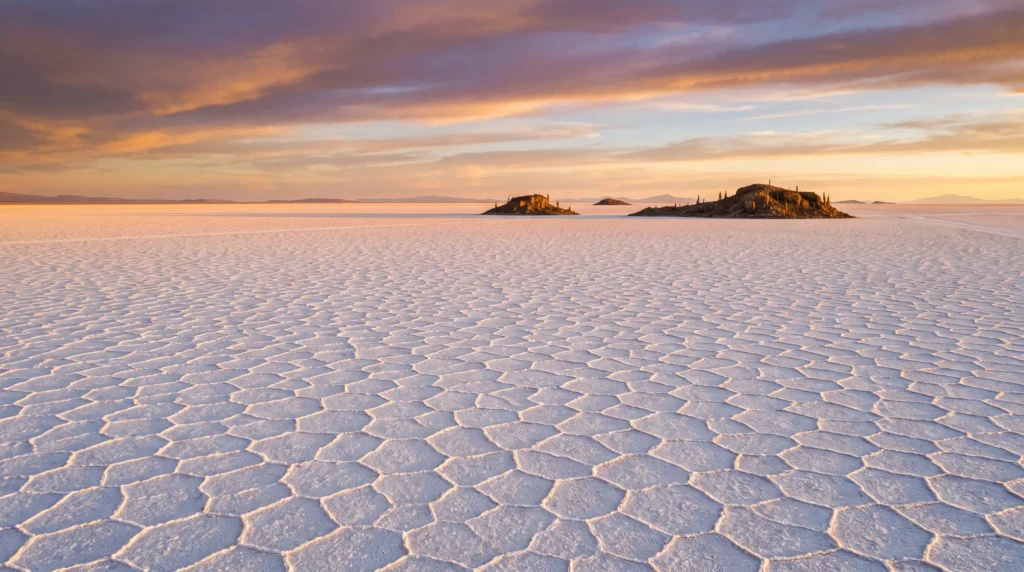
Uyuni is a dusty, unglamorous little railway town that happens to sit next to one of the strangest landscapes on Earth. The town itself — roughly 29,700 people at last count, at 3,700 meters up on Bolivia’s altiplano — is not the destination. The Salar de Uyuni is: 10,582 square kilometers of blinding white salt, the largest salt flat on the planet, sitting at 3,656 meters and ringed by volcanoes. For a few months a year a thin sheet of rainwater turns the whole thing into a mirror so perfect you cannot tell where the ground ends and the sky begins. The rest of the year it cracks into a honeycomb of hexagons that stretches to a horizon that is genuinely, disorientingly curved. I will be straight with you up front: getting here is a slog, the tours vary wildly in quality, and the nights are cold enough to hurt. None of that matters once you are standing on it.
In This Guide
- Overview — Why Uyuni Is Worth the Trek
- Mirror Season — When the Salt Flat Becomes a Sky
- Best Time to Visit Uyuni (Season by Season)
- Getting There — Train, Plane & Overnight Bus
- Getting Around — Why You Can’t Just Rent a Car
- Key Areas — Town, Colchani, Tunupa & the Islands
- Culture & People — Quechua, Aymara & the Railway Legacy
- A Food Lover’s Guide to Uyuni
- Off the Beaten Path
- Day Trips — Eduardo Avaroa Reserve & Potosí
- Practical Information
- Budget Breakdown — What Uyuni Actually Costs in 2026
- Frequently Asked Questions
Overview — Why Uyuni Is Worth the Trek
Uyuni was founded in 1890 as a trading post, built up around a rail junction that British engineers laid down between 1888 and 1892 to haul silver, tin and salt out to the Pacific coast. Four rail lines still converge here — to La Paz, Potosí, Villazón on the Argentine border, and Calama in Chile — which tells you everything about why this remote, wind-scoured town on the Potosí department altiplano exists at all. It receives something like 60,000 visitors a year now, almost none of whom come for the town itself.
They come for what’s next door: the Salar de Uyuni, a dried prehistoric lakebed of almost pure salt covering 10,582 square kilometers at 3,656 meters above sea level — the largest salt flat on Earth by a wide margin. Beneath the crust sits a genuinely staggering resource: Bolivia holds roughly a fifth of the world’s known lithium, most of it concentrated right here in the Salar’s brine. None of that is visible from the surface. What you actually see is white in every direction, a scatter of cactus-covered volcanic islands, and — depending on the month — either a cracked hexagonal crust or a perfect, ankle-deep mirror.
To say the quiet part loudly: the town of Uyuni is not pretty. It’s a grid of low concrete buildings, tour agency storefronts and a windy central plaza, and most travelers spend as little time in it as possible between arriving and setting off on a tour. That’s fine — it’s not supposed to be the show. It’s the staging ground for one of the most singular landscapes in South America, and once you’re out on the salt, you’ll stop thinking about the bus station entirely.
Mirror Season — When the Salt Flat Becomes a Sky
The single fact that decides your trip: during the December–April rainy season, a thin film of water sits on top of the salt and turns the entire Salar into what is genuinely the world’s largest natural mirror — clouds, sunsets and your own silhouette reflected back with no visible horizon line. January is typically the wettest month, with up to around 80mm of rain, while the rest of the year sees only a trickle. The peak mirror window is generally January through March.
Here’s the honest catch: mirror season is also when some routes across the Salar get impassable or muddy, tours get shortened or rerouted, and the classic hexagon-pattern photos — the ones that made this place famous on Instagram — are simply not there, because they’re the dry-season phenomenon. You are trading one iconic photo for another. Neither is a compromise; just know which one you’re chasing before you book your flight.
Best Time to Visit Uyuni (Season by Season)
April – November · Dry season
This is when the Salar shows its famous cracked-hexagon salt crust and the ground is firm everywhere, so 4×4 tours can range further, including out to remote lagoons in the Eduardo Avaroa Reserve. Days are sunny and the UV is brutal at this altitude; nights, especially June through August, regularly drop well below freezing on the open Salar, so pack for genuine cold no matter how warm La Paz felt.
December – March · Wet / mirror season
Warmer, wetter, and this is your window for the mirror effect, concentrated roughly January to March. Some access roads and the Incahuasi Island approach can flood or turn muddy; confirm with your tour operator which route variant they’re running before you commit to a date.
April & November · Shoulder
The best-kept secret if your dates are flexible — a real shot at catching both a wet patch for reflections and enough dry crust for the classic shots, plus thinner crowds than peak dry season (July–September, when Bolivian and international school holidays collide).
Getting There — Train, Plane & Overnight Bus
Uyuni’s own airport, Joya Andina (UYU), is small but useful — Boliviana de Aviación runs the country’s only route in and out, a roughly one-hour hop from La Paz’s El Alto airport. It’s the fastest option by far if you’re short on time, and worth booking early since it’s a single well-used route.
The classic overland approach is the overnight bus from La Paz — roughly nine hours, leaving in the evening and rolling into Uyuni around dawn. Companies like Todo Turismo run reclining “cama” seats that make the ride genuinely bearable; budget lines are a rougher night. Our La Paz to Uyuni transport comparison breaks down current bus, flight and train prices side by side. Trains also still run: Uyuni sits at the junction of four rail lines, with passenger service south to the Argentine border at Villazón and north to Oruro (connecting onward to La Paz), a legacy of the same 1888–1892 railway construction that built the town in the first place. Many travelers also arrive from the opposite direction, on multi-day 4×4 tours originating in San Pedro de Atacama, Chile, that finish (or start) in Uyuni — a popular way to link Bolivia and Chile without backtracking.
One genuinely good piece of news as of December 2025: US, UK, EU and Canadian citizens no longer need a visa for Bolivia at all for stays up to 90 days a year, reversing what had been a costly and paperwork-heavy visa requirement for Americans specifically. You do still need to complete Bolivia’s SIGEMIG online migratory pre-registration before you arrive — don’t skip this step, immigration checks for it.
Getting Around — Why You Can’t Just Rent a Car
Uyuni town itself is small enough to walk end to end in fifteen minutes — the market, the plaza, and the strip of tour agencies are all within a few blocks of each other, and that’s genuinely all you need to navigate on foot.
The Salar and the Eduardo Avaroa Reserve are a different story: there’s no public transport, no rental-car network built for the terrain, and no marked roads across most of the salt — just tire tracks that shift with the season. Everyone visits via organized 4×4 tours with a driver-guide, typically in shared groups of six, and this isn’t a rule imposed for tourist convenience, it’s a genuine safety matter given the distances, the altitude and the lack of any services once you’re out there. Shop around agencies in person the day before you go; quality varies a lot between operators running the same route at similar prices, and word-of-mouth from other travelers that morning is worth more than any online review.
Key Areas — Town, Colchani, Tunupa & the Islands
Uyuni Town Center
The market, the tour agency strip along Avenida Ferroviaria, and a handful of pizza-and-pasta backpacker restaurants that exist purely because every nationality on earth passes through here between tours. Budget one night before and after your Salar trip, not more.
The Train Cemetery (Cementerio de Trenes)
A field of rusting British-built steam locomotives, a few minutes outside town, abandoned when Bolivia’s mining industry collapsed in the 1940s and diesel replaced steam. The salt-laden wind off the Salar has corroded them into skeletal, climbable ruins — it’s usually the first stop on any tour, right at sunset or sunrise for the light.
Colchani
The gateway village where the paved road meets the salt, and where most of Bolivia’s table salt is still hand-processed. Small stalls sell salt-carved souvenirs and the first perspective-trick photos of the trip happen here.
Incahuasi Island (Isla del Pescado)
A rocky outcrop in the middle of the Salar studded with towering cacti — some genuinely centuries old — and covered in fossilized coral, remnants of the prehistoric lake that once submerged this entire region. Climbing to its viewpoint gives you 360 degrees of pure white to the horizon; it’s the standard lunch stop on day tours.
The Salt Hotels near Colchani
A cluster of hotels built almost entirely from salt blocks — walls, furniture, even beds — the most famous being the Palacio de Sal. Novelty aside, they’re genuinely warmer at night than the more basic community refuges further out toward the Chilean border, which matters more than it sounds like it should.
Tunupa Volcano & Coquesa
On the Salar’s northern edge, the dormant Tunupa volcano offers a half-day hike with views straight down over the entire salt flat, plus access to pre-Hispanic mummies preserved in dry caves near the village of Coquesa — arranged through community-run local guides rather than the standard Uyuni-based tour agencies.
San Juan & San Pedro de Quemez
Small quinoa-farming villages along the standard 3-day route toward the Chilean border, typically the first night’s stop, with basic salt-block or adobe accommodation and little else — which is rather the point out here.
Culture & People — Quechua, Aymara & the Railway Legacy
The Uyuni area’s population is predominantly Quechua and Aymara, two of Bolivia’s largest Indigenous nations and among the country’s official languages alongside Spanish. Bolivia’s 2009 constitution formally recognizes the country’s plurinational character, and that shows up here in everything from market conversations switching fluidly between Spanish and Quechua to the Aymara New Year celebrations at the winter solstice across the altiplano.
The town’s own identity is inseparable from its rail history: British engineers built the junction in the 1880s–90s to move Bolivian silver and tin to the Pacific, and that boom-then-bust arc — mining wealth, then the industry’s 1940s collapse — is written across the landscape in the abandoned locomotives you’ll walk through on day one. Out on the altiplano, communities around the Salar are also the exclusive global source of Quinoa Real — a protected-origin variety grown only above roughly 3,600 meters in the salt-flat region, and distinct from the quinoa varieties now grown worldwide. Quinoa farming, not tourism, is still the backbone of daily life in the villages your tour passes through.
A Food Lover’s Guide to Uyuni
This is highland Bolivian food, built for cold and altitude. Expect llama meat — grilled, in stews, or as jerky-like charque — alongside quinoa soup and thick, warming chairo, a hearty broth of vegetables, meat and chuño (freeze-dried potato). Breakfast or a mid-morning pick-me-up often means api morado, a hot, cinnamon-spiced purple corn drink, sometimes served alongside a fried pastelito.
Bolivia’s national savory pastry, the salteña — a baked empanada packed with juicy meat-and-vegetable stew — travels well and shows up on tour-day lunch spreads alongside quinoa salads grown in the very villages you’re driving through. Coca tea (mate de coca) is offered everywhere as the standard, culturally embedded response to altitude discomfort; it’s legal, mild, and worth accepting. For something stronger, look for singani, Bolivia’s grape-brandy spirit, usually served in a chuflay with ginger ale.
Off the Beaten Path
Coipasa Salt Flat
Bolivia’s second, much smaller salt flat, north of Uyuni and visited by a tiny fraction of the crowds the Salar de Uyuni gets — a genuinely quiet alternative if you’ve already done the main event on a previous trip.
Ojos de Sal
Small bubbling springs where groundwater pushes up through the salt crust from below, dotted across the Salar’s surface — an easy, striking stop most tours make en route to Incahuasi that most visitors never learn the name of.
The Tunupa Hike
Genuinely off almost everyone’s itinerary: a full climb of the volcano (rather than the shorter viewpoint walk) is a serious full-day trek at extreme altitude, arranged locally in Coquesa, and rewards you with a summit view over the entire white expanse below.
Julaca & the Ghost Stations
Small, near-abandoned rail junction stops along the historic line toward the Chilean border — a glimpse of the same railway network that built Uyuni, now largely bypassed and forgotten.
Day Trips — Eduardo Avaroa Reserve & Potosí
Eduardo Avaroa Andean Fauna National Reserve
Most visitors don’t do this as a single “day trip” so much as the back half of a standard 3-day Salar tour, but it deserves its own mention: a 7,147-square-kilometer reserve in far southwestern Bolivia, sitting between 4,200 and 5,400 meters, and Bolivia’s most-visited protected area. Highlights include Laguna Colorada, a shallow, blood-red lake at 4,278 meters colored by algae and sediment and thick with Andean, James’s and Chilean flamingos; the Sol de Mañana geyser field, active with fumaroles and boiling mud at dawn; the wind-carved rock spire of Árbol de Piedra; and Laguna Verde, a mineral-tinted lake near the Chilean border overlooked by Licancabur volcano. Entrance runs roughly 150 Bolivianos for foreign visitors, payable in cash at the gate; Incahuasi Island carries its own small separate fee.
Potosí
A few hours from Uyuni by road, Potosí is one of the most historically important cities in the Americas — a UNESCO World Heritage Site since 1987, built on the silver wealth of Cerro Rico, the mountain whose 16th-century mining output helped reshape the global economy of the Spanish empire. Sobering mine tours still run into the working shafts; the mountain’s ongoing collapse risk led UNESCO to add the site to its List of World Heritage in Danger in 2014, and conditions inside are genuinely not for everyone — go with a reputable operator and skip it if you’re claustrophobic or altitude-sensitive.
Practical Information
Money. The Boliviano (BOB) is the only currency accepted almost everywhere in Uyuni — cards are rare outside the biggest tour agencies, and ATMs in town can run out of cash, so arrive with enough Bolivianos for your whole visit. Bolivia’s exchange rate has been unusually volatile lately after years pegged near 6.96 to the US dollar; check the Central Bank’s current published rate before you travel rather than relying on an old number, and be aware informal “street” rates can differ from the official one.
Safety. The US State Department currently rates Bolivia overall at Level 2 (exercise increased caution), with a Level 4 “do not travel” warning specifically for Chapare province — far from the Uyuni/Salar circuit — and a Level 3 warning for La Paz tied to recurring roadblocks and demonstrations. The UK FCDO similarly flags the Chapare region and notes ongoing protest-related disruption elsewhere in the country. None of this specifically targets the Uyuni tourist trail, but Bolivia’s political situation can shift with little notice — check current advisories close to your travel date, and build slack into overland itineraries in case of roadblocks elsewhere in the country.
Health. Altitude is the real issue here, not any tropical disease — the town sits at 3,700 meters and reserve routes climb past 5,000. Give yourself a day or two adjusting in La Paz or Uyuni before strenuous activity, hydrate hard, and take altitude sickness seriously if it hits. Yellow fever vaccination is only relevant if you’re continuing on to Bolivia’s lowland Amazon regions below about 2,300 meters — not needed for the altiplano itself. Sun protection is non-negotiable; UV reflecting off the salt is intense even on cool days.
Connectivity. Decent 4G in Uyuni town, essentially none once you’re out on the Salar or in the reserve — tell people back home not to expect updates for two or three days. Plugs: Type A/C, 230V. Time zone: UTC−4, no daylight saving.
Budget Breakdown — What Uyuni Actually Costs in 2026
Uyuni town itself is cheap by South American standards; the tour is where your budget actually lives or dies.
Budget (US$25–45/day in town): hostel dorm or basic guesthouse, market almuerzo set-lunches, walking everywhere. A standard 3-day Salar-and-reserve tour with a shared group, basic refuges and standard meals runs roughly US$150–180 on top of this.
Mid-range (US$80–150/day averaged, incl. tour): a 3-day tour in the US$200–250 range buys smaller groups, a night in one of the salt hotels near Colchani, and better food along the route.
Luxury (US$250+/day averaged): private 4×4 and driver-guide, premium salt-hotel stays, and top-tier tours running US$280 and up, plus a domestic flight instead of the overnight bus.
Fixed extras to budget separately: the Eduardo Avaroa Reserve entrance fee (~150 BOB) and Incahuasi Island’s small entry fee are frequently not included in quoted tour prices — always ask before you pay — see our full Uyuni tour cost breakdown for an itemised look at every fee. Tipping your driver-guide and cook at tour’s end, in cash, is customary and expected.
Planning Your Trip to Uyuni
The standard structure is simple: arrive by overnight bus or the short flight from La Paz, spend one night in town sorting your tour agency, then head out for a 3-day loop through the Salar and Eduardo Avaroa Reserve, finishing either back in Uyuni or across the border in San Pedro de Atacama, Chile. Not sure which end to start from? See our Uyuni vs San Pedro de Atacama comparison for the full trade-offs. Decide your season first — dry-crust hexagons or wet-season mirror — since it drives everything else about your dates. Many travelers fold Uyuni into a wider Andean circuit: our La Paz city guide covers Bolivia’s dramatic seat of government just an hour’s flight away, our Bolivia travel guide zooms out to the whole country, and if you’re continuing the classic Chile-Bolivia-Peru overland route, see our Chile travel guide and our Cusco city guide for the Peru leg.
Frequently Asked Questions
How many days do you need for Salar de Uyuni?
A 1-day tour covers the highlights near town (train cemetery, Colchani, Incahuasi Island) and works if you’re short on time. The classic experience is the 3-day tour through to the Eduardo Avaroa Reserve and its colored lagoons and geysers, often finishing at the Chilean border. Our full cost breakdown itemises what each option actually costs.
Wet season or dry season — which is better?
They’re different trips, not better-or-worse: dry season (roughly April–November) gives you the famous hexagon salt crust and full route access; wet season, peaking January–March, gives you the mirror-reflection effect but can limit some routes. Pick based on which photo you actually want.
Do US citizens need a visa for Bolivia?
Not anymore, as of December 2025 — US, UK, EU and Canadian citizens get visa-free entry for stays up to 90 days a year. You do still need to complete Bolivia’s SIGEMIG online pre-registration before you fly; check current requirements close to your travel date since policy can change.
Is Uyuni safe to visit right now?
The Salar tourist circuit itself is generally calm; Bolivia’s current safety concerns are concentrated in Chapare province and periodic unrest around La Paz, neither of which sits on the standard Uyuni route. Still, check your government’s current advisory before booking, since roadblocks elsewhere in the country can disrupt overland connections with little warning.
Will I get altitude sickness?
Possibly — Uyuni sits at 3,700 meters and reserve routes go higher still. Spend a day or two acclimatizing beforehand if you can, drink far more water than feels necessary, go easy on alcohol the first couple of days, and accept the coca tea.
Can I skip the tour and explore the Salar independently?
Not really, and you shouldn’t try. There’s no public transport or marked road network across the salt, distances and altitude are genuinely dangerous without local knowledge, and organized 4×4 tours with an experienced driver-guide are effectively the only practical way in. See our Uyuni tour cost guide for what a guided tour actually costs.
Ready to Explore Uyuni?
A rusting train graveyard at sunrise, a lunch stop on an island covered in centuries-old cacti, and a horizon so flat and white it stops making sense — Uyuni delivers a landscape that genuinely doesn’t look like anywhere else on Earth. Pick your season, book a reputable driver, pack for real cold, and go stand on the mirror or the hexagons while both are still exactly this uncrowded.
Explore More
- La Paz City Guide — Bolivia’s dizzying, cable-car-crossed seat of government
- Bolivia Travel Guide — the whole country beyond the salt flat
- Chile Travel Guide — continue the classic route across the Atacama border
- Cusco City Guide — pair the salt flats with the Inca heartland in Peru
How this guide was built
Published as part of Facts From Upstairs’ city guide series. Built from authoritative sources — Wikipedia entity pages for Uyuni, the Salar de Uyuni, Bolivia and the Eduardo Avaroa Andean Fauna National Reserve; UNESCO’s World Heritage Centre listing for the City of Potosí; the Central Bank of Bolivia; the US State Department and UK FCDO Bolivia travel advisory pages; the US CDC traveler page for Bolivia; the US Embassy in Bolivia’s announcement on visa-free entry; a peer-reviewed nutrition-science paper on Bolivian Quinoa Real; and a Bolivia-focused travel resource for current Salar tour pricing and reserve entrance fees. Numeric and checkable claims carry inline citations.
Sources cited on this page
- Wikipedia — Uyuni
- Wikipedia — Salar de Uyuni
- Wikipedia — Bolivia
- Wikipedia — Eduardo Avaroa Andean Fauna National Reserve
- UNESCO World Heritage Centre — City of Potosí
- Banco Central de Bolivia
- US State Department — Bolivia Travel Advisory
- UK FCDO — Bolivia Travel Advice
- US CDC — Bolivia Traveler Page
- US Embassy in Bolivia — Visa-Free Entry Announcement
- npj Science of Food — Nutritional Distinction of Bolivian Quinoa Real
- LOVEBOLIVIA — Salar de Uyuni Tips (tour pricing & reserve fees)
More city guides you might like
Plan your trip to Uyuni
The booking tools we use ourselves. FFU may earn a commission at no extra cost to you.
Plan & book your trip to Uyuni
Booking through these searches supports our guides at no extra cost to you.