
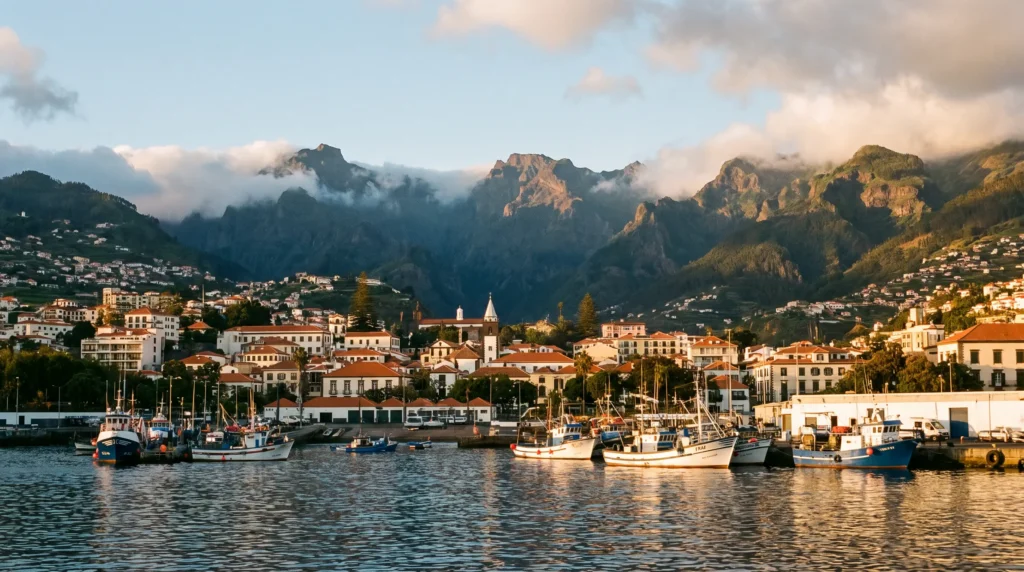
Madeira Travel Guide — Portugal’s Floating Garden of Cliffs, Levadas & Wine
I keep telling people Madeira is Portugal’s answer to “what if Hawaii had cobblestone and custard tarts,” and I keep getting the same reaction: a blank stare, because most travelers have never quite placed it on a map. It’s a volcanic island floating in the Atlantic roughly 805 kilometers southwest of mainland Portugal, closer to Morocco than to Lisbon, and it has been drawing in wine merchants, sea captains and Winston Churchill’s easel for over 600 years. What sold me on it wasn’t the beaches, because Madeira barely has any — it’s a cliff-walled, banana-terraced, laurel-forested mountain that happens to rise out of the sea, and the whole island is stitched together by centuries-old irrigation channels you can walk for days without repeating a view. Funchal, the capital, does the cosmopolitan bit — markets, museums, a cable car climbing straight out of the harbor — while five minutes outside town you’re in cloud forest that predates the Ice Age. It’s not undiscovered, and I won’t pretend it is, but it’s the rare “everyone should visit” island that has genuinely not been ruined by saying so.
In This Guide
- Overview — Why Madeira Is Europe’s Best-Kept Volcanic Secret
- The Flower Festival & New Year’s Fireworks
- Best Time to Visit Madeira (Season by Season)
- Getting There — FNC, the Runway on Stilts & the Ferry Option
- Getting Around — Buses, Rental Cars & the Monte Cable Car
- Neighborhoods & Towns — Funchal to the North Coast
- Culture & People
- A Food & Wine Lover’s Guide to Madeira
- Off the Beaten Path
- Day Trips — Porto Santo & Beyond
- Practical Information
- Budget Breakdown — What Madeira Actually Costs in 2026
- Frequently Asked Questions
Overview — Why Madeira Is Europe’s Best-Kept Volcanic Secret
Madeira is an autonomous region of Portugal, discovered uninhabited by Portuguese sailors in 1419 and settled within a few years after — no indigenous population, no colonial displacement story, just an empty volcanic island that became a mid-Atlantic refueling stop and, eventually, a wine empire. The archipelago’s population sits at roughly 254,000–257,000 people, the vast majority packed onto the main island’s southern coastal strip, with Funchal — the capital and Portugal’s sixth-largest city, at around 106,000 residents — anchoring everything.
What makes Madeira geographically strange is that it’s essentially a mountain that broke the surface of the ocean: the island covers only about 741 square kilometers but rises to Pico Ruivo at 1,862 meters, meaning you can go from sea-level palm trees to above-the-clouds hiking trails in under an hour’s drive. That vertical terrain is also why Madeira has almost no natural sandy beaches — most of the coastline is black volcanic rock and cliff — and why its most famous UNESCO listing isn’t a monument at all but the Laurisilva, the largest surviving stand of primeval laurel forest on Earth, a Jurassic-looking ecosystem that once covered much of southern Europe and now survives mainly here.
The pitch for 2026: direct flights from a growing list of European cities, a well-run tourism board, genuinely excellent hiking infrastructure, and a food-and-wine culture that punches far above the island’s size — all without the resort-strip feel of Tenerife or the Algarve. It’s more “hiking holiday with a harbor town attached” than “beach holiday,” and travelers who show up expecting the latter tend to leave disappointed. Show up for the former and it’s one of the best-value trips in Europe.
The Flower Festival & New Year’s Fireworks
Time a spring trip around the Festa da Flor, Madeira’s Flower Festival, which in 2026 runs from 30 April to late May with two separate allegorical flower parades down Funchal’s Avenida do Mar. Funchal’s squares and roundabouts get carpeted in flower-petal “carpets,” children build a symbolic Wall of Hope out of a single flower each on 2 May, and a vintage-car parade adds a second spectacle in mid-May. Most of it is free to watch from the street.
If you’re planning for December instead, Madeira’s other calling card is the New Year’s Eve fireworks show over Funchal’s harbor — a display so large it earned a Guinness World Record in 2006/2007 for roughly 20,000 fireworks launched from 37 stations around the bay, drawing more than 100,000 spectators packed onto the hillsides overlooking the amphitheater-shaped city. The record has since been surpassed elsewhere, but the show is still one of the largest annual fireworks displays in Europe and books out hotels for weeks around it.
Best Time to Visit Madeira (Season by Season)
April – May & September – October · The sweet spot
Warm days, minimal rain, and the clearest hiking conditions of the year — this is when levada trails and the high peaks are least likely to be socked in with cloud. Spring adds the Flower Festival; September–October brings grape-harvest season and quieter trails.
June – August · Summer
Mild by Mediterranean standards — highs around 25°C rather than a scorching heatwave — with sea temperatures reaching roughly 24°C, good for swimming at the lidos and natural pools. Coastal towns get busy with European summer holidaymakers; book accommodation early.
November – March · Winter (mild, wet at altitude)
Rarely drops below 15°C at the coast, so it’s a legitimate winter-sun escape by northern European standards, but the mountain interior sees more rain and cloud, and some higher levada paths can close after heavy rainfall. The trade-off is New Year’s Eve — worth the crowds once.
Getting There — FNC, the Runway on Stilts & the Ferry Option
Everyone arrives through Cristiano Ronaldo International Airport (FNC), named — controversially, if you followed the 2017 unveiling — after the island’s most famous native son. It has a genuine aviation-nerd backstory: the original runway was so short and hemmed in by ocean and mountains that it was considered one of the most technically demanding landings in commercial aviation, until a 2000 extension stretched it to 2,781 meters on a partially stilted platform built out over the sea.
Most visitors connect through mainland Portugal — TAP Air Portugal, easyJet and Ryanair all run frequent direct flights from Lisbon and Porto (under two hours), and easyJet alone serves the island from roughly a dozen European cities including London, Paris and Berlin. From the UK, Gatwick, Manchester, Stansted and Luton all have direct routes on easyJet, Ryanair or Jet2, taking under four hours. From North America, direct service is currently limited and seasonal — United has flown a summer Newark–Funchal route — so most US and Canadian travelers connect via Lisbon. Cruise ships also call regularly at Funchal’s harbor as an Atlantic-crossing stop.
Getting Around — Buses, Rental Cars & the Monte Cable Car
Madeira’s terrain — a mountain rising straight from the sea — means roads switchback constantly, so a rental car (from roughly €35–55/day) is the most flexible way to reach levada trailheads, viewpoints and the north coast, but it also means slow going and a learning curve on unlit tunnels and cliff-edge hairpins; confident mountain drivers only. Madeira’s extensive tunnel network has cut cross-island drive times dramatically compared to a generation ago.
Within Funchal, the public bus network (Horários do Funchal) covers the city cheaply, and regional carriers (Rodoeste, SAM) connect Funchal to towns across the island, though schedules thin out on weekends. The single most-photographed piece of transit infrastructure is the Funchal cable car, which climbs roughly 550 meters from the old town up to the hillside parish of Monte in about 15 minutes — and the classic way down is the Monte wicker toboggan, a two-kilometer, roughly ten-minute sledge run steered by two uniformed “carreiros” that dates back to the 1850s, when locals used basket sledges to haul goods and people downhill before it became a tourist ride. Taxis and ride-hail apps cover the rest, and organized minibus tours are the easiest way to see the north coast without driving yourself.
Neighborhoods & Towns — Funchal to the North Coast
Zona Velha (Funchal Old Town)
Cobbled lanes running from the cathedral down to the harbor, best known for painted doors — a public-art project that turned dozens of derelict old-town doorways into small murals — and a concentration of the city’s best seafood restaurants and late-night bars.
Mercado dos Lavradores & City Center
Funchal’s Art Deco farmers’ market is the sensory center of town — flower stalls, tropical-fruit pyramids, and a fish hall where vendors carve up scabbardfish (peixe-espada) to order. Around it sits the shopping core, the cathedral, and most of the city’s museums.
Monte
A cooler, cloud-forest hillside parish above the city, reached by cable car, home to the Monte Palace Tropical Garden and the toboggan run’s starting point — worth the trip even without the sledge.
Câmara de Lobos
A working fishing village a short drive west of Funchal, famous for its brightly painted boats, poncha bars, and the fact that Winston Churchill painted here on a 1950 holiday. It also sits below Cabo Girão, one of Europe’s highest sea cliffs, with a glass-floored skywalk platform for the view straight down.
Santana
On the north coast, known for its traditional triangular thatched “palheiro” houses — a handful preserved as a small open-air museum — and as a gateway to some of the island’s greenest levada walks.
São Vicente & Porto Moniz
The dramatic north coast: volcanic sea caves at São Vicente and, further west, the natural lava-rock swimming pools at Porto Moniz, where the Atlantic floods into rock basins that make for a genuinely unique ocean swim.
Curral das Freiras
A village hidden in the crater-like heart of the island, historically so isolated it was named for nuns who fled here for refuge — reached by a switchbacking mountain road with one of Madeira’s best viewpoint stops, Eira do Serrado, on the way in.
Ponta de São Lourenço
The island’s dry, treeless eastern tip, a complete change of scenery from the green center — a hiking peninsula of red-and-ochre cliffs jutting into the Atlantic.
Culture & People
Madeirans are Portuguese but distinctly islander — proud of a maritime history that predates most of mainland Portugal’s colonial ventures, and quick to point out that the island has been continuously Portuguese since its 1419 discovery, with no earlier population to displace. Emigration has shaped the culture heavily — sizeable Madeiran diaspora communities exist in Venezuela, South Africa and New Jersey — and many families have relatives abroad who return each summer.
Embroidery (bordado Madeira) and wickerwork are the island’s classic handicrafts, both tied historically to the 19th-century tourism and export trade that British wine merchants helped build. Religious festivals matter here more than in much of secular Europe — village patron-saint feasts (arraiais) run all summer, with fireworks, brass bands and folk dancing in even the smallest parishes, and Christmas in Funchal means elaborate street lighting that rivals anywhere in Europe. Fado exists on the island but the more distinctly Madeiran folk tradition is bailinho da Madeira, danced to accordion and braguinha (a small four-string guitar that is a direct ancestor of the Hawaiian ukulele, carried there by 19th-century Madeiran emigrants).
A Food & Wine Lover’s Guide to Madeira
Start with the wine, because Madeira invented a category: a fortified wine that — unusually — is deliberately heated and oxidized during aging, a process discovered by accident in the 18th century when barrels shipped to the tropics and back came home tasting better, not worse. That quirk means Madeira wine is essentially unspoilable — opened bottles keep for months — and it comes in a dry-to-sweet range across four classic grape styles: Sercial, Verdelho, Bual and Malmsey. Blandy’s, founded in 1811 and still family-run, runs the best-known cellar tours in Funchal.
The signature local drink to actually order at a bar is poncha — aguardente de cana (sugarcane spirit) muddled with honey and citrus, traditionally lemon, though passion fruit and tangerine versions are everywhere now. Câmara de Lobos is considered the spiritual home of poncha bars.
On the plate, espetada — beef skewered on a laurel branch and grilled over an open fire, often served hanging from a metal stand at the table — is the island’s signature dish, usually alongside bolo do caco, a griddle-cooked flatbread served warm with garlic-herb butter. Peixe-espada com banana (black scabbardfish with fried banana) is the classic only-in-Madeira seafood pairing, born from the deep-water scabbardfish caught off the coast and the bananas grown on the island’s terraces. Milho frito (fried cornmeal cubes) and lapas (limpets) grilled in garlic butter round out a typical spread. For dessert, bolo de mel — Madeira’s dense, spiced “honey cake” (traditionally made with sugarcane molasses, not honey) — is sold everywhere and travels well as a souvenir.
Off the Beaten Path
Levada walks beyond the postcard routes
Madeira’s defining outdoor feature is its levada network — irrigation channels first cut in the 16th century to carry water from the wet north to the dry, sun-drenched south, which now total more than 2,170 kilometers and double as one of Europe’s best long-distance walking networks. Levada do Caldeirão Verde and Levada das 25 Fontes get the crowds; ask a local guide for a quieter alternative on the same water-channel system and you’ll likely have it largely to yourself.
Pico Ruivo at sunrise
A pre-dawn hike from Pico do Areeiro or Achada do Teixeira to Madeira’s 1,862-meter summit, above the cloud line more mornings than not, is one of the best sunrise hikes in Europe and still relatively unknown outside hiking circles.
Ilhas Desertas boat trip
A near-uninhabited, arid three-island chain visible from Funchal on a clear day, protected as a nature reserve and reachable by day-boat for those chasing monk seals and total quiet.
Northern lava pools outside Porto Moniz
The main Porto Moniz pools draw a crowd; smaller, wilder natural pools dot the coast nearby for travelers willing to walk a little further.
Day Trips — Porto Santo & Beyond
Porto Santo
Madeira’s low-lying sister island sits about 73 kilometers (44 nautical miles) northeast and is everything Madeira isn’t: flat, dry, and fronted by a nine-kilometer stretch of golden sand — genuinely one of the best beaches in the Atlantic. A daily car ferry from Funchal takes a little over two hours each way, or a 20-minute flight covers it in a hurry; an overnight is worth it if you can spare one.
West-coast loop: Cabo Girão, Câmara de Lobos & Ribeira Brava
A half-day driving loop covering the glass skywalk at Cabo Girão, lunch and poncha in Câmara de Lobos, and the riverside town of Ribeira Brava — an easy introduction to the west coast without committing to a full-day tour.
North coast circuit
São Vicente’s caves, Porto Moniz’s lava pools, and the mountain-crater village of Curral das Freiras can be strung into one long day by car or organized minibus tour, crossing some of the island’s older mountain tunnels along the way.
Practical Information
Money. Madeira uses the euro, same as mainland Portugal, and cards are accepted almost everywhere in Funchal and tourist areas; carry some cash for small village cafés, market stalls and toboggan tips.
Safety. Portugal overall carries a Level 1 “exercise normal precautions” advisory from the US State Department, and the main risks flagged for the country are petty crime in crowded tourist areas and, in the hot summer months, wildfire risk in forested regions — a real consideration on an island covered in laurel forest and eucalyptus. The UK FCDO gives the same broad guidance for Madeira specifically, flagging wildfire risk from April to October and standard street-crime caution on public transport. The bigger practical safety issue for most visitors is trail-related, not crime-related: some levada paths run along narrow, unprotected ledges, and a handful of hiking deaths are reported most years — stick to maintained routes and check conditions after rain.
Health. No special vaccinations are required for Portugal beyond routine immunizations; the CDC’s Madeira Islands page recommends being up to date on standard travel vaccines and notes the usual advice on food, water and sun protection at altitude.
Connectivity. An EU/UK roaming plan or local eSIM covers Funchal and most coastal towns well; signal thins out in the mountain interior. Plugs: European two-pin (Type F), 230V. Time zone: WET (UTC+0), aligned with mainland Portugal, with EU daylight saving observed.
Budget Breakdown — What Madeira Actually Costs in 2026
Madeira runs cheaper than the Portuguese mainland’s headline cities in peak season and considerably cheaper than the Algarve in August, but prices climb around New Year’s Eve and the Flower Festival.
Budget (US$70–110/day): guesthouse or hostel outside the old-town core, bakery breakfasts and market lunches, bus travel, free levada walks and viewpoints.
Mid-range (US$150–260/day): a boutique quinta-style hotel or Funchal apartment, espetada dinners, a rental car for a few days (€35–55/day), the Monte cable car and toboggan, a Blandy’s wine-cellar tour.
Luxury (US$400+/day): five-star coastal resorts with infinity pools cut into the cliffside, private levada guides, a Porto Santo overnight, and top-shelf vintage Madeira tastings.
Fixed costs to expect: modest entry fees at botanical gardens and some viewpoints, cable car and toboggan tickets (bought as a combo saves money), and car rental insurance excess if you’re driving the mountain roads yourself. Tipping around 5–10% is appreciated but not obligatory.
Planning Your First Trip to Madeira
Five nights is the practical minimum: two or three based in Funchal for the old town, market, cable car and a west-coast day loop, then two more split between a levada hike and a Porto Santo overnight if your dates allow. Pair it with a few days in Lisbon or Porto on either end of the flight, since most routes connect through the mainland anyway — see our full Portugal travel guide for the rest of the country. If you’re chasing more dramatic-cliff, island-hopping energy afterward, our Santorini guide covers the Mediterranean’s answer to Madeira’s coastline.
Frequently Asked Questions
Is Madeira safe for tourists in 2026?
Yes, broadly — Portugal carries the US State Department’s lowest advisory tier, and Madeira’s main flagged risks are petty theft in crowded tourist spots and wildfire season (roughly April–October) rather than violent crime. The more common real risk is on hiking trails — stick to maintained levada paths, wear proper footwear, and skip narrow ledge routes after rain.
Do I need a visa to visit Madeira?
Madeira is part of Portugal and the Schengen Area, so US, UK, Canadian and EU passport holders can typically enter visa-free for up to 90 days within any 180-day period, provided passports meet Schengen validity rules.
Does Madeira have good beaches?
Not really, and that’s worth knowing before you book — most of the coastline is dramatic black volcanic rock and cliff rather than sand. Funchal has a couple of small imported-sand and pebble beaches plus lido-style pool complexes, but travelers who specifically want long sandy beaches should budget a day trip to Porto Santo, whose nine-kilometer golden beach is the real thing.
Is Madeira good for non-hikers?
Yes — Funchal alone (market, old town, cable car, wine cellars, museums) fills two or three days without setting foot on a trail, and short, flat, well-paved levada stretches near towns give a taste of the scenery without technical hiking. But the island’s best-known experiences skew outdoorsy, so pure beach-and-pool travelers may find it a mismatch.
Madeira or the Canary Islands?
Choose Madeira for greener, more dramatic mountain scenery, a stronger hiking culture and a quieter, more upscale feel; choose the Canaries for reliable sandy beaches, a bigger party scene and generally lower prices. They sit in the same ocean but deliver very different trips.
What’s the cheapest way to see the island?
Base in central Funchal, use the city bus network and regional coaches instead of a rental car, walk the free lower-altitude levada stretches near town, and watch for the seasonal glass-panel cable car and toboggan combo tickets.
Ready to Explore Madeira?
A cable car ride out of a working harbor, a wicker sledge ride steered by men in straw hats, wine that’s been drinkable for two centuries, and a summit above the clouds — Madeira packs an absurd amount of contrast onto one small mountain in the Atlantic. Go for the hiking, stay for the espetada and poncha, and don’t leave without at least one levada walk under your boots.
Explore More
- Portugal Travel Guide — the mainland behind Madeira’s flights
- Lisbon City Guide — the usual gateway city for connecting flights
- Porto City Guide — the other easy mainland pairing
- Santorini City Guide — another cliffside island escape, Mediterranean-style
How this guide was built
Published as part of Facts From Upstairs’ city guide series. Built from authoritative sources — Wikipedia entity pages for Madeira, Funchal, Madeira Airport, Madeira wine and the levada and Monte toboggan systems, the UNESCO World Heritage Centre listing for the Laurisilva of Madeira, the official Visit Madeira tourism board, the US State Department and UK FCDO Portugal travel advisories, the US CDC’s Madeira Islands traveler page, and operator/heritage pages for Blandy’s wine lodge and the Funchal–Porto Santo ferry. Numeric and checkable claims carry inline citations.
Sources cited on this page
- Wikipedia — Madeira
- Wikipedia — Funchal
- Wikipedia — Madeira Airport
- Wikipedia — Levada (Madeira)
- Wikipedia — Madeira wine
- Wikipedia — Carros de cesto do Monte (Monte toboggan)
- UNESCO World Heritage Centre — Laurisilva of Madeira
- Visit Madeira — Weather in Madeira
- Visit Madeira — Flower Festival
- Madeira Live — Guinness World Record fireworks
- Blandy’s — About Us
- Say Yes to Madeira — Funchal to Porto Santo ferry
- US State Department — Portugal Travel Advisory
- UK FCDO — Portugal travel advice
- UK FCDO — Portugal entry requirements
- US CDC — Madeira Islands traveler page
More city guides you might like
Plan your trip to Madeira
The booking tools we use ourselves. FFU may earn a commission at no extra cost to you.
Plan & book your trip to Madeira
Booking through these searches supports our guides at no extra cost to you.