
São Paulo Travel Guide — Brazil’s Massive, Underrated Food-and-Culture Capital
I’ll be honest about how I feel about São Paulo: it took me three trips to fall for it, because nothing about it performs “postcard city” the way Rio does forty minutes away by plane. There’s no Christ the Redeemer silhouette, no single beach everyone photographs. What São Paulo has instead is scale — nearly 12 million people in the city itself, more than 21 million across the wider metro region, making it the largest city in the Southern Hemisphere and one of the biggest urban areas on the planet. That scale means it absorbed more immigration than almost anywhere in South America — Italian, Japanese, Lebanese, Portuguese, Bolivian, African-Brazilian — and turned it into the best food city on the continent, a genuinely serious art and design scene, and nightlife that runs until whenever you give up first. This isn’t a guide about ticking off sights in two days. It’s a guide about a city that rewards people who slow down, eat constantly, and stop expecting a beach.
In This Guide
- Overview — Why São Paulo Is Brazil’s Real Capital
- The World’s Largest Pride Parade Hits Avenida Paulista
- Best Time to Visit São Paulo
- Getting There — GRU, CGH & the Journey In
- Getting Around — Metro, CPTM & Ride-Hailing
- Neighborhoods — Where to Base Yourself
- Culture & People — A City Built by Immigration
- A Food Lover’s Guide to São Paulo
- Off the Beaten Path
- Day Trips from São Paulo
- Practical Information
- Budget Breakdown — What São Paulo Actually Costs in 2026
- Frequently Asked Questions
Overview — Why São Paulo Is Brazil’s Real Capital
São Paulo was founded by Jesuit missionaries in January 1554 as a small hilltop mission; today it’s the anchor of the Southern Hemisphere’s largest metropolitan area, sitting at roughly 799 metres elevation, which is why the climate stays milder than the tropical postcard version of Brazil most people imagine. It isn’t Brazil’s political capital — that’s Brasília — and it isn’t the beach-and-samba Brazil of the tourist boards; that’s Rio, forty minutes away by plane. São Paulo is the money, the industry, the fashion weeks, and above all the food: a city shaped so heavily by waves of Italian, Japanese, Lebanese, Portuguese and African-Brazilian immigration that its restaurant scene is arguably the most diverse in South America.
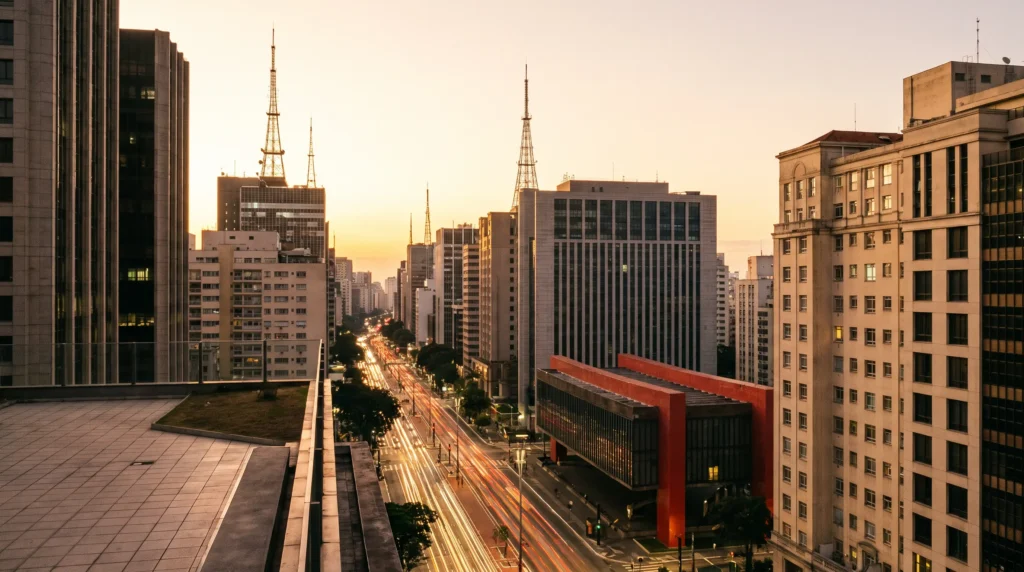
The skyline is the first thing that reorients you. There’s no single postcard tower — instead, tens of thousands of buildings sprawl in every direction as far as you can see from any rooftop bar, a genuinely disorienting sight the first time you take it in. Avenida Paulista, built up from 1900 as a boulevard of coffee-baron mansions, is now the symbolic spine of the city — financial towers, MASP’s raised red-glass museum block, and on weekends a car-free promenade packed with street vendors, skaters and protest marches alike.
What São Paulo does not have is an easy elevator pitch, and that’s honestly the catch worth naming upfront: it’s a hard city to fall in love with from a rooftop view or a single Instagram shot. It rewards you slowly, meal by meal, neighborhood by neighborhood — and it demands more street smarts than Lisbon or Buenos Aires. Go in expecting a serious world city, not a resort, and it delivers in ways almost no other South American destination can match.
The World’s Largest Pride Parade Hits Avenida Paulista
Time a June trip around one event: the São Paulo LGBT+ Pride Parade, held annually along Avenida Paulista since 1997 and recognized as the largest Pride parade on Earth, drawing several million people along a route nearly three kilometres long and eight lanes wide. Recent editions have pulled crowds numbering in the millions, second only to the city’s Formula One Grand Prix weekend as its biggest annual gathering. Expect the entire avenue shut to traffic, sound trucks (trio elétricos) blasting from morning to night, and a genuinely joyful, chaotic street-party atmosphere that spills into Jardins and Bela Vista bars for days afterward.
If Pride isn’t your target date, São Paulo runs a packed festival calendar year-round: Carnival street blocos in February/March, the overnight Virada Cultural arts festival in May, São Paulo Fashion Week twice a year, and the São Silvestre road race through downtown every December 31st. Whatever week you land, something civic-sized is probably happening — check the city’s event calendar before you book, because hotel prices swing hard around these dates.
Best Time to Visit São Paulo
April – September · Dry season (best window)
São Paulo’s elevation keeps things cooler than tropical Brazil — daytime temperatures typically sit in the high teens to mid-20s Celsius, rain is much less frequent, and this is genuinely the most comfortable stretch for walking neighborhoods on foot. Nights in June and July can turn surprisingly chilly; pack a jacket.
October – November · Shoulder
Warming up, rain returning gradually, fewer crowds than peak summer, and prices still reasonable. A quietly good window if you want lower rates without full rainy-season downpours.
December – March · Hot, humid, rainy summer
This is Brazilian summer: hot, humid, with intense but usually short afternoon thunderstorms. It’s also Carnival season and New Year’s, when the city empties out somewhat as residents head to the coast — hotel prices can actually dip in central São Paulo even as they spike in Rio and the beach towns. Flooding on low-lying streets during heavy storms is common enough to plan around; check forecasts before scheduling outdoor plans.
Getting There — GRU, CGH & the Journey In
São Paulo–Guarulhos International Airport (GRU), about 25 kilometres northeast of downtown, is Brazil’s busiest international gateway, handling roughly 47 million passengers in 2025 with nonstops from Miami, New York, Atlanta, Toronto, Montreal, Lisbon, Frankfurt, Munich, Doha, Dubai and most major Latin American capitals. From GRU, the CPTM Line 13-Jade rail connects to Engenheiro Goulart station with onward metro transfers, and an hourly Airport Express bus runs directly to Luz station downtown; taxis and ride-hailing apps take 40–90 minutes into the center depending on traffic, which in São Paulo is rarely light.
São Paulo–Congonhas Airport (CGH), just 8 kilometres from downtown in the Campo Belo district, handles the domestic shuttle routes to Rio de Janeiro and other Brazilian cities and is far more convenient if you’re arriving on from elsewhere in Brazil — figure about 25 minutes to the center by car. There’s no long-distance passenger rail into the city; overland arrivals from other Brazilian cities and neighboring countries come by long-haul bus into one of São Paulo’s major rodoviárias (bus terminals), notably Tietê.
Getting Around — Metro, CPTM & Ride-Hailing
São Paulo’s public transport is genuinely good by regional standards but the city itself is vast, so plan transit time generously. The Metro runs about 75 kilometres across five lines and roughly 65 stations, while the CPTM commuter rail network adds another 260-plus kilometres and six more lines — combined, one integrated ticket covers nearly 400 kilometres of track. It’s clean, frequent, and the fastest way to cross the city during rush hour gridlock, though it doesn’t reach every neighborhood.
Ride-hailing (Uber and the Brazilian app 99) is cheap, reliable, and the default choice for most visitors after dark or for door-to-door trips — far safer and less confusing than hailing a street taxi. Driving yourself is not recommended: São Paulo traffic is dense and aggressive, and street parking is scarce. Within individual neighborhoods like Vila Madalena, Jardins or Pinheiros, walking is pleasant and the way locals actually get around for short hops; between neighborhoods, especially at night, take the metro or a car.
Neighborhoods — Where to Base Yourself
Avenida Paulista & Jardins
The spine of the city and the safest, most convenient base for first-timers. MASP’s raised glass-and-red-concrete block anchors the avenue’s cultural end; Jardins behind it is leafy, upscale, full of design boutiques and some of the city’s best fine dining. Weekend mornings, Paulista closes to cars entirely.
Vila Madalena & Pinheiros
The bohemian, bar-and-graffiti heart of São Paulo, packed with craft beer bars, indie galleries and live-music venues. This is home to Beco do Batman (“Batman’s Alley”), a constantly repainted open-air street art corridor that’s one of the city’s most photographed spots — arrive on a weekday morning to see it without the tour groups.
Liberdade
Home to one of the largest Japanese communities outside Japan, with red torii-style lamp posts, a lively Saturday street market, and the city’s densest concentration of Japanese, Korean and Chinese restaurants.
Bela Vista & Bixiga
São Paulo’s historic Italian quarter, all narrow hillside streets, family-run cantinas serving Sunday lunch since the early 1900s, and the annual Bixiga street festivals. Adjacent to Paulista, easy walking distance to downtown.
Itaim Bibi & Vila Olímpia
The modern business district — glass towers, rooftop bars, upscale nightlife and the city’s steakhouse row. Less charming architecturally, but convenient if you’re here for work or want the highest-end hotels.
Ibirapuera & Moema
Quiet, residential, and anchored by Ibirapuera Park, São Paulo’s answer to Central Park, inaugurated in 1954 for the city’s 400th anniversary and home to several of its best museums and pavilions. A good base for families or anyone prioritizing green space and calm over nightlife.
Centro Histórico
The historic core around Praça da Sé and the Pátio do Colégio, where the city was founded in 1554 — grand early-20th-century architecture, the Municipal Market, and genuinely worthwhile daytime sightseeing, but thin out fast after dark. Visit, don’t necessarily sleep here.
Culture & People — A City Built by Immigration
São Paulo’s culture is inseparable from its immigration history. Italian arrivals from the late 1800s coffee boom built Bela Vista and shaped the city’s food and family culture; Japanese immigration, among the largest outside Japan itself, built Liberdade and made São Paulo a genuine sushi and ramen capital; Lebanese, Portuguese and, more recently, Bolivian and Venezuelan communities have layered in further. The result is a city that doesn’t feel stereotypically “Brazilian” in the way Rio or Salvador do — it feels like its own distinct, cosmopolitan thing.
The arts scene runs deep: MASP’s collection is the most important in the Southern Hemisphere for European painting, the Pinacoteca do Estado covers Brazilian art across centuries, and the São Paulo Bienal, held in Ibirapuera Park, is one of the world’s oldest and most respected contemporary art biennials. Street art is taken seriously here too — beyond Beco do Batman, look for large-scale murals by artists like Eduardo Kobra scattered across the city. Add São Paulo Fashion Week, one of the largest fashion events outside Paris/Milan/New York, and a food and cocktail scene that regularly places restaurants on global “best of” lists, and you get a city whose culture is expressed through craft and commerce as much as through festivals.
A Food Lover’s Guide to São Paulo
This is the reason serious eaters put up with São Paulo’s traffic and sprawl. Start at the Mercado Municipal (Mercadão) downtown for the legendary mortadella sandwich — a doorstop of thin-sliced mortadella piled absurdly high — and fresh tropical fruit juices from stalls that have run for generations. Because of the Italian immigration wave, São Paulo also claims one of the highest concentrations of pizzerias per capita anywhere outside Italy; Bixiga’s family cantinas do proper Sunday-lunch-length Italian meals.
Liberdade is the city’s Japantown and the place for genuinely excellent, non-touristy sushi, ramen and yakisoba — this isn’t a novelty district, it’s where a lot of São Paulo’s Japanese-Brazilian population actually eats. For Brazilian classics, hunt down feijoada (black bean and pork stew, traditionally a Saturday dish), coxinha (teardrop-shaped fried chicken croquettes) from any padaria counter, and pastel from a street-market fryer. São Paulo’s fine-dining scene has also become a genuine destination in its own right, with tasting-menu restaurants exploring Amazonian and native Brazilian ingredients well beyond the usual churrascaria formula — book ahead if a specific name is on your list, tables move fast.
Coffee is worth a specific mention: São Paulo state was the historical engine of Brazil’s coffee export economy, and the city’s café culture — from old-school padarias serving cafezinho at the counter to a newer wave of specialty roasters in Vila Madalena and Pinheiros — reflects that legacy.
Off the Beaten Path
Beco do Batman, early morning
Everyone photographs this graffiti alley by afternoon; go at opening hours on a weekday and you’ll have the murals — which repaint constantly, so no two visits look the same — mostly to yourself.
Bixiga’s hidden vilas
Behind Bela Vista’s main streets, small residential “vilas” (courtyard alleyways) built by Italian immigrant families still stand largely untouched by tourism — ask a local café owner to point you toward one.
Municipal Theatre & Centro’s Art Nouveau core
Downtown São Paulo empties out at night, which is exactly why a weekday daytime walk through its early-1900s Belle Époque architecture around the Teatro Municipal feels like a different, older city hiding under the skyscraper version.
Feira da Liberdade
Liberdade’s Saturday street market goes well beyond souvenir stalls — Japanese, Korean and Chinese street food, live taiko drumming, and a genuinely local Saturday-afternoon crowd rather than a tour-bus one.
Day Trips from São Paulo
Santos & the coast
Brazil’s largest port city and the closest beach escape, roughly 70–80 kilometres south down the Serra do Mar via a dramatic descending highway. Santos has its own historic center, a long beachfront promenade, and — for football fans — Vila Belmiro, Pelé’s home stadium.
Serra do Mar & the Atlantic Forest
The mountain range separating São Paulo from the coast is part of the Atlantic Forest South-East Reserves, a UNESCO World Heritage natural site spanning some 470,000 hectares of remaining Atlantic rainforest across São Paulo and Paraná states. Serra do Mar State Park within it offers hiking and waterfalls within striking distance of the city.
Paranapiacaba
A remarkably preserved 19th-century British-built railway village in the mountains above Santos, currently on UNESCO’s tentative World Heritage list for its cultural landscape and historic funicular railway infrastructure. Foggy, atmospheric, and almost nothing like the city it belongs to.
Campos do Jordão
A mountain town nicknamed “Brazil’s Switzerland” for its chalet architecture and cool climate, popular for a weekend of hiking, chocolate shops and — despite being firmly in Brazil — genuinely chilly winter nights.
Embu das Artes
A colonial-era arts-and-crafts town on São Paulo’s outskirts, best visited on a weekend when its cobbled main square fills with artisan stalls, antique dealers and live music.
Practical Information
Money. The Brazilian Real (BRL) floats freely against other currencies. Cards are accepted almost everywhere in São Paulo, and Pix — Brazil’s instant bank-transfer payment system — has become the default way locals pay for everything from taxis to street food; carrying some cash still helps for small vendors and markets.
Safety. The US State Department rates Brazil Level 2: Exercise Increased Caution, citing violent crime and kidnapping risk in urban areas, and specifically advises against entering informal housing developments (favelas) even on guided tours, and against caution on public buses at night. In practice: stick to well-trafficked neighborhoods (Jardins, Vila Madalena, Itaim, Paulista), don’t display expensive jewelry or phones openly, use Uber/99 rather than street taxis after dark, and keep bags zipped and in front of you on the metro during rush hour. Rua 25 de Março, the famous downtown shopping street, is a notorious pickpocket hotspot — go alert, not paranoid.
Health. The CDC recommends routine vaccines plus Hepatitis A for most travelers to Brazil, and yellow fever vaccination for travelers heading to most Brazilian states (São Paulo state included), though it’s not required for entry; malaria risk in São Paulo city itself is minimal, and mosquito-borne dengue/Zika precautions (repellent, covering up) are sensible year-round. Tap water in São Paulo is treated, but most visitors stick to bottled or filtered water out of habit.
Connectivity. An eSIM with regional coverage is the easiest option; 4G/5G coverage across the city is strong. Plugs: Brazil mainly uses type N sockets (also accepts type C two-pin plugs), and voltage varies by building between 110V and 220V — check before plugging in sensitive electronics. Time zone: UTC-3 (BRT), no daylight saving since 2019.
Budget Breakdown — What São Paulo Actually Costs in 2026
São Paulo runs cheaper than Rio for equivalent quality, and considerably cheaper than European or North American cities for food and transit — but hotel rates in Jardins and Itaim can climb toward global-city prices.
Budget (US$50–90/day): Hostel or budget guesthouse in Vila Madalena or Pinheiros, padaria breakfasts and street-market lunches, metro/CPTM for transit, free museum days and park time.
Mid-range (US$120–220/day): Boutique hotel in Jardins or Vila Madalena, a proper restaurant dinner most nights, Uber for evening trips, entry to MASP or the Pinacoteca, one Liberdade food crawl.
Luxury (US$400+/day): Five-star hotel on or near Paulista/Itaim, tasting-menu dinners at the city’s destination restaurants, private guided neighborhood tours, day-trip car and driver to the coast or Campos do Jordão.
Tipping 10% is common in restaurants (sometimes already added as a service charge — check the bill), and rounding up for ride-hailing and casual service is appreciated but not required.
Planning Your First Trip to São Paulo
Three to four nights is enough to cover Paulista, Jardins, Vila Madalena and Liberdade properly without rushing meals — and meals are the point here. Most visitors pair São Paulo with a beach or nature stretch elsewhere in Brazil, since the city itself is inland and skyline-focused rather than coastal. The classic combo is São Paulo for food and culture, then a short domestic flight from Congonhas to Rio de Janeiro for beaches and Sugarloaf views, or onward into our full Brazil travel guide for the wider country. If you’re continuing around South America, Buenos Aires and Santiago are both reachable by direct flight from GRU in under four hours.
Frequently Asked Questions
Is São Paulo safe for tourists in 2026?
The US State Department rates Brazil overall at Level 2: Exercise Increased Caution, flagging urban crime and kidnapping risk, and specifically advises against entering favelas even on guided tours. Within São Paulo, the neighborhoods visitors actually use — Jardins, Paulista, Vila Madalena, Itaim — are generally fine with normal city precautions: use ride-hailing at night, don’t flash valuables, and stay alert on public transport and around downtown after dark.
Do I need a visa to visit São Paulo?
US, Canadian and Australian citizens need an e-Visa as of April 2025 — apply online in advance for roughly US$80.90, which grants a stay of up to 90 days (extendable once) on a 10-year multiple-entry visa. This reversed the previous visa-free arrangement, so don’t assume old advice still applies — apply well before your flight.
São Paulo or Rio de Janeiro?
Choose Rio for beaches, Sugarloaf and Christ the Redeemer views; choose São Paulo for food, museums, nightlife and a genuine big-city cultural scene. Most first-time Brazil trips do both — they’re a short domestic flight apart from Congonhas.
How many days do I need in São Paulo?
Three to four full days covers the main neighborhoods, a couple of museums, and enough meals to understand the food scene, without feeling rushed.
What’s the best neighborhood to stay in?
Jardins or Avenida Paulista for first-timers wanting central, walkable and safe; Vila Madalena or Pinheiros for nightlife and a more bohemian feel; Itaim Bibi for business travel and high-end hotels.
Does anyone speak English?
Less than you’d expect for a city this size — English is spoken in upscale hotels, some restaurants and business settings, but basic Portuguese phrases (or a translation app) go a long way in taxis, markets and smaller restaurants.
Ready to Explore São Paulo?
No single skyline shot captures it, no single dish sums it up, and that’s exactly the point — São Paulo is Brazil’s biggest, most layered city, built meal by meal and neighborhood by neighborhood by everyone who ever immigrated there. Go hungry, go curious, and don’t expect a beach.
Explore More
- Brazil Travel Guide — the full country, beaches to Amazon
- Rio de Janeiro City Guide — beaches, Sugarloaf and samba, a short flight away
- Buenos Aires City Guide — pair São Paulo with Argentina’s capital
- Santiago City Guide — continue on to Chile
How this guide was built
Published as part of Facts From Upstairs’ city guide series. Built from authoritative sources — Wikipedia entity pages for São Paulo, its Metro system, Guarulhos and Congonhas airports, the Brazilian Real, and the São Paulo Gay Pride Parade; UNESCO World Heritage Centre listings for the Atlantic Forest South-East Reserves and the Paranapiacaba tentative-list entry; the US State Department’s Brazil travel advisory; the US Embassy in Brazil’s e-Visa notice for US citizens; and the US CDC’s Brazil traveler health page. Numeric claims carry inline citations.
Sources cited on this page
- Wikipedia — São Paulo
- Wikipedia — São Paulo–Guarulhos International Airport
- Wikipedia — São Paulo–Congonhas Airport
- Wikipedia — São Paulo Metro
- Wikipedia — São Paulo Gay Pride Parade
- Wikipedia — Brazilian Real
- UNESCO — Atlantic Forest South-East Reserves
- UNESCO — Paranapiacaba Tentative List Entry
- US State Department — Brazil Travel Advisory
- US Embassy in Brazil — e-Visa Notice for US Citizens
- US CDC — Brazil Traveler Health Page
More city guides you might like
Plan your trip to São Paulo
The booking tools we use ourselves. FFU may earn a commission at no extra cost to you.
Plan & book your trip to São Paulo
Booking through these searches supports our guides at no extra cost to you.