
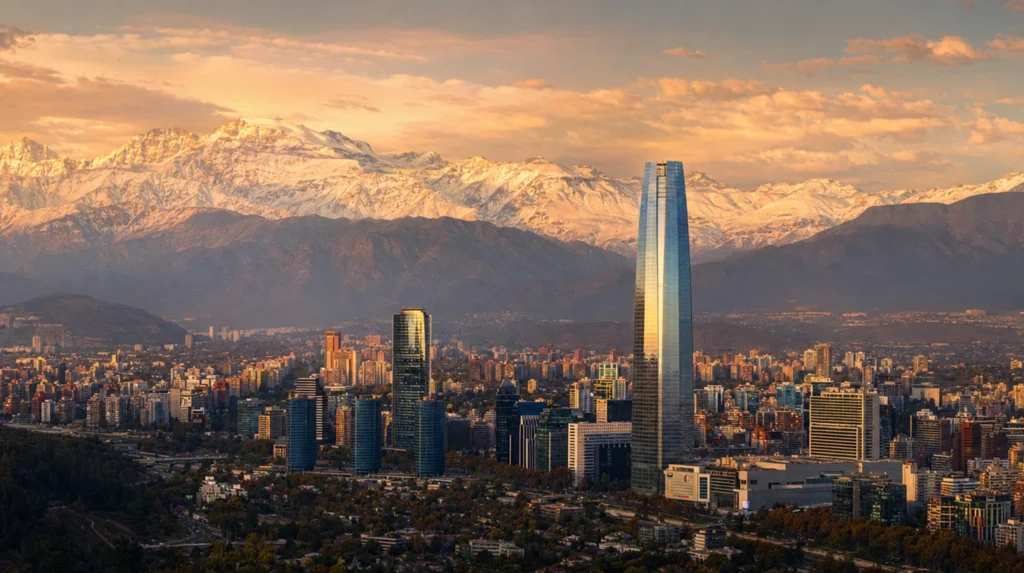
Santiago, Chile: Andes-Backed Capital, Wine Valley Gateway, South America’s Cleanest Metro
Part of our Chile travel guide.
I have flown into Santiago a dozen times and the moment that never gets old is the descent: the Andes appear in the right-hand window like a wall, and you understand instantly why Chileans orient by the cordillera rather than by the compass — east is up, west is down, north is the desert and south is Patagonia. We tell first-time travellers that Santiago is the cleanest big-city base in South America, the easiest one to navigate without Spanish, and the only continental capital where you can ski at 3,000 metres and surf the Pacific within the same 24 hours. My favourite afternoon here is a Mercado Central seafood lunch followed by the funicular up Cerro San Cristóbal for the sunset over the cordillera. Treat this guide as the brief I would hand my own family before they cleared customs.

Table of Contents
Why Santiago?
Santiago is the capital of Chile and the country’s commercial, political and cultural anchor — a metropolitan area of about 6.9 million people sitting at 520 metres elevation in a fertile central valley between the Andes and the lower Coastal Range. The city was founded in 1541 by Spanish conquistador Pedro de Valdivia at the foot of Cerro Santa Lucía, and the colonial street grid he laid out still defines the centro histórico.
The city’s pitch to first-time travellers is its sheer ease. Santiago has the cleanest, most punctual Metro in Latin America — six lines, more than 130 stations and a flat fare around CLP 880 (~$0.95), all signed in Spanish but legible to a non-speaker. The downtown is small and walkable, the Bellavista bar district is a five-minute stroll across the Mapocho river, and the funicular up Cerro San Cristóbal lifts you to a 300-metre viewpoint where on a clear winter morning you can count five 5,000-metre Andean peaks.
Practically, Santiago is the only continental capital where you can ski before lunch and surf before dinner. Three resorts — Valle Nevado, La Parva and El Colorado — sit 50 km east at 3,000 metres on the same lift system; Pacific surf at Maitencillo and Pichilemu is a 90-minute drive west. Plan three to four days here as your Chile anchor, then add the Casablanca and Maipo wine valleys, Valparaíso’s street art, or a flight south to Puerto Varas and Patagonia.
Neighborhoods: Finding Your Santiago
📍 Santiago Map: Every Place in This Guide


Centro Histórico (Plaza de Armas & La Moneda)
The colonial core laid out by Pedro de Valdivia in 1541 around the Plaza de Armas, with the Metropolitan Cathedral, the Central Post Office and the National History Museum facing each other across the square. Five blocks south, the neoclassical La Moneda palace is the seat of the Chilean presidency and the building bombed during the 1973 coup. Best for daytime sightseeing; the centro empties after 7pm.
- Plaza de Armas — the original 1541 main square with cathedral and museum frontage
- La Moneda Palace — presidential residence, free guided tours weekday mornings (book ahead)
- Centro Cultural La Moneda — the underground arts complex below the palace, free entry to most exhibits
- Mercado Central (1872) — iron-roofed seafood market, the lunch institution
- Pre-Columbian Art Museum — Latin America’s best collection of Andean textiles and ceramics
Best for: first-day orientation, museums, daytime walking. Access: Metro Plaza de Armas (Line 5) or Universidad de Chile (Line 1).
Barrio Lastarria & Bellas Artes
The most likeable base in Santiago: a four-block pedestrian zone south of Cerro Santa Lucía with the Museum of Fine Arts, the GAM cultural centre, design hotels, wine bars, and the Sunday antique market on Plaza Mulato Gil de Castro. Walk-anywhere from here — Centro is 10 minutes north, Bellavista 15 minutes across the Mapocho, and Providencia 20 minutes east.
- Museo Nacional de Bellas Artes — the 1880 fine-arts museum, free entry Tuesdays
- Museo de Arte Contemporáneo (MAC) — in the same Belle Époque building
- Cerro Santa Lucía — the leafy hill where Valdivia founded the city, free entry, sunset viewpoint
- GAM (Centro Gabriela Mistral) — concrete-and-rust theatre and gallery complex on Alameda
- Sunday antique market — Plaza Mulato Gil de Castro, 10am–5pm
Best for: first-time base, museum walking, café evenings. Access: Metro Universidad Católica (Line 1) or Bellas Artes (Line 5).
Bellavista (Pablo Neruda’s District)
The bohemian bar-and-restaurant district sandwiched between the Mapocho river and Cerro San Cristóbal — mural-covered streets, terrace dining on Pío Nono and Constitución, and Pablo Neruda’s 1953 home La Chascona open as a museum. The Patio Bellavista courtyard concentrates 20+ restaurants in a single block. Lively weeknights, packed weekends.
- La Chascona — Pablo Neruda’s Santiago home, now the Pablo Neruda Foundation museum
- Patio Bellavista — restaurant courtyard at Constitución 30, open daily until late
- Pío Nono — the late-night bar-strip, busy Thu–Sat
- Cerro San Cristóbal funicular — entrance at Plaza Caupolicán; 300 m climb to the summit Virgin
Best for: nightlife, dinner, the funicular. Access: Metro Baquedano (Lines 1, 5).
Providencia (Modern Spine)
The leafy commercial avenue between centro and Las Condes, lined with offices, mid-range hotels and the country’s tallest tower — the 300-metre Gran Torre Santiago, with a public viewpoint Sky Costanera on floors 61–62. Manuel Montt and Pedro de Valdivia metros sit at the heart of the eating-out belt.
- Sky Costanera — 300 m public viewpoint, adult ticket CLP 18,000 (~$19) in 2026, verify on site
- Costanera Center — the largest mall in South America by retail floor area, attached to Sky Costanera
- Parque Bicentenario — the riverside park with flamingo pond, free entry
- Avenida Providencia — the eating-out spine
Best for: mid-range hotels, shopping, the tower view. Access: Metro Tobalaba (Lines 1, 4) or Pedro de Valdivia (Line 1).
Las Condes & Vitacura (Upscale East)
Santiago’s wealthier east-side comunas at the foot of the cordillera — embassy row, the Apoquindo high-rises, the Drugstore boutique cluster, and the city’s most expensive restaurants. Vitacura is quieter and contains the Pueblito Los Domínicos craft market and the Ralli Museum. Useful base if you have a rental car or are commuting up to the ski resorts.
- Pueblito Los Domínicos — an open-air craft market in restored adobe buildings
- Parque Araucano — the Las Condes city park, weekend yoga and runners
- El Drugstore (Drugstore boutique block) — Providencia’s designer concept-store cluster
- Embassy Row along Avenida Apoquindo
Best for: business travellers, ski-day-trip base, fine dining. Access: Metro El Golf or Tobalaba (Line 1).
Barrio Italia & Ñuñoa (Design & Indie)
The design and antique district along Avenida Italia, plus the leafy Ñuñoa neighbourhood with Plaza Ñuñoa as its café-and-bar centre. Best for a low-key second day — restored conventillo houses now home to galleries, Chilean craft shops, and the city’s best independent ice-cream parlours.
- Avenida Italia — antique galleries and design shops in restored conventillos
- Plaza Ñuñoa — café and bar square, busy weeknights with the local-student crowd
- Estadio Nacional Julio Martínez Prádanos — the 48,000-seat national football stadium
Best for: second-day strolling, antique-hunting, indie cafés. Access: Metro Italia (Line 5).
The Food

Chilean Classics
Santiago’s anchor dishes are pastel de choclo (a sweet-corn casserole with beef, chicken and a hard-boiled egg), cazuela (a one-pot beef-or-chicken stew with corn-on-the-cob), the completo italiano hot dog, and the empanada de pino. Lunch is the main meal — menus del día at the picadas and clinching CLP 7,000–9,000 (~$7–10) for a three-course set.
- Liguria — the Providencia institution for completos and Chilean tavern food, three locations
- El Hoyo (Estación Central) — an 1898 picada serving terremoto cocktails and pastel de choclo
- Bocanáriz (Lastarria) — Chilean wine bar with 350 wines by the glass and a paired tasting menu
Mercado Central & La Vega
The 1872 Mercado Central’s iron pavilion (architect Fermín Vivaceta, fabricated in Glasgow) is the seafood lunch institution — congrio (conger eel), corvina, and machas a la parmesana on the half shell. Across the river, La Vega Central is the working-class produce market and a more honest lunch at one of its picadas.
- Donde Augusto — the Mercado Central’s most famous stall, congrio frito the order
- La Vega Chica — the smaller produce hall, picadas in the inner ring
- Tirso de Molina market — cheap Peruvian-Chilean lunch counters on the second floor
Modern Chilean & Fine Dining
- Boragó (Vitacura) — chef Rodolfo Guzmán’s endemic-Chile tasting menu, regularly Latin America’s 50 Best top 5; book 2–3 months ahead
- 040 (Bellavista) — modern Spanish, basement counter at hotel 040
- Ambrosía Bistró (Lastarria) — chef Carolina Bazán, Latin America’s 50 Best Female Chef 2019
Coffee & Café Culture
- Café del Opera (Lastarria) — the wedge-shaped corner café with Mapocho-river views
- Cafés con piernas — the centro’s mid-century ‘coffee with legs’ standing cafés (Café Caribe, Café Haití); the local quirk worth one visit
- Wonderland Café (Bellas Artes) — specialty third-wave roaster
Cultural Sights
Museums & Memory
Santiago’s museum trio is unmissable: the Pre-Columbian Art Museum (the best Andean-textile collection on the continent), the Museum of Fine Arts (Belle Époque palace, free Tuesdays), and the Museum of Memory and Human Rights documenting the 1973–1990 dictatorship.
- Museo Chileno de Arte Precolombino — CLP 7,000 adult, free under-10s, closed Mondays
- Museo de la Memoria y los Derechos Humanos — free entry, the dictatorship’s definitive testimony archive
- Museo Nacional de Bellas Artes — free Tuesdays, the country’s flagship art museum
Cerro San Cristóbal & Parque Metropolitano
The 880-hectare Parque Metropolitano covers two hills: Cerro San Cristóbal (300 m, with the funicular and summit Virgin) and Cerro Manquehue across the avenue. The funicular has run since 1925; the cable-car (teleférico) reopened 2016 connects the summit with Tupahue and the Pío Nono base.
Plaza de Armas & the Cathedral
The 1541 colonial square anchors the centro — the Metropolitan Cathedral (1799), the Central Post Office (1882), and the National History Museum on the south side. The free walking tours that depart from the cathedral steps at 10am and 3pm daily are a solid first-morning orientation.
Concha y Toro Wine Estate (40 km south)
South America’s largest wine producer runs daily 90-minute tours of the 1883 estate at Pirque, including the legendary Casillero del Diablo (‘the Devil’s cellar’) and a tasting of three reserve wines. Easily a half-day from central Santiago by car or organised shuttle.
Entertainment
Santiago’s nightlife splits along three axes: Bellavista’s Pío Nono and Patio Bellavista for the under-30 crowd, Barrio Italia and Ñuñoa for the design-and-cocktail set, and Las Condes’ Apoquindo highrise hotels for upscale rooftop bars. The Teatro Municipal de Santiago (1857) hosts the country’s opera and ballet seasons; tickets from CLP 8,000.
Live Music & Theatre
- Teatro Municipal de Santiago — opera, ballet, classical concerts since 1857
- Movistar Arena (Parque O’Higgins) — the city’s 16,000-capacity concert arena
- GAM (Centro Gabriela Mistral) — theatre, dance and free indie music programming
- Estadio Nacional — football matches and major touring concerts
Bars & Clubs
- Chipe Libre (Lastarria) — pisco bar with a 100-bottle Chilean–Peruvian list
- La Piojera (Estación Mapocho) — the iconic terremoto picada, cash only, daytime drinking
- Club Amanda (Vitacura) — mid-thirties electronic-music club
Day Trips
Valparaíso & Viña del Mar (90 min west)
The UNESCO-listed port city of Valparaíso is the easiest day-trip — 119 km on Ruta 68 — with painted hillside cerros, Pablo Neruda’s third house La Sebastiana, and the working ascensores (funiculars) connecting the upper neighbourhoods. Combine with neighbouring beach resort Viña del Mar.
Casablanca & Maipo Wine Valleys
Casablanca Valley (Sauvignon Blanc, Pinot Noir — cool-climate coastal) is on the Ruta 68 to Valparaíso; Maipo Valley (the country’s flagship Cabernet) is 30 minutes south. Concha y Toro at Pirque and Viña Santa Rita at Buin are the easiest first visits; Casa Lapostolle at Apalta and Vik in Cachapoal are the architectural showpieces.
Ski the Cordillera (60 min east)
Valle Nevado, La Parva and El Colorado share a single lift system at 3,000–3,670 m, 50 km east on Ruta G-21. Season runs mid-June to early October; day passes around CLP 65,000 (~$70). Portillo on the Argentine border is a 2.5-hour drive north.
Cajón del Maipo (90 min south-east)
The Andean canyon south-east of the city — Embalse El Yeso’s turquoise reservoir at 2,500 m, the Cascada de las Ánimas waterfall, and the Termas Valle de Colina hot springs at 3,500 m. A driving day; rent a car or join an organised tour.
Isla Negra & Pomaire (full day)
Pablo Neruda’s clifftop house at Isla Negra (his most personal of three) is 110 km west. Combine with Pomaire, the pottery village 40 km south-west of Santiago, for a circular day.
Seasonal Guide
Santiago has a dry Mediterranean climate — long warm summers, dry mild winters, almost no rain November to April. The city’s notorious smog (atmospheric inversion in winter, wildfire smoke in summer) is the year’s scheduling problem.
Spring (Sep–Nov) — the best window
Daytime highs 20–26°C, jacarandas in November, wine harvest at the start of autumn (March–April south of the equator). Vendimia (harvest festivals) in Curicó and Santa Cruz wine regions. Air clarity is at the year’s peak in mid-November.
Summer (Dec–Feb) — hot & smoggy
Daytime highs 28–32°C; locals leave for the coast. The city is quieter but smog can spike in February when wildfires burn in central Chile. Skip mid-January to mid-February if possible.
Autumn (Mar–May) — the photographer’s window
Crisp mornings, golden vineyard light, daytime highs 18–24°C. Late March to mid-April is the wine-harvest peak in Maipo and Casablanca.
Winter (Jun–Aug) — ski season
Daytime highs 10–15°C, snow in the cordillera June–September, occasional rain July–August. The smog sits low some weeks; the 60-minute drive up to Valle Nevado breaks above the inversion layer at 1,500 m.
Getting Around
Santiago’s Metro is Latin America’s largest by ridership and the easiest way to navigate the city — six lines, more than 130 stations, and a flat fare around CLP 880 in 2026 (~$0.95). Trains run Mon–Sat 06:00–23:00, Sundays 07:30–22:30. Buy a Bip! contactless card at any station; CLP 1,550 deposit, top up at machines.
From Arturo Merino Benítez Airport (SCL)
- Centropuerto / Tur Bus coaches — CLP 2,300 (~$2.50) one-way to Pajaritos Metro or Los Héroes, every 10 minutes
- Cabify or Uber — CLP 14,000–20,000 (~$15–22) to Lastarria, both legal in Chile
- Official airport taxis — CLP 25,000+ (~$27); fix the price at the kiosk before exiting
Buses, Cabify & Bicycles
The Transantiago bus network (red articulated buses) shares the Bip! card with the Metro, but routes are cryptic and the Metro is faster. Cabify and Uber operate normally and quote in CLP. The Bicicletas Itaú dock-bike network has 200+ stations across central comunas; CLP 25,000 monthly. The Mapocho river path (Costanera Norte to Vitacura) is the longest continuous cycling corridor.
Budget Breakdown
Santiago is one of Latin America’s pricier capitals, but well below European levels. Lunch menus del día and Metro fares are still cheap; restaurant dinners in Las Condes and Vitacura are not.
Daily Budgets (per person)
- Hostel / shoestring: USD $35–55 (dorm bed, lunch menu del día, Metro, two completos)
- Mid-range: USD $90–160 (3-star hotel in Lastarria, table-service lunch & dinner, Sky Costanera ticket, taxi or Cabify)
- Luxury: USD $260+ (boutique hotel in Vitacura or Las Condes, Boragó dinner, wine-valley driver)
Sample Costs (2026)
- Metro fare flat: CLP 880 (~$0.95)
- Coffee in a café: CLP 2,500–3,500 (~$2.70–3.80)
- Lunch menu del día: CLP 7,000–9,000 (~$7–10)
- Dinner mid-range: CLP 15,000–25,000 (~$16–27) per person without wine
- Sky Costanera adult ticket: CLP 18,000 (~$19)
- Concha y Toro wine tour: CLP 28,000 (~$30)
Practical Tips
Money & ATMs
Currency is the Chilean peso (CLP), with notes of $1,000, $2,000, $5,000, $10,000 and $20,000. Card payment is universal; Apple Pay and Google Pay work everywhere card terminals do. ATMs charge a CLP 6,500 (~$7) foreign-card fee — use BancoEstado machines at any Líder supermarket for the lowest fee.
Safety & the Centro
Santiago is statistically one of South America’s safer capitals, but petty theft (phone-snatching, distraction theft) spiked after the 2019 social unrest and remains higher than 2018 levels. Don’t carry a phone in your back pocket, hold bags closed in Plaza de Armas and Bellavista at night, and avoid the empty centro after 10pm.
Altitude & Smog
Santiago itself sits at 520 m, no altitude effect. The atmospheric inversion that traps smog (mid-May to August, mid-January to February in wildfire years) means asthmatic visitors should check the daily Air Quality Index. Pre-emergencia and Emergencia days trigger driving restrictions.
SIM & Connectivity
WOM, Entel and Movistar all sell prepaid tourist SIMs at the airport; CLP 5,000 for 5 GB / 30 days is the standard package. 5G is rolled out in central comunas; 4G everywhere else.
Etiquette
Chileans are formal at first introduction (don del nombre on first meeting), warm by the second. A 10% propina (tip) is expected at restaurants — usually pre-suggested on the bill. Tap water is safe centrally, but high-mineral content; bottled water is widely sold for the taste, not the safety.
Frequently Asked Questions
How many days do I need in Santiago?
Three to four days — one for the centro and Lastarria, one for Bellavista and the funicular, one for a wine-valley day-trip, and one for either Valparaíso or skiing.
Is Santiago safe for solo travellers?
Yes, with normal big-city precautions. The Lastarria, Bellas Artes, Bellavista, Providencia, Las Condes and Vitacura comunas are walkable at night; the deserted centro after 10pm and parts of Estación Central after dark are not.
Do I need Spanish?
You will get by without it — Metro signage is unilingual but easy to read, hotels and Lastarria/Las Condes restaurants speak English, and Cabify/Uber dispenses with the language barrier. A few Chilean phrases (po, cachai, wena) make you a friend instantly.
Can I drink the tap water?
Yes in central comunas (Santiago, Providencia, Las Condes, Vitacura, Ñuñoa). The water is safe but high in calcium and copper minerals from the cordillera, which gives it a distinctive taste; many locals use a filter jug.
When is the smog worst?
Mid-May to early August (winter inversion) and mid-January to mid-February in wildfire years. The 60-minute drive up to Valle Nevado, Maipo or San Pedro de Atacama breaks above the inversion layer; the ski resorts often sit in clear sun while the city is fogged in.
Is the Bip! card worth it for a 4-day visit?
Yes — the CLP 1,550 deposit pays itself back in two Metro rides versus paper tickets, and the same card works on the Transantiago buses.
What about the tap-and-go contactless on Metro?
Some stations now accept Visa/Mastercard contactless directly at the gate (Línea 6, Línea 3 stations from late 2024). A foreign contactless card works without buying a Bip! card — charges in CLP at the day’s spot rate.
Map
More city guides you might like
Plan your trip to Santiago
The booking tools we use ourselves. FFU may earn a commission at no extra cost to you.
Plan & book your trip to Santiago
Booking through these searches supports our guides at no extra cost to you.