
☰ On this page
- 📋 In This Guide
- Overview — Why Quito Belongs on Every South America Trip
- ⛰️ Late-April / Early-May 2026 — Why You’re Right in the Window
- Best Time to Visit (Season by Season)
- Getting There — Mariscal Sucre Airport & Arrival
- Getting Around — Metro, Trolley, Taxi & the New Q Cards
- Top Districts & Neighbourhoods
- 🗓️ Sample Itineraries
- Quiteño Culture & Etiquette
- A Food Lover’s Guide to Quito
- 📸 Photography Notes
- Off the Beaten Path — Beyond the Centro
- Practical Information
- Budget Breakdown — What Quito Actually Costs
- ✅ Pre-Trip Checklist
- 🤔 What Surprises First-Timers
- Frequently Asked Questions
- Ready to Explore Quito?
- Explore More
Quito, Ecuador — Andean Capital, Colonial Heart & UNESCO Old Town at 2,850m
Part of our Ecuador travel guide.
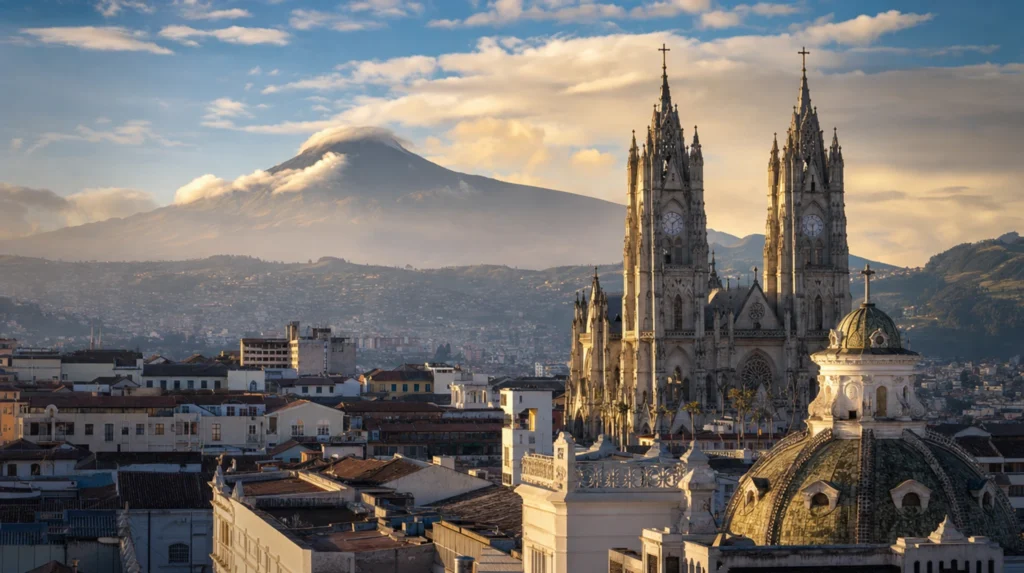
Quito is the second-highest capital in the world and the only one that sits directly on the equator. The city stretches 50 kilometres north-to-south along a narrow valley floor at 2,850 metres above sea level, hemmed in on the east by the snow-line cone of Cayambe and on the west by the active stratovolcano Pichincha, which last erupted in 2002 and dusted the city in fine grey ash that took weeks to wash off the colonial-era roof tiles. The Centro Histórico — the Old Town — was the first UNESCO World Heritage Site ever inscribed, jointly with Kraków on the inaugural 1978 list, and it is still the largest, best-preserved, least-altered colonial centre in the Americas: 320 hectares of 16th-, 17th- and 18th-century architecture, 23 churches, four Baroque masterpieces and the densest concentration of pre-republican religious art on the continent.
What makes Quito unusual among Andean capitals is the compression. Cusco is higher (3,400m) but smaller and more touristically curated; La Paz is denser but has no real colonial quarter; Bogotá has the architecture but spreads across a much larger basin. Quito holds the equation in tension — you can stand in the courtyard of the Compañía de Jesús (1605–1765, the most ornately gilded Baroque church in South America), walk twelve minutes to a metro station that opened in December 2023, and ride for fifteen minutes to a glass-and-steel financial district where you can drink a cold-brew flat white at 2,800 metres altitude without leaving the same valley.
This guide covers Quito end to end — the Centro Histórico, the residential gentility of La Mariscal and La Floresta, the new business district of La Carolina, the equator monument at Mitad del Mundo, and the cloud-forest day-trip towns within two hours of the city. Ecuador does not yet have a country guide on this site; for the regional context, see our Peru travel guide and Colombia travel guide for the Andean north and south, and our Cusco city guide and Lima city guide for the most natural travel pairings.
📋 In This Guide
- Overview — Why Quito Belongs on Every South America Trip
- ⛰️ Late-April / Early-May 2026 — Why You’re Right in the Window
- Best Time to Visit (Season by Season)
- Getting There — Mariscal Sucre Airport & Arrival
- Getting Around — Metro, Trolley, Taxi & the New Q Cards
- Top Districts & Neighbourhoods
- 🗓️ Sample Itineraries — 2, 4 and 7 Days
- Quiteño Culture & Etiquette
- A Food Lover’s Guide to Quito
- 📸 Photography Notes
- Off the Beaten Path — Beyond the Centro
- Practical Information
- Budget Breakdown — What Quito Actually Costs
- ✅ Pre-Trip Checklist
- 🤔 What Surprises First-Timers
- Frequently Asked Questions
- Ready to Explore Quito?
Overview — Why Quito Belongs on Every South America Trip
Quito sits on a pre-Columbian site that was the northern administrative centre of the Inca Empire under Atahualpa, who was born here. When the Spanish conquistador Sebastián de Benalcázar arrived in December 1534, he found that the retreating Incan general Rumiñahui had burned the city to the ground rather than surrender it. Benalcázar founded the new Spanish settlement on December 6 of that year — the date is still the city’s annual festival, las Fiestas de Quito, with bullfights, brass bands and street parties for ten days each early December — and within twenty years the Franciscans, the Augustinians, the Dominicans and the Jesuits had all established their headquarters here. Quito’s Baroque art tradition, the Escuela Quiteña, emerged in the 17th century as a fusion of Spanish religious iconography and Andean technique; it produced sculptors and painters whose work was exported across the entire Spanish Empire.
Independence came on August 10, 1809 — Quito was the first city in Spanish America to declare independence, although the declaration was crushed within months and the formal independence of Ecuador did not arrive until 1822. The 19th century was a sequence of internal struggles between liberals and conservatives, with Quito’s role as the conservative-Catholic capital and Guayaquil’s as the liberal-mercantile counterweight; the rivalry shapes Ecuadorian politics to this day. The 20th century brought oil — Ecuador joined OPEC in 1973, leaving in 1992 and rejoining briefly — and a 1998 dollarization that replaced the sucre with the US dollar and stabilised an economy that had been on the edge of collapse.
The contemporary city is a metropolitan area of 2.8 million in a country of 18 million. Quito is administratively the country’s second-largest city by population (Guayaquil on the coast is larger) but the political and cultural capital. The 2024–2025 security crisis — Ecuador experienced a sharp spike in gang-related violence concentrated mostly in coastal cities — reduced tourist numbers significantly, but central Quito itself has remained measurably safer than Guayaquil and far safer than the rural border zones. The new metro line, opened December 2023 after seven years of construction delays, has reduced traffic congestion in the central corridor by an estimated 22%. The city is investing aggressively in tourism recovery for 2026.
For a traveller, the practical consequence is that you are visiting a city that has the densest concentration of colonial Catholic art in the Americas, the highest-altitude operating metro system in the world, a contemporary cuisine scene that has produced two World’s 50 Best restaurants in the last five years, and a security situation that requires neighbourhood-by-neighbourhood awareness without being paralysingly difficult. The compression of altitude, history, art and active volcanism in a single valley is what makes Quito interesting.
🏛️ Historical Context
The Compañía de Jesús — the Jesuit church on the corner of García Moreno and Sucre in the Old Town — took 160 years to build (1605–1765) and contains seven tonnes of gold leaf applied across the interior. The exterior is a relatively restrained volcanic-stone Baroque facade; the interior is an entire universe of carved cedar and gilded plaster, with a single coffered nave that produces the most dramatic visual effect of any colonial church in South America. The Jesuits commissioned Andean indigenous carvers to do the work, and the iconography quietly fuses Catholic saints with pre-Columbian symbolism — the sun above the altar carries Inca solar imagery, certain capitals contain corn cobs and maize gods that evade Catholic recognition. The Jesuits were expelled from Spanish America in 1767, two years after the church’s completion. It has been on the UNESCO list since 1978. Entry is $5; photographs of the interior require an additional $4 permit.
🎌 Did You Know?
The actual equator runs about 240 metres north of the famous yellow line painted at the Mitad del Mundo monument in San Antonio de Pichincha. The colonial-era French Geodesic Mission of 1736 used the best instruments of the day to determine the equator’s location and built the original monument; modern GPS in the 1990s revealed the small offset. The smaller Museo Inti Ñan immediately adjacent stands on the actual GPS-confirmed equator and runs the famous “egg balanced on a nail” demonstration that is technically a parlour trick (gravity is not measurably different at the equator) but a fun one. Tour operators bundle both into a single visit. Roughly 800,000 visitors stop here annually; the geographic accuracy is the second-most-asked-about fact in the city.
⛰️ Late-April / Early-May 2026 — Why You’re Right in the Window
Late April through mid-May is a transition window on the Quito calendar. The longer rainy season is winding down — March and April are typically the wettest months, with afternoon thunderstorms most days, and the rains become noticeably more intermittent through May. By April 28–30, the typical pattern is bright dry mornings, scattered afternoon clouds, and an occasional brief rain between 3 and 5 p.m. Daytime highs hover at a steady 19–21°C all year (the city’s altitude-equator combination produces almost no seasonal temperature variation), but the cloud cover drops and the sky on a clear May morning over the Andes is the Andean light that photographers come for.
The cultural calendar is light in this window — most major festivals (Fiestas de Quito in December, Easter Holy Week in March/April depending on the calendar, Inti Raymi in June) fall outside it — but that is part of the appeal. Hotel prices in the boutique colonial neighbourhood and La Mariscal are at their lowest of the year, the major museums (Casa del Alabado, Museo del Carmen Alto, the new Yaku interactive water museum) are at quiet weekday capacity, and you can climb the Basilica del Voto Nacional towers without queuing. The cloud-forest reserves around Mindo (90 minutes northwest of Quito) are at their wildflower peak — May is the start of orchid season — and the bird-watching at altitude transitions from the resident species to the early arrivals from northern migration routes.
One important caveat for late April / early May: the Cotopaxi volcano, 50 km south of Quito, remains in an elevated-monitoring phase after its 2022–2023 ash-emission cycle. The mountain is the world’s highest active volcano (5,897m) and a frequent day-trip destination from Quito. As of late 2025, Cotopaxi National Park access is at green-status and the Refugio Jose Rivas climbing hut is open to visitors — but check the IGEPN (Instituto Geofísico de la Escuela Politécnica Nacional) website at igepn.edu.ec for the current status before booking a tour. The geological observatory updates its public bulletins weekly. Quito itself has never been at risk from a Cotopaxi eruption — the volcano’s lahar-flow corridors run south toward Latacunga — but the day-trip access can change overnight.
⚠️ Important — Altitude Acclimatisation
Quito sits at 2,850 metres. About 25–35% of arriving travellers experience some altitude effects — headache, mild nausea, shortness of breath, disrupted sleep — for the first 24 to 48 hours. The city’s local response is mate de coca (coca-leaf tea, legal and widely available) which moderates symptoms but is not a substitute for proper acclimatisation. The general advice: take it easy on day one (no aggressive walking tours, no alcohol, plenty of water), avoid heavy meals, climb the Basilica towers on day two not day one. If you are arriving from sea level and continuing higher (Cotopaxi at 4,800m for the day-trip refuge climb, or the Quilotoa Loop at 3,800m+), allow at least 36 hours in Quito itself before going higher. Travellers with cardiovascular conditions should consult a physician before the trip — diamox (acetazolamide) is the standard prophylactic and is available over-the-counter in Quito pharmacies for $3 a strip.
Best Time to Visit (Season by Season)
Quito has two seasons — wet and dry — with very mild temperature variation across the year. The latitude is 0° (the equator runs through the northern outskirts), so day length is essentially constant: sunrise around 6:00 a.m., sunset around 6:15 p.m., 365 days a year. The variable that matters is rainfall. The altitude (2,850m) keeps temperatures mild even in the wettest months.
Dry Season Peak (June – September)
The cleanest, sunniest stretch. Daytime highs sit at 20°C, overnight lows at 8°C, and afternoon thunderstorms are rare. The light is at its Andean clearest — Cotopaxi and Cayambe are reliably visible from the city’s higher viewpoints (Panecillo Hill, the TelefériQo cable car). This is also the country’s main tourist season as it coincides with the northern hemisphere summer; expect higher hotel prices and crowded bookings at the major sights. Inti Raymi (the Inca winter solstice festival, June 21–22) is celebrated across the highlands and Quito hosts smaller but worthwhile cultural events. The dry-season concentration in San Antonio’s equator monument and Cotopaxi National Park is the key consideration.
Short Wet Season (October – November)
A transition window with intermittent rainfall and otherwise comfortable conditions. Mornings remain dry and sunny in most weeks; afternoon rains are common but pass quickly. The cultural calendar includes the All Saints’ / All Souls’ commemorations (November 1–2) when the highland tradition of guaguas de pan (sweet bread shaped like infants) and colada morada (a thick purple corn drink) come out across the city. The Día de los Difuntos cemetery visits in San Diego and El Tejar cemeteries are quiet but profound. Hotel prices drop 15% off the dry-season peak.
Festive Dry Window (December – Early February)
The second dry window. Rainfall is light, daytime highs at 19°C, and the cultural calendar is the year’s heaviest. Las Fiestas de Quito (December 1–6, commemorating the city’s 1534 Spanish founding) is the city’s biggest party — bullfights, parades, brass bands, and the Año Viejo tradition on December 31 (life-size effigies of departing-year figures burnt at midnight). Christmas in Quito is family-oriented and quieter than the secular celebrations, but the Old Town’s churches stage an extraordinary set of nativity displays from December 8. The first two weeks of December are heavily booked; January and early February are quieter and excellent for travellers seeking the dry weather without the crowds.
Long Wet Season (February – May)
The proper wet season. March and April are the wettest months, with measurable afternoon rain on roughly 70% of days, and February and May lighter at the bookends. Mornings remain mostly sunny — the rhythm is bright morning, cloud build-up by noon, thunderstorm 2–5 p.m., clearing by sunset. The temperature stays mild (19°C peak) but the humidity is higher and cloud cover obscures the volcanic peaks more often. Hotel prices are at their year-round low; February is the best-value month, with weekend hotel rates 25–30% below dry-season peak. Easter Holy Week is the major cultural event (the Jesús del Gran Poder procession on Good Friday is the largest religious event in Quito’s calendar).
🧳 Travel Guru Tip
If you have a week and want Quito at its weather-perfect best with photographable Andean views, target the second half of June. The dry season is established, the light is at its Andean clearest, the post-Inti Raymi calendar is quieter, and Cotopaxi and Cayambe are visible from the city on most clear mornings. The light from the Panecillo viewpoint at 6:30 a.m. in late June is the city’s most photographed moment of the year. Most international guides default to “December–March” recommendations and miss what June actually offers.
| Experience | Best months | Best districts | Notes |
|---|---|---|---|
| Old Town walking | Year-round (mornings) | Centro Histórico | Avoid Sunday closures of major churches |
| Cotopaxi day trip | Jun – Sept (dry) | Cotopaxi National Park | Check IGEPN.edu.ec status before booking |
| Mindo cloud forest | May – early Jul | Mindo, Tandayapa | Bird migration overlap, orchid bloom peak |
| Mitad del Mundo equator | Year-round (mornings) | San Antonio de Pichincha | Combine with Pululahua crater day-trip |
| Fiestas de Quito | Dec 1 – 6 | Old Town, Plaza de Toros | Brass bands, parades, bullfights |
| TelefériQo cable car | Jun – Sept (clear) | Cruz Loma at 4,100m | Best at 7–9 a.m. before clouds form |
Getting There — Mariscal Sucre Airport & Arrival
Quito is served by Mariscal Sucre International Airport (UIO), opened in 2013 in Tababela 35 km east of the city centre. The new airport replaced the old in-city airport (which sat at 2,800m on a runway constrained by the surrounding mountains and produced one of the world’s most famously hairy approaches). The current airport is a more comfortable 2,400m, properly long runway, modern terminal, handles roughly 5 million passengers annually, and is the country’s primary international gateway alongside Guayaquil. The drive from UIO to the city centre is 45–60 minutes via the E35 highway depending on traffic.
From North America, direct flights run from Miami (American Airlines, 4h45m), Atlanta (Delta), Houston (United), New York JFK (LATAM, JetBlue) and Fort Lauderdale (Spirit). Round-trip pricing in shoulder season typically lands $450–750. Toronto direct on Air Canada operates seasonally. From Europe, KLM operates direct from Amsterdam (12 hours, the only Europe-direct option), Iberia from Madrid, and Air Europa from Madrid — round-trips €700–1,100. Within South America, LATAM, Avianca and Aeroméxico operate hub-and-spoke routes from Lima, Bogotá, Mexico City and Buenos Aires.
The airport is small, modern, and efficiently designed. Immigration runs Ecuadorian and foreign-passport lanes; from gate to ground transport is rarely more than 35 minutes. Three options into the city: a metered taxi (the official airport-taxi co-op operates yellow-and-orange cabs from outside arrivals, $25–30 to the city centre); a Cabify or Uber ride-hail (both operate at the airport, $20–28 to the city, the default for most travellers); or the Aeroservicios bus to the old airport site at La Mariscal ($8, 90 minutes, runs every 30 minutes 5 a.m.–11 p.m.). The bus is significantly slower; rideshare is the right choice for almost every visitor.
✨ Pro Tip
Most nationalities — including US, UK, Canadian, EU, Australian and NZ passport-holders — enter Ecuador visa-free for 90 days within any 365-day period. The visa-free policy is among the most generous in South America. There is no fee to enter, no advance e-visa to register, and arrival immigration typically takes 10–20 minutes. The single requirement to verify on arrival is sufficient yellow-fever-vaccination for travellers entering from countries where transmission is documented (the WHO list updates periodically) — for direct US/Europe arrivals this is not required, but if your itinerary includes Brazil, Peru’s Amazon basin, or Bolivia within the prior month, the yellow-fever certificate may be checked. Carry it just in case.
Getting Around — Metro, Trolley, Taxi & the New Q Cards
Quito’s transport situation changed in December 2023 when the metro line finally opened. Line 1 (the only operating line) runs 22 km north-south through the city centre, 15 stations, from Quitumbe in the south to El Labrador in the north. Stations include El Recreo, La Magdalena, San Francisco (Old Town), La Alameda, El Ejido (just south of La Mariscal), Universidad Central, La Pradera (Mariscal proper), La Carolina (the financial district), and the new northern stations. A single ride is $0.45; the metro runs 6 a.m. to 10 p.m. on weekdays, 8 a.m. to 9 p.m. on weekends. Ridership has grown rapidly through 2024 and 2025 to roughly 250,000 daily users.
Beyond the metro, the city operates three trolley lines (Trolebús, Ecovía, Metrobús) running on dedicated bus-rapid-transit corridors. Each is $0.35. The trolley network is genuinely useful for tourists — the main Trolebús line follows Avenida 10 de Agosto from the south to the north of the city and stops at the Plaza Grande in the Old Town, La Mariscal, and La Carolina. Buses elsewhere in the city are inexpensive ($0.35) but the network is harder to read for non-Spanish-speakers; downloading the Moovit app helps.
For everywhere else, taxis and rideshares are the default. Quito has a robust regulated taxi sector (yellow-painted cabs, official medallions, mandatory meter use, mandatory passenger-list paperwork on each trip — this is the “Q-Reg” anti-kidnapping system introduced in 2008 and still active). Taxi fares are inexpensive: most trips within the central districts run $3–7. Cabify and Uber both operate in Quito and are the standard for foreign travellers — both apps work, both accept foreign credit cards, both are tracked and offer GPS visibility. Most local English-speaking travellers prefer Cabify for the reliability of pre-quoted fares.
⚠️ Important — Q-Reg Taxis & Safety After Dark
Quito had a problem with “express kidnapping” in unlicensed taxis in the 2000s; the response was the Q-Reg system, which is now genuinely effective. Officially registered yellow taxis have a meter, a printed driver-ID card visible on the dashboard, and orange license plates with the city emblem. After dark, particularly between 9 p.m. and 6 a.m., book a Cabify or Uber rather than hailing on the street — the GPS-tracking and pre-payment significantly reduce any residual risk. The Old Town and La Mariscal are well-lit until 10 p.m. and reasonably safe to walk; the El Panecillo hill is unsafe to walk up at any hour and should always be reached by taxi. Sensible urban precautions (no flashed phones, modest jewellery, registered taxis after dark) keep visitors out of the small remaining risk pool.
Top Districts & Neighbourhoods
📍 Quito Map: Every Place in This Guide
Quito’s geography is a 50-km north-south valley, and the city is read along that axis. The practical map for travellers is the Centro Histórico (the colonial heart), La Mariscal and La Floresta (the residential restaurant-and-bar belt north of the centre), La Carolina (the financial district further north), El Panecillo (the hill at the southern end of the Old Town), and the day-trip corridor north toward Mitad del Mundo and the cloud forests.
⛪ Centro Histórico — The UNESCO Old Town
The 320-hectare colonial core — the largest, oldest, best-preserved historic centre in the Americas, inscribed by UNESCO in 1978. Centro Histórico contains 23 churches, 15 monasteries, eight major plazas, and roughly 5,000 historic buildings dating from the 16th to early 20th century. The compressed heart — bounded roughly by Plaza Grande, Plaza Santo Domingo, Plaza San Francisco and the Loma Grande hill — covers about 1 km² and is walkable corner-to-corner in 25 minutes if the altitude allows.
The Plaza de la Independencia (Plaza Grande) is the symbolic centre — anchored by the Presidential Palace (Palacio de Carondelet), the Cathedral of Quito, and the Archbishop’s Palace. The Cathedral is the oldest in South America (1535–1567) and contains the tomb of independence hero Antonio José de Sucre. A block away, the Plaza San Francisco holds the Convent of San Francisco — the largest colonial complex on the continent (40,000 m² of cloisters, library, churches and museum) — and the smaller, older Iglesia y Convento de San Diego.
The single must-do is the Compañía de Jesús — the Jesuit church on the corner of García Moreno and Sucre. Seven tonnes of gold leaf in the interior, 160 years of construction, and a single coffered nave that produces an acoustic and visual effect unmatched in South American Baroque. Allow 45 minutes minimum. The neighbouring La Ronda street — a steeply-cobbled 18th-century street that has been carefully restored as a cultural quarter — is the city’s best evening walk for live music and small workshops (chocolate, hat-making, ceramics).
- What to do: Compañía de Jesús ($5); Convent of San Francisco ($3 museum); La Ronda evening walk; climb the Basilica del Voto Nacional towers for the best Old Town panorama ($2).
- Signature eats: Locro de papa (potato-and-cheese soup with avocado) at Hasta la Vuelta Señor in the Plaza San Francisco; Quito-style empanadas at Govindas on La Ronda.
- Access: Metro Line 1 San Francisco station opens directly into the Old Town. Trolebús stops at Plaza Grande.
🍷 La Mariscal & La Floresta
The two adjacent residential neighbourhoods that form Quito’s restaurant-and-bar belt, immediately north of the Old Town. La Mariscal is the older of the two — a 1930s suburb of Republican-era houses, now a dense grid of bars, hostels, restaurants and the city’s main backpacker zone (Plaza Foch is the centre). La Floresta, immediately east, is the quieter, more architectural neighbourhood of restored 1920s villas, the city’s best independent cinema (Ochoymedio), and the highest concentration of fine-dining restaurants.
The food scene here is the best in the city. Nuema (the country’s first World’s 50 Best Latin America restaurant since 2022) sits at La Floresta on Calle Madrid; Somos restaurant opened in 2024 with the same chef-owner Pia Salazar at the helm focusing on fermentation; Zazu offers contemporary Ecuadorian-Mediterranean. The cafés are equally credible — Café Galletti for the country’s best espresso, La Liebre for breakfast, Pájaro Azul for evening cocktails. La Mariscal, by contrast, is louder and more backpacker-oriented, but Plaza Foch’s outdoor restaurants are reliable for casual eats.
- What to do: Restaurant tasting at Nuema or Somos (book 2–3 weeks ahead, $90–140 tasting menu); Casa del Alabado pre-Columbian art museum (excellent and small, $4); Mercado Artesanal La Mariscal (the indoor handicrafts market — better for shopping than the touristy outdoor stalls).
- Signature eats: Tasting menu at Nuema; ceviche at Mar y Mar in La Floresta; modern Ecuadorian at Zazu.
- Access: Metro Line 1 La Pradera station for La Mariscal; walking from El Ejido station for both neighbourhoods.
🏗️ La Carolina & the Financial District
The northern business district built around La Carolina Park, the city’s largest urban green space. La Carolina the neighbourhood developed since the 1970s as Quito’s modern commercial centre — glass-and-steel office towers, the Quicentro and Plaza de las Américas shopping centres, and the city’s higher-end international hotels (Marriott, Swissôtel, JW Marriott). It is structurally newer and less interesting architecturally than the central districts, but is where business travellers stay and where the most reliable, internationally-comparable hotel and restaurant infrastructure lives.
The 64-hectare La Carolina Park itself is the genuine reason to come — joggers, families, the Sunday afternoon picnic crowd, paddle-boats on the small lake, and the Vivarium reptile museum at the southern end. The park hosts cultural fairs, weekend markets, and the annual Festival de Independencia in August. The Botanical Garden adjacent (separate $4 entry) holds 8,000 species of Andean and Amazonian plants. From the park’s high ground, on a clear morning, Cotopaxi is visible 50 km south.
- What to do: Walk La Carolina Park (free); Vivarium reptile museum ($4); Quito Botanical Garden ($4); Quicentro for shopping mall convenience.
- Signature eats: Theatrum (modern Ecuadorian fine dining, in the Teatro Bolívar building); Pim’s at the Swissôtel for Sunday brunch; the food court at Quicentro for casual chains.
- Access: Metro Line 1 La Carolina station opens directly onto the park.
🗿 Mitad del Mundo & the Equator
The Mitad del Mundo monument complex in San Antonio de Pichincha, 25 km north of central Quito and the country’s most visited tourist destination after the Galapagos. The site is bigger than its photographs suggest — a 30-metre stone monument with a viewing deck and equator-line plaza, a colonial-village reproduction with restaurants, a small ethnographic museum, and the adjacent Museo Inti Ñan on the actual GPS-confirmed equator (240 metres north). Day-trip operators run combined tours from Quito for $25–40 per person including transport, both museums, and lunch.
The standard tour combines Mitad del Mundo with the Pululahua crater — an extinct volcanic caldera 9 km away with a green farming valley inside, accessed by a short cable car or a steeper 4WD descent. From the rim viewpoint at Ventanillas, the crater is photogenically green-and-misty in late afternoon. The full half-day tour returns to Quito by 3 p.m.; the more thorough full-day version adds the Cochasquí pre-Inca pyramid complex 30 km further north.
- What to do: Mitad del Mundo monument and viewing deck ($5); Museo Inti Ñan with the equator demonstrations ($4); Pululahua crater rim and cable-car descent.
- Signature eats: Tigrillo (mashed green plantain with cheese and egg, the local specialty) at any of the Mitad del Mundo plaza restaurants.
- Access: Half-day organized tours from Quito $25–40 including transport; or take the Metropolitana bus from La Ofelia north terminal ($1.30 each way) and walk in — slower but cheaper.
🏔️ El Panecillo & the South
El Panecillo (“the small bread loaf”) is the 200-metre hill at the southern end of the Old Town, topped by a 41-metre aluminium statue of the Virgin of Quito (the only winged Virgin Mary in the world) erected in 1976. The viewpoint at the top — accessible only by taxi or organised tour, never on foot for safety reasons — gives the canonical photograph of the Old Town with the Virgin’s silhouette in the foreground. The interior of the statue’s base is a small museum ($1). Allow 45 minutes including the taxi up and the views.
South of the Panecillo is Quito’s older, working-class southern half — La Magdalena, Quitumbe, and the southern districts where the metro now connects but tourist activity is genuinely sparse. The city has invested in safety improvements through the southern districts as the metro infrastructure rolled out, but for most travellers the south is for quick metro rides between the centre and the airport corridor rather than for sightseeing.
- What to do: Taxi to El Panecillo (10 minutes from Old Town, $5 one way), 30-minute viewing stop, return; combine with a stop at the Itchimbía cultural centre on the way down.
- Signature eats: Quitueños — small fried-dough fritters sold by street vendors at the Panecillo viewpoint, $1 a portion.
- Access: Taxi only; never walk up. Round-trip taxi $8–10.
🌿 Mindo & the Cloud Forest
The cloud-forest town of Mindo, 90 minutes northwest of Quito by car, sits at 1,250m on the western slope of the Andes — measurably warmer (22–24°C daytime), much wetter, and biologically among the densest birding zones in the world. The greater Mindo cloud-forest reserve hosts roughly 500 bird species in a 19,000-hectare protected area, plus 90 species of butterfly, an endemic chocolate industry (the Yumbos chocolate-making class is a popular afternoon stop), and zip-line and tubing operations on the Mindo River.
Day trips from Quito are possible (depart 7:30 a.m., return 7 p.m., $50–80 per person organised); overnight stays are the better experience. Mindo Garden Lodge, Casa Divina, and Mashpi Lodge (the higher-end cloud-forest resort 90 minutes further at $1,200/night) are the established options. The bird-watching at El Quetzal Reserve at dawn — the chance to see the Andean cock-of-the-rock display lek between 5:30 and 7:00 a.m. — is the genuine attraction; a Mindo overnight is the only realistic way to be there at the right hour.
- What to do: Cock-of-the-rock dawn lek; Mindo butterfly farm; Yumbos chocolate-making class; Mindo Canopy zip-line; Tarabita cable-car over the cloud-forest canopy.
- Signature eats: Mindo chocolate; trout from the Mindo River at any of the small riverside restaurants; the breakfast buffet at Mindo Lodge.
- Access: Co-op bus from the Ofelia north terminal in Quito to Mindo, 2.5 hours, $3.10 each way; or organised day-trip from Quito.
“In Latin America we have learned to trust slowly, and in cities like Quito the past is closer than it should be — close enough to whisper from a corner and ask if you’ve eaten.”
— Eduardo Galeano, in conversation, Quito (1996)
🗓️ Sample Itineraries
Quito rewards travellers who pace themselves through the altitude on day one and explore systematically from day two. Below are three templates that work; pick the one that matches your time, then adjust by season. The dawn-museum/afternoon-walking pattern works year-round; the morning-clear, afternoon-cloud weather rhythm holds across most of the year.
2 Days — Quito Compressed
Day 1: Arrive UIO morning, Cabify to Old Town hotel (45–60 minutes), drop bags. Light walking in the Centro Histórico — Plaza Grande, the Cathedral exterior, La Compañía de Jesús (allow 45 minutes for the gold-leaf interior), Plaza San Francisco. Lunch on La Ronda — locro de papa or a Quito-style empanada, light because of altitude. Afternoon nap (genuine recommendation, not a luxury — most travellers sleep 90 minutes on day one). Evening, gentle stroll on La Ronda for the live-music workshops and a chocolate tasting. Bed early. Day 2: Mitad del Mundo half-day tour morning ($35 organised), back in Quito by 1 p.m. Late lunch in La Mariscal at Plaza Foch. Afternoon at the Casa del Alabado pre-Columbian museum (small, excellent), the climb up the Basilica del Voto Nacional towers if energy allows. Evening dinner at Theatrum or Zazu. Late departure or one more day.
4 Days — Quito & the Cloud Forest
Day 1: Arrive, light Old Town walking, early sleep. Day 2: Centro Histórico deep — Compañía de Jesús, Convent of San Francisco museum, Casa del Alabado, La Ronda evening. Day 3: Mitad del Mundo and Pululahua crater full-day, return Quito for tasting menu at Nuema (book ahead). Day 4: Day-trip to Mindo cloud forest — depart 7:30 a.m., dawn cock-of-the-rock if booked the previous night, butterfly farm, chocolate workshop, return Quito 7 p.m., late departure or one more night.
7 Days — Quito, Cotopaxi & Otavalo
The version that lets you acclimatise properly and see the surrounding region. Day 1: Arrive, gentle Old Town walking. Day 2: Centro Histórico deep dive. Day 3: Mitad del Mundo + Pululahua. Day 4: Otavalo Saturday market day-trip — the country’s largest indigenous textile market, 2 hours north of Quito, $35–55 organised. Day 5: Cotopaxi National Park day-trip — drive to the Refugio José Rivas at 4,800m, hike to 4,900m if the altitude allows (most don’t — the climb to the actual summit is a technical mountaineering objective). Verify IGEPN status before booking. Day 6: Mindo overnight — depart Quito morning, cloud-forest activities, sleep at Mindo Garden or Casa Divina, return Quito afternoon Day 7. Day 7: Final morning Quito — La Carolina, last meal at Somos or Theatrum, late departure.
🎯 Strategy
If you only have one Quito trip, do the 4-day version with Mindo as a day-trip rather than overnight, and skip Cotopaxi and Otavalo for a future visit. The 4-day version gets you the colonial UNESCO core, the equator, the cloud-forest dawn birding, and a high-end fine-dining tasting menu — which is the city’s headline experience set without compromising acclimatisation. Do the 7-day version only if you’ve already been to Andean South America and have your altitude tolerance dialled in. Two-day visits are realistic but compressed; if your trip is two days, treat it as a stopover en route to the Galapagos rather than a destination.
Quiteño Culture & Etiquette
Quiteños are reserved on first encounter and warm once acquainted — closer to their Bogotá and Lima counterparts than to the more openly extroverted Caribbean South Americans. The city operates on a polite formality (señor/señora as first-encounter address, the polite “usted” rather than the informal “tú” until invited), the conversational pace is relatively slow, and small acts of formal courtesy (greeting everyone in a small shop on entry, saying “buen provecho” to strangers eating nearby) are appreciated. Loud-on-arrival foreign energy reads as gringo-inappropriate and is gently mocked rather than indulged.
The cultural-Catholic substrate is more pronounced here than in most South American capitals. Sunday Mass is still attended by a substantial proportion of the population; the Holy Week processions (especially Jesús del Gran Poder on Good Friday in Quito Old Town) are major events. Visitors should dress modestly when entering churches — covered shoulders and knees minimum, removed hats in church interiors. Photographs of religious ceremonies are generally tolerated but a quiet ask of a verger or priest first is the courteous default.
The indigenous question matters. Ecuador is one of the most indigenous-population South American countries — roughly 25% of the population identifies as Indigenous, and the Kichwa-speaking communities of the Sierra (the Andean highland) have organised political power that has shaped recent governments. Travelers visiting Otavalo, the smaller markets, or any of the highland villages should dress modestly, ask before photographing people (a small gratuity for individual photographs is the local norm), and approach indigenous communities with the same respect you would give to any cultural minority. The Kichwa language survives strongly in the Andean north; learning “imanalla” (hello) and “yupaychani” (thank you) earns appreciation.
💬 The Saying
“Tranquilo, no hay apuro.” Roughly: “Easy, there’s no rush.” Quiteños use this phrase constantly — about meetings, about service, about appointments, about plans that need to flex. It is the Andean fatalism polished into a calmer practical wisdom: things will happen when they happen, and stress about the timing rarely improves the outcome. Travellers who learn to deploy it correctly (warm, not sarcastic) earn quick rapport. The phrase pairs with another: “Lo que pasa, conviene” — what happens, suits — which is the Andean version of “everything happens for a reason.” Hearing both is the Quito conversation made plain.
A Food Lover’s Guide to Quito
Ecuadorian food is among the most underrated cuisines in South America — caught between Peruvian fine-dining (which gets the international recognition) and Colombian regional cooking (which exports more), Ecuador’s repertoire combines Andean root-crop traditions, Amazonian forest ingredients, and a coastal seafood tradition centred on ceviche. Quito’s restaurant scene is the country’s strongest, with two World’s 50 Best Latin America restaurants in 2024 — Nuema and Somos, both helmed by chef Pia Salazar.
Locro de papa is the universal Andean lunch: a thick potato-and-cheese soup with avocado garnish, tracing back to pre-Columbian Andean potato cuisine and reinforced by Spanish dairy. Hasta la Vuelta Señor on the Plaza San Francisco serves the canonical Quito version. $5–7. The closely related yahuarlocro adds blood sausage to the same base.
Llapingachos are the city’s iconic comfort dish: pan-fried mashed-potato cheese cakes, served with chorizo, fried egg, peanut sauce and avocado. Found everywhere and best at the Mercado Central food stalls (10 a.m. to 3 p.m. only, $4–6 a plate) or at Llapingachos La Magdalena in the south.
Hornado is the slow-roasted whole pig, served on plate with maize, mote (boiled corn), llapingacho and pickled red onion. Mercado Iñaquito has the best-known stalls. $7. The pig is roasted whole over wood fires; ask for crispy skin (cuero).
Cuy (guinea pig) is the bucket-list Andean specialty — slow-roasted whole, served with maize and aji peppers. The flavour is closer to dark-meat chicken than pork. Cuy specialty restaurants outside the city are better than the Quito ones; Tambillo and the Cuyera Patria de Hornados near the Otavalo road are the addresses for travellers serious about trying it. $20–28 per cuy. Most travellers split one between two.
Ceviche ecuatoriano differs from Peruvian ceviche — Ecuadorian ceviche typically uses tomato sauce in the marinade, includes shrimp or shellfish (rather than predominantly white fish), and is served with chifles (fried green plantain chips) and choclo. The Old Town’s Mar y Mar restaurant in La Floresta and the casual Mercado Mariscal Sucre stalls serve the genuine versions. $10–18.
Empanadas de viento (“wind empanadas”) are the city’s distinctive sweet-savoury fried pocket: a thin pastry filled with mozzarella-style cheese, deep-fried until puffy, dusted with sugar. Govindas on La Ronda and the various Old Town stalls serve them. $1.50 a piece. The best are on Sunday mornings when families queue at La Ronda.
Encebollado is the country’s hangover cure and a coastal-Quito crossover dish: a tomato-based fish soup with onions, yucca, and a squeeze of lime, served with chifles and a side of popcorn. La Llave Latinoamericana in La Mariscal serves the genuine version; expect to be at a low plastic table. $5.
Modern Ecuadorian fine-dining is the new headline. Nuema, opened 2008 by chef Pia Salazar in La Floresta, was the first Ecuadorian restaurant on the World’s 50 Best Latin America list (debuted 2022, climbed to top 30 in 2024). The 11-course tasting menu ($120 with pairing) reinterprets Andean and Amazonian ingredients — wild palm hearts, achiote-spiced river fish, fermented cacao — through a contemporary fine-dining lens. Salazar’s newer venture Somos focuses entirely on Ecuadorian fermentation traditions; book 3+ weeks ahead.
📸 Photography Notes
Quito is a high-altitude photographer’s city in two registers: the colonial-Baroque density of the Old Town and the panoramic Andean horizon visible from any high viewpoint. The light at the equator is unique — direct overhead at noon (no useful shadow play between 11 a.m. and 1 p.m.), low angle and dramatic at the bookends of the day, and the Andean atmospheric clarity at 2,850m produces colour saturation that lower-altitude cities cannot match. The general rule: shoot the Old Town at 7–9 a.m. and 4:30–5:30 p.m., the panoramic views from Panecillo and TelefériQo at sunrise.
Best light by month: June–September 6:30–8 a.m. and 5:00–6:00 p.m. for the dry-season golden hours (the sky is at its most reliably clear); October–May 6:30–8:30 a.m. for the dependably sunny mornings before afternoon cloud builds. The “blue hour” at the equator is genuinely brief — 15–20 minutes after sunset — so plan accordingly.
Five locations worth the detour:
- El Panecillo viewpoint (0.2305°S, 78.5181°W) — the canonical Old Town panorama with the Virgin of Quito’s silhouette in the foreground. Best at 6:30 a.m. for the soft eastern light, or at 5:30 p.m. for the long shadows on the colonial roofs.
- Basilica del Voto Nacional towers (0.2152°S, 78.5128°W) — the climb is up rickety wooden ladders inside the unfinished tower, but the view from the spire down to the Old Town is the city’s best aerial composition. $2.
- Plaza San Francisco at golden hour (0.2207°S, 78.5151°W) — the Convent’s white facade catches the late afternoon light. Best at 4:30 p.m. with the Pichincha volcano backdrop.
- TelefériQo cable car at Cruz Loma (4,100m) (0.1741°S, 78.5224°W) — best at 7:00–9:00 a.m. before the cloud forms. The view encompasses the entire valley plus distant Cotopaxi on clear mornings. $9 round-trip.
- Mitad del Mundo at midday (0.0022°S, 78.4555°W) — the obvious tourist shot but genuinely unique: the only place where you can stand with one foot in each hemisphere. Best at noon when the painted equator line is shadowless and the light is harsh enough that the colours of the surrounding pavilions saturate.
Drone rules: Ecuador requires drone operators to register with the DGAC (Dirección General de Aviación Civil) before flying — a process that takes 2–3 weeks for foreigners and is not always reliable. Drone use within 5 km of Mariscal Sucre Airport (which covers most of central Quito) is forbidden; the historic centre is also prohibited under UNESCO heritage rules. Most travellers leave the drone at home and rely on the abundant high viewpoints. The cloud-forest reserves around Mindo permit registered drones in some private reserves; check with the lodge before flying.
✨ Pro Tip — Photographing People
Quiteños are mostly relaxed about photography in public spaces, but the indigenous communities at the markets and outside the city operate on a different protocol. At Otavalo, San Antonio de Pichincha, and any of the smaller highland markets, ask before photographing individual people — a small gratuity ($1) is appreciated for portraits and is the local norm rather than a tourist exploitation. Wide shots of market scenes are generally fine. Photographs of religious ceremonies are tolerated but a quiet check with a verger first earns goodwill. Children should never be photographed without their parents’ explicit permission.
Off the Beaten Path — Beyond the Centro
The Centro Histórico and La Mariscal account for the majority of foreign visits to Quito and roughly 6% of the city’s actual surface. The 94% beyond it is harder to read for first-timers, less Instagram-saturated, and much closer to the Quito Quiteños actually use.
🏞️ Pululahua Geobotanical Reserve
The 3,400-hectare protected area encompassing the extinct Pululahua volcanic caldera, 30 km north of central Quito and 9 km past the Mitad del Mundo monument. The crater’s interior is one of the few inhabited calderas on Earth — a small farming community of about 60 families lives inside, growing organic vegetables in the volcanic soil. The Ventanillas viewpoint on the rim gives the dramatic photographable view; for travellers with more time, a 4WD descent into the crater (or a guided 90-minute hike down) lets you visit the small village. Most Mitad del Mundo half-day tours include a Pululahua viewpoint stop; the proper visit needs a full day.
🪨 Cochasquí Pre-Inca Pyramid Complex
The 84-hectare archaeological site at 3,100m, 60 km north of Quito on the road to Otavalo. Cochasquí was built between 950 and 1550 CE by the Quitu-Cara culture — a pre-Inca civilization that controlled this part of the Andes — and contains 15 truncated pyramidal mounds and 21 funerary tumuli. The site museum is small but credible. The pyramids are not as visually impressive as Mexican equivalents but the archaeological story (a sophisticated Andean civilization predating and partly resisting the Inca conquest) is genuinely interesting. Half-day tour from Quito $40–60.
🌊 Hot Springs of Papallacta
The Papallacta thermal springs at 3,300m, 67 km east of Quito on the road to the Amazon basin. The springs are fed by geothermal sources from Antisana volcano; the public Termas (entry $10) and the more upscale Termas de Papallacta resort spa (entry $32, day-use) operate adjacent pools. The drive over the Papallacta pass (4,065m, the highest point on any Ecuadorian highway) is dramatic; the steam rising from outdoor pools at 3,300m altitude with páramo grass meadows visible across the valley is one of the more photogenic Andean experiences. Day-trip $50–80 organised; or rent a car ($35/day) and drive yourself.
🛒 Otavalo Saturday Market
The largest indigenous market in South America, in the town of Otavalo 110 km north of Quito at 2,532m. Saturday is the main market day (smaller markets operate Wednesday and Sunday). The Plaza de los Ponchos is the textile heart — handwoven tapestries, llama-wool sweaters, the famous Otavalo wool that has been traded along this route for 600 years — but the surrounding livestock market on the city outskirts (5–9 a.m. only) is the genuinely cultural experience: indigenous farmers from across northern Ecuador trading guinea pigs, sheep, cattle and chickens. Day-trip $35–55 organised; departure 7:30 a.m., return 6 p.m.
🌋 Quilotoa Crater Lake
The 3,500-metre-elevation crater lake of Quilotoa volcano, 200 km south of Quito (3.5 hours by road), known for the impossibly turquoise colour of the water and the Quilotoa Loop multi-day trek through the surrounding highland villages. Day-trips are possible but compressed (depart 6 a.m., return 9 p.m.); the better visit is two-night homestay version that includes the trek. The crater rim is at 3,914m and the descent to the water is a steep one-hour hike each way. The water itself is acidic and not for swimming, but kayaking on the lake is permitted ($10/30 minutes). $90–140 organised day-trip from Quito.
Quito by Numbers
- 2,850 m — central city elevation (the world’s 2nd-highest capital)
- 2.8 million — metropolitan area population
- 320 ha — Centro Histórico UNESCO area
- 1978 — year inscribed (first UNESCO World Heritage Site, jointly with Kraków)
- 23 — colonial churches in the Old Town
- 2023 — year Metro Line 1 opened (after 17 years of construction delays)
Practical Information
Currency: US dollar (USD). Ecuador adopted the US dollar in 2000 after the collapse of the sucre; it remains the official currency and there is no local banknote substitute (Ecuadorian-minted coins exist for cents but US coins are also accepted interchangeably). This is a meaningful convenience for US travellers and a slight inconvenience for everyone else (no exchange rate needed mentally, but a small adjustment to a fixed-USD economy where prices may not have moved with USD inflation). ATMs are everywhere; foreign cards work seamlessly. Tipping is appreciated but not compulsory; 10% at restaurants is the new norm, $1–2 for taxi drivers, $1 per bag for porters.
Visa & entry: Most nationalities — including US, UK, Canadian, EU, Australian, NZ, Japanese — enter visa-free for 90 days within any 365-day period. There is no fee, no advance e-visa, and arrival immigration is straightforward. Yellow-fever vaccination is recommended (and may be checked) for travellers entering from Brazil, the Peruvian Amazon, or Bolivia within the previous month; not required for direct US/Europe arrivals.
Language: Spanish is the official language. Kichwa is the second-most-spoken language and a co-official language in indigenous communities. English fluency is moderate — significantly higher than rural Ecuador but lower than tourist-heavy Cusco or Cartagena. Most Quito hotel staff, taxi drivers in central districts, and high-end restaurant servers speak workable English. Bus drivers, market vendors and most local taxi drivers do not. Spanish phrases worth learning: “buenos días” (good morning), “gracias” (thank you), “¿cuánto cuesta?” (how much does it cost?), “la cuenta por favor” (the bill please).
Connectivity: 4G covers all central Quito districts and most of the country’s populated zones. 5G launched commercially in 2024 and now covers the central districts. Local SIM cards from Claro, Movistar or CNT cost $5–15 for 10–30 GB packages; eSIM equivalents from Airalo or Holafly start at $7 for a week. Free Wi-Fi is universal in cafes, hotels and restaurants.
Tap water: Not drinkable. Quito’s tap water is treated but the distribution system is old enough that bottled water is universal for drinking. Most hotels provide free filtered water in rooms or on each floor. A 600 ml bottle from any market is $0.50–0.75. Ice in established restaurants and cafes is generally safe; ice from informal street stalls is the residual risk.
Plug type: Type A and B (US standard). 110V/60Hz. North American travellers use plugs without adapters. UK and European travellers need adapters and should check that devices accept 110V (most modern phone chargers do; older European hairdryers do not).
Budget Breakdown — What Quito Actually Costs
Quito is among the more affordable South American capitals — significantly cheaper than Cartagena, Buenos Aires, or Santiago, comparable to Bogotá and slightly more expensive than La Paz or Quito’s smaller Andean peers. The dollarized economy means prices are stable and predictable but the country has not seen the same wage inflation as the rest of South America since 2000, so labour-intensive services (taxis, restaurants, guided tours) remain unusually inexpensive by international standards. The places where costs climb are imported goods, the few high-end international hotels, and the Galapagos add-on if your trip includes it.
💚 Budget Traveller — $35–60 / day
Hostels in La Mariscal or the Old Town, $10–18/night for a dorm bed. Almuerzo (the universal Andean lunch — soup, main course with rice and meat, a small dessert and juice) at any neighbourhood restaurant, $3–4. Free entry at most public museums on Sunday afternoons. Public transport (metro and trolley) for daily commutes, $1–2. The trick is to eat lunch at the menu del día restaurants and dinner at the markets rather than the tourist-zone restaurants.
💙 Mid-Range — $90–160 / day
Three-or four-star boutique hotel in the Old Town (Casa Gangotena, the Plaza Grande, Hotel Patio Andaluz) or La Mariscal (Le Parc, Swissôtel), $90–180/night. Restaurant dinner with a glass of wine, $25–45. One major activity per day (Mitad del Mundo half-day $35, Mindo full-day $65, Cotopaxi day-trip $95). Cabify rides instead of public transport when crossing the city. This is the realistic shoulder-season cost for a couple staying central.
💜 Luxury — $280+ / day
The high end runs from $250–500 a night for the Casa Gangotena (the city’s most beautiful boutique hotel, in a 1922 mansion on Plaza San Francisco), the Plaza Grande (across from the Presidential Palace, the city’s most historic luxury hotel), the JW Marriott in La Carolina, or Mashpi Lodge in the cloud-forest 90 minutes away ($1,200/night, all-inclusive). Tasting-menu dinner at Nuema or Somos $120 with pairing. Private guide for a half-day, $80–120. Quito’s luxury tier is genuinely good value compared to other Andean capitals — a five-star colonial-mansion hotel here is roughly half the cost of the equivalent in Cartagena.
| Item | Budget (USD) | Mid-range (USD) | Luxury (USD) |
|---|---|---|---|
| Bed (per night) | $10–25 | $70–180 | $250–500+ |
| Dinner | $3–8 (almuerzo) | $25–45 | $80–140 (tasting menu) |
| Daily transport | $2 (metro day pass) | $15 (Cabify x4) | $80 (private driver) |
| One activity | $0 (free Sunday) | $35 (Mitad del Mundo) | $120 (private guide half-day) |
| USD daily | $35–60 | $90–160 | $280+ |
🧳 Travel Guru Tip — The Almuerzo Lunch
The almuerzo — fixed-price set-menu lunch — is Ecuador’s universal working-day meal and one of the genuine bargains of the country. For $3–5 you receive: a bowl of soup (typically a hearty Andean soup like locro de papa or sopa de quinoa), a main course (rice, beans or lentils, a piece of grilled or stewed meat, a small salad), a small dessert (jello, fresh fruit, or a small cake), and a glass of fresh fruit juice. Almost every neighbourhood restaurant in Quito serves an almuerzo from 12:30 to 3 p.m.; the quality at the small unmarked places is genuinely as good as the touristy ones. La Floresta and the Old Town have dozens. Find one near your hotel, eat there twice, and your daily food cost drops dramatically.
✅ Pre-Trip Checklist
The minimum kit and admin to have sorted before you fly. Quito punishes underprepared travellers in two specific ways: altitude-related illness on day one, and the assumption that everything works exactly the way it does at sea level. The acclimatisation takes about 36 hours.
- Documents: Passport valid 6 months past return date. Print hotel reservation. International Certificate of Vaccination (yellow card) if entering from a yellow-fever transmission country. Save offline copies of bookings to your phone.
- Insurance: Travel insurance with cover for high-altitude activities (Cotopaxi day-trip, Quilotoa, the TelefériQo cable car), medical evacuation up to $250,000, and any adventure activities you are planning. World Nomads, SafetyWing and IMG Patriot are the standard options.
- Health: Diamox (acetazolamide) for altitude prophylaxis is available in Quito pharmacies for $3 a strip; bring some from home if your physician recommends. Imodium. Routine vaccines current; Hepatitis A, Typhoid and yellow-fever recommended for the wider Ecuador travel context.
- Layers: Quito’s altitude makes layering essential year-round — a light wool sweater for the cool early mornings (8°C overnight), a t-shirt under it for midday (20°C), a rain shell for afternoon thunderstorms (March–May particularly). Sun-protective hat. Sunglasses are non-negotiable; the UV index at the equator at altitude is consistently extreme.
- Footwear: Comfortable walking shoes — Quito’s cobblestoned Old Town streets are unforgiving for thin soles. A second pair of trainers for activities.
- Sun protection: SPF 50 sunscreen (the equator + altitude UV index frequently exceeds 11). Brimmed hat. Sunglasses. Lip balm with SPF.
- Apps to download: Cabify and Uber (both work — most travellers prefer Cabify), Moovit (the public transport app — better than Google Maps for Quito), Google Translate with Spanish offline pack, Maps.me with offline Ecuador map, XE Currency if you’re not from a USD country.
- Cash: $200 USD as a fallback in small bills. Most ATMs work seamlessly; the cash backup is useful for taxis, tipping, and the smaller markets that don’t accept cards.
- Credit card: A no-foreign-transaction-fee Visa or Mastercard. Amex acceptance is patchy outside major hotels.
🤔 What Surprises First-Timers
- The altitude is genuinely felt, even by fit travellers. Marathon runners report feeling out of breath on stairs the first day. The fatigue and mild headache of the first 24–36 hours is normal and resolves naturally with rest and hydration. The “I’m in shape, this won’t affect me” assumption is the most common error.
- The dollarized economy is a convenience, not a tourism premium. Visitors expect dollarization to mean US-style prices; the reality is that Ecuador remains significantly cheaper than dollar-zone neighbours like Panama City. A meal that’s $40 in Panama is $12 in Quito.
- Sunday is the genuinely sleepy day. Most major museums close on Sundays (the Compañía de Jesús and the Convent of San Francisco have variable Sunday hours; verify before planning), most restaurants close earlier, and the Old Town is at its quietest. Sunday morning is for ciclovía (the bicycle-only street closure on Avenida Amazonas) and family lunches; Sunday afternoon is for visits to relatives.
- Safety is neighbourhood-specific. Visitors who arrive expecting a uniform “Latin American capital risk” find a more nuanced reality. The Centro Histórico, La Mariscal central blocks, La Floresta, La Carolina and the major tourist routes are reliably safe in daylight and acceptably safe in the evening with sensible precautions. The southern districts, the El Panecillo hill, and the outer northern areas after dark require taxi-only travel. The 2024–2025 security situation has made coastal cities (Guayaquil, Esmeraldas) significantly more dangerous than Quito; Quito itself remains comparable to Lima or Bogotá in actual experienced risk.
- The colonial art is genuinely world-class. Visitors coming for the equator and Galapagos as the headline experiences are often startled by how good the Old Town museums and churches actually are. Casa del Alabado, Compañía de Jesús, Convent of San Francisco, Casa del Carmen Alto — any of these would be the centrepiece in a smaller European city.
- The food scene has transformed in the last decade. The “Ecuadorian food is bland” reputation that lingers in older guidebooks is genuinely outdated. Two World’s 50 Best Latin America restaurants, a vibrant casual modern-Ecuadorian wine-bar scene, and the deep regional cuisine tradition produce a food culture that ranks with the better South American capitals.
- The light is unique. The combination of high altitude (2,850m) and equatorial latitude (0°) produces atmospheric clarity and colour saturation that visitors find disorienting at first. Photographs taken in Quito look brighter than photographs taken anywhere else; this is real and not a phone-camera effect.
Frequently Asked Questions
Is Quito safe to visit in 2026?
Yes, with neighbourhood-specific awareness. Quito has been considerably less affected by Ecuador’s 2024–2025 coastal-city security crisis than Guayaquil or Esmeraldas — the gang-related violence has been concentrated in port cities and rural border zones. Central Quito (Centro Histórico, La Mariscal, La Floresta, La Carolina) remains comparable in actual risk to Lima, Bogotá or Mexico City. The standard urban precautions (registered taxis after dark, no flashed phones, modest jewellery, no walking up Panecillo) are sufficient. The US, UK and Canadian government travel advisories distinguish between Quito and the coastal danger zones; verify the latest before booking but expect Quito proper to remain in the “exercise normal precautions” tier.
Is the altitude a serious concern?
For most travellers, no — but it requires acclimatisation. About 25–35% of new arrivals experience mild altitude effects (headache, fatigue, mild nausea, disrupted sleep) for the first 24–48 hours. Travellers with cardiovascular conditions or respiratory disease should consult a physician before travel. The general advice: take it easy on day one, no alcohol the first night, plenty of water, ascend higher only after at least 36 hours in Quito itself. Diamox (acetazolamide) prescription is widely available and generally well-tolerated as prophylaxis.
How many days do I need in Quito?
Three days minimum to do the city justice (one for the Old Town, one for Mitad del Mundo and the equator, one for La Mariscal/La Floresta and a fine-dining dinner). Four to five days is the comfortable version that includes a Mindo cloud-forest day-trip. Two-day visits work as a stopover en route to Galapagos but undersell what the city offers as a destination.
Should I visit Quito or Cusco if I have to choose one Andean capital?
Different things. Cusco offers the Inca historical context, easier proximity to Machu Picchu, and a more compact tourist experience. Quito offers the largest, best-preserved colonial old town in the Americas, the equator, and easier Galapagos proximity. Most travellers visit both; if you can only do one, the choice depends on whether your priority is Inca archaeology (Cusco) or colonial-Baroque art (Quito).
Can I visit the Galapagos from Quito?
Yes — Quito is the standard mainland gateway. Daily flights run from UIO to Baltra (GPS) and San Cristobal (SCY) on Avianca, LATAM and AeroGal, 2.5 hours each way, $350–600 round-trip in shoulder season. Most multi-day Galapagos cruises depart from Baltra. The Galapagos National Park entry fee is $200 cash (paid on arrival in Galapagos, USD) plus a $20 INGALA transit card paid at UIO airport before boarding. Allow 5–8 days minimum for a meaningful Galapagos visit; a 3-day add-on is technically possible but undersells the islands.
What’s the best season for the cloud forest?
Late May through July is the best window for Mindo — the wet season is winding down, the orchids are at peak bloom, the cock-of-the-rock leks are reliably active at dawn, and migrating bird species overlap with the resident populations. The dry months June–September are also good but slightly drier and less dramatic for the typical “cloud forest at dawn” photographs. Avoid the wettest months February–April for cloud-forest visits unless you’re a serious birder who doesn’t mind rain.
Is the food really that good?
Yes — and Quito has surprised most repeat South America travellers in the last five years. The fine-dining tier (Nuema, Somos, Theatrum, Zazu) is competitive with Lima’s better-known scene at significantly lower prices. The casual modern-Ecuadorian wine-bar scene that has emerged in La Floresta is among the more interesting in the region. The street-food and almuerzo culture provides reliable cheap eating. Three days of disciplined eating in Quito will recalibrate most preconceptions about Ecuadorian cuisine.
Can I drink the tap water?
No — bottled water only. Quito’s tap water is treated but the distribution system age means most locals filter or boil it. Hotels universally provide free filtered water. Street ice in established restaurants is generally safe; ice from informal stalls is the residual risk worth being slightly cautious about.
What’s the one thing first-timers always regret skipping?
The Casa del Alabado pre-Columbian art museum on Calle Cuenca in the Old Town. Most travellers spend hours at the Compañía de Jesús and the Convent of San Francisco (rightly), and skip the small private museum that holds one of the best pre-Columbian Ecuadorian collections in the country — Valdivia ceramics, Manteño masks, Tolita gold. It is a 90-minute visit, the entry fee is $4, and it provides the deep historical context that makes the colonial Catholic art make sense as a layered cultural overlay.
Ready to Explore Quito?
Quito rewards travellers who acclimatise patiently and walk slowly through the layered city. The colonial Old Town with seven tonnes of gold leaf in a single church, the equator monument 25 km north, the Pichincha volcano hovering above the western skyline, the cloud forest of Mindo within a 90-minute drive, the cock-of-the-rock dawn lek — they will be there. The altitude, the season and your willingness to slow down will decide the order. Build the itinerary, then let the tranquilo-no-hay-apuro pace take over.
For a tailored Quito trip — including 2026 security-aware routing, Mindo cloud-forest overnights, or a Quito-Cusco-Galapagos combination — start with our trip-planning team. We can match you with the right hotel district, day-trip operator and altitude-aware schedule.
Explore More
🇵🇪 Peru travel guide
The Andean neighbour to the south — Cusco, Machu Picchu, the Sacred Valley, and the Lima coastal cuisine that pairs naturally with a Quito visit.
🇨🇴 Colombia travel guide
The Andean neighbour to the north — Bogotá, Medellín, Cartagena, and the coffee-region landscapes that complete the northern Andean tour.
🏔️ Cusco city guide
The other major Andean colonial capital — the Inca core, easier Machu Picchu access, and the obvious comparison to Quito’s Spanish-Catholic counterpart.
🌊 Lima city guide
The coastal-Peruvian gastronomic capital — the food-tour comparison to Quito’s emerging fine-dining scene, and the natural flight pairing.
🗺️ Plan a custom trip
Tell us when you’re going and we’ll design a day-by-day Quito itinerary that respects altitude acclimatisation and the season’s rain pattern.
More city guides you might like
Plan your trip to Quito
The booking tools we use ourselves. FFU may earn a commission at no extra cost to you.
Plan & book your trip to Quito
Booking through these searches supports our guides at no extra cost to you.