
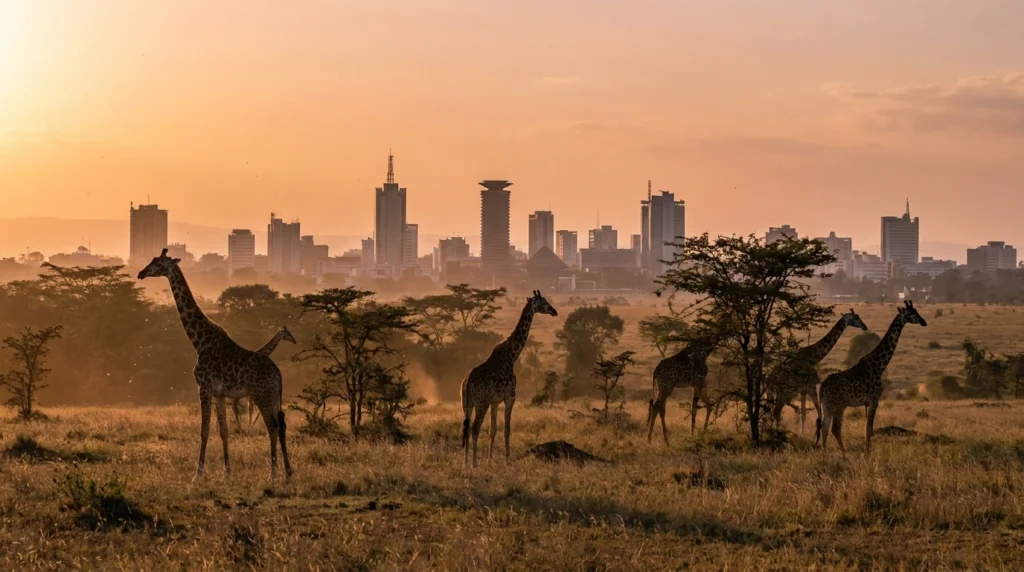
Nairobi, Kenya: Where Lions Roar Within City Limits
Part of our Kenya travel guide.
Nairobi City Guide
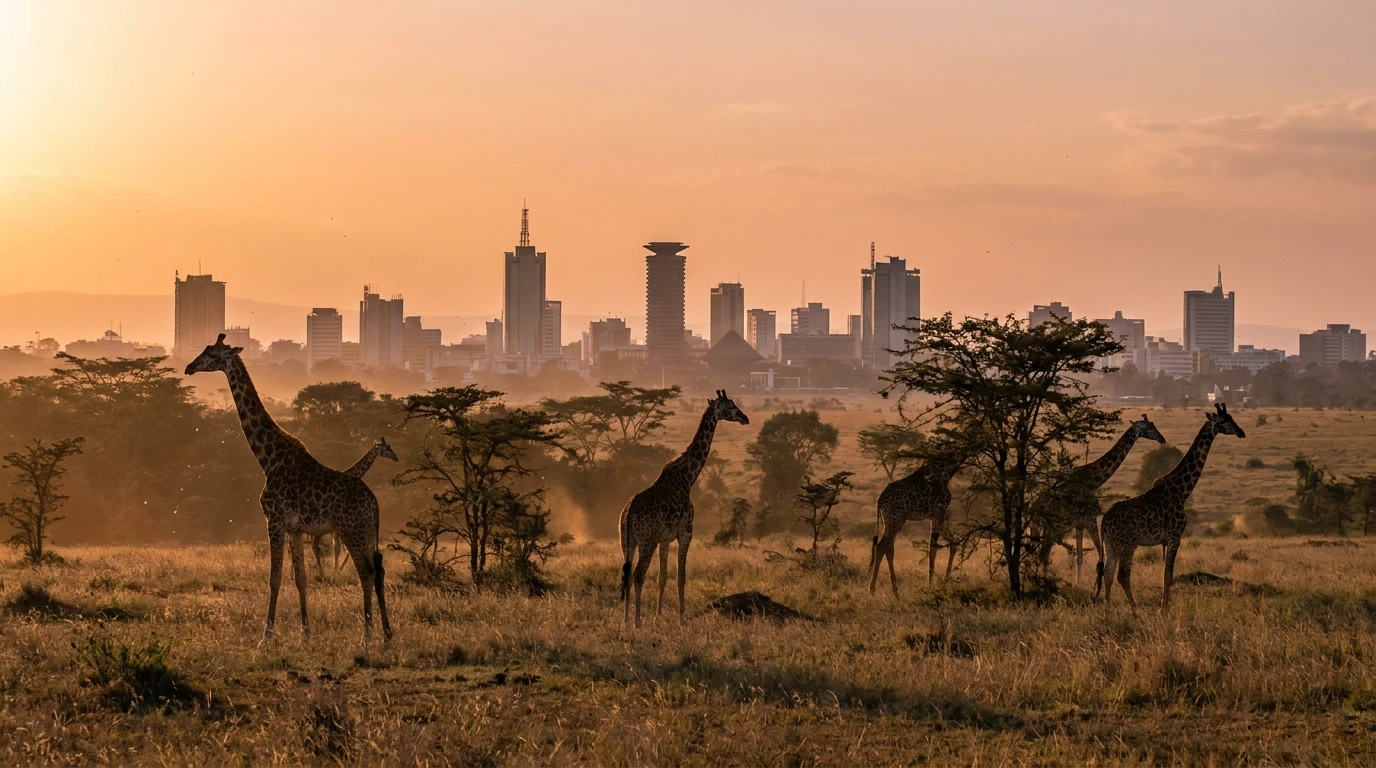
Table of Contents
Why Nairobi?
Nairobi is the capital of Kenya, East Africa’s commercial engine, and the only capital city on Earth with a wild-game national park inside its municipal boundary. The city sits at 1,795 metres above sea level on a cool, breezy plateau south of the equator, with a metropolitan population of roughly 5 million spread across a ring of estates, slums, industrial zones, and leafy suburbs that together form Kenya’s political, financial, and diplomatic core. The name itself comes from the Maasai phrase Enkare Nairobi, meaning “cool water,” a reference to the stream that drew Maasai herders and later a British railway camp to the site in 1899.
The city’s defining contradiction is geography. Black rhino, lion, giraffe, buffalo, and over 400 bird species live in Nairobi National Park, a 117 km² fenced reserve whose northern boundary sits 7 kilometres from downtown skyscrapers, and whose most photographed view frames grazing rhinos against the glass towers of Upper Hill. No other capital on the planet offers a before-breakfast lion sighting on the commute. Within the same 30-minute radius, visitors can feed orphan elephants at the David Sheldrick Wildlife Trust, have breakfast with Rothschild’s giraffes at the Giraffe Centre, and tour the farmhouse where Karen Blixen wrote Out of Africa.
The scale tells the rest of the story. Jomo Kenyatta International (JKIA) is East Africa’s busiest airport and Kenya Airways’ global hub, handling direct routes from London, New York, Paris, Amsterdam, Dubai, Doha, Mumbai, and Bangkok. Over 80% of adult Kenyans use M-Pesa mobile money daily, making Nairobi the global reference point for cashless urban economies. More than 40 international organisations maintain regional headquarters here, including the only UN office in the Global South (UN-Habitat and UNEP in Gigiri).
Nairobi is also Kenya’s safari staging post. Every Amboseli, Masai Mara, Samburu, or Tsavo itinerary begins at JKIA or Wilson Airport, the in-town light-aircraft hub for safari charters. For many travellers the city is a transit point, but those who stay two or three days discover a capital with wild game on the edge, Swahili-accented nyama choma grills, a booming art and craft scene in Karen and Westlands, and a jazz calendar anchored by the Safaricom Jazz Festival in February.
This guide covers the ten neighborhoods that make sense of the city, the restaurants and markets behind its food scene, the cultural and wildlife sites that justify extending a safari layover into a full visit, five day trips that use Nairobi as a base, and the transit, budget, and safety details that make a first trip run smoothly on arrival.
Neighborhoods: Finding Your Nairobi
📍 Nairobi Map: Every Place in This Guide
Nairobi works as a ring of distinct districts around a compact Central Business District, each with its own income level, architectural scale, and dominant traveller use case. The city is spread, not dense — distances between neighborhoods matter, and traffic is the single biggest factor in how a day unfolds. A base in Westlands, Kilimani, or Karen places most sights within a 15–40 minute Uber ride depending on the time of day, and the Nairobi Expressway (opened 2022) cuts JKIA-to-Westlands transfers to roughly 20 minutes in light traffic. The ten neighborhoods below cover the widest practical range for visitors.
Westlands
Westlands is the city’s modern commercial and nightlife core, a 3 km² district of mid-rise towers, shopping malls, and restaurant-lined streets west of the CBD. Sarit Centre and Westgate Mall anchor the retail scene; Westgate was rebuilt and reopened in 2015 after the 2013 terrorist attack and now operates with visible security layers that are standard across Nairobi malls. The area is home to the densest concentration of international restaurants, Nairobi’s biggest after-work bar strips along Mpaka Road and Muthithi Road, and most of the city’s co-working spaces and tech offices. Hotel rates run KES 8,000–25,000 (~$60–190) for mid-range options and KES 25,000+ (~$190+) for the Sankara, Villa Rosa Kempinski, and Radisson Blu.
- Sarit Centre and Westgate Mall shopping complexes
- Mpaka Road and Muthithi Road bar and restaurant strips
- Village Market (Gigiri) 15 min drive north for weekend Maasai Market
- Ithaga Road casual dining and cafes
- Sankara Hotel rooftop pool bar with Ngong Hills view
Best for: first-time visitors, business travellers, and nightlife seekers. Access: Waiyaki Way (matatu routes 23, 24, 44) or Uber from anywhere in the city; 8 km / 20–40 min from JKIA via the Nairobi Expressway.
Karen
Karen is the leafy, low-rise suburb 15 kilometres south-west of downtown, named after Danish author Karen Blixen, whose 1937 memoir Out of Africa was set on her Ngong coffee estate here. The neighborhood today concentrates most of Nairobi’s wildlife and cultural half-day sights within a 10-minute radius of each other, including the Karen Blixen Museum, the David Sheldrick Wildlife Trust elephant orphanage, the Giraffe Centre, and the Kazuri Beads ceramic workshop. Forest-covered streets, walled compounds, polo fields, and large horse stables give Karen a rural-adjacent feel despite being inside the city limits. Dining clusters around Karen Country Club, the Talisman restaurant, and Brew Bistro & Lounge.
- Karen Blixen Museum (entry KES 1,200 / ~$9)
- David Sheldrick Wildlife Trust (orphan elephants, 11:00–12:00 slot KES 1,500 / ~$12)
- Giraffe Centre, Rothschild’s giraffe feeding platform (KES 1,500 / ~$12)
- Kazuri Beads hand-painted ceramic workshop
- The Talisman restaurant and Brew Bistro Karen
Best for: wildlife-and-culture day bases and families. Access: 45 min Uber from CBD, 60 min from JKIA; matatu route 24B from CBD.
Lavington
Lavington is a residential suburb north-west of Kilimani, popular with diplomats, expat families, and Nairobi’s upper-middle class. Quiet tree-lined avenues, gated compounds, and two of the city’s better grocery destinations — Lavington Mall and Valley Arcade — define the shape of the district. The Lavington Curio Market sells Maasai beadwork, carved soapstone, and kikoy textiles at prices 30–40% below the hotel gift shops. Restaurants along James Gichuru Road and Mbaazi Avenue serve the neighborhood’s residential trade with a focus on breakfast cafes, boutique coffee, and international cuisine. The area is low-rise, spread-out, and calmer than Westlands; most visits are daytime errand-style rather than destination nightlife.
- Lavington Mall and Valley Arcade grocery stops
- James Gichuru Road brunch cafes
- Lavington Curio Market for craft shopping
- Lavington Green shopping centre
- Kibagare Way quiet jogging loop
Best for: longer stays, families, and quiet residential bases. Access: 25 min Uber from CBD; matatu routes 102 and 103 along James Gichuru Road.
Kilimani
Kilimani, 4 kilometres south-west of the CBD, is Nairobi’s fastest-growing residential-commercial zone, densified since 2015 with mid-rise apartment towers and hotel-brand serviced apartments. It is the centre of the city’s younger professional and digital-nomad scene, with the densest concentration of co-working spaces outside Westlands, a cafe culture along Kilimani Road and Argwings Kodhek, and the Yaya Centre mall as a neighborhood anchor. Hotel inventory spans budget Airbnb apartments at KES 3,000–6,000 (~$23–46) per night up to five-star Villa Rosa Kempinski territory in neighbouring Chiromo. Kilimani is walkable in ways most of Nairobi is not — sidewalks exist on most major streets and the distances between cafes, restaurants, and gyms are short.
- Yaya Centre mall and grocery
- Argwings Kodhek Road cafe strip
- Adams Arcade weekend food court
- Prestige Plaza speciality retail
- Java House and Artcaffe original Kilimani branches
Best for: digital nomads, solo travellers, and longer walkable stays. Access: 15 min Uber from CBD; matatu route 46 on Ngong Road.
Central Business District (CBD)
The CBD is the historical heart of Nairobi, a tight grid of 20-storey towers, colonial-era stone buildings, matatu termini, and street-level hawkers bounded roughly by Uhuru Highway, University Way, Tom Mboya Street, and Haile Selassie Avenue. Kenyatta International Conference Centre (KICC), the 28-floor cylindrical tower completed in 1973 that appears on Kenya’s 100 KES banknote, sits at the centre with a rooftop viewing deck open to the public for KES 400 (~$3). Parliament Buildings, the Supreme Court, and most government ministries are within a five-minute walk. The Nairobi Railway Museum on Station Road preserves the history of the Uganda Railway that founded the city in 1899. Visitors should exercise caution at night, stick to main streets, and use Uber rather than walking after 19:00.
- Kenyatta International Conference Centre (KICC) rooftop deck
- Nairobi Railway Museum (entry KES 600 / ~$5)
- Jamia Mosque (19th-century Indian-Muslim architecture)
- Uhuru Gardens Memorial Park
- City Market (covered colonial-era curio market)
Best for: historical sightseeing and quick half-day CBD loops. Access: walkable core from Moi Avenue or Kenyatta Avenue; all matatu routes terminate here.
Gigiri
Gigiri, 10 kilometres north of the CBD, is Nairobi’s diplomatic quarter and the home of the United Nations Office at Nairobi (UNON), the only UN headquarters in the Global South and the hub for UN-Habitat and UNEP. Embassies for the United States, Canada, the United Kingdom, France, Germany, and Japan sit along Limuru Road and United Nations Avenue. The neighborhood’s commercial heart is the Village Market, an open-air shopping complex with 150+ shops, a bowling alley, a water park, and the city’s biggest Maasai Market on Fridays (10:00–18:00), where crafts, beadwork, kikoys, and soapstone carvings are sold directly by artisans at lower prices than the hotel shops. Gigiri is secure, quiet, and well-served by international chain hotels including the Tribe Hotel and the Trademark.
- United Nations Avenue embassy corridor
- Village Market shopping complex and Friday Maasai Market
- Tribe Hotel and Trademark Hotel for upscale stays
- Karura Forest 10 min south for weekend walks
- Two Rivers Mall nearby for retail
Best for: diplomatic or NGO travellers and craft shopping. Access: 25–40 min Uber from CBD; matatu route 107 along Limuru Road.
Runda
Runda is an upscale residential suburb north of Gigiri, with 5,000+ large single-family homes laid out on winding, tree-canopied streets behind private gates. It is one of the most secure and lowest-density residential zones in the city, popular with diplomats, senior UN staff, and expat families on multi-year postings. Runda itself has almost no commercial inventory — visitors stay in nearby Gigiri hotels or short-term rentals within the estate and drive 10 minutes to Village Market for groceries and restaurants. The adjacent Karura Forest (1,063 hectares) offers one of the best walking and cycling circuits in the city, with 50 km of trails, waterfalls, bamboo groves, and cave systems; entry costs KES 200 (~$1.50).
- Karura Forest walking, cycling, and birdwatching
- Runda Estate gated residential streets
- Two Rivers Mall adjacent for groceries
- Windsor Golf Hotel & Country Club nearby
- Kiambu Road access to Tigoni tea-estate day trips
Best for: long stays and expat family bases. Access: 35 min Uber from CBD; mainly private-vehicle area.
Eastleigh
Eastleigh, 3 kilometres north-east of the CBD, is Nairobi’s Somali and Ethiopian commercial quarter, nicknamed “Little Mogadishu” for its dense concentration of Somali-owned wholesale and retail trade. The neighborhood reinvented itself since the 1990s as an East African consumer-goods distribution hub, and the malls along First Avenue and General Waruingi Street — BBS Mall, Garissa Lodge Mall, Amal Plaza — carry electronics, textiles, and gold at prices 20–30% below CBD retail. For visitors, the draw is food: Al-Yusra, Banadir, and Jamhuri Restaurants serve some of the best Somali, Yemeni, and Ethiopian cuisine in the city, with camel-meat stews, lamb suqaar, injera platters, and spiced Somali tea. Eastleigh is best visited during daylight (10:00–17:00) with an Uber drop-off at a specific destination; the area is busy but generally safe in daylight hours with standard urban awareness.
- BBS Mall and Garissa Lodge Mall retail
- Al-Yusra and Banadir Somali restaurants
- First Avenue textile and gold markets
- Jamia Mosque Eastleigh
- 12th Street wholesale corridor
Best for: East African food exploration and bargain retail. Access: 15 min Uber from CBD; avoid walking in from CBD.
Kibera
Kibera, 6 kilometres south-west of the CBD, is one of Africa’s largest informal settlements, home to an estimated 250,000–500,000 residents packed into approximately 2.5 km² of self-built housing south of the Ngong Road. It is included here for factual completeness — Kibera is a major part of the Nairobi story and visitors should understand it exists next to the wealthier suburbs they are booking — but independent tourism is strongly discouraged. Responsible visits happen only through community-led organisations such as Kibera Tours (operated by young residents), Shining Hope for Communities (SHOFCO), or the Carolina for Kibera programme; these guided half-day walks fund local schools, libraries, or clinics and typically cost KES 2,500–4,000 (~$20–30). Photograph only with explicit permission; do not arrive on your own by Uber expecting to wander.
- Kibera Tours (resident-led, KES 2,500–4,000 / ~$20–30)
- Shining Hope for Communities (SHOFCO) visits
- Carolina for Kibera programmes
- Soweto West and Laini Saba sub-areas
- Kibera Railway tracks (SGR passes the settlement)
Best for: ethically-guided context on urban Kenya. Access: via community tour operator only.
Parklands
Parklands, immediately north-east of Westlands, is Nairobi’s oldest Indian-Kenyan community and the best neighborhood in the city for South Asian food. The Aga Khan University Hospital is a landmark; the surrounding streets concentrate Gujarati sweet shops, vegetarian thalis, tandoori grills, and Jain eateries that have served the community since the 1940s and 1950s. Chowpaty and Gaia on Fourth Avenue Parklands are two well-known Gujarati family restaurants. The BBS Textile Market and Diamond Plaza offer saris and Indian-import clothing at wholesale prices. The neighborhood is calm, walkable in pockets, and notably multicultural — mandirs, a Swaminarayan temple, the Sikh Gurdwara Siri Guru Singh Sabha, and multiple mosques cluster within a 1 km radius.
- Diamond Plaza Indian restaurant and retail strip
- Swaminarayan Temple and Sikh Gurdwara
- Aga Khan University Hospital (landmark)
- Chowpaty vegetarian Gujarati restaurant
- Highridge Road samosa and chaat stalls
Best for: Indian-Kenyan food and temple visits. Access: 15 min Uber from CBD; walkable from Westlands.
The Food
Nairobi’s food scene is a layered record of its communities. Kikuyu, Luo, Luhya, Kamba, and Kalenjin staples — ugali, sukuma wiki, githeri, mukimo — anchor the everyday plate, while over a century of Indian-Kenyan, Swahili-coast, Ethiopian, Somali, and more recent Chinese, Korean, and Western additions broaden the range in all directions. Nyama choma (roasted meat) is the national dish and the social-Saturday default; it is eaten standing around a butchery-restaurant with kachumbari salad and ugali maize porridge, shared off a wooden board cut to order by a chef-butcher who weighs the meat at the counter before the cooking begins. Nairobi is also Kenya’s main centre for fine dining, with the flagship restaurants clustered in Westlands, Karen, and Gigiri, and with a booming specialty-coffee scene rooted in the country’s position as one of the world’s great arabica producers. Budget meals run KES 300–700 (~$2–5) at a local kibanda (food stall); mid-range mains are KES 1,200–2,500 (~$9–19); top-end tasting menus reach KES 8,000–15,000 (~$60–115) per person excluding wine. The categories below cover the two headline cuisines, a broader sample of specialities, the fine-dining tier, and the food experiences that are distinctive to the city and hard to recreate anywhere else.
The biggest change in the Nairobi food scene in the last decade has been the rise of the upper-middle-class casual chain: Java House (opened 1999), Artcaffe (2009), and Nyama Mama (2016) now operate dozens of outlets across the city’s malls and high streets, serving coffee, Kenyan classics, and Western comfort food at mid-range prices with consistent hygiene standards. For first-time visitors these chains are a safe landing pad; for return visitors the real rewards are the neighbourhood-specific specialists below.
Nyama Choma and the Kenyan Grill
Nyama choma — literally “burned meat” — is goat, beef, or mutton sold by the kilo at a counter, grilled over charcoal, and carved onto a wooden board at the table with kachumbari (tomato-onion-coriander salad) and a stiff white maize porridge called ugali. The format is communal, hands-on, and weekend-coded: lunchtime Saturday is the peak, extending into early evening, and the social center is often a shared bottle of Tusker lager from the attached bar. Goat (mbuzi) is the default; beef (ng’ombe) is the cheaper alternative; pork variants exist but are less traditional and sit outside the classic template. The order is priced by weight: half a kilo feeds one hungry diner, one kilo shares between two, and a full kilo of goat at a mid-range Nairobi choma runs KES 2,000–2,600 (~$15–20). Accompanying ugali, kachumbari, and sukuma wiki add KES 200–400 each (~$1.50–3). Hands are the standard utensil — fold meat into small pinches of ugali and dip into kachumbari juice. A basin of warm water and soap is brought to the table at the start and end of the meal.
- Nyama Mama — casual modern nyama-choma chain across Westlands, Karen, and Delta; half-kilo goat platter KES 1,400 (~$11), full meal KES 1,800–2,500 (~$14–19).
- Carnivore Restaurant (Langata) — the tourist-staple all-you-can-eat roast meat carnival carved tableside from Maasai swords; fixed menu KES 3,800 (~$29) per person including soup, salads, and dessert.
- Ranalo Foods “K’Osewe” (CBD) — an institution for Kenyan classics since 1994, whole tilapia KES 900 (~$7), beef stew and ugali KES 600 (~$5), tempered by a bustling lunchtime CBD crowd.
- Mama Oliech (Kilimani) — whole grilled or wet-fried tilapia (fugu) from Lake Victoria, a Barack Obama family favourite on his 2018 visit; whole fish KES 1,300–1,800 (~$10–14).
- The Bull Kibanda Co. (Karen) — upmarket choma concept with aged beef and craft butchery cuts; half-kilo platters KES 2,500–3,500 (~$19–27).
- Njugu’s (Kenyatta Market) — backstreet goat choma pits around Kenyatta Market for the local-price experience; per kilo KES 1,200–1,500 (~$9–12) including ugali.
- Olepolos Country Club (Ngong Road) — 45-minute drive out of the city on the way to the Ngong Hills, a classic Sunday-drive choma destination with a terrace overlooking the Rift Valley and goat KES 1,400 (~$11) per half kilo.
- Amaica Restaurant (Muthaiga) — a regional Kenyan menu built around slow-cooked Luo, Kikuyu, Luhya, and Kalenjin specialities; mains KES 900–1,600 (~$7–12); the best place in the city to try Luo-style fried tilapia or Luhya-style managu (black nightshade) stew.
A nyama-choma meal is almost always bookended by Tusker beer (Kenya’s flagship lager brewed since 1922, KES 250–450 / ~$2–3.50 a bottle) or by a fresh tamarind or passion-fruit juice (KES 200–350 / ~$1.50–2.70). The social rhythm is slow — meat takes 30–45 minutes on the grill after ordering, and most Nairobi chomas expect guests to spend two to three hours at a table. Come hungry, dress casually, and do not plan anything strenuous for the afternoon.
Swahili-Coast and Indian-Kenyan Cuisine
Nairobi is 500 kilometres from the Indian Ocean but inherits Mombasa’s Swahili kitchen through the city’s large coastal diaspora, and a 120-year Indian-Kenyan presence (descendants of Uganda Railway labourers who stayed after 1901) has made north-Indian and Gujarati food genuinely local rather than imported. Biriani, pilau, coconut fish curry, samosas, chapati, and mishkaki skewers appear on almost every mid-range menu in the city, often alongside the Kenyan staples as if they were indigenous dishes — which, after five generations, they effectively are. Parklands and Diamond Plaza hold the deepest Indian-Kenyan inventory with Gujarati thali counters that have operated since the 1960s; Eastleigh covers the Somali and Yemeni end with camel-meat stews and injera platters; Ziwani, South C, and Hurlingham add Swahili-coast specialists serving coconut-based seafood curries at prices a fraction of the equivalent Westlands hotel dining rooms.
- Chowpaty (Parklands) — Gujarati vegetarian thalis and Bombay street snacks since 1966; thali KES 1,200 (~$9), pani puri KES 450 (~$3.50).
- Haandi (Westlands) — refined North Indian tandoori, butter chicken KES 1,600 (~$12), lamb rogan josh KES 1,900 (~$15).
- Mama Ashanti (Kileleshwa) — West African crossover; jollof rice and suya KES 1,400–1,800 (~$11–14).
- Swahili Plate Restaurant (Kilimani) — biriani, coconut fish curry, and mahamri doughnuts for breakfast; mains KES 900–1,400 (~$7–11).
- Habesha (Hurlingham) — Ethiopian injera platters for two KES 2,400 (~$18); doro wat and kitfo specialists.
- Al-Yusra (Eastleigh) — Somali camel-meat suqaar, muqmad, and spiced tea KES 300 (~$2.30); mains KES 600–1,100 (~$5–8).
- Diamond Plaza food court (Parklands) — six Indian stall-kitchens side-by-side, chaat and dosa KES 400–800 (~$3–6).
- Anghiti (Westlands) — refined Punjabi and Mughlai cuisine; tandoori platters for two KES 3,800 (~$29); booked two or three days ahead on Friday and Saturday evenings.
- Cafe Javas (multiple) — Ugandan-founded chain with a Kenyan and East African crossover menu; all-day breakfast, rolex (chapati-egg wrap), and chapati-beef stew KES 500–1,100 (~$4–8).
Spice levels at most Indian-Kenyan restaurants are moderate by default; requesting “Indian spicy” rather than “Nairobi spicy” raises the heat considerably and is recognised by every veteran server in Parklands. Most Gujarati restaurants in Parklands are strictly vegetarian and do not serve alcohol; the Muslim-owned Somali and Eritrean venues in Eastleigh similarly do not serve alcohol. For Swahili-coast dishes paired with wine, Tatu at the Fairmont or Seven Seafood in Westlands are the default.
Beyond Nyama Choma and Biriani
A broader sample of Nairobi specialities extends across fast-casual chains, coffee culture, safari hotel dining, and neighbourhood kibandas. The dishes below are what a visitor will encounter in hotels, coffee shops, and grills across the ten neighborhoods — in most cases at prices that let you try each dish for under KES 1,000 (~$8). Kenya is the world’s fifth-largest black-tea producer, so tea is typically drunk with milk and sugar (kahawa tungu, strong coffee, is the everyday coffee-shop order). The Kenyan fast-food scene is dominated by local chicken-and-chips operators Kenchic, Ranalo, and Big Square, with meal-deals at KES 400–700 (~$3–5) across every neighbourhood.
- Githeri and mukimo — Kikuyu stewed bean-and-maize dishes; Ranalo, Savannah Coffee Lounge, and Kenyan Kitchen KES 600–900 (~$5–7).
- Sukuma wiki — sauteed collard greens (literally “push the week”); KES 200–400 (~$1.50–3) as a side.
- Ugali and tilapia — Kenya’s defining plate; Mama Oliech KES 1,500 (~$12) set, Ranalo KES 900 (~$7).
- Samosas and mandazi — hand-held snacks at any Java House or street vendor; KES 60–150 (~$0.50–1.20).
- Chapati and beans — ubiquitous lunch combination; KES 200–350 (~$1.50–2.70) at matatu-rank kibandas.
- Kenyan AA coffee — single-origin arabica at Connect Coffee, Point Zero, and Spring Valley Coffee; flat white KES 350 (~$2.70).
- Dawa cocktail — vodka, honey, and lime (“medicine” in Swahili); KES 600–900 (~$5–7) at most bars.
Fine Dining and Hotel Restaurants
Nairobi’s top-end restaurants are clustered in Westlands, Karen, Gigiri, and the five-star hotel ballrooms. Tasting menus typically run KES 6,000–15,000 (~$46–115) per person excluding wine. The fine-dining scene is small compared to Johannesburg or Cape Town but has grown rapidly since 2018 with the arrival of Nairobi Restaurant Week, a week-long annual festival held in September that offers set menus at KES 2,000–4,500 (~$15–35) at roughly 60 participating restaurants — the single best time to sample the city’s upper-tier food without the full price tag.
- Seven Seafood & Grill (Westlands, ABC Place) — Nairobi’s best seafood counter; Lake Victoria perch KES 3,200 (~$25), prawn thermidor KES 3,800 (~$29).
- Talisman (Karen) — eclectic global menu in a converted colonial bungalow; mains KES 1,900–3,500 (~$15–27).
- Cultiva (Karen) — farm-to-table from an on-site 2-acre garden; tasting menu KES 8,500 (~$65).
- Hemingways Nairobi (Karen) — colonial-style hotel dining room with high tea at KES 3,200 (~$25) and a full Sunday brunch at KES 5,500 (~$42).
- Tatu at Fairmont The Norfolk (CBD) — the 1904 Norfolk Hotel’s restaurant, safari-trophy walls, steak KES 3,200–4,800 (~$25–37).
Food Experiences You Can’t Miss
Five formats are difficult or impossible to replicate outside Nairobi and reward a specific booking or route-planning decision. The choma crawl is the weekend anchor; the Karen coffee tour and the Carnivore dinner are the two tourist-classic experiences; the Nairobi Restaurant Week sampler is the September special; and the up-country roadside grill is the “secret” locals eat on Sunday drives back into the city.
- Saturday-lunch nyama choma crawl through Kenyatta Market — the backstreet choma pits behind the market building are where locals eat; half-kilo goat with ugali for around KES 900 (~$7) and a Tusker beer for KES 250 (~$2).
- Weekend brunch at Talisman or Hemingways Karen — the quintessential Nairobi leisure meal, served 11:00–15:00, with garden seating and KES 2,800–5,500 (~$22–42) set menus.
- Coffee-tasting at the Karen Coffee Farm or Fairview Coffee Estate — farm tours with cupping from KES 1,800 (~$14), covering picking, washing, drying, roasting, and tasting on a single tour.
- Friday-night Carnivore — the tourist carnival, but eaten once; the all-you-can-eat meat carousel has been running since 1980 and still carves crocodile, ostrich, and traditional meats tableside for KES 3,800 (~$29) per person.
- Nyama choma at Kikuyu highland grills on the way back from a day trip — the roadside choma on the Naivasha Road (e.g. Kikuyu town, Limuru) is the real local thing; a kilo of mbuzi with ugali KES 1,800–2,200 (~$14–17).
- Nairobi Restaurant Week sampler (late September) — roughly 60 city restaurants run set menus at KES 2,000–4,500 (~$15–35) for seven days; the easiest way to test three or four top-tier kitchens at mid-range prices.
Cultural Sights
Nairobi’s cultural inventory is a compact mix of colonial history, independence-era architecture, wildlife conservation sites, and museums covering Kenyan ethnography and natural history. A focused day can cover Karen’s four main sights (Blixen, Sheldrick, Giraffe Centre, Kazuri) plus a CBD stop at the Nairobi National Museum; a second day can add Uhuru Gardens, Bomas of Kenya, and the Railway Museum.
Nairobi National Park
Founded in 1946 as Kenya’s first national park, Nairobi National Park covers 117 km² south of the city and is the only fenced game park inside a capital city on Earth. Lion, black and white rhino, Masai giraffe, buffalo, eland, hartebeest, hippo, and over 400 bird species live here year-round. The park is open 06:00–19:00; adult non-resident entry is USD $43 (~KES 5,600) and the park is accessed through the Main Gate on Langata Road, Maasai Gate (southern edge), and Lang’ata East Gate. Self-drive is permitted; half-day game-drive safaris from major Nairobi hotels cost USD $90–130 (~KES 12,000–17,000) per person including transfer and vehicle.
David Sheldrick Wildlife Trust Elephant Orphanage
The David Sheldrick Wildlife Trust, founded in 1977 by Dame Daphne Sheldrick in memory of her husband, is a Kenya Wildlife Service-collaborating orphanage that raises baby elephants orphaned by poaching or human-wildlife conflict and returns them to wild herds in Tsavo. The orphans’ nursery on the edge of Nairobi National Park in Karen opens to the public only between 11:00 and 12:00 daily; the KES 1,500 (~$12) fee supports the trust’s conservation work. Booking ahead online is strongly recommended as the session is capacity-limited. A fostering programme (USD $50 minimum annual donation) gives access to a second 17:00 private viewing at the stockades.
Giraffe Centre
The Giraffe Centre, founded in 1979 by Jock and Betty Leslie-Melville of the African Fund for Endangered Wildlife, sits in Karen on a 60-acre property and hosts a resident herd of endangered Rothschild’s giraffes. Visitors hand-feed pellets from an elevated wooden platform that brings them eye-to-eye with the animals; the experience is family-friendly and takes 45–60 minutes. Entry is KES 1,500 (~$12) for adult non-residents. Open 09:00–17:30 daily. The adjacent Giraffe Manor Hotel is a separate luxury property; day visits to the hotel are not possible but breakfast service for giraffe-feeding is famous to overnight guests.
Karen Blixen Museum
The Karen Blixen Museum occupies Danish author Karen Blixen’s 1912 farmhouse at the foot of the Ngong Hills, preserved as it was when she left Kenya in 1931 after the collapse of her coffee operation. The museum commemorates her 1937 memoir Out of Africa, later adapted into the 1985 Sydney Pollack film. Guided tours run every 20–30 minutes and cover the house, her gramophone, personal effects, and the original furniture shipped from Denmark. Entry is KES 1,200 (~$9) for adult non-residents. Open 09:30–18:00 daily.
Nairobi National Museum
The Nairobi National Museum on Museum Hill Road is Kenya’s flagship museum, covering natural history, cultural heritage, the country’s 67 ethnic groups, and the Leakey family’s paleoanthropological finds including fossil hominid remains from Turkana. The adjacent snake park displays 200+ reptile species from across Kenya. Entry is KES 1,200 (~$9) for adult non-residents; the museum opens 08:30–17:30 daily. Allow 2–3 hours for a focused visit; a combined ticket with the snake park runs KES 1,500 (~$12).
Bomas of Kenya
Bomas of Kenya, 10 kilometres south-west of the CBD adjacent to Nairobi National Park, is a living-culture complex built in 1971 to preserve the traditional homesteads (bomas) of Kenya’s major ethnic groups. Reconstructed Kikuyu, Luo, Luhya, Kamba, Maasai, Samburu, Taita, and Kalenjin villages sit around a central amphitheatre where afternoon dance shows (14:30–16:00 Mon–Fri, 15:30–17:00 Sat–Sun) present traditional music from across the country. Entry for non-residents KES 1,200 (~$9).
Kazuri Beads Women’s Cooperative
Kazuri Beads in Karen is a women’s cooperative founded in 1975, employing 340+ single mothers who hand-roll, paint, and fire clay beads and ceramics on-site. The free workshop tour runs hourly and ends in the cooperative’s gift shop where finished jewellery and ceramics are sold at lower prices than hotel boutiques. Open 08:00–17:00 Mon–Sat. Combine with the Blixen Museum and Giraffe Centre for a compact Karen circuit.
Uhuru Gardens Memorial Park
Uhuru Gardens, 6 kilometres south-west of the CBD on Langata Road, is the site where Kenya’s independence was declared on 12 December 1963. A 2022 redevelopment added a museum wing, a 24-metre monument, and landscaped gardens covering the independence history, the Mau Mau resistance (1952–1960), and post-independence nation-building. Entry is free; the museum opens 08:00–17:00 daily. The site is 15 minutes from Karen by car and pairs well with a morning at Bomas of Kenya (adjacent) and an afternoon circuit through Karen.
Jamia Mosque and Jeevanjee Gardens
Jamia Mosque, on Banda Street in the CBD, is the oldest mosque in Nairobi, built between 1902 and 1925 in Arab-Indian architectural style with three silver domes and two minarets. The mosque serves the city’s Sunni Muslim community and is open to respectful visitors outside prayer times (typically 10:00–11:30 and 14:30–16:00 Mon–Thu); women cover shoulders and hair, men wear long trousers. Across the street, Jeevanjee Gardens is a small 5-acre public park donated to the city in 1906 by Indian businessman Alibhai Mulla Jeevanjee, featuring a statue of Queen Victoria and marking one of the earliest public green spaces in what was then British East Africa.
Ngong Racecourse
The Ngong Racecourse, home of the Jockey Club of Kenya since 1954 and Nairobi’s weekly live horse-racing venue, hosts a Sunday meeting most weekends of the year with general-admission entry at KES 300 (~$2.30) and club stand KES 1,500 (~$12). The surrounding grounds also host the city’s major outdoor festivals, including Blankets & Wine and Koroga Festival, and are a short 5-minute drive from Karen. For travellers with a free Sunday afternoon, a Nairobi race day is a surprisingly accessible slice of local leisure culture.
Entertainment
Nairobi is East Africa’s live-music, theatre, and nightlife capital. The scene splits cleanly between the Westlands-Kilimani bar-and-club strip, the Karen-and-Lavington garden-restaurant circuit, and a calendar of annual festivals that are worth planning a trip around — particularly the Safaricom International Jazz Festival in February, the Koroga Festival monthly pan-African music parties, and Blankets & Wine Sunday afternoons.
Live Music and Jazz
Jazz has been Nairobi’s signature music-scene export since the early 2010s, anchored by the Safaricom International Jazz Festival (held February–March each year since 2014 at the Kasarani complex or the Commercial Bank of Africa grounds). The festival has hosted Branford Marsalis, Hugh Masekela, Jonathan Butler, and a rotating bill of East African acts including Nairobi Horns Project and Kato Change. Tickets run KES 3,500–12,000 (~$27–92) depending on the tier and year. Year-round jazz is at Tamasha (Westlands Wednesday nights), J’s Fresh Bar (Westlands live nights), and Alchemist Bar (Thursday jazz). Typical live cover KES 500–1,500 (~$4–12). Book Safaricom Jazz online weeks ahead; venue jazz does not require reservations.
Nightclubs and Bars
Westlands is the high-energy club strip — Brew Bistro & Lounge, B-Club, Tamasha, and Sankara Rooftop bars pull the biggest Saturday-night crowds with Afrobeats, Amapiano, and deep-house sets that run 22:00 to 04:00. Kilimani’s Alchemist Bar (along Westlands Road) is a cross-cultural courtyard complex with street-food trucks, dedicated reggae, hip-hop, and live-band rooms, and a younger, mixed-nationality crowd. Cover charges run KES 500–1,500 (~$4–12) at most clubs; bottle service KES 6,000–15,000 (~$46–115) per bottle. Ubers from Westlands clubs to Kilimani or Karen after 02:00 should be pre-booked via the app, not hailed off the street.
Theatre and Performing Arts
The Kenya National Theatre adjacent to the University of Nairobi on Harry Thuku Road stages English and Kiswahili productions including contemporary Kenyan drama and travelling work from Johannesburg and Lagos. The Alliance Française de Nairobi (Loita Street) runs a film and music calendar across three weekly screening slots and monthly concerts by regional artists. The Phoenix Players have staged English-language theatre since the 1980s at venues including Braeburn School and the Kenya Cultural Centre. Ticket prices are typically KES 1,000–2,500 (~$8–19). Shows are mostly Wednesday–Sunday; check programmes weekly via Facebook pages rather than websites.
Festivals and Outdoor Events
Three festivals dominate the Nairobi calendar. Blankets & Wine is a monthly Sunday-afternoon picnic-and-live-music event that has run since 2008, usually at the Ngong Racecourse or Commercial Bank of Africa grounds, with tickets KES 2,000–3,500 (~$15–27) and a distinct family-friendly, pan-African vibe. Koroga Festival is a similar concept with larger headlining acts (Angelique Kidjo, Sauti Sol, Mr Eazi) and tickets KES 3,500–7,000 (~$27–54). Safaricom Jazz Festival is the February flagship. Additional one-off events such as the Beneath the Baobabs or Nairobi Restaurant Week add variety. Ticket purchase via Tikiti.co.ke or Mookh is standard.
Cinema and Comedy
Cinema is concentrated in four major multiplex chains: IMAX Cinemas at Westgate Mall and Anga Diamond Plaza; Prestige Cinema at Prestige Plaza; Century Cinemax at Junction and Nextgen Malls. Standard ticket KES 600–1,100 (~$5–8); IMAX 3D KES 1,400 (~$11). The Alchemist Bar runs a weekly stand-up open-mic with performers from Churchill Show and Comedy Africa; cover KES 500 (~$4). Comedy Club Kenya holds monthly ticketed shows at the Kenya National Theatre KES 1,500–2,500 (~$12–19).
Sports and Recreation
Nyayo National Stadium and Moi International Sports Centre Kasarani host domestic football (Kenya Premier League), the Safari Sevens rugby tournament (one of the World Rugby Sevens tour’s oldest legs, held annually since 1996), and occasional athletic internationals featuring Kenya’s world-class marathon and distance-running talent. Match tickets KES 300–1,000 (~$2–8) for domestic football, KES 1,500–5,000 (~$12–38) for Safari Sevens. Golf is popular — Muthaiga Golf Club (founded 1914) and Karen Country Club (founded 1937) are the two flagship 18-hole courses; visitor green fees run KES 5,000–9,000 (~$38–69) plus a caddy fee of KES 1,500–2,500 (~$12–19). Hiking at Ngong Hills and Karura Forest fills the weekend outdoor calendar; both are detailed in the Day Trips section below.
Shopping as Entertainment
Nairobi’s largest shopping complexes double as evening entertainment venues. Westgate Mall (Westlands), Village Market (Gigiri), Two Rivers Mall (Runda), and The Hub Karen each combine 100+ retail outlets with multiplex cinemas, food courts, kids’ play zones, and weekend events. The Friday-morning Maasai Market at Village Market (10:00–18:00) is the single best artisan-craft market in the city for beadwork, kikoys, soapstone carvings, and Maasai blankets; a smaller rotating Maasai Market runs at different venues weekly (Tuesday at Kijabe, Wednesday at Capital Centre, Saturday at High Court). Prices are negotiated — expect to pay 40–60% of the opening quote.
Day Trips
Nairobi’s position at the centre of Kenya’s southern-circuit road network makes it an unusually strong base for single-day wildlife and landscape excursions. Five destinations work as same-day round trips from the city, ranging from a 15-minute drive (Nairobi National Park) to a 3.5-hour haul (Amboseli). Every trip below can be booked through Nairobi tour operators (Gamewatchers, Bonfire Adventures, Pollmans Tours) or self-driven in a rented 4×4.
Nairobi National Park (15 minutes by road from Westlands)
The single most distinctive day trip in any capital city: a fully wild 117 km² national park containing lion, rhino, giraffe, buffalo, and hippo, entered through the Main Gate on Langata Road 7 kilometres south of downtown. Adult non-resident entry is USD $43 (~KES 5,600). A half-day game drive with a local operator (06:00 pick-up from Westlands or Karen, return by 11:30) costs USD $90–130 (~KES 12,000–17,000) per person including vehicle, driver-guide, and park fees. Early-morning departures have the best wildlife viewing and photograph the skyline with rhinos in foreground.
Lake Naivasha & Crescent Island (1.5 hours by road)
Lake Naivasha is a 139 km² freshwater Rift Valley lake 90 kilometres north-west of Nairobi, reached via the A104 and the Mai Mahiu escarpment road. The primary draw for day-trippers is Crescent Island, a peninsula that functions as a walking safari — no predators live here, so visitors walk among giraffe, zebra, eland, impala, and waterbuck on foot. Crescent Island entry KES 3,500 (~$27); boat safaris on Lake Naivasha KES 3,000–4,500 (~$23–35) per person including hippo viewing. Full-day guided trip from Nairobi KES 11,000–18,000 (~$85–138) including lunch at Elsamere or Fisherman’s Camp.
Amboseli National Park (3.5–4 hours by road)
Amboseli is a 392 km² park on the Tanzanian border 240 kilometres south of Nairobi, famous for large elephant herds and the most iconic view of Mount Kilimanjaro’s snow-capped summit anywhere on the continent. The drive is long but the payoff is significant. Day-trip operators run 05:00 departures and 21:00 returns with a full day’s game viewing; typical all-inclusive cost USD $220–350 (~KES 29,000–46,000) per person including transfer, park fees (USD $80 non-resident adult), vehicle, and lunch at a lodge such as Ol Tukai or Amboseli Serena. A Safarilink charter flight from Wilson Airport (45 min each way, ~USD $200 each way) turns Amboseli into a realistic overnight.
Lake Magadi (2 hours by road)
Lake Magadi is a 100 km² alkaline soda lake in the Rift Valley 110 kilometres south-west of Nairobi, reached via the C58 Magadi Road through the Ngong Hills and the Oloibortoto escarpment. The lake’s pink surface is stained by salt-loving algae and cyanobacteria, and flamingo populations concentrate here seasonally. The route passes through Maasai group-ranch country with spectacular savannah landscapes; the lake itself offers hot springs at the southern end where visitors can bathe. Entry is free; self-drive in a 4×4 is recommended as the last 40 kilometres are rough. Day trip cost via operator KES 14,000–22,000 (~$107–170).
Ngong Hills (30 minutes by road)
The Ngong Hills are a seven-peak volcanic ridge 25 kilometres south-west of the CBD, rising to 2,459 metres and famous from Karen Blixen’s Out of Africa for the view from her Karen farmhouse. A 6 km ridge walk between the peaks is one of Nairobi’s most popular day hikes; weekends see hundreds of local walkers. The trailhead at the Ngong Hills Forest Reserve gate costs KES 200 (~$1.50) for Kenyan residents and KES 600 (~$5) for non-residents. Guided walks with a Kenya Forest Service ranger (required for safety on the full traverse) cost KES 2,000 (~$15) per group. Allow 3–4 hours for the full ridge traverse; 1–2 hours for the first-peak-and-back route.
Seasonal Guide
Nairobi sits at 1° 17′ south of the equator at 1,795 metres of altitude, so the temperature range across the year is unusually narrow and the real variable is rainfall. The city has two dry seasons and two wet seasons rather than the familiar four northern-hemisphere seasons; below, the template season labels are mapped to the practical Nairobi calendar. Sources: Kenya Meteorological Department.
Spring (March – May) — Long Rains
The long rains drop roughly 150–250 mm per month across March to May, the wettest quarter of the year, with afternoon thunderstorms and cool overnight temperatures of 13–15°C. Day highs reach 22–25°C. This is the greenest period; Nairobi National Park landscapes turn emerald and newborn wildlife appears. Flight and hotel prices drop to their annual lows. Downsides: game-drive tracks can wash out, migratory bird seasons have ended, and the short rains have yet to begin concentrating wildlife at water holes. April sees Nairobi Fashion Week and the Easter long weekend; book airport transfers ahead during the holiday.
Summer (June – August) — Cool Dry
June through August is Nairobi’s cool-dry season, the coldest quarter of the year, with overnight lows of 10–12°C and day highs of 21–23°C. Locals wear jackets and scarves; visitors often underpack. Fog is common on the Ngong Hills escarpment and the Karen-Langata corridor in the mornings. This is the best quarter for Masai Mara day-trip staging: the Great Migration enters the Mara from the Serengeti from mid-July and remains active through October. Expect peak safari-season prices and book Nairobi hotels in Karen or Westlands well ahead.
Autumn (September – November) — Migration Continues and Short Rains Arrive
September and October are peak Masai Mara migration viewing, so Nairobi hotels fill with safari-bound travellers; November opens the short rains. Temperatures warm slightly to highs of 24–26°C and lows of 13–15°C. The short rains are less intense than the March–May long rains — afternoon thunderstorms rather than all-day downpours — and the landscape recovers its green quickly. The Nairobi Jazz Festival typically holds a secondary event in October and Kenya celebrates Mashujaa Day on 20 October and Independence Day (Jamhuri) on 12 December.
Winter (December – February) — Hot Dry and Migratory Birds
December to February is Nairobi’s hot-dry season, with day highs of 26–28°C and warm sunny weather almost daily. Schools are on holiday through January and Kenya’s coast fills with domestic tourists, so Nairobi itself feels less crowded. This is also the season of Palearctic migratory birds at Nairobi National Park and the Nairobi Wetlands — roughly 130 migrant species arrive from Europe and Asia. The Safaricom International Jazz Festival flagship weekend is in mid-to-late February each year. Christmas and New Year Uber demand doubles; book airport transfers ahead.
Getting Around
Nairobi has no metro or subway, a single limited SGR rail line, and an air-travel-heavy safari network — the practical reality is that visitors move by a mix of Uber, Bolt, private transfer, and occasional matatu. Traffic is Nairobi’s defining transit problem: a 7 km Westlands-to-CBD trip takes 15 minutes at 10:00 and 50 minutes at 17:30. The Nairobi Expressway (opened 2022) bypasses much of the central congestion on the Mombasa Road–Waiyaki Way axis and is worth the toll on airport runs.
Nairobi Expressway (Airport Access)
The Nairobi Expressway is a 27 km elevated toll road connecting JKIA and Mlolongo in the south-east to James Gichuru Road in Westlands via Mombasa Road and Uhuru Highway. Opened in 2022 and operated by Moja Expressway, it cuts JKIA–Westlands transfer times from 60–90 minutes in heavy traffic to 20–25 minutes for a toll of KES 360 (~$2.80) in a private car (KES 310 inside Uber pricing). This is the single biggest change to Nairobi transit in the past decade; request it explicitly when booking an Uber to or from the airport.
Matatus and Shared Minibuses
Matatus are privately-run 14- or 33-seater minibuses that form Nairobi’s informal public transport system. They run numbered routes from downtown termini (Afya Centre, Tom Mboya Street, Railways Bus Station) to every major residential zone. Fares are KES 50–150 (~$0.40–1.20) per ride depending on route and time of day (peak hours cost double). Matatus are safe during daylight for destination-specific short rides (e.g. CBD to Westlands, CBD to Karen) but are not recommended at night or with luggage. Pay cash or M-Pesa via a till number called out by the conductor.
Uber and Bolt
Uber, Bolt, and Little operate across Nairobi with the same app interfaces as elsewhere. Fares inside Nairobi run KES 300–700 (~$2.30–5.40) for most cross-town trips; JKIA to Westlands runs KES 1,500–2,500 (~$12–19) with the Expressway toll added. Airport Uber pickups use the designated ride-share pickup point at the domestic arrivals exit. Request the driver use the Expressway on airport runs for a 30+ minute time saving. Tipping is not expected but is appreciated.
SGR Madaraka Express (Inter-City Rail)
The Standard Gauge Railway (SGR) from the Nairobi Terminus at Syokimau to Mombasa is a 472 km electrified line opened in 2017 and operated by Kenya Railways Corporation. The Madaraka Express runs one daily return service (departing Nairobi ~08:00, arriving Mombasa ~12:30) at a max speed of 120 km/h. Economy class KES 1,500 (~$12); first class KES 4,500 (~$35). The Syokimau terminus is 20 km south-east of the CBD — plan for a 40-minute Uber transfer (KES 800–1,200 / ~$6–9). Book online at least 48 hours ahead; the train sells out on weekends.
Wilson Airport (Domestic and Safari Charters)
Wilson Airport (WIL), 6 kilometres south of the CBD on Langata Road, is the hub for all domestic safari light-aircraft charters in Kenya. Safarilink, AirKenya, and Scenic Air operate scheduled Cessna Caravan services to Masai Mara (45 min, USD $220–320), Amboseli (45 min, USD $200), Samburu (1h 15m, USD $240), and the Laikipia airstrips. Wilson is a short 20-minute Uber from Karen or Westlands; flights typically depart between 07:30 and 13:00.
Airport Access (JKIA)
- Uber via Nairobi Expressway — 20–25 min to Westlands, KES 1,800–2,500 (~$14–19) including toll
- Uber without Expressway — 45–90 min depending on traffic, KES 1,400–2,000 (~$11–15)
- Hotel private transfer (pre-booked) — KES 3,500–6,000 (~$27–46); sensible for late-night arrivals
- JKIA is 18 km south-east of the CBD; Wilson Airport (domestic) is separate and 6 km south of CBD
Budget Breakdown: Making Your Shillings Count
Nairobi is middle-priced by African-capital standards: cheaper than Cape Town or Johannesburg, significantly pricier than Kampala or Dar es Salaam, and with extreme range between budget and luxury inventory. A dorm bed in Milimani costs KES 1,500 (~$12); a Giraffe Manor suite runs USD $1,200+ (~KES 156,000) per person per night. The table below assumes typical non-resident prices at the April 2026 FX rate of 1 USD ≈ 130 KES.
| Tier | Daily | Sleep | Eat | Transport | Activities | Extras |
|---|---|---|---|---|---|---|
| Budget | KES 5,500 (~$42) | KES 1,500–3,000 hostel / ~$12–23 | KES 800–1,200 kibanda / ~$6–9 | KES 500 matatu+Uber / ~$4 | KES 1,500 one sight / ~$12 | KES 300 data+tips / ~$2 |
| Mid-Range | KES 16,500 (~$127) | KES 8,000–12,000 3* hotel / ~$62–92 | KES 2,500–4,000 mid-range restaurants / ~$19–31 | KES 1,500 Uber / ~$12 | KES 3,500 two sights / ~$27 | KES 1,000 bar+tips / ~$8 |
| Luxury | KES 45,000+ (~$346+) | KES 25,000–60,000 5* hotel / ~$192–462 | KES 8,000–15,000 fine dining / ~$62–115 | KES 4,000 private transfer / ~$31 | KES 12,000 park+operator / ~$92 | KES 3,000 spa/wine / ~$23 |
Where Your Money Goes
The biggest variable in a Nairobi budget is whether you book a safari day trip (USD $90–350 per person) or stay city-only. Park fees alone — Nairobi National Park USD $43, Amboseli USD $80, Lake Nakuru USD $60 — will dominate a wildlife-heavy trip. Hotels split along a bright line: KES 3,000–8,000 (~$23–62) for serviceable Kilimani or Westlands options, KES 15,000–30,000 (~$115–230) for brand-name 4-star in the same districts, and KES 35,000+ (~$270+) for colonial-era properties like Hemingways Nairobi, Fairmont The Norfolk, or Giraffe Manor. Eating cheaply is easy — a solid daily food budget of KES 1,500 (~$12) covers breakfast, lunch, and dinner at Kenyan kibandas and Java House outlets. Alcohol is inexpensive at local bars (Tusker beer KES 250–400 / ~$2–3) but doubles at hotel bars.
Money-Saving Tips
- Pre-load M-Pesa via a local SIM on arrival — mobile money avoids the 3–5% card-processing surcharges at small venues and most kibandas.
- Buy park tickets at Kenya Wildlife Service gates rather than via intermediary operators; operator commissions add 15–25% on Nairobi National Park day entries.
- Book Nairobi National Park game drives directly through small operators (Gamewatchers, Pollmans) rather than through hotel concierges — roughly 30% cheaper for the same vehicle and guide.
- Eat the main meal at lunch: most upscale restaurants offer lunch sets at KES 1,400–2,200 (~$11–17), roughly half the dinner price for similar plates.
- Share Ubers with other hotel guests on shared day trips — two-person carpools to Naivasha or Amboseli via the hotel front desk can save KES 4,000–8,000 (~$31–62) per person versus solo bookings.
- Stay in Kilimani or Westlands instead of the safari-branded Karen hotels — comparable 3-star rooms are KES 4,000–8,000 (~$31–62) cheaper and the Uber to Karen’s sights is only KES 600–900 (~$5–7) each way.
A focused 3-day city stay (Westlands 3-star, Uber around, self-guided sights, two casual dinners, one nyama-choma session, Nairobi National Park game drive) runs roughly KES 35,000–50,000 (~$270–385) per person all-in. Adding an Amboseli day trip pushes the total to KES 75,000–95,000 (~$575–730) for the same three days. Extending into a proper Kenya safari loop is a separate budgeting exercise covered in the Kenya country guide.
Practical Tips
Language
Kenya’s two official languages are English and Kiswahili, and Nairobi is an English-dominant city in professional, commercial, and hospitality contexts. Menus, hotel signage, airport announcements, and Uber driver communication will all be in English. Kiswahili is the lingua franca of everyday street life, and a handful of phrases (“Jambo” for hello, “Asante” for thank you, “Karibu” for welcome, “Pole pole” for slowly) open doors. Nairobi slang (Sheng) mixes Kiswahili, English, and ethnic-language words; no visitor needs to learn it, but matatu conductors and market vendors use it heavily.
Cash vs. Cards & M-Pesa
M-Pesa, Safaricom’s mobile-money platform, is the dominant payment method in Nairobi — more than 80% of adult Kenyans use it daily and the system moves over KES 40 trillion annually. Hotels, supermarkets, malls, and high-end restaurants accept Visa and Mastercard (typically with a 3–5% surcharge); matatus, kibandas, market vendors, and most Ubers accept cash KES or M-Pesa. Buy a Safaricom tourist SIM on arrival at JKIA (KES 300 / ~$2 with 5GB data) and load M-Pesa via any agent for KES 1,000–10,000 (~$8–77) at a time. American Express is rarely accepted; bring a Visa or Mastercard as backup.
Safety
Nairobi is safer than its “Nairobbery” reputation suggests but requires standard big-city urban awareness. The US State Department’s current Kenya travel advisory rates the country at Level 2 (“exercise increased caution”) with specific warnings about crime in Nairobi after dark, particularly in the CBD, Eastleigh, Kibera, and Mathare. Practical rules: do not walk in the CBD after 19:00, do not use ATMs on the street after dark (use bank-branch or mall ATMs in daytime), do not hail taxis off the street (use Uber/Bolt), and do not wear expensive watches or jewellery to markets. Westlands, Kilimani, Karen, Lavington, Gigiri, and Runda are generally safe for daytime walking and evening dining with standard precautions. Keep your phone out of sight in traffic; smash-and-grab thefts at stationary cars happen.
What to Wear
Nairobi’s 1,795 m altitude and equatorial location produce a cool year-round climate — day highs 21–28°C, overnight lows 10–15°C depending on season. Pack a mid-weight jacket or fleece for mornings and evenings year-round (many visitors underpack for the cool-dry season June–August). Sun protection is critical even on overcast days due to the thin high-altitude atmosphere. Business dress in Westlands and CBD offices is smart-casual. Safari-style khaki is optional in the city but helpful for game drives; neutral earth tones are recommended on Nairobi National Park visits. Bring closed-toe walking shoes for Ngong Hills hikes.
Cultural Etiquette
A handshake on meeting is standard; the right hand only (passing money, food, or documents with the left hand is impolite in some contexts). Elderly people are greeted first in any group; age commands respect. Photographing people without permission is poor practice, particularly in Maasai, Samburu, or Kibera contexts where a small tip (KES 200–500 / ~$2–4) is the norm. Removing shoes is expected at mosques and some homes but not at churches or businesses. Public displays of affection beyond holding hands are unusual. Homosexuality is legally penalised in Kenya; LGBTQ+ travellers should exercise discretion in public.
Connectivity
Safaricom, Airtel Kenya, and Telkom Kenya operate 4G networks across all Nairobi residential and commercial zones. A tourist SIM with 5GB of data costs KES 300–400 (~$2–3). 5G is live in select Nairobi areas (Westlands, Kilimani, Upper Hill) as of 2024. Most hotels, cafes, and malls offer free WiFi with a phone-number-based login. Power plugs are UK-style Type G (three rectangular pins, 240V, 50Hz) — bring a UK adapter if arriving from a Type A/B country.
Health & Medications
Yellow fever vaccination is required on entry to Kenya if arriving from a country with risk of yellow fever transmission (most of Central, West, and parts of East Africa, plus parts of South America). Carry the yellow vaccination card; it is checked at passport control. Malaria prophylaxis (Malarone / atovaquone-proguanil) is standard advice for Nairobi even though altitude-adjusted risk is low. Tap water is not safe to drink — use bottled or filtered. Aga Khan University Hospital (Parklands) and Nairobi Hospital (Upper Hill) are the two best-equipped private hospitals for foreigners; travel insurance covering evacuation is strongly recommended.
Altitude Adjustment
Nairobi at 1,795 metres is high enough to affect unacclimatised visitors for the first 24–48 hours, particularly those arriving from sea-level cities. Mild symptoms (slight headache, shortness of breath climbing stairs, faster fatigue during exercise) are common. Drink more water than usual on the first day, avoid heavy alcohol on the arrival night, and postpone strenuous hikes (Ngong Hills, Mount Kenya) until Day 2 or 3. Altitude affects sleep on the first night; expect to wake early.
Luggage & Storage
JKIA has 24-hour luggage storage at the arrivals hall (KES 500–1,500 / ~$4–12 per piece per day). Most Westlands and Kilimani hotels will hold bags for guests between checkout and a later flight at no charge. Safari operators routinely let Nairobi hotels hold a city suitcase while you go on a 2–4-day Masai Mara or Amboseli circuit with a lighter duffel — ask the concierge at check-in.
Frequently Asked Questions
How many days do I need in Nairobi?
Two to three days covers Nairobi well as a standalone city visit and as a safari staging post. Day 1: Nairobi National Park morning game drive plus the Karen circuit (Blixen Museum, David Sheldrick orphan elephants 11:00–12:00 slot, Giraffe Centre, Kazuri Beads) in the afternoon. Day 2: Nairobi National Museum, a CBD loop including KICC rooftop and the Railway Museum, and a Westlands dinner. Day 3 (optional): Lake Naivasha and Crescent Island walking safari day trip. Most Kenya itineraries use Nairobi as a 1–2 night bookend before and after a Masai Mara or Amboseli safari, which is sensible; staying longer than 3 days is worthwhile only if you add day trips to the Rift Valley or the Ngong Hills. Business travellers routinely stay a week in Westlands or Gigiri without running out of meeting-logistics usefulness.
Is Nairobi good for solo travellers?
Yes, with the caveats that apply to any large African capital. Westlands, Kilimani, Karen, Lavington, and Gigiri are comfortable solo-walkable zones in daylight and for evening dining with sensible precautions. Solo female travellers report fewer issues than in many comparable cities, but the basic urban rules apply: Uber rather than walk after dark, skip CBD night wandering, and avoid the eastern and southern slum-adjacent districts solo. The city’s cafe and co-working scene (particularly Kilimani’s Alchemist Bar, Java House locations, and Nairobi Garage co-working spaces) is extremely welcoming to solo digital-nomad stays. Accommodation inventory for solo travellers ranges from hostels at KES 1,500 (~$12) per dorm bed to four-star single rooms at KES 12,000 (~$92). Join group day trips (Naivasha, Amboseli) to meet other travellers.
Do I need a safari to visit Nairobi?
No — Nairobi National Park inside the city delivers a genuine Big-Four experience (lion, rhino, buffalo, giraffe — only elephant is absent) within a 30-minute drive of most city hotels, and the park is usually cheaper and faster than any out-of-town safari. For travellers short on time or budget, a morning Nairobi National Park game drive plus a Karen afternoon (Giraffe Centre, Sheldrick elephant orphanage) provides a full wildlife day for USD $120–180 (~KES 16,000–23,000) per person without leaving the metro. That said, Kenya’s global-icon safaris (Masai Mara, Amboseli, Samburu) are 3–8 hours from Nairobi and operate at a fundamentally different scale — most visitors combine 1–2 days in Nairobi with 2–4 days at a longer-haul park.
What about the language barrier?
Minimal. English is an official language of Kenya and the dominant language in all Nairobi business, hospitality, and government contexts. Every Uber driver, hotel front-desk, mall clerk, and restaurant server speaks enough English for daily transactions. Learning a half-dozen Kiswahili greetings (“Jambo”, “Asante sana”, “Karibu”, “Pole pole”, “Hakuna matata”) is appreciated but never required. Matatu conductors, market vendors, and roadside kibanda cooks may default to Kiswahili or Sheng slang, but will always switch to English when asked. Menus at every mid-range restaurant are in English, often with Kiswahili dish names in parenthesis.
Is it safe to visit Kibera?
Only with a community-led tour operator such as Kibera Tours, Shining Hope for Communities (SHOFCO), or Carolina for Kibera; independent visits are strongly discouraged. A guided 3-hour walk (KES 2,500–4,000 / ~$20–30) funds local schools and clinics, is led by young residents who grew up in the settlement, and provides a responsible context for understanding the economic reality of the city. Do not photograph people without explicit permission, and do not arrange a tour through a generic taxi driver — book only through the named organisations. The experience is sobering, informative, and often the most memorable half-day of a Nairobi trip for travellers who want to understand the city beyond the Karen-Westlands bubble.
Can I use credit cards everywhere?
Credit cards work at hotels, chain restaurants, malls, and supermarkets but not at most kibandas, matatus, Ubers, or backstreet nyama-choma places. The practical solution is a Safaricom SIM card with M-Pesa loaded on arrival: M-Pesa covers every daily-life transaction in Nairobi at no surcharge, and credit cards cover the large hotel, restaurant, and retail bills. Visa and Mastercard are widely accepted; American Express rarely. Most restaurants add a 3–5% card-processing surcharge on top of the 16% VAT and 10% discretionary service charge, so M-Pesa or cash can be meaningfully cheaper. ATMs are plentiful in malls, airports, and bank branches; standard withdrawal limit KES 40,000 (~$308) per transaction.
What’s the best time of year for a Nairobi visit?
June to October is the peak window: cool-dry weather in Nairobi (day highs 21–23°C, almost no rain) and simultaneous Masai Mara migration timing that lets a city base double as a safari launchpad. January to February is the secondary best window: warmer and dry, with the Safaricom International Jazz Festival as a major cultural anchor. The March–May long rains are the lowest-priced quarter but come with afternoon thunderstorms and muddy game-drive tracks. November–December short rains are shorter and less disruptive than the long rains but also less crowded and cheaper than July–September. Overall, June–October is the default answer for first-timers and February for music-and-festival travellers.
Ready to Experience Nairobi?
Nairobi is the only capital on Earth where lions roar inside the city boundary, where M-Pesa settles your nyama-choma bill by SMS, and where the Ngong Hills frame every westward sunset at 1,795 metres of breezy, cool-water altitude. Two days is enough for the in-city park and the Karen circuit; a week adds Naivasha, Amboseli, and Ngong Hills, plus the Kilimani cafe and Westlands jazz scene. For the full country context — migration timing, coastal extensions, SGR to Mombasa, and the Rift Valley circuit — read the Kenya Travel Guide and plan the safari side of the trip from there.
Explore More City Guides
Where to Stay
Nairobi hotels guide — Westlands, Karen, Kilimani, and Gigiri properties compared.
Alex the Travel Guru
Alex is Facts From Upstairs’ resident travel writer — a serial capital-city completionist who has covered Tokyo, Osaka, Seoul, Bangkok, and now East Africa’s under-told cities for the site. Nairobi earned a dedicated long-form guide because, frankly, no other capital on Earth lets you photograph a black rhino against a glass office tower before breakfast and still make it to a 10:00 meeting in Westlands. Alex writes from notebooks filled at Karen coffee farms, Kenyatta Market choma pits, and Sankara rooftop sunsets, and maintains a rolling list of Nairobi restaurant openings for the Facts From Upstairs Kenya newsletter. Questions, corrections, or a pin for the next M-Pesa curiosity? Drop a line via the contact page — every email is read.
Sibling Cities
Other city guides we recommend for africa me-focused trip planning around Nairobi:
- Cape Town city guide — South Africa
- Zanzibar City city guide — Tanzania
- Marrakesh city guide — Morocco
- Jerusalem city guide — Israel
More city guides you might like
Plan your trip to Nairobi
The booking tools we use ourselves. FFU may earn a commission at no extra cost to you.
Plan & book your trip to Nairobi
Booking through these searches supports our guides at no extra cost to you.