
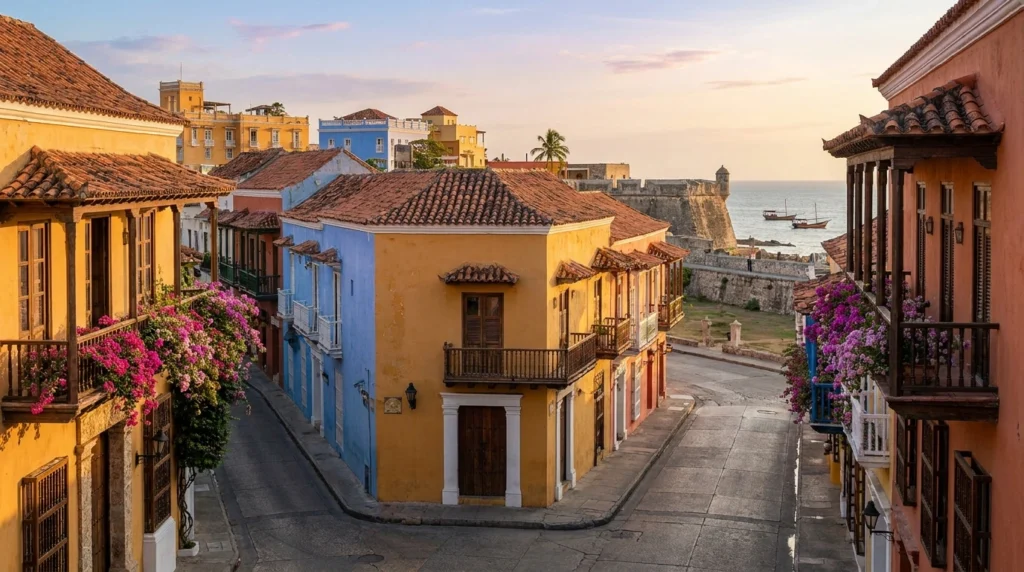
Cartagena, Colombia: Where a 16th-Century Walled City Meets the Caribbean
Part of our Colombia travel guide.
Cartagena City Guide
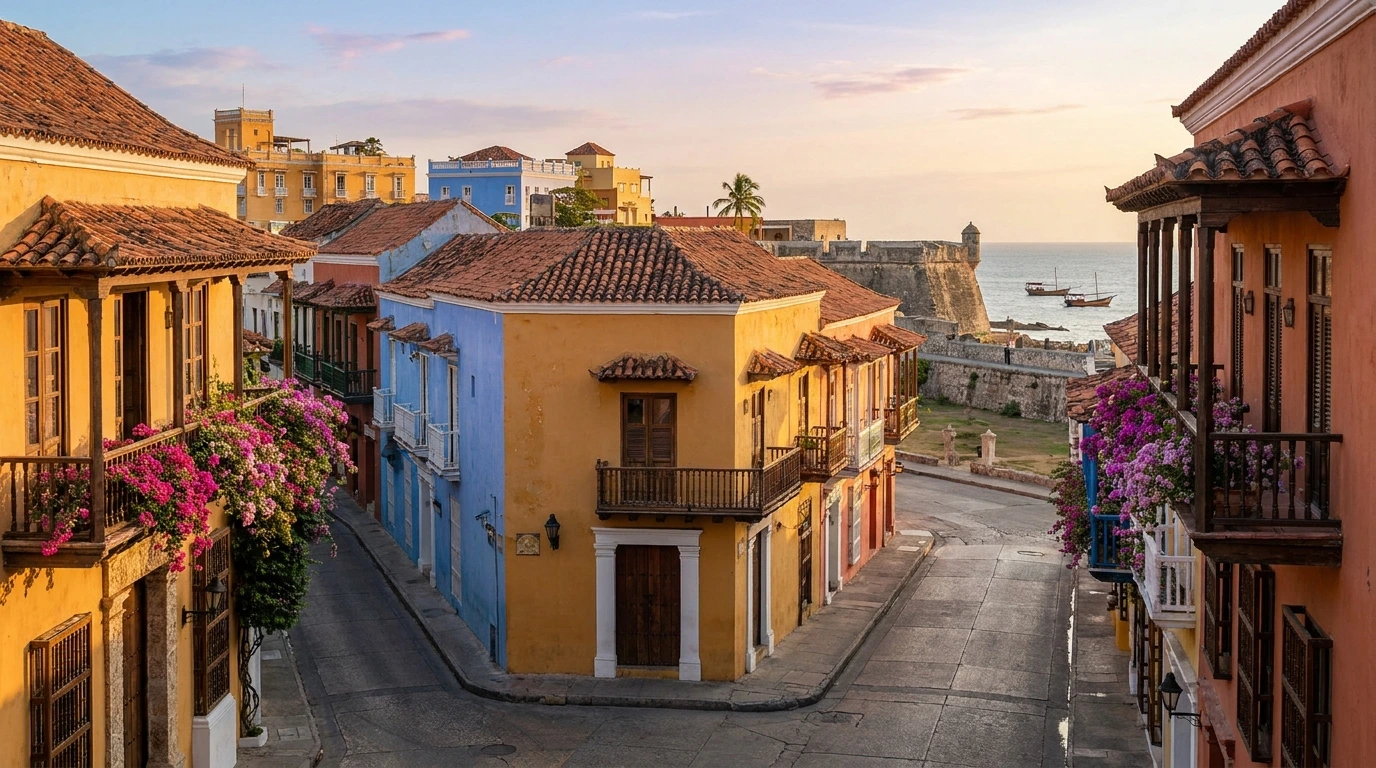
Table of Contents
Why Cartagena?
Cartagena de Indias is the Caribbean-coast colonial city that made Spain rich, made pirates infamous, and now makes first-time visitors to Colombia fall so hard they almost forget to visit the rest of the country. Founded in 1533 by Pedro de Heredia, the walled port became the single most heavily fortified city in the Spanish Americas — ringed by eleven kilometres of sea-wall, defended by the 36-metre-tall Castillo de San Felipe de Barajas, and repeatedly besieged by Francis Drake, the French, and in 1741 by a 29,000-man British fleet under Admiral Edward Vernon that was famously repelled by Blas de Lezo. In 1984 UNESCO inscribed the Port, Fortresses and Group of Monuments of Cartagena on the World Heritage list, protecting what remains one of the most intact colonial-military ensembles on earth.
With roughly one million residents inside the Cartagena district as of 2024, it is Colombia's fifth-largest city and the Caribbean coast's undisputed cultural capital. The contradiction every visitor notices first is the temperature. Bogotá at 2,640 metres hovers in the teens year-round, Medellín boasts its eternal spring, and then Cartagena sits right on the Caribbean with daytime highs that never drop below 28°C and a humidity shelf that leaves every first-day arrival drenched by lunch. The payoff is that the walled city glows pastel in direct sun, the Caribbean stays swim-warm in January, and the Rosario Islands forty-five minutes offshore deliver reef snorkelling you can combine with a walled-city sunset on the same day.
Cartagena is also the city where Gabriel García Márquez chose to spend the last decades of his life, where the Hay Festival stages its most-attended Latin American edition every January, and where the street vendor selling you a 2,000-peso cocada on Plaza Santo Domingo speaks a Spanish lightly flavoured by Palenquero, the only surviving Spanish-based creole language in the Americas. What that collision of history and heat means on the ground is that the same afternoon can take you from a reef-snorkel stop in a national park to a 16-course tasting menu in a restored 17th-century mansion to a Palenquera fruit cup on a UNESCO-listed cobblestone corner, each for a fraction of what the equivalent would cost in Cancun or Havana. The city rewards slow days: a three-night itinerary will show you the walled city, Castillo de San Felipe and one boat day, but four or five nights lets the texture — vallenato drifting from a second-floor balcony at dusk, a late lunch in a Manga villa, a pre-dawn Mercado de Bazurto walk — actually settle in.
Over the following sections you will get our pick of the nine neighbourhoods worth structuring a visit around, a four-category tour of the food from the 500-peso arepa de huevo to the Celele tasting menu, practical routes to Castillo de San Felipe, Iglesia de San Pedro Claver, the Rosario Islands and Mompox, and the festival calendar from Hay in late January through Independence Day on November 11.
Neighborhoods: Finding Your Cartagena
📍 Cartagena Map: Every Place in This Guide
Cartagena's geography is shaped by two bays — Bahía de Cartagena and Bahía de las Ánimas — and by the long sand peninsula that shelters them from the open Caribbean. The historic core is a compact walled oval of roughly one square kilometre bounded by the sea on two sides and the Cienaga de San Lázaro on a third. Getsemaní sits immediately south, the city's bohemian heart. Bocagrande's high-rises stretch south on a sandbar. Manga, Castillogrande, La Matuna and the islands fill out a map walkable end-to-end in 48 hours. The following ten neighbourhoods anchor every itinerary, each tied to a named gate, bus stop, muelle or ferry point.
Walled City / Centro (Old Town)
The Ciudad Amurallada is the 1533-founded colonial core that UNESCO inscribed in 1984 — roughly fifteen blocks of pastel colonial houses, balconies dripping bougainvillea, and the 11-kilometre rampart ring that still traces its original 16th and 17th-century alignment. The Torre del Reloj clock-tower gate (built 1601, clock added 1888) is the ceremonial main entrance off Plaza de los Coches, the former slave-market square. From there, Calle Badillo and Calle de la Factoría thread north into a grid whose corners still carry their original hand-painted tile street names. Plaza Santo Domingo, Plaza San Pedro Claver and Plaza Bolívar anchor the social life; sunset drinks on Cafe del Mar atop the rampart are the city's signature golden-hour tradition. This is where the boutique hotels, rooftop bars and high-end restaurants cluster.
- Torre del Reloj — the 1601 clock-tower gate off Plaza de los Coches.
- Plaza Santo Domingo — with Fernando Botero's reclining bronze Gertrudis.
- Iglesia de San Pedro Claver — 1580 church with the saint's remains.
- Cafe del Mar — rampart-top sunset bar on Baluarte de Santo Domingo.
Best for: first-timers, history, boutique hotels, sunset cocktails. Access: Torre del Reloj gate, or taxis from Getsemaní on Avenida Venezuela.
Getsemaní
Getsemaní sits immediately south of the walled city across a short bridge over Puente Román, historically the quarter where enslaved Africans, artisans and dockworkers lived outside the colonial walls. It is also where the 11 November 1811 declaration of independence from Spain was plotted in the Parque del Centenario. Since roughly 2014, Getsemaní has become the city's bohemian anchor — street-art murals on Calle de la Sierpe, hostels and boutique guesthouses on Calle del Espiritu Santo, and a nightly social ritual on Plaza de la Trinidad where locals and travellers mingle from about 19:00 over 7,000-peso Club Colombia beers. Cafe Havana (open Thursday-Sunday, Cuban son music from 22:00) is a pilgrimage dance floor, and Demente pizzeria runs a Sunday tasting-menu night that books two weeks out.
- Plaza de la Trinidad — the nightly gathering plaza in front of the 1643 church.
- Calle de la Sierpe — the street-art spine of the neighbourhood.
- Cafe Havana — Cuban son music and salsa venue on Calle del Guerrero.
- Parque del Centenario — sloths in the ceiba trees, yes, really.
Best for: nightlife, street art, budget and mid-range travellers, solo travellers. Access: Puente Román bridge from Torre del Reloj, 8 minutes on foot.
San Diego
San Diego is the quieter northern half of the walled city, named for the 17th-century Convento de San Diego (now the Universidad de Bellas Artes), and known for the breezier sidewalks and the cluster of small boutique hotels off Plaza Fernandez de Madrid. The neighbourhood is noticeably calmer than the Centro strip around Plaza Santo Domingo, yet still fully inside the UNESCO walls, which makes it the single most-requested base for returning visitors who want Old Town access without the evening crowds. Las Bóvedas at the northeastern corner — 23 whitewashed 1798 dungeons converted into souvenir arcades — marks the border with the sea rampart walk toward Cafe del Mar. The restaurant La Cevichería (made famous by Anthony Bourdain in 2008) sits on Calle Stuart at the heart of the neighbourhood and still serves a shrimp ceviche at 45,000 pesos (~$11) that justifies the occasional 40-minute queue.
- Plaza Fernandez de Madrid — the quiet leafy plaza at the centre of the neighbourhood.
- Las Bóvedas — 23 former 1798 dungeons now housing handicraft stalls.
- La Cevichería — the Bourdain-anointed ceviche spot on Calle Stuart.
- Convento Santa Clara — now the Sofitel Legend Santa Clara hotel on Calle del Torno.
Best for: second visits, quieter walled-city stays, mid-range and luxury boutique hotels. Access: Puerta de Santo Domingo on Calle del Porvenir, or taxis dropped at Plaza Fernandez de Madrid.
Bocagrande
Bocagrande is the high-rise beach strip on the southern sandbar, laid out in the 1950s and 1960s in a pattern that deliberately referenced Miami Beach, which still reads in the tower-hotel skyline. The neighbourhood is where Colombian families and a large Venezuelan and Argentine package-tourism contingent book their stays: it trades colonial atmosphere for actual Caribbean beach access, air-conditioned shopping malls (Centro Comercial Bocagrande, Plaza Bocagrande) and a walkable Avenida San Martín restaurant strip. Sand quality is workable rather than postcard-perfect — the colour is darker than on Barú or the Rosario Islands because the Canal del Dique empties silt into the bay. Hotels run from the 1945 Hotel Caribe (the neighbourhood's founding resort, now Hilton-managed) up through the Hyatt Regency, InterContinental and a dense stack of apartment-hotel towers. The stretch is the single most family-friendly base in the city.
- Playa de Bocagrande — the neighbourhood's workable 3 km urban beach.
- Avenida San Martín — the restaurant and bar spine of the strip.
- Hotel Caribe — the 1945 founding hotel of the neighbourhood.
- Centro Comercial Bocagrande — air-conditioned shopping and cinema refuge.
Best for: families, package tourism, beach-first visitors, longer resort stays. Access: taxi from Old Town (15 min, 15,000 COP / ~$4), or a 25-minute walk along the seafront.
Manga
Manga is the leafy residential island directly east of the walled city, connected by the Puente Román (from Getsemaní) and Puente Heredia bridges. It was laid out in the late 19th and early 20th century when the upper middle class began to move out of the walled city to escape the yellow-fever outbreaks, which is why the neighbourhood is still lined with some of the most architecturally distinguished Republican-era houses in the country — Moorish villas, Caribbean verandas, Art Deco mansions — many of which have been converted into boutique hotels, restaurants and embassies over the last decade. Manga is where the Club de Pesca (restaurant inside the 17th-century Fuerte de San Sebastian del Pastelillo, sea-view terrace, grilled fish at 65,000 pesos / ~$16) sits on its own promontory. The neighbourhood is quiet, walkable, and markedly cheaper than the walled city or Bocagrande, which makes it one of the best-value mid-range bases in the whole coast.
- Club de Pesca restaurant — sea-view terrace inside a 17th-century fort.
- Avenida Miramar — the waterfront promenade facing the walled city across the bay.
- Caribbean-Moorish mansions on Calle Real and Calle del Arsenal.
- Santa Cruz de Manga church — the neighbourhood's 1940 parish church.
Best for: architecture enthusiasts, quieter stays with walled-city access, mid-range budgets. Access: Puente Heredia from La Matuna or Puente Román from Getsemaní, 10-15 min taxi from Old Town.
La Matuna
La Matuna is the transitional commercial corridor that fills the narrow strip between the walled city and Getsemaní, running along Avenida Venezuela and Avenida Daniel Lemaître. It is where the local bureaucratic life of the city actually happens — notaries, pharmacy chains, bus company offices, the municipal registry, and the open-air Mercado de Bazurto buses terminate. Architecturally La Matuna is the least interesting neighbourhood on this list (mid-20th-century concrete rather than colonial pastel) but it is the single most useful one to know how to navigate: this is where you catch the Metrocar buses to Bocagrande, book your Rosario Islands speedboat tickets at the Muelle de la Bodéguita, and find the cheapest almuerzo corriente set-lunch cafeterias at 15,000-20,000 pesos (~$3.70-$4.90). Few visitors stay here, but almost every visitor walks across it at least twice a day.
- Muelle de la Bodéguita — the departure pier for Rosario Islands speedboats.
- Avenida Venezuela — the bus-spine connecting the Old Town and Getsemaní.
- Mercado de Bazurto bus terminal — for central-market day trips.
- Caja de Compensación and Notaries — the bureaucratic core of the city.
Best for: pass-through logistics, local set-lunches, boat transfers. Access: on foot from Torre del Reloj; all walled-city to Getsemaní walks cut through it.
Castillogrande
Castillogrande is the affluent gated-feeling residential tip of the Bocagrande sandbar, where the peninsula narrows and the bay reopens toward the open Caribbean. Compared with Bocagrande's tower strip, Castillogrande feels almost suburban — three- and four-storey family buildings, a calmer beach (Playa de Castillogrande) that locals actually prefer to Bocagrande's tourist stretch, and a handful of upscale seafood restaurants facing the yacht marina. This is where the Club Naval and the Cartagena Yacht Club dock, where several of the city's most expensive private homes cluster behind security guards, and where the consular residences of several countries sit. The neighbourhood is a good pick if you want beach access in Cartagena without the package-tourism energy of Bocagrande proper, and without the colonial-era constraints (no air conditioning, thick walls, small rooms) of the Old Town boutique hotels.
- Playa de Castillogrande — the locally-preferred calmer beach.
- Club Naval and Club de Pesca marinas — yacht-club anchorages.
- Avenida del Retorno — the seafront running loop at the tip.
- Restaurant La Vitrola's Castillogrande outpost — Cuban-Caribbean lunch-and-dinner.
Best for: beach stays without the package crowd, families, runners, yacht-adjacent visitors. Access: taxi from Old Town (20 min, 20,000 COP / ~$4.90), or southern terminus of the Bocagrande walk.
Santa Cruz (Isla de Manga)
Santa Cruz refers to the quieter, southern half of Manga island, which locals often call Isla de Manga to distinguish from Manga proper. Here the streets fall away from the bridge traffic into a grid of single-family Caribbean houses, a small neighbourhood park, and the century-old Santa Cruz de Manga parish church that gives the area its name. A cluster of small guesthouses and one reliable budget hotel (Casa del Viajero) mean you can stay here for roughly half the walled-city rate with a 15-minute walk to Getsemaní. The promenade along Pie de la Popa is where locals walk dogs and run in the evening, and the restaurants lean Colombian-family rather than tourist-polished — the weekday sancocho at the fonda next to the church runs 22,000 pesos (~$5.40) including a glass of refresco.
- Santa Cruz de Manga parish church — the 1940s neighbourhood church and plaza.
- Pie de la Popa promenade — the dog-walking and running stretch.
- Casa del Viajero — the reliable budget guesthouse of the neighbourhood.
- Neighbourhood fondas — weekday sancocho at 22,000 COP (~$5.40).
Best for: budget longer stays, local residential feel, walking-commute to Getsemaní. Access: Puente Heredia plus 10-minute walk, or direct Manga-corridor taxi.
Rosario Islands (Islas del Rosario)
The Rosario Islands are a 28-island archipelago designated as the Corales del Rosario y San Bernardo national park in 1977, 45 minutes offshore by speedboat from Muelle de la Bodéguita. Strictly speaking the islands are a day-trip rather than a neighbourhood, but a growing inventory of boutique eco-hotels and private-island stays means a meaningful share of Cartagena visitors now overnight on one of them. Isla Gente de Mar, Isla del Rosario proper, Isla Grande and Isla Tintipán house the most-booked accommodations. The snorkelling runs from shallow coral on the windward side to deeper reef walls off Isla Mangle, and the water is reliably 27-29°C year-round. Day-trippers pay 130,000-180,000 COP (~$32-44) for a full-day tour including transfer, snack and one-island beach access; multi-day stays run 700,000-1,800,000 COP (~$170-440) per night.
- Isla Grande — the largest island, with the Oceanario aquarium.
- Isla Gente de Mar — private-island day club for structured day-trippers.
- Isla Tintipán — a quieter choice for single-night escapes.
- Oceanario Isla San Martín de Pajarales — dolphin shows, open 09:00-16:00.
Best for: reef snorkelling, private-island escapes, honeymooners. Access: 45-minute speedboat from Muelle de la Bodéguita, roughly 08:00 or 09:00 morning departures.
Tierra Bomba
Tierra Bomba is the 19.5 km² island directly across the Bocachica channel from Bocagrande, reachable in 15 minutes by private launch or 30 minutes by shared boat from Muelle de la Bodéguita. The island is historically Afro-Colombian and under-developed compared with the Rosarios, which is why it has become the preferred "day-trip beach" for travellers who want clearer water than Bocagrande but cannot justify the full Rosario Islands budget. A handful of beach clubs — Blue Apple, Fenix Beach, Baru Beach Club and Playa Gazebo — run day passes in the 80,000-150,000 COP (~$19-37) range including lunch and lounger. The island also houses the 17th-century fort of San Fernando de Bocachica, which guarded the southern entrance to the bay against pirate ships and which is still accessible on foot from Bocachica village.
- Blue Apple Beach Club — design-led day club and overnight stays.
- Fuerte San Fernando de Bocachica — 17th-century twin fortress to Castillo San Felipe.
- Fenix Beach Cartagena — day club and cabana rentals.
- Playa Punta Arena — the island's clearer-water public beach.
Best for: mid-range day-trippers, design-led beach clubs, shorter-than-Rosarios escapes. Access: 15-30 minute boat from Muelle de la Bodéguita, most beach clubs include transfer.
The Food
Cartagena's food scene runs on three unusually legible tracks that almost no first-time visitor fully navigates on a single trip. The Caribbean-Colombian street tradition — arepa de huevo, carimañola, cocadas, patacones — is the oldest and cheapest layer, still priced at 1,500 to 5,000 pesos (~$0.35-$1.20) per item from sidewalk carts and the Mercado de Bazurto. The coastal-seafood tradition layered on top — ceviches, cazuelas, fried whole snapper — is the city's iconic sit-down category, typically 35,000 to 90,000 pesos (~$8.50-$22) per plate. A third, more recent layer of Colombian fine-dining, anchored by Celele's inclusion on Latin America's 50 Best Restaurants list and echoed by Carmen, Alma and Oh La Là, now puts Cartagena on the region's culinary-travel map. Cutting across all three is the Palenquera tradition — Afro-Colombian women from the nearby village of San Basilio de Palenque who have sold sliced tropical fruit from polka-dotted dresses and balanced bowls on Plaza Santo Domingo for four generations. Coconut rice, fried plantain, and cold Club Colombia beer at 6,000-8,000 COP (~$1.50-$2) tie every version of the meal together.
Caribbean Colombian Street Food
The canonical Cartagena street-food universe is a short list you can cover on a single three-hour Mercado de Bazurto walk. The arepa de huevo is the signature: a round of corn dough folded around a raw egg, deep-fried in a pan of hot oil until puffed and golden, served at 3,000-5,000 pesos (~$0.75-$1.25) from sidewalk stands that operate from dawn to mid-morning and from 17:00 until late. Carimañolas (yuca dumplings stuffed with ground beef or chicken) and empanadas de carne follow the same rhythm at similar prices. Cocadas — coconut caramels — are the dessert version, typically at 1,000-2,000 pesos (~$0.25-$0.50) each from Palenquera vendors working Plaza Santo Domingo and the perimeter of the walled city. Patacones (twice-fried green plantain coins) and bollos (boiled corn-dough cylinders) fill out the savoury side. Prices stay honest because this food is still how chilangos — or rather, cartageneros — actually feed themselves every day.
- La Esquina del Pan de Bono (Getsemaní) — cheese-bread and arepa de huevo station on Calle San Andrés. Arepa de huevo 3,500 COP (~$0.85).
- Mercado de Bazurto street stalls — the reference point for arepa de huevo, carimañolas and bollos. Everything 2,000-5,000 COP (~$0.50-$1.25).
- La Casa del Bollo (La Matuna) — sit-down fonda for bollos de mazorca with butter at 5,000 COP (~$1.25).
- Plaza Santo Domingo cocada vendors — Palenquera women selling coconut, panela and tamarind cocadas at 1,500 COP (~$0.35) each.
- Di Silvio Trattoria (Getsemaní) — hybrid Italian-Cartagenero menu where a single arepa de huevo sit-down order runs 10,000 COP (~$2.45).
- Cevichería la Perla Negra carts (Bocagrande) — sidewalk cups of shrimp ceviche at 15,000 COP (~$3.65).
Seafood & Cazuelas
The sit-down seafood scene is the category most first-time visitors structure their evenings around. Ceviche here is emphatically not the Peruvian version: Cartagenero ceviche de camarón leans on cooked rather than raw shrimp, lime, ketchup-laced salsa rosada, finely chopped onion and cilantro, and crackers or saltines on the side, served cold in a tall glass or plastic cup. Cazuela de mariscos is the city's signature sit-down dish: a coconut-milk and tomato seafood stew with shrimp, squid, fish, and crab in the shell, typically served bubbling over a small burner with a side of coconut rice and fried plantain, 55,000-85,000 pesos (~$13-$21) depending on the restaurant. Whole fried red snapper (pargo rojo) is the all-rounder: the fish is scored, fried until crackling, and plated with coconut rice, patacones and a squeeze of lime for 65,000-95,000 pesos (~$16-$23).
- La Cevichería (San Diego) — the Anthony Bourdain spot. Shrimp ceviche 45,000 COP (~$11).
- La Mulata (Old Town) — the lunch-only cevichería-fonda on Calle Quero. Cazuela de mariscos 55,000 COP (~$13.40).
- Club de Pesca (Manga) — grilled whole snapper with coconut rice 72,000 COP (~$17.50), sea-view terrace.
- La Vitrola (Old Town) — Cuban-Caribbean live-band dining room; cazuela 85,000 COP (~$20.70).
- El Bolicí (Getsemaní) — budget lunch-only sancocho de pescado at 25,000 COP (~$6.10).
- El Boliche Cebichería (San Diego) — refined takes on classic Cartagena ceviches, tasting ceviche 48,000 COP (~$11.70).
Palenquera Coastal Tradition
The Palenquera tradition is the single most photographable and the most historically-loaded food category on this list. The Palenqueras are the Afro-Colombian women descended from the residents of San Basilio de Palenque — the first free African town declared anywhere in the Americas, founded by escaped slaves in 1691 — who still bring in baskets of sliced pineapple, papaya, mango and watermelon every morning from the village 50 km east of the city and sell them balanced on their heads around Plaza Santo Domingo, Plaza San Pedro Claver and along the walls. A single cup of mixed fruit runs 10,000-15,000 COP (~$2.45-$3.65). The tradition survives because UNESCO recognised the Palenque of San Basilio as a Masterpiece of the Oral and Intangible Heritage of Humanity in 2005, and because the women's collective, Asociación de Palenqueras de Cartagena, has secured reserved vending positions around the Old Town.
Beyond the fruit bowls, the Palenque culinary repertoire that now filters into Cartagena restaurants includes arroz con coco titoté (coconut rice cooked until a caramelised crust forms at the bottom of the pot), suero costeno (fermented-milk condiment like a Caribbean crème fraîche) spread on bollo de yuca, kibbeh-influenced kubbas from 19th-century Lebanese-Palenque marriages, and mote de queso (a peasant soup of yam, yuca and salty costeno cheese). Celele's tasting menu explicitly engages with these sources, and Juana Caribe in Getsemaní runs a Thursday-Friday Palenque menu at 120,000 COP (~$29) with portions of mote, suero and fried mojarra. Photo norms matter: Palenquera women who pose expect a 10,000-20,000 COP (~$2.45-$4.90) tip.
- Plaza Santo Domingo fruit Palenqueras — fresh fruit cup 10,000-15,000 COP (~$2.45-$3.65).
- Juana Caribe (Getsemaní) — Palenque-sourced Thursday-Friday tasting menu 120,000 COP (~$29).
- La Cocina de Pepina (Getsemaní) — chef Pepina Ospina's acclaimed Caribbean mains; mote de queso 28,000 COP (~$6.80).
- Candé (Old Town) — Caribbean-Colombian sit-down with Palenque dance shows; mains 55,000-75,000 COP (~$13.40-$18.30).
International & Michelin-Adjacent Fine Dining
Colombia has no formal Michelin Guide yet, but Cartagena is the country's single most-decorated fine-dining city by Latin America's 50 Best Restaurants standards. Celele (Getsemaní, chef Jaime Rodríguez) has placed inside the Latin America's 50 Best list repeatedly since 2021 for its "Proyecto Caribe" tasting menu that documents the entire Colombian Caribbean coast. Carmen (Old Town) runs a Colombian-contemporary tasting at 340,000 pesos (~$83) in a former colonial mansion on Calle 38. Alma, inside the Casa San Agustín boutique hotel, leans European-contemporary with Cartagena sourcing. Oh La Là (Getsemaní) runs a French-Caribbean tasting under chef Nahum Velasco. Reservations for all four open 30-45 days out via the restaurants' own websites and the high-season Christmas-to-Easter window books up within days of release.
- Celele (Getsemaní) — Proyecto Caribe tasting menu 380,000 COP (~$93). Latin America's 50 Best list.
- Carmen (Old Town) — Colombian contemporary tasting 340,000 COP (~$83) in a restored mansion on Calle 38.
- Alma (Old Town) — European-Cartagenero tasting inside Casa San Agustín boutique hotel, 290,000 COP (~$70).
- Oh La Là (Getsemaní) — French-Caribbean tasting by Nahum Velasco at 260,000 COP (~$63).
- Don Juan (Old Town) — Colombian bistro mains 75,000-110,000 COP (~$18-27).
- Interno (Old Town) — rehabilitation-programme restaurant inside the San Diego women's prison, lunch set 120,000 COP (~$29).
Food Experiences You Can't Miss
The single highest-leverage food experience in Cartagena is a guided Mercado de Bazurto walk with a local chef early on your trip — it resets your expectations of everything you will eat for the rest of the week. Reputable operators (Cartagena Connections, Lokal, Jaime Rodríguez's own Kitchen at Celele) run three-hour circuits at 220,000-350,000 COP (~$54-$85) per person, including seven to eight tastings and a sit-down sancocho lunch. A second high-value experience is the Celele or Carmen tasting menu once during the trip — both scale up to 14 or 16 courses and give you the single most legible map of what Colombian Caribbean cuisine now looks like in 2026. Celele's Proyecto Caribe menu in particular walks diners through the foodways of seven distinct micro-regions of the Colombian Caribbean, from Guajira cactus fruits to Chocó river-snail preparations, and it is the closest any single restaurant in the country comes to a formal research program. A third is a Palenque day trip to San Basilio itself (one hour east), which pairs the history of the first free African town with a lunch of mote de queso and arroz de coco titoté cooked in the home of a Palenquera family for 85,000 COP (~$21) including transport and guide.
For drinks, the Cartagena canon is narrower but memorable. Club Colombia Dorada is the default lager at 6,000-8,000 COP (~$1.50-$2) the bottle almost everywhere; Aguila Light is its cheaper counterpart. Aguardiente Antioqueño and ron Medellín Añejo are the two national spirits you will be handed at any fiesta. Coffee is surprisingly uneven — the Caribbean coast is not a growing region — but specialty roasters like Café San Alberto and Epoca have opened walled-city outposts pulling cups from 12,000-18,000 COP (~$3-$4.50). Fresh fruit juices (lulo, maracuyá, guanábana, corozo) at sidewalk fruterías run 5,000-9,000 COP (~$1.25-$2.20) and remain the best hydration strategy between ceviche lunch and rooftop sunset.
- Early-morning Mercado de Bazurto walk with a local chef — 220,000-350,000 COP (~$54-$85).
- A book-ahead tasting menu at Celele or Carmen — the best survey of Colombian Caribbean cuisine available anywhere.
- A Palenque day trip to San Basilio — lunch in a family home for 85,000 COP (~$21) including transport.
- A sunset ceviche-and-Club-Colombia on the Baluarte de Santo Domingo ramparts — the city's signature golden-hour ritual.
- A Saturday morning Palenquera fruit-cup tour of Plaza Santo Domingo — three cups, three vendors, 45,000 COP (~$11) total.
Cultural Sights
Castillo de San Felipe de Barajas
The Castillo de San Felipe is the Spanish colonial fortress built on the 40-metre San Lázaro Hill between 1657 and 1798, and the centrepiece of the 1984 UNESCO inscription. The fortification is celebrated for Antonio de Arevalo's ingenious angled-battery design, the network of underground tunnels cut through solid coral rock, and the 1741 defence led by the one-legged one-eyed Admiral Blas de Lezo that repelled the 29,000-man British fleet under Edward Vernon and helped preserve Spanish America for another 80 years. Admission 32,000 COP (~$7.80) for foreign adults, open daily 08:00 to 18:00. Allow 90 minutes including the tunnel walk; the upper ramparts offer the single best panoramic view of the walled city.
Ciudad Amurallada (Walled City)
The walled city is the founded-1533 colonial core itself — roughly fifteen blocks of pastel colonial houses, balconies dripping bougainvillea, and the 11-kilometre rampart ring built in stages between 1586 and 1794. The most photographed stretch runs along Baluarte de Santo Domingo and Baluarte de Santa Catalina on the north sea-wall, with Cafe del Mar as the sunset vantage point. Entry is free and the ramparts are walkable around the clock, though the quieter stretches are safer before 23:00. Budget at least one full morning for a Plaza de los Coches to Las Bóvedas north-to-south walk; the tile street-name signs at every corner are original hand-painted cerámica vidriada.
Iglesia de San Pedro Claver
The Iglesia de San Pedro Claver on Plaza de San Pedro Claver is the 1580 Jesuit church and convent where Peter Claver, the Spanish Jesuit priest known as the "slave of the slaves", lived and ministered to enslaved Africans arriving at the Cartagena port between 1610 and his death in 1654. His remains are preserved in a glass sarcophagus at the main altar. The attached convent museum houses pre-Columbian and Afro-Colombian art plus a restored Claver-era cloister. Admission 18,000 COP (~$4.40), open Monday-Saturday 08:00-17:30, Sunday 10:00-16:00. The church itself is free to enter during mass times; the adjacent Plaza de San Pedro Claver also houses an outdoor sculpture installation of bronze chessmen-sized figures depicting everyday Cartagena street life.
Palace of the Inquisition
The Palacio de la Inquisición on Plaza de Bolívar is the 1770 baroque mansion that housed the Tribunal de la Inquisición from its 1610 establishment until Colombian independence in 1811. It was one of only three Holy Office tribunals in the Spanish Americas (the others were in Mexico City and Lima) and is now one of the most complete museums of colonial-era legal and religious practice anywhere in the region. Exhibits include surviving instruments of torture, signed sentences against women accused of witchcraft, and a section on the 1697 sack of the city by the French privateer Baron de Pointis. Admission 22,000 COP (~$5.40), open Monday-Saturday 09:00-18:00, Sunday 10:00-16:00.
Las Bóvedas
Las Bóvedas — literally "the vaults" — are the 23 barrel-vaulted dungeons built into the northeastern segment of the city wall between 1792 and 1798 as the last major work of the colonial-era fortification. Originally designed as storage for gunpowder and later as prison cells during the independence wars, they were restored in the 1970s and converted into a whitewashed souvenir arcade with 23 artisan stalls selling hammocks, emeralds, leather goods and Palenque textiles. Entry is free, open daily 09:00-19:00. Prices are negotiable and typically land 20-30% above Mercado de Bazurto equivalents, but the location and the architecture make it the single most convenient souvenir stop on the walled-city circuit.
Convento de la Popa
The Convento de Santa Cruz de la Popa is the 1607 Augustinian monastery perched on the 150-metre Cerro de la Popa hill, which is also the highest point inside Cartagena proper and the best panoramic viewpoint of the city, the bay, the walled oval and the Caribbean. The restored cloister holds a small museum of colonial religious art and the celebrated image of La Virgen de la Candelaria, patron saint of Cartagena, whose 2 February feast brings the annual Fiesta de la Candelaria pilgrimage up the hill. Admission 16,000 COP (~$3.90), open 08:30-17:30. Taxi up is 25,000-35,000 COP (~$6-$8.50); walking up is strongly discouraged due to safety conditions on the hillside.
Torre del Reloj & Museo del Oro Zenú
The Torre del Reloj — the clock-tower main gate built in 1601 and topped with its Swiss clock in 1888 — is the ceremonial entrance to the walled city off Plaza de los Coches. Immediately inside, on Plaza de Bolívar, the Museo del Oro Zenú (free admission, Tuesday-Saturday 09:00-17:00, Sunday 10:00-13:00) holds a small but exquisite collection of Zenú pre-Hispanic gold ornaments from the Río Sinú valley, dating from 200 BCE to 1600 CE. The museum is a satellite of Bogotá's more famous Museo del Oro and is a reliable 45-minute stop that most itineraries under-schedule.
Entertainment
Salsa, Champeta & Live Music
Cartagena is one of the three cities in Colombia where music is a load-bearing component of the social week (Cali and Barranquilla are the other two). The local rhythm is champeta — the Afro-Caribbean genre born in the 1970s in Palenque-adjacent Cartagena neighbourhoods, drawing on Congolese soukous and Nigerian juju via imported 45 rpm records. Cafe Havana in Getsemaní is the reference live-music venue for Cuban son and classic salsa, open Thursday-Sunday from 21:00, cover 30,000-40,000 COP (~$7.30-$9.80). Quiebra-Canto, on the ramparts near Baluarte de San Ignacio, is an institutional Cartagenero salsa bar with a tiny dance floor and the best house DJ in town. El Arsenal next door runs champeta-heavy weekends. Cover at champeta venues runs 20,000-35,000 COP (~$4.90-$8.55); book Cafe Havana's small reserved tables by 20:00 on Friday-Saturday.
Rooftop Bars & Rampart Sunsets
The signature Cartagena golden-hour ritual is a sunset cocktail on a rampart-top terrace facing the Caribbean. Cafe del Mar on Baluarte de Santo Domingo is the original and still the best-positioned: open 17:00-02:00, cocktails 30,000-55,000 COP (~$7.30-$13.40), with a small cover of 15,000 COP (~$3.65) after 20:00 on weekends. Rooftop alternatives include Movich Hotel's 11th-floor bar (hotel-guest-friendly, best skyline view), the Townhouse Boutique Hotel rooftop (small plunge pool, signature frozen mojito at 42,000 COP / ~$10.25), and Alquimico's third-floor terrace on Calle del Colegio (cocktails 38,000-55,000 COP / ~$9.25-$13.40; placed on the World's 50 Best Bars list since 2020).
Chiva Rumbera Party Buses
The chiva rumbera is Cartagena's mobile party institution — a wooden Andean country bus repainted in primary colours, stripped of windows, fitted with speakers the size of refrigerators, and driven in a three-hour loop through the walled city, Bocagrande and Manga with an onboard vallenato or cumbia band. Tickets run 70,000-95,000 COP (~$17-$23) per person including unlimited aguardiente, rum and Club Colombia beer. Departures are nightly at 20:00 from Plaza de los Coches or the Torre del Reloj. It is an unapologetically tourist-oriented experience but it is also the single easiest way for solo travellers to meet a dozen other travellers inside the first four hours in town.
Boat Parties & Day Clubs
Morning-to-afternoon day-club boats to Cholon (a sandbar between Barú and Tierra Bomba) run every weekend of the dry season. Tickets 120,000-220,000 COP (~$29-$54) depending on the operator (Fenix, Blue Apple, Baru Beach Club) include transfer, DJ, lunch and unlimited drinks. On-water days run 10:00 to 15:00, returning to Muelle de la Bodéguita by 16:30. Book via the day-club's own website or through your hotel 24-48 hours in advance; premium Saturday slots in high season (December-March) can sell out five days out. Overnight boat parties at Isla Tintipán run larger EDM events monthly between December and April.
Boxing, Baseball & Spectator Sport
Cartagena is one of the Colombian coast's baseball hotbeds and the home of Los Tigres de Cartagena, who play in the Liga Colombiana de Béisbol Profesional between November and January at the Estadio Once de Noviembre. Tickets run 15,000-60,000 COP (~$3.65-$14.65), walk-up available even for weekend games. The city also produces an outsized share of Colombia's championship boxers — Antonio Cervantes "Kid Pambele" was born in Palenque and trained in Cartagena — and the amateur circuit holds Saturday cards at the Estadio de Béisbol Once de Noviembre neighbourhood gym. Tickets are 10,000-25,000 COP (~$2.45-$6.10).
Cinemas, Theatres & Festivals
The Teatro Adolfo Mejía on Plaza de la Merced is the city's restored 1911 theatre and the main venue for the Festival Internacional de Música de Cartagena in January and the Hay Festival's headline events. Regular-season ticket prices run 40,000-180,000 COP (~$9.75-$44). The Festival Internacional de Cine de Cartagena (FICCI) — Latin America's oldest film festival, running since 1960 — takes over the Teatro and several walled-city plazas for ten days each March-April; day passes 80,000 COP (~$19.50) and 10-day accreditations at 450,000 COP (~$110). For mainstream cinema, the Royal Films multiplex inside Centro Comercial Caribe Plaza shows Hollywood releases in English with Spanish subtitles at 16,000-22,000 COP (~$3.90-$5.40) per seat.
Casinos, Comedy & Late-Night Scene
Cartagena's licensed casinos cluster in Bocagrande — the Hollywood Casino inside Hotel Caribe and the Rio Casino are the two largest, both open daily from 16:00 until roughly 04:00, minimum table bets from 20,000 COP (~$4.90) and no admission fee. Stand-up comedy has quietly grown since 2022 around Getsemaní's La Presentación bar, where Sunday open-mics in Spanish run free and ticketed Friday showcases at 35,000 COP (~$8.55) feature headliners from Bogotá and Medellín. For a low-stakes late night, the Calle del Arsenal strip between Plaza de los Coches and Getsemaní stays open until 03:00 weekends with a mix of reggaeton bars, salsa clubs, and a scattering of quieter terraces for anyone already defeated by the cumbia volume at Cafe Havana.
Day Trips
Rosario Islands (45 minutes by speedboat)
The Rosario Islands are the 28-island national-park archipelago 45 minutes offshore by speedboat from Muelle de la Bodéguita, and the most-booked day trip from Cartagena. Full-day tours run 130,000-180,000 COP (~$32-$44) per person including 08:00 pick-up, round-trip boat transfer, national-park fee (around 18,500 COP / ~$4.50 extra), a snorkel stop, and beach-club day-pass with lunch. Isla del Rosario proper, Isla Grande, and the commercialised Isla Gente de Mar are the most-visited; Isla Mangle and Isla Tintipán are quieter. Water stays 27-29°C year-round. Return boats depart 15:30-16:00 to clear the afternoon Caribbean chop. Pack reef-safe sunscreen, motion-sickness tablets for the speedboat transfer, and cash: beach clubs accept cards but the peripheral snack vendors, snorkel-rental kids and boat-tip circle do not.
Playa Blanca, Barú (1 hour by boat or road)
Playa Blanca is the long white-sand beach on the west side of Isla Barú, accessible in 45 minutes by shared speedboat from Muelle de la Bodéguita or in 75-90 minutes by road via the 2014-completed causeway bridge at Pasacaballos. The beach was the reference Caribbean postcard of the region until volume tourism overwhelmed it around 2018; it has since rebounded under permit controls. Day-trips by boat run 90,000-140,000 COP (~$22-$34) including lunch; self-driving with Uber from Cartagena runs roughly 200,000 COP (~$49) round-trip per car. Day-club options along the beach include Playa Blanca Baru Club, Tahiti Beach Club and the quieter southern stretch near Hotel Sport Baru; expect lounger-and-lunch packages from 80,000-130,000 COP (~$20-$32). Exit by 15:30 to avoid Caribbean afternoon swells on the return. For travellers who want Playa Blanca without the day-crowd, a single-night overnight at a beachside cabana (from 280,000 COP / ~$68) delivers the pre-09:00 and post-17:00 windows when the sand actually empties.
Volcán de Lodo El Totumo (1 hour by minibus)
El Totumo is the 15-metre-tall mud volcano 55 km northeast of Cartagena, near the village of Galerazamba, and the single most-photographed gimmick day trip out of the city. The cone is actually a constructed mound around a natural methane-and-clay vent; you climb wooden stairs to the crater rim, descend a second ladder into the neutrally-buoyant grey mud, and are attended to by masseurs and photographers working for propinas. Half-day tours (13:00-17:30 typical) cost 75,000-110,000 COP (~$18-$27) including transport, 20,000-COP entry fee, lunch, and a shower in the adjacent Cienaga lagoon. Bring a swim-bag; the mud takes three washes to fully clear.
Mompox (5 hours by car, worth an overnight)
Santa Cruz de Mompox is the Magdalena river town 250 km south of Cartagena that Spanish colonial trade bypassed after the river silted up in the 19th century, leaving behind an almost completely preserved 16th-18th-century colonial centre inscribed by UNESCO in 1995. The drive is five hours with a final 20-minute river-crossing ferry; direct day trips are logistically awkward, which is why almost every visitor turns it into an overnight or two-night detour. Filigree silverwork is the town's craft — the generational workshops on Calle Real del Medio remain the place to buy it — and the Semana Santa processions (March-April) are considered among the most atmospheric in Colombia. Hotels from 180,000 COP (~$44) for a colonial room; the Bioma and Casa Amárilla properties run between 320,000-550,000 COP (~$78-$134). Gabriel García Márquez's The General in His Labyrinth is the relevant reading.
San Basilio de Palenque (1 hour by car)
San Basilio de Palenque is the small village 50 km east of Cartagena, founded by escaped enslaved Africans in 1691 and the first officially free African town declared anywhere in the Americas. UNESCO inscribed the Palenque cultural space as a Masterpiece of the Oral and Intangible Heritage of Humanity in 2005 on the basis of the Palenquero creole language (the only Spanish-based Creole in the Americas), the drum-ensemble funeral tradition (lumbalú), and the community's sustained Afro-Colombian cultural autonomy. Organised day tours run 180,000-280,000 COP (~$44-$68) per person including transport, a community-house lunch of mote de queso and arroz de coco titoté, and a guided walk led by a Palenque cultural ambassador. The village's music collective, Kombilesa Mi, runs a Saturday afternoon performance (8,000 COP / ~$2 donation) blending Palenquero rap with traditional bullerengue drums, and the house museum of boxer Antonio "Kid Pambele" Cervantes — Palenque's most famous son and Colombia's first world boxing champion — is a ten-minute walk from the main plaza.
Seasonal Guide
Cartagena sits roughly 10 degrees north of the equator on the Caribbean, which means the four "seasons" you know from temperate cities simply do not exist. Daily highs run 30-32°C, nightly lows 24-25°C, and the meaningful calendar split is between the dry-and-sunny months (December to April) and the wetter months (May to November) plus the edge of the Atlantic hurricane season (September-October). What genuinely changes across the year is the festival calendar, the room rates, and the humidity pressure rather than the temperature itself.
Spring (March – May)
Average highs 31-32°C, lows 25°C. March still falls inside dry season and is one of the hottest, most reliably sunny stretches of the year; Semana Santa (late March or early April) fills the walled city to capacity and hotel rates spike 60-80%. By May the first pre-monsoon afternoon showers return. The Cartagena International Film Festival (FICCI, late March-early April) is the cultural highlight.
Summer (June – August)
Highs 31°C, lows 25°C, humidity 80%+. June through early August is a short secondary dry window the locals call the "veranillo de San Juan" (little summer of Saint John), with cleaner skies and Colombian domestic tourism peaking in the second half of June and first week of July for school holidays. Hotel rates are high but below the December-January peak. Caribbean sea temperatures are at their warmest, 29°C, ideal for Rosario Islands snorkelling.
Autumn (September – November)
The genuine shoulder: September-October are the wettest months, with afternoon thunderstorms and the edge of Atlantic hurricane activity, though direct hurricane strikes are very rare because the bay sits outside the main track. Hotel rates are their lowest of the year. November brings the Cartagena Independence Day celebrations (November 11 — parades, drums, and the Miss Colombia coronation), which turn the whole walled city into a multi-day street festival.
Winter (December – February)
Highs 30°C, lows 24°C, humidity 70%. The dry-season high-tourism peak. December 20 through January 6 is the single busiest stretch of the year and hotel rates can double. January brings both the Festival Internacional de Música (classical, Teatro Adolfo Mejía) and the Hay Festival Cartagena (late January-early February, 150+ authors). February is slightly calmer but still high-season; book walled-city hotels 60-90 days out. Trade winds pick up in January-February, which gives the walled city its cleanest skies of the year and the Caribbean a choppier surface that can cancel reef-snorkel trips on roughly one morning in five; always confirm the Rosarios operator the night before.
Getting Around
On Foot & the Walled-City Grid
The single most useful fact about getting around Cartagena is that the walled city itself is roughly 1 km² and fully walkable; from Torre del Reloj to Las Bóvedas is 900 metres, about 15 minutes at a slow pace. Getsemaní is a further 8-minute walk south across Puente Román. Most first-time visitors quickly discover that a three-day stay inside the Old Town, Getsemaní and San Diego triangle requires no motorised transport at all. Streets inside the walls are cobblestone, uneven, and occasionally closed for festivals, which makes flat-soled walking shoes more useful than sandals. Walking after 22:00 is generally fine in the Old Town, Getsemaní, San Diego, Manga and Castillogrande; exercise caution elsewhere.
Taxis & Ride-Hail
Standard yellow taxis are plentiful, unmetered, and almost always negotiated before departure. Reference fares: walled city to Bocagrande 15,000-18,000 COP (~$3.65-$4.40), walled city to airport 22,000-30,000 COP (~$5.40-$7.30), walled city to Castillogrande 18,000-22,000 COP (~$4.40-$5.40). Uber and Cabify operate in a legal grey zone but are widely used; ride-hail adds 20-30% over yellow taxis but removes the price-negotiation friction. InDrive lets passengers propose their own fare; Bolívar-branded radio taxis called at 6611000 are the preferred night-time option. Always confirm the fare or meter before getting in and never enter an unmarked car with no decal.
Buses: TransCaribe BRT, Metrocar & Colectivos
TransCaribe is Cartagena's articulated-bus BRT network, modelled on Bogotá's TransMilenio, which opened in 2016 and now covers 43 km across three main lines linking the airport, the Old Town (India Catalina station), Bocagrande, Manga and the outer neighbourhoods of La María and La Bocana. Fares are a flat 3,200 COP (~$0.80) paid with the reloadable TransCaribe card sold at station kiosks for 5,000 COP (~$1.20). Standard urban Metrocar buses serve the older routes and cost 2,800 COP (~$0.70) flat. Shared taxis and colectivos fill in the peripheral routes at 3,000-5,000 COP (~$0.75-$1.20). Most first-time visitors use TransCaribe mainly for the airport transfer.
Airport Access — Rafael Núñez (CTG)
Rafael Núñez International Airport sits 3 km north of the walled city in the neighbourhood of Crespo, one of the closest city-centre airports in Latin America. Transfer options:
- Official airport taxi (Taxi Aeropuerto) — 10-15 min, 22,000-30,000 COP (~$5.40-$7.30).
- TransCaribe bus route T-102 from the airport arcade — 20 min to India Catalina station, 3,200 COP (~$0.80).
- Uber pick-up from the departures level (not arrivals) — 10-15 min, typically 18,000-25,000 COP (~$4.40-$6.10).
- Hotel private transfer — 10 min, typically 60,000-100,000 COP (~$14.60-$24.40).
Bicycles & Scooters
Cartagena is gradually building out a bicycle infrastructure, but the combined heat, cobblestones and Bocagrande-Manga traffic mean cycling is a weekend-brunch-ride rather than a practical daily mode. Bicicletas públicas Encicla-style rentals are available from 15,000 COP (~$3.65) per four-hour block at hostels in Getsemaní and along Avenida Venezuela. Electric scooters from Grin and Movo have had intermittent availability since 2022. The Castillogrande-Bocagrande seafront promenade is the single best flat-and-traffic-free cycling stretch in the city, 6 km each way.
Navigation & Apps
Google Maps is fully functional for walking, taxis and TransCaribe route planning. Moovit covers TransCaribe and Metrocar buses with live arrival times. Waze is the preferred driving app for Colombian locals. InDrive (ride-hail with passenger-proposed fare) and DiDi are alternatives to Uber. Download the TransCaribe app for topping up the bus card from a Colombian phone number; tourists almost always end up paying with cash at the kiosk instead. For walks after dark inside the Old Town, pin your hotel in Google Maps ahead of time — the pastel-on-pastel facades and the recurring Calle de la blank-blank street names make orientation harder than first-time visitors expect. WhatsApp is the default channel for tour operators and hotel concierges; expect booking confirmations by text rather than email.
Budget Breakdown: Making Your Pesos Count
Cartagena is the single most expensive major city in Colombia for foreign visitors, roughly 25-40% above equivalent stays in Bogotá or Medellín, largely because the Old Town's hotel stock is concentrated in restored colonial buildings with limited room counts and very high Caribbean-season demand from December through April. The table below is priced in Colombian pesos with USD conversions at 1 USD = 4,100 COP (xe.com, FX_DATE 2026-04-19). Prices assume per-person double-occupancy unless noted.
| Tier | Daily | Sleep | Eat | Transport | Activities | Extras |
|---|---|---|---|---|---|---|
| Budget | 180,000 COP (~$44) | Dorm in Getsemaní (45,000-90,000 COP / ~$11-22) | Arepa de huevo, menu del día (20,000-35,000 COP / ~$5-8.50) | TransCaribe + walking (5,000 COP / ~$1.20) | Free ramparts + 22,000 COP / ~$5.40 Inquisition museum | Club Colombia beer 6,000 COP (~$1.50) |
| Mid-Range | 550,000 COP (~$134) | Boutique San Diego hotel (300,000-450,000 COP / ~$73-110) | La Mulata, El Boliche (45,000-80,000 COP / ~$11-19.50) | Taxis + Uber (30,000-50,000 COP / ~$7.30-12.20) | Castillo 32,000 + Rosarios 150,000 COP (~$44.40) | Sunset rooftop cocktail 45,000 COP (~$11) |
| Luxury | 1,600,000 COP (~$390) | Sofitel Legend Santa Clara / Casa San Agustín (1,500,000+ COP / ~$365+) | Celele or Carmen tasting (340,000-380,000 COP / ~$83-93) | Private driver (320,000 COP / ~$78 full day) | Private Rosarios charter (600,000-900,000 COP / ~$146-220) | Spa 280,000 COP (~$68), wine pairing 180,000 COP (~$44) |
Where Your Money Goes
Cartagena's dominant cost line is accommodation: inside the walled city, a restored-mansion boutique hotel with 10-20 rooms routinely runs 500,000-900,000 COP (~$122-$220) a night in dry season. Food and transport are comparatively cheap: even an upmarket walled-city dinner with wine pairing rarely exceeds 400,000 COP per couple (~$98), and a full day of taxis and Ubers lands under 80,000 COP (~$19.50) for two. Expect activities (Rosarios tours, chiva buses, Palenque day trips) to be the second-biggest daily category after sleep.
Money-Saving Tips
- Base in Getsemaní or Manga instead of the walled city — equivalent rooms run 35-50% cheaper with a 10-minute walk or 15,000-COP taxi to Torre del Reloj.
- Travel in the May-June or September-November shoulder windows to catch hotel rates 30-45% below December-April peak.
- Book Rosarios and Palenque tours through Getsemaní hostels or direct with operators; walled-city hotel concierges routinely mark up by 25-40%.
- Eat the menu del día set lunch at neighbourhood fondas (18,000-25,000 COP / ~$4.40-6.10 for three courses) instead of tourist-row restaurants.
- Withdraw pesos from a single Bancolombia ATM at 600,000-800,000 COP per pull to amortise the 15,000-18,000 COP per-transaction fee; card surcharges at small restaurants run another 3-5%.
- Take the TransCaribe T-102 from Rafael Núñez airport to India Catalina station for 3,200 COP (~$0.80) instead of the 22,000-30,000 COP taxi, unless you have more than a carry-on.
- Split a Rosario Islands private-speedboat charter four ways — 600,000 COP (~$146) total, roughly the same per-person price as a structured day-tour but with flexible timing and better swim stops.
Daily Spend Reality Check
Most first-time visitors under-budget Cartagena because they anchor on general-Colombia numbers rather than the Caribbean-coast premium. A realistic envelope for a couple on a mid-range seven-night stay in dry season — boutique San Diego hotel, two tasting-menu dinners, one Rosarios day trip, one Palenque day trip, taxis and rooftops — is 9.5-12 million COP (~$2,300-$2,930) all-in before flights, or 1.4-1.7 million COP per day for two (~$340-$415). Solo travellers basing in Getsemaní hostels can do the same week comfortably at 2.5-3.5 million COP (~$610-$855), while a luxury couple at Sofitel Santa Clara with a private-island Rosarios night and daily spa treatments easily clears 30 million COP (~$7,320). Airline connections through Bogotá on Avianca or Latam from major North American hubs add another $450-$900 round-trip per person depending on season.
Practical Tips
Language
Spanish is universal in Cartagena. English is spoken at tourist-facing hotels, high-end restaurants in the walled city and by most licensed guides, but it drops off sharply in taxis, local restaurants, Mercado de Bazurto stalls, TransCaribe staff and in Getsemaní outside the main gringo-trail bars. Learn the core courtesies (buenos días, por favor, gracias, la cuenta, cuánto cuesta, sin salsa rosada) plus the numbers to one hundred. Caribbean coast Spanish drops final s-sounds ("pescao" for "pescado") and speaks faster than the Andean Bogotá standard; do not be surprised if Spanish that worked well in Bogotá suddenly feels harder to understand. Google Translate offline packs are reliable.
Cash vs. Cards
Cards are accepted at virtually every walled-city hotel, restaurant, tour operator and supermarket. Visa and Mastercard are universal; American Express accepted roughly 60% of the time. Cash is still required for taxis, street food, cocada vendors, Mercado de Bazurto, small fondas, and for most Rosarios boat-ticket walk-up purchases. Carry 50,000-100,000 COP (~$12-24) in small denominations (10,000, 20,000) at all times. ATMs of Bancolombia, Davivienda, BBVA and Banco de Bogotá are widely available inside the walled city and in Bocagrande; withdraw 600,000-800,000 COP (~$146-$195) at a time to amortise the 15,000-COP withdrawal fee.
Safety
The US State Department places Colombia at Level 2 (Exercise Increased Caution) as of April 2026, with specific Level-4 zones near the Venezuelan and Ecuadorean borders that do not affect Cartagena. Inside Cartagena, the walled city, San Diego, Getsemaní, Bocagrande, Castillogrande and Manga are considered safe day and night; travellers should exercise normal big-city caution. Outlying neighbourhoods including Olaya Herrera, La Boquilla north of the airport, and the Mercado de Bazurto perimeter after 19:00 require more caution. The UK FCDO echoes the general Level-2 caution and recommends registered taxis after dark.
What to Wear & the Heat
Cartagena in any season is hot, humid and sunny. Light breathable fabrics (linen, cotton, technical), a wide-brimmed hat, reef-safe sunscreen SPF 50, and closed-toe flat shoes for the cobblestones are the core packing list. Tank tops, shorts and swimwear are socially fine in Getsemaní, Bocagrande and anywhere inside the walled city; slightly more modest cover is expected at churches (covered shoulders at San Pedro Claver, no shorts inside the Palace of the Inquisition). Evening dress at upscale walled-city restaurants like Celele, Carmen or Alma is smart-casual; jackets are not required but a collared shirt and long trousers are the standard for men.
Cultural Etiquette & Palenquera Photo Norms
The single most-asked etiquette question concerns photographing the Palenquera fruit vendors on Plaza Santo Domingo. The norm is that a posed photograph with a Palenquera expects a 10,000-20,000 COP (~$2.45-$4.90) tip; a candid unposed photograph is usually fine without payment. Ask "una foto?" and hold up your phone or camera; a nod means yes, a shake means no. Beyond photo norms, Cartageneros address strangers as señor or señora and greet with a handshake or a cheek kiss among women; tipping 10% is customary in restaurants where a propina voluntaria is not already added to the bill.
Scammers, Aggressive Vendors & the Emerald Play
The walled city has a well-documented aggressive-vendor and scammer layer that first-time visitors universally encounter. The most common versions are: the "friendship bracelet" tied onto your wrist before you can refuse (remove it and hand it back with a firm "no, gracias"); the emerald-vendor approach with a printed certificate of authenticity (almost always synthetic stones, do not buy emeralds on the street); the "cigar roller" demonstration that ends in a 200,000-COP high-pressure sale; and the "timed cocada" where a basket is placed in your hands for a photo and then priced at 50,000 COP. Firm polite refusal is almost always sufficient.
Connectivity
Claro, Movistar and Tigo Colombia SIM cards are sold at the airport arcade and at most Bocagrande pharmacies; a 7-day prepaid SIM with 15 GB costs 25,000-35,000 COP (~$6.10-$8.55). Airalo and Holafly eSIMs activate on arrival without a SIM swap. 4G coverage inside the walled city and in Bocagrande is consistently strong; signal drops in stretches of Manga and on the Rosario Islands. Almost every walled-city hotel offers free WiFi that genuinely works.
Health, Water & Mosquitoes
Tap water in Cartagena is not reliably potable for travellers; bottled water is the norm, widely available at 2,000-3,000 COP (~$0.50-$0.75) per 600 ml bottle. Mosquitoes on the Caribbean coast can carry dengue fever; use DEET repellent especially at dusk and on the Rosario Islands. No yellow fever vaccine is required to enter Cartagena but is required for onward travel to Tayrona National Park or the Amazon. Private hospitals (Hospital Serena del Mar, Nuevo Hospital Bocagrande) are of high regional quality; travel insurance is strongly recommended.
Frequently Asked Questions
How many days do I need in Cartagena?
Three nights is the minimum that makes the flight and the accommodation premium worthwhile: one full day for the walled city and Castillo de San Felipe, one full day for a Rosario Islands or Playa Blanca boat trip, and a third for Getsemaní, San Pedro Claver and an evening at Cafe Havana or a rampart-top sunset. Four nights is the sweet spot if you can spare it — add a San Basilio de Palenque day trip or a second beach day on Tierra Bomba. Five or more nights let you add El Totumo, an overnight on Isla Tintipán and a Palenque evening. Most itineraries that try to squeeze Mompox into a Cartagena trip end up regretting the five-hour each-way drive; either budget a two-night detour to Mompox or skip it and return another time.
Is Cartagena good for solo travellers?
Yes, particularly if you base in Getsemaní. The walled-city / Getsemaní / San Diego triangle is compact, walkable, safe by day and well-lit by night, and Plaza de la Trinidad provides an almost guaranteed meet-other-travellers ritual every evening from 19:00. Hostels like Media Luna, The Clock House, and Mamallena run organised chiva-rumbera nights, day-club boat trips and walking tours that make it easy for solo travellers to find company. Women travelling alone report that while street catcalling is common it rarely escalates; standard precautions (registered taxis at night, not walking alone on the outer ramparts after 22:00) are the norm.
Do I need to book Rosario Islands tours in advance?
For standard shared-speedboat day tours you do not; hostel reception desks and the Muelle de la Bodéguita ticket booths sell next-day seats reliably, and in shoulder season (May-November) same-morning departures are easy. For Saturday day-club boat trips to Cholon in peak season (December 20 to January 15), and for overnight stays on Isla Tintipán or Isla Grande, book 48-72 hours out via the operator's own website. Private speedboat charters at 600,000-900,000 COP (~$146-$220) should be booked three to five days in advance in peak season.
What about the language barrier?
English covers you at most walled-city hotels, tasting-menu restaurants, high-end tour operators and the Rafael Núñez airport. It does not cover you reliably in taxis, Mercado de Bazurto, Metrocar buses, neighbourhood fondas or Palenque. Google Translate's offline Spanish pack handles 90% of the remaining friction. Caribbean-coast Spanish speaks faster and drops final consonants compared with the Bogotá standard, so expect a 24-48-hour re-adjustment if you arrive from the Andean interior. Duolingo's Spanish course plus fifty flashcards of Caribbean-specific food words (arepa, carimañola, cocada, patacón, bollo, cazuela) is enough to negotiate most transactions.
When is the best time to visit Cartagena?
Late January through early February is the single best window: dry, sunny, 30°C highs, and the calendar overlap of the Festival Internacional de Música (early January) and the Hay Festival (late January-early February). December 20-January 6 is the hottest-demand stretch and hotel rates effectively double. November 11 Independence Day is another high-interest date for travellers who want the civic-celebration atmosphere. The September-October shoulder is the cheapest with the highest rain risk; May-June is the best compromise between price and weather. Avoid Semana Santa (late March-early April) unless you specifically want the religious processions — prices spike and accommodation books up months in advance.
Can I use credit cards everywhere?
Visa and Mastercard are accepted at essentially every walled-city hotel, boutique restaurant, upscale bar and supermarket chain. American Express acceptance is roughly 60%, Discover and Diners Club close to zero. You still need 50,000-100,000 COP (~$12-24) in cash per day for taxis, street food, Palenquera vendors, small fondas, the Mercado de Bazurto and tips. ATMs of Bancolombia, Davivienda and BBVA inside the walled city dispense reliably; expect a 15,000-18,000 COP (~$3.65-$4.40) fee per withdrawal. Contactless tap payments work at most large merchants; smaller family-run restaurants still prefer chip-and-PIN.
Is it safe to walk at night inside the walled city?
Yes, the walled city, San Diego and Getsemaní are considered safe to walk until roughly midnight, and the main streets (Calle del Arsenal, Calle Badillo, the Plaza de los Coches / Torre del Reloj entry corridor, the Plaza de la Trinidad social heart of Getsemaní) stay lively until 01:00-02:00. Exercise the standard big-city precautions after 23:00: walk in pairs, avoid the outer ramparts away from Cafe del Mar, keep phones out of hand on empty side streets, and take a registered taxi or Uber home from Cafe Havana rather than walking past the Parque del Centenario. Bocagrande's seafront is safe late; its back-street grid less so.
Ready to Experience Cartagena?
From the Caribbean heat bouncing off pastel colonial balconies to the late-night son cubano at Cafe Havana to the Rosario Islands' reef snorkelling forty-five minutes offshore, Cartagena is the single easiest city in Colombia to fall for on a short trip. Time your visit for late January to overlap the Hay Festival, or for November 11 to catch the Independence Day celebrations. For the full country context including the altitude realities of Bogotá, the Metrocable-built transformation of Medellín, and the UNESCO-listed coffee landscapes around Salento, read the Colombia Travel Guide. The Colombian Caribbean is warmer, slower, and louder than the Andean interior — and Cartagena is where that Caribbean Colombia announces itself loudest.
Explore More City Guides
Where to Stay
Cartagena hotels guide — Old Town boutique, Getsemaní guesthouses, Bocagrande towers, and Rosario private islands.
- Bogotá City Guide — the high-altitude Andean capital.
- Medellín City Guide — the city of eternal spring and the Metrocable comunas.
- Colombia Country Guide — the full-country context from Caribbean to Amazon.
- All City Guides — browse every FFU city guide.
Alex the Travel Guru
Alex Chen has spent the last 15 years on the Latin American trail, from the Rosario Islands and the Mercado de Bazurto in Cartagena to the Comuna 13 escalators in Medellín and the Amazon riverboats out of Leticia. He has lived in Bogotá, Mexico City and Lima, speaks working Spanish (with the Bogotá standard rather than the Caribbean drop-s), and writes FFU's Latin America coverage. His pick for a single perfect Cartagena day: Mercado de Bazurto at 07:00 with a local chef, shrimp ceviche lunch at La Cevichería, Castillo de San Felipe in the late afternoon shade, sunset on Baluarte de Santo Domingo, and Cafe Havana at 22:00 until the last Club Colombia.
Sibling Cities
Other city guides we recommend for americas-focused trip planning around Cartagena de Indias:
- Toronto city guide — Canada
- Vancouver city guide — Canada
- Mexico City city guide — Mexico
- Rio de Janeiro city guide — Brazil
More city guides you might like
Plan your trip to Cartagena
The booking tools we use ourselves. FFU may earn a commission at no extra cost to you.
Plan & book your trip to Cartagena
Booking through these searches supports our guides at no extra cost to you.