
Bogotá, Colombia: Andean Capital, Street-Art Mecca, La Candelaria Heart
Part of our Colombia travel guide.
I have been visiting Bogotá for almost a decade and the city still humbles me on every return — it is the only major South American capital where you can ride a colectivo to a 2,640-metre cable-car summit before lunch, eat ajiaco soup in a cobblestone colonial alley, and end the night in one of the world’s biggest dance clubs. We tell first-timers Bogotá is the cultural and political brain of Colombia, not the postcard, and the trade-off is worth it. My favourite ritual is a tinto coffee at the Plaza de Bolívar before the changing of the guard, the Botero room at the Museo Botero, and a Sunday Ciclovía bike loop down the Carrera Séptima. Treat this guide as the brief I would hand my own family before they boarded the El Dorado airport bus to the centro.

Table of Contents
Why Bogotá?
Bogotá is Colombia’s capital and one of the highest large cities on Earth — sitting at 2,640 metres above sea level on the Sabana de Bogotá Andean plateau, founded in 1538 by Spanish conquistador Gonzalo Jiménez de Quesada on the territory of the Muisca confederation. The city’s metropolitan area holds about 8 million people across twenty localidades — the country’s biggest city by some distance, and the political, financial and cultural capital. The result is a Latin American capital where 17th-century Spanish-colonial churches, mid-century brutalist concrete blocks, and 21st-century glass towers sit on the same skyline, framed by the green wall of the Cerros Orientales — the eastern mountains rising 600 metres above the city.
What makes Bogotá feel different from its regional peers is the altitude and the cultural depth. The 2,640-metre elevation makes the city’s climate genuinely temperate (14–20 °C daytime year-round) rather than tropical — most travellers arriving from the coast find the air thin for the first 24 hours and cool enough to need a jacket every evening. The city holds Colombia’s three best museums (the Gold Museum, the Botero Museum, and the National Museum), the country’s flagship university scene, and the strongest restaurant culture in the country. La Candelaria — the colonial historic centre — is one of South America’s best-preserved Spanish-colonial old towns and is the working political and cultural heart of the country.
The city is also Colombia’s transport hub. El Dorado International Airport (BOG) is 13 km west of the centre and is South America’s third-busiest airport (after São Paulo Guarulhos and Bogotá-El Dorado is itself ranked among the busiest in Latin America). The TransMilenio bus rapid transit network — one of the world’s biggest BRT systems — runs from the airport to the centro for COP $3,200 (about USD $0.80). The first metro line is under construction with opening expected 2028. Bogotá is the natural starting point for a Colombia loop: three nights in the city, two in Cartagena, two in Medellín, and an optional coffee-region or Tayrona-coast extension.
The other elevator above its peers is the Sunday Ciclovía and the cultural calendar. Every Sunday and public holiday from 07:00 to 14:00, Bogotá closes 120 kilometres of major streets to cars and turns them over to bicycles, runners and roller skaters — the largest weekly car-free event of any major city in the world, running uninterrupted since 1974. The biennial Iberoamerican Theatre Festival (FITB) in March-April is the largest performing-arts festival in Latin America. Plan around any of these and the cultural payoff doubles for the same flight cost.
Neighborhoods: Finding Your Bogotá
📍 Bogotá Map: Every Place in This Guide


La Candelaria (Historic Centre)
The Spanish-colonial historic centre on the eastern edge of the city, climbing the Cerros Orientales foothills toward Monserrate — cobblestone streets, 17th-century churches, the Plaza de Bolívar with the Capitolio Nacional and Cathedral Primada, and the country’s three flagship museums (Gold, Botero, National). La Candelaria holds the headline budget hostels (Masaya, Cranky Croc, Selina) and a strong density of colonial-villa boutique hotels (Hotel de la Opera, Casa Deco). The neighbourhood is the city’s most-walked tourist zone but does require situational awareness after dark — most travellers Uber back to their hotel by 21:00.
- Plaza de Bolívar (free, the city’s political square)
- Museo del Oro — the Gold Museum (admission COP $5,000; free Sundays)
- Museo Botero (free)
Best for: first-time visitors, museum-heavy itineraries, budget hotels, photography. Access: Walk from any Candelaria hotel; Uber from the airport ~COP $35,000.
La Macarena
The compact bohemian neighbourhood immediately north of La Candelaria — a single steep street of restaurants, art galleries, and the city’s most-cited mid-tier dining scene. La Macarena is genuinely walkable and is the natural pairing-neighbourhood with a Candelaria-based itinerary: walk up for a long lunch, walk back down for the museums. The Plaza de Toros La Santamaría (the historic bullring, now a cultural venue) sits on the eastern edge.
- El Patio Restaurant — Mediterranean-Colombian fusion, mid-tier
- Tabula Restaurant — the most-cited Colombian fine-dining address in the centre
- Plaza de Toros La Santamaría — concert venue (was the bullring until 2012)
Best for: mid-range dining, slow afternoons, repeat visitors. Access: Walk from La Candelaria, eight minutes uphill.
Chapinero (Zona G & Quinta Camacho)
The “Zona G” (Gourmet Zone) of upper Chapinero — the city’s headline modern-restaurant district running roughly between Calle 67 and Calle 73, holding the country’s strongest dining bench and most of the third-wave coffee scene. The adjacent Quinta Camacho holds the city’s small-but-active LGBTQ+ social scene. Chapinero as a whole is the largest middle-class residential district in the city, with strong indie cinema, bookshops and bar culture. Most upper-middle-tier hotels (Click Clack, Casa Legado, Bog Hotel, B3 Virrey) sit between Chapinero and the Zona Rosa.
- Andrés DC — the Bogotá branch of the Andrés Carne de Res institution (Chía’s massive original is the headline)
- Leo Restaurant — Leonor Espinosa’s Latin America’s-50-Best-cited Colombian fine dining
- Café de la Fonda & Café Cultor — third-wave coffee headline addresses
Best for: restaurants, third-wave coffee, mid-range hotels. Access: Uber from La Candelaria 15–20 min; TransMilenio Calle 72 station.
Zona Rosa & Zona T (Chapinero Norte)
The 1990s-era nightlife and shopping zone — Zona Rosa (around Calle 82 and Carrera 13) holds the densest concentration of bars, clubs and high-end restaurants in the city, with the Zona T (a T-intersection of pedestrianised streets) at its centre. Andrés DC, the Bogotá Beer Company taproom, the Andino mall, and the El Retiro mall all sit within walking distance. Most international hotel chains (JW Marriott, Sofitel, Four Seasons) cluster within five blocks of the Zona T.
- Theatron — South America’s biggest gay club, 13 different rooms
- Andino & El Retiro malls — luxury shopping and brand cinema
- Bogotá Beer Company — the Colombian craft-beer headline
Best for: luxury hotels, nightlife, high-end shopping. Access: Uber 20–25 min from La Candelaria; TransMilenio Calle 85.
Usaquén & the North
The colonial-village-turned-suburb at Bogotá’s far northern edge, absorbed into the city in 1954 — Sunday’s Mercado de las Pulgas (flea market) on the Plaza de Usaquén is the city’s most-cited weekend craft-and-antique market. The neighbourhood preserves a small colonial centre (much smaller than La Candelaria) and has become an upscale residential zone with the city’s best brunch culture. Most travellers visit on Sundays for the market and stay for lunch.
Teusaquillo & the Embassy Quarter
The 1930s-1940s art-deco residential district immediately south of Chapinero — the city’s most architecturally consistent neighbourhood, with the National University main campus, the Parque Nacional, and the Embassy Quarter (most foreign embassies concentrate between Carrera 7 and Carrera 13 in this district). The Estadio El Campín — Millonarios FC’s and Independiente Santa Fe’s home ground — sits on its western edge.
The Food

Ajiaco & the Bogotá Bench
Ajiaco is Bogotá’s signature dish — a thick chicken-and-three-potato soup with ears of corn, the indigenous herb guascas, and capers, cream and avocado served on the side. The dish is genuinely a Bogotá speciality (not pan-Colombian) and uses the three high-altitude potato varieties (papa criolla, papa pastusa, papa sabanera) that grow in the Sabana de Bogotá. The institutional addresses for ajiaco are La Puerta Falsa (the Plaza de Bolívar institution since 1816, COP $25,000), Restaurante Ajiaco (the colonial-villa specialist in La Candelaria, COP $30,000–40,000), and Casa Vieja Bogotá (the upscale traditional-cuisine chain, COP $40,000–55,000).
The Cundiboyacense Repertoire
Beyond ajiaco, Bogotá’s everyday food culture pulls from the Cundiboyacense (Cundinamarca + Boyacá) Andean-region repertoire:
- Tamal tolimense — corn-dough package with chicken, pork ribs and vegetables, wrapped in a banana leaf and steamed; the canonical Bogotá Sunday breakfast (COP $18,000–28,000)
- Bandeja paisa — though originally from Antioquia, the country’s national-platter dish (red beans, rice, ground beef, fried egg, plantain, chorizo, chicharrón, arepa) is widely served (COP $35,000–55,000)
- Sancocho de gallina — chicken-and-yuca-and-corn stew, the canonical Sunday family meal
- Arepa boyacense — flatter, sweeter arepa than the Antioqueño cornmeal pancake, often stuffed with cheese
- Empanadas — small fried beef-and-potato pastries, sold by every street stall (COP $2,500–4,000)
- Lechona tolimense — whole roast pig stuffed with rice, peas and spices (the special-occasion centrepiece)
The Modern Restaurant Scene
Bogotá holds Colombia’s strongest fine-dining bench — Leonor Espinosa’s Leo Restaurant in Chapinero is the country’s most decorated address (Latin America’s 50 Best Restaurants since 2018, the chef herself the World’s 50 Best Best Female Chef 2022). Other Latin America’s 50 Best-cited addresses: Mesa Franca (Quinta Camacho), El Chato (Chapinero), Mini-Mal (Quinta Camacho). The Zona G in upper Chapinero holds about thirty restaurants from the upper-mid range to the country’s most expensive — a single-evening fine-dining tasting circuit is possible on foot.
Coffee — The Cultural Tradition Meets the Third Wave
Colombia is the world’s third-largest coffee producer (after Brazil and Vietnam) and the largest washed-arabica producer globally. Bogotá’s traditional coffee culture is the small black “tinto” served in styrofoam cups from street vendors at every corner (COP $1,000–2,000). The third-wave specialty-coffee scene has matured rapidly over the past decade and is concentrated in Chapinero — Café Cultor, Café de la Fonda, Azahar Coffee, Catación Pública (the cupping-room specialist), and Amor Perfecto are the headline addresses.
Markets & Food Experiences
- A Sunday Mercado de las Pulgas in Usaquén plus a brunch on the plaza
- A Paloquemao Market visit (the city’s central wholesale fruit-and-flower market on Avenida Carrera 24) — Bogotá Foodie and Bogotá Bites Tours run guided market mornings
- An ajiaco lunch at La Puerta Falsa (Plaza de Bolívar; cash only; arrive before 13:00)
- A Leo Restaurant evening (book six weeks ahead; tasting menu COP $480,000)
Cultural Sights

Museo del Oro (Gold Museum)
The world’s most important pre-Columbian gold collection — about 34,000 gold objects and a comparable number of stone, ceramic and textile artefacts from the Muisca, Quimbaya, Calima, Tairona, Sinú and Tolima cultures. The headline piece is the Balsa Muisca (Muisca Raft) — a 19.5-cm cast-gold votive figure (c. 600–1600 AD) depicting the coronation ceremony at Lake Guatavita that gave rise to the El Dorado legend. The museum is operated by the Banco de la República and is an internationally significant institution. Admission COP $5,000; free Sundays. Closed Mondays. Allow two hours.
Museo Botero
The 123-piece personal art collection of Fernando Botero — the Medellín-born painter and sculptor whose voluminous figures became Colombia’s most internationally recognised artistic style. The museum holds 87 of Botero’s own paintings and sculptures plus 36 works he donated from his personal collection (including pieces by Picasso, Renoir, Monet, Chagall, Matisse and Miró). The donation was made to the Banco de la República in 2000 on the condition that admission remains free in perpetuity. Closed Tuesdays. Allow ninety minutes.
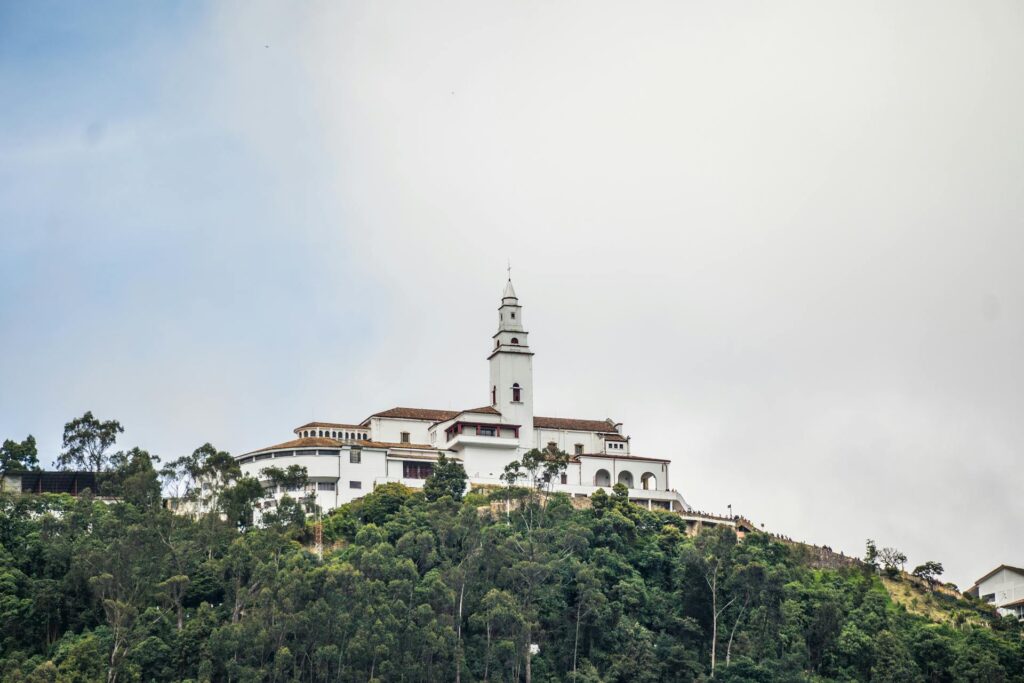
Cerro de Monserrate
The 3,152-metre sanctuary peak immediately east of La Candelaria — a 17th-century church on a peak reached by a 1955 funicular and a 1953 cable car. The viewpoint over Bogotá at sunset is the city’s most-cited photo spot. The walk up (about 1.5 hours, 1,500 vertical metres) is a popular morning fitness trail; most travellers take the cable car or funicular up and walk down. Round-trip ticket COP $25,000 weekdays, COP $30,000 Sunday. Closed for maintenance Tuesday morning; allow a half-day for the visit including the climb time.
Plaza de Bolívar & the Civic Centre
The political and ceremonial centre of Colombia — the square holds the Capitolio Nacional (parliament, 1847–1926, neoclassical), the Catedral Primada de Colombia (1823, on the foundation of the city’s first 1539 cathedral), the Casa de Nariño (presidential palace, behind the cathedral), and the Palacio de Justicia (Supreme Court, the rebuilt successor to the original burned in the 1985 M-19 siege). The changing of the Presidential Guard at the Casa de Nariño runs Wed and Sun at 15:30; the Plaza de Bolívar fills with pigeons and street performers daily.
Museo Nacional de Colombia
The country’s flagship national museum, in a 1874 panoptic-prison building (the original cell-block structure is preserved as part of the museum’s design). The collection covers Colombian history from prehistory to the present across about 20,000 objects — strong in colonial-era painting, Independence-period documents and 20th-century social-realist art. Admission COP $5,000; free on the third Sunday of each month. Closed Mondays.
The Bogotá Graffiti Tour
The city’s signature street-art scene runs through La Candelaria — a generation of public-mural commissioning launched in 2012 (after the police-killing of teenage tagger Diego Felipe Becerra became a national political controversy) and turned the historic centre’s walls into one of Latin America’s most-photographed open-air galleries. The free, tip-based Bogotá Graffiti Tour leaves daily from the Parque de los Periodistas at 10:00 and 14:00 — about 2.5 hours, the canonical introduction to the artists (Stinkfish, DJ Lu, Bastardilla, Crisp). Tip COP $30,000–60,000.
Catedral de Sal de Zipaquirá
The Salt Cathedral of Zipaquirá — a 200-metre-deep underground basilica carved out of an active 13th-century rock-salt mine fifty kilometres north of Bogotá. The current cathedral is the second on the site — the original (1954) was closed in 1992 over structural-safety concerns; the replacement opened in 1995, 60 metres deeper in the same mine. Fourteen Stations of the Cross plus a central nave seating about 8,000. Most travellers visit as a half-day or full-day trip from Bogotá. Admission COP $115,000; combined Bogotá + Salt Cathedral guided tours COP $200,000–300,000.
Entertainment

The Sunday Ciclovía (07:00–14:00 weekly)
Every Sunday and public holiday, Bogotá closes 120 kilometres of major streets — the entire Carrera Séptima from the historic centre to the northern suburbs, the Avenida Carrera 24, and a network of secondary arteries — to cars and turns them over to bicycles, runners and roller skaters. The programme started in 1974 and now draws about 1.5 million participants on a typical Sunday — the world’s biggest weekly car-free event of any major city. Bike-rental shops along the Carrera Séptima rent for COP $10,000–20,000 per hour. The accompanying Recreovía exercise programme runs free outdoor aerobics and yoga classes at fifty-plus parks along the route.
Iberoamerican Theatre Festival (March-April, biennial)
The Festival Iberoamericano de Teatro de Bogotá (FITB) — the largest performing-arts festival in Latin America, held biennially in odd years (next 2027). About 800 performances over seventeen days at venues across the city, with strong international representation. Tickets COP $30,000–250,000. Hotel rates spike during the festival window; book six weeks ahead.
Theatron — South America’s Biggest Gay Club
The Theatron in Chapinero — South America’s largest LGBTQ+ club, with thirteen different rooms playing electronic, salsa, reggaeton, vallenato and crossover. Open Friday and Saturday only, 22:00–05:00. Cover charge COP $25,000–45,000 (the price includes open bar — the inclusive-bar concept is standard at most large Bogotá clubs).
Andrés Carne de Res & the Salsa Scene
Andrés DC (the Bogotá city-centre branch of the Chía-original Andrés Carne de Res) is the city’s most-cited Saturday-night dinner-and-dance experience — six floors, themed around the elements, with a full late-night dance programme that turns the restaurant into a club after midnight. The original Chía branch (45 minutes north, COP $40,000 by Uber) is the larger spectacle; both run COP $80,000–180,000 per person for the meal-plus-dancing combination.
Live Music & the Salsa Bars
Bogotá’s salsa bars cluster in the Galerías and the central La Candelaria — Quiebra Canto and Café del Sello are the most-cited live-salsa-band addresses; the Sunday-afternoon salsa lessons at Quiebra Canto are the easiest entry point for beginners. The El Goce Pagano in Galerías runs the country’s longest-running Saturday-salsa-and-Cuban-music night.
Day Trips

Catedral de Sal de Zipaquirá (50 km north — 1.5 hours)
The most popular day trip from Bogotá — the Salt Cathedral carved 200 metres deep into the active rock-salt mine at Zipaquirá. Combine with the Plaza de la Independencia in Zipaquirá’s small colonial centre and lunch at one of the country-style restaurants on the road back. The Tren Turístico de la Sabana (a working steam-railway tourist train) runs Saturdays and Sundays from Bogotá’s Estación de la Sabana to Zipaquirá and back — the most photogenic route. Admission cathedral COP $115,000; combined Bogotá-departure tour COP $200,000–300,000 with private guide.
Laguna de Guatavita (60 km north — 1.5 hours)
The volcanic crater lake that gave rise to the El Dorado legend — the Muisca leader of Bacatá would coat himself in gold dust and ceremonially row a raft to the centre of the lake to make votive offerings to the goddess Bachué. The lake itself is a 700-metre-circumference perfect-circle crater; the Spanish drained it twice (1545 and 1580) attempting to recover the gold without significant success. Now a protected ecological reserve. Admission COP $20,000; full-day tour from Bogotá COP $150,000–220,000.
Villa de Leyva (165 km north — 3.5 hours)
The whitewashed colonial-era town in Boyacá department — declared a national monument in 1954, the Plaza Mayor (one of South America’s largest cobblestone plazas) is unchanged from the 16th century. Most travellers stay overnight rather than day-trip — the round-trip drive from Bogotá makes a same-day return tight. Combine with the Pozos Azules turquoise pools and the El Fósil Museum (a 7-metre kronosaurus marine-reptile fossil) for a two-night Boyacá visit. Bus from Bogotá 18,000 COP each way; rental car COP $200,000/day.
Suesca (60 km north — 1.5 hours)
The country’s headline rock-climbing destination — sandstone cliffs along the Bogotá-Boyacá highway with about 400 marked routes from beginner-friendly to advanced multi-pitch. Most climbers stay in Suesca’s small village; day-trippers from Bogotá can do half a day of climbing and return for dinner. The Río Bogotá nearby holds the country’s first whitewater-rafting commercial operations.
Coffee Region (Eje Cafetero) — flight + overnight required
The Quindío–Risaralda–Caldas coffee region — the UNESCO Coffee Cultural Landscape — is a 50-minute flight from Bogotá. Most travellers do not day-trip; a two-night minimum at a finca (coffee farm) in Salento or Manizales is the canonical experience, including a working-farm tour, the Cocora Valley wax-palm hike, and the Filandia heritage village. Flights from Bogotá to Pereira (Matecaña) or Armenia (El Edén) run COP $150,000–280,000 round-trip on Avianca, Wingo or Latam.
Seasonal Guide

Dry Seasons (December – March & July – August)
Bogotá’s two dry-season windows — daytime highs 18–20 °C, dropping to 6–9 °C at night, mostly clear mornings, the year’s best mountain visibility from Monserrate. Hotel rates climb modestly in late December (the Christmas-New Year peak) and again in late July. The Iberoamerican Theatre Festival in March-April (odd years) and the Hip-Hop al Parque festival in August are the calendar highlights.
Rainy Seasons (April – June & October – November)
The two wet windows — daytime highs 14–18 °C, afternoon thunderstorms common from 15:00 onward, occasional persistent drizzle that can run multiple days. Mornings are usually clear; plan Monserrate and outdoor sightseeing for the morning hours. Hotel rates dip 10–20% versus the dry-season peak. Pack a waterproof shell year-round; an umbrella is a Bogotá standard accessory.
Festival Calendar Highlights
Iberoamerican Theatre Festival (FITB) in March-April of odd years (next 2027). Festival Estéreo Picnic — Latin America’s biggest indie-rock festival — runs four days in late March. Rock al Parque in late June-early July is the largest free rock festival in Latin America (about 400,000 attendees over three days). Hip-Hop al Parque in August. The Festival Iberoamericano de Cine in October.
Altitude Note
Bogotá at 2,640 metres causes mild altitude effects in most travellers for the first 24–48 hours — shortness of breath on stairs, slight dehydration, occasional headaches. The effects are far milder than Cusco (3,400 m) or La Paz (3,650 m) but real. Drink water aggressively, skip alcohol the first evening, and take the Monserrate cable car (not the walking trail) on day one if you must visit it immediately.
Getting Around
Walking La Candelaria
La Candelaria is genuinely walkable — most sights cluster within an 800-metre radius of the Plaza de Bolívar, and the cobblestone streets are pleasant on foot. The catch is the altitude and the steep eastern slope toward Monserrate; pace yourself on the climbs in your first 24 hours. After dark, La Candelaria empties quickly — Uber back to your hotel by 21:00 is the local convention.
TransMilenio (BRT)
Bogotá’s TransMilenio bus rapid transit network is one of the world’s largest BRT systems — about 110 kilometres of dedicated bus lanes and 12 trunk lines, carrying about 2 million passengers per day. Single ride COP $3,200 (about USD $0.80); buy and reload a TuLlave card at any station. Useful for the airport (Portal El Dorado), the northern Zona G (Calle 72 station), and the Sunday Ciclovía route. Avoid rush hour (06:00–08:30 and 17:30–19:00) — the system runs at standing-room density.
Uber, Cabify & Free Now (Beat)
Uber, Cabify, DiDi and inDrive all operate in Bogotá and are the canonical safe ride option — significantly safer than hailing yellow street taxis, fixed-fare display, credit-card payment. A typical Candelaria-to-Chapinero Uber runs COP $15,000–25,000 (USD $4–6); airport-to-centro COP $30,000–45,000.
Yellow Street Taxis
Yellow taxis are everywhere but have a documented “millionaire’s ride” risk — a small percentage of drivers will take a tourist on a circuitous route while a partner waits at an ATM. The safer pattern is to call a registered taxi via the Tappsi or Cabify app rather than hailing on the street. The metered fare structure is genuinely cheap (flag-fall COP $4,500 plus COP $130 per 100 metres) but the hailed-taxi risk pattern is real enough to make Uber the default for most travellers.
Bogotá Metro (Line 1, opening 2028)
The first metro line — Line 1 from Portal de las Américas to Calle 72 — has been under construction since 2020 and is scheduled to open in 2028. When operational, the elevated 23.96-kilometre line will serve about 16 stations across the southern and central city. Not relevant for most 2026 visits.
Airport Access
- El Dorado International (BOG): TransMilenio Portal El Dorado COP $3,200 (35 minutes to centro); airport bus shuttles COP $4,000–8,000; Uber COP $30,000–45,000 (35 minutes); Yellow taxi flat rate COP $35,000–45,000.
Budget Breakdown: Making Your Peso Count
| Tier | Daily | Sleep | Eat | Transport | Activities | Extras |
|---|---|---|---|---|---|---|
| Budget | 110k–220k COP ($30–55) | Hostel dorm 35k–60k | Almuerzo 18k–25k | TransMilenio 10k/day | Free museums + Ciclovía 0 | Tinto 2k |
| Mid-Range | 320k–600k COP ($80–150) | Boutique 240k–460k | Restaurant 50k–90k/meal | Uber 50k/day | Salt Cathedral 115k + Monserrate 25k | Cocktail 30k |
| Luxury | 1,050k+ COP ($260+) | Four Seasons / JW 750k+ | Tasting 350k–550k | Private car 350k/day | Spa + tour 250k | Champagne 220k |
Where Your Money Goes
Bogotá’s cost stack is bottom-heavy by global-capital standards — sleeping and eating are extraordinarily cheap (a hostel dorm runs COP $35,000–60,000, an almuerzo lunch COP $18,000–28,000), and the headline cultural sights are state-subsidised at COP $5,000 admission or free on Sundays. The luxury tier diverges sharply: the Four Seasons Casa Medina, the JW Marriott and the Sofitel Victoria Regia all run COP $750,000–1,200,000 per night, but the Plaza de Bolívar’s free museums and the Sunday Ciclovía are five blocks away. Colombia’s standard sales tax (IVA) is 19% and is included in most marked prices; restaurants typically add a 10% service charge that is voluntary and explicitly removable on request.
Money-Saving Tips
- Eat the daily almuerzo lunch special — soup, main, juice and coffee for COP $18,000–28,000 is everywhere
- Use Uber rather than yellow taxis — fixed fares avoid the meter-bypass risk
- Visit on a Sunday — the Museo del Oro is free, the Ciclovía closes 120 km of streets, and most museums offer free admission
- TransMilenio to El Dorado airport — COP $3,200 vs COP $35,000 for an Uber, similar journey time outside rush hour
- Drink the local tinto from street stalls (COP $1,000–2,000) rather than third-wave coffee bars (COP $9,000–14,000) for casual coffee
- Stay in Chapinero or La Candelaria mid-range guesthouses rather than Zona Rosa international chains — the rate gap is 50–70% for similar comfort
Currency & Exchange
The Colombian peso (COP) trades around 4,000–4,300 to the US dollar through 2026 — current rates are published daily by the Banco de la República. ATMs are everywhere; most charge a flat 22,000–35,000 COP foreign-card fee per withdrawal, so withdraw 800,000–1,500,000 COP at a time to amortise. Cards work at hotels, mid-range-up restaurants, supermarkets and chain cafés; cash is needed at street stalls, market stalls, and most independent restaurants. Avoid the “dollar-priced” tourist menus at La Candelaria restaurants — they charge a 10–15% peso markup over the menú normal. Carry small denominations (10,000, 20,000, 50,000 COP).
Practical Tips
Language
Spanish is the official language; the Bogotano dialect (sometimes called Cachaco) is widely considered Latin America’s clearest and most-easily-understood Spanish, with modest regional vocabulary differences from Mexican or Argentine Spanish. English is functional in mid-range-and-up hotels, the Zona G restaurants, the Museo del Oro and Museo Botero, and most under-30 university-educated Bogotanos. It falls off quickly outside the centro and Chapinero, and at street stalls and in yellow taxis. Learn five phrases: buenos días (good morning), gracias (thanks), cuánto cuesta? (how much?), la cuenta, por favor (the bill, please), está bien (it’s fine / no thanks). Older-generation Bogotanos often speak French as a second language from the historical Liceo Francés influence.
Cash vs. Cards
Bogotá is mostly card-friendly — Visa, Mastercard and increasingly Daviplata and Nequi (the Colombian mobile-payment apps) work at every hotel, mid-range-up restaurant, supermarket and chain café. Cash is mandatory at street stalls, motorbike-taxi style services, traditional markets and most independent restaurants outside the centro and Chapinero. Plan to carry COP $50,000–150,000 in cash for any given day. ATMs charge COP $22,000–35,000 per foreign-card withdrawal.
Safety
Bogotá’s safety profile has improved dramatically since the 1990s but remains a meaningful concern compared to most travel destinations — petty crime (pickpocketing, distraction-style theft, the “no dar papaya” principle of not displaying valuables) is the realistic risk; violent crime against tourists is rare in the central tourist zones. Avoid La Candelaria’s quieter side streets after 21:00; do not display phones in TransMilenio stations or at red lights; use Uber rather than yellow taxis. The U.S. State Department maintains Colombia at travel advisory Level 3 — primarily a function of the rural FARC-dissident and ELN border zones rather than urban Bogotá. Emergency numbers: 123 (general emergency, Spanish). The Tourist Police office in La Candelaria is English-speaking and operates 24 hours.
What to Wear
Layered, mid-temperate wardrobe — Bogotá’s 2,640-metre altitude means daytime temperatures are 14–20 °C year-round, dropping to 6–10 °C at night. Pack a warm jacket and waterproof shell regardless of season; an umbrella is a Bogotá standard accessory. The dress code is normal-Western with a Bogotano formal-leaning standard at the Zona G fine-dining venues (no shorts at evening restaurants). Comfortable walking shoes for La Candelaria’s cobblestones. Sun protection — UV index at altitude is genuinely high even on cloudy days.
Cultural Etiquette
Three rules: (1) Greet shopkeepers, restaurant staff and Uber drivers with “Buenos días/tardes/noches” — failing to greet is read as rude. (2) The Pablo Escobar tourism — the Medellín cartel-tour scene — is genuinely culturally sensitive in Bogotá; locals consider it disrespectful to the country’s victims of that era and most Bogotanos will react coolly to questions about it. Read the country before discussing the topic. (3) Mealtimes are family-and-social events; rushing through a restaurant lunch in under thirty minutes reads as impolite. The two-hour almuerzo is a feature, not a bug.
Connectivity
Colombian SIM cards from Claro, Movistar or Tigo are cheap — about COP $30,000 for a tourist-tier SIM with 15 GB of data for fifteen days. 4G coverage is excellent in Bogotá and along the Bogotá-Cartagena-Medellín axis; weaker in the Amazon and Pacific coast regions. eSIMs (Airalo, Holafly) work fine. Hotel and café Wi-Fi is universal and generally fast in the Zona G and Chapinero; weaker in older Candelaria boutique hotels.
Health & Medications
Bogotá’s private hospitals (Fundación Santa Fe de Bogotá, Clínica del Country, Hospital Universitario San Ignacio) operate to international standards and run English-speaking clinics. Tap water is potable in Bogotá itself — the city’s altitude-fed reservoir water is among the cleanest in Latin America — but bottled water is recommended outside Bogotá. Travel insurance is strongly recommended. Altitude effects (mild headaches, shortness of breath) are normal for the first 24–48 hours; aspirin and aggressive hydration are the standard responses. Yellow-fever vaccine is required for travel to the Amazon or Pacific regions (not Bogotá itself) and is a useful general-Colombia precaution.
Tipping
Tipping in Colombia is more codified than in most Latin countries — restaurants automatically add a 10% service charge (servicio voluntario) that is technically optional and explicitly removable on request, but in practice 95% of diners pay it. Hotel porters: COP $3,000–5,000 per bag. Uber and taxi drivers: round up to the nearest 1,000 COP. Tour guides on full-day trips: COP $30,000–60,000 per group is the convention.
Frequently Asked Questions

How many days do I need in Bogotá?
Three full days is the sweet spot. Day 1 La Candelaria walk + Plaza de Bolívar + Museo del Oro + Museo Botero. Day 2 Monserrate cable car + Zona G dinner. Day 3 Salt Cathedral of Zipaquirá day-trip OR Sunday Ciclovía + Usaquén Sunday market. Two days is enough for the headlines but feels rushed and does not allow proper altitude acclimatisation. Four days lets you add a graffiti-tour morning and a Chapinero exploration day. Most Colombia itineraries spend three nights in Bogotá before flying to Cartagena or Medellín.
Is Bogotá safe for solo travellers?
Yes, with appropriate precautions — Bogotá’s safety profile has improved dramatically since the 1990s, and the central tourist zones (La Candelaria, Chapinero, Usaquén) are genuinely safe during daylight and reasonably safe with sensible behaviour after dark. The realistic risks are pickpocketing and distraction-style theft, not violent crime against tourists. Stick to Uber after 21:00; avoid La Candelaria’s quieter side streets after dark; do not display phones at red lights or in TransMilenio stations. Female solo travellers report Bogotá as a more challenging Latin American capital than Buenos Aires or Montevideo but easier than São Paulo or Lima.
Will I get altitude sickness in Bogotá?
Mild effects, almost certainly. At 2,640 metres, most travellers experience some shortness of breath on stairs, slight dehydration and occasional mild headaches for the first 24–48 hours. The effects are far milder than Cusco (3,400 m) or La Paz (3,650 m) but real. Drink water aggressively, skip alcohol the first evening, take Monserrate by cable car (not the walking trail) on day one, and rest if symptoms persist past 48 hours. The full-blown altitude sickness (HAPE/HACE) seen above 3,500 metres does not occur at Bogotá’s elevation.
Is Bogotá worth visiting before Cartagena and Medellín?
Yes — and the order matters. Most travellers fly into Bogotá first, spend three nights for the museums and altitude-adjusted altitude, then fly to Cartagena (1.5 hr, COP $200,000–400,000) for the colonial Caribbean coast and finally Medellín (1 hr, COP $150,000–280,000) for the eternal-spring climate. Bogotá holds the country’s three best museums and the political-cultural depth that Cartagena and Medellín do not match; Cartagena holds the postcard colonial coast; Medellín holds the climate and the Pablo-Escobar-era reinvention story. All three together is the canonical seven-to-ten-day Colombia trip.
What about the language barrier?
It exists but rarely blocks travel in the central tourist zones. English is functional in mid-range hotels, the Zona G restaurants, the major museums and most under-30 university-educated Bogotanos. Where it matters: street-stall ordering, Uber driver communication, and any interaction outside Chapinero or La Candelaria. The Bogotano Spanish dialect is genuinely the easiest Latin American Spanish to follow — clear pronunciation and standard vocabulary. Five phrases of Spanish go a long way.
When is the Sunday Ciclovía and is it worth planning around?
Yes — every Sunday and public holiday from 07:00 to 14:00, year-round. The Carrera Séptima between the Plaza de Bolívar and Calle 110 is the canonical route — about 8 km of pedestrianised flat avenue with bike-rental shops every 600 metres. Most Bogotá visits include at least one Sunday for this reason. The Recreovía free outdoor exercise classes run at parks along the route between 08:00 and 12:00.
Can I use credit cards everywhere?
Mostly yes. Visa and Mastercard work at every hotel, mid-range-up restaurant, supermarket and chain café; Daviplata and Nequi are the local mobile-payment standard. Cash is mandatory at street stalls, market stalls, motorbike taxis and most independent restaurants outside the Zona G. Carry COP $50,000–150,000 in cash for any given day. ATMs charge COP $22,000–35,000 per foreign-card withdrawal.
Is the tap water safe to drink?
In Bogotá, yes — the city is famous for its tap water, fed from high-altitude reservoirs in the Cerros Orientales and treated to the highest standards in Latin America. Drink it confidently in the city. Outside Bogotá (Cartagena, Medellín, the coffee region, the coast), the safe rule is bottled water everywhere.
What’s the deal with the Pablo Escobar tour scene?
The cartel-tour culture is concentrated in Medellín, not Bogotá, and is genuinely culturally sensitive in both cities. Many Colombians (especially Bogotanos and older-generation Medellínenses) consider the Escobar tourism disrespectful to the country’s victims of the era — about 200,000 dead during the cartel-and-paramilitary years. Read the room before discussing the topic. The country has moved on; the international tourist focus on the Escobar story is genuinely outdated.
Ready to Experience Bogotá?
Three days, one Monserrate sunset, one Museo del Oro morning, one Sunday Ciclovía and one Zona G fine-dining evening — that is the Bogotá rhythm. For the full country context, read the Colombia Travel Guide; if you are continuing north to the coast, see our Cartagena City Guide.
Explore More City Guides
Where to Stay
- Cartagena City Guide — Colombia’s UNESCO walled-Caribbean colonial port
- Medellín City Guide — the eternal-spring city and reinvention story
- Cali City Guide — Colombia’s salsa-dance capital and Pacific gateway
- Colombia Country Guide
- All City Guides
Alex the Travel Guru
Alex has been writing destination guides for FFU since 2019, with seven Colombia trips on the docket and a long-running Bogotá-as-base habit on the South America loop. The city is Alex’s favourite under-rated Latin American capital — the Museo del Oro, the Sunday Ciclovía and a Zona G fine-dining evening are the unchanging anchors of every visit. For the full country context, read the Colombia Travel Guide.
More city guides you might like
Plan your trip to Bogotá
The booking tools we use ourselves. FFU may earn a commission at no extra cost to you.
Plan & book your trip to Bogotá
Booking through these searches supports our guides at no extra cost to you.