
Nashville Travel Guide — Honky-Tonks, Hot Chicken & the Real Music City
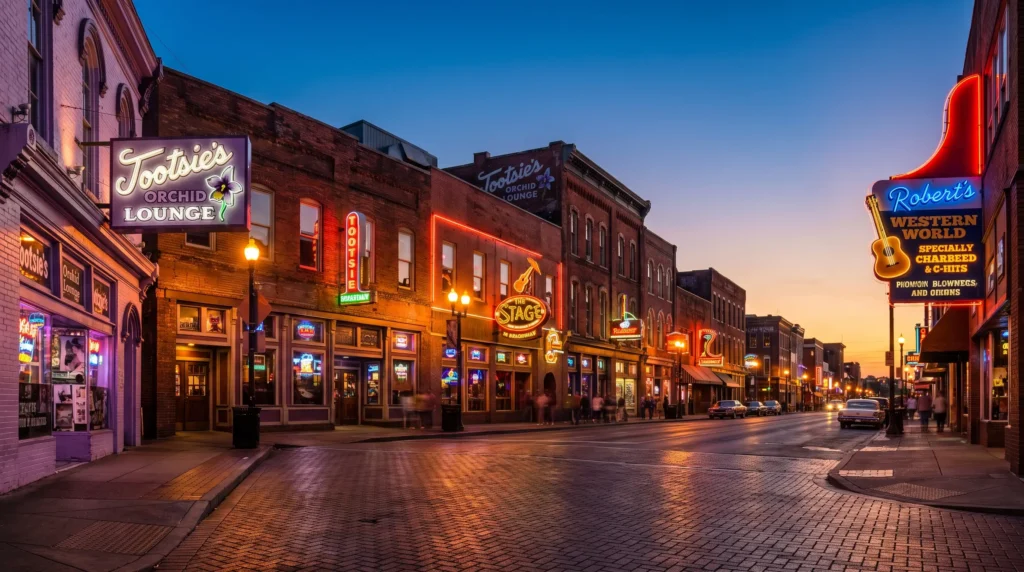
I went to Nashville expecting a bachelorette-party punchline and left having rearranged my entire mental map of American music. Yes, Lower Broadway is loud, neon and full of pedal taverns — that part of the reputation is earned. But walk two blocks off the strip and you’re in a city that gave the world bluegrass at a converted gospel tabernacle, invented hot chicken as an act of romantic revenge, and still has songwriters playing three-chord truth in rooms that seat sixty people. Nashville rewards you for staying past the first night out. The bachelorette buses thin out by Tuesday, the cover bands give way to the writers who actually penned the hits, and a city of just over 720,000 starts to feel less like a theme park and more like a genuine, slightly sweaty, extremely welcoming Southern town that happens to have the best live music density per square mile in the country.
In This Guide
- Overview — Why Nashville Is More Than Bachelorette HQ
- CMA Fest & Nashville’s Festival Calendar
- Best Time to Visit Nashville (Season by Season)
- Getting There — BNA & Beyond
- Getting Around — WeGo, Rideshare & Walkable Pockets
- Neighborhoods — Broadway, the Gulch, East Nashville & More
- Culture & People — Music Row, Faith & the New South
- A Food Lover’s Guide to Nashville
- Off the Beaten Path
- Day Trips from Nashville
- Practical Information
- Budget Breakdown — What Nashville Actually Costs in 2026
- Frequently Asked Questions
Overview — Why Nashville Is More Than Bachelorette HQ
Nashville was founded in 1779 on a bluff above the Cumberland River and named for Revolutionary War general Francis Nash. It picked up the nickname “Music City” in 1950 from a radio announcer, and the name stuck so hard the city has basically built its entire tourism identity around it ever since. That identity is not marketing spin: this is the headquarters of the country music industry, home to the Grand Ole Opry, the Country Music Hall of Fame, and a Music Row full of publishing houses and recording studios that still churn out the songs playing on trucks’ radios across the country.
But Nashville’s population has genuinely exploded over the past decade — the metro area now runs to roughly 2.15 million people, the 35th-largest in the US — and that growth shows up as a city with more going on than steel guitars. There’s a serious food scene, a genuinely beautiful park system (Nashville has the largest share of urban tree canopy of any big US city ), a full-blown Parthenon replica, and a professional sports and convention economy that has nothing to do with cowboy boots.
The honest catch: Lower Broadway on a Friday or Saturday night is a lot — bachelorette sashes, pedal taverns blasting Top 40 covers, and cover charges that creep up as the night goes on. If that’s not your scene, it’s easy to avoid; Nashville is big enough that you can build an entire trip around East Nashville dive bars and Bluebird Cafe songwriter rounds and barely see a rhinestone.
CMA Fest & Nashville’s Festival Calendar
If you want to see Nashville at its most concentrated, aim for CMA Fest, the four-day country music festival that takes over downtown and Nissan Stadium every June — 2026’s edition runs June 4–7, with free daytime stages, Fan Fair X fan events, and nightly stadium concerts starting around 8pm. Hotel prices spike hard that week and Broadway gets genuinely difficult to move through, so book months ahead or deliberately avoid it if crowds aren’t your thing.
Outside CMA Fest, Musicians Corner brings free outdoor concerts to Centennial Park each spring and fall, and 2026 brought an extra jolt of energy with Nashville hosting World Cup-adjacent Summer Kickoff events at GEODIS Park through June. Fall brings a quieter but equally rich run of neighborhood festivals, from the Tomato Art Fest in East Nashville to Oktoberfest in Germantown.
Best Time to Visit Nashville (Season by Season)
March – May · Spring (favorite window)
Mild temperatures, blooming dogwoods, patio season kicking off, and Musicians Corner’s spring run in Centennial Park. This is the sweet spot before summer humidity and before the CMA Fest crowd crush, though March can still throw a cold snap.
June – August · Summer (hot, busy, festival-heavy)
Nashville’s humid subtropical climate means summer highs regularly push into the 90s°F with thick humidity; Nashville has recorded a June high of 109°F. CMA Fest (early June) and peak bachelorette season make Broadway loudest and hotel rates highest. Rooftop bars and river activities are at their best if you can handle the heat.
September – November · Fall (second favorite window)
Warm days, cool nights, fall foliage in the parks, and a lighter crowd than summer. Fall festival season (Tomato Art Fest, Oktoberfest, Musicians Corner’s second run) makes this arguably the best all-around stretch to visit.
December – February · Winter (quiet, occasional snow)
Nashville sees an average of under five inches of snow a year but has hit record lows near -17°F in a hard freeze. Hotel rates drop, Broadway is far calmer, and the Country Christmas lights around the Gaylord Opryland Resort are genuinely worth seeing.
Getting There — BNA & Beyond
Nashville International Airport (BNA) sits roughly 8 miles east of downtown in the Donelson neighborhood and handles well over 20 million passengers a year, with the airport in the middle of a second major expansion phase. Nonstops connect BNA to most major US hubs plus a growing list of seasonal European and Caribbean routes.
From BNA, downtown is a 15–25 minute trip depending on traffic. WeGo’s Route 18 bus runs airport-to-downtown for the standard $2 fare, a taxi runs a flat rate of roughly $30 plus $2 per extra passenger, and rideshare typically lands in a similar range. There’s no direct passenger rail into Nashville — if you’re road-tripping in, I-40, I-65 and I-24 all converge here, making it a natural stop between Memphis, Louisville, Atlanta and Chattanooga.
Getting Around — WeGo, Rideshare & Walkable Pockets
Nashville is not a walkable city in the way New York or Boston are — it’s spread across nearly 528 square miles and built around a car-first Sun Belt layout. WeGo Public Transit runs the city’s bus network, with fares capped under a Best Value program so you never pay more than $4 a day or $65 a month regardless of how many rides you take. It’s serviceable for downtown-to-downtown hops but not fast for suburban neighborhoods.
In practice, most visitors lean on rideshare (Uber/Lyft are everywhere and reasonably priced) or a rental car for day trips. That said, individual neighborhoods are genuinely walkable once you’re in them: Lower Broadway, the Gulch, 12South and East Nashville’s core strips are all fine on foot, and a lot of first-time visitors base themselves downtown or in the Gulch specifically so they can walk to dinner and a show without needing a car at all.
Neighborhoods — Broadway, the Gulch, East Nashville & More
Downtown & Lower Broadway
The famous strip: honky-tonks with live bands on every floor, the Ryman Auditorium a block off the neon, and Nissan Stadium and Bridgestone Arena within walking distance. Loud, touristy, and honestly worth one night even if you base elsewhere.
The Gulch
A former rail yard turned Nashville’s most polished neighborhood — boutique hotels, mural-heavy Instagram corners, rooftop bars and a walkable core that connects easily to downtown and Music Row.
East Nashville
The creative, slightly scruffier counterpoint to downtown’s polish: chef-driven restaurants, dive bars, vintage shops and a music scene built more on songwriters than tour buses. Increasingly the neighborhood locals actually recommend.
12South
Boutique shopping, the “I Believe in Nashville” mural, and a concentration of brunch spots that get lines out the door on weekends. Compact and easy to pair with a Belmont-area stroll.
Germantown
Historic, walkable, and packed with acclaimed restaurants in renovated 19th-century buildings — a good pick if you want dinner-focused nights over honky-tonk-focused ones.
Music Row & Demonbreun
The literal engine of the country music industry — publishing houses, studios, and Third Man Records’ storefront and live venue — plus the Music Row roundabout’s guitar-shaped landmark.
Green Hills & Belle Meade
Upscale shopping and dining, plus the intimate, famously hush-during-songs Bluebird Cafe, where the city’s songwriters (not always the stars who recorded the hits) play in-the-round sets that are as close as Nashville gets to a masterclass.
Culture & People — Music Row, Faith & the New South
Nashville’s culture runs on two parallel engines: the music business and a deep-rooted Southern civic and religious life — the city is home to enough church steeples and gospel history to have earned an early nickname as the “Athens of the South,” reinforced literally by its full-scale Parthenon replica in Centennial Park. The music industry side means you’ll bump into working songwriters waiting tables and session musicians playing writer’s rounds for tip jars — Nashville runs on the idea that today’s bartender wrote last year’s number-one single.
The Grand Ole Opry itself began as a radio barn dance in 1925 and became the genre-defining stage it is today, moving from the Ryman Auditorium — the “Mother Church of Country Music,” where bluegrass itself was essentially born through Bill Monroe, Earl Scruggs and Lester Flatt — to its purpose-built Opryland home in 1974. That history is still very present: the Ryman still hosts touring artists and a winter Opry residency, and old-timers will tell you the room’s acoustics haven’t been matched anywhere since.
A Food Lover’s Guide to Nashville
The dish you came for is hot chicken — fried chicken coated in a cayenne-heavy paste that ranges from “mild” to genuinely dangerous. The dish traces back to Prince’s, founded in 1945 after (according to Nashville legend) a scorned girlfriend spiked her boyfriend’s breakfast fried chicken with extra pepper as revenge, only for him to love it and turn it into a business. Dozens of hot chicken spots have followed, from casual counters to sit-down versions, but Prince’s remains the reference point.
Beyond hot chicken, Nashville’s food scene runs meat-and-threes (cafeteria-style Southern plates — pick a protein, pick three sides), biscuits at breakfast spots that open before dawn, and a genuinely strong fine-dining scene that’s grown up alongside the population boom in Germantown and East Nashville. Broadway itself is mostly a tourist-trap food zone — save your appetite for a few blocks off the strip. Meat-and-threes, biscuit counters and hot chicken joints tend to close early (some by mid-afternoon), so plan lunch, not dinner, around the classics.
Off the Beaten Path
Cheekwood Estate & Gardens
A Georgian mansion turned botanical garden and art museum on the city’s west side — seasonal light shows, sculpture trails and a genuinely peaceful counterpoint to Broadway.
Percy Warner & Edwin Warner Parks
Thousands of acres of hiking and horse trails minutes from Belle Meade — one of the reasons Nashville claims the country’s highest urban tree-canopy share among big cities.
Jefferson Street
The historic heart of Nashville’s Black music scene, once a stop on the R&B and soul circuit for artists like Jimi Hendrix before he was famous — quieter now, but a handful of venues and murals keep the history visible.
Radnor Lake State Natural Area
The highest point in the city limits at 1,163 feet, with a quiet lake loop trail that feels nothing like the rest of the city — no music, just herons and deer.
Day Trips from Nashville
Franklin
A well-preserved Civil War-era downtown about 22 miles south, with boutique shopping, Southern restaurants, and the Carnton and Carter House historic sites — an easy half-day that pairs well with a 12South visit on the way back.
Lynchburg & the Jack Daniel’s Distillery
Roughly a 90-minute drive southeast to a town of about 6,500 people whose entire identity is the Jack Daniel’s Distillery — notably located in a dry county, so tastings are limited to the distillery grounds itself.
Natchez Trace Parkway
The scenic parkway’s northern terminus is right at Nashville’s edge — even a short drive south gets you overlooks, waterfalls and historic markers with almost no traffic.
Practical Information
Money. US dollars only; cards are accepted almost everywhere, though many honky-tonks and food trucks still run cash-friendly tip jars and cover charges.
Safety. Downtown, the Gulch, East Nashville and 12South are generally easygoing tourist areas; use normal city precautions on Broadway late at night (crowds, pickpocketing risk, drunk-driving traffic) and stick to licensed rideshare or taxis rather than walking long stretches alone after bars close. As with any US destination, check current conditions and any local advisories before you travel.
Health. No special vaccinations are required to visit Nashville; standard US travel health precautions apply, and summer heat and humidity call for hydration and sun protection more than anything exotic.
Connectivity. US cell coverage and Wi-Fi are excellent throughout the city. Plugs: US-style Type A/B, 120V. Time zone: Central Time (UTC-6, UTC-5 during daylight saving).
Budget Breakdown — What Nashville Actually Costs in 2026
Nashville isn’t cheap by Southern-US standards anymore — the population boom pushed hotel and restaurant prices up considerably over the past decade — but it’s still generally less expensive than New York, LA or Nashville’s fellow music-tourism draw, Austin.
Budget (US$110–170/day): hostel or budget hotel outside downtown, meat-and-three lunches and hot chicken, WeGo bus rides, free honky-tonk covers (no cover on Broadway, just a one-drink-minimum expectation and tip-jar tips for the band).
Mid-range (US$220–380/day): boutique hotel in the Gulch or East Nashville, a proper dinner in Germantown, a ticketed show at the Ryman or a Bluebird Cafe reservation, rideshare instead of walking everywhere.
Luxury (US$600+/day): downtown high-rise or Gaylord Opryland Resort stay, premium Opry seats, private honky-tonk crawls, and Nashville’s growing fine-dining upper tier.
Fixed costs to expect: cover charges climb on upper floors of multi-story honky-tonks as the night goes on, and CMA Fest week inflates every hotel rate in the city — book well ahead or avoid that week entirely if budget matters more than the festival.
Planning Your First Trip to Nashville
The classic first-timer split is three nights downtown/Gulch, one night East Nashville: fly into BNA, spend your first two nights on or near Broadway for the honky-tonk crawl and a Ryman show, then shift to East Nashville or 12South for food-focused nights and a Bluebird Cafe set. Add a Franklin half-day if you have a car. Pair a Nashville trip with our New Orleans guide for a two-city Southern music run, our Chicago guide if you’re chaining a broader US music-cities itinerary, or our United States guide for the bigger picture on visas, driving and general trip planning.
Frequently Asked Questions
Is Nashville safe for tourists in 2026?
The main visitor areas — downtown, the Gulch, East Nashville, 12South — are generally safe and easygoing tourist zones. Standard late-night city precautions apply on and around Lower Broadway, where bar crowds and drunk-driving risk are the biggest practical hazards; use rideshare rather than walking long distances alone after the bars close.
Do international visitors need a visa for Nashville?
Nashville doesn’t have its own visa rules — international visitors need whatever is required to enter the United States generally: a valid passport plus either a US visa or, for Visa Waiver Program countries, an approved ESTA. Check current US entry requirements for your nationality before booking.
Do I need a car in Nashville?
Not if you’re sticking to downtown, the Gulch and East Nashville — those are walkable once you’re there, and rideshare covers the gaps. You’ll want a car (or a tour/shuttle) for day trips to Franklin, Lynchburg or the Natchez Trace, since Nashville’s transit network doesn’t reach far into the suburbs.
When should I avoid visiting Nashville?
CMA Fest week (early June 2026) brings the highest hotel prices and the thickest downtown crowds of the year — great if that’s what you’re there for, rough if you want a quieter trip. Peak summer heat and humidity (July–August) are also worth planning around if you’re sensitive to heat.
Nashville or Austin?
Choose Nashville for the deeper country-music heritage, the Ryman/Opry pedigree, and a more walkable, compact downtown-to-Gulch core; choose Austin for a bigger tech-and-food scene, Hill Country day trips, and a younger, less bachelorette-heavy nightlife reputation. Both are genuinely great live-music towns — Nashville just wears the “Music City” title on paper.
What’s the cheapest way to see live music in Nashville?
Walk Lower Broadway — most honky-tonks have no cover charge (they make money on drinks and tips), so you can hear a dozen different bands in one night by just walking in and out. Tip the band a few dollars per stop; it’s the unwritten rule that keeps the whole system running.
Ready to Explore Nashville?
Neon-lit honky-tonks with a live band on every floor, a hot chicken order that will genuinely test you, and a songwriter in a sixty-seat room playing the song you’ll hear on the radio next year — Nashville delivers on the Music City promise louder than almost anywhere else in the country. Just budget an extra night to get past Broadway and find the city underneath it.
Explore More
- New Orleans City Guide — pair Music City with the birthplace of jazz
- Chicago City Guide — blues, deep-dish and another great American music city
- Miami City Guide — swap honky-tonks for a completely different US scene
- United States Travel Guide — entry requirements and trip-planning basics
How this guide was built
Published as part of Facts From Upstairs’ city guide series. Built from authoritative sources — Wikipedia’s Nashville, Grand Ole Opry, Ryman Auditorium, Nashville International Airport, Prince’s Hot Chicken Shack and Lynchburg, Tennessee entity pages, the official Nashville Convention & Visitors Corp site (visitmusiccity.com), WeGo Public Transit’s official fare page, and CMA Fest’s official 2026 schedule. Numeric claims carry inline citations.
Sources cited on this page
- Wikipedia — Nashville, Tennessee
- Visit Music City — Nashville Convention & Visitors Corp
- Wikipedia — Ryman Auditorium
- Wikipedia — Grand Ole Opry
- WeGo Public Transit — Fare Information
- CMA Fest — Official 2026 Schedule
- Wikipedia — Nashville International Airport
- Wikipedia — Prince’s Hot Chicken Shack
- Wikipedia — Lynchburg, Tennessee
More city guides you might like

Plan your trip to Nashville
The booking tools we use ourselves. FFU may earn a commission at no extra cost to you.
Plan & book your trip to Nashville
Booking through these searches supports our guides at no extra cost to you.