
Languages of United States
All languages of Northern America →fluent beta classical · classes by phone with Maya at ranas.ai/maya
United States Travel Guide — Fifty States, Sixty-Three National Parks & a Continent of Variety
I have crossed this country by car, train, and red-eye more times than I can count, and the part I still find hard to convey to first-time visitors is the scale. We tell people that the United States is “big” and that is technically correct — 9.83 million km² across 50 states and six time zones — but it is the variety that catches you out. You can drive five hours in Iceland and see one weather system; you can drive five hours in California and lose two climates and gain a desert. My favourite thing about travelling here is the way a Friday-night roadhouse outside Marfa or Memphis tells you more about the place than three days in any city. Treat this as the brief I would hand my own family before they booked the long flight in.

In This Guide
- Overview — Why the United States Belongs on Every Bucket List
- America 250 — The 2026 Semiquincentennial
- Best Time to Visit the United States (Region by Region)
- Getting There — Flights & Arrival
- Getting Around — Cars, Amtrak & the Interstate System
- Top Cities & Regions
- American Culture & Etiquette
- A Food Lover’s Guide to the United States
- Off the Beaten Path
- Practical Information
- Budget Breakdown
- Planning Your First Trip to the United States
- Frequently Asked Questions
Overview — Why the United States Belongs on Every Bucket List
The United States is a 9.83 million km² federal republic of 50 states, a federal district, and five inhabited territories, stretching 4,500 km across mainland North America from the Atlantic to the Pacific and reaching well past the Arctic Circle in Alaska and into the Tropics in Hawaii. Roughly 340 million people live here as of the U.S. Census Bureau’s 2024 vintage estimates, making it the third most populous country on Earth after India and China. Six time zones — Eastern, Central, Mountain, Pacific, Alaska and Hawaii–Aleutian — span a country wider than the Atlantic Ocean is at its narrowest.
Geography is the whole story. The country has 63 designated national parks, 432 National Park Service units in total, 25 UNESCO World Heritage Sites and the longest interstate highway system in the world — 78,465 km of high-speed road originally signed by President Eisenhower in 1956. Yellowstone, the world’s first national park (1872), sits over a hotspot caldera that contains roughly half the planet’s geysers. The Mississippi River drains 31 states and flows 3,766 km from Lake Itasca, Minnesota to the Gulf of Mexico. Denali in Alaska — at 6,190 m — is the highest mountain on the continent.
Culturally, the United States is a federation of regional Americas more than a single nation. New England and the Pacific North-West feel like different countries from the Deep South or the Mountain West. Spanish is co-equal with English in much of the South-West and Florida; Hawaiian and Spanish are official languages alongside English in Hawaii and New Mexico respectively; the Smithsonian’s 21 museums and 14 research centres on the National Mall in Washington, D.C. are free to enter. The country is also the most visited in the Americas — 67.4 million international arrivals in 2024 according to the U.S. National Travel and Tourism Office.
Practically, the United States is welcoming and very car-shaped. ESTA covers 41 visa-waiver countries for tourist stays up to 90 days; the federal minimum tip in restaurants is 18% (20% in major cities); EPA-regulated tap water is generally safe; and the dollar is everywhere. The country runs on Type A & B plugs at 120V/60Hz — bring an adapter from anywhere outside North America. The pay-off is everything outside the windscreen — Yosemite granite, neon Vegas, Memphis blues at midnight, Acadia in October, Hawaii in February — almost any climate or culture you want, somewhere in the country, this week.

America 250 — The 2026 Semiquincentennial Anniversary Year
2026 is the 250th anniversary of the Declaration of Independence, signed in Philadelphia on 4 July 1776. The U.S. Semiquincentennial Commission — known as America250 — has coordinated a national programme of state-level celebrations, museum openings and public-history events from January 2026 through December 2026, with peak activity around 4 July weekend. If you have ever considered an American history-and-monuments trip, this is the year.
- Independence Day signature event: 3–4 July 2026 (Philadelphia, Boston, Washington D.C.) — federal celebration anchored at Independence National Historical Park.
- Peak window: Memorial Day weekend (23–25 May) through Labor Day weekend (5–7 September 2026)
- Peak duration: Most state programmes run all summer; expect 4 July weekend hotel rates 2–3× normal in Philadelphia, Boston, D.C., New York City
- National Mall, Washington D.C.: A National Independence Day Parade and the National Symphony Orchestra concert run annually; 2026 is enlarged for the 250th
- Boston, MA: The Massachusetts 250 programme runs commemorations from Concord and Lexington (April 2025 had the 250th of “the shot heard round the world”) through to Bunker Hill

Best Time to Visit the United States (Region by Region)
Because the country spans the Arctic to the tropics, there is no single best season — there is a best season for every region. The U.S. National Weather Service publishes regional climate normals; in broad strokes:
Spring (March – May)
Cherry blossom in Washington D.C. (peak around 25 March – 8 April) ; desert wildflowers in Death Valley and Big Bend; Grand Canyon and Yosemite reopening fully; tornado season ramps in Tornado Alley (Texas, Oklahoma, Kansas) from April. New England remains cold and muddy until late April. Ideal for the Deep South, the Carolinas, and the South-West before summer heat.
Summer (June – August)
National-park peak: Yellowstone, Glacier, Grand Teton, Olympic and Denali at full access. New England and the Pacific North-West at their best; Arizona, Nevada, Texas and Florida brutally hot — Phoenix averages 41°C in July. Hurricane season runs 1 June – 30 November in the Atlantic and Gulf. Crowds are at maximum — book Yellowstone lodging six months out.
Autumn (September – November)
Fall-foliage peak in New England runs roughly 25 September – 20 October (north to south); Pacific North-West and Colorado peak earlier. Atlantic hurricanes peak mid-September. The South-West (Arizona, New Mexico, Utah) is at its best — cool nights, no monsoon, no crowds. October is arguably the single best travel month nationally.
Winter (December – February)
Florida, Hawaii, Southern California, Arizona and the Texas Gulf Coast hit their season — “snowbird” month for Northeasterners. Ski season at Vail, Aspen, Park City, Jackson Hole, Mammoth and Whistler-adjacent resorts runs roughly mid-November to mid-April. Yellowstone is largely closed; Yosemite Valley remains open with snow. Mardi Gras peaks in New Orleans (17 February 2026); Sundance Film Festival in Park City, Utah runs 22 January – 1 February 2026.
Shoulder-season tip: Late April through mid-June and mid-September through early November are the country’s two genuine sweet spots — most regions still pleasant, kids in school (so parks emptier), hotel rates 30–50% off summer peak.
Getting There — Flights & Arrival
The United States has 13 airports each handling 30+ million passengers annually; in Federal Aviation Administration 2024 data the busiest is Hartsfield–Jackson Atlanta (over 108 million pax). The most useful arrival airports for a typical first international trip:
- John F. Kennedy International Airport (JFK) — New York’s primary long-haul gateway, 24 km from Manhattan; Air Train + LIRR + subway to Penn Station ~$15.
- Los Angeles International (LAX) — second-busiest for international arrivals; the Metro K Line and LAX/Metro Transit Center now connect to Downtown LA.
- Miami International (MIA) — Latin-America gateway and Caribbean hub; MIA Mover + Tri-Rail / Metrorail integrated.
- Chicago O’Hare (ORD) — central-US hub, CTA Blue Line direct to the Loop in 45 minutes ($5).
- San Francisco International (SFO) — BART direct to Downtown SF in 30 minutes ($10.95).
- Honolulu International (HNL) — main Pacific gateway via the West Coast.
Flight times: London–New York 7h 30m; London–LA 11h; Tokyo–LA 11h; Sydney–LAX 14h; Frankfurt–Atlanta 9h 30m; Doha–JFK 13h 30m. Domestic transcontinental (e.g. JFK–LAX) is around 6 hours westbound, 5 hours eastbound.
Flag carriers / largest airlines: American, Delta, United (the “Big Three”), Southwest (largest domestic), JetBlue, Alaska.
Visa / entry: The Visa Waiver Program covers 41 countries for stays up to 90 days; you need an approved ESTA (USD $21) before boarding. All other nationalities need a B-1/B-2 visitor visa (USD $185, in-person interview at a U.S. embassy). Visit the State Department’s official portal — not a third-party site. Customs and Border Protection runs Mobile Passport Control and Global Entry kiosks at most major airports — sign up for Global Entry (USD $120, 5 years) if you visit more than once.
Getting Around — Cars, Amtrak & the Interstate System
The United States is a car country. Outside the dense urban corridor between Boston and Washington (the Northeast Corridor), the West Coast urban centres, Chicago and a handful of others, public transport is thin and a rental car is effectively required for any non-urban trip. The Federal Highway Administration’s 78,465 km Interstate Highway System — Eisenhower’s 1956 Federal-Aid Highway Act — connects every state of the lower 48 and Alaska/Hawaii separately.
- Interstate Highway System: 78,465 km of high-speed limited-access highway; speed limits 65–80 mph (105–129 km/h) by state. Interstate 90 is the longest at 4,861 km (Boston–Seattle); Interstate 95 hugs the Atlantic from Maine to Miami.
- Amtrak national rail: 34,000 km network; 32 million passengers in FY2024 (record). The Northeast Corridor (Boston–NYC–Philadelphia–Washington D.C.) is the only high-speed leg — Acela hits 240 km/h in short bursts. Long-distance routes (Southwest Chief, Empire Builder, California Zephyr, Coast Starlight) are scenic but slow — Chicago–LA on the Southwest Chief is 43 hours.
- Domestic flights: A 6-hour transcontinental hop is faster than a 4-day cross-country drive; book early.
- Rental cars: USD $40–80 per day for an economy car; USD $80–130 for an SUV. International driving permit is recommended but a valid home-country licence in English is accepted in most states.
Rail / transit pass: Amtrak USA Rail Pass — 10 segments in 30 days for USD $499 (off-peak). A useful Northeast-Corridor experience but limited utility outside the corridor.
Urban transit (where it works): NYC’s MTA subway runs 24 hours, 472 stations (largest network in the world by stations); Washington D.C. Metro, Chicago L, Boston T, San Francisco BART, and Los Angeles Metro all have functional rail networks. Outside these cities, plan to drive or use rideshare.
Apps: Google Maps, Apple Maps, Waze (driving), Uber and Lyft (rideshare), Citymapper (NYC/SF/Boston/D.C.), Transit (general).
Top Cities & Regions
📍 Map of United States: Every Place in This Guide


New York City, NY
Five boroughs, 8.3 million people, and the gateway most international visitors land at first. Manhattan in 24 hours is one of the world’s great urban experiences; Brooklyn, Queens, the Bronx and Staten Island double or triple it. The flagship city guide breaks the boroughs down.
- Statue of Liberty National Monument & Ellis Island ferry
- Metropolitan Museum of Art (5,000-year collection)
- Central Park (341 ha — bigger than Monaco)
Chicago, IL
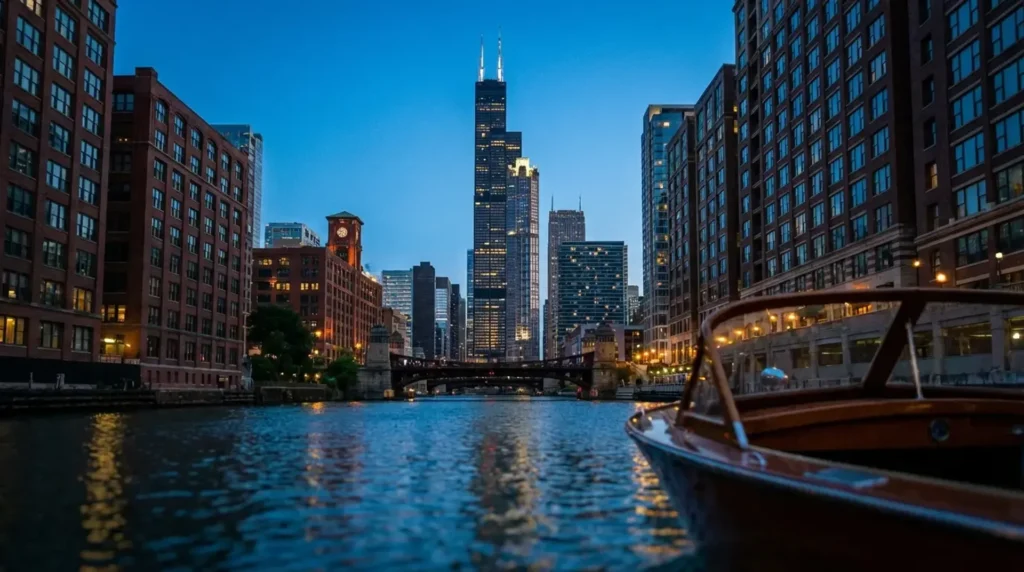
Big-shouldered architecture on Lake Michigan — birthplace of the skyscraper, deep-dish pizza, world-class museums and a lakefront that rivals any coast. Our Chicago city guide has the full itinerary.
San Francisco, CA
The Bay Area’s hilly, fog-wrapped icon — cable cars, the Golden Gate Bridge, Alcatraz and a tech-and-food culture that punches far above its compact footprint. Our San Francisco city guide covers neighbourhoods, transit and day trips.
Los Angeles, CA
America’s second-largest city — Hollywood, Disneyland, beaches from Malibu to Long Beach, and the country’s most diverse food scene by neighbourhood. Allow at least four days; LA distances are deceptively large.
- Griffith Observatory + Hollywood sign hike
- Getty Center + Getty Villa
- Santa Monica Pier & Venice Beach
Chicago, IL
The country’s third city, on Lake Michigan. The architectural-boat tour on the Chicago River is the single best 90 minutes in any American city. Deep-dish pizza is real but contested; thin-crust tavern-style is local consensus.
- Art Institute of Chicago (Hopper, Seurat, Wood)
- Architectural River Cruise (Chicago Architecture Center)
- Millennium Park “The Bean” (Cloud Gate)
San Francisco, CA
49 sq mi (127 km²) of compact, hilly, walkable city. Alcatraz, the Golden Gate, the Painted Ladies, Mission burritos, and Muir Woods 30 minutes north. Smaller than New York or LA but punches above its weight.
- Alcatraz Island night tour (book 60+ days out)
- Golden Gate Bridge cycle from Sausalito
- Mission District murals
Miami & South Florida
Art Deco South Beach, Cuban Calle Ocho, Wynwood street art, and the Florida Keys 5 hours south on the Overseas Highway. Best November–April when humidity drops and prices spike. Everglades National Park on the doorstep.
- South Beach Art Deco Historic District (800+ buildings)
- Wynwood Walls — outdoor street-art museum
- Everglades airboat from Shark Valley
The National Park West (Utah, Arizona, Wyoming)
The American South-West is the world’s densest concentration of national parks. Utah’s “Mighty 5” (Zion, Bryce, Capitol Reef, Arches, Canyonlands) is a 10-day road trip; the Grand Circle adds the Grand Canyon, Monument Valley and Antelope Canyon.
- Zion National Park — Angels Landing & The Narrows
- Bryce Canyon hoodoos at sunrise
- Antelope Canyon (Navajo Nation, guided only)
Yellowstone & Grand Teton (Wyoming, Montana, Idaho)
The world’s first national park (1872), home to roughly half the planet’s geysers including Old Faithful, plus wolves, grizzly bears, bison and elk. Allow 4–5 days; book lodging through Xanterra 6+ months out.
- Old Faithful + Upper Geyser Basin loop
- Lamar Valley wolf-watching at dawn
- Grand Prismatic overlook from Fairy Falls trail
Hawaii
Six visitable islands; Oahu (Honolulu/Waikiki, Pearl Harbor) is the gateway, Maui balances beach and volcano (Haleakalā), Hawaii Island has Volcanoes National Park’s active Kīlauea, and Kauai is the most scenic.
- Pearl Harbor National Memorial — USS Arizona
- Volcanoes National Park (Kīlauea Iki crater rim)
- Nā Pali Coast (Kauai) by boat or helicopter
American Culture & Etiquette — What to Know Before You Go

The Essentials
- Tipping is obligatory. 18% in restaurants is the floor; 20% in major cities; 18–20% on bar bills, taxi/rideshare and hotel-bag service. Tip is rarely included on the bill — read the fine print.
- Sales tax is added at the till. Listed prices almost never include tax — expect to add 4–10% (state) plus 0–4% (city/county) at checkout. Five states have no statewide sales tax (Delaware, Montana, New Hampshire, Oregon, Alaska).
- Drinking age is 21, strictly enforced. Bring photo ID even if you look 50; “carding” up to age 30+ is normal. Public alcohol consumption is illegal in most states.
- Drive on the right. Right turn on red is legal in most states unless signed otherwise; pedestrians have right of way at unmarked crossings. Speed limits in mph, not km/h.
- Personal space is bigger. About a metre of distance in queues is standard; touching strangers (even a polite hand on the arm) reads more intimate than in much of Europe or Latin America.
Regional Variation Matters
- Service interaction is warmest in the South (“Hi y’all”), brisker in New York and Boston (“waddya want?”), Pacific North-West tilts polite-and-quiet, Midwest is genuinely friendly to strangers.
- Cash is increasingly rare; many small businesses are card-only post-2020. The “no cash” sign at coffee shops is normal in Manhattan and the Bay Area.
- Health care is privately insured and expensive — buy travel medical insurance with at least USD $100,000 cover.
- Recreational cannabis is legal in 24 states and Washington D.C.; medical-only or fully illegal elsewhere — know the state you’re in. Federally it remains a Schedule I controlled substance, so do not cross state lines or fly with it.
A Food Lover’s Guide to the United States

Must-Try American Regional Dishes
| Dish | Region / Description |
|---|---|
| Central Texas BBQ Brisket | Post-oak smoked beef brisket, served on butcher paper. Lockhart and Austin are pilgrimage towns. |
| Kansas City / Memphis Ribs | Pork ribs, sweet sauce (KC) or dry-rub (Memphis). Generally falls-off-the-bone tender. |
| New York Slice / Chicago Deep Dish | Two civilisations. The NY slice is foldable, thin-crust, paper-plate fast food. Chicago deep-dish is a knife-and-fork pie. |
| Cajun & Creole (Louisiana) | Gumbo, jambalaya, étouffée, beignets at Café du Monde, po-boys. New Orleans is the centre of gravity. |
| New England Clam Chowder + Lobster Roll | White-cream chowder; the Maine lobster roll is cold lobster + mayo on a buttered split-top bun. Avoid the red Manhattan chowder unless you’re in Manhattan. |
| California Cuisine | Farm-to-table, citrus and avocado heavy, with strong Mexican and East Asian influence. Mission burrito (SF), fish taco (San Diego), In-N-Out Burger. |
| Tex-Mex & New Mexican | Tex-Mex is its own American cuisine — fajitas (invented in San Antonio), queso, breakfast tacos. New Mexican is its own thing — green chile on everything. |
| Southern Soul Food | Fried chicken, collard greens, mac & cheese, cornbread, biscuits and gravy, peach cobbler. Atlanta, Charleston, Nashville and the Mississippi Delta are flagships. |
Diner Culture & the American Breakfast
The diner — open 24 hours, “bottomless coffee”, booths and a counter — is one of the genuine American institutions. Order pancakes (with maple syrup), eggs your way, hash browns, bacon, toast. The “Lumberjack” or “Grand Slam” stack costs USD $14–18 and feeds two. Waffle House across the South-East is the cheapest and the most fun (24/7, $8 hash browns, scattered/smothered/covered).
- Chains: Denny’s, Waffle House, IHOP, Cracker Barrel
- Signature items: pancakes & maple syrup, eggs Benedict, French toast, biscuits-and-gravy, country-fried steak, hash browns “scattered, smothered, covered”
Off the Beaten Path — The United States Beyond the Guidebook

Marfa, West Texas
A 1,700-person high-desert art town that Donald Judd transformed into a contemporary-art pilgrimage site. The Chinati Foundation guided tour (Wed–Sun) is the headline; eat at Marfa Burrito, drink at Lost Horse Saloon.
The Olympic Peninsula, Washington
Olympic National Park has temperate rainforest (Hoh), 12,000-year-old glaciers (Mt Olympus) and 117 km of wild Pacific coast within a single park boundary. Drive the Olympic Loop in 4 days from Seattle.
The Mississippi Delta & Highway 61
Drive Highway 61 — “the Blues Highway” — from Memphis through Clarksdale, Tunica, the Crossroads of legend, to Vicksburg and New Orleans. Stop at the Delta Blues Museum, Ground Zero Blues Club, B.B. King Museum in Indianola.
The North Cascades & Methow Valley
Washington’s “American Alps” — North Cascades National Park has fewer annual visitors than Acadia gets in a busy week. Methow Valley on the east side is one of the country’s best Nordic-skiing networks.
The Black Hills & Badlands, South Dakota
Mount Rushmore is the famous draw, but Badlands National Park’s eroded buttes, Custer State Park’s bison herd (1,300 head), and the Crazy Horse Memorial in progress since 1948 are the better stories.
The Big Island Volcanoes (Hawaii)
Hawaii Volcanoes National Park’s Kīlauea was actively erupting through 2024–2026 in episodic fountains. Book a sunset visit when an eruption is active for one of the most dramatic landscapes in the country.
Acadia in October, Maine
New England’s only national park; rocky Atlantic coast, Cadillac Mountain (the first place in the U.S. to see the sunrise from October to early March), and the Park Loop Road at peak fall colour.
Practical Information
| Currency | United States Dollar (USD, $); 1 USD = 1 USD by definition. |
| Cash needs | Minimal. Cards (Visa/MC/Amex) accepted virtually everywhere; tap-to-pay and Apple/Google Pay near-universal. Carry USD $40–60 for tips/parking/farmers’ markets. |
| ATMs | Ubiquitous — bank ATMs are free with a Visa/MC/foreign card; bodega/casino ATMs charge USD $3–7 fees. |
| Tipping | 18% restaurant minimum (20% in NYC/SF/LA); USD $1–2 per drink at bars; 18–20% rideshare; USD $1–2 per bag (hotel porter); USD $3–5 per night for housekeeping. |
| Language | English. Spanish widely spoken in California, Florida, the South-West, NYC. New Mexico, Hawaii official languages include Spanish/Hawaiian. |
| Safety | Generally safe in tourist areas; gun ownership and concealed-carry laws vary widely by state. Petty theft on the rise in some West Coast cities — keep valuables out of parked cars. |
| Connectivity | 5G nationwide on T-Mobile/Verizon/AT&T. Free WiFi in most cafés, hotels, libraries, parks. National parks often have no service — download offline maps. |
| Power | Type A & B plugs, 120V/60Hz (vs. 230V in Europe — high-wattage hair tools may not work). |
| Tap water | Generally safe; EPA Safe Drinking Water Act applies. Bottled water common in restaurants. |
| Healthcare | World-class care, eye-watering prices for the uninsured. A single ER visit can be USD $2,000+. Travel medical insurance is essential. |
Budget Breakdown — What the United States Actually Costs
💚 Budget Traveller
Hostel dorm bed in NYC USD $60–90; rest of the country USD $30–55. Diner breakfast USD $12–16, food-truck lunch USD $10–15, Subway/Chipotle dinner USD $12–16. Long-distance Greyhound or FlixBus tickets from USD $15–60. Yellowstone vehicle pass USD $35 (7 days). National Parks Annual Pass USD $80 covers every NPS unit.
💙 Mid-Range
Mid-range hotel USD $180–280 per night (more in NYC/SF/LA/Boston); Airbnb private apartment USD $150–240. Sit-down restaurant dinner USD $35–55 per person + 18–20% tip + 8–10% sales tax. Rental car USD $55–80/day plus fuel ($3.30/gallon US average — Apr 2026).
💜 Luxury
Luxury hotel in NYC/SF/Vegas USD $700–1,500 per night; resort hotel in Hawaii USD $600–1,200; tasting-menu dinner at a Michelin-starred restaurant USD $250–600 per person. Private guide / heli-tour over the Grand Canyon USD $400–800 per person. Sleeper-car upgrade on Amtrak’s California Zephyr ~USD $1,200 Chicago–Emeryville (single).
| Tier | Daily (USD) | Accommodation | Food | Transport |
|---|---|---|---|---|
| Budget | $90–140 | Hostel/budget motel | Diner + Chipotle | Greyhound + transit |
| Mid-Range | $200–350 | 3–4 star hotel / Airbnb | Sit-down lunch + dinner | Rental car + flights |
| Luxury | $700+ | Boutique / resort | Tasting menu | Private + first class |
Planning Your First Trip to the United States
- Pick a region, not the country. The U.S. is too big for one trip. Common first-time picks: New York City + a New England fall-foliage loop (10 days); the California Coast (San Francisco → Big Sur → LA → San Diego, 10 days); the South-West Grand Circle (Las Vegas → Zion → Bryce → Grand Canyon → Antelope Canyon → Monument Valley, 10–14 days); or NYC + Washington D.C. + Philadelphia + Boston (the East-Coast 250 trip for 2026, 12 days).
- Apply for ESTA at least 72 hours before flying — and only on the official cbp.gov site, never a third-party that adds USD $40+ in “service fees”.
- Buy travel insurance with USD $100,000+ medical cover. Healthcare is private and expensive.
- Book national-park lodging 6+ months ahead. Yellowstone, Yosemite, Grand Canyon and Zion in-park hotels sell out for summer in March; April for July is already too late.
- Rent a car for everything outside NYC, Boston, D.C., Chicago, SF and Honolulu. Public transport beyond those cities is thin. International Driving Permit recommended.
Classic 14-Day East Coast 250 Itinerary: Days 1–4 New York City · Day 5 Train to Philadelphia (Independence Hall + Liberty Bell) · Day 6 Train to Washington D.C. · Days 7–8 D.C. (Smithsonians) · Day 9 Train to Boston · Days 10–11 Boston (Freedom Trail + Concord/Lexington) · Day 12 Lobster on the Maine coast · Days 13–14 Acadia National Park.
Frequently Asked Questions
Is the United States expensive to visit?
It depends on which one. New York, San Francisco, Hawaii and Aspen are among the world’s most expensive destinations. Memphis, Nashville, New Orleans, Texas and most of the Mountain West are cheaper than London or Tokyo. National-park entry is USD $35 per vehicle (seven days) or USD $80 for an annual pass good at every NPS unit. The big additions for international visitors: 18–20% tipping (always), 4–10% sales tax (added at the till), and the cost of a rental car if you leave the dense north-east corridor.
Do I need to speak any language other than English?
No. English fluency is universal and signage is overwhelmingly in English. Spanish helps in Miami, Los Angeles, the South-West, parts of Texas and most of the Florida Keys; menus and signs are routinely bilingual. Hawaiian appears on signage in Hawaii but you will not need it. Indigenous languages on reservations may not be needed for tourist interactions but a “thank you” in the local language is appreciated.
Is the Amtrak USA Rail Pass worth it?
For the Northeast Corridor (Boston–NYC–Philadelphia–D.C.) — yes, it can be a useful sampler. For the rest of the country it is rarely worth it because long-distance Amtrak is slow (Chicago–LA is 43 hours), runs once a day, and is often delayed by freight traffic. If your trip is rail-focused, build it around the Northeast Corridor’s Acela trains plus one classic scenic route (the Coast Starlight, the Empire Builder, or the California Zephyr).
Is the United States safe for solo travellers?
Generally yes. Tourist areas of major cities, national parks and small towns are very safe in absolute terms; the U.S. State Department issues no general travel warning. Risks vary by neighbourhood — research before booking accommodation in a city you don’t know. Gun-violence statistics make headlines but are heavily concentrated in specific neighbourhoods rarely visited by tourists. The biggest practical risks: car theft / smash-and-grab in some West Coast city centres, and motor-vehicle accidents (drive defensively).
When is Northern Lights season in Alaska?
Late August through April, peaking December–March. Fairbanks, Alaska is statistically the most reliable U.S. aurora destination — auroral oval crosses overhead 200+ nights per year. The Geophysical Institute at the University of Alaska Fairbanks runs a real-time aurora forecast.
Can I get by as a vegetarian or vegan?
Easily in any major city, on the West Coast, in college towns and across the Pacific North-West. Vegan signage is mainstream — Beyond Burgers and Impossible Burgers are at most fast-food chains. Rural South and rural Mountain West can be thinner; Subway, Chipotle and supermarket salad bars are reliable safety nets nationwide.
What’s the deal with America 250 in 2026?
The country is celebrating the 250th anniversary of the Declaration of Independence (4 July 1776) throughout 2026. Federal lead is the U.S. Semiquincentennial Commission (“America250”), which coordinates state-level programmes, museum openings and a flagship Independence Day weekend in Philadelphia, Boston and Washington D.C. If you have ever wanted to do an East-Coast colonial-history road trip, this is the year — but book Philadelphia and Boston hotels for 4 July weekend (3–5 July 2026) at least 6 months out, and expect rates 2–3× normal.
Ready to Explore the United States?
The U.S. rewards travellers who pick a region rather than chase the whole continent. Land in New York City or San Francisco, rent a car the moment you leave the urban core, buy the USD $80 National Parks Annual Pass on day one, and let the interstates and the 63 national parks do the rest.
Explore More
Cities we cover in United States
More country guides you might like
Plan your trip to United States
The booking tools we use ourselves. FFU may earn a commission at no extra cost to you.
Plan & book your trip to United States
Booking through these searches supports our guides at no extra cost to you.