
Languages of Croatia
All languages of Southern Europe →fluent beta classical · classes by phone with Maya at ranas.ai/maya
Croatia Travel Guide — Walled Cities, 1,244 Islands & the Adriatic Blue
Croatia Travel Guide
📋 In This Guide
- Overview — Why Croatia Belongs on Every Bucket List
- 🌊 Adriatic Summer 2026 & Dubrovnik Summer Festival
- Best Time to Visit Croatia (Season by Season)
- Getting There — Flights & Arrival
- Getting Around — Buses, Ferries & a Short Rail Network
- Top Cities & Regions
- Croatian Culture & Etiquette
- A Food Lover’s Guide to Croatia
- Off the Beaten Path
- Practical Information
- Budget Breakdown
- Planning Your First Trip to Croatia
- Frequently Asked Questions
Overview — Why Croatia Belongs on Every Bucket List
Croatia is a small country with an outsized coastline and an unusually eventful century behind it. Wedged between the Alps, the Pannonian plain and the Adriatic Sea, it occupies 56,594 square kilometres of land — roughly the size of West Virginia — but stretches a 1,777-km mainland coastline into a crescent that, when you measure all the inlets and islands, totals 5,835 kilometres of shoreline. Along that coast lie 1,244 islands, islets, rocks and reefs, only about 50 of which are permanently inhabited. The result, for visitors, is a Mediterranean country with Alpine forests in the north, flat farm-plain in the east, and more navigable swimming coastline than any other nation on the Adriatic.
The political recent past explains much of what you’ll see. Croatia declared independence from Yugoslavia in 1991, fought a four-year Homeland War that ended with the Erdut Agreement in 1995, and spent the next two decades rebuilding. It joined the European Union on 1 July 2013, adopted the euro on 1 January 2023, and entered the Schengen Area on exactly the same day — one of the few countries to make both moves simultaneously. Land borders with Slovenia, Hungary and Italy are now open; a Zagreb–Ljubljana drive is passport-free for the first time in a generation. The recovery from the 1990s is visible in the polished old towns of Dubrovnik, Split and Vukovar, many rebuilt stone-by-stone using pre-war photographs.
Culturally, Croatia is Mediterranean in the south and Central European in the north. A Dubrovnik fisherman and a Zagreb architect share a language but not much else: the Dalmatian coast runs on pomalo (slowly, easily, Adriatic-time), two-hour coffees, and konoba taverns built around a daily catch, while Zagreb keeps Viennese café hours, Austro-Hungarian architecture, and a punctual tram system. The language itself — Croatian, a South Slavic tongue written in the Latin alphabet, not Cyrillic — is the unifying thread. Croatia’s 10 UNESCO-listed sites reach from Diocletian’s Roman palace in Split to the ancient Greek field grid on Hvar’s Stari Grad Plain.
Practically, Croatia has quietly become one of Europe’s easier and safer Mediterranean entry points. English is fluent under 40 and in every tourist-facing business, the currency is now the familiar euro, the Global Peace Index ranks it 14th in the world, and prices remain markedly lower than Italy or France on the same coastline. A konoba dinner of peka lamb with local red wine runs €25 per person, a foot-passenger catamaran from Split to Hvar is €10, and a bowl of black cuttlefish risotto on a Dalmatian terrace is €12. Croatia is quietly having its moment — this is the country before mass Mediterranean tourism completely catches up.
🌊 Adriatic Summer 2026 — Dubrovnik Summer Festival & Ultra Europe
The Croatian Adriatic peaks from mid-June through mid-September, and 2026 sees the two pillar events of the summer back on their traditional schedule. The Dubrovnik Summer Festival (Dubrovačke ljetne igre) — founded in 1950 and a member of the European Festivals Association — runs open-air theatre, classical concerts, opera and ballet on stone stages inside the walled Old Town every night for roughly seven weeks. Two weeks earlier in July, Ultra Europe takes over the 40,000-capacity Park Mladeži in Split for three consecutive nights of electronic dance music, plus island-hopping after-parties on Hvar and Brač.
- Adriatic peak window: mid-June through mid-September 2026, with the absolute peak late July through mid-August
- Dubrovnik Summer Festival 2026: traditional 47-day run from 10 July to 25 August, opening ceremony at the Luža Square outside the Rector’s Palace
- Ultra Europe Split 2026: three festival nights in mid-July at Park Mladeži, plus official boat parties and island-day events
- Hvar & Pakleni Islands: peak yacht and beach-club season runs late June through late August
- Pag, Zrće Beach: open-air club season (Aquarius, Papaya, Kalypso) runs early June through mid-September
- Split & Riva: Split Summer Festival (Splitsko ljeto) opera and theatre, mid-July to mid-August
Best Time to Visit Croatia (Season by Season)
Spring (Mar–May)
Shoulder-season sweet spot for inland Croatia and the coast alike. Daytime temperatures climb from 12°C in March to 22°C by May on the Adriatic, and Istria’s olive and asparagus season peaks in April. Zagreb’s Flower Festival (Floraart) opens in early June but the lead-up greens the city’s parks from March, and Plitvice Lakes runs its full boardwalk circuit from April once snowmelt has slowed. The Adriatic is too cool to swim until late May, but the pre-peak pricing on the coast is the best window of the year. Downside: mountain passes in Velebit and Gorski Kotar can still hold snow through mid-April, and ferry schedules are on the winter timetable until 1 June.
Summer (Jun–Aug)
The postcard season. Daytime temperatures run 26–32°C along the coast and the Adriatic sits at a reliable 24–27°C from late June through early September. Dubrovnik Summer Festival fills the Old Town with open-air opera from 10 July to 25 August; Ultra Europe Split takes over Park Mladeži in mid-July; and every island (Hvar, Brač, Korčula, Pag) hits peak ferry capacity in August. Warnings: Dubrovnik Old Town imposes daily visitor caps on cruise-ship days and sells out hotels six months ahead; midday sun is punishing and most sights close from 1pm to 4pm; interior Zagreb and Slavonia regularly spike to 35°C with no sea breeze.
Autumn (Sep–Nov)
Arguably Croatia’s best travel window. Early September keeps sea temperatures above 23°C and drops accommodation prices roughly 30% from August; late September adds Istria’s white-truffle hunting season in the Motovun forest (September through January); October reopens the konoba inland and colours the forests of Plitvice, Risnjak and Velebit. Daytime temperatures drop from 24°C to 14°C over the three months. By November the coast is shuttering and ferry schedules thin out, but inland Croatia, Zagreb’s cafés, and the Istrian truffle restaurants are at their autumn best.
Winter (Dec–Feb)
Christmas-market country and ski-resort country. Zagreb’s Advent market runs from the last Saturday of November through 7 January and is Europe’s most-awarded Christmas market; Sljeme (Medvednica) on Zagreb’s northern edge hosts annual FIS Snow Queen and Snow King World Cup ski races in early January; and Adriatic cities like Split and Zadar stay mild (5–12°C) but quiet. Plitvice Lakes in snow is a spectacular (if icy) experience with a fraction of summer crowds. Downside: most islands close their restaurants, and Dubrovnik Old Town hotels run 70% off peak.
Shoulder-season tip: late May to mid-June and mid-September to mid-October are Croatia’s twin golden windows — swimmable sea, open konobe, running ferries, truffles coming in for autumn, and prices 30–40% below peak August. Most first-time travellers miss both.
Getting There — Flights & Arrival
Croatia has three coastal airports and one capital airport; pick your entry by region — Zagreb (ZAG) for the capital and inland, Split (SPU) for central Dalmatia and the islands, Dubrovnik (DBV) for the south coast, Pula (PUY) or Zadar (ZAD) for Istria.
- Zagreb Airport / Franjo Tuđman (ZAG) — Croatia’s largest and the Croatia Airlines hub; shuttle bus to Zagreb Main Bus Station in ~30 minutes for €8.
- Split Airport (SPU) — Croatia’s second-busiest, gateway to Dalmatia; shuttle bus to Split city centre in ~30 minutes for €8.
- Dubrovnik Airport / Čilipi (DBV) — 20 km south of the Old Town; Atlas shuttle bus to Pile Gate in ~30 minutes for €10.
- Pula Airport (PUY) — Istrian gateway; 6 km from the city; shuttle in ~15 minutes.
- Zadar Airport (ZAD) — northern Dalmatian gateway; shuttle to Zadar Old Town in ~20 minutes.
Flight times: New York–Zagreb about 9 hours via Frankfurt; London–Split 2 hours 45 minutes; Dubai–Zagreb 6 hours; Rome–Dubrovnik 1 hour.
Flag carriers: Croatia Airlines (Star Alliance), Trade Air.
Visa / entry: Schengen rules apply since 1 January 2023 — citizens of the US, UK, Canada, Australia, Japan, South Korea and 60+ other countries enter visa-free for up to 90 days in any 180-day window. A €7 ETIAS pre-authorisation will be required once ETIAS launches.
Getting Around — Buses, Ferries & a Short Rail Network
Croatia is a bus-and-ferry country, not a train country. HŽ Putnički Prijevoz (Croatian Railways) runs an efficient line from Zagreb to Split and Rijeka, but no rail touches the southern Dalmatian coast — there is no train between Split and Dubrovnik, and there never has been. Between cities on the coast you’ll use the national bus network; between islands you’ll use Jadrolinija and Krilo catamarans and car ferries; inland you’ll fly ZAG into the rail and motorway grid.
- Zagreb → Split: ~6 hours on the direct InterCity train, or about 5h 30m by bus on the A1 motorway.
- Zagreb → Rijeka: ~4 hours by train, or about 2h 30m by bus on the motorway.
- Split → Dubrovnik: ~4h 30m by coastal bus (passing briefly through Bosnia-Herzegovina’s Neum corridor).
- Split → Hvar Town: ~1 hour on the Krilo or Jadrolinija catamaran; about 2 hours for the car ferry to Stari Grad.
Buses: Arriva, FlixBus and Globtour run the intercity network; foot-passenger buses leave from every coastal town’s main bus station. Book on GetByBus, Arriva or the operator site; fares €10–30 intercity.
Ferries & catamarans: Jadrolinija (state ferry operator) and Krilo run car and foot-passenger boats to every inhabited island. Foot-passenger catamarans are same-day; car ferries in July and August must be booked 1–2 months ahead.
Apps: GetByBus, Jadrolinija, Google Maps.
Top Cities & Regions
📍 Map of Croatia: Every Place in This Guide
🏛️ Zagreb
Croatia’s capital, inland, refreshingly unspoiled by the Adriatic tourism machine, and built on a split-personality geography: the medieval Upper Town (Gornji Grad) on the hill, reached by one of the world’s shortest funiculars, and the Austro-Hungarian Lower Town of 19th-century boulevards below. Ban Jelačić Square is the pulse; Tkalčićeva is the café street; and the Advent Christmas market in December has been voted Europe’s best three years running.
- Upper Town — St. Mark’s Church with its tiled coat-of-arms roof, Lotrščak Tower’s noon cannon, and the Stone Gate shrine
- Museum of Broken Relationships — a globally touring museum of donated love-artefacts, founded in Zagreb in 2010 and now with a permanent Upper Town home
- Dolac open-air market (daily) above Ban Jelačić Square, Mirogoj Cemetery arcades, and Maksimir Park
Signature eats: štrukli (baked cottage-cheese dumplings), kremšnita vanilla cream cake, purica s mlincima (turkey with flat-noodle pasta), Bermet aperitif.
🏰 Dubrovnik
The Pearl of the Adriatic — a walled Ragusan maritime republic in polished Dalmatian limestone, continuously inhabited since the 7th century and UNESCO-listed since 1979. Game of Thrones fans know it as King’s Landing (filmed here 2011–2018), and the Old Town now routinely features on global lists of over-touristed destinations. Visit early morning, late evening, or in shoulder season to avoid the cruise-ship lunchtime crush.
- The 1,940-metre Old Town city walls walk — two hours, views every 50 metres, best at dawn
- Stradun main street, Sponza Palace, the Rector’s Palace and the Franciscan Monastery pharmacy (est. 1317)
- Mount Srđ cable car for sunset over the red-roofed Old Town and Lokrum island
Signature eats: crni rižot (black cuttlefish risotto), Ston oysters, pršut with Pag cheese, Plavac Mali red wine from Pelješac.
🏟️ Split
Dalmatia’s biggest city, built inside and around the 1,700-year-old Roman retirement palace of the Emperor Diocletian (built AD 305) — a UNESCO-listed World Heritage site where cafés, apartments and the fish market still occupy the imperial walls. Split is the ferry hub for central Dalmatia and has become Croatia’s fastest-growing tourist city.
- Diocletian’s Palace — the Peristil central square, the cathedral (originally Diocletian’s mausoleum), and the cellars beneath
- Riva waterfront promenade at golden hour with a sunset ice-cream walk
- Marjan Hill hiking park and Bačvice beach (home of picigin, a local ball game played in ankle-deep water)
Signature eats: peka (meat or octopus slow-cooked under a cast-iron bell), pašticada slow-braised beef with gnocchi, brudet fish stew, soparnik Swiss-chard savoury pie.
🌞 Hvar
The sunniest island in the Adriatic — lavender fields, Venetian architecture, one of the oldest municipal theatres in Europe (1612), and a yacht-and-DJ nightlife reputation in July and August. Hvar Town is the glamour port; Stari Grad and Jelsa are quieter working towns.
- Hvar Town’s Venetian loggia, Spanish Fortress and the 1612 municipal theatre
- Pakleni Islands boat tours to Palmižana and Jerolim for swimming and seafood lunches
- Stari Grad Plain — UNESCO-listed ancient Greek agricultural grid laid out by Ionian colonists in the 4th century BC
Signature eats: pršut with Hvar lavender honey, Paški sir sheep’s cheese, gregada (island fisherman’s stew).
💧 Plitvice Lakes
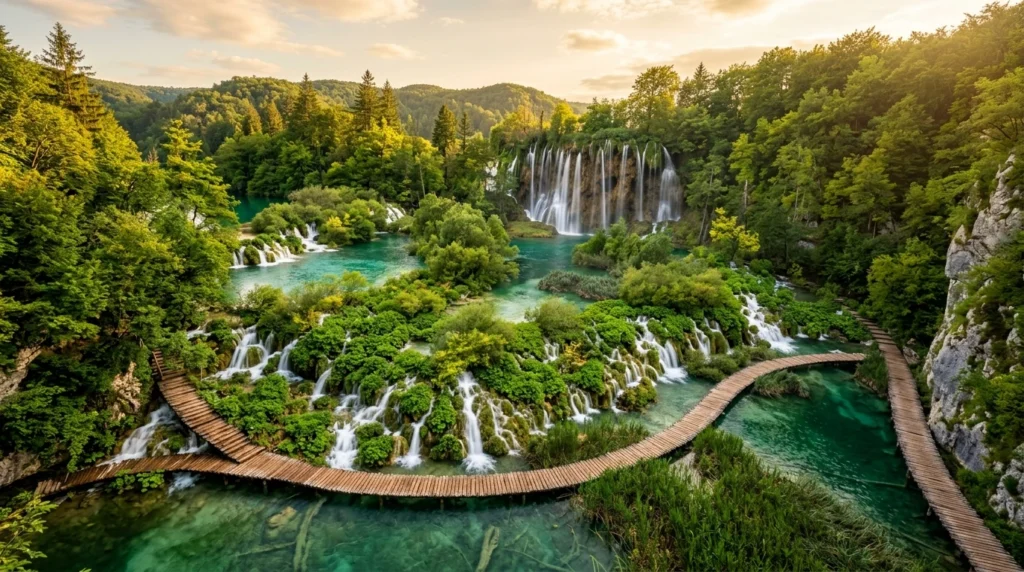
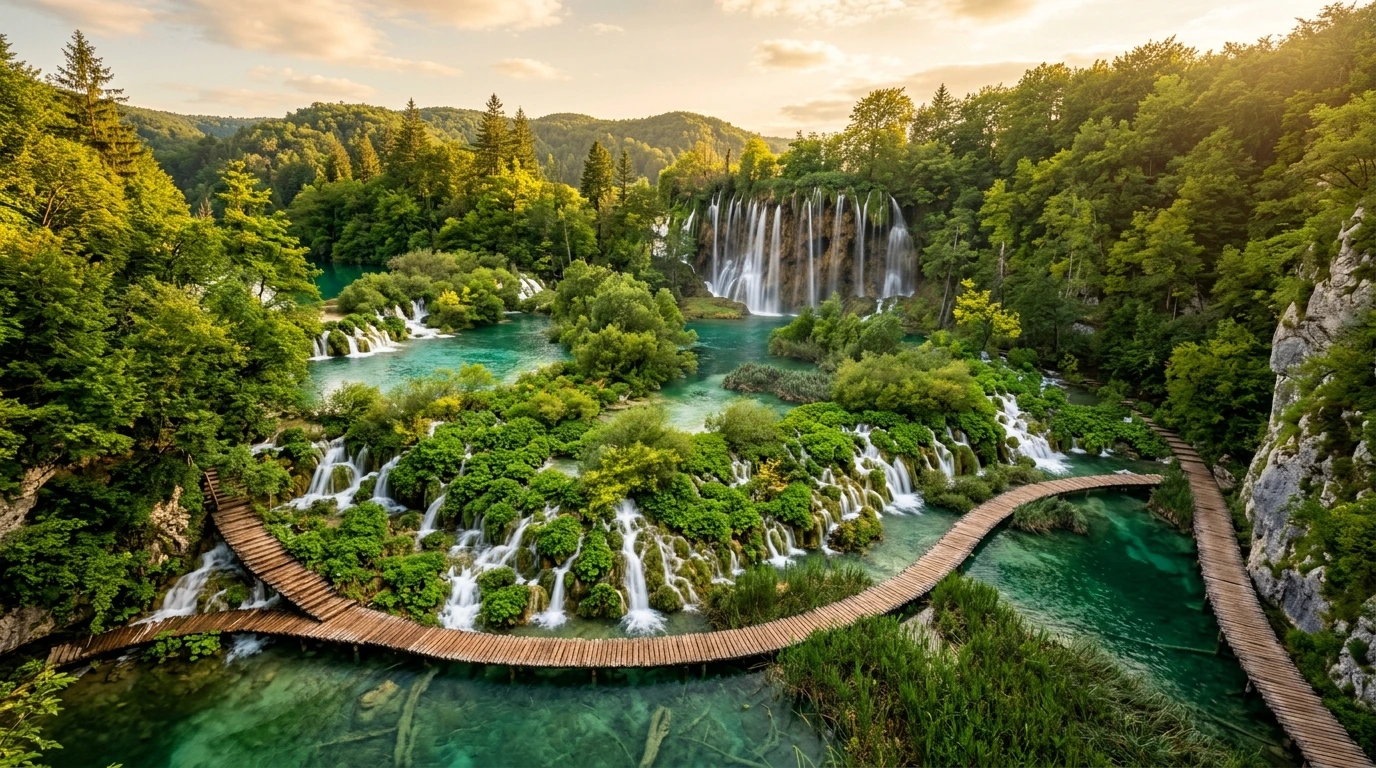
Croatia’s first national park (founded 1949) and its oldest UNESCO listing (1979) — 16 terraced turquoise lakes stitched together by 90+ waterfalls and 18 km of raised wooden boardwalks through limestone karst forest.
- Upper Lakes circuit with Veliki Slap (78 m waterfall, Croatia’s tallest)
- Boardwalks and the electric boat across Lake Kozjak, and Rastoke mill-village 30 km west
🫒 Istria (Rovinj & Pula)
Croatia’s heart-shaped north-western peninsula — culturally half-Italian, olive-oil country, truffle country, and home to one of the six best-preserved Roman amphitheatres on Earth at Pula (built 1st century AD).
- Pula Arena 1st-century Roman amphitheatre — still used for summer concerts and an August film festival
- Rovinj’s Venetian old town climbing to St. Euphemia’s basilica; Motovun and Grožnjan hill towns, and autumn white-truffle hunts in the Motovun forest
Croatian Culture & Etiquette — What to Know Before You Go
Croatian culture rewards warmth, unhurried conversation, and a quiet respect for a difficult recent past. Regional identity runs deep — a Dalmatian and a Zagorje villager see themselves as different people — but the national baseline is the same: greet everyone when you enter a small shop, don’t rush a coffee, and treat the 1991–1995 Homeland War period with care. Croatian is a South Slavic language written in the Latin alphabet (not Cyrillic).
The Essentials
- Greet with a firm handshake and direct eye contact. “Dobar dan” (good day) in shops, restaurants, lifts and taxis is expected; close friends exchange two or three cheek kisses on meeting.
- In Dalmatia, pomalo is a genuine social rule — don’t rush servers, ferry staff or market sellers. A coffee is a two-hour event, not a takeaway; a konoba dinner is a 2.5-hour sitting.
- Cover shoulders and knees when entering Catholic churches, especially Dubrovnik Cathedral, St. Mark’s in Zagreb, and the 6th-century Euphrasian Basilica in Poreč.
- Cash is still common for island konobe, foot-passenger ferries and farmers’ markets, despite near-universal card acceptance in cities. Keep €50–100 in small notes.
- Treat the Yugoslav-war period respectfully. Many Croats lost family and homes between 1991 and 1995; don’t raise politics unprompted, and avoid nostalgic Yugoslavia references unless a local leads the conversation.
Konoba Dining Etiquette
- A konoba is a family-run Dalmatian tavern with a daily set menu and a fixed service rhythm — sit, let them bring bread, olives and wine, and don’t rush.
- Peka must be ordered 3–5 hours ahead. Meat (usually lamb, veal shank or octopus) is slow-cooked under a cast-iron bell heaped with hot embers and cannot be done à la carte.
- Wine is ordered by the 0.25 L, 0.5 L or 1 L pitcher in most konobe — ask for the house vino stolno, or a regional bottle of Malvazija, Graševina, Pošip or Plavac Mali.
- Fresh fish is priced by the kilo on a chalkboard — expect the waiter to bring the whole fish to your table for approval before cooking.
A Food Lover’s Guide to Croatia
Croatian food divides more neatly than the country’s small size suggests. The Dalmatian coast — olive oil, Adriatic seafood, peka under the iron bell, Mediterranean herbs — cooks like a Venetian outpost; inland Zagorje and Slavonia — heavier, cream-and-paprika, stuffed cabbage, turkey with mlinci pasta, and cottage-cheese dumplings — cooks like Austria-Hungary. Istria in the north-west is an entire third cuisine built around truffles, fuži pasta, and Malvazija Istarska white wine; Dubrovnik’s Pelješac peninsula is wine country (Plavac Mali and Dingač reds). Bread, coffee and a two-hour lunch are universal.
Must-Try Dishes
| Dish | Description |
|---|---|
| Peka | Meat (lamb, veal, veal shank or octopus) plus potatoes, onions and herbs cooked for hours under a cast-iron bell heaped with hot embers. Order 3–5 hours ahead at a konoba; the communal feast dish of Dalmatia and a ritual more than a meal. |
| Black risotto (crni rižot) | Short-grain rice stained inky-black with cuttlefish ink, studded with squid and cuttlefish and finished with Dalmatian olive oil and parsley. Signature plate of the Dubrovnik and Hvar coastline — order it on a terrace at sunset. |
| Pršut | Air-dried, lightly smoked Dalmatian ham from the karst bora-wind regions of Drniš, Istria and Pag — Croatia’s answer to prosciutto, typically served paper-thin with Paški sir sheep’s cheese and olives. |
| Pag cheese (Paški sir) | Hard, salty sheep’s milk cheese from Pag Island, where the sheep graze on wild sage and rosemary salted by sea spray. An EU-protected designation of origin product and Croatia’s most decorated cheese at international competitions. |
| Istrian white truffles | The Motovun forest produces some of Europe’s finest white truffles from September through January — shaved over fuži pasta, scrambled eggs, or steak in konobe from Buzet to Livade. The 1999 Giancarlo Zigante truffle (1.31 kg) held a Guinness world record for a decade. |
| Štrukli | Baked or boiled cottage-cheese dumplings wrapped in a thin pasta-style dough — a Zagreb and Hrvatsko Zagorje staple, served both savoury with sour cream and sweet with sugar and walnuts. La Štruk in Zagreb Upper Town does the definitive modern version. |
| Ston oysters | European flat oysters farmed in Mali Ston Bay near Dubrovnik since Roman times — briny, meaty, and usually eaten on the wooden pontoons at Mali Ston with a glass of Pošip white wine. |
Coffee, Pekara & Burek Culture
Croatia doesn’t have konbini, but it does have the pekara. Every Croatian town has multiple bakeries open from 6am, selling burek, krafne, fritule and crescent kiflice for €1–3 a piece. Café culture, meanwhile, is a nationally protected right — Croats drink more coffee per capita than nearly any other European country and a two-hour sitting over one macchiato is completely normal. Zagreb’s špica ritual (late Saturday-morning coffee on Tkalčićeva or Bogovićeva) is a civic event.
- Chains: Mlinar (national bakery, open 6am), Pan-Pek, Konzum supermarket bakery counters — plus the supermarket chain Tommy on the coast.
- Signature items: Burek (layered filo with cheese, meat or spinach), krafne (jam-filled doughnuts, especially for Maškare Carnival), fritule (Dalmatian rum-raisin doughnut balls), kiflice crescent rolls, kremšnita layered cream cake (especially from Samobor, 20 km west of Zagreb).
At the top end, Croatia has a growing Michelin-starred scene concentrated on the coast and in Istria — restaurants like Noel (Zagreb), LD (Korčula), Monte (Rovinj) and Draga di Lovrana (Opatija) are on the Michelin Guide and pair Adriatic seafood with pristine Croatian wines from Plavac Mali and Malvazija Istarska at prices roughly half their Italian counterparts.
Off the Beaten Path — Croatia Beyond the Guidebook
Krka National Park
A quieter cousin to Plitvice, inland of Šibenik — seven travertine waterfalls on the Krka river, a 17th-century Franciscan monastery on the island of Visovac in the middle of a karst lake, and the 46-metre Skradinski Buk cascade which was the second hydroelectric site in the world to use alternating current (engineered in 1895, two days after Niagara). Reachable by electric boat from the town of Skradin. Swimming below the falls is banned as of 2021, but the walking boardwalk loop is among the best in Europe.
Mljet Island
Croatia’s most forested island, a 90-minute Krilo or Jadrolinija catamaran from Dubrovnik — a national park of two saltwater lakes with a 12th-century Benedictine monastery on a tiny island in the middle of the larger lake. In Homeric legend, Odysseus was marooned here by the nymph Calypso for seven years. It’s still a place where you can walk for an hour on a forest trail and see nobody. Rent a bike at Polače and circle Veliko Jezero in an afternoon.
Korčula
A walled medieval town on an island south of Split, sometimes called Little Dubrovnik for its circular herringbone street grid designed to channel the sea breeze. The contested alleged birthplace of Marco Polo (Korčula claims it; Venice disagrees), and the home of Croatia’s best Pošip and Grk white wines from the vineyards at Lumbarda. The Moreška sword dance has been performed here on St. Theodore’s Day since 1571.
Zagorje Castle Country
The gentle green hills north of Zagreb — Trakošćan Castle on a lake (built in the 13th century and romanticised in the 19th), Veliki Tabor on a hilltop, hot-spring spa towns at Krapinske Toplice and Tuheljske Toplice, and the world-class Krapina Neanderthal Museum at one of Europe’s richest Neanderthal archaeological sites (discovered 1899, ~900 Neanderthal fossil fragments). A perfect rainy-day inland detour from the capital.
Kornati Islands
An archipelago of 89 uninhabited islands, islets and reefs off the northern Dalmatian coast, 76 of which form a national park — bare, moonscape-white, with dramatic 80-metre vertical sea-cliffs called the Kornati “crowns.” Visited mostly by day-sailing charters out of Zadar, Murter or Šibenik. The playwright George Bernard Shaw called them “the last day of creation,” and on a calm August afternoon under sail, you’ll see exactly why.
Practical Information
| Currency | Euro (€ / EUR), adopted 1 January 2023; 1 USD ≈ 0.94 EUR (April 19, 2026) |
| Cash needs | Cards work everywhere in cities and serious restaurants, but many island konobe, farmers’ markets, foot-passenger ferries and remote national-park kiosks are still cash-first. Keep €50–100 in small notes. |
| ATMs | Bankomati ubiquitous at Zagrebačka banka, PBZ and Erste branches. Decline dynamic currency conversion and always choose to be charged in euros for the interbank rate. |
| Tipping | Not automatic — round up 5–10% for restaurant bills. Cafés: leave the coin change. Taxis and Uber/Bolt: round up the fare. |
| Language | Croatian (hrvatski), a South Slavic language written in the Latin alphabet — NOT Cyrillic. English is widely spoken under 40 and in tourism; German and Italian are common on the coast. Learn “Dobar dan” (hello), “Hvala” (thank you), “Molim” (please), “Račun molim” (the bill, please). |
| Safety | Very safe — 2024 Global Peace Index rank 14, one of the safest countries in Europe. Petty pickpocketing at Zagreb Glavni Kolodvor, Dubrovnik Pile Gate in August, and crowded Split ferry ports is the main risk. |
| Connectivity | 4G/5G blanket coverage from A1, Hrvatski Telekom (T-Mobile HR) and Telemach. eSIMs (Airalo, Holafly) work nationwide from the moment you land. |
| Power | Type F (Schuko) plugs; 230V / 50 Hz. |
| Tap water | Tap water is safe and genuinely excellent nationwide — Zagreb’s mountain-spring supply from Sljeme is some of the best in Europe. |
| Healthcare | EU-standard public hospitals; EHIC cards work for EU visitors, others need travel insurance. Ljekarna green-cross pharmacies are on every high street and rotate a 24/7 duty roster. |
Budget Breakdown — What Croatia Actually Costs
💚 Budget Traveller
Hostels (Swanky Mint in Zagreb, Tchaikovsky in Split, Hostel Angelina in Dubrovnik), sobe (private rooms in family homes), Konzum and Tommy supermarket stops, and foot-passenger catamarans between islands instead of car ferries. Doable at €55–85 per day (~US$55–90), with inland Zagreb and Slavonia the cheapest regions and Dubrovnik Old Town the most expensive. A pekara burek breakfast is under €3, a konoba fixed-menu lunch is €10–14, and a market-fresh picnic on a ferry deck costs under €8.
💙 Mid-Range
3-star hotel or a coastal apartman rental, one konoba dinner and one café or bakery meal per day, catamaran or car-ferry island legs, and a couple of paid sights (Dubrovnik city walls: €35 in 2024, Plitvice Lakes day pass: €40 in peak season, Diocletian’s Palace cellars: €8). Plan €130–200 per day (~US$140–220). Dubrovnik Old Town in August pushes the top of that range; everywhere else in Croatia settles comfortably at €140.
💜 Luxury
5-star hotels (Hotel Excelsior Dubrovnik, Le Méridien Lav Split, Esplanade Zagreb, Monte Mulini Rovinj), private transfers, Michelin-recommended tasting menus with paired Malvazija and Pošip, and a crewed sailing charter for 3–5 days through the Dalmatian archipelago. Plan €420+ per day (~US$450+). A Michelin-recommended Istrian truffle tasting with wine pairings is about €130 per person; a three-day crewed gulet cruise from Split runs €1,800+ per person in peak summer and drops nearly 40% in September.
| Tier | Daily (USD) | Accommodation | Food | Transport |
|---|---|---|---|---|
| Budget | $55–90 | Hostel €20–35 / sobe €40–65 | €15–25/day | Intercity bus €10–25 + city day pass €3–5 |
| Mid-Range | $140–220 | 3-star hotel / apartman €90–160 | €40–65/day konoba meals | Catamaran €10 + car ferry from €50 |
| Luxury | $450+ | 5-star hotel €300–700+ | €120–250/day | Private transfer + sailing charter from €400/day |
Planning Your First Trip to Croatia
- Pick your coast or the capital. Dalmatia (Split–Hvar–Dubrovnik) is the classic summer trip; Istria (Rovinj–Pula–Motovun) is food-and-truffle-focused; Zagreb + Plitvice is the inland shoulder-season route. Two regions fit in 10 days.
- Fly open-jaw. Land in Zagreb (ZAG) for inland or Istria, Split (SPU) for central Dalmatia, Dubrovnik (DBV) for the south — and fly out of the opposite end.
- Book Dubrovnik and Hvar 6+ months ahead for July and August. Old Town Dubrovnik has strict capacity controls on cruise-ship days, and Hvar Town hotels sell out for the Dubrovnik Summer Festival window (10 July – 25 August 2026).
- Plan ferry legs around Jadrolinija and Krilo. Reserve car ferries 1–2 months ahead in summer; foot-passenger catamarans (Split–Hvar, Split–Korčula) are same-day for €7–10.
- If renting a car, budget for road tolls. Croatian motorways are fully tolled — Zagreb–Split on the A1 is roughly €27 one-way, paid at the booth.
Classic 10-Day Itinerary: Days 1–2 Zagreb (Upper Town, Dolac, Museum of Broken Relationships) · Day 3 Plitvice Lakes + drive south · Day 4 Zadar + Krka Waterfalls · Days 5–6 Split (Diocletian’s Palace, Marjan, konoba dinners) · Day 7 Hvar catamaran day · Days 8–9 Korčula stop-over · Day 10 Dubrovnik Old Town walls at dawn.
Cities & Regions to Explore
Frequently Asked Questions
Is Croatia expensive to visit?
Cheaper than Italy or France on the same coast; roughly on par with Slovenia or Greece. Budget travellers get by on €55–85/day with hostels, sobe rooms and pekara food; mid-range travellers plan €130–200/day. Dubrovnik Old Town in August is Croatia’s one genuinely expensive spot — nearly double the rest of the country. Zagreb, Zadar and inland Istria are the affordable alternatives.
Do I need to speak Croatian?
No. English works almost everywhere among under-40s and in tourist-facing businesses. Croatian is a South Slavic language written in the Latin alphabet (not Cyrillic), so you can at least read signs and menus phonetically. A little Croatian goes a long way: “Dobar dan” (hello), “Hvala” (thank you), “Molim” (please), “Račun molim” (the bill, please). German and Italian are common on the coast, especially in Istria.
Is the Split–Dubrovnik train worth it?
There is no Split–Dubrovnik train — the Croatian rail network only runs Zagreb–Split and Zagreb–Rijeka on the main lines. Between Split and Dubrovnik, use the coastal bus (~4h 30m, passing briefly through Bosnia-Herzegovina’s Neum corridor) or the Krilo catamaran (~4h 30m with a Korčula or Mljet stop). For Zagreb–Split, the InterCity train is ~6 hours and cheaper than renting a car with tolls.
Is Croatia safe for solo travellers?
Extremely — Croatia ranks 14th in the 2024 Global Peace Index, one of the safest countries in Europe, and violent crime against visitors is very rare. Solo women report feeling comfortable on urban transit and ferry decks late at night. The main risks are petty pickpocketing at Zagreb Glavni Kolodvor, Split ferry ports in August, and Dubrovnik Pile Gate in peak season.
When is Adriatic peak season?
Mid-June through mid-September, with the absolute peak late July through mid-August. Dubrovnik Summer Festival runs 10 July – 25 August 2026, and Ultra Europe Split takes over in mid-July. For the same sea temperatures at 30–40% lower prices, travel the shoulders: the last two weeks of June and the first two weeks of September.
Can I get by as a vegetarian or vegan?
Yes in Zagreb, Split, Rovinj and Dubrovnik — dedicated vegan restaurants and plant-forward menus have grown fast since 2019. On small islands and in rural konobe, plant-based thins out; soparnik (Swiss-chard pie), fuži with truffles, grilled vegetables and paški sir (sheep’s cheese) are reliable fallbacks on classic menus.
Was Dubrovnik really King’s Landing in Game of Thrones?
Yes — Dubrovnik’s walled Old Town doubled as King’s Landing from Season 2 (2012–2019), and official GoT walking tours leave daily from Pile Gate. Filming boosted tourism so intensely that the city now caps daily visitors on cruise-ship days to protect the UNESCO-listed Old Town. Visit at dawn or late evening for the quietest walls.
Ready to Explore Croatia?
Croatia rewards travellers who pick one coastal region, fly open-jaw, book Dubrovnik and Hvar 6 months ahead, and let pomalo do the rest. Start in Zagreb for the inland capital, Split for Diocletian’s Palace and the island catamarans, or Dubrovnik for the walls and King’s Landing.
Explore More
Cities we cover in Croatia
Cities to explore in Croatia
Deep-dive guides to specific cities, neighbourhoods, and food scenes — written with the same magazine voice.

More country guides you might like

Plan your trip to Croatia
The booking tools we use ourselves. FFU may earn a commission at no extra cost to you.
Plan & book your trip to Croatia
Booking through these searches supports our guides at no extra cost to you.