

Dubrovnik, Croatia: Limestone Walls, the Adriatic, and the Pearl of the Sea
Part of our Croatia travel guide.
Dubrovnik City Guide
What’s Happening in Dubrovnik Right Now · Updated June 22, 2026
Peak Adriatic Season — and the 77th Summer Festival Lands July 10
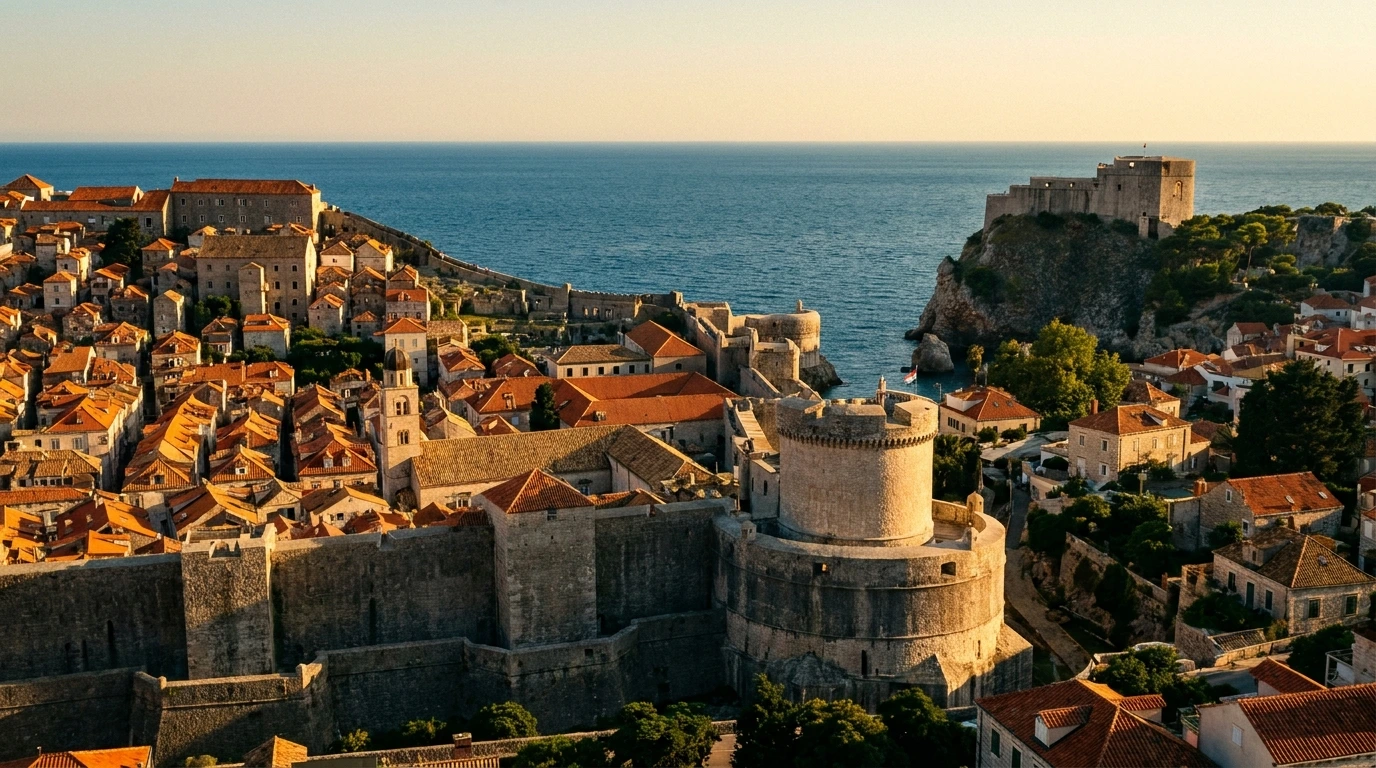
Dubrovnik is at full summer tilt: warm Adriatic swims, golden light on the limestone ramparts, and a marble Stradun best walked early or late. From July 10 to August 25, the 77th Dubrovnik Summer Festival (Dubrovačke ljetne igre) turns the Old Town itself into a stage — more than 70 theatre, classical-music and dance performances across 20-plus historic venues, many open-air beneath the walls. Below: how to walk the city walls before the cruise crowds arrive, when to book festival tickets, and the konobas worth the climb.
Source: Dubrovnik Summer Festival — official
Cinematic aerial of Dubrovnik (8s).
Table of Contents
Why Dubrovnik?
Dubrovnik is the rare small city — roughly 41,500 residents inside a coastal municipality — that stops you at first sight and then keeps earning the reaction for the next four days . Byron’s nineteenth-century “Pearl of the Adriatic” has become a marketing cliché, but the geography that produced it is genuinely improbable: a walled limestone city of about 10 square kilometres perched on a rocky promontory, its Old Town ringed by a continuous 1,940-metre defensive wall up to 25 metres high, built from the 13th through the 16th centuries and never once breached by a besieging army . UNESCO has listed the Old Town since 1979, and the 1991–1992 Yugoslav People’s Army shelling — which damaged two-thirds of the roofs — did not take the walls down .
The city reads as a series of contradictions you learn to hold at once. It is the ancient seat of the Ragusan Republic — a maritime aristocratic city-state that negotiated its independence from Venice, the Ottomans and Napoleon for 450 years — and it is the on-screen capital of King’s Landing from Game of Thrones seasons 2–8, with Fort Lovrijenac standing in as the Red Keep and the Jesuit Stairs as Cersei’s Walk of Shame. It is a tiny city — the Old Town is a 20-minute walk end-to-end — that absorbs more than a million cruise passengers each summer and is now aggressively capping them at two ships and 5,000 passengers per day since 2019 . It is a Croatian Catholic city that still eats like a Venetian one, and a Schengen-eurozone member (both since 1 January 2023) whose border posts to Bosnia and Montenegro sit 30 minutes up the road on either side .
The density of what you can do in 48 hours is unusual for a city of this size. You can walk the full wall circuit in two hours; ferry to Lokrum island in ten minutes; ride a cable car to the 412-metre Mount Srđ for a sunset panorama of the red-tiled roofs; eat European flat oysters pulled that morning from Mali Ston Bay; day-trip across a non-Schengen border to Mostar or Kotor; and close the evening with a drink at a “Buža” bar drilled through the Old Town wall onto an Adriatic rock terrace — all inside a UNESCO-listed footprint smaller than most airport terminals. This guide covers the nine neighbourhoods you will actually walk, the Dalmatian dishes and konobe worth an hour of your day, the Ragusan-era sights priced and timed for real-world visits, the five day trips locals themselves take — Lokrum, Cavtat, the Elafiti, Mostar and Kotor — and the practical realities of cruise-ship crowding, Old Town stair fatigue, and the Schengen border rules that govern every cross-border day trip from the Pearl of the Adriatic.
Neighborhoods: Finding Your Dubrovnik
📍 Dubrovnik Map: Every Place in This Guide
Dubrovnik is administratively divided into 32 local committees, but travellers effectively cycle through ten distinct zones — the walled Old Town (Stari Grad) and its immediate gates at Pile and Ploče; the residential peninsulas of Lapad and Babin Kuk; the working port at Gruž; the southern coastal villages of Srebreno, Mlini and Cavtat; the offshore Elafiti islands; and the 412-metre summit of Mount Srđ looming behind it all . Each one has a distinct rhythm, a different base price for coffee, and its own best-for-whom shorthand. First-timers gravitate to the Old Town and Pile for proximity to the walls and Stradun; returning visitors trade that for the lower price and lower cruise-ship density of Lapad, Cavtat, or the Elafiti. Accommodation rates, restaurant pricing, and the density of English-language menus track distance from Pile Gate — noticeably cheaper and more Croatian at a 15-minute bus ride than at a 5-minute walk.
Old Town (Stari Grad)
The walled 13th–17th-century Ragusan city, paved in limestone polished by six centuries of footfall. The Old Town is entirely pedestrianised and entirely on stairs — the main boulevard Stradun runs flat for 300 metres between Pile and Ploče gates, but every alley sideways climbs 10–20 steps at a time up the slope. The post-1667-earthquake uniform Baroque gives the streetscape its cohesion; the walls give it its silhouette; and the 1991–1992 siege (visible in the lighter-toned replaced roof tiles) gives it its modern civic memory . Expect the densest crowds in Dubrovnik, especially on Stradun and Prijeko between 10:00 and 15:00 on cruise-ship days.
- Stradun (Placa) — the 300-metre limestone main boulevard, paved in its current form after 1667
- Sponza Palace (1522) and the 15th-century Rector’s Palace on Pred Dvorom square
- Franciscan Monastery with Europe’s third-oldest functioning pharmacy, dispensing since 1317
- Onofrio’s Large Fountain (1438) inside Pile Gate
- Dubrovnik Cathedral, the Treasury, and the reliquaries of St. Blaise
Best for: first-time visitors, architecture walkers, Game of Thrones fans, anyone who wants to wake up already inside the walls. Access: Pile Gate (west) or Ploče Gate (east); Libertas city bus 1A/1-B, 3 or 8 from the bus station to Pile.
Pile (Pile Gate & the Western Approach)
The western threshold to the Old Town and Dubrovnik’s de facto transit hub — every city bus terminates at Pile, every taxi rank centres on Pile, and Fort Lovrijenac looms across the cove at the end of Pile Bay. The square immediately outside Pile Gate (Brsalje) is ringed with cafés that charge Old Town prices for a view of the drawbridge and the 1438 Onofrio’s Fountain beyond it. Most walking tours begin here, most cruise-ship shuttles arrive here, and the afternoon queue to enter the walls snakes back from the Pile Gate ticket office.
- Fort Lovrijenac — 37-metre sea-rock fortress inscribed with “Liberty is not sold for all the gold in the world”
- Bokar Fort on the seaward city walls, directly across the cove from Lovrijenac
- Pile Bay swimming cove beneath the fortress (free, pebble)
- Libertas city bus terminus and the main taxi rank
Best for: arriving travellers, photographers hunting the classic walls-from-the-sea shot, anyone on a tight connection. Access: All Libertas city bus lines 1A/1-B, 3, 8 terminate at Pile; airport shuttle (Atlas) drops here.
Ploče
The Old Town’s quieter easterly neighbour — boutique five-star hotels, Banje Beach, and the 16th-century Lazareti quarantine buildings now reimagined as a cultural complex with concerts and film nights. Ploče is where you stay if you want the Old Town at a 5-minute walk but not at a 5-metre distance; it is also the start point for the “clockwise” city-walls route that most guidebooks recommend, and the lower cable-car station for Mount Srđ sits a 10-minute walk uphill. Banje Beach, with its view of Lovrijenac across the Old Port, is the closest proper swimming beach to the walls.
- Banje Beach — pebble beach with the Old Town-walls view, paid loungers and free zone
- Lazareti — 16th-century quarantine buildings, now a cultural centre hosting festival performances
- Hotel Excelsior and Hotel Argentina — the city’s two historic five-star waterfront hotels
- Museum of Modern Art Dubrovnik (Put Frana Supila 23) — Ragusan-era villa with a seafront sculpture garden
Best for: couples, boutique-hotel travellers, early-morning wall walkers who want to start clockwise at Ploče Gate. Access: Ploče Gate (east Old Town entrance); Libertas bus 1A/1-B, 3 — Ploče stop.
Lapad
A leafy 3 km-west peninsula where locals actually live, Lapad is the city’s apartment-holiday hub, its main swimming strip, and its pedestrianised dinner promenade. Šetalište kralja Zvonimira runs flat and car-free for 500 metres down to Lapad Bay, with a spine of mid-priced restaurants, ice-cream shops and live-music bars that fill with families in July and August. This is the Dubrovnik travellers come back to on a second or third visit — half the price of the Old Town, direct bus access in 10–15 minutes, and a swimmable bay at the end of each day. Hotels stretch from 3-star apartment towers to the 5-star Hotel Dubrovnik Palace anchoring the peninsula’s southwestern edge.
- Lapad Bay (Uvala Lapad) — the main pebble swimming bay, shallow and family-friendly
- Šetalište kralja Zvonimira — pedestrian dinner promenade with 20+ restaurants and bars
- Sunset Beach and Copacabana Beach on the western edge of the peninsula
- Hotel Kompas and Hotel Dubrovnik Palace — 4- and 5-star peninsula anchors
Best for: families, week-long apartment stays, travellers who want a swim every afternoon and half the cruise-crowd density. Access: Libertas bus 4 or 6 from Pile (~10–15 minutes).
Babin Kuk
The northwestern resort peninsula adjoining Lapad, Babin Kuk is Dubrovnik’s 1970s-era package-holiday heart — pine forest, big Yugoslav-era hotel complexes now renovated under Valamar and Tirena branding, and quieter coves on the west side than you’ll find on the Lapad strip. Cave Bar More inside Hotel More is a genuine natural sea cave fitted out as a cocktail bar (a Dubrovnik set-piece most cruise passengers miss because it’s a 20-minute bus ride from Pile). Copacabana Beach on the peninsula’s north side is the flattest, sandiest-bottomed, most family-friendly swimming spot in the city.
- Cave Bar More — a cocktail bar inside a natural sea cave at Hotel More
- Copacabana Beach — shallow, family-friendly, the flattest-entry swimming beach in Dubrovnik
- Park Orsula viewpoint on the walk south toward Gruž
- Valamar Lacroma, Tirena and Argosy resort cluster
Best for: families with small kids, all-inclusive resort stays, travellers who like cave-bar sunset drinks. Access: Libertas bus 7 or 8 from Pile (~20 minutes).
Gruž
The working port and ferry terminal 2.5 km northwest of the Old Town — cruise ships, Jadrolinija and Krilo catamarans, the Dubrovnik Main Bus Station (Autobusni kolodvor), and the morning Gruž Market are all clustered here. It is grittier than the rest of Dubrovnik, much cheaper for groceries and fish, and is increasingly where locals suggest you eat — the Gruž waterfront has a rising scene of small seafood restaurants that the cruise-ship day-trippers never reach. The Franjo Tuđman Bridge (the cable-stayed bridge you see from the port) makes the whole Gruž basin feel modern-industrial rather than medieval.
- Gruž Port — cruise terminal and domestic Jadrolinija / Krilo ferry berths
- Dubrovnik Main Bus Station (Autobusni kolodvor) — intercity coaches to Split, Mostar, Kotor, Zagreb
- Gruž Market (07:00–12:00) — the city’s proper fish, produce and cheese market
- Franjo Tuđman Bridge — the modern cable-stayed bridge crossing the port mouth
Best for: arrivals and departures, early-ferry days, budget travellers staying outside the walls. Access: Libertas bus 1A/1-B, 3, 8 from Pile (~10 minutes); Jadrolinija and Krilo catamarans dock here.
Srebreno & Mlini (Župa Dubrovačka)
A coastal village strip 10 km southeast of the Old Town, Srebreno and Mlini form a quieter overnighting alternative for travellers with a rental car. The Sheraton Dubrovnik Riviera anchors Srebreno, and a pedestrian seaside promenade runs the full length of Srebreno Bay. Mlini’s stream-fed mill streams feed tiny waterfalls into the Adriatic at the village centre. Ten minutes further south lies Kupari — an abandoned Yugoslav-era military resort whose skeletal concrete hotels are a surprising offbeat photo stop and (as of 2026) still awaiting their promised redevelopment.
- Srebreno beach promenade — the pedestrian bayfront walk
- Sheraton Dubrovnik Riviera Hotel and the Valamar Argosy
- Mlini village and its old mill streams feeding the Adriatic
- Kupari — abandoned Yugoslav-era military hotel complex (offbeat photo stop)
Best for: calmer overnighters with a rental car, airport-day stays, families priced out of the Old Town. Access: Libertas bus 10 from Pile (~30 minutes); 10 km southeast on the Jadranska Magistrala coastal road.
Cavtat
A palm-lined Baroque fishing town 17 km south of Dubrovnik toward the airport — quieter, cheaper, and home to the Ivan Meštrović–designed Račić Family Mausoleum (1921) on the hill above the harbour. Cavtat is the original Greek Epidaurus, settled in the 6th century BC; the present old town dates largely from the 15th-century Ragusan period after the original Epidaurus was sacked. The pedestrian waterfront Riva is a 20-minute strolling loop around the peninsula. Water taxis to Dubrovnik Old Town run every 30–60 minutes in summer, making Cavtat a practical second base for travellers who want a Dubrovnik trip without Dubrovnik prices.
- Cavtat old-town waterfront (Riva) — pedestrianised peninsula loop
- Račić Family Mausoleum (Ivan Meštrović, 1921) — cypress-framed hilltop chapel on St. Roko hill
- Vlaho Bukovac House — the Croatian painter’s birthplace-museum (1855–1922)
- Water taxis to Dubrovnik Old Town — roughly 45 minutes, €15 one-way
Best for: travellers who want the airport close and the cruise crowds far, anyone planning a quieter second base. Access: Libertas bus 10 from Pile (~40–50 minutes, €5–6); water taxi to Old Town in summer.
Elafiti Islands (Koločep, Lopud, Šipan)
Three car-free green islands just northwest of Dubrovnik, strung out along the coast . Koločep (15 minutes out) is the closest; Lopud (45 minutes) has the only real sandy beach in Dalmatia at Šunj Bay; Šipan (over an hour) is the largest and agricultural, with 15th-century Ragusan summer villas at Suđurađ and Sipanska Luka. Jadrolinija scheduled ferries from Gruž Port are the cheapest way out — €5–8 each way — and day-trip charter boats from the Old Port package all three islands with lunch and wine-tasting into a single sunrise-to-sunset run. None of the three has a car, which makes walking or cycling the entire point.
- Lopud’s Šunj Bay — one of very few genuine sand beaches in Dalmatia
- Koločep’s sea caves and coastal walking trail around the island
- Šipan’s 15th-century Skočibuha summer villas at Suđurađ
- Jadrolinija car-and-passenger ferry 9807 from Gruž Port
Best for: day-trippers, swimmers, cyclists, anyone who wants one car-free day. Access: Jadrolinija ferry from Gruž Port (~25 min to Koločep, 45 min to Lopud, 1h 10m to Šipan).
The Food
Dubrovnik eats like a coastal hybrid — half Dalmatian konoba (the Croatian Mediterranean home-cooking idiom of slow-braised meats, grilled whole fish, Pelješac and Korčula wines by the carafe, and a cast-iron baking bell at the back of the kitchen), half Ragusan Renaissance (candied oranges, rose flan, and 700-year-old monastic pharmacy recipes that outlived the republic that invented them). The city’s three headline dishes are black risotto stained with cuttlefish ink, European flat oysters from the Mali Ston bay 50 km north , and peka — lamb, veal or octopus slow-cooked under a cast-iron bell buried in coals, always ordered 3 to 5 hours ahead of the meal . Prices inside the walls run noticeably above the Croatian norm, especially on Stradun and Prijeko; step one street inland to Zamanjina, Antuninska, Palmotićeva or Kunićeva, or one Libertas-bus ride out to Gruž or Lapad, and the same plate lands 20 to 40 percent cheaper for identical fish, identical wine and identical konoba service. The city’s restaurant density is also unusual for its size — the Old Town alone holds more than 100 licensed restaurants and konobe in about 10 hectares, which is roughly one restaurant per 1,000 square metres of walled city.
Dalmatian Seafood & Black Risotto (Crni Rižot)
Black risotto — short-grain Arborio or Vialone Nano rice stained inky black with the ink sac of cuttlefish, studded with chopped cuttlefish and squid, and finished with Dalmatian olive oil and parsley — is on almost every Old Town menu, but price and quality swing wildly. A Dubrovnik black risotto done properly is not a paella and not a squid-ink pasta sauce; the rice is cooked in fish stock rather than wine, stirred constantly, and the ink is added near the end so the grains are evenly black but still al dente. The city is also surrounded by grilled-whole-fish konobe where the fish is sold by the kilo and carried to your table for weighing before cooking. A competent black risotto in 2026 runs €22–28 per plate; a dinner of grilled whole sea bream or sea bass plus green salad plus a half-litre of house wine sits between €35 and €55 per person at a mid-priced konoba inside the walls, and €55–80 per person at the higher-end Stradun restaurants. Adriatic fish commonly served in Dubrovnik include orada (sea bream), brancin (sea bass), zubatac (dentex), lignje (squid) and cipal (grey mullet).
- Proto Fish Restaurant — black risotto and grilled Adriatic whole fish, opened 1886 on Široka ulica and one of the oldest continuously operating restaurants in the Old Town (€28–45, ~$30–48)
- Kopun — candied-orange capon (kopun) and seafood pasta on Poljana Ruđera Boškovića with a terrace view of St. Ignatius Church and the Jesuit Stairs (€22–36, ~$23–38)
- Lokanda Peskarija — grilled squid, fried anchovies, mussels buzara and octopus salad on the Old Port quay; shared plates, unreserved tables, and the single busiest casual seafood spot in the walls (€12–22, ~$13–23)
- Nautika — fine-dining sea bass tasting menu beside Fort Lovrijenac with Pile Bay views, favoured by visiting heads of state since the 1990s (€80–150, ~$85–160)
- Restaurant Dubrovnik — elevated Old Town rooftop on Marojica Kaboge street, black risotto and grilled turbot (€40–70, ~$43–75)
Oysters & Peka
The Mali Ston Bay — a 50 km drive north of Dubrovnik at the root of the Pelješac peninsula — has farmed European flat oysters (Ostrea edulis) since Roman times and is considered among the most prized oyster grounds in the Mediterranean . The bay’s shellfish culture is so old that Ragusa’s 14th-century Statutes already regulated it with written conservation rules. Unlike the more common Pacific rock oyster (Magallana gigas) that dominates most European oyster menus, the Mali Ston variety is the native European flat — meatier, brinier, and slower-growing, harvested between October and April. The Ston oyster festival falls on 19 March each year, marking the feast day of St. Joseph, and is the one day locals queue alongside tourists at the waterfront pontoons. Peka — lamb, veal, veal shank or octopus cooked for three hours under a cast-iron bell (peka, also spelt “ispod peke”) heaped with hot coals — is the other Dubrovnik signature; it must be ordered by phone 3–5 hours ahead, requires a minimum of two diners , and cannot be produced à la carte. The bell traps steam and smoke, basting the meat in its own juices while slowly caramelising the potatoes underneath.
- Bota Šare (Mali Ston) — raw oysters straight from the family’s own farm, pontoon seating over the bay, €2 per oyster (€24 for a dozen, ~$26)
- Konoba Kapetanova kuća (Mali Ston) — raw Ston oysters, mussels buzara, and black risotto in a 16th-century sea-captain’s house at the Ston waterfront (€22–40, ~$23–43)
- Konoba Dubrava (Mount Srđ road) — veal or octopus peka under the bell — minimum 3 hours ahead, 2-person minimum, picnic-style long-table seating (€28–38 per person, ~$30–40)
- Konoba Konavoski dvori (Konavle) — trout peka and lamb under the bell at an old mill-stream complex 25 km southeast of the city in the Konavle region (€30–42, ~$32–45)
- Villa Ruža (Koločep, Elafiti) — island peka on the first Elafiti island, usually paired with a day boat from the Old Port (€35–50, ~$38–54)
Beyond Black Risotto and Peka
Beyond the two headline dishes, Dubrovnik’s food map takes in Dalmatian cured ham, Ragusan-era orange-and-almond desserts, the famously steep-slope Pelješac reds, an unusually Italian-leaning pasta tradition for a Croatian city, and a dessert culture anchored by rose water and candied citrus peel. These are the plates you will see chalked on konoba blackboards if you read past the glossy English-language tourist menu and ask what the kitchen is actually cooking that day. Many of these dishes trace directly to the Ragusan Republic’s Mediterranean trade networks — Ragusan ships were crossing from the Levant to the Atlantic in the 15th and 16th centuries, and they brought citrus, almonds, rose water, sugar and North African spices home in commercial quantities long before those ingredients were common in the rest of the Croatian interior. The result is a city where Dalmatian home cooking and a distinctly Mediterranean-trading cuisine sit on the same menu, often in the same dish.
- Pršut — Dalmatian air-dried ham from the bora-wind karst country of Drniš and Pag, served paper-thin with Pag sheep’s cheese and oil-cured olives (€15–22 starter plate)
- Rozata — Dubrovnik’s signature rose-water caramel flan, on every konoba dessert list, and a direct ancestor of crème caramel by way of Ragusan trade with France (€5–8 per serving)
- Šporki makaruli — “dirty macaroni” — thick tube pasta in slow-cooked beef ragù, traditionally eaten on St. Blaise’s Day on 3 February and now a year-round Old Town konoba staple (€14–20 per plate)
- Dingač & Plavac Mali — full-bodied Pelješac red wines grown on near-vertical slopes above the sea; the Plavac Mali grape is a confirmed genetic parent of California Zinfandel (€40–90 per bottle at a konoba)
- Arancini — candied orange peel slow-cooked in sugar, a Dubrovnik monastic confection still sold at the Mala Braća pharmacy shop inside the Franciscan Monastery (€5–8 per bag)
- Brudet — the Dalmatian fisherman’s tomato-based stew of mixed white fish, garlic, onion and wine vinegar, always served with polenta to soak the broth (€18–28 per plate)
- Pašticada — slow-braised beef in red wine with gnocchi, Dalmatia’s Sunday-lunch dish, marinated 24 hours ahead (€22–30 per plate)
Food Experiences You Can’t Miss
- Take the short drive or Libertas bus 15 up the Pelješac road to Mali Ston and eat raw European flat oysters on a wooden pontoon directly over the bay where they were farmed an hour earlier — bring a lemon and a glass of Pošip white
- Phone Konoba Dubrava before 11:00 to reserve a peka, then ride the Mount Srđ cable car up for a late lunch when the bell is lifted off the coals in front of your table with a flourish of smoke
- Visit Gruž Market on a Saturday morning (07:00–12:00) for fresh Adriatic fish, Pag cheese, Istrian olive oil, Korčula Grk and Pelješac Plavac Mali wine, and the local gossip — all hours before the Old Town restaurants have even opened
- Drive or join a half-day tour to the Pelješac peninsula for a Dingač and Plavac Mali tasting at a family winery in Potomje or Dingač village; the vineyards climb so steeply that grapes are still carried downhill by hand, not machine
- Eat inside the walls at a konoba on Prijeko street, but sidestep the aggressive tout menus in English in favour of a place with a Croatian-language chalkboard and the day’s fish priced by the kilo and shown to you before cooking
- Visit the Franciscan Monastery pharmacy shop (operating since 1317) and buy a tin of candied orange arancini or a jar of rose cream made to a Ragusan-era recipe that pre-dates the United States by 459 years
Cultural Sights
Dubrovnik’s Old Town is itself one big UNESCO-listed cultural sight (inscribed 1979), but eight specific sites make up the essential itinerary — all inside, on, or ten minutes off the walls. Admission prices below are 2026 rates; most are covered by the Dubrovnik Pass.
City Walls of Dubrovnik (Gradske zidine)
The 1.94-kilometre walled circuit is Dubrovnik’s single defining monument — a continuous walk around the Old Town at rooftop height, built between the 13th and 16th centuries, with five main bastions (Minčeta, Bokar, Revelin, St. John’s and Lovrijenac) and three gates, reaching 25 metres high at their tallest section on the landward side . The walls have never been breached by a besieging army and they survived the December 1991 Yugoslav People’s Army siege largely intact, even as roughly two-thirds of the Old Town roofs beneath them took damage. Founded 13th century. Admission €40 adult summer, €20 off-season (1 Nov–31 Mar). Hours 08:00–19:30 summer; 09:00–15:00 winter. Enter at Ploče gate and walk clockwise with the sun behind you for photos, and allow at least 90 minutes for the full loop with stops.
Stradun (Placa)
The 300-metre main boulevard of the Old Town, running arrow-straight from Pile Gate to Ploče Gate and paved in limestone slabs polished to a near-mirror finish by more than six centuries of footfall . Paved in its current form after the devastating April 1667 earthquake that levelled most of the medieval city and killed an estimated 5,000 Ragusans, Stradun is lined with three-storey uniform Baroque merchant houses (rebuilt to a single height-controlled streetscape in the decades after the quake) and terminates at each end with a fountain — Onofrio’s Large Fountain at Pile, the smaller Onofrio’s Little Fountain at Ploče. Founded 14th century, paved in current form 1667. Admission free. Hours always open (pedestrianised). Walk Stradun at dawn for empty, wet-reflective stone, or at 22:00 in summer when the Old Town softens.
Rector’s Palace (Knežev dvor)
Seat of the elected Rector of the Ragusan Republic, who served exactly one month and was constitutionally forbidden to leave the palace during his term — a built-in check against accumulated personal power that kept Ragusa stable for 450 years . Rebuilt three times after earthquakes in 1435, 1520 and 1667, today the palace houses the Cultural-Historical Museum with reconstructed period rooms, the Rector’s throne, and a Baroque atrium that doubles as a Dubrovnik Summer Festival stage. Founded in its present form 15th century. Admission €15 adult (included in the Dubrovnik Pass). Hours 09:00–18:00 summer; 09:00–16:00 winter. Visit the atrium for free even without a ticket if you catch a festival rehearsal.
Sponza Palace
A Gothic-Renaissance palace designed by Paskoje Miličević and completed in 1522, Sponza once housed the Ragusan customs house, mint, treasury and state archive in a single purpose-built building — the administrative spine of the republic and one of very few major Old Town buildings to survive the 1667 earthquake intact . The ground-floor Memorial Room of the Defenders of Dubrovnik, a free-access chamber, honours the roughly 200 residents killed in the 1991–1992 siege with photographs, birth dates, and age-at-death carvings. Founded 1522. Admission free entry; Memorial Room free. Hours 10:00–22:00 summer. A rare genuinely free Old Town interior — read every defender’s photograph before leaving.
Franciscan Monastery & Pharmacy (Mala Braća)
The third-oldest continuously operating pharmacy in Europe, dispensing from Ragusan herbal recipes — rose cream, almond oil, arancini candied orange peel — since 1317 . The monastery’s Romanesque cloister, carved by the 14th-century stonemason Mihoje Brajkov of Bar in 1360, is among the best-preserved in the Adriatic, and was funded by Ragusan merchant families whose family crests still ring the colonnade’s paired columns. The adjoining museum holds the original 1317 apothecary registers, hand-forged mortars, and a library manuscript collection predating the Gutenberg Bible. Founded 14th century; pharmacy operating since 1317. Admission €6 monastery and museum; pharmacy shop free. Hours 09:00–18:00. Buy the rose cream (€10) on your way out.
Fort Lovrijenac (St. Lawrence Fortress)
A 37-metre rock fortress on the seaward side of Pile Bay, detached from the main city walls but functionally part of the Old Town’s seaward defence, bearing the city’s Latin civic motto carved in stone above its gate: “Non bene pro toto libertas venditur auro” — “Liberty is not sold for all the gold in the world” . The fortress was reputedly built in just three months in the early 11th century, when Ragusa learned that Venice was sending a force to claim the site; according to local tradition, Ragusa’s masons worked day and night so that when the Venetian fleet arrived, the fortress already stood. Founded 11th century; current walls rebuilt after 1571. Admission included with city walls ticket. Hours same as the city walls. Fort Lovrijenac doubles as the Red Keep of King’s Landing throughout Game of Thrones seasons 2 through 8 (2012–2019) and is the traditional Summer Festival outdoor venue for Hamlet.
Dubrovnik Cathedral & Treasury
A Baroque cathedral rebuilt between 1672 and 1713 on the site of a 12th-century Romanesque predecessor reputedly funded by Richard the Lionheart in gratitude for safe Ragusan harbour after a wrecked return voyage from the Third Crusade . The Treasury (Riznica) holds reliquaries of St. Blaise — the city’s patron saint and the same 3rd-century Armenian bishop whose relics arrive each year on 3 February in procession along Stradun — including a gold-and-silver head reliquary encrusted with Byzantine enamel medallions. Founded in its present form 1713. Admission €5 Treasury; cathedral free. Hours 08:00–17:00; shorter in winter. Look for the 15th-century painted scale model of Dubrovnik that St. Blaise holds in his hand — it captures the pre-earthquake skyline.
Lokrum Island
A 72-hectare forested island 600 metres offshore from the Old Port, reached by 10-minute passenger ferry . Home to a ruined 11th-century Benedictine monastery, a saltwater “Dead Sea” lagoon, a tropical botanical garden first planted by Archduke Maximilian of Habsburg in the 1860s before he left for Mexico, free-roaming peacocks introduced at the same time, and the original Iron Throne prop donated by HBO at the close of Game of Thrones. Founded 1023 (monastery). Admission €27 combined ferry-and-entry ticket in 2026. Hours ferry runs 09:00–19:00 summer. No overnight stays are permitted — local legend holds that medieval monks cursed the island before being expelled in the 1790s, and no one has tested the curse since.
Entertainment
Dubrovnik’s entertainment is compact, site-specific, and heavily weighted toward the 47-day Dubrovnik Summer Festival in July and August. Outside those six peak weeks, the city still runs a respectable year-round roster of sea-kayak tours, cable-car sunsets, cliff-bar drinks, Game of Thrones walking tours, and a 1950s-era outdoor summer cinema in Lapad. The marquee outdoor venues — Fort Lovrijenac, Revelin Fort, the Rector’s Palace atrium, the Lazareti cultural complex at Ploče — each carry their own programmed calendar that leaks beyond the festival window into spring and autumn. What Dubrovnik does not have is a big-name arena or a stadium-scale venue, so entertainment here is set-piece and intimate rather than festival-field-scale.
Dubrovnik Summer Festival (Dubrovačke ljetne igre)
The 77th edition runs 10 July – 25 August 2026, staging classical concerts, opera, drama and ballet across the Old Town’s fortresses and palace atria over a 47-day span — Fort Lovrijenac traditionally hosts Hamlet outdoors (a tradition since 1952), the Rector’s Palace atrium hosts chamber music, the Revelin Fort hosts opera, and Stradun itself hosts the opening-night fireworks and the civic procession of the festival flag . Typical cost €15–90 per performance depending on venue and programme. Book at least three months ahead for Hamlet at Lovrijenac — it sells out first every year, and the Stradun-facing seats go fastest.
Sea Kayaking Below the Walls
Two-to-three-hour guided sea-kayak tours leave from Pile Bay every hour in summer, paddle past Fort Lovrijenac and along the entire southern seaward face of the city walls, and usually include a 20-minute swim stop at the sea cave of Betina on Lokrum’s back side. It is the only Dubrovnik viewpoint where you look up at the walls from the Adriatic instead of down at the Adriatic from the walls, and the scale of the limestone from sea level is genuinely different from the walls-top perspective. Typical cost €35–45 per person including kayak, life vest, dry bag and English-speaking guide. Afternoon tours running 16:00–19:00 catch the best limestone light; morning tours are cooler and have calmer seas.
Game of Thrones Walking Tours
Two-hour small-group tours visit Fort Lovrijenac (the Red Keep), Pile Bay (Blackwater Bay), the Jesuit Stairs at St. Ignatius Church (Cersei’s Walk of Shame), the Minčeta Tower on the city walls (the House of the Undying in the season 2 Qarth scenes), and the Rector’s Palace (the Spice King’s palace in the same arc), with short show clips played on a tablet at each stop. Typical cost €25–40 per person. The Jesuit Stairs get mobbed from 10:00 to 16:00 in July and August — go at 18:00 or 19:00 when the walking tours thin out. Many operators also run a “Filming Locations” version that drives the group out to the nearby Trsteno Arboretum (the Tyrell gardens of Highgarden).
Mount Srđ Cable Car & Panorama Sunset
The 778-metre Dubrovnik Cable Car (Žičara) climbs from the Ploče-side lower station to the 412-metre summit of Mount Srđ in about three minutes, with cars running every 15 minutes in summer and every 30 minutes off-season . The Panorama Restaurant-Bar at the top is the city’s premier sunset view — the Old Town’s red tile, Lokrum island, the Elafiti chain and on clear days the Pelješac peninsula all in one frame. Typical cost €27 adult return ticket in 2026; drinks from €8, tasting menus from €60. Buy the return ticket, walk the bunker ridge and the Homeland War Museum inside Fort Imperial (1812), and ride down after dark for the lit-up Old Town panorama from above.
Old Town Nightlife: Cliff Bars & Cocktail Bars
Dubrovnik’s Old Town nightlife is compact but set-piece — the standout genre is the “Buža” bar (meaning “hole in the wall” in Croatian), a hole drilled through the outer city wall leading onto a rock terrace directly above the Adriatic. The drinks are not cheap and the bartender is never in a hurry, but the setting is what you’re paying for. Typical cost €6–25 per drink venue. Arrive by 18:30 at Buža II to get a rock-edge seat for sunset. Revelin Club, a full nightclub operating inside the 16th-century Revelin Fort at the Ploče Gate, takes over after midnight in summer and runs a different resident-DJ programme every week of July and August.
- Buža I and Buža II — cliff bars through the outer walls, €6–10 per cocktail, cash preferred, no reservations
- D’Vino Wine Bar on Palmotićeva street — by-the-glass Croatian wine flights €12–18 across the main regions
- Revelin Club inside Revelin Fort — club nights, €20 cover in high season, opens 23:00
- Culture Club Revelin — an upmarket cocktail bar adjacent to the Club, €12–18 per drink
Outdoor Summer Cinema (Ljetno Kino Slavica)
A 1950s-era outdoor cinema in Lapad that still runs nightly screenings in original language with Croatian subtitles from mid-June to early September, plus a festival of Croatian-language films each August. Typical cost €6 per screening. Screenings start at 21:30 once it’s dark in midsummer — bring a sweater, the Adriatic night cools fast even after a 32 °C day.
Day Trips
Lokrum Island (10 minutes by ferry)
The closest escape — a 10-minute passenger ferry from the Old Port delivers you to a 72-hectare forested island of Benedictine ruins, free-roaming peacocks, a saltwater “Dead Sea” lagoon, a tropical botanical garden planted by Archduke Maximilian in the 1860s, and the original Iron Throne prop from Game of Thrones on display in the old monastery. Combined ferry-and-entry ticket is €27 per adult in 2026 . Ferries depart every 30 minutes in peak summer and every hour in shoulder season; the last ferry back is typically 19:00 in summer, after which no one is permitted on the island overnight (local legend holds a monks’ curse from the 19th century). Bring swim shoes, sunscreen, and water — cafés on the island are limited and overpriced.
Cavtat (20 minutes by water taxi)
A palm-lined Baroque fishing town 17 km south of Dubrovnik on the road to the airport , settled originally as the Greek colony of Epidaurus in the 6th century BC. Quieter than Dubrovnik, roughly half the price, and home to the Ivan Meštrović-designed Račić Family Mausoleum (1921) on St. Roko hill above the harbour and the painter Vlaho Bukovac’s family house-museum at the south end of the Riva waterfront. The town is a 20-minute peninsula-loop walk; the cafés and konobe line the Riva in a continuous strip. Water taxis from Dubrovnik’s Old Port run every 30–60 minutes in summer for €15 one-way ; the Libertas bus 10 is slower at 45 minutes but runs year-round for €5–6. Last summer water taxi back to Dubrovnik is around 20:00; the bus runs until 23:00.
Elafiti Islands (45 minutes by catamaran)
Three car-free green islands just northwest of Dubrovnik — Koločep (15 min out), Lopud (45 min), and Šipan (1h 10m). Day-trip boats from the Old Port stop for a swim at Koločep’s sea caves, lunch at Lopud’s Šunj Beach (one of the only true sand beaches in all of Dalmatia), and a wine-tasting at a Šipan family estate before returning before sunset. Packaged day trips run €40–60 per adult with lunch and wine included; the scheduled Jadrolinija ferry from Gruž Port is cheaper (€5–8 each way) if you only want one island or want to plan your own day. Pack swim shoes — even the sand beach at Šunj has a pebble approach, and the other Elafiti beaches are pure pebble. None of the three islands has a car; everything happens on foot or by bicycle.
Mostar, Bosnia and Herzegovina (2h 30m by coach)
A UNESCO-listed Ottoman-era bridge town in Bosnia’s Herzegovina region — the arched Stari Most (Old Bridge), originally built in 1566 and rebuilt after its 1993 wartime destruction using the original 16th-century stones, is the emotional centre, along with the old Kujundžiluk bazaar street and the Koski Mehmed-Paša Mosque whose minaret offers the single best Stari Most photograph from above. Day tours from Dubrovnik run roughly 07:30 to 19:30 and cross two non-Schengen border posts each way; add an hour round-trip for border queues in August. Bring your passport, not a national ID — Bosnia is outside Schengen, so entry and exit are both stamped.
Kotor, Montenegro (2 hours by coach)
A fortified Venetian-era walled town inside Europe’s southernmost fjord — the Bay of Kotor — reachable by organised day tour or by rental car through the Croatian border at Debeli Brijeg. Climb the 1,350-step switchback staircase up Mount Lovćen to the Castle of San Giovanni for the fjord-from-above view, then eat grilled calamari on the Kotor waterfront before driving back. Allow 45 minutes each way for the non-Schengen border crossing . Rental-car cross-border fees run €10–30; confirm the Green Card insurance extension with your rental company before departure, and be aware that Montenegro is on the euro despite not being in the EU.
Seasonal Guide
Spring (March – May)
Temperatures 11–22 °C . The shoulder sweet spot — the city walls open 08:00–18:00, cruise-ship calls are still modest, and Stradun is walkable without a crush. St. Blaise Day on 3 February falls just before, but the Easter processions in April and the Libertas Carnival wrap-up keep things lively through spring. Sea temperatures are still 16–18 °C in May — too cold for long swims but fine for a plunge at Banje Beach. Expect occasional cold bora-wind days in March that close the Lokrum ferry for safety. Accommodation runs 30–40 % below the July peak, and the walls’ crowd density from 08:00 to 11:00 is as relaxed as Dubrovnik ever gets in daylight.
Summer (June – August)
Temperatures 22–32 °C . Peak everything — festival, heat, accommodation prices, and cruise-ship volume. The Dubrovnik Summer Festival runs 10 July – 25 August 2026, with Shakespeare at Fort Lovrijenac, chamber music in the Rector’s atrium, and the opening-night fireworks over Stradun . Midday heat on the walls between 11:00 and 16:00 is genuinely unpleasant and every year a handful of visitors need paramedic attention for heat stroke — locals walk the walls at dawn or dusk only. Sea temperatures of 24–26 °C make Banje, Lapad, Copacabana and the Elafiti prime swimming. Hotel prices peak in the last week of July through the first week of August; Old Town flats triple against April rates.
Autumn (September – November)
Temperatures 12–26 °C . The city’s quietly best quarter. September is still swimming weather with a 22 °C Adriatic , the festival is over so accommodation drops 20–30 %, and the walls reopen to a comfortable daytime crowd after 16:00. Mid-October brings the Good Food Festival (centred on St. Francis’s Day on 4 October) and truffle-hunting events in the Konavle region 25 km south . November turns genuinely quiet — some konobe close for annual holidays, but prices halve against high summer and the walls are nearly empty after 14:00. The autumn bura (bora) winds occasionally strand the Lokrum ferry but rarely close the main Stradun boulevard.
Winter (December – February)
Temperatures 6–14 °C . Dubrovnik Winter Festival lights up Stradun from early December through early January with mulled-wine stalls, carol concerts, gingerbread stands, and the New Year’s Eve concert on Stradun itself that draws 20,000+ locals and visitors. The city walls drop to roughly €20 adult admission — about half the summer rate . St. Blaise Day on 3 February is Dubrovnik’s founding feast; the saint’s reliquaries are paraded down Stradun by clergy and the civic guard, and the city eats šporki makaruli (slow-ragù macaroni) in every konoba. Expect cold bora-wind gusts and closed konobe on many weekdays, but near-zero tourists and zero cruise ships.
Getting Around
The Libertas City Bus
Dubrovnik has no tram and no metro — Libertas runs the city bus network from Pile Gate to Lapad, Babin Kuk, Gruž Port, Ploče and Cavtat, with about 15 numbered day lines and a small night-bus programme . A single ride is €2 bought in cash from the driver or €1.70 using the Libertas mobile ticket app; a 24-hour pass is €5 and a weekly pass €25. Buses 1A/1-B, 3 and 8 link Pile Gate to Gruž Port in about 10 minutes; bus 4 and bus 6 reach Lapad in 15 minutes; bus 7 and bus 8 continue to Babin Kuk; bus 10 runs the Cavtat-airport route. Services run from roughly 05:30 to 02:00 in summer and 06:00 to 23:00 in winter, with frequency every 15–30 minutes on main lines .
Walking the Old Town
The Old Town is entirely pedestrianised and entirely on stairs. Stradun (Placa) runs flat for 300 metres between Pile and Ploče gates, but every alley sideways — Prijeko, Antuninska, Palmotićeva, Zamanjina, Kunićeva — climbs 10–20 steps at a time up the slope to the northern wall. Budget for good grippy walking shoes; the limestone is polished slick when wet from a summer thunderstorm or the morning cleaning truck. Expect to walk 8–12 km a day around the Old Town without really trying; add the 1.94 km wall circuit on top and the day’s total gets past 15 km easily.
Tickets & the Dubrovnik Pass
The Dubrovnik Pass is the city’s single most useful ticket — €35 for 1 day, €45 for 3 days, €55 for 7 days in 2026 — covering the city walls (€40 walk-up), six museums (Rector’s Palace, Cultural-Historical Museum, Maritime Museum, Archaeological Museum, Ethnographic Museum, and Dulčić-Masle-Pulitika Gallery), Fort Lovrijenac, and unlimited Libertas city-bus use for the pass duration . It pays for itself on the walls alone plus any two museums. Buy online at dubrovnikpass.com to skip the Pile Gate ticket-office queue (routinely 20+ minutes on cruise-ship days), or in person at the Pile Gate tourist information office.
Airport Access
Dubrovnik Airport (IATA code DBV, also called Čilipi Airport after the village it sits beside) is 18 km southeast of the Old Town near Cavtat . The Atlas (Platanus) airport shuttle runs timed to arriving flights and drops at both Pile Gate and Gruž Bus Station. DBV handled over 2.9 million passengers in 2023 and remains one of Europe’s most seasonal airports — winter schedules drop to a handful of daily flights.
- Atlas shuttle bus to Pile Gate — 30 minutes, €10 one-way / €15 return
- Taxi DBV → Old Town (Pile) — 25 minutes, flat €35–45 depending on rank
- Uber or Bolt — 25 minutes, €30–40 depending on surge
- Libertas local bus 11 — 40 minutes, €5, limited schedule , not recommended with luggage
Taxis & Ride-Hail
Flag-fall is €3.50 with a €1.20 per kilometre rate on the meter for standard taxis. Ride-hail apps (Uber, Bolt) are legal and often 20–30 % cheaper than a street taxi for the same Pile-to-Lapad or Pile-to-airport route. Always agree a price before leaving the Pile taxi rank for Lapad, Gruž or the airport; the flat rates from the rank are regulated but can drift €5–10 in peak season. Uber and Bolt surge pricing is more transparent and the app quote is the final price.
Navigation Tips
Apps: Google Maps (accurate for Libertas bus lines, ferry schedules and walking times), Libertas Mobile (tickets and real-time bus arrivals), Bolt and Uber for ride-hail, and the Jadrolinija app for Gruž ferries and Elafiti schedules. Phone signal is excellent everywhere inside the walls and on the walls themselves — but GPS can jump among tall narrow limestone alleys where the sky is only a slit above you. If your blue dot jumps, step into a plaza (Luža, Pred Dvorom, Bunićeva Poljana, Poljana Ruđera Boškovića) to re-acquire, or use the Stradun clock tower at the Ploče end as your compass reference.
Budget Breakdown: Making Your Euro Count
Dubrovnik is the most expensive city in Croatia — consistently 20–30 % above Split and roughly double Zagreb on accommodation, restaurants and paid attractions, driven by a compact Old Town footprint, peak-season cruise volume, and the kind of global-brand hotel scene (Hilton, Sheraton, Rixos, Villa Dubrovnik, Hotel Excelsior) that puts quiet pressure on mid-range rates as well . 2026 USD conversions below use the rate €1.00 ≈ $1.08 . July and August rates can be 50–100 % higher than April or October rates at the same property.
| Tier | Daily | Sleep | Eat | Transport | Activities | Extras |
|---|---|---|---|---|---|---|
| Budget | €65–100 / $70–110 | Hostel dorm €22–35 / private sobe €55–85 | €20–30/day — pekara, coffee, konoba fixed menu | Libertas 24h pass €5 + walking | Walls off-season €20 / summer €40 | Gelato €3 scoop |
| Mid-Range | €160–260 / $170–280 | 3-star Old Town room €130–220 | €50–80/day — Kopun or Lokanda with wine | Dubrovnik Pass 3-day €45 + a water taxi | Walls €40 + Lokrum €27 + cable car €27 | Kayak tour €40 |
| Luxury | €500+ / $540+ | 5-star Hotel Excelsior or Villa Orsula from €500/night | €200+/day — Proto or Prora tasting menus | Private driver €180/half-day + speedboat €350 | Private yacht Elafiti day €1,200 | Festival Fort Lovrijenac seat €90 |
Where Your Money Goes
In Dubrovnik, accommodation is the single largest budget line — a July night in a basic Old Town one-bedroom apartment averages €250, while an off-season November night in the same flat runs under €90 . Food is the second largest. A dinner inside the walls costs 20–30 % more than the exact same plate on the Lapad promenade or in Gruž; a cold-drink café sitting on Stradun runs €6–8 for a coffee that’s €2.50 in a Gruž neighbourhood bar. Entry tickets stack fast — the walls plus Lokrum plus the cable car plus one museum pushes past €110 per adult at summer rates, which is why the Dubrovnik Pass (€35 for 1 day or €45 for 3 days) is an honest saver if you intend to see more than the walls alone. Transport is cheap by European standards — a 24-hour Libertas bus pass is €5, water taxis are €15.
Money-Saving Tips
- Stay in Lapad or Gruž rather than inside the walls — same Old Town access in 10–15 bus minutes at roughly half the nightly rate, and the Libertas day pass covers the transit both ways.
- Visit in early May or late September — walls at summer hours, sea still swimmable at 20–22 °C , and hotel rates already 25–35 % below the July peak with festival energy present on either shoulder.
- Shop Gruž Market in the morning for picnic lunches (a €6 plate of bread, pršut and Pag cheese), rather than eating every meal at a konoba on Stradun.
- Book the Dubrovnik Pass online rather than at Pile Gate — online is the same price (€35/day) but skips the ticket-window queue entirely.
- Do the walls in winter (1 Nov – 31 Mar) when the adult ticket drops to €20 — half the €40 summer price, and the walls are nearly empty.
Practical Tips
Language
Croatian (hrvatski) is written in the Latin alphabet — not Cyrillic — so you can read street names, menus and signage without transliteration. English is functionally universal in tourist-facing Dubrovnik: servers, taxi drivers, museum staff, cable-car operators and hotel reception all speak workable-to-fluent English, and under-40s are near-native. Older market vendors in Gruž skew to Italian and German, reflecting Ragusa’s Venetian and Habsburg trade history. “Dobar dan” (hello), “Hvala” (thank you), “Molim” (please), and “Živjeli” (cheers, literally “to life”) buy a lot of goodwill even when your next sentence is in English.
Cash vs. Cards
Cards work everywhere inside the walls, at serious restaurants, at DBV airport, at Jadrolinija ticket offices, and in all supermarkets (Konzum, Tommy, Studenac). But smaller konobe on Prijeko, the Buža cliff bars on the walls, many Gruž Market stalls, some Elafiti ferry snack kiosks, occasional water taxis, and bus drivers buying single-ride tickets are still cash-first. Keep €30–50 in small notes and a stash of €1 and €2 coins for toilet fees (€1), small tips, and bus drivers. Decline dynamic currency conversion at every ATM and card terminal — always choose to be charged in euros, never in your home currency.
Safety
Dubrovnik is among the safer walkable cities its size in Europe — Croatia ranked 14th on the 2024 Global Peace Index, one of the safest countries in Europe . The Old Town is genuinely safe at 03:00 for solo walkers, including solo women; the walls keep the neighbourhood intimate and the police presence near Pile Gate is constant in high season. Petty pickpocketing at Pile Gate, the Gruž cruise terminal on ship-docking mornings, and on Stradun in peak August is the only real risk. Carry a crossbody bag, keep valuables zipped in high-density zones, and be aware that the two most-photographed spots (Pile Gate and the Stradun clock tower) are also the two busiest for distraction-based lifts.
What to Wear
Smart-casual is fine almost everywhere, including dinner at mid-range konobe. Cover shoulders and knees to enter Dubrovnik Cathedral, the Franciscan Monastery, the Dominican Monastery or the Cathedral Treasury — pashminas are sold at the door for €5 if you forgot. Good grippy walking shoes are effectively mandatory: the Stradun limestone is polished slick when wet (after a summer thunderstorm or the morning cleaning truck), Old Town alleys are stair after stair for anything off Stradun, and the wall circuit itself is an uneven 1.94 km with stone stairs up and down. Leave heeled sandals in the luggage and bring actual walking shoes.
Cultural Etiquette
Pomalo — the Dalmatian philosophy of doing things slowly and on Adriatic time. Coffee is a sit-down social institution, never a takeaway (the “third place” tradition is intact); lunch is an event, not an errand; the Jadrolinija ferry sails when the Jadrolinija ferry sails, and rushing the crew is both useless and rude. Don’t raise the 1991–1995 Yugoslav war unless a local leads the conversation — many Ragusans lost family during the December 1991 shelling and still remember it — and don’t romantically call Ragusans “Croatian-Italian” or “Venetian Croatian.” The Ragusan Republic was its own thing for 450 years, negotiating independence with Venice rather than belonging to it, and residents are aware of it.
Connectivity
4G and 5G coverage from A1, Hrvatski Telekom (T-Mobile Hrvatska) and Telemach blankets the entire city and extends to Lokrum and the Elafiti islands. Free Wi-Fi is available at Pile Gate, along Stradun, at DBV airport, and at most cafés (ask for the “wifi” password at checkout). eSIM providers (Airalo, Holafly, Nomad) activate automatically on arrival at DBV; a typical 10 GB 30-day plan runs roughly €15. Croatia is inside the EU roam-free zone, so existing EU and UK SIMs work at home rates without roaming surcharges.
Health & Medications
The public hospital Opća Bolnica Dubrovnik is in Lapad at Roka Mišetića; EHIC cards work for EU visitors, non-EU visitors should carry travel insurance. The two central pharmacies Ljekarna Gruž (near the port) and Ljekarna Stradun (on the main boulevard) rotate a 24-hour duty roster with pharmacies elsewhere in the city — a notice posted at any pharmacy door lists that night’s duty chemist. Summer sunstroke is a real risk on the unshaded city walls between 11:00 and 16:00 — carry at least 1.5 L of water per person on the wall loop, and do the walk at 08:00 or after 16:30 in July and August.
Luggage & Storage
Dubrovnik Main Bus Station in Gruž has 24-hour lockers at €5–8 per day depending on locker size. The Old Town has no dedicated left-luggage office, but LuggageHero and Radical Storage partners at Pile Gate cover most day-trip and cruise-day arrivals at around €6 per day per bag. Many Old Town flats are reached up 50 to 100 stone stairs with no lift and no porter — pack light if at all possible, and confirm the exact stair count with your Airbnb or apartment host before you book. Uphill flats with Adriatic views are cheaper for a reason.
Frequently Asked Questions
How many days do I need in Dubrovnik?
Two full days is the honest minimum — one to walk the 1,940-metre walls and cover the Old Town at street level, one to pair Lokrum island with Mount Srđ and the cable car. Three full days lets you add a Cavtat water-taxi afternoon or a full Elafiti Islands day; four days adds a Pelješac wine-and-oyster drive. If you are driving in from Split (roughly 4h 30m on the coastal bus via the Pelješac Bridge) , count a half-day’s arrival time on top of that — the last hour on the Adriatic Magistrala coastal road is one of the most scenic drives in Europe, and you will stop at viewpoints whether you planned to or not. Five days is when a non-Schengen Mostar or Kotor day trip becomes worth fitting in.
Is Dubrovnik good for solo travellers?
Yes — it is genuinely one of the safer walkable cities in Europe, with a small enough Old Town that solo walkers recognise the same faces in the same konobe after 48 hours . Solo women consistently report comfortable night walking even at 02:00, and the Old Town’s dense café culture makes single-diner sitting unremarkable rather than awkward. The downside for solo travellers is cost: tasting-menu restaurant culture is strong here and shared-plate places like Lokanda Peskarija are the exception rather than the rule, so per-head prices run noticeably higher than Split or Zagreb. Hostel dorms are available (€22–35 per night) but concentrated in Lapad rather than inside the walls — a trade-off of €10 a night against a 15-minute bus ride to Stradun.
Is the Dubrovnik Pass worth buying?
Yes, if you plan to walk the walls and enter any two museums — the 1-day pass at €35 comfortably beats €40 walls plus €15 Rector’s Palace plus €6 Franciscan Monastery bought separately, and also covers unlimited Libertas bus use the same day. Skip the pass if all you want is the walls themselves and nothing else. Buy the 3-day pass (€45) if you will use the Libertas city bus to Lapad, Ploče, Gruž or Cavtat more than twice; the 7-day (€55) is almost never worth it unless you are basing a full week in Lapad and commuting in daily. Buy online at dubrovnikpass.com to skip the Pile Gate ticket office queue, which regularly tops 20 minutes on cruise-ship days .
What about the language barrier?
Functionally none in tourist-facing Dubrovnik. Servers, taxi drivers, museum staff, cable-car operators, Libertas bus drivers and hotel reception staff speak good English; under-40s are effectively fluent, and many under-30s have also studied Italian or German. Older market vendors in Gruž skew toward Italian or German as second languages, reflecting Ragusa’s Venetian and Austro-Hungarian trade history. Croatian is written in the Latin alphabet — no Cyrillic — so you can read every street name, menu, museum caption and bus destination without transliterating. “Dobar dan,” “Hvala,” “Molim” and “Živjeli” buy a lot of goodwill even when your next sentence is in English.
When is Dubrovnik at its worst — and when is it best?
Worst: 11:00 to 15:00 on a cruise-ship Tuesday in the third week of July, with Stradun at full density, the walls at 32 °C of unshaded limestone heat , and konoba wait lists running 90 minutes or more . Best: mid-May or mid-September — 22 °C air , swimmable Adriatic, walls walkable at 08:00 with a takeaway coffee, Summer Festival buzz still in the air or gently receding, and cruise-ship density roughly half the July peak. Winter (December through February) is the purist’s choice: wall admission drops to €20, the Winter Festival lights Stradun from early December to early January, St. Blaise’s Day on 3 February puts a city feast on the main street, and the tourists are effectively gone.
Can I use credit cards everywhere?
Yes in the Old Town, in Lapad, at DBV airport, at Jadrolinija ticket offices and on all Libertas buses via the mobile-ticket app; mostly at Gruž Market at the bigger stalls but rarely at the small-producer vendors; often not on Buža cliff-bar walk-up counters, at smaller Mali Ston konoba bar counters, or on some Elafiti ferry snack kiosks. Keep €30–50 cash with a mix of small notes and €1 / €2 coins for exactly those cases. Decline dynamic currency conversion at every ATM and card terminal and always choose to be charged in euros, never in your home currency .
What’s the deal with Game of Thrones filming?
Dubrovnik really did double as King’s Landing from season 2 of the show (2012) through season 8 (2019), with Fort Lovrijenac as the Red Keep, the Jesuit Stairs at St. Ignatius Church as Cersei’s Walk of Shame, Minčeta Tower on the walls as the House of the Undying in the season 2 Qarth sequence, the Rector’s Palace as the Spice King’s palace, and Pile Bay as Blackwater Bay in the pivotal season 2 battle. Two-hour walking tours run €25–40 per person and are genuinely worth it if you watched the show; if you did not, the Old Town’s own Ragusan-republic history is richer and the Homeland War Museum on Mount Srđ is more important. Either way, do not re-enact the Shame Walk in swim costume on the Jesuit Stairs — the city has actively fined visitors for costume re-enactments since 2023.
Do I need to worry about Schengen rules?
Only if you are combining Dubrovnik with Bosnia (Mostar) or Montenegro (Kotor) day trips. Croatia joined the Schengen Area on 1 January 2023 and adopted the euro the same day, so entry from the rest of Schengen is passport-check-free . Bosnia and Herzegovina and Montenegro are NOT Schengen members, so every Mostar or Kotor day trip crosses two external Schengen borders each way — carry your passport (not a national ID card), and expect 30-minute border queues in August, especially on weekends. ETIAS travel authorisation for visa-exempt non-EU travellers (Americans, Canadians, Britons, Australians and others) is expected to launch for Schengen, Croatia included, in late 2026; check etias.com before you fly.
Ready to Experience Dubrovnik?
Dubrovnik rewards a pomalo pace — a slow coffee on Stradun, a 90-minute peka lunch above Mount Srđ, a wall walk at dawn with the Adriatic empty below you. Book a late-May or mid-September week, buy the Dubrovnik Pass online before the Pile Gate queue, and save one day for a non-Schengen run across the border to Mostar or Kotor. For the full country context — inland Zagreb, Plitvice Lakes, the Split-Hvar-Pelješac coast — read the Croatia Travel Guide.
Explore More City Guides
Where to Stay
Dubrovnik hotels guide — Old Town boutique versus Lapad resort versus Cavtat-airport calm.
About This Guide
Written by the FFU Editorial Team · AI-assisted research, human-verified. The Dubrovnik walls change character with the seasons — 06:30 openings on Summer Festival mornings, December bora winds hard enough to send Adriatic spray up to the battlements. Facts From Upstairs has been publishing city guides since 2020, and every Croatia article on the site has been fact-checked against Croatia.hr, the Dubrovnik Tourist Board, UNESCO listings, and the 2026 ticket prices published by the Pile Gate office.
Sibling Cities
Other city guides we recommend for europe-focused trip planning around Dubrovnik:
- Paris city guide — France
- Amsterdam city guide — Netherlands
- Berlin city guide — Germany
- Munich city guide — Germany
More city guides you might like

Plan your trip to Dubrovnik
The booking tools we use ourselves. FFU may earn a commission at no extra cost to you.
Plan & book your trip to Dubrovnik
Booking through these searches supports our guides at no extra cost to you.