
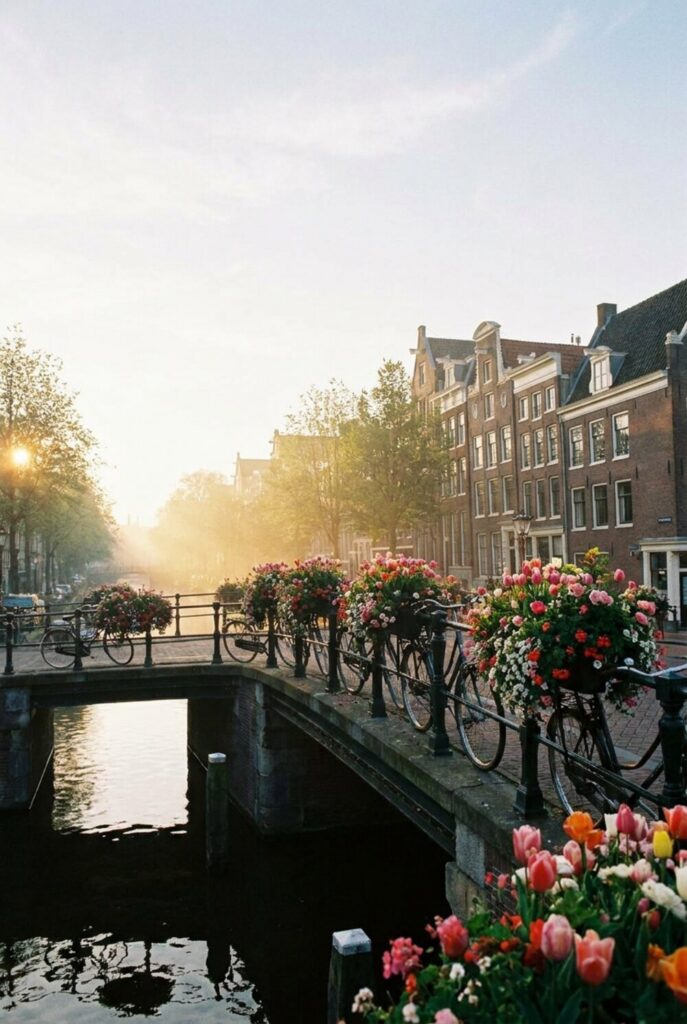
Amsterdam, Netherlands: Canals, Cycles, and the Golden-Age Grid
Part of our Netherlands travel guide.
Amsterdam City Guide
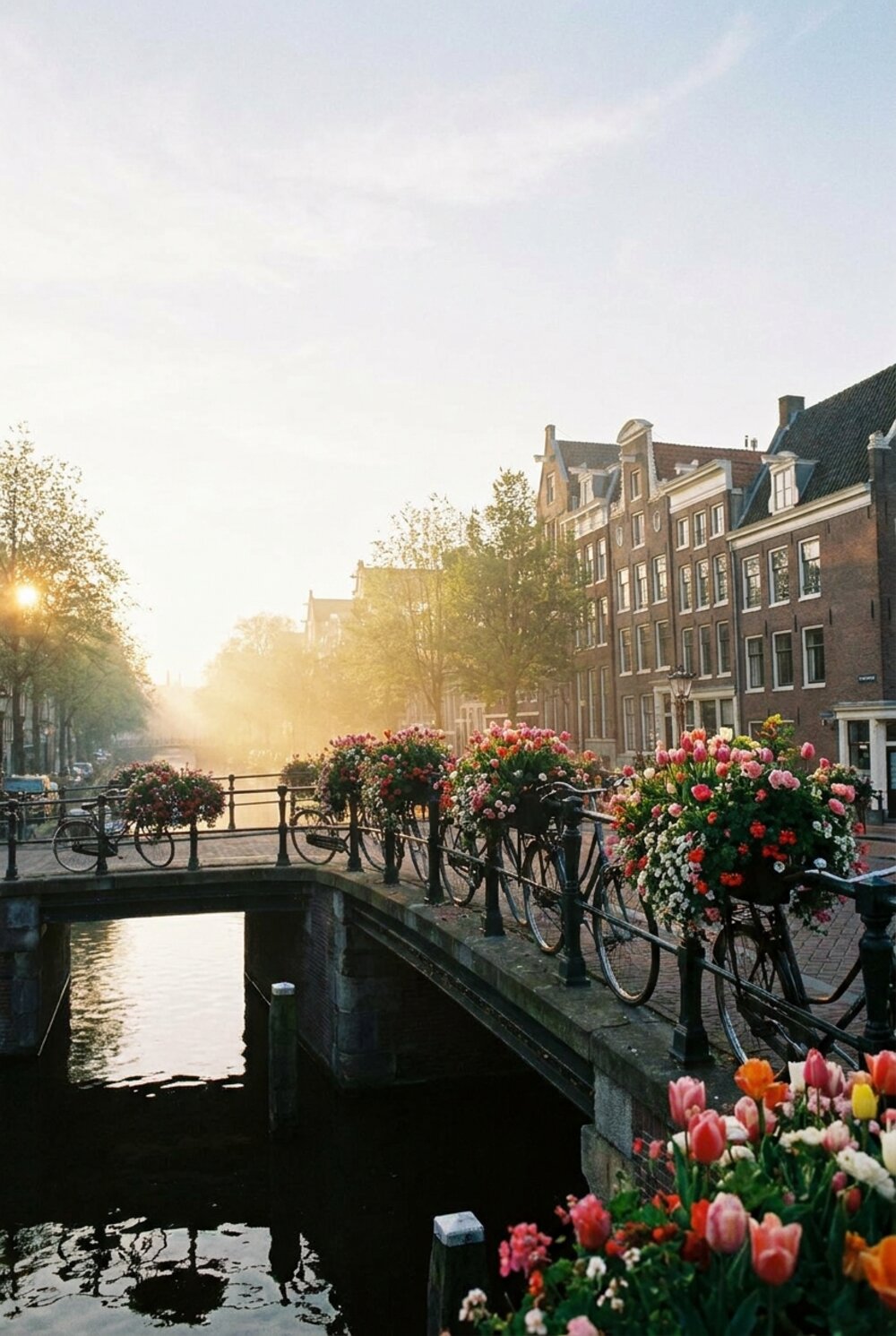
Table of Contents
Why Amsterdam?
Amsterdam is a 13th-century fishing hamlet that the Dutch Golden Age turned into the world’s first modern capital-market city and that the 20th century quietly reorganised around the bicycle. It sits at the mouth of the Amstel river on ground that would be underwater without the pumps; today around 920,000 people live inside the city limits, with the Metropolitan Region Amsterdam stretching to roughly 2.5 million across the Zaanstreek, Haarlem and Almere . The historic centre — the semicircular grid of four concentric canals dug between 1612 and 1665 — has been listed as a UNESCO World Heritage Site since 2010 and is still the legal form the city works around .
The city reads as a set of productive contradictions. It is the most photographed canal grid in Europe, yet every canal is a working waterway with residential houseboats paying municipal mooring rates. It is a tourist magnet that welcomed around 22 million overnight visitors in 2024 — more people than the entire country has residents — yet in 2023 the municipality imposed a new visitor cap of 20 million overnights per year and banned new hotel construction inside the centre . It is a permissive city of coffeeshops and legal sex work, yet in April 2023 cannabis smoking was banned on the streets of De Wallen and the entire Red Light District is being relocated to a purpose-built \”erotic centre\” out of the centre by 2030. It is famously Dutch-directness pragmatic, yet it funds the Concertgebouw, the Rijksmuseum, and the Van Gogh Museum at a density you would only otherwise see in Paris.
The scale is part of the pleasure. The UNESCO Canal Ring walks across in about 45 minutes; the GVB tram network reaches every neighbourhood on a €9.00 day pass; and the city has more registered bicycles (880,000+) than residents . That compactness means you can stand in front of The Night Watch at the Rijksmuseum at 10:00, have a broodje haring on a canal bridge at noon, see the Van Gogh Museum at 14:00, climb the Westerkerk tower above Anne Frank House at 16:00, and still be at a wood-panelled brown café in the Jordaan drinking jenever by 18:30. This guide covers the eight neighbourhoods worth a half-day each, the bitterballen-and-haring food culture that predates the restaurant scene, the big museums with their timed-entry realities, five day trips you can actually do before dinner — Zaanse Schans, Keukenhof in season, Haarlem, Utrecht, Volendam-Marken — and the specific practicalities a 2026 visitor will need: cycling etiquette, the iDEAL payments rail, tram-2 pickpocketing, and the ETIAS travel authorisation for visa-exempt non-EU travellers launching later this year.
Neighborhoods: Finding Your Amsterdam
📍 Amsterdam Map: Every Place in This Guide
Amsterdam is administratively divided into seven stadsdelen (districts) and around 100 buurten (neighbourhoods), but travellers effectively cycle through eight of them — the medieval Centrum, the gabled 17th-century Jordaan, the food-and-terrace grid of De Pijp, the leafy Plantage ribbon, residential Oost, post-industrial Noord across the IJ, mid-range Oud-West, and the historic De Wallen quarter . Each has a distinct rhythm, a different baseline price for a koffie verkeerd, and its own best-for-whom shorthand. First-timers almost always land in the Centrum for proximity to Centraal Station and the big museums; returning visitors cheat outward to Jordaan, De Pijp, Oost or Noord, where a neighbourhood bakery at 08:30 still feels like a neighbourhood bakery. Accommodation prices, menu prices and the share of locally owned shops track distance from Dam Square — noticeably cheaper and less tourist-shaped at a 20-minute walk or a single tram stop than at a three-minute walk.
Centrum (Old Centre)
The oldest layer of Amsterdam, laid out in concentric arcs around the original 13th-century dam across the Amstel. Centrum carries most of the city’s marquee addresses — Dam Square, the Royal Palace, the Nieuwe Kerk, the Nieuwmarkt, the Begijnhof and the Nine Streets shopping grid — along with the highest footfall, the highest rents, and the densest concentration of pickpocket reports on trams 2/5 and at Centraal Station . The Begijnhof, a 14th-century courtyard of almshouses tucked behind a low wooden door on Spui, remains one of the quietest spaces in the entire city despite sitting a three-minute walk from Dam Square — a reminder that the old centre rewards slight detours. Everything in Centrum is within walking distance; choose accommodation here only if you value proximity over calm, and accept that your 07:30 coffee will come with a tour-group queue.
- Dam Square and the Royal Palace (Paleis op de Dam, completed 1665)
- Begijnhof — a 14th-century walled courtyard of almshouses with Amsterdam’s oldest surviving wooden house (c. 1528)
- Nieuwmarkt and the 1488 Waag — former city gate turned weigh house
- Nine Streets (De 9 Straatjes) — cross-canal shopping grid between Prinsengracht and Singel
- Oude Kerk (1213) — Amsterdam’s oldest building, sitting in the middle of De Wallen
Best for: first-time visitors, short stays, museum stackers. Access: Metro 51/52/53/54 or trams 2/12/14 to Centraal or Nieuwmarkt.
Jordaan
West of the Prinsengracht, the Jordaan is the 17th-century working-class quarter that gentrified into Amsterdam’s most photographed residential district. Narrow gabled houses, hidden hofjes (charitable courtyards), brown cafés with doors opening straight onto the canal, and the Monday-morning Noordermarkt flea market define the rhythm. The neighbourhood was built on marshland in the 1610s to house the labourers who dug the canal ring on the other side of the Prinsengracht, and until the 1950s it remained a poor, socialist, overwhelmingly Catholic district. The post-1960s gentrification replaced most of its textile workshops with galleries, florists, and restaurants — but the hofjes, many still administered as social housing for the elderly, and the brown cafés (Café Chris has been open since 1624) keep the older texture visible. The Anne Frank House sits on the eastern edge at Prinsengracht 263–267; the Westerkerk (1631), at 87 m, is the tallest church tower in the city.
- Anne Frank House (Prinsengracht 263–267) — timed entry only, book 6 weeks ahead
- Westerkerk (1631) — climb the 87 m tower for the best rooftop canal view in the city
- Noordermarkt — farmers’ market Saturdays, flea market Mondays
- Café Chris — a working brown café in operation since 1624
- Electric Ladyland — the world’s first museum of fluorescent art (by appointment)
Best for: repeat visitors, slow travellers, café sitters. Access: Tram 13/17 to Westermarkt; tram 3 to Marnixplein.
De Pijp
A late-19th-century grid in Amsterdam-Zuid, De Pijp (\”the Pipe\”, so called because of its narrow strip-like streets) is the neighbourhood where Amsterdam’s food-and-drink energy lives now. The spine is the Albert Cuypmarkt, 260 stalls long, six days a week, the Netherlands’ largest daily street market and the cheapest lunch in the city at around €10 for a fries-herring-stroopwafel combination . Around it, a dense grid of Moroccan bakeries, Surinamese takeaways, specialty coffee bars, and terrace cafés fills the streets between Sarphatipark and the Ceintuurbaan. The 1867 original Heineken brewery sits at the northern edge and has been a ticketed \”experience\” since 2001. De Pijp was originally conceived as affordable housing for 19th-century factory workers; the 2010s redevelopment of the Rode Loper and the opening of Metro 52 in July 2018 turned it into one of the city’s most expensive rental markets, but its 1885 urban grain keeps it denser and more sociable than the canal belt.
- Albert Cuypmarkt — 260 stalls, Mon–Sat, 09:00–17:00
- Heineken Experience — the original 1867 brewery, €25 timed entry
- Sarphatipark — the neighbourhood’s 19th-century green lung
- Gerard Douplein — terrace café square for evening beers
- De Taart van m’n Tante — the signature queer-friendly cake café
Best for: food travellers, terrace loungers, second-time visitors. Access: Metro 52 to De Pijp or Europaplein; tram 4 to Stadhouderskade.
Oost (East)
East of Artis Zoo and stretching through the Oosterpark to the former eastern docks and the newly built island of IJburg, Oost is the district that absorbed Amsterdam’s 20th-century colonial diaspora — Indonesian, Surinamese, Moluccan, Turkish and Moroccan communities built some of the city’s best-value food streets here, particularly around the Javastraat and the Dappermarkt. Oost has been Amsterdam’s fastest-gentrifying district since 2015, but the older food infrastructure has held. The National Slavery Monument, unveiled in Oosterpark in 2002, sits at the geographic and moral centre of the district. Oost is also home to the Tropenmuseum (world-cultures museum in a 1910 palace) and to the less-touristed Dappermarkt, where most stalls still operate at neighbourhood rather than visitor prices. A tram ride from Centraal is 12 minutes ; rents are roughly 30% lower than in Centrum. Long-stay travellers, families, and anyone planning to cook for themselves find Oost the easiest base in the city.
- Oosterpark (1891) — the Slavery Monument and the Keti Koti emancipation festival (1 July)
- Tropenmuseum — world cultures in a 1910 palace, €17 admission
- Dappermarkt — cheaper, less-touristed version of Albert Cuyp
- Javaplein — Sunday farmers’ market
- Studio/K — ex-film-school café-cinema hybrid, great lunch spot
Best for: repeat visitors, food explorers, family stays. Access: Tram 3/19 to Muiderpoortstation; Metro 51 to Weesperplein.
Noord (North)
Across the IJ waterway from Centraal Station, Noord was industrial shipyard land until the 1980s and empty until the 2010s. Today it is Amsterdam’s creative frontier — converted warehouses, floating gardens, the cantilevered EYE Film Museum (2012), the A’DAM Lookout observation tower, and the NDSM Wharf where the monthly IJ-Hallen flea market is the largest in Europe. The free GVB passenger ferry from Centraal pier 7 runs every 5–10 minutes, 24 hours a day, and takes three minutes to cross ; the July 2018 opening of Metro 52’s underwater crossing brought Noord within nine minutes of Amsterdam Zuid station and transformed the district’s rental market. Noord is the single best neighbourhood in the city for budget hotels and hostels (ClinkNOORD is the landmark), for post-industrial design-district walking, and for a specific kind of long-lunch-on-a-shipping-container-beach scene that does not exist south of the water.
- EYE Film Museum — Delugan Meissl’s 2012 cantilevered building, €14 exhibition admission
- A’DAM Lookout — 100 m observation deck with the \”Over the Edge\” swing ride (€15 + €7.50 swing)
- NDSM Wharf — Europe’s largest monthly flea market (IJ-Hallen, ~5,000 stalls)
- Tolhuistuin — cultural garden and restaurant in a former Shell office
- Café Pllek — shipping-container beach bar on the NDSM harbour
Best for: design-minded travellers, budget stays, creatives. Access: Free GVB passenger ferry from Centraal (3–10 min); Metro 52 to Noorderpark.
Oud-West
The 19th-century ring immediately west of the Singelgracht — practical, residential, and anchored by the Foodhallen food-court (an ex-tram depot opened 2014) and the Ten Katemarkt daily street market. Oud-West is where Amsterdam residents move when they want to be five tram stops from the canal belt without paying Jordaan rents, and travellers increasingly follow the same logic: three-star hotel rates are roughly 25–35% lower here than in Centrum for what is effectively a ten-minute bike ride from Dam Square. The neighbourhood’s western boundary is the Vondelpark — the city’s largest and most heavily used green space, 47 hectares, 10 million visits a year — which means the Foodhallen lunch–Vondelpark walk–Overtoom dinner chain works as a complete day without any public transport. Kinkerstraat is the shopping spine; Ten Katemarkt is six days of fruit, bread, cheese and flowers; Bellamyplein and Kwakersplein are the two neighbourhood squares where everyone ends up at 22:00.
- Foodhallen — 20+ indoor food stalls in a converted tram depot, open daily 11:00–23:30
- Ten Katemarkt — daily street market (Mon–Sat)
- Vondelpark — 47 hectares, free outdoor theatre in summer, signature of the city
- Kinkerstraat — the 19th-century shopping strip
- Overtoom — café-and-bar corridor connecting Vondelpark to Leidseplein
Best for: mid-range stays, foodies, families. Access: Tram 7/17 to Ten Katestraat; tram 1 to Overtoom.
De Wallen (Red Light District)
Two small canals (the Oudezijds Voorburgwal and the Oudezijds Achterburgwal) wrapping around the Oude Kerk form the city’s oldest quarter and its most contested present. De Wallen is a working residential neighbourhood with regulated sex work visible in red-lit street-front windows — a trade that has been legal and licensed in the Netherlands since 2000 — and since April 2023 cannabis smoking on these specific streets has been prohibited, with fines of €100 . The municipality has also committed to relocating the sex-work facilities to a purpose-built \”erotic centre\” elsewhere in the city by around 2030, a decision passed by city council in 2023 and still generating legal challenge from sex workers and residents. For visitors the practical implications are specific: photographing the windows is strictly forbidden and phones have been confiscated or thrown into the canal; late-night alcohol-fuelled stag crowds are heavily policed; and walking through during daylight hours to see the Oude Kerk and Ons’ Lieve Heer op Solder museum is entirely straightforward.
- Oude Kerk (1213) — Amsterdam’s oldest building, hosts rotating contemporary art
- Ons’ Lieve Heer op Solder (Our Lord in the Attic, 1663) — clandestine Catholic attic church
- Zeedijk — the old sailors’ street, now Amsterdam’s Chinatown
- Warmoesstraat — bars, clubs and the Condomerie (world’s first condom speciality shop)
- Princess Juliana Bridge viewpoint — the most-photographed canal angle in the city
Best for: historic walks, architecture spotters, anyone curious about the relocation debate. Access: Metro 51/52/53/54 to Nieuwmarkt or Centraal; trams 4/14 to Rokin.
Plantage and Artis
The leafy 19th-century \”plantation\” quarter between Centrum and Oost was built as the garden district for the city’s wealthy merchant class and now forms a cultural ribbon connecting Artis Royal Zoo (founded 1838, Europe’s oldest continuously operating zoo), the Hortus Botanicus (1638, one of the oldest botanical gardens in the world), the Hermitage Amsterdam (now rebranded H’ART Museum), and the Verzetsmuseum (Dutch Resistance Museum). The neighbourhood is also the core of Amsterdam’s Jewish heritage — the Jewish Museum, Portuguese Synagogue, Hollandsche Schouwburg, and the National Holocaust Museum (opened 2024) all sit within a five-minute walk on Jonas Daniël Meijerplein, with a single €30 combined ticket covering all five . Plantage is quieter than Centrum, greener than De Pijp, and makes an excellent mid-afternoon stop between the Rijksmuseum and a Jordaan dinner.
- Artis Royal Zoo — founded 1838, €26 admission, Europe’s oldest continuously operating zoo
- Hortus Botanicus — founded 1638, €12 admission
- National Holocaust Museum — opened 2024, included in the €30 JCK combined ticket
- Verzetsmuseum — the Dutch Resistance story in the former Plancius Jewish cultural centre
- Wertheimpark — the city’s first public park (1812), with the Auschwitz memorial
Best for: families, museum pass holders, slow walkers. Access: Tram 14 to Artis; Metro 51/53/54 to Waterlooplein or Weesperplein.
The Food
Eating in Amsterdam is not what most visitors arrive expecting. Dutch cuisine proper is a thrifty peasant-and-merchant tradition — stamppot (mashed potato with kale or sauerkraut and sausage), erwtensoep (thick split-pea soup), bitterballen, herring — and the restaurant scene is built on top of that base with heavy contributions from the Netherlands’ colonial past (Indonesian rijsttafel, Surinamese roti, South-African braai) and a modern wave of Scandinavian-style New Nordic kitchens. The single most important thing to understand about Amsterdam’s food culture is that it is a snack-and-café culture before it is a restaurant culture: a day of proper eating here goes bakery breakfast → bitterballen at 17:00 → rijsttafel at 20:00, with a broodje haring somewhere in between, and none of that is expensive. A typical neighbourhood lunch runs under €15, a Michelin-plate evening under €150, and a three-star tasting under €295 per person.
Prices range from €3 fries at Vleminckx to €295 tasting menus at two-star Ciel Bleu overlooking the Amstel. The eating cadence matters too: lunch 12:00–14:00, dinner 18:30–21:00 (an hour earlier than Mediterranean cities), borrel hour 17:00–19:00, brown-café closing time 01:00 weekdays and 03:00 weekends. Eating with locals means accepting the earlier dinner hour; eating tourist-only means eating at 21:30 in a half-empty dining room. Reservations in the centre are essential Thursday through Saturday; in Oud-West, Oost and Noord they are optional before 19:00. Tipping is a 5–10% round-up, not a US-style 18–20%; service is included in menu prices by law.
Brown Cafés and Bitterballen
The bruin café (brown café) is Amsterdam’s defining drinking-and-snacking institution — wood-panelled, nicotine-stained since before the 2008 smoking ban, often serving the city’s defining bar snack. The bitterbal is a deep-fried beef-ragout croquette the size of a walnut, served with coarse Dutch mustard, and it is the correct order to accompany a vaasje (a 200 ml glass of lager) between 17:00 and 19:00. \”Brown\” refers to the colour of the walls, tobacco-stained over decades — the tobacco is now gone, the colour remains. A typical brown-café order is a vaasje or a jenever (Dutch gin) by the centimetre, a plate of six or twelve bitterballen, and two hours of unhurried conversation.
- Café Hoppe — open since 1670 on Spui, the single most famous brown café; bitterballen €8.50 for six
- Café Chris (Jordaan) — in operation since 1624, the oldest café in the city; vaasje + bitterballen €9
- Café ‘t Smalle (Egelantiersgracht) — canalside 1780 distillery, bitterballen platter €9.50
- Proeflokaal Arendsnest — 100% Dutch craft beer brown café, bitterballen €10.50
- Café Papeneiland (Prinsengracht) — since 1642, the apple pie is the order (€5.50)
- In ‘t Aepjen (Zeedijk) — 16th-century wooden sailors’ tavern, one of only two surviving all-wood houses in Amsterdam
Haring and North Sea Fish Counters
Raw-cured North Sea herring (Hollandse Nieuwe) eaten whole, held by the tail and tilted into the mouth — or chopped on a soft white roll with onions and pickles (broodje haring) — is the most emblematically Dutch street food, and the cheapest three-euro meal in the Netherlands. The season opens with Vlaggetjesdag in the fishing village of Scheveningen in mid-June, when the first barrels of the new catch are auctioned. Haringhandels (fish stalls) are scattered across the city from the Singel bridge in the centre to the Albert Cuypmarkt; all follow the same unspoken rule — eat standing up, pay cash or tap, tip the onion-chopper by nodding. If you can only have one haring in Amsterdam, have it at Stubbe’s on the Singel with the Hollandse Nieuwe and the white-onion-and-pickle-roll combination.
- Stubbe’s Haring — broodje haring €3.75 on the Singel bridge, since 1962
- Frens Haringhandel (Koningsplein) — Hollandse Nieuwe €3.50
- Volendammer Vishandel (Albert Cuyp) — kibbeling (fried cod) €6.50
- Pinokkio Haring (De Pijp) — haring with pickles €3.25
- Vishandel Molenaar (Utrechtsestraat) — local favourite, no tourist signage
- Vishandel Volendam (Haarlemmerdijk) — weekday-lunch kibbeling €6.50
Markets and Street Food
Amsterdam’s market network is the city’s most reliable eating strategy. The Albert Cuypmarkt (Mon–Sat, De Pijp) is the headline act — 260 stalls, 1.5 kilometres long, daily since 1905 — and is where most visitors first taste a stroopwafel fresh off the iron, a poffertje doused in powdered sugar, and a herring roll in quick succession for under €15 total . Beyond Albert Cuyp, the Noordermarkt (Saturdays farmers’, Mondays flea), the Dappermarkt (daily, Oost), the Ten Katemarkt (daily, Oud-West), and the Foodhallen (Mon–Sun, Oud-West) each have their own rhythm. The Foodhallen — a 2014 conversion of a 1902 tram depot into 20+ independent stalls — is the nighttime answer, open until 23:30.
- Original Stroopwafels (Albert Cuypmarkt) — €2.50 for a fresh-off-the-iron stroopwafel
- De Carrousel Poffertjeskraam (Weteringcircuit) — €6.50 for 15 puffed pancakes with butter and powdered sugar
- Vleminckx Sausmeesters (Voetboogstraat) — patat met / patatje oorlog €4, since 1887
- Winkel 43 (Noordermarkt) — the city’s best Dutch apple pie, €5.95 the slice
- Foodhallen — 20+ stalls, average plate €10–€16
- De Kaaskamer (Nine Streets) — 100+ Dutch cheeses, €12–€18 tasting board
Indonesian Rijsttafel and Surinamese-Dutch
Amsterdam’s single most important culinary inheritance is Indonesian — the Dutch East Indies (now Indonesia) was a Dutch colony from 1800 until 1949, and the \”rice table\” (rijsttafel) banquet of 15–25 small plates was codified in colonial Java as a European interpretation of an Indonesian feast. Today rijsttafel remains the Sunday-night Dutch classic, and Amsterdam has more authentic Indonesian restaurants than any other European city. Expect a ceremonial lazy Susan laden with satay, rendang, sambal goreng, gado-gado, pisang goreng, and at least four rice variants. Surinamese cuisine arrived via Dutch-Caribbean migration in the 1970s — roti flatbreads with chicken-potato-egg-long-bean curry, moksi meti (mixed meats with rice), bara dumplings — and concentrates on De Clercqstraat in Oud-West and Javastraat in Oost.
- Sama Sebo (since 1969, Museum Quarter) — 19-dish rijsttafel €52.50 pp
- Kantjil & de Tijger (Spuistraat) — 15-dish rijsttafel €37.50 pp
- Blauw (Oud-West) — 17-dish rijsttafel €42.50 pp, the modern reference
- Roopram Roti (Oost) — Surinamese roti with chicken curry €9.50
- Warung Spang Makandra (De Pijp) — Javanese-Surinamese hybrid, moksi €14.50
- De Tjolomadoe (Jordaan) — Indonesian small plates €8–€16 each
New Dutch and Michelin Dining
Amsterdam closed 2024 with 22 Michelin-starred restaurants in the metropolitan area, including two with two stars (Ciel Bleu and Spectrum) . The city’s modern kitchen leans Scandinavian-Dutch — fermented local vegetables, North Sea fish, Flevoland beef, foraged coastal plants — and borrows from the Indonesian legacy with confident spice. Reservations for two-star kitchens typically open 60 days ahead; one-star and Bib Gourmand tables are usually available within 2–3 weeks. Lunch menus at most starred kitchens run 30–40% cheaper than dinner for a similar plate count. The New Dutch scene — De Kas in a glass greenhouse, Rijks inside the Rijksmuseum, Breda on Singel — is arguably more interesting than the city’s three Michelin stars for the same money.
- Ciel Bleu ** (Okura Hotel, De Pijp) — 23rd-floor tasting menu €215–€295, two stars since 2005
- Spectrum ** (Waldorf Astoria) — €195 tasting menu in a canal palace
- Vinkeles ** (The Dylan, Keizersgracht) — €175 tasting menu in a converted 1787 bakery
- RIJKS * (Rijksmuseum) — €95 four-course lunch in the national museum
- De Kas (Oost) — seasonal glass-greenhouse restaurant, €65 four-course dinner
- Breda (Singel) — Bib Gourmand tasting €65, walk-in friendly at lunch
Beyond Bitterballen and Haring
Two plates you will see on every traditional Dutch menu: stamppot boerenkool, kale mashed into potato and topped with a smoked sausage (rookworst), served in winter only; and erwtensoep (or snert), a split-pea soup so thick that the spoon traditionally has to stand up in it before it qualifies as proper. On weekends, look for pannenkoeken — giant Dutch pancakes, sweet or savoury, at specialist pannenkoekhuizen like The Pancake Bakery (since 1973). From mid-December through New Year, oliebollen stands set up on every busy street corner — deep-fried dough balls with raisins, dusted in powdered sugar, €1.75 each. Two more to know: patatje oorlog (\”war fries\” — fries with mayonnaise, peanut sauce and onion) at Vleminckx, and the Uitsmijter — two fried eggs on buttered rye with ham and cheese — which is the classic Dutch hangover brunch at any café before 11:30.
- Stamppot boerenkool met rookworst — kale mash with smoked sausage, €14–€18
- Erwtensoep (Snert) — thick split-pea soup, €7–€11
- Oliebollen — Dec 1 – Jan 1, €1.75 each
- Pannenkoek — Dutch pancakes sweet/savoury, €10–€16
- Uitsmijter — two-egg-ham-cheese open sandwich, €8–€12
- Gouda and Beemster cheeses — young/aged/smoked boards, €12–€18
Food Experiences You Can’t Miss
Building an itinerary around food in Amsterdam is genuinely rewarding — the city is small enough that you can chain three neighbourhood food experiences in a single day without once using a tram. The ritual matters as much as the plate: stand at a haringhandel, hold the fish by the tail, pay contactless, walk on.
- A brown-café crawl through the Jordaan: Café Chris (1624) → Café ‘t Smalle (1780) → Café Papeneiland (1642)
- Saturday farmers’ market at Noordermarkt, then appeltaart at Winkel 43
- Albert Cuypmarkt lunch: poffertjes + herring + stroopwafel + patat, under €15 total
- Foodhallen dinner — 20+ stalls, eat six small plates for €25
- 19-dish Indonesian rijsttafel at Sama Sebo, Sunday evening reservation preferred
- Mid-morning jenever proeverij at Wynand Fockink (since 1679) — the city’s oldest distillery tasting room, €5 per centimetre from the clay jug
- Seven-euro afternoon borrel: vaasje Heineken + six bitterballen at any brown café, 17:00–19:00
- A pre-opening Heineken Experience tour slot at 09:00, then Winkel 43 apple pie at 11:00 before the Jordaan tour buses arrive
Cultural Sights
Amsterdam’s cultural core sits on a single square — the Museumplein — where the Rijksmuseum, Van Gogh Museum, Stedelijk Museum, and Concertgebouw concert hall face each other across an open lawn. Add the Anne Frank House five minutes by tram to the north and the Jewish Cultural Quarter ten minutes east, and you have the city’s entire world-heritage itinerary within a 25-minute walk. Every major museum sells timed-entry tickets online — book the Van Gogh Museum 7 days ahead and the Anne Frank House exactly 6 weeks ahead at noon CET . An efficient Museumplein day pairs the Rijksmuseum at 09:00 opening with the Van Gogh at 13:00, lunch at RIJKS inside the Rijksmuseum, and the Stedelijk in the late afternoon; that sequence minimises queue time and gives you The Night Watch before the tour buses arrive.
Rijksmuseum
The Dutch national museum sits in a neo-gothic Cuypers palace completed in 1885, re-opened in April 2013 after a ten-year, €375 million renovation. Its collection spans 8,000 works across 80 galleries, with the Gallery of Honour — a single long corridor at the heart of the building — displaying Rembrandt’s The Night Watch (1642), Vermeer’s The Milkmaid (c. 1658), Hals’ The Merry Drinker, and Avercamp’s Winter Landscape in sequence. Admission €25; open daily 09:00–17:00 . Free entry with the I amsterdam City Card or the Museumkaart (€75 annual for Dutch residents). The Asian pavilion, a separate concrete building designed by the same Spanish firm as the renovation, holds a world-class collection of Japanese and Indonesian works and is almost always uncrowded.
Van Gogh Museum
Holds the world’s largest Van Gogh collection — 200+ paintings, 500+ drawings and 700+ personal letters — installed in a 1973 Gerrit Rietveld building with a 1999 Kisho Kurokawa extension. Admission €22, timed entry only; open 09:00–18:00 daily and until 21:00 Fridays . The permanent collection traces Van Gogh’s career chronologically across three floors, from the dark Nuenen paintings of 1885 to the final Auvers-sur-Oise works of 1890. Tickets do not release reliably on the day; book 7–14 days ahead in peak season and at least 48 hours ahead year-round. Friday-night visits (after 18:00) are the quietest hours.
Anne Frank House
The preserved 17th-century canal house on the Prinsengracht where Anne Frank wrote her diary in hiding with her family and four others between July 1942 and August 1944. Admission €16; open 09:00–22:00 in summer and 09:00–19:00 in winter . 80% of daily timed tickets are released online exactly six weeks ahead at noon Central European Time and sell out within 30 minutes; the remaining 20% are released on the day at 09:00 and sell out within seconds. There are no walk-ins, no same-week tickets, and no backup option — miss the six-week window and your alternative is the 20% day-of release. The 90-minute tour climbs steep, narrow 17th-century staircases through the bookcase-hidden annex; audio guides are included.
Stedelijk Museum
Amsterdam’s modern and contemporary-art collection holds Mondrian, Malevich, Chagall, De Kooning, and Rietveld’s original furniture, in an 1895 building extended with a controversial 2012 \”Bathtub\” pavilion by Benthem Crouwel Architects. €22.50 admission; 10:00–18:00 daily, Fridays until 22:00 . The Malevich collection — 24 paintings and 27 drawings — is the largest outside Russia and was acquired in a controversial 1927 purchase from the artist’s own hand. The museum’s new-media and photography programming is consistently strong; check the rotating exhibitions before deciding between this and the more predictable Van Gogh.
Royal Palace Amsterdam (Paleis op de Dam)
Built 1648–1665 as the Amsterdam Town Hall at the height of the Golden Age, it was described in its time as the Eighth Wonder of the World. The building became a royal residence under Louis Bonaparte in 1808 and remains the working palace of the Dutch monarch for state functions; the Citizens’ Hall (Burgerzaal) is one of the most astonishing single rooms in Europe. €12.50 admission, 10:00–17:00 subject to royal events . Check the palace schedule before booking — the building closes at short notice for state visits.
Oude Kerk and Nieuwe Kerk
Amsterdam’s oldest building is the Oude Kerk, consecrated in 1306, now hosting rotating contemporary art installations on the ceiling above the 15th-century tombstones of Dutch East India Company shareholders. The Nieuwe Kerk on Dam Square dates to 1408 and is the traditional coronation site of Dutch monarchs, with the 2013 inauguration of King Willem-Alexander the most recent. Oude Kerk €14 admission; Nieuwe Kerk €22 during exhibitions, 10:00–18:00 daily .
Het Scheepvaartmuseum (National Maritime Museum)
Inside the 1656 Dutch Admiralty arsenal at the eastern docks, with a full-scale replica of the 1749 VOC East Indiaman Amsterdam moored alongside the main building. €18.50 admission, 10:00–17:00 daily . The museum was built for, and by, the Dutch East India Company — still the most valuable company in history by inflation-adjusted market capitalisation — and holds one of Europe’s largest globe, atlas and navigational-instrument collections.
NEMO Science Museum
Renzo Piano’s 1997 copper-clad ship-hull building above the IJ tunnel — the Netherlands’ largest science museum and an uncontested family highlight. €19.50 admission, 10:00–17:30 daily . The roof terrace (open in summer) offers one of the best panoramic views of the old harbour and city skyline and is free to access without a museum ticket.
Jewish Cultural Quarter
Five linked institutions around Jonas Daniël Meijerplein: the Jewish Museum, Portuguese Synagogue (1675), Hollandsche Schouwburg (a deportation-point memorial), the National Holocaust Museum (opened March 2024 in the former Reformed Teachers’ Training College), and the Children’s Jewish Museum. A single €30 combined ticket covers all five; 10:00–17:00, closed on major Jewish holidays .
Entertainment
Amsterdam’s entertainment rhythm is earlier than Mediterranean cities — dinner at 19:00, first drinks at 21:00, clubs fill by midnight and stay open until 04:00 on weekends. The city permits residential-zone bars to operate until 01:00 weekdays and 03:00 weekends; music venues with late licences (Paradiso, Melkweg, Shelter, De School) run until 06:00 Friday and Saturday . The entertainment calendar splits into the high-tourism summer festivals (Pride Canal Parade in August, Amsterdam Dance Event in October) and the year-round infrastructure of Concertgebouw classical, Paradiso indie, Melkweg eclectic and Ajax Eredivisie football. Travellers who align their visit with a specific festival rarely regret it, but the baseline programming alone offers at least three nights a week of something worth the walk.
Canal Cruises
Scheduled open and glass-topped boats depart from Damrak, Rokin, the Anne Frank House pier and the Rijksmuseum pier. A 75-minute daytime UNESCO-circuit cruise runs €19–€25; evening cruises with Dutch cheese and wine pairings run €35–€55; small-group electric boats with your own skipper cost €35–€50 per person for a 90-minute ride . Those Damrak Boats is the large-fleet baseline; Those Dam Boat Guys, Flagship and Mr Jordaan run the smaller, quieter electric alternatives. A single canal cruise is the fastest way to orient yourself on arrival day — do one within 24 hours of landing, preferably in the late afternoon as the light goes gold on the gabled houses.
Concertgebouw and Classical Music
The Concertgebouw (1888), home to the Royal Concertgebouw Orchestra, hosts more than 250 concerts a year and is consistently ranked among the world’s top three concert halls for acoustics — alongside Vienna’s Musikverein and Boston’s Symphony Hall. Free 30-minute Wednesday Lunch Concerts at 12:30 run weekly from September to June; tickets are distributed at 11:30 on the door, queue from 11:00 for a seat. Evening concerts €15–€120 . The Muziekgebouw aan ‘t IJ handles contemporary classical and jazz in a 2005 waterfront building near Centraal.
Paradiso, Melkweg and Live Music
Two converted-sanctuary venues anchor the city’s live scene: Paradiso in a former 1879 Lutheran church on Weteringschans (main-hall capacity 1,500), and Melkweg in a former dairy on Lijnbaansgracht (multi-room complex opened 1970). Tickets €15–€60, most shows sell out 1–2 weeks ahead; Paradiso’s monthly Noodlanding indie night is the best-value cover in the city at €15 for four bands . For smaller rooms and techno: Shelter (under the A’DAM tower), De Marktkantine, and the now-legendary De School hosted across the former trade school.
Coffeeshops and Cannabis
A \”coffeeshop\” in Amsterdam is a cannabis retailer — licensed, regulated, tolerated. Smoking tobacco/cannabis blends is permitted indoors at coffeeshops only (the 2008 tobacco-indoors ban shaped Dutch spliff culture). Purchase is limited to 5 g per transaction, age 18+, and cash or PIN only — no foreign bank cards and no alcohol sales . Since April 2023, cannabis smoking has been prohibited on the streets of De Wallen (the Red Light District), with €100 fines; stick to coffeeshop interiors. The Bulldog, Boerejongens, and Dampkring are the named tourist coffeeshops; the neighbourhood coffeeshops (Abraxas, Siberië, Tweede Kamer) offer a calmer and noticeably cheaper experience.
Football — Ajax at the Johan Cruijff ArenA
AFC Ajax plays Eredivisie home matches at the 54,990-capacity Johan Cruijff ArenA in Amsterdam Zuidoost — a retractable-roof stadium opened in 1996 and renamed in 2018 after the city’s favourite footballer. Tickets from €35 on the club site; the biggest fixtures sell out months in advance and often require an Ajax \”Supporterscard\” for non-members. The ArenA stadium tour runs year-round for €17.50 adult and includes the dressing rooms, press centre and player tunnel . Metro 50/54 runs direct from Centraal to Strandvliet in 18 minutes on match days.
Amsterdam Light Festival
The city’s signature winter event — 30+ large-scale illuminated art installations along the canals, viewable on foot (Walking Route, ~4 km, free) or by canal cruise (€22–€30). The 2026/27 edition runs November 27, 2026 through January 17, 2027 . The walking route starts at Oosterdok near NEMO and ends near the Rijksmuseum; bundle it with a Magere Brug (Skinny Bridge) stop and an appeltaart at Café de Jaren to close the evening.
Pride Amsterdam and the Canal Parade
Unlike most Pride parades globally, Amsterdam’s runs on the water. The Canal Parade — held on the first Saturday of August (August 1, 2026) — features around 80 decorated boats parading from the Scheepvaartmuseum through the Prinsengracht and Amstel to the Mauritskade, drawing roughly 500,000 viewers along the banks. The whole week around the parade is one long street festival across Reguliersdwarsstraat (the city’s main gay strip), Spui, and Amstel 54. Amsterdam Pride is one of the oldest and most attended in Europe.
Brown Cafés and Jenever Proeflokalen
The cheapest and most distinctively Amsterdam entertainment is still drinking in a wood-panelled room. Proeflokalen (tasting rooms) serve jenever — the Dutch gin that English colonists shortened to \”gin\” in the 17th century — by the centimetre from a clay jug, filled to the brim so you take the first sip bent at the waist. Wynand Fockink, open since 1679, is the oldest in the city; Proeflokaal A. van Wees pours the largest jenever list. Expect €3.50–€6 per centimetre; an evening of three jenevers and two bitterballen runs under €25.
Day Trips
Five destinations account for the vast majority of day-trip traffic out of Amsterdam, all reachable by NS train or regional bus in under an hour and all returnable before dinner. The NS Intercity and Sprinter network handles Haarlem, Utrecht and Zaandijk; the EBS regional bus network handles Volendam-Marken; and the seasonal Keukenhof Express bus connects Schiphol to the tulip gardens only during the eight-week open season .
Zaanse Schans (17 minutes by NS Sprinter)
An open-air village of working 18th-century windmills, wooden green-painted houses, and a cheese-and-clog museum along the Zaan river 17 km northwest of Amsterdam. Take the NS Sprinter train from Amsterdam Centraal to Zaandijk Zaanse Schans station (17 minutes, return fare ~€7.60) , then walk ten minutes to the village itself. The site is free to wander; individual mill interiors cost €2–€6 each — of the six working mills, De Kat (paint grinding, 1781) and De Huisman (mustard) are the most interesting visits. The village is permanent industrial heritage rather than a reconstructed theme park; several of the mills still produce small-batch oils, paints, and mustards for sale. Combine the trip with Zaandijk’s Inntel Hotel, whose 2010 façade stacks 70 traditional Zaan houses into a single postmodern building that is worth a photograph even if you do not stay.
Keukenhof (40 minutes by Keukenhof Express bus, seasonal)
The world’s largest flower garden — 32 hectares, 7 million bulbs planted annually, 100+ tulip varieties — open only eight weeks per spring; in 2026, March 19 through May 10 . Peak bloom is typically the last week of April, and the garden draws 1.4 million visitors per season. A combined ticket including entry and the Keukenhof Express bus from Schiphol airport or the Amsterdam RAI convention centre costs €32 adult. Book in advance — same-day tickets are almost never available on weekends at peak bloom. Arrive by 09:00 when the gates open to see the flowers without tour-bus crowds; the gardens close at 19:30. The adjacent Bollenstreek cycle routes through the commercial tulip fields offer a cheaper, less-crowded alternative — rent a bike at Lisse station for €15/day and follow the yellow-painted signs.
Haarlem (15 minutes by NS Intercity)
A Golden-Age satellite city 20 km west of Amsterdam — smaller, less crowded, and arguably more pleasant for a half-day walk . The central Grote Markt is ringed by the 13th-century St Bavokerk (home to the 1738 Christian Müller organ that Mozart played as a ten-year-old) and the Frans Hals Museum, the definitive collection of the painter who founded the Dutch school of group portraiture. Return NS fare ~€8.80. Haarlem’s historic centre has one of the highest concentrations of hofjes in the Netherlands (20+ almshouse courtyards), most still functioning as social housing and free to walk through during daylight. Use Haarlem as an alternative accommodation base if the Amsterdam hotel ring is fully booked — commuter trains run every 10 minutes until midnight .
Utrecht (27 minutes by NS Intercity)
Founded by the Romans in AD 47, the Netherlands’ fourth city, and home to a two-tier canal network that is quieter than Amsterdam’s and arguably more beautiful . Climb the Domtoren — at 112 m the tallest church tower in the Netherlands, currently completing a multi-year restoration — for panoramic city views ; visit Museum Speelklok (the world’s leading collection of self-playing musical instruments), the 2022 Utrecht University Botanic Gardens, and the Miffy Museum dedicated to the Dutch children’s-book rabbit icon by Dick Bruna. Return NS fare ~€17.40 . The Oudegracht canal, with its two-metre-lower werf embankment level, is lined with café terraces and small shops — an entire afternoon walks past without retracing.
Volendam and Marken (30–45 minutes by EBS bus 316)
Two North Holland fishing villages on the old Zuiderzee — Volendam with its harbour-front fish stalls, eel-smoking houses and traditional costume photo-booths, and Marken, a former island village (connected to the mainland by causeway since 1957) of black-timber fishermen’s cottages. Take EBS bus 316 from Amsterdam Centraal Bus Terminal (30 min to Volendam, 45 min to Marken via transfer) or link the two villages by the Marken Express ferry (summer only, 30 min crossing, €15 return) . Volendam is the larger and more touristed; Marken is quieter and has an older housing stock. Pair the visit with a smoked-eel lunch at Hotel Spaander or a sail out to Marken on the seasonal ferry. Both villages are free to enter; the Zuiderzeemuseum in Enkhuizen (1 hour further) is the paid counterpart if you want more depth on the region’s fishing history.
Seasonal Guide
Spring (March – May)
The city’s best tourist season. Daytime highs rise from 8°C in early March to 17°C by late May, with 45–55 mm of monthly rainfall . Keukenhof opens March 19 and closes May 10, 2026, with peak tulip bloom in the last week of April; the city also hosts its own Tulip Festival Amsterdam, with 500,000 bulbs planted in public squares and the Rijksmuseum gardens from early April through early May . Koningsdag (King’s Day) on April 27, 2026 is the single biggest day of the year — the entire country turns orange, Amsterdam’s canals fill with decorated boats, and the city-wide Vrijmarkt flea market turns every front stoop into a pop-up shop. Book accommodation at least three months in advance for King’s Day .
Summer (June – August)
High tourist season but mild-climate by European standards. Daytime highs run 19–23°C, overnight lows 12–15°C, and sunset reaches 22:00 in late June . Accommodation prices peak in July and August; museum queues stretch past 45 minutes without timed tickets; tram-2 pickpocket reports cluster in the same months. Upsides: Vondelpark Open Air Theatre runs free weekend concerts late May through August, Pride Amsterdam’s Canal Parade (first Saturday of August, 2026 on August 1) draws around 500,000 viewers and is one of the most joyful public events in Northern Europe, and canal-side terrace life runs from 10:00 until 01:00 on weekends. Bring a layer — evenings on the water can drop under 15°C even in July .
Autumn (September – November)
The best travel weather for most visitors, and the cheapest of the three temperate seasons. September highs still reach 18°C and the canals stay photogenic through late October. The cultural calendar peaks in late October with Amsterdam Dance Event (ADE) — a five-day electronic-music festival across 200+ venues, 450+ events, and 2,500+ artists, which draws roughly 500,000 attendees from 150 countries . Museumnacht on the first Saturday of November opens 50+ museums from 19:00 to 02:00 for a single ticket (€22). By mid-November rainfall increases (~75 mm/month), temperatures drop to 5–11°C, and accommodation rates fall 20–40% below summer rates. Pack a waterproof jacket and treat rain as the default weather for any 48-hour forecast window.
Winter (December – February)
Low season, cold, and visually extraordinary. Daytime highs run 4–7°C, overnight lows hover near freezing, and direct daylight shrinks to about 7 h 40 m at the December solstice (sunrise ~08:45, sunset ~16:30) . The Amsterdam Light Festival runs November 27, 2026 through January 17, 2027 with 30+ illuminated canal-side art installations; Sinterklaas arrives by steamboat in mid-November; and the Amstel’s fireworks display on 31 December is the city’s unofficial New Year ritual . Canal skating, when the ice is thick enough — typically once every 3–5 winters — is rare but unforgettable. Flight and hotel prices are at their annual lows in January and February; Anne Frank and Van Gogh Museum tickets are often available for next-day visits.
Getting Around
Amsterdam is built for three modes: the bicycle, the tram, and the foot. GVB (Gemeente Vervoerbedrijf, the municipal transport company) runs the trams, buses, metros and passenger ferries; NS (Nederlandse Spoorwegen) handles the national train network including the airport link; OV-fiets offers train-station bike-share across the country. All three operators are integrated into a single OVpay contactless system — you can tap in and out with any contactless bank card, Apple Pay or Google Pay on every mode of transport nationwide without buying a ticket .
GVB Trams and Metro
GVB runs 14 tram lines, five metro lines (50/51/52/53/54), 40+ bus routes and six passenger ferries across the IJ . The tram network is the tourist backbone — lines 2, 5, 12, 13 and 17 connect Centraal Station with every major neighbourhood, and a single ride takes 5–15 minutes. Trams run 05:30–00:30 daily, with night-bus service on weekends. Metro 52 (the Noord-Zuidlijn, opened July 2018) crosses the IJ in three minutes and links Amsterdam Noord to Amsterdam Zuid and the RAI convention centre — the fastest crossing for anyone staying in Noord.
GVB Fares and OVpay
A single GVB ride costs €3.60 when bought at the tram driver, or €1.13 when you tap in with OVpay (average fare calculated on your journey length) . For most visitors, the GVB Day Ticket is the best value: €9.00 for 24 hours, €15.00 for 48 hours, €21.00 for 72 hours, €26.50 for 96 hours, all with unlimited GVB tram/bus/metro and the free Centraal passenger ferries to Noord . The I amsterdam City Card (€60 for 24 hours, €85 for 48 hours, €100 for 72 hours) bundles unlimited GVB with free entry to 70+ museums and a canal cruise — break-even is usually at three museum visits and a cruise in a single day .
Schiphol Airport Access
Amsterdam Schiphol Airport (AMS) handled a record 66.8 million passengers in 2024 and is Europe’s third-busiest airport . The airport sits 14 km southwest of Centraal Station, and its NS train platform is directly under the main terminal — budget 30–45 minutes door-to-gate from most city centre accommodations. Terminal is single-building; all airlines and Schengen/non-Schengen gates share the same security.
- NS Sprinter/Intercity — Schiphol → Amsterdam Centraal, 15–20 minutes, €5.90
- NS Schiphol Express → Amsterdam Zuid, then Metro 52 to Centraal, 22 minutes, €5.90
- GVB Bus 397 Airport Express to Leidseplein / Museumplein, 30 minutes, €6.50
- TCA Taxi from Schiphol to Centrum, 25–45 min in traffic, €45–€60
Cycling
Amsterdam has 515 km of dedicated cycle paths, separated from both motor traffic and pedestrians by kerbs, grass strips, or red asphalt . The OV-fiets train-station bike-share is the cheapest and most local option — €4.55 per 24-hour period after a one-time €15/year subscription, pickup at nearly every NS station including Centraal. Visitor-focused rentals (MacBike, A-Bike, Black Bikes) cost €15–€20 per day and include a lock; you lock the frame plus the front wheel to a fixed object using both a ring lock and a second chain lock. Amsterdam’s 2024 bike-theft rate was around 10,000 incidents annually — use two locks, never chain to a bridge railing (the municipality cuts them), and never leave a rental bike overnight outside a paid bike garage.
Taxis and Ride-Hail
TCA is the dominant licensed taxi fleet; flag-fall €3.30, then €2.50 per km in daytime . A cross-city ride (Centraal to De Pijp, 5 km) runs €15–€18. Uber operates across the city using the same TCA-licensed fleet plus private drivers; Bolt and Free Now also active. A Centraal-to-Schiphol Uber typically runs €45–€55 depending on traffic; Centrum-to-Schiphol private transfers pre-booked through the hotel are €55–€65 fixed.
Navigation, Apps and Long-Distance Rail
Use the GVB app for trams and buses, the NS Reisplanner Xtra app for trains, and the 9292 app for cross-operator journey planning — Google Maps is usable but underweights tram transfers and occasionally misses IJ ferries. Long-distance rail from Amsterdam Centraal: Rotterdam 40 min on Intercity Direct, Utrecht 27 min, The Hague 50 min, Maastricht 2h 30m, Brussels 1h 50m on Eurostar, Paris 3h 17m, London 3h 52m on Eurostar . The Eurostar platform at Centraal has its own security and UK border pre-clearance — allow 75 minutes for boarding on London-bound trains.
Budget Breakdown: Making Your Euros Count
Amsterdam sits at the upper end of European travel costs as of 2026 — more expensive than Madrid, Rome, or Berlin, roughly level with Paris and Copenhagen, cheaper than London and Zurich. Accommodation is the largest single lever: the municipality banned new hotel construction inside the city centre in 2024, meaning the supply is effectively fixed while demand continues to grow . Food runs roughly in line with Northern European cities; transport is excellent value thanks to OVpay and the €9 GVB day ticket.
| Tier | Daily | Sleep | Eat | Transport | Activities | Extras |
|---|---|---|---|---|---|---|
| Budget | €85–€120 (~$92–$130) | Hostel dorm €35–€55 | AH picnic €5–€7, Vleminckx fries €4, herring €3.75 | GVB 24h €9.00 | Free: Begijnhof, Vondelpark, ferry to Noord | Coffee €3.50, beer €4.50 |
| Mid-Range | €180–€260 (~$195–$280) | 3-star canal hotel €130–€180 | Sit-down dinner €30–€45 + wine | GVB 72h €21 / I amsterdam Card €60 | Rijksmuseum €25, Anne Frank €16, cruise €25 | Cocktails €13–€15, bike €15/day |
| Luxury | €500+ (~$540+) | 5-star canal house €400+ (Waldorf, Dylan, De L’Europe) | Tasting menu €150–€295 + pairing | Private Schiphol transfer €85, Uber €15–€25 | Private 2-hr canal-boat hire €250+ | Hotel spa €120–€200 |
Where Your Money Goes
At the budget tier, accommodation consumes 40–55% of your daily spend; at the luxury tier, food overtakes it. Amsterdam’s €4.50 beer, €3.50 coffee and €9 GVB day pass keep mid-range transport and café spending below comparable Northern European capitals. Activities are the swing variable: the big three museums (Rijksmuseum, Van Gogh, Anne Frank) total €63 full-price, but the I amsterdam City Card (€60 for 24 h) bundles unlimited GVB with 70+ museums and a canal cruise — break-even at three visits. Restaurant inflation has been significant: CBS tracked a roughly 15% rise in Amsterdam restaurant prices from 2022 to 2024, above the national average . Budget like you are spending 2025 prices, not 2019 prices, and keep a buffer for the Amsterdam tourist tax (12.5% of room rate, added at check-in).
Money-Saving Tips
- Buy the GVB day ticket, not single rides — break-even at three trips
- Use OVpay with a foreign contactless bank card and you avoid all ticket-machine queues
- Eat lunch rather than dinner — dagmenu lunches are €17–€24 for the same plates that cost €35–€45 at dinner
- The I amsterdam City Card (€60/24 h) covers the Rijksmuseum + Stedelijk + a canal cruise + unlimited GVB — break-even in one day
- Wednesday Lunch Concerts at the Concertgebouw are free — queue from 11:00
- First Sunday evenings and late-open Friday nights many museums run €0–€10 specials
- Drink at brown-café happy hour (17:00–19:00) before restaurant dinner prices kick in
- Stay in Noord or Oost — 3-star hotel rates are 25–35% lower than Centrum for a 10-minute ferry or tram
Tourist Tax and Hidden Costs
Amsterdam’s tourist tax rose to 12.5% of the room rate on January 1, 2024 — the highest in Europe by percentage — and is charged on top of your booking total at check-in or check-out. A €200 hotel night becomes €225 after tax; a €400 canal-house night becomes €450 . Children under 16 pay a reduced rate; day-visitors arriving by cruise ship pay an additional €14 \”day visitor\” tax. Other hidden costs: restaurant couvert (bread and butter up-charge, €2–€4), public toilet access at Centraal Station (€0.70), and 20–30% mark-ups at tourist-area coffeeshops versus neighbourhood equivalents.
Practical Tips
Language
Dutch is the official language; over 90% of Amsterdam residents speak English fluently, and many will switch to English before you have finished the first Dutch syllable. Learning \”dank u wel\” (thank you), \”alstublieft\” (please), \”proost\” (cheers) and \”pardon\” (excuse me) is appreciated but not required. Menus, museum signage, tram announcements and airport information are fully bilingual Dutch-English.
Cash vs. Cards and iDEAL
Amsterdam is effectively cashless. Contactless Visa/Mastercard and mobile-wallet taps work everywhere — trams, herring stalls, the Albert Cuypmarkt, most coffeeshops. The Netherlands’ native online-payment rail is iDEAL, a bank-direct-debit system used by 70% of Dutch e-commerce and not available to foreign cards; when booking museums or trains online, fall back to the Visa/Mastercard option. Some small shops display \”PIN only\” (meaning Dutch Maestro debit only) which excludes foreign credit cards — keep €20–€30 cash for those edge cases and station toilets. Amex acceptance is limited to hotels and chain restaurants.
Cycling Etiquette
Cyclists have right-of-way in every red-asphalt lane. Pedestrians walking in cycle lanes are the single most common cause of visitor injuries; look left, right and left again before crossing any red strip. Bells mean move. If you rent: use hand signals before turning, keep right when faster riders pass, never ride two abreast in heavy lanes, do not use your phone while riding (fineable €150 since 2019), and lock both frame and front wheel with two separate locks. The ring lock on a Dutch rental is not enough on its own.
Safety and Pickpocketing
Amsterdam ranks among the 25 safest capital cities in Europe on 2024 security indices, with violent crime against tourists statistically rare . The dominant risks are pickpocketing — concentrated on trams 2 and 5, at Centraal Station, and in Dam Square crowds — plus bike theft and canal-edge drunk falls. Use a front-pocket wallet or zipped cross-body bag; never leave a phone on a café table. In the Red Light District, photographing sex workers’ windows is strictly forbidden. Emergency number: 112.
Coffeeshop Etiquette
Coffeeshops are cannabis retailers, not cafés. They serve no alcohol and usually no tobacco, only herbal smoking mixes. Age limit 18+, ID required, purchase limit 5 g per transaction. Since April 2023 cannabis smoking is banned on the streets of De Wallen with €100 fines — stay inside the coffeeshop to smoke . Edibles are slower to take effect — start with a quarter and wait 60 minutes. Foreign bank cards often fail at coffeeshop terminals (Dutch-only PIN rails); bring cash.
Dutch Directness
Dutch communication is blunt by Anglo-American standards. Waiters, shopkeepers and cyclists will tell you plainly when something is wrong — there is no apologetic cushion in the language. This is not rudeness: opinions are expected to be shared, criticism is factual rather than personal, and small-talk is minimal. Respond in kind: direct questions, no conversational disclaimers, say no when you mean no. Service is included by law; a 5–10% round-up is sufficient.
Dress Code and Weather
Smart-casual covers 95% of situations. No enforced dress code at Amsterdam’s churches or museums. What you actually need is a windproof, water-resistant outer layer year-round — the North Sea climate delivers horizontal rain on 150+ days a year and an umbrella is useless against it. Layering beats a thick coat; winters rarely drop below -3°C but damp cold penetrates fast.
Connectivity
4G/5G coverage is universal across the city and on all metro lines and trams . EU roaming applies at no extra charge for EU SIMs. Non-EU visitors can buy a Lebara, Lycamobile or KPN prepaid SIM at any Albert Heijn To Go or HEMA for €10–€15 with 5–20 GB valid 30 days. eSIMs from Airalo, Holafly and Ubigi start at €8 for 3 GB.
ETIAS and Entry Requirements
The Netherlands is a full Schengen Area member. Citizens of the UK, US, Canada, Australia, New Zealand and most of Latin America and East Asia currently travel visa-free for up to 90 days in any 180-day period. The EU’s ETIAS travel authorisation is scheduled to launch in late 2026 for visa-exempt non-EU nationals — a €7 online application valid 3 years, filed before travel . Check the official EU portal before booking; the launch date has been repeatedly pushed back.
Luggage and Storage
Amsterdam Centraal Station lockers €7–€12 per bag per day; Schiphol airport lockers €8–€15 per day. The Bounce and Radical Storage networks place luggage drops at roughly 60 participating shops and cafés from €5–€7 per bag, bookable online with a QR code .
Frequently Asked Questions
How many days do I need in Amsterdam?
Three to four full days is the honest minimum for a first-time visit that covers the Rijksmuseum, the Van Gogh Museum, the Anne Frank House, at least two old-town neighbourhoods, a canal cruise, and one day trip (Zaanse Schans or Haarlem, both under 20 minutes from Centraal) . Five to seven days gives you room for Keukenhof in season, a half-day in Utrecht, a long brown-café evening in the Jordaan, and the slow-travel time in Oost or Noord that makes the city stop feeling like a museum-and-canal-cruise itinerary. Less than three days and you will be queueing more than sitting.
Is Amsterdam good for solo travellers?
Yes, without major caveats. The city’s compact walkability, 24-hour passenger ferries across the IJ, high English fluency, hostel density in Noord, Oud-West and Oost, and genuinely solo-friendly café bar seating make solo travel logistics as simple as any European capital. Restaurant counter seating is culturally normal; dining alone at a brown café at 19:00 draws no attention. The only real caveat is bicycle-lane awareness — pay attention when crossing red-asphalt lanes — and pickpocketing on trams 2 and 5. LGBTQ+ solo travellers consistently report Amsterdam as one of Europe’s most welcoming cities, with Reguliersdwarsstraat as the main queer nightlife strip and a long history dating to the 1968 founding of the Homomonument.
Do I need an I amsterdam City Card?
Only if you will stack three or more major museum visits and a canal cruise within the 24 or 48 hours you hold the card. The 24-hour version is €60 and includes the Rijksmuseum, Stedelijk, Van Gogh (partial), Hermitage, Scheepvaartmuseum, Jewish Cultural Quarter, a canal cruise, and unlimited GVB transit — break-even is three museums plus a cruise . The Anne Frank House is not included on any city card (book separately, six weeks ahead). If you are planning two museums and walking the rest, buy tickets individually and a GVB 24-hour pass for €9.
How do I actually get Anne Frank House tickets?
80% of tickets are released online at annefrank.org exactly six weeks ahead at 12:00 noon Central European Time, and typically sell out within 30 minutes of release . The remaining 20% are released on the day at 09:00 and sell out within seconds. There are no walk-ins, no same-week tickets, and no phone or e-mail reservation. Set a calendar reminder for six weeks before your visit date; have a login ready before 11:59 CET; refresh at exactly 12:00. If you miss the six-week window, try the 09:00 day-of release or visit the nearby Westerkerk tower — Anne Frank references the bells in her diary, and the tower climb is often a meaningful alternative .
Can I really cycle in Amsterdam if I haven’t cycled in years?
Yes, with a gentle start. Dedicated red-asphalt cycle paths mean you are protected from motor traffic but sharing space with fast confident local cyclists moving at 20–25 km/h. Start in Vondelpark or Noord before taking on Dam Square; use hand signals for every turn; keep right for faster riders to pass; lock both the frame and the front wheel. If you are uncertain, an e-bike from MacBike (€25/day) makes hills and wind manageable. Helmet culture is near-zero in Amsterdam — locals do not wear them — but bringing your own is entirely normal and occasionally sensible.
Is the Red Light District safe and can I photograph it?
Yes to safety — heavily policed, dense footfall, well-lit 24/7 — but no to photography of sex-worker windows. The confiscated-phone rule is enforced and real. As of April 2023 cannabis smoking is banned on these specific streets with €100 fines; smoke inside coffeeshops only. The district is a working residential neighbourhood — walk quietly after midnight, do not block doorways, and respect that you are moving through people’s actual home streets. The Red Light District is being relocated to a purpose-built \”erotic centre\” elsewhere by approximately 2030; depending on your trip timing, the current De Wallen layout may look different on a future visit .
Can I use credit cards everywhere?
Almost. Contactless Visa and Mastercard work at hotels, restaurants, supermarkets, trams, NS ticket machines, herring stalls, and the Albert Cuypmarkt. The main exceptions are coffeeshops (many run on Dutch-only PIN terminals — bring cash), some small shops with \”PIN only\” signs (meaning Dutch Maestro debit only), standing-only bars like In ‘t Aepjen, and public toilets at Centraal Station (€0.70 coin). Amex works at hotels and chain restaurants but not universally. The Netherlands’ native online-payment rail is iDEAL — a bank-direct-debit system that foreign cards cannot use — so when booking museum or train tickets online, choose the Visa/Mastercard option rather than iDEAL.
When is the best time to visit Amsterdam?
Mid-April to mid-June and late September through October are the two highest-quality windows — warm enough for outdoor terraces, cool enough for walking, smaller museum queues than July and August, and lower accommodation prices than summer peaks. Align with Keukenhof (Mar 19 – May 10, 2026), King’s Day (Apr 27, 2026) or the Amsterdam Dance Event (mid-October) for the cultural peaks. Avoid July’s tourist density if you can, and accept that November through early January is short-daylight wet weather offset by the Amsterdam Light Festival and the cheapest hotel rates of the year. January and February are the two cheapest months; rates drop 30–50% versus August peaks .
Ready to Experience Amsterdam?
Amsterdam rewards slow mornings as much as packed itineraries — a 09:00 Rijksmuseum visit, a Jordaan brown café at 17:00, a canal-side appeltaart at Winkel 43 on a Saturday. Build in the borrel hour, the haringhandel stop, the unplanned detour through a hofje. For the broader Dutch context and a seven-day Netherlands route that pairs Amsterdam with Rotterdam, The Hague and Utrecht, read the Netherlands Travel Guide.
Explore More City Guides
Where to Stay
- Rotterdam City Guide
- The Hague City Guide
- Utrecht City Guide
- Netherlands Country Guide
- All City Guides
Alex the Travel Guru
Alex has spent the better part of two decades turning a battered notebook and a tolerance for rainy tram platforms into the FFU city guide archive. In Amsterdam specifically, he has stayed in six neighbourhoods across a dozen trips, cycled the full length of the Prinsengracht in both directions, queued three times for Anne Frank tickets (succeeded twice), and eaten his weight in bitterballen at Café Hoppe. He writes these guides to answer the questions he needed answered the first time — what to book six weeks out, what to skip, where the locals actually eat, and how to respect a city that is increasingly rewriting its relationship with tourists.
More city guides you might like
Plan your trip to Amsterdam
The booking tools we use ourselves. FFU may earn a commission at no extra cost to you.
Plan & book your trip to Amsterdam
Booking through these searches supports our guides at no extra cost to you.