
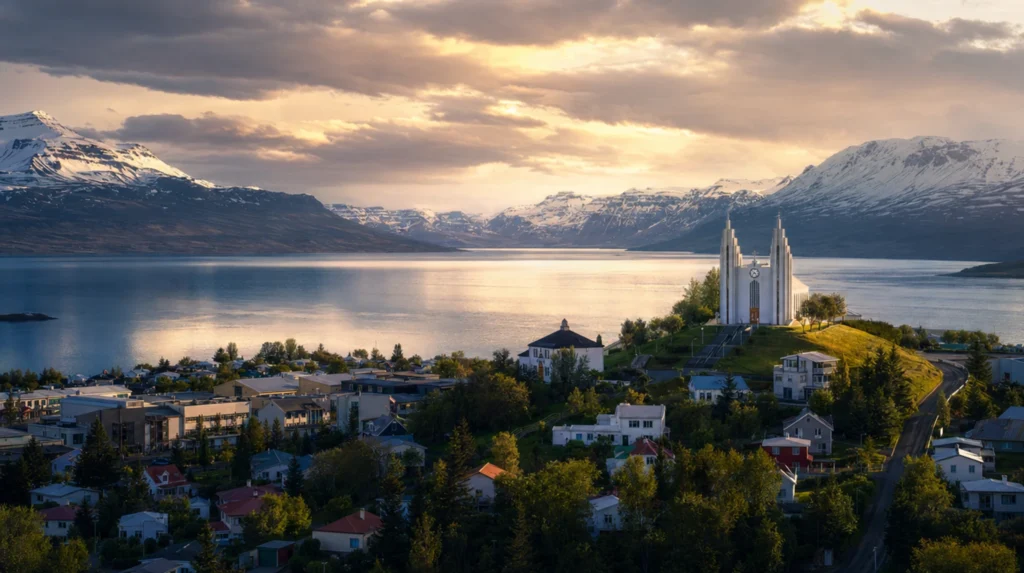
Akureyri, Iceland: The Capital of the North, Whale Coast Base, Aurora Belt Anchor
Part of our Iceland travel guide.
I have driven into Akureyri at the end of three different Ring Road loops and the part I still find astonishing is how protected it feels — wedged at the head of a 60 km fjord, with the open Arctic Ocean pushed safely beyond the headlands. We tell first-time travellers it is Iceland’s quiet second city, and that is true, but the genuine pitch is the microclimate: drier than Reykjavík, colder in winter, brighter in summer, and reliably better for aurora. My favourite hour in Akureyri is the late soak at Forest Lagoon with the fjord glowing under midnight sun. Treat this guide as the brief I would hand my own family before they boarded the 45-minute flight north.

Table of Contents
Why Akureyri?
Akureyri is Iceland’s quiet second city — population around 19,500 at the head of the 60 km Eyjafjörður, the country’s longest and most sheltered fjord. It is 388 km north of Reykjavík by road and 45 minutes north by air, and it sits 100 km south of the Arctic Circle on a microclimate that is drier and colder than the south coast — exactly what aurora hunters and skiers want.
The city earns its ‘capital of the north’ nickname by stuffing genuine urban infrastructure into a town the size of an English market town: Iceland‘s second hospital, the country’s second-largest geothermal pool, a botanic garden famously above the 65th parallel, a microbrewery cluster, and four ski resorts within an hour.
Practically, Akureyri is the best small base for the spectacular north. Lake Mývatn is 90 km east; Húsavík’s whale-watching fleet is 90 km north-east; Goðafoss is 50 km east. Plan two to three days here as your northern anchor — and shave an entire Ring Road day by flying in or out from Reykjavík.
Neighborhoods: Finding Your Akureyri
📍 Akureyri Map: Every Place in This Guide


Innbær (Old Town)
The old quarter at the southern end of the spit — restored 19th-century timber houses, a small turf-house museum (Nonnahús, the home of children’s author Jón Sveinsson), and the church-yard Hofskirkja site. The streets are quiet and a 10-minute walk from the modern centre.
- Nonnahús — turf-walled timber house, museum admission ISK 1,500 in 2026 (verify on site)
- Akureyri Heritage Museum (Minjasafnið á Akureyri)
- Aðalstræti’s restored timber rows, walkable to the harbour in 10 minutes
Best for: photographs, a slow first afternoon. Access: 15-minute walk from Akureyrarkirkja.
Miðbær (City Centre)
The compact pedestrianised zone radiating from the church — Hafnarstræti, Glerárgata and Strandgata — with most of the city’s restaurants, the tourist office, and the harbour cruise terminals. Heart-shaped traffic lights are an Akureyri quirk worth photographing.
- Akureyrarkirkja — basalt-column-inspired Lutheran church by Guðjón Samúelsson, 1940
- Hof Cultural Centre and the Akureyri Theatre (Leikfélag Akureyrar)
- The pedestrianised Hafnarstræti shopping street and the heart-shaped red lights
Best for: first-time base, walking to dinner. Access: the centre, walkable to everything.
Glerárhverfi (North-City Pool & Family)
Across the Glerá river bridge — Glerárlaug pool (newer than Akureyri’s main pool and a local favourite), Kjarnaskógur urban forest with hiking trails, and the Glerártorg shopping centre. Quieter and more residential than the centre.
- Glerárlaug — neighbourhood geothermal pool with hot pots and waterslide
- Kjarnaskógur urban forest — running, mountain biking and Nordic skiing
- Glerártorg Shopping Centre — Akureyri’s main supermarket cluster (Bónus, Krónan, Nettó)
Best for: running, cheaper accommodation, families. Access: 20-minute walk or 5-minute bus from centre.
Naustahverfi & Eyrarlandsholt (East Slope)
The residential slope rising east of the centre toward Súlur (1,213 m ), the city’s signature peak. Akureyri Botanic Garden — the world’s most northerly public botanic garden until very recent rivals — sits just below the church-yard skyline. The University of Akureyri campus is a 15-minute walk south of the centre.
- Akureyri Botanical Garden (Lystigarðurinn) — free entry, 7,000+ plant species in summer
- University of Akureyri campus and the Sólborg cultural-events hall
- Súlur trailhead — 5-hour return ascent (1,213 m), summer only
Best for: botanic-garden visits, summer hiking. Access: 15-minute walk uphill from centre.
Forest Lagoon & East Fjord Bank
Across the fjord on the east bank — the 2022-opened Forest Lagoon (Skógarböðin) is the city’s headline geothermal spa, surrounded by Vaðlaskógur forest and overlooking the fjord. A 10-minute drive from Akureyri centre.
- Forest Lagoon (Skógarböðin) — adult admission ISK 7,990 in 2026 (verify on site)
- Vaðlaskógur forest — Iceland’s most-replanted woodland, walkable trails
- Fjord-bank cycling path back toward Akureyri
Best for: spa evenings, midnight-sun soaks, aurora soaks in winter. Access: 10-minute drive or summer-only shuttle from centre.
Hlíðarfjall (Ski Mountain)
The 1,116 m mountain west of the city, home to Iceland’s largest ski resort by lift count. Lifts run daily mid-November through late April; lift pass ISK 6,500 in 2026 (verify on site). Day skiing here is a viable Reykjavík weekend if you fly in.
- Hlíðarfjall ski area — 13 km of pistes, season Nov–Apr
- Iceland Winter Games (March) — annual freestyle ski/snowboard event
- Sólarkaffi at Súlnaberg — slope-side café open winter only
Best for: skiing, freestyle. Access: 10-minute drive from centre, free shuttle in winter.
The Food

North-Coast Classics
Akureyri’s food anchor is fish from Eyjafjörður and lamb from the surrounding farms — arctic char (bleikja) smoked at small Eyjafjörður smokehouses, plokkfiskur using the day’s haddock catch, and slow-cooked lamb shank with mountain herbs. Fish-and-chips at Hafnarstræti is the everyday lunch; the high-end versions appear at the Berlín and Strikið dining rooms.
- Strikið — fjord-view fine dining on the top floor of Skipagata 14, Icelandic seasonal menu.
- Rub23 — sushi and Icelandic-fusion chef’s tasting menu.
- Berlín — bistro-style breakfast and lunch, fjord-fish daily.
Mývatn Earth-Oven Rye
An hour east at Lake Mývatn, Vogafjós farm-to-table café bakes its rúgbrauð (rye bread) for 24 hours in geothermal ground ovens — the same method documented in the National Museum’s farming exhibit. Worth the day-trip detour for the bread alone; the smoked-char plate that comes with it is the bonus.
Brewery Cluster
Akureyri is Iceland’s craft-beer capital by per-capita microbrewery count. Kaldi Brugghús in Árskógssandur (40 km north) was Iceland’s first microbrewery (2006); Einstök Ölgerð brews in Akureyri itself; Bruggsmiðjan in Holtsmúli runs brewery tours.
- Kaldi Bruggsmiðjan (Árskógssandur) — Iceland’s first microbrewery, brewery tours and Bjórböðin beer-bath spa next door.
- Einstök Ölgerð — based at Akureyri, signature Icelandic White Ale and Toasted Porter.
- Götubarinn — Akureyri’s downtown craft-beer pub on Hafnarstræti.
Bakery & Café Habit
- Kristjáns Bakarí — third-generation bakery on Strandgata, snúðar and rye loaves.
- Bláa Kannan — the iconic blue-painted café below the church, brunch and waffle staple.
- Brynja — celebrated 1939 ice-cream parlour on Aðalstræti; the Icelandic ‘bragðarefur’ soft-serve mix is the local order.
Cultural Sights

Akureyrarkirkja
The Lutheran church above the town, designed by Guðjón Samúelsson (the same architect as Reykjavík’s Hallgrímskirkja) and completed 1940. Basalt-column-inspired facade; free entry; the central stained-glass window came from the bombed-out Coventry Cathedral in 1940. Open daily in summer, Mon–Fri shorter hours in winter.
Akureyri Botanical Garden (Lystigarðurinn)
Free public garden, opened 1912, claimed for decades as the world’s most northerly public botanic garden. Around 7,000 plant species in collection, with 400 native to Iceland; the rhododendron season peaks late June. Open mid-May through September.
Hof Cultural Centre
The harbourfront concert hall and conference centre opened 2010, home to the North Iceland Symphony Orchestra and the Akureyri Theatre Company. The amphitheatre window onto the fjord is itself a sight; daytime entry to the foyer is free.
Akureyri Heritage Museum (Minjasafnið)
Three-site complex covering the Settlement-era turf-house Laufás, the central Heritage Museum, and the Nonnahús children’s-author home. Combination ticket ISK 2,500 covers all three; plan three hours.
Goðafoss
The 30-m-wide ‘Waterfall of the Gods’ on the Skjálfandafljót, 50 km east of Akureyri on Route 1. Named for the moment in 1000 CE when Þorgeir, the Lawspeaker of the Alþing, threw the carved figures of the old Norse gods into the falls after declaring Iceland Christian. Free, 24/7, full volume year-round.
Iceland Aviation Museum
At Akureyri Airport, a small but credible collection of Icelandic civil and military aviation history. Adult admission ISK 2,000; useful in poor weather.
Entertainment

Geothermal Pools (the actual nightlife)
Akureyri Sundlaug is the city pool — 50 m main basin, two waterslides and several hot pots — plus Glerárlaug across the river. Adult admission ISK 1,200 in 2026 (verify on site).
Forest Lagoon (Skógarböðin)
The 2022-opened geothermal spa across the fjord — two pools at 36–40°C, a cold plunge, and a sauna with a fjord-facing wall. Sunset shifts are the booking-required slot; the swim-up bar opens at 6pm.
Hlíðarfjall Skiing
Iceland’s largest ski resort by lift count, 10 minutes from the city centre. Season runs mid-November through late April; lift pass ISK 6,500 in 2026 (verify on site). The Iceland Winter Games freestyle competition lands here in March.
Aurora Cruises in the Fjord
Several harbour operators run aurora cruises into Eyjafjörður September through March — far enough out to escape city light pollution. The fjord is calmer than Faxaflói off Reykjavík, which is decisive if you are seasick-prone. Tickets around ISK 12,000 in 2026 (verify with operator).
Live Music & Theatre
Hof Cultural Centre hosts the North Iceland Symphony Orchestra; Græni Hatturinn (the Green Hat) is the city’s small live-music venue, with weekly Icelandic-language indie and folk shows.
Akureyri Summer Arts Festival
Annual festival every July across Hof and the Botanical Garden — concerts, plays and pop-up exhibitions. Akureyrarvaka, the city’s birthday weekend in late August, is the bigger street festival.
Day Trips
Akureyri is the classic overnight stop on our day-by-day 10-day Ring Road itinerary.

Húsavík & Whale-Watching (Half-day, 91 km, by car)
The country’s whale-watching capital — Skjálfandi Bay sees minke, humpback and blue whales April through October. North Sailing’s traditional schooner tours run 3 hours, around ISK 13,500 in 2026 (verify on site). The wooden Húsavíkurkirkja and the Húsavík Whale Museum are worth an extra hour after the cruise.
Lake Mývatn & the Geothermal Field (Full day, 90 km east)
Pseudo-craters at Skútustaðir, the lava maze of Dimmuborgir, the Námaskarð fumaroles, and the Mývatn Nature Baths (the Blue Lagoon’s quieter, cheaper northern cousin). Plan 8–10 hours; pair with Goðafoss on the way out.
Goðafoss & Aldeyjarfoss (Half-day)
Goðafoss is 50 km east on Route 1; Aldeyjarfoss, the basalt-column waterfall further inland on the F26 4×4 track, requires a high-clearance vehicle and is summer-only.
Dettifoss (Long day, 175 km)
Europe’s highest-volume waterfall, 44 m high, 100 m wide, around 193 m³/sec. Approach from the western side via Route 862 (paved, year-round); the eastern Route 864 is gravel and summer-only. Combine with the Ásbyrgi horseshoe canyon and the Krafla volcanic area for a long Ring Road day.
Tröllaskagi Peninsula Loop (Full day, 220 km )
The ‘Troll Peninsula’ north-west of Akureyri — fishing villages of Hauganes, Hjalteyri, Dalvík, Ólafsfjörður and Siglufjörður, the Herring Era Museum at Siglufjörður (winner of the European Museum of the Year 2004 special commendation), and dramatic coast road tunnels.
Grímsey Island & the Arctic Circle (Half/full day)
The only Icelandic territory across the Arctic Circle, reachable by 25-minute Norlandair flight or 3-hour Sæfari ferry from Dalvík. 86 residents, a 30-tonne Orbis et Globus marble sphere that marks the moving Arctic Circle position, and one of Iceland’s largest puffin colonies May–August.
Seasonal Guide

Spring (Mar–May)
Aurora season ends 21 March; ski season runs into late April at Hlíðarfjall. Coastal temperatures climb from −2°C to around 8°C ; the Eyjafjörður whale-watching fleet returns from late April.
Summer (Jun–Aug)
Long sub-Arctic days with around 24 hours of visible daylight at solstice on 21 June. Whale-watching peaks July–August; Forest Lagoon midnight-sun shifts; the Botanic Garden is at peak bloom; Akureyrarvaka festival mid-August.
Autumn (Sep–Nov)
Aurora season returns 21 September; whale-watching ends late October; first snow on Hlíðarfjall mid-October. Genuinely the best price-quality window — hotel rates 25–35% below July.
Winter (Dec–Feb)
Ski and aurora season at full speed. Daylight shrinks to 3.5 hours at solstice. The drier microclimate gives Akureyri better aurora odds than Reykjavík; Iceland Winter Games (March) closes the freestyle ski season.
Getting Around
Walking
Akureyri’s downtown is walkable end-to-end in 15 minutes. The harbour, church, restaurants and tourist office sit within a five-block grid; you only need wheels for Forest Lagoon, Hlíðarfjall and the Mývatn day trip.
City Buses (Strætisvagnar Akureyrar)
Free city bus network, six routes — yes, free. Daily 6:30am–11pm; routes 1–6 cover every neighbourhood including Glerárhverfi and the Hlíðarfjall ski shuttle (winter only).
Rental Cars
Rent at Akureyri Airport (3 km south) or downtown branches of Hertz, Sixt, Europcar and Blue Car Rental. Standard small car ISK 6,500–10,000 per day, 4×4 ISK 14,000–20,000 in summer. Most Mývatn-Húsavík visitors fly into Akureyri and pick up the rental at the airport.
Taxis
BSO Akureyri is the local fleet — flag-fall around ISK 700, airport-to-downtown around ISK 4,500. Uber and Lyft do not operate.
Long-Distance Coach
Strætó BS runs three round-trips a day from Reykjavík (route 57); around 6h 30min, ISK 13,500 one-way in 2026 (verify on site). Cheaper but longer than the 45-minute Icelandair Domestic flight.
Air Travel
Icelandair Domestic flies Reykjavík–Akureyri three to five times a day in 45 minutes; seasonal direct international services from London, Copenhagen and Amsterdam in winter.
Cycling
Akureyri has a small but expanding bike-path network and rents from Hjólageymsla. The harbour-to-Forest-Lagoon waterfront ride is the city’s best loop in summer.
Budget Breakdown: Making Your Króna Count
| Tier | Daily | Sleep | Eat | Transport | Activities | Extras |
|---|---|---|---|---|---|---|
| Budget | USD $95–145 | Hostel dorm ISK 5,500–8,500 | Bónus + bakery ISK 2,500–4,000 | Free city bus + rental car ISK 6,500 | Akureyri pool ISK 1,200, Goðafoss free | Bjórböðin beer-bath ISK 9,500 |
| Mid-Range | USD $200–320 | 3-star hotel ISK 22,000–35,000 | One Strikið dinner ISK 7,000–9,000 | 4×4 rental ISK 14,000–20,000 | Whale-watching ISK 13,500, Forest Lagoon ISK 7,990 | Iceland Winter Games lift pass ISK 6,500 |
| Luxury | USD $550+ | Boutique hotel ISK 45,000–95,000 | Strikið tasting ISK 14,000+ | Private chauffeur or helicopter | Private Mývatn Super-Jeep ISK 75,000+ | Heli-skiing day from Klængshóll ISK 250,000+ |
Where Your Money Goes
Akureyri runs around 15–20% cheaper than Reykjavík for restaurants, hotels and rental cars on average — the Strikið two-course dinner that costs ISK 11,000 in the capital is closer to ISK 8,500 here. The biggest single saving is the city bus, which is genuinely free.
Money-Saving Tips
- Use the free city bus instead of taxis — six routes, 6:30am–11pm.
- Pre-book Forest Lagoon for the 4–6pm ‘Quiet Hours’ shift, around 20% off peak.
- Pair Mývatn and Húsavík into one long day with a 6am start, saving a hotel night.
- Self-cater breakfast from Bónus on Glerártorg — open until 18:30 most days.
Practical Tips
Language
Icelandic is the everyday language; English fluency is near-universal among under-50s. Akureyri University attracts an international student body, and the centre’s restaurants all serve in English. Learn ‘takk’ (thanks), ‘skál’ (cheers).
Cash vs. Cards
Akureyri is fully cashless — cards work at every café, bus stop, parking meter and pool. Free city buses don’t even take cash. Decline dynamic currency conversion and pay in ISK.
Safety
Akureyri is among the safest small cities in Europe — Iceland is number one on the Global Peace Index for 17 consecutive years. Real risks are weather (slippery streets in winter, sudden storms) and the Hlíðarfjall avalanche zone (always check the SafeTravel-issued forecast before off-piste skiing). Emergency 112.
What to Wear
Drier and colder than Reykjavík in winter; pack a heavier insulating layer plus a wind shell. Summer evenings can drop to single digits even in July; restaurants are casual, swim gear for pool visits.
Cultural Etiquette
Same as the rest of Iceland — shoes off indoors, naked-shower-with-soap before pool entry (posted in every changing room) , no tipping (24% VAT included ), first-name basis with everyone.
Connectivity
4G/5G blanket coverage from Síminn, Vodafone and Nova throughout the city and the Eyjafjörður corridor; patchy on the Mývatn highway approach. eSIMs work nationwide.
Health & Medications
Sjúkrahúsið á Akureyri (Akureyri Hospital) is Iceland’s second-largest hospital and handles all emergencies for North Iceland. Lyfja Akureyri pharmacy on Hafnarstræti carries the standard EU range; 24-hour service via the hospital out of hours.
Luggage & Storage
Akureyri Bus Terminal stores bags from ISK 800/day; Forest Lagoon and the city pool both have lockers. Akureyri Airport has 24-hour storage for travellers connecting to onward flights or the Sæfari ferry to Grímsey.
Frequently Asked Questions
How many days do I need in Akureyri?
Two to three days as a north Iceland anchor — one for the city itself (church, Botanic Garden, Forest Lagoon), one for Mývatn + Goðafoss, and one for Húsavík whale-watching. Add a fourth for a Tröllaskagi loop or an Iceland Winter Games / Hlíðarfjall ski day in winter.
Is Akureyri good for solo travellers?
Extremely. Iceland tops the Global Peace Index , and Akureyri’s compact downtown is genuinely walkable at any hour. The free city buses and the absence of a tipping culture make solo dining and transit straightforward.
Should I fly or drive from Reykjavík?
For 2–3 day trips, fly: 45 minutes versus a 6-hour drive each way, around ISK 25,000 round-trip in 2026 (verify on Icelandair). For a Ring Road loop, drive: Akureyri sits roughly halfway around Route 1 and is the natural overnight before the East Fjords leg. The Strætó coach is the cheapest option (ISK 13,500) but slowest.
What about the language barrier?
None for English-speakers — every sign, menu and museum label appears in English, and Icelanders under 50 are functionally bilingual.
When is the busiest week?
Iceland Winter Games (third weekend of March) for skiing; Akureyrarvaka (last weekend of August) for the city’s birthday festival. Iceland Airwaves week in November also drives Akureyri hotel demand as travellers extend the trip north for aurora.
Can I use credit cards everywhere?
Yes. Akureyri is as cashless as Reykjavík — even the free city bus does not take cash. Visa, Mastercard and Amex work everywhere.
Is Akureyri better than Reykjavík for aurora?
Statistically, yes. Akureyri’s drier, colder microclimate produces fewer cloud-out nights than Reykjavík over the same season — the Met Office’s aurora forecast accounts for this. If aurora is the trip’s primary purpose, base in Akureyri or Mývatn rather than the capital.
Ready to Experience Akureyri?
Two days in Iceland’s quiet second city, one day at Mývatn, one whale-watching cruise from Húsavík, and at least three aurora-chase evenings in winter — that is the Akureyri rhythm. For the full country context, read the Iceland Travel Guide; for the seasonal-maximum aurora window, see our Northern Lights 2026 guide.
Explore More City Guides
Where to Stay
- Reykjavík City Guide — the world’s northernmost capital and Iceland’s main gateway
- Húsavík City Guide — Iceland’s whale-watching capital
- Mývatn Region Guide — pseudo-craters, fumaroles and nature baths
- Siglufjörður City Guide — Tröllaskagi herring town
- Iceland Country Guide
- All City Guides
Alex the Travel Guru
Alex has based three Iceland trips out of Akureyri now and rates it the most underrated small city in Europe — drier than Reykjavík, cheaper than Reykjavík, and an hour closer to almost everything in the spectacular north. For the full country context, read the Iceland Travel Guide.
More city guides you might like
Plan your trip to Akureyri
The booking tools we use ourselves. FFU may earn a commission at no extra cost to you.
Plan & book your trip to Akureyri
Booking through these searches supports our guides at no extra cost to you.