
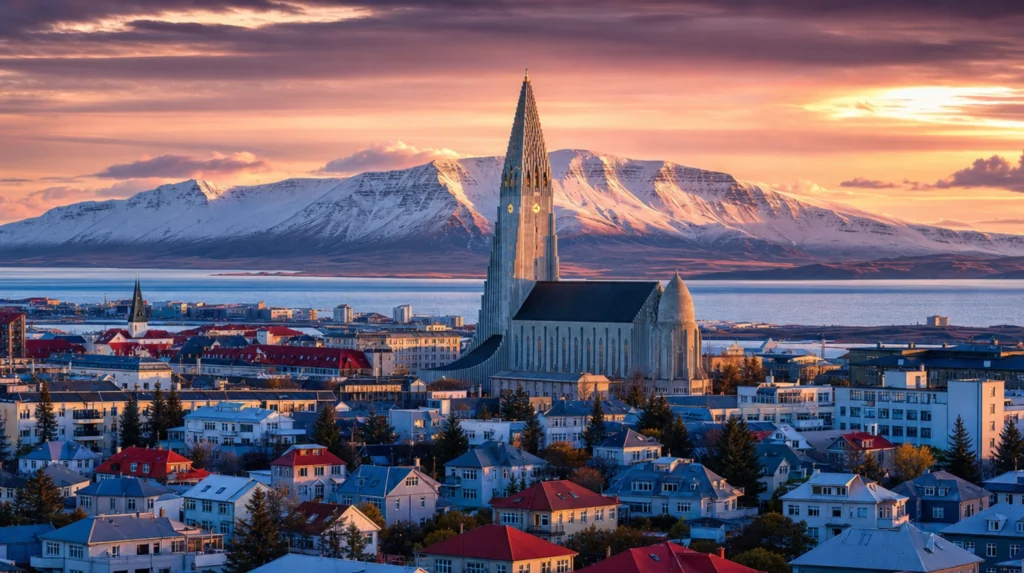
Part of our Iceland travel guide.
Reykjavík, Iceland: Northernmost Capital, Geothermal Pool Capital, Aurora Base Camp
Reykjavík keeps revealing new corners even to frequent visitors. First-time travellers should know that the city is small — fewer than 140,000 people in the whole capital area — and that is true, but it is also the only real city Iceland has, and the place where most aurora trips begin and end. A quintessential Reykjavík morning: the 7 a.m. heitir-pottar shift at Sundhöll, with two espressos and a cinnamon snúður on the way home. Treat this guide as the brief you’d want in hand before boarding the Flybus from Keflavík.

Table of Contents
Why Reykjavík?
Reykjavík is the world’s northernmost capital at 64°N and the only city in a country of just 400,000 people. The greater capital area holds around 140,000 of those residents — well over a third of Iceland’s population — packed into a low-rise port on the south-west coast where the Atlantic, the Reykjanes lava fields and the open North-Atlantic sky meet. The city is small enough to walk end to end in 30 minutes and quiet enough that you can stand on Sólfar at 11pm in February and hear nothing but wind.
What makes the city feel bigger than its population is the density of culture for its scale: a 74.5 m Lutheran landmark, a world-class concert hall in Harpa, Iceland’s first Michelin-starred restaurant in Dill, the Iceland Airwaves festival every November, and 17 geothermal pools across the capital area where Icelanders genuinely socialise rather than exercise.
The city is also the launchpad for nearly every Iceland itinerary. Keflavík International Airport is 50 km west, the Flybus reaches BSÍ in 45 minutes, Þingvellir is 45 minutes east, the Blue Lagoon is 20 minutes south-west, and the Snæfellsnes Peninsula is two hours north. Plan three full days here as your urban anchor, then drive.
Neighborhoods: Finding Your Reykjavík
📍 Reykjavík Map: Every Place in This Guide


101 Reykjavík (Downtown / Miðborg)
The 101 postal code covers the original city core — Laugavegur and Skólavörðustígur shopping streets, the Old Harbour, Tjörnin pond and the lower slopes of Skólavörðuholt up to Hallgrímskirkja. Almost every Reykjavík visitor walks here within an hour of arriving, and most never leave. Painted timber and corrugated-iron houses line cobbled side-streets; cafés open at 7am and run continuously until 10pm.
- Hallgrímskirkja — 74.5 m Lutheran church, tower elevator
- Reykjavík City Hall (Ráðhús Reykjavíkur) on Tjörnin pond
- Bæjarins Beztu Pylsur hot-dog stand, open since 1937
Best for: walking the city in a day, café-hopping. Access: all on foot from BSÍ in under 25 minutes.
Old Harbour (Gamla höfnin)
The working harbour where the city earned its living for two centuries — now the embarkation point for whale-watching, puffin-watching and Northern-Lights cruises, plus a cluster of seafood-forward restaurants and the Marshall House art space. Harpa Concert Hall, opened 2011, anchors the eastern end with its Olafur-Eliasson honeycomb glass facade.
- Harpa Concert Hall and Conference Centre
- Whale-watching tours from Ægisgarður pier (around 3h, ISK 12,500–14,500 in 2026)
- The Marshall House (Marshallhúsið) contemporary-art building
Best for: harbour walks, whale-watching, contemporary art. Access: 10-minute walk from Hallgrímskirkja.
Vesturbær (West Side)
The quiet residential west, home to the University of Iceland, the National Museum of Iceland, the Saga Museum, and the Vesturbæjarlaug pool — a local favourite that sees fewer tourists than Laugardalslaug. The Seltjarnarnes peninsula at the western end is the city’s best aurora-watching point inside city limits.
- National Museum of Iceland — Þjóðminjasafn
- Vesturbæjarlaug pool — local-favourite geothermal facility
- Grótta lighthouse and aurora viewpoint at Seltjarnarnes
Best for: aurora chasing inside the city, museums, pool routine. Access: bus 14 or 25-minute walk from 101.
Laugardalur
The eastern recreation valley — Laugardalslaug, the city’s biggest geothermal pool, sits here, alongside the Botanic Garden, the Reykjavík Family Park & Zoo, and the Ásmundur Sveinsson Sculpture Museum. A 25-minute walk or 10-minute bus ride from downtown.
- Laugardalslaug — Reykjavík’s largest pool, 50 m main basin plus seven hot pots
- Reykjavík Botanic Garden — free entry
- Ásmundur Sveinsson Sculpture Museum
Best for: families, big-pool routine, Botanic Garden. Access: bus 14, 12 or 25-minute walk from Hlemmur.
Hlemmur & Eastern 105
The transit-and-food node centred on Hlemmur — the city’s main bus interchange — and the Hlemmur Mathöll food hall, the largest in the city. Eastern 105 has the best concentration of casual independent restaurants and the city’s most reliable open-late ramen and tacos.
- Hlemmur Mathöll — 10+ vendors, daily 8am–11pm
- Reykjavík Bus Terminal (Hlemmur) — Strætó interchange
- Skúli Craft Bar and the surrounding craft-beer cluster
Best for: food hall, casual dinners, late-night transit. Access: 12-minute walk from Hallgrímskirkja or any bus to Hlemmur.
Grandi (Old Harbour West)
The reclaimed industrial wharf west of Old Harbour — five years ago Grandi was a working fish-processing zone; today it holds Reykjavík Maritime Museum, Whales of Iceland, and the Bryggjan Brugghús brewery. Walkable from 101 in 15 minutes along the harbour.
- Reykjavík Maritime Museum (Sjóminjasafnið)
- Whales of Iceland — full-scale models of all 23 cetacean species in Icelandic waters
- Bryggjan Brugghús — brewery-tap with harbourfront seating
Best for: rainy-afternoon museums, harbour-edge brewery. Access: 15-minute waterfront walk from Old Harbour.
Skólavörðuholt & the Hill
The hillside neighbourhood radiating south from Hallgrímskirkja — small galleries, design stores, and the Einar Jónsson Sculpture Garden. Quieter than Laugavegur and the best base for first-time visitors who want to be five minutes from the city’s most-photographed building.
- Einar Jónsson Museum — sculpture garden free, museum ISK 1,400
- Skólavörðustígur — rainbow-painted pedestrian street
- The independent galleries on Bergstaðastræti and Frakkastígur
Best for: photo walks, slow cafés, first-time base. Access: directly south of Hallgrímskirkja.
Þingholt & Tjörnin
The leafy area south of Bankastræti around Tjörnin pond — the National Gallery of Iceland, the Settlement Exhibition (Landnámssýningin), and a cluster of 19th-century timber houses. The pond freezes most of the winter and locals skate on it.
- National Gallery of Iceland — Listasafn Íslands
- The Settlement Exhibition — excavated longhouse from c. 871 ±2 CE under Aðalstræti
- Tjörnin pond and the Reykjavík City Hall reflecting in it
Best for: art museums, archaeology, photography in winter light. Access: 5-minute walk from Hallgrímskirkja or Old Harbour.
The Food

Icelandic Classics, Done Properly
Reykjavík is the easiest place in Iceland to taste the genuine national pantry — skyr at every supermarket, lamb soup served with refills at every café, plokkfiskur on most lunch menus, and pylsur from the harbour stand that has worked the same recipe since 1937. The classics anchor every itinerary; everything below is layered on top.
- Bæjarins Beztu Pylsur — the harbour-front lamb hot-dog stand, open since 1937. Order ‘ein með öllu’ (one with everything).
- Icelandic Street Food (Lækjargata) — refillable kjötsúpa lamb soup and plokkfiskur in bread bowls.
- Íslenski Barinn — pub menu of plokkfiskur, hákarl & Brennivín shooter, lamb shank.
New Nordic & Tasting Menus
Iceland’s first Michelin star arrived at Dill in 2017 — chef Gunnar Karl Gíslason’s restaurant on Laugavegur — and the city’s tasting-menu scene has expanded steadily since. Reservations open four to eight weeks ahead at the busiest tables.
- Dill Restaurant — the first Icelandic Michelin star, New Nordic tasting menu (around ISK 18,500 in 2026; verify on the official site).
- Matur og Drykkur — Icelandic-history tasting menu inspired by the 1947 cookbook of the same name.
- Skál! at Hlemmur Mathöll — sustainable small plates, no-reservation seating.
Beyond Pylsur and Plokkfiskur
The 2020s broadened Reykjavík’s food map well beyond the canon — the city has Hlemmur Mathöll’s 10-vendor food hall, a credible ramen scene, several solid pizza places, and a reliable sushi bar in Sushi Social. Bakery culture is the year-round constant: Sandholt and Brauð & Co. anchor downtown bread.
- Hlemmur Mathöll — food hall with Skál, Flatey Pizza, Kröst and Mai Thai.
- Sandholt — third-generation bakery on Laugavegur for snúðar and sourdough.
- Brauð & Co. — neon-painted bakery on Frakkastígur for cinnamon swirls and rye.
- Reykjavík Roasters — speciality coffee at Kárastígur 1 and Brautarholt 2.
Food Experiences You Cannot Miss
- An ISK 1,400 morning at Sundhöll — pool, three espressos, and a snúður on the way home
- ‘Ein með öllu’ at Bæjarins Beztu after midnight in summer — the Midnight-Sun ritual
- The Saturday Kolaportið flea market for harðfiskur and dried-fish snacks
Cultural Sights

Hallgrímskirkja
Reykjavík’s most-photographed building — a 74.5 m basalt-column-inspired Lutheran church designed by Guðjón Samúelsson and finally completed in 1986 after 41 years of construction. The bell-tower elevator (ISK 1,300 adult ticket in 2026, verify on site) gives the city’s best 360° rooftop panorama and on a clear day reaches Snæfellsjökull 130 km west. Open daily 9am–9pm in summer, shorter hours in winter; entry to the nave is free.
Harpa Concert Hall and Conference Centre
The honeycomb-glass landmark opened in 2011 after construction stalled in the 2008 financial crisis and was rescued by the state. The Ólafur Elíasson facade is itself a sight; inside, the 1,800-seat Eldborg hall hosts the Iceland Symphony Orchestra, the Icelandic Opera and pop tours. Free to wander during the day; book a 45-minute architecture tour (ISK 2,500) for the upper-floor halls.
National Museum of Iceland (Þjóðminjasafn)
The country’s headline museum — 1,000 years of Icelandic history from the c. 871 settlement to the present day, anchored by the Valþjófsstaður door (a carved 13th-century church door telling the lion-knight legend). Adult admission ISK 2,500 in 2026 (verify on site); plan two hours.
The Settlement Exhibition (Landnámssýningin)
An excavated 10th-century longhouse foundation under Aðalstræti, presented in situ with augmented projections showing the original turf walls. Adult admission ISK 1,950; combination ticket with the Maritime Museum and Árbær Open Air Museum.
Sun Voyager (Sólfar)
Jón Gunnar Árnason’s 1990 stainless-steel sculpture on the Sæbraut waterfront, often misread as a Viking ship — the artist described it as a dream-boat ode to discovery. Free, 24/7, best at midnight in June or under aurora in February.
Perlan
The dome built atop Reykjavík’s hot-water storage tanks on Öskjuhlíð hill, now a museum dedicated to Icelandic nature — a real ice cave reconstructed from Vatnajökull glacier ice, a planetarium with a Northern-Lights show, and a 360° observation deck. Adult admission with all exhibits ISK 6,990 in 2026 (verify on site); plan three hours.
Reykjavík Art Museum (Listasafn Reykjavíkur)
Three sites under one ticket: Hafnarhús (downtown contemporary, focused on Erró), Kjarvalsstaðir (Jóhannes S. Kjarval, the country’s most beloved 20th-century painter), and Ásmundarsafn (sculptor Ásmundur Sveinsson’s studio-house). Adult day-ticket ISK 2,200 covers all three.
Entertainment

Geothermal Pools (the actual nightlife)
Icelanders’ most reliable evening venue is the neighbourhood pool, not the bar. Sundhöll is the central Art-Deco original (built 1937, restored 2017) and has both indoor and outdoor pots; Vesturbæjarlaug is the local-favourite west-side facility; Laugardalslaug is the biggest, with seven hot pots and a saltwater tub. Adult admission ISK 1,400 across all 17 capital-area pools in 2026 (verify on site); a 10-visit card drops the per-visit cost to around ISK 1,000.
Live Music
Reykjavík’s live-music habit is dense for the city’s size. Harpa hosts the Iceland Symphony Orchestra and the Icelandic Opera; Gamla bíó (a converted cinema) is the mid-size pop venue; Húrra and Mengi cover indie and experimental.
Iceland Airwaves Festival
The country’s flagship music festival, every November across Harpa, Gamla bíó, the Art Museum and downtown bars. 2026 dates: 5–7 November. Festival passes around ISK 32,000–45,000 depending on early-bird tier; book accommodation by July.
Bars & Craft Beer
Iceland legalised beer only in 1989, and the craft-beer scene is therefore young but enthusiastic. Skúli Craft Bar, Mikkeller & Friends, Session Craft Bar and Kaldi Bar are the downtown four. Pints run ISK 1,400–1,800; happy hour 4–7pm typically halves the price.
Whale-Watching Cruises
Departures from the Old Harbour, run year-round but most reliable April through October. Around 3 hours; minke whales are the year-round species and humpbacks return in summer.
Northern Lights Cruises
September through March, the same Old Harbour operators run 2.5–3 hour aurora cruises into Faxaflói Bay. The advantage over a road tour is no light pollution at all once you clear the harbour mouth; the disadvantage is ocean motion if the wind picks up. Tickets around ISK 13,500 in 2026 (verify on site).
Day Trips

Golden Circle (Full day, 200 km loop, by car)
Iceland’s iconic 200-km loop east from Reykjavík: Þingvellir National Park (UNESCO 2004) , the Haukadalur geyser field with reliable Strokkur (erupts every 6–10 minutes), and the 32 m two-tier Gullfoss waterfall. 6 hours minimum at a steady pace; 8–9 hours with a Friðheimar tomato-soup lunch and Secret Lagoon soak.
Blue Lagoon (Half day, 50 km, by car or Flybus)
The geothermal spa 20 minutes from Keflavík and 50 minutes from Reykjavík. Comfort entry ISK 9,990 in 2026 with two complimentary treatments and a drink; reservations are mandatory, sells out 1–2 weeks ahead in peak weeks. Combine with KEF arrivals or departures rather than a separate day.
South Coast Day Tour (12 hours, 380 km, by car)
Seljalandsfoss (60 m, walk behind), Skógafoss (60 m, 527 steps to the top), Reynisfjara black-sand beach and the Reynisdrangar sea stacks at Vík. A long day; a Sólheimajökull glacier-walk add-on extends it to 14 hours but is worth the extra. Watch sneaker-wave warnings at Reynisfjara — the SafeTravel.is risk rating must be checked before walking on the sand.
Reykjanes Peninsula (Half day)
The ongoing eruption zone — Fagradalsfjall and Sundhnúkur have been active in cycles since March 2021, and current safe-viewing parameters change weekly. The Bridge Between Continents lets you walk across the visible Mid-Atlantic rift, and the Krýsuvík geothermal field (steam vents and hot mud pools) sits on the route. Always check Veður and SafeTravel before any eruption-zone visit.
Snæfellsnes Peninsula (Long day, 320 km loop)
Iceland in miniature in 90 km — Kirkjufell mountain (463 m), Snæfellsjökull stratovolcano (1,446 m), Arnarstapi cliffs, Djúpalónssandur black-pebble beach. 12 hours from Reykjavík and back; an overnight in Hellnar is the better version.
Whale-Watching from Old Harbour (3 hours)
From the city itself — minke whales year-round in Faxaflói, humpbacks May through October. Pair with a morning at Sundhöll for a low-stakes Reykjavík day.
Seasonal Guide

Spring (Mar–May)
Aurora season ends 21 March; Midnight Sun begins building. Coastal temperatures climb from −2°C to around 10°C ; café culture moves outdoors from late April; the puffin colonies return to Akurey and the Westman Islands from mid-April. Reykjavík Arts Festival runs late May. The genuine best-value city window — hotels 25–35% off summer rates.
Summer (Jun–Aug)
Peak season and Midnight Sun — around 21 hours of visible daylight at solstice on 21 June. Pylsur queues form at Bæjarins Beztu past midnight; Old Harbour cruises are at full frequency; Secret Solstice festival lands around the solstice. Hotel rates 30–60% above winter; book three months ahead.
Autumn (Sep–Nov)
The underrated shoulder. Temperatures fall from around 10°C to near zero; aurora season returns 21 September; Iceland Airwaves lights up downtown in early November. The first snowstorms arrive on the Ring Road from mid-October; city-only itineraries stay perfectly drivable.
Winter (Dec–Feb)
Aurora and ice-cave season. Daylight shrinks to 4–5 hours in Reykjavík around the solstice. Pool culture is at its peak — heitir pottar at −5°C with snow on the deck is the Icelandic winter pinnacle. Þorrablót festivals run late January through late February. Pack a wind shell and waterproof boots.
Getting Around
Walking
Reykjavík’s downtown is genuinely walkable end-to-end in 30 minutes — Grandi to Hlemmur is around 2.4 km along the harbour. Most first-time visitors do not use public transport at all inside 101, 105 and Vesturbær. Hills are gentle except for the climb to Hallgrímskirkja.
Strætó (City Buses)
Iceland’s only public-transport network. Single fare ISK 630 in 2026 (verify on the official site), buy via the Klappið app or onboard with cash (no change). The 1, 3, 6, 12 and 14 hit every neighbourhood you’d want as a visitor; 55 connects Reykjavík–Keflavík (cheaper than Flybus, slower).
Airport Access
- Flybus (Reykjavík Excursions) — KEF to BSÍ in 45 minutes, ISK 4,599 one-way in 2026 (verify on site).
- Airport Direct (Gray Line) — KEF to multiple downtown hotels, similar timing and price.
- Strætó 55 — KEF to Mjódd, around 70 minutes, ISK 2,520; cheapest option but slowest.
Taxis
Hreyfill and BSR are the two main fleets. Flag-fall around ISK 700; KEF to downtown ISK 18,000–22,000. Uber and Lyft do not operate in Iceland; ride-hail is taxi-only.
Rental Cars
You do not need a car inside Reykjavík; you do for any day trip beyond Blue Lagoon. Most travellers pick up the rental at KEF rather than downtown for fewer parking hassles. Standard small economy car ISK 8,000–12,000 per day in winter, ISK 12,000–18,000 in summer; a 4×4 (RAV4 class) ISK 16,000–22,000 in summer. Check road.is and vedur.is every morning before driving.
Cycling
The city has a 50 km network of bike paths, much of it along the harbour and Tjörnin. Bike rental from WOW Cyclothon and Reykjavík Bike Tours from ISK 4,000 per day. The path west to Grótta is the city’s best ride.
Navigation Tips
Apps: Klappið (Strætó tickets), Veður (Met Office weather), road.is (live road status). Google Maps works fine. Note: Icelandic addresses are first-name + patronymic of the building owner historically — modern street addresses are conventional but the patronymic system shows up everywhere else.
Budget Breakdown: Making Your Króna Count
| Tier | Daily | Sleep | Eat | Transport | Activities | Extras |
|---|---|---|---|---|---|---|
| Budget | USD $110–160 | Hostel dorm ISK 6,500–9,500 | Bónus + pylsa ISK 3,000–4,500 | Walking + Strætó ISK 630/ride | Free pools (ISK 1,400) and museums (Reykjavík City Card 24h ISK 4,990) | Beer 4–7pm happy hour ISK 800–1,000 |
| Mid-Range | USD $230–360 | 3-star hotel ISK 28,000–45,000 | One sit-down dinner ISK 5,500–8,500 | Walking + occasional taxi | Whale-watching ISK 12,500, Perlan ISK 6,990 | Lunch tasting menu ISK 4,500–6,500 |
| Luxury | USD $600+ | 5-star hotel ISK 60,000–120,000+ | Dill tasting menu ISK 18,500 | Private transfer / chauffeured tour | Helicopter to Reykjanes from ISK 95,000 | Spa session at Sky Lagoon Sky Pass ISK 14,990 |
Where Your Money Goes
Reykjavík is the most expensive city in the country, but it is also the city with the most ways to skip the worst prices. The biggest line item for most mid-range travellers is dinner at sit-down restaurants — switching one of three dinners to a Hlemmur Mathöll meal (ISK 2,500–3,500) saves around ISK 5,000 a day. The second-biggest is alcohol; Vínbúðin off-licence prices are a fraction of bar prices, and most Reykjavík hotels have a kitchenette or kettle for the cheaper habit. The third is taxis from KEF — the Flybus saves ISK 13,000+ on the airport run alone.
Money-Saving Tips
- Buy a Reykjavík City Card (24h ISK 4,990, 48h ISK 6,990) for free pools, museums and Strætó.
- Eat lunch tasting menus instead of dinner — 40–60% off at most fine-dining addresses.
- Stop at Bónus (open until 18:30 most days) for breakfast and snacks rather than the hotel buffet.
- Skip the Blue Lagoon if budget is tight — Sky Lagoon (ISK 14,990 Sky Pass) is closer and arguably better; the city pools are ISK 1,400.
Practical Tips
Language
Icelandic is a North Germanic language close to Old Norse; 10th-century Sagas remain readable today. English fluency is near-universal among Icelanders under 50, and every sign, menu and museum label appears in English. Learn ‘takk’ (thanks), ‘skál’ (cheers), and ‘afsakið’ (excuse me).
Cash vs. Cards
Reykjavík is essentially cashless. Cards work at every café, bus, parking meter and pool. Decline dynamic currency conversion and always pay in ISK. Many travellers spend a full week without touching cash; the only place you might need it is the Saturday Kolaportið flea market, where some vendors prefer cash.
Safety
Iceland is among the world’s safest countries — number one on the Global Peace Index for 17 consecutive years. The genuine risks in Reykjavík are weather (slippery streets in winter, sleet making intersections lethal for pedestrians on Bankastræti), and the late-night bar zone on Laugavegur after 1am is loud but not violent. Emergency 112.
What to Wear
Reykjavík dress code is functional and casual — locals wear technical outerwear day and night. A waterproof shell, base layer, beanie and sturdy walking shoes are needed all year. Restaurants do not require formal dress; even Dill seats guests in jeans. Pack a swimsuit and small flip-flops for pool visits.
Cultural Etiquette
Shoes off indoors. Naked-shower-with-soap before the pool is non-negotiable and posted in every changing room. Tipping is not expected; service and 24% VAT are included. First-name basis with everyone, including the Prime Minister.
Connectivity
4G/5G blanket coverage from Síminn, Vodafone and Nova. eSIMs work everywhere; Síminn Prepaid 10 GB ISK 2,990 in 2026 (verify on site). Free WiFi at every café, on Strætó buses, at KEF, and at all 17 city pools.
Health & Medications
Pharmacies (apótek) carry standard EU medications; Lyfja and Apótekarinn are the two big chains. 24-hour pharmacy at Lyfja Lágmúla (Lágmúli 5). EHIC/GHIC valid for EEA/UK visitors; the public Landspítali hospital handles emergencies on Hringbraut.
Luggage & Storage
BSÍ Bus Terminal stores bags from ISK 990/day; Hlemmur Mathöll has lockers; KEF has 24-hour storage. Useful if your flight is late evening and you have checked out of the hotel.
Frequently Asked Questions
How many days do I need in Reykjavík?
Three full days as an urban anchor — one for downtown sights and Hallgrímskirkja, one for the National Museum and a pool routine, one for an Old Harbour whale-watch and Harpa. Add an aurora-chase evening to Þingvellir on a clear night. The Golden Circle, Blue Lagoon and South Coast each count as separate day trips.
Is Reykjavík good for solo travellers?
Extremely. Iceland ranks first on the Global Peace Index , the city is small enough to walk everywhere day and night, and pool culture is famously sociable. Female solo travellers report Reykjavík as one of the easiest capitals in Europe. The only risk is weather, not crime.
Is the Reykjavík City Card worth it?
Yes if you plan to visit two pools and two museums in 24 hours. The 24h card (ISK 4,990) covers all 17 capital-area pools, all Reykjavík Art Museum sites, the Settlement Exhibition, the Maritime Museum, the Botanic Garden zoo and unlimited Strætó. Two pools and one museum already break even.
What about the language barrier?
There is none for English-speakers. Every sign, menu, museum label, bus app and government form appears in English. Icelanders under 50 are functionally bilingual. Learning ‘takk’ (thanks) and ‘skál’ (cheers) is appreciated, but not required.
When are the busiest weeks?
Mid-June through mid-August (Midnight Sun + cruise season) and Iceland Airwaves week in early November. Christmas–New Year is a soft local peak with sky-high hotel rates and quiet streets. The aurora-shoulder windows of late February to mid-March and late September to mid-October are the best price-quality trade-off.
Can I use credit cards everywhere?
Yes. Reykjavík is one of the most cashless cities on Earth. Visa, Mastercard and Amex work at every venue including bus single-fares, parking meters, public toilets and the campsite honesty boxes outside city limits. Decline dynamic currency conversion at the till.
Is the Blue Lagoon worth it, or should I just go to a city pool?
Different products. The 17 city pools cost ISK 1,400, run year-round, and are where Icelanders actually spend their evenings. The Blue Lagoon is a luxury spa experience at the geothermal silica field — ISK 9,990 Comfort, two hours, towels and one drink included. Both are worth doing if budget allows; if forced to pick one, the city pool wins for cultural authenticity and the Blue Lagoon wins for photography.
Ready to Experience Reykjavík?
Three days in the world’s northernmost capital, two pool sessions, one aurora-chase evening east to Þingvellir — that is the Reykjavík rhythm. For the full country context, read the Iceland Travel Guide; for the seasonal-maximum aurora window, see our Northern Lights 2026 guide.
Explore More City Guides
Where to Stay
- Akureyri City Guide — North Iceland’s gateway and Iceland’s quiet second city
- Vík í Mýrdal City Guide — Iceland’s southernmost village and South Coast base
- Höfn City Guide — South-East Iceland’s langoustine capital and Vatnajökull base
- Ísafjörður City Guide — Westfjords capital
- Iceland Country Guide
- All City Guides
About This Guide
Written by the FFU Editorial Team · AI-assisted research, human-verified. Reykjavík is one of the destinations FFU covers in the greatest depth — anchor city, base camp and aurora launchpad for the whole Iceland collection. For the full country context, read the Iceland Travel Guide.
More city guides you might like
Plan your trip to Reykjavík
The booking tools we use ourselves. FFU may earn a commission at no extra cost to you.
Plan & book your trip to Reykjavík
Booking through these searches supports our guides at no extra cost to you.