
Northern Lights 2026 — Solar Maximum Over Iceland: Forecasts, Best Spots, Tours and Photography This aurora guide is part of our full Iceland travel guide.
I have chased aurora across Iceland on five separate trips and the part I keep underselling to first-timers is how much the science matters. We tell readers the lights are unpredictable — and they are, hour by hour — but the underlying solar cycle is the most predictable space-weather signal we have, and 2026 sits on the back-slope of an unusually strong maximum. My favourite aurora memory is still the 02:30 wake-up at a Mývatn cabin in February, when the geomagnetic Kp jumped from 3 to 6 in 20 minutes and the entire sky turned. Treat this guide as the brief I would hand my own family before they booked a winter flight to Keflavík.

In This Guide
- Overview — Why Iceland for Aurora
- Solar Cycle 25 & the 2026 Window
- Best Time to See Aurora (Month by Month)
- Forecasting — Reading Kp, Cloud and CMEs
- Aurora Hunting — How a Successful Night Looks
- Best Spots Near Reykjavík and Along the Ring Road
- Photography — Phones, Cameras and the Tripod Habit
- Tour Operator Comparison
- Self-Drive Aurora Hunting
- 2026 Calendar — Festivals, Storm Windows, New Moon Dates
- Aurora Trip Budget
- Frequently Asked Questions
Overview — Why Iceland for Aurora
The aurora borealis is one of the rare astronomical phenomena that genuinely depends on where you stand. The auroral oval — the ring-shaped band where charged particles from the solar wind precipitate into Earth’s upper atmosphere — averages 65–70° geomagnetic latitude on quiet nights and expands south during storms. Iceland sits between 63°N and 66°N geographic latitude, almost entirely under the active oval whenever the geomagnetic activity index Kp reaches 2 or 3. By comparison, Reykjavík at 64°N receives aurora on a Kp-2 night that would not show in Stockholm or Helsinki.
Geography helps for two more reasons. Iceland’s empty interior — a population of 400,000 spread across 103,000 km² — gives almost zero light pollution outside Reykjavík; even Þingvellir, 45 minutes east of the capital, qualifies for International Dark Sky observing. And the country’s coastal-shaped weather — fast-moving systems, multiple microclimates — means a cloud-out in one quarter usually means a clear sky in another. Drive 100 km and the sky often opens.
Iceland is also the closest aurora-belt destination by flight time from North America’s east coast (around 5h 40min from New York to Keflavík ) and from most of Europe (around 3h from London). That access matters when the goal is to put yourself under aurora-active sky for 4–6 nights to absorb the volatility.
The catch is the weather. Late September through late March is the dark window, and Iceland’s coastal microclimate produces persistent cloud over the south coast that ruins more aurora trips than low Kp ever has. The drier inland north (Akureyri, Mývatn, Húsavík) and the Westfjords offer better statistical odds — but anywhere with a moving rental car beats one fixed Reykjavík hotel night.

Solar Cycle 25 & the 2026 Aurora Lights Window
NOAA’s Space Weather Prediction Center confirmed Solar Cycle 25 reached its maximum in October 2024, around 14 months earlier than the 2019 forecast and noticeably stronger than expected. Sunspot counts in 2024 averaged the highest values since the 2002–2003 maximum at the back end of Cycle 23.
The implication for aurora travellers is direct. Solar maxima last roughly 18 months, and the back-slope of a maximum typically produces the strongest geomagnetic storms because of the increased frequency of coronal mass ejections from active sunspot regions. NOAA’s current outlook places elevated activity through 2026 and well into 2027 before activity tapers toward the next minimum in the early 2030s.
What this looks like in practice: in 2024 the May Gannon Storm produced a G5 (extreme) event, and aurora was visible as far south as Texas and Andalusia. 2025 saw multiple G3–G4 storms. 2026 is statistically likely to deliver several more G3+ events — exactly the conditions that turn an Iceland aurora trip from ‘pretty green ribbon’ into the saturated curtain-and-corona shows you see in promo footage.
The ETIAS context is also worth flagging: visa-exempt travellers from late 2026 will need a €7 ETIAS pre-authorisation. If your aurora trip lands in winter 2026/27, plan ETIAS into your booking checklist.
- Solar Cycle 25 maximum: October 2024 confirmed by NOAA SWPC
- Elevated geomagnetic activity outlook: through 2026 and well into 2027
- Best 2026 windows: mid-Jan through mid-Mar (full dark, post-maximum CME density), and Sep–Nov 2026 (returning dark, equinox storm bias)
- Equinox CME effect: September and March equinoxes statistically deliver more G3+ storms than other months
Best Time to Visit (Month by Month)
September
Aurora season opens 21 September with the autumnal equinox and lengthening dark. Coastal temperatures still 5–10°C, so sleeping bags lighter than mid-winter. Equinox storm bias makes the second half of September a strong window. Watch for the highlands closing for winter from late September.
October
The dark builds quickly and the first snowstorms arrive on the Ring Road from mid-month. Coastal temperatures fall from 5°C to near zero. Last viable month for the Westfjords gravel roads. Rates and demand still shoulder-season; an excellent first-time-aurora window.
November
Reykjavík down to 5–7 hours of visible daylight, weather more aggressive. Iceland Airwaves festival dominates the city the first week. Aurora odds genuinely good but Ring Road becomes harder; consider a Reykjavík + Akureyri fly-in plan rather than a full self-drive.
December
Around 4 hours of daylight at solstice on 21 December. The most-marketed aurora month and the most expensive — Christmas/New Year sees Reykjavík hotel rates well above July. The flip side: the sky is dark from 4pm, so you can do an aurora hunt and still be in bed by 11.
January
Coldest of the season, often −5°C to 0°C in Reykjavík, much colder inland. The new year drops crowd levels back from Christmas peak; pricing softens. Þorrablót festivals begin late January. Pack a real wind shell.
February
The local-favourite aurora month. Daylight has lengthened to 8–9 hours, weather still aggressive but slightly more stable than December. Ice caves under Vatnajökull are at their best; the Mývatn microclimate often delivers clear, cold aurora nights when the south is cloud-locked.
March
The equinox bias kicks in and storms cluster. Daylight 11–13 hours. Aurora season ends 23 March as the sky stays too bright after that. Statistically a strong final-shot month; combine with a Hlíðarfjall ski day or an Iceland Winter Games visit (third weekend of March).
The aurora-shoulder sweet spot: Late February into mid-March, and mid-September through mid-October. Both windows combine elevated equinox-bias geomagnetic activity with full-dark sky and softer pricing than mid-winter. If 2026 is your year, book one of those two over Christmas.
Getting There — Forecasting Aurora (Kp, Cloud & CMEs)
Aurora forecasting is two parallel problems: predicting geomagnetic activity (Kp index) and predicting cloud cover. Both have to align for a good night. The Icelandic Met Office bundles both into a single product.
- Kp index (0–9): a planetary geomagnetic activity index updated every 3 hours. At Iceland’s latitude, Kp 2 or 3 with a clear sky is enough to see aurora overhead at Þingvellir or Mývatn. Kp 5+ is a ‘storm’ and routinely produces curtain-and-corona displays. Kp 7+ can saturate the entire sky.
- NOAA SWPC 30-minute forecast: a real-time product based on solar-wind data from the DSCOVR satellite at Lagrange point L1. Useful when the Kp forecast is borderline — DSCOVR sees the solar wind 15–60 minutes before it hits Earth.
- Coronal mass ejections (CMEs): sun-bursts of plasma that can drive G1–G5 storms 1–4 days after eruption. NOAA SWPC publishes CME alerts; SpaceWeather.com is a more digestible read.
- Cloud forecast: the Icelandic Met Office produces a 0–8 cloud-cover map updated every 3 hours. Look for a 0–2 reading anywhere within a 100 km radius of your overnight base.
- Aurora alert apps: Aurora (by Hukilau Labs), My Aurora Forecast, and the SafeTravel.is partner notification system. Set Kp threshold to 4 and alerts fire on storm.
Getting Around — Aurora Hunting Pattern
A successful aurora night follows a pattern that is almost identical for every operator and self-drive trip in Iceland. The key is being mobile enough to chase a clear sky.
- 16:00–18:00: Refresh vedur.is cloud forecast, NOAA SWPC Kp outlook and the 30-minute forecast. Make a ‘plan A / plan B’ based on which 100-km radius is clearest.
- 18:00–20:00: Eat early. Aurora nights generally end past midnight; food at 9pm slows the chase.
- 20:00–22:00: Drive to plan-A point. Common Reykjavík bases: Þingvellir (45 min), Þórsmörk-fjord overlook (90 min), Hvalfjörður tunnel-side car parks.
- 22:00–02:00: Watch. If cloud rolls in, drive to plan B. Hot drinks essential; a thermos flask saves more aurora trips than expensive equipment.
- If Kp jumps: stay out — storm onsets can last 30 minutes to 3 hours and produce the saturated curtain-and-corona shows. Most operators use a Kp jump of 2+ within 30 minutes as the cue to stay out past midnight.
The default ‘fail mode’ is sticking with one fixed location and not chasing — a guesthouse on the south coast under cloud will produce zero aurora even on a Kp-6 storm. The default ‘win mode’ is a flexible base in Akureyri or Mývatn with a willingness to drive 100 km in any direction at 22:00.
Top Cities & Regions for Aurora


Þingvellir National Park
The most reliable Reykjavík short-drive aurora base. 45 minutes east of the city, on the Mid-Atlantic Ridge, with negligible light pollution and big-sky foregrounds. Park at the P5 lot and walk 10 minutes to the Almannagjá rift wall for the iconic foreground shot.
Snæfellsnes Peninsula (Kirkjufell)
Two hours north of Reykjavík; the Kirkjufell + Kirkjufellsfoss view is Iceland’s most-photographed aurora foreground. The peninsula’s emptier eastern coast — Búðir black church, Arnarstapi, Djúpalónssandur — gives a wider choice of clear-sky pockets.
Akureyri & Mývatn
The drier, colder northern microclimate. Akureyri at 65.7°N, Mývatn at 65.6°N, statistically more clear-sky aurora nights than the south coast. Mývatn’s pseudo-craters and the Námaskarð fumaroles make extraordinary aurora foregrounds.
Vík & the South Coast
Reynisfjara black-sand beach and the Reynisdrangar sea stacks at Vík make spectacular foregrounds — but the south coast’s wet maritime microclimate produces the most cloud-out nights in Iceland. Watch sneaker-wave warnings — never walk on the sand at night.
Jökulsárlón & Stokksnes
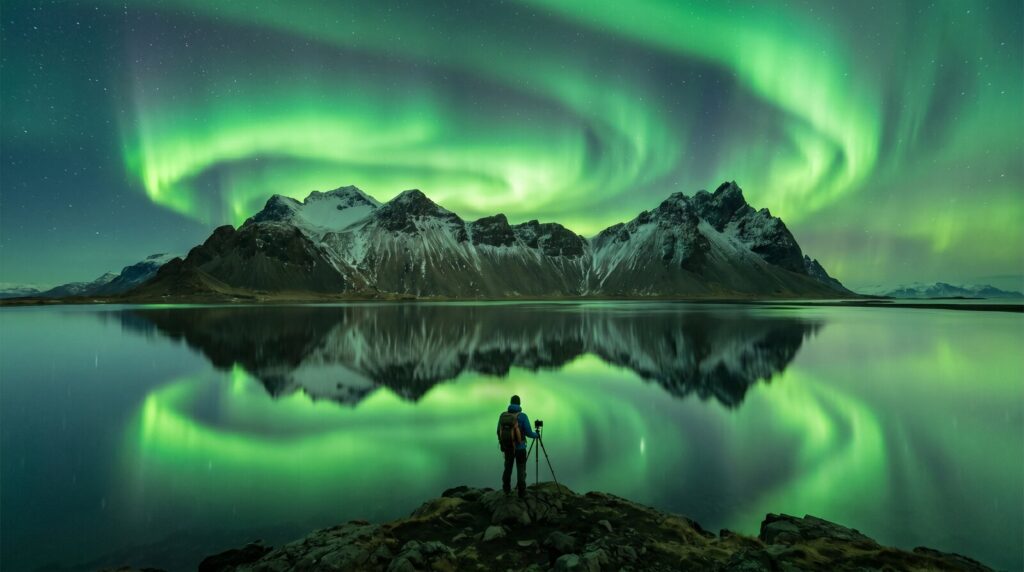
South-east Iceland’s headline foregrounds — Jökulsárlón’s icebergs reflecting aurora on still water, and the Vestrahorn massif at Stokksnes (a 30 km detour from the Ring Road that requires a 1,000 ISK access fee at the Viking Café). Both are 5 hours east of Reykjavík; an overnight at Hofn is the practical base.
Westfjords (Ísafjörður & Hornstrandir)
The country’s emptiest skies and the lowest-pollution land surface in Europe by population density. Logistically the hardest — gravel roads, 7-hour drive, only flyable to Ísafjörður via Icelandair Domestic — but if you have a week and want zero light pollution, the Westfjords win.
Aurora Culture & Photography Etiquette

Modern phones genuinely produce aurora photos. iPhone 14 Pro and Pixel 8 Pro on three-second Night Mode pull out colours invisible to the naked eye; iPhone 15 Pro and Pixel 9 added Action Mode that further reduces handheld blur. The catch is they need to stay still — even three-second handheld is wobbly, and a small tabletop tripod (Manfrotto Pixi or equivalent, around USD 30) eliminates 80% of phone-aurora failures.
Camera Settings That Work
- Camera body: any modern mirrorless — Sony A7-series, Canon R-series, Nikon Z-series. Full-frame helps but is not required.
- Lens: wide and fast. 14–24mm f/2.8, 16–35mm f/2.8, or the cheaper Samyang/Rokinon 14mm f/2.8 manual primes.
- ISO: 1600–3200 for normal aurora; 800 for storms; 6400 for very dim Kp-1 events.
- Shutter: 2–8 seconds. Storms with fast-moving curtains need shorter exposures (2–4s) to keep the shape; static green ribbons can stretch to 10–15s.
- Aperture: wide open (f/2.8 or wider).
- Focus: manual, set to infinity using a distant light or lens-marking focus assist.
What Aurora Actually Looks Like to the Eye
Around 80% of visible Iceland auroras are pale grey-green ribbons to the naked eye — the human retina has very few cone-cells active in low light, and most of what you ‘see’ is grey-scale rod vision. The saturated colours show up only in storms (Kp 4+) or under very dark sky after the eyes fully adapt (around 25 minutes). Cameras pull more colour out because their sensors record what your eyes cannot. This mismatch surprises many first-timers; manage expectations accordingly.
A Food-and-Tour Operator’s Guide — Aurora Tour Comparison
Aurora-Night Snacks: What Icelandic Operators Pack
Every Iceland aurora night runs on the same hot-drink-and-savoury-snack pattern. The food is unglamorous and exactly what you want in a parking pull-out at minus five.
| Dish | Description |
|---|---|
| Hot chocolate | The default operator pour — usually with brennivín on offer for the over-20s. Most coach tours include a free pour at the first stop. |
| Kjötsúpa (lamb soup) | Refillable bowl at every Ring Road N1 stop and most Reykjavík Excursions tour rest-stops. The single most reliable warm-up after a 20-minute outdoor stand-and-stare. |
| Plokkfiskur | Cod-and-potato mash served on rúgbrauð — a heavier alternative to kjötsúpa for late dinner before a 22:00 tour pickup. |
| Skyr | The high-protein cultured dairy — Bónus packs sell for around ISK 200 and travel well in a thermos bag for a midnight snack. |
| Snúðar (cinnamon rolls) | The default Icelandic late-night carb. Sandholt and Brauð & Co. bake from 06:00; many travellers stock the day’s haul before an aurora tour. |
| Harðfiskur | Wind-dried fish, crumbled with butter on rúgbrauð. The compact high-protein snack that fits in a coat pocket and survives sub-zero nights. |
| Pylsur (lamb hot dog) | The Bæjarins Beztu pre-tour dinner — open until midnight, ISK 650 with everything. |
| Brennivín | The ‘Black Death’ caraway aquavit served at most Þorrablót festivals; one shot at the 23:00 stop is a tour-guide tradition. |

Why Take a Tour
Tours buy you three things a self-drive cannot: an experienced guide who reads cloud and Kp better than most first-timers, a vehicle and a driver who can chase to plan B without you driving on icy roads, and a rebooking guarantee — every reputable Icelandic operator offers a free reschedule if the night is a cloud-out. The trade-off is cost (tour vs DIY) and group size (small group vs minibus).
Reykjavík Excursions (Iceland Excursions / Gray Line)
Two of Iceland’s largest operators run aurora tours from the Reykjavík BSÍ terminal nightly through the season. Tours typically depart 9:30pm, return 1–2am, run on 50-seat coaches, and include hot chocolate. Pricing around ISK 12,500–14,500 in 2026 (verify on each operator). Standard rebooking guarantee. The compromise is the 50-seat coach: less mobile, larger group, more limited photo time at each stop.
Gray Line Iceland
Similar product to Reykjavík Excursions; departs from Lækjartorg downtown. Pricing comparable. Coach size and itinerary very similar. Both companies’ tours are interchangeable for a first-timer.
Small-Group Operators
Smaller operators run 8–16-person minibuses with more flexibility — they can chase further off-route and stop at smaller pullouts. The small-group premium is roughly 50–100% over the big-coach products: budget around ISK 18,500–25,000 in 2026 (verify with operator). Tour reviews and consumer recommendations are the practical sort criterion; operators come and go year to year.
Hire-Your-Own (Private Charter)
Private guide + 4×4 from around ISK 95,000–150,000 per night (1–4 passengers, verify with operator). Highest mobility, no group tradeoff, full control of itinerary. Worth the spend for photography-focused trips and groups that already have the cost-share, especially for multi-night chasing.
Self-Drive (DIY)
Cheapest option and the most flexible if you have winter-driving experience. Standard small economy car ISK 8,000–12,000 per day in winter; a 4×4 (essential outside Reykjavík/south-coast paved routes) ISK 14,000–22,000 per day. Always carry chains, check road.is and vedur.is morning and night, and never drive icy gravel without 4×4 experience.
Off the Beaten Path — Self-Drive Aurora Hunting

Self-drive aurora is the highest-reward, highest-skill option. The freedom to chase any clear sky and stay out as long as you like is unmatched, but the risk profile demands honest assessment of winter-driving experience and weather-reading habits.
Vehicle Choice
- Reykjavík + Þingvellir + Snæfellsnes only: a small economy car (Toyota Yaris, Hyundai i20) is enough on paved roads.
- Ring Road full loop: a small 4×4 (Toyota RAV4, Suzuki Vitara) handles every paved Ring Road condition; ISK 14,000–20,000/day in winter.
- Westfjords or East Fjord gravel: a real 4×4 or AWD with winter tyres and ground clearance; the standard 4×4 size class.
Daily Pattern
- Morning: check road.is and vedur.is.
- Afternoon: drive to the next overnight base before dark.
- Dinner before 19:00.
- Aurora window 21:00–02:00 with at least one drive option in your back pocket.
- Sleep in the next morning — aurora trips run on a late-night clock.
Safety Floor
- Register your daily route on safetravel.is — Iceland’s mountain rescue is volunteer ICE-SAR.
- Never park on the verge of the Ring Road. Use designated pullouts only — the death rate from cars stopping mid-road for photos is a real, documented risk.
- Carry a thermos, a wind shell, gloves, a beanie, and one extra layer beyond what you think you need.
Practical Information — 2026 Calendar & New Moon Dates
| Aurora season opens | 21 September 2025 (autumnal equinox) |
| Aurora season ends | 23 March 2026 (vernal equinox) |
| 2026 new-moon dates | 18 Jan, 17 Feb, 19 Mar (best aurora visibility — full-dark sky) |
| Equinox storm windows | Around 21 March 2026 and 23 September 2026 — historically elevated G3+ storm rates |
| Iceland Airwaves | 5–7 November 2026 — combines aurora and music in Reykjavík |
| Þorrablót festivals | Late January–late February 2026, country-wide — aurora + traditional food |
| Iceland Winter Games | Third weekend of March 2026 at Hlíðarfjall, Akureyri |
| Solar Cycle 25 outlook | Post-maximum afterglow expected through 2026 and into 2027 |
| ETIAS launch | Expected late 2026 — €7 pre-authorisation for visa-exempt travellers |
| Sunset on 21 Dec 2026 | Reykjavík ~15:30; full astronomical dark by 17:30 |
Aurora Trip Budget
Budget DIY
Reykjavík hostel + 4-day self-drive small economy car + Bónus + one shared aurora tour. Plan ISK 17,000–26,000 per day (USD 130–200) including pool admission and Þingvellir parking. Budget travellers should base in Reykjavík with one Akureyri overnight via Strætó coach (ISK 13,500).
Mid-Range Group Tours
3-star hotel + small-group aurora tour each evening + 4×4 self-drive Day 5 onwards. Plan ISK 35,000–60,000 per day (USD 250–450). Includes one Forest Lagoon or Mývatn Nature Baths visit, one Húsavík whale-watching adjacent in shoulder season, and one Hlíðarfjall ski day in Feb–Mar.
Private Photography Trip
Boutique-hotel base + private 4×4 charter with photography guide + Forest Lagoon and Sky Lagoon evenings + helicopter day around Reykjanes eruption sites. Plan ISK 95,000+ per day (USD 700+). Most photography-led trips are 7 nights to absorb the volatility.
| Tier | Daily (USD) | Accommodation | Aurora method | Transport |
|---|---|---|---|---|
| Budget | $130–200 | Hostel ISK 6,500–11,000 | 1× group coach tour (ISK 12,500), DIY rest | Small economy car ISK 8,000–12,000 |
| Mid-Range | $250–450 | 3-star hotel ISK 28,000–45,000 | Small-group minibus tours ISK 18,500–25,000 | 4×4 rental ISK 14,000–22,000 |
| Luxury | $700+ | 5-star hotel ISK 80,000+ | Private guide + 4×4 ISK 95,000–150,000 | Private chauffeur or helicopter |
Planning Your 2026 Aurora Trip
- Pick your window. Late Feb–mid Mar or mid-Sep–mid-Oct give the best balance of full-dark sky, equinox storm bias and softer pricing. December peak is the most expensive and least flexible.
- Book at least 4 dark nights. One night is a coin flip; four nights stacks the odds dramatically.
- Don’t anchor in Reykjavík alone. Build in 2–3 nights at Akureyri or Mývatn for the drier microclimate.
- Install vedur.is, road.is, SafeTravel and a SWPC alert app before you land.
- Plan ETIAS. The €7 pre-authorisation is expected to launch late 2026 for visa-exempt travellers.
Frequently Asked Questions
What are my odds of seeing aurora on a typical Iceland trip?
Roughly 70–85% on a 4-night winter trip with a flexible base, depending on cloud-cover luck and how far you are willing to chase. A single fixed-base night drops to 25–40%. Solar Cycle 25 maximum has lifted those numbers across 2024–2026.
How is 2026 different from a normal aurora year?
Solar Cycle 25 reached maximum in October 2024 — the strongest peak in roughly two decades. The post-maximum afterglow is expected to deliver elevated G3+ storm frequency through 2026 and well into 2027 before activity tapers.
Should I take a tour or self-drive?
Both. The optimum is one small-group tour on night one (to learn the chase pattern under expert eyes) and self-drive nights two through four. First-time winter drivers should stay on tours throughout.
How do I read the Icelandic Met Office aurora forecast?
Two layers: cloud cover (0–8) and Kp index (0–9). Look for cloud cover 0–2 within a 100 km radius of your base AND Kp 2 or higher. Either alone is not enough.
Can I see aurora from Reykjavík itself?
Yes on storms (Kp 4+). The city’s light pollution washes out fainter Kp-1 and Kp-2 nights, but Kp 4+ is visible from Grótta lighthouse, Perlan, and the harbour even with the streetlights.
Is the Reykjanes eruption visible alongside aurora?
Sometimes — Reykjanes has been erupting in cycles since March 2021, and when an active fissure coincides with a clear-sky aurora night, the lava-glow + aurora combination is visible. Always check the Met Office volcano feed and access restrictions before any eruption-zone visit.
What if I see no aurora at all?
Plenty of operators offer free re-bookings if cloud cover ruins a tour night, but no operator guarantees visible aurora — that depends on Kp, which no one controls. Iceland’s standard insurance against zero-aurora is the trip itself: glaciers, hot springs, ice caves, geothermal pools, whale-watching, and the Westman Islands all stand alone as winter draws.
Ready to Chase Aurora in Iceland?
Solar Cycle 25 has given travellers an unusually generous 2026 window. Book four nights, base outside Reykjavík at least two of them, and let cloud cover dictate whether you drive north to Akureyri or east to Stokksnes. For the full country context, read the Iceland Travel Guide; for the canonical winter loop, see the 10-day Ring Road itinerary.
Explore More
FFU contains affiliate links. We earn a commission when you book through them — at no extra cost to you.
Plan your trip
- Tours & experiences: browse tours and experiences on Klook.
- Airport pickup: pre-book an airport transfer with GetTransfer.
- Car hire: compare rental cars on GetRentacar.
- Bag storage: store your bags with RadicalStorage.
Disclosure: some links above are affiliate links — booking through them supports Facts From Upstairs at no extra cost to you.