
Rotterdam Travel Guide — The City the Dutch Rebuilt From Scratch, and Made Better
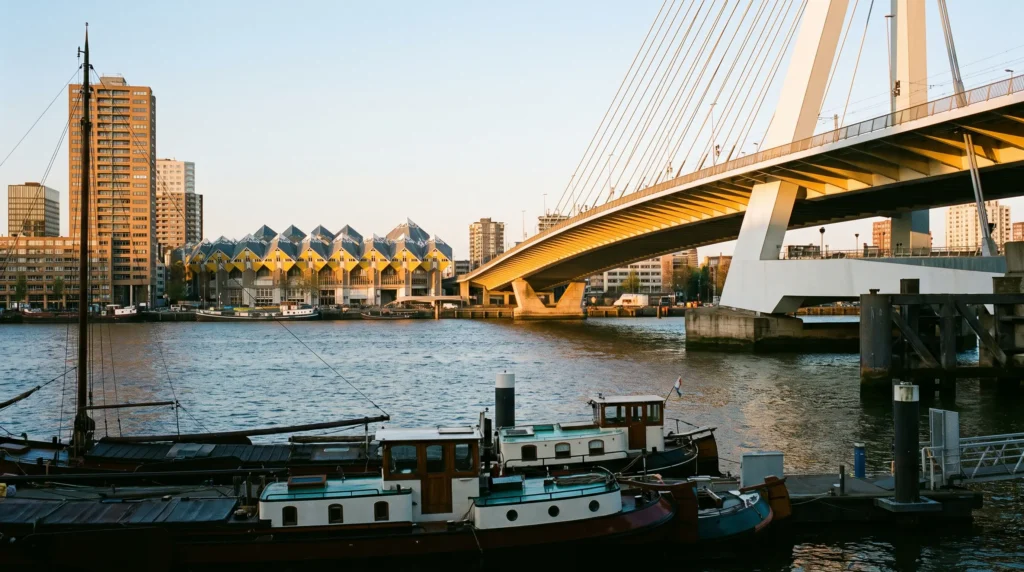
I’ll say the unpopular thing first: I like Rotterdam more than Amsterdam, and I say that as someone who adores Amsterdam. Rotterdam doesn’t have the canal-house postcard looks — it lost most of that on 14 May 1940, when the Luftwaffe flattened the historic center in the Rotterdam Blitz. What it built instead, over the following eighty-plus years, is the most architecturally fearless skyline in the Netherlands — tilted cube houses, a market hall with a fruit-and-vegetable ceiling mural the size of a football pitch, a bridge nicknamed The Swan that lights up blue at night. This is also, quietly, the busiest port city in Europe, the kind of place where a container ship the size of a small town can glide past your lunch table. It’s grittier than Amsterdam, cheaper than Amsterdam, and — because most tourists still skip it for the canals — refreshingly free of the crowds that make central Amsterdam feel like a theme park in July. Come for a weekend, and you may find yourself wondering why you didn’t come for a week.
In This Guide
- Overview — Why Rotterdam Is the Netherlands’ Boldest City
- Festival Season — Summer Carnival, World Port Days & Rotterdam Marathon
- Best Time to Visit Rotterdam (Season by Season)
- Getting There — Schiphol, Rotterdam The Hague Airport & Rail
- Getting Around — Metro, Tram & Water Taxi
- Neighborhoods — From Kop van Zuid to Witte de With
- Culture & People — A Port City’s Character
- A Food Lover’s Guide to Rotterdam
- Off the Beaten Path
- Day Trips — Kinderdijk, Delft, The Hague & Gouda
- Practical Information
- Budget Breakdown — What Rotterdam Actually Costs in 2026
- Planning Your First Trip
- Frequently Asked Questions
Overview — Why Rotterdam Is the Netherlands’ Boldest City
Rotterdam’s story starts with a dam built across the Rotte river around 1270, and the city received official town rights in 1340. That medieval core barely exists anymore — the Rotterdam Blitz of 14 May 1940 destroyed the historic heart of the city and left roughly 80,000 people homeless. Rather than reconstruct a pastiche of what was lost, postwar planners let architects experiment, and the result is a downtown where nothing looks older than the 1950s and plenty looks like it landed yesterday: Piet Blom’s tilted Cube Houses, MVRDV’s cavernous Markthal with its 11,000-square-metre “Horn of Plenty” ceiling mural, and the Erasmus Bridge, an 802-metre cable-stayed span nicknamed “The Swan” that has become the city’s visual signature since it opened in 1996.
None of this happened by accident of geography. Rotterdam sits at the mouth of the Rhine and Meuse delta, and its port is the largest seaport in Europe and the largest outside Asia, spanning roughly 105 square kilometres along 40 kilometres of waterfront. From 1962 to 2004 it was the busiest port on Earth by cargo tonnage before Singapore overtook it. That maritime money built the skyline, and it still funds a city that punches well above its population of roughly 608,000 in ambition.
What you get as a visitor is a compact, walkable, design-obsessed city that photographs like nowhere else in the country, paired with a working-class, multicultural energy that feels more like a global port town than a Dutch tourist postcard. It’s also the easiest possible base for day-tripping into the postcard version of the Netherlands — Delft, Gouda and the windmills of Kinderdijk are all under an hour away.
Festival Season — Summer Carnival, World Port Days & the Marathon
Rotterdam’s calendar peaks in summer. Rotterdam Unlimited, the city’s Caribbean-inflected summer carnival, fills late July with parades, sound systems and street food reflecting the city’s large Surinamese and Antillean communities — one of the biggest Caribbean carnivals in Europe. World Port Days, usually held on a September weekend, opens up normally closed corners of the working harbor to the public, with tugboat rides and crane-climbing for kids. And the Rotterdam Marathon, run each April, draws elite times on its famously flat course through the city center and across the Erasmus Bridge.
If you’re building a summer trip around one weekend, Rotterdam Unlimited or World Port Days both give you a version of the city that regular sightseeing doesn’t — loud, proud, and unmistakably a port town rather than a museum piece.
Best Time to Visit Rotterdam (Season by Season)
May – September · Peak season
Long daylight (sunset past 9pm in June), terrace weather, festival season, and the best conditions for wandering Kop van Zuid or taking a harbor boat tour. This is also when hotel prices climb and Kinderdijk day-trip buses fill up — book ahead for July and August weekends.
April & October · Shoulder sweet spot
Tulip season (best combined with a side trip toward Keukenhof, which sits closer to Amsterdam) and mild, walkable weather with noticeably thinner crowds and softer hotel rates than midsummer.
November – March · Low season
Rotterdam leans into indoor culture: the Kunsthal, Depot Boijmans Van Beuningen and Museum Boijmans’s satellite shows, plus a genuinely good winter market scene. Expect grey skies, wind off the water, and the lowest prices of the year. Rotterdam’s temperate oceanic climate rarely brings extreme cold, but pack a proper waterproof — this is a city built by people who take rain seriously.
Getting There — Schiphol, Rotterdam The Hague Airport & Rail
Most international visitors fly into Amsterdam Airport Schiphol, the Netherlands’ primary gateway, then take a direct intercity train to Rotterdam Centraal in about 40 minutes. It’s frequently the easier and cheaper option even if Rotterdam is your only stop.
Rotterdam The Hague Airport (RTM), about 5.5 kilometres northwest of the city center, is the country’s third-busiest airport and handles mostly European leisure routes — Transavia and TUI fly Netherlands are the focus carriers, with Málaga, Alicante and Faro among the busiest 2024 destinations, plus links to London City and Istanbul. It’s a useful option if you’re coming from within Europe, less so for long-haul.
By rail, Rotterdam Centraal is a genuine hub: direct high-speed Eurostar and Thalys-network trains connect to Brussels in under an hour and continue on to Paris and beyond, while regular intercity service links Amsterdam, The Hague, Utrecht and Antwerp. For a Benelux trip, Rotterdam slots in naturally between Amsterdam and Brussels.
Getting Around — Metro, Tram & Water Taxi
Rotterdam has the oldest metro system in the Netherlands, opened in 1968 as the first in the country, now running five lines (A–E) across roughly 103 kilometres and 71 stations. Combined with an extensive RET tram and bus network, the city center, Kop van Zuid and outlying neighborhoods are all easily reachable without a car.
Tap in and out with a contactless bank card or phone wallet on every metro, tram and bus — this has become the standard way for visitors to pay, alongside the traditional OV-chipkaart smart card. Central Rotterdam is also compact and flat enough to walk end to end in well under an hour, and the Waterbus and Rotterdam water taxis add a scenic way to cross the Nieuwe Maas or reach Kinderdijk without setting foot in a car. Cycling is the local default — rental bikes and the OV-fiets bike-share system are everywhere, though as in the rest of the Netherlands, learn the cycle-lane etiquette before you wobble into one.
Neighborhoods — From Kop van Zuid to Witte de With
Centrum (City Center)
Rotterdam Centraal station, the Markthal, the Cube Houses and the shopping streets around Coolsingel and Lijnbaan sit here — the modern, rebuilt heart of the city, dense with architecture from every decade since the 1950s.
Kop van Zuid
The former harbor docklands south of the river, redeveloped since the 1990s into Rotterdam’s most striking modern skyline: the Wilhelminapier towers, the Hotel New York (once the Holland America Line’s headquarters), and museums and theaters built into old harbor infrastructure like Leuvehaven.
Witte de Withstraat
The city’s gallery-and-nightlife spine — contemporary art spaces, cocktail bars and restaurants clustered on one street, busiest after dark.
Delfshaven
The one pocket of Rotterdam that dodged the 1940 bombing: a preserved 17th–19th-century harbor quarter with a working windmill, canal-side cafés and the church from which the Pilgrim Fathers left for America in 1620. The single best place in the city to picture pre-war Rotterdam.
Nieuwe Binnenweg & Het Nieuwe Westen
A trendier, more residential stretch west of the center — vintage shops, independent coffee roasters and a genuinely local, less-touristed atmosphere.
Katendrecht (“Kaap”)
A former red-light and dockworker district on the south bank now rebuilt as a food and nightlife destination, anchored by the Fenix Food Factory market hall and De Kaap’s waterfront terraces.
Little C
A small, walkable dining strip near the river with a laid-back, community feel — good for an evening away from the bigger crowds.
Culture & People — A Port City’s Character
Rotterdammers describe their own city as “no-nonsense” (geen woorden maar daden — “no words, just deeds,” the city’s unofficial motto), and it shows: less polished than Amsterdam, more direct, and proud of having rebuilt itself. Roughly half the city’s population has a migration background, giving Rotterdam one of the most diverse populations in the Netherlands, with especially large Surinamese, Antillean, Turkish and Moroccan communities that shape everything from the food scene to Rotterdam Unlimited’s summer carnival.
Design runs through the city’s identity at an institutional level — Rotterdam hosts an internationally regarded architecture biennale and produced firms like MVRDV and OMA (Rem Koolhaas’s practice). The city also carries a genuine industrial-heritage credential: the Van Nelle Factory, a 1920s coffee-tea-tobacco plant on the western edge of the city, was inscribed as a UNESCO World Heritage Site in 2014 for its pioneering glass-and-steel factory design, and now operates as a co-working and events space open to visitors.
A Food Lover’s Guide to Rotterdam
Start with the classics: bitterballen (crispy fried beef ragout balls with mustard) as a bar snack anywhere with a terrace, stroopwafels fresh off a market griddle, and Dutch cheese from a real kaaswinkel rather than a souvenir shop. Rotterdam’s port-city history shows up on the plate too — Indonesian rijsttafel and Surinamese roti are both everyday staples here, not novelty imports, a legacy of Dutch colonial trade and postwar migration.
For a single stop that captures the city’s food identity, head to Fenix Food Factory on Katendrecht: a converted harbor warehouse housing a microbrewery, a cheese counter, an oyster bar and a bakery under one roof, with Erasmus Bridge views from the terrace. The Markthal itself is worth a visit for the ceiling mural alone, though locals will tell you the fresh produce stalls are better value than the sit-down restaurants ringing the hall. For a proper dinner, the city’s restaurant scene has grown a Michelin presence in recent years, spanning everything from refined Cantonese cooking to sustainability-focused Dutch tasting menus. Wash it down with a Dutch pils — Rotterdam has its own small craft-brewing scene alongside the national beer giants.
Off the Beaten Path
Van Nelle Factory
A UNESCO World Heritage industrial site most visitors have never heard of — a glass-curtain-wall former coffee and tobacco factory from the late 1920s, radically modern for its era, now a co-working and events space with occasional public tours.
Depot Boijmans Van Beuningen
A mirrored, bowl-shaped art storage building where the public can wander an entire museum’s stored collection and its conservation studios — a genuinely unusual way to see art most cities keep locked in a basement.
Dakpark
A rooftop park built atop a shopping center — over a kilometre of green space, playgrounds and allotment gardens above the retail, with none of the tourist foot traffic of the center.
Hef Bridge & Noordereiland
A quiet, mostly residential island in the river beneath the old railway lift bridge, a short walk from Kop van Zuid but rarely visited by tourists.
Blue City
A former tropical swimming pool complex reborn as a circular-economy hub of small sustainable businesses — part startup incubator, part curiosity, entirely off the standard itinerary.
Day Trips — Kinderdijk, Delft, The Hague & Gouda
Kinderdijk, about 15 kilometres east of Rotterdam, is the single best day trip: 19 surviving 18th-century windmills built to drain the polder, inscribed as a UNESCO World Heritage Site in 1997 and reachable by a scenic Waterbus ride right from the city center.
Delft, a 15-minute train ride away, delivers the canal-house, Vermeer-country Netherlands that Rotterdam’s bombed-out center no longer has — plus the Royal Delft pottery works. The Hague, the country’s seat of government and home to the International Court of Justice, is equally close and pairs museum-going (the Mauritshuis, home to Vermeer’s Girl with a Pearl Earring) with a proper North Sea beach at Scheveningen. Gouda, roughly 25 minutes by train, is worth timing around its Thursday cheese market in summer. All four are comfortably doable as half-day trips using the same regional rail network that runs through Rotterdam Centraal.
Practical Information
Money. The euro is the Netherlands’ currency, adopted in 1999 with cash circulating since 2002. Contactless card and phone payments are the norm, including on public transport; note that some retailers only accept chip-and-pin cards rather than older magnetic-strip cards.
Safety. The US State Department rates the Netherlands Level 2 (“Exercise Increased Caution”), citing the general European terrorism risk rather than anything Rotterdam-specific; the more common everyday issue is pickpocketing around train stations and busy transit, so keep bags zipped and phones pocketed. Cyclists have the right of way almost everywhere — look both ways for bike lanes before stepping off a curb.
Health. No special vaccinations are required for the Netherlands; the US CDC recommends being current on routine vaccines (MMR, DTaP, flu) and considering Hepatitis A/B depending on your itinerary. Tap water is safe to drink everywhere.
Visa. US, UK, Canadian and Australian passport holders enter visa-free under the Schengen 90-days-in-180 rule; carry a passport valid at least three months beyond your stay and be ready to show proof of onward travel and funds.
Connectivity. An EU-wide eSIM is the easiest option; free Wi-Fi is common in cafés and on trains. Plugs: Europlug/Type C and F, 230V. Time zone: Central European Time (UTC+1), UTC+2 in summer with EU daylight saving.
Budget Breakdown — What Rotterdam Actually Costs in 2026
Rotterdam runs noticeably cheaper than Amsterdam for hotels and dining, while public transport, museum tickets and restaurant prices sit in line with the rest of the Netherlands.
Budget (US$75–120/day): Hostel dorm or budget hotel, supermarket breakfast, a market-hall lunch, day tickets on RET metro/tram, one paid attraction (Cube Houses museum or Euromast).
Mid-range (US$150–260/day): Three-star hotel in the center or Kop van Zuid, restaurant dinners, a Kinderdijk or Delft day trip, Depot Boijmans and Markthal combined, a harbor boat tour.
Luxury (US$400+/day): Design hotel with river views, a Michelin-level tasting menu, private canal or port charter, first-class rail to Brussels or Amsterdam.
Tipping 5–10% for good service is appreciated but not obligatory — round up rather than calculating a fixed percentage. Museum and attraction admission is rarely bundled into a city pass the way Amsterdam’s is, so budget individual tickets.
Planning Your First Trip to Rotterdam
Two full days covers the essentials: day one for the Markthal, Cube Houses, Erasmus Bridge and Kop van Zuid; day two for a Kinderdijk windmill morning followed by an afternoon train to Delft. Three or four nights lets you add Delfshaven, Depot Boijmans and a slower dinner in Katendrecht. Rotterdam also works as a low-key, less-touristed alternative base for exploring the whole Randstad — pair it with our full Netherlands travel guide for the wider country, add Amsterdam for the canal-ring classics, or keep heading south by direct train to Brussels and beyond.
Frequently Asked Questions
Is Rotterdam worth visiting if I’m already going to Amsterdam?
Yes — it’s under 40 minutes away by direct train and offers a completely different Netherlands: modern architecture instead of canal houses, a working port instead of a museum-city center, and noticeably fewer tourists. Most visitors do it as a day trip; a night or two lets you see far more.
Do I need a visa to visit Rotterdam?
US, UK, Canadian, Australian and most Schengen-exempt passport holders can enter visa-free for up to 90 days in any 180-day period. Check requirements for your specific nationality before you travel.
Is Rotterdam safe?
Yes, by ordinary European-city standards — the main everyday risk is pickpocketing near stations and crowded transit, not violent crime. The US State Department’s Level 2 rating reflects general regional terrorism concerns rather than a Rotterdam-specific threat.
How many days do I need in Rotterdam?
Two days covers the architectural highlights; three to four lets you add a proper day trip to Kinderdijk or Delft without rushing.
Can I sleep inside the Cube Houses?
One cube operates as a small hostel and another as a show-house museum you can tour; most of the roughly 40 cubes are private residences, so admire the exteriors respectfully and stick to the ones set up for visitors.
What’s the best way to see the port?
A Spido harbor boat tour from the city center is the easiest option for casual visitors; if your visit lines up with World Port Days in September, that’s the one time normally closed working-port areas open to the public.
Ready to Explore Rotterdam?
Tilted yellow cubes, a market hall ceiling painted like a giant’s fruit bowl, windmills a Waterbus ride away, and a skyline that looks nothing like the rest of the Netherlands on purpose. Rotterdam rewards travelers who want the country’s real texture — port grit and design ambition together — without the canal-side crowds. Go before everyone else figures out what Rotterdammers already know.
Explore More
- Netherlands Travel Guide — the full country beyond Rotterdam
- Amsterdam City Guide — canal-ring classics, 40 minutes away
- Brussels City Guide — direct high-speed rail south
- Belgium Travel Guide — continue on through the Low Countries
How this guide was built
Published as part of Facts From Upstairs’ city guide series. Built from authoritative sources — Wikipedia entity pages for Rotterdam, the Port of Rotterdam, Rotterdam The Hague Airport, the Rotterdam Metro, the Markthal, the Erasmusbrug, Kinderdijk and the Van Nelle Factory (a UNESCO World Heritage Site); the European Central Bank’s euro page; the US State Department’s Netherlands travel information page; and the US CDC traveler page for the Netherlands. Numeric and checkable claims carry inline citations.
Sources cited on this page
- Wikipedia — Rotterdam
- Wikipedia — Port of Rotterdam
- Wikipedia — Rotterdam The Hague Airport
- Wikipedia — Rotterdam Metro
- Wikipedia — Markthal
- Wikipedia — Erasmusbrug
- Wikipedia — Kinderdijk
- Wikipedia — Van Nelle Factory (UNESCO World Heritage Site)
- European Central Bank — The Euro
- US State Department — Netherlands
- US CDC — Netherlands traveler page
More city guides you might like


Plan your trip to Rotterdam
The booking tools we use ourselves. FFU may earn a commission at no extra cost to you.
Plan & book your trip to Rotterdam
Booking through these searches supports our guides at no extra cost to you.