
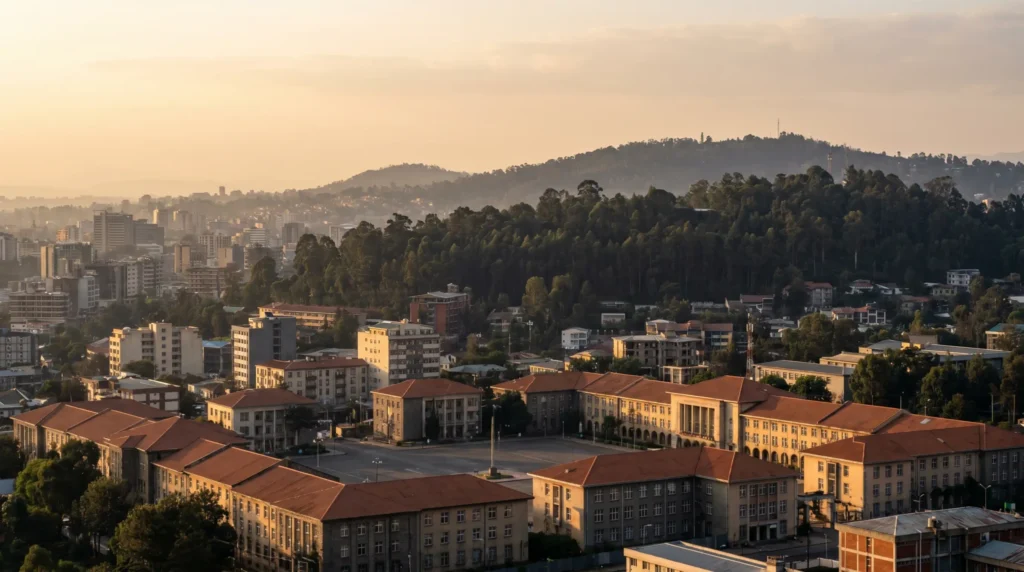
Addis Ababa, Ethiopia: Africa’s Highest Capital, Where the Continent Meets to Talk and the Coffee Was Born
I landed at Bole at dawn, a little light-headed, and it took me an embarrassingly long time to work out it was the altitude rather than the red-eye. Addis sits more than two kilometres up in the Ethiopian highlands, and the thin, cool air is the first thing the city tells you about itself. The second is the smell of roasting coffee, drifting out of doorways before nine in the morning, because this is the country that gave the bean to the world and still treats brewing it as a ceremony, not a transaction. We came expecting a transit hub for the gorges and rock churches of the north; we left convinced that Ethiopia’s sprawling, contradictory, fast-changing capital deserves days of its own. This guide is the one I wish I’d had: where to eat injera that ruins you for anything else, how the Light Rail actually works, and why you should give Addis at least three days.

Table of Contents
Why Addis Ababa?
Most travellers treat Addis Ababa as a one-night layover on the way to the rock-hewn churches of Lalibela or the gorges of the Simien Mountains, and that is a genuine mistake. Founded in 1886, when Empress Taytu Betul persuaded her husband Emperor Menelik II to move the capital down from the cold, windy heights of Entoto to the warmer plain below — and named it “Addis Ababa”, meaning “new flower” — this is one of Africa’s youngest great cities and one of its most consequential. In barely 140 years it has grown from a hot-springs settlement into the sprawling, restless home of roughly 5.7 million people.
The scale, and the setting, undo most first-timers. The city sits at around 2,355 metres above sea level, which makes it the highest capital in Africa and the fourth-highest in the world — high enough that the air feels thin and the nights stay cool even on the equator. From Bole airport in the south it climbs to over 3,000 metres in the forested Entoto hills to the north, so Addis is less a single city than a series of altitudes stitched together by ring roads, minibus taxis and Sub-Saharan Africa’s first light-rail line.
And then there is the superlative that defines its place in the world: Addis Ababa is the diplomatic capital of an entire continent. It hosts the headquarters of the African Union and the United Nations Economic Commission for Africa, making it, after New York and Geneva, one of the most important diplomatic cities on the planet — a city where the whole of Africa comes to talk. That heritage shows in the embassies, the conference hotels and the worldly, multilingual energy of a place used to hosting the world.
What separates Addis from almost anywhere else, though, is harder to put in a statistic. Ethiopia was never colonised, and it shows in everything from the unique Ge’ez-derived script to the 13-month calendar to a cuisine that owes nothing to anyone else’s. This is also, genuinely, the birthplace of coffee, and the daily coffee ceremony — green beans roasted, ground and brewed in front of you over incense — is the warm, unhurried heart of social life. Come for the African Union headline; stay because Addis Ababa is the most distinctive, least-touristed great capital on the continent.

Neighborhoods: Finding Your Addis Ababa
📍 Addis Ababa Map: Every Place in This Guide
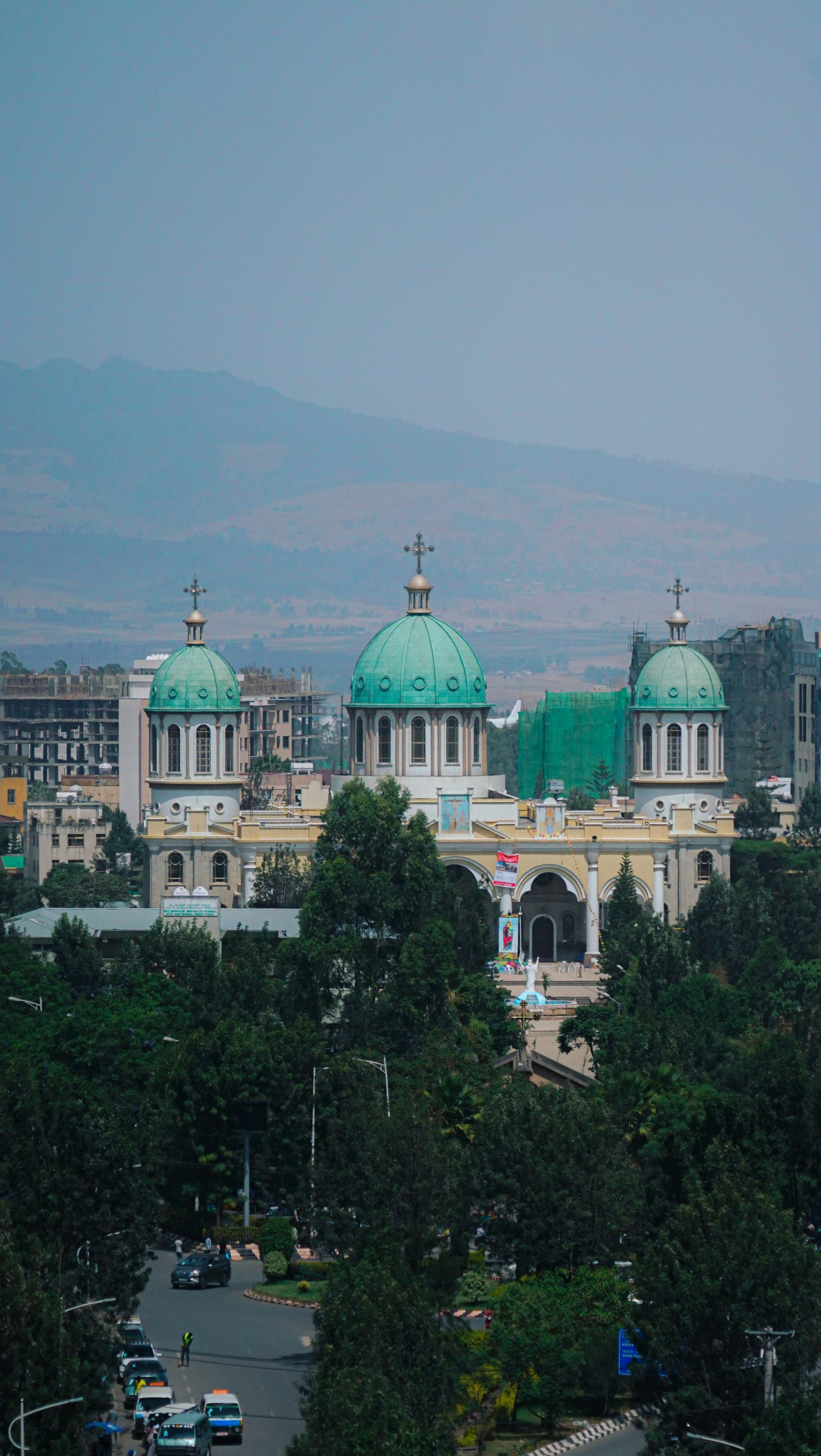

Addis Ababa is really several cities stacked on one slope: the gritty old commercial core around Piazza and Merkato low to the west, the diplomatic and business heart at the centre, the modern Bole corridor by the airport, and the cool green hills of Entoto rising to the north. There is no historic walled medina to anchor you here — the city is young, low-rise and spread out — so knowing the main districts and basing yourself well makes the difference between an easy trip and a frustrating one. Below is how I’d carve it up for a first visit.
A quick mental map helps. Think of the city as draped over a long north-facing slope. The Light Rail’s two lines cross near the centre and give you a rough spine: the busy commercial old town sits to the west and downhill, the leafy embassy and museum districts in the middle, and the newer hotel-and-restaurant strip of Bole runs southeast toward the airport. When in doubt, “uphill” takes you toward Entoto and cooler air; “downhill” toward Merkato and the oldest, densest parts of town. Once that orientation clicks, the apparent sprawl becomes far more legible.
Bole
The modern face of Addis and where most visitors land and stay. Strung along the wide Bole Road between the airport and the centre, it’s the city’s glossiest district: new hotels, shopping malls, cafes, the best concentration of restaurants and nightlife, and the giant Bole Medhane Alem Cathedral, one of the largest Orthodox churches in Africa. It’s convenient, walkable in parts and easy to land in jet-lagged, though you trade some local texture for comfort.
- Bole Medhane Alem Cathedral
- Bole Road cafes and malls
- Edna Mall and Friendship Center
Best for: first-timers, comfort, nightlife, airport proximity. Access: minutes from Bole airport by taxi.
Piazza
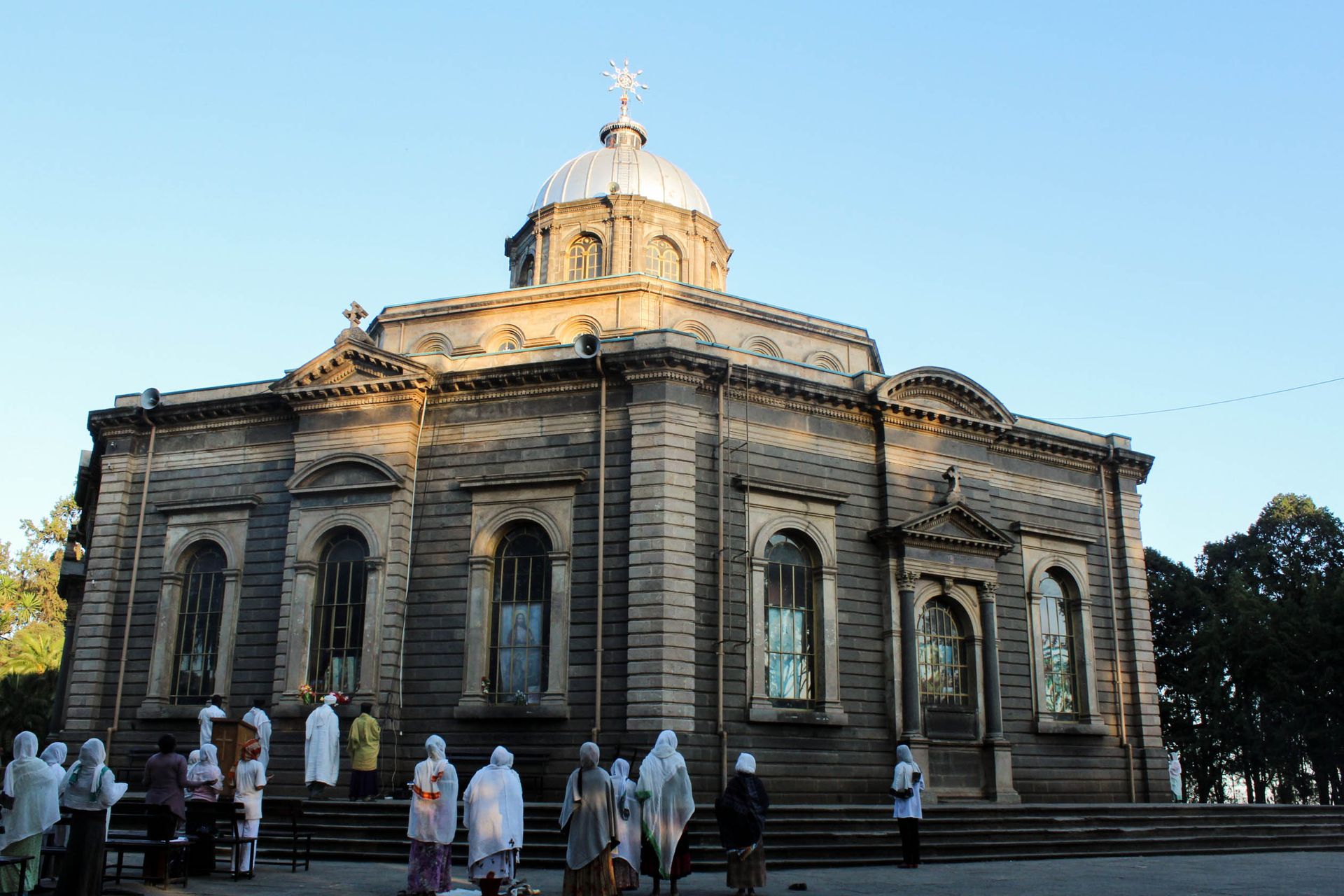
The atmospheric old centre, laid out in the early 20th century with a strong Italian occupation-era imprint in its arcades, Art Deco facades and espresso bars. Faded but full of character, Piazza is the best place to feel the city’s history, sip a macchiato in a decades-old cafe, browse the jewellery and bookshops, and walk to St George’s Cathedral. It’s gritty and busy — mind your bag — but it has a soul the newer districts lack.
- St George’s Cathedral and museum
- Italian-era arcades and cafes
- Taitu Hotel, the city’s oldest
Best for: history, old-Addis atmosphere, cafe culture. Access: Light Rail and minibus; central and walkable.
Merkato
Said to be the largest open-air market in Africa, Merkato is a vast, overwhelming, thrilling sprawl of lanes selling everything from spices and coffee to recycled metal, textiles, electronics and livestock. It is the beating commercial heart of the city and a sensory overload in the best and most exhausting way. It can be chaotic and pickpockets work the crowds, so go in the morning, carry little and ideally with a local guide the first time.
- The spice and coffee lanes
- The recycled-goods (Minalesh Tera) section
- Traditional textile stalls
Best for: markets, photography, coffee and spice buying. Access: Light Rail to Merkato station, then on foot.
Kazanchis & the Diplomatic Quarter
The institutional core, where the gleaming African Union headquarters, the UN Economic Commission for Africa, embassies and big conference hotels cluster. It’s a district of wide avenues, security gates and worldly hotel lobbies rather than street life, but it’s central, safe and well-connected, and it’s where a lot of business travellers base themselves.
- African Union headquarters
- UN Economic Commission for Africa
- Conference hotels and embassies
Best for: business travellers, central convenience. Access: central; taxi or Light Rail.
Arat Kilo & Sidist Kilo (the Museum District)
The cultural and academic heart, named for the squares (“kilo”) that mark it, and home to the National Museum (where Lucy lives), the Holy Trinity Cathedral, Addis Ababa University and the Ethnological Museum in Haile Selassie’s former palace. Leafy, monumental and studenty, it’s the district to base yourself in if museums and history are your priority.
- National Museum of Ethiopia
- Holy Trinity Cathedral
- Ethnological Museum at the university
Best for: museums, history, a calmer central base. Access: central; minibus and taxi.
Entoto
The forested ridge on the city’s northern rim, climbing past 3,000 metres, where Menelik II first built his capital before moving down to found Addis. Today it’s a cool, eucalyptus-scented escape with the historic Entoto Maryam Church and Menelik’s palace, panoramic views over the whole city, and the new Entoto Park with walking and cycling trails. It’s a half-day trip up rather than a place to stay, and a welcome lungful of mountain air.
- Entoto Maryam Church and Menelik’s palace
- Entoto Park trails
- Panoramic city viewpoints
Best for: views, fresh air, history, an easy half-day. Access: 30–45 minutes by taxi uphill from the centre.
CMC, Gerji & the Eastern Suburbs
The fast-growing residential east, full of new apartment blocks, gated compounds and the kind of cafe-and-supermarket normality where middle-class Addis actually lives. There’s not much for the short-stay tourist here, but it’s worth understanding as the direction the city is expanding, and some quieter guesthouses and serviced apartments make a calm, local-feeling base away from the Bole bustle.
- Modern apartment districts
- Quiet guesthouses and serviced flats
- Local cafes and supermarkets
Best for: longer stays, a residential feel. Access: taxi; further from the centre.
The Old Heart: Piazza, Arada & Filwoha
If you want to feel where the city began, spend a morning in the oldest districts. Around Piazza and the wider Arada area you’ll find the early-20th-century streetscape at its most intact: shaded arcades, decades-old jewellery shops, the legendary Tomoca coffee roaster pouring tiny cups since the 1950s, and the grand octagonal St George’s Cathedral where successive emperors were crowned. A few minutes away, the Filwoha area takes its name from the very hot springs (filwoha means “hot water”) that drew Empress Taytu to settle here in the first place, and public bathhouses still tap them. This is the part of Addis to wander slowly on foot, cup of macchiato in hand, soaking up a faded grandeur the glassy new districts can’t fake. It rewards the curious walker and the lover of old cafes more than the box-ticking sightseer.
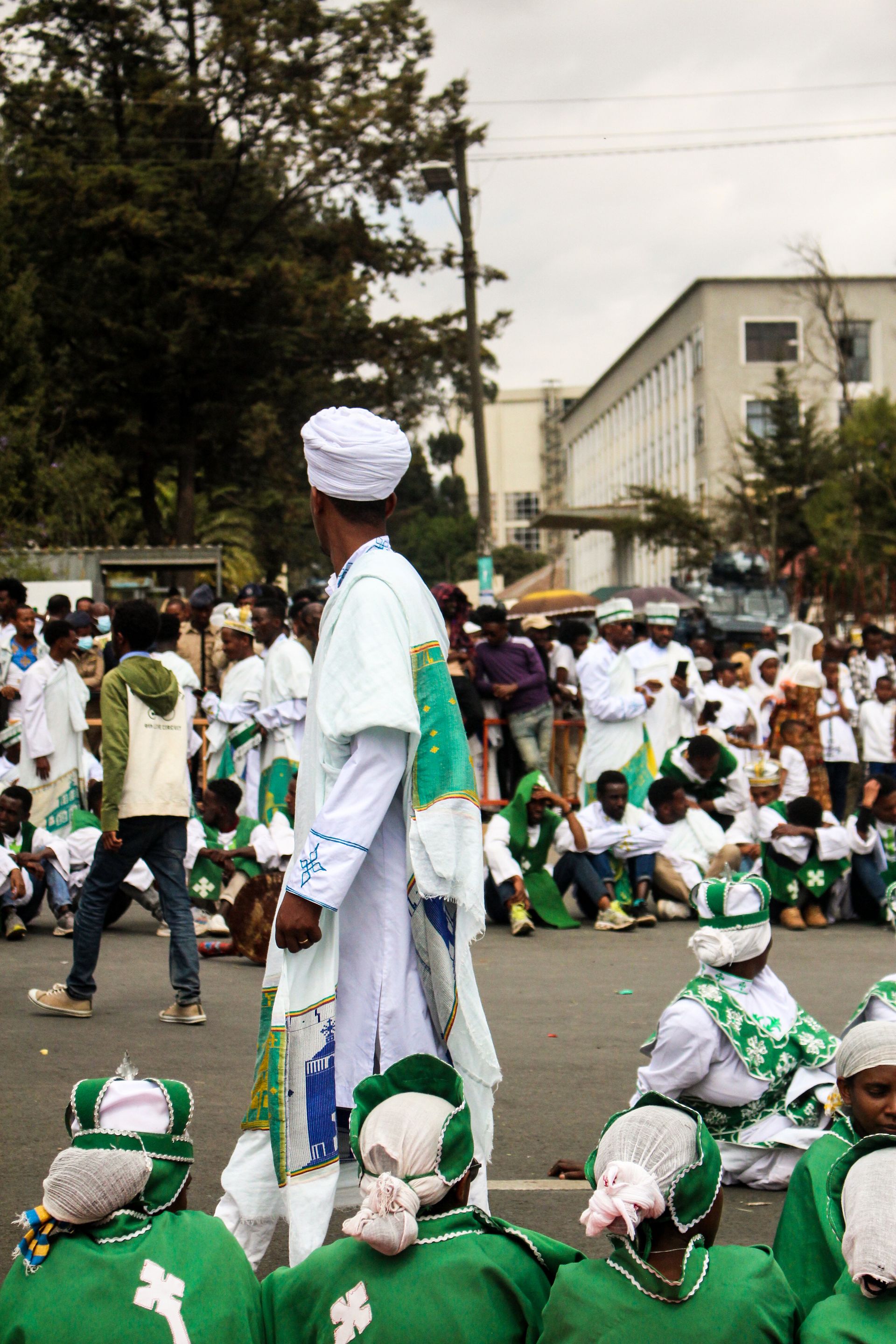
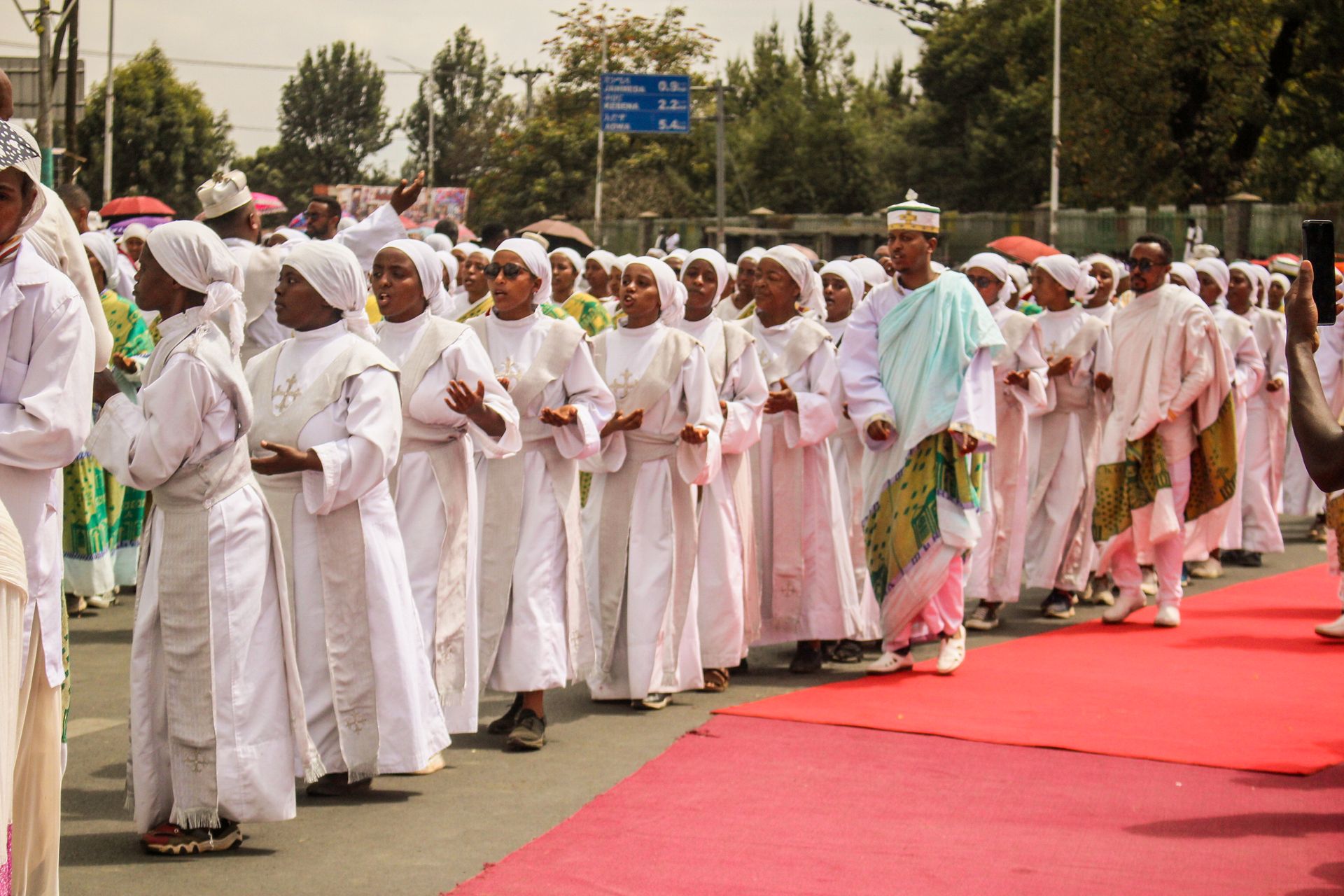
Threaded through all of these districts are the church compounds and their rhythms, which shape neighbourhood life more than any commercial street. Ethiopian Orthodox Christianity is woven into the fabric of the city: white-shawled worshippers gather outside cathedral walls, chanting carries from loudspeakers before dawn on holy days, and the great festivals spill out of the churches and into the squares. Even as a non-religious visitor, timing a stroll to catch the crowds streaming out of Sunday liturgy, or the white sea of the faithful at a major feast, tells you more about how Addis actually lives than any monument. Treat the church compounds with respect — dress modestly, ask before photographing, remove shoes where required — and they become one of the most rewarding free experiences in the city.
Where to Base Yourself: Bole vs. the Centre
For most first visits the choice comes down to Bole versus the central museum-and-Piazza belt. Bole is the easy option — close to the airport, packed with hotels and restaurants, glossy and comfortable, and the obvious base if you’re nervous, jet-lagged or in town for business. The trade-off is that it can feel a little generic and you’ll be commuting in for the sights. Basing nearer the centre — around Arat Kilo, Kazanchis or Piazza — puts you within reach of the museums, the cathedrals and the old town’s atmosphere, at the cost of a bit of polish. Many travellers split the difference, and the Light Rail and cheap taxis make moving between the two painless in any case.
One reality worth setting expectations on: Addis is a big, low-rise, traffic-clogged city without a compact tourist core you can stroll between sights. You will use taxis or the Light Rail every day, distances are real, and rush-hour traffic is heavy. None of this is a problem once you accept it — pick a base near a Light Rail stop or your main interest, build in travel time, and let the city’s friendliness do the rest.
It’s worth understanding how the city grew, because that history is written into its neighbourhoods. Addis began as Empress Taytu’s settlement around the Filwoha hot springs, spread up toward the imperial palace and St George’s Cathedral, then absorbed a strong Italian-occupation imprint in the late 1930s — the arcades, the espresso culture, the grid of Piazza all date from those few intense years. After the war it ballooned outward in rings of mixed housing, and in the last two decades it has been transformed again by a wave of glass towers, condominiums, ring roads and the Light Rail. The result is a city with no single old core but layer upon layer of eras jostling side by side, so that a centuries-old church compound can sit a block from a brand-new mall. Reading those layers as you move around is half the pleasure of the place.
A note on the texture of daily life across these districts. Addis is overwhelmingly a low-rise, walkable-in-pockets city of busy pavements, blue minibus taxis, roadside coffee stands and church compounds whose loudspeakers thread the day with prayer. You’ll see shoeshine boys, fruit sellers and macchiato bars on almost every block, and the famous Ethiopian friendliness means you’re rarely short of someone to point you the right way. The flip side is that it can feel chaotic and the air quality and traffic in the busiest central arteries are real; retreating to a leafy embassy street, a hotel courtyard or up to Entoto for an afternoon resets you nicely. Pick a base that balances access to your priorities with a quieter street to come home to.
The Food

Ethiopian food is unlike anything else on Earth, and Addis Ababa is the best place in the world to eat it. The cuisine is built around injera — a vast, tangy, spongy sourdough pancake made from teff, a tiny highland grain native to Ethiopia — which doubles as plate, utensil and staple. Onto it are ladled wats: rich, slow-cooked stews of meat, lentils and vegetables, layered with berbere (the fiery, complex spice blend at the heart of the kitchen) and spiced butter. You eat communally, with your right hand, tearing injera and scooping. It is delicious, sociable and very cheap. Here’s how I’d structure a few days of eating.
A little context explains why it tastes so distinctive. Because Ethiopia was never colonised, its cuisine developed almost entirely on its own terms, with its own grains, spices and a deep Orthodox Christian tradition of fasting. That fasting calendar — some 200-odd days a year when observant Ethiopians eat no animal products — gave rise to one of the world’s great vegan traditions, the “fasting food” (beyaynetu) of lentil, chickpea, cabbage, beetroot and spinach dishes that even committed carnivores order for the sheer variety. Layered onto that is the coffee, born here, woven through every social occasion.
The Great Injera & Wat Houses
The classic Addis meal is a shared platter at a traditional restaurant, often with live azmari music and the swaying eskista shoulder-dance. These cultural restaurants are touristy but genuinely fun and a great first introduction; the food at the best of them is excellent and the show is a proper night out.
- Yod Abyssinia — the famous cultural restaurant: huge mixed platters with live music and dance (~400–700 ETB, ~$3–6)
- 2000 Habesha — another well-loved cultural dinner-and-show spot popular with locals and visitors (~400–700 ETB, ~$3–6)
- Dashen Traditional Restaurant — a long-running favourite for honest, generous injera platters (~300–500 ETB, ~$2–4)
Go hungry and order a mixed platter (a “beyaynetu” for the vegetarian version, or a meat combination) so you can taste a dozen wats at once. A small bowl of fresh, fiery awaze or mitmita on the side is for the brave.
Local Joints & Street Bites
The cheapest, most memorable eating in Addis happens in the no-frills neighbourhood joints where office workers and students pile in at lunchtime. Follow the crowds and you’ll eat brilliantly for the price of a coffee back home.
- Tegabino / shiro joints — a sizzling clay dish of spiced chickpea-flour stew, the ultimate cheap comfort food (40–80 ETB)
- Tibs houses — cubes of beef or lamb fried with onion, rosemary and chilli, often served sizzling (120–250 ETB)
- Firfir / fitfit — shredded injera tossed with berbere sauce, a beloved cheap breakfast (40–70 ETB)
- Sambusa stands — crisp fried pastry triangles stuffed with spiced lentils or meat, sold on the street (10–20 ETB each)
Beyond Injera and Berbere
The headline dishes are only the start. Ethiopian cooking has specialities and rituals worth seeking out, some of them genuinely unusual, that reward the curious eater. A few are tied to the calendar — the fasting platters dominate on Wednesdays and Fridays and through the long Lenten fast — so what’s on offer shifts with the Orthodox year.
- Doro wat — the national dish: chicken slow-simmered in berbere and spiced butter with a whole boiled egg, the Sunday and feast-day centrepiece (200–350 ETB)
- Kitfa — Ethiopian steak tartare, minced raw beef seasoned with mitmita and spiced butter, often served leb leb (lightly warmed) (250–400 ETB)
- Beyaynetu — the colourful vegan “fasting” platter of lentil, vegetable and pulse stews, one of the great cheap vegetarian meals anywhere (120–220 ETB)
- Tej — the traditional honey wine, sweet and deceptively strong, drunk from a rounded flask called a berele in dedicated tej bets (per flask 50–120 ETB)
Save room for the sweet, dense Ethiopian honey and the seasonal feast-day breads; and if someone offers you a spoonful of fresh, raw honeycomb, take it.
A useful thing to understand is how the meat-eating works, because it surprises visitors. Beef and lamb dominate, often eaten raw or barely warmed in dishes like kitfo and the celebratory tere siga (raw meat eaten fresh from butcher-restaurants), which devotees swear by and the cautious admire from a distance. Pork is essentially absent, since neither the Orthodox Christian nor the Muslim half of the country eats it, and chicken is reserved for the special-occasion doro wat rather than thrown casually into everything. Fish features mainly around the Rift Valley lakes and on fasting days. If raw meat isn’t for you, every dish has a cooked equivalent — just ask — and the vast vegetarian repertoire means no one ever goes hungry. The golden rule, as ever, is to eat the raw specialities only where they’re busy, fresh and well regarded.
Vegetarians, Vegans & Dietary Needs
Addis Ababa is one of the easiest cities on Earth for vegetarians and vegans, thanks to the Orthodox fasting tradition. On fasting days and throughout Lent, almost every restaurant serves a full spread of meat-free dishes, and the beyaynetu platter is reliably vegan as standard — lentils, split peas, cabbage, beetroot, spinach, all on injera. Outside fasting periods just ask for “fasting food” (ye tsom megeb) and you’ll be understood instantly. The main thing to check is that injera is made purely from teff (some cheaper versions blend in wheat or barley), which matters for the gluten-sensitive; pure teff is naturally gluten-free.
The Coffee Ceremony
You cannot understand Addis without understanding its coffee. This is, by most accounts, the birthplace of the coffee plant, and the traditional coffee ceremony is the social ritual at the centre of daily life. Green beans are roasted over coals in front of you, ground by hand, and brewed in a clay pot called a jebena, then poured in three rounds — abol, tona and baraka — over burning incense and often a bowl of popcorn. It is unhurried, hospitable and utterly central to how Ethiopians socialise. Accept the invitation whenever it comes; refusing the second and third cups is mildly rude. You’ll find it everywhere, from hole-in-the-wall stalls to grand hotels.

Food Experiences You Can’t Miss
Beyond simply eating, Addis offers a handful of food experiences that double as the best window onto how the city actually works. These are the things I’d build a day around.
- A full traditional coffee ceremony, start to finish, ideally in someone’s home or a neighbourhood cafe rather than a hotel
- A cultural-restaurant dinner with live azmari music and eskista dancing, sharing a vast platter with your group
- A morning wander through Merkato’s spice and coffee lanes, buying berbere and green beans to take home
- A tej bet (honey-wine house) crawl in the old town, where the homemade mead flows and the music is live and loud
Cafe Culture & the Italian Legacy
One delicious surprise in Addis is the cafe scene, an unexpected legacy of the brief Italian occupation of the late 1930s. Espresso machines hiss in cafes all over the city, and a perfectly pulled macchiato — strong, sweet, topped with a little steamed milk — is a ritual Addis Ababans take seriously. The historic Tomoca, roasting since the 1950s, is the pilgrimage stop, but every neighbourhood has its favourite, and you’ll often see the traditional jebena coffee ceremony running in one corner while a gleaming Italian machine works the counter in the other. Pair your coffee with a slice of cake or a flaky pastry and you have the most civilised mid-morning pause imaginable. The cafes are also where Addis socialises, debates and does business, so pull up a chair and watch the city go by.
Don’t overlook the everyday staples and the breads, either. Beyond injera, look out for ambasha and the festival breads, the chickpea snacks roasted and sold by the bag, the fresh tropical-fruit juices layered into a colourful “spris”, and the avocado-heavy juices that are a local obsession. Honey is everywhere and excellent, given the country’s beekeeping tradition, and turns up in the tej, drizzled on bread and folded into sweets. And because so much produce is grown in the fertile highlands, the vegetables, pulses and fruit are genuinely fresh and flavourful — one reason the humble vegetarian beyaynetu platter tastes so much better here than its cheap price suggests.
Where to Eat: Cultural Show vs. Local Joint
Addis dining splits into two worlds and you should do both deliberately. The cultural restaurants — Yod Abyssinia and its peers — give you the full theatrical experience: a groaning platter, live music, dancers pulling guests up to try the shoulder-shaking eskista, and a fixed, tourist-friendly setting. They’re genuinely fun and a great first night. The other world is the tiny, often unsigned local joint where a shiro or tibs costs almost nothing and the room is full of Addis getting on with lunch. My advice: one cultural dinner for the spectacle, and the rest of your meals in the neighbourhood places where the city actually eats. A word on alcohol — it’s freely available here, from the local St George and Habesha beers to tej and imported wine, so a drink with dinner is no problem at all.
A practical rhythm that works well: a macchiato and a pastry or some firfir for breakfast, a cheap shiro or beyaynetu lunch at a busy local joint when hunger hits, an afternoon coffee ceremony to slow the day down, then either a big cultural-restaurant dinner with music or a string of small plates and a tej crawl in the old town. Eating is unhurried and deeply social here, so don’t over-schedule it. And a note on hygiene, since it’s the question everyone has: eat where it’s busy, because a place with a constant turnover of locals serves the freshest food. Ease into the spicing over your first day or two, stick to bottled or filtered water, and the food of Addis becomes one of the genuine highlights of any Ethiopia trip rather than a hazard to be managed.
Cultural Sights

Addis Ababa packs a remarkable density of museums, cathedrals and monuments into its central districts, and the great pleasure is that they tell the story of a civilisation unlike any other — the only African nation never colonised, the home of one of the world’s oldest Christian traditions, and the place where the human story itself begins. Here are the ones worth your time.
A word on what makes these sights feel different from those of almost any other capital. Ethiopia’s history is unusually deep and unusually its own: a continuous Christian kingdom stretching back to the fourth century, a unique alphabet and calendar, a line of emperors that ended only in 1974, and a fossil record that reaches back over three million years to the very origins of humankind. The sights of Addis are the showcases of that long, singular story, and they reward a little reading beforehand. Hire a knowledgeable local guide for the museum belt if you can; the objects are remarkable, but the context — who Lucy was, why the Adwa victory matters, what the processional crosses mean — is what turns a quick walk-through into something memorable.
National Museum of Ethiopia
The unmissable headliner, home to “Lucy” (Dinknesh in Amharic), the 3.2-million-year-old hominid fossil whose discovery rewrote our understanding of human origins. The museum also holds royal regalia, ancient artefacts and Ethiopian art across several floors. Admission is cheap (a few dollars). Go in the morning and allow a couple of hours.
Holy Trinity Cathedral (Kidist Selassie)
The grandest Orthodox cathedral in the country and the final resting place of Emperor Haile Selassie and Empress Menen, with soaring architecture, vivid stained glass and the tombs of notable Ethiopians in its grounds. A small admission applies. Dress modestly, cover shoulders and knees, and remove shoes where asked.
Ethnological Museum (Institute of Ethiopian Studies)
Housed inside Haile Selassie’s former palace within the leafy Addis Ababa University campus, this is many visitors’ favourite museum: the emperor’s preserved private apartments sit alongside superb displays on Ethiopia’s peoples, religious art and the famous processional crosses. Admission is modest. The setting alone is worth the trip.
Unity Park
The beautifully restored grounds of the Imperial Palace (Menelik’s Grand Palace), reopened to the public in recent years with historic throne rooms and pavilions, landscaped gardens, a small zoo of Ethiopian wildlife and exhibits celebrating the country’s regions. Admission is higher than the museums but the restoration is genuinely impressive; book ahead in peak season.
Merkato
Reputedly the largest open-air market in Africa and a sight in its own right — a vast, chaotic, fascinating sprawl of lanes trading spices, coffee, textiles, recycled metal and everything in between. Free to wander, but go in the morning, carry little, watch your pockets and ideally take a local guide your first time.
Mount Entoto & Entoto Maryam Church
Climb the forested northern ridge for the city’s best panorama, the historic Entoto Maryam Church where Menelik II was crowned, his preserved palace, and the cool eucalyptus air that gave the hill its forests. The new Entoto Park adds trails and viewpoints. Church and museum entries are small; the views are free. Best in clear morning light.
St George’s Cathedral & Meskel Square
The octagonal St George’s Cathedral in Piazza, where Haile Selassie was crowned, has a lovely small museum of royal and ecclesiastical treasures. Nearby Meskel Square is the city’s great civic gathering place, named for the annual Meskel festival celebrating the finding of the True Cross — an extraordinary spectacle of bonfires and processions every late September.
How to Visit the Sights Without Burning Out
The sights are spread across the centre and north, so cluster them geographically rather than racing back and forth across the traffic. Do the museum belt — National Museum, Ethnological Museum and Holy Trinity — in one focused half-day around Arat Kilo, since they sit close together. Save Entoto for a clear morning when the views are sharp. Tackle Merkato early and light. And build a coffee-ceremony pause into each day; half the pleasure of Addis is the unhurried sit-down between the headline stops, watching the city go by over three small cups poured from a clay jebena.
A few practicalities make sightseeing smoother. Many museums and churches charge a small separate fee for cameras on top of the modest entry, so carry a stash of small birr notes. Opening hours can be loose and some sites close over lunch or for religious observance, so it’s worth confirming on the day rather than assuming. Dress modestly for the cathedrals and church compounds — covered shoulders and knees, and a scarf handy for women — and be ready to remove your shoes at the threshold of sacred spaces. Above all, don’t try to cram everything into a single frantic day: Addis rewards a gentler pace, with time built in for the coffee, the conversations and the small, unplanned discoveries between the headline stops that so often become the trip’s best memories.
Entertainment

Addis Ababa has the liveliest nightlife in the Horn of Africa, and it surprises visitors who expect a sleepy capital. Evenings here mean live jazz and traditional azmari music, tej houses, buzzing Bole bars and late dinners that turn into dancing — this is a city that stays up. Here’s how Addis Ababans and savvy travellers spend a night.
The shift from day to night is one of the city’s great pleasures. As the highland air cools, the cafes that fuelled the day hand over to bars and music venues, the Bole strip lights up, and the smoky tej bets and azmari houses of the old town fill with music and mead. It ranges from refined hotel jazz lounges to raucous local dance bars, so there’s a register for every mood. Below are the options worth seeking out.
Ethio-Jazz & Live Music
Addis is the home of Ethio-jazz, the hypnotic, pentatonic fusion sound made famous by Mulatu Astatke, and catching live music is the single best night out in the city. Venues like the African Jazz Village and a rotating cast of bars and hotel lounges host superb acts most nights of the week. Typical cost runs from a small cover up to a few hundred birr, plus drinks. Check what’s on locally, as the best gigs move around.
Azmari Bets & Tej Houses
For something rawer and more traditional, the azmari bets are smoky, intimate bars where a singer with a one-stringed masenqo improvises witty, often teasing songs about the crowd, while homemade tej (honey wine) flows from rounded flasks. It’s loud, participatory and utterly local. Typical cost is just the price of your tej and a tip for the musician. Go with a local or a confident sense of humour.
Bole Bars & Clubs
The modern nightlife strip runs along and off Bole Road, where stylish bars, lounges and nightclubs draw a young, fashionable crowd and keep going late, especially at weekends. It’s the place for cocktails, dancing and people-watching. Typical cost is 200–500 birr a drink in the smarter spots, less in the everyday bars.
Cultural Dinner Shows
The big cultural restaurants like Yod Abyssinia double as entertainment, pairing a vast traditional platter with a full programme of live music and regional dances, including the mesmerising shoulder-shaking eskista. Typical cost is the price of the meal, roughly 400–800 birr a head. It’s touristy but genuinely enjoyable and a painless introduction to Ethiopian music and dance.
Cafe Culture & the Everyday Evening
For a gentler night, Addis runs on cafes, and the European-style coffee houses (a legacy of the brief Italian occupation) stay busy into the evening with macchiatos, pastries and conversation. Football is close to a religion, so catching a big match in a packed bar — everyone roaring at a single screen — is its own entertainment. Typical cost is the price of a coffee or a beer, a handful of birr. It’s the most relaxed and authentic way to spend an evening, watching the city wind down over the strong, sweet coffee that built it.
A few practical notes on going out in Addis. The city is lively but it pays to be sensible after dark: use a ride-hailing app rather than walking unfamiliar streets late at night, keep valuables out of sight, and let your hotel recommend current venues, since the best bars and music spots come and go and aren’t well advertised online. Things start late by Western standards — live music often doesn’t get going until well after nine — and weekends are far busier than weekdays. Dress is relaxed in most places but the smarter Bole lounges appreciate a bit of effort. And because the altitude amplifies alcohol, pace yourself, especially in your first couple of nights before you’ve acclimatised.
It’s also worth knowing how the religious calendar shapes the city’s nights. During the long Orthodox fasting periods, and especially through Lent, the mood is quieter, some venues scale back and the food turns vegan, while the great festivals like Meskel and Timkat fill the streets with music, processions and a celebratory energy you won’t find at any other time. Timing a visit to catch one of these is the single best way to see Addis at its most alive after dark — just book ahead, as the city fills up.
Day Trips

Addis Ababa sits in the central highlands, which makes it a superb base for day trips into the Rift Valley, crater lakes and historic monasteries. Distances below are approximate door-to-door times by the mode noted; most of these are easiest with a hired car and driver for the day, which is affordable when split between a group. The pleasant surprise for many visitors is how much variety sits within reach of the capital: flamingo-flecked lakes, a steaming crater, monastery islands and the gateway to the southern Rift are all day-trip distance. If your time is short, the Debre Zeit crater lakes are the easiest and most rewarding single day out.
Debre Zeit / Bishoftu Crater Lakes (1 hour by car)
A cluster of pretty volcanic crater lakes ringed by resorts and lakeside cafes, just southeast of the city. It’s the locals’ favourite weekend escape — swim, kayak, eat fish by the water and watch the birdlife. Easy, relaxing and close enough for a half-day if you’re short on time.
Lake Wenchi (3 hours by car)
A spectacular green crater lake high in the western highlands, reached by a scenic drive and then a walk or horse-ride down to the water, with a monastery island and hot springs. It’s a long but gorgeous day out into rural Ethiopia and the kind of landscape that explains why people fall for the highlands.
Adadi Maryam & Tiya Stelae (2.5 hours by car)
A rewarding southern loop pairing the rock-hewn church of Adadi Maryam — a southern cousin of the famous Lalibela churches — with the UNESCO-listed Tiya stelae field, where mysterious carved standing stones mark ancient graves. A fascinating, under-visited slice of Ethiopia’s deep history.
Menagesha Suba Forest (1.5 hours by car)
One of Africa’s oldest conserved forests, planted by royal decree centuries ago, now a cool, green reserve of indigenous trees, birds and walking trails on the slopes of Mount Wuchacha. A wonderful escape into highland nature, easy to combine with a countryside drive.
Debre Libanos & the Blue Nile Gorge (2.5 hours by car)
A dramatic northern day trip to the important Debre Libanos monastery, the nearby “Portuguese Bridge” and a jaw-dropping viewpoint over the vast Blue Nile (Abay) Gorge, often called Ethiopia’s Grand Canyon. Spectacular scenery and gelada baboons en route make this a memorable full day.
How you reach these depends on the destination, but for almost all of them a hired car with a driver is the practical choice, since public transport is slow and the sites are spread out. Debre Zeit is the easy DIY option, close enough to reach by minibus or a short taxi, while Wenchi, Tiya and Debre Libanos really want a full day and a driver. Agree all driver prices in advance and confirm exactly which stops are included. A full day with a car and driver typically runs in the region of $50–90 depending on distance, excellent value split between a group. Whichever you choose, set off early: highland weather closes in by afternoon, especially in the rains, and the light is best in the morning.
A practical word on logistics, because the highlands punish the unprepared. Roads vary enormously, from smooth new expressways to rutted rural tracks, so journey times can be longer than the distance suggests, especially in the rains when unpaved sections turn to mud. Carry water, snacks, cash in small notes and warm layers (it gets cold at altitude and in the late afternoon), and confirm your driver knows the specific sites and any entry fees in advance. Fuel, simple food and bottled water are available in the larger towns en route, but don’t count on much beyond that, so stock up before you leave the city. Most of all, manage expectations: these are real rural drives through a developing highland landscape, and the reward is scenery and history you simply can’t reach any other way.
Seasonal Guide
Addis sits over 2,300 metres up near the equator, which gives it a mild, spring-like highland climate year-round rather than four conventional seasons — days are pleasantly warm, nights are cool, and the real divide is between the dry season and the rains. That matters here because the heavy summer rains can genuinely disrupt sightseeing and day trips, so timing your visit is worth a little thought. Here’s what to expect by the calendar.
Spring (March – May)
The “little rains” arrive intermittently, especially later in the period, but it’s still a pleasant time with warm days, green hills and fewer crowds than the peak dry months. Pack a light rain layer. Early spring is reliably dry and lovely; May edges toward the big rains, so plan day trips for the mornings.
Summer (June – August)
The main rainy season (kiremt), when Addis sees its heaviest, most reliable downpours, usually in afternoon bursts. The city turns lush and the air is washed clean, but unpaved roads turn to mud and some rural day trips become difficult. It’s the low season, so prices soften and sights are quiet — just travel with good waterproofs and flexible plans.
Autumn (September – November)
The glorious payoff. As the rains end the highlands explode with yellow Meskel daisies, the air is crystal clear and the landscapes are at their greenest. This coincides with the Ethiopian New Year (Enkutatash) in September and the spectacular Meskel festival in late September — one of the best times of all to visit, though book ahead around the festivals.
Winter (December – February)
Peak dry season and the most popular time to visit: sunny, clear, warm days and crisp, cool nights, ideal for sightseeing and day trips on dry roads. It’s high season for good reason, so reserve accommodation ahead. The Orthodox Christmas (Genna) in January and the dramatic Timkat (Epiphany) festival are magical highlights to time a trip around.
Two calendar quirks are worth planning around. Ethiopia follows its own 13-month calendar and is running some seven to eight years “behind” the Gregorian one, and the day starts at a different hour — so always double-check whether a quoted time is “Ethiopian” or “European” to avoid missed appointments. And the great Orthodox festivals — Meskel in September, Genna and Timkat in January — are spectacular but pack the city, so book early if you’re timing your visit to catch one.
Whatever the season, the constant is the altitude-driven temperature swing: pleasantly warm in the midday sun, genuinely cool once it drops, and chilly at night year-round, so pack layers and a light jacket no matter when you come. Rain, when it falls, tends to arrive in heavy afternoon bursts rather than all-day drizzle, so a morning-first sightseeing plan keeps you dry in almost any month. There’s no truly “bad” time to visit Addis itself — the city functions year-round — but if you have the flexibility, the clear, daisy-strewn months of October and November are about as good as a highland capital gets.
Getting Around
Getting around Addis is a mix of the surprisingly modern and the gloriously chaotic. The city has Sub-Saharan Africa’s first light-rail line, swarms of blue-and-white minibus taxis, app-hailed cars and metered cabs, all of them cheap. There’s no compact walkable core, so you’ll use some form of transport every day, but once you understand the options the system is easy and very affordable. The main adjustment is patience: traffic is heavy and the city is big, so build in time.
Addis Ababa Light Rail
Opened in 2015, this was the first light-rail and rapid-transit system in East and Sub-Saharan Africa, with two lines — an east-west and a north-south route — totalling around 32 kilometres and crossing near the centre. Fares are tiny (a few birr), and while it can be crowded at peak times and doesn’t reach every district, it’s a cheap, traffic-free way to cover the main corridors, including out to Merkato.
Minibus Taxis
The blue-and-white (and newer) shared minibuses are the backbone of how Addis actually moves — fixed informal routes, a conductor (the “weyala”) leaning out shouting destinations, and fares of just a few birr. They’re cheap and authentic but bewildering for newcomers, with no maps or printed routes; ask locals which one goes where, or use them once you’ve found your feet. Hold small change ready.
Ride-Hailing & Metered Taxis
For ease, ride-hailing apps such as Ride and Feres work well across the city, giving you a fair, fixed price without haggling — this is the simplest option for most visitors. Traditional taxis (the older blue Ladas and yellow cabs) also abound; agree a price before you set off, as they’re rarely metered for tourists. Both are inexpensive by international standards.
Airport Access
- Hotel shuttle or pre-arranged pickup from Bole International — 15–40 minutes depending on traffic, often free with mid-range and upper hotels
- Ride-hailing app or metered taxi from Bole to the centre — 20–45 minutes, roughly 300–600 birr depending on distance and traffic
Taxis
For older non-app taxis, flag-fall is negotiable rather than metered, so always agree the fare before getting in — short city hops run roughly 150–300 birr. Use ride-hailing apps where you can for transparent pricing; keep older taxis for when no app car is nearby or for chartering a driver by the half-day.
Navigation Tips
Apps: Google Maps works well for driving and walking, and the Ride and Feres apps handle hailing. Download an offline map before you arrive in case of patchy data. Note that addresses are vague here — navigate by landmarks, major squares (“kilo”) and well-known buildings rather than street names, which is how locals do it too.
Walking & Getting Your Bearings
Within a single district — along the Bole strip, around Piazza, between the central museums — walking is pleasant and the best way to absorb street life, provided you accept Addis’s quirks: uneven pavements, missing kerbs, heavy traffic at crossings and the constant, mostly friendly attention of vendors and would-be guides. The altitude makes the city’s gentle hills more tiring than they look, so don’t over-ambitious your walking plans, and wear comfortable, sturdy shoes. Crossing big roads takes nerve; do as the locals do and cross in a group, decisively. For anything beyond a district, switch to wheels.
Driving Yourself
Self-driving is not recommended for visitors. Traffic is dense and assertive, road discipline is loose, signage is limited and often in Amharic script, and you’d spend your trip parking and navigating rather than enjoying the city. With ride-hailing apps and chartered drivers so cheap, there’s simply no reason to take the wheel yourself — hire a car with a driver for the day if you want door-to-door flexibility, and let someone who knows the roads handle the rest.
Budget Breakdown: Making Your Birr Count
Addis Ababa is excellent value for an African capital — food, transport and museum entries are all cheap, and accommodation is the main lever on your daily spend. The table below is a realistic per-person daily estimate in three tiers; prices are in US dollars, and note that the birr has been devaluing, so check the current rate. Carry cash for small vendors, taxis and markets, though cards work in better hotels and restaurants. Bear in mind that you’ll spend a little more on transport than in a compact city, simply because Addis is big and you’ll be hopping by taxi or Light Rail.
| Tier | Daily | Sleep | Eat | Transport | Activities | Extras |
|---|---|---|---|---|---|---|
| Budget | ~$30 | $12 guesthouse | $6 local joints | $3 Light Rail + minibus | $5 museum entries | $4 coffee/tips |
| Mid-Range | ~$80 | $40 hotel room | $18 cultural dinner | $8 ride-hailing | $10 guided tour | $4 extras |
| Luxury | $200+ | $130 upscale hotel | $45 fine dining | $20 private driver | $10 Unity Park etc. | $5 extras |
Where Your Money Goes
Accommodation is the big swing factor in Addis. A simple guesthouse versus an international-brand business hotel can be a tenfold difference in nightly cost, while food, museum entries and local transport stay genuinely cheap at every tier — you can eat a superb injera platter for a couple of dollars and see Lucy for the price of a coffee back home. The one place mid-range and budget travellers spend a touch more than expected is on getting around, simply because the city is large and you’ll take a taxi or two most days.
Tipping & Hidden Costs
Tipping is appreciated but modest here: round up taxi fares, leave roughly 10% in proper restaurants, and tip guides and hotel porters a small amount in birr. The main “hidden costs” are the visa on arrival (around $50, payable in US dollars only at the airport, so bring cash) and the higher-than-museum entry for Unity Park. Keep a stash of small birr notes for parking attendants, washroom attendants and the constant small courtesies of daily life.
Currency & Changing Money
A practical note that trips up many visitors: the Ethiopian birr is a closed currency you can’t easily obtain before you arrive, and its value has been falling, so check the live rate rather than trusting old figures. Change money only at banks, the airport or your hotel, never with street touts, and keep your exchange receipts, which you may need to convert leftover birr back on departure. Crucially, bring a supply of clean, recent US dollar bills for the visa on arrival and as a backup, since dollars are widely trusted and the visa itself can only be paid in cash dollars at Bole. ATMs exist but international cards are hit-and-miss, so don’t rely on plastic alone.
Money-Saving Tips
- Eat where the office workers do — a shiro or beyaynetu at a busy local joint costs a fraction of a hotel meal and is often better
- Use the Light Rail for the main corridors and minibuses for short hops — both cost only a few birr
- Buy coffee and berbere spice in Merkato rather than tourist shops, for a fraction of the price and as a great gift
- Bring crisp US dollars for the visa on arrival to avoid airport hassle and poor rates
- Travel in the green low season (the summer rains) for softer hotel prices, if you don’t mind afternoon downpours
- Use ride-hailing apps to avoid the tourist mark-up that older taxis often quote
Practical Tips
Addis is a friendly, rewarding and genuinely safe-feeling city for visitors, but a few practicalities — the visa, the altitude, the unique calendar and the wider security picture — trip up the unprepared. Here’s the on-the-ground detail I wish someone had spelled out for me.
Language
Amharic is the working language and uses its own beautiful Ge’ez-derived script, so signage can be opaque to newcomers. The good news is that English is widely spoken in hotels, restaurants, museums and among educated and younger Addis Ababans, so you’ll get by easily. Learning a few words — “selam” (hello), “ameseginalehu” (thank you) — earns warm smiles and goes a long way.
Cash vs. Cards
Carry cash. Better hotels and upmarket restaurants take cards, but the vast majority of daily transactions — taxis, markets, local joints, coffee — are cash only, in birr. International cards don’t always work at ATMs and networks can be unreliable, so withdraw what you need from reliable bank ATMs in advance, and crucially bring crisp US dollars for the visa on arrival, which is dollars-only.
Safety
Addis itself is generally safe for visitors, with petty theft (especially pickpocketing in crowds like Merkato) the main risk rather than violent crime; keep valuables zipped away and stay alert in busy areas. The bigger consideration is the wider country: government travel advice from the UK FCDO and others warns against travel to parts of Ethiopia, including the Tigray and parts of the Amhara and Oromia regions, so check current advice and confirm any out-of-city plans before you go. For the full region-by-region picture — which parts of the country carry a Do-Not-Travel designation and which don’t — see our Ethiopia safety reality check.
What to Wear
Dress modestly, especially around churches and in more conservative areas — cover shoulders and knees, and women may want a scarf for church visits. Because of the altitude, days are warm but evenings are genuinely cool, so pack layers and a light jacket. Comfortable shoes help, as you’ll do plenty of walking around the spread-out sights.
Cultural Etiquette
Eat with your right hand, accept the coffee and food you’re offered (refusing hospitality can offend), and don’t be surprised by “gursha”, the affectionate act of feeding a morsel into a friend’s mouth. Always ask before photographing people, especially at churches and markets. Greetings are warm and unhurried; take the time for them. Religious sensitivity matters in this deeply Orthodox society.
Connectivity
Buy a local SIM with a data bundle from Ethio Telecom (or the newer Safaricom Ethiopia) on arrival, using your passport; it’s cheap and far more reliable than chasing hotel Wi-Fi. Be aware that data speeds can be modest and the government has occasionally restricted internet access during unrest, so don’t rely on being constantly online.
Health & Altitude
The 2,355-metre altitude is the thing first-timers underestimate: take it easy on day one, drink plenty of water, and go gently on alcohol until you’ve acclimatised, as mild breathlessness and tiredness are normal. Stick to bottled or filtered water, ease into the food, and bring any prescription medication in its original packaging plus a basic stomach kit. Check recommended vaccinations (including yellow fever, often required for entry) well before you travel.
Luggage & Storage
Bole International is a major hub, so most travellers pass through with full luggage; left-luggage facilities exist at the airport and most hotels will store bags free on arrival and departure days. Pack a small daypack for city sightseeing and keep your valuables and documents on you rather than in checked bags.
Visa & Entry
Most visitors need a visa. The simplest route is the official e-Visa, applied for online before you travel; visa on arrival is also available for tourists at Bole, payable in US dollars only (around $50 for one month, $75 for three). Apply through the official Ethiopian e-Visa portal to avoid scam sites, ensure your passport has at least six months’ validity, and check whether a yellow-fever certificate is required for your itinerary.
Frequently Asked Questions
How many days do I need in Addis Ababa?
Three full days is the sweet spot. Spend one on the central museum belt — the National Museum to meet Lucy, the Ethnological Museum and Holy Trinity Cathedral; one exploring Merkato, Piazza and a cultural dinner with music; and one on a day trip out to the Debre Zeit crater lakes or up to Entoto. Two days is the realistic minimum to scratch the surface, while many travellers also use Addis as the comfortable start and end point of a wider Ethiopia trip.
Is Addis Ababa good for solo travellers?
Yes, it’s a welcoming city for solo travel, with friendly, English-speaking locals used to visitors and a genuinely safe feel by day in the central districts. The main precautions are ordinary big-city ones: watch your belongings in crowds like Merkato, use ride-hailing apps at night rather than walking unfamiliar areas, and keep an eye on wider-country travel advice. Solo women travellers generally report feeling comfortable, though modest dress and the usual situational awareness help.
Does the Light Rail make getting around easy?
It helps on the main corridors but it isn’t a complete solution. The two lines cover useful east-west and north-south routes very cheaply and traffic-free, including out to Merkato, but they don’t reach every district and can be crowded at peak times. For most trips you’ll combine the Light Rail with cheap ride-hailing apps and the occasional minibus, which together cover the whole city affordably.
What about the language barrier?
It’s lower than the unfamiliar script suggests. Amharic is the local language and uses its own alphabet, so signage can be hard to read, but English is widely spoken in hotels, restaurants, museums and among younger and educated locals, so you’ll communicate easily in tourist situations. A few words of Amharic — “selam” for hello, “ameseginalehu” for thank you — are warmly appreciated and smooth every interaction.
When is the best time to visit Addis Ababa?
The dry season from October to March is ideal — clear, sunny, mild highland days perfect for sightseeing and day trips on dry roads. October and November are especially lovely, with the hills covered in yellow Meskel daisies after the rains and the spectacular Meskel festival in late September. Avoid the heaviest rains of the summer (June to August) if you can, when afternoon downpours can disrupt rural day trips.
Can I use credit cards everywhere?
No, and this catches visitors out. Upmarket hotels and better restaurants take cards, but the bulk of daily life — taxis, markets, local restaurants, coffee — runs on cash in birr, and international cards don’t always work at ATMs. Withdraw cash in advance from reliable bank machines and, crucially, bring crisp US dollars for the visa on arrival, which can only be paid in dollars at the airport.
Do I need to worry about the altitude?
It’s worth respecting rather than fearing. At over 2,300 metres, Addis is high enough that arriving visitors often feel mildly breathless or tired for a day or two, especially if flying in from sea level. The fix is simple: take day one gently, drink plenty of water, go easy on alcohol until you’ve adjusted, and you’ll acclimatise quickly. If you’re heading on to higher trekking in the Simien Mountains, Addis is a useful first step up. Serious altitude sickness is rare at this elevation, but if you have a heart or lung condition it’s worth a word with your doctor before you travel.
Is Addis Ababa worth more than a layover? Emphatically yes. Many travellers route through Bole on Ethiopian Airlines’ vast hub network and grab only a single night, but the city itself rewards a proper stop: the National Museum and Lucy, the sprawling Merkato, the cathedrals and the singular food and coffee culture are world-class in their own right, and nowhere else gives you this particular blend of ancient Christian civilisation, never-colonised pride and fast-changing African capital. If you’re connecting onward to Lalibela, the Simien Mountains or the Omo Valley, give Addis at least a couple of days at the start to acclimatise to the altitude and ease into Ethiopia — it’s the gentlest possible introduction to a country quite unlike anywhere else you’ll have travelled.
One last piece of advice that applies to all of the above: give Addis Ababa a chance to surprise you. It rewards the traveller who treats it as a destination rather than a layover — who sits down for the full coffee ceremony, lingers over a shared platter, and lets the friendliness of a city used to hosting the whole continent do its work. Do that, and Ethiopia’s capital will be a highlight rather than an afterthought.
Ready to Experience Addis Ababa?
Give yourself three slow days, accept every cup of coffee, and let Africa’s highest capital surprise you. For the full country context, read the Ethiopia Travel Guide.
Explore More City Guides
Alex the Travel Guru
Alex has spent two decades getting lost in the world’s great cities, from the souks of Fez to the highland cafes of Addis Ababa, and writes the guides he wishes he’d had on the first trip — practical, honest and obsessed with the small details that make a place click.
More city guides you might like
Plan your trip to Addis Ababa
The booking tools we use ourselves. FFU may earn a commission at no extra cost to you.
Plan & book your trip to Addis Ababa
Booking through these searches supports our guides at no extra cost to you.