
☰ On this page
- 📋 In This Guide
- Overview — Why Ethiopia Belongs on the Serious Traveller’s List
- ⛪ Current Travel Window — Why 2026 Is Different
- Best Time to Visit Ethiopia (Season by Season)
- Getting There — Flights & Arrival
- Getting Around — Domestic Flights, the Historic Circuit and 4WD Country
- Top Regions & Cities
- 🗓️ Sample Itineraries
- Ethiopian Culture & Etiquette
- A Food Lover’s Guide to Ethiopia
- 📸 Photography Notes
- Off the Beaten Path — Ethiopia Beyond the Historic Circuit
- Practical Information
- Budget Breakdown — What Ethiopia Actually Costs
- ✅ Pre-Trip Checklist
- 🤔 What Surprises First-Timers
- Frequently Asked Questions
- Ready to Explore Ethiopia?
- Explore More
Languages of Ethiopia
All languages of Eastern Africa →fluent beta classical · classes by phone with Maya at ranas.ai/maya
Ethiopia is the only country in Africa that was never formally colonised, the place where coffee was first cultivated some 1,500 years ago, and one of the few nations on Earth that still runs on its own calendar (currently 2018, with thirteen months of sunshine), its own clock (where the day starts at sunrise, not midnight), and its own script (Ge’ez, with 250-plus characters and a continuous literary tradition since the 4th century). It sits in the highlands of the Horn of Africa at altitudes most travellers don’t expect — Addis Ababa, the capital, is the third-highest in the world at 2,355 metres, and the Simien Mountains lift to over 4,500m within a day’s drive of it.
What makes Ethiopia different is the depth. The country is the cradle of human evolution — Lucy, the 3.2-million-year-old Australopithecus afarensis skeleton found in the Afar region in 1974, is the most famous of more than a dozen hominid finds in the country. It contains nine UNESCO World Heritage Sites, a higher count than all but a handful of African nations. The Lalibela rock-hewn churches, carved out of a single volcanic plateau in the 12th century, are still in active liturgical use eight hundred years later. The Ethiopian Orthodox Tewahedo Church, founded in the 4th century, is one of the world’s oldest Christian institutions and has shaped the rhythm of life across the highlands for sixteen hundred years.
This guide covers Ethiopia end to end — from the rock churches of the north to the volcanic Danakil Depression in the east. If you’re planning an East Africa loop or comparing notes with neighbours, see our Kenya travel guide for the safari benchmark to the south, our Tanzania travel guide for the Serengeti and Kilimanjaro pairing, and our Madagascar travel guide for the Indian Ocean island option. For trip planning, our trip-planning team can advise on routes, festivals and weather windows.
📋 In This Guide
- Overview — Why Ethiopia Belongs on the Serious Traveller’s List
- ⛪ Current Travel Window — Why 2026 Is Different
- Best Time to Visit Ethiopia (Season by Season)
- Getting There — Flights & Arrival
- Getting Around — Domestic Flights, the Historic Circuit and 4WD Country
- Top Regions & Cities
- 🗓️ Sample Itineraries — 7, 10, 14 and 21 Days
- Ethiopian Culture & Etiquette
- A Food Lover’s Guide to Ethiopia
- 📸 Photography Notes
- Off the Beaten Path — Ethiopia Beyond the Historic Circuit
- Practical Information
- Budget Breakdown — What Ethiopia Actually Costs
- ✅ Pre-Trip Checklist
- 🤔 What Surprises First-Timers
- Frequently Asked Questions
- Ready to Explore Ethiopia?
Overview — Why Ethiopia Belongs on the Serious Traveller’s List
Ethiopia is Africa’s second-most-populous country, with roughly 130 million people, and the continent’s oldest independent state. The country’s modern shape was set by Emperor Menelik II in the late 19th century after his army defeated Italian forces at the Battle of Adwa in 1896 — the first decisive defeat of a European colonial power by an African one, and the reason Ethiopia entered the 20th century with sovereignty intact. Brief Italian occupation under Mussolini (1936-1941) ended with British and Ethiopian forces restoring Emperor Haile Selassie to the throne. The Selassie era ended with the 1974 communist Derg coup; the Derg regime fell in 1991, and the country has been a federal republic of nine ethnic-based regions since 1995.
For a traveller, three things define Ethiopia. First, the religious heritage: the country adopted Christianity as state religion in the 4th century — only Armenia adopted it earlier — and the Ethiopian Orthodox Tewahedo Church is one of the most distinctive Christian traditions on Earth, with its own canon (including 81 books versus the standard 66), its own liturgical language (Ge’ez, the ancient Semitic precursor of Amharic), and its own architectural inheritance of rock-hewn and built-up monasteries scattered across the northern highlands. Second, the human-origins story: Ethiopia’s Afar Triangle has produced more pre-human and early-human fossils than any other region on Earth, including Lucy (3.2 million years old, in the National Museum in Addis Ababa) and the 4.4-million-year-old Ardipithecus ramidus. Third, the food — Ethiopian cuisine, built around injera (the spongy sourdough flatbread made from teff grain), is one of the world’s most distinctive and one of the few unambiguously vegetarian-friendly East African cuisines.
The practical consequence for a traveller is that Ethiopia rewards a two-week minimum focused on the historic circuit (Addis Ababa, Lalibela, Gondar, Aksum, Bahir Dar) plus one of the natural extensions — the Simien Mountains, the Danakil Depression, or the Omo Valley tribal regions in the south. A week is enough only for Addis plus Lalibela. Three weeks lets the country open up properly.
🏛️ Historical Context
Coffee was first cultivated in Ethiopia, with the genetic and historical evidence pointing to the Kaffa region of the southwest highlands roughly 1,500 years ago — the word “coffee” derives from “Kaffa.” The plant Coffea arabica, which still accounts for around 60% of global coffee production, is genetically native to Ethiopia and grows wild in forest patches that are now the source of the highest-end specialty coffees on Earth. The traditional jebena coffee ceremony, performed in homes throughout the country, lasts roughly 90 minutes and serves three rounds (abol, tona and bereka) from green beans roasted, ground and brewed in front of guests. UNESCO inscribed the ceremony as Intangible Cultural Heritage in 2024.
🎌 Did You Know?
Ethiopia uses its own calendar — currently 2018 in 2026 by the Western Gregorian count — based on the Coptic Egyptian calendar with 13 months: 12 months of 30 days and a final month (Pagumē) of 5 or 6 days. The Ethiopian New Year (Enkutatash) falls on September 11 (or September 12 in leap years), which is why the country’s tourism board has long marketed Ethiopia as the destination “with thirteen months of sunshine.” The country also operates on a 12-hour clock starting at dawn — a meeting “at 3” likely means 9 a.m. in Western terms. Ask whether the time is “in habesha sa’at” (Ethiopian) or “ferenj sa’at” (Western) when scheduling.
⛪ Current Travel Window — Why 2026 Is Different
Ethiopian tourism was disrupted from late 2020 to 2022 by the conflict in the Tigray region, which closed the historic-circuit cities of Aksum and Mekele to most international visitors. A November 2022 cessation-of-hostilities agreement reopened these regions; international tour operators have been running standard historic-circuit itineraries through the area since 2023. Conflict has shifted focus to the Amhara and Oromia regions, where intermittent unrest in 2023-2025 has affected some land routes. Most international travellers in 2026 fly between historic-circuit sites with Ethiopian Airlines rather than driving the long roads, which sidesteps most of the security-affected stretches.
The Lalibela churches, the Simien Mountains, Bahir Dar and Lake Tana, Addis Ababa, the Bale Mountains, and most of the southern Omo Valley are routinely visited by foreign travellers in 2026 with normal tour-operator arrangements. The Danakil Depression in the Afar region requires a registered local operator, an armed escort (this is a long-standing requirement, not new), and current advisory checks. The Sudanese-border areas in the west are not advisable for foreign travellers.
The practical reality is that Ethiopia’s tourism infrastructure has rebuilt steadily since 2022, the historic-circuit hotels have reopened, Ethiopian Airlines flies all the major historic-circuit routes daily, and a layer of established tour operators (Tesfa Tours, Endemic Ethiopia, Imagine Ethiopia, Lalibela Trekking) operates with foreign visitors year-round. Conditions can shift, and the historic-circuit experience is best booked through a Pakistan-style ground operator who can route around any current advisories rather than fully independent travel.
⚠️ Important — Check Current Conditions Before Booking
Ethiopia’s regional security situation can shift on a province-by-province basis. Before booking flights or itineraries, check the latest advisories from your country’s foreign ministry — UK FCDO (gov.uk/foreign-travel-advice/ethiopia), US State Department (travel.state.gov), and Australian DFAT smartraveller all publish region-specific guidance. Confirm with a local operator the week before departure. For a full region-by-region breakdown of what the US and UK advisories currently flag in Amhara, Tigray, Afar and Oromia, see our Ethiopia safety reality check. The Tigray, Amhara and Oromia regions all carry active advisory status as of 2026; the historic circuit can usually be flown above land-route concerns, but specific routes and side-trips may be temporarily affected.
Best Time to Visit Ethiopia (Season by Season)
Ethiopia’s climate is dominated by altitude rather than latitude — the country sits across the equator but the highlands are temperate to cold year-round, while the lowland Danakil Depression is one of the hottest places on Earth. Two distinct rainy seasons govern the highlands: the smaller belg rains in February-April, and the major kiremt rains from June to mid-September. Plan around the rainy seasons; the difference between dry-season clarity and wet-season mud is the difference between a good trip and a frustrating one.
Dry Season Peak (October – February)
The high tourist window. Skies are clear, the highland greens are at their peak (the kiremt rains have just ended), Simien Mountains trekking trails are dry, and the major Orthodox festivals (Meskel in late September, Ethiopian Christmas/Genna on January 7, Timkat / Epiphany on January 19) fall in this window. Daytime highs in Addis Ababa average 22-25°C with cool nights (8-12°C). The Danakil Depression is at its most accessible, though “accessible” still means 35-40°C daytime. Lalibela hotel rooms book out 3-4 months ahead for Genna; the celebration involves up to 100,000 pilgrims and is one of the great spectacles in Ethiopian tourism.
Spring (March – May)
The shoulder season, complicated by the unpredictable belg rains in February-April. Daytime temperatures across the highlands climb to 28°C; the Danakil becomes brutal (45°C+) and most operators close it. The trekking trails in the Simien Mountains are still passable through April but rain showers become frequent. Hotel prices drop 20-30% from peak season. Ethiopian Easter (Fasika), one of the country’s holiest celebrations, falls in April or May (lunar-calendar dependent) and is a remarkable cultural moment to witness in any of the historic-circuit cities.
Wet Season (June – September)
The kiremt rains. Almost daily heavy afternoon downpours in the highlands; rural roads become muddy or impassable; the Simien Mountains close to most trekking; Lalibela’s surrounding access roads can require 4WD. Most international tour operators consider this off-season and many Lalibela hotels reduce staff. The flip side: countryside is at its greenest, the highland fields shift from brown to vivid emerald, and the Blue Nile Falls below Bahir Dar reach their peak flow (a 400m-wide curtain of water in August, versus a trickle in dry season). Photography in the highlands during a clear afternoon between rain showers is genuinely spectacular. Hotel prices are 30-40% below peak.
Festival Window (Late September – January)
The single best stretch for cultural travellers. Meskel (the Finding of the True Cross, September 27 in Western dates) involves enormous bonfires in Meskel Square in Addis Ababa and across the country. Ethiopian New Year (Enkutatash, September 11) marks the start of dry season. Genna (Ethiopian Christmas, January 7) at Lalibela is one of the most photographed cultural events in Africa — pilgrims dressed in white netela shawls fill the rock churches and the entire town. Timkat (Ethiopian Epiphany, January 19) features the carrying of the tabot (a replica of the Ark of the Covenant) by priests in elaborate gold-trimmed robes from each church to a symbolic body of water for blessing. Gondar’s Timkat at the Fasilides bath compound is the celebrated venue.
🧳 Travel Guru Tip
The single best window for a comprehensive Ethiopia trip is October-November, after the kiremt rains have ended but before the December peak crowds. Skies are clear, the highlands are at their greenest, hotel availability is good without booking months ahead, and the price premium for the Genna and Timkat festivals (which add 30-50% to historic-circuit hotel rates) hasn’t kicked in yet. If your trip can be flexed to coincide with one major festival, choose Timkat — Gondar’s Fasilides bath ceremony is the most photogenic single event in Ethiopian tourism and locals will agree.
| Experience | Best months | Best regions | Notes |
|---|---|---|---|
| Historic circuit (Lalibela, Aksum, Gondar) | Oct – Feb | Amhara, Tigray | Avoid Jul–Sep rains; book Genna 4 months ahead |
| Simien Mountains trekking | Oct – Apr | Amhara highlands | 4,500m altitude; dry-season trails |
| Danakil Depression | Nov – Feb | Afar Region | Mar – Oct brutally hot; permits and armed escort required |
| Omo Valley tribes | Aug – Mar | South Omo | Avoid heaviest Apr-May rains; festival season Aug-Sep |
| Bale Mountains / Ethiopian wolf | Oct – Mar | Bale, Oromia | Rare endemic wolf at Sanetti Plateau |
| Genna (Christmas) | January 7 | Lalibela | 100,000 pilgrims; major spectacle |
| Timkat (Epiphany) | January 19 | Gondar, Addis Ababa | Most photographed festival in country |
Getting There — Flights & Arrival
Ethiopia has one international airport that matters: Addis Ababa Bole International (ADD), the hub of Ethiopian Airlines and one of the busiest airports in Africa. The airline operates the largest and most-developed network on the continent — direct flights to over 60 international destinations including London, Frankfurt, Paris, New York, Newark, Washington Dulles, Los Angeles, Toronto, Mumbai, Bangkok, Beijing and Shanghai, plus comprehensive Africa coverage including Nairobi, Johannesburg, Cape Town, Lagos, Dakar and Accra.
From Europe, expect 7h30m from London Heathrow (Ethiopian and British Airways), 7h from Frankfurt, 7h from Paris CDG. From North America, Ethiopian flies New York-Addis (12h direct), Washington Dulles (12h direct via Lomé), Toronto via Dublin, and Los Angeles via Dublin or Lomé. Round-trip fares from London or New York typically run £600-900 / $850-1,300 in shoulder season booked 8-12 weeks ahead. Star Alliance partners (United, Lufthansa, ANA) offer through-fares with good redemption rates.
Bole International handled an upgrade in 2018 and is reasonably efficient — Ethiopian visa-on-arrival is available for over 80 nationalities at the kiosks before passport control, costing $50 USD for a 30-day single-entry tourist visa. The e-visa portal at evisa.gov.et is the alternative and offers slight cost savings ($52 for the same visa) plus avoids the queue. Bole to most central Addis hotels takes 25-40 minutes by taxi, costing roughly ETB 800-1,200 ($14-20). The light rail, opened in 2015, doesn’t connect to the airport but is useful within the city.
✨ Pro Tip
If you’re flying Ethiopian Airlines internationally, the airline offers a generous stopover programme — break up the long-haul ticket with up to 3-7 days in Addis Ababa for no additional fare on a number of routes. This is a particularly valuable deal for travellers connecting Europe to Southern Africa or East Asia, since you can effectively visit Ethiopia for the cost of the onward leg. Ethiopian also offers a free hotel night for transit passengers with layovers over 8 hours, accessible at the airline’s transit hotel desk in the arrivals hall. Ask about it before you book the multi-city option on ethiopianairlines.com rather than a third-party engine.
Getting Around — Domestic Flights, the Historic Circuit and 4WD Country
Ethiopia is large and the road network is uneven — Addis Ababa to Lalibela by road is 660 km but takes 12-14 hours due to mountain switchbacks, while the Ethiopian Airlines flight covers it in 90 minutes. The rule of thumb for the historic circuit is to fly between cities and use ground transport for the local sights once arrived. Ethiopian Airlines is the country’s primary domestic carrier and offers a “discount on a discount” — international Ethiopian Airlines passengers receive 50% off domestic fares on the same trip. Internal one-way fares typically run $90-180 per leg.
Hiring a vehicle with driver is the standard for the Omo Valley, the Simien Mountains base from Gondar, and the Bale Mountains from Addis. Self-driving is technically possible with an international driving permit but is genuinely not recommended — Ethiopian roads have idiosyncratic rules, livestock and pedestrian traffic, and a road accident rate that ranks among the highest in Africa per kilometre driven. Local drivers cost ETB 4,000-7,500 per day ($70-130) for a 4WD with English-speaking driver, depending on region. Tour operators handle the daily logistics, restaurant suggestions, language facilitation, and most importantly the driver hiring — go through them rather than direct, since the price is similar and the accountability is built in.
The Addis Ababa-Djibouti railway, completed in 2017 by Chinese contractors, is the country’s main freight corridor and runs limited passenger service to the southern town of Adama. Long-distance buses operate between major cities (Sky Bus, Selam Bus, Limalimo Bus) at low prices but slow speeds and uncomfortable conditions; almost no foreign travellers use them.
⚠️ Important — Domestic Flight Reliability and Backup Plans
Ethiopian Airlines’ domestic network is generally reliable but weather, runway maintenance and occasional schedule changes can disrupt connections — particularly in the wet season (June-September) and during peak festival days when load factors push aircraft to capacity. Build at least a 24-hour buffer at the end of any trip before international departure. The Lalibela airstrip is at 2,500m altitude, and weather there can ground flights in a way that is hard to predict from Addis. Local tour operators routinely keep a backup plan involving an early-morning road transfer; coordinate with them on contingencies if your trip is tight.
Top Regions & Cities
📍 Map of Ethiopia: Every Place in This Guide
Ethiopia’s historic circuit — the loop that takes in Addis Ababa, Lalibela, Aksum, Gondar and Bahir Dar — is the spine of any first trip. Beyond it, four natural regions broaden the trip: the Simien Mountains, the Danakil Depression, the Omo Valley in the south, and the Bale Mountains. Below are the bases worth building an itinerary around.
🏙️ Addis Ababa — The Capital
Africa’s diplomatic capital — host to the African Union, the UN Economic Commission for Africa, and dozens of international organisations — and Ethiopia’s largest city at roughly 5 million people. Addis (the locals’ shorthand) sits at 2,355m altitude, which rewards visitors with cooler year-round temperatures than its 9°N latitude suggests; daytime highs hover around 22-25°C and the city has been called “the only African capital where you sometimes need a fleece.” Founded in 1886 by Empress Taytu Betul, who chose the site for its hot springs at Filwoha, the city was named “new flower” in Amharic and grew under successive emperors and the Derg regime into the sprawling, traffic-choked, intermittently spectacular metropolis it is today.
For a traveller, the priority sights in Addis fall in three clusters. The first is the National Museum, which holds Lucy (the 3.2-million-year-old hominid fossil), Ardi (the older 4.4-million-year-old skeleton), and a substantial Aksumite and Solomonic-dynasty collection — entry is ETB 50 (under $1) and the fossils alone justify a visit. The second cluster is the Holy Trinity Cathedral and the surrounding government quarter, where the Tomb of Haile Selassie (relocated from a railway station in 2000) sits in the cathedral crypt and the British Embassy compound holds the city’s most photographed jacaranda avenue. The third is the Mercato — Africa’s largest open-air market, covering several square kilometres with sections for spices, livestock, salt blocks, lopapeysa-equivalent local textiles (gabi shawls), recycled tin can products, and the country’s most distinctive coffee shops in the surrounding lanes.
- What to do: National Museum (Lucy and Ardi); Holy Trinity Cathedral and Selassie’s tomb; Mt Entoto sunset (3,200m, the original location of Empress Taytu’s first hilltop palace before she chose the Addis Ababa valley); Mercato visit with a guide; Sheger Park (the new urban-park system opened in 2020); a coffee ceremony at any neighbourhood Tomoca or smaller café.
- Signature eats: Yod Abyssinia (Bole, traditional injera-based meals plus live music); Habesha 2000 (long-running restaurant for special occasions); Tomoca Coffee on Wavel Street (since 1953, the oldest coffee house in Addis); Stockholm Café in Bole (the city’s strongest espresso scene). Try the doro wat (chicken stew with boiled egg, the national dish) and the beyaynetu (vegetarian fasting platter, served on Wednesdays and Fridays everywhere).
- Access: Bole International (ADD), 30 minutes by taxi from city centre. Light rail covers some neighbourhoods but doesn’t reach airport.
⛪ Lalibela — The Rock-Hewn Churches
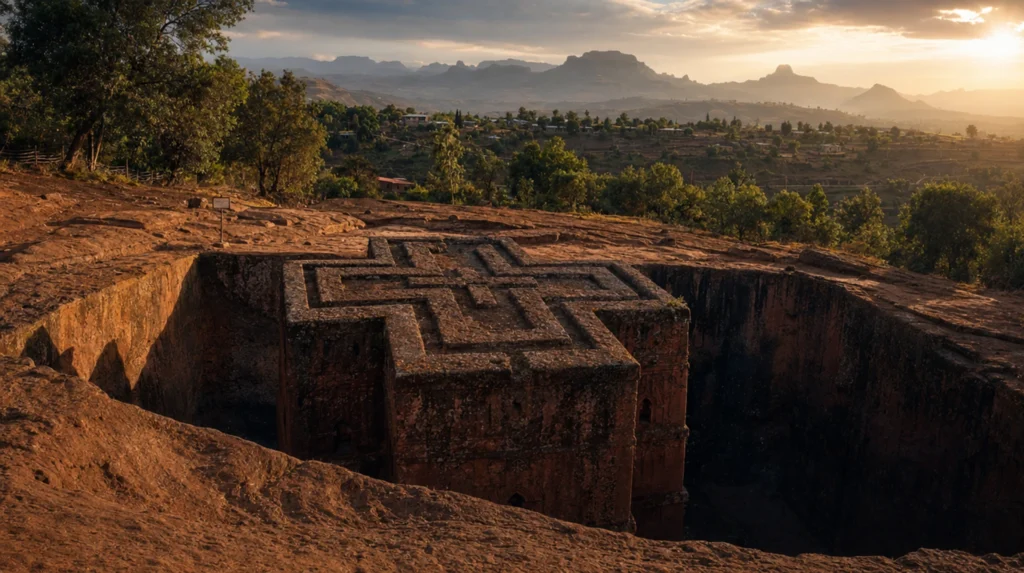
The single most extraordinary site in Ethiopia and one of the great architectural achievements of medieval Africa. The eleven rock-hewn churches of Lalibela were carved out of a single volcanic plateau in the late 12th and early 13th centuries during the reign of King Lalibela, who reportedly intended to create a “New Jerusalem” after Saladin’s 1187 capture of the original made pilgrimage difficult for Ethiopian Christians. The eleven churches divide into two clusters connected by tunnels and trenches: the northern group (including Bete Maryam, Bete Medhane Alem and Bete Golgotha) and the southern group (including Bete Gabriel-Rufael and Bete Amanuel). The most photographed individual church is Bete Giyorgis (the Church of St. George), a free-standing cross-shaped cathedral 30 metres on each side, carved 12 metres downward into the rock and accessed by a narrow trench.
Lalibela is still in active use — the churches are not museums but functioning Ethiopian Orthodox sites, with priests in residence, daily liturgies, and pilgrim crowds that swell to roughly 100,000 during Genna (Ethiopian Christmas, January 7). The town itself, population around 20,000, sits at 2,500m altitude on the rim of a deep valley with views across to the Lasta Mountains. UNESCO inscribed the churches in 1978; protective metal canopies have covered four of them since 2008 (controversial among traditionalists, necessary for preservation). Visitors purchase a 5-day pass at the entrance for $50 USD which covers all eleven churches, plus the option of nearby Yemrehanna Krestos (a built-up cave church 40 km away that pre-dates Lalibela by 200 years and is arguably more architecturally remarkable).
- What to do: Both clusters of churches (allow a full day each); early morning attendance at any church liturgy (5-6 a.m. starts, the most atmospheric experience available); day-trip to Yemrehanna Krestos cave church; sunset hike to Asheton Maryam monastery (1,000m above town, 3 hours one-way).
- Signature eats: Ben Abeba restaurant (a Scottish-Ethiopian-owned spot built into the cliff with valley views); Mountain View hotel restaurant; fresh injera and tej (honey wine) at any guesthouse.
- Access: Ethiopian Airlines daily 1-hour flight from Addis Ababa to Lalibela airstrip (LLI), which sits 25 km from town (taxi $15-25). Road access from Bahir Dar or Gondar takes 8-12 hours.
🏰 Gondar — The Camelot of Africa
Ethiopia’s capital from 1632 to 1855, founded by Emperor Fasilides as a permanent imperial seat after generations of nomadic court-on-the-move emperors. The Royal Enclosure (Fasil Ghebbi) at the city centre contains six stone-and-mortar palaces built in a hybrid Portuguese-Indian-Moorish-Aksumite style by successive emperors over two centuries, all within a single fortified compound. The most architecturally complete is Fasilides’ own palace from the 1640s, with its three-storey towers, balconied windows, and views over the surrounding hills. UNESCO inscribed the complex in 1979.
Outside the Royal Enclosure, two more sites belong on every Gondar itinerary. The first is the Fasilides bath, a 2-hectare rectangular pool fed by an aqueduct from the Qaha River, used for the imperial coronations and now the centre of the country’s most spectacular Timkat (Ethiopian Epiphany) celebration each January 19 — the bath is filled, blessed, and then up to 30,000 of the faithful jump in for ritual immersion. The second is Debre Berhan Selassie church, a small 17th-century stone-and-thatch church on the edge of town whose interior is covered floor-to-ceiling with painted angel faces (about 80 of them on the wooden ceiling) and biblical scenes — locals say the church survived the 19th-century Mahdi raids that destroyed most other Gondar churches because the resident bees swarmed the attackers.
- What to do: Royal Enclosure (allow 2-3 hours); Fasilides bath; Debre Berhan Selassie church; Empress Mentewab’s complex at Kuskuam; sunset from Goha Hotel.
- Signature eats: Four Sisters restaurant in central Gondar (traditional injera and Amharic specialities, cultural performances Wed/Sat nights).
- Access: Ethiopian Airlines daily flight from Addis Ababa (1h, then 20-min taxi); also accessible by road from Bahir Dar (3h on the lakeshore route).
📜 Aksum — The Ancient Capital
The capital of the Aksumite Empire from roughly the 1st century BCE to the 7th century CE, and one of the four great powers of antiquity (alongside Rome, Persia and China, according to a 3rd-century Persian classification). Aksum’s stelae field is the signature site — over 100 carved granite obelisks erected as royal grave markers between the 3rd and 4th centuries CE, including the 24-metre Great Stele (collapsed in antiquity, the largest single-stone obelisk ever attempted), the 21-metre Stele of Aksum (looted by Italian forces in 1937, returned in 2008 and re-erected), and the still-standing 23-metre King Ezana stele. UNESCO inscribed the site in 1980.
The Cathedral of Saint Mary of Zion, built initially by Emperor Ezana around 340 CE and rebuilt in its current form in the 17th century, is the most sacred site in Ethiopian Christianity. Adjacent to the cathedral is a small chapel that, according to Ethiopian Orthodox tradition, holds the original Ark of the Covenant brought from Jerusalem by Menelik I (the legendary son of Solomon and the Queen of Sheba, the founder of the Solomonic dynasty in the 10th century BCE). Only one monk — the elected Guardian of the Ark — is permitted to see it; he never leaves the chapel grounds for life. Whether or not the tradition is literally true, the social and religious force of the claim has been formative for Ethiopian Christianity for at least 1,500 years.
- What to do: Northern stelae field; St Mary of Zion Cathedral and Ark chapel approach (visitors view from the gate); the underground tomb of King Bazen; the Aksum Archaeological Museum; the Queen of Sheba’s bath; the ruins of Dungur (the supposed Sheba palace).
- Signature eats: Africa Hotel restaurant for Tigrayan tihlo (a Tigrayan barley-flour fondue served with spicy meat dipping sauces).
- Access: Ethiopian Airlines daily flight from Addis Ababa (1h45m). Road access from Mekele or Gondar but security advisories should be checked for current overland conditions in the Tigray region.
⛰️ Simien Mountains National Park
Ethiopia’s signature trekking destination and one of the most visually striking mountain ranges in Africa. The Simiens are not classic alpine peaks but a dissected highland plateau — vertical 1,000-metre escarpments drop from the 4,000m grassland tops down into the Tekezé River canyon to the north. The plateau has its own ecosystem of giant lobelia plants, frost-dwarfed grasses, and a rich endemic fauna including the gelada baboon (Africa’s only grass-grazing primate, sometimes called the “bleeding heart” baboon for the red chest patch on adult males), the walia ibex (numbering only around 1,000 worldwide, all in this park), and the Ethiopian wolf (more famously found in the Bale Mountains, but a small population also lives here).
Trekking is the standard mode of visit, with options ranging from day-hikes to 8-12 day trans-park traverses. The Sankaber-Geech-Chenek 4-day hut-to-hut trek is the most popular. Mules carry gear; armed park scouts accompany every group (mandatory, ETB 200/day, more cultural than security-driven); guides cost roughly ETB 1,500-2,000/day. The country’s highest point, Ras Dashen (4,550m), is a 6-7 day round-trip from Sankaber and requires moderate fitness and acclimatisation. The Limalimo Lodge above the Geech valley is the highest-end accommodation in the park and books months ahead.
- What to do: 4-day hut-to-hut trek; gelada baboon viewing at Sankaber escarpment edge (groups of up to 600 individuals graze the plateau, totally unconcerned by quiet visitors); Imet Gogo viewpoint; Ras Dashen summit attempt (for the committed); birding for the endemic thick-billed raven and white-collared pigeon.
- Signature eats: Limalimo Lodge or Simien Lodge dinners; on trek, your camp cook will produce remarkably good shiro (chickpea stew) and injera at altitude.
- Access: Trekking starts from Debark, 100 km north of Gondar (3-hour drive). Most trekkers fly Addis-Gondar then drive Gondar-Debark on Day 1 of the trek.
🌋 Danakil Depression — The Hottest Place on Earth
The Afar Triangle’s lowest point sits 125m below sea level, holds the year-round-hottest inhabited place on Earth (Dallol, with a 35°C annual average temperature and summer highs above 50°C), and contains some of the most surreal landscapes outside science fiction. The Erta Ale active basaltic shield volcano holds a permanent lava lake that has been bubbling for at least a century; the Dallol hydrothermal field produces yellow and green sulphur towers, neon-orange salt-acid pools, and spiral salt formations that don’t exist anywhere else; the Lake Karum salt flats produce the Afar people’s traditional camel-caravan salt trade, with 12-day round-trips bringing salt slabs to the highland markets. The whole region is thinly populated by Afar herder families.
Visiting the Danakil requires a registered local tour operator (ETT, Origins Ethiopia, GETTS Travel, and a few others), an armed escort (mandatory by law since 2012), and 4-5 days minimum from Mekele. Tours run November-February only — outside that window the heat is genuinely dangerous. Standard 4-day itineraries cost $400-700 per person and include the Erta Ale crater rim climb (an overnight on the volcano rim, sleeping on stone mats), the Dallol salt formations day, the Karum salt flats lookoff, and the camel caravan encounter.
- What to do: Erta Ale lava lake (overnight rim camp); Dallol sulphur formations and acid pools; Lake Karum salt flats sunset; meeting the Afar salt caravans at Hamadela.
- Signature eats: Bring everything in. Camp food on the trip is basic and water is the priority.
- Access: Mekele airport; tours start with a long 4WD day east. Currently dependent on Tigray region accessibility — check current conditions with the operator a month before booking.
🐊 Bahir Dar & Lake Tana
Ethiopia’s third-largest city and the gateway to Lake Tana, the source of the Blue Nile and the country’s largest lake (3,150 km², roughly the size of Greater London). The lake holds 37 islands, 20 of which contain Ethiopian Orthodox monasteries dating from the 14th to 17th centuries. The most accessible (Ura Kidane Mehret on Zege Peninsula and Tana Cherqos) can be visited on a half-day boat tour from the Bahir Dar waterfront; the more remote ones (Daga Estifanos, where six Ethiopian emperors are buried) require longer day-trips and don’t admit women under traditional rules. The Blue Nile Falls (Tis Issat, “smoke of fire” in Amharic), a 400m-wide curtain of water 30 km downstream from Bahir Dar, is at peak flow in the August rainy season and reduces to a trickle in dry season due to upstream hydro-dam diversion.
- What to do: Lake Tana monastery boat tour (full day, ETB 2,500-3,500); Blue Nile Falls (4-hour round-trip from Bahir Dar); papyrus-boat ride at the lake outflow; sunset at the Bezawit Hill viewpoint.
- Signature eats: Desset Resort lakeside dining; Lake Tana fish (catfish and tilapia, often fresh-caught the same day).
- Access: Ethiopian Airlines daily flight from Addis Ababa (1h); also reachable by road from Gondar (3h) on the lakeshore route.
“The earth had been pulled apart by the same hands that built the rocks, and the rocks were full of living things, full of memory.”
— Maaza Mengiste, The Shadow King (2019)
🗓️ Sample Itineraries
Ethiopia rewards longer trips. Below are four templates that work for most first-time travellers; pick the one that matches your time, then adjust by season. All assume Ethiopian Airlines domestic flights between historic-circuit cities; substitute road days only where security advisories permit.
7 Days — Addis + Lalibela Sampler
Day 1: Arrive Addis Ababa evening. Coffee ceremony at the hotel; settle in. Day 2: National Museum (Lucy and Ardi); Holy Trinity Cathedral; Mt Entoto sunset. Day 3: Mercato walking tour with guide; Sheger Park; dinner at Yod Abyssinia with cultural performance. Day 4: Ethiopian Airlines flight to Lalibela (1h). Northern church cluster (Bete Maryam, Bete Medhane Alem, Bete Golgotha). Day 5: Southern church cluster and Bete Giyorgis (the cross-shaped St George cathedral). Dawn liturgy if interest in religious context. Day 6: Day-trip to Yemrehanna Krestos cave church (4WD required, 40 km each way). Day 7: Fly back to Addis, evening flight or overnight before international departure. The minimum that gives a real introduction.
10 Days — Historic Circuit
Day 1: Arrive Addis. Day 2: Addis sights. Day 3: Fly to Lalibela. Days 4-5: Lalibela churches and Yemrehanna Krestos. Day 6: Fly to Aksum. Stelae field. Day 7: Aksum (St Mary of Zion, archaeological museum, Sheba palace). Fly to Gondar. Day 8: Gondar (Royal Enclosure, Fasilides bath, Debre Berhan Selassie). Day 9: Drive Gondar to Bahir Dar (3h). Lake Tana monasteries afternoon. Day 10: Blue Nile Falls morning, fly to Addis, depart. The standard historic-circuit trip and the right choice for most first-time travellers.
14 Days — Adding the Simiens
The 10-day historic circuit plus a 4-day Simien Mountains trek inserted after Gondar. Days 1-7: as 10-day template. Day 8: Drive Gondar-Debark (3h), enter Simien Mountains National Park, hike Sankaber. Sleep Simien Lodge or Sankaber camp. Day 9: Trek Sankaber to Geech (5-6 hours). Gelada baboon encounters along the escarpment. Day 10: Day-hike to Imet Gogo viewpoint (4,000m). Sleep Geech. Day 11: Trek Geech to Chenek (full day). Sleep Limalimo Lodge or Chenek camp. Day 12: Drive Chenek-Debark-Gondar; fly to Bahir Dar. Day 13: Bahir Dar Lake Tana and Blue Nile. Day 14: Fly Addis and depart.
21 Days — End-to-End Ethiopia
The serious trip, including the southern Omo Valley and either the Danakil or the Bale Mountains. Days 1-14: Historic circuit plus Simiens as above. Days 15-21: Two main options: (a) Omo Valley — fly Addis to Arba Minch, 4WD circuit through the Mursi, Hamer, Karo and Konso tribal areas (5 nights, returning to Addis via Arba Minch). (b) Danakil Depression — fly Addis to Mekele, 4-night Danakil tour (Erta Ale, Dallol, Karum salt flats), return to Addis. The Omo option is the deeper cultural experience; the Danakil is the more visually surreal. Both require a registered operator.
🎯 Strategy
If you only have one trip to Ethiopia, do the 10-day historic circuit in October-November. The kiremt rains have ended, the highlands are at their greenest, the festival pricing premium hasn’t kicked in, and the major sites (Lalibela, Aksum, Gondar) are at their most photogenic. If your trip can flex to coincide with one major festival, choose Timkat at Gondar (January 19) — the Fasilides bath ceremony is the most spectacular cultural event in Ethiopian tourism, but book hotels four months ahead and expect 30-50% price premium. Genna at Lalibela on January 7 is the alternative, with a different but equally remarkable atmosphere.
Ethiopian Culture & Etiquette
Ethiopia is a deeply religious society — roughly 43% Ethiopian Orthodox Christian, 35% Muslim (Sunni), 19% Protestant, and small Catholic and traditional-religion minorities. Religious practice shapes daily life across the country: Wednesday and Friday are Orthodox fasting days (no meat or dairy, hence the universal availability of vegan-friendly beyaynetu platters at every restaurant), the Orthodox calendar of saints’ days punctuates the year, and the call to prayer from the country’s many mosques marks the rhythm of urban life. The Tewahedo Church is genuinely autocephalous (governing itself rather than under the Coptic Patriarchate) since 1959, with its own theology that emphasises the “single nature” of Christ.
Ethiopian hospitality (yegna engida) is a cultural cornerstone. Coffee ceremony invitations are common and should be accepted when possible — refusing politely twice before a third invitation is the conventional rhythm. The ceremony lasts roughly 90 minutes and involves three rounds of coffee (abol, tona, bereka, with the third bringing blessing); refusing any of the three is a mild slight. Gursha — the traditional gesture of feeding a friend or honoured guest a bite of food directly with one’s hand — is a sign of affection and is offered to foreign visitors who have shared a meal repeatedly with locals.
Dress norms are conservative but not severe. In rural and church settings, women cover their heads with a netela shawl and dress modestly (long skirts, sleeves); shoulders and thighs covered are the urban standard. Men in religious settings cover their heads with a kuta and wear traditional shirts. Visitors entering Orthodox churches must remove shoes (left at the entrance), and women may be asked to wear a head-covering (usually provided). Photographing church interiors is sometimes restricted; ask the priest first.
💬 The Saying
“Tilik shai be qil tigana yiwetal” — “A small thing combined makes a big tigana (traditional bread).” The proverb is the cultural shorthand for the country’s emphasis on cooperation, communal labour, and the conviction that small contributions accumulate into significant outcomes. Travellers will hear it deployed across contexts — from describing village agricultural work to explaining how the Lalibela churches were carved over centuries by patient hands. The same instinct shows up in the iddir mutual-aid funeral societies that operate in every neighbourhood and bring the social-cooperation principle into modern urban life.
A Food Lover’s Guide to Ethiopia
Ethiopian food is one of the most distinctive cuisines in Africa and one of the world’s most genuinely vegetarian-friendly traditions. Built around injera — the spongy sourdough flatbread made from teff, an ancient indigenous grain that grows almost exclusively in Ethiopia — the cuisine layers stewed dishes (wat) on top of the injera in a single shared platter, with everyone tearing pieces of injera to scoop the stews. The flavour profile is built around berbere (the country’s signature spice mix, with chilli, fenugreek, ginger, garlic, cardamom and twelve other spices) and niter kibbeh (spiced clarified butter).
Doro wat is the national dish — a slow-cooked chicken stew with onions, berbere, and a hard-boiled egg, traditionally served on holidays and Sunday lunches. The cooking takes hours; the onion base is reduced slowly until it disappears entirely into the sauce. Habesha 2000 in Addis Ababa is among the city’s most celebrated venues for it.
Tibs is the meat-and-fire dish — sautéed beef or lamb cubes with onion, garlic and rosemary, served sizzling on a clay platter (the “yeshukla tibs”). Variants include awaze tibs (with the spicy awaze chilli sauce), kitfo (a finely minced raw beef dish, served with mitmita spice and ayib soft cheese), and gored gored (raw beef cubes). The kitfo is the prestige dish — order it leb-leb (warmed to body temperature) for the safer first try; raw is the local standard.
Beyaynetu — the vegetarian fasting platter — is the universal injera-based meal, served on every Wednesday and Friday (Orthodox fasting days) and the entire 56-day Lenten fast period. A circular platter of injera holds 5-8 small mounds of stewed dishes: shiro (chickpea stew, the national comfort food), misir (red lentils), kik (yellow split peas), gomen (collard greens), atkilt (cabbage and carrot), and various spiced dishes. The whole platter, large enough to share between two people, costs ETB 200-400 ($3-7) at most local restaurants.
Coffee (buna) is the country’s contribution to global cuisine — Coffea arabica is genetically Ethiopian, and the highland coffee-growing regions of Sidamo, Yirgacheffe and Harrar produce some of the world’s most distinctive beans. The traditional ceremony begins with green beans being roasted in a small pan over a charcoal stove, then ground in a mortar, then brewed in the jebena (a clay pot with a long curved neck). Three rounds are served (abol, tona, bereka), each weaker than the last, with frankincense smouldering nearby and grass spread on the floor. The ceremony is essentially a 90-minute social occasion. UNESCO inscribed it as Intangible Cultural Heritage in 2024.
Tej is the country’s traditional honey wine — fermented honey, water and gesho (a hops-equivalent native shrub), served in a vase-like berele glass. Sweet at the entry-level, drier and more interesting at the locally-brewed homemade end. The Topia tej-house chain in Addis serves a reliable approachable version; the rural homemade versions in Lalibela or Bahir Dar guesthouses are stronger and more variable.
Tihlo is the Tigrayan speciality — a fondue-like preparation of barley flour shaped into balls, dunked into spicy meat sauce. It’s specific to the Aksum and Mekele regions and rare elsewhere in the country.
St George Beer (Bedele) and Habesha are the country’s two main brewery products; both are pale lagers in the East African brewery style. Tella, the homemade barley beer, is the village alternative.
📸 Photography Notes
Ethiopia is one of the more photographically rewarding destinations in Africa precisely because the subjects are so varied — medieval rock churches, alpine highlands, salt-flat surrealism, traditional Orthodox liturgy, geographically isolated tribal cultures. The light is best at the high-altitude clarity of October-November and again in January-February, when the air is dry and the colour saturation is at its peak.
Best light by region: Highland October-November for clean skies and emerald greens; Lalibela in early-morning liturgy hours (5-7 a.m.) for the candlelit interiors; Simiens late-afternoon when the long shadows define the escarpments; Danakil at dawn or dusk only (midday is washed-out and brutal); Aksum in late afternoon for the shadow definition on the stelae.
Five locations worth the detour:
- Bete Giyorgis (St George church) at Lalibela (12.0319°N, 39.0476°E) — the cross-shaped roof seen from the trench wall above. Best at 7 a.m. with morning light angled into the trench; vertical composition.
- Sankaber escarpment edge, Simien Mountains (13.2540°N, 38.0660°E) — gelada baboons grazing the cliff edge with the 1,000m drop and the highland plain behind. Late afternoon for golden hour.
- Fasilides bath at Gondar during Timkat (12.6010°N, 37.4570°E) — January 19 only. The chain of priests, the white-clad pilgrims, the immersion crowd. Uncrowded only at dawn before the main ceremony.
- Dallol sulphur fields, Danakil (14.2410°N, 40.2900°E) — neon-orange acid pools and yellow sulphur towers against the reddish brown salt crust. Mid-afternoon (the colours are most saturated in stronger light, surprisingly).
- Erta Ale lava lake (13.6010°N, 40.6700°E) — overnight on the volcano rim, the lava lake glow against night sky. Tripod and long exposure required; this is the cover image of Ethiopian volcanism.
Drone rules: Ethiopia has tightly restricted drone usage and currently requires a permit from the Ethiopian Civil Aviation Authority and the Ministry of Defence for any drone operation — a process that takes weeks and is not realistic for casual tourists. Drones are explicitly prohibited near military, government and airport sites, and at Lalibela, Gondar and Aksum heritage sites. Bringing a drone is not advisable; customs may confiscate it without prior permits.
✨ Pro Tip — Photographing People
Photography of people in Ethiopia, especially in the Omo Valley, is a specific cultural and ethical issue. The Mursi, Hamer and Karo tribes have largely commercialised their interaction with photographers — the conventional rate is ETB 5-15 per portrait, paid per individual photographed (so a group shot can quickly run $10-30). Critics argue this has distorted traditional practices; defenders point out it provides direct income to communities. The standard ethical practice is: ask first, agree on a price up-front (your guide will broker), pay everyone in the frame, and don’t photograph children without parents’ explicit consent. In churches, photography during liturgy is often disruptive; visit during off-hours instead. Government installations, military checkpoints, bridges and the airport tarmac should never be photographed.
Off the Beaten Path — Ethiopia Beyond the Historic Circuit
The historic circuit accounts for roughly 80% of foreign visits and a fraction of the country’s surface area. The remaining regions are harder to reach, less photographed, and contain some of the most distinctive cultural and natural sites in the Horn of Africa.
🐺 Bale Mountains National Park
The Sanetti Plateau — at 4,000m altitude, the highest road in Africa — runs across an Afro-alpine grassland that holds the densest population of the Ethiopian wolf, Africa’s rarest canid (only around 500 individuals worldwide, half of them here). Drive the 100 km Sanetti road from the park entrance at Dinsho and you have realistic odds of seeing the wolves hunting giant mole-rats during daylight. The Harenna Forest, on the south slope of the Bale massif, is one of the largest Afromontane forest blocks left in East Africa and home to forest-dwelling lions, leopards, and the wild Coffea arabica forests where coffee genuinely grows in its ancestral state. Reach via Goba (5-6 hour drive south of Addis Ababa).
🪙 Harar — The Walled City
The 16th-century walled city of Harar, in eastern Ethiopia near the Somaliland border, is one of the holiest cities in Islam and a UNESCO World Heritage Site. Its 5-metre-high stone walls enclose a maze of 369 alleyways and 82 mosques, with traditional courtyard houses (gegar) painted in the bright reds, yellows and greens specific to Harari Muslim tradition. The city’s most famous nightly ritual is the hyena-feeding — a single Harari man hand-feeds wild hyenas from his mouth at the Erer Gate as they emerge from the surrounding hills, a practice that has been continuous since at least the 1960s and has become one of Ethiopia’s signature cultural performances. Reach by 1-hour Ethiopian Airlines flight from Addis Ababa to Dire Dawa, then 1-hour drive.
🏞️ Omo Valley — Tribal Cultures of the South
The lower Omo River valley in southwestern Ethiopia is home to roughly 200,000 people across more than a dozen ethnic groups — the Mursi (famous for the women’s lower-lip clay plates), the Hamer (the bull-jumping coming-of-age ceremony for young men), the Karo (the body-painting tradition), the Konso (the UNESCO-inscribed cultural landscape of dry-stone terraced fields), and others. The valley is one of the most ethnically diverse small regions on Earth and one of the more controversial visiting destinations — the 2010 Gibe III hydroelectric dam upstream and the subsequent agricultural development have disrupted traditional pastoral and flood-recession farming. Travellers visit through registered tour operators; standard 5-7 day 4WD circuits cost $1,200-2,500 per person depending on group size. Ethical photography practices are central to a respectful visit.
🦅 Gheralta & the Tigray Cliff Churches
The dramatic sandstone cliffs of the Gheralta range, north of Mekele in Tigray region, hold over 30 ancient rock-hewn churches, many carved into the cliff faces and accessible only by hand-and-foot scrambling routes that involve actual climbing. The 6th-century Abuna Yemata Guh, perched on a 200-metre vertical cliff, is the most famous — visitors finger-traverse a narrow ledge for the last 10 metres of the approach, with no safety equipment. Inside, the church preserves intact 14th-century frescos. Other notable Gheralta churches (Maryam Korkor, Daniel Korkor, Petros and Paulos) are equally dramatic. Currently dependent on Tigray region accessibility — check current security advisories before booking.
☕ Yirgacheffe & the Coffee Highlands
The Sidamo and Yirgacheffe regions south of Addis Ababa produce some of the world’s most distinctive specialty coffees, sold at premium prices in Tokyo, Melbourne and Brooklyn third-wave cafés. A coffee farm visit — to a small cooperative like Worka or Banko Gotiti — gives the full source-to-cup experience: the wild forest origin trees, the cooperative wet mill, the cherry-picking, the natural and washed processing methods. Prices for the original product at the farm gate are remarkable — a kilo of grade-1 Yirgacheffe that might retail for $40+ in London sells for around $15 at the Sidamo cooperative. Reach via 4-5 hour drive south from Addis Ababa.
Ethiopia by Numbers
- 9 — UNESCO World Heritage Sites
- 13 — months in the Ethiopian calendar (currently 2018, in 2026)
- 1,500 years — continuous coffee cultivation history
- 3.2 million years — age of Lucy, in the National Museum
- 4,550 m — Ras Dashen, the country’s highest peak
- -125 m — lowest point of the Danakil Depression below sea level
Practical Information
Currency: Ethiopian birr (ETB). The currency has weakened consistently against the dollar (5-15% per year). Cash is the dominant medium outside Addis Ababa hotels and the international chains; ATMs in cities accept foreign cards but rural areas can run out of cash on weekends. Credit cards are accepted at upscale restaurants and chains; carry cash for everywhere else. Tipping is appreciated — 10% in restaurants, ETB 100-200 per day for guides.
Visa & entry: Visa-on-arrival or e-visa (evisa.gov.et) is available for nationals of 80+ countries. Standard tourist visa is 30 days single-entry at $50 USD; 90-day multiple-entry at $70. Most travellers find the e-visa more convenient — apply at least 2 weeks before travel. Yellow fever vaccination certificate is required for entry from yellow-fever-endemic countries (including most of sub-Saharan Africa); not required from North America or Europe.
Language: Amharic is the federal working language and the most widely spoken (around 32 million speakers). English is the language of higher education, government and most road signage. Tigrinya, Oromo, Somali and Afar are the other major regional languages. Learn “selam” (hello), “amasegenallo” (thank you), and “betam tiru” (very good).
Connectivity: 4G covers Addis Ababa, the historic-circuit cities and most regional centres. Local SIMs from Ethio Telecom or Safaricom Ethiopia (entered the market 2023) cost ETB 100 for the card plus ETB 300-500 for a 10GB month package. WiFi is reliable in urban hotels but slow in rural areas. The Simien Mountains and Danakil have essentially no signal.
Tap water: Not safe in most of the country. Use bottled water (universally available, ETB 30-50 per litre) or a UV/filter purifier. Carbonated drinks and bottled juices are universally available alternatives.
Plug type: Type C, E, F (European-style two-pin), and L (Italian three-pin), 220V/50Hz. Bring a universal adapter; power cuts occur regularly in Addis Ababa and most upscale hotels run generators with a 30-second changeover delay.
Budget Breakdown — What Ethiopia Actually Costs
Ethiopia is one of the most affordable destinations in East Africa for a Western traveller — local food costs are low, mid-range hotels are cheaper than equivalents in Kenya or Tanzania, and the historic circuit can be done on a moderate budget. The international flights to Addis are the larger expense, and the Danakil and Omo Valley extensions are more expensive due to the registered-operator requirements. The good news is that the Lalibela churches, the Simien trek, the Lake Tana monasteries and most of the cultural inheritance is genuinely accessible across budget tiers.
💚 Budget Traveller — $40–70 / day
Backpacker hostels and pensions ($10–20/night), local restaurant meals (ETB 200-400 for beyaynetu or shiro), domestic Ethiopian Airlines flights ($90-180 with the international-passenger discount), park and church entry fees ($5-50). The trick is to book the Ethiopian Airlines stopover programme (free domestic flights tied to international ticketing) and use small local restaurants rather than hotel dining. Lalibela and Gondar both have reasonable hostel networks; Mercato in Addis has a number of cheap pensions, though location matters for safety.
💙 Mid-Range — $130–250 / day
Three-star hotel double $50-120/night, restaurant dinner $10-25, hired driver and 4WD $80-130/day, occasional domestic flight $90-180 one-way. The Limalimo Lodge in the Simiens, Mountain View hotel in Lalibela, and the Goha Hotel in Gondar are the upper-mid-range standards. Allow $400-700 per person for a 4-day Danakil Depression tour; $1,200-2,500 per person for a 5-7 day Omo Valley circuit. Festival pricing premiums (Genna, Timkat) add 30-50% to historic-circuit hotel rates and require booking 4 months ahead.
💜 Luxury — $500+ / day
Sheraton Addis or Marriott Addis $250-500/night; Limalimo Lodge in Simiens $400-600/night with full board; private 4WD with English-speaking guide and the best operators $200-400/day. The genuine top-end Ethiopia experience is the Limalimo Lodge plus a Bale Mountains private camp plus a customised Omo Valley circuit, which can run $700-1,200/day per person but delivers an experience few other African destinations can match for pure cultural depth.
| Item | Budget (ETB) | Mid-range (ETB) | Luxury (ETB) |
|---|---|---|---|
| Bed (per night) | 700–1,400 | 3,500–8,500 | 17,500–35,000+ |
| Dinner | 200–400 | 700–1,800 | 2,800–5,500 |
| Daily transport | 500 (bus/shared) | 5,500–9,500 (driver+4WD) | 17,500+ (private 4WD) |
| One activity | 500 (church entry) | 3,500 (Lake Tana boat) | 40,000+ (Danakil 4-day tour) |
| USD daily | $40–70 | $130–250 | $500+ |
🧳 Travel Guru Tip — The Ethiopian Airlines Discount
The single biggest practical money-saver for a Pakistan-style trip across multiple historic-circuit cities is to book all your domestic flights through the same Ethiopian Airlines reservation as your international ticket. The airline offers a 50% discount on domestic flights when booked alongside an international itinerary on the same reservation — this can cut a 5-leg historic-circuit (Addis-Lalibela-Aksum-Gondar-Bahir Dar-Addis) from around $700 to $350. The discount is not always apparent on the booking page; book at ethiopianairlines.com directly or through a travel agent who knows the trick. The same booking automatically registers the Ethiopian Airlines stopover programme, which gives free hotel nights for layovers above 8 hours.
✅ Pre-Trip Checklist
The minimum kit and admin to have sorted before you fly. Ethiopia is a high-altitude country and the temperature swings are bigger than expected — a sunny October day in Lalibela can drop from 25°C at noon to 8°C after sunset.
- Documents: Passport valid 6 months past return date with at least 2 blank pages. E-visa printout (not just digital). Photocopies of passport main page x5. Yellow fever vaccination certificate if arriving from a yellow-fever country (most of sub-Saharan Africa).
- Insurance: Comprehensive travel insurance with high-altitude trekking cover (some policies exclude above 4,000m), medical evacuation, and rural-Africa hospital cover. World Nomads, Global Rescue, and BUPA Global are common standards. Confirm whether your specific regions are excluded as advisory zones.
- Health: Hepatitis A, Typhoid, and Yellow Fever vaccinations are recommended; consult your travel clinic 4-6 weeks before departure. Anti-malarial prophylaxis is recommended for the lowlands (Danakil, Omo Valley) but not for the highlands (Addis, Lalibela, Gondar, Simiens) above 2,500m. Bring acetazolamide (Diamox) for Simien trek if going to Ras Dashen. Carry SteriPen, Lifestraw, or iodine tablets.
- Layers: Lightweight long-sleeve shirts and trousers; full set of warm layers (fleece, down jacket, hat, gloves) — Lalibela and Simien nights drop near freezing in October-February. The pre-dawn liturgy temperatures inside Lalibela churches are genuinely cold.
- Footwear: Comfortable walking shoes for the cities; proper hiking boots if Simien Mountains trek planned. Sandals for hotel rooms and church entries (shoes must come off at all Orthodox churches).
- Apps to download: Ethiopian Airlines (mobile boarding passes), Maps.me (offline mapping, better Ethiopia coverage than Google Maps), Google Translate Amharic offline pack, WhatsApp (universal communication tool with operators and guides), XE Currency, Star Alliance (for Ethiopian Airlines miles).
- Cash: Bring $200-400 USD in clean small notes for emergency exchange and tour-operator deposits; ATMs occasionally fail in rural areas.
- Cultural prep: Read Maaza Mengiste’s The Shadow King or Dinaw Mengestu’s Beautiful Things That Heaven Bears for Ethiopian-American literary perspective; know that Wednesday and Friday are Orthodox fasting days (no meat or dairy at most restaurants); learn the basic injera-eating etiquette (right hand only, no biting from a single piece).
🤔 What Surprises First-Timers
- The altitude is real and unexpected. Addis Ababa at 2,355m is higher than Denver. Visitors flying in from sea level routinely report shortness of breath on first-day walks; the Simien plateau at 4,000m needs proper acclimatisation. Drink water aggressively, take it slow on Day 1, and consider Diamox if going above 4,000m.
- The calendar and clock are different. Ethiopians often write dates in the Ethiopian calendar (currently 2018 in 2026 by Western count) and tell time on the 12-hour day-starts-at-dawn system. Always confirm whether a meeting is “habesha sa’at” (Ethiopian, where 3 = 9 a.m.) or “ferenj sa’at” (Western, where 3 = 3 a.m.).
- The Orthodox fasting calendar is genuinely 200+ days a year. Wednesdays, Fridays, the 56-day Lent (Hudadi), and several other periods are no-meat-no-dairy. This is why beyaynetu (vegetarian platter) is so universal — restaurants must offer it on Wed/Fri.
- The hospitality runs in both directions. Ethiopian hosts genuinely expect to provide for you when you visit homes. Bringing a small gift (good chocolate from a Western country, a coffee table book, or schoolbooks for children) is the conventional gesture and is much appreciated.
- The sense of ancient continuity is unlike anywhere else in Africa. The Lalibela churches still hold daily mass after 800 years. The Aksum cathedral guards an Ark tradition that reaches back to the 10th century BCE. The script you see on shop signs is the same script Ge’ez scribes were copying into illuminated manuscripts in the 4th century. The deep-time effect compounds.
- The food is more vegetarian-friendly than any major destination outside India. Beyaynetu, shiro, gomen — vegan visitors often find Ethiopia easier than home.
- Ethiopia was never colonised, and the country’s pride in this is constant and present. The Battle of Adwa monument in Addis Ababa, the Selassie statues across the country, the way history is taught in schools — the sovereignty narrative shapes how locals talk about their country to visitors. Acknowledging it is the right cultural register.
- “Ferenj” is the universal word for foreigner. It derives from “Frank” (the medieval term for European Crusaders) and is not pejorative — locals use it casually and warmly. Learn to recognise it.
Frequently Asked Questions
Is Ethiopia safe for tourists in 2026?
The historic circuit (Addis Ababa, Lalibela, Gondar, Bahir Dar, the Simien Mountains) is routinely visited by foreign travellers in 2026 with normal precautions. Aksum and the rest of Tigray have reopened since the 2022 cessation-of-hostilities agreement but specific routes can be affected by current conditions. Parts of Amhara and Oromia regions, the Sudanese border areas, and the Somali regional state carry active advisory status. Always check your government’s current travel advisory the week before booking and use a registered local operator for non-urban itineraries.
Do I need a visa, and how do I apply?
Yes for most nationalities — visa-free entry is not available for Western passports. Apply at evisa.gov.et (the official portal) or use the visa-on-arrival kiosks at Bole International. The standard tourist visa is 30 days at $50 USD single-entry; 90-day multiple-entry at $70. Apply at least 2 weeks before travel for the e-visa.
Is Ethiopia good for vegetarians and vegans?
Yes — exceptionally so. Wednesdays and Fridays are Orthodox fasting days when virtually every restaurant offers a beyaynetu (vegetarian platter) of injera with multiple stew dishes. The 56-day Lenten fast period multiplies vegan availability. Even on non-fasting days, shiro (chickpea stew), misir (red lentils), gomen (collard greens), and atkilt (cabbage and carrot) are universally available. Ethiopia is one of the easier vegan destinations in Africa.
Should I book a tour or travel independently?
For the historic circuit (Addis-Lalibela-Aksum-Gondar-Bahir Dar), independent travel works well — Ethiopian Airlines flies between cities, hotels are bookable online, and most sites are accessible without a guide. For the Simien Mountains, Danakil, Omo Valley, and Bale Mountains, registered local operators are either mandatory (Danakil, Simien) or strongly recommended. Tesfa Tours, Endemic Ethiopia, Imagine Ethiopia and Lalibela Trekking are among the established names. For the Danakil specifically, see our Danakil Depression cost and access breakdown, which covers current departure-hub restrictions in detail.
When do the major festivals fall?
Meskel (September 27), Ethiopian New Year (Enkutatash, September 11), Genna (Ethiopian Christmas, January 7), Timkat (Ethiopian Epiphany, January 19), and Ethiopian Easter (Fasika, lunar-calendar dependent, falls in April-May). Genna at Lalibela and Timkat at Gondar are the two most spectacular celebrations and book out 4 months ahead.
Can I drink the tap water?
No — not in most of the country. Use bottled water (universally available, ETB 30-50 per litre) or a UV/filter purifier. Coffee, tea, and bottled drinks are safe everywhere.
How does Ethiopia compare to Kenya for first-time East Africa travel?
Different focus. Kenya is the safari benchmark (Maasai Mara, Amboseli, Tsavo, Samburu — the East African big-five wildlife experience). Ethiopia is the cultural and historical depth — rock churches, ancient Christian liturgy, fossil heritage, distinctive cuisine. Many travellers do both as separate trips; pairing them is logistically possible (Ethiopian Airlines has hourly Addis-Nairobi flights) but compresses both. The 14-day historic-circuit-plus-Simiens trip is the right Ethiopia introduction; Kenya is the right safari introduction.
Is the Lalibela visitor pass really $50 USD?
Yes, and it covers all eleven churches over five consecutive days. The pass goes toward maintenance of the heritage site and the priests’ upkeep. It is a legitimate fee paid to the Lalibela Heritage Authority and is non-negotiable. Yemrehanna Krestos (40 km away, the older cave church) requires a separate $15 entry and is well worth the side-trip. Note: that figure has changed for 2026 — see our full Lalibela guide for the current price and the region advisory status.
Can I visit Ethiopia during Ramadan?
Yes — Ethiopia’s Muslim population is concentrated in the eastern lowlands (Harar, Dire Dawa, the Somali regional state) and parts of the south. The historic-circuit cities (Lalibela, Gondar, Aksum, Bahir Dar) are predominantly Orthodox Christian and Ramadan affects local life less directly there. Restaurants stay open. Travellers visiting Harar during Ramadan should be more discreet about eating in public during fasting hours.
What’s the one thing first-timers always regret skipping?
The early-morning liturgy at Lalibela. Travellers visit the churches in the bright midday hours when the light is unflattering and the atmosphere is touristic. The 5 a.m. liturgy services — when the priests chant in Ge’ez, the candlelit interiors come alive, and the rock-hewn architecture feels its full weight — is the experience that travellers describe afterward as the high point of the trip. Bring a fleece (the rock keeps the cold) and arrive 15 minutes before the 5 a.m. start.
Ready to Explore Ethiopia?
Ethiopia rewards travellers who plan thoroughly and stay flexible. The rock churches, the highland trekking, the coffee-ceremony culture, the historic circuit — they will be there. The festival calendar, the seasonal rains, and the regional advisories decide the order. Build the itinerary, time the festival, and let the country surprise you.
For a tailored Ethiopia trip — including Genna or Timkat festival timing, Simien Mountains trekking logistics, Danakil Depression registered-operator coordination, or a focused historic-circuit first visit — start with our trip-planning team. We can match you with the right operator, the right Ethiopian Airlines routing, and the right hotel circuit.
Explore More
🏙️ Addis Ababa city guide
Addis Ababa is Ethiopia’s flagship city guide — start here for the on-the-ground capital experience before heading out to the wider country.
🇰🇪 Kenya travel guide
The safari benchmark to the south — Maasai Mara, Amboseli, the Indian Ocean coast. The natural Ethiopia pair for travellers who want both cultural depth and Big Five wildlife.
🇹🇿 Tanzania travel guide
The Serengeti and Kilimanjaro pairing — Tanzania extends the East African experience with the migration calendar and the African continent’s highest peak.
🇲🇬 Madagascar travel guide
The Indian Ocean island option — endemic lemurs, baobab forests, and a culture distinct from continental Africa. The right counterpoint to Ethiopian highlands.
🗺️ Plan a custom trip
Tell us when you’re going and we’ll design a day-by-day Ethiopia itinerary that respects the festival calendar, the seasonal rains, and the latest regional advisories.
More country guides you might like

Plan your trip to Ethiopia
The booking tools we use ourselves. FFU may earn a commission at no extra cost to you.
Plan & book your trip to Ethiopia
Booking through these searches supports our guides at no extra cost to you.