
☰ On this page
- 📋 In This Guide
- Why Athens — Why It Belongs on Every Europe List
- 🌸 Late-April 2026 — Greek Easter, the Acropolis & the Best Two Weeks of the Year
- Best Time to Visit Athens (Season by Season)
- Getting There — Flights & Arrival
- Getting Around — Metro, Trolley, Foot
- Neighbourhoods — Where to Base Yourself
- Cultural Sights — Acropolis & Beyond
- A Food Lover’s Guide to Athens
- Entertainment, Bouzoukia & Late Nights
- 🗓️ Sample Itineraries — 2, 3 and 5 Days
- Day Trips — Sounion, Delphi, Aegina
- 📸 Photography Notes
- Practical Information
- Budget Breakdown — What Athens Actually Costs
- ✅ Pre-Trip Checklist
- 🤔 What Surprises First-Timers
- Frequently Asked Questions
- Ready to Experience Athens?
- Explore More
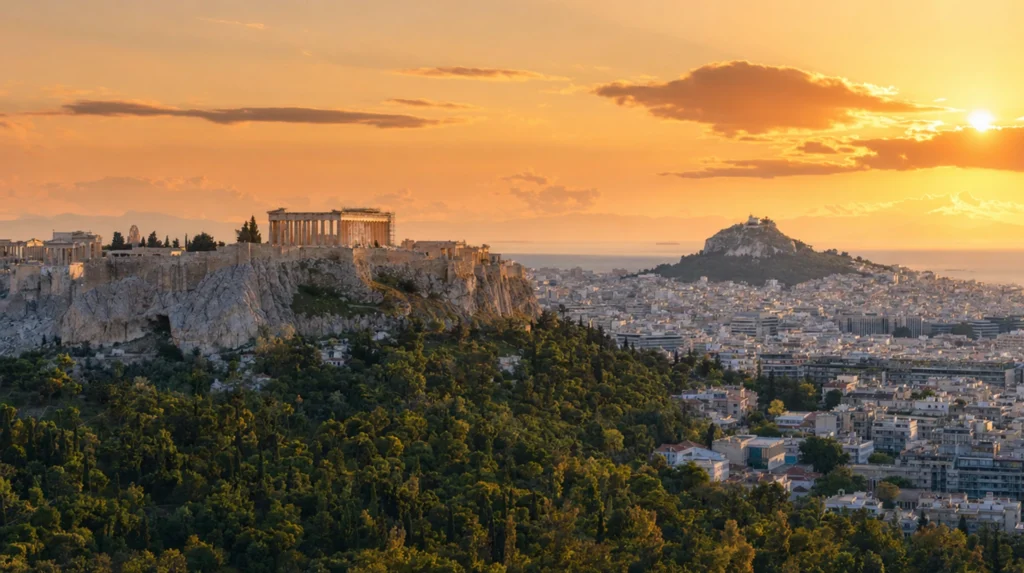
Athens, Greece: Acropolis, Anarchy & a Three-Thousand-Year Conversation
Part of our Greece travel guide.
Athens is the only capital in Europe where you can stand in a metro station and watch a Roman bath house behind glass while a commuter trades stock tips in a language whose grammar Plato would still recognise. It is the oldest continuously inhabited city in Europe — a settlement on the Acropolis hill goes back to the late Neolithic, around 5000 BC — and for the last 3,400 years its inhabitants have been writing the same language down. Greek is the longest continuously documented language on Earth, beating Chinese by a few hundred years and Latin by every century since Rome forgot how to speak it. The conversation Athens is having with itself has never paused.
What makes the city overwhelming on a first visit is not the ruins. It is the layering. The Parthenon (447–432 BC) sits on top of an older Mycenaean palace, which sat on top of a Bronze Age settlement, which sat on top of a Neolithic spring-cult. Below the modern Plaka neighbourhood the Roman agora overlaps the Greek agora overlaps a 5th-century BC sewer that still works. The Syntagma metro station’s mezzanine doubles as a free archaeological museum because they could not dig the line without uncovering 50 metres of stratigraphy and decided to leave it visible. Athens does not display its history. Its history simply refuses to stop showing up.
This guide covers Athens end-to-end — from the Acropolis at dawn to Exarcheia after midnight, from a €4 souvlaki at Kostas to a €120 tasting menu at Spondi. If you’re island-hopping afterwards or working through the eastern Mediterranean, see our Greece travel guide, our Istanbul city guide for the imperial sequel, our Rome city guide for the Latin cousin, and our Dubrovnik city guide if you’re tracing the old Adriatic-to-Aegean ferry routes. For broader trip mechanics, the trip planner handles the moving parts.
📋 In This Guide
- Why Athens — Why It Belongs on Every Europe List
- 🌸 Late-April 2026 — Greek Easter, the Acropolis & the Best Two Weeks of the Year
- Best Time to Visit Athens (Season by Season)
- Getting There — Flights & Arrival
- Getting Around — Metro, Trolley, Foot
- Neighbourhoods — Where to Base Yourself
- Cultural Sights — Acropolis & Beyond
- A Food Lover’s Guide to Athens
- Entertainment, Bouzoukia & Late Nights
- 🗓️ Sample Itineraries — 2, 3 and 5 Days
- Day Trips — Sounion, Delphi, Aegina
- 📸 Photography Notes
- Practical Information
- Budget Breakdown — What Athens Actually Costs
- ✅ Pre-Trip Checklist
- 🤔 What Surprises First-Timers
- Frequently Asked Questions
- Ready to Experience Athens?
- Explore More
Why Athens — Why It Belongs on Every Europe List
Athens spent most of the 20th century being underrated by its own visitors. Travellers stopped for 36 hours, climbed the Acropolis in the wrong shoes, ate a tired moussaka in a Plaka tourist trap, and left for Santorini convinced the city was a transit lounge with a hill in it. That city does not exist anymore. The modern Athens that emerged from the 2004 Olympics, the 2010–2018 debt crisis, and the post-pandemic rebound is a properly functional European capital with a museum sector that ranks with Paris and Berlin, a food scene that has converted three Michelin stars in the last decade, and a coastline (the Athenian Riviera) that nobody told tourists about until roughly 2019.
It is also a city of compression. The historic centre — Acropolis to Syntagma to Monastiraki to Psyrri to Kerameikos — fits inside a 1.8 km² rectangle you can walk corner to corner in 30 minutes. Within that rectangle sit four UNESCO World Heritage components, two of the world’s top fifty archaeological museums, a 2,500-year-old marketplace still functioning as a flea market, and roughly 600 restaurants. You do not need a car. You barely need the metro. You do need calf muscles — Athens has seven hills, and the photogenic ones are not the easy ones.
The other thing nobody tells you: Athens is loud, opinionated and politically alive in a way most European capitals lost decades ago. The graffiti on the walls of Exarcheia is a real-time political diary. Strikes shut down the metro twice a year. The neighbourhood of Plaka has working monasteries; the neighbourhood three blocks north has anarchist squats; the neighbourhood three blocks south has Versace and Prada. The contrast does not feel forced. It feels like a city that simply refuses to pick a single century to live in.
🏛️ Historical Context
The Parthenon was built between 447 and 432 BC under Pericles, designed by the architects Iktinos and Kallikrates with sculptural programme by Phidias. It was a temple to Athena Parthenos for roughly 900 years, a Christian church (the Church of the Parthenos Maria) for about 1,000 years, an Ottoman mosque from the 1460s, and a powder magazine for the Ottoman garrison until 1687 — when a Venetian mortar shell ignited the gunpowder stored inside and blew the roof, the central colonnades, and three centuries of intact pediment sculpture into rubble. The building had survived nearly intact for 2,134 years before that single afternoon. Most of what you see today on the Acropolis hill is the result of a 40-year restoration that began in 1983 and is still underway — the original blocks are being put back where laser scans say they belong, with cleaner 1970s repairs being undone.
🎌 Did You Know?
Greek is the oldest continuously written language on Earth — the Linear B tablets at Knossos and Pylos record an early form of Greek from roughly 1450 BC, and the language has been written without a break since then. That’s 3,400+ years of continuous documentary tradition. A modern Greek schoolchild can read inscriptions on the Parthenon with effort and a dictionary; the alphabet has barely changed since the 5th century BC. By comparison, English in its recognisable form is about 700 years old.
🌸 Late-April 2026 — Greek Easter, the Acropolis & the Best Two Weeks of the Year
Late April in Athens is the best two-week stretch on the calendar. The light has not yet sharpened into the white summer glare that blows out every photograph from June through August; instead it stays the warm, golden-honey colour that makes Pentelic marble look genuinely gold and gives the Parthenon the patina photographers chase from a tripod at Filopappou hill. Daytime highs sit at 19–22°C, evenings drop to a polite 12–14°C, and the wisteria along Dionysiou Areopagitou — the pedestrian boulevard that loops around the Acropolis — is in full violet bloom. The poppies on the slopes of Lycabettus are red. The crowds are 60% smaller than July.
Greek Orthodox Easter falls on Sunday April 12, 2026 — a fortnight before our late-April window — but the lingering effect on the city is what matters. Restaurants and tavernas serve magiritsa (Easter offal soup) and roast lamb through the week after; Holy Week processions and midnight Resurrection services at Mitropoli cathedral and Agios Dionysios echo for days. By April 25–30, when most foreign visitors actually arrive, the city has shifted from Easter solemnity to spring festivity, and the laiki agora (street markets) are at their best — stacks of artichokes, fresh fava, the year’s first strawberries from Manolada, and the bittersweet wild greens called horta picked by the road into the Peloponnese.
One small but useful thing: the Acropolis closes at 8 p.m. in late April (versus 5 p.m. in winter and 8 p.m. in summer), and the last entry is 7:30 p.m. The site is genuinely transformed at golden hour — go after 6 p.m. and you’ll have 90 minutes of declining sun on the Parthenon stone and crowds reduced by perhaps two-thirds compared with a 10 a.m. visit. The Acropolis combo ticket (€30, valid 5 days, covers seven sites including the Ancient Agora, Roman Agora, Hadrian’s Library, Kerameikos, the Olympeion and Aristotle’s Lyceum) is still in effect. This is the visit you want.
⚠️ Important — Greek Orthodox Easter 2026
Greek Easter is calculated on the Julian calendar and almost never aligns with Western Easter. In 2026 it falls April 12 — Western Easter is April 5. The week leading up to it (April 6–12) is the most important religious period of the Greek year and many businesses, museums and government offices observe restricted hours: the Acropolis itself is closed on Good Friday afternoon (April 10) and on Easter Sunday morning. Public transport is reduced from Holy Friday through Easter Monday. If you arrive in the late-April window after Easter (April 13 onwards), you avoid the closures and get the celebratory aftermath. If you arrive during Holy Week itself, plan around it and embrace it — the candle-lit midnight Anastasi service is one of the most photogenic religious events in Europe.
Best Time to Visit Athens (Season by Season)
Athens has a Mediterranean climate sharpened by an inland basin that traps heat in summer and traps cold air for the few weeks of winter that count. The locals will tell you there are really only two seasons here — when you can sit outside, and when you can sit outside if you wear a light jumper. They are roughly correct. But the differences between the four nominal seasons matter more than that joke implies, especially because the Acropolis itself has weather-related closure rules in the high summer.
Spring (March – May)
The window described above. March is still cool (highs 15°C, frequent rain), April is the inflection point (highs climb from 17°C to 22°C, wisteria blooms mid-month), and May is warm and dry (highs 25°C, almost no rain). Greek Easter floats between early April and early May depending on the year. The Athens Marathon’s spring half-marathon counterpart runs in mid-March; the May 1 Labour Day holiday closes museums and many restaurants. Crowds are 40–60% lower than July, hotel rates 25–40% lower, and the light is at its best for photography.
Summer (June – August)
Hot and busy. Daytime highs sit at 32–35°C in June and routinely top 38–42°C in July and August. Heat waves above 40°C have happened every summer since 2017. The Acropolis has imposed midday closures (12:00–17:00) on days forecast above 39°C since 2023 — a measure introduced after a tourist died of heatstroke during the July 2023 wave. The Athens & Epidaurus Festival runs June through early September with ancient drama at the Odeon of Herodes Atticus on the Acropolis south slope. The city locals largely abandon Athens in August; many neighbourhood restaurants close for two to three weeks. If you visit in summer, do all sightseeing before 11 a.m. or after 5 p.m. Carry water. Carry more water than you think you need.
Autumn (September – November)
Athens’ second-best season, after spring. September is still warm (highs 30°C) but the heat has lost its bite and the sea at Vouliagmeni is at its annual warmest, around 24°C. October is mild (highs 22°C dropping to 18°C by month’s end) and dry. November brings the first reliable rain of the year and the first chestnut sellers on Syntagma Square — the smell of roasting kastana at dusk is one of the city’s seasonal markers. The Athens Classic Marathon is the second Sunday of November, retracing the 42 km from Marathon to the Panathenaic Stadium that Pheidippides ran in 490 BC.
Winter (December – February)
Cool and grey, occasionally cold. Daytime highs sit at 13–15°C, lows at 7–9°C, with occasional dustings of snow on Lycabettus and Hymettus a couple of days each February (the city last had a real snowfall in January 2022 — Medea — that closed the Acropolis for 48 hours). Tourist crowds are at their annual low; the Acropolis on a January Tuesday at 10 a.m. has perhaps 200 visitors, against 8,000+ on a July afternoon. Hotel rates are 50% off summer peak. The downside: many island ferries are reduced or suspended, the Athens Riviera is too cold to swim, and rain on cobblestones makes Plaka treacherous.
🧳 Travel Guru Tip
If you have one week and want Athens at its most photogenic with minimum crowds and maximum food, target the last week of April or the first week of October. Both windows give you 22–25°C days, 13°C nights, restaurants fully open, the Acropolis available all day without heat-closures, and hotel rates roughly 30% below July peak. Locals call them the “soft seasons.” Most international guides still default to recommending May–June or September, which are 10–15% more crowded and 20% more expensive than the genuine sweet spots.
| Season | Highs / Lows | Crowds | What’s open | Best for |
|---|---|---|---|---|
| Spring (Apr–May) | 22°C / 12°C | Moderate | Everything; Easter caveats | Photography, food, walking |
| Summer (Jun–Aug) | 35°C / 23°C | Heavy | All; Acropolis midday closures >39°C | Festival, beaches, islands |
| Autumn (Sep–Nov) | 25°C / 14°C | Light to moderate | Everything; Marathon mid-Nov | Sea swimming Sep, hiking Oct |
| Winter (Dec–Feb) | 14°C / 7°C | Light | Most; ferries reduced | Museums, low rates, no queues |
Getting There — Flights & Arrival
Athens has one international airport: Eleftherios Venizelos (ATH), 33 km east of the city centre, opened in 2001 to replace the cramped Hellenikon airport that had been swallowed by the southern suburbs. It handles roughly 31 million passengers annually, ranks consistently among Europe’s better-rated airports for cleanliness and arrival speed, and is connected to the city by metro, suburban rail, express bus and taxi.
From most of Europe expect 2h45m–3h45m: London 3h45m, Paris CDG 3h25m, Frankfurt 2h45m, Rome 2h, Istanbul 1h25m, Berlin 2h55m, Amsterdam 3h25m. From North America there are direct seasonal flights from New York JFK (10h, Delta and Emirates), Newark (United), Chicago O’Hare (American), Boston, Toronto, Philadelphia and Atlanta — most of these run April through October only. Aegean Airlines (the Greek flag carrier and a Star Alliance member) offers the densest network from European secondary cities; Sky Express handles most of the domestic and inter-island flying. Round-trip fares from London or other major European hubs in spring shoulder season run €120–220 if booked 6–10 weeks ahead.
From the airport into the city, four options. The metro Line 3 runs every 30 minutes (5:30 a.m. – 11:30 p.m.), 40 minutes to Syntagma, €9 one-way per adult or €18 for two travelling together — the best option in nearly every case unless you arrive after 11:30 p.m. or are loaded with luggage. The express bus X95 runs 24 hours to Syntagma, 60–90 minutes depending on traffic, €5.50. The suburban rail goes to Larissa station and is awkward for most hotels. A taxi is a fixed €40 (06:00–24:00) or €55 (00:00–06:00) by tariff to the historic centre — pay this fixed rate and refuse the meter.
✨ Pro Tip
If you’re flying in via Aegean and connecting onward to a Greek island, build a stopover in Athens rather than transiting Athens airport. Aegean offers a free stopover programme on most international itineraries — the same total fare as a direct Athens-island connection — and 48 hours in the capital before a Cycladic island makes the islands feel even more like islands. Use the multi-city search on aegeanair.com and pick a 24-, 48- or 72-hour layover. Most third-party booking sites hide this option entirely.
Getting Around — Metro, Trolley, Foot
The Athens metro has three lines, opened in stages between 1869 (Line 1, the original ISAP electric railway from Piraeus to Kifisia) and 2000 (Lines 2 and 3, built for the 2004 Olympics). It is clean, frequent (every 4–6 minutes at peak), runs roughly 5:30 a.m. to 12:30 a.m., and has been engineered as a free archaeological exhibit at almost every central station — the construction of Lines 2 and 3 produced the largest single archaeological excavation in Greek history, with finds displayed in glass cases at Syntagma, Monastiraki, Acropolis and Panepistimio. A single ride is €1.20 valid for 90 minutes including transfers; a 24-hour pass €4.10; a 5-day pass €8.20.
For sightseeing in the historic centre you almost never need transport. The walking distances are small: Acropolis to Syntagma is 800 metres, Syntagma to Monastiraki 600 metres, Monastiraki to Kerameikos 500 metres. The pedestrianised loop around the Acropolis (Dionysiou Areopagitou and Apostolou Pavlou) connects every major archaeological site without crossing a road. Bring shoes with grip — the marble cobbles polish slick after rain, and the Acropolis hill itself is loose limestone that has been smoothed by 2,500 years of foot traffic into something approaching ice in damp conditions.
Taxis are abundant and cheap (€4–8 for most central trips, €10–15 across town) but ride-hail apps are restricted by Greek law — Uber operates only as a taxi-dispatch service, not a driver-marketplace. The local equivalent is Beat (now FreeNow), which works the same way. Tipping is not expected but rounding up to the nearest euro is standard. Trams run from Syntagma down to the Athenian Riviera (Glyfada, Voula) — useful for a beach day but slow.
♟️ Strategy
Buy the 5-day combined Acropolis ticket (€30) and the 5-day Athens Public Transport pass (€8.20) on your first morning. Together they cost €38.20 and cover seven major archaeological sites and unlimited metro/bus/tram for your stay. Pick up both at the Acropolis main entrance ticket office (less queue than the Dionysiou Areopagitou entrance) at 8:00 a.m. exactly. The order you then visit the seven sites matters less than the fact that you bought the bundle: it works out at roughly €4 per major site against €12–20 individually, and the combined ticket lets you skip queues at the satellite sites entirely.
Neighbourhoods — Where to Base Yourself
Comparing Athens with island bases? Our guide to where to stay in Greece covers Santorini, Mykonos and Crete too.
📍 Athens Map: Every Place in This Guide
Athens’ historic centre is a tight cluster of small neighbourhoods, each with a distinct flavour and a different argument for staying there. The 30-minute walking radius from Syntagma covers basically every base worth considering for a first visit.
🏛️ Plaka — The Old City Under the Acropolis
The oldest continuously inhabited neighbourhood in Athens — settlement here has been continuous since at least the 7th century BC. Plaka clings to the northern and eastern slopes of the Acropolis, a maze of narrow streets, neoclassical houses painted ochre and white, bougainvillea spilling over walls, and (yes) a high concentration of tourist tavernas. It is also the only Athenian neighbourhood where you can step out of your hotel at 7 a.m. and have the Roman Forum, the Tower of the Winds, and the Acropolis ticket office all within 400 metres. Stay here for archaeology and atmosphere; eat dinner in Psyrri or Pangrati.
🛍️ Monastiraki & Psyrri — The Bazaar & the Bars
Monastiraki square sits on top of the Hadrianic aqueduct and against the Roman agora; its flea market on Sundays sweeps west into Psyrri. By night, Psyrri turns into the city’s densest cluster of low-rent meze bars, mezedopoleia, and rebetiko clubs (the Greek blues idiom that came out of refugee camps after the 1922 catastrophe). Stay here if you prioritise nightlife and don’t mind 4 a.m. noise; avoid the southwest blocks toward Plateia Iroon if you have early flights.
🏛️ Syntagma & Kolonaki — Embassies & Espresso
Syntagma is the central square — Parliament, the changing of the Evzones honour guard every hour on the hour, the Grande Bretagne hotel’s rooftop bar with the city’s best Acropolis-and-sea view. Kolonaki, climbing the slope of Lycabettus to the northeast, is the upmarket residential neighbourhood: international embassies, Greek senior politicians, antique shops, espresso bars, and the Benaki Museum. Stay in Kolonaki if you want quiet streets, well-dressed neighbours, and a 12-minute walk to Syntagma.
⚡ Exarcheia — Anarchy, Bookshops & Better Coffee
The neighbourhood that gives this guide’s subtitle. Exarcheia has been the centre of Greek leftist and anarchist politics since the November 1973 student uprising at the Polytechnic — the protests that broke the military junta. The walls are a real-time political diary in spray paint, the bookshops are independent, the cafes are radical, and the food is excellent. The 2018 panic about Exarcheia being unsafe was exaggerated; the 2024 evictions of the largest squats softened the neighbourhood’s edges. It is now genuinely safe for visitors. It is also where the city’s best new restaurants are opening.
🌆 Koukaki & Pangrati — Where Locals Actually Live
Koukaki sits on the Acropolis’s southern slope, walking distance to the Acropolis Museum, with quieter residential streets and a cluster of excellent neighbourhood tavernas. It was named one of the world’s top neighbourhoods by Airbnb in 2017 and is now one of the most popular bases for first-time visitors who don’t want the Plaka tourist density. Pangrati, east of the National Garden, is the genuine local middle-class neighbourhood — the Mavili Square area, the Mets cemetery, the playgrounds, the laiki (street market) on Fridays.
✨ Pro Tip
For a 3-night first visit, book Koukaki. You get a 12-minute walk to the Acropolis, a 9-minute walk to Plaka, the Acropolis Museum at the end of your street, an actual residential neighbourhood with bakeries opening at 6 a.m. for the morning bougatsa, and rates 25–35% below comparable Plaka or Syntagma hotels. The streets named after Filopappou (Mouson, Veikou, Drakou) are the prime corridor.
Athens at a Glance
Cultural Sights — Acropolis & Beyond
Athens tops our list of the 30 best things to do in Greece.
The Acropolis is the obvious start, but the city has at least eight cultural sites that would headline a smaller capital. Here is the order of operations that works for a 3-day first visit, weighted toward the morning windows and the late-afternoon golden hour. For a fuller country-level context on Greek antiquity see our Greece travel guide.
The Acropolis & Parthenon
The single most photographed site in Greece, and for once the photographs do not oversell. Climb at 8 a.m. when the gates open, or after 6 p.m. when the bus tours leave. The full sequence on the rock — Propylaia (entrance gateway), Temple of Athena Nike (the small Ionic temple on your right as you enter), Erechtheion (the temple with the Caryatid porch, where Athena and Poseidon competed for patronage of the city in the founding myth), and the Parthenon itself — takes 90 minutes at a pace that allows reading a panel or two. Add another 45 minutes for the climb up Areopagus rock just below (where Paul preached his “unknown god” sermon in 51 AD) and for the south-slope walk past the Theatre of Dionysus and the Odeon of Herodes Atticus.
The Acropolis Museum
Opened in 2009, designed by Bernard Tschumi with archaeologist Manolis Korres, built directly over a 4th-century BC residential excavation that you walk across on glass floors. The top-floor gallery is the heart of the visit: a 1:1 reconstruction of the Parthenon frieze, oriented exactly as the original sat on the building, with the white plaster casts of the British Museum’s Elgin Marbles standing in for the missing originals. The space is silent on purpose. The political argument it makes for the return of the Marbles is more persuasive than any speech ever delivered on the subject.
National Archaeological Museum
The world’s most comprehensive collection of Greek antiquities, in a 19th-century neoclassical building 1.5 km north of Syntagma. The headline pieces: the Mask of Agamemnon (gold funeral mask from the 16th-century BC shaft graves at Mycenae, found by Schliemann in 1876), the Antikythera Mechanism (the 2nd-century BC astronomical computer recovered from a Roman shipwreck in 1901, the most important single object in the history of computing), the Artemision Bronze (a 460 BC bronze of either Zeus or Poseidon recovered from the seabed in 1928), and the Akrotiri Frescoes (Bronze Age wall paintings from Santorini, preserved by the Theran eruption around 1620 BC). Allow three hours minimum.
Ancient Agora & Roman Agora
Two adjacent civic centres covered by the combo ticket. The Ancient Agora was the marketplace where Socrates harassed the citizenry until they made him drink hemlock in 399 BC; its centrepiece is the Hephaisteion, the most intact Doric temple in the Greek world (better preserved than the Parthenon, ironically, because no Venetian artillery ever hit it). The Stoa of Attalos, reconstructed by the American School of Classical Studies in 1956 using the original 2nd-century BC plans, houses the Agora Museum. The adjacent Roman Agora (1st century BC) contains the Tower of the Winds, an octagonal water-clock and weather-vane built around 50 BC.
Benaki Museum & Cycladic Art Museum
Two of Europe’s better small private museums, both in Kolonaki within 400 metres of each other. The Benaki covers Greek art from prehistoric to 20th-century in a 1900 mansion bequeathed by the Alexandria-born collector Antonis Benakis. The Museum of Cycladic Art houses 3,000-BC marble figurines whose abstract simplicity influenced Picasso, Modigliani and Brancusi a hundred years ago and still feels contemporary today.
📜 Regulatory Notice — Drones, Closures & Heat Rules
Drones are prohibited at all Greek archaeological sites under Ministry of Culture decree 2018, including the Acropolis, Ancient Agora, Olympeion, Kerameikos, Hadrian’s Library and the National Archaeological Museum perimeter. Penalties include a €500–5,000 fine and confiscation of equipment; multiple foreign tourists have been arrested under this regulation since 2021. Drones are also prohibited within 8 km of any Greek airport without prior CAA authorisation, which excludes most of the Athens basin from legal flight. Separately, since summer 2023 the Acropolis has imposed midday closures (12:00–17:00) on days the Hellenic National Meteorological Service forecasts above 39°C — the closure is announced the prior evening on culture.gov.gr. In late April 2026 these heat rules will not apply, but plan around them if your trip extends into June or beyond.
“And if you find her poor, Ithaka won’t have fooled you. / Wise as you will have become, so full of experience, / you will have understood by then what these Ithakas mean.”
— C. P. Cavafy, “Ithaka” (1911), tr. Edmund Keeley
📜 Cultural Voice
“For we are lovers of the beautiful, yet simple in our tastes, and we cultivate the mind without loss of manliness. Wealth we employ, not for talk and ostentation, but when there is real use for it. To avow poverty with us is no disgrace; the true disgrace is in doing nothing to avoid it. Our ordinary citizens, though occupied with the pursuits of industry, are still fair judges of public matters; for, unlike any other nation, we regard the citizen who takes no part in these duties not as unambitious but as useless.”
— Pericles, Funeral Oration, 431 BC, as recorded by Thucydides, History of the Peloponnesian War, Book II, tr. Richard CrawleyA Food Lover’s Guide to Athens
Greek food in Athens has had a quiet revolution since 2010. The cliché — moussaka, gyros, retsina, bouzouki — is still on the menu in Plaka, and the Plaka tourist tavernas are still mostly tired. But underneath that surface, the city now has three Michelin-starred restaurants (Spondi has held two stars since 2008, Hytra one star, Soil one star), a serious natural-wine scene, a coffee culture that has overtaken Italy by some local measures, and a dozen neighbourhood mezedopoleia where the menu changes weekly with the laiki agora.
Souvlaki, Gyros & Street Food
The good souvlaki shops in central Athens cluster around three small corners. Kostas (Plateia Agia Irini, since 1950) does a single, perfect, hand-made souvlaki for €3 — a few sticks of grilled pork in a round pita with tomato, parsley and yoghurt, no fries, no fuss. O Thanasis (Mitropoleos near Monastiraki, since 1964) is the contrarian choice — a kebab made from a heavily-spiced mix of pork and lamb. Lefteris O Politis (Satovriandou, near Omonia) is the late-night choice. A proper gyros (the rotating spit) costs €3.50–4.50 most places; a souvlaki on a stick €2.50–3.50; a fancier one wrapped in pita €4–5.50. Avoid anywhere on Plaka’s main pedestrian streets that prices a gyros above €6 — you are paying for the location, not the meat.
The Mezedopoleio Tradition
The Greek answer to Spanish tapas: a small restaurant where you order eight to twelve small dishes (mezedes) for the table and eat them slowly over two hours with a litre of house wine or a half-bottle of tsipouro (the grape-marc spirit similar to grappa). Diporto in Psyrri is a 1900 cellar with no menu and no prices on the wall — you eat what the brothers who run it cooked that day, usually for €15–22 a head with wine. Tzitzikas kai Mermigas (three locations, the Syntagma original is the original) is more polished. Karamanlidika tou Fani (just off Mitropoleos) specialises in the cuisine of the Anatolian Greeks who arrived as refugees in 1922 — pastourma (cured beef), soutzouk (spiced sausage), Smyrna-style meatballs.
Fine Dining
Spondi (Pangrati, 2 Michelin stars since 2008) is the city’s flagship — a French-trained kitchen working primarily with Greek raw material in an 18th-century Pangrati townhouse with a courtyard garden. Tasting menus run €120–180. CTC (Vrasida 5, Hilton area) is more avant-garde; the chef Alexandros Tsiotinis is an Andoni Aduriz alumnus and the eight-course menu is around €110. Funky Gourmet earned 2 stars before closing in 2018; its successor Soil (Athinas) earned a star in 2023. Book all of these 2–3 weeks ahead in spring.
Coffee, Bougatsa & the 5 a.m. Bakery
Greek coffee culture has shifted dramatically over the last 15 years. The freddo espresso (cold-shaken espresso over ice) and freddo cappuccino are now the national default — Greeks drink more of these per capita than any other nation drinks any other coffee. Taf (Emmanouil Benaki 7) and Underdog (Iraklidon 8, Thissio) are the third-wave roasters. For traditional Greek coffee in a brass briki, head to Diporto or to one of the surviving 1950s kafeneia in Pangrati. Bougatsa (sheets of phyllo wrapped around custard or feta, baked, then dusted with cinnamon and sugar) at Bougatsa Iorghantas (Akadimias 41) is the best in the city for €2.50.
✨ Pro Tip
Avoid restaurants on the main Plaka pedestrian drags (Adrianou and Kydathineon, the streets with menus on stands and waiters trying to seat you). The food is universally tired and the prices are 60–100% above neighbourhood norms. Walk three streets in any direction and you will find a better, cheaper, less crowded version. The rule of thumb in central Athens: if the menu is written in eight languages and the staff speak to you in English first, leave. If the menu is in Greek with English translations underneath and the waiter looks slightly inconvenienced when you ask a question, sit down.
Entertainment, Bouzoukia & Late Nights
Athens has the longest functional night of any European capital. Restaurants seat dinner from 9 p.m. to midnight, bars peak between 1 and 3 a.m., bouzoukia (the Greek live-music nightclubs) run from 11 p.m. to 5 a.m., and the souvlaki at Lefteris O Politis is sold continuously until the laiki agora opens at 6 a.m. Saturdays. If you keep European hours, you will miss most of it. The trick is to nap from 5 to 7 p.m., eat at 10, and start the bar from 12:30.
For live music, the rebetiko clubs are the genuine cultural inheritance. Rebetiko emerged in the 1920s among Greek refugees from Asia Minor — bouzouki-driven songs about hashish, exile, prison, unrequited love, and the working-class life of the Athens port suburbs. UNESCO inscribed it as Intangible Cultural Heritage in 2017. The original Stoa Athanaton (1930s, in the Athens central market hall) hosts the most authentic rebetiko nights in the country; Boemissa (Solomou 19, Exarcheia) is younger, looser and cheaper. The connection to Istanbul’s own café-aman tradition is direct — the same refugee musicians played both cities before 1922.
For classical and theatre, the Athens Epidaurus Festival (June through September) hosts Greek tragedy at the Odeon of Herodes Atticus on the Acropolis south slope — the open-air Roman theatre completed in 161 AD. The Greek National Opera and Greek National Theatre both moved to the Stavros Niarchos Foundation Cultural Center (designed by Renzo Piano, opened 2016) in the southern suburb of Kallithea — a 30-minute tram or 15-minute taxi from Syntagma. The view from the SNFCC’s rooftop bar back to the Acropolis is the best in the city.
🗓️ Sample Itineraries — 2, 3 and 5 Days
Three itinerary skeletons that work in late April. Each builds on the previous; the 5-day version assumes you’ve done the 3-day plan and adds a Riviera day plus a Delphi day-trip.
2 Days — The Speed Run
Day 1: Acropolis at 8 a.m. (90 minutes), descend via south slope to Acropolis Museum (2 hours), lunch at Mani Mani in Koukaki, afternoon Ancient Agora and Stoa of Attalos, sunset at Areopagus rock, dinner at Karamanlidika tou Fani, bar in Psyrri.
Day 2: National Archaeological Museum at 9 a.m. (3 hours), lunch at Diporto in the central market, afternoon stroll Plaka–Roman Agora–Hadrian’s Library on the combo ticket, climb Lycabettus (or take the funicular) for sunset, dinner Spondi or Aleria, late-night freddo at Taf.
3 Days — The Right Length
Days 1 and 2 as above. Day 3: Cape Sounion half-day (drive south along the coast at 9 a.m., 70 km, 75 minutes; Temple of Poseidon at 10:30; lunch at Ydroussa in Lavrio; back by 4 p.m.), late-afternoon shopping in Kolonaki and Benaki Museum, dinner at a Pangrati taverna (Telis, Karavitis), Greek-coffee nightcap at the rebetiko club Boemissa.
5 Days — Athens Plus
Days 1–3 as above. Day 4: Delphi day-trip (3-hour drive each way, or organised tour 10–15 hours, €70–120). The Sanctuary of Apollo and the museum’s bronze Charioteer of Delphi (478 BC, the most important surviving Greek bronze) are individually worth the round-trip. Day 5: Athenian Riviera — tram to Glyfada or Voula, swim at Astir Beach (Vouliagmeni), seafood lunch at Ithaki or Matsuhisa Athens, Cape Sounion drive in late afternoon, dinner at Varoulko in Piraeus (Michelin starred seafood).
Day Trips — Sounion, Delphi, Aegina
Three day-trips genuinely worth doing from Athens. None requires an overnight; all can be combined with a same-evening dinner back in the city.
Cape Sounion (70 km south): The Temple of Poseidon (444 BC, same year as the Parthenon, same architect Iktinos by attribution) sits on a cliff at the southernmost tip of Attica. Lord Byron carved his name into one of the columns in 1810; you can still find it. Sunset views over the Saronic Gulf are the obvious draw, but the morning light is better for photography. Drive yourself (90 minutes via Vouliagmeni and the coastal road) or take the KTEL Attikis bus from Aigyptou Square (€8 one-way, 1h45m).
Delphi (180 km northwest): The most important religious sanctuary of the ancient Greek world, where the oracle of Apollo issued ambiguous prophecies for nearly 1,200 years. The site is dramatic — a steep slope on the southwest face of Mount Parnassus, terraced with the Sanctuary of Apollo, the Treasury of the Athenians, the theatre, and the stadium at the top. The museum’s Charioteer (478 BC) is one of the great surviving Greek bronzes. Three hours by car each way; full-day organised tours run €70–120.
Aegina, Hydra or Poros (Saronic islands): Hydroflite or ferry from Piraeus. Aegina is the closest (40 minutes by hydrofoil); its Temple of Aphaia (480 BC) is the third leg of the so-called sacred triangle with the Parthenon and Sounion. Hydra is the most photogenic (90 minutes by hydrofoil) — no cars are allowed on the island, only mules and water-taxis. A one-day visit to either is genuinely possible from Athens. For onward Adriatic-side travel, our Dubrovnik city guide picks up the old maritime routes.
📸 Photography Notes
Athens rewards photographers willing to walk between 6 and 9 a.m. and again between 5 and 8 p.m. The summer light is too harsh for the marble — it bleaches the Parthenon to a flat white in any photo taken between 10 a.m. and 4 p.m. — but in late April the sun angle is low enough that the marble keeps its honey colour all day. The trick is just to avoid the noon hour.
For the Acropolis itself: Filopappou Hill (the wooded hill across the valley to the southwest) is the iconic angle. Climb at 6:30 p.m. in late April for golden hour on the Parthenon’s south face. Pnyx Hill (slightly further) gives you a wider frame including the Erechtheion. From inside the site, the best shot is the Erechtheion’s Caryatid porch from low and east, around 7 p.m. The Areopagus rock just below the entrance gives you the Parthenon framed against the modern city below — best at 7:45 p.m. blue hour.
Other angles: The Lykavittos summit (260 m) gives the only view that includes both the Acropolis and the sea, but the funicular usually runs the last car at 7:30 p.m. — if you want sunset from the top, climb on foot. The rooftop bar at the Hotel Grande Bretagne on Syntagma gives you the best dinner-while-shooting angle. Mount Pentelicus, 16 km northeast, is where the Parthenon’s marble was quarried and gives the only reverse-angle view back across the city to the Acropolis at distance.
Drone reminder: as noted in the regulatory callout, drones are entirely prohibited at archaeological sites and within 8 km of the airport. Multiple foreign tourists have been arrested. Use a long lens from public ground instead.
Practical Information
Currency: Euro (€). Most places take cards; small kiosks (periptera) and traditional kafeneia still prefer cash. ATMs are everywhere; use bank-affiliated ones (Eurobank, Piraeus Bank, Alpha) rather than the high-fee Euronet machines that dominate tourist areas.
Language: Greek. English is widely spoken in the centre; outside the centre, less so. Learning kalimera (good morning), efharisto (thank you), and parakalo (please / you’re welcome) genuinely changes how locals respond to you.
Tipping: 10% in restaurants is generous; rounding up to the nearest euro is more common. Taxi tips are not expected. Hotel porters €1–2 per bag.
Safety: Athens is broadly safe. Pickpockets work the metro Line 3 (the airport line), Monastiraki square at the flea market, and the Syntagma changing-of-the-guard. Keep your phone in a front pocket. The neighbourhoods east of Omonia (parts of Vathi, Kolonos) are the rougher ones; you have no reason to be in them as a tourist.
Strikes: Greek public-sector strikes happen 3–6 times a year and can shut down the metro, ferries, museums or all three for 24 hours. Watch the Greek English-language news (ekathimerini.com) for advance notice.
Water: Tap water in Athens is safe and good — sourced from Mornos and Marathon reservoirs. No need to buy bottled.
Budget Breakdown — What Athens Actually Costs
Athens is the cheapest European capital in the western half of the continent — significantly cheaper than Rome, Madrid or Barcelona on a like-for-like basis, comparable to Belgrade or Bucharest on food and bars but with first-tier museum quality. Three rough tiers below.
💚 Budget — €45–80/day (~$50–90)
Hostel dorm bed €20–30/night, or a private hostel room €40–55. Souvlaki and bakery meals €5–10. One sit-down meze dinner with house wine €15–22. 5-day metro pass €8.20. Combo Acropolis ticket €30 (one-time). Walking is free and covers most sights. Frappé in a square €2.50, can of beer at a kiosk €1.80.
💙 Mid-range — €130–230/day (~$145–255)
3-star or boutique hotel €90–160/night in shoulder season (Koukaki, Plaka). One taverna lunch €18–28, one mezedopoleio dinner €30–45 with wine. Coffee culture (€4 freddo, €3 espresso, €5 cocktail) at a working pace. One museum entry per day on top of the combo ticket. One taxi a day (€8–12). One quality wine bottle from Trilogia or Heteroclito €25–35.
💜 Luxury — €450+/day (~$500+)
Five-star hotel €300–600/night (Grande Bretagne, King George, Electra Metropolis). Spondi or Hytra tasting menu with pairings €180–250 per person. Private guide for the Acropolis (€280 for half-day). Helicopter transfer Athens-Hydra (€2,500 for four). Driver and Mercedes for Sounion or Delphi (€450/day).
✅ Pre-Trip Checklist
- Buy your Acropolis combo ticket online at hhticket.gr (€30, valid 5 days, covers seven sites). It saves you the morning ticket-office queue.
- Confirm your accommodation address on a Greek map app — many hotels list both Latin and Greek street names; pin both.
- Download the Athens metro app (OASA Telematics) — schedules and strike alerts in English.
- Pack shoes with proper grip — the marble cobbles and Acropolis limestone are slick after rain.
- Bring a 1L refillable water bottle. Tap water is safe; the city has free public fountains in most squares.
- Sun: even in late April, the UV index hits 7+ from 11 a.m. to 4 p.m. on a clear day. Sunscreen and a hat for the Acropolis climb.
- Cash: about €100 in small denominations for kiosks, taxis, and the souvlaki shops that don’t take cards.
- If your trip overlaps Greek Easter (April 12, 2026), check culture.gov.gr for site closures the week before.
- Roaming: an EU eSIM (Holafly, Airalo) for €15–25 covers the trip; Greece is on EU roaming rules.
- Travel insurance: standard, but check that it covers the Acropolis-specific exclusions some policies have for “extreme height activities.”
- Reservations for Spondi, Hytra, CTC, Soil — book 2–3 weeks ahead in spring.
- If you’re driving day-trips, bring an International Driving Permit (Greek police occasionally check; rental agencies require it for non-EU licences).
🤔 What Surprises First-Timers
Visitors arrive expecting a museum-piece capital and a few good gyros; they leave having recalibrated. Some recurring surprises:
- How modern most of the city is. Athens was a town of 4,000 in 1833 when it was made capital of newly independent Greece. Almost everything you see — the boulevards, the apartment blocks, the metro, even the National Archaeological Museum — was built between 1834 and 2004. The 5,000-year settlement on the rock is a tiny island in a 19th-and-20th-century city.
- How much Greeks eat at 10 p.m. Restaurants are nearly empty at 7:30 and full at 10:00. If you sit down at 7, you’ll think the place is failing.
- How loud the streets are at 2 a.m. Friday and Saturday night noise in Plaka, Psyrri, Exarcheia and Monastiraki runs until 5 a.m. Bring earplugs.
- How modest the Acropolis hilltop is in size. The plateau is 270 metres long and 156 metres wide. After the climb you expect more square metres; you have to walk slowly to extract a full visit.
- How polite Greek service can be in good places — and how brusque in bad ones. A neighbourhood taverna’s elderly waiter is a courtly figure. A Plaka tourist trap’s waiter will yell at you in five languages. Both are normal.
- How safe the city actually feels. Despite the graffiti, the strikes, and the reputation, Athens has lower violent-crime rates than Rome, Paris or Madrid.
- How present antiquity is in everyday life. A construction crew finds a 5th-century BC drain, archaeologists arrive within 24 hours, the project pauses for two years. This is not a once-in-a-decade event. It happens every few months somewhere in the city.
- The smell of bougatsa at 6 a.m. If your hotel is in Koukaki, Pangrati or Plaka, the morning smell of the local bakery is a small daily pleasure most travellers don’t know to wake up for.
Frequently Asked Questions
How many days do I need in Athens?
Three full days is the right length for a first visit — one for the Acropolis and Acropolis Museum, one for the Ancient/Roman Agora and the National Archaeological Museum, one for the Athenian Riviera or a Sounion or Delphi day-trip. Two days works as a tight speed run; five days lets you breathe and add a Saronic island.
Is the Acropolis worth the queue?
Yes, but the queue is avoidable. Buy the combo ticket online, arrive at the main entrance (south slope) at 8:00 a.m. when gates open, or after 6:00 p.m. for golden hour. The midday crush (10 a.m. to 4 p.m.) is genuinely unpleasant and rarely worth fighting through.
Should I do a guided tour of the Acropolis or self-guide?
A licensed Greek guide (€60–90 for a 90-minute tour, €280 for a half-day private guide) is genuinely worth it. The on-site signage is improving but still sparse; the layered history is impossible to follow without context. Book through Tours by Locals or directly through the Acropolis Museum’s licensed-guide programme.
Can I day-trip from Athens to Santorini or Mykonos?
Technically yes — Sky Express flies to either in 50 minutes — but it is a punishing trip and you barely get four hours on the island. Better to spend three days in Athens and three days on a single Cycladic island than to try to cram both. If you’re going to one island only and are short on time, Aegina (40-minute ferry) or Hydra (90-minute hydrofoil) is the realistic day-trip.
Is Exarcheia safe to visit?
Yes, in 2026. The 2018–2019 panic about the neighbourhood was overblown even at the time, and the 2024 evictions of the largest squats softened the area further. By day it’s a cafe-and-bookshop neighbourhood with the city’s best independent music venues. By night it’s lively but not unsafe. Avoid the immediate streets around the Polytechnic on November 17 (the anniversary of the 1973 student uprising), when the annual demonstration sometimes turns into low-grade clashes with police.
What’s the deal with the Elgin Marbles?
About half the Parthenon’s surviving sculpture (mostly the frieze and the eastern pediment) is in the British Museum, removed by Lord Elgin between 1801 and 1812 under contested Ottoman authorisation and sold to Britain in 1816. Greece has been formally requesting their return since 1983; the Acropolis Museum was designed in part to house them when (not if) they return. The British Museum has begun discussions about a long-term loan but no agreement has been reached as of 2026. The political weather has shifted considerably toward return.
How do I avoid tourist-trap restaurants?
The simplest rule: walk three streets away from any pedestrian street with a menu on a stand. The five-language menus and the multilingual maître d’s who try to seat you on the street are universally bad value. Greek-only menus with handwritten English translations stapled inside are the green light.
Is Athens walkable?
The historic centre is entirely walkable — the longest reasonable walk (Kerameikos to Kolonaki) is 2.5 km. Outside the centre you’ll want metro or taxi. Wear shoes with grip; the marble cobbles in Plaka are slick when wet and the Acropolis hill itself is loose limestone polished by 2,500 years of feet.
Can I drink the tap water?
Yes. Athens tap water is sourced from the Mornos and Marathon reservoirs and is safe and clean. It tastes a bit hard but is fine. Bring a refillable bottle.
Do I need to learn Greek?
No, but a few words go a long way. Kalimera (good morning), efharisto (thank you), parakalo (please / you’re welcome), yia sas (hello, formal) and geia (hi, informal). English is widely spoken in the centre, less so in the outer neighbourhoods. The Greek alphabet is worth learning in 30 minutes for sign-reading — most letters are close to their Latin or Cyrillic equivalents.
Ready to Experience Athens?
Athens is a city you do not exhaust on a first visit. Three days will give you the headline sites, the food, and a sense of the pace; but the conversation the city has been having with itself for 3,400 years cannot be heard in a long weekend. Come back for the second visit. Skip the Acropolis the second time — you’ve done it. Spend three days in Pangrati and Exarcheia, eat in five different mezedopoleia, take the bus out to Marathon, learn the Greek alphabet, and listen.
Late April is the right window — Easter has passed, the wisteria is open, the light is honey, and the Acropolis is crowd-free at 8 a.m. If this guide has helped, the next step is the trip planner, which handles flights, hotels and the moving parts. For the broader country context, our Greece travel guide covers islands, Crete, the Peloponnese, and the routes onward to Istanbul, Dubrovnik, and Rome.
Explore More
- Greece travel guide — country-level overview, regions, islands, Peloponnese
- Istanbul city guide — the imperial Byzantine and Ottoman sequel to Greek antiquity
- Rome city guide — the Latin cousin and inheritor of the classical legacy
- Dubrovnik city guide — the old Adriatic-to-Aegean trade route’s western anchor
- Plan your trip — flights, hotels, day-by-day moving parts
More city guides you might like

Plan your trip to Athens
The booking tools we use ourselves. FFU may earn a commission at no extra cost to you.
Plan & book your trip to Athens
Booking through these searches supports our guides at no extra cost to you.