
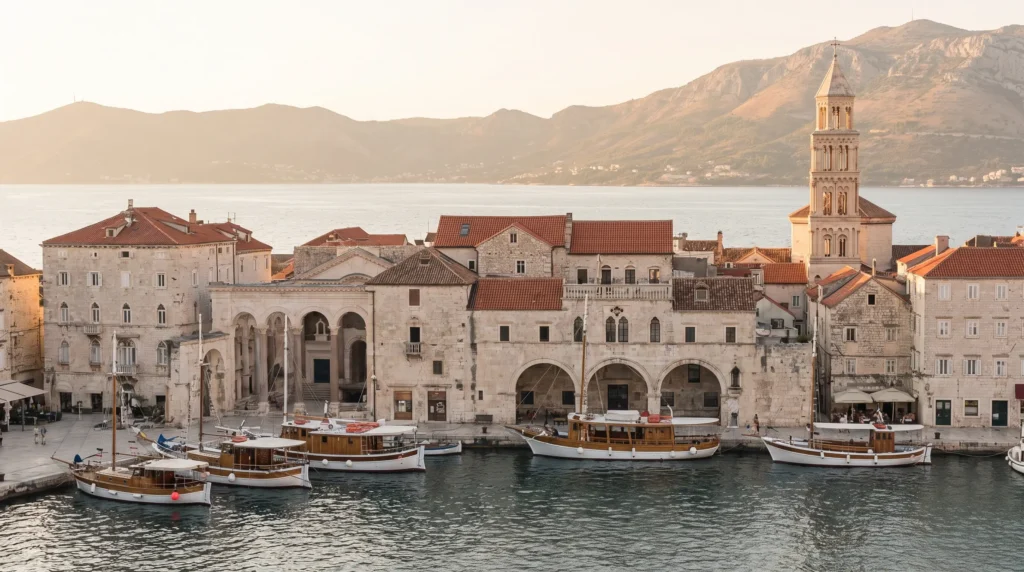
Split Travel Guide — Living Inside a Roman Emperor’s Palace on the Dalmatian Coast
The first time you walk into Diocletian’s Palace, your brain refuses to process it for a second: this is not a museum you are touring, it is a neighborhood you are standing in, with laundry strung between 1,700-year-old walls, a wine bar in what used to be an imperial cellar, and someone’s grandmother hanging out the window above a UNESCO World Heritage plaque. Split is Croatia’s second city after Zagreb and its busiest port on the Adriatic, but it has never quite settled into being a “sight” — people have lived inside this palace continuously since the Roman emperor retired here in 305 CE, and that lived-in messiness is exactly what makes it better than the postcard next door. I’ve used it as a base for a week of island-hopping and I’ve also just passed through for two days on the way to Hvar, and both trips worked — that flexibility, plus an airport that’s shockingly well connected for a city this size, is why Split has become the real gateway to Dalmatia, not just a stopover before Dubrovnik.
In This Guide
- Overview — Why Split Is More Than Dubrovnik’s Warm-Up Act
- Ultra Europe & Split’s Summer Festival Calendar
- Best Time to Visit Split (Season by Season)
- Getting There — SPU Airport, Ferries & the Coastal Highway
- Getting Around — Walking, Buses & Ferries
- Neighborhoods — Old Town to Marjan
- Culture & People — Fjaka, Klapa & Football
- A Food Lover’s Guide to Split
- Off the Beaten Path
- Day Trips — Krka, Hvar, Vis & Trogir
- Practical Information
- Budget Breakdown — What Split Actually Costs in 2026
- Frequently Asked Questions
Overview — Why Split Is More Than Dubrovnik’s Warm-Up Act
Most people book Split as a layover on the way to somewhere else — Hvar, Dubrovnik, a sailing charter through the islands. That’s a mistake, or at least it undersells the place. Split is Croatia’s second-largest city, seaport, and unofficial capital of Dalmatia, built on a peninsula around a natural harbor that has made it a shipping hub since Roman times. The city proper counts around 161,000 residents, with roughly 307,000 in the wider metro area — a real, working Croatian city, not a resort town dressed up for tourists.
The headline attraction is the Historical Complex of Split with the Palace of Diocletian, a UNESCO World Heritage Site since 1979. Roman Emperor Diocletian built it as his retirement palace between roughly 295 and 305 CE, and unlike almost every other Roman monument of comparable scale, it was never abandoned — locals moved into the walls as the empire crumbled, and they never really left. Today the emperor’s mausoleum is Split’s cathedral, Roman basement halls are wine bars and boutiques, and the whole 30,000-square-metre complex functions as the actual downtown, not a roped-off ruin.
What Split doesn’t have is Dubrovnik’s single postcard silhouette or its cruise-ship crush at the same scale — though it has plenty of cruise traffic of its own. What it does have is a genuine city rhythm: a seafront promenade (the Riva) where locals still do their evening walk, a working port sending ferries to a dozen islands, and prices that, since the 2023 euro switch, sit noticeably below Dubrovnik’s for comparable rooms and meals. It is, honestly, the better base for anyone who wants Dalmatia’s beaches and islands without paying Dubrovnik’s premium for the privilege.
Ultra Europe & Split’s Summer Festival Calendar
If you’re reading this in July, know what you’re walking into: Ultra Europe, one of Europe’s largest electronic music festivals, takes over Park Mladeži for three nights, with 2026’s edition running July 10–12 and attendance projected past 150,000. It’s a genuinely fun time to be in town if that’s your scene — the whole city gets a buzz, and “Destination Ultra” events spill onto Brač and Vis for the week around it — but book accommodation months ahead and expect Old Town bars and the airport to be slammed. If loud crowds and 5am closing times aren’t your idea of a good Split trip, avoid mid-July entirely.
Immediately after, the mood flips completely: the Split Summer Festival (Splitsko ljeto) runs mid-July through mid-August, staging opera, ballet and classical concerts across more than a dozen open-air venues, including the Peristyle — the Roman palace’s original ceremonial courtyard — which has hosted the festival every summer since 1954. Earlier in the year, the city marks Sudamja, the feast of patron saint St. Domnius, around 7 May, with over a week of processions, boat races, fairs and street music along the Riva — a good, low-key window to see local pride on full display without festival-week prices.
Best Time to Visit Split (Season by Season)
Late May – June · The sweet spot
Sea’s warm enough to swim, days are long, crowds are a fraction of August, and hotel rates haven’t peaked yet. This is the window most repeat visitors quietly prefer over high summer.
July – August · Peak heat, peak crowds
Split gets genuinely hot and genuinely busy — cruise ship days can pack the Palace walkways shoulder to shoulder by midmorning. It’s also the only time for Ultra Europe and the Summer Festival, and the ferries to the islands run their fullest schedules. Book everything — flights, rooms, ferry tickets — well in advance.
September – October · The other sweet spot
Sea stays warm into September, crowds thin fast after the first week, and light turns golden for photos. Many locals rate this the best month of the year to visit.
November – April · Quiet season
Mild, wet winters rather than harsh ones — Split logs over 2,600 hours of sunshine a year, so even the off-season isn’t gray. Many island ferries and seasonal restaurants scale back, but the Palace, museums and city itself are fully open and pleasantly empty.
Getting There — SPU Airport, Ferries & the Coastal Highway
Split Airport (SPU), also called Resnik Airport, sits about 19 kilometres west of the city near Kaštela, with direct flights from dozens of European cities plus seasonal long-haul connections; it handled just under 3.9 million passengers in 2025, making it Croatia’s second-busiest airport after Zagreb. A shuttle bus timed to flights runs to the main bus station in about 40 minutes; taxis and rideshares take roughly 25–30 minutes depending on traffic.
Split is also one of the busiest passenger ports on the Mediterranean, with car ferries and fast catamarans fanning out to Hvar, Brač, Vis, Korčula and beyond, plus international routes to Italy (Ancona) in season. Overland, the A1 motorway connects Split to Zagreb (roughly 4–5 hours by car or bus) and continues south toward Dubrovnik (about 3–4 hours), while the rail line to Zagreb is scenic but considerably slower than the bus.
Getting Around — Walking, Buses & Ferries
The Old Town and Riva are entirely walkable and largely car-free by design — the palace’s narrow stone lanes weren’t built for traffic, and that’s the point. For anywhere beyond walking range, Split’s local bus network (Promet Split) is cheap and covers the whole metro area, including Marjan’s edges and the beaches at Žnjan and Bačvice.
Rental cars make sense mainly for day trips inland (Krka, the Cetina river canyon) since island-hopping runs on ferries and catamarans, not roads. Taxis and rideshare apps operate normally, though the UK and US advisories both flag occasional overcharging scams targeting tourists at nightlife venues — agree fares or use a metered/app-based ride rather than hailing casually late at night.
Neighborhoods — Old Town to Marjan
Diocletian’s Palace (Grad / Old Town)
The UNESCO-listed core and the reason you came: the Peristyle, the Cathedral of St. Domnius (once the emperor’s mausoleum), the substructure halls beneath (of Game of Thrones fame), and the Golden, Silver, Iron and Bronze gates. Come at dawn or after the day-trip buses clear out — it’s a different, quieter place.
Riva Promenade
The palm-lined waterfront just outside the palace’s southern wall — cafés, evening strolling crowds, and the first and last thing most visitors see of Split. Overpriced for coffee, essential for the ritual anyway.
Veli Varoš
The old fishermen’s quarter climbing the slope toward Marjan hill — steep stone stairways, laundry lines, small family-run konobas with none of the Old Town markup.
Marjan
Split’s green lung: a forested peninsula-hill with pine trails, cliffside chapels, hidden coves for swimming, and a viewpoint (Telegrin) that puts the whole Palace and harbor below you. Free, uncrowded, and a five-minute walk from downtown.
Bačvice
The city’s signature sandy beach, a rarity on this rocky coast, and home to picigin — a local water sport where players keep a small ball from touching the water. Lively bars and clubs cluster right behind it.
Meje & Sustipan
A quieter, upscale residential pocket toward the port, with the Ivan Meštrović Gallery (the sculptor’s former villa) and Sustipan park’s sunset views over the harbor.
Poljud & Spinut
More residential, less touristed — home to Hajduk Split’s Poljud Stadium, a good gauge of how seriously this city takes football, and workaday neighborhoods worth a wander if you want Split without a single souvenir shop in sight.
Culture & People — Fjaka, Klapa & Football
Dalmatians have a word, fjaka, for the specific, unhurried torpor of a hot afternoon when nothing should be rushed — and it’s a genuinely useful concept for understanding the local pace, especially outside peak tourist hours. Traditional klapa singing — close-harmony, unaccompanied male (and increasingly mixed) vocal groups — remains a living tradition here, not a museum piece; you’ll hear it in the Palace’s stone corridors, where the acoustics turn a cappella singing into something close to church music.
Football matters enormously: HNK Hajduk Split, founded by students in Prague in 1911, commands a fan devotion (the “Torcida” ultras, among Europe’s oldest organized supporter groups) that rivals anything in southern Europe — a match at Poljud Stadium is as much a cultural experience as a sporting one. Split is also proudly Dalmatian first, Croatian second, in the way locals will tell you: the regional identity, cuisine and even accent set it apart from Zagreb’s continental character.
A Food Lover’s Guide to Split
Dalmatian cooking runs on olive oil, garlic, fresh fish and slow time, and Split is the best place on the coast to eat it properly. Crni rižot (black cuttlefish-ink risotto) and brudet (a mixed-fish stew over polenta) anchor most menus; pašticada — beef slow-braised in wine, prunes and spices, served over gnocchi — is the celebration dish, traditionally reserved for weddings.
Peka — meat or octopus and vegetables slow-roasted under a metal dome buried in embers — needs ordering hours ahead at most konobas, and it’s worth the wait. For something quick and cheap, grab soparnik, a savory chard-and-onion pie sold by the slice, or a burek from a street window before a ferry. Pair anything with a Dalmatian white (Pošip, Grk) or the local rakija — travarica, herb-infused, is the digestif of choice. The Pazar green market just outside the Silver Gate and the fish market (Ribarnica) near the Iron Gate are where locals actually shop, and both make for a good wander even if you’re not cooking.
Off the Beaten Path
Marjan’s hidden coves
Past the tourist viewpoints, trails drop to small pebble coves (Kašjuni, Ježinac) where locals swim without a single tour group in sight — bring your own shade, there are no facilities.
Diocletian’s substructures at closing time
The underground halls beneath the palace are packed by day; the last hour before closing thins them out dramatically for a genuinely eerie, empty-Rome experience.
Klis Fortress
A dramatic hilltop fortress about 15 minutes outside the city, predating the Palace itself and offering some of the best panoramic views over Split and the islands — heavily used as a filming location, and still relatively light on visitors compared to downtown.
Poljud match day
Catching Hajduk Split play at Poljud, if the fixture list cooperates, gets you a slice of Split that has nothing to do with Roman ruins and everything to do with how the city actually spends its Saturdays.
Day Trips — Krka, Hvar, Vis & Trogir
Krka National Park, about 90 km and roughly 1.5 hours north of Split, is Croatia’s answer to Plitvice — travertine waterfalls, turquoise pools, and (unlike Plitvice) swimming allowed at designated points near Skradinski Buk. Go early or via organized tour to beat both the heat and the tour-bus crush.
Hvar is around 1–1.5 hours away by ferry, mixing lavender fields and a hilltop fortress with the loudest beach-club scene in Croatia — brilliant for a day of both, but know which Hvar (the harbor party town or the quieter villages) you’re actually heading for.
Vis and the Blue Cave make for a longer day — a direct ferry to Vis runs about 3 hours, so most visitors join an organized speedboat tour instead, which typically bundles the Blue Cave on Biševo island, Stiniva Bay, and a Hvar stop into one long day. Vis itself, having been a closed military zone until the 1990s, remains the least developed of the major islands — worth a proper overnight if you have the time rather than a rushed day trip.
Trogir, a compact medieval town and UNESCO World Heritage Site in its own right, sits about 30 minutes from Split near the airport — an easy half-day add-on, especially if you’re already heading that direction for a flight.
Practical Information
Money. Croatia adopted the euro on 1 January 2023 at a fixed rate of €1 = 7.5345 kuna; kuna coins stopped being exchangeable at the central bank at the end of 2025, though banknotes remain exchangeable indefinitely — you shouldn’t encounter kuna in daily use at all now. Cards are widely accepted; carry some cash for small konobas and market stalls.
Safety. The US State Department rates Croatia Level 1 — Exercise Normal Precautions — as of its most recent 2026 update. UK guidance flags the same real, if narrow, risks: pickpocketing in crowded tourist areas, and “gentlemen’s clubs” that have overcharged and threatened tourists — simply avoid them.
Health. Routine vaccinations should be current, and the CDC recommends Hepatitis A protection for most travelers to Croatia; consider a tick-borne encephalitis vaccine if you’ll be hiking or camping inland. Tap water is safe to drink throughout Split.
Connectivity & visa. An EU-roaming plan or eSIM covers Split easily; Croatia is a full Schengen member since 2023, so US/UK/Canadian/EU passport holders enter visa-free for up to 90 days in any 180-day period. Plugs: Type C/F, 230V. Time zone: Central European Time (UTC+1), with daylight saving in summer.
Budget Breakdown — What Split Actually Costs in 2026
Split runs cheaper than Dubrovnik and Hvar’s peak-season prices, but the euro switch nudged everything visibly upward from kuna-era levels — budget accordingly.
Budget (€45–85/day): Hostel bed or budget guesthouse outside the Old Town, konoba lunch specials, city buses, self-guided Palace wandering, a Marjan hike instead of a paid tour.
Mid-range (€120–220/day): Boutique hotel near the Riva, sit-down seafood dinners, one island ferry day trip, a guided Krka or Blue Cave tour (roughly €60–100 with transport).
Luxury (€400+/day): Palace-adjacent heritage hotel, private boat charter to the islands, chef’s-table pašticada dinners, front-row Split Summer Festival tickets at the Peristyle.
Expect a modest tourist tax added to accommodation, and 10% is a generous, appreciated tip rather than an obligatory one.
Planning Your First Trip to Split
Two full days covers the Palace, Marjan and a Riva evening comfortably; four to five nights lets you add Krka and an island day trip without rushing. The classic pairing is Split as your Dalmatian base — fly into SPU, spend two or three nights in the city, then ferry out to Hvar or Vis for a few island nights before flying home. If you’re continuing the coast, our Dubrovnik guide covers the walled-city finale to the south, our full Croatia country guide is the place to plan the wider trip, and Kotor just across the Montenegrin border makes a natural extension for anyone with an extra week.
Frequently Asked Questions
Is Split safe for tourists in 2026?
Yes — the US State Department rates Croatia Level 1, its lowest advisory tier, and violent crime against tourists is rare. The main real risks are pickpocketing in crowded spots and overcharging scams at certain nightlife venues, both easily avoided with normal caution.
Do I need a visa to visit Split?
US, UK, EU and Canadian passport holders enter visa-free, since Croatia is a full Schengen member — up to 90 days within any 180-day period. Your accommodation is required to register your stay with police, which hotels and most listed apartments handle automatically.
Is Split expensive now that Croatia uses the euro?
It’s pricier than the kuna era but still generally cheaper than Dubrovnik or Hvar in peak season — expect Western/Southern European mid-tier pricing rather than bargain Balkan rates.
How many days do I need in Split?
Two full days covers the Palace and Marjan properly; add extra nights only if you’re using Split as your island-hopping base rather than a standalone stop.
Split or Dubrovnik?
Split for a real working city, cheaper prices and easier island access; Dubrovnik for the single most photogenic walled Old Town on the Adriatic and a heavier cruise-crowd, higher-price experience. Many trips do both back to back.
What’s the best way to island-hop from Split?
Base yourself in Split, buy ferry tickets a day or two ahead in summer, and treat Hvar and Vis (or an organized Blue Cave tour) as day or overnight trips rather than trying to pack a full multi-island itinerary into one short visit.
Ready to Explore Split?
A Roman emperor’s retirement palace that turned into a living neighborhood, a green pine-covered hill five minutes from the cathedral, and a harbor sending ferries to some of the best islands in the Adriatic — Split does a lot with a compact footprint. Go for the ruins, stay for the fact that nobody roped them off.
Explore More
- Croatia Travel Guide — plan the full Dalmatian coast and beyond
- Dubrovnik City Guide — the walled-city finale south of Split
- Kotor City Guide — an easy extension into Montenegro’s bay
- Venice City Guide — Split’s centuries-long Adriatic rival across the water
How this guide was built
Published as part of Facts From Upstairs’ city guide series. Built from authoritative sources — UNESCO’s Historical Complex of Split with the Palace of Diocletian inscription, Wikipedia entity pages for Split and Split Airport, Britannica’s Split entry, the European Central Bank’s Croatia euro-changeover page, the EU Council’s Schengen enlargement announcement, the US State Department and UK FCDO Croatia advisory pages, the US CDC traveler page for Croatia, Ultra Europe’s official festival site, and the official Split Tourist Board (visitsplit.com) event pages. Numeric claims carry inline citations.
Sources cited on this page
- Wikipedia — Split, Croatia
- Britannica — Split
- UNESCO — Historical Complex of Split with the Palace of Diocletian
- Wikipedia — Split Airport
- European Central Bank — Croatia euro changeover
- Council of the EU — Croatia joins Schengen
- US State Department — Croatia Travel Advisory
- UK FCDO — Croatia entry requirements
- UK FCDO — Croatia safety and security
- US CDC — Croatia traveler page
- Ultra Europe — official site
- Split Tourist Board — Sudamja 2026
- Split Tourist Board — Split Summer Festival
More city guides you might like
Plan your trip to Split
The booking tools we use ourselves. FFU may earn a commission at no extra cost to you.
Plan & book your trip to Split
Booking through these searches supports our guides at no extra cost to you.