
Malacca Travel Guide — Malaysia’s 500-Year Port City of Sultans, Spice Traders & Nyonya Kitchens
I went to Malacca expecting a half-day detour from Kuala Lumpur and stayed three nights, which is the most common mistake people make about this place. Founded in 1396 by a fugitive Sumatran prince named Parameswara, Malacca spent the next five centuries getting fought over by Malay sultans, Portuguese conquistadors, Dutch merchants and British colonists — and somehow kept receipts from every single one of them. You can stand inside a 1512 Portuguese fortress gate, walk out onto a Dutch town square, eat lunch in a Peranakan shophouse whose great-grandparents were doing the exact same trade in 1750, and be back at your hotel before the afternoon downpour. UNESCO jointly inscribed Malacca and George Town as World Heritage Sites in 2008 specifically because nowhere else in East or Southeast Asia layers this much colonial and trading history onto streets you can still walk. It’s humid, the traffic near Jonker Street on a Saturday night is genuinely bad, and the river is more picturesque in photos than in person — but the food alone justifies the trip, and the history is not exaggerated marketing copy. It’s just true.
In This Guide
- Overview — Why Malacca Is Malaysia’s Most Layered City
- Fiesta San Pedro — the Kristang Fishing Festival
- Best Time to Visit Malacca
- Getting There — KLIA, Buses & the Coastal Highway
- Getting Around — Trishaws, Grab & Walking the Core
- Neighborhoods — Jonker, Dutch Square, the Portuguese Settlement & More
- Culture & People — Peranakan, Portuguese-Eurasian & Malay Malacca
- A Food Lover’s Guide to Malacca
- Off the Beaten Path
- Day Trips From Malacca
- Practical Information
- Budget Breakdown — What Malacca Actually Costs in 2026
- Frequently Asked Questions
Overview — Why Malacca Is Malaysia’s Most Layered City
Malacca (Melaka in Malay) sits on the Strait of Malacca, the sea lane that has moved a huge share of the world’s shipping traffic for over 500 years, and the city’s entire identity was built on controlling that chokepoint. Parameswara founded it in 1396; by 1400 it was a sultanate; by 1511 the Portuguese had taken it by force; the Dutch held it from 1641 to 1795 (with a brief later return); and the British administered it from 1826 until independence, save for the Japanese occupation of 1942–45. City status was only formally granted in 2003, which sounds odd for somewhere this old — but Malacca spent most of its modern life as a sleepy administrative town, overshadowed by Singapore and Penang, until heritage tourism rediscovered it.
That rediscovery peaked in 2008, when UNESCO jointly inscribed Malacca with George Town, Penang, as “Historic Cities of the Straits of Malacca,” citing 500 years of trade and cultural exchange between Malay, Chinese, Indian and European communities and a built environment with no real parallel elsewhere in the region. The core historic zone is compact — you can walk from the ruins of a 1512 Portuguese fort to a working 1645 Dutch church to a still-functioning 17th-century Chinese temple in under twenty minutes.
What Malacca isn’t is a beach destination or a nightlife town. The river is brown, not turquoise; the coastline nearby is muddy estuary, not white sand. The pitch here is entirely about density of history and food packed into walkable streets, plus easy striking distance from Kuala Lumpur for a long weekend. It rewards slow walking and getting mildly lost more than it rewards a checklist.
Fiesta San Pedro — Malacca’s Kristang Fishing Festival
If you can time a trip around one date, make it 29 June, the Feast of St. Peter, celebrated for a full week beforehand in the Portuguese Settlement (Medan Portugis), about two kilometres south of the historic core. The community here — the Kristang, descendants of Portuguese settlers and local Malays going back to the 16th century — open the festival with a high mass at the Church of Our Lady of the Immaculate Conception, then carry a statue of St. Peter in procession through the settlement down to the shoreline, where the priest blesses the fishing boats. The boats themselves are decked out in flags, lights and religious icons for the occasion — genuinely one of the more striking small-scale festivals in Malaysia, and one almost no first-time visitor plans around.
Outside festival week, the Portuguese Settlement is still worth an evening for its open-air seafood square, where grilled stingray and Kristang-style debal curry are the draw and the crowd is a mix of locals and the handful of travelers who made the detour.
Best Time to Visit Malacca
February – April · Driest stretch
Malacca sits close to the equator and stays hot and humid year-round — daytime highs typically run 31–33°C regardless of season. Early in the year brings the least rainfall, making it the most comfortable window for walking the historic core all day.
May – August · Warm, occasional showers, festival season
Short afternoon storms are common but rarely all-day washouts. This window also covers Fiesta San Pedro (late June) and school-holiday crowds from elsewhere in Malaysia and Singapore, so weekends at Jonker Street get genuinely packed — go on a weekday if you can.
September – November · Heaviest rain
The wettest months of the year, with the highest rainfall totals; flash flooding on low-lying streets near the river is not unusual and can disrupt the night market. Rooms are cheaper and the historic core is far less crowded — a fair trade if you don’t mind carrying an umbrella.
December – January
Still warm, moderate rain, and Chinese New Year (dates shift year to year) turns the Peranakan quarter into its most colorful version of itself, with lion dances through Jonker Street and shophouses hung with lanterns.
Getting There — KLIA, Buses & the Coastal Highway
Malacca has its own small airport (Malacca International Airport, MKZ) but it carries minimal scheduled service — almost everyone arrives overland from Kuala Lumpur International Airport (KLIA/klia2), about 149 kilometres north. Direct airport buses (Transnasional and similar operators) run from KLIA and klia2 straight to Melaka Sentral, the city’s bus terminal, in around 2–3 hours for roughly RM18–25.
From central Kuala Lumpur (Terminal Bersepadu Selatan, TBS) it’s faster and cheaper: frequent buses take about 1 hour 45 minutes and cost only a few dollars, making Malacca an easy long-weekend or even day trip from the capital. Melaka Sentral sits a 15–20 minute taxi or Grab ride from the historic core — there’s no direct rail line into the old town, so budget that last leg into your arrival plan. Drivers coming from KL take the North-South Expressway; the drive is straightforward and well signed the whole way.
Getting Around — Trishaws, Grab & Walking the Core
The historic core — Dutch Square, St. Paul’s Hill, Jonker Street, the Malacca River waterfront — is genuinely walkable, and walking is how you actually experience it; most of the interesting stuff is in shopfronts and alleys a car would sail straight past. Expect heat and humidity, though, so pace yourself and duck into air-conditioned museums at midday.
For longer hops — to the Portuguese Settlement, Bukit China, or out to Ayer Keroh — Grab (Malaysia’s ride-hailing app) is cheap, reliable and the default choice for most visitors over metered taxis. Malacca’s famously kitsch, LED-lit, flower-and-cartoon-decorated trishaws are a genuine local institution rather than a pure tourist gimmick, though a short ride is priced for tourists; agree the fare before boarding. There’s no metro or tram system — this is a bus-and-ride-hail city, small enough that you rarely need either for more than a few trips a day.
Neighborhoods — Jonker, Dutch Square, the Portuguese Settlement & More
Jonker Street & Chinatown
The spine of Peranakan Malacca, lined with antique shops, kopitiams and clan houses along what was once a residential street for well-off Dutch-era and later Chinese families. Every Friday, Saturday and Sunday night it closes to traffic for the Jonker Street Night Market — hundreds of food and craft stalls, live buskers, and a crowd that can get shoulder-to-shoulder by 8pm.
Dutch Square & St. Paul’s Hill
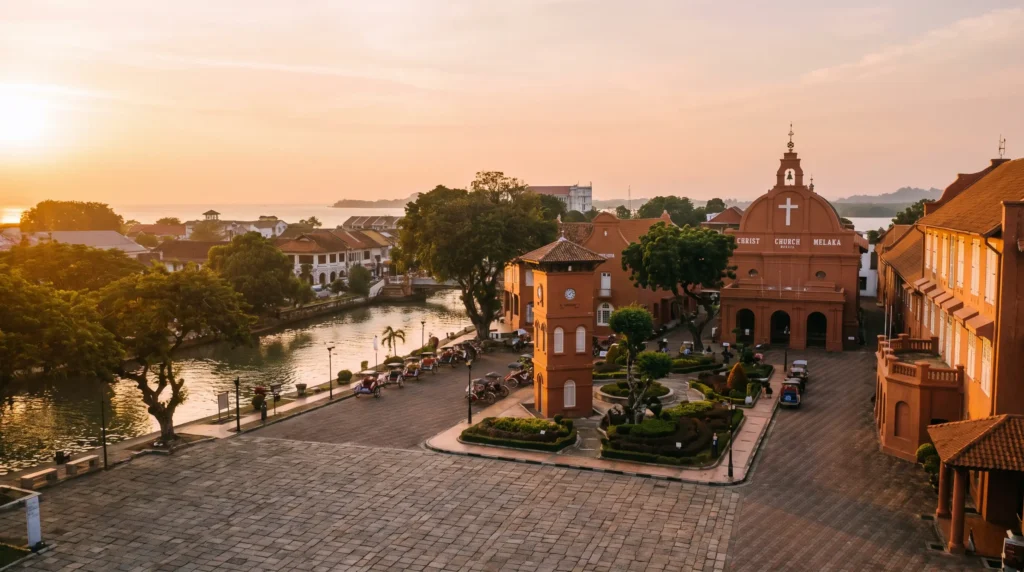
The postcard center of the city: the blood-red Stadthuys and Christ Church anchor Dutch Square, and a short climb up St. Paul’s Hill leads to the ruined 16th-century St. Paul’s Church and sweeping harbor views. At the hill’s foot sits the Porta de Santiago — the last standing gate of A Famosa, the Portuguese fortress built around 1512, mostly demolished by the British in the early 1800s and now one of the oldest surviving pieces of European architecture in Asia.
Portuguese Settlement (Medan Portugis)
Home to the Kristang community and their open-air seafood square, this is the neighborhood built around the Fiesta San Pedro tradition covered above — worth an evening visit any time of year, not just festival week.
Kampung Morten
A century-old Malay village on stilts, incongruously wedged along the river a few minutes’ walk from the modern city center — traditional wooden houses, some open for small-fee visits, and a strong contrast to the shophouse architecture just across the water.
Bukit China
Reputedly one of the largest Chinese cemeteries outside China, a hillside of graves dating back centuries, quiet and green and a useful break from the heat and crowds of the core streets.
Klebang & the Straits Mosque
A beachside strip northwest of downtown, known locally for roadside coconut-shake stalls and for Masjid Selat Melaka, the “floating mosque,” built on stilts over the strait so that at high tide it appears to sit directly on the water.
Ayer Keroh
The green, spread-out edge of the city — zoo, botanical garden, and the theme-park cluster — best treated as a half-day, Grab-accessible outing rather than somewhere to base yourself.
Culture & People — Peranakan, Portuguese-Eurasian & Malay Malacca
Malacca’s defining cultural fact is the Peranakan (Baba Nyonya) community — descendants of Chinese traders who settled and intermarried locally centuries ago, producing a hybrid culture that speaks a Malay-based creole rather than a Chinese dialect, cooks a distinctive fusion cuisine, and built the ornate shophouses lining Jonker Street and Heeren Street. Alongside them sit the Kristang of the Portuguese Settlement — Catholic, Portuguese-Eurasian, and still speaking a Portuguese-derived patois at home — plus a Malay Muslim majority and long-established Indian and Chinese communities practicing their own traditions side by side. Cheng Hoon Teng, one of Malaysia’s oldest functioning Chinese temples, the Kampung Kling Mosque, and the Sri Poyatha Moorthi Temple sit within a few streets of each other in a stretch locals call “Harmony Street” — a genuinely accurate name rather than tourist-board spin.
Chinese New Year and the Fiesta San Pedro are the two biggest cultural flashpoints on the calendar, but everyday Malacca is Malaysia’s multicultural pitch made concrete: a mosque call to prayer, temple incense and church bells within earshot of each other most mornings.
A Food Lover’s Guide to Malacca
Malacca is arguably Malaysia’s best food city, and Peranakan (Nyonya) cuisine is the reason. Look for chicken kapitan (a dry, coconut-milk curry), inchi kabin (Nyonya-style fried chicken) and pongteh (chicken or pork braised with fermented soybean paste and onions) — dishes that fuse Chinese technique with Malay spice in a way you genuinely can’t get elsewhere. Chicken rice balls — hand-rolled rice into golf-ball-sized portions, served with poached chicken — are a Malacca-specific spin on a dish found across the region, said to have originated here during the Japanese occupation when rice had to be rationed and portioned by hand.
Nyonya laksa (a coconut-curry noodle soup, distinct from the sourer asam laksa found further north) and cendol (shaved ice, coconut milk, palm sugar and green rice-flour jellies) are the two dishes every visitor ends up chasing down more than once — Jonker Street has several long-running cendol stalls worth the queue. For a sit-down meal, the old Peranakan shophouse restaurants along Jonker and Heeren Street serve full Nyonya tasting menus in genuinely historic dining rooms. Round it out with a Kristang seafood dinner in the Portuguese Settlement, or a plate of otak-otak (spiced fish paste grilled in banana leaf) from a street stall — cheap, everywhere, and one of the better breakfast-adjacent snacks in the country.
Off the Beaten Path
Kampung Morten at dawn
Most visitors see the stilt houses from the river-cruise boat at night; walking through in early morning, before the heat and the crowds, is a quieter and more respectful way to see a community that still actually lives there.
Baba Nyonya Heritage Museum, on a weekday
A preserved 19th-century Peranakan townhouse-turned-museum on Heeren Street, worth timing for a weekday morning to actually hear the guided tour over the crowd noise that builds by afternoon.
The back streets behind Jonker
Jonker Street itself is well-trodden; the parallel and cross streets one block over hold the same shophouse architecture, working clan associations and small kopitiams with none of the night-market crush.
Bukit China at sunset
Skipped by almost every tour itinerary, but a genuinely peaceful hillside walk with harbor views and centuries of gravestones as company.
Day Trips From Malacca
Kuala Lumpur
Malaysia’s capital is under two hours away by bus, making it a genuinely viable day trip in either direction — Petronas Towers, Batu Caves and KL’s own hawker-food scene versus a full day back in the historic core.
Port Dickson
The nearest proper beach town, roughly an hour up the coast in neighboring Negeri Sembilan — calmer and less dramatic than Malaysia’s east-coast islands, but an easy sand-and-sea break from a city with no real beach of its own.
Alor Gajah & the durian orchards
Inland from the city, this stretch of Malacca state is durian-growing country; several orchard operators run seasonal tasting visits (roughly June–August and November–January, Malaysia’s two durian seasons) that pair well with a countryside drive away from the tourist core.
Practical Information
Money. The Malaysian Ringgit (MYR/RM) has floated freely since Malaysia ended its US-dollar peg in July 2005, and currently trades in the high-3s to low-4s per US dollar — check a live rate before you go rather than assuming a fixed number. Cards are widely accepted in malls and mid-range restaurants; carry cash for hawker stalls, the night market and trishaws.
Visa & entry. US, UK, EU, Canadian and Australian passport holders get 90 days visa-free, but everyone must file a free Malaysia Digital Arrival Card (MDAC) online within three days before arrival — do this yourself at the official immigration portal, since fraudulent look-alike sites exist.
Safety. The US State Department rates Malaysia Level 1, “Exercise Normal Precautions,” with the one notable carveout being remote eastern Sabah islands, hundreds of kilometres away and irrelevant to a Malacca trip; Malaysia’s genuinely elevated risk is road traffic accidents, so take care as a pedestrian and be cautious in any rented vehicle.
Health. The CDC recommends being current on routine vaccines plus Hepatitis A and Typhoid for most travelers; malaria risk is essentially confined to rural forested areas rather than the city itself, and dengue prevention (repellent, covering up at dawn/dusk) matters more day to day in Malacca.
Connectivity & logistics. An eSIM or local prepaid SIM gives cheap, solid data coverage across the city. Plugs: UK-style three-pin (Type G), 240V. Time zone: UTC+8, no daylight saving.
Budget Breakdown — What Malacca Actually Costs in 2026
Malacca is one of Malaysia’s better travel values — cheaper than Kuala Lumpur for lodging, and hawker food remains genuinely inexpensive.
Budget (US$35–60/day): Guesthouse or hostel dorm near Jonker Street, hawker-stall meals (chicken rice balls, laksa, cendol), buses and walking, free museums and temples.
Mid-range (US$80–150/day): A heritage-shophouse boutique hotel, sit-down Nyonya restaurant dinners, a river cruise, Grab rides between neighborhoods, entry fees to paid museums.
Luxury (US$250+/day): Restored colonial-era boutique hotels with courtyard pools, private guided heritage-walk tours, chauffeured day trips to Port Dickson or the durian orchards.
Fixed costs to expect: small entry fees at most museums (a few ringgit each), and the usual tipping-not-required norm of Malaysia — round up rather than calculate a percentage.
Planning Your First Trip to Malacca
The classic itinerary is two full days: day one for the historic core on foot — St. Paul’s Hill, the Porta de Santiago, Dutch Square, Jonker Street by evening (ideally a Friday, Saturday or Sunday for the night market) — and day two for Kampung Morten, the Portuguese Settlement and a slower Nyonya-food crawl. Three or four nights lets you add a Port Dickson beach day or the KL day trip without rushing. Most visitors either open or close their Malaysia trip here, pairing Malacca with a few days in Kuala Lumpur or reading our full Malaysia country guide for the wider picture — Penang and Langkawi both extend naturally from here if you have the time.
Frequently Asked Questions
Is Malacca safe for tourists in 2026?
Yes — the US State Department rates all of Malaysia (Malacca included) at its lowest advisory level, “Exercise Normal Precautions.” The country’s real elevated risk is road traffic, not crime, so the main precaution is being careful as a pedestrian and cautious about scooter or car rentals.
Do I need a visa?
US, UK, EU, Canadian and Australian passport holders enter visa-free for up to 90 days, but everyone must submit a free Malaysia Digital Arrival Card (MDAC) online within three days of arrival — do it directly through the official immigration portal.
Is Malacca a day trip from Kuala Lumpur, or does it need an overnight?
It works as a long day trip — buses run under two hours each way — but you’ll only see the core sights. An overnight or two lets you catch the Jonker Street Night Market properly, eat a full Nyonya dinner without rushing, and see the Portuguese Settlement in the evening.
What’s the best neighborhood to stay in?
Around Jonker Street or Heeren Street puts you inside the historic core within walking distance of almost everything; it’s noisier on weekend nights but unbeatable for convenience.
Malacca or Penang (George Town)?
Both share the same 2008 UNESCO inscription and colonial-trading-port DNA, but Penang leans harder into street art and a bigger food scene, while Malacca is more compact and arguably has the denser concentration of visible history per city block. Many visitors do both on the same trip.
Is Jonker Street worth it if I’m not there on a market night?
Yes — the shophouses, antique dealers and clan houses are there daily; you just trade the stall crowds and street food for a quieter, more walkable version of the same street.
Ready to Explore Malacca?
A Portuguese fortress gate, a Dutch town square, a Peranakan shophouse dinner and a Malay stilt village, all within a twenty-minute walk of each other — Malacca packs five centuries of trade history into a city small enough to properly see in a long weekend. Go on a weekday if you can, eat everything Nyonya you can find, and give the river cruise a pass in favor of walking the back streets instead.
Explore More
- Malaysia Travel Guide — the full country picture, from Penang to Borneo
- Kuala Lumpur City Guide — the easy day-trip pairing, under two hours away
- Singapore Travel Guide — the region’s other great trading-port city
- Hoi An City Guide — Vietnam’s own UNESCO-listed historic trading town
How this guide was built
Published as part of Facts From Upstairs’ city guide series. Built from authoritative sources — UNESCO’s Historic Cities of the Straits of Malacca World Heritage listing, Tourism Malaysia’s official Fiesta San Pedro page, the US State Department’s Malaysia travel advisory, the US CDC’s Malaysia traveler page, and Wikipedia entity pages for Malacca City, Malacca state, the Malaysian Ringgit, Malaysia’s visa policy, the Peranakan community, A Famosa fortress and Malaysia itself. Numeric and checkable claims carry inline citations.
Sources cited on this page
- Wikipedia — Malacca City
- Wikipedia — Malacca (state)
- UNESCO — Melaka and George Town, Historic Cities of the Straits of Malacca
- Wikipedia — Historic Cities of the Straits of Malacca
- Wikipedia — Peranakan
- Wikipedia — A Famosa
- Wikipedia — Malaysia
- Wikipedia — Visa policy of Malaysia
- Wikipedia — Malaysian ringgit
- US State Department — Malaysia
- US CDC — Malaysia traveler page
- Tourism Malaysia — Fiesta San Pedro
More city guides you might like
Plan your trip to Malacca
The booking tools we use ourselves. FFU may earn a commission at no extra cost to you.
Plan & book your trip to Malacca
Booking through these searches supports our guides at no extra cost to you.