
Languages of Singapore
All languages of Southeast Asia →fluent beta classical · classes by phone with Maya at ranas.ai/maya
Singapore Travel Guide — Hawker Heritage, Skyline Gardens & Night-Race Spectacle
Singapore Travel Guide
📋 In This Guide
📍 Map of Singapore: Every Place in This Guide
- Overview — Why Singapore Belongs on Every Bucket List
- 🏁 Singapore Grand Prix 2026
- Best Time to Visit Singapore (Season by Season)
- Getting There — Flights & Arrival
- Getting Around
- Top Neighborhoods, Cities & Regions
- Singaporean Culture & Etiquette
- A Food Lover’s Guide to Singapore
- Off the Beaten Path
- Practical Information
- Budget Breakdown
- Planning Your First Trip to Singapore
- Frequently Asked Questions
Overview — Why Singapore Belongs on Every Bucket List
Singapore is the Southeast Asian city-state that does everything at intercontinental scale on an island smaller than New York City. It occupies 734.3 square kilometres at the southern tip of the Malay Peninsula, one degree north of the equator, and packs a UNESCO botanic garden, a 57-storey hotel with a rooftop infinity pool, 120 hawker centres, four official languages and the world’s only Formula 1 night street race into a territory you can cross end-to-end on the MRT in under an hour.
The country spans roughly 50 kilometres east-to-west and 27 kilometres north-to-south, yet it supports a resident population of 6.04 million across three main ethnic communities — Chinese, Malay and Indian — and a large expatriate workforce. English, Mandarin, Malay and Tamil share official status. Sixty-three outlying islands extend the territory, with Sentosa developed as the resort island and Pulau Ubin preserved as a rustic kampong relic of 1960s village life. Land reclamation has expanded the country’s area by more than 20% since independence in 1965, a programme that continues at the Tuas megaport and Changi’s eastern runway.
Two contrasts define Singapore. First, the country runs on engineered precision: Changi has ranked among the world’s top airports for more than a decade, the MRT network covers 241 kilometres with trains every 2–3 minutes at peak hour, and the tap water is safely potable nationwide. Second, the food culture remains gloriously informal. Hawker culture was inscribed on the UNESCO Representative List of the Intangible Cultural Heritage of Humanity in December 2020, and the open-air food centres remain the heart of daily Singaporean life.
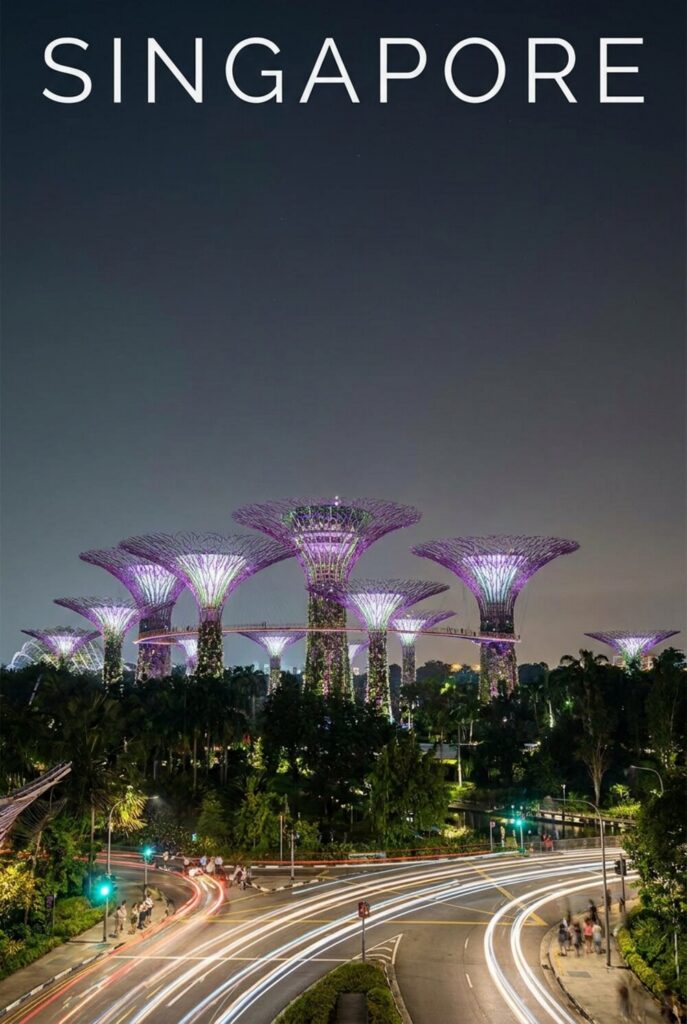
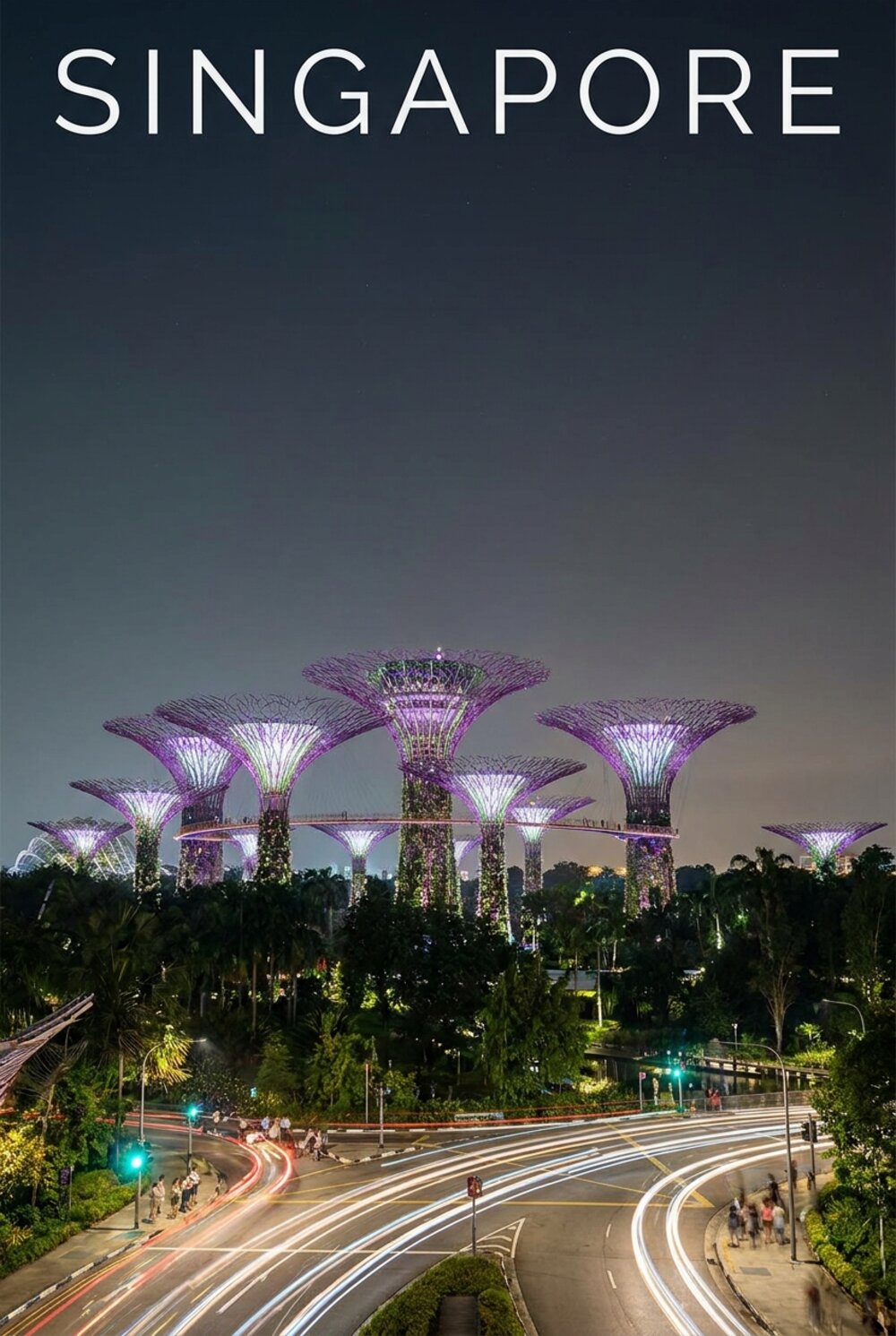
Singapore also punches above its weight on scale and ambition. Marina Bay Sands dominates the skyline with a 340-metre SkyPark spanning three hotel towers; Gardens by the Bay’s Supertrees rise 25 to 50 metres above the waterfront and put on a nightly light show at 7:45 and 8:45 p.m. The country hosted 16.5 million international visitors in 2024, a figure closing in on its pre-pandemic peak. A full hawker-centre dinner — chicken rice, char kway teow, sugar cane juice — still costs under S$10 (~$7 USD), a feature that helps Singapore feel paradoxically affordable the moment you step away from its cocktail bars and five-star hotels. Repeat visitors return less for the skyline and more for the daily grammar of the hawker-centre breakfast.
🏁 Singapore Grand Prix 2026 — You’re Right on Time
The Formula 1 Singapore Airlines Singapore Grand Prix is the only night street race on the F1 calendar and the country’s single biggest international event. The 2026 edition runs September 25–27 on the 5.063-kilometre Marina Bay Street Circuit, wrapping past the Esplanade, Fullerton Hotel, Anderson Bridge and the Padang with Marina Bay Sands dominating the backdrop. Three days of on-track action pair with three nights of post-race concerts at the Padang and Zone 4 stages, and hotel rates across Marina Bay and Orchard typically triple over the weekend.
- First practice: September 25, 2026 (Friday, 5:00 p.m. local)
- Peak window: September 25–27, 2026, with three-day and single-day passes available
- Race night: Sunday September 27, 2026 — lights out at 8:00 p.m. local time
- Padang Grandstand: premium main-straight viewing near Esplanade Bridge
- Zone 4 walkabout: general admission with Marina Bay Sands backdrop
- Bay Grandstand: Anderson Bridge and Fullerton Hotel section
Beyond the race, Singapore’s 2026 cultural calendar anchors Chinese New Year on February 17 (Chinatown lantern displays and the River Hongbao festival), Hari Raya Puasa around March 20 (Geylang Serai bazaar for the preceding six weeks), the Singapore Food Festival in August, and Christmas on Orchard Road from mid-November through early January — the 2.2-kilometre shopping strip lights up with themed installations renewed each year. The F1 weekend is the hardest ticket in Singapore’s tourism year, but these other festivals require no paid entry and deliver Singapore at full cultural volume.
Best Time to Visit Singapore (Season by Season)
Spring (Mar–May)
Singapore sits one degree north of the equator, so it has no true seasons — only monsoon rhythms. March and April are the inter-monsoon transition: sunny mornings, humid afternoons, and thunderstorms that roll in after 3:00 p.m. Temperatures run 24–33°C with humidity above 80%. Hari Raya Puasa falls on March 20 in 2026; Geylang Serai’s Ramadan bazaar runs for six weeks before it, and the Singapore International Festival of Arts usually anchors late May. This is also the hottest stretch of the year — April commonly posts the country’s highest annual temperatures.
Summer (Jun–Aug)
The southwest monsoon brings the driest overall window of the year: 24–32°C, shorter afternoon showers, and more outdoor hours. The Great Singapore Sale usually runs June to July with mall-wide discounts across Orchard Road. The Singapore Food Festival anchors August with hawker tours, chef collaborations, and the Ultimate Hawker Fest at Marina Bay. Occasional regional haze from Sumatran land-clearing fires can briefly degrade air quality; check the NEA’s 24-hour PSI index if you are planning an outdoor marathon or Sentosa beach day.
Autumn (Sep–Nov)
The inter-monsoon again: 23–31°C, heavy localised afternoon downpours, and the year’s busiest tourism stretch. The Singapore Grand Prix dominates the last weekend of September. Deepavali in October–November lights up Little India’s Serangoon Road with arches of coloured bulbs and month-long street markets. The Singapore Writers Festival runs early November at the Arts House. Hotel rates are at their highest in September and lowest in early November between festivals.
Winter (Dec–Feb)
The northeast monsoon is the wettest stretch: daily showers and occasional multi-day rains push through December and early January. Temperatures still run 23–31°C so rainfall rarely threatens outdoor sightseeing for more than a few hours. Christmas on Orchard Road fills the corridor with illuminations from mid-November through early January. Chinese New Year falls on February 17 in 2026 — Chinatown’s Mid-Autumn Street Light-Up happens each September, but Lunar New Year is the country’s biggest Chinese celebration, with the River Hongbao festival at Gardens by the Bay.
Shoulder-season tip: Late February to early April delivers the best blend of drier air, lower hotel rates and festival density — Chinese New Year tails into International Women’s Day and Hari Raya bazaars without the September F1 spike.
Getting There — Flights & Arrival
Nearly every international traveller arrives at Changi Airport, consistently ranked among the world’s top airports and connected by direct flights from more than 150 cities. Changi sits 17.2 kilometres east of the CBD and has its own MRT station under Terminal 2 connecting the East West Line to the city centre.
- Changi Airport (SIN) — MRT East West Line to City Hall in ~30 minutes for S$2.50 via SimplyGo
- Seletar Airport (XSP) — regional turboprop hub; ~20 min taxi to the central city
- Changi Terminal 4 / Jewel (SIN-T4) — free Skytrain to T2/T3 connecting to MRT
Flight times: 17–18 hours nonstop from LAX or SFO on Singapore Airlines; 13 hours nonstop from London Heathrow on Singapore Airlines or British Airways; 1 h 10 min from Kuala Lumpur, 2 h 20 min from Bangkok, and 3 h 45 min from Hong Kong on regional carriers.
Flag carriers: Singapore Airlines (the country’s full-service flag), Scoot (long-haul low-cost) and Jetstar Asia.
Visa / entry: Nationals of 158 countries, including the US, Canada, UK, Australia, New Zealand, Japan and all EU Schengen states, enter visa-free for 30 to 90 days depending on nationality. The free SG Arrival Card is mandatory and must be submitted within 3 days before arrival.
Getting Around — MRT, SimplyGo & the Art of Singaporean Transit
Singapore is one of the easiest cities in the world to navigate without a car. The Mass Rapid Transit (MRT) and Light Rail Transit (LRT) network covers 241 kilometres with nine colour-coded lines connecting the CBD, Changi, the heartland HDB estates and Sentosa’s gateway at HarbourFront. Taxis and Grab ride-hailing are plentiful, buses cover every postcode, and private cars are deliberately expensive under the Certificate of Entitlement system.
- Mass Rapid Transit (MRT + LRT): network length 241 km
- Changi Airport → City Hall (MRT East West Line): ~30 minutes
- Marina Bay → Sentosa (MRT + Sentosa Express monorail): ~20 minutes
- Orchard → Chinatown (MRT North South / Downtown): ~10 minutes
Rail / transit pass: the Singapore Tourist Pass costs S$17 for 1 day (includes S$10 refundable rental deposit) and S$29 for 3 days (~$13 / $22 USD) for unlimited MRT, LRT and basic bus rides. It pays off only if you make 6+ transit journeys per day. For shorter itineraries, contactless cards via SimplyGo are cheaper — fares cap at S$2 per ride and distance-based pricing applies automatically.
IC cards: EZ-Link (the traditional stored-value card), SimplyGo (tap any Visa, Mastercard, Apple Pay or Google Pay contactless card), and NETS FlashPay (accepted on MRT, at ERP tolls and convenience stores). One card covers the entire country’s transit plus some retail.
Apps: Citymapper handles transit routing; Google Maps covers walking and cycling; Grab is the dominant ride-hailing app with fixed upfront pricing.
Top Neighborhoods, Cities & Regions
Singapore is a city-state, so this section covers the six neighbourhoods and districts most first-time visitors anchor around instead of distinct regional cities. Each is a 10-minute MRT hop from the next, and any five-day itinerary comfortably fits all of them.
🏙️ Marina Bay & CBD
Singapore’s showpiece waterfront and the backdrop for almost every national-day photograph. Marina Bay Sands’ three-tower SkyPark defines the skyline; Gardens by the Bay’s Supertrees and Cloud Forest conservatory sit along the eastern shore; and the Merlion still spouts water from the western promenade. The Formula 1 street circuit weaves through this district every September.
- Gardens by the Bay — Supertree Grove, Cloud Forest and Flower Dome conservatories
- Marina Bay Sands SkyPark observation deck on level 57
- Merlion Park and the Esplanade — Theatres on the Bay concert halls
Signature meals: Lau Pa Sat’s evening satay street (stalls 7 & 8), Michelin-starred chilli crab at Red House on Boat Quay.
🛍️ Orchard Road
Southeast Asia’s most famous shopping corridor — a 2.2-kilometre strip of department stores, luxury malls and hotel arcades running east from Tanglin to Dhoby Ghaut MRT. Christmas on Orchard Road lights the entire length from mid-November through early January. The Singapore Botanic Gardens (UNESCO, inscribed 2015) anchors the western end with free entry.
- ION Orchard and Ngee Ann City flagship malls
- Emerald Hill Peranakan shophouse lane and its heritage bars
- Singapore Botanic Gardens — UNESCO World Heritage Site, National Orchid Garden inside
Signature meals: kaya toast at Killiney Kopitiam (opened 1919), laksa at Takashimaya’s basement food hall.
🏮 Chinatown
Restored Qing-era shophouses, clan temples, and Singapore’s densest hawker centres within a 500-metre grid. Sri Mariamman Temple (1827) is Singapore’s oldest Hindu temple; Buddha Tooth Relic Temple stands two blocks away on South Bridge Road. The district’s Mid-Autumn Festival and Chinese New Year light-ups are the biggest in the country.
- Sri Mariamman Temple (1827) — Singapore’s oldest Hindu temple
- Buddha Tooth Relic Temple and Museum on South Bridge Road
- Maxwell Food Centre and Chinatown Complex hawker centre
Signature meals: Hainanese chicken rice at Tian Tian (Maxwell), Michelin-starred Hawker Chan’s soya-sauce chicken rice.
🌺 Little India
Singapore’s Tamil quarter — garland sellers, gold arcades, 24-hour department stores and the country’s loudest Deepavali celebrations along Serangoon Road. The district retains much of its pre-war shophouse grid and feels measurably louder, more crowded and more fragrant than the rest of the CBD.
- Sri Veeramakaliamman Temple on Serangoon Road
- Tekka Centre wet market and upstairs hawker floor
- Mustafa Centre — 24-hour department store stocking everything from gold to suitcases
Signature meals: fish-head curry at Muthu’s (opened 1969), thosai and masala dosa at Komala Vilas.
🕌 Kampong Glam
The historic Malay-Muslim quarter built around Sultan Mosque, now also Singapore’s indie boutique and café district. Haji Lane’s painted shophouse fashion row is the city’s most photographed side street; Arab Street retains its carpet and textile trade; and the former Istana Kampong Glam now houses the Malay Heritage Centre.
- Sultan Mosque (1824, rebuilt 1932) on Muscat Street
- Haji Lane painted shophouses — boutiques, bars, graffiti walls
- Malay Heritage Centre in the former Istana Kampong Glam
Signature meals: nasi padang at Hjh Maimunah, Turkish kebabs and shisha along Arab Street.
🏝️ Sentosa
Singapore’s resort island, connected by cable car from Mount Faber, Sentosa Express monorail from HarbourFront, and a pedestrian boardwalk. Beaches on the southern shore, Universal Studios Singapore theme park at Resorts World, and the S.E.A. Aquarium make it a full day for families and a half-day for everyone else.
- Universal Studios Singapore at Resorts World Sentosa
- S.E.A. Aquarium and Adventure Cove Waterpark
- Mount Faber cable car to Sentosa’s Imbiah Lookout
Signature meals: beach-club fare at Tanjong Beach Club, grilled seafood at Palawan Pier.
Singaporean Culture & Etiquette — What to Know Before You Go
The Essentials
- Remove shoes when entering private homes, mosques and Hindu temple inner halls; hawker centres, restaurants and most Chinese temples keep the shoes-on convention.
- Queue discipline is strict. Stand on the left side of escalators, walk on the right, and never cut MRT or hawker-stall lines — locals will call it out aloud.
- Eating and drinking are prohibited on MRT trains and platforms, enforced by fines up to S$500; smoking outside designated areas carries a S$200 on-the-spot fine.
- Tipping is not customary. Mid-range restaurants and hotels add a 10% service charge plus 9% Goods and Services Tax automatically; hawker centres and kopitiams charge neither.
- Dress modestly when visiting mosques, Hindu temples and Buddhist monasteries — cover shoulders and knees, remove shoes at the inner hall, and respect photograph restrictions.
Hawker Centre Etiquette
- ‘Chope’ your table by placing a packet of tissues on it before joining the queue — a uniquely Singaporean custom that every local respects.
- Return your tray and crockery to the tray-return racks. Since 2021 this is mandated nationwide by the National Environment Agency, with fines for non-compliance.
- Cash is still common at older stalls; keep S$2, S$5 and S$10 notes handy before queuing. SimplyGo QR and PayLah! are increasingly accepted at larger centres.
- Hawker centres are non-smoking, non-alcoholic zones (except licensed stalls). Water is self-serve at most drink stalls for S$0.50–1, or buy sugar cane juice and fresh lime from the drinks stall.
A Food Lover’s Guide to Singapore
Singapore may have the best value-for-skill street food in the developed world. A full hawker-centre meal — chicken rice, a fresh lime juice, and a side of kangkong — runs S$8–12 (~$6–9 USD), and two of the country’s roughly 6,000 hawker stalls hold Michelin stars. The cuisine is a layered inheritance: Hokkien, Teochew, Hainanese and Cantonese traditions brought by 19th-century migrants; Peranakan (Straits Chinese) cooking that blends Malay and Chinese techniques; Tamil and North Indian kitchens imported through the British colonial period; and Malay foundations that predate the 1819 founding as a British trading post. Hawker culture itself was inscribed on the UNESCO Representative List of the Intangible Cultural Heritage of Humanity in December 2020.
Practical advice: the highest-density hawker centres are Maxwell Food Centre (Chinatown), Lau Pa Sat (CBD), Tiong Bahru Market, Old Airport Road Food Centre, and Tekka Centre (Little India). Each opens early for breakfast trade, peaks at lunch, and runs to roughly 9–10 p.m. Go hungry, graze across five or six stalls, and split dishes with your group — most stalls cook to single portions, so the economics of sharing work out cleanly.
Must-Try Dishes
| Dish | Description |
|---|---|
| Hainanese chicken rice | Singapore’s unofficial national dish — poached chicken over fragrant rice cooked in chicken broth, served with chilli-ginger sauce and a bowl of clear soup. Tian Tian at Maxwell is the canonical pilgrimage stall. |
| Chilli crab | Mud crab wok-fried in a sweet-savoury tomato-chilli gravy with beaten egg; eaten with mantou buns for dipping. A Singaporean invention from the 1950s, claimed by both Roland and Cher Yam Tian. |
| Laksa (Katong style) | Coconut-milk curry noodle soup with prawns, cockles, tau pok and fish cake; the Katong version uses short-cut rice vermicelli eaten with a spoon only — no chopsticks required. |
| Char kway teow | Flat rice noodles stir-fried over high heat with Chinese sausage, cockles, egg, bean sprouts and dark sweet soy. Wok hei (breath of the wok) is the measure of a good stall. |
| Satay | Skewered grilled meat (chicken, beef, mutton) served with peanut sauce, ketupat rice cakes, cucumber and raw onion. Lau Pa Sat’s satay street is the canonical evening venue. |
| Kaya toast set | Toasted bread with coconut-egg kaya jam and a slab of cold butter, soft-boiled eggs with dark soy and pepper, and kopi (sweet milk coffee). The country’s default breakfast since the 1930s. |
Hawker Culture
Singapore’s hawker centres were UNESCO-inscribed on the Representative List of the Intangible Cultural Heritage of Humanity in December 2020. There are roughly 120 hawker centres across the country operated by the National Environment Agency and town councils, with around 6,000 stalls collectively. These are not tourist traps — they are the working-class cafeterias, after-office gathering spots, family Sunday lunches, and late-night supper grounds of every community. Many stalls have been operated by the same family for two or three generations.
- Key centres: Maxwell Food Centre (Chinatown), Lau Pa Sat (CBD), Tiong Bahru Market, Old Airport Road Food Centre, Tekka Centre (Little India)
- Signature stalls: Tian Tian chicken rice (Maxwell), Hill Street Fried Kway Teow, oyster omelette at Old Airport Road, white and black carrot cake (chai tow kway), Hawker Chan’s Michelin-starred soya-sauce chicken rice at Chinatown Complex.
Off the Beaten Path — Singapore Beyond the Guidebook
Pulau Ubin
A 10.2-square-kilometre rustic island off Singapore’s northeastern coast, reached by S$4 bumboat from Changi Point Ferry Terminal. Ubin preserves 1960s kampong life with wooden zinc-roofed houses, a single general store, and the Chek Jawa Wetlands boardwalk across six ecosystems — coastal forest, mangrove, sandbar, seagrass lagoon, rocky shore and coral rubble. No ATMs, limited mobile coverage, and bicycle rentals near the jetty make a full day here feel like leaving Singapore entirely without crossing a border.
Southern Ridges
A 10-kilometre connected trail linking Mount Faber Park, Telok Blangah Hill, Kent Ridge and HortPark via the curved steel Henderson Waves Bridge — 36 metres above Henderson Road, the highest pedestrian bridge in the country. The elevated forest walkway through HortPark is a canopy-level boardwalk rarely crowded outside weekends, and the whole trail covers in 3 to 4 hours with HarbourFront MRT at the western end and Pasir Panjang at the eastern.
Tiong Bahru
Singapore’s oldest housing estate (1936), built in Streamline Moderne style — curved balconies, horizontal sun-breaks, and pre-war Art Deco typography on the block numbers. Now a low-rise neighbourhood of independent bookshops, third-wave cafés, heritage bakeries and the original Tiong Bahru Market — a two-level wet-market-and-hawker that locals rate among the country’s best. It is the easiest place in Singapore to feel what the city looked like before the HDB high-rise era.
Haw Par Villa
A 1937 theme park on Pasir Panjang Road built by Aw Boon Haw and Aw Boon Par — the brothers behind Tiger Balm — featuring over 1,000 hand-painted concrete statues depicting Chinese mythology and Buddhist morality. The Ten Courts of Hell diorama inside a walk-through dragon is graphically violent enough to traumatise children and delight adults in equal measure; entry has been free since 2020. It is one of the strangest cultural landmarks in the city.
Sungei Buloh Wetland Reserve
A 202-hectare mangrove and mudflat reserve on the northwest coast, inscribed as an ASEAN Heritage Park and a major migratory-bird stop on the East Asian-Australasian Flyway. Free entry, boardwalks through mangrove and freshwater pond zones, a visitor centre, and resident mudskippers, monitor lizards, kingfishers, otters and saltwater crocodiles. The migratory peak runs from September through March, when plovers and sandpipers stop over in their thousands.
Practical Information
Singapore is one of the easiest countries anywhere to navigate logistically — English is the working language, signage is comprehensive, and tourist support sits inside Changi and every MRT interchange. The table below compresses the essentials.
| Currency | Singapore Dollar (S$ / SGD); 1 USD ≈ S$1.34 as of April 2026 |
| Cash needs | Useful at older hawker stalls, temple donation boxes, and Pulau Ubin bumboats. Otherwise Singapore is nearly cashless via SimplyGo, PayNow QR, and contactless cards. |
| ATMs | DBS, OCBC, UOB and Standard Chartered ATMs accept all major foreign cards; most impose no surcharge on top of your home-bank fee. |
| Tipping | Not customary. Mid-range restaurants and hotels add a 10% service charge plus 9% GST automatically; hawker centres and kopitiams charge neither. |
| Language | Four official languages: English, Mandarin, Malay and Tamil. English is the working language of government, business and education; signage is predominantly English. |
| Safety | Singapore ranked 5th of 163 countries on the 2024 Global Peace Index — one of the safest countries in the world for solo travel. |
| Connectivity | Free Wireless@SG WiFi across transit stations, hawker centres and malls; 4G and 5G eSIMs from Singtel, StarHub and M1 available at Changi Arrivals. |
| Power | Type G plugs (same as UK), 230V, 50 Hz |
| Tap water | Safe to drink nationwide per PUB, Singapore’s National Water Agency |
| Healthcare | Excellent — Raffles, Mount Elizabeth (private) and SGH, Tan Tock Seng (public) staff English-speaking international wards. Travel insurance recommended; non-resident rates are high. |
Budget Breakdown — What Singapore Actually Costs
Singapore is a game of two halves. Accommodation, alcohol, and paid attractions are priced at global-city rates; hawker food and public transit remain a bargain. Most visitors come in over budget on the first and under budget on the second, and balance out close to the planned daily total. The three tiers below assume a couple sharing a room and splitting transport; solo travellers add roughly 40% to accommodation.
💚 Budget Traveller
Hostel dorm bed S$40–60 in a Chinatown or Little India guesthouse, hawker-centre meals S$5–10 each, MRT rides S$1–2 per hop, one or two paid attractions (Gardens by the Bay conservatories S$53). A full day runs S$70–120 (~$52–90 USD) including dorm bed. Use SimplyGo for transit, skip alcohol (a bar beer is S$12–18), and queue for the free attractions: Botanic Gardens, Merlion Park, and Haw Par Villa all cost zero.
💙 Mid-Range
Four-star hotel room S$200–350 per night in Chinatown, Bugis or Tanjong Pagar, sit-down restaurant meals S$25–45, a Singapore Sling at Long Bar (S$39), and one or two paid attractions per day. A comfortable mid-range day runs S$200–350 (~$149–261 USD). Includes the Singapore Flyer or Sands SkyPark, one hawker lunch, one sit-down dinner in Tiong Bahru, and transit plus one Grab.
💜 Luxury
Marina Bay Sands or Raffles Hotel suites from S$800–2,500, Michelin-starred omakase S$400+ per person, private-guide half-days S$300, and the full Gardens by the Bay premium ticket bundle. Budget S$600+ (~$448+ USD) per day for a suite, one fine-dining dinner, a private Sentosa transfer and an F1 grandstand if travelling in September.
| Tier | Daily (USD) | Accommodation | Food | Transport |
|---|---|---|---|---|
| Budget | $52–90 | Hostel dorm | Hawker centres | MRT + SimplyGo |
| Mid-Range | $149–261 | 4-star hotel | Sit-down restaurants | MRT + occasional Grab |
| Luxury | $448+ | 5-star / Marina Bay Sands | Michelin / omakase | Private driver + Grab Premium |
Planning Your First Trip to Singapore
Singapore rewards short, dense itineraries. Three days covers the Marina Bay, Orchard and Chinatown core; five days adds Sentosa and Little India; a full week fits Pulau Ubin and a Johor day trip.
- Decide your trip length: three days for the core, five days for hawker depth plus Sentosa, a full week for Pulau Ubin and a Johor day trip.
- Submit the free SG Arrival Card within 3 days before arrival — mandatory for every visitor.
- Book flights into Changi (SIN); the MRT East West Line to City Hall takes 30 minutes for S$2.50 and beats a S$30–40 taxi at most hours.
- Activate SimplyGo before arrival — tapping any contactless Visa, Mastercard, Apple Pay or Google Pay card works on every MRT, LRT and bus.
- Book Singapore Grand Prix, Chinese New Year and Deepavali weekends six months ahead — F1 weekend rates typically triple across every category.
Classic 5-Day Itinerary: Marina Bay 1 · Chinatown + Tiong Bahru 1 · Orchard + Botanic Gardens 1 · Sentosa 1 · Kampong Glam + Little India 1.
Frequently Asked Questions
Is Singapore expensive to visit?
Yes for accommodation and alcohol, no for food and transit. Mid-range hotels run S$250–400 a night and a bar beer is S$12–18, but hawker-centre meals remain S$5–10, MRT fares cap at S$2 per ride, and many major attractions — Botanic Gardens, Merlion Park, Haw Par Villa — are free. Budget travellers can manage S$70–120 (~$52–90 USD) per day; mid-range runs $150–260.
Do I need to speak Mandarin or Malay?
No. English is the working language of government, business, education and transport signage, alongside Mandarin, Malay and Tamil as the country’s other three official languages. Most Singaporeans are at least bilingual, and Singlish — the local English creole that drops articles and ends sentences in “lah” — is fully understandable with context.
Is the Singapore Tourist Pass worth it?
Only sometimes. The S$17 one-day and S$29 three-day passes pay off if you take 6+ MRT or bus rides per day. For most visitors, tapping a regular contactless Visa, Mastercard, Apple Pay or Google Pay card via SimplyGo is cheaper — fares cap at S$2 per ride and distance-based pricing kicks in automatically.
Is Singapore safe for solo travellers?
Yes. Singapore ranked 5th of 163 countries on the 2024 Global Peace Index, among the five safest countries in the world. Violent crime is negligible, the MRT runs safely late at night, and solo women travellers report consistently good experiences. Standard urban caution applies around Geylang and late-night Clarke Quay bar districts.
When is the Singapore Grand Prix?
The 2026 F1 Singapore Airlines Singapore Grand Prix runs September 25–27 on the Marina Bay Street Circuit — the only night street race on the F1 calendar. Hotel rates across Marina Bay and Orchard typically triple over the weekend. Book tickets and accommodation six months ahead.
Can I get by as a vegetarian or vegan?
Easily. Singapore has strong vegetarian traditions from its Tamil, Hindu and Buddhist Chinese communities. Every hawker centre has at least one vegetarian stall (look for 素 or “vegetarian” signage), and Little India has the highest density of fully vegetarian South Indian restaurants in the country — thosai, dal, thali sets, and paneer dishes across a five-block radius of Serangoon Road.
Is it true that chewing gum is illegal?
Partly. The import and commercial sale of chewing gum has been banned since 1992; personal-quantity medicinal and therapeutic gum is allowed with a prescription. Enforcement focuses on suppliers and bulk importers rather than individual chewers. Alongside the gum law, Singapore enforces strict rules on smoking (S$200 fine outside designated areas), jaywalking (S$50), and eating or drinking on the MRT (up to S$500 fine).
Ready to Explore Singapore?
Start at a hawker centre for breakfast, pick one neighbourhood per day, and let the MRT do the rest. Singapore rewards curiosity and repeat visits — three days covers the greatest hits, five days covers the depth, and the city reliably pulls most first-timers back within two years.
Explore More
More country guides you might like
Plan your trip to Singapore
The booking tools we use ourselves. FFU may earn a commission at no extra cost to you.
Plan & book your trip to Singapore
Booking through these searches supports our guides at no extra cost to you.