
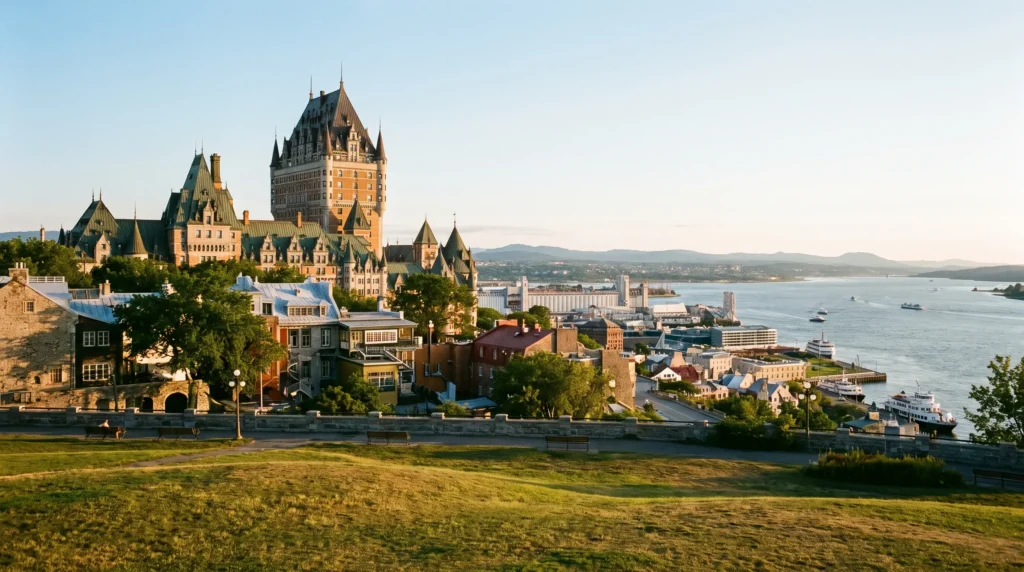
Quebec City Travel Guide — Cobblestones, Fortress Walls & the Only Piece of Old Europe in North America
I still remember rounding a corner near the Château Frontenac at dusk, hearing accordion music drift out of a bistro, and genuinely forgetting I was still in Canada. That disorientation is the whole point of Quebec City. Founded by Samuel de Champlain in 1608, it’s one of the oldest European settlements in North America, and Old Quebec remains the only fortified city with intact walls left anywhere in the Americas north of Mexico. UNESCO agreed it was worth protecting, inscribing the historic district as a World Heritage Site back in 1985. Here’s the honest catch: this is French-speaking Canada in the fullest sense, not a bilingual veneer over an English city, and that’s exactly what makes it feel like a genuine escape rather than a theme park — you’ll want at least a few stock phrases of French, even though most people in the tourist core switch to English without missing a beat.
In This Guide
- Overview — Why Quebec City Feels Like Nowhere Else in North America
- Winter Carnival — the World’s Largest Winter Festival
- Best Time to Visit Quebec City (Season by Season)
- Getting There — YQB, Trains & the Drive from Montreal
- Getting Around — Walking, Buses & the Funicular
- Neighborhoods — Old Quebec, Saint-Roch & Beyond
- Culture & People — Life in French North America
- A Food Lover’s Guide to Quebec City
- Off the Beaten Path
- Day Trips — Montmorency Falls, Île d’Orléans & the Beaupré Coast
- Practical Information
- Budget Breakdown — What Quebec City Actually Costs in 2026
- Frequently Asked Questions
Overview — Why Quebec City Feels Like Nowhere Else in North America
Quebec City is the capital of the province of Quebec and, with roughly 549,000 people in the city proper and about 839,000 across the metro area, it’s compact enough to feel walkable but substantial enough to have real neighborhoods, real winters, and a real local life that doesn’t stop just because the tour buses have gone home. Champlain built his fortified trading post here in 1608 because the narrowing of the St. Lawrence River — the name “Québec” comes from an Algonquin word meaning “where the river narrows” — made it a natural chokepoint to defend. Four centuries of British and French colonial tug-of-war followed, and you can trace nearly all of it just by walking the ramparts.
What sets Old Quebec apart isn’t just its age — it’s that the walls are still there. This is the only city north of Mexico in the entire Americas where the fortifications survive intact enough to walk the perimeter, and UNESCO recognized the historic district for exactly that reason in 1985. The protected core covers about 1.42 square kilometers and roughly 1,400 buildings, split between the clifftop Upper Town — home to the Château Frontenac and the old military and administrative buildings — and the Lower Town along the river, anchored by Place Royale, the exact spot where Champlain’s original habitation stood.
The honest pitch: Quebec City rewards slow travel more than almost any city its size in North America. You’re not racing between fifteen must-see landmarks — you’re wandering cobblestone lanes, ducking into creperies, and letting the fact that everyone around you is speaking French turn an ordinary weekend into something that feels like it happened on a different continent.
Winter Carnival — the World’s Largest Winter Festival
If you’re building a trip around one date, make it February 6–15, 2026, when the Carnaval de Québec runs its 72nd edition. Bonhomme, the carnival’s snowman ambassador in his red tuque and traditional sash, presides over ten days of ice sculpture competitions, night parades through Old Quebec, canoe races across the ice-choked St. Lawrence, and an entire palace built from carved ice blocks. It bills itself as the largest winter carnival on the planet, and having stood in a crowd on a -15°C night watching the parade lights bounce off the fortress walls, I’m not inclined to argue.
Book accommodation well ahead if you’re coming for Carnival — Old Quebec’s hotel stock is limited by definition, since you can’t exactly build more inside 17th-century walls. Outside Carnival week, Quebec City’s winter runs long and genuinely cold, so dress like you mean it: this is not a destination where a city coat cuts it.
Best Time to Visit Quebec City (Season by Season)
June – September · Peak season
Warm days, long evenings, terrace season on every street in Old Quebec, and the bulk of the festival calendar including the Festival d’été de Québec. This is also when hotel prices and crowds both peak — book the Château Frontenac area weeks ahead if you want to be inside the walls.
September – October · Fall foliage
My personal favorite window: crisp air, thinner crowds than summer, and the maple forests along the Beaupré Coast and Île d’Orléans turning color. Restaurant reservations get easier and rates drop from summer peaks.
December – March · Winter
Genuinely cold — expect regular days well below freezing — but this is when Quebec City looks like the postcard: snow on the fortress walls, sleigh rides, the ice hotel (Hôtel de Glace) outside town, and Winter Carnival in early-to-mid February. Not for anyone who hates being cold — pack accordingly.
April – May · Shoulder / sugar shack season
Quiet, unglamorous-looking (spring thaw is not Quebec’s best look), but it’s sugar shack season in the surrounding countryside, when maple syrup producers open their cabins for traditional meals ladled in maple syrup at every course.
Getting There — YQB, Trains & the Drive from Montreal
Québec City Jean Lesage International Airport (YQB) sits about 17 kilometers west of downtown and handled roughly 1.8 million passengers in 2025, making it Canada’s 11th-busiest by traffic. It’s mostly a connections airport — Air Canada and WestJet link to Montreal, Toronto and seasonal sun destinations, Air Transat runs year-round to Cancún and Paris, and United Express connects to Newark. For most non-Canadian travelers, the realistic gateway is Montreal-Trudeau (YUL), then a short hop or ground connection onward.
That onward leg is genuinely pleasant: VIA Rail runs frequent service between Montreal’s downtown Gare Centrale and Quebec City’s Gare du Palais, with dozens of departures a week and a journey time around 3.5 hours. Driving is faster — the 250-kilometer run down Highway 20 takes about 2 hours 45 minutes to 3 hours depending on traffic — and intercity buses cover the same route for less than either. US citizens need only a valid passport and no visa to enter Canada; travelers of other nationalities should confirm eTA or visa requirements with Canadian immigration authorities before booking.
Getting Around — Walking, Buses & the Funicular
Old Quebec is made for walking — it’s a UNESCO-protected historic core, so the cobblestones and hills are part of the deal, not an inconvenience. The one mobility quirk worth knowing: Upper Town sits on a clifftop, Lower Town sits at the river’s edge, and the fastest way between them (short of the stairs) is the funicular that connects the Château Frontenac boardwalk to Petit-Champlain below.
Beyond the old walls, the RTC bus network (Réseau de transport de la Capitale) covers the wider city cheaply and reliably, useful for reaching Sainte-Foy, the Plains of Abraham’s far end, or the airport. Rental cars make sense only for day trips out to the Beaupré Coast or Île d’Orléans — inside the old city, a car is dead weight, since much of the historic core is pedestrianized or one-way cobblestone lanes never designed for modern traffic.
Neighborhoods — Old Quebec, Saint-Roch & Beyond
Old Quebec — Upper Town
The clifftop heart of the city: the Château Frontenac, the Citadelle, the Plains of Abraham battlefield park, and the Dufferin Terrace boardwalk with river views that justify every cliché photo you’ll take of it. Most of the buildings you see date to the 19th century even though the street plan is far older.
Old Quebec — Lower Town & Petit-Champlain
Down the cliff via the funicular or the Breakneck Stairs, Place Royale marks the exact site of Champlain’s 1608 habitation, ringed by the 1687–1723 Church of Notre-Dame-des-Victoires. Rue du Petit-Champlain, often called the oldest commercial street in North America, is impossibly pretty and impossibly touristy in equal measure — go early morning to get it without the cruise-ship crowds.
Saint-Jean-Baptiste
Just outside the walls, this is where Quebec City locals actually live and eat — rue Saint-Jean is lined with bistros, cheese shops and bars with none of the Old Town markup.
Montcalm & Grande Allée
The city’s grand boulevard, lined with Second Empire mansions turned restaurants and terraces, running past the National Assembly building toward the Plains of Abraham. This is Quebec City’s answer to a Parisian avenue, minus the crowds.
Saint-Roch
The reinvented former industrial district, now the city’s tech and creative quarter — third-wave coffee, design studios, and some of the best contemporary dining in the city, a useful counterpoint if Old Quebec starts to feel like a museum.
Limoilou & Saint-Sauveur
Working-class-turned-hip residential neighborhoods north of the old city, worth a detour for neighborhood bakeries, microbreweries and a look at Quebec City that has nothing to do with tourism at all.
Île d’Orléans
Technically its own island, a 20-minute drive from downtown, this is the agricultural heart of the region — strawberry farms, cider houses, and some of the best farm-table food near the city, laid out along a single ring road.
Culture & People — Life in French North America
French is the dominant language of daily life here in a way it simply isn’t in Montreal — in the 2021 census, roughly 90.6% of Quebec City residents reported French as their sole mother tongue. That makes Quebec City the single easiest place in North America to feel immersed in French language and culture without needing a passport to Europe. English is spoken fluently in hotels, restaurants and shops that deal with tourists, but a “bonjour,” a “merci,” and patience with the occasional language gap go a long way and are genuinely appreciated.
The city’s identity is bound up with its role as the cradle of French North America and, later, as the site of the 1759 Battle of the Plains of Abraham, the pivotal battle of the French and Indian War fought on what’s now a public park just outside the old walls. Quebec’s National Assembly sits here too, making this a political capital as much as a historic one — provincial politics and the question of Quebec’s place within Canada remain live, present-day conversations, not just museum exhibits.
A Food Lover’s Guide to Quebec City
Quebec City takes credit, alongside the rest of the province, for inventing poutine — fries, cheese curds and gravy — and you’ll find both purist versions and outlandish gourmet ones on nearly every menu. Winter specialties include tourtière (a spiced meat pie, essential at Christmas but served year-round) and pea soup thick enough to stand a spoon in. Crêperies are everywhere in the old city, and rightly so — thin savory galettes and dessert crêpes are a Quebec institution, not just a tourist food.
Maple shows up in ways you won’t expect outside Quebec: maple taffy poured onto snow and rolled onto a stick (tire d’érable) is a genuine only-here experience, best found at sugar shacks in spring but sold as a novelty in Old Quebec year-round. The Marché du Vieux-Port along the harbor is the spot for local cheese, cider and produce, and Saint-Roch has emerged as the city’s serious dining district for anyone wanting contemporary Québécois cooking rather than tourist-menu classics. Quebec’s microbrewery scene is strong too — look for local beers alongside the ubiquitous Québécois cidre de glace (ice cider), a dessert wine made from apples frozen on the tree.
Off the Beaten Path
The ramparts walk at dawn
Walk the full circuit of the city walls before 8am, before the tour groups arrive, and you’ll have four kilometers of fortifications — cannons, gates, the works — essentially to yourself.
Wendake
A short drive or bus ride from downtown, Wendake is the territory of the Huron-Wendat Nation, with a cultural museum, traditional longhouse, and restaurant serving Indigenous cuisine — a meaningful counterpoint to the colonial history that dominates the rest of the city’s story.
Saint-Roch’s back streets
Skip the Old Town entirely for an afternoon and wander Saint-Roch’s converted warehouses, indie bookstores and coffee roasters — the neighborhood that shows you where Quebec City is heading, not just where it’s been.
The Plains of Abraham off-season
In winter, the battlefield park becomes a cross-country ski and snowshoe trail network in the middle of the city — a strange and lovely way to process a place where a war once decided the fate of a continent.
Day Trips — Montmorency Falls, Île d’Orléans & the Beaupré Coast
Montmorency Falls, about 12 kilometers from Old Quebec, drops 83 meters — some 30 meters higher than Niagara Falls, though nowhere near as wide. A cable car and a suspension bridge let you get close, and in winter the spray freezes into a climbable ice cone locals call the “sugarloaf.” It’s a 15–20 minute drive or an easy public bus ride from downtown, making it the single best half-day trip from the city.
Île d’Orléans sits just past the falls, a rural island of farms, orchards, cideries and heritage villages that’s been supplying Quebec City’s tables since the colonial era — rent a car or bike and ring the whole island in a day, stopping for strawberries, cider tastings and river views.
Further along the Beaupré Coast, the Basilica of Sainte-Anne-de-Beaupré is one of the oldest and most visited pilgrimage sites in North America, and the road continues toward Mont-Sainte-Anne, a four-season resort with skiing in winter and hiking and via ferrata routes in summer. All of these combine easily into a single full-day loop by rental car, or can be visited individually on guided tours from Old Quebec if you’d rather not drive.
Practical Information
Money. The Canadian Dollar (CAD) is the currency; tap-to-pay and chip cards work almost everywhere, including small cafés and market stalls, so carrying much cash isn’t necessary. Sales tax is added at the register rather than shown on price tags, so expect the total to run higher than the sticker price.
Safety. The US State Department rates Canada at Level 1, “Exercise Normal Precautions,” its lowest advisory tier, as of its June 2026 update. Petty crime like pickpocketing and car break-ins does occur in tourist areas, so don’t leave valuables visible in a parked car, but Quebec City is generally regarded as one of the safer major cities in North America for visitors.
Health. No special vaccinations are required to visit Canada, though routine and measles (MMR) vaccination is recommended for all international travel given rising global case counts. Travel insurance is worth having since Canadian healthcare typically requires upfront payment or proof of insurance from non-residents.
Connectivity & practicalities. Wi-Fi is reliable throughout Old Quebec’s hotels and cafés; an eSIM covers the rest. Plugs: North American style (Type A/B), 120V, same as the US. Time zone: Eastern Time (UTC-5, UTC-4 with daylight saving).
Budget Breakdown — What Quebec City Actually Costs in 2026
Quebec City runs cheaper than Montreal’s trendiest districts and considerably cheaper than a comparable historic European city, but Old Quebec hotels carry a premium simply for being inside the walls.
Budget (US$90–140/day): Hostel or budget hotel outside the walls in Saint-Jean-Baptiste or Saint-Roch, casse-croûte and crêperie meals, walking and public buses, free ramparts and Plains of Abraham exploring.
Mid-range (US$200–320/day): Boutique hotel in or near Old Quebec, restaurant dinners in Saint-Roch or Petit-Champlain, a guided day trip to Montmorency Falls and Île d’Orléans, a museum pass or two.
Luxury (US$450+/day): A room at the Château Frontenac itself, tasting menus, private guided history tours, a stay at the seasonal Hôtel de Glace ice hotel.
Fixed costs to expect: Canadian sales taxes added at checkout (not included in listed prices), and tipping 15–18% at restaurants, which is standard practice across Canada rather than optional.
Planning Your First Trip to Quebec City
The classic itinerary is three to four nights: two full days inside and around the walls of Old Quebec (Château Frontenac, Dufferin Terrace, Petit-Champlain, Place Royale, the ramparts walk), one day for Montmorency Falls and Île d’Orléans, and an evening or two exploring Saint-Roch or Saint-Jean-Baptiste for a taste of daily Quebec life beyond the tourist core. Most visitors pair it with Montreal — 250 kilometers and a comfortable train ride away — for a francophone-Canada double bill, or fly in via Montreal or Toronto if arriving internationally. Check our full Canada travel guide for the bigger picture before you go.
Frequently Asked Questions
Is Quebec City safe for tourists in 2026?
Yes — Canada carries the US State Department’s lowest advisory tier, Level 1, “Exercise Normal Precautions,” as of its June 2026 update. The usual big-city cautions apply — watch for pickpockets in crowded tourist spots and don’t leave valuables visible in a parked car — but violent crime against tourists is rare.
Do I need a visa to visit?
US citizens need only a valid passport — no visa required. Travelers from many other countries can enter visa-free with an Electronic Travel Authorization (eTA) instead of a full visa; requirements vary by nationality, so confirm with Canadian immigration before booking flights.
Do I need to speak French?
No, but it helps and it’s appreciated. French is the dominant everyday language — about 90.6% of residents speak it as their sole mother tongue — and it’s noticeably more French-first here than in Montreal. Hotel staff, restaurant servers and shop workers in tourist areas generally speak fluent English.
How many days do I need in Quebec City?
Three full days covers Old Quebec thoroughly plus one day trip. Four or five lets you add Wendake, Saint-Roch’s restaurant scene, or a slower pace through Île d’Orléans without rushing.
Quebec City or Montreal?
Choose Quebec City for concentrated colonial history, fortress walls, and a smaller, more intensely French-speaking old-world atmosphere. Choose Montreal for a bigger, more cosmopolitan, more bilingual city with a stronger food and nightlife scene. Most visitors who can manage it do both — they’re a comfortable train ride apart.
What’s the best way to see Old Quebec without the crowds?
Walk the ramparts and Petit-Champlain before 8am, before tour buses and cruise-ship groups arrive, then retreat to Saint-Roch or Saint-Jean-Baptiste for lunch away from the historic core’s peak-hour crush.
Ready to Explore Quebec City?
Fortress walls you can still walk end to end, a waterfall taller than Niagara twenty minutes from your hotel, and an entire old town where French is simply how the day happens rather than a novelty. Quebec City is the rare North American destination that genuinely earns the word “storybook” — go before another summer of tour buses discovers it in full.
Explore More
- Montreal City Guide — the bigger, bilingual sibling city 250km down Highway 20
- Canada Travel Guide — the full country picture before you plan the rest of your trip
- Toronto City Guide — Canada’s largest city, a common international gateway
- New York City Guide — the closest major US hub, about a 90-minute flight away
How this guide was built
Published as part of Facts From Upstairs’ city guide series. Built from authoritative sources — Wikipedia’s Quebec City, Historic District of Old Québec, Quebec City Jean Lesage International Airport and Montmorency Falls entity pages, the official Carnaval de Québec site, Destination Québec cité (quebec-cite.com), VIA Rail’s Montreal–Quebec City route page, the US State Department’s Canada travel advisory, and the US CDC’s Canada traveler health page. Numeric claims carry inline citations.
Sources cited on this page
- Wikipedia — Quebec City
- Wikipedia — Historic District of Old Québec
- Wikipedia — Québec City Jean Lesage International Airport
- Wikipedia — Montmorency Falls
- Carnaval de Québec — official 2026 dates
- Destination Québec cité — official tourism site
- Destination Québec cité — Montreal to Quebec City
- VIA Rail — Montreal–Quebec City route
- US State Department — Canada travel advisory
- US CDC — Canada traveler health page
More city guides you might like
Plan your trip to Quebec City
The booking tools we use ourselves. FFU may earn a commission at no extra cost to you.
Plan & book your trip to Quebec City
Booking through these searches supports our guides at no extra cost to you.