
Kanazawa Travel Guide — Japan’s Little Kyoto, Minus the Crowds
I keep telling people Kanazawa is what they imagined Kyoto would be before they actually got to Kyoto and found themselves shuffling through Fushimi Inari shoulder-to-shoulder with three thousand strangers. Kanazawa has the same lacquered wooden teahouses, the same geisha districts, the same feudal-era gravity — it was the seat of the Maeda clan, the second-richest domain in Edo-period Japan, and by 1700 the city rivaled Rome and Amsterdam in size — but almost none of the tour-bus crush. It was spared aerial bombing in World War II, so the wooden districts are original, not rebuilt-to-look-old , and since the Hokuriku Shinkansen reached town in 2015 it’s a straight 2.5-hour bullet-train hop from Tokyo. Condé Nast Traveler named it one of just 12 places on Earth worth visiting in 2024, and National Geographic put it on its 2025 best-places list. The catch: it snows here, a lot, and if you show up expecting Kyoto-level restaurant density and English signage everywhere, you’ll find a smaller, quieter, more work-required city. That’s the whole appeal.
In This Guide
- Overview — Why Kanazawa Is Japan’s Best-Kept Open Secret
- Snow on the Pines — Kanazawa’s Winter Garden Ritual
- Best Time to Visit Kanazawa (Season by Season)
- Getting There — Shinkansen, Komatsu Airport & Trains
- Getting Around — Buses, Bikes & Walking
- Neighborhoods — Chaya, Samurai & Market Districts
- Culture & People — Crafts, Geisha & the Maeda Legacy
- A Food Lover’s Guide to Kanazawa
- Off the Beaten Path
- Day Trips — Shirakawa-go, Gokayama & the Noto Peninsula
- Practical Information
- Budget Breakdown — What Kanazawa Actually Costs in 2026
- Planning Your First Trip to Kanazawa
- Frequently Asked Questions
Overview — Why Kanazawa Is Japan’s Best-Kept Open Secret
Kanazawa is the capital of Ishikawa Prefecture, tucked on the Sea of Japan coast in the Hokuriku region roughly midway between Tokyo and Kyoto — close enough to visit as a two- or three-night add-on, far enough that it never gets the crowd overflow. For 280 years it was the seat of the Maeda clan, feudal lords of the Kaga Domain, the wealthiest domain in Japan outside the shogun’s own territory. That money went into gardens, castles, gold leaf, lacquerware and a level of craft investment most Japanese cities of the era couldn’t match — and because Kanazawa had no major military targets, it was one of the few historic Japanese cities to escape World War II firebombing largely intact.
The result, three centuries later: original Edo-period teahouse streets you can still walk at night, a feudal garden ranked among the finest in the country, and samurai-district canals that were dug for real defensive and irrigation purposes rather than restored for tourists. Kanazawa produces roughly 99% of Japan’s gold leaf and remains a serious center for Kutani porcelain and Kaga yuzen silk dyeing. None of this was a secret to serious travelers, but 2024–2025 put it on the mainstream radar: Condé Nast Traveler named it one of just twelve destinations worldwide worth visiting, and National Geographic listed it among its 25 best places to visit globally.
What Kanazawa doesn’t have is Kyoto’s restaurant density, its sheer number of temples, or its level of English infrastructure — book English-friendly experiences (guided castle tours, tea ceremony) ahead, and expect some menus and signage to require a translation app. That trade-off is exactly why it still feels like discovering something.
Snow on the Pines — Kanazawa’s Winter Garden Ritual
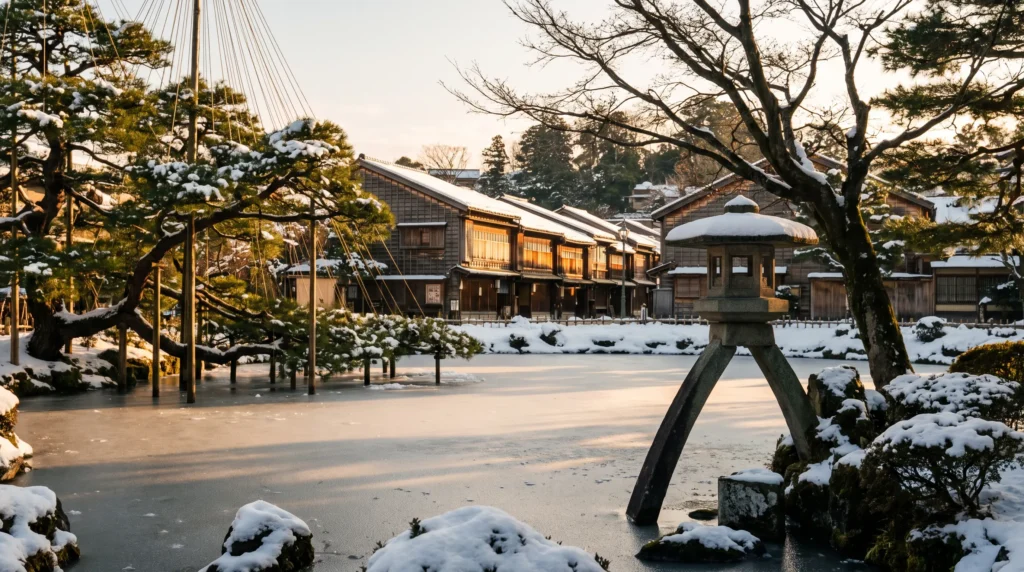
Every November, gardeners at Kenrokuen begin rigging yukitsuri — rope-and-pole scaffolding tied in cone shapes above the garden’s pines to keep heavy snow from snapping their branches. By December the ropes are strung, and by January the garden’s most photographed image comes together: snow-laden pines held up by yukitsuri cones, lit by stone lanterns, with barely another visitor in sight. Kanazawa’s winters are genuinely snowy — this stretch of the Sea of Japan coast sits in one of the country’s heaviest snowfall belts — and the garden stays open through it, with occasional free-entry mornings after fresh snowfall.
If winter isn’t your thing, the same garden peaks again in early April for cherry blossoms and in autumn for maple color, and Kenrokuen has been open to the public since 1874, so this isn’t a manufactured photo-op — it’s a century and a half of the same seasonal choreography.
Best Time to Visit Kanazawa (Season by Season)
Late March – May · Spring (peak)
Cherry blossoms around Kenrokuen and Kanazawa Castle Park in early April, mild temperatures, and the year’s best light for walking the chaya districts. Book ryokan two to three months out around Golden Week (late April–early May), when domestic tourism spikes hard.
June – July · Rainy season
Humid with frequent rain; fewer crowds and lush green gardens if you don’t mind an umbrella. Late July starts warming into a proper, sticky Japanese summer.
August – September · Summer, then typhoon watch
Hot and humid; September carries typhoon risk along the Sea of Japan coast, so keep travel insurance current and watch forecasts if visiting then.
October – November · Autumn (second peak)
Maple color in Kenrokuen and Kenroku-en’s surrounding hills, comfortable temperatures, and — usefully — this is when yukitsuri rigging begins, so late November visitors get autumn color and a preview of the winter ritual in the same trip.
December – February · Winter
Heavy snowfall, short days, and the yukitsuri-pine garden scenes that make Kanazawa’s postcards. Fewer international visitors, better hotel rates, and some of the best kaiseki dining of the year built around winter Kaga crab and Nodoguro fish.
Getting There — Shinkansen, Komatsu Airport & Trains
Almost everyone arrives by Shinkansen. The Hokuriku Shinkansen has connected Kanazawa directly to Tokyo since March 2015, and the ride takes about two and a half hours — the same 2h30 from Osaka and Nagoya via connections, or about 2h10 from Kyoto. In March 2024 the line was extended a further 124 kilometers southwest to Tsuruga in Fukui Prefecture, adding new stops at Komatsu and Kaga Onsen and shaving time off Kansai-region connections.
Komatsu Airport (KMQ), about 30 minutes south of the city, handles domestic flights (notably from Tokyo Haneda) plus a handful of international charters and routes to Seoul and Shanghai. Limousine buses run directly between the airport and Kanazawa Station in around 40 minutes for roughly ¥1,300; a cheaper bus-plus-local-train combo via Komatsu Station also works. If you’re arriving from Tokyo, the Shinkansen is simply faster door-to-door than flying into Komatsu — factor in Haneda/Narita transfer time and it isn’t close.
Getting Around — Buses, Bikes & Walking
Kanazawa doesn’t have a subway or tram network — buses are the backbone. The Kanazawa Loop Bus circles the main sightseeing area (station, castle, Kenrokuen, chaya districts, Nagamachi) in both directions with a flat fare and an unlimited one- or two-day pass that pays for itself after three or four rides. Regular city buses fan out further, and most drivers and stops have enough English signage for visitors to manage.
The historic core — Kenrokuen, the castle, Nagamachi and Omicho Market — is compact enough to walk between in 15–25 minutes each way, and the Machinori bike-share system (docking stations scattered across downtown) is a genuinely good option in the milder months. Taxis are plentiful and metered fairly by Japanese standards; rental cars only make sense if you’re heading out toward the Noto Peninsula independently, since parking downtown is scarce and unnecessary.
Neighborhoods — Chaya, Samurai & Market Districts
Higashi Chaya District
Kanazawa’s largest and most photogenic geisha district: a preserved lattice of wooden teahouses (ochaya) along narrow lanes, several now open as cafés, gold-leaf shops and small museums. Come at dusk when the lanterns come on and the day-trip crowds have thinned.
Nishi Chaya District
Higashi’s smaller, quieter counterpart on the west side of town — the same architecture with a fraction of the foot traffic, good for the same photos without the queue.
Nagamachi Samurai District
Mud-walled lanes and canals where mid-ranking Maeda-clan samurai once lived; several former residences, including the Nomura Family Samurai House, are open with their gardens intact. It’s the closest thing Kanazawa has to a time machine into feudal domestic life rather than feudal grandeur.
Kenrokuen & Kanazawa Castle Park
The city’s centerpiece: Kenrokuen, one of Japan’s three great gardens, developed by the Maeda clan from the 1620s through the 1840s, opened to the public in 1874 and designated a National Site of Special Scenic Beauty. Next door, Kanazawa Castle Park holds mostly careful 21st-century reconstructions of the original castle — the six-story main tower burned in 1602 and was never rebuilt, and further fires in 1759 and 1881 destroyed most of what came after — but the 1788 Ishikawa-mon Gate survives as an original structure, and the grounds became a National Historic Site in 2008.
Omicho Market
Kanazawa’s “kitchen” since the Edo period: a covered warren of fishmongers, produce stalls and standing sushi counters that’s as much a place to eat breakfast as to sightsee.
Kazuemachi
A small third chaya district along the Asano River, less visited than Higashi or Nishi and worth the ten-minute walk for the riverside views alone.
21st Century Museum of Contemporary Art area
The circular glass museum near Kenrokuen is Kanazawa’s modern counterpoint to all that Edo-period wood — home to the famous “Swimming Pool” installation and a genuinely excellent design-focused gift shop, with the surrounding streets home to newer cafés and boutiques.
Culture & People — Crafts, Geisha & the Maeda Legacy
Kanazawa’s identity is built on craft, not conquest. The Maeda lords deliberately funneled Kaga Domain’s wealth into art and artisanship rather than military ambition, and the habit stuck: the city still produces about 99% of Japan’s gold leaf, along with Kutani ware ceramics known for bold overglaze enamel painting and Kaga yuzen, a distinctive style of hand-dyed silk kimono decoration.
Geisha culture, called geiko locally, persists in the Higashi and Kazuemachi chaya districts in a smaller, more low-key form than Kyoto’s Gion — sightings are rarer, and that’s treated as normal rather than a photo emergency. Locals are generally reserved but helpful; a little spoken Japanese or a translation app goes further here than it would in Tokyo, where more people are used to fumbling tourists.
A Food Lover’s Guide to Kanazawa
Kanazawa sits on some of Japan’s best cold-water seafood, thanks to the Sea of Japan and the Kaga cuisine tradition the Maeda court cultivated. At Omicho Market, standing sushi counters serve the day’s catch — look for kaisendon (seafood rice bowls) piled with local catch, and winter visits bring Kaga crab (branded snow crab) and nodoguro (blackthroat seaperch), two of the region’s signature luxuries.
For something stranger and more local, try jibuni, a Kaga-cuisine duck (or chicken) stew thickened with flour and served with wheat gluten cake and vegetables, or hunt down a gold-leaf-topped soft-serve cone in Higashi Chaya — kitsch, yes, but genuinely tied to the city’s craft economy. Kanazawa also has its own curry-rice subculture (thicker, darker roux than Tokyo’s version, ladled generously over cutlets) with dedicated local chains worth a lunch stop. Wash it down with sake — Ishikawa Prefecture has a serious brewing tradition, and several kura (breweries) around town offer tastings.
Off the Beaten Path
Myoryuji (“Ninja Temple”)
Not actually a ninja site — a Nichiren-sect temple riddled with trick staircases, hidden rooms and escape tunnels, built as a Maeda-era lookout and refuge disguised as an ordinary temple. Visits are guided-tour only and require advance reservation, which keeps it well off the casual tourist trail despite being one of the city’s most interesting buildings.
Kazuemachi at night
Skip the Higashi Chaya crowds after dark and walk Kazuemachi’s riverside lane instead — the same lantern-lit wooden facades, a fraction of the foot traffic.
Ishikawa Prefectural Museum of Traditional Products and Crafts
A quieter, deeper dive into gold leaf, Kutani ware and Kaga yuzen than the souvenir-shop version most visitors get, right beside Kenrokuen.
Yasue Gold Leaf Museum
A hands-on look at the paper-thin hammering process behind Kanazawa’s signature export, with workshop options to apply gold leaf to your own souvenir.
Day Trips — Shirakawa-go, Gokayama & the Noto Peninsula
Kanazawa’s best day trip is the UNESCO-listed Historic Villages of Shirakawa-go and Gokayama, thatched-roof gassho-zukuri farmhouse villages built to shed heavy mountain snow — reachable by highway bus in about 75 minutes each way for roughly ¥2,800, run by Nohi and Hokutetsu bus lines with mandatory seat reservations (note: the Japan Rail Pass does not cover this route). Winter illumination nights, when the snow-capped village is lit up after dark, require reservations that sell out weeks ahead.
The Noto Peninsula, jutting north into the Sea of Japan, offers a slower, rural counterpoint — rugged coastline, the Wajima morning market, and Wajima-nuri lacquerware workshops. It’s best reached by rental car or organized tour; note that parts of the peninsula sustained serious damage in the January 2024 Noto earthquake, and some sites and roads were still recovering as of this writing, so check current access before planning a full-day loop.
Closer in, Komatsu and the Kaga Onsen hot-spring towns are 30–40 minutes away on the Hokuriku Shinkansen extension that opened in 2024, making a soak-and-return day trip an easy add-on.
Practical Information
Money. Japan’s currency is the yen (JPY); many small shops, market stalls, temples and older ryokan still expect cash, though card and IC-card (Suica/ICOCA) acceptance keeps improving. Carry more cash than a first-timer to Tokyo would expect to need.
Visa & entry. US citizens can enter Japan visa-free for tourism for up to 90 days; a valid passport with at least one blank page and proof of onward travel are required, and amounts over ¥1,000,000 must be declared at entry and exit. Most Western passport holders get a similar short-stay exemption; check your own government’s current guidance, since electronic pre-registration requirements for visa-exempt travelers have been evolving.
Safety. The US State Department rates Japan Level 1 — Exercise Normal Precautions, its lowest advisory tier, with pickpocketing and drink-spiking/robbery risk concentrated in nightlife districts of major cities (a far smaller concern in Kanazawa than in Tokyo’s entertainment quarters) and natural-disaster risk from earthquakes, typhoons and, locally, heavy winter snow. Japan’s drink-driving limit is strict (0.03% BAC) and marijuana possession carries serious penalties even in small amounts.
Health. No special vaccines are required for entry; keep routine vaccinations (including measles) current, and consider Hepatitis A if you’ll be eating a lot of street food or visiting rural areas — Japanese encephalitis vaccination is only generally advised for extended rural stays of a month or more. Travel insurance is strongly recommended, since Japanese hospitals commonly expect upfront payment.
Connectivity. Rent a pocket Wi-Fi or grab an eSIM before arrival; hotel and station Wi-Fi is decent but coverage thins out around rural day-trip stops. Plugs: Type A/B, 100V. Time zone: UTC+9, no daylight saving.
Budget Breakdown — What Kanazawa Actually Costs in 2026
Kanazawa runs a little cheaper than Tokyo or Kyoto for lodging, similar for food and transit.
Budget (US$70–110/day): Guesthouse or capsule-style stay, Omicho Market meals and convenience-store breakfasts, Loop Bus day pass, free-entry temples and neighborhood walking.
Mid-range (US$180–320/day): Business hotel or a modest ryokan, Kenrokuen and castle admission, one sit-down kaiseki or sushi-counter dinner, a Shirakawa-go day-trip bus ticket, gold-leaf workshop or museum entries.
Luxury (US$500+/day): Traditional ryokan with in-room kaiseki, private guided tours of the chaya and samurai districts, top-tier sushi omakase, chartered day trips into the Noto Peninsula.
Fixed costs to expect: modest admission fees at Kenrokuen (~¥300–500 range), the castle grounds, and most museums; Shirakawa-go bus fares run around ¥2,800 one-way. Tipping is not customary anywhere in Japan and can cause confusion if offered.
Planning Your First Trip to Kanazawa
The classic pairing is Kanazawa as a Kyoto detour: ride the Shinkansen in from Tokyo or Kyoto, spend two full days covering Kenrokuen, the castle, Higashi Chaya and Nagamachi, add a third day for the Shirakawa-go day trip, then continue on to Kyoto for temples or back to Tokyo for the return flight. If you have more time, extend south to Osaka for food and nightlife, or read our full Japan travel guide for the country-level visa, rail-pass and seasonal planning that applies wherever you go next.
Frequently Asked Questions
Is Kanazawa worth visiting if I’ve already seen Kyoto?
Yes — it’s smaller and quieter, with the same category of historic wooden districts and feudal-era gardens but a fraction of the crowds, plus a distinct craft culture (gold leaf, Kutani ware) Kyoto doesn’t emphasize the same way.
How many days do I need in Kanazawa?
Two full days covers the core sights comfortably; three lets you add the Shirakawa-go day trip without rushing either.
Do I need a visa?
US citizens get up to 90 days visa-free for tourism, and most Western passport holders get a similar short-stay exemption — check your own government’s current entry requirements before booking, since electronic pre-clearance rules for visa-exempt visitors have been changing.
Is Kanazawa walkable, or do I need transit?
The historic core is walkable, but the Loop Bus (with a day pass) is worth it for saving your legs between Kenrokuen, the castle, Nagamachi and Omicho Market, especially in winter snow or summer humidity.
When’s the best time to see the snow-covered gardens?
January and early February, after the yukitsuri rope rigging is in place and fresh snow has fallen — check ahead, since some of the most photogenic mornings follow overnight snowfall rather than a fixed calendar date.
Is the Noto Peninsula safe to visit after the 2024 earthquake?
Much of the peninsula has been recovering, but some roads, accommodations and cultural sites were still affected as of this guide’s writing — check current conditions and official advisories before planning an independent trip out there, and consider a guided tour if you’re unsure about access.
Ready to Explore Kanazawa?
Snow-rigged pines in a 150-year-old garden, gold leaf hammered thin enough to eat, geisha lanes that never got rebuilt because they never got bombed — Kanazawa delivers Kyoto’s feudal atmosphere at a scale you can actually absorb in a few days. Get there while the Shinkansen keeps making it this easy.
Explore More
- Japan Travel Guide — the full country-level primer, visas and rail passes
- Kyoto City Guide — temples, geisha districts and the classic next stop
- Tokyo City Guide — the Shinkansen gateway in and out
- Osaka City Guide — extend south for food and nightlife
How this guide was built
Published as part of Facts From Upstairs’ city guide series. Built from authoritative sources — Wikipedia entity pages for Kanazawa, Kenroku-en and Kanazawa Castle, the official Visit Kanazawa tourism board, the Japanese Government’s JapanGov feature on the Hokuriku Shinkansen extension, Komatsu Airport’s official access page, the Nohi/Hokutetsu highway bus operator page, the US State Department’s Japan country page, and the US CDC traveler page for Japan. Numeric claims carry inline citations.
Sources cited on this page
More city guides you might like
Plan your trip to Kanazawa
The booking tools we use ourselves. FFU may earn a commission at no extra cost to you.
Plan & book your trip to Kanazawa
Booking through these searches supports our guides at no extra cost to you.