
Cambridge Travel Guide — Punts, Colleges & England’s Prettiest College Town
Cambridge is a working town that happens to contain one of the oldest universities on Earth, and that tension is what makes it worth the 55-mile trip from London. You come for the postcard — a flat-bottomed punt gliding under stone bridges, choristers filing into King’s College Chapel, bicycles stacked six deep outside a college gate — and you get to keep it, because unlike Oxford, Cambridge never quite got swallowed by its own fame. I’ve walked the Backs at 7am with nobody but a heron for company and I’ve also queued behind a coach party at noon; the trick, which I’ll get into, is timing. This is a genuinely small city — barely 146,000 people — built almost entirely to human, bicycle-shaped scale, and it rewards a slow two or three days far more than a rushed day trip from the capital.
In This Guide
- Overview — Why Cambridge Is Worth More Than a Day Trip
- May Bumps & May Week — Cambridge’s Wildest Fortnight
- Best Time to Visit Cambridge (Season by Season)
- Getting There — From London, Stansted & Beyond
- Getting Around — Bikes, Buses & the Backs on Foot
- Neighborhoods — The Backs, City Centre & Beyond
- Culture & People — Gowns, Town & Everyone in Between
- A Food Lover’s Guide to Cambridge
- Off the Beaten Path
- Day Trips from Cambridge
- Practical Information
- Budget Breakdown — What Cambridge Actually Costs in 2026
- Frequently Asked Questions
Overview — Why Cambridge Is Worth More Than a Day Trip
The University of Cambridge was founded in 1209, reportedly by scholars fleeing hostility in Oxford, making it the second-oldest university in the English-speaking world. It’s still organized the same odd way it always was: not one campus but 31 semi-independent colleges, each with its own gate, chapel, dining hall and quirks, scattered through a compact medieval street plan. Between them, Cambridge’s alumni and academics have picked up 126 Nobel Prizes — more than most countries.
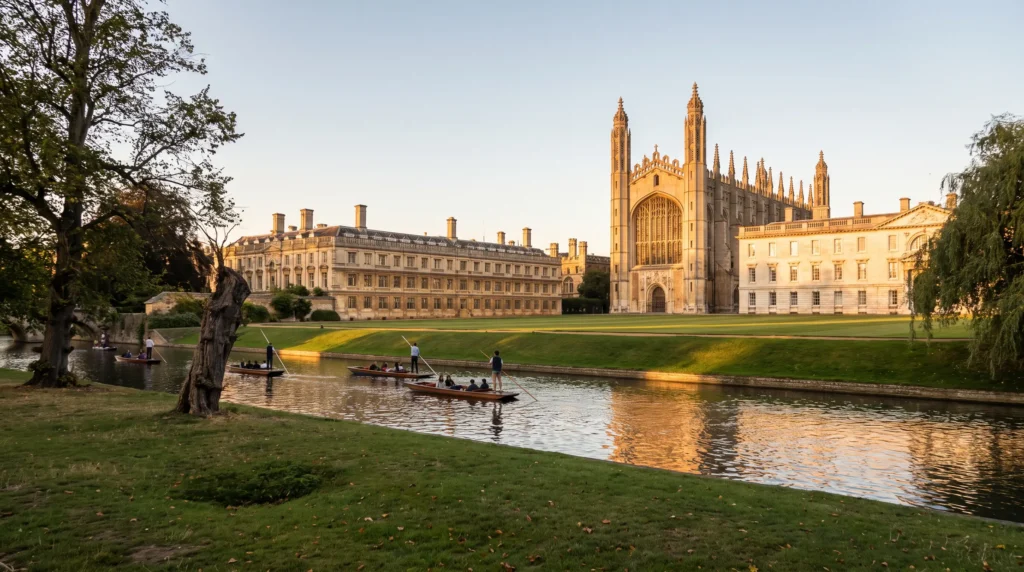
What actually pulls you in on the ground is simpler: the River Cam threading behind the grandest colleges — a stretch called the Backs — with willow trees, footbridges, and the Bridge of Sighs and the Mathematical Bridge among the postcard shots. King’s College Chapel, begun in 1446, is the building everyone photographs and few forget. The whole thing sits on flat, low-lying ground — 6 to 24 metres above sea level — which is exactly why it’s such a good cycling city and such a classic punting one.
Here’s the honest catch: Cambridge is not undiscovered. It pulls something like 7.6 million visitors a year worth over £2 billion to the local economy, and King’s Parade at midday in August can feel more like a theme park queue than a scholarly idyll. The fix isn’t avoiding Cambridge — it’s showing up early, staying a night or two so you get the town after the coach parties leave, and treating the colleges as living institutions (many close to visitors during exams and functions) rather than a checklist.
May Bumps & May Week — Cambridge’s Wildest Fortnight
Confusingly, “May Week” happens in June, and the main event is the May Bumps — four days of chaotic, cannon-started rowing races on the River Cam where boats chase and physically bump the crew ahead rather than racing side by side (the Cam is too narrow and winding for that). The races date back to 1887 and now run every June, drawing college boat clubs, ex-rowers and a genuinely festive crowd along the towpath with Pimm’s in hand.
The same window (roughly mid-to-late June) is when Cambridge’s famous May Balls take over the colleges — black-tie, all-night affairs with fireworks over the river that you’ll mostly experience from the outside unless you know a student, but the atmosphere spills into the streets regardless. If you’re building a trip around the academic year’s high point, aim for the back half of June; just book accommodation months ahead, because this is peak-of-peak for a town that’s already busy in summer.
Best Time to Visit Cambridge (Season by Season)
April – June · Full term, dry(ish), the sweet spot
Cambridge is at its most Cambridge with students actually in residence — punts on the river, exam-time garden parties, and the May Bumps in June. Rainfall is genuinely modest for England: the city averages around 570mm a year, roughly half the UK’s national average, so spring days are more often bright than sodden.
July – August · Warmest, busiest, and the colleges empty out
Peak tourist season and peak heat — Cambridge has recorded temperatures as high as 39.9°C in a July heatwave, though normal summer days run pleasantly warm rather than extreme. Students are largely gone, some colleges open longer hours for visitors, but King’s Parade and the punting stations get genuinely crowded by mid-morning.
September – October · The insider’s window
New term starts, the light turns gold on the honey-colored stone, and day-tripper numbers drop from the summer peak. This is probably the single best combination of weather, atmosphere and lower crowds.
November – February · Quiet, cold, cheap
Short days, real chill, and the town largely to yourself outside Christmas week. King’s College Chapel’s Christmas Eve carol service is a globally broadcast institution if you can get a seat (queue from the small hours, no advance booking for the public).
Getting There — From London, Stansted & Beyond
Cambridge has no major international airport of its own. London Stansted is the closest, about 30 miles south by road (roughly 24 miles as the crow flies), with direct trains and coaches running to Cambridge in well under an hour. Heathrow, Gatwick and Luton are all workable too, usually via a train or coach connection through London or direct coach services.
From central London, direct trains run from King’s Cross roughly every 30 minutes, with the fastest services covering the 56-mile route in about 50 minutes and typical journeys around an hour to 70 minutes. This is genuinely one of the easiest and most frequent city-to-city rail links in England, which is exactly why so many people treat Cambridge as a day trip — and exactly why staying a night to see it after the last train back to London leaves is worth the extra cost.
Getting Around — Bikes, Buses & the Backs on Foot
Cambridge is flat, compact and built for bicycles — the city has an extensive network of cycle paths and bike hire is everywhere, and honestly it’s the single best way to feel like a local rather than a tourist. The historic centre, colleges and the Backs are all walkable in an afternoon, with almost everything of interest inside a 20-minute walk of the Market Square.
Park & Ride buses ring the city and are the sane way to arrive if you’re driving, since the centre’s medieval streets were never built for cars and parking is scarce and pricey. Local buses (Stagecoach) cover the rest of the city and out to the science parks and villages beyond. Punting is transport too, in a sense — chauffeured or self-hire punts run the Backs and the quieter upstream stretch toward Grantchester.
Neighborhoods — The Backs, City Centre & Beyond
The Backs
The green, river-fronted stretch behind King’s, Clare, Trinity and St John’s colleges — willow trees, manicured lawns, and the view every Cambridge postcard is shot from. Best seen slowly, either punting or walking the towpath at dawn before the crowds arrive.
King’s Parade & the Historic Centre
The tourist spine: King’s College and its chapel, Great St Mary’s Church (climb the tower’s 123 steps for a 360° view over the rooftops), Corpus Christi’s Chronophage clock, and the Market Square, which has traded on this spot for centuries.
Trinity & St John’s
The wealthiest, grandest colleges, both fronting the river with their own Bridge of Sighs (St John’s version, not the Venice one) and the Wren Library at Trinity, which holds Newton’s own annotated books among its treasures.
Mill Road
Cambridge’s actual multicultural high street — independent cafes, curry houses, an old cinema turned community hub, and the part of town where you remember this is a real working city, not just a university backdrop.
Newnham & the Grantchester Meadows path
A quieter, leafier residential quarter that opens onto the riverside meadow walk to the village of Grantchester — a favorite Cambridge escape since Rupert Brooke’s day.
Cambridge Science Park & “Silicon Fen”
North of the centre, the tech and biotech cluster that’s grown up around the university — not a sightseeing draw exactly, but the reason Cambridge punches so far above its size economically, and worth knowing about if you’re curious why the city feels wealthier than its population would suggest.
Culture & People — Gowns, Town & Everyone in Between
Cambridge runs on a centuries-old “town and gown” split — the university’s roughly 22,500 students and academics on one side, the working city of textile-era streets, Mill Road communities and biotech workers on the other. Evensong at King’s College Chapel is open to the public most days in term and is genuinely one of the most moving free things you can do in England — choristers, that famous fan-vaulted ceiling, and acoustics built for exactly this. Formal Halls, May Balls and college feasts are the university’s private social world, glimpsed by outsiders mostly through windows and stories.
The city also has a long tradition of public debate and eccentricity — the Cambridge Union, open-air theatre in college gardens each summer, and a dry, self-deprecating local sense of humor about how odd it is to live somewhere this famous. Expect academic terms (roughly October–December, January–March, April–June) to visibly change the town’s rhythm, energy and crowd levels.
A Food Lover’s Guide to Cambridge
Cambridge’s food scene is classic English pub-and-market territory with a growing crop of serious independent restaurants layered on top. Start at the Market Square, running most days with street food stalls, cheese, and fresh produce. Historic pubs are half the point of a visit: The Eagle on Bene’t Street claims the RAF airmen’s ceiling graffiti and the table where Watson and Crick reportedly announced discovering DNA’s structure; The Anchor and The Mill sit right on the river by the punting stations, perfect for a pint watching the chaos of first-time punters.
For something sweeter, Fitzbillies on Trumpington Street has been selling its sticky Chelsea buns since 1920 and is a genuine Cambridge institution. A punt upstream (or a walk across the meadows) to Grantchester for cream tea at the Orchard Tea Garden — where Rupert Brooke, Virginia Woolf and the Bloomsbury set once took tea among the apple trees — is one of the most quintessentially English afternoons available anywhere in the country. Mill Road is the place for curry houses, Vietnamese pho and the city’s best coffee roasters, well away from the tourist-menu prices of King’s Parade.
Off the Beaten Path
Punt the Backs at dawn, not noon
Self-hire a punt (cheaper than a chauffeured tour, harder to steer, much funnier) before 9am and you’ll have the Bridge of Sighs and the Mathematical Bridge almost entirely to yourself, instead of sharing them with a flotilla of tour punts. Shared chauffeured tours run roughly £15–40 per person depending on time and season; self-hire runs cheaper by the hour if you don’t mind learning to pole a punt in public.
The Fitzwilliam Museum
A genuinely world-class, entirely free museum of antiquities, paintings and manuscripts that most day-trippers skip in favor of the colleges — Titians and Rembrandts with no entry fee and none of the King’s Parade queues.
Sedgwick Museum of Earth Sciences & the Museum of Zoology
Two free, quirky university museums — dinosaur fragments and a “4.5-billion-year journey through time” at Sedgwick, a full whale skeleton and cabinets of curiosities at the Museum of Zoology — that most visitors never find.
Grantchester Meadows on foot
Skip the punt entirely and walk the riverside footpath from Cambridge to Grantchester — about 45 minutes each way through genuine English meadow, with cows, willows and none of the crowd.
Day Trips from Cambridge
Ely
Fifteen minutes north by train, Ely is a small cathedral city built around one of England’s most striking medieval cathedrals, its octagonal tower visible for miles across the flat Fens — a completely different, less crowded atmosphere from Cambridge itself.
London
With trains roughly every half hour and journeys as short as 50 minutes from King’s Cross, London is entirely doable as a day trip from Cambridge, or vice versa.
Bury St Edmunds & the Suffolk countryside
A pretty market town with its own abbey ruins and cathedral, plus surrounding villages of thatched cottages, if you want a slower, more rural contrast to Cambridge’s academic bustle.
Duxford (IWM Duxford)
A former WWII airfield turned Imperial War Museum branch, a short drive or bus ride south of Cambridge — hangars full of Spitfires, Concorde and American warplanes, genuinely one of the best aviation museums in Europe.
Practical Information
Money. The pound sterling (GBP, £) is the only currency you’ll need; cards are accepted almost everywhere, including small cafes and market stalls, and contactless is the default.
Visa. As of the current UK entry rules, most visa-exempt visitors — including US, Canadian, Australian and (since 2025) EU/EEA travelers — need an Electronic Travel Authorisation (ETA) approved before departure, in addition to the usual passport validity requirements; this is a policy that has changed recently, so check the current UK government guidance before you fly.
Safety. Cambridge is a low-key, low-crime university town by any standard, and the UK overall carries a general “exercise increased caution” advisory from the US State Department, largely tied to isolated terrorism risk and ordinary petty crime rather than anything specific to Cambridge. Bike theft is the one real local nuisance — always lock a rental bike properly.
Health. No special vaccines are required for the UK; routine immunizations (MMR, polio boosters) should be current, and the US CDC currently flags a polio alert requiring travelers keep boosters up to date given recent detections in UK wastewater surveillance. Tap water is safe to drink throughout the city.
Connectivity. Fast, reliable 4G/5G and widespread cafe Wi-Fi; an eSIM is the easiest option for short stays. Plugs: UK type G, 230V. Time zone: GMT (UTC+0) in winter, British Summer Time (UTC+1) late March to late October.
Budget Breakdown — What Cambridge Actually Costs in 2026
Cambridge runs pricier than the English average thanks to tourism and university-town demand, but it’s still meaningfully cheaper than central London.
Budget (US$70–110/day): hostel or budget chain hotel outside the centre, market-square lunches and pub meals, walking and cycling everywhere, free museums and college grounds where entry isn’t charged.
Mid-range (US$150–260/day): a well-located boutique or chain hotel, a shared punting tour (roughly £15–40/person) , a couple of paid college/chapel entries, sit-down dinners on or off Mill Road.
Luxury (US$400+/day): a river-view room at a hotel like the Varsity or Graduate by Hilton, a private chauffeured punt, fine dining, and a driver for day trips to Ely or the Suffolk countryside.
Fixed costs to expect: several colleges (King’s, Trinity, St John’s) charge a modest entry fee, especially in summer, and it can add up if you try to see them all; some are closed to visitors entirely during exam term (roughly April–June) and for private events.
Planning Your First Trip to Cambridge
The classic itinerary is two nights: arrive by train from London or Stansted, spend your first afternoon walking King’s Parade, the Market Square and into King’s College Chapel, then punt the Backs the next morning before the day-trip crowds arrive. Add an afternoon for the Fitzwilliam Museum or a walk to Grantchester for cream tea, and a half-day trip to Ely’s cathedral if you have a third day. Pair it naturally with a London stay before or after — trains run every half hour — or extend north into Edinburgh for a longer UK rail trip, or west to Cardiff and Wales.
Frequently Asked Questions
Is Cambridge worth visiting if I’m only doing a London trip?
Yes — it’s an easy half-day-plus excursion, with direct trains from King’s Cross taking as little as 50 minutes each way, though it rewards an overnight stay more than most London day trips do.
Do I need a visa to visit Cambridge/the UK?
Most visa-exempt nationalities, including US, Canadian and EU citizens, now need to apply for a UK Electronic Travel Authorisation (ETA) before departure rather than just showing up — this is a relatively new requirement, so check current UK government guidance close to your travel date.
Cambridge or Oxford?
Both are strikingly similar in structure (medieval colleges, a punting river, roughly the same distance from London) and rivals for centuries, but Cambridge’s river runs directly behind its grandest colleges — the Backs — giving it arguably the more scenic punting stretch, while Oxford’s city centre feels slightly more built-up. Genuinely, you can’t go wrong; many visitors do both on the same UK trip.
Can I get into the colleges for free?
Some grounds are free to wander, but the big-name colleges — King’s, Trinity, St John’s — typically charge a modest entrance fee, especially April to September, and close entirely during exam periods and for private functions. Check individual college websites before you go, since hours change term to term.
How long does punting actually take and is it worth it?
A standard shared tour along the Backs runs about 45 minutes to an hour; self-hire lets you go longer and further (toward Grantchester) for less money per person if you’re willing to do the poling yourself. It’s touristy, yes — and still worth doing once.
What’s the best free thing to do in Cambridge?
Evensong at King’s College Chapel, open to the public most days in term time, and the Fitzwilliam Museum, a genuinely major fine-art collection with no admission charge.
Ready to Explore Cambridge?
A university town where the “campus” is a working medieval city, the river runs behind the grandest buildings in England, and a Chelsea bun has been sold on the same corner since 1920. Cambridge rewards patience and an early alarm far more than it rewards a rushed afternoon off a London train — give it the two nights it’s asking for.
Explore More
- London City Guide — 50 minutes away by direct train
- Edinburgh City Guide — continue north for Scotland’s own college-and-castle skyline
- Cardiff City Guide — pair with a longer UK rail trip west into Wales
- Ireland Travel Guide — more Anglo-Celtic history a short flight or ferry away
How this guide was built
Published as part of Facts From Upstairs’ city guide series. Built from authoritative sources — Wikipedia entity pages for Cambridge, the University of Cambridge, the Pound Sterling and the May Bumps, VisitCambridge (the official tourism board), Stansted Airport’s own transfer guidance, National Rail journey-planning data via Trainline, the US State Department’s UK country information page, and the US CDC traveler health page for the United Kingdom. Numeric claims carry inline citations.
Sources cited on this page
- Wikipedia — Cambridge
- Wikipedia — University of Cambridge
- Wikipedia — May Bumps
- Wikipedia — Pound Sterling
- VisitCambridge — official tourism board
- Scudamore’s Punting Company
- London Stansted Airport — Cambridge transfers
- Trainline — Cambridge to London King’s Cross
- US State Department — United Kingdom
- US CDC — United Kingdom traveler page
More city guides you might like



Plan your trip to Cambridge
The booking tools we use ourselves. FFU may earn a commission at no extra cost to you.
Plan & book your trip to Cambridge
Booking through these searches supports our guides at no extra cost to you.