
City Guide · Nepal · Kathmandu Valley
Kathmandu, Nepal: Seven World-Heritage Zones in One Valley
I have flown into Kathmandu in clear October light and in the grey hush of a monsoon afternoon, and the first thing I tell anyone landing at Tribhuvan is to slow their expectations down to the speed of the valley. This is not a city you tick off in an afternoon: it is a 1,400-metre Himalayan bowl that holds seven separate UNESCO World Heritage monument zones — three royal Durbar Squares, two great Buddhist stupas, and two Hindu temple complexes — stacked among medieval brick lanes, prayer-flag rooftops, and the snowline of the Himalaya on the horizon. We treat Kathmandu as the front door to the whole of Nepal, the place every trek, rafting trip, and jungle safari begins and ends. Treat this guide as the briefing I hand my own friends before they fly into the valley.

Table of Contents
Why Kathmandu?
Kathmandu is the capital of Nepal and its largest city, with 845,767 residents inside the metropolis at the 2021 census and roughly four million across the wider valley that bears its name. It sits at about 1,400 metres in a bowl-shaped Himalayan valley, ringed by terraced hills and, on a clear morning, by the white wall of the Himalaya beyond. That geography is the whole story: for centuries the valley was a self-contained kingdom of three rival royal cities — Kathmandu, Patan, and Bhaktapur — whose Malla kings competed to out-build one another in brick, timber, and gilded bronze, leaving behind one of the densest concentrations of monumental art and architecture anywhere in Asia.
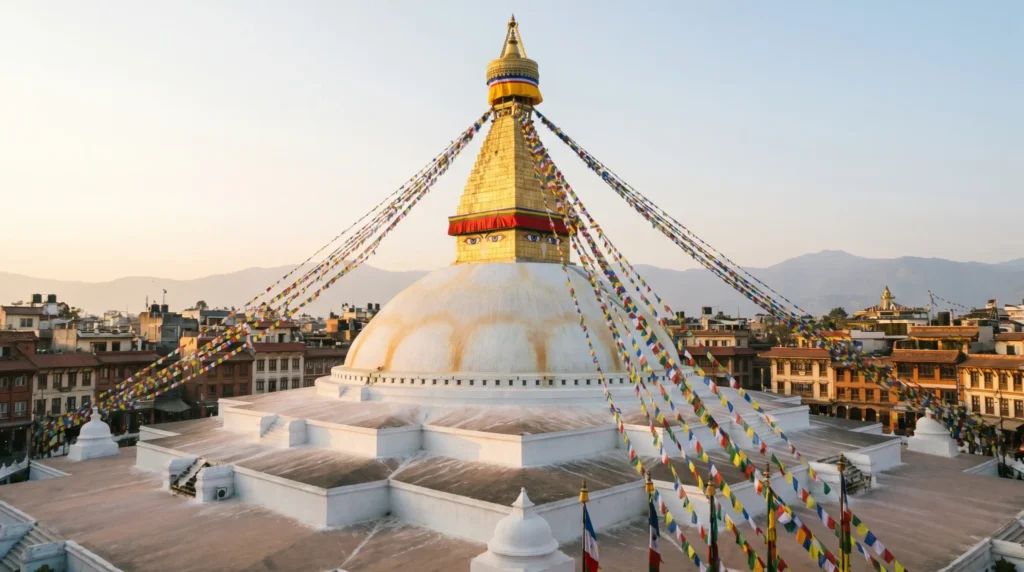
The scale claims are blunt. The Kathmandu Valley was inscribed on the UNESCO World Heritage List in 1979 as a single property made up of seven monument zones — the Durbar Squares of Kathmandu (Hanuman Dhoka), Patan, and Bhaktapur, the Buddhist stupas of Swayambhunath and Boudhanath, and the Hindu temple complexes of Pashupatinath and Changu Narayan. Boudhanath is one of the largest stupas in the world and the most important Tibetan Buddhist site outside Tibet, dating to around the fifth century. Nepal welcomed 1,147,567 foreign tourists in 2024 — a 13 percent rebound on the previous year — and almost every one of them passed through Kathmandu, the country’s only major international gateway.
The contradiction underneath those numbers is what makes Kathmandu worth several days rather than a single pre-trek overnight. This is at once a living medieval city and a chaotic modern capital: a 17th-century pagoda can sit a five-minute walk from a tangle of motorbike traffic and dust, and a centuries-old courtyard shrine can open onto a lane of trekking-gear shops and German bakeries. The 2015 earthquake damaged many of the valley’s monuments, and the long, visible work of restoration is part of what you see today — scaffolded temples standing beside freshly rebuilt ones, a city actively repairing its own heritage.
Kathmandu runs at a density of the sacred that few cities match: thousands of temples and shrines, the cremation ghats of Pashupatinath where Hindu funerary rites play out in the open beside the Bagmati River, the dawn kora of maroon-robed monks and Tibetan pilgrims circling Boudhanath, and the hilltop Buddha eyes of Swayambhunath gazing out over the rooftops. It is also the staging ground for the country’s adventure tourism — the trailhead-by-air for the Everest and Annapurna regions, and the place where every expedition is provisioned, permitted, and celebrated on return.
This guide covers the neighbourhoods that define the city from the medieval old town to backpacker Thamel and the Tibetan quarter at Boudha, the food scene behind momos, dal bhat, and Newari feasts, the UNESCO sights from the Durbar Squares to the great stupas, the day trips that turn Kathmandu into a base camp for the valley and the mountains beyond, and the transit, budget, monsoon, altitude, and earthquake-recovery details that first-time visitors need to plan a trip in any season.

Neighborhoods: Finding Your Kathmandu
📍 Kathmandu Map: Every Place in This Guide
Kathmandu reads less like one downtown than like a cluster of villages that grew into each other, and the fastest way to understand it is to think in three rough rings. The medieval core — the old city around Durbar Square, Asan, and Indra Chowk — is the dense brick-and-timber heart. Around it sit the traveller districts: backpacker Thamel to the north-west, the Tibetan-Buddhist quarter at Boudha to the east, and the temple town of Pashupati beside it. Beyond the river lie the sister royal cities of Patan and, further out, Bhaktapur. A willingness to switch between taxi, the occasional walk, and a great deal of patience with traffic will get you through all of the districts below.


Read the neighbourhoods below as a loose sweep from the medieval core outward through the traveller quarters to the sister cities across the river. Most visitors base themselves in or near Thamel for its concentration of hotels, trekking outfitters, and restaurants, and day-trip out to Boudha, Patan, and Bhaktapur; a quieter alternative is to stay at Boudha itself, waking to the dawn kora. Whichever base you choose, plan your days by geography rather than by checklist, because the valley’s traffic punishes back-and-forth crossings.
The Old City (Durbar Square, Asan & Indra Chowk)
The medieval heart of Kathmandu, laid out around the old royal palace of Hanuman Dhoka and threaded by trading lanes that have run for centuries from the Asan and Indra Chowk markets. This is the Kathmandu of the imagination: brick temples leaning over narrow streets, courtyards hidden behind carved wooden doorways, vegetable sellers and brass-shops spilling onto the cobbles, and the living temple of the Kumari, the city’s child goddess. It is loud, dusty, and crowded, and parts still bear the scaffolding of post-earthquake repair, but it is where the city’s history is most legible. Come early, walk slowly, and look up — the best carving is often on the upper struts of the temples.
- Kathmandu Durbar Square (Hanuman Dhoka) and the Kumari Ghar
- Asan Tole, the old city’s busiest market crossroads
- Indra Chowk and the lanes of brass, beads, and textiles
Best for: history, photography, market wandering. Access: a short walk south-east of Thamel; taxis drop at the square’s edge.
Thamel
The dense traveller district north-west of Durbar Square — a warren of trekking-gear shops, guesthouses, bars, bookshops, and restaurants that has been the launch pad for Himalayan expeditions for half a century. Thamel is where you provision a trek, change money, book a guide, and eat your first and last proper meal in Nepal. It is touristy and at times chaotic, with touts, rickshaws, and motorbikes competing in the lanes, but it is also unbeatably convenient and, after dark, the centre of the city’s nightlife. The recent pedestrianisation of some core streets in the evenings has made it markedly more pleasant to wander.
- Trekking and outdoor-gear shops (genuine and knock-off)
- Live-music bars, rooftop restaurants, and cafes
- The Garden of Dreams, a restored Edwardian garden on Thamel’s edge
Best for: first-timers, trek prep, nightlife, food. Access: walkable; most hotels arrange airport pickup.
Boudha (Boudhanath)
The Tibetan-Buddhist quarter east of the centre, built in concentric rings around the giant white dome of the Boudhanath Stupa — the most atmospheric corner of the valley, especially at dawn and dusk when pilgrims walk the kora and butter lamps flicker in the monasteries. The neighbourhood is home to a large Tibetan refugee community and dozens of gompas (monasteries), and its rooftop cafes give you the rare chance to sit at eye level with the stupa’s painted eyes. Staying here trades Thamel’s buzz for a calmer, more contemplative base within a short taxi ride of Pashupatinath.
- Boudhanath Stupa and the surrounding kora path
- Tibetan monasteries and thangka-painting schools
- Rooftop cafes overlooking the dome
Best for: Buddhist culture, quiet mornings, photography. Access: ~7 km east of Thamel; taxi or arranged transfer.
Pashupati
The sacred Hindu quarter on the banks of the Bagmati River around the Pashupatinath temple complex, the holiest Shiva shrine in Nepal and one of the most important in the Hindu world. The riverside ghats here are working cremation sites, where funerary rites unfold in the open beside the water; sadhus (ascetics) in ochre robes and ash gather in the precinct, and the area is busiest at the Maha Shivaratri festival. It is a place to visit with great respect and a quiet camera; the inner temple is open only to Hindus, but the views from the terraces opposite are extraordinary.
- Pashupatinath temple and the riverside cremation ghats
- The sadhus and ascetics of the temple precinct
- The hillside shrines and Mrigasthali deer park across the river
Best for: Hindu pilgrimage, ritual, photography (respectfully). Access: adjacent to Boudha, ~5 km east of the centre.
Patan (Lalitpur)
The sister royal city immediately south across the Bagmati, often considered the artistic capital of the valley and home to the finest of the three Durbar Squares. Patan is a Newari craft city, famous for its bronze-casters, wood-carvers, and silversmiths, and its compact Durbar Square — a tight ensemble of stone Krishna temples and the superb Patan Museum — is the most rewarding to linger in. The surrounding lanes hide Buddhist courtyards (bahals) and the Golden Temple, and the city has a slower, more residential feel than Kathmandu proper.
- Patan Durbar Square and the Patan Museum
- The Golden Temple (Hiranya Varna Mahavihar)
- Workshops of metalworkers and wood-carvers
Best for: crafts, museums, Newari architecture. Access: ~5 km south; taxi across the river.
Bhaktapur
The best-preserved of the three medieval cities, ~13 km east of Kathmandu, where a paid heritage-entry system has helped keep traffic out and the brick squares intact. Bhaktapur feels like a step back several centuries: pottery squares where potters still throw by hand in the sun, the towering five-storey Nyatapola temple, and the Durbar Square with its 55-window palace and Golden Gate. It is far calmer than central Kathmandu and rewards an unhurried half-day or, better, an overnight to see the squares empty at dawn.
- Bhaktapur Durbar Square and the 55-Window Palace
- Taumadhi Square and the five-storey Nyatapola temple
- Pottery Square, where potters still work by hand
Best for: medieval atmosphere, pottery, photography. Access: ~13 km east; taxi or local bus (heritage entry fee applies).
Lazimpat, Lainchaur & the Embassy Belt
The leafier, more upmarket strip north of Thamel, where many embassies, mid-range and boutique hotels, and quieter restaurants cluster along Lazimpat road. It is an easy walk or short ride from Thamel but several degrees calmer, and it suits travellers who want comfort and good cafes without the backpacker buzz. The neighbouring Naxal and Durbar Marg areas hold the city’s smartest shopping and dining, including the former royal palace (now the Narayanhiti Palace Museum).
- Boutique and business hotels along Lazimpat
- The Narayanhiti Palace Museum
- Durbar Marg’s upscale shops and restaurants
Best for: comfort, quiet, mid-range and upscale stays. Access: just north of Thamel; walkable or a short taxi.
How the Valley Fits Together
It helps to picture the valley as a wheel. At the hub sits the old city, the medieval Kathmandu of Durbar Square and the Asan lanes, with Thamel pressed against its north-western edge as the traveller annexe. Spokes run outward from there: east to Boudha and Pashupati, which sit close enough together to pair in a single half-day; south across the Bagmati to Patan, the artistic sister city; west up the hill to Swayambhunath, the valley’s oldest stupa and its best panorama; and further east to Bhaktapur, the most complete of the three medieval cities and far enough out to deserve its own day. The genius of this layout, and its frustration, is that almost everything you came to see lies within ten or fifteen kilometres of your hotel — yet the valley’s congested, single-lane roads can turn a five-kilometre hop into a forty-minute crawl at rush hour. The travellers who enjoy Kathmandu most are the ones who stop fighting this and lean into it: they walk the dense cores where cars cannot follow, they ride between districts in the quiet of mid-morning or early afternoon rather than the morning and evening crush, and they accept that the valley moves at the speed of its lanes rather than its map distances. Get the geography into your head on the first day and the rest of the trip flows; ignore it, and you will spend your holiday in the back of a taxi.
Kirtipur & the Valley Rim
For travellers with time, the older Newari settlements on the valley rim repay a half-day of exploration far from the tourist trail. Kirtipur, a hilltop Newari town on the south-western edge, preserves a quieter, more lived-in version of the brick-and-timber townscape you see polished up in the Durbar Squares, with working temples, weaving workshops, and wide views back across the valley. Further out, the rim villages and the ridge viewpoints — Nagarkot to the north-east, Champadevi and Chandragiri to the south-west — mark the edge of the bowl and the start of the hills, and on a clear morning they hand you the Himalaya. These are not first-day destinations, but they are where you go once you have seen the headline sites and want to understand how the valley’s people actually live, away from the trekking shops and the souvenir lanes.
- Kirtipur’s hilltop temples and weaving workshops
- Valley-rim viewpoints for the Himalaya panorama
- A quieter, more residential Newari townscape
Best for: off-trail wandering, panoramas, local life. Access: south-west of the centre; taxi or arranged transfer.
Where to Base Yourself
For a first visit, Thamel is the most logical base — it is central, walkable, and packed with the hotels, trekking outfitters, money-changers, and restaurants you will need before and after the mountains, and it puts the old city and Durbar Square within a ten-minute walk. Travellers who prize calm and a more spiritual atmosphere should consider Boudha, accepting a longer ride into the centre in exchange for dawns at the stupa. Those who want comfort without the buzz gravitate to Lazimpat and the embassy belt just north of Thamel, while anyone determined to wake among medieval brick squares can overnight in Bhaktapur or Patan. Wherever you land, plan your days by geography: cluster the old-city sights together, pair Boudha with Pashupati on the eastern side, and give Patan and Bhaktapur their own half- or full days, so you spend your time inside courtyards rather than stuck in cross-valley traffic. Keep a buffer for the unexpected — a festival road closure, a power cut, a slow taxi — because Kathmandu rewards travellers who treat the schedule as a sketch rather than a timetable.
The Food

Kathmandu eats at the crossroads of the Himalaya. At its heart is Newari cuisine, the indigenous food of the valley’s Newar people — a complex, festive tradition of buffalo, lentils, beaten rice, and fierce pickles that most visitors never look beyond momos to find. Layered on top are Tibetan and Sherpa staples carried down from the high country, the dal-bhat that fuels every trek, north-Indian restaurant food, and a whole ecosystem of banana-pancake trekker cafes in Thamel. Prices below are indicative and were current at the time of writing; treat them as ranges, not quotes.
Momos & Tibetan Staples
The momo — a steamed or fried dumpling of spiced buffalo, chicken, or vegetables served with a tomato-sesame achar — is the city’s defining street snack, carried down from Tibet and now utterly local. Pair it with thukpa, a hearty Tibetan noodle soup, on a cold valley evening.
- Momos (buff, chicken, or veg) — steamed or kothey (pan-fried), with jhol or sesame achar (NPR 120–300, ~$1–2.50)
- Thukpa & thenthuk — Tibetan noodle soups for a cold evening (NPR 200–400, ~$1.50–3)
- Tibetan bread & butter tea — the high-country breakfast, in Boudha’s Tibetan cafes (NPR 100–300, ~$0.80–2.50)
Newari Cuisine
The valley’s indigenous cuisine is its great hidden pleasure, built around buffalo, beaten rice (chiura), and a long list of spiced small plates eaten with raksi (millet spirit) or chhyang (rice beer). Seek out a samay baji platter to taste the tradition in one sitting.
- Samay baji — a ceremonial platter of beaten rice, marinated buff, soybeans, egg, and pickles (NPR 350–700, ~$2.50–5.50)
- Chatamari — the “Newari pizza,” a rice-flour crepe topped with minced meat or egg (NPR 150–350, ~$1–2.50)
- Bara & choila — a lentil patty and spiced grilled buffalo, classic festival food (NPR 200–450, ~$1.50–3.50)
Dal Bhat & Everyday Nepali
Dal bhat — rice, lentil soup, a vegetable curry, greens, and pickle — is the national meal, eaten twice a day by most Nepalis and famously refillable. It is the cheapest, most reliable, and most genuinely Nepali thing you can order, and the fuel of every trek.
- Dal bhat tarkari — the unlimited-refill national thali (NPR 250–600, ~$2–4.50)
- Sel roti — a ring-shaped sweet rice doughnut eaten at festivals (NPR 50–150, ~$0.40–1.20)
- Gundruk & dhido — fermented greens and a millet/buckwheat porridge, hill-country staples (NPR 200–400, ~$1.50–3)
Thamel’s Trekker Cafes & International Food
Decades of trekkers have given Thamel a dense layer of international cafes — wood-fired pizza, apple pie, espresso, and the famous “banana pancake” breakfasts — alongside steakhouses, Korean and Israeli kitchens, and bakeries. It is where to recover after the mountains, not where to find the real valley, but the best places are genuinely good.
- Wood-fired pizza & pasta — the classic post-trek splurge (NPR 500–1,200, ~$4–9)
- Bakeries & apple pie — cinnamon rolls, brownies, and espresso (NPR 200–600, ~$1.50–4.50)
- Steak & yak dishes — including water-buffalo and, occasionally, yak steak (NPR 600–1,500, ~$4.50–11)
Food Experiences You Can’t Miss
- A Newari food walk through the old-city lanes around Asan and Indra Chowk, tasting bara, chatamari, and juju dhau
- A samay baji platter with raksi at a traditional Newari bhojan ghar in Patan or Kirtipur
- Butter tea and Tibetan bread in a Boudha cafe overlooking the stupa kora
Where the Mountains Meet the Plains: Understanding Kathmandu’s Plate
To eat well in Kathmandu is to read the valley’s position on the map. From the north came the Tibetan and Sherpa kitchen — momos, thukpa, butter tea, tsampa — carried over the passes by traders and, later, refugees who settled around Boudhanath; from the south came the rice, lentils, and spice repertoire shared with the north-Indian plains; and at the centre sits the deep, festive Newari tradition that predates both and remains the truest taste of the valley. The smartest approach is to treat each meal as a chance to taste a different layer rather than chasing one definitive Kathmandu dish, because there isn’t one: a Tibetan breakfast in Boudha, a Newari lunch in Patan, and a dal bhat dinner anywhere will travel you across the whole Himalayan food map in a single day. The city also rewards curiosity over caution — the most memorable meals are rarely in hotel dining rooms but in the bhojan ghars and street-side momo counters where a single dish has been perfected over generations. Share plates, ask a local what they are eating, and do not let the wall of banana-pancake cafes in Thamel convince you that you have seen the city’s food. You have only seen what was built for visitors.
One practical note on prices and value: nearly everything in this section costs a fraction of what comparable food would in a Western capital, which means the usual budgeting instinct — trading down to save money — rarely applies. The best momos, the best dal bhat, and the best Newari samay baji are cheap precisely because they are everyday food made at volume by specialists, so chase reputation and queues rather than price. Where you do spend more — a sit-down Newari feast, a heritage-hotel dinner — you are paying for the setting and the service as much as the cooking. If you are nervous about street food on a first trip, a guided Newari food walk through the old city is the best on-ramp: a knowledgeable guide picks the hygienic, high-turnover stalls, orders the right dishes in the right sequence, and explains a cuisine that is almost invisible to outsiders. Go hungry, wear shoes you do not mind getting dusty, and treat the meal as the introduction to the lanes you will then explore on your own. Above all, arrive curious rather than cautious: a careful, well-guided introduction to Newari food is one of the great and least-expected pleasures of any visit to the valley.
A Day of Eating, Hour by Hour
Start in Boudha with a Tibetan breakfast — butter tea and Tibetan bread, or a bowl of tsampa — while the morning kora circles the stupa. Move into the old city for a mid-morning snack of freshly steamed momos or a chatamari griddled to order at a hole-in-the-wall counter around Asan. Lunch is the moment for dal bhat — the unlimited-refill national thali that will carry you through an afternoon of walking — or a Newari samay baji platter if you want to taste the valley’s own tradition. Take an afternoon break with sweet milky tea and a slice of juju dhau (Bhaktapur’s “king of yoghurt”) if you are out that way, then return to Thamel after dark for the trekker-cafe comforts — wood-fired pizza, a cold Gorkha beer, apple pie — or to a Newari bhojan ghar for choila, bara, and raksi. This rhythm spaces out the rich food and keeps you eating where each neighbourhood does its best work.
Festival Food & the Newari Feast
To understand Newari food properly you have to see it in its festival context, because this is a cuisine built around the feast. The bhoj — a ceremonial banquet that can run to dozens of small dishes — marks weddings, religious occasions, and the great valley festivals, and many of the dishes a visitor meets piecemeal (choila, bara, the spiced soybeans, the beaten rice) are really components of this larger ritual table. The samay baji platter that restaurants now serve year-round is a compressed, everyday version of that feast, designed to give you the whole spectrum — smoked and grilled buffalo, fermented and fresh, sweet and fiercely pickled — in a single sitting, washed down with raksi or chhyang. If your visit coincides with Dashain, Tihar, or Indra Jatra, the food becomes inseparable from the celebration: families slaughter and share meat, sel roti is fried in great rings, and sweets pile up in the markets. Even outside festival time, asking a Newari restaurant for the traditional set menu rather than ordering a la carte is the single best way to taste the depth of the valley’s own cuisine, and a knowledgeable host will walk you through the order in which the dishes are meant to be eaten.
Sweets, Drinks & the Tea Ritual
The valley’s sweet tradition runs to sel roti (the festival rice doughnut), the dense Newari juju dhau yoghurt set in clay pots in Bhaktapur, and the syrupy jeri-swari eaten for breakfast. For drinks, the everyday default is chiya — sweet, milky, spiced tea served in small glasses at every corner — while the valley’s own alcohol is raksi, a clear millet or rice spirit, and chhyang, a cloudy rice beer, both central to Newari feasts. Local lager (Gorkha, Everest, Nepal Ice) is cheap and widely drunk, and a serious independent coffee scene has taken root in Thamel, Jhamsikhel, and Patan, roasting beans grown in the Nepali hills. But the soul of the city’s drinking life is still the roadside tea glass, which costs a few rupees and comes with as much conversation as you want.
Vegetarian & Dietary Notes
Kathmandu is one of the easiest cities in the region to eat vegetarian: dal bhat is naturally meat-optional, a huge share of Hindu kitchens cook pure-veg, and the trekker cafes of Thamel cater fluently to vegetarian and vegan diets. Vegans should watch for ghee, paneer, curd, and butter tea, which appear widely; say “no dairy” clearly. Beef is essentially unavailable for religious reasons — the cow is sacred — so the red meat you will see is buffalo (“buff”), goat (khasi), and occasionally yak from the high country. Spice levels are negotiable; ask for “less spicy” if you are sensitive, and be aware that Newari pickles and choila can carry real heat.
Cultural Sights

Boudhanath Stupa
One of the largest stupas in the world and the most important Tibetan Buddhist monument outside Tibet, dating in its present form to around the construction of the great valley stupas in the early centuries CE. The dome is ringed by monasteries and rooftop cafes, and at dusk the kora — the clockwise circuit of pilgrims, prayer wheels turning — is the single most atmospheric experience in the valley. Modest entry fee for foreign visitors; come at dawn or dusk.
Swayambhunath (the Monkey Temple)
The valley’s oldest and most sacred Buddhist site, a hilltop stupa reached by a steep 365-step climb, its golden spire painted with the watchful Buddha eyes and surrounded by troops of resident monkeys. The platform offers the best panorama over the whole Kathmandu Valley. Modest entry fee; go early for soft light and fewer crowds.
Pashupatinath Temple
The holiest Hindu temple in Nepal, a sprawling Shiva complex on the banks of the Bagmati where open-air cremations take place on the riverside ghats. The inner temple is open only to Hindus, but the terraces opposite give an extraordinary, sobering view of Hindu funerary ritual. Modest entry fee for the complex; visit with great respect and a quiet camera.
Kathmandu Durbar Square (Hanuman Dhoka)
The medieval royal heart of the old city, a dense ensemble of pagoda temples, the old royal palace, and the Kumari Ghar — home of the living goddess. Several structures were lost or damaged in the 2015 earthquake and reconstruction continues, but the square remains the most evocative open-air museum of Newari architecture in the city. Foreign-visitor entry fee applies.
Patan Durbar Square
Widely regarded as the finest of the three Durbar Squares, a tight, beautifully preserved ensemble of stone Krishna temples and royal palace courtyards, home to the superb Patan Museum. The surrounding lanes hide Buddhist courtyards and the Golden Temple. Foreign-visitor entry fee (which includes the museum); the most rewarding square to simply linger in.
Bhaktapur Durbar Square & the 55-Window Palace
The best-preserved medieval square in the valley, where a paid heritage-entry system has kept traffic out and the brick intact — the 55-Window Palace, the Golden Gate, and the soaring Nyatapola temple a short walk away in Taumadhi Square. Heritage entry fee (valid several days); calmest at dawn before the day-trippers arrive.
The Garden of Dreams & Narayanhiti Palace Museum
For a change of register from temples and stupas, the Garden of Dreams — a restored neo-classical garden walled off from the chaos of Thamel — is the city’s most peaceful spot for a coffee, while the Narayanhiti Palace Museum, the former royal palace, opens the rooms where Nepal’s monarchy ended in 2008. Both charge modest entry; the Garden of Dreams is open late, the palace museum closes on Tuesdays and Wednesdays. Together they offer an easy, shaded half-day that balances the intensity of the religious sites.
Changu Narayan & the Older Layers
Beyond the headline stupas and squares, the valley holds the seventh of its UNESCO monument zones at Changu Narayan, a hilltop Vishnu temple north of Bhaktapur that is among the oldest Hindu shrines in Nepal, ringed by some of the finest early stone and metal sculpture in the country. It sees a fraction of the crowds of the central sites and pairs naturally with a Bhaktapur day. Together with Pashupatinath, the two great stupas, and the three Durbar Squares, it completes the set of seven zones that make the valley a single World Heritage property — a reminder that Kathmandu’s significance is the density and age of its monuments, not any one building.
Planning Your Sightseeing
The valley’s monuments divide neatly by geography, which is how you should plan them. Group Kathmandu Durbar Square and the old-city lanes into one morning on foot; pair Boudhanath and Pashupatinath, which sit close together on the eastern side, into a second half-day; and give Patan and Bhaktapur their own outings, since each rewards an unhurried few hours rather than a rushed stop. Almost every major site now charges a separate foreign-visitor entry fee, so carry cash in small notes and your passport, which some sites require for a multi-day or extension pass. Most sites open from early morning to dusk; the squares are at their best at dawn, before the tour groups and the heat, and Boudhanath is unmatched at the dusk kora. A licensed guide is genuinely worth it at the Durbar Squares and Pashupatinath, whose layers of myth, dynasty, and ritual are easy to walk past unread; a good guide turns a handsome pile of temples into a coherent story. Carry water and sun protection for the open squares, dress modestly at the Hindu and Buddhist sites, remove your shoes and leather where asked, and budget more time than you expect at Patan and Bhaktapur, both large enough to absorb a couple of unhurried hours. Reconstruction from the 2015 earthquake is ongoing at several monuments, so expect scaffolding at some structures and check which buildings are currently open before you go.
Entertainment

Thamel Nightlife & Live Music
Thamel is the city’s nightlife core, a dense grid of rooftop bars, live-music venues, and clubs that fills with trekkers, climbers, and locals once the shops close. Typical cost NPR 800–2,500 (~$6–19) for an evening with drinks and a band. Most venues wind down by around midnight under local rules.
The Dusk Kora at Boudhanath
The free, unforgettable evening “entertainment” of the valley is the dusk kora at Boudhanath — joining the slow clockwise circuit of pilgrims as butter lamps are lit and monks chant from the surrounding monasteries. Typical cost free (after the daytime entry fee). Arrive before sunset, walk clockwise, and keep your camera quiet and respectful.
Cultural Dance & Newari Feasts
Several restaurants and cultural houses stage nightly Nepali folk- and masked-dance performances paired with a Newari set-menu feast — a touristy but genuinely enjoyable window onto the valley’s dance traditions. Typical cost NPR 1,500–3,500 (~$11–27) including dinner. Book ahead for the dinner-and-show evenings.
Festivals as Spectacle
Kathmandu’s real entertainment is its festival calendar — chariot processions, masked dances, and night-long celebrations that turn the squares into open-air theatres. Typical cost free to watch. Time a visit to Indra Jatra, Dashain, or Tihar and the city itself becomes the show.
Coffee Houses, Bookshops & the Garden of Dreams
For a gentler evening, the cafe-and-bookshop culture of Thamel and Patan’s Jhamsikhel is a pleasure in itself, and the Garden of Dreams stays open into the evening for a quiet drink walled off from the street. Typical cost NPR 200–800 (~$1.50–6). A calm alternative to the bars for a slow night.
Cinema & the Arts
Kathmandu has a lively arts scene out of proportion to its size: contemporary galleries in Patan and around the old city, the Nepali-language and Bollywood cinemas of the New Road area, and a steady programme of film screenings, talks, and live gigs at venues and cafes around Thamel and Jhamsikhel. Typical cost NPR 200–1,000 (~$1.50–8). It is an easy, inexpensive way to spend a rain-bound monsoon afternoon, and a window onto a creative city most visitors rush past on their way to the mountains.
Casinos & Late Hotel Bars
One quirk of Kathmandu’s after-dark scene is its cluster of casinos, attached to several of the larger international hotels and historically popular with visitors from India, where casino gambling is more restricted. They run late and offer table games, slots, and live entertainment in a setting quite removed from the trekker bars of Thamel. The big hotels also keep the city’s latest-running bars, useful if you want a quiet, comfortable drink after the Thamel venues wind down around midnight. Neither is the reason to come to Kathmandu, but both fill the gap for travellers who want a later or more polished night than the backpacker district provides, and the hotel bars in particular are a calm spot to plan the next day’s sightseeing over a nightcap.
How Kathmandu Goes Out
Kathmandu’s nightlife is concentrated, early, and far more about live music and good company than late clubbing. The centre of gravity is Thamel, where rooftop bars and live-music venues run sets of Nepali folk-rock, blues, and covers to a mixed crowd of travellers and locals, but most places wind down around midnight under local licensing, so the night peaks earlier than visitors from Europe or East Asia might expect. The scene splits by district: Thamel for the trekker-bar buzz, Patan’s Jhamsikhel (“Jhamel”) for a more grown-up cafe-and-cocktail crowd, and Boudha for the quiet, spiritual evening of the kora and butter-lamp light. Whatever you choose, the practical rules are the same: pre-book your ride home through the Pathao or InDrive apps or have your hotel arrange a taxi, carry small notes, and remember that power cuts, while far rarer than they once were, can still dim a venue without warning. For a more cultural evening that sidesteps the bar scene entirely, a dinner-and-dance show or simply the dusk kora at Boudhanath offers a window onto the valley’s living traditions that most nightlife never touches. Check festival dates before you travel, because timing a visit to Indra Jatra or Tihar turns the whole city into a night-time spectacle no bar can match.
Day Trips

Bhaktapur (~13 km / 45 min by taxi)
The best-preserved medieval city in the valley rewards a full day or, better, an overnight: pottery squares where potters still throw by hand, the five-storey Nyatapola temple, the 55-Window Palace, and the famous juju dhau yoghurt. A heritage entry fee keeps the brick squares traffic-free and intact. Go early or stay over to see the squares empty at dawn.
Nagarkot (~32 km / 1h 30m by taxi)
A ridge-top village northeast of the valley famous for its dawn Himalaya panorama — on a clear autumn or winter morning the view runs across the Langtang range and, in the far distance, toward Everest. Stay overnight for the sunrise; the daytime view is often hazier. Best October–December for clear skies.
Patan / Lalitpur (~5 km / 30 min by taxi)
The valley’s artistic capital, just across the Bagmati, with the finest Durbar Square, the superb Patan Museum, and a living tradition of bronze-casting and wood-carving in its courtyards. An easy half-day, or a full day if you fold in the Newari food. Quieter and more residential than Kathmandu proper.
Dhulikhel & Namobuddha (~30 km / 1h 30m by taxi)
A Newari hill town with a wide mountain panorama and gentle walking trails, paired with the hilltop Namobuddha monastery, one of the most important Tibetan Buddhist pilgrimage sites in Nepal. A scenic walk links the two. Best as a relaxed full day with a packed lunch.
Chandragiri Hills & the Cable Car (~16 km / 1h to the base)
A cable car climbs from the valley rim to a 2,550-metre ridge with a temple, a panoramic deck, and short forest walks — an easy, family-friendly half-day with a big view on a clear morning. Buy the cable-car ticket at the base; go early before cloud builds.
The Trailheads: Where the Treks Begin
For many visitors the most important “day trip” from Kathmandu is the journey out to the trailheads: the drive or short flight to Pokhara for the Annapurna circuits, the dramatic mountain flight or long drive to Lukla for Everest Base Camp, and the road north to the Langtang valley. None of these is a true single-day round trip, but Kathmandu is where every trek is organised, permitted, and provisioned, and a day spent arranging permits (TIMS and the relevant conservation-area card) and gear in Thamel is part of the experience. Book domestic flights and permits through reputable, licensed operators.
How to Choose & Book
The single most important decision for any Kathmandu day trip is taxi versus organised tour. For the close valley sites — Patan, Bhaktapur — a metered or pre-agreed taxi is the simplest choice, and is inexpensive by international standards; agree the round-trip fare and waiting time in writing before you set off. For the ridge viewpoints — Nagarkot, Dhulikhel, Chandragiri — a hired car with a driver for the day (roughly NPR 5,000–9,000, ~$38–68 including fuel and the driver’s time) removes the hassle of connections and lets you chase the clear morning light, which is everything for the mountain views. Always leave at first light: the Himalaya is reliably visible at dawn and routinely vanishes behind cloud and haze by mid-morning, so a sunrise start is the difference between a life-list panorama and a grey wall. Confirm each site’s entry fee and opening days, carry cash in small notes, and build in buffer time for the valley’s slow, congested roads. If you only have time for one trip, make it Bhaktapur for the medieval squares; if you have two, add a Nagarkot sunrise overnight. And resist the temptation to cram three ridge viewpoints into one day — the roads are slow and the reward is the early light, not the distance covered.
Seasonal Guide

Spring (March – May)
One of the two prime windows: March and April bring mild days (15–28°C), rhododendron bloom in the hills, and generally clear mornings, though dust and pre-monsoon haze build by May and afternoon temperatures climb. A fine time for the valley and the lower treks.
Summer / Monsoon (June – September)
The monsoon brings warm, humid days, heavy afternoon downpours, leeches on the trails, and frequently cloud-hidden mountains. It is the cheapest and least crowded season, the valley turns lush and green, and the rain-shadow regions (Mustang, Dolpo) stay trekkable. Pack for rain and accept that mountain views are rare.
Autumn (October – November)
The peak season and the best of the year: the monsoon clears to leave crisp, clean air, mild days (15–25°C), and the sharpest Himalaya views, all coinciding with the great festivals of Dashain and Tihar. The downside is crowds and higher prices on the popular treks; book ahead.
Winter (December – February)
Cold but often brilliantly clear in the valley (highs 10–19°C, near-freezing nights), with the year’s sharpest mountain panoramas on still mornings. High passes and the Everest/Annapurna base camps are snowbound and cold; the valley sights and lower walks remain perfectly doable with warm layers. Morning fog and haze can occasionally dull the views.
When Should You Actually Go?
The honest answer for most visitors is October to November, with March to April a close and slightly warmer second. Autumn delivers the trifecta — clean post-monsoon air, mild temperatures, and the year’s clearest Himalaya, all wrapped around the two biggest festivals, Dashain and Tihar — which is exactly why it is also the busiest and priciest season on the popular trekking routes, so book flights, permits, and teahouses well ahead. Spring is the relaxed alternative: warm, colourful with rhododendron bloom, and quieter, at the cost of more haze and dust as the pre-monsoon heat builds. Winter rewards the cold-tolerant with the sharpest valley-floor mountain views of the year and almost no crowds, though the high passes are snowbound; pack serious layers for the near-freezing nights. The monsoon is for budget travellers and those happy to gamble on the weather: prices crater and the valley turns green, but the mountains hide behind cloud for days and the trails turn muddy and leech-ridden. Whatever the season, plan mountain-view outings for the first hours after dawn, when the Himalaya is reliably clear before cloud and haze build through the day, and always check the forecast before locking in a Nagarkot sunrise or a mountain flight.
Getting Around

Taxis
Metered taxis are the default for visitors, though drivers rarely use the meter — agree the fare before you get in, or use a ride app to lock the price. Short hops across central Kathmandu run roughly NPR 300–700 (~$2.50–5.50); have small notes ready, as drivers seldom carry change.
Ride Apps (Pathao & InDrive)
The Pathao and InDrive apps work well in Kathmandu for both car and motorbike rides, fixing the price in advance and removing the haggle that defeats many first-time visitors. They are usually cheaper than a street-hailed taxi and give you a GPS trail. Download and set up a payment method before you arrive.
Local Buses & Microbuses
Kathmandu’s public transport is a dense, cheap, and chaotic network of buses, minibuses, and microbuses (fares from around NPR 20) that locals rely on, but routes are unmarked, vehicles are crowded, and Nepali is essential to navigate them — most visitors skip them in favour of taxis and ride apps. A growing fleet of electric “Sajha” buses runs some main corridors more comfortably.
Airport Access
- Tribhuvan International Airport (KTM) sits ~6 km east of Thamel; a pre-paid or hotel-arranged taxi runs ~NPR 800–1,500 (~$6–11) and 30–60 min depending on traffic
- Use the airport pre-paid taxi counter or a pre-arranged hotel pickup rather than the touts in arrivals
Motorbike & Scooter Rental
Renting a scooter or motorbike is popular for getting around the valley and out to the ridge viewpoints, with rentals widely available in Thamel. It demands confidence in dense, assertive traffic and a valid licence (an International Driving Permit is expected); helmets are compulsory. Inspect the bike, photograph any damage, and confirm the insurance before you ride.
Walking & Realistic Expectations
Kathmandu is a walking city at the neighbourhood scale and a frustrating one across town. The dense old-city core — Thamel, Asan, Durbar Square — is best explored entirely on foot, where lanes too narrow for cars hide the city’s real life; the same is true of Boudha, Patan’s core, and Bhaktapur. But pavements are uneven or missing, the traffic is heavy and assertive, the air can be dusty, and cross-valley distances are long, so the winning strategy is to ride between districts and then explore each one on foot. Build in generous buffer time for any cross-town journey, because valley traffic is congested and unpredictable, worst in the morning and evening rush. There is no metro, tram, or commuter rail in the valley, so unlike many Asian capitals there is no fast underground alternative to the surface traffic; your only levers are timing your trips outside rush hour and choosing a base close to the sights you most want to see. A pair of comfortable, sturdy shoes is genuinely the most important piece of transport kit you can pack.
Navigation Tips
Apps: Google Maps, Maps.me, and the Pathao/InDrive ride apps. Download an offline map, since signal drops in the old-city lanes, and save your hotel’s name and a nearby landmark in your phone to show drivers, as street numbering is inconsistent and most navigation is by landmark. Carry small notes for taxis and the inevitable cash-only ride, keep the ride apps installed with a payment method loaded, and budget generous time for cross-city road trips. One more habit worth forming: confirm the fare or app price before every taxi ride, agree any waiting time for day trips up front, and keep a torch handy for the dimmer lanes and the occasional power cut.
Budget Breakdown: Making Your Rupee Count
| Tier | Daily | Sleep | Eat | Transport | Activities | Extras |
|---|---|---|---|---|---|---|
| Budget | NPR 2,500–4,000 (~$19–30) | NPR 800–2,000 hostel/guesthouse | NPR 500–1,000 momos & dal bhat | NPR 300–600 taxis/bus | NPR 500–1,000 site fees | NPR 300 SIM/water |
| Mid-Range | NPR 6,000–14,000 (~$45–105) | NPR 3,500–8,000 3-star hotel | NPR 1,500–3,500 restaurants | NPR 800–1,800 ride apps | NPR 1,200–2,500 tours | NPR 600 tips/extras |
| Luxury | NPR 25,000+ (~$190+) | NPR 14,000+ heritage/5-star | NPR 4,000+ fine dining | NPR 5,000+ car & driver | NPR 4,000+ private guide | NPR 2,500+ spa/shopping |
Where Your Money Goes
Kathmandu is one of the cheapest capitals in Asia for food and local transport: a plate of momos can cost under NPR 250 (~$2) and a cross-town taxi under NPR 700 (~$5.50). The big variables are accommodation, which spans NPR 800 hostel dorms to heritage-hotel suites, and the foreign-visitor entry fees at the major monuments and Durbar Squares, which add up quickly across a sightseeing-heavy day.
Sample Daily Budgets
To make the table concrete: a shoestring traveller sleeping in a Thamel guesthouse, eating dal bhat and momos, riding taxis sparingly, and seeing two or three sites can run a comfortable day on around NPR 3,000–3,500 (~$23–27), with the monument entry fees being the single biggest line item. A mid-range traveller in a clean three-star hotel, mixing ride-app trips with walking, eating in proper restaurants, and taking the occasional guided walk or day trip, should plan for NPR 8,000–12,000 (~$60–90) a day. At the luxury end — a heritage or five-star hotel, a private car and driver, fine dining, and a personal guide — NPR 28,000–45,000 (~$210–340) a day is realistic and still strong value compared with a Western capital. The biggest swing factor is always accommodation; food and local transport stay cheap across all tiers. A few costs are easy to forget when budgeting: the foreign-visitor entry fees (typically NPR 1,000–1,800 each at the major squares and stupas) add up across a busy day, a prepaid tourist SIM and bottled water are small but daily, and any trek sits entirely outside these figures — allow separately for permits (TIMS plus the relevant conservation-area card), guides, porters, and domestic flights. Travel insurance with helicopter-evacuation cover is essential for any trekking and worth penciling in from the start.
Money-Saving Tips
- Eat where the locals eat: a dal bhat or a plate of momos at a busy local kitchen beats a Thamel tourist cafe on both price and authenticity, and a full meal can cost under NPR 400 (~$3)
- Use the Pathao and InDrive ride apps for fixed, fair prices instead of negotiating with street taxis, and share rides where you can
- Carry small notes (NPR 10/20/50/100) for taxis, tips, tea, and site fees — drivers and vendors rarely have change for large bills
- Budget for the monument entry fees in advance and cluster nearby sites on the same day; balance ticketed monuments with free experiences like the Boudhanath kora and the old-city lanes
- Change money at licensed exchanges (rates beat the airport), withdraw from bank ATMs, and avoid changing on the street
- Walk the dense old-city cores and the Boudhanath kora rather than riding short hops, and time any cross-town taxi outside the morning and evening rush when traffic doubles your travel time and, with metered fares, your fare
Practical Tips
Language
Nepali is the official language and Newari is widely spoken in the valley, but English is spoken across hotels, restaurants, trekking outfitters, and tourist sites — you can travel comfortably on English alone. A few words of Nepali (namaste, dhanyabaad, kati ho) are warmly received.
Cash vs. Cards
Cards are accepted at hotels, larger restaurants, and trekking agencies, but cash is essential for taxis, momo counters, small shops, site fees, and anything outside the city. Carry NPR 2,000–4,000 in small notes per day, change money at licensed exchanges, and withdraw from bank ATMs (which charge a per-withdrawal fee).
Safety
Kathmandu is broadly safe for tourists, with petty scams (overcharging, fake trekking guides, gem and trinket touts) the main hazard rather than violent crime. Watch traffic carefully as a pedestrian, keep valuables close in crowded markets, and use only licensed, registered trekking operators. Solo women should take normal night-time precautions.
What to Wear
Dress modestly — shoulders and knees covered — especially at temples and stupas; carry a scarf for religious sites. Light layers for warm days and cool evenings, a warm jacket for winter and any high-altitude trip, and comfortable closed shoes for dusty, uneven lanes and temple steps.
Cultural Etiquette
Walk clockwise around stupas and shrines, remove shoes and leather before entering temple interiors, and use your right hand for eating and giving. Ask before photographing people and ritual, especially at Pashupatinath’s cremation ghats. The cow is sacred and beef is taboo; public displays of affection are frowned upon.
Connectivity
Buy a prepaid tourist SIM (Ncell or Nepal Telecom) at the airport or an official store with your passport and a photo; data is cheap and 4G covers the valley well. Wi-Fi is common in hotels and cafes. Mobile coverage thins quickly on the high treks, so do not rely on it in the mountains.
Health & Altitude
Drink only sealed bottled, boiled, or filtered water, including for brushing teeth, and ease into street food. Kathmandu sits at ~1,400 m, low enough to be comfortable, but any trek climbs fast — learn the signs of altitude sickness, ascend gradually, and carry comprehensive travel insurance that explicitly covers high-altitude trekking and helicopter evacuation. Air quality can be poor in the dry winter and dusty pre-monsoon weeks; sensitive travellers should carry a mask.
Visas & Arrival
Most nationalities can get a visa on arrival at Tribhuvan International Airport in 15-, 30-, or 90-day tiers, paid in cash (US dollars are easiest) — bring a passport photo, or use the airport kiosks, and check the latest fees and eligibility on the official immigration portal before you fly. At the airport, use the pre-paid taxi counter or a pre-arranged hotel pickup rather than touts, and consider buying your SIM and changing a small amount of cash before leaving the terminal.
Tipping & Money Etiquette
Tipping is appreciated but not rigid: round up or add about 10% in restaurants that do not already add a service charge, tip trekking guides and porters generously at the end of a trip (this is expected and a meaningful part of their income), and keep small notes for the constant small transactions of a Kathmandu day. Bargaining is expected in the Thamel souvenir shops and with street-hailed taxis but not in fixed-price stores or restaurants; negotiate with good humour and be prepared to walk away, which is often the most effective tactic. The ride-app price gives you a fair benchmark to negotiate taxi fares against. A confident, friendly “no, thank you” defuses most persistent touts without rudeness.
Power Cuts & Practicalities
Scheduled blackouts (“load-shedding”) are far rarer than they once were, but unplanned cuts still happen, so carry a power bank and a small torch; better hotels have backup generators. Tap water is not potable; bottled, boiled, or filtered only.
Frequently Asked Questions
How many days do I need in Kathmandu?
Three full days is the realistic minimum to see the valley without rushing: one for the old city and Kathmandu Durbar Square, one for Boudhanath and Pashupatinath on the eastern side, and one split between Patan and Bhaktapur. Add a fourth day for a Nagarkot sunrise overnight or a valley day trip, and remember that Kathmandu is also where you arrange and provision any trek, which can absorb an extra day of permits and gear.
Is Kathmandu good for solo travellers?
Yes — it is one of Asia’s easiest cities for solo and first-time travellers. Thamel is full of budget accommodation, trekking outfitters, and other travellers, English is widely spoken, and the trekking culture makes it simple to find groups and guides. Petty scams rather than violent crime are the main risk; use licensed operators, agree taxi fares in advance, and take normal night-time precautions. Solo women travel widely here, with sensible caution after dark.
Do I need to pay entry fees at the sights?
Yes. Almost every major monument and Durbar Square charges a separate foreign-visitor entry fee (typically NPR 1,000–1,800), payable in cash, and these are the single biggest sightseeing cost across a busy day. Carry small notes, keep your passport handy for multi-day or extension passes at the Durbar Squares, and budget for the fees in advance; balance them with free experiences like the Boudhanath kora and the old-city lanes.
What about the language barrier?
It is minimal in the tourist areas. Nepali is the official language and Newari is widely spoken in the valley, but English is spoken across hotels, restaurants, trekking agencies, the main sights, and ride apps, so you will not need Nepali to get around. A few polite phrases (namaste, dhanyabaad) are warmly received, and saving your destination and a nearby landmark to show taxi drivers helps with navigation.
When is the best time to visit?
October to November is the peak window — clean post-monsoon air, mild days, and the sharpest Himalaya views, coinciding with the Dashain and Tihar festivals — with March to April a warmer, quieter second choice. Winter is cold but often brilliantly clear in the valley, while the June–September monsoon is cheap and green but hides the mountains behind cloud. Plan mountain-view outings for the hours just after dawn in any season.
Can I use credit cards everywhere?
No — Kathmandu is still substantially a cash economy. Cards are accepted at hotels, larger restaurants, and trekking agencies, but taxis, momo counters, small shops, and monument ticket counters want cash. Carry NPR 2,000–4,000 in small notes per day, change money at licensed exchanges (rates beat the airport), and withdraw from bank ATMs, which charge a per-withdrawal fee.
Is the tap water safe?
No — do not drink Kathmandu tap water, and use sealed bottled, boiled, or filtered water even for brushing teeth. To avoid stomach trouble, skip ice in roadside drinks, eat at busy momo and dal-bhat counters with high turnover, favour freshly cooked hot food, and ease into street food over your first couple of days rather than going all-in on arrival. Carry hand sanitiser, since you will often eat with your hands.
How do I get from the airport into the city?
Tribhuvan International Airport sits about 6 km east of Thamel. The simplest options are the airport’s official pre-paid taxi counter or a pre-arranged hotel pickup, which run roughly NPR 800–1,500 (~$6–11) and 30–60 minutes depending on traffic; avoid the touts in the arrivals hall. There is no airport metro or train. Buy your SIM and change a little cash before leaving the terminal, and confirm any pickup with your hotel in advance.
Do I need a visa, and how do I get one?
Most nationalities can get a visa on arrival at Tribhuvan in 15-, 30-, or 90-day tiers, paid in cash (US dollars are easiest), using the airport kiosks; bring a passport photo to speed things up. Check the latest fees and eligibility on the official Nepal immigration portal before you fly, since rules change, and have the cash ready on arrival rather than relying on the airport ATMs, which can be unreliable.
Is Kathmandu a good base for trekking?
It is the base for trekking in Nepal. Almost every major trek — Everest Base Camp, the Annapurna circuits, Langtang — is organised, permitted, and provisioned from Kathmandu, with Thamel packed with licensed agencies, guides, porters, and gear shops. Arrange your TIMS card and the relevant conservation-area or national-park permit through a registered operator before you set off, allow a day or two in the city to sort logistics, and carry travel insurance that explicitly covers high-altitude trekking and helicopter evacuation.
Ready to Experience Kathmandu?
Kathmandu rewards travellers who slow down to the speed of the valley and take it one monument zone at a time. Its seven UNESCO sites, the dusk kora at Boudhanath, and its role as the front door to every trek in Nepal make it both an unforgettable destination in its own right and the natural launch point for the high country. For the full country context — visa rules, regional routes, trekking seasons, and the broader cultural picture — read the Nepal Travel Guide before booking. Give the valley at least three full days, time your visit to autumn or spring for clear Himalaya views, and arrange any trek through a licensed operator once you arrive.
Explore More City Guides
Where to Stay
Kathmandu hotels guide — backpacker bases and trekking guesthouses in Thamel, quieter mid-range and boutique stays in Lazimpat, and heritage hotels in Patan and around the old city.
- Delhi City Guide — the Indian capital and the most common overland and air gateway into Nepal, a short flight south
- Bangkok City Guide — Southeast Asia’s street-food and temple capital and a major hub for onward flights from Kathmandu
- Hanoi City Guide — Vietnam’s old-quarter capital, another classic stop on a wider Asia itinerary
- Nepal Country Guide — national context for visas, regional routes, trekking seasons, and the bigger cultural picture
- All City Guides
More city guides you might like
Plan your trip to Kathmandu
The booking tools we use ourselves. FFU may earn a commission at no extra cost to you.
Plan & book your trip to Kathmandu
Booking through these searches supports our guides at no extra cost to you.