
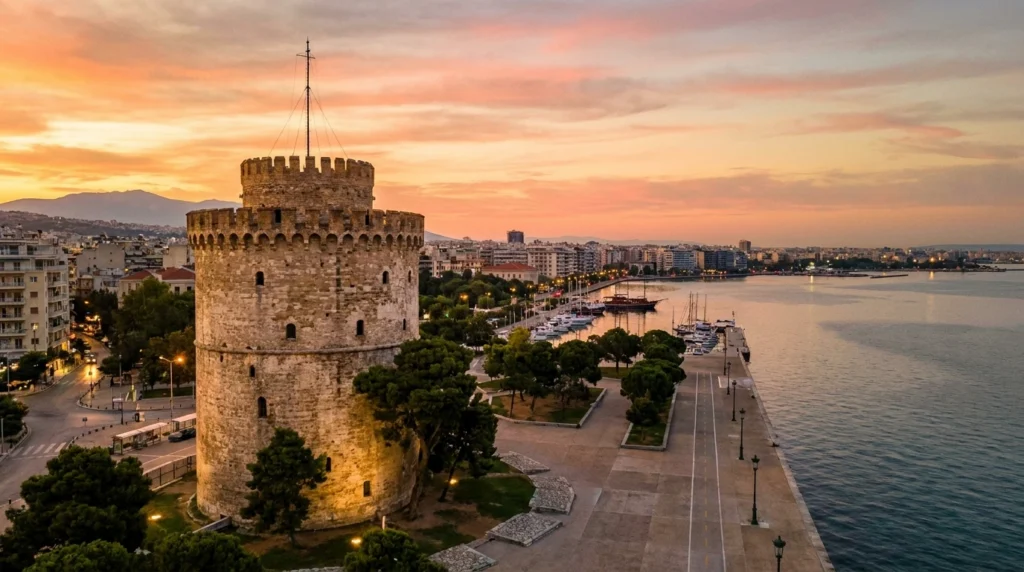
Thessaloniki, Greece: The Byzantine Soul of the North
I came to Thessaloniki expecting a quick stopover and left rearranging my entire idea of Greece. We had budgeted two nights and stayed five, because the city kept handing me reasons — a breakfast bougatsa eaten standing on a market stool, a Roman rotunda turned church turned mosque turned monument, a waterfront sunset behind the White Tower with half the city out walking it. This is Greece’s second city, the capital of Macedonia, and it wears two thousand years of Greek, Roman, Byzantine, Ottoman and Sephardic history without ever feeling like a museum. For the wider Greek context — the euro, the islands, the seasons — read our Greece travel guide. What follows is everything I wish I had known before my first morning on the Nea Paralia.
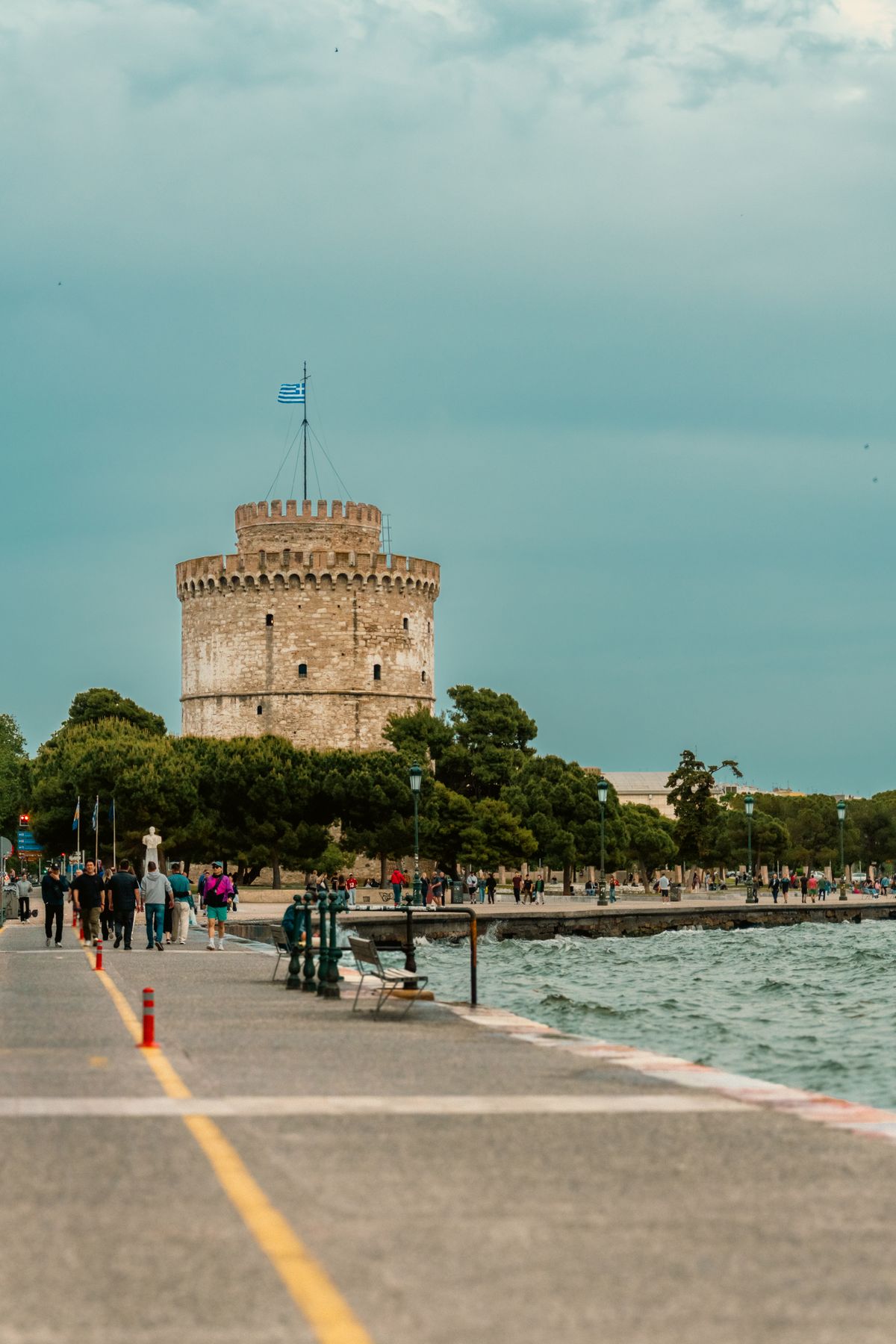
Table of Contents
Why Thessaloniki?
Thessaloniki is the city Greece keeps to itself. While the cruise crowds funnel through Athens and the islands, Greece’s second city gets on with being a real metropolis — a working port, a university town, a waterfront where locals walk every evening, and the unofficial food capital of the country. It was founded in 315 BC by Cassander of Macedon, who named it after his wife Thessalonike, the half-sister of Alexander the Great . Twenty-three centuries later that founding name still sits on the road signs.
It is a city of layers laid one atop another. Around 319,045 people live within the municipality and just over a million across the metropolitan area , yet the historic core you actually walk is compact and entirely on foot. A Roman emperor’s rotunda stands a few streets from an Ottoman bathhouse; a Byzantine church sits beside a Belle Époque arcade; the upper town’s medieval walls look down on a thoroughly modern seafront. Few European cities stack their history so visibly or so casually.
What pulls travellers back, though, is the texture of daily life. This is Greece’s great gastronomic city — the home of bougatsa, the spiritual capital of meze and tsipouro — and a place where the simple act of eating becomes the main event. Add a 15-monument UNESCO ensemble of Paleochristian and Byzantine architecture , the symbol-of-the-city White Tower, and a waterfront promenade made for aimless walking, and you have a city break that earns several days rather than the single afternoon most itineraries grant it.
History here is not behind glass — it is structural. Thessaloniki was the Roman empire’s second city in the eastern Mediterranean, a Byzantine metropolis second only to Constantinople, and for nearly five centuries an Ottoman city where the largest community was Sephardic Jewish, refugees welcomed from Spain after 1492. By the early twentieth century the city was so thoroughly Jewish that it was nicknamed the “Mother of Israel” and the port closed on Saturdays. The Great Fire of 1917 erased much of the centre and displaced 72,000 people , and the Holocaust destroyed a community of around 50,000 — only a tiny fraction survived . To walk the city is to read those chapters in its stones.
And it simply works as a city. Students from the largest university in the Balkans fill the cafés , the markets sell mountain cheese and barrel wine, and a brand-new driverless metro glides beneath two thousand years of ruins. You can spend a morning among fourth-century mosaics and an afternoon swimming off a Halkidiki beach an hour away. By the time you’ve watched the sun drop behind the White Tower with the whole city out walking the promenade, the question stops being “why Thessaloniki” and becomes “how did I not come here sooner.”
Neighborhoods: Finding Your Thessaloniki
📍 Thessaloniki Map: Every Place in This Guide
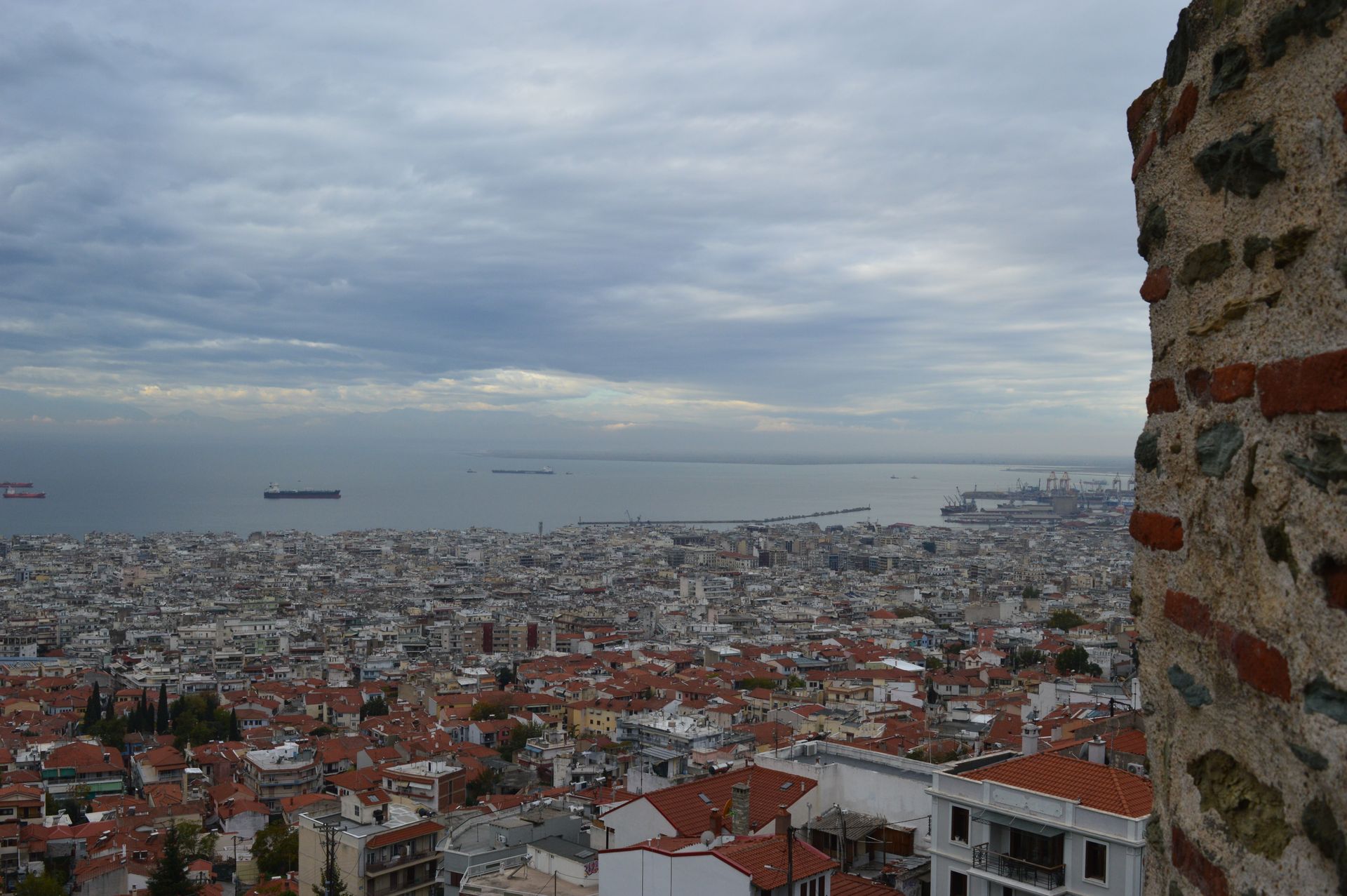
Thessaloniki reads as a long, narrow city pressed between the Thermaic Gulf and the wooded hills behind it, and where you base yourself shapes the whole trip. The waterfront and the centre around Aristotelous are the obvious choice for a first visit; the Ladadika warehouses and the markets carry the food and nightlife energy; the upper town of Ano Poli holds the Byzantine walls and the city’s oldest soul; and the university quarter and eastern seafront show you how locals actually live. Here is how to read each of them, and where you might choose to stay.
The Waterfront & Nea Paralia
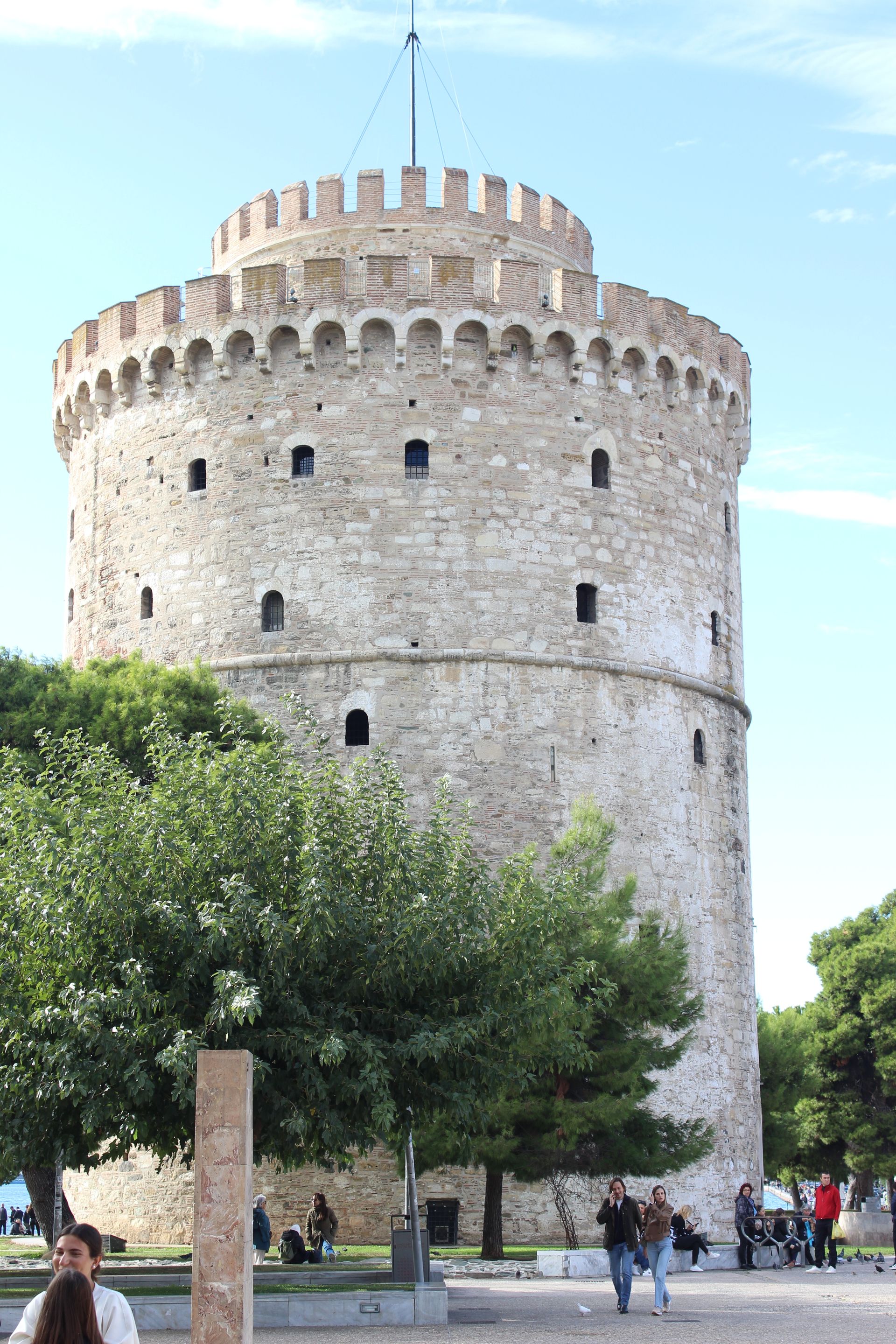
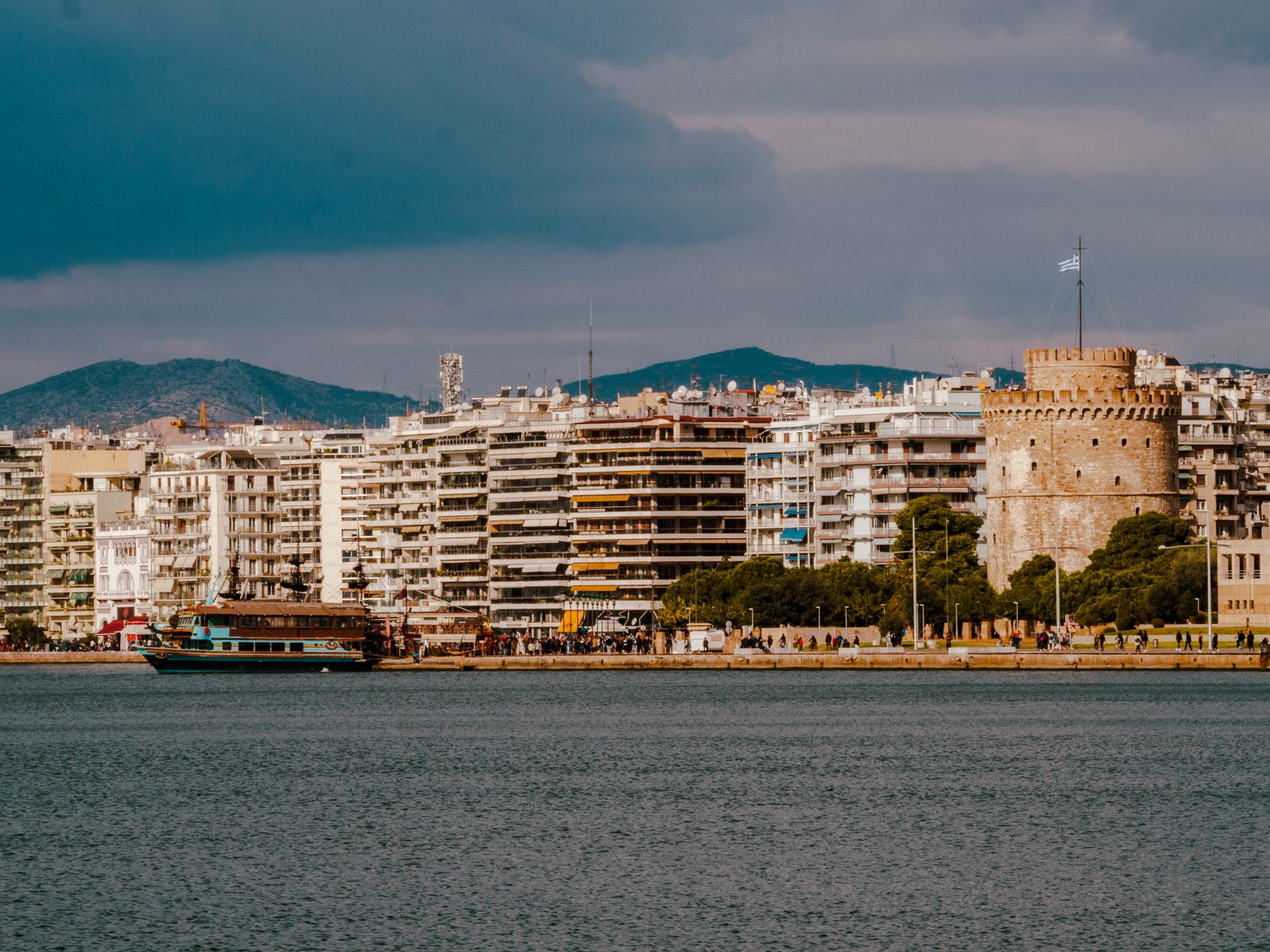
The seafront is Thessaloniki’s living room. The old promenade runs from the port to the White Tower, and beyond it the redesigned Nea Paralia — a 3.5 km landscaped seafront opened in 2014 and built around a sequence of themed “garden rooms” — is where the entire city comes to walk at dusk . This is where you’ll find the Umbrellas sculpture by George Zongolopoulos, a cluster of steel parasols that has become the second emblem of the city after the Tower, and a parade of joggers, cyclists, families and couples that does not let up until well after dark. Staying near here puts the best of Thessaloniki on your doorstep.
- The White Tower and its waterfront gardens
- The Umbrellas sculpture and the themed gardens of Nea Paralia
- Sunset views across the Thermaic Gulf toward Mount Olympus on a clear day
Best for: first-timers who want the sea and the sights within a short walk. Access: walkable from the centre; bus along the seafront, or a short ride on the new metro to the centre.
Basing yourself near the waterfront is the right call for a first visit of a few days. You’ll wake minutes from the Tower, drift down to the promenade for an evening volta (the Greek ritual stroll), and never be far from a café with a sea view. The price premium over inland districts buys you the single most pleasant location in the city — and the walk along the water never gets old. The promenade also functions as the city’s natural spine: orient yourself to the sea on one side and the hills on the other and you’ll never lose your bearings, which makes the waterfront the ideal anchor for a first stay even before you factor in the sunsets. From here every other neighbourhood is a short, flat walk or a quick hop on the new metro.
Aristotelous & the Centre
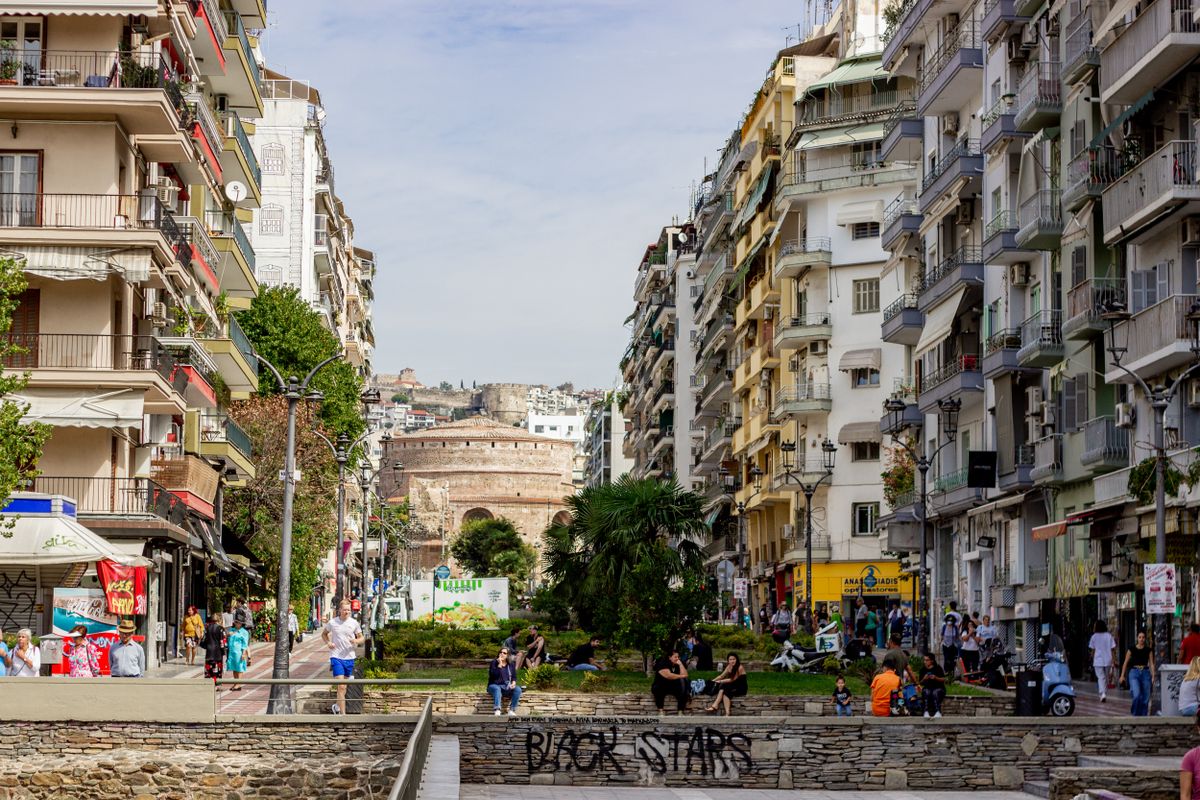
The monumental heart of the city is Aristotelous Square, a grand axis of arcaded buildings opening straight onto the sea. It was designed by the French architect Ernest Hébrard as part of the wholesale replanning of the centre after the 1917 fire , and its symmetrical Belle Époque-meets-Byzantine facades give the city a stage-set grandeur you don’t expect in Greece. The square runs inland to the Roman Forum and connects the seafront to the markets and the upper town. Around it sit the main shopping streets, the cinemas, the cafés where the city does its business, and the densest concentration of hotels.
- Aristotelous Square and its arcaded cafés facing the sea
- Tsimiski and Mitropoleos — the main shopping streets
- The Roman Forum (Ancient Agora) at the square’s inland end
Best for: shoppers, café-sitters and anyone who wants to be in the thick of it. Access: central and walkable; Venizelos and Aghia Sofia metro stations are minutes away.
Staying around Aristotelous puts you in the city’s engine room: everything radiates from here, the metro links you east and to the railway station, and you can walk to the sea, the markets and the Roman monuments in minutes. The trade-off is noise — the surrounding streets are busy day and night — so ask for a room off the main avenues if you’re a light sleeper. For a first visit with limited time, though, the sheer convenience of basing yourself here is hard to beat, and the square itself, lit up at night with the sea at its open end, is one of the loveliest urban spaces in Greece.
Ladadika & the Port District
Down by the harbour, Ladadika is a tight grid of 19th-century warehouses — once the oil and provisions district, the name comes from the Greek for olive oil — that survived the fire and is now the city’s nightlife and tsipouradiko heartland . Pastel-painted buildings on pedestrianised cobbles fill with tavernas, ouzeri and bars; by night the whole quarter hums. It sits beside the port and the MOMus contemporary-art and photography museums, so a day of culture rolls naturally into an evening of meze. This is where to come hungry.
- Tsipouradika and ouzeri spilling onto the cobbles
- The MOMus museums of photography and contemporary art at the port
- Late-night bars in restored warehouses
Best for: food, drink and nightlife. Access: a short walk west of Aristotelous toward the port.
By day Ladadika is quiet and a little faded, its pastel warehouses worth a wander for the architecture alone; by night it transforms, the cobbled lanes filling with tables and the smell of grilled meze. It’s the easy, atmospheric choice for your first dinner in the city — touristy, yes, but genuinely pleasant — and it sits within stumbling distance of both the port museums and the centre, so you can roll a cultural afternoon straight into an evening of small plates and tsipouro without ever needing transport.
Ano Poli (The Upper Town)
Climb above the modern grid and you reach Ano Poli, the upper town — the one quarter the 1917 fire never touched, and the closest the city comes to old Salonica. Steep cobbled lanes wind between timber-framed Ottoman houses and tiny Byzantine churches up to the Byzantine walls and the Heptapyrgion (Yedi Kule) fortress that crowns the hill . The reward at the top is the finest view in the city: the whole sweep of the metropolis falling away to the gulf, with Mount Olympus floating on the horizon on a clear day. It is also where the city keeps its quietest, most atmospheric tavernas.
- The Byzantine and Ottoman city walls and the Heptapyrgion fortress
- The Vlatadon Monastery and the Trigonion Tower viewpoint
- Timber Ottoman houses on stepped, car-free lanes
Best for: history travellers, photographers and sunset hunters. Access: steep walk up from the centre, or the number 23 local bus from Aristotelous.
Give Ano Poli an unhurried late afternoon. Wander up through the lanes while it’s cool, watch the sunset from the walls or the Trigonion Tower, then settle into one of the quarter’s tavernas as the lights come on across the city below. It’s residential and lived-in rather than touristy — washing strung between houses, cats on the steps, the occasional Byzantine chapel tucked between modern houses — which is exactly why it feels like the real city, and a meal up here with that view is one of Thessaloniki’s defining pleasures. Take the bus up if the climb daunts you, and walk down through the lanes; gravity is on your side and the descent is the prettier direction.
The Markets: Kapani & Modiano
Between Aristotelous and the upper town lie the two great food markets, and they function almost as a neighbourhood of their own. Kapani (the Vlali) is the older open-air market, a warren of butchers, fishmongers, spice and olive stalls; the covered Modiano Market, built in 1922 and reopened in 2022 after a long restoration, now mixes traditional stalls with meze bars where you can eat standing among the trade . This is the gut of the city. Come mid-morning for the full theatre of it, and stay for an early meze lunch.
- Kapani open-air market — fish, meat, spices, olives
- The restored Modiano covered market and its meze counters
- Tiny ouzeri tucked between the stalls
Best for: food lovers and morning wanderers. Access: a few minutes’ walk inland from Aristotelous.
You probably won’t sleep in the markets, but you’ll find yourself drawn back to them again and again — for breakfast, for a meze lunch, for the simple theatre of the place. They’re at their best mid-morning when the trade is in full swing and again in the early evening as the meze counters fill. Treat a slow graze through Kapani and Modiano as a meal in itself rather than a quick errand, and you’ll eat some of the best and cheapest food of your whole trip while watching the real working city go about its day.
The University Quarter & Eastern Seafront
East of the White Tower the city stretches into the residential and student districts — the campus of the Aristotle University, the largest in Greece and the Balkans with tens of thousands of students , and the lively areas around it where the city’s famous café and bar culture is at its densest. This is the engine of Thessaloniki’s youthful energy, full of cheap eats, third-wave coffee and late-opening bars. Further east the seafront continues toward the genteel suburbs and the exhibition grounds.
- The Aristotle University campus and its surrounding cafés
- The Archaeological and Byzantine Culture museums nearby
- The eastern continuation of the seafront promenade
Best for: budget travellers, café culture and long stays. Access: walkable east of the White Tower, or local buses along the seafront.
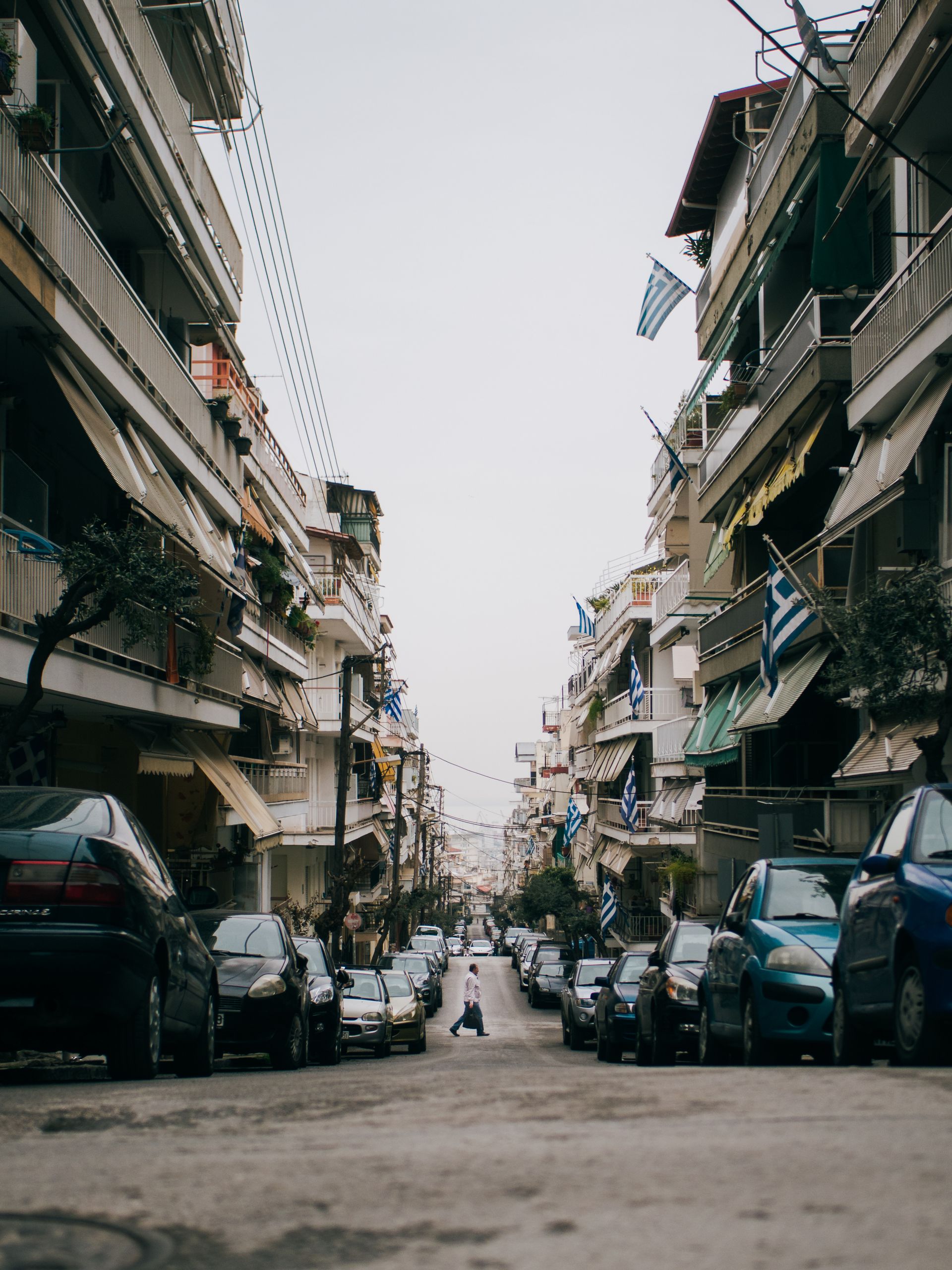
This is where to base yourself for value and a more local rhythm. Rooms are cheaper than on the waterfront, the cafés and tavernas are cheaper still, and you’re a flat walk along the sea from the White Tower and the centre. It’s not picturesque in the way the old town and Ano Poli are — this is residential Thessaloniki, apartment blocks and student bars — but it’s where the city actually lives, and a few days here gives you a truer sense of the place than the postcard centre alone. The two great culture museums on its edge are a bonus you’ll pass on every walk into town.
The Food

Thessaloniki is, by broad Greek consensus, the country’s food capital, and the city leans into it: it was named a UNESCO City of Gastronomy in 2021 . The cooking here carries the imprint of the refugees who reshaped the city — the Greeks of Asia Minor and Constantinople who arrived in 1922, and the centuries of Sephardic and Ottoman influence before them — which is why the food is spicier, more aromatic and more varied than the taverna standards further south. You could eat for a week and never repeat yourself.
If you do one thing in Thessaloniki, eat. The city’s relationship with food borders on obsession: the markets are temples, the bougatsa bakers are local celebrities, and a long tsipouro lunch is a perfectly respectable way to spend a working afternoon. The good news for travellers is that all of it is affordable — this is a city where eating brilliantly costs a fraction of what it would in a Western capital, and where the best meals are often the cheapest. Below are the categories to build your eating around, with specific places to point you in the right direction.
A practical note before you dive in: Thessalonians eat late and linger long, so don’t be surprised to find tavernas half-empty at eight and heaving at eleven. Lunch is the bigger, more relaxed meal for many, and the markets and bakeries hum from early morning. Pace yourself, share everything, and resist the urge to over-order at the start — in this city the meal is a conversation between you and the kitchen, and it’s almost always better to order a second round than to face a table groaning with food you can’t finish. Tap water and good bread come as standard; the rest is yours to discover plate by plate.
Bougatsa & the Pastry Tradition
If one dish belongs to Thessaloniki it is bougatsa — warm semolina custard wrapped in crisp, hand-stretched phyllo, dusted with sugar and cinnamon and cut up with a scraper in front of you. There are savoury versions with cheese or minced meat, but the sweet custard one is the classic city breakfast, and the ritual is half the pleasure: you order at the counter, the pastry comes straight from the oven, and the cook chops it into bite-sized squares while you wait. The other great street snack is the koulouri, the sesame-crusted bread ring sold from every corner cart from dawn, widely held to be better here than in Athens — locals grab one on the way to work and it costs barely anything.
The pastry tradition runs deeper than these two. The city’s refugee bakers brought a whole repertoire of sweet and savoury phyllo work from Asia Minor and Constantinople, and Thessaloniki takes its patisserie seriously — the shop windows along the main streets are an event in themselves, stacked with syrupy trigona, custard-filled cones, tsoureki braids and the dense, sweet pastries that pair with the city’s coffee obsession. A morning here is best begun, not ended, with something from a baker’s counter. The competition between the famous bougatsa shops is taken seriously enough that locals will argue their corner with real passion, and trying two or three to pick your own favourite is a perfectly legitimate way to spend your first hours in the city.
- Bougatsa Bantis — sweet custard bougatsa, a family operation since 1969 with phyllo still stretched by hand, often cited as the city’s best (around €2.50–3.50)
- Bougatsa Giannis — long-running central bougatsa shop doing both the sweet custard and savoury cheese versions (around €2.50–4)
- Terkenlis — the famous Thessaloniki patisserie chain for tsoureki, the chocolate-filled trigona and sweet pastries (cakes and slices from ~€3)
- Elenidis — the original home of trigona Panoramatos, the crisp custard cones (~€2–3 each)
Tsipouradiko & Meze
The defining way to eat in Thessaloniki is mezedes — a rotating parade of small plates — washed down with tsipouro, the unsweetened northern Greek grape spirit served by the carafe. The tsipouradika of Ladadika and the meze bars of the markets are where you settle in for a long, slow afternoon of seafood, grilled vegetables, cheeses and spreads, ordering plate after small plate as the carafes empty. This is not a quick meal: the whole point is to linger, to let one round of meze suggest the next, and to treat the table as the evening’s entertainment rather than a prelude to it.
The form has its own etiquette. You don’t order a main course; you order tsipouro, and the small plates arrive to match — a few grilled sardines, some fried courgette, a plate of cheese, then whatever the kitchen is proud of that day. The bill stays small because each dish is, and a group can graze happily for hours on a modest spend. It is the single most characteristic way to eat in the city, and once you’ve done it properly you’ll understand why locals consider Thessaloniki, not Athens, the real food capital of Greece.
A word on the drink itself: tsipouro comes in two styles, plain and aniseed-flavoured (me glyko anison), and it’s served chilled in little bottles you pour over ice. It’s strong, so the steady stream of food is not optional — that’s the whole design of the ritual, food and drink pacing each other across an afternoon. Order conservatively at first; the kitchen and your waiter will happily keep things coming once you’ve found your rhythm, and the best tables are the ones where you’ve stopped trying to plan the meal and simply let it unfold.
- To Elliniko — classic central mezedopoleio with northern-Greek small plates and barrel wine (mezedes ~€5–9 each)
- Tsinari — a historic ouzeri in Ano Poli, one of the city’s oldest, in an old Ottoman corner building with tables on the lane (mezedes ~€5–10)
- Full tou Meze — buzzing modern meze house near Ladadika, good for a lively group dinner (small plates ~€5–9)
- Ouzou Melathron — long-running, characterful taverna with an enormous, witty menu of mezedes (small plates ~€5–10)
- Nea Folia — well-regarded for refined modern takes on northern-Greek meze (small plates ~€7–12)
The Markets & Street Eats
No food trip to Thessaloniki is complete without grazing the markets. Kapani and the restored Modiano (see the neighbourhoods above) are where the city shops and where the cheapest, freshest eating happens — a souvlaki from a hole-in-the-wall, a paper cone of fried smelt, a wedge of feta and a handful of olives bought from the stall and eaten on a bench. The covered halls hide tiny meze counters and ouzeri where you perch on a stool among the traders and order whatever’s fresh. This is the city at its most authentic and its most affordable, and a market lunch rarely tops a few euros.
- Modiano Market meze bars — standing or stool eating among the stalls (plates ~€4–8)
- Kapani souvlaki and grill stalls — the cheapest hot lunch in the centre (~€3.50–6)
- Koulouri carts — the sesame bread ring from any street corner (~€0.50–1)
Beyond Bougatsa and Tsipouro
The wider table is where the city’s mixed heritage shows. Look for the dishes the Asia Minor refugees brought when more than a million Greeks arrived from Anatolia in 1922, the spices and sweets the Sephardim left behind across five centuries, and the fresh seafood of the Thermaic Gulf. Thessaloniki’s cooking is noticeably more aromatic and more generous with chilli, cumin and fresh herbs than the taverna standards of the south — a direct inheritance of those eastern kitchens. The city even has its own spicy condiments and pepper-laden dishes that you simply won’t find further south, and locals are fiercely proud of the difference.
It is also a brilliant city for vegetables and pulses, the everyday Lenten and refugee cooking that became year-round comfort food: stuffed peppers and tomatoes, giant baked beans (gigantes), briam, wild greens (horta) and the dense bean soups of the north. Seafood is a particular strength given the gulf on the doorstep — beyond the famous mussels, look for fresh anchovies, grilled octopus and whatever the day’s catch brings to the meze counters. Wash any of it down with the region’s wines — Macedonia is serious wine country, and the local xinomavro reds and the crisp whites of nearby Naoussa and Goumenissa are among Greece’s best — and you have a table that rewards curiosity at every price point.
Don’t leave without trying the sweets, either. Beyond the trigona cones, the city is known for syrup-soaked Ottoman-influenced pastries, the dense semolina halva, and the Sephardic-rooted treats that survive in a handful of old bakeries. A coffee and a sweet in the afternoon is as fixed a ritual here as the morning bougatsa.
- Soutzoukakia — spiced Smyrna-style meatballs in tomato sauce, an Asia Minor signature (~€8–11)
- Mydia (mussels) — saganaki, steamed or as mussel pilaf, a Thessaloniki staple from the gulf (~€7–10)
- Trigona Panoramatos — crisp filo cones filled with custard cream, a city sweet (~€2–3)
- Gyros and souvlaki — the city’s everyday street meal, a wrap from ~€3.50
Food Experiences You Can’t Miss
Some of the city’s best eating isn’t about a single dish but about the setting. These are the experiences that turn a Thessaloniki visit into a food trip, and most cost very little beyond your appetite.
- Eat a standing meze lunch inside the restored Modiano Market while the trade carries on around you
- Settle in for a slow tsipouro-and-meze afternoon in a Ladadika ouzeri as the carafes keep coming
- Take a guided market-and-tasting food tour through Kapani and Modiano to learn the city’s refugee-shaped cuisine
- Queue with the locals for a warm bougatsa breakfast and eat it standing, the proper way
- Pair a plate of grilled gulf sardines with a glass of cold tsipouro at a seafront ouzeri
Cultural Sights
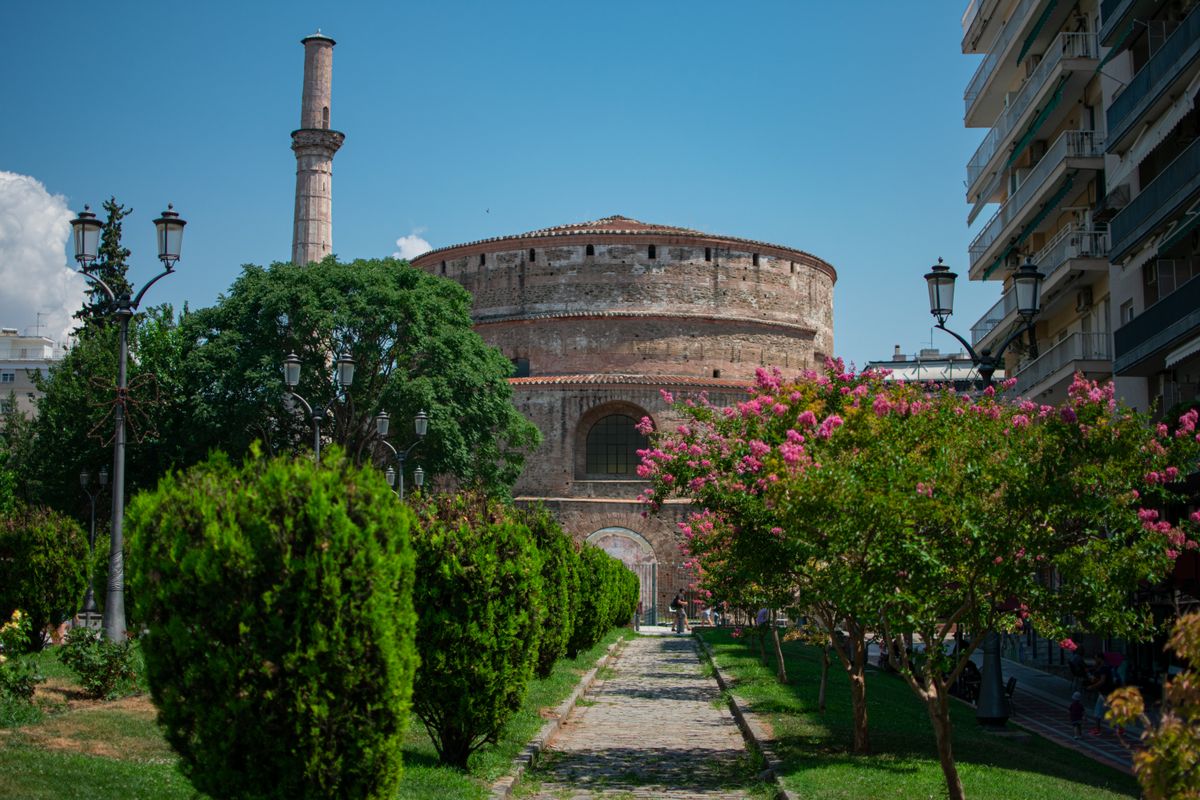
Few cities pack so much history into so small a walk. Thessaloniki’s monuments span Roman, early Christian, Byzantine and Ottoman eras, and most of the headline sights sit within a fifteen-minute stroll of one another in and around the centre. What makes them remarkable is not just their age but their continuity — buildings that began as Roman temples became churches, then mosques, then museums, each layer left visible. Here are the ones to prioritise on a first visit.
The White Tower (Lefkos Pyrgos)
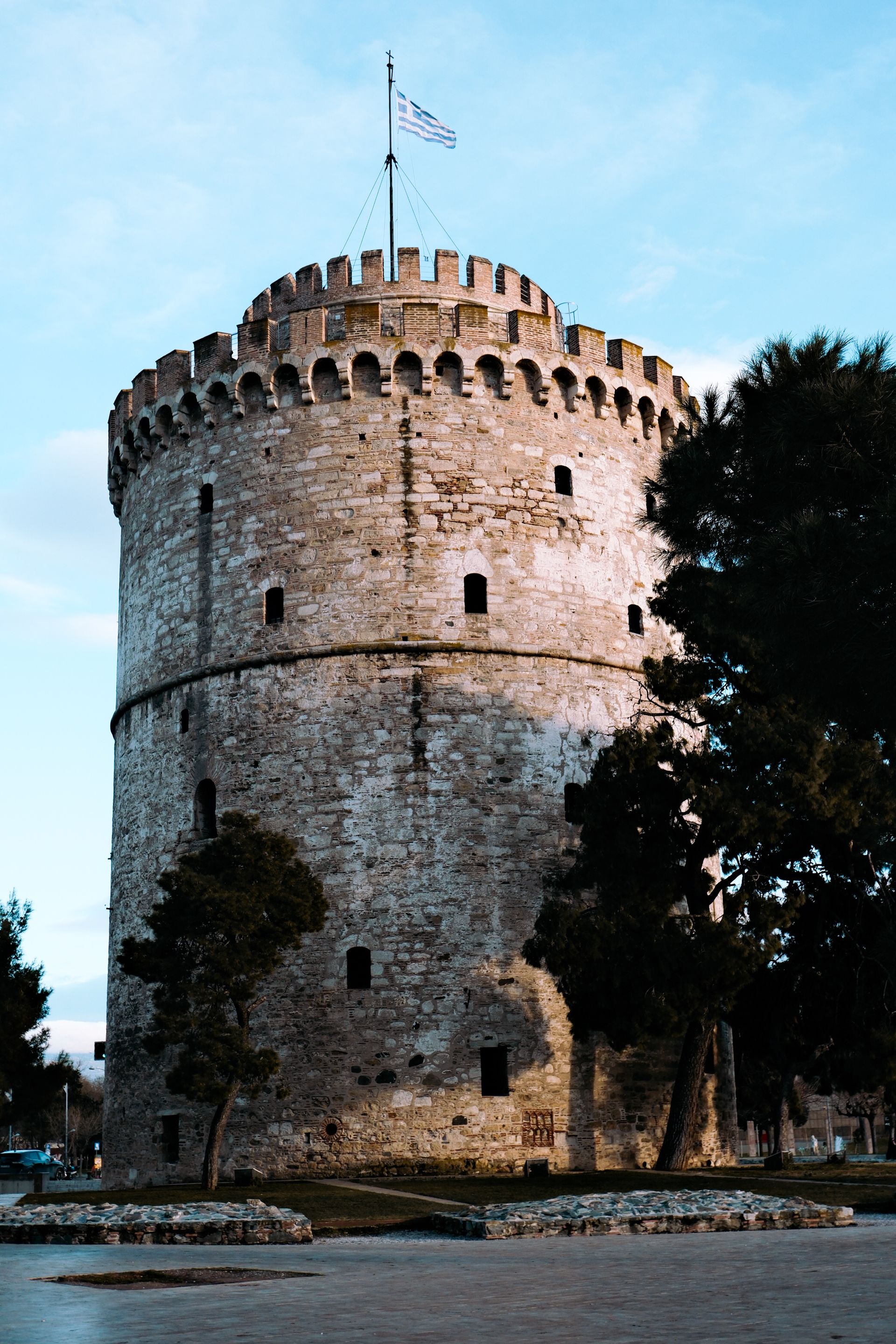
The symbol of the city, this six-storey cylindrical tower stands on the waterfront where the old sea walls met the shore. The present tower dates to the Ottoman period (around the 15th century) on earlier Byzantine foundations, and it was once a prison and place of execution, nicknamed the “Tower of Blood” or “Red Tower,” before being symbolically whitewashed and renamed in the early twentieth century . Inside, an excellent museum tells the story of the city floor by floor as you wind up the spiral ramp; the top gives a sweeping panorama of the seafront and the gulf. Admission is modest, and the slow climb with the city’s history unfolding around you is the real highlight.
Rotunda of Galerius
One of the oldest buildings in the city and a cornerstone of its UNESCO listing, the Rotunda was built around AD 306, probably as a mausoleum or temple for the Roman emperor Galerius . It later became a Christian church with magnificent early mosaics, then an Ottoman mosque — the minaret still stands beside it, the only one left in the city. The scale of the brick dome and the surviving mosaics are extraordinary. Admission is included in the city’s combined archaeological ticket.
Arch of Galerius (Kamara)
A few steps downhill, the Arch of Galerius — known locally as the Kamara — was raised around AD 298–299 to celebrate the emperor’s victory over the Persians, its remaining piers carved with dense battle reliefs . It once spanned the Roman city’s main road and connected to the Rotunda along a processional axis. It stands free in the middle of the modern street and is a favourite meeting point. Free to visit, always open.
Church of Saint Demetrios (Agios Dimitrios)
The largest church in Greece and the spiritual heart of the city, dedicated to its patron saint, a Roman soldier martyred here around AD 306 . The five-aisled basilica was rebuilt after the 1917 fire but preserves precious seventh-century mosaics of the saint that survived, and beneath it lies the atmospheric crypt on the very site of the martyrdom, built around the Roman bath where, by tradition, Demetrios was held and killed. The saint’s feast day on 26 October is the city’s biggest celebration. Entry is free; the dimly lit crypt, with its ancient masonry and trickling spring, is the unmissable part and easy to overlook.
Hagia Sophia of Thessaloniki
An eighth-century Byzantine church modelled on its great namesake in Constantinople, with a domed interior carrying a striking gold mosaic of the Ascension of Christ ringed by the apostles; it too served as a mosque under the Ottomans, who added a minaret long since removed . It is one of the 15 Paleochristian and Byzantine monuments inscribed by UNESCO in 1988, and a working church to this day. Free to enter outside services — step inside for the dome alone, then sit a moment in the shaded square outside, a favourite local meeting spot.
The Roman Forum (Ancient Agora)
Behind Aristotelous lies the excavated Roman forum, the civic and commercial centre of the imperial city laid out in the late second century AD, with its restored odeon (a small theatre still used for summer events), the two-level cryptoporticus and a small museum explaining the layered city below . It is an open archaeological park sunk into the middle of the modern centre, and standing in it you grasp how the present streets sit directly on the Roman grid. Modest admission, and included in the combined ticket.
Archaeological & Byzantine Culture Museums
Two world-class museums sit side by side near the seafront: the Archaeological Museum, home to the dazzling gold of the Macedonian kingdom, and the Museum of Byzantine Culture, which won the European Museum of the Year award in 2005 . Together they tell the city’s story from antiquity to Byzantium. Each charges a separate modest entry; combined tickets are available.
Entertainment

Thessaloniki’s reputation for going out precedes it. This is a city where the student population sets the tempo, where “entertainment” means something closer to a way of life than a night out, and where the line between a café, a bar and a music venue blurs happily over the course of an evening. You don’t plan a night here so much as let it unfold — and most of the best of it costs very little. The other thing to know is that the city’s social life is relentlessly outdoor and public: the real show is on the streets and the seafront, free to anyone who steps into it.
Café & Bar Culture
Thessaloniki’s nightlife begins in its cafés, where the city has a near-mythical reputation: per head it is said to have one of the highest densities of cafés and bars in Europe, fuelled by the vast student population . The scene flows seamlessly from morning frappé to afternoon freddo espresso to late-night cocktails, often in the same venue, and Greeks will happily nurse a single coffee for two hours while the world goes by. The streets around Valaoritou and the university are wall-to-wall with terraces. Typical cost: a coffee €2.50–4, a cocktail €8–11. No booking needed — just follow the crowds.
Ladadika & Valaoritou Nightlife
Two districts carry the night. Ladadika, the old warehouse quarter by the port, mixes tavernas with bars and is the gentler, more touristy of the two; Valaoritou, a former garment-trade district, has become the city’s edgiest nightlife hub, its old workshops and arcades turned into bars and clubs that fill late and empty later. The crowd is young, the music ranges from Greek pop to techno, and the energy peaks well after midnight — nobody arrives before eleven. Typical cost: drinks €7–11, most clubs free entry midweek and a modest cover with a drink at weekends. Wander the area, follow the noise, and you’ll find your spot; this isn’t a scene that rewards advance planning so much as curiosity.
Live Music & Rebetiko
Thessaloniki has a deep live-music tradition, from rebetiko — the Greek “blues” born in the refugee quarters of the 1920s — in smoky boites to glitzy bouzoukia clubs and a strong indie and jazz scene. Winter is the high season for the live-music tavernas, where a band plays as you eat and drink and the whole room ends up singing. It’s an unmissable, deeply local experience if your visit falls between October and April. Typical cost: a night with food and wine €25–40 per person.
Festivals & the Arts
The city punches above its weight culturally and has a packed events calendar. The Thessaloniki International Film Festival each November is the most important in southeastern Europe and turns the whole centre into a cinema for a fortnight , while the September Thessaloniki International Fair is a century-old trade-and-culture institution that draws the whole country’s attention. Add a documentary festival in spring and a year-round programme at the concert hall and theatres, and there’s almost always something on. Typical cost: film festival screenings around €5–7.
The Evening Volta
The most beloved entertainment is entirely free: the volta, the ritual evening stroll along the waterfront from the White Tower to the Umbrellas sculpture and back, ice cream or coffee in hand, the whole city out at once. It is part exercise, part social ritual, part theatre — you go to see and be seen, to bump into friends, to watch the light fade over the gulf and, on the clearest evenings, to catch the silhouette of Mount Olympus across the water. Do it at least once and you’ll understand the city better than any museum could teach you. It is the single most characteristic Thessaloniki experience and costs nothing but a gelato from one of the seafront kiosks.
Beach Bars & Day Clubs
In summer the action migrates to the beaches of Halkidiki, an hour or two away, where beach bars run seamlessly from afternoon swims into sunset cocktails and all-night parties on the sand. It’s how young Thessalonians spend the hot months, and many of the bigger beach clubs lay on free buses from the city in season. Typical cost: a sunbed and drink €10–20; entry to the larger day-club events varies with the line-up.
Day Trips

Thessaloniki is the perfect base for northern Greece, and this is where the city’s real strategic advantage shows: within two hours you can stand among the gold of Alexander’s Macedon, climb toward the home of the gods, swim off a pine-backed cove, or gaze up at monasteries balanced on rock spires. Each of the day trips below works from the city, and most can be reached by public transport if you’d rather not drive. Here are the five worth your time, roughly in order of how essential they are.
Vergina (1 hour by car or bus)
The ancient Macedonian capital of Aigai, about 80 km southwest, holds one of the great archaeological finds of the 20th century: the royal tombs, including what is widely accepted as the tomb of Philip II, father of Alexander the Great, discovered intact in 1977 with its astonishing gold larnax and grave goods . The site and its underground museum were inscribed by UNESCO in 1996. Seeing the gold of Macedon in the dim of the burial mound is unforgettable — this is the single best day trip from the city.
Mount Olympus & Dion (1.5 hours by car)
The mythical home of the Greek gods rises south of the city, its summit at Mytikas reaching 2,917 m, the highest point in Greece . You don’t have to climb it to feel it: the trailhead village of Litochoro and the gorge below make a wonderful day, paired with the sanctuary city of Dion at the mountain’s foot, where you walk among temples and mosaics in a green archaeological park. Organised tours run daily from the city.
Halkidiki Beaches (1–2 hours by car)
The three-fingered Halkidiki peninsula holds the best beaches near the city, with clear turquoise water and pine-backed coves an easy drive away on the Kassandra and Sithonia “legs” . The nearest beaches are reachable in about an hour, which is why locals treat the peninsula as the city’s summer playground — busy and developed on Kassandra, wilder and more beautiful on Sithonia. The third leg, the monastic republic of Mount Athos, is closed to all but male pilgrims with permits, though boat cruises sail along its coast for a distant look at the monasteries. Buses from the KTEL Halkidikis terminal serve the main resorts in season; with a car you can chase the quieter coves.
Meteora (2.5 hours by car or train)
Greece’s most spectacular monastic site — Byzantine monasteries perched atop sheer sandstone pinnacles — lies further west and is a long but achievable day, also a UNESCO World Heritage Site . The drive is around 230 km; many prefer the scenic train to Kalambata followed by a local shuttle, or an organised tour to handle the logistics. Best as a full, early-start day.
Pella (40 minutes by car or bus)
The birthplace of Alexander the Great and the capital of the Macedonian kingdom at its height, Pella sits about 40 km west of the city and is famous for its exquisite pebble-mosaic floors — including the celebrated lion hunt and Dionysos riding a panther — and a fine modern site museum . It pairs naturally with Vergina for a deep-dive day into Macedonian antiquity, the two sites only around 25 km apart, letting you trace the dynasty from Alexander’s birthplace to his father’s tomb in a single, unforgettable outing. Frequent buses from the city’s KTEL Macedonia terminal pass nearby if you’d rather not drive, and a guided tour will combine the two sites with commentary that brings the dynasty’s story to life. Allow a full, unhurried day for the pairing — there is a lot to take in, and the mosaics in particular reward slow looking.
Seasonal Guide
Spring (March – May)
The sweet spot. Daytime highs climb from the mid-teens in March to the mid-20s Celsius by May, the seafront greens up, and the café terraces fill again after winter. Easter is a major event, with church processions and a city that empties of students but fills with families. Crowds are light and prices reasonable, the sea is warming for the first early swims by late May, and the surrounding countryside — and the day trips to Vergina and Olympus — are at their most pleasant before the summer heat. Pack layers for cool evenings, but this is arguably the best all-round window of the year — warm enough to walk and sit out, cool enough to climb the upper town without melting, and quiet enough that the sights feel like your own.
Summer (June – August)
Hot and humid, with highs regularly in the low-to-mid 30s Celsius and the city noticeably quieter as locals decamp to Halkidiki. The energy shifts to the beaches and the late-night seafront, where evenings stay warm and the volta runs past midnight. It’s the season for swimming day trips, beach bars and open-air cinema, but the midday heat makes sightseeing a morning-and-evening affair. Many central businesses keep shorter August hours; book a hotel with air conditioning and plan your museum visits for the cool of the morning.
Autumn (September – November)
My second-favourite season. September keeps the warm sea while the heat eases, the students return and the city snaps back to full life, and the cultural calendar fires up — the Thessaloniki International Fair in September and the Film Festival in November bookend the season. October is crisp and ideal for walking the upper town and the day trips, with the lightest crowds of the year. By November the rains arrive and the first snows dust Olympus, but the indoor pleasures — the tavernas, the live music, the markets — come into their own.
Winter (December – February)
Cool, sometimes wet, occasionally snowy, but never dead — the student city keeps its café and live-music culture humming right through. Daytime highs sit around 8–12 Celsius and the seafront wind can bite, so pack a proper coat. This is the season for the indoor city: long lunches over tsipouro, rebetiko in the boites, the warmth of the markets, and Christmas lights strung along Aristotelous. Prices are at their lowest and the major sights are blissfully uncrowded. It’s a fine, atmospheric time for a culture-and-food city break if you don’t mind trading the sea for the tavernas.
Getting Around
Getting around Thessaloniki is refreshingly simple. The historic core is flat, compact and made for walking — laid out on a grid that runs parallel to the sea, so you can rarely get truly lost — the city just gained a brand-new metro after decades of waiting, and ride-hailing fills every gap cheaply. You will not need a car for the city itself, and even most day trips are reachable by intercity bus or train. The one thing to know is that traffic on the main avenues can be heavy and parking is a nightmare, which is exactly why the new metro and a good pair of walking shoes are your best tools. Here is how each piece fits together.
The New Metro
Thessaloniki’s long-awaited metro finally opened on 30 November 2024, a fully automated, driverless system whose construction took decades partly because tunnellers kept hitting ancient ruins — some of which are now displayed inside the stations . Line 1 runs 9.6 km with 13 stations linking the railway station, the centre and the eastern districts . It’s clean, fast and the easiest way to skip the traffic along the main axis.
City Buses (OASTH)
Before the metro the city ran entirely on buses, and they still reach everywhere the trains don’t — including the upper town and the seafront. The network is run by OASTH; buy tickets from machines or kiosks and validate on board. The number 23 bus up to Ano Poli saves a steep climb, and seafront routes link the centre to the eastern districts.
Metro & Transit Tickets
Tickets are integrated across metro and bus. A single metro trip launched at a promotional €0.60 for the system’s first months (against a standard €0.90), with a monthly pass around €16 . Buy from station machines and tap in; the same paper or contactless tickets cover the buses.
Airport Access
Thessaloniki Airport “Makedonia” (SKG) sits about 15 km southeast of the centre on the coast . It’s the second-busiest airport in Greece, well connected to European cities and a growing list of long-haul seasonal routes, with a modern terminal opened in recent years. Transfers into town are cheap and quick whether you take the bus or a taxi.
- Bus 01X/01N express to the centre — about 40–45 minutes, roughly €2
- Taxi or ride-hail to the centre — about 25 minutes, roughly €25–35
Taxis & Ride-Hailing
Blue-and-white metered taxis are plentiful and cheap; flag-fall is low and a cross-town ride rarely exceeds a few euros, making them a genuine option rather than a luxury. The FREENOW app works across the city’s taxis and lets you book and pay by card, which sidesteps the occasional meter dispute and the language barrier on the phone. As a rule, hail one on the street for short hops and use the app at night, at the airport or whenever you want a fixed, transparent price. Confirm the meter is running before you set off, or simply default to the app and pay digitally.
Navigation Tips
Apps: Google Maps, FREENOW. The centre is a flat grid running parallel to the sea, so orientation is easy — the water is always “down,” the upper town always “up.” Walk the seafront and the centre; take the metro along the main axis, the 23 bus up to Ano Poli, and a taxi or the airport bus for SKG. Download an offline map before any mountain day trip, where mobile signal can drop in the valleys and on the trails.
Budget Breakdown: Making Your Euros Count
| Tier | Daily | Sleep | Eat | Transport | Activities | Extras |
|---|---|---|---|---|---|---|
| Budget | €40–60 | Hostel dorm €15–22 | €12–18 | €2–4 metro/bus | €5–10 | €5 |
| Mid-Range | €80–130 | 3-star double €60–90 | €25–40 | €8–15 taxis | €15–30 | €10 |
| Luxury | €200+ | 4–5 star €140+ | €60+ | €30 private car | €50+ tours | €25+ |
Where Your Money Goes
Thessaloniki is one of the better-value city breaks in the eurozone, materially cheaper than Athens and dramatically cheaper than Western Europe, and understanding where the money goes makes it easy to travel here well on almost any budget. Eating and drinking — the whole point of the city — are the bargains: a sit-down meze meal with tsipouro runs a fraction of what an equivalent night out costs in a Western capital, a bougatsa breakfast is a couple of euros, and the famous café culture means an afternoon’s people-watching costs the price of a single coffee. Local transport is almost trivial now the metro has opened, so your daily spend is driven mostly by how you sleep and how you do day trips.
Your biggest variable costs are accommodation and excursions. Central waterfront hotels carry a premium, but step a few streets inland or into the university quarter and prices fall sharply for the same short walk to the sights. Day trips are the other swing factor: an organised tour to Vergina, Olympus or Meteora is convenient but adds up, while the public KTEL buses and the train reach most of the same places for a handful of euros if you’re willing to plan. The good news is that many of the city’s defining experiences — the seafront volta, the Roman Forum, Agios Dimitrios, the upper-town walls, the markets — are completely free.
To put real numbers on it: a frugal traveller in a hostel dorm, eating market food and street snacks, using the metro and sticking to free sights can have a full day for €40–50. A mid-range couple in a central three-star, eating two proper meze meals and doing a paid day trip, will spend somewhere around €90–130 each. Even the luxury end — a four-star sea-view room, fine dining and a private driver — costs a fraction of the equivalent in Paris or London. The currency is the euro, cards are widely accepted, and as a rough rule of thumb you can expect a Thessaloniki trip to come in well below the cost of the same days in Athens, with the savings largest on exactly the things that make the city — eating, drinking and guided experiences.
Money-Saving Tips
- Eat your big meal as a long meze lunch — many tavernas and ouzeri are cheaper and livelier at midday
- Take the public KTEL bus to Halkidiki or the train toward Meteora rather than a private transfer
- Visit the free sights — the seafront, Agios Dimitrios, the Arch of Galerius and the upper-town walls cost nothing
- Stay inland or in the university quarter for cheaper rooms a short walk or metro ride from the sea
- Pay by card with a fee-free travel account to dodge poor airport exchange rates
Practical Tips

Language
The language is Greek, written in its own alphabet, but English is very widely spoken in the centre, in cafés and hotels and especially among the huge student population. A few words — “efcharistó” for thank you, “yassas” for hello — go a long way and are warmly received. Street signs in the centre are often transliterated into Latin script too.
Cash vs. Cards
Cards are accepted almost everywhere, including most tavernas and the metro, and contactless tap-to-pay is standard in shops and cafés. That said, carry some cash for the markets, smaller kiosks (periptera), the bougatsa cart and rural day-trip stops, where small operators may still prefer coins and notes, and for the small tips you’ll want to leave. ATMs are plentiful in the centre, but favour bank-branded machines over the independent “Euronet”-style ones, which charge poor rates and high fees; always decline the machine’s offer to “convert” to your home currency and choose to be charged in euros.
Safety
Thessaloniki is a generally safe city by European standards, with the usual big-city caveats: watch for pickpockets in crowded markets and on busy buses, and take normal care in nightlife districts late at night . Solo travellers, including women, generally report feeling comfortable. Occasional political demonstrations occur in the centre; they are usually peaceful but best avoided.
What to Wear
Casual and relaxed by day; the city dresses up a little for its café and bar culture in the evening. Pack light, breathable clothes for the hot, humid summer and a warm layer for the windy seafront in winter. Bring modest cover (shoulders and knees) for visiting the churches and monasteries, and comfortable shoes for the cobbles and steep steps of the upper town. A light scarf is useful for both sun and the occasional cool sea breeze.
Cultural Etiquette
Greeks are warm and informal; a handshake or, between friends, a cheek kiss on both sides is normal. Meals are unhurried social affairs and the table is a place to linger — don’t expect the bill to arrive until you ask for it (raising a hand and miming a signature works). Tipping is appreciated but not obligatory; rounding up or leaving 5–10% in a restaurant is considered generous, and a euro or two for good service is plenty. Lunch runs late by northern-European standards (1–3pm) and dinner later still (after 9pm), so adjust your hunger accordingly. And the evening volta along the seafront is a genuine social ritual, not just exercise — the friendliest way to feel part of the city is simply to join it.
Connectivity
Greece has excellent 4G/5G coverage and Thessaloniki is well served; EU roaming applies for European visitors at no extra cost. Free Wi-Fi is common in cafés and on parts of the seafront. A local or eSIM data plan is cheap if you need one for navigation and ride-hailing.
Health & Medications
Pharmacies (farmakeío, marked with a green cross) are plentiful and Greek pharmacists are well trained and happy to advise on minor ailments, often dispensing things that need a prescription elsewhere; a posted rota covers nights and weekends so there is always one open. EU and UK visitors should carry a GHIC/EHIC card for state healthcare, and everyone should have travel insurance for anything serious. Bring any prescription medication in its original packaging with a copy of the prescription. Tap water is safe to drink throughout the city, so there’s no need to buy bottled.
Luggage & Storage
Left-luggage lockers and staffed services are available at the railway station and through private operators near the centre, handy if you arrive before check-in or have a late flight after checkout. Many hotels will also hold bags on your arrival or departure day.
Frequently Asked Questions
How many days do I need in Thessaloniki?
Give the city itself two to three full days — one for the waterfront, White Tower and centre, one for the Byzantine and Roman monuments and the upper town, and one for the markets, museums and simply soaking up the café culture. Add a day each for the day trips you care about: Vergina for Macedonian gold, Mount Olympus or Halkidiki for nature and beaches, Meteora if you have the time. Four to five days is the sweet spot for a city most people wrongly treat as an overnight stop.
Is Thessaloniki good for solo travellers?
Excellent. It’s compact, walkable, safe by European standards, and the vast student population gives it a young, sociable energy that makes it easy to fall into conversation in a café or ouzeri. The food culture is built around small plates and sharing, which suits eating alone far better than a formal restaurant scene would, and the evening volta means you’re never short of company on the seafront. English is widely spoken, hostels and budget rooms are plentiful around the centre and the university, and the city is small enough that you’ll quickly feel oriented. Solo women travellers generally report feeling comfortable, with the usual sensible caution late at night in the nightlife districts.
Do I need to buy a transit pass?
Not for a short visit. The historic core is entirely walkable, and individual metro and bus tickets are cheap and integrated, so you can simply pay per trip. If you’re staying a week or relying on the metro and buses daily, the roughly €16 monthly pass quickly pays for itself; otherwise single tickets bought from station machines are all you need.
What about the language barrier?
Minimal in practice. Greek uses its own alphabet, which looks daunting at first, but English is very widely spoken in the centre, in hospitality and especially among the huge student population, and many signs and menus are transliterated into Latin script or printed in English. Learning to recognise a few Greek letters genuinely helps with reading street names and bus stops, and a handful of polite phrases — yassas for hello, efcharistó for thank you, parakaló for please — is warmly received and opens doors. But you will not struggle to get by in English anywhere a visitor is likely to go.
When is the best time to visit?
May–June and September–October are ideal — warm but not stifling, the sea swimmable, the day trips at their best and the crowds light. High summer is hot and humid and the locals decamp to the beaches, leaving some central businesses on shorter August hours, while winter is cool and sometimes wet but keeps its lively café and live-music culture humming. There’s genuinely no dead season thanks to the student city, so it comes down to whether you want the sea and the day trips (late spring and early autumn) or the cosy indoor pleasures of long tavernas and live music (winter). If you can time it to the September Fair or the November film festival, all the better.
Is the new metro worth using?
Yes, for the right journeys. Thessaloniki’s driverless metro opened in November 2024 after decades of construction, and Line 1’s thirteen stations make light work of the long east–west axis — getting from the railway station to the centre or out to the eastern districts in minutes, traffic-free. Several stations double as little museums, displaying the ancient finds unearthed during the dig. That said, the historic core is so compact and flat that you’ll still do most of your sightseeing on foot; use the metro to cover distance quickly, not to replace the lovely seafront walk.
Can I use credit cards everywhere?
Almost. Cards and contactless are accepted at most tavernas, shops, hotels and on the metro, so you can travel largely cashless. Keep some euros on hand for the markets, the bougatsa cart, smaller kiosks and rural day-trip stops, where small operators may still prefer cash. ATMs are easy to find in the centre.
Is Thessaloniki worth visiting over Athens or the islands?
It’s not an either/or — it’s the perfect complement. Thessaloniki gives you something Athens and the islands don’t: a real, lived-in northern city with two thousand years of Greek, Roman, Byzantine, Ottoman and Jewish history stacked in plain sight, the country’s best food, and a waterfront made for slow evenings. It’s also the natural base for Macedonian antiquity and Mount Olympus. Pair it with a few Halkidiki beach days and you have a side of Greece most visitors never see.
Ready to Experience Thessaloniki?
Come hungry, walk the seafront at dusk, and give Greece’s second city the days it deserves. For the full country context — visas, the euro, the islands and the seasons — read the Greece Travel Guide.
Explore More City Guides
Alex the Travel Guru
Alex has spent two decades chasing the cities everyone else skips, and Thessaloniki is the one he wishes he’d reached sooner. He’s eaten his way through the Modiano market, walked the Byzantine walls at sunset more times than he can count, and remains convinced that the seafront volta is the most civilised thing any European city does. He writes Facts From Upstairs to send travellers toward the places that reward an extra day.
More city guides you might like
Plan your trip to Thessaloniki
The booking tools we use ourselves. FFU may earn a commission at no extra cost to you.
Plan & book your trip to Thessaloniki
Booking through these searches supports our guides at no extra cost to you.