
Ohrid Travel Guide — Byzantine Churches, Europe’s Oldest Lake & the Balkans’ Best-Kept Secret
I’ve had a hard time explaining Ohrid to people back home, because it sounds like I’m making it up. A lake older than the Alps, holding species found nowhere else on the planet. A hillside town that once claimed 365 churches, “one for every day of the year,” where the alphabet you’re reading this in was refined by monks who taught at what’s arguably Europe’s first university. And somehow, in 2026, almost none of my friends had heard of it. Ohrid sits in the far southwest corner of North Macedonia, hard against the Albanian border, and it rewards the kind of traveler who doesn’t need everything translated into English before they’ll go. The swimming is genuinely great, the church-hopping is genuinely great, and the prices are the kind that make you recalculate your whole trip. The catch — and there’s always a catch — is getting there takes some patience, and August afternoons on Kaneo Beach are not the secret they used to be.
In This Guide
- Overview — Why Ohrid Punches Above Its Size
- Ohrid Summer Festival — 60+ Years of Opera on the Lake
- Best Time to Visit Ohrid (Season by Season)
- Getting There — OHD, Skopje & the Border Crossings
- Getting Around — Walking, Buses & Lake Boats
- Neighborhoods — Old Town, Kaneo & the New Town
- Culture & People — Saints Cyril and Methodius’ Legacy
- A Food Lover’s Guide to Ohrid
- Off the Beaten Path
- Day Trips from Ohrid
- Practical Information
- Budget Breakdown — What Ohrid Actually Costs in 2026
- Frequently Asked Questions
Overview — Why Ohrid Punches Above Its Size
Ohrid is a town of roughly 38,800 people wrapped around the edge of a lake that has existed, in more or less its current form, since before humans did. Lake Ohrid formed somewhere between 1.9 and 4 million years ago through the same slow tectonic sinking that created a handful of “ancient lakes” worldwide, which is why it’s home to over 200 endemic species — creatures found in this lake and nowhere else on Earth, including the Ohrid trout. UNESCO recognized this double act — a genuinely rare natural phenomenon layered under one of the best-preserved Byzantine old towns in the Balkans — by inscribing the “Natural and Cultural Heritage of the Ohrid Region” back in 1979 and 1980, making it one of a small club of sites protected for both nature and culture simultaneously.
The town itself climbs a hillside from the harbor up to Samuil’s Fortress, its cobbled Old Town stacked with Ottoman-era wooden houses, Byzantine churches and an ancient theatre still in use today. Ohrid was, for a stretch around the turn of the first millennium, the capital of the First Bulgarian Empire under Tsar Samuil, and centuries before that it was Lychnidos — “city of light” — a stop on the Roman Via Egnatia connecting Rome to Constantinople. That layered history is why locals still half-joke about the “365 churches, one for every day of the year” — an exaggeration, but not by as much as you’d think.
What Ohrid doesn’t have is the crowd you’d expect for a place this good. It’s a five-hour scenic drive from Skopje, an awkward-enough trip that keeps it off the standard two-week Balkans itinerary — which is exactly the appeal. You get Dubrovnik-adjacent architecture and Lake Como-adjacent water, minus the cruise ships and minus the prices.
Ohrid Summer Festival — Opera, Jazz & the Ancient Theatre
If you can time a trip around one thing, make it the Ohrid Summer Festival, running every year from 12 July to 20 August since its founding in 1961. This is Ohrid at its most theatrical, literally: opera, ballet, classical concerts and folklore performances are staged in the 2,000-year-old Hellenistic-Roman theatre carved into the Old Town hillside, with Lake Ohrid glittering below the stage as the sun goes down. Smaller stages around town host jazz nights and open-air film screenings for the full six-week run.
Book Old Town accommodation weeks ahead if you’re arriving in late July or early August — this is also peak lake-swimming season, so festival season and beach season collide, and the good guesthouses fill fast. If a packed schedule isn’t your thing, the shoulder weeks either side of the festival still get you warm water and long daylight with noticeably thinner crowds.
Best Time to Visit Ohrid (Season by Season)
Late May – June · The sweet spot
The lake has warmed up enough to swim, wildflowers are still out in Galičica National Park, and neither the festival crowds nor the peak-summer heat have arrived. This is the window locals themselves recommend.
July – August · Peak season
Hot, dry, and busy — this is when the Ohrid Summer Festival runs and when most of the Balkans’ own domestic tourists show up. Kaneo Beach and the lakefront promenade get genuinely crowded on weekends. Worth it for the festival, but book ahead.
September · The insider’s month
Still warm enough to swim most days, the festival crowds have gone home, and prices soften. Many longtime visitors call this the best month of the year.
October – April · Quiet season
Cool, occasionally cold and grey, with lake mist rolling over the Old Town rooftops. Many restaurants and guesthouses scale back or close. Beautiful if you like a town to yourself, but come prepared for limited services and pack layers — winters see real cold at this elevation.
Getting There — OHD, Skopje & the Border Crossings
Ohrid has its own small international airport, St. Paul the Apostle Airport (OHD), about 9 kilometres northwest of town, with seasonal and charter connections to a handful of European cities. Outside peak summer, though, most travelers fly into the country’s main gateway, Skopje International Airport (SKP), which has far more year-round connections from Western Europe. From Skopje, buses and private transfers to Ohrid take roughly three to four hours through mountain scenery that’s a highlight in its own right — book a daytime departure if you can, the views over the Jablanica range are worth staying awake for.
Overland, Ohrid sits close enough to Albania that a lot of visitors combine the two: the Kjafasan/Qafë e Thanës border crossing near Sveti Naum puts you within striking distance of Pogradec on the Albanian side of the same lake, and minibuses run that route regularly. Coming from Greece, Bitola is the usual staging point before the final hop to Ohrid.
Getting Around — Walking, Buses & Lake Boats
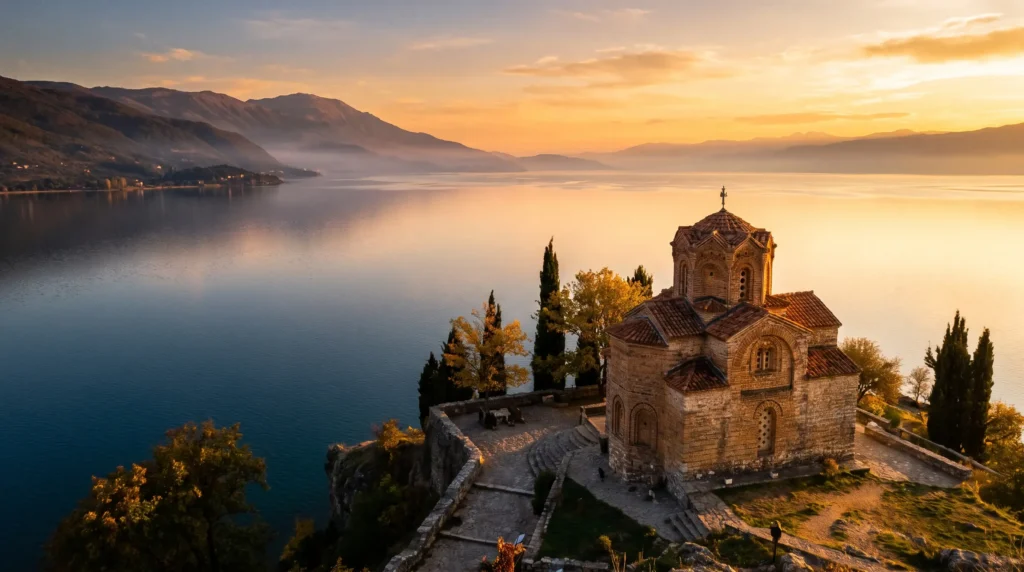
Ohrid’s Old Town is compact and steep — this is a walking town, full stop. The cobbled lanes up to Samuil’s Fortress and the Church of St. John at Kaneo aren’t built for cars, and you wouldn’t want to drive them even if they were. The lakefront promenade connecting the harbor, the beaches and the New Town is flat, shaded and easily covered on foot in twenty minutes.
For anything further — the airport, Struga, Sveti Naum — local buses run from the main bus station on cheap, if unhurried, schedules, and taxis are inexpensive by Western standards (agree a price or confirm the meter before you get in). In summer, small wooden boats line the harbor offering short lake cruises or a direct run down to Sveti Naum, which is a genuinely lovely way to spend a morning and beats the bus for scenery. A rental car makes sense only if you’re planning to explore Galičica National Park or the surrounding villages independently.
Neighborhoods — Old Town, Kaneo & the New Town
The Old Town (Old Bazaar to Samuil’s Fortress)
The historic heart, climbing from the harbor up a steep hillside of Ottoman-era wooden houses, Byzantine churches and cobblestone lanes. This is where you’ll find the Church of St. Sophia — its interior frescoes among the best-preserved Byzantine painting anywhere, and its facade famous enough to appear on the 1,000-denar note — plus the ancient Hellenistic theatre and, at the very top, Samuil’s Fortress, whose ramparts give the best panoramic view of the lake in town.
Kaneo
The postcard neighborhood, a cluster of fishermen’s houses tumbling down to the lakeshore beneath the single most photographed building in North Macedonia: the Church of St. John at Kaneo, perched on its own cliff over the water. Kaneo Beach below is small, pebbly and genuinely swimmable, with clear water that shows the lake bed several metres down.
Plaošnik
Technically part of the Old Town but worth calling out on its own — this hilltop archaeological complex holds the reconstructed Church of St. Panteleimon, built on the foundations of the monastery where St. Clement of Ohrid taught what’s often called the first Slavic university in the 9th and 10th centuries, refining the Cyrillic script still used across the Slavic world today.
The New Town & Lakefront Promenade
Downhill and lakeside from the Old Town, this is where day-to-day Ohrid actually lives — cafés, the fish market, ferry docks and most of the mid-range hotels, strung along a promenade that’s the default evening stroll for the whole town.
Struga
A short bus ride around the lake’s northern shore, where the Black Drin River drains out of Lake Ohrid. Quieter and more residential than Ohrid town, Struga hosts its own well-regarded poetry festival each summer and has a sandier, more relaxed beach scene.
Culture & People — Saints Cyril and Methodius’ Legacy
Ohrid’s cultural identity is inseparable from its role as a cradle of Slavic literacy. Saints Clement and Naum, disciples of Cyril and Methodius, settled here in the 9th century and built on the Glagolitic and early Cyrillic scripts their teachers had developed — the direct ancestor of the alphabet still used from Serbia to Siberia. That history is treated with genuine reverence locally, not tourist-board spin — you’ll see Clement and Naum’s names on schools, streets and the university itself.
Day to day, Ohrid is Macedonian-speaking with a significant Albanian-speaking population, reflecting the town’s position near the border and the mixed communities around the lake. Orthodox Christianity shapes the calendar — expect church bells, name-day celebrations and, if you’re here in January, Epiphany’s dramatic cross-retrieval swim in the freezing lake, a local tradition not for the faint-hearted.
A Food Lover’s Guide to Ohrid
Lake Ohrid trout is the dish everyone will point you toward — grilled simply with lemon and local olive oil — but note that the true wild Ohrid trout is a protected, endangered species, and much of what’s served is farmed or substituted with similar lake fish; ask before ordering if that distinction matters to you. Beyond fish, expect the Macedonian staples that show up on every table across the country: tavče gravče (baked beans in a clay pot), grilled kebapi and pleskavica, and shopska salata under a thick layer of grated white cheese.
Ohrid’s own contribution is a genuinely excellent local wine scene — the surrounding hills produce Vranec and Temjanika grapes, and small family wineries around the lake offer tastings that feel far more intimate than their price tags suggest. Pair it with local trout or a plate of ajvar and kashkaval. Coffee culture runs deep here as everywhere in the former Yugoslavia — expect to linger over a Turkish-style coffee or a macchiato for far longer than the drink itself takes to finish, and to be mildly judged if you rush it.
Off the Beaten Path
Gorica & the hillside above town
Skip the crowded lower lanes and climb into the residential hillside neighborhoods above the Old Town, where stone houses and small orchards give you the same lake views as Samuil’s Fortress without the queue.
The Bay of Bones (Museum on Water)
A reconstructed Bronze Age pile-dwelling settlement on stilts over the water near Peštani, built on the site of genuine archaeological finds. It’s touristy in the best way — a hands-on look at how people lived on this exact lake three thousand years ago, with a small dive museum attached.
Galičica National Park’s back roads
Most visitors see Galičica only from a car window en route to Sveti Naum. The park’s hiking trails and the viewpoint road between Lake Ohrid and Lake Prespa reward anyone willing to get out and walk — alpine meadows with two ancient lakes visible at once.
Vevčani
A mountain village a short drive from Struga, known for its springs, waterfalls and a wildly elaborate New Year’s masquerade carnival every January 13th (Old New Year) that draws crowds from across the region for a night of pagan-tinged costume theater.
Day Trips from Ohrid
Monastery of Saint Naum
The single most popular day trip, and deservedly so: a 10th-century monastery founded in 905 by St. Naum himself, perched on a bluff 29 kilometres south of Ohrid, right at the Albanian border. The real draw is the springs beside it, where dozens of freshwater sources bubble up from beneath Galičica National Park — the underground overflow from Lake Prespa on the other side of the mountains — and you can paddle a small rowboat right through them. Go by lake boat from the harbor rather than the road if you want the scenic version.
Bitola
North Macedonia’s elegant, faded “city of consuls,” under an hour’s drive away, built around a pedestrian boulevard of 19th-century Ottoman-era mansions that once housed a dozen foreign consulates. Pair it with the nearby Roman ruins of Heraclea Lyncestis on the edge of town.
Pogradec, Albania
The same Lake Ohrid, seen from its quieter Albanian shore. It’s an easy border crossing for a day, and the contrast — a more workaday lakeside town, different architecture, same water — is worth the paperwork-free hop for anyone curious how the other side lives.
Struga’s poetry evenings
If your visit lines up with late August, Struga’s Poetry Evenings is one of the world’s oldest international poetry festivals, drawing writers from across the globe to read on bridges over the Black Drin.
Practical Information
Money. The Macedonian denar (MKD) floats in a soft, closely managed peg near 61.5 to the euro, and euros are widely accepted in tourist businesses even though denars are technically the only legal currency. Carry cash — smaller guesthouses, taxis and lake-boat operators often don’t take cards.
Safety. The US State Department rates North Macedonia Level 1, “Exercise Normal Precautions,” its lowest advisory tier. The UK’s FCDO notes petty crime is low but flags occasional organized-crime activity near the northern Kosovo border, well away from Ohrid, and reminds visitors that a passport valid at least 90 days beyond arrival is required for entry.
Health. The CDC recommends routine vaccinations be up to date and standard bug-bite precautions given local mosquito and tick activity; no special vaccines are mandated for entry. Tap water in Ohrid is generally considered safe, but bottled water is cheap and widely available if you’d rather not risk it.
Connectivity. An EU-roaming-compatible eSIM or a local prepaid SIM (widely available in Skopje and Ohrid town) covers you well; Old Town Wi-Fi is decent in cafés and guesthouses. Plugs: European two-pin (Type C/F), 230V. Time zone: Central European Time (UTC+1), with EU-aligned daylight saving.
Budget Breakdown — What Ohrid Actually Costs in 2026
Ohrid is one of the better values left in Europe, festival weeks aside.
Budget (US$35–60/day): A guesthouse room or hostel bed in the New Town, grilled-meat plates and bakery lunches, local buses, self-guided church visits (most charge a small entry fee).
Mid-range (US$80–150/day): An Old Town guesthouse with a lake view, restaurant dinners with wine, a Sveti Naum boat-and-springs excursion, a taxi or two, entry to the Bay of Bones museum.
Luxury (US$250+/day): A lakefront boutique hotel, private boat charters, guided wine tastings at family vineyards, a driver for Bitola or the Albanian border crossing.
Church and monastery entry fees run small (typically a few euros equivalent each), and festival-season tickets for the ancient theatre performances are the one real splurge worth budgeting for separately. Tipping 10% is appreciated but not obligatory.
Planning Your First Trip to Ohrid
Three nights is the practical minimum: one day for the Old Town churches and Samuil’s Fortress, one for Sveti Naum and the springs, and one to actually sit still on Kaneo Beach or a harbor terrace. Five nights lets you add Bitola or a Pogradec crossing without rushing. Most visitors pair Ohrid with a few days in Skopje at the start or end of the trip, and it slots naturally into a wider Balkans loop — our North Macedonia guide covers the rest of the country, our Albania guide covers Pogradec’s side of the lake and beyond, and our Tirana guide and Sofia guide both make sensible bookends for a longer regional trip.
Frequently Asked Questions
Is Ohrid safe for tourists in 2026?
Yes — North Macedonia sits at the US State Department’s lowest advisory level, “Exercise Normal Precautions,” and Ohrid itself is a low-crime, tourism-oriented town. Standard precautions around valuables in crowded festival areas are all that’s needed.
Do I need a visa?
US, UK, EU, Canadian and most Western passport holders can enter visa-free for stays of up to 90 days within any 180-day period; just make sure your passport is valid at least 90 days past your arrival date.
Can I swim in Lake Ohrid?
Absolutely — it’s one of the main reasons people come. Kaneo Beach, the pebbly stretches near the New Town, and the beaches around Sveti Naum and Struga all offer clear, cold-to-cool water that’s warm enough to swim from roughly June through September.
Ohrid or Lake Bled?
Choose Ohrid for depth of history — Byzantine churches, an ancient theatre, the Cyrillic connection — plus lower prices and fewer crowds; choose Bled for its famous island church and Julian Alps backdrop. They’re genuinely different trips wearing similar marketing photos.
How many days do I need in Ohrid?
Three days covers the essentials comfortably; five lets you fold in Sveti Naum, Bitola and a slower pace without feeling rushed.
Is Ohrid expensive?
No — it remains one of the better values in Europe outside the Ohrid Summer Festival’s peak weeks, when accommodation prices climb and should be booked well ahead.
Ready to Explore Ohrid?
A church on a cliff, an opera in a 2,000-year-old theatre, and a lake that’s been quietly doing its own thing since before there were humans around to name it. Ohrid doesn’t need you to have heard of it before you arrive — it just needs you to show up, climb the hill, and jump in the water.
Explore More
- North Macedonia Travel Guide — Skopje, canyons and the rest of the country
- Albania Travel Guide — Pogradec and the Albanian side of the lake
- Tirana City Guide — Albania’s colorful, chaotic capital
- Sofia City Guide — Bulgaria’s capital, tied to Ohrid through shared First Bulgarian Empire history
How this guide was built
Published as part of Facts From Upstairs’ city guide series. Built from authoritative sources — UNESCO’s Natural and Cultural Heritage of the Ohrid Region inscription, North Macedonia’s official government tourism agency, the US State Department and UK FCDO country pages, the US CDC traveler page for North Macedonia, and Wikipedia entity pages for Ohrid, Lake Ohrid, the Monastery of Saint Naum, both national airports, the Ohrid Summer Festival, the Macedonian denar and North Macedonia’s visa policy. Numeric claims carry inline citations.
Sources cited on this page
- Wikipedia — Ohrid
- Wikipedia — Lake Ohrid
- UNESCO — Natural and Cultural Heritage of the Ohrid Region
- Wikipedia — Ohrid St. Paul the Apostle Airport
- Wikipedia — Skopje International Airport
- Wikipedia — Ohrid Summer Festival
- Wikipedia — Monastery of Saint Naum
- Wikipedia — Macedonian denar
- Wikipedia — Visa policy of North Macedonia
- US State Department — North Macedonia Travel Advisory
- UK FCDO — North Macedonia Travel Advice
- US CDC — North Macedonia Traveler View
- Tourism Macedonia — Official Government Tourism Agency
More city guides you might like
Plan your trip to Ohrid
The booking tools we use ourselves. FFU may earn a commission at no extra cost to you.
Plan & book your trip to Ohrid
Booking through these searches supports our guides at no extra cost to you.