
Languages of Albania
All languages of Southern Europe →fluent beta classical · classes by phone with Maya at ranas.ai/maya
Albania Travel Guide — Ionian Beaches, Ottoman Stone Towns & Alpine Trails
Albania Travel Guide
📋 In This Guide
- Overview — Why Albania Belongs on Every Bucket List
- 🏖️ Albanian Riviera Summer Season 2026
- Best Time to Visit Albania (Season by Season)
- Getting There — Flights & Arrival
- Getting Around — Furgons, Buses & Coastal Ferries
- Top Cities & Regions
- Albanian Culture & Etiquette
- A Food Lover’s Guide to Albania
- Off the Beaten Path
- Practical Information
- Budget Breakdown
- Planning Your First Trip to Albania
- Frequently Asked Questions
Overview — Why Albania Belongs on Every Bucket List
Albania is the small Balkan country where a turquoise Ionian coastline, Ottoman-era stone towns, glacial alpine peaks and a road network only fully paved this century all fit inside 28,748 square kilometres — a land area smaller than Belgium but holding four UNESCO World Heritage sites, more than 700 kilometres of coastline, and mountains that top out at Mount Korab at 2,764 metres on the North Macedonian border.
Geography explains the variety. Albania faces the Adriatic in the north and the Ionian in the south, with the Llogara Pass at 1,027 metres separating the two seas in a single 20-minute drive. Inland, the Accursed Mountains (Bjeshkët e Nemuna) push against Montenegro and Kosovo; the central plain around Tirana flattens into olive groves and the Shkumbin river valley; the southern uplands hold Lake Ohrid on the North Macedonian border, the deepest and oldest lake in Europe at over one million years old and 288 metres at its deepest. A country this compact can put you on a beach in Sarandë at breakfast and hiking to a glacial valley in Theth by sundown.
Culturally, Albania runs on contradictions. Albanian (Shqip) is a distinct Indo-European language with no close living relative — its own branch of the family, like Greek or Armenian. The country spent roughly five centuries under Ottoman rule, inherited mosques and bazaars from that era, then spent 1944 to 1991 as the most isolated communist state in Europe under Enver Hoxha, who sealed the borders and scattered an estimated 170,000 concrete bunkers across the landscape. The country is majority Muslim by heritage, but religious practice is famously relaxed, and the national motto — attributed to the 19th-century writer Pashko Vasa — is “the religion of Albanians is Albanianism”.
Practically, Albania is one of Europe’s best-value destinations. It is not in the EU or Schengen, but visa-free entry runs up to 90 days for US, UK, EU, Canadian and Australian passports, the lek holds steady around 92 to the US dollar, and a seafood dinner with Raki on the Sarandë waterfront still costs less than a Rome cappuccino. Tourist arrivals hit roughly 11.7 million in 2023 and climbed again in 2024 as Tirana’s Rinas airport completed its terminal expansion. Beach bars, hilltop castles and a bowl of tavë kosi after a hike make Albania the Mediterranean trip most travellers haven’t taken yet.
🏖️ Albanian Riviera Summer Season 2026 — Ionian Blue on a Balkan Coast
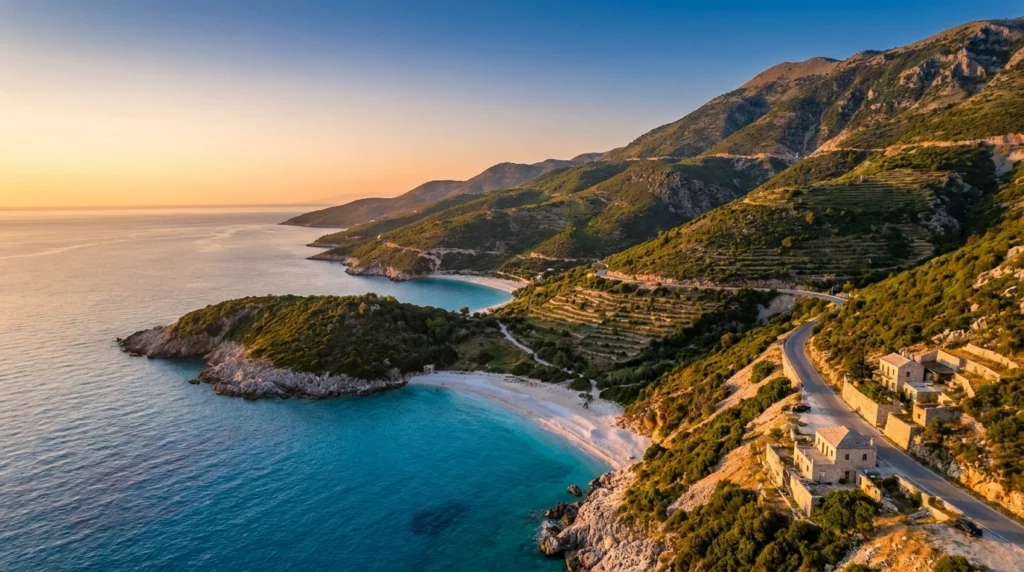
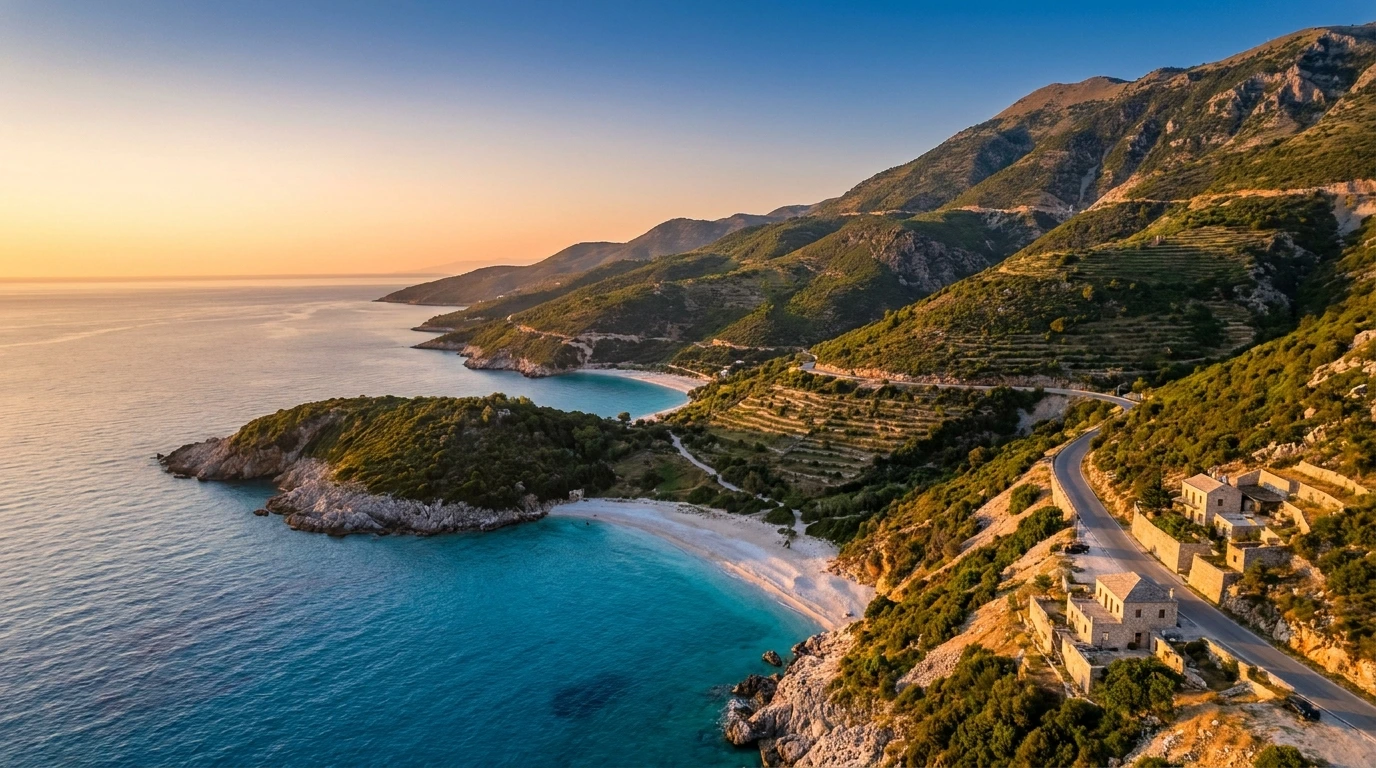
The Albanian Riviera (Bregu) is the 120-kilometre stretch of Ionian coast between the Llogara Pass and the Greek border at Sarandë — olive-covered hills dropping into turquoise coves, whitewashed stone villages, and the closest thing the Mediterranean still has to an undiscovered coastline, now firmly discovered. The official summer season runs from June 1 through September 30, 2026, with peak crowds Italian-Ferragosto-week (August 10–20) and the best swim-weather window roughly late June through mid-September.
- First swimmable week: approximately June 1, 2026 — sea temperatures cross 22°C on the southern Ionian coast
- Peak window: July 15 – August 25, 2026 (daytime highs 30–34°C, sea 25–27°C)
- Peak duration: approximately 42 days of reliable summer before the first September storms
- Ksamil: three small turquoise-water islands 20 minutes south of Sarandë, Butrint UNESCO ruins next door
- Himarë & Dhërmi: cliff-backed pebble beaches, Llogara Pass drive 1,027 m to the summit
- Gjipe Beach: 30-minute walk from the paved road; unofficial summer-party cove
Best Time to Visit Albania (Season by Season)
Spring (Mar–May)
The shoulder-season sweet spot inland. Tirana temperatures climb from 14°C in early March to 24°C by late May, wildflowers bloom across the Llogara National Park, and the Theth and Valbona valleys in the Albanian Alps become passable from late April as the snow recedes. Berat and Gjirokastër are at their photogenic best with green hills behind the white Ottoman houses. Tirana’s Dita e Verës (Summer Day) on March 14 is a national pagan-origin spring festival with picnics and ballokume biscuits. Downsides: the sea is still cold for swimming until mid-May, and Theth’s Valbona Pass trail is not fully open until late May or early June.
Summer (Jun–Aug)
Beach country. Coastal temperatures run 28–34°C, heatwaves hit 38°C inland on the Myzeqe plain, and the Ionian sea warms to 25–27°C. The Albanian Riviera — Himarë, Dhërmi, Ksamil, Gjipe — is in full swing; the Valbona and Theth alpine valleys offer cool mountain air and the classic Valbona-to-Theth day hike over the 1,795 m pass. The Gjirokastër National Folklore Festival, held every five years, is scheduled for 2026 at the Gjirokastër Castle amphitheatre. Warnings: Ferragosto week (August 10–20) doubles Riviera pricing; smaller towns shut midday in heat.
Autumn (Sep–Nov)
The underrated season. September still swims on the Ionian (sea 24°C through mid-October); inland, the Accursed Mountains turn gold and red by early October. Olive and grape harvest fills the southern villages, and Berat’s Raki tasting season opens in late September. Temperatures drop from 26°C in early September to 10°C by late November. The Tirana International Film Festival takes over the Millennium Cinema in early November. Best-value window of the year — Riviera hotel rates drop 40–50% after September 15, flights from European hubs stay frequent into late October.
Winter (Dec–Feb)
Quiet-season city travel plus surprise skiing. Tirana and the coast run 6–14°C, rainy but rarely freezing. The Albanian Alps get serious snow — Dardha near Korçë and Voskopojë have small lifts, and Valbona and Theth shut almost entirely between November and April as the access road closes. Korçë’s Beer Festival runs the last week of August (not winter) but the city’s Christmas market and Orthodox New Year on January 14 are genuine winter draws. Short daylight (sunset 4:40pm in December) and closed mountain roads make this the best window for Tirana, Berat and Gjirokastër urban trips.
Shoulder-season tip: Late May through mid-June (sea warm enough, alpine passes open, no Ferragosto crowds) and mid-September to mid-October (Ionian still swimmable, olive harvest underway, hotels at 50% off peak) are the two windows most first-time travellers miss.
Getting There — Flights & Arrival
Tirana handles the overwhelming majority of international arrivals; Kukës in the north-east and Vlorë (opened 2025) in the south-west are small secondary airports used mostly by regional low-cost carriers. North Americans typically connect via Istanbul, Rome or Vienna; Western Europeans fly direct on Wizz Air, Ryanair, Lufthansa or ITA.
- Tirana International Airport Nënë Tereza (TIA) — also called Rinas — Albania’s primary hub, handling roughly 10.3 million passengers in 2024. Shuttle bus Rinas Express runs every hour to Tirana central square in 30 minutes for 400 lek; official taxi rank runs 2,500–3,000 lek to central Tirana.
- Kukës International Airport (KFZ) — small north-eastern airport, seasonal low-cost flights to European hubs; gateway to the Valbona Valley and the Albanian Alps.
- Vlorë International Airport (VOA) — new southern gateway that opened commercial operations in 2025, targeting Riviera traffic; schedules still limited.
Flight times: NYC–Tirana 10–11 hours via Istanbul or Rome; London–Tirana 3 hours direct on Wizz Air; Dubai–Tirana 5 hours direct on FlyDubai.
Carriers: Air Albania, Wizz Air, Ryanair, Lufthansa, ITA Airways, Turkish Airlines, Pegasus, FlyDubai.
Visa / entry: Non-Schengen — US, UK, EU, Canadian, Australian, Japanese, South Korean and 80+ passports enter visa-free for up to 90 days in any 180-day window.
Getting Around — Furgons, Buses & Coastal Ferries
Albania has no functioning intercity passenger rail to speak of — HSH trains run only a handful of slow suburban services. Long-distance travel is by intercity bus, shared minibus (furgon), rental car, or the Lake Koman ferry in the north. The SH1 Tirana–Shkodër motorway and SH4 Tirana–Vlorë highway are fast, but the southern SH8 Riviera road is winding and scenic.
- Intercity buses & furgons: depart Tirana’s Regional Bus Terminal (TRBT, opened 2023); pay cash to the driver.
- Tirana → Sarandë: approximately 5 hours 30 minutes direct coach (roughly 1,500 lek).
- Tirana → Berat: approximately 2 hours 30 minutes by furgon (roughly 500 lek).
- Tirana → Shkodër: approximately 2 hours on the SH1 motorway (roughly 400 lek).
- Tirana → Gjirokastër: approximately 4 hours 30 minutes direct coach (roughly 1,300 lek).
- Lake Koman ferry: Koman dam → Fierzë, 2 hours 45 minutes — the fjord-like gateway to Valbona.
Tickets: No national pass exists. Pay cash on intercity buses; long-distance coaches increasingly accept card. Sarandë–Corfu ferries (30 minutes, Finikas Lines) run 2–3 times daily in summer for roughly 2,500 lek one-way.
City transit: Tirana’s municipal buses are flat-fare 40 lek; the QR e-ticket launched 2024. Bolt rideshare covers Tirana and Durrës. In smaller cities, agree taxi fares first — meters are rare.
Apps: Bolt (ride-hail), Google Maps (routes reliable, timetables spotty), Gjirafa (Albanian-language transit search).
Top Cities & Regions
📍 Map of Albania: Every Place in This Guide
🏙️ Tirana
The capital and the country’s only genuinely international city — roughly 598,000 people in the municipality, a post-communist colour-splashed skyline thanks to former mayor Edi Rama’s paint-the-façades campaign, and a cafe-and-nightlife culture running past midnight on Blloku. Skanderbeg Square was pedestrianised in 2017 and remains the symbolic and geographic centre.
- Skanderbeg Square, the Et’hem Bey Mosque (1821) and the National History Museum’s “Albanians” mosaic
- Bunk’Art 1 (1970s Cold War bunker complex on the city edge) and Bunk’Art 2 (central interior-ministry bunker on Skanderbeg Square)
- Blloku nightlife district (Enver Hoxha’s former sealed villa neighbourhood, now cocktail bars), Dajti Ekspres cable car to 1,613 m (15 minutes)
Signature eats: tavë kosi (baked lamb with yoghurt), fërgesë (peppers with cottage cheese), Tirana-style qofte, Korça Birra on tap at a Blloku bar.
🏰 Berat
The “City of a Thousand Windows” — a UNESCO-listed Ottoman town of roughly 60,000 people 2 hours 30 minutes south of Tirana, where whitewashed stone houses stack up the Osum river valley under a hilltop castle still inhabited by residents. The Mangalem (Muslim) and Gorica (Christian) quarters face each other across the river, linked by an Ottoman stone bridge.
- Berat Castle (Kala), still inhabited; inside, the Onufri Iconographic Museum of 16th-century Orthodox icons
- Mangalem quarter and its characteristic thousand-windowed façade, Gorica quarter across the Gorica Bridge (1780)
- Day trip to the Osum Canyon (26 km long, 90 m deep) and the Bogove thermal springs 30 minutes south
Signature eats: paçe koke (slow-cooked lamb’s head soup), pite me spinaq (spinach byrek), Berat-region Raki Rrushi (grape Raki) at a kullë cellar tasting.
🗿 Gjirokastër
The “City of Stone” — UNESCO-listed Ottoman hillside town of roughly 55,000 in southern Albania, with slate-roofed tower houses (kulla) and a Byzantine-Ottoman castle housing an open-air arms museum. Birthplace of writer Ismail Kadare and dictator Enver Hoxha; the Folk Bazaar’s stone streets are original Ottoman cobbles.
- Gjirokastër Castle and its 1811 expansion — arms museum, prison wing, amphitheatre for the 2026 National Folklore Festival
- Skënduli House and Zekate House — 18th-century Ottoman tower-houses with original frescoed reception rooms
- Blue Eye (Syri i Kaltër) karst spring, 18 metres deep, electric-blue and 12°C year-round, 25 km south of Gjirokastër
Signature eats: qifqi (herbed rice balls, a Gjirokastër original), oshaf (fig-and-milk dessert), shëndetlie (honey nut cake), local white cheese.
🏖️ Albanian Riviera (South Coast)
The 120 km Ionian coast from the Llogara Pass to the Greek border — Himarë, Dhërmi, Jale, Ksamil, Sarandë — backed by olive-grove hills, connected by the SH8 coastal road, and the single biggest reason international arrivals are up.
- Ksamil’s three small islands off the south-facing beach; Sarandë harbour and 30-minute ferry to Corfu
- Butrint UNESCO archaeological park — Greek, Roman, Byzantine and Venetian layers on a single lagoon peninsula
⛰️ Albanian Alps (Theth & Valbona)
The Accursed Mountains (Bjeshkët e Nemuna) on the Montenegrin and Kosovar borders — Theth National Park and Valbona Valley National Park linked by a classic 17 km day hike over the 1,795 m Valbona Pass.
- Theth village and its stone lock-in tower (kulla ngujimi) from the blood-feud era; the Grunas Waterfall 45 min up-valley
- Lake Koman ferry from Shkodër-region roads → Fierzë → Valbona, the scenic gateway route
🏛️ Shkodër & Lake Shkodër
Albania’s northern cultural capital (roughly 135,000 people), on the shore of Lake Shkodër — the largest lake in Southern Europe at 369 km², shared with Montenegro.
- Rozafa Castle (Illyrian-origin hilltop fortress, 4th century BCE) above the confluence of the Drin and Buna rivers
- Marubi National Museum of Photography — 500,000 negatives from the 19th-century Marubi studio, the oldest photographic archive in the Balkans
Albanian Culture & Etiquette — What to Know Before You Go
Albanian culture rewards warmth, directness and hospitality. Visitors notice slow-paced café afternoons, families still walking the xhiro (evening promenade), and strangers inviting foreigners to coffee with surprising frequency. Decades of Hoxha-era isolation left a population that is curious about outsiders rather than suspicious, and under-40s speak meaningful Italian and English thanks to unblocked 1980s Italian TV and post-1991 openness. The country is majority Muslim by heritage but practice is relaxed; Orthodox, Catholic and Bektashi Sufi communities coexist without tension.
The Essentials
- Greet with Tungjatjeta (“long life to you”) or the shortened Tung; Mirëmëngjes in the morning, Mirëmbrëma in the evening. Shake hands with eye contact on meeting.
- Head-shake is famously inverted: older Albanians nod for “no” and shake for “yes.” Urban under-40s use the international version for foreigners; rural speakers still use the traditional direction — confirm verbally.
- Remove shoes on entering a home — slippers (pantofla) are offered. Bring a small gift (flowers, pastries, a bottle) for a first dinner invitation.
- Tipping is modest: 5–10% at sit-down restaurants, round up at bars and taxis. Service charges are uncommon outside high-end Tirana restaurants.
- Never refuse a Raki toast outright — it is served on arrival, departure and often between. Take a small sip and clink; Gëzuar! is the standard cheers.
Mosque, Church & Tekke Etiquette
- Dress modestly in places of worship — shoulders and knees covered. Women receive a headscarf at mosque entrances if needed; men remove hats.
- Remove shoes before entering any mosque; a shoe rack is at the door. Visiting Orthodox churches outside liturgy is fine, but do not photograph during a service.
- The Bektashi World Headquarters in Tirana (the Sufi order’s global centre, relocated from Turkey in 1925) welcomes visitors outside major holidays.
- Carry cash for a candle donation at Orthodox churches (20–50 lek). Kruja’s and Berat’s older mosques accept small donations at the shoe rack.
A Food Lover’s Guide to Albania
Albanian food sits at the crossroads of Ottoman, Mediterranean and Balkan kitchens — olive oil and lamb from the south, dairy and maize pite from the north, grilled seafood from Vlorë and Sarandë, and vegetable dishes like fërgesë that make even lifelong carnivores order a second round. Fruit and vegetables are seasonal and genuinely local; tomatoes, peppers, olives and peaches taste like the ones most Western Europeans have stopped tasting. Coffee is the social currency — an espresso macchiato and a 90-minute café sit is the unit of daily life.
Must-Try Dishes
| Dish | Description |
|---|---|
| Tavë kosi | The national dish — baked lamb (or veal) with rice, eggs and yoghurt, slow-cooked in a clay tavë dish until the yoghurt sets into a golden crust. Elbasan is the spiritual home; every Tirana restaurant serves a version. Rich, creamy and distinctively tangy — the dish tourists most consistently remember from their Albania trip. Around 700–1,200 lek at a restaurant. |
| Fërgesë | A skillet of grilled red peppers, tomatoes, white cottage cheese (gjizë) and a splash of olive oil, sometimes with liver — served bubbling hot straight from a clay dish. Tirana-style is vegetarian; the Berat and Korçë versions add meat. A classic meze course before a main. 400–700 lek. |
| Byrek | Paper-thin filo pastry layered with spinach (me spinaq), white cheese (me djathë), pumpkin (me kungull) or meat (me mish) — cut into squares and eaten from the hand. The default Albanian breakfast and a street-food staple at every furrë (bakery). A slice is 50–100 lek. |
| Qofte | Grilled minced-meat rolls — Tirana-style are long, flat and seasoned with onion and pepper; Korçë-style are smaller, rounder and heavy on mint. Served with chopped onion, grilled pepper and flatbread, with a yoghurt dip on the side. A plate of six is 500–900 lek. |
| Paçe koke | Slow-cooked lamb’s-head soup served at dawn in small paçe shops — an acquired taste, a hangover cure, and a cultural artefact. Berat and Gjirokastër are the places to try it. 300–500 lek a bowl; the experience is the thing. |
| Grilled Ionian fish | Sarandë, Himarë and Vlorë waterfront restaurants grill sea bass (levrek), sea bream (kocë) and octopus whole over coals — served with a lemon wedge, boiled chard and a carafe of local white wine. Fish is priced by the kilo; a whole plate runs 1,800–3,500 lek. |
| Baklava & sheqerpare | Baklava in Albania is the Ottoman walnut-and-syrup classic; sheqerpare are soft semolina biscuits in lemon syrup. Ballokume are Elbasan’s corn-flour-and-butter biscuits eaten only on Dita e Verës (March 14). Every furrë has a pastry counter; a tray slice is 100–200 lek. |
Raki, Coffee & Ionian Seafood Culture
Raki is the national spirit — a clear fruit brandy (40–45% ABV) distilled from grapes (Raki Rrushi), mulberries (Raki Mani) or plums, usually homemade and served at room temperature as both aperitif and digestif. Korça Birra (since 1928) is the national beer on tap across the country. Wine is a discovery: Kallmet and Vlosh are the indigenous reds, Cërruja the white; Çobo, Kantina Arbëri and Çajupi produce serious bottles.
- Iconic Tirana spots: Mullixhiu (modern Albanian), Artigiano (pastries), Pasta e Vino, the Era chain (casual)
- Signature drinks: Raki Rrushi and Raki Mani, Korça Birra on tap, Kallmet red from Lezhë, Albanian macchiato
Off the Beaten Path — Albania Beyond the Guidebook
Theth National Park
A glacial alpine valley in the Accursed Mountains 80 kilometres north of Shkodër, designated a national park in 1966 and now roughly 2,630 hectares of stone villages, beech forest and 1,800 metre peaks. Theth village sits at 750 metres with stone-roofed houses, a whitewashed 19th-century church, and a preserved kulla ngujimi (blood-feud lock-in tower). The classic 17 kilometre Theth-to-Valbona day hike crosses the 1,795 metre Valbona Pass — usually passable from late May to mid-October. Most guesthouses serve home-raised lamb and home-distilled Raki; Wi-Fi is spotty and satisfyingly so.
Butrint National Park
A UNESCO-listed archaeological peninsula 20 kilometres south of Sarandë, inscribed in 1992, where Greek, Roman, Byzantine, Venetian and Ottoman layers sit on a single lagoon site. The Greek theatre (4th century BCE) still hosts summer performances; the Roman forum, a Byzantine baptistery with mosaic floors, and a Venetian triangular fortress (1490) all fit inside a 2-kilometre walking loop. Butrint is reachable by the vintage Ksamil–Butrint local bus in 25 minutes and is quietest before 10am.
Osum Canyon & Bogove Thermal Springs
A 26 kilometre gorge cut 90 metres deep into the limestone east of Berat, signposted from the village of Çorovodë. Whitewater-rafting operators run it from April to June when snowmelt is high; in late summer the water drops to ankle depth and the canyon becomes a hike. Thirty minutes south, Bogove thermal springs emerge at 28°C in a pebble-lined natural pool beside the Osum river — free to bathe in, no facilities, an afternoon detour from a Berat overnight. Best paired with a Gradec cave church visit.
Voskopojë
A mountain Aromanian village in the southern uplands 20 kilometres west of Korçë — once one of the largest cities in the Balkans (reputedly 30,000 people and 24 churches in the 18th century), now home to roughly 600 residents and five remaining post-Byzantine churches with extraordinary frescoes by master painters David of Selenicë and the Zografi brothers. The 1724 Church of Saint Nicholas is the most complete; visits require finding the keyholder at the village café. Snow closes the road in winter; autumn colour is best.
Apollonia Archaeological Park
An Ancient-Greek city founded 588 BCE on the Aoös river plain 12 kilometres west of Fier, still a working excavation site run by the Albanian Institute of Archaeology and French CNRS teams. The partly restored Bouleuterion (council house) façade, a 2nd-century odeon, a 14th-century Byzantine Monastery of Saint Mary built over Greek foundations, and scattered stelae across olive groves make Apollonia the quieter counterpart to Butrint. An hour by car from Vlorë or Berat; usually almost empty.
Practical Information
| Currency | Albanian lek (L or ALL); 1 USD ≈ 92 lek, 1 EUR ≈ 99 lek (April 23, 2026). Euros accepted informally on the coast at a worse rate. |
| Cash needs | Cards work at Tirana hotels and supermarkets; furgons, small restaurants, markets and mountain guesthouses run on cash. Keep 5,000–10,000 lek in small notes. |
| ATMs | Raiffeisen, Credins, Intesa Sanpaolo, BKT and Alpha Bank branches in every mid-sized town. Decline dynamic currency conversion. Withdraw before heading to Theth or Valbona. |
| Tipping | 5–10% at sit-down restaurants; round up at taxis and bars. Hand the tip with payment. A 10% service charge occasionally appears on Tirana bills — check the menu. |
| Language | Albanian (Shqip) — its own Indo-European branch. English widely spoken by under-40s; Italian very common; older rural speakers may only have Albanian. |
| Safety | Very safe for travellers; violent crime rare. Normal pickpocket awareness on Tirana squares. Driving standards are the main hazard. |
| Connectivity | 4G nationwide, 5G in Tirana, Durrës and Vlorë from Vodafone, One Albania and ALBtelecom. eSIMs from €5 a week. |
| Power | Type C and Type F plugs; 230V / 50 Hz. Standard Continental European fit. |
| Tap water | Generally safe in Tirana and major cities; locals often prefer bottled. Drink bottled in mountain villages. Ujë pa gaz = still, me gaz = sparkling. |
| Healthcare | Basic public hospitals in cities; Tirana’s private American Hospital is the main visitor choice. Travel insurance strongly recommended. |
Budget Breakdown — What Albania Actually Costs
💚 Budget Traveller
Hostels in Tirana (Trip’n’Hostel, Hostel Albania), guesthouses in Berat and Gjirokastër at 2,000–3,500 lek a bed, furfun and intercity-bus travel, and self-catered markets. Doable at US$30–50 per day. A byrek breakfast is under 150 lek (~US$1.60); a restaurant menu of the day runs 600–1,000 lek (~US$7–11) for soup, main and drink; a 0.5 L Korça Birra at a pub is 200–300 lek (~US$2.20–3.25). Berat, Gjirokastër and Korçë are noticeably cheaper than Tirana or the Riviera.
💙 Mid-Range
3-star hotel or well-rated guesthouse in Tirana or on the Riviera, one sit-down dinner and one café or street-food meal a day, rental car for Riviera and Alps legs, plus two or three paid sights (Butrint entrance 1,000 lek; Berat Castle 400 lek; Gjirokastër Castle 400 lek). Plan US$85–140 per day. A mid-range dinner for two with wine runs 4,000–7,000 lek (~US$45–75). Riviera season doubles these numbers Ferragosto week.
💜 Luxury
5-star Tirana hotels (Plaza Tirana, Xheko Imperial, Mak Albania), private driver-guides for multi-day trips, whole-fish dinners on the Sarandë or Himarë waterfront, and boutique stone-house conversions in Berat and Gjirokastër. Plan US$220+ per day. A tasting dinner at Mullixhiu or a fine-dining Ionian seafood evening runs 8,000–15,000 lek per person with wine. Plaza Tirana Skanderbeg-view suites run US$350–600+ per night in peak season.
| Tier | Daily (USD) | Accommodation | Food | Transport |
|---|---|---|---|---|
| Budget | $30–50 | Hostel 1,200–2,000 lek / guesthouse 2,500–4,500 lek | 1,200–2,500 lek/day | Furgon / intercity bus 400–1,500 lek |
| Mid-Range | $85–140 | 3-star hotel 6,000–12,000 lek | 3,500–6,000 lek/day | Rental car ~4,000 lek/day |
| Luxury | $220+ | 5-star hotel 22,000–55,000 lek+ | 8,000–15,000 lek/day | Private driver / chartered boat |
Planning Your First Trip to Albania
- Pick your route. The classic circuit is Tirana → Berat → Gjirokastër → Sarandë/Ksamil → back via Vlorë. A week covers it; ten days adds Theth or Valbona.
- Rent a car from TIA. Buses connect the cities, but Riviera coves (Dhërmi, Jale, Gjipe) and the Alps (Theth, Valbona) need wheels. Compacts rent from about 4,000 lek a day.
- Pay in lek, not euro. Coastal hotels accept euros at a worse rate than the Bank of Albania mid-rate. Withdraw from Raiffeisen, Credins or BKT; decline dynamic currency conversion.
- Book the summer Riviera early. Dhërmi, Himarë and Ksamil sell out 3–4 months ahead for Ferragosto (August 10–20). Gjirokastër books up during the 2026 National Folklore Festival.
- Learn five Albanian words. Tungjatjeta (hello), Faleminderit (thanks), Ju lutem (please), Mirupafshim (goodbye), Gëzuar (cheers).
Classic 10-Day Itinerary: Days 1–2 Tirana · Day 3 Berat · Day 4 Osum Canyon + Gjirokastër · Day 5 Blue Eye + Butrint + Ksamil · Days 6–7 Himarë or Dhërmi · Day 8 Llogara Pass to Shkodër · Days 9–10 Lake Koman ferry + Valbona or Theth before flight home from TIA.
Frequently Asked Questions
Is Albania expensive to visit?
No — it is one of the cheapest destinations in Europe. Budget travellers get by on US$30–50 per day; mid-range plan US$85–140. Tirana’s Blloku district and the Riviera in August are the priciest spots; Berat, Gjirokastër, Korçë and Shkodër are meaningfully cheaper. A byrek is 50–150 lek; a whole grilled sea bass on the Sarandë waterfront is 1,800–3,500 lek.
Do I need to speak Albanian?
No. English is widely spoken by under-40s and in tourist-facing businesses; Italian is near-universal thanks to 1980s unblocked Italian TV and decades of labour migration. A little Albanian goes a long way — Tungjatjeta, Faleminderit, Ju lutem, Mirupafshim, Gëzuar. In the Alps and remote southern villages English thins out, but Italian and gestures bridge the gap.
Is a rental car worth it in Albania?
Yes, for almost every itinerary that includes the Riviera or the Alps. Intercity buses connect Tirana, Berat, Gjirokastër, Sarandë and Shkodër fine, but the Riviera coves and the Theth and Valbona mountain valleys are barely served by public transport. Rental is 3,500–5,000 lek a day for a compact from TIA airport; drive defensively and avoid night mountain roads.
Is Albania safe for solo travellers?
Very — violent crime against tourists is rare and Albanians are generally warm toward visitors. Solo women report feeling comfortable in Tirana and on intercity buses, though the Riviera summer party crowd can be pushy. Main risks are pickpocketing in Tirana’s main squares, unmetered taxis (always agree the fare first), and the driving culture. Use Bolt for rides in Tirana and Durrës.
When is the Albanian Riviera best?
Mid-June to mid-September for swimming, with late June and the first half of September the sweet-spot shoulders — sea warm, crowds thinner, prices lower. August is peak; the Italian Ferragosto window (August 10–20) sees the highest prices and busiest coves. By October the water drops below 22°C and most beach bars close.
Can I get by as a vegetarian or vegan?
Easily in Tirana (Artigiano, Mullixhiu tasting menus, dedicated vegan spots). Traditional menus offer fërgesë (peppers and cheese), speca me gjizë, byrek me spinaq, trahana soup and excellent seasonal vegetable dishes. Outside Tirana and the Riviera, meat is the default — flag preferences clearly when ordering.
Are the Hoxha-era bunkers safe to visit?
The museum conversions (Bunk’Art 1 and Bunk’Art 2 in Tirana, Gjirokastër Castle bunker, the Shkodër bunker museum) are fully safe and signposted. Wild bunkers on hillsides and beaches are usually empty concrete shells — fine to photograph from outside, but inside they are often flooded, rubble-filled and home to wildlife. Don’t crawl into one after dark.
Ready to Explore Albania?
Albania rewards travellers who rent a car, slow down, and say yes to the Raki. Start in Tirana for the history, Berat and Gjirokastër for the Ottoman stone, the Riviera for the beaches, and the Accursed Mountains for the alpine day hike most travellers haven’t heard of.
Explore More
More country guides you might like
Plan your trip to Albania
The booking tools we use ourselves. FFU may earn a commission at no extra cost to you.
Plan & book your trip to Albania
Booking through these searches supports our guides at no extra cost to you.