
Languages of Hungary
All languages of Eastern Europe →fluent beta classical · classes by phone with Maya at ranas.ai/maya
Hungary Travel Guide — Thermal Baths, Paprika Kitchens & Danube Dreams
Hungary Travel Guide
📋 In This Guide
- Overview — Why Hungary Belongs on Every Bucket List
- 🎶 Budapest Sziget Festival 2026
- Best Time to Visit Hungary (Season by Season)
- Getting There — Flights & Arrival
- Getting Around — MÁV Railways & Budapest Transit
- Top Cities & Regions
- Hungarian Culture & Etiquette
- A Food Lover’s Guide to Hungary
- Off the Beaten Path
- Practical Information
- Budget Breakdown
- Planning Your First Trip to Hungary
- Frequently Asked Questions
Overview — Why Hungary Belongs on Every Bucket List
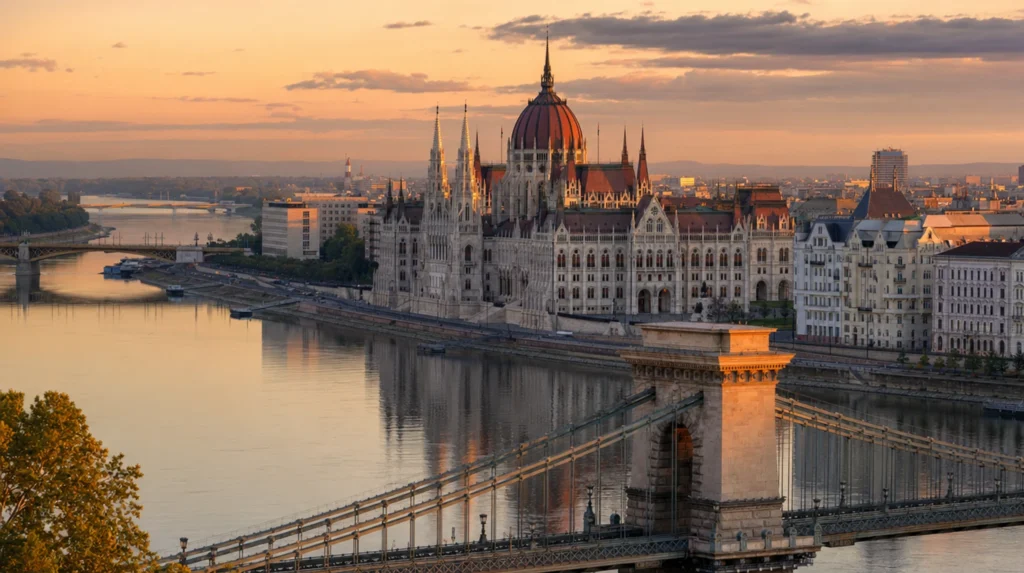
Hungary is the Central European country where Roman aqueducts, Ottoman-era thermal baths, Habsburg coffeehouses and Art Nouveau facades share the same kilometre of cobbled street. It sits landlocked on the flat, fertile Carpathian Basin, shares borders with seven countries — Austria, Slovakia, Ukraine, Romania, Serbia, Croatia and Slovenia — and packs eight UNESCO World Heritage sites into just 93,030 square kilometres of puszta grassland, Danube-bend river valley and volcanic wine hills.
Geography shapes everything here. The Danube splits the country roughly north-to-south and the capital exactly east-to-west: Buda’s hills on the right bank, Pest’s flat boulevards on the left. North of Budapest, the Danube bends sharply around the Visegrád hills at Szentendre and Esztergom; east of the capital, the country flattens into the Great Plain (Alföld), a former steppe that still supports shepherds, grey cattle and the csikós horsemen of Hortobágy National Park. The west is rolling wine country and Lake Balaton, Central Europe’s largest freshwater lake at 77 km long. You can cross the country end-to-end by IC train in under four hours and pass every one of those landscapes in a day.
Culturally, Hungary runs on a striking contradiction: a small, fiercely proud nation of 9.6 million people speaking a language related to nothing spoken by any neighbour. Hungarian (Magyar) is Uralic — distantly related to Finnish and Estonian, unrelated to the Slavic languages to the east and north or to German across the Austrian border. Hungarians nested into the Carpathian Basin in 895 CE, became Christian under King Stephen I in 1000, spent 150 years under Ottoman occupation, three more centuries under Habsburg Austria, and forty-five years behind the Iron Curtain until 1989. All of that layers — visibly — on one Budapest city block.
Practically, Hungary is one of Europe’s best-value entry points. It joined the European Union in 2004 and the Schengen border-free area in 2007, so the same ninety-day tourist rules apply as in France or Germany, but Hungary kept its own currency — the forint (HUF or Ft) — which is why a Budapest weekend costs roughly a third less than an equivalent one in Vienna just across the border. Safety is excellent, trains radiate from Budapest to every region, and more than 100 thermal bath establishments across the country offer a warm, mineral-rich soak for the price of a pub lunch. At the end of a long walking day, a bowl of gulyás, a glass of Egri Bikavér and a soak in Széchenyi Baths at 8pm is what every traveller ends up doing, regardless of what the itinerary said.
🎶 Budapest Sziget Festival 2026 — The Island of Freedom on the Danube
Sziget (Hungarian for “island”) is Central Europe’s biggest music-and-culture festival — a six-day takeover of Óbudai-sziget, an old-Buda island in the Danube, running from August 5 through August 10 in 2026. Founded in 1993 by university students looking for a cheap summer, Sziget now pulls roughly 400,000 attendees across the week for headline rock, pop, electronic and world-music acts on more than 50 stages, plus circus tents, art installations and a 24-hour camping city the Hungarian press calls “the island of freedom.” Week passes sell out by the spring, and daily tickets hold price almost until the gate.
- Opening day: Wednesday, August 5, 2026 — Óbudai-sziget, Budapest
- Peak window: August 5 – August 10, 2026 (6 days, 50+ stages)
- Daily attendance: roughly 65,000–80,000 per day, peaking on Friday and Saturday nights
- Main Stage: headline rock and pop acts from 9pm — past headliners include Arctic Monkeys, Billie Eilish, Kendrick Lamar, Dua Lipa
- Globális Udvar: world-music stage; the Cirkusz tent hosts nightly Hungarian and international acrobatic acts
- Party district: Ráday utca and District VII ruin bars (Szimpla Kert, Instant) stay open 6am for post-festival crowds
Best Time to Visit Hungary (Season by Season)
Spring (Mar–May)
The shoulder-season sweet spot. Daytime temperatures climb from 10°C in early March to 22°C by late May, tree blossom fills the Buda hills by mid-April, and Budapest’s outdoor café terraces reopen for the season by Easter. The Budapest Spring Festival runs the first half of April with classical music and opera across the city. May brings the first wine-tasting weekends at Eger and Villány. Downsides: the Great Plain (Hortobágy) can still be cold and windy into early April, and Lake Balaton’s water is too cold for swimming until late May.
Summer (Jun–Aug)
Peak season. Temperatures run 22–30°C in Budapest, with heatwaves regularly pushing past 35°C in July and August on the Great Plain. Lake Balaton fills with Hungarian and Austrian holidaymakers from Saint Stephen’s Day (August 20) back through late June; the south shore is the party beach, the north shore is the wine-and-quiet coast. Budapest Sziget Festival runs six days in early August. The Szeged Open-Air Theatre Festival runs July through late August on the Dóm Tér. Warnings: Budapest hotels hit peak pricing, and older apartments rarely have air conditioning.
Autumn (Sep–Nov)
The underrated season. Wine harvest (szüret) fills every weekend of September and October at Eger, Villány, Badacsony and Tokaj, with grape-picking festivals and street parades in every wine town. Temperatures drop from 24°C in early September to 6°C by late November, and the Buda hills and Danube Bend turn a brilliant amber by mid-October. The Budapest International Wine Festival takes over Buda Castle in early September. Saint Martin’s Day on November 11 brings the release of the year’s new wine and roast goose at every traditional restaurant. Best-value travel window of the year.
Winter (Dec–Feb)
Christmas-market country with a thermal-bath twist. Budapest’s Vörösmarty Square and St. Stephen’s Basilica markets run from mid-November through early January, Debrecen and Szeged have their own smaller markets, and Széchenyi Baths stays open until 10pm for outdoor soaks in snow. Temperatures run −3°C to 5°C in the cities, with snow possible in December and January. The Mátra and Bükk mountains have modest ski hills (Kékestető, 1,014 m, is the country’s highest point) — fine for beginners, not Alpine. Short daylight (sunset 4pm) suits café-and-bath itineraries over long walking days.
Shoulder-season tip: Late April through mid-May (pre-summer crowds, first warm café terraces, Spring Festival finale) and mid-September to mid-October (wine harvest, golden Danube Bend, empty castles, post-summer pricing) are the two windows most first-time travellers miss.
Getting There — Flights & Arrival
Budapest handles almost all intercontinental arrivals; Debrecen and Hévíz–Balaton are small regional airports used mostly by European low-cost carriers. Direct North American flights land only at BUD; from Asia, most travellers connect via a European hub.
- Budapest Ferenc Liszt International (BUD) — Hungary’s primary hub, a record 17.6 million passengers in 2024. Shuttle bus 100E runs every 7–10 minutes to Deák Ferenc tér in ~40 minutes for 2,200 HUF; official Főtaxi rank is a flat 9,000–11,000 HUF to Pest.
- Debrecen (DEB) — seasonal Wizz Air to London, Eindhoven, Malta and Tel Aviv; direct bus to Debrecen station in 15 minutes.
- Hévíz–Balaton (SOB) — near Lake Balaton; seasonal summer charters only.
Flight times: NYC–Budapest 9h nonstop on LOT; London–Budapest 2h 30m; Dubai–Budapest 5h 30m on Emirates.
Carriers: Wizz Air, Ryanair, Lufthansa, British Airways, KLM, Emirates, Qatar Airways, LOT.
Visa / entry: Schengen member — US, UK, Canada, Australia, Japan, South Korea and 60+ passports enter visa-free for 90 days in any 180-day window. From late 2026, visa-exempt travellers need a €7 ETIAS pre-authorisation.
Getting Around — MÁV Railways & Budapest Transit
Hungary is small and radial — every main rail line leaves Budapest and every traveller is likely to return through it at least once. MÁV (Magyar Államvasutak) runs the national network, with InterCity (IC) services topping 160 km/h on the Budapest–Debrecen, Budapest–Pécs and Budapest–Lake Balaton corridors. Buses (Volánbusz, FlixBus) fill in where rail doesn’t reach — particularly the Danube Bend, Hollókő and smaller wine villages.
- MÁV InterCity (IC): top speed 160 km/h; electrified on most main lines.
- Budapest → Debrecen: approximately 2 hours 40 minutes by direct IC.
- Budapest → Pécs: approximately 3 hours by direct IC.
- Budapest → Szeged: approximately 2 hours 20 minutes by direct IC.
- Budapest → Siófok (Lake Balaton): approximately 1 hour 30 minutes by IC.
- Budapest → Eger: approximately 2 hours by direct train, sometimes with a change at Füzesabony.
Rail tickets: Hungary Rail Pass products exist but point-to-point IC fares on mav.hu are almost always cheaper. Budapest–Debrecen runs roughly 4,500–6,500 HUF in second class booked a few days early. An IC seat reservation is mandatory on most IC services (700 HUF on top of the base fare).
City transit: Budapest’s BKK network covers four metro lines, 33 tram lines, dozens of buses, the HÉV suburban rail and the Danube ferry service — a single ticket is 450 HUF and a 24-hour Budapest travelcard is 2,500 HUF. Debrecen, Szeged and Miskolc all have tram or trolleybus systems with single fares under 500 HUF.
Apps: MÁV app (national rail tickets and live timetable), BudapestGO (Budapest mobile tickets), Google Maps (reliable nationwide for transit).
Top Cities & Regions
📍 Map of Hungary: Every Place in This Guide
🌉 Budapest
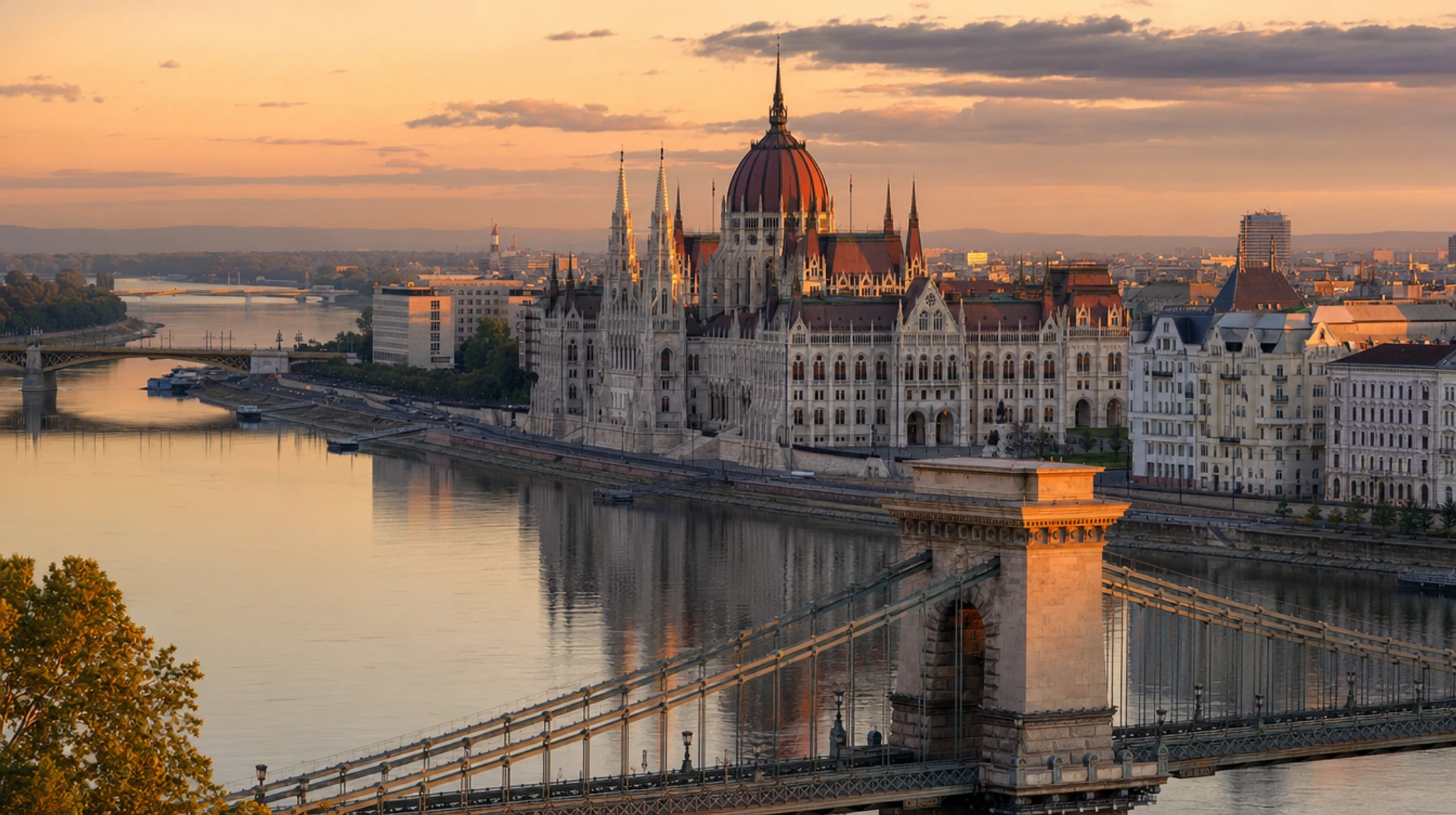
The capital and the country’s only genuinely international city — 1.7 million people across the Danube’s two banks, one of the most complete 19th-century cityscapes in Europe, with a thermal-bath culture inherited from the Romans and expanded by the Ottomans. The banks of the Danube, the Buda Castle Quarter and Andrássy Avenue are a single UNESCO World Heritage site.
- Buda Castle district, Fisherman’s Bastion and Matthias Church on Castle Hill
- Széchenyi Thermal Baths (1913, neo-Baroque, outdoor pools open year-round) and Gellért Baths (1918, Art Nouveau)
- Hungarian Parliament (1904, Europe’s third-largest parliament building) and St. Stephen’s Basilica (96 m)
Signature eats: gulyás and chicken paprikash at a traditional étterem, lángos at the Central Market Hall (Nagyvásárcsarnok), kürtőskalács from a street spit, Unicum herbal liqueur as a digestif.
🏛️ Debrecen
Hungary’s second city and the cultural heart of the Great Plain — 200,000 people in what Hungarians call the “Calvinist Rome”, the centre of Hungarian Protestantism since the Reformation. A two-hour-forty-minute IC train east of Budapest and a gateway to Hortobágy National Park.
- Great Reformed Church (1821) — where Lajos Kossuth declared Hungarian independence from Habsburg Austria on April 14, 1849
- Déri Museum with Mihály Munkácsy’s monumental Christ Trilogy oil paintings
- Hortobágy National Park day trip — UNESCO puszta grasslands, nine-arched 1833 bridge, csikós horseback shows
Signature eats: Debrecener sausage (spicy paprika kolbász), tökös-mákos rétes (poppy-and-pumpkin-seed strudel), beef pörkölt with nokedli.
⛪ Pécs
A Mediterranean-feeling southern city of 140,000 at the foot of the Mecsek hills — Roman Sopianae became an early Christian stronghold, 150 years of Ottoman rule left the largest surviving mosque in Hungary, and Pécs was a European Capital of Culture in 2010. The Early Christian Necropolis is UNESCO-listed.
- Early Christian Necropolis of Sopianae (UNESCO, 4th-century painted burial chambers)
- Mosque of Pasha Qasim (1579) on Széchenyi tér — converted into a Catholic church after 1686, still the largest Ottoman structure in Hungary
- Zsolnay Cultural Quarter and porcelain manufactory (founded 1853, famous iridescent eosin glaze)
Signature eats: halászlé Baja-style, Villány red wines (Cabernet Franc, Kékfrankos), almás rétes (apple strudel).
🌶️ Szeged
The sunniest city in Hungary on the Tisza river — 160,000 people, Art Nouveau and early-modernist architecture rebuilt after the catastrophic 1879 flood, and the paprika capital of the country. Hungary’s largest open-air theatre festival takes over Dóm tér every summer.
- Votive Church (Szegedi Dóm, 1930) — twin towers, 12,000-pipe organ, floodlit summer evenings
- Szeged Open-Air Festival on Dóm tér, July through late August — Hungary’s largest open-air theatre
- Pick Salami and Paprika Museum, plus the Tisza river promenade and fish-soup restaurants
Signature eats: Szegedi halászlé (Tisza-style fisherman’s soup, passed through a sieve), Pick salami (since 1869), szegedi gulyás with sauerkraut.
🍷 Eger
A Baroque wine town of 55,000 in northern Hungary’s Bükk foothills — home of Egri Bikavér (Bull’s Blood) red blend, the site of the legendary 1552 siege where 2,000 Hungarians held off 40,000 Ottoman troops, and the home of the northernmost surviving Ottoman minaret in Europe.
- Eger Castle and István Dobó Museum (1552 siege site, underground casemates)
- Valley of the Beautiful Women (Szépasszony-völgy) — horseshoe of 200+ family wine cellars, tastings from 500 HUF per glass
- Ottoman minaret (40 m, 97 narrow steps, 1596) — Europe’s northernmost surviving
Signature eats: Egri Bikavér (Bull’s Blood blend of Kékfrankos, Kadarka, Merlot), bográcsgulyás (cauldron goulash), palacsinta stuffed with ground walnuts and rum.
🏖️ Lake Balaton Region
Central Europe’s largest freshwater lake — 77 km long, 594 km², the Hungarians’ “sea” and a summer holiday tradition since the 1890s. The north shore is volcanic wine country (Badacsony, Balatonfüred, Tihany); the south shore is flatter, sandier and the party coast (Siófok, Zamárdi).
- Tihany Peninsula and the Benedictine Abbey (founded 1055 — its founding charter is the oldest surviving document with words of the Hungarian language)
- Badacsony volcanic wine hills — Kéknyelű, Szürkebarát and Olaszrizling whites from basalt soil
- Hévíz thermal lake (4.4 hectares, 33–38°C year-round, largest biologically active thermal lake in the world)
Signature eats: Balatoni fogas (pike-perch, the lake’s signature fish), south-shore lángos, Szürkebarát and Olaszrizling wines from the north-shore cellars.
Hungarian Culture & Etiquette — What to Know Before You Go
Hungarian culture rewards quiet courtesy and respect for language. Visitors notice clean trams, orderly queues and strangers who don’t smile without reason — not rudeness, just the Central European baseline. Hungarians are not Slavs or Germans: Magyar is Uralic, not Indo-European, and locals are quietly proud it is unrelated to any neighbour’s. The communist period (1949–1989) ended with a peaceful round-table transition, symbolically closed when Hungary tore open its Austrian border in August 1989 — an act historians credit with starting the collapse of the Iron Curtain.
The Essentials
- Greet with Jó napot kívánok (yoh na-poht kee-vah-nok, “I wish you a good day”) on entering a shop, restaurant or lift; Viszontlátásra on leaving. Szia is informal for friends only.
- Hungarian names are family-name-first (Kovács János, not János Kovács) — match the order on business cards and formal introductions, and use “Mr/Ms + family name” until invited to switch.
- Remove shoes on entering a Hungarian home — slippers (papucs) are usually offered. This is non-optional even in modern apartments.
- Tipping is expected: 10% at restaurants, 10% for taxis, round up at bars. Hand the tip to the server with payment — leaving it on the table is considered rude.
- Cheers with eye contact — Hungarians toast wine and pálinka freely (Egészségedre!), but see the callout below on beer.
Thermal Bath (Fürdő) Etiquette
- Swim caps are required in the lap (swimming) pools but not in the thermal pools — bring one or rent from the desk for 200–500 HUF.
- Use the wristband locker system — tap to lock and tap to unlock. Losing the band costs 3,000–5,000 HUF.
- Gellért and Rudas have historically had single-sex days and mixed days on different schedules — check the current week’s calendar at the entrance desk.
- Shower before entering any pool. It’s posted in Hungarian and enforced by attendants (fürdőmester).
- Flip-flops and a towel are expected around the pools — most baths rent them for 1,000–2,000 HUF if you don’t bring your own.
A Food Lover’s Guide to Hungary
Hungarian food is the cooking of a landlocked, cauldron-and-smokehouse country — red with paprika, thick with sour cream, built around pork, beef, chicken and river fish. Paprika is the national spice; every kitchen keeps édes (sweet) and csípős (hot) in separate jars. Budapest has Michelin-starred restaurants (Babel, Stand), a thriving pálinka tradition, the Tokaji sweet-wine region, and Habsburg-era coffeehouses at Gerbeaud, Centrál and the New York Café.
Must-Try Dishes
| Dish | Description |
|---|---|
| Gulyás (goulash) | The national dish — a paprika-rich beef-and-vegetable SOUP cooked in a bogrács (iron cauldron) over open fire. Gulyás is a soup, not a stew (the stew is pörkölt). Beef chuck, onions, sweet and hot paprika, caraway, potatoes, csipetke (pinched egg noodles); served with white bread and red wine. |
| Pörkölt | The thick meat stew foreigners call “goulash” — beef, pork, lamb or chicken braised in lard, onion and paprika until the sauce is dark and glossy. Served with nokedli (egg dumplings) or boiled potatoes. Marhapörkölt (beef) and birkapörkölt (mutton) are the traditional cauldron versions. |
| Chicken paprikash (paprikás csirke) | Chicken stewed with onion, bell pepper, tomato and sweet paprika, finished with sour cream (tejföl). Served with nokedli or galuska. A classic Sunday-lunch dish and staple on every magyaros menu from Budapest étterem to village csárda. |
| Lángos | Deep-fried flatbread rubbed with raw garlic and topped with sour cream and grated Trappista cheese — the classic. Variations add ham, sausage, paprika spread or Nutella. Street-food staple at markets and food halls. Plate-sized round 1,500–2,500 HUF. |
| Halászlé (fisherman’s soup) | A fiery paprika-red river-fish soup — the national soup of Danube and Tisza towns. Szeged style is ultra-smooth, passed through a sieve; Baja style is chunkier with matzo-style pasta. Intensely spicy, served with crusty white bread. A defining Christmas Eve dish. |
| Kürtőskalács (chimney cake) | A spit-roasted yeast-dough cylinder coated in caramelised sugar, cinnamon, walnuts or coconut — Transylvanian-Hungarian in origin, now a Christmas-market icon. Sold hot off the spit for 1,500–2,500 HUF. |
| Dobos torta & rétes | Dobos torta — seven-layer sponge with chocolate buttercream and a glassy caramel top, invented by József C. Dobos in 1884 — and rétes, the Hungarian strudel: paper-thin stretched dough filled with meggy (sour cherry), mák (poppy), túró (curd) or káposztás (cabbage). Every Budapest coffeehouse has its version. |
Wine, Pálinka & Coffeehouse Culture
Hungary has 22 official wine regions. Tokaj makes Tokaji Aszú (the sweet noble-rot wine of Louis XIV); Eger makes Egri Bikavér (Bull’s Blood); Villány is the southern red-wine capital; Badacsony is the volcanic white-wine hill on Lake Balaton’s north shore. A glass of house wine in a pub runs 500–900 HUF; a bottle of Bikavér in a shop is 2,500–4,500 HUF.
- Iconic Budapest spots: Gerbeaud Café (since 1858), Central Market Hall, Szimpla Kert ruin bar in District VII, Rudas Baths
- Signature drinks: Unicum herbal liqueur (1790, bitter digestif), pálinka (fruit brandy at 40–50% ABV), Tokaji Aszú 5 Puttonyos dessert wine
Off the Beaten Path — Hungary Beyond the Guidebook
Hortobágy National Park & the Great Plain
Europe’s largest continuous natural grassland — roughly 800 square kilometres of puszta steppe on Hungary’s Great Plain, UNESCO-listed since 1999 as a cultural landscape for its csikós (Hungarian horsemen), grey cattle, racka sheep with corkscrew horns, and the nine-arched 1833 stone bridge at Hortobágy village. Sunrise over the empty horizon with a passing shepherd and the silhouette of a sweep-pole well (gémeskút) is one of the quietest images in Europe. Easiest access is Debrecen + bus to Hortobágy village; overnight at a csárda inn for pörkölt and the evening horseman show.
Hollókő village
A 17th-century Palóc ethnographic village of 58 whitewashed wooden-shingled houses 90 minutes north-east of Budapest in the Cserhát hills, UNESCO-listed since 1987 as a rare surviving example of traditional Central European rural life. Easter Monday sees the famous Palóc water-splashing ritual in full folk costume (women in red-and-white embroidered skirts, men in black waistcoats); winter weekends bring wood-smoke, kolbász smoking sheds and snow on the hillside castle ruin above. Bus from Budapest Stadionok takes 2 hours.
Tokaj wine region
UNESCO-listed wine country three hours east of Budapest, on the Bodrog and Tisza rivers. The only region in the world producing Tokaji Aszú, the sweet wine made from noble-rotted Furmint grapes that Louis XIV famously called “the wine of kings, the king of wines”. Hand-dug volcanic-rock cellars with black mould-coated walls maintain a perfect constant humidity; Puttonyos 5 and 6 aszú tastings run 2,500–6,000 HUF per flight at Disznókő, Royal Tokaji and Oremus. Eger and Villány are larger Hungarian wine regions; Tokaj is the historic one.
Pannonhalma Archabbey
Hungary’s oldest functioning Benedictine monastery — founded in 996, now 1,000+ years of continuous monastic life on a hilltop 20 minutes south of Győr in western Hungary. UNESCO-listed since 1996 for its combined monastic, library (400,000 volumes, oldest 1060) and wine-making heritage. The monks still make award-winning Olaszrizling and Tramini whites in the abbey cellars, host a Lavender Festival in late June, and run a guided visitor programme through the basilica and crypt.
Miskolc-Tapolca Cave Bath
A natural thermal bath inside a limestone cave system in north-eastern Hungary — warm mineral water at a near-constant 30°C flowing through a network of rock chambers you swim through under coloured lighting and low rock ceilings. Unique in Europe and unusually cheap (roughly 3,500 HUF entry). Easy rail day trip from Eger on the Budapest–Miskolc line; the surrounding Bükk National Park has Hungary’s best hardwood-forest hiking and the country’s highest point at Kékestető (1,014 m).
Practical Information
| Currency | Hungarian forint (HUF / Ft); 1 USD ≈ 368 HUF, 1 EUR ≈ 405 HUF (April 19, 2026). NOT the euro. |
| Cash needs | Cards work at hotels and most Budapest restaurants; small pubs, markets and rural spots run partly on cash. Keep 20,000–30,000 HUF in small notes. Avoid street exchange kiosks on Váci utca. |
| ATMs | Use Bankomats at OTP, K&H, Erste and Raiffeisen branches. Decline dynamic currency conversion and choose HUF for the interbank rate. Avoid orange Euronet ATMs in tourist zones. |
| Tipping | 10% at sit-down restaurants and taxis; hand it with payment, don’t leave it on the table. Round up at bars. Some Budapest restaurants add a 12–15% service charge — check the menu first. |
| Language | Hungarian (Magyar) — Uralic, not Indo-European. English works in Budapest and among under-40s; thinner in the countryside and older generations. Google Translate camera handles menus and signs. |
| Safety | Very safe; violent crime rare. Pickpocketing risk on tram 2, at Keleti station, around Deák Ferenc tér and at summer festivals. |
| Connectivity | 4G/5G nationwide from Magyar Telekom, Vodafone and Yettel. eSIMs (Airalo, Holafly) work on landing. |
| Power | Type C and Type F plugs; 230V / 50 Hz. Standard Continental European fit. |
| Tap water | Safe and excellent nationwide. Ask for “csapvíz, kérem”; many restaurants default to bottled mentes (still) or szénsavas (sparkling). |
| Healthcare | EU-standard public hospitals; EHIC works for EU visitors, others need travel insurance. Green-cross gyógyszertár rotate an after-hours ügyeletes service, posted on every closed door. |
Budget Breakdown — What Hungary Actually Costs
💚 Budget Traveller
Hostels (Maverick City Lodge, Wombat’s, Flow Hostel in Budapest; Centrum Hostel in Debrecen), supermarket breakfasts from Spar or Aldi, a Budapest 24-hour BKK travelcard at 2,500 HUF, and point-to-point MÁV second-class IC trains. Doable at US$55–85 per day. A bakery breakfast is under 1,000 HUF (~US$2.70); a lunch menu (napi menü) at a neighbourhood étterem is 2,500–3,800 HUF (~US$7–10) for soup, main and drink; a 0.5 L beer at a pub is 700–1,200 HUF (~US$2–3.30). Debrecen, Szeged and Pécs are noticeably cheaper than Budapest.
💙 Mid-Range
3-star or boutique hotel inside Budapest’s V., VI. or VII. district, one sit-down dinner and one café/street-food meal a day, MÁV IC trains booked a few days early, plus two or three paid sights (Széchenyi Baths day ticket 9,400 HUF; Parliament tour 10,000 HUF; Hungarian National Museum 2,600 HUF). Plan US$130–200 per day. A mid-range dinner for two with wine runs 20,000–35,000 HUF (~US$55–95). Budapest Sziget Festival daily tickets are 30,000–45,000 HUF depending on day.
💜 Luxury
5-star hotels (Four Seasons Gresham Palace, Aria, Kempinski Corvinus, Matild Palace in Budapest; Bock Hotel Ermitage in Eger), first-class IC Premium tickets, Michelin-starred tasting menus with wine pairings, and private Tokaj cellar tours. Plan US$350+ per day. A tasting menu at Babel or Stand runs 45,000–70,000 HUF per person with paired wines. Four Seasons Gresham Palace Danube-view suites run US$650–1,500+ per night in peak season.
| Tier | Daily (USD) | Accommodation | Food | Transport |
|---|---|---|---|---|
| Budget | $55–85 | Hostel 5,500–9,000 HUF / budget hotel 18,000–28,000 HUF | 4,000–7,000 HUF/day | Budapest 24h pass 2,500 HUF or MÁV 2nd class |
| Mid-Range | $130–200 | 3-star hotel 32,000–55,000 HUF | 12,000–22,000 HUF/day | MÁV IC 4,500–8,000 HUF intercity |
| Luxury | $350+ | 5-star hotel 110,000–280,000 HUF+ | 35,000–70,000 HUF/day | IC Premium 1st class / private transfer |
Planning Your First Trip to Hungary
- Pick your route. The classic first-timer circuit is Budapest plus one day-trip (Szentendre, Eger or the Danube Bend). A week adds Eger or Lake Balaton for two nights; ten days opens Pécs, Debrecen and the Great Plain.
- Book Budapest accommodation early. V., VI. and VII. district hotels sell out 3–4 months ahead for Sziget (August 5–10, 2026), the Spring Festival (April) and the Christmas markets.
- Pay in Hungarian forint, not euro. Hungary is EU but NOT eurozone — shops that accept euros use a worse rate. Use an OTP / K&H / Erste ATM for HUF and decline “charged in your home currency.”
- Buy point-to-point IC tickets, not a pass. MÁV dynamic pricing makes Budapest–Debrecen or Budapest–Pécs cheaper as single tickets than a multi-country Eurail pass.
- Learn five Hungarian words. Jó napot (hello), Kérem (please), Köszönöm (thank you), Viszontlátásra (goodbye), Egészségedre (cheers) — every café and tram interaction goes better with them.
Classic 7-Day Itinerary: Days 1–3 Budapest (Castle Hill, Parliament, Széchenyi Baths, Jewish Quarter) · Day 4 Eger day trip or Szentendre + Danube Bend · Day 5 train to Pécs, overnight · Day 6 return through Villány for a wine tasting · Day 7 Budapest for the Central Market Hall, a final bath and flight home from BUD.
Frequently Asked Questions
Is Hungary expensive to visit?
No — one of the best-value destinations in the EU. Budget travellers get by on US$55–85 per day; mid-range plan US$130–200. Budapest’s V., VI. and VII. districts are priciest; Debrecen, Szeged, Pécs and Eger are meaningfully cheaper. A 0.5 L beer in a neighbourhood pub is 700–1,200 HUF; a lángos is 1,500–2,500 HUF.
Do I need to speak Hungarian?
No. English works in Budapest among under-40s and in tourist-facing businesses. A little goes a long way — Jó napot, Kérem, Köszönöm, Viszontlátásra, Egészségedre. In smaller towns English thins out. Google Translate camera mode is reliable on menus.
Is a Hungary rail pass worth buying?
Usually not. Point-to-point IC tickets on mav.hu are almost always cheaper — Budapest–Debrecen is 4,500–6,500 HUF in second class if booked a few days early. A Eurail Hungary or Global Pass only makes sense on a wider multi-country rail trip.
Is Hungary safe for solo travellers?
Very — violent crime against visitors is rare. Solo women regularly report feeling comfortable on Budapest transit late at night. Main risks are pickpocketing on tram 2, at Keleti station, Deák Ferenc tér, and in festival crowds. Keep phones out of back pockets and use official Főtaxi or Bolt — not unmarked taxis.
When is the Budapest Christmas Market?
Vörösmarty Square and St. Stephen’s Basilica markets run mid-November through early January, with peak crowds December 15–26. They sell mulled wine (forralt bor), kürtőskalács, goulash bowls and handmade ornaments; the Basilica has a synchronised light-show every half-hour from 5:30pm.
Can I get by as a vegetarian or vegan?
Easily in Budapest (Napfényes, Vegan Love, Las Vegan’s). Traditional menus offer lángos, túrós csusza (curd-cheese pasta), gombapaprikás (mushroom paprikash) and rétes as fallbacks. In smaller towns the default is still meat-centric.
Is it rude to clink beer glasses in Hungary?
Historically, yes. After Austrian generals toasted with beer to celebrate crushing the 1848–49 revolution, Hungarians swore off clinking beer — observed as a 150-year custom, informally lifted around 2000. Today most no longer follow it, but older or traditional locals may still decline. Wine and pálinka are always clinked freely.
Ready to Explore Hungary?
Hungary rewards travellers who slow down — pick Budapest plus one or two regions, learn five Hungarian words, and let the thermal baths, paprika kitchens and Danube sunsets do the rest. Start in Budapest for the history, Eger for the wine, Lake Balaton for the summer, or Debrecen for the Great Plain.
Explore More
Cities we cover in Hungary
More country guides you might like
Plan your trip to Hungary
The booking tools we use ourselves. FFU may earn a commission at no extra cost to you.
Plan & book your trip to Hungary
Booking through these searches supports our guides at no extra cost to you.