
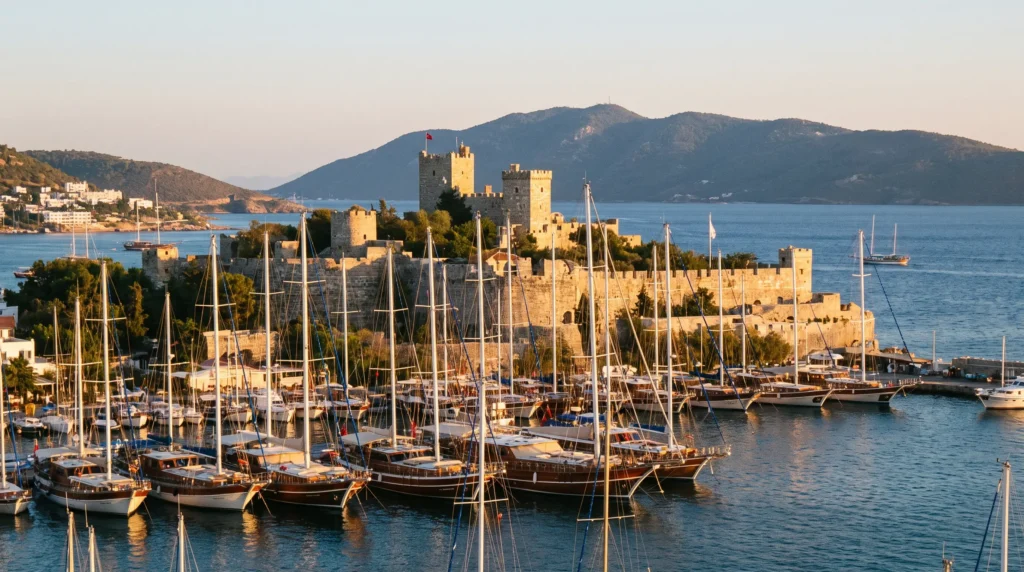
Bodrum Travel Guide — Whitewashed Cliffs, a Crusader Castle & Turkey’s Aegean Playground
I keep telling people Bodrum is the town that ruined ancient tombs for me — because once you’ve stood where the Mausoleum of Halicarnassus used to be, one of the actual Seven Wonders of the Ancient World, and realized the Knights of St. John quarried most of it into the castle next door, every other ruin feels a little incomplete. Bodrum sits where the Aegean does its best work: whitewashed cube houses stacked up bougainvillea-covered hills, a horseshoe bay ringed by windmills, and a peninsula of a dozen little towns each with its own personality, from backpacker-loud Gümbet to yacht-money-quiet Yalıkavak. It’s touristy, it’s proud of it, and it’s also genuinely one of the few places where you can snorkel over 2,500-year-old shipwreck fragments in the morning and be eating grilled sea bream on a working fishing-village quay by sunset. The catch is honest, too: August is a furnace, the peninsula’s roads clog solid at peak season, and Bodrum town itself leans nightlife-and-cruise-crowd more than serene — you have to know which of its dozen faces you actually want.
In This Guide
- Overview — Why Bodrum Is Turkey’s Aegean Showpiece
- Blue Voyage Season — Gulet Cruising the Peninsula
- Best Time to Visit Bodrum (Season by Season)
- Getting There — Milas-Bodrum Airport & Ferries
- Getting Around — Dolmuş, Taxi Boats & Rental Cars
- Neighborhoods — Bodrum Town & the Peninsula’s Twelve Bays
- Culture & People — Halicarnassus to Modern Riviera
- A Food Lover’s Guide to Bodrum
- Off the Beaten Path
- Day Trips — Kos, Pamukkale & Ephesus
- Practical Information
- Budget Breakdown — What Bodrum Actually Costs in 2026
- Planning Your First Trip to Bodrum
- Frequently Asked Questions
Overview — Why Bodrum Is Turkey’s Aegean Showpiece
Bodrum is built on the bones of Halicarnassus, the ancient Carian capital where Herodotus — often called the father of history — was born around 484 BC. The town’s defining monument was the Mausoleum, a roughly 45-metre marble tomb built for the satrap Mausolus in the mid-4th century BC, so extraordinary it gave the English language the word “mausoleum” and earned a spot among the Seven Wonders of the Ancient World. Earthquakes brought it down between the 11th and 15th centuries, and in 1402 the Knights Hospitaller arrived and quarried its remaining stones to build the Castle of St. Peter — the fortress that still dominates Bodrum’s harbor today and now houses the Bodrum Museum of Underwater Archaeology, one of the world’s leading collections of shipwreck finds.
Modern Bodrum is really a peninsula of towns, not one destination: whitewashed Bodrum town itself, low-key fishing villages, yacht marinas, and package-holiday beach resorts, spread across 215 kilometres of coastline. It has been Turkey’s boho-chic answer to Saint-Tropez since the writer Cevat Şakir Kabaağaçlı popularized it in the mid-20th century, and it still splits cleanly between the party beaches near town and the quieter, pricier villages further out — which means your Bodrum can look completely different from someone else’s, depending on which bay you pick.
Blue Voyage Season — Gulet Cruising the Peninsula
Bodrum is the traditional home port of the Mavi Yolculuk (Blue Voyage) — multi-day cruises on wooden gulet schooners along the Turquoise Coast, a tradition that started here in the mid-20th century and still launches most heavily from Bodrum’s harbor. Peak gulet season runs June through September, with July and August commanding the highest charter rates and the busiest marinas; shoulder-season sailings in May, late September and October cost noticeably less and dodge the worst heat.
If you’re not chartering a multi-day boat, Bodrum’s harborside is lined with day-trip “taxi boats” doing loop tours to nearby coves, Black Island, and the Rabbit Island sandbar near Gümüşlük — the single most popular half-day outing on the peninsula, and worth booking a morning departure to beat the midday crowds.
Best Time to Visit Bodrum (Season by Season)
Late May – Mid-June · The sweet spot
Sea temperatures are warming, hotel rates sit well below peak, and daytime highs run a comfortable 25–30°C — locals and repeat visitors treat this as the best window of the year.
July – August · Peak season
The busiest and hottest stretch, with daytime temperatures regularly hitting 30–34°C and occasionally pushing past 36°C in August. Beaches, marinas and restaurants are at capacity; book accommodation well ahead and expect the highest prices of the year.
Mid-September – October · The other sweet spot
Sea still warm from summer, air cooling into the 15–25°C range, crowds thinning fast after early September — many locals rate this the single best month to visit.
November – April · Quiet season
Mild by northern-European standards but genuinely wet, especially January; many seasonal restaurants and beach clubs close entirely. Hotel prices drop to their lowest of the year, which suits budget travelers and those chasing history sites without the crowds rather than beach time.
Getting There — Milas-Bodrum Airport & Ferries
Milas–Bodrum Airport (BJV) is the gateway, sitting roughly 36 kilometres northeast of Bodrum town — figure on a 30–40 minute transfer by taxi, shuttle or rental car depending on traffic and exact destination on the peninsula. It runs seasonal and year-round direct flights from Istanbul plus a wide summer charter network from the UK, Germany and other European markets; outside high season, connecting through Istanbul is often the more reliable option.
Bodrum is also a genuine international ferry hub: the short hop across to the Greek island of Kos takes as little as 20–45 minutes depending on the operator and departure point, one of the shortest international ferry crossings in the Aegean and a popular day-trip or onward-travel route into the Greek islands. Longer domestic ferries and seasonal routes to other Aegean ports also use Bodrum’s harbor.
Getting Around — Dolmuş, Taxi Boats & Rental Cars
The peninsula’s backbone is the dolmuş network — shared minibuses that run frequently and cheaply between Bodrum town and every peninsula village, Gümbet to Gümüşlük to Yalıkavak and back, with fares payable in cash. They’re the default way most visitors without a car get around, though schedules thin out late at night and off-season.
Rental cars (widely available from the airport and Bodrum town) make the most sense if you want to chase multiple beaches and villages in a day or explore at your own pace — a Turkish or notarized/permitted foreign driving license plus, for many nationalities, an International Driving Permit is required. Taxi boats along the harbor front cover short hops between coastal points faster than a road detour would. Bodrum town itself is compact and walkable, with the marina, castle and old bazaar streets all within easy reach on foot.
Neighborhoods — Bodrum Town & the Peninsula’s Twelve Bays
Bodrum Town (Merkez)
The historic core: Bodrum Castle and its Museum of Underwater Archaeology, the ancient theatre, the twice-weekly bazaar, and a harborfront lined with gulets and, after dark, the marina-side bar and club strip that gives Bodrum its “Turkish Ibiza” reputation.
Gümbet
The nearest beach resort to town, a short hop away, and the peninsula’s loudest, most budget-friendly party base — bars, watersports and package hotels stacked along a curved sandy bay.
Bitez
A quieter, greener bay just past Gümbet, known for its long sandy beach, windsurfing and a more low-key, family-friendly feel than its neighbor.
Yalıkavak
The peninsula’s glamour address: a purpose-built marina lined with superyachts and designer boutiques, plus an old-town core of restored stone houses and a genuinely charming Thursday market.
Türkbükü
Bodrum’s answer to the Hamptons — waterfront beach clubs, minimalist white architecture and some of the peninsula’s priciest sunbeds, popular with Istanbul’s weekend crowd.
Turgutreis
A working town on the peninsula’s western tip facing the Greek island of Kos, with a long promenade and a reputation for the best open-water sunsets on the coast — more local, less resort-polished than Bodrum town.
Gümüşlük
Built over the ancient sunken city of Myndos, and protected from heavy development because of it — a low-rise fishing village of seafood restaurants on the water’s edge, best known for the shallow sandbar walk to Rabbit Island.
Torba
A calmer, resort-heavy bay closer to the airport side of the peninsula, generally quieter than Gümbet with a handful of larger hotels.
Culture & People — Halicarnassus to Modern Riviera
Bodrum’s identity runs through two very different eras stacked on top of each other: the Carian-Greek city of Halicarnassus, birthplace of Herodotus and seat of the Mausoleum, and the Ottoman-then-Turkish-Republic fishing town that the writer and self-exiled “Fisherman of Halicarnassus,” Cevat Şakir Kabaağaçlı, helped turn into a bohemian retreat for artists and writers from the 1940s onward. That layered history is why Bodrum feels different from Turkey’s more conservative interior — it’s socially relaxed, alcohol is everywhere, and the culture leans coastal-Mediterranean as much as it does traditionally Turkish.
Away from the marina strip, the peninsula’s older villages — Gümüşlük especially — still run on fishing-family rhythms, and the twice-weekly Bodrum bazaar and Yalıkavak’s Thursday market are where you’ll see that older, less touristed daily life continue alongside the yachts.
A Food Lover’s Guide to Bodrum
Bodrum eats like an Aegean fishing town that got rich: expect long meze spreads — smoky patlıcan (aubergine), fava, stuffed vine leaves, octopus salad — followed by whatever the boats brought in that morning, typically grilled çipura (sea bream) or levrek (sea bass) sold by weight. Gümüşlük’s waterfront tables are the classic setting for a long seafood lunch with your feet nearly in the water.
For something distinctly Bodrum, look for testi kebab (meat and vegetables slow-cooked in a sealed clay pot, cracked open tableside) at inland restaurants, and don’t skip the region’s olive oil and fig products — the peninsula’s dry, rocky soil is well suited to both. Raki, the anise spirit, is the standard accompaniment to a meze table across the whole coast, and Turkish coffee or a glass of çay closes most meals.
Off the Beaten Path
Myndos Gate & Ancient Myndos
Most of ancient Myndos now sits underwater off Gümüşlük, protected as a marine archaeological site — snorkeling over submerged walls is a quiet, low-key alternative to the crowds at the castle.
Bodrum Windmills
A row of ruined stone windmills on a ridge above town, best visited near sunset for one of the peninsula’s most photographed — but rarely crowded — viewpoints over the bay.
Kadıkalesi
A quiet village with a small Byzantine-era castle ruin directly on the water, largely bypassed by the bigger resort towns nearby.
Inland Villages Around Mumcular
A short drive inland trades sea views for olive groves, tangerine orchards and rural Turkish life almost nobody visiting the coast ever sees.
Day Trips — Kos, Pamukkale & Ephesus
The easiest day trip from Bodrum is Kos, the Greek island visible across the strait, reachable by ferry in as little as 20–45 minutes depending on the sailing — enough time for a wander through Kos Town’s castle and ancient agora and back before dinner. Note this is an international border crossing, so bring your passport and check current entry rules before you go.
Further afield, organized tours run from Bodrum to Pamukkale’s white travertine terraces and the ancient site of Hierapolis, and to Ephesus, one of the best-preserved ancient cities in the Mediterranean — both are full-day trips given the driving distance, usually via a pre-dawn departure.
Practical Information
Money. The Turkish Lira floats freely and has been depreciating steadily — it traded around 47 to the US dollar in July 2026, so check a live rate before you go and expect the number to keep moving. Cards are widely accepted in Bodrum’s tourist areas; carry some cash for markets, dolmuş fares and smaller village restaurants.
Safety. The US State Department rates Turkey a Level 2 “exercise increased caution” advisory as of mid-2026, driven mainly by terrorism and conflict risk concentrated near the Syrian and Iraqi borders — nowhere near Bodrum — plus general guidance to stay alert in crowded public spaces anywhere in the country. The UK FCDO advises against all travel within 10km of the Syrian border, again well away from the Aegean coast, and flags that insulting the Turkish state or flag is a criminal offense, including online. Check current advisories before you travel regardless.
Health. No special vaccinations are required for most visitors; standard travel insurance and routine vaccines are the baseline. Tap water is generally treated but bottled water is the safer default for visitors, especially outside main hotels.
Connectivity. An eSIM or local Turkish SIM covers the peninsula well; coverage in central Bodrum, Yalıkavak and Gümbet is strong. Plugs: Type C/F, 230V, 50Hz. Time zone: UTC+3 year-round — Turkey has not observed daylight saving since 2016.
Budget Breakdown — What Bodrum Actually Costs in 2026
Bodrum runs cheaper than Western Europe but pricier than inland Turkey, with a wide spread between peak-August rates and shoulder-season deals.
Budget (US$45–80/day): Guesthouse or budget hotel in Gümbet or Bodrum town, dolmuş transport, meze-and-fish lunches, self-guided castle and museum visits.
Mid-range (US$110–220/day): Boutique hotel in Yalıkavak or Türkbükü, restaurant dinners, a rental car for a few days, a half-day taxi-boat tour to Rabbit Island, entry fees for a Pamukkale or Ephesus day trip.
Luxury (US$350+/day): Marina-front suites, private gulet charters, beach-club daybeds in Türkbükü, chef-led seafood dinners on the water.
Fixed costs to expect: museum and site entry fees (Bodrum Castle/Museum of Underwater Archaeology charges admission), a currency-conversion buffer given the lira’s volatility, and 10% tipping as the general restaurant norm.
Planning Your First Trip to Bodrum
The classic first-timer split is castle + coves: fly into BJV, base three or four nights in Bodrum town or nearby Gümbet for the castle, museum and bazaar, then relocate to Yalıkavak or Gümüşlük for a few days of beach clubs, boat trips and sunset dinners. A week covers it comfortably; ten days lets you add a Kos day trip or a longer Pamukkale/Ephesus excursion. Pair it with our Istanbul city guide for the connecting flight hub, our Greece travel guide if you’re island-hopping onward from Kos, or our Turkey travel guide for the wider country picture.
Frequently Asked Questions
Is Bodrum safe for tourists in 2026?
Yes, for the areas tourists actually visit. The US State Department’s Level 2 advisory and the UK FCDO’s cautions both concentrate on the Syrian and Iraqi border regions, far from the Aegean coast — normal city-travel awareness applies in Bodrum itself. Check current advisories before you go regardless.
Do I need a visa?
US and UK citizens with ordinary passports enter Turkey visa-free for tourism, for up to 90 days within any 180-day period; passports should remain valid well beyond the stay. Citizens of some other countries need an e-visa in advance, so verify your specific nationality’s requirement before booking.
How many days do you need in Bodrum?
Four to five days covers the castle, museum and one or two beach towns comfortably; a week to ten days lets you add a Kos day trip, a longer excursion to Pamukkale or Ephesus, and time in more than one peninsula village.
Which Bodrum neighborhood should I stay in?
Bodrum town or Gümbet for nightlife and easy access to the castle; Yalıkavak or Türkbükü for a quieter, upscale marina scene; Gümüşlük or Turgutreis for a slower, fishing-village pace with fewer crowds.
Bodrum or the Turkish Turquoise Coast (Fethiye/Antalya)?
Choose Bodrum for history layered into a lively resort scene and easy Greek-island hopping via Kos; choose Fethiye or Antalya for longer stretches of coastline, paragliding and more dramatic mountain-meets-sea scenery.
Can I visit Greece from Bodrum on a day trip?
Yes — the ferry to Kos takes as little as 20–45 minutes depending on the operator, making it one of the easiest international day trips anywhere in the Aegean. Bring your passport; it’s a full border crossing.
Ready to Explore Bodrum?
A Crusader castle built from the stones of an actual Wonder of the Ancient World, twelve bays each with a different personality, and a 20-minute ferry to another country if you get restless — Bodrum packs an unreasonable amount into one Aegean peninsula. Just pick your bay carefully, and go in the shoulder season if you can.
Explore More
- Turkey Travel Guide — the full country picture beyond the peninsula
- Istanbul City Guide — the classic connecting hub and add-on city
- Cappadocia City Guide — balloons and cave hotels further inland
- Mykonos City Guide — for continuing the Aegean island-hop from Kos
How this guide was built
Published as part of Facts From Upstairs’ city guide series. Built from authoritative sources — Wikipedia entity pages for Bodrum, the Mausoleum at Halicarnassus, Bodrum Castle, Milas–Bodrum Airport and Time/DST in Turkey; Turkey’s Ministry of Foreign Affairs visa information page; the US State Department and UK FCDO Turkey travel advisories; Ferryhopper’s Kos–Bodrum route data; and Trading Economics’ live Turkish lira exchange rate. Numeric and checkable claims carry inline citations.
Sources cited on this page
- Wikipedia — Bodrum
- Wikipedia — Mausoleum at Halicarnassus
- Wikipedia — Bodrum Castle
- Wikipedia — Milas–Bodrum Airport
- Wikipedia — Daylight Saving Time in Turkey
- Republic of Türkiye Ministry of Foreign Affairs — Visa Information
- US State Department — Turkey Travel Advisory
- UK FCDO — Turkey Travel Advice
- Ferryhopper — Kos–Bodrum Ferry Route
- Trading Economics — Turkish Lira
More city guides you might like
Plan your trip to Bodrum
The booking tools we use ourselves. FFU may earn a commission at no extra cost to you.
Plan & book your trip to Bodrum
Booking through these searches supports our guides at no extra cost to you.