
City Guide · Maharashtra · West Coast of India
Mumbai, India: Bollywood, the Gateway of India, Two UNESCO Sites & the World’s Busiest Suburban Railway on the Arabian Sea
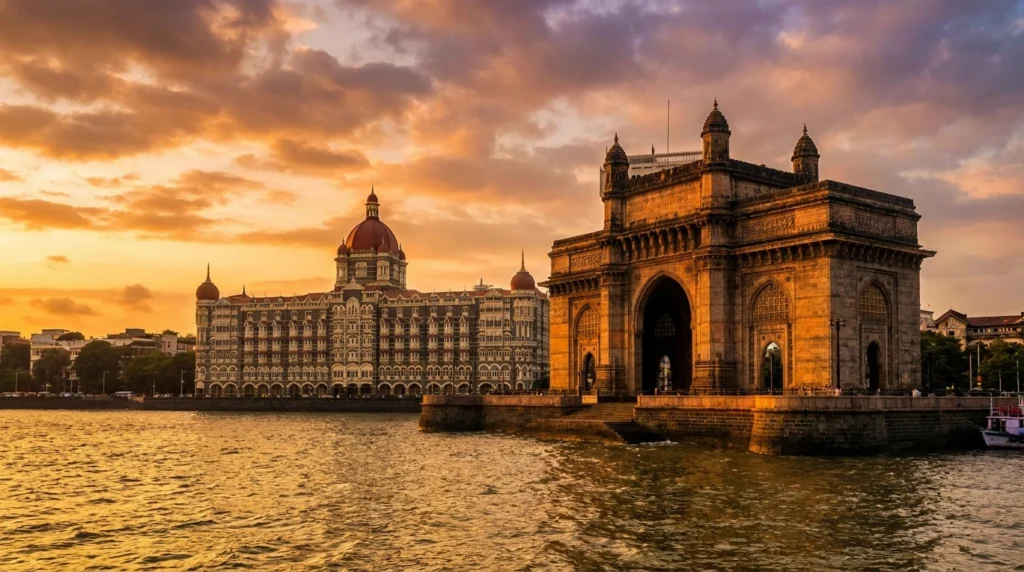
I came to Mumbai expecting the cliché of slum-and-skyscraper contrast and got handed something far denser — a city of roughly 12.5 million people inside the municipal limits and over 24 million across the wider Mumbai Metropolitan Region built on seven reclaimed islands, where a 7.5-million-passenger-a-day suburban railway, a Victorian-Gothic UNESCO railway terminus, and the Hindi-film industry that gives the place its “Bollywood” nickname all share the same humid sea air. The Gateway of India, finished in 1924 to mark the 1911 royal visit, still frames the Taj Mahal Palace hotel on the Colaba waterfront ; the Chhatrapati Shivaji Maharaj Terminus has been a UNESCO World Heritage Site since 2004 ; the Elephanta Caves — the 5th-to-8th-century rock-cut Shiva sanctuary an hour’s ferry across the harbour — have been inscribed since 1987. Treat this guide as the brief I would hand my own family before they boarded a flight into Chhatrapati Shivaji Maharaj International Airport (BOM) — and for the wider Indian frame (the rupee, the e-visa, the rail network, the monsoon calendar) read it alongside our India country guide.

Table of Contents
- Why Mumbai?
- Best Time to Visit Mumbai
- Getting There — BOM Airport, Trains & Buses
- Getting Around — Local Trains, Metro, Taxis & Auto
- Top Neighbourhoods
- Cultural Sights
- Entertainment & Nightlife
- Day Trips from Mumbai
- Food & Drink in Mumbai
- Practical Information
- Budget & Costs
- Planning Your Trip
- Frequently Asked Questions
Why Mumbai?
Mumbai is the only city in India where you can stand under a triumphal basalt arch built to greet a British king-emperor in 1911, walk five minutes into a Victorian-Gothic railway terminus that UNESCO calls one of the finest in the world, take an hour’s ferry to a 1,400-year-old rock-cut Shiva cave, and eat a vada pav from a street cart whose recipe was invented to feed textile-mill workers in the 1960s — all without leaving the seven reclaimed islands that the Portuguese called Bom Bahia and the British turned into Bombay. The city sits on the Konkan coast of Maharashtra, on a peninsula jutting into the Arabian Sea, and it has been India’s commercial and financial capital since the 19th-century cotton boom; it generates a disproportionate share of the national economy and hosts the Reserve Bank of India, the Bombay Stock Exchange (Asia’s oldest, founded 1875), and the headquarters of much of corporate India. Bombay was officially renamed Mumbai in 1995 — after Mumbadevi, the Koli fishing-community goddess whose temple still stands near Zaveri Bazaar — though both names remain in daily use.
The city wears several identities simultaneously. It is a colonial-era port — the seven islands were ceded by Portugal to England in 1661 as part of Catherine of Braganza’s dowry, leased to the East India Company, and progressively joined by land reclamation into the single landmass of today. It is the capital of Hindi cinema — the “Bollywood” film industry centred on Mumbai is one of the largest film producers on earth by output, and Film City in Goregaon, the studios of the western suburbs and the star bungalows of Bandra are the geography of that industry. And it is a 21st-century megacity of contrasts — the same harbour frames the ₹-billion towers of the Bandra-Kurla Complex and Dharavi, one of Asia’s largest and most economically productive informal settlements, a 30-minute drive apart.
The pull beyond the colonial core is the harbour-and-coast rotation. Elephanta Island — the UNESCO rock-cut Shiva sanctuary inscribed in 1987 — is a one-hour ferry from the Gateway of India and the single best half-day trip in the harbour. The Sanjay Gandhi National Park, an unusual 87-square-kilometre protected forest entirely inside the city limits with the 2,000-year-old Kanheri Buddhist rock-cut caves , sits in the northern suburbs. The hill stations of the Western Ghats — Lonavala, Khandala and Matheran (the last a vehicle-free hill town reached by a narrow-gauge toy train) — are two-to-three hours inland and are the classic monsoon-season escape. And the Ajanta and Ellora caves near Aurangabad — two more UNESCO World Heritage rock-cut complexes — are an overnight or short-flight trip for travellers building the wider Maharashtra heritage circuit.
What guidebooks under-rate is the railway. The Mumbai Suburban Railway is among the busiest commuter networks on earth, carrying roughly 7.5 million passengers a day across its Western, Central and Harbour lines over some 450 route-kilometres. For a visitor it is both a logistical backbone and an attraction in itself — riding a Churchgate-bound Western Line train in the off-peak, watching the dabbawalas (the lunchbox-delivery network whose six-sigma logistics are a Harvard Business School case study) hand off tiffins at the platform, is as much “Mumbai” as the Gateway. The Mumbai Metro, expanded steadily through the 2020s, now supplements the suburban rail with air-conditioned underground and elevated lines. Chhatrapati Shivaji Maharaj International Airport (BOM) — India’s second-busiest after Delhi, with the architecturally celebrated Terminal 2 — sits about 20 kilometres north of the colonial core, a 45-to-90-minute drive depending on the notorious traffic.
And then the monsoon — the single most distinctive Mumbai season and the one that defines the city’s rhythm. The southwest monsoon arrives reliably in early-to-mid June and runs through September, dumping the bulk of the city’s ~2,200 mm annual rainfall in a few intense months. The 26 July 2005 deluge — when nearly a metre of rain fell in 24 hours and paralysed the city — is the reference event for Mumbai flooding, and the low-lying areas still flood every monsoon. India sits on the US State Department’s Travel Advisory at Level 2 (Exercise Increased Caution) and the UK FCDO publishes detailed India travel advice that visitors should check before travel.
Above all, Mumbai is a city of dizzying contrasts held in a single frame — and that is precisely why it rewards the curious traveller. It is India’s financial capital and the home of the Reserve Bank, the Bombay Stock Exchange and the country’s corporate headquarters , yet it is also the city of Dharavi and the pavement dwellers; it is the glamour capital of Bollywood and the star bungalows of Bandra, yet its soul is the textile-mill worker’s vada pav and the dabbawala’s tiffin. Greater Mumbai is home to well over twelve million people, with the wider metropolitan region among the most populous urban areas on the planet, packed onto a narrow peninsula where land is the scarcest commodity of all. The result is an intensity — of people, of commerce, of striving, of sheer human energy — that you feel the moment you step out of the airport. Travellers who come expecting postcard serenity leave disappointed; those who come ready to be swept up in the most dynamic city in India leave converted. Mumbai does not ask to be admired from a distance. It asks to be plunged into.
Best Time to Visit Mumbai
Mumbai has a tropical wet-and-dry climate split into three practical seasons: a hot, humid pre-monsoon (March–May), a dramatic southwest monsoon (June–September) that delivers the overwhelming majority of the city’s ~2,200 mm of annual rain, and a cool, dry winter (November–February) that is the comfortable visitor window. The city sits at sea level on a low-lying reclaimed peninsula, so the single most important calendar fact is that the heaviest monsoon months flood the low areas every year — the catastrophic 26 July 2005 deluge, when nearly a metre of rain fell in 24 hours, remains the reference event. Plan your trip around which Mumbai you want, and use the four-season breakdown below as the realistic timeline.

Winter (November – February) — the ideal window
The single best window of the Mumbai year. Daytime highs run 28–33°C with comfortable overnight lows of 18–22°C, humidity drops, and rainfall is effectively zero from late October through to May. The air is clearest in December and January, the Arabian Sea sunsets off Marine Drive and Bandstand are at their best, and the long South Mumbai heritage walks are pleasant rather than punishing. This is the festival-dense window too — the Kala Ghoda Arts Festival fills the Fort district with installations and performances in early February , Diwali (typically late October or November) lights up the whole city, and the Mumbai wedding and event season peaks. The catch: this is also the primary inbound tourism window, hotel rates run 20–40% above the monsoon low, and the Christmas-New-Year fortnight in Colaba and Bandra books out weeks ahead. Reserve heritage hotels (the Taj, the Oberoi) a month in advance for the December peak. If you can only come once and want the city at its most comfortable and photogenic, this is the window to choose — clear light for the skyline and the sea, cool enough for the long heritage walks, and the full festival-and-events calendar in swing.
Pre-monsoon summer (March – May) — hot and humid
The most uncomfortable stretch of the Mumbai year for sightseeing. March-to-May daytime highs climb to 33–36°C with humidity above 70% and little respite at night; the pre-monsoon mugginess in May is the limiting factor and the reason locals talk about “waiting for the rains.” Plan two-shift days: walk the colonial core 07:00–10:30, retreat to an air-conditioned museum, mall or café through the midday heat, and return at 16:30 for the waterfront. Marine Drive and the Bandstand promenade are the evening escape valves where the whole city goes for the sea breeze. Hotel rates dip from the winter high and the crowds thin, so budget travellers willing to tolerate the heat get the best value of the year in April-May, just ahead of the rains. Gudi Padwa (the Marathi New Year, March/April) brings colourful processions in the Marathi heartland neighbourhoods of Girgaon and Dadar.
Monsoon (June – September) — the dramatic rains
The most weather-volatile window and the one that defines Mumbai’s character. The southwest monsoon arrives reliably in the first half of June and runs through September, delivering the bulk of the year’s rain in intense bursts; July and August are the wettest months. Low-lying areas — parts of Kurla, Sion, Andheri and the rail tracks themselves — flood; suburban trains are suspended on the worst days; and an unprepared visitor can lose a day to waterlogging. The flip side is real: the monsoon is the most atmospheric time to see the city, the Western Ghats hill stations (Lonavala, Khandala, Matheran) erupt into waterfalls and green , hotel rates fall to their annual low, and the late-August/September Ganesh Chaturthi festival — the city’s biggest, when millions of devotees carry Ganesha idols to the sea for immersion at Girgaon Chowpatty and Juhu Beach — is one of the great spectacles of urban India. Pack waterproof footwear, build buffer days, watch the IMD nowcasts, and base yourself on higher ground in South Mumbai rather than the flood-prone low suburbs.
Post-monsoon (October) — humid transition
October is the awkward shoulder — the rains retreat but the humidity lingers and the so-called “October heat” can be as oppressive as May, with daytime highs back up to 33–35°C and sticky nights. The upside is that the city is washed clean, the greenery from the monsoon is still vivid in the parks and the national park, and the major autumn festivals cluster here: Navratri and Dussehra fill the Gujarati neighbourhoods with garba dancing, and Diwali (often late October) is the brightest night of the Mumbai calendar. Hotel rates are still below the December peak and rising. By the very end of October the humidity finally breaks and the comfortable winter window begins — arriving in early-to-mid November is the cleanest way to catch the festivals and the start of the good weather without the Christmas price surge.
Getting There — BOM Airport, Trains & Buses
Mumbai is one of India’s two principal international gateways. The single answer for most overseas visitors is a flight into Chhatrapati Shivaji Maharaj International Airport (BOM) about 20 kilometres north of the colonial core, with a prepaid taxi, app-cab or Metro/rail combination into the city. The viable alternatives are the long-distance Indian Railways network into one of Mumbai’s terminus stations, and the interstate bus network. Whichever way you arrive, the golden rule is to factor in Mumbai’s traffic and its linear north-south geography — the distance on the map is rarely the distance in time, and a 20-kilometre transfer can swallow an hour and a half in the wrong conditions.
Chhatrapati Shivaji Maharaj International Airport (BOM) — the default
BOM is India’s second-busiest airport after Delhi, handling tens of millions of passengers a year across two terminals — Terminal 1 (domestic, at Santacruz) and the architecturally celebrated Terminal 2 (international and some domestic, at Sahar), whose “peacock” column-and-skylight ceiling and vast art collection make it a sight in its own right. The airport is a hub for IndiGo, Air India and Vistara among others, with direct long-haul links to the Gulf, Europe, Southeast Asia and North America, and dense domestic connections to Delhi, Bengaluru, Hyderabad, Goa and the rest of the country. A second airport — Navi Mumbai International Airport — has been developed to relieve pressure on BOM. The road transfer from BOM to South Mumbai is the single most important onward leg, and Mumbai traffic means it can take anywhere from 45 minutes to well over 90 minutes.
From BOM to the city — the transfer
Several viable options to cover the airport-to-city leg:
- App cabs (Uber / Ola) — the default for most visitors; book in the app and meet your driver at the designated pickup zone outside Arrivals. Typical fare to Colaba/Fort ₹500–900 (~$6–11 USD) depending on traffic and surge, 45–90 minutes.
- Prepaid taxi — the official airport prepaid-taxi counters at both terminals issue a fixed-fare receipt with no surge or negotiation; the standard for travellers who prefer to lock the price before boarding. Confirm the destination and keep the receipt.
- Mumbai Metro & suburban rail — the Metro network connects near the airport and links into the wider system; budget travellers can combine a short cab to a Metro or suburban-rail station with a train into the centre, though with heavy luggage the cab is simpler.
- Hotel pickup — most mid-range and luxury hotels offer a private airport transfer; worth booking for late-night arrivals when the prepaid counters are quieter.
Indian Railways — long-distance trains
Mumbai is a major node on the Indian Railways network, the backbone of long-distance travel across the country. Long-distance trains use several terminus stations — chiefly Chhatrapati Shivaji Maharaj Terminus (CSMT, the UNESCO building, for Central Railway routes), Mumbai Central and Bandra Terminus (for Western Railway routes toward Gujarat and the north), and Lokmanya Tilak Terminus. Premium services such as the Rajdhani, Shatabdi, Tejas and Vande Bharat trains connect Mumbai to Delhi, Ahmedabad, Pune and beyond; the overnight sleepers to Delhi, Goa (the scenic Konkan Railway) and the south are an experience in themselves. Book through the official IRCTC portal; air-conditioned classes and premium trains sell out days to weeks ahead around festivals and holidays.
Interstate buses & the Konkan coast
The Maharashtra State Road Transport Corporation and a large network of private operators run interstate and intercity coaches from Mumbai to Pune (the classic 3–4-hour Expressway run), Goa, Nashik, Aurangabad (for Ajanta and Ellora) and across western India. Volvo air-conditioned sleeper and seater coaches are the comfortable tier; the Mumbai-Pune Expressway is one of India’s best motorways. For the Konkan coast and Goa, the train (the Konkan Railway) is usually preferable to the bus for comfort and scenery.
Getting Around — Local Trains, Metro, Taxis & Auto

The Suburban Railway — the city’s spine
The Mumbai Suburban Railway is the backbone of the city and one of the busiest commuter networks on earth, carrying roughly 7.5 million passengers a day over its Western, Central and Harbour lines across some 450 route-kilometres. The Western Line runs from Churchgate north through Mumbai Central, Dadar, Bandra, Andheri and Borivali toward Virar; the Central Line runs from CSMT through Dadar and Kurla toward Thane and Kalyan; the Harbour Line runs from CSMT toward Vashi/Panvel and Andheri. Trains are cheap (single fares are a matter of rupees), frequent and fast, but rush-hour crowding is extreme — ride off-peak (roughly 11:00–16:00) as a visitor, use the clearly marked ladies’ compartments where appropriate, and keep belongings secure. First-class costs several times the second-class fare for far more space. A few orientation points for the newcomer: the trains run roughly 04:00 to 01:00; “fast” trains skip minor stations while “slow” trains stop everywhere, so check the indicator board; the platforms and trains are not air-conditioned on most services (though AC locals now run on some routes); and the doors stay open as the train moves, so stand well clear of the edge. Buying tickets is simple at the station counter, or via the UTS mobile app once you have a local SIM. Treated with a little respect for the peak-hour crush, the suburban railway is the fastest and cheapest way to cover the long north-south axis of the city — and an experience no other city on earth quite offers.
Mumbai Metro — the air-conditioned network
The Mumbai Metro has expanded steadily through the 2020s into a multi-line network of elevated and underground lines, adding air-conditioned, less-crowded alternatives to the suburban rail for many cross-city journeys. The underground Line 3 (Aqua Line) in particular links key business and transit nodes. Buy a token or a rechargeable smart card at the station; the Metro is the comfortable choice for routes it covers, though it does not yet reach every corner the suburban rail does.
App cabs & the kaali-peeli taxis
Uber and Ola operate across Mumbai and are the simplest door-to-door option for visitors; fares are metered through the app with surge at peak times. The iconic black-and-yellow (“kaali-peeli”) metered taxis still ply South Mumbai — insist on the meter or agree the fare first. Air-conditioned “cool cabs” cost a little more. Mumbai traffic is heavy and unpredictable, so always pad your timings, especially for airport runs and during the monsoon.
Auto-rickshaws & the suburb rule
The three-wheeled auto-rickshaw is the workhorse of the suburbs — but note the local rule: autos are not permitted in the South Mumbai core below Bandra/Sion, where taxis and app cabs take their place. North of that line, autos are everywhere, metered, and cheap for short hops; insist on the meter. They are open-sided, so they are also the breeziest way to cover a few kilometres in the heat.
Ferries, buses & walking
The BEST bus network (the city’s red double-deckers and single-deckers) covers routes the rail does not, at very low fares, though it is slow in traffic. Ferries run from the Gateway of India to Elephanta Island (about an hour each way) and shorter harbour and creek crossings operate elsewhere; sea services are weather-dependent and largely suspend in the rough monsoon. The colonial core of South Mumbai — Colaba, Fort, Kala Ghoda, Marine Drive — is genuinely walkable, and the heritage-walk circuit is best done on foot in the cool morning hours.
Top Neighbourhoods: Finding Your Mumbai
📍 Mumbai Map: Every Place in This Guide
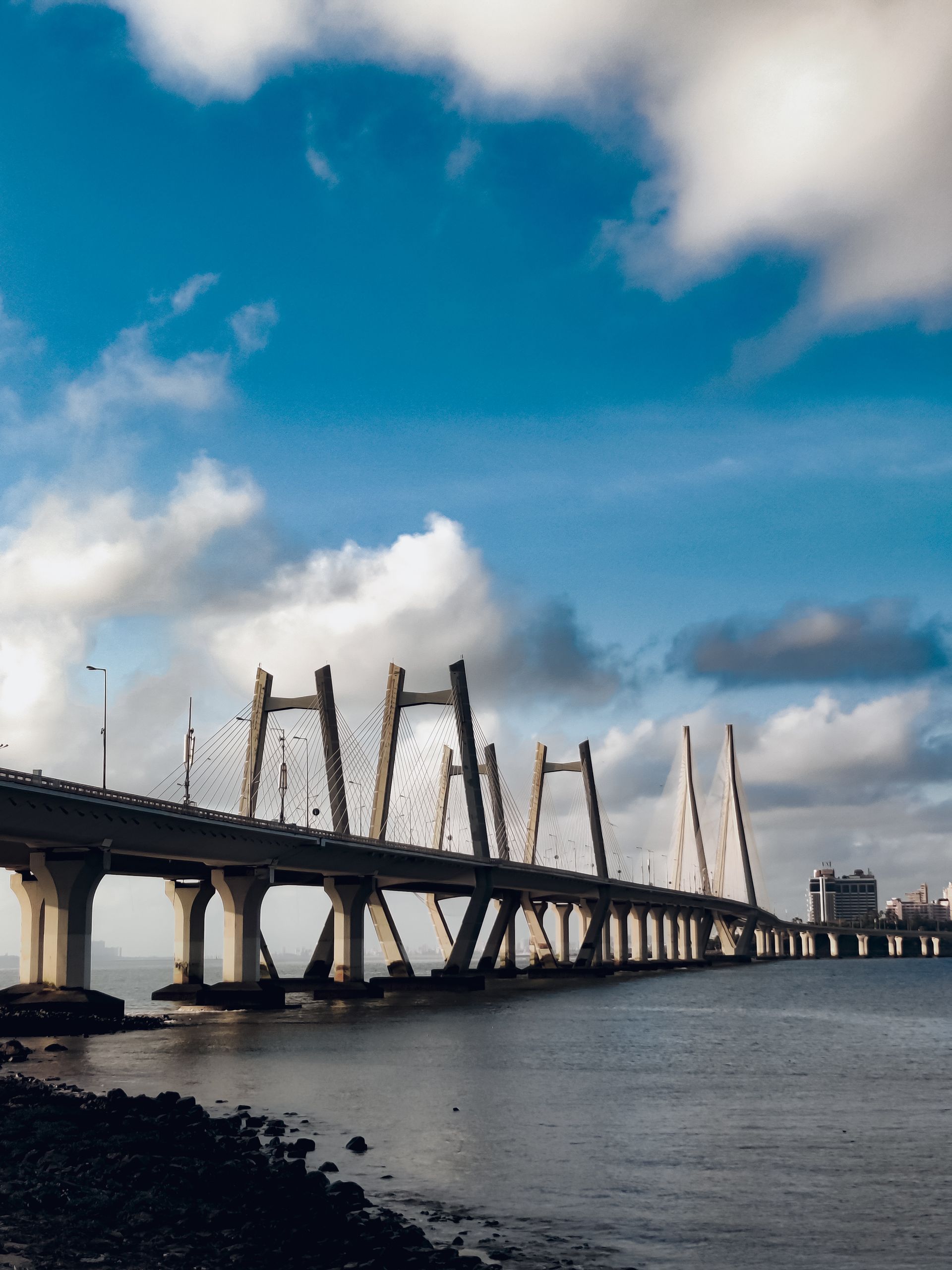

Mumbai’s neighbourhood map is a north-south story along a narrow peninsula: the colonial South Mumbai core (Colaba, Fort, Kala Ghoda, Marine Drive); the central mill-and-market districts (Lower Parel, Dadar, Byculla); the western suburbs (Bandra, Juhu, Andheri) where Bollywood and the new nightlife live; and the eastern and northern stretches toward Powai, the national park and Navi Mumbai. We have ranked them by traveller-relevance, with the South Mumbai heritage core and the Bandra/Juhu western-suburb axis as the must-visits.
Colaba — the traveller’s South Mumbai
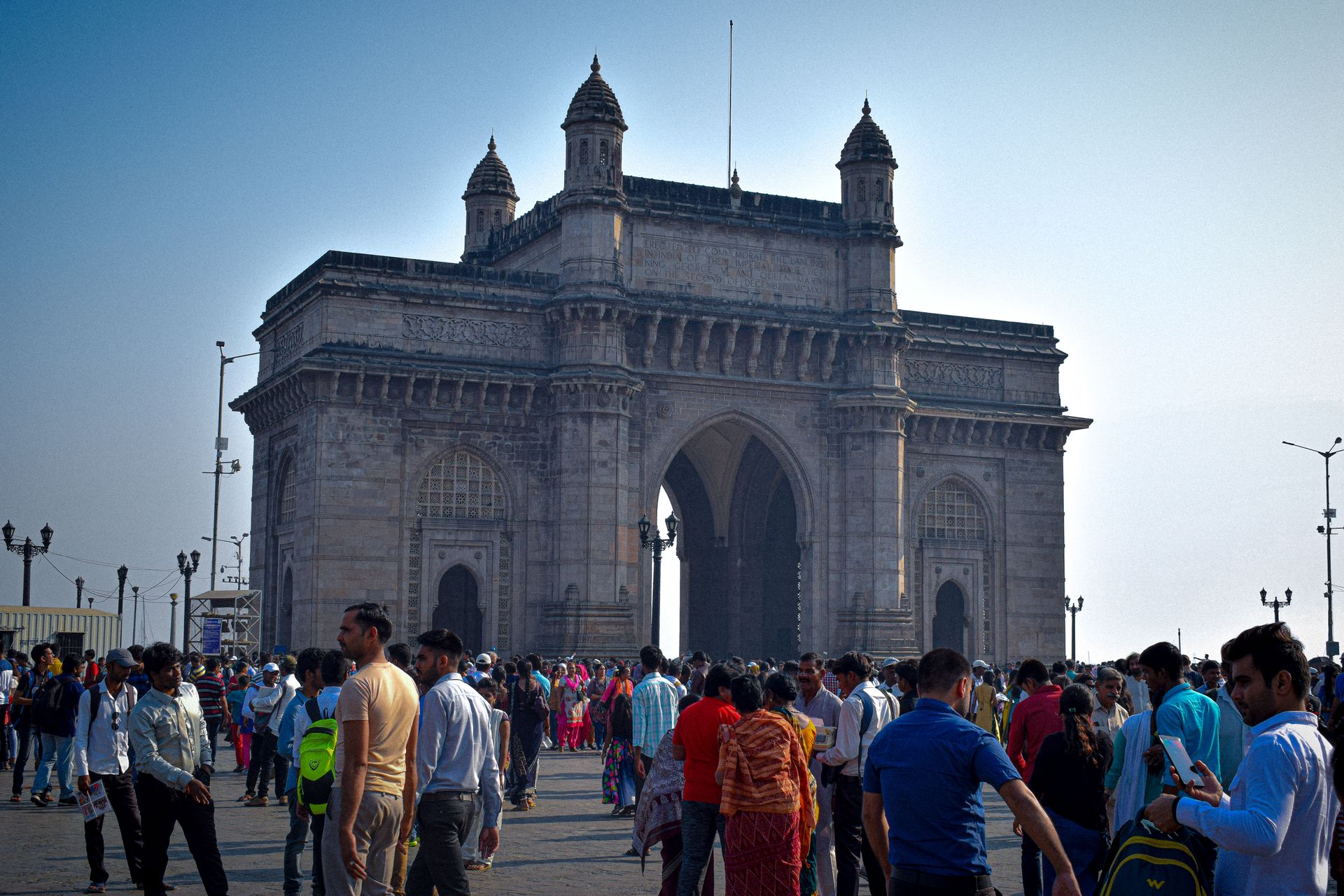
Colaba is the southern tip of the peninsula and the visitor heart of the city — the Gateway of India, the Taj Mahal Palace hotel, the Colaba Causeway shopping street, the cafés (Leopold, Café Mondegar), the budget guesthouses and boutique hotels all cluster here. This is where I would base a first Mumbai visit: you can walk to the harbour, the Elephanta ferry, the museums and the Fort heritage ensemble. The Causeway is the bargaining-and-browsing strip for clothes, jewellery, leather and souvenirs (haggle hard — the opening price is two to three times the real one); the Sassoon Dock fish market at the southern end is a raucous working dawn spectacle where the Koli fishing fleet lands its catch. Colaba blends backpacker grit and heritage grandeur in a single walkable square kilometre, and for a first-time visitor focused on the sights it is hard to beat as a base.
- Gateway of India & the Elephanta ferry jetty
- Taj Mahal Palace hotel (1903) — the landmark facade
- Colaba Causeway shopping street
- Leopold Café & Sassoon Dock fish market
Best for: first-time visitors, heritage walkers, anyone with limited time. Access: taxi/app cab (no autos in South Mumbai); walkable core.
Fort & Kala Ghoda — the Victorian-Gothic district
The Fort district immediately north of Colaba is the administrative and Victorian-Gothic heart of Bombay — the University of Mumbai with the Rajabai Clock Tower, the High Court, the old Secretariat, and the ensemble of 19th-century public buildings that, together with the later Art Deco of the Oval Maidan and Marine Drive, form a UNESCO-listed Victorian Gothic and Art Deco precinct. Kala Ghoda (“black horse,” named for an equestrian statue that once stood here) is the compact art-and-culture sub-district — the Jehangir Art Gallery, the Chhatrapati Shivaji Maharaj Vastu Sangrahalaya museum, a cluster of contemporary galleries, design boutiques and cafes, and the celebrated February arts festival that fills the streets with installations. Walking the Fort by day, looking up at the gargoyles, clock towers and stained glass of the Gothic public buildings, is one of the great free pleasures of the city.
- Chhatrapati Shivaji Maharaj Vastu Sangrahalaya (the Prince of Wales Museum)
- Rajabai Clock Tower & the University of Mumbai
- Jehangir Art Gallery & the Kala Ghoda galleries
- The Oval Maidan Art Deco frontage
Best for: architecture lovers, museum-goers, art browsers. Access: walk from Colaba; Churchgate or CSMT suburban rail.
Marine Drive & Nariman Point — the seafront
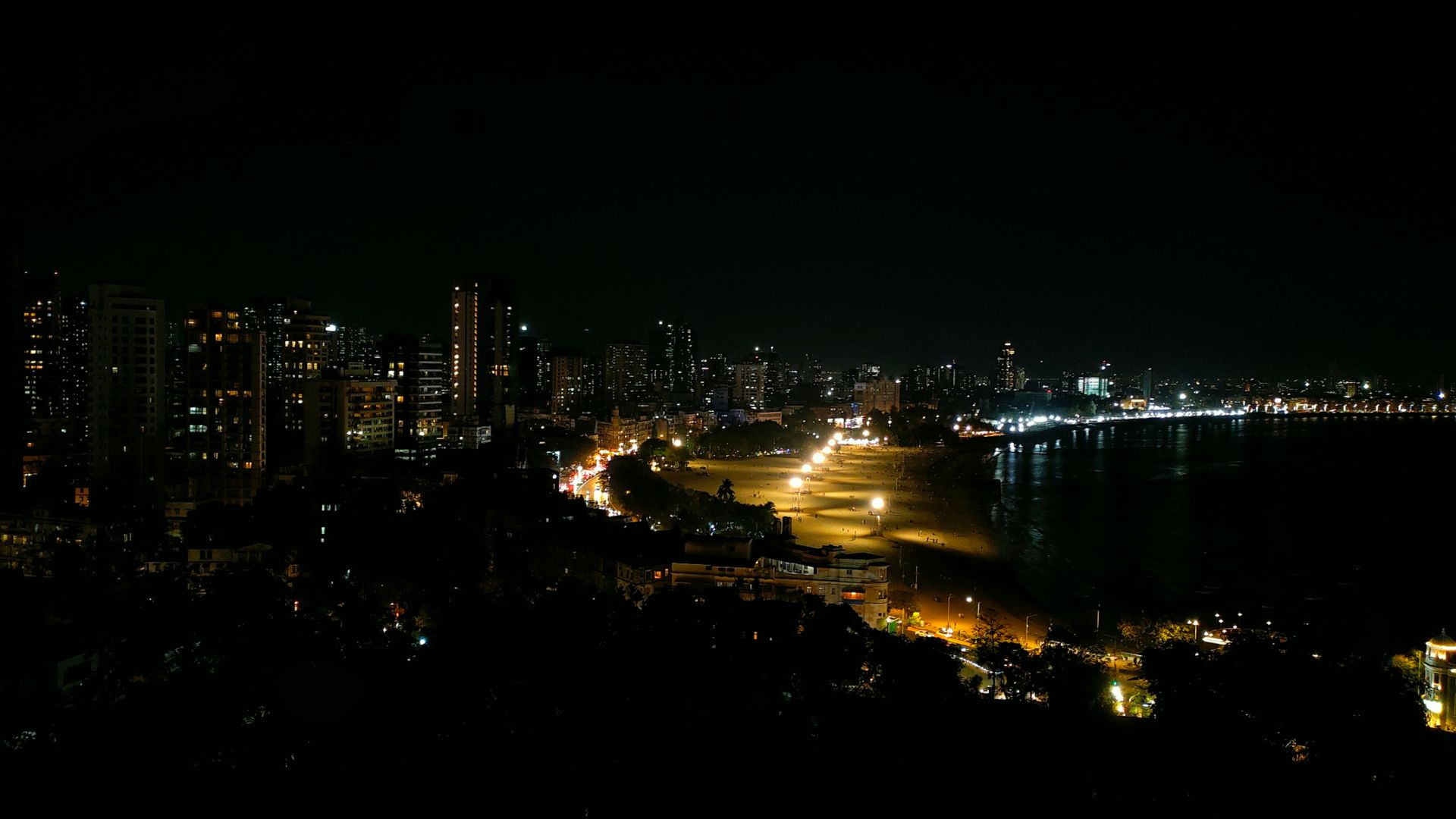
Marine Drive is the 3.6-kilometre Art Deco-lined boulevard curving along Back Bay from Nariman Point to Girgaon Chowpatty — the “Queen’s Necklace,” so called because its curve of streetlights forms a glittering arc when seen from the elevated ends at night. It is the city’s great democratic promenade, where all of Mumbai — courting couples, joggers, families, office workers, students — comes to sit on the sea wall for the breeze and the sunset over the Arabian Sea. The buildings facing the sea are a near-continuous run of 1930s-40s Art Deco apartment blocks, part of the UNESCO-listed ensemble. Girgaon Chowpatty beach at the northern end is the city’s festival-immersion beach — the focal point of the Ganesh Chaturthi idol immersions — and a heaving bhelpuri-pav-bhaji-and-kulfi street-food row in the evenings. Nariman Point at the southern end is the original purpose-built business district, still home to corporate headquarters and the NCPA arts complex. Sunset here, with an order of bhelpuri in hand, is the quintessential free Mumbai experience.
- The Marine Drive promenade & Art Deco frontage
- Girgaon Chowpatty beach & street food
- Wankhede Stadium (cricket) just inland
Best for: sunset walks, street food, photographers. Access: Churchgate suburban rail; walkable from Fort.
Bandra — the cool western suburb
Bandra is the hip, cosmopolitan western suburb that blends its old Indo-Portuguese Catholic heritage with the city’s most fashionable cafés, boutiques and nightlife — the “Queen of the Suburbs.” The Bandstand promenade runs a kilometre along the sea to Bandra Fort and Land’s End, with sweeping views of the Bandra-Worli Sea Link; the quiet lanes of Ranwar village and Chapel Road carry colourful street art, wayside crosses and old Portuguese-era East Indian cottages with sloping tiled roofs — a village atmosphere improbably surviving inside the metropolis. The Bollywood connection is real and central to Bandra’s identity: many of the biggest film stars live here, and crowds of fans gather outside Mannat, the seafront mansion of Shah Rukh Khan, hoping for a wave from the balcony. Linking Road and Hill Road are the bustling high-street shopping strips for clothes, shoes and accessories at every price point, while the bars and restaurants around Pali Naka anchor the suburb’s celebrated nightlife. For repeat visitors and younger travellers, Bandra is often the most appealing base in the city.
- Bandstand Promenade, Bandra Fort & Land’s End
- Mount Mary Basilica & the Bandra Fair (September)
- Ranwar village street art & Chapel Road
- Linking Road / Hill Road shopping
Best for: nightlife, cafés, Bollywood-spotters, repeat visitors. Access: Bandra Western Line suburban rail; app cab over the sea link.
Juhu — the beach-and-stars suburb
Juhu, further north on the coast, is the city’s most famous beach suburb — a long sandy strand lined with the chaat-and-bhelpuri stalls that make Juhu Beach a Mumbai institution, plus the five-star beachfront hotels and the bungalows of more film stars. The beach itself is for strolling and street food rather than swimming (the water is not clean), busiest in the cool evenings and on weekends. The ISKCON temple and the comedy-and-theatre venues of the area round out a night out.
- Juhu Beach & the evening street-food row
- ISKCON Juhu temple
- Prithvi Theatre (theatre & café)
Best for: families, beach-walk evenings, foodies. Access: Andheri/Vile Parle suburban rail then auto/cab.
Lower Parel & Worli — the mills-to-towers belt
The central belt of Lower Parel and Worli is Mumbai’s most visible transformation story — the 19th-century cotton-mill district reborn as a corridor of glass office towers, restored mill-compound malls (Phoenix, Kamala Mills) and the city’s densest cluster of upscale restaurants and bars. Worli sits at the South Mumbai end of the Bandra-Worli Sea Link and holds the Worli Fort and the Koliwada fishing village — a reminder of the original islanders beneath the towers.
- Kamala Mills & Phoenix Mills dining/nightlife
- Worli Sea Face & the sea-link viewpoint
- Worli Koliwada fishing village & fort
Best for: dining, nightlife, modern Mumbai. Access: suburban rail to Lower Parel/Mahalaxmi; app cab.
Dharavi & the city of work
Dharavi, between the Western and Central rail lines in the city’s centre, is one of Asia’s largest and most economically productive informal settlements — a dense warren of homes layered with leather workshops, pottery (Kumbharwada), recycling units, garment manufacture and bakeries that together turn over a remarkable annual economy. Responsible, locally-run walking tours (run by social enterprises that reinvest in the community) introduce visitors to the industry and the people rather than the poverty; choose an ethical operator, never photograph residents without consent, and treat it as the lesson in Mumbai’s economy that it is. A massive government-backed redevelopment is under way.
- Ethical, community-run walking tours
- Kumbharwada potters’ colony
- Leather & recycling micro-industries
Best for: thoughtful travellers, economy-and-society interest. Access: Mahim/Sion suburban rail; book a guided tour.
Cultural Sights: Gateway, CSMT, Elephanta & the Museums

The Gateway of India
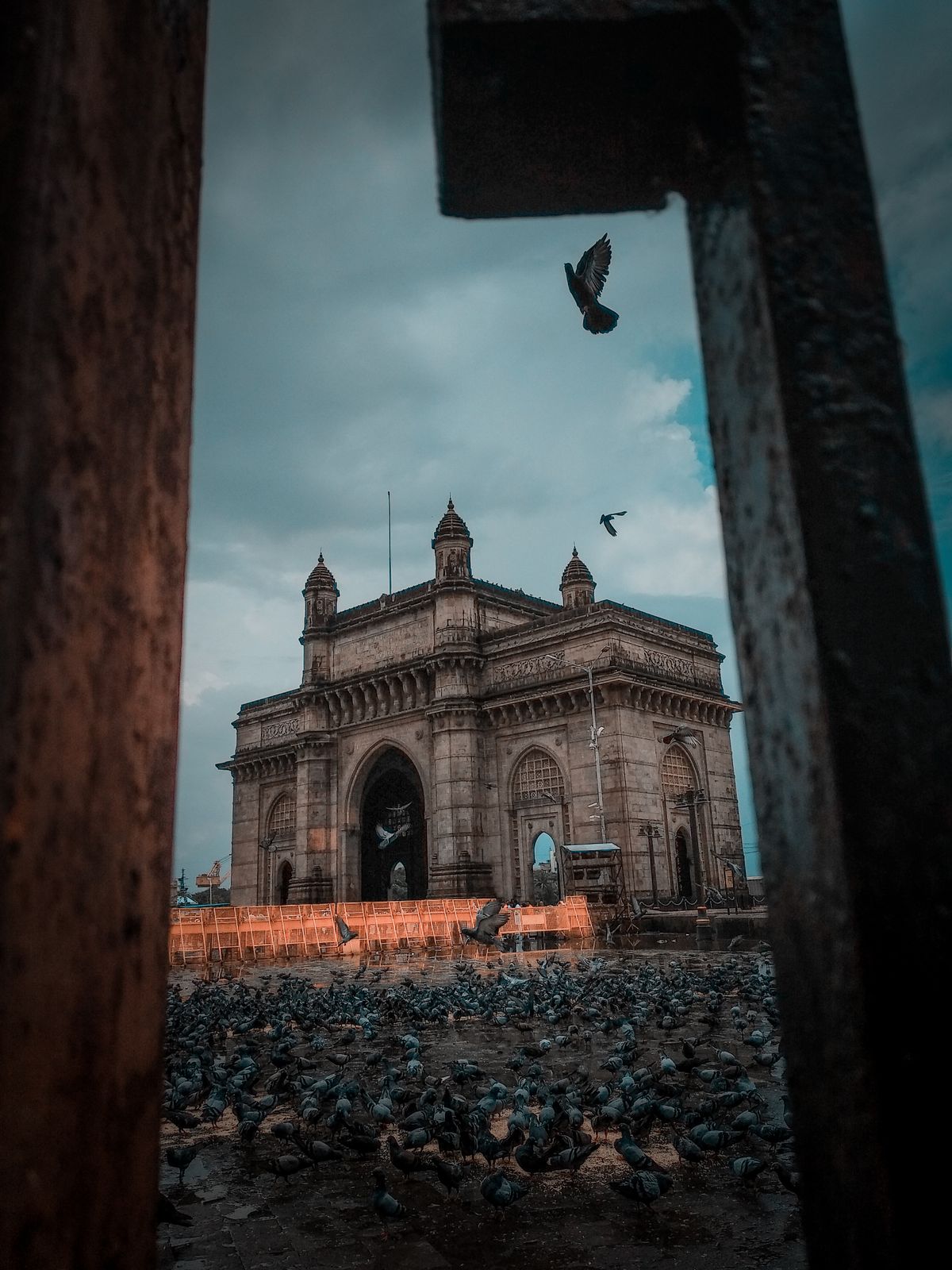
The single most recognisable monument in Mumbai — a 26-metre basalt triumphal arch on the Colaba waterfront, designed by George Wittet in an Indo-Saracenic style blending Hindu and Muslim architectural elements. The arch was conceived to commemorate the 1911 visit of King George V and Queen Mary, the foundation stone laid in 1913, and the structure completed in 1924; ironically, it later served as the ceremonial point from which the last British troops departed independent India in 1948. Today it is the city’s great gathering place — thronged with families, balloon and snack vendors, photographers and touts, framing the domed Taj Mahal Palace hotel behind it, and serving as the jetty from which the Elephanta and harbour ferries depart. The waterfront here is the symbolic heart of Mumbai, the place where the city presents itself to the sea, and it has played that role through coronation durbars, the British departure of 1948, and the dark night of the November 2008 terror attacks that struck the adjacent Taj. Come early in the morning for the monument near-empty and softly lit, or in the evening for the full carnival of the Mumbai crowd. Free to visit; busiest in the evenings and on weekends.
Chhatrapati Shivaji Maharaj Terminus (CSMT)
The Victorian-Gothic railway terminus formerly known as Victoria Terminus is a UNESCO World Heritage Site (inscribed 2004) and one of the finest railway buildings in the world. Designed by the British architect Frederick William Stevens, built between 1878 and 1887 to mark Queen Victoria’s Golden Jubilee, it fuses Italian Gothic Revival with traditional Indian palace architecture — a great stone dome, turrets, pointed arches, stained glass, gargoyles and a riot of carved detail, crowned by the statue of “Progress.” It remains a working terminus and the headquarters of the Central Railway, handling both long-distance and suburban trains. Admire the exterior at any time (it is floodlit at night); the heritage interior and museum can be visited on guided terms. Renamed from Victoria Terminus in 1996 to honour the 17th-century Maratha king Chhatrapati Shivaji Maharaj, and refined to its current full name in 2017. To stand in the booking hall beneath the ribbed vaults and stained glass while 18-car suburban trains disgorge a river of commuters is to see the building doing exactly what it was built for, 135 years on — a living monument rather than a museum piece. It is also a sobering site: the station was one of the targets of the November 2008 Mumbai attacks, commemorated by a memorial within. Floodlit at night, it is one of the city’s most photographed facades.
Elephanta Caves

The Elephanta Caves on Gharapuri Island, about 10 kilometres east across Mumbai Harbour, are a UNESCO World Heritage Site (inscribed 1987) and the single best half-day trip from the city. The complex is a group of rock-cut cave temples carved between roughly the 5th and 8th centuries, dedicated primarily to the Hindu god Shiva. The masterpiece is the great Trimurti — a colossal three-headed Shiva relief representing the deity as creator, preserver and destroyer — one of the supreme achievements of Indian rock-cut sculpture. The Portuguese named the island for a large stone elephant they found there (now in the Mumbai zoo’s garden). Reach the caves by the hour-long ferry from the Gateway of India (services suspend in the rough monsoon), then a short walk or toy-train and a climb of about 120 steps lined with stalls; watch for the resident monkeys. Closed Mondays; allow a half-day round trip.
Chhatrapati Shivaji Maharaj Vastu Sangrahalaya
The city’s premier museum — formerly the Prince of Wales Museum of Western India — sits in Kala Ghoda in a grand Indo-Saracenic building of 1922, designed by George Wittet (the same architect as the Gateway of India) and crowned by a great Mughal-style dome set in a palm garden. Its collection spans Indian sculpture, Indus Valley and Gupta-era artefacts, exquisite Mughal and Rajput miniature paintings, jade and decorative arts, a natural-history wing, and a notable collection of arms and armour, alongside touring international exhibitions. The building itself — one of the finest examples of the Indo-Saracenic Revival style anywhere — is reason enough to visit, and the air-conditioned galleries are a welcome cool refuge from the heat and the street. It is the essential indoor counterpoint to the South Mumbai heritage walk, sitting a short stroll from the Jehangir Art Gallery and the Kala Ghoda cultural cluster. Open most days with a ticketed entry; allow two hours, more if a special exhibition is on.
Marine Drive & the Art Deco precinct
Beyond its role as a promenade, Marine Drive and the adjoining Oval Maidan frontage form one of the world’s great ensembles of Art Deco architecture — the curving sweep of 1930s residential buildings is, together with the Victorian-Gothic Fort buildings, a UNESCO World Heritage Site (the “Victorian Gothic and Art Deco Ensembles of Mumbai,” inscribed 2018). Walking from the Gothic High Court and University across the Oval Maidan to the Deco apartment blocks facing the sea is a lesson in two architectural eras facing each other across a cricket ground.
Haji Ali Dargah & Mahalaxmi Temple
Haji Ali Dargah is the 15th-century mosque and tomb of the Sufi saint Pir Haji Ali Shah Bukhari, built on an islet off the Worli coast and reached by a long, narrow causeway that the sea covers entirely at high tide — a striking white-domed-and-minareted structure that appears to float on the Arabian Sea. The walk out along the causeway, lined with flower-and-offering sellers and beggars, is itself part of the experience, and the dargah draws a constant stream of pilgrims of every faith, especially on Thursday and Friday evenings when qawwali devotional singing fills the courtyard. Nearby, the Mahalaxmi Temple — perched on the coast and dedicated to the goddess of wealth, one of the trio of Mahalaxmi, Mahakali and Mahasaraswati — is among the city’s most important and most visited Hindu temples. Both sites welcome respectful visitors; dress modestly with covered shoulders and knees, remove shoes, and time the dargah visit to low tide so the causeway is walkable (check the tide tables before setting out).
Crawford Market & the bazaar district
Crawford Market (officially Mahatma Jyotiba Phule Mandai), a Victorian covered market of 1869 near CSMT, is the historic heart of the bazaar district — fruit, spices, and a maze of surrounding wholesale lanes (Zaveri Bazaar for gold, Chor Bazaar the “thieves’ market” for antiques and curios, Mangaldas Market for textiles). It is sensory overload in the best way and the place to feel the trading city beneath the colonial monuments.
Dhobi Ghat & the working city
The Mahalaxmi Dhobi Ghat is the world’s largest open-air laundry — row upon row of concrete wash-pens where the city’s dhobis hand-wash and dry thousands of garments daily, an extraordinary working-city spectacle best viewed from the Mahalaxmi station bridge above. It is a window into the informal logistics that keep Mumbai running — the same city of work that produces the dabbawala lunchbox network, whose accuracy is studied at business schools worldwide.
Entertainment & Nightlife

Bollywood & the studios
Mumbai is the capital of Hindi cinema, and the “Bollywood” industry is woven into the city’s geography — Film City in Goregaon, the studios of the western suburbs, and the star homes of Bandra and Juhu. Studio tours of Film City can be booked, and fans gather outside Mannat (Shah Rukh Khan’s seafront home) in Bandra. Catching a new Hindi film in a grand Mumbai cinema — the single-screen Art Deco Regal or Eros, or a plush multiplex — is the most authentic Bollywood experience of all: the audience claps, whistles, sings along and talks back to the screen, an exuberant communal ritual you will not find in a Western multiplex. No Hindi needed to enjoy the spectacle.
Rooftop bars & the Lower Parel scene
The city’s nightlife centres on three zones: Lower Parel and Worli (the restored mill compounds of Kamala Mills and Phoenix, the densest cluster of rooftop bars, gastropubs and clubs), Bandra (the suburb’s buzzing café-and-bar lanes around Pali Naka and Hill Road), and Colaba (the backpacker-and-heritage strip around Leopold and Mondegar). The signature Mumbai experience is the rooftop bar with sea-link and skyline views, but the heritage-hotel bars are the classier option — the Taj Mahal Palace’s Harbour Bar (India’s oldest licensed bar) and the Oberoi’s lounges deliver the colonial-grandeur version of a Mumbai night. The craft-cocktail and microbrewery scene has matured fast over the last decade. A few practical notes: the legal drinking age in Maharashtra is high (and technically requires a liquor permit, rarely enforced for tourists), licensing and closing times vary and have periodically been tightened by the authorities, and the upmarket venues enforce dress codes and cover charges. Check current hours and book ahead for the popular rooftops at weekends.
Live music, theatre & comedy
Mumbai has a lively live-performance scene — the Prithvi Theatre in Juhu for Hindi and English theatre and its famous café, the National Centre for the Performing Arts (NCPA) at Nariman Point for classical music, dance and orchestral concerts, and a thriving stand-up comedy and indie-music circuit across the suburbs.
Cricket & the maidans
Cricket is the city’s sporting religion. The Wankhede Stadium near Marine Drive hosts international matches and IPL games (the Mumbai Indians); catching a match here is electric. On any non-match day, the maidans (Oval, Azad, Cross) of South Mumbai are dotted with dozens of simultaneous informal games — a quintessential Mumbai sight.
Markets, festivals & the street
The great Mumbai festivals are entertainment in themselves — Ganesh Chaturthi (August/September), when idol-immersion processions fill the streets and beaches; Navratri garba dancing; Diwali; and the February Kala Ghoda Arts Festival that turns the Fort district into an open-air gallery. The shopping bazaars (Colaba Causeway, Linking Road, Crawford Market, Chor Bazaar) are an evening entertainment in their own right.
Day Trips from Mumbai
Elephanta Island (1 hour by ferry)
The closest and best half-day trip — the UNESCO rock-cut Shiva caves on Gharapuri Island, an hour’s ferry from the Gateway of India. Take an early ferry (the first departures leave around 09:00), allow a couple of hours on the island for the caves and the climb, and be back in the city by early afternoon. The crossing itself is part of the appeal — you pass anchored cargo ships, naval vessels and fishing dhows in one of Asia’s busiest harbours, with the South Mumbai skyline receding behind you. On arrival a short jetty walk (or the small toy-train) leads to the foot of roughly 120 stone steps lined with souvenir and snack stalls; the climb is gentle but warm, so carry water and sun cover. The Trimurti and the side panels reward an unhurried look — hire one of the licensed island guides at the base for the iconography. Closed Mondays; ferries suspend in the rough monsoon (roughly June to early September). Budget the regular ferry over the deluxe; the boat is the same.
Sanjay Gandhi National Park & Kanheri Caves (in the city)
An 87-square-kilometre protected forest entirely inside the northern city limits — a rare urban national park with a resident leopard population, a butterfly garden, a lion-and-tiger safari and, at its heart, the Kanheri Caves: more than a hundred Buddhist rock-cut caves and viharas carved from the 1st century onward into a basalt hillside. The caves were once a thriving monastic university linked to the ancient trade ports, and the largest of them — a great pillared prayer hall (chaitya) with a stupa and colossal standing Buddhas — is genuinely impressive. The park is a startling contrast: tropical forest, langur monkeys and birdsong a short train ride from one of the densest cities on earth. Reach it via Borivali on the Western Line, then an auto or the park shuttle to the cave trailhead. A green half-day escape from the concrete; go early in the day before the heat and the weekend crowds, carry water, and keep an eye out for the macaques around the caves.
Lonavala & Khandala (2–3 hours by road/rail)
The classic Western Ghats hill-station pair on the Mumbai-Pune corridor — cool, green and dotted with viewpoints (Tiger’s Leap, Lion’s Point, Bhushi Dam), the ancient Karla and Bhaja rock-cut Buddhist caves nearby, and the chikki (nut-and-jaggery brittle) sweet shops that are the obligatory local souvenir. The pair sit at around 600 metres in the Sahyadri range, where the plateau breaks away in dramatic escarpments — the views over the Konkan plain are the whole point. They are spectacular in the monsoon, when the hillsides run with seasonal waterfalls and the valleys fill with mist (though the same months bring crowds of Mumbai and Pune day-trippers, so go on a weekday). The cool, dry winter is the most comfortable time. Reach Lonavala by the frequent trains on the Mumbai-Pune line (about two hours from CSMT), by car on the Mumbai-Pune Expressway, or on an organised tour; it pairs naturally with a Karla/Bhaja caves stop and makes a relaxed full-day outing or an overnight in a hill resort.
Matheran (2–3 hours; vehicle-free hill town)
Asia’s only vehicle-free hill station — a small, red-earth-laned town in the Ghats where no motor vehicles are allowed past the car park; you arrive on foot, on horseback, or aboard the narrow-gauge “toy train” from Neral, a charming century-old mountain railway that switchbacks up through the forest. The absence of cars is the whole atmosphere: the only sounds are birdsong, hooves on the red laterite paths and the chatter of walkers. The string of viewpoints — Panorama Point, Echo Point, Louisa Point, Porcupine (Sunset) Point — look out over the plains and the surrounding ranges, and the cool air is a genuine relief from the coastal humidity. The forest walks between viewpoints are gentle and shaded. An overnight in one of the old colonial-era guesthouses is better than a rushed day trip and lets you catch both sunrise and sunset, but Matheran is doable in a long day if you take an early train out and the last one back.
Pune (3–4 hours by Expressway)
Maharashtra’s cultural and educational second city, an easy run down the Mumbai-Pune Expressway — the Aga Khan Palace (where Mahatma Gandhi and Kasturba were interned during the Quit India movement, and where Kasturba died), the imposing Shaniwar Wada fort of the Peshwa rulers, the Osho International Meditation Resort, the colourful Dagdusheth Halwai Ganpati temple and a young, lively café-and-college scene fed by Pune’s many universities. Pune is the historic seat of the Maratha empire and has a markedly different feel from coastal Mumbai — drier, cooler, more relaxed, and proud of its Marathi cultural heritage. It is more comfortable as an overnight than a same-day return, but the Expressway and the fast Deccan Queen and Shatabdi trains (around three to three-and-a-half hours) make it close enough for a long day if you start early. Combine it with a Lonavala stop on the way for the fullest version of the corridor trip.
Ajanta & Ellora Caves (overnight, via Aurangabad)
For travellers building the wider Maharashtra heritage circuit, the UNESCO Ajanta and Ellora rock-cut cave complexes near Aurangabad are extraordinary — Ajanta’s 2nd-century-BC-to-6th-century-AD Buddhist painted caves and Ellora’s Buddhist, Hindu and Jain caves crowned by the monolithic Kailasa temple. Reach Aurangabad (now formally Chhatrapati Sambhajinagar) by a short flight or overnight train; this is an overnight or two-night trip rather than a day trip, but it is the natural extension of Mumbai’s own rock-cut heritage at Elephanta and Kanheri, and for many travellers the artistic high point of a Maharashtra itinerary. The Ajanta paintings in particular — serene Buddhist murals that have survived more than a thousand years — are among the supreme achievements of ancient Indian art.
Food & Drink in Mumbai — Vada Pav, Bombay Street Food & Irani Cafes

Mumbai is, with apologies to Delhi and Kolkata, the street-food capital of India — the city that invented the vada pav, perfected the pav bhaji, and turned the humble sandwich into an art form. The food here is a collision of histories: Maharashtrian home cooking, Gujarati vegetarian thalis, Parsi-Irani cafe fare brought by Zoroastrian migrants from Persia, Mughlai grills from the north, Goan and Mangalorean coastal seafood, and the koliwada fried-fish tradition of the city’s original Koli fishing communities. The price point spans the full spectrum — a vada pav costs 15-25 rupees ($0.20-0.30 USD) from a street cart, while a tasting menu at a fine-dining room runs 4,000-8,000 rupees. The unifying thread is “pav” (the soft Portuguese-derived bread roll) and the city’s genius for fast, cheap, intensely flavoured food eaten standing up.
There is a logic to eating your way through Mumbai. Mornings belong to the Irani cafes and the breakfast carts — bun maska and chai, or a plate of idli-dosa from a South Indian Udupi restaurant. Lunch is the working city’s domain: a thali, a station-side vada pav, or whatever the dabbawalas are not delivering. Late afternoon is chaat hour, best taken on a beach. Evenings open up the full range, from a Mohammed Ali Road kebab crawl (especially electric during Ramadan, when the street becomes a midnight food festival) to a Bandra gastropub or a Fort seafood house. The city’s religious and community diversity is written directly into its menus — Parsi dhansak, Bohra Muslim biryani, Gujarati and Marwari vegetarian thalis, Mangalorean and Malvani fish, Goan vindaloo, Punjabi tandoor, South Indian dosa — so that you can eat a different India every day without leaving the peninsula. Vegetarians are exceptionally well served; Mumbai has one of the richest vegetarian food cultures of any city on earth.
Vada Pav — the Bombay burger
The single most Mumbai dish of all: vada pav is a deep-fried spiced-potato dumpling (batata vada) in a pav bun, with dry garlic chutney, green chutney and a fried green chilli on the side. Invented in the 1960s-70s by street vendor Ashok Vaidya outside Dadar station to feed textile-mill workers a cheap, filling, eaten-on-the-go meal, it became the working city’s default snack and is now sold from an estimated tens of thousands of carts across the metropolitan area. The best are still found near the suburban railway stations. Budget 15-30 rupees ($0.20-0.40 USD).
- Ashok Vada Pav (Kirti College, Dadar) — near the claimed birthplace, 20 rupees
- Anand Stall (Vile Parle) — the suburban institution, 25 rupees
- Graduate Vada Pav (Dadar) — the cult favourite, 25-30 rupees
Pav Bhaji — the griddle classic
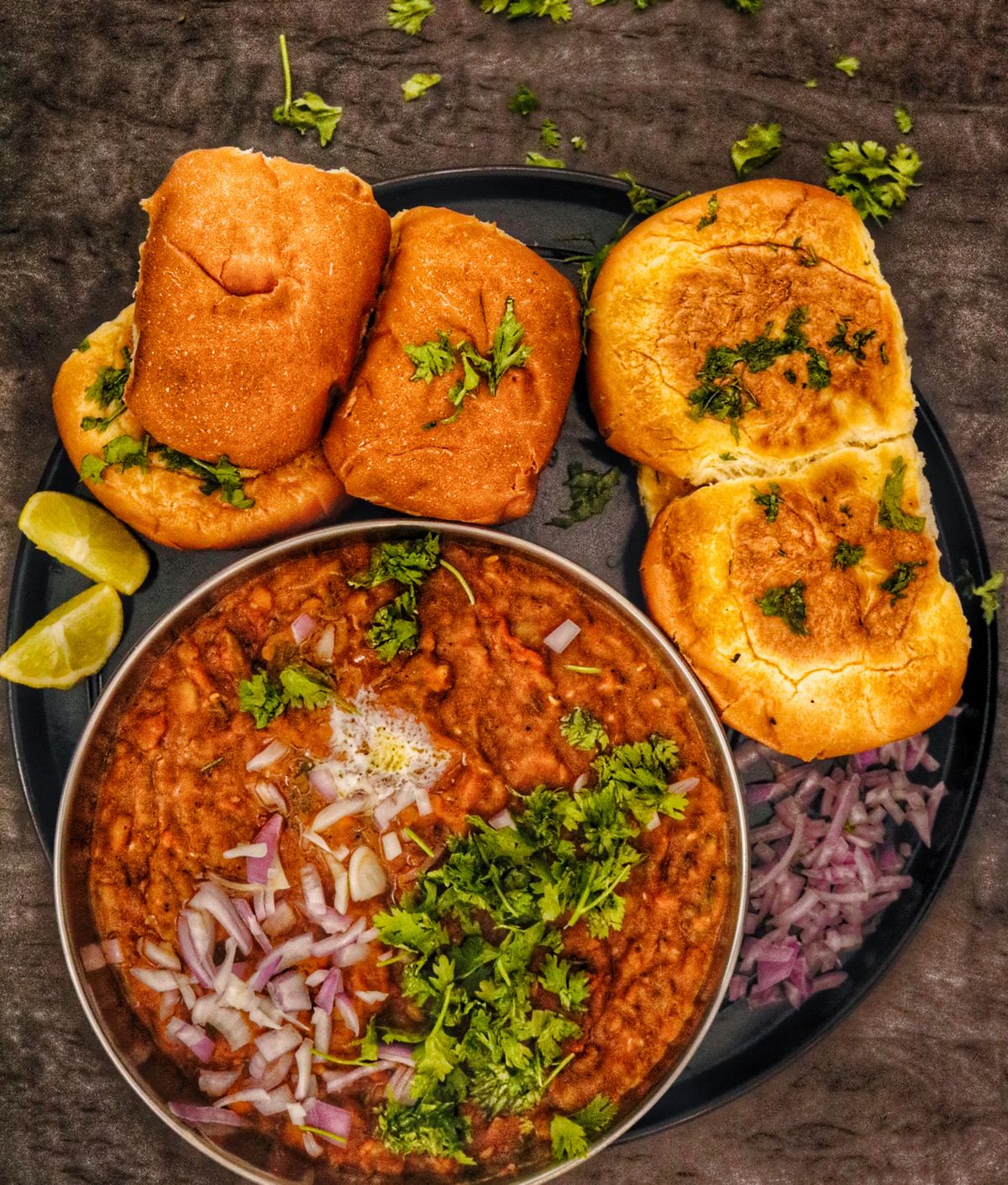
A thick, buttery mashed-vegetable curry (the “bhaji”) cooked on a giant flat griddle and served with one or two butter-toasted pav, a heap of raw chopped onion and a wedge of lime. The dish was invented in 1850s-60s Mumbai as a quick, filling lunch for textile-mill workers, and the griddle-side theatre — the cook mashing the vegetables with a flat spatula, drowning them in butter, toasting the buns alongside — is half the experience. The variations multiply: cheese pav bhaji, Jain (no onion or garlic), pulao pav bhaji, and the indulgent “butter pav bhaji” that arrives swimming in ghee. Sarvi, Cannon Pav Bhaji (near CSMT, a lunchtime institution for office workers), Sardar Pav Bhaji (Tardeo) and the Juhu and Chowpatty beach stalls are the famous addresses; locals argue fiercely over which is best. Budget 120-250 rupees ($1.50-3 USD) and eat it hot off the griddle.
Bombay Sandwich & Chaat
The Bombay sandwich — thin white bread layered with green coriander-mint chutney, boiled potato, beetroot, cucumber, tomato, onion and a dusting of chaat masala, optionally grilled with butter and cheese into the “grilled sandwich” version — is the city’s office-lunch staple, assembled at lightning speed from carts outside every business district. The wider chaat universe is at its best on Chowpatty and Juhu beaches at sunset: bhel puri (puffed rice, sev, chutneys and chopped vegetables tossed to order), sev puri and dahi puri (crisp shells topped with potato, chutneys and yoghurt), pani puri (hollow crisp shells filled with spiced tamarind water, eaten in one explosive bite), and ragda pattice (potato cakes in a white-pea curry). Each vendor guards a chutney recipe; the sweet-sour-spicy-crunchy balance is the art. Bhel puri is the quintessential Mumbai beach snack — eaten standing at the water’s edge as the sun drops into the Arabian Sea. Budget 50-150 rupees per item, and pick a busy stall for freshness.

Irani Cafes — the Parsi-Zoroastrian institution
The Irani cafe — high-ceilinged, marble-topped, bentwood-chaired rooms opened by Zoroastrian immigrants from Iran in the late-19th and early-20th centuries — is a vanishing Mumbai institution and one of its most atmospheric eating experiences. The menu is unchanging: bun maska (buttered bun) with Irani chai, keema pav, berry pulao, akuri (spiced scrambled eggs), and caramel custard. Once numbering in the hundreds, fewer than two dozen authentic ones survive — squeezed out by rising rents, generational change and the city’s relentless redevelopment — which lends a visit a faint elegiac quality. The pleasure is as much in the setting as the food: the marble-topped tables, the bentwood chairs, the antique mirrors, the “please do not” rule-boards, the slow ceiling fans, and the unhurried regulars reading the morning paper over a second chai. Britannia & Co. (famous for its Parsi berry pulao and the late owner’s framed devotion to the British royals), Kyani & Co., Yazdani Bakery and Cafe Mondegar are the survivors to seek out. Go for breakfast, order the bun maska and chai, and linger — the whole point is to slow down in a room that has refused to change for a century.
- Britannia & Co. (Ballard Estate) — the legendary berry pulao, since 1923
- Kyani & Co. (Marine Lines) — the oldest surviving Irani cafe, 1904
- Cafe Mondegar / Cafe Leopold (Colaba) — the tourist-friendly Colaba pair
Seafood — the Koli coastal tradition
Mumbai’s original inhabitants were the Koli fishing communities, and the city’s coastal-seafood tradition runs deep. The headline dishes: Bombay duck (a fish despite the name — the bombil, eaten fresh in a curry or dried and crisp-fried), koliwada prawns (batter-fried in a fiery red masala named for the Koliwada fishing quarter), surmai (kingfish) and pomfret in tawa-fry or coconut curry, prawn koliwada, and the rice-flour-batter fish fries of the Malvani Konkan coast. The cuisine splits into distinct coastal schools — Malvani (Konkan, coconut-and-kokum-forward), Mangalorean (ghee-roast and gassi curries), and the Koli home-style fish curry of the city’s own islanders. Trishna and Mahesh Lunch Home in Fort are the famous fine-ish seafood addresses (the butter-pepper-garlic crab and koliwada are the orders); Gajalee specialises in Malvani; and the no-frills Koli-run places near the fishing docks serve the freshest catch of all. Budget 800-2,500 rupees a head for a full seafood meal, more for crab.
Regional thalis & fine dining
For the full vegetarian thali experience, the Gujarati and Rajasthani thali houses (Shree Thaker Bhojanalay, Rajdhani) serve unlimited multi-course meals on a steel platter. Mumbai’s fine-dining scene has matured into one of Asia’s most exciting — The Bombay Canteen and O Pedro (Bandra Kurla) lead the modern-Indian movement, while Wasabi by Morimoto at the Taj and the Trident’s rooms anchor the luxury-hotel tier. The dabbawala lunch-delivery network — roughly 5,000 carriers delivering 200,000 home-cooked tiffin lunches daily with famous near-zero error rates — is a Mumbai institution in its own right.
Practical Information
Mumbai is one of the easiest Indian cities for a first-time foreign traveller — widely English-speaking, served by a 24-hour transport network, and used to international visitors — but it has its own rhythms: the monsoon-window flooding, the cash-and-UPI split, the local-train etiquette, and the distinction between the metered taxi, the app-cab and the suburban auto-rickshaw. The 10-row table below covers the practical decisions that matter on the ground.
| Topic | Mumbai reality |
|---|---|
| Currency | Indian rupee (INR); approximately 85-86 rupees/USD in mid-2026 . Carry small notes (10/20/50/100) for street food, autos and chai; ATMs are everywhere. UPI digital payment (PhonePe, Google Pay, Paytm) is near-universal — even street carts display QR codes — but requires an Indian bank account or an international-UPI workaround. |
| Local trains | The Western, Central and Harbour suburban lines carry roughly 7.5 million passengers a day on the world’s busiest commuter rail. Buy a paper ticket or use the UTS mobile app; ride first class for space; always use the dedicated ladies’ coaches if travelling as a woman. Avoid peak hours (08:00-11:00, 17:00-21:00) when crush-loading is genuinely dangerous for the unaccustomed. |
| Taxis, autos & app-cabs | Black-and-yellow metered taxis run south of Bandra/Sion; auto-rickshaws run only in the suburbs (none allowed in the southern island city). Ola and Uber operate citywide and are the simplest option for visitors. Insist on the meter in kaali-peelis or agree the fare first. The Mumbai Metro (multiple lines, expanding) and the air-conditioned BEST buses fill the gaps. |
| Safety & advisories | US State Department Travel Advisory Level 2 — Exercise Increased Caution for India (terrorism/crime), with Mumbai itself broadly safe for tourists. UK FCDO advice covers India travel with region-specific notes. Mumbai is one of India’s safest big cities; the real risks are road-traffic accidents, monsoon flooding, petty theft in crowds, and train-platform crush. Solo women should use ladies’ train coaches and app-cabs at night. |
| Health & vaccinations | CDC recommends Hep A and typhoid for all India visitors; routine immunisations up-to-date; consider Hep B, Japanese Encephalitis and rabies for longer or rural trips. Dengue is a monsoon-season mosquito risk; use repellent. Malaria risk is low in the city but present — consult a travel clinic. Mumbai has excellent private hospitals (Lilavati, Breach Candy, Kokilaben) for tourism cases. |
| Tap water | Not potable for visitors; use bottled (check the seal) or filtered water. Avoid street-vendor ice and pre-cut fruit on hot days. Established restaurants’ ice and filtered water are generally fine. Refillable bottles plus a filter or purification tablets cut plastic waste. |
| Mobile data & SIM | Jio, Airtel and Vi offer prepaid tourist SIMs (around 300-700 rupees for a month of generous data); buy at the airport or an official store with passport, visa and a passport photo. eSIM via Airalo/Saily works on arrival. 4G/5G coverage across Mumbai is excellent. A local number unlocks UPI, app-cabs and the UTS train-ticket app. |
| Tipping | Restaurants: 5-10% if no service charge is added (many add 5-10% automatically). Hotel porters: 50-100 rupees a bag. Drivers and guides: 200-500 rupees a day. Round up auto/taxi fares. Tipping is appreciated but not as rigidly expected as in the West. |
| Dress & etiquette | Mumbai is India’s most cosmopolitan city and relaxed on dress, but covering shoulders and knees is respectful at temples and mosques (Haji Ali, the Jain temples require it). Remove shoes at religious sites. The city is liberal by Indian standards; modest beachwear only on the public beaches. |
| Monsoon window | The June-September southwest monsoon floods low-lying areas (Hindmata, Sion, Kurla, Andheri subway) and can paralyse trains and the airport for hours. Carry an umbrella, keep a buffer day, watch IMD alerts, and avoid travel during red-alert downpours. The 26 July 2005 deluge (944 mm in a day) is the benchmark disaster the city plans around. |
Budget & Costs — Stretching the Rupee in India’s Most Expensive City
Mumbai is India’s most expensive city — accommodation in particular runs well above Delhi, Bangalore or Kolkata — but it remains extraordinary value by international standards, and the food and transport are genuinely cheap. The rupee runs around 85-86 to the US dollar in mid-2026 . The three-tier table below assumes a couple splitting accommodation and transport; solo travellers add roughly 30-40% to daily cost. All prices in USD with rupee context.
| Tier | Daily / person | Sleep | Eat | Transport | Activities | Extras |
|---|---|---|---|---|---|---|
| Budget | $25-50 | $12-30 (Colaba/Fort hostel dorm $8-15, basic guesthouse double $25-50) | $5-12 (vada pav, thalis, Irani cafes, street chaat) | $2-6 (local trains, BEST buses, shared autos) | $5-12 (Elephanta ferry + ticket, museum entries) | $3-8 (chai, beach snacks, ferry rides) |
| Mid-Range | $80-160 | $50-110 (boutique Bandra/Fort hotel or serviced apartment) | $15-35 (sit-down restaurants, one fine-dining lunch) | $10-25 (Ola/Uber, Elephanta deluxe ferry, day-trip cabs) | $15-35 (guided heritage walk, Bollywood studio tour, Elephanta) | $10-25 (rooftop bar, Crawford Market shopping) |
| Luxury | $300+ | $250-900+ (Taj Mahal Palace, The Oberoi, Trident Nariman Point, Four Seasons) | $60-150 (Wasabi by Morimoto, Masque, The Table, hotel fine dining) | $40-90 (private car + driver, airport limousine transfers) | $80-250 (private heritage guide, private Elephanta charter, helicopter city tour) | $60-200 (spa, designer shopping at Kala Ghoda, cocktails at the Taj) |
Where Your Money Goes — Mumbai Specifics
The Mumbai budget profile is dominated by one line item: accommodation. The city’s chronic land scarcity makes hotels materially pricier than the rest of India — a mid-range room that costs $35 in Delhi can run $70-90 in South Mumbai. Everything else is cheap: a complete street-food meal runs $1-3, a local-train fare across the city is well under a dollar, and a museum entry is a few dollars. The Elephanta day trip (ferry plus the 40-rupee Indian / 600-rupee foreigner site ticket) is among the best-value half-days in India. The swing variables are the luxury hotels (the Taj Mahal Palace and Oberoi command international rates) and the nightlife (Mumbai’s rooftop bars and clubs are priced like a global city). The dabbawala-style strategy — eat where locals eat — keeps daily food spend remarkably low. A useful mental model: in Mumbai you can spend almost nothing or almost anything on the same day, and the cheap option is frequently the better experience. A vada pav from a station cart, a first-class train ride across the city, an Elephanta ferry and a sunset bhelpuri on Marine Drive together cost a handful of dollars and deliver the essential city; the luxury layer (the heritage-hotel suite, the tasting menu, the private guide) is a genuine indulgence rather than a necessity. Budget travellers should base in the suburbs and lean on the trains; mid-range travellers get the best balance basing in Bandra or Fort and mixing street food with a couple of standout sit-down meals.
Money-Saving Tips
- Eat street food and Irani-cafe lunches; reserve fine dining for one or two standout meals
- Use the local trains (first class for comfort) over app-cabs for cross-city journeys — the fare gap is 20-50x
- Stay in Bandra or the suburbs rather than South Mumbai if budget matters; the trains connect you in 20-40 minutes
- Take the regular Elephanta ferry rather than the deluxe; the boat ride is the same
- Set up UPI before arrival if possible (international-UPI options exist) to avoid ATM fees and carry less cash
- Visit museums on any reduced-fee days and buy the combined heritage tickets where offered
- Negotiate firmly at Colaba Causeway and Crawford Market; the opening price is 2-3x the real one
- Drink chai and nimbu pani from stalls rather than hotel cafes — a fraction of the price and more authentic
- Avoid taxis in monsoon-flood gridlock; the elevated Metro and trains keep moving when the roads do not
Planning Your Trip — A Five-Step Mumbai Anchor

Mumbai rewards travellers who arrive with the structure of a 3-to-4-day plan and the flexibility to adjust around traffic and weather. It is a city where a little forethought pays off disproportionately — because the distances are real, the traffic is unpredictable, the monsoon is disruptive, and the best experiences (Elephanta, a Dharavi walk, a cricket match, a lantern-lit festival night) reward advance booking and good timing. The five-step framework below is the cleanest way to lock in a Mumbai visit, and it works whether you have three nights or a week.
- Pick the season — avoid the peak monsoon. The best window is November to February (cool, dry, clear) ; March to May is hot and humid but functional; June to September is the dramatic-but-disruptive monsoon. Time a visit to Ganesh Chaturthi (the city’s biggest festival, August/September) or the Kala Ghoda Arts Festival (February) if those appeal, and avoid arriving mid-monsoon for a first visit.
- Book BOM flights and the airport transfer. Chhatrapati Shivaji Maharaj International Airport (BOM) is India’s second-busiest, with the showpiece Terminal 2 handling international arrivals. Pre-book an Ola/Uber or hotel transfer (the airport is 25-30 km from South Mumbai, 45-90 minutes in traffic). Apply for the e-Visa through the official Government of India portal at least 4 days ahead.
- Choose your base by district. Three solid choices: Colaba/Fort (South Mumbai — the heritage core, the Gateway, the museums, walkable, priciest); Bandra (the hip suburb — cafes, nightlife, Bollywood-adjacent, better value); or near the airport (Andheri/BKC — convenient for short stays and business). South Mumbai is best for a first heritage-focused visit; the trains connect everything.
- Lock in the Elephanta and Bollywood logistics early. The Elephanta Caves ferry runs from the Gateway of India and is closed Mondays — plan a Tuesday-Sunday morning. Film City / Bollywood studio tours and the Dharavi community walks need advance booking through reputable operators. Reserve at least the Elephanta morning and one guided heritage or Dharavi walk before you arrive; leave museums and markets as flexible day-of options.
- Plan around traffic, not distance. Mumbai’s defining planning constraint is its linear north-south geography and its traffic. Group activities by area (one day South Mumbai heritage, one day the suburbs/Bandra/Juhu, one day Elephanta) rather than criss-crossing the city; use the trains and the Metro for the long axes and cabs for the last mile; and start early to beat both the heat and the gridlock. The single most common first-timer mistake is underestimating cross-city travel time.
Frequently Asked Questions
How many days do I need in Mumbai?
Three full days covers the essentials — one for South Mumbai heritage (the Gateway of India, the Taj, CSMT, the museums and the Colaba-Fort walk), one for the Elephanta Caves morning plus Marine Drive and Chowpatty at sunset, and one for the suburbs (Bandra, Dharavi, Juhu, Bollywood). Four days lets you add a slower pace, a day trip, and the markets; five fits a Western Ghats hill-station or the Sanjay Gandhi National Park / Kanheri Caves. The default-recommended first visit is three to four nights, based in South Mumbai or Bandra.
Is Mumbai safe for tourists, solo and family travellers?
Yes — Mumbai is one of India’s safest big cities and broadly comfortable for solo and family travellers. The US State Department keeps India on Travel Advisory Level 2 (Exercise Increased Caution, primarily for terrorism and crime nationally), with Mumbai itself low-risk for ordinary tourism. The genuine risks are road-traffic accidents, monsoon flooding, petty theft in crowds, and the dangerous crush on peak-hour local trains. Solo women should use the dedicated ladies’ train coaches and app-cabs (Ola/Uber) at night. Follow CDC advice on Hep A and typhoid vaccination.
How do I get from the airport into the city?
Chhatrapati Shivaji Maharaj International Airport (BOM) is 25-30 km north of South Mumbai. The simplest option for visitors is a pre-booked Ola or Uber, or a prepaid airport taxi from the official counter (45-90 minutes to Colaba depending on traffic, 600-1,200 rupees). The Mumbai Metro now connects parts of the airport corridor, and the suburban trains from nearby stations are the cheapest option but not luggage-friendly. Avoid arriving at peak traffic hours if you can; the same 25 km can take well over an hour.
Do I need to buy a ticket for the Elephanta Caves?
Yes — and you pay twice: the return ferry from the Gateway of India (around 200-260 rupees) plus the site entry ticket at the UNESCO-listed caves themselves (about 40 rupees for Indian nationals, 600 rupees for foreign visitors). The caves are closed on Mondays. Allow a half to full day; the ferry takes about an hour each way, and there is a steep stairway (or a small toy-train and palanquins) up to the cave entrance. Go on a clear, non-monsoon morning for the best light and calmest crossing.
What is the best time of year to visit Mumbai?
November to February is the clear best window — cool, dry and clear, with daytime highs in the high-20s Celsius and comfortable evenings. March to May is hot and increasingly humid but fully functional. June to September is the dramatic southwest monsoon — spectacular to witness but disruptive, with flooding that can paralyse trains, roads and occasionally the airport. The Ganesh Chaturthi festival (August/September) is the city’s biggest celebration but coincides with the monsoon. First-time visitors should target the November-February cool season.
How does the Mumbai local-train system work for visitors?
The Western, Central and Harbour suburban lines are the city’s circulatory system, carrying roughly 7.5 million passengers a day on the world’s busiest commuter network. Buy a paper ticket at the station window or use the UTS mobile app (needs an Indian SIM); travel first class for more space; and always use the dedicated ladies’ coaches if you are a woman travelling. Crucially, avoid the peak commuter hours (roughly 08:00-11:00 and 17:00-21:00) when the crush-loading is genuinely unsafe for the unaccustomed — ride mid-day or use app-cabs at peak.
Can I use credit cards and digital payments in Mumbai?
Widely, yes — Mumbai is India’s financial capital and runs heavily on UPI (the unified digital-payment system: PhonePe, Google Pay, Paytm), with QR codes displayed even at street carts. Credit cards work at hotels, restaurants, malls and larger shops. UPI generally needs an Indian bank account, though international-UPI options are expanding for visitors. Carry small rupee notes (10/20/50/100) for autos, chai, street food and temple offerings; ATMs are everywhere. The rupee runs about 85-86 to the US dollar in mid-2026.
Is it worth visiting Dharavi, and how should I do it responsibly?
Yes, with the right operator. Dharavi — one of Asia’s largest informal settlements and a remarkably productive industrial-and-residential community of recycling, leather, pottery and textile micro-enterprises — is best seen on a small-group walk run by a community-based social enterprise that employs local guides and reinvests in the neighbourhood. Choose operators that ban photography of residents, channel fees back into local programmes, and keep groups small. Done respectfully, it is one of the most thought-provoking half-days in Mumbai and a corrective to the “slum tourism” cliché; done badly it is voyeuristic. Pick the operator with care.
What should I know about the Mumbai monsoon if I visit June-September?
Plan around it rather than fighting it. The June-September southwest monsoon delivers the bulk of Mumbai’s rain and routinely floods low-lying areas (Hindmata, Sion, Kurla, the Andheri and Milan subways), occasionally paralysing the trains, roads and airport. The 26 July 2005 deluge (944 mm in 24 hours) is the disaster the city now plans around. Carry an umbrella and quick-dry clothing, keep a buffer day in the itinerary, watch the IMD alerts, avoid travel during red-alert downpours, and use the elevated Metro and trains over road taxis when the streets flood. The monsoon is genuinely beautiful — the city greens, the Western Ghats run with waterfalls — but it demands flexibility.
Ready to Experience Mumbai?
Mumbai rewards travellers who lean into its energy — ride a first-class local train across the city, eat vada pav from a station cart, watch the sun set over the Arabian Sea from Marine Drive, take the morning ferry to the Elephanta Caves, walk the Gothic-and-Art-Deco waterfront ensemble, and let the dabbawalas, the Bollywood billboards and the monsoon teach you how the maximum city actually works. Pair this guide with the wider India country guide for the cross-country frame (the rupee, the e-Visa, the railways, the festivals, the regional cuisines) and with our Delhi, Dubai and Bangkok companions for the capital, the Gulf hub and the Southeast-Asian gateway that bracket a Mumbai trip.
Explore More City Guides
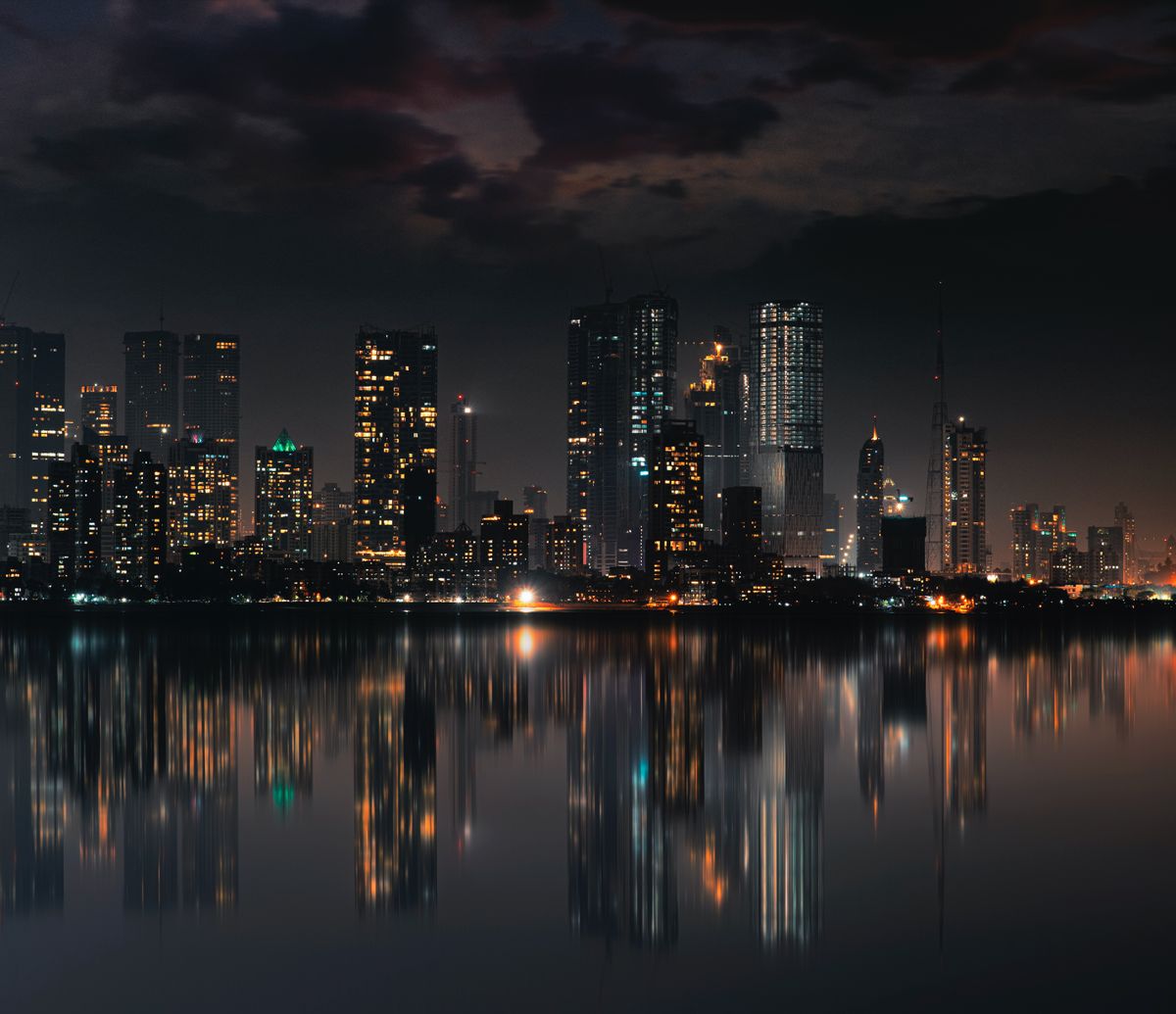
Where to stay: South Mumbai heritage stays around Colaba and the Gateway, boutique picks in Bandra, and the Taj Mahal Palace / Oberoi luxury tier on the waterfront.
- India Country Guide — the wider Indian frame: rupee, e-Visa, railways, festivals, regional cuisines (see also the India guide)
- Delhi City Guide — the capital: Old Delhi, the Red Fort, India Gate, the Mughal and colonial layers
- Dubai City Guide — the Gulf hub and the most common Mumbai-to-anywhere stopover
- Bangkok City Guide — the Southeast-Asian gateway and a frequent onward connection
- All City Guides
Alex the Travel Guru
Alex has spent two decades watching Mumbai grow from a city of textile mills and Ambassador taxis into the glass-tower financial capital it is today. He’s ridden the 08:30 Virar fast in the crush, eaten vada pav outside Dadar, taken the Elephanta ferry in flat-calm December light and in choppy pre-monsoon swell, walked Dharavi with a community guide, and watched Ganpati immersions on Chowpatty under September rain. The Mumbai brief here reflects the rhythm of those visits, the Maharashtra and India tourism-board guidance, the UK FCDO and US State Department advice, and the ground-truth on what works for a 3-to-4-night stay in 2026 — with a soft spot for Marine Drive at dusk, the Irani-cafe bun maska, and the first-class local-train window seat.
More city guides you might like
Plan your trip to Mumbai
The booking tools we use ourselves. FFU may earn a commission at no extra cost to you.
Plan & book your trip to Mumbai
Booking through these searches supports our guides at no extra cost to you.