
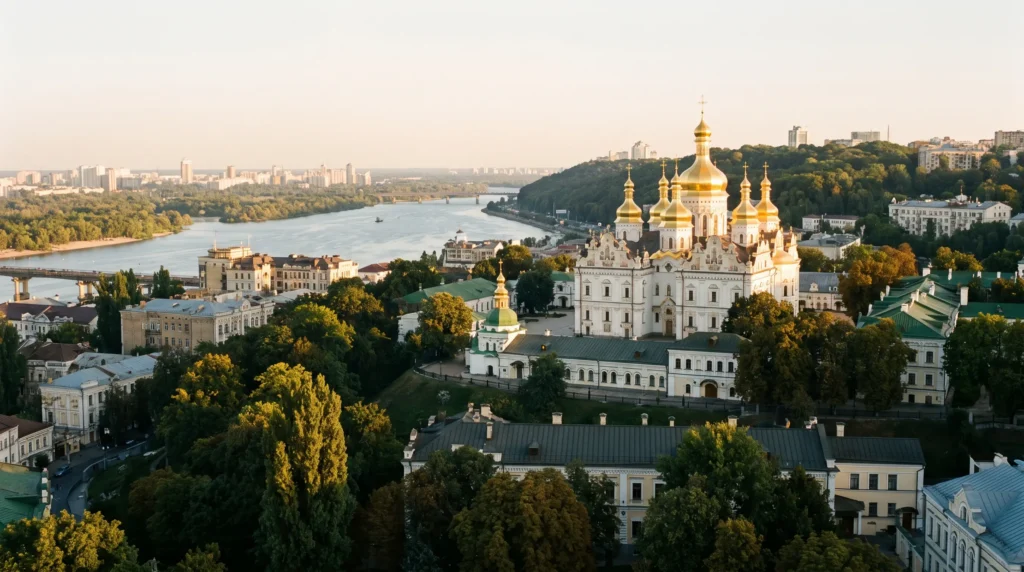
Kyiv Travel Guide — Golden Domes, Chestnut-Lined Boulevards & a City That Hasn’t Stopped
I have to open this one the same honest way I opened our full Ukraine guide: Kyiv sits inside a country currently under a US State Department Level 4 “Do Not Travel” advisory, the strongest warning the US government issues, and the UK’s FCDO advises against all travel to Ukraine’s capital. Russia’s war against Ukraine has been ongoing since February 2022, Kyiv still absorbs missile and drone strikes, and the city’s airspace has been closed to commercial aviation the entire time. This is not a guide nudging you to book a weekend break. It’s the guide I’d want written about a city I love — honest about the war, and honest about the fact that Kyiv is a two-and-a-half-thousand-year-old capital of golden-domed cathedrals, chestnut-lined boulevards and a metro system that doubles as Europe’s deepest bomb shelter, still very much functioning, still very much worth understanding, for whenever the day comes that a trip here is simply a trip again.
In This Guide
- Overview — Why Kyiv Matters
- Chestnut Blossom & Kyiv Day
- Best Time to Visit Kyiv (When Travel Resumes)
- Getting There — Airspace Closed, Overland & Rail Only
- Getting Around — The Metro-as-Shelter City
- Neighborhoods — Podil, Pechersk, Khreshchatyk & Beyond
- Culture & People
- A Food Lover’s Guide to Kyiv
- Off the Beaten Path
- Day Trips From Kyiv
- Practical Information
- Budget Breakdown — Reference Figures for 2026
- Planning Your Trip (For When It’s Time)
- Frequently Asked Questions
Overview — Why Kyiv Matters
Kyiv is one of the oldest cities in Eastern Europe, with a traditional founding date of 482 CE, sprawling across both banks of the Dnipro River with roughly 2.95 million residents inside city limits and about 3.475 million across the wider metro area — Europe’s seventh-most populous city. It was the cradle of Kievan Rus’, the medieval state that gave Ukraine, Russia and Belarus their shared Orthodox Christian roots, and its skyline still carries that thousand-year weight: gold domes rising over wooded hills on the high right bank, looking down at the flatter, greener left bank across the river.
The headline sight is a single UNESCO World Heritage inscription covering two sites at once — Saint-Sophia Cathedral, built in the 11th century to rival Constantinople’s Hagia Sophia and still holding its original mosaics and frescoes, and the Kyiv-Pechersk Lavra, a monastery founded in the same century whose labyrinth of underground caves runs over 600 meters. Both have been on UNESCO’s endangered list since the war began. That single fact says most of what needs saying about Kyiv right now: it is a first-tier European capital, and it is a capital at war, and both of those things are true at the same time.
Before 2022, Kyiv had spent a decade becoming one of the continent’s most interesting under-the-radar city breaks — cheap flights, a booming café and craft-beer scene, techno clubs that rivaled Berlin’s, and prices a fraction of Prague’s or Vienna’s. None of that infrastructure has vanished; cafés, theatres and the metro still run, often around air-raid alerts. What’s gone, for now, is the ability to simply fly in for a weekend. This guide exists so that when that changes, you already know where to go.
Chestnut Blossom & Kyiv Day — the City’s Softest Season
Kyiv’s unofficial emblem is the horse chestnut tree, and its candle-shaped white blossoms lining Khreshchatyk and the boulevards each May have been the city’s most photographed seasonal marker for generations — the chestnut leaf even appears on Kyiv’s coat of arms and municipal branding. Late May traditionally also brings Kyiv Day, a city-wide holiday marking the capital’s founding, held on the last weekend of the month with concerts, markets and fireworks over the Dnipro in ordinary years.
Since 2022, Kyiv Day and most large public gatherings have been scaled back or held with real security constraints, and fireworks displays are an obvious non-starter in a city under air-raid alerts — Ukrainian civic life has adapted rather than disappeared, with smaller, more subdued marks of the day rather than the pre-war spectacle. It’s a small, telling detail about the city right now: the chestnuts still bloom on schedule every spring, whatever else is happening.
Best Time to Visit Kyiv (When Travel Resumes)
The honest first answer is the same as for the country as a whole: right now, “best season” isn’t the operative question for leisure travel — both the US and UK advisories currently say don’t go. With that caveat firmly in place, Kyiv runs a warm-summer humid continental climate worth knowing for planning ahead: summers average roughly 14–25°C, winters sit between about -5°C and -1°C, and the shoulder months of May and September have historically been the sweet spot — mild, green, and (pre-war) short on crowds compared to Western European capitals.
Winters bring the added wartime complication of a nationwide energy grid under sustained attack, meaning rolling blackouts and heating disruptions have been a real feature of Kyiv winters in recent years — one more reason the cold months are a harder ask than the calendar alone would suggest. When the security picture genuinely changes, the same advisory pages linked throughout this guide will say so faster and more reliably than general news headlines.
Getting There — Airspace Closed, Overland & Rail Only
There is currently no commercial air option into Kyiv. Ukraine closed its airspace to civilian flights on 24 February 2022 as the invasion began, and it has stayed closed continuously since — Boryspil International Airport (KBP), Kyiv’s main pre-war gateway 29km southeast of the city, has run no scheduled passenger service the entire time. The FAA separately prohibits US aviation operations into, out of, within or over Ukraine outright. In 2026 the Ukrainian government began forming a working group toward an eventual phased reopening, but no date is set and any restart depends entirely on the security and air-defense situation.
Everyone entering the country right now does so overland or by rail via a neighboring EU country — Poland, Hungary, Romania, Slovakia or Moldova — then onward into Kyiv by Ukrainian Railways, which has kept remarkably reliable overnight sleeper service running between Kyiv, Lviv and other cities even under wartime and blackout conditions. Expect thorough document checks at the border: passport, proof of purpose of travel, roughly $60/day in demonstrable funds, and medical insurance. Ukrainian men aged roughly 18–60 are generally barred from leaving the country under martial law — a real complication for dual nationals with Kyiv family ties.
Getting Around — The Metro-as-Shelter City
The Kyiv Metro is the backbone of the city: three lines and 52 stations running about 69.6 kilometers, opened in 1960 and built deep enough into the high right bank’s hills to double as bomb shelters. Arsenalna station is the standout: at 105.5 meters below ground it’s the second-deepest metro station in the world, with an escalator ride that alone can take up to five minutes. That same depth is exactly why Kyivans have sheltered in metro stations during air-raid alerts throughout the war — a grim but genuine second life for Soviet-era engineering built with a different kind of siege in mind.
Above ground, an extensive network of trams, trolleybuses and buses covers the rest of the city, and the historic center — Khreshchatyk, Podil, Maidan Nezalezhnosti — is compact and walkable by European capital standards. Ride-hailing apps have long been the easy option for visitors, cash and card both widely accepted pre-war, though expect service disruptions tied to blackouts and air-raid alerts under current conditions.
Neighborhoods — Podil, Pechersk, Khreshchatyk & Beyond
Khreshchatyk & Maidan Nezalezhnosti
Kyiv’s grand central boulevard and its central square — the site of the 2004 Orange Revolution and the 2013–14 Euromaidan protests that reshaped Ukraine’s modern politics, and now a place of remembrance for the war, lined with photographs of the fallen. This is the chestnut-lined spine of the city and the natural first stop.
Podil
The old riverside merchants’ quarter and, pre-war, Kyiv’s most fashionable neighborhood: cobbled lanes, the funicular up to the hills above, contemporary art spaces, and the city’s best concentration of specialty coffee and craft-beer bars.
Pechersk
Home to the Kyiv-Pechersk Lavra monastery complex and its underground caves, plus government buildings and leafy, hilltop streets with some of the best river views in the city.
Saint Sophia & the Golden Gate
The historic religious core around Saint-Sophia Cathedral itself, alongside the reconstructed Golden Gate, an 11th-century city gate rebuilt in the 1980s, and Saint Michael’s Golden-Domed Monastery, whose gleaming cupolas are one of the most photographed views in the city.
Andriyivskyy Descent
A steep, cobbled, artist-lined street connecting Podil to the upper town, historically Kyiv’s answer to Montmartre — souvenir stalls, small museums, and one of the best places in the city for a slow wander.
Left Bank (Livyi Bereh)
The flatter, greener, more residential side of the Dnipro, dominated by Soviet-era housing blocks and, further out, the vast Hydropark recreation area on the river islands — a genuinely local, un-touristy side of the city.
Culture & People
Ukrainian is the sole official language, though Russian and a blended vernacular called Surzhyk remain in everyday use, and the war has visibly accelerated a shift toward Ukrainian in daily life, media and signage since 2022. Kyiv has long been the country’s cultural engine — its opera and ballet, its literary and film scene, and, pre-war, a techno and club culture (anchored by venues like Closer and ∄) that drew comparisons to Berlin’s. Much of that nightlife infrastructure has pivoted toward fundraising events and volunteer logistics since the invasion, a striking, resilient reinvention of the same spaces and the same crowd.
The defining cultural note of this decade in Kyiv is wartime civil society itself: volunteer networks, drone-fundraising drives, and a blunt, dark, deeply resilient sense of humor that shows up on graffiti, in coffee-shop small talk and in how the city has kept functioning — cafés, markets and the metro operating around air-raid sirens — without pretending the war isn’t happening. Kyiv Day and Independence Day (24 August) remain the major civic dates on the calendar, though large public gatherings have understandably scaled back since 2022 for security reasons.
A Food Lover’s Guide to Kyiv
Borscht is the city’s, and the country’s, headline dish — a beet-based soup with more regional variations than most countries have national dishes, and one that carries a distinction almost no food anywhere holds: UNESCO fast-tracked the “Culture of Ukrainian borscht cooking” onto its Intangible Cultural Heritage in Need of Urgent Safeguarding list in 2022, explicitly because the war was disrupting the families and communities who keep the tradition alive. Every Kyiv kitchen, restaurant and grandmother has an opinion on the “correct” version.
Beyond borscht: varenyky (dumplings, sweet or savory — potato, cherry and cottage cheese are classics), holubtsi (cabbage rolls), and salo (cured pork fat, treated with genuine reverence). Kyiv also lends its name to two famous exports: chicken Kiev, the breaded, butter-stuffed cutlet known worldwide by an anglicized spelling of the city, and the Kyiv cake, a meringue-and-hazelnut layer cake that’s the city’s signature dessert souvenir. Pre-war Kyiv also built a genuinely serious specialty-coffee scene in Podil, alongside a growing craft-beer and natural-wine circuit.
Off the Beaten Path
Kyiv-Pechersk Lavra’s caves
Beyond the golden-domed churches most photographs show, the Lavra’s underground network of monastic caves — over 600 meters of them — holds centuries of mummified monks in a setting that’s as solemn as it is strange.
Hydropark
A sprawling river-island recreation zone on the left bank — beaches, forest trails and open-air gyms used almost entirely by locals, with essentially no tourist infrastructure.
Motherland Monument & the WWII museum complex
A colossal Soviet-era steel statue overlooking the Dnipro, paired with a sprawling underground museum of Kyiv’s brutal WWII history — a heavy but essential counterpoint to the city’s golden-dome postcard image.
Left Bank markets
Skip the souvenir stalls on Andriyivskyy Descent for a wander through a genuine left-bank produce market — the real texture of how Kyivans actually shop and eat.
Day Trips From Kyiv
Pre-war, the classic Kyiv day trip was Chernobyl and Pripyat, roughly two hours north, one of the most-searched dark-tourism sites on earth. That option is currently unavailable: Ukrainian authorities suspended all exclusion-zone visitor passes in April 2022 for the duration of martial law, and the zone remains closed to tourists as of 2026, with no confirmed reopening date and residual landmines and unexploded ordnance from 2022 fighting in the area. Officials have said they intend to reopen it once the war ends.
Other pre-war favorites worth knowing for later: Pyrohiv, an open-air museum of traditional wooden Ukrainian village architecture on Kyiv’s southern edge, and the historic river town of Vyshhorod just upstream on the Dnipro. Given the current advisories, none of these should be treated as active itinerary items today — they’re here so this guide is ready the moment that changes.
Practical Information
Safety — read this first. The US rates all of Ukraine, including Kyiv, Level 4, “Do Not Travel,” citing active combat elsewhere in the country and missile and drone strikes reaching civilians nationwide including the capital, closed airspace, martial law and exit restrictions for Ukrainian men. The UK FCDO advises against all travel to Kyiv and reports substantial monthly civilian casualty figures as of mid-2026. Travel insurance is typically invalidated once you travel against your government’s advice — factor that in fully before any essential trip, and know where the nearest metro station or designated shelter is at all times if you are in the city for essential reasons.
Money. The hryvnia trades under a managed float against the US dollar, roughly 42–45 UAH per dollar through 2026, a policy the National Bank of Ukraine adopted after the initial wartime peg. Cards work widely in functioning parts of the city; carry cash given power and connectivity disruptions.
Health. No special vaccination requirements beyond routine and MMR coverage, but travel and medical evacuation insurance are strongly recommended, and current guidance focuses primarily on the security situation rather than infectious disease.
Connectivity, plugs, time. Ukraine uses type C and F plugs at 230V/50Hz. Kyiv runs on Eastern European Time (UTC+2, UTC+3 with summer time), though the ongoing energy crisis means blackouts can affect power and connectivity with little notice — carry a power bank and download offline maps in advance.
Budget Breakdown — Reference Figures for 2026
These are pre-war-informed reference figures for planning purposes, not an active itinerary budget — leisure travel to Kyiv is not currently advised.
Budget (US$40–70/day): hostel or budget guesthouse, borscht and varenyky at neighborhood canteens, metro and tram fares, walking the historic core.
Mid-range (US$80–150/day): a well-reviewed hotel in Podil or near Khreshchatyk, restaurant meals, museum and Lavra entry fees, occasional taxis.
Business/upscale (US$200+/day): Kyiv’s better hotels, many of which have housed press, NGO staff and business travelers throughout the war, plus private transport arrangements.
Fixed costs to plan for: proof of roughly $60/day in funds at the border, mandatory medical insurance, and travel insurance that — read the fine print — may not cover a country under a Do Not Travel advisory at all.
Planning Your Trip (For When It’s Time)
For nearly everyone reading this, the honest plan is: not yet. Bookmark this guide, follow your government’s advisory page rather than headlines, and revisit when the picture genuinely changes. If you do have essential, non-tourism reasons to be in Kyiv, route through a neighboring EU country first — most overland access runs via Warsaw and Poland’s Medyka crossing, or through Budapest or Prague further west — all worth their own trip regardless of what’s happening next door. And if it’s Kyiv’s Byzantine-inspired golden domes that first drew your eye, our Istanbul guide covers the Hagia Sophia that Saint-Sophia Cathedral was built to rival.
Frequently Asked Questions
Is Kyiv safe for tourists in 2026?
No — not for leisure travel. The US rates all of Ukraine, including Kyiv, Level 4, “Do Not Travel,” and the UK FCDO advises against all travel to the capital. Anyone with genuinely essential reasons to go should read both advisories in full and plan around martial law, closed airspace and unpredictable strikes, not around this or any general-interest guide.
Can I fly into Kyiv?
No. Ukrainian airspace has been closed to commercial aviation since the February 2022 invasion, and the FAA prohibits US aviation operations there entirely. All entry currently happens overland or by rail via neighboring countries.
Do I need a visa?
US, UK, EU, Canadian and most Commonwealth passport holders can enter visa-free for up to 90 days within a 180-day period, a rule that remains in effect during martial law, though enhanced document and funds checks apply at the border.
Can I visit Chernobyl from Kyiv?
Not currently. Ukraine suspended all exclusion-zone visitor passes in April 2022 for the duration of martial law, and the zone remains closed to tourists as of 2026, with landmines and unexploded ordnance an added hazard from 2022 fighting in the area.
Are there restrictions on who can enter or leave?
Yes. Ukraine’s martial law generally bars men of Ukrainian nationality aged roughly 18–60 from leaving the country, and dual nationals should expect this to apply to them too — a serious consideration for anyone with Kyiv family links planning a visit.
What’s Kyiv actually like day to day right now?
Functioning, and genuinely resilient — cafés, the metro, markets and theatres operate, often around air-raid alerts, and residents have adapted daily life around blackouts and shelter routines rather than stopping. That said, “functioning” is not the same as “safe for tourism,” and the advisories above should be the deciding factor, not anecdotes of normalcy.
The Kyiv We’re Waiting to Write About Again
Golden domes over a hilltop skyline, chestnut blossoms down Khreshchatyk every May, a metro deep enough to double as a shelter and a food culture that got a soup recognized by UNESCO as an act of cultural survival — Kyiv has always been a capital worth the trip. Right now it’s also a capital fighting for its existence, and the responsible thing this guide can do is tell you plainly not to book a holiday, and to keep the door open, genuinely and factually, for the day it gets to be about lobster-festival-style fun again instead of advisory levels. Until then: read, learn, cook the borscht, and keep an eye on the State Department and FCDO pages linked throughout.
Explore More
- Warsaw City Guide — the main overland gateway into Ukraine right now
- Budapest City Guide — another Central European route in, and a trip worth taking on its own
- Prague City Guide — Central Europe’s other golden-domed capital
- Istanbul City Guide — the Hagia Sophia that inspired Kyiv’s own Saint-Sophia Cathedral
How this guide was built
Published as part of Facts From Upstairs’ city guide series. Built from authoritative sources — the US State Department’s Ukraine travel advisory, the UK FCDO’s Ukraine travel advice, the US CDC’s Ukraine traveler health page, UNESCO’s World Heritage listing for Saint-Sophia Cathedral and the Kyiv-Pechersk Lavra, UNESCO’s Intangible Cultural Heritage inscription for Ukrainian borscht cooking, the National Bank of Ukraine’s official exchange rate data, Ukraine’s Ministry of Foreign Affairs entry-regime page, the Visit Ukraine entry-rules portal, and Wikipedia entity pages for Kyiv, the Kyiv Metro, Arsenalna station, Boryspil Airport and the Chernobyl exclusion zone. Numeric and safety claims carry inline citations, and given the fast-moving security situation, readers are urged to check the State Department and FCDO pages directly for the current advisory before making any decisions.
Sources cited on this page
- US State Department — Ukraine Travel Advisory
- UK FCDO — Ukraine Travel Advice
- US CDC — Ukraine Traveler Health Page
- UNESCO — Kyiv: Saint-Sophia Cathedral and Kyiv-Pechersk Lavra
- Wikipedia — List of World Heritage Sites in Ukraine
- UNESCO ICH — Culture of Ukrainian Borscht Cooking
- National Bank of Ukraine — Official Exchange Rates
- Ukraine MFA — Entry Regime for Foreign Citizens
- Visit Ukraine — Entry Rules 2026
- Wikipedia — Kyiv
- Wikipedia — Kyiv Metro
- Wikipedia — Arsenalna Station
- Wikipedia — Boryspil International Airport
- Wikipedia — Chernobyl Exclusion Zone
- Wikipedia — Ukraine
More city guides you might like



Plan your trip to Kyiv
The booking tools we use ourselves. FFU may earn a commission at no extra cost to you.
Plan & book your trip to Kyiv
Booking through these searches supports our guides at no extra cost to you.