
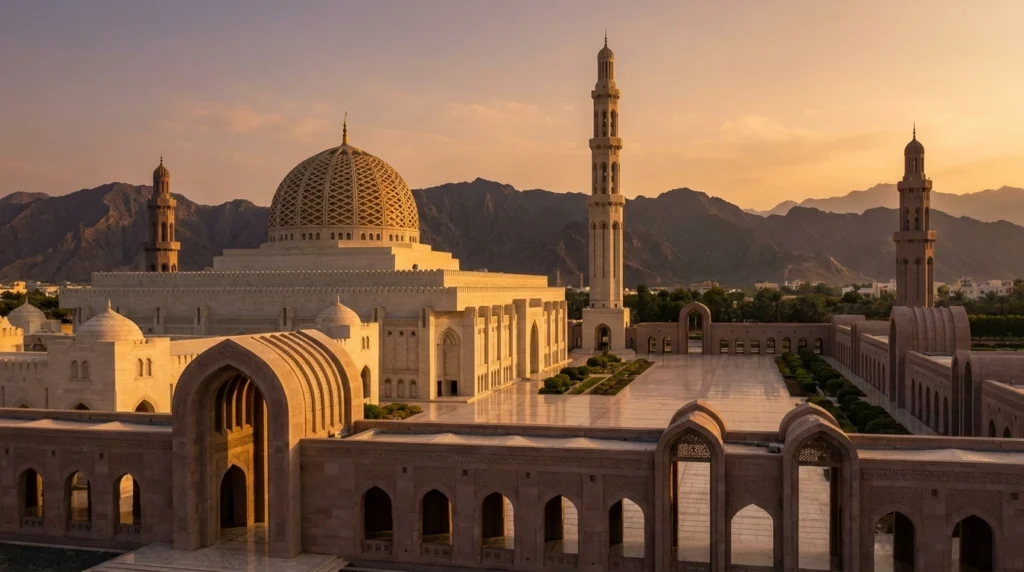
Muscat, Oman: The Low-Rise Arabian Capital Where the Hajar Mountains Drop Into the Gulf
I have flown into Muscat at dawn three times, and the thing that still resets my expectations every single time is the skyline that isn’t one. There are no glass towers clawing at the sky here — a royal decree caps most buildings to a handful of storeys, so the city spreads low and white along a 60-kilometre ribbon of coast, wedged between the deep blue of the Gulf of Oman and the bare ochre wall of the Hajar Mountains. We tend to file Muscat next to Dubai in our heads, and that is exactly the mistake I want to talk you out of. This is a capital that still smells of frankincense in the souq, where a 200-year-old market and a 21st-century opera house sit twenty minutes apart, and where the call to prayer rolls off the mountains at sunset with nothing tall enough to break it. My favourite hour is 5:30 p.m. on the Mutrah Corniche, when the harbour turns copper and the dhows come in. Treat this guide as the brief I would hand my own family before they boarded the red-eye into Muscat International.

Table of Contents
Why Muscat?
Muscat is the rare capital that refuses to shout. Where its Gulf neighbours raced upward in glass and steel, Oman’s largest city stayed low and white by design — a planning ethic that keeps the Hajar Mountains, not a skyline, as the dominant feature. It is home to an urban population of roughly 1.72 million spread across a metropolitan area of about 6,500 square kilometres, which is why the city feels less like a single downtown and more like a string of coastal towns linked by one long highway hugging the sea.
The scale here is human, and the contrast is the whole point. In a single afternoon you can wander a frankincense souq that has traded for around 200 years, then drive twenty minutes to a marble opera house that opened in 2011 with a 1,100-seat auditorium. Portuguese forts from the 1500s still guard the old harbour; the Sultan Qaboos Grand Mosque, opened in 2001, can hold 20,000 worshippers under a single hand-woven carpet. The city wears five centuries of trading history without turning any of it into a theme park.
And the superlatives are earned, not invented: Lonely Planet named Muscat the best city in the world to visit in 2012, the same year it served as Capital of Arab Tourism. Come for the mosque and the souq, stay for the way the mountains turn rose-gold over the Corniche at dusk, the call to prayer rolling off the rock with nothing tall enough to break it — there is simply no other city in Arabia that feels like this.

Neighborhoods: Finding Your Muscat
📍 Muscat Map: Every Place in This Guide


Mutrah (Muttrah)
Mutrah is old Muscat’s beating heart — a curving Corniche along the harbour, the candy-striped fish market, and behind it the lantern-lit lanes of the souq, locally nicknamed “Al Dhalam,” meaning darkness, for the way its packed stalls block out the sun.
- Mutrah Souq — frankincense, silver, khanjars
- Mutrah Fish Market (Snøhetta-designed)
- The Corniche promenade at dusk
Best for: first-time arrivals, photographers, frankincense shopping. Access: 20 min by taxi from the airport; walkable end to end.
Old Muscat (Al Alam)
The walled original port, hemmed in by Portuguese-era forts Jalali and Mirani, centred on the gold-and-blue Al Alam Palace — the Sultan’s ceremonial residence and one of the city’s most photographed façades.
- Al Alam Palace façade
- Forts Jalali & Mirani
- National Museum of Oman
Best for: history, royal architecture, museum-goers. Access: a short drive east of Mutrah around the headland.
Ruwi
The commercial and banking district, sometimes called “Little India” for its South Asian eateries and money-changers. It is the city’s most workaday quarter and the cheapest place to eat well.
- Ruwi High Street markets
- Bait Al Baranda local museum nearby
- Budget curry houses and shawarma stands
Best for: budget travellers, foodies, currency exchange. Access: inland behind Mutrah; frequent local buses.
Qurum
Muscat’s leafy seaside lung, built around Qurum Natural Park and a long public beach. This is where Muscatis come to jog, picnic and watch the sun set over the Gulf.
- Qurum Beach
- Qurum Natural Park
- Royal Opera House Muscat (adjacent Shatti)
Best for: families, beach days, evening strolls. Access: central, on the main coastal highway.
Shatti Al Qurum & Al Khuwair
The polished modern stretch — embassies, malls, the opera house and the city’s best beachfront hotels line this run of coast, the closest Muscat comes to a contemporary downtown.
- Royal Opera House Muscat
- Shatti beach hotels
- Oman Avenues / Avenues Mall
Best for: opera nights, upscale dining, shopping. Access: 10 min west of Qurum.
Al Ghubra & Bawshar
The sprawling residential west, home to the Sultan Qaboos Grand Mosque and a growing belt of newer hotels and shopping centres closer to the airport.
- Sultan Qaboos Grand Mosque
- Mall of Oman
- Bawshar sand dunes
Best for: mosque visits, late-arrival airport hotels. Access: west of Khuwair toward Seeb and the airport.
Seeb & Al Mouj
The airport end of the city, anchored by the traditional Seeb fishing town and the modern Al Mouj marina-and-golf development with its waterfront promenade and luxury resort.
- Al Mouj Marina & promenade
- Seeb Souq (fresh fish)
- The St. Regis Al Mouj resort
Best for: marina dining, golf, last-night airport convenience. Access: beside Muscat International Airport.
Yiti & Bandar Khayran
Muscat’s wild eastern edge — empty beaches, a turquoise lagoon and the dramatic Bandar Khayran fjords, all under an hour from the centre and barely touched by development.
- Yiti Beach
- Bandar Khayran kayaking & snorkelling
- Quriyat coastal road
Best for: escape from the city, snorkelling, sunrise. Access: 40–60 min southeast by car.
The Food

Omani Classics
Omani cooking is gentle, spice-forward and built around rice, slow-cooked meat and the sea. The national set-piece is shuwa — meat marinated in a date-and-spice paste, wrapped in palm leaves and buried in an underground pit oven to roast for a day or more, traditionally for Eid. Everyday tables lean on machbous, a saffron-and-loomi (dried lime) spiced rice with chicken, mutton or kingfish.
- Bait Al Luban (Mutrah Corniche) — shuwa & harees (~OMR 6–9, ~$16–23)
- Ubhar (Bareeq Al Shatti) — modernised Omani tasting plates (~OMR 8–14, ~$21–36)
- Kargeen (Madinat Qaboos) — garden-set traditional grills (~OMR 5–10, ~$13–26)
Seafood & the Coast
With the Gulf on the doorstep, Muscat eats superb fish. Mashuai — whole kingfish spit-roasted and served over lemon rice — is the dish to seek out, alongside grilled hammour and the daily catch off the Mutrah and Seeb fish markets.
- The Beach Restaurant (The Chedi) — fine seafood (~OMR 25–45, ~$65–117)
- Seeb Fish Market grills — pick-and-cook catch (~OMR 3–6, ~$8–16)
- Bin Ateeq (Qurum) — floor-seating Omani fish & rice (~OMR 4–8, ~$10–21)
Beyond Shuwa and Machbous
The supporting cast is where Omani food gets personal — slow-cooked, communal and built for hospitality rather than show.
- Harees — wheat and meat pounded to a soft, savoury paste (~OMR 2–4)
- Mishkak — street-side skewered grilled meat, the local kebab (~OMR 1–3)
- Halwa — a dense rosewater-and-saffron sweet served with coffee (~OMR 2–5)
- Kahwa & dates — cardamom coffee and dates, the ritual welcome (often free)
Food Experiences You Can’t Miss
- The kahwa-and-dates ritual — never refuse the first cup; a gentle shake of the cup means “no more”
- Friday-morning grazing through Mutrah Souq for frankincense, halwa and spices
- A pick-your-fish dinner grilled to order at the Seeb fish market
Cultural Sights

Sultan Qaboos Grand Mosque
Muscat’s defining monument, opened on 4 May 2001 after six years of construction. It holds up to 20,000 worshippers, its main prayer hall crowned by a 14-metre Swarovski chandelier set with around 600,000 crystals and floored with a 21-tonne hand-woven carpet. Founded 2001. Admission free. Open to non-Muslim visitors mornings only (typically 8–11 a.m., closed Fridays); modest dress required, women must cover hair.
Royal Opera House Muscat
The Gulf’s first opera house, opened on 12 October 2011 with a production of Puccini’s Turandot. Its 1,100-seat marble auditorium has since hosted Plácido Domingo, Andrea Bocelli and Yo-Yo Ma. Admission by performance ticket; guided daytime tours run when no rehearsal is scheduled. Best visited for an evening show.
Mutrah Souq
A roughly 200-year-old maze of frankincense, silver and khanjar daggers, and the single best place in the city to feel old Arabia. Admission free. Liveliest in the cool of the evening and on Friday mornings.
Al Alam Palace & the Forts
The ceremonial palace of the Sultan, framed by the twin Portuguese forts Jalali and Mirani that have guarded the harbour since the early 1500s. Admission to the palace forecourt free; forts viewed from outside. Best at golden hour.
National Museum of Oman
Opposite Al Alam Palace, Oman’s flagship museum traces 5,000 years of frankincense trade, maritime history and Ibadi heritage across fourteen galleries. Admission a few rial; allow two hours. Best in the morning before the heat.
Entertainment

Royal Opera House Muscat
The city’s cultural centrepiece runs a full season of opera, ballet, classical concerts and Arabic music in its 1,100-seat hall. Typical cost OMR 10–60 (~$26–156) depending on production and seat. Book online weeks ahead for marquee names and observe the smart dress code.
The Mutrah Corniche at Dusk
Free and unbeatable: an evening stroll along the harbour as the dhows come in and the forts glow. Typical cost nothing but an ice cream.
Shisha Cafés & Coffee Houses
The local nightlife is social rather than boozy — shisha lounges and cardamom-coffee cafés along Qurum and Shatti stay busy past midnight. Typical cost OMR 3–8 (~$8–21).
Beach Clubs & Hotel Bars
Licensed hotels in Shatti and Al Mouj host the city’s bars, live music and beach lounges — the only legal place for a drink. Typical cost OMR 5–15 (~$13–39).
Dolphin-Watching & Sunset Cruises
Morning dolphin boats and evening dhow cruises leave from Marina Bandar Al Rowdha and Al Mouj. Typical cost OMR 15–25 (~$39–65) per person.
Cinema & Malls
Modern multiplexes and air-conditioned malls — Mall of Oman, Avenues Mall — are where Muscatis spend the hot evenings. Typical cost OMR 3–5 (~$8–13) per film.
Day Trips

Nizwa (1h 45m by car)
Oman’s former capital, about 140 km from Muscat, built around the great cylindrical fort completed in 1668 and a souq famous for its Friday goat market. The drive is an easy four-lane highway.
Wadi Shab (1h 40m by car)
A turquoise-pooled canyon on the coast road toward Sur, ending in a hidden waterfall cave — the most popular wadi swim within reach of the capital.
Jebel Akhdar (2h by car)
The “Green Mountain,” a cool plateau of terraced rose farms and stone villages around 2,000 m up; a 4×4 is required for the final ascent.
Jebel Shams & Wadi Ghul (2h 40m by car)
Oman’s highest mountain at 3,018 m, looming over the Al Nakhur canyon — the “Grand Canyon of Arabia” — and the W6 balcony walk.
Sharqiya (Wahiba) Sands (2h 30m by car)
A 12,500-square-kilometre sea of dunes up to 100 m high, best done as an overnight desert-camp trip with a dawn dune drive.
Seasonal Guide
Spring (March – May)
March is the tail of the pleasant season, with warm days and comfortable evenings ideal for the souq and the Corniche. By May the coastal heat is climbing fast toward summer, so do mosque visits and wadi swims early in the morning and retreat to air conditioning by midday.
Summer (June – August)
Muscat’s low season for good reason — coastal temperatures push toward 43 °C with high humidity. Hotel rates fall hard, the beaches and pools stay usable at dawn and dusk, and it is the cheapest time to visit if you can plan your sightseeing around the heat.
Autumn (September – November)
From mid-October the heat breaks and Muscat slides into its best stretch. November brings clear, dry days in the mid-20s °C, cool enough for the Jebel Shams balcony walk and warm enough for the beach — the start of peak season.
Winter (December – February)
The prime window: sunny days around 22–28 °C, cool desert nights and the full opera season in swing. It is also the busiest and priciest period, so book hotels and Grand Mosque mornings ahead, especially around the New Year holidays.
Getting Around
The Coastal Highway
Muscat is a long, linear city with no rail, so the Sultan Qaboos Highway is its spine — most journeys between districts run along this one fast road, and a rental car or taxi is how nearly every visitor gets between Mutrah, the mosque and the airport.
Mwasalat Public Buses
The state operator Mwasalat runs clean, air-conditioned city and intercity buses, including a useful airport route and long-distance services to Nizwa, Sur and Salalah. Fares are a few hundred baisa within the city — cheap, but infrequent compared with taxis.
Nool Card / Prepaid Transit
Mwasalat’s rechargeable Nool smartcard taps you onto city buses and saves fumbling for change; buy and top up at bus stations and select shops. Cash is still accepted onboard if you do not have one.
Airport Access
- Taxi from Muscat International — 30–45 min, ~OMR 8–15 (~$21–39) to central hotels
- Mwasalat airport bus — ~45–60 min, ~OMR 0.5 (~$1.30) to the city
Taxis & Ride-Hailing
Orange-and-white taxis are unmetered, so agree the fare first; the Otaxi and Marhaba apps offer metered, app-booked alternatives that most visitors find easier. Flag-fall is informal — confirm OMR before you ride.
Navigation Tips
Apps: Google Maps, Otaxi. Oman drives on the right (steering on the left), road signage is bilingual Arabic-English, and the highways are modern and well-lit; the main hazard is loose gravel and flash-flooded wadis on interior roads, not city traffic.
Budget Breakdown: Making Your Rial Count
| Tier | Daily | Sleep | Eat | Transport | Activities | Extras |
|---|---|---|---|---|---|---|
| Budget | $55–90 | $25–45 guesthouse | $10–18 street food | $3–8 bus | $0–15 free sights | $5–10 |
| Mid-Range | $130–250 | $70–140 hotel | $30–55 restaurants | $25–45 rental car | $20–60 tours | $15–30 |
| Luxury | $500+ | $300+ resort | $90–180 fine dining | $60+ private driver | $100+ opera & cruises | $50+ |
Where Your Money Goes
Muscat is mid-priced for the Gulf — far cheaper than Dubai for sights, since the Grand Mosque, souq, Corniche and beaches are free, but accommodation and alcohol are where costs climb. The rial is strong: one OMR is worth about $2.60, so small-looking prices add up fast. A rental car plus cheap petrol is the single best value for couples and families.
Money-Saving Tips
- Eat in Ruwi’s South Asian and Omani diners, where a full meal runs OMR 2–4
- Visit in the summer shoulder for hotel rates up to half the winter peak
- Stack the free sights — mosque, souq, palace forecourt, beaches — into your first cool morning
- Self-drive the day trips rather than booking guided tours; cheap petrol makes a rental the best-value way to see the interior
Practical Tips
Language
Arabic is the official language, but English is spoken almost everywhere a visitor goes — hotels, taxis, restaurant menus and bilingual road signs. A few words of Arabic (shukran, as-salaam alaykum) are warmly received but never required.
Cash vs. Cards
Cards are accepted in hotels, malls and mid-range restaurants, but carry rial for taxis, the souq, street food and the interior, where cash still rules. ATMs are plentiful in the city.
Safety
Muscat has very low street crime and is one of the safest capitals in the region for solo and family travel. Note, however, that the UK FCDO advised increased caution and the US State Department raised Oman to a Level 3 “Reconsider Travel” advisory in April 2026 over wider regional tensions around the Strait of Hormuz; check the latest before you fly.
What to Wear
Oman is conservative: cover shoulders and knees in public, and at the Grand Mosque women must cover hair, arms and legs. Beachwear is fine on hotel beaches only. Lightweight, breathable cottons suit the heat.
Cultural Etiquette
Accept the kahwa-and-dates welcome graciously, use your right hand for eating and greeting, ask before photographing people, and dress modestly during Ramadan, when eating or drinking in public during daylight is not permitted.
Connectivity
Buy an Omantel or Ooredoo SIM/eSIM at the airport for cheap, fast 4G/5G across the city; Wi-Fi is standard in hotels and cafés. Coverage thins in remote interior wadis.
Health & Medications
No vaccines are required beyond routine ones; the CDC recommends Hepatitis A and Typhoid for most travellers. Muscat’s hospitals are modern; bring any prescription meds in their original packaging with a doctor’s note, as some common drugs are restricted.
Luggage & Storage
Muscat International offers left-luggage, and most city hotels will hold bags before check-in or after check-out — handy if you arrive on a dawn flight and want to hit the mosque before your room is ready.
Frequently Asked Questions
How many days do I need in Muscat?
Two full days cover the city’s headline sights comfortably — one for the Grand Mosque, Mutrah Souq and the Corniche, a second for the opera house, Old Muscat forts and a Qurum beach evening. Add a third or fourth day for a Nizwa or Wadi Shab day trip, which is what most visitors end up wishing they had.
Is Muscat good for solo travellers?
Yes — it is among the safest, easiest capitals in the Middle East for solo travel, including for women, with very low crime and friendly, helpful locals. Dress modestly, use app-based taxis at night, and you will rarely feel anything but welcome.
Do I need a car to get around Muscat?
For the city itself you can manage with taxis and the airport bus, but Muscat is long and linear with no rail, so a rental car makes both the districts and the day trips far easier. If you plan any interior or coastal excursions, rent one.
What about the language barrier?
There is barely one for English speakers. English is used throughout the tourism trade, on menus and on bilingual road signs, so you can navigate, order and bargain comfortably without any Arabic.
When is the best time to visit Muscat?
November to March, when days sit around 22–28 °C and the opera season is running. Summer (June–August) is cheap but coastal heat near 43 °C limits midday activity to dawn and dusk.
Can I use credit cards everywhere?
Cards work in hotels, malls and mid-range restaurants, but carry Omani rial for taxis, the souq, street food and anywhere outside the city. ATMs are easy to find in Muscat.
Can non-Muslims visit the Sultan Qaboos Grand Mosque?
Yes — it is open to non-Muslim visitors on weekday mornings (typically 8–11 a.m., closed Fridays), free of charge, with a modest dress code and headscarf for women. It is the one major mosque in the country that welcomes tourists.
Ready to Experience Muscat?
Book a cool-season morning at the Grand Mosque, an evening on the Mutrah Corniche and at least one day in the interior, and Muscat will quietly outshine every glossier Gulf city you compare it to. For the full country context, read the Oman Travel Guide.
Explore More City Guides
Where to Stay
Alex the Travel Guru
Alex has driven the Muscat–Nizwa–Wahiba loop more times than is strictly reasonable and still books a window seat for the dawn approach over the Hajar Mountains. A decade of guiding the Gulf and Indian Ocean coasts goes into every FFU guide, paired with on-the-ground price checks and a stubborn preference for the souq over the mall.
More city guides you might like
Plan your trip to Muscat
The booking tools we use ourselves. FFU may earn a commission at no extra cost to you.
Plan & book your trip to Muscat
Booking through these searches supports our guides at no extra cost to you.