
Languages of Oman
All languages of Western Asia →fluent beta classical · classes by phone with Maya at ranas.ai/maya
Oman Travel Guide — 3,165 km of Coast, 5,000 Years of Frankincense & the Arabian Peninsula Done Properly
I have driven the Muscat–Nizwa–Jebel Akhdar–Wahiba–Sur loop three times now, and the part I still cannot quite explain to friends is how a country wedged between the Gulf and the Empty Quarter manages to feel both completely distinctive and quietly modest about it. We tend to bracket Oman with the UAE in our heads, and that’s a mistake — Oman has dhow yards still building wooden ghanjahs at Sur, a summer monsoon greening Salalah while the rest of Arabia bakes, an Ibadi religious tradition older than the Sunni-Shi’a split, and roughly one Pizza Hut for every dozen wadis. My favourite hour in Oman is 6:42 a.m. on the W6 trail at Jebel Shams, when the first light hits Wadi Ghul 1,200 metres below and the silence is so complete you hear stones cooling. Treat this guide as the brief I would hand my own family before they boarded the red-eye into Muscat.

In This Guide
- Overview — Why Oman Is the Arabian Peninsula Done Properly
- A Pocket History — Frankincense Caravans to Vision 2040
- Best Time to Visit Oman (Season by Season)
- Khareef 2026 — Salalah’s Monsoon Greening
- Getting There — Muscat (MCT) & Salalah (SLL)
- Getting Around — Self-Drive Culture, Coastal Ferry & Local Quirks
- Top Cities & Regions — Muscat, Nizwa, Jebel Akhdar, Wahiba, Salalah, Musandam & Sur
- Culture & Customs — Ibadi Islam, Dishdasha & the Quiet Sultanate
- A Food Lover’s Guide to Oman
- Off the Beaten Path — Misfat al Abriyeen, Empty Quarter & Masirah
- Practical Information
- Budget Breakdown
- Planning Your First Trip to Oman
- Frequently Asked Questions
Overview — Why Oman Is the Arabian Peninsula Done Properly
Oman is a sultanate on the south-eastern shoulder of the Arabian Peninsula — 309,500 km² of mountains, desert, gravel plain and Indian Ocean, wedged between the United Arab Emirates to the north-west, Saudi Arabia and the Empty Quarter to the west, and Yemen across a 288 km southern border. Roughly 5.46 million people live here as of 2025, the great majority along a 3,165 km coastline that wraps from the Strait of Hormuz at the very tip of Musandam down through the Gulf of Oman, around the Arabian Sea cape at Ras al Hadd, and on to the Yemeni frontier south-west of Salalah. The capital, Muscat, sits in the north on a 60 km strip of cliff-bounded coast and houses about 1.72 million people in its metropolitan area — one in three Omanis.
The first story of Oman is geography. The Hajar Mountains — a 700 km arc of folded limestone running from Musandam to Sur — top out at Jebel Shams (3,018 m), the country’s highest peak, where Wadi Ghul plunges 1,200 m below the W6 trail rim and is routinely called the “Grand Canyon of Arabia.” Inland of the mountains the Empty Quarter (Rub’ al Khali) covers some 650,000 km² of sand sea spilling across Saudi, Yemen, the UAE and southern Oman, with dunes up to 250 m and rainfall under 50 mm a year. A separate exclave — Musandam — sits 90 km north across UAE territory, sharing the 39 km-narrow Strait of Hormuz with Iran and so giving Oman a literal hand on the world’s most strategically important oil chokepoint, through which roughly a quarter of seaborne petroleum trade transits in any given year.
The second story is 5,000 years of trade. Bronze-Age tombs at Bat, Al-Khutm and Al-Ayn (UNESCO since 1988) document a third-millennium-BCE oasis culture already moving copper through the Indian Ocean. By classical antiquity, Dhofar’s frankincense — harvested from Boswellia sacra trees that still grow north of Salalah — was the most valuable commodity in the Roman Mediterranean, shipped from caravan ports at Khor Rori (Sumhuram) and Al-Baleed and traded as far as Han-dynasty China. UNESCO inscribed the four-site “Land of Frankincense” as a cultural property in 2000. The same maritime DNA produced the dhow yards of Sur, where wooden sambuks and ghanjahs were built that “formerly went as far as China, India, Zanzibar, Iraq and many other countries” — and at the imperial high-water mark in 1840, Oman’s capital was actually in Zanzibar, not Muscat.
The third story is the modern transformation, and it is essentially one man’s work. When Sultan Qaboos bin Said ousted his isolationist father in a 1970 palace coup, Oman had three primary schools, ten kilometres of paved road and a per-capita GNI under USD $400; he abolished slavery in his first year, opened the country to foreign aid and tourism, defeated the Marxist-backed Dhofar Rebellion by 1976 and built almost every kilometre of asphalt, every hospital and every airport you will use on a 2026 trip. Qaboos died on 10 January 2020 having no children; his cousin Haitham bin Tariq succeeded under a sealed will and immediately published Oman Vision 2040, a twenty-year diversification plan adopted in 2020 to wean the economy off oil and gas (currently 26.2% of GDP) and lift tourism receipts to 11 million annual visitors by 2040. By the World Bank’s 2024 numbers, Oman is now a USD $107.14 billion economy with GDP per capita of $20,285, life expectancy of 80, internet penetration of 95% and an unemployment rate of 3.3%.
The fourth story is religion and identity, and it is the one that makes Oman quietly distinct from every neighbour. Ibadi Islam — a moderate sect that broke from the early Kharijite movement in 7th-century Basra and that pre-dates the Sunni-Shi’a split — is the dominant tradition in Oman, where roughly 45% of Muslims are Ibadi alongside about 45% Sunni and 5% Shi’a. Oman is the only country on Earth with an Ibadi-majority Muslim population, and the consequences are visible in everyday life: minimal sectarian rhetoric, a state policy of religious pluralism (Sultan Qaboos personally financed Hindu temples and Christian churches), no morality police, and an architectural restraint that keeps every Muscat skyscraper under nine storeys. The national dress reflects the same temperament: men wear a cotton ankle-length dishdasha (almost always white), with either an embroidered pillbox kummah or a silk-wool turban (massar) on formal occasions, and a silver J-curved khanjar dagger at weddings — the same dagger you’ll see on the national flag, the rial banknotes and the police shoulder patches.
The fifth story is tourism, and it is in a sharp upswing. Oman drew approximately 4.3 million international arrivals in 2023 and was projected to clear 5.3 million in 2024 — a 24.7% year-on-year jump — with GCC neighbours sending the largest share (about 1.6 million), India second (610,000), Germany the largest European market (150,000) and mainland China rising fast (118,000). Tourism revenue reached OMR 2.12 billion (USD $5.51 billion) in 2024, up from OMR 1.75 billion in 2018, and hotel revenues climbed a further 21.4% in 2025 against 2024. The Khareef season alone (21 June – 21 September 2024) drew 1,048,000 visitors to Salalah, up 9% year-on-year; domestic tourism added another 13.6 million Omani trips spending OMR 834 million across 31.3 million hotel-nights.
Practically, Oman in 2026 is the easiest sultanate in the region to travel independently. Arabic is the official language, but English is functionally universal in tourism, hotel signage, restaurants and at the airport, with Modern South Arabian languages like Mehri and Shehri still spoken by Dhofari minorities. Driving is on the right (steering on the left), plugs are British Type G at 240V/50Hz, the currency is the Omani rial pegged 1 OMR = USD $2.6008 since 1986 — the third-highest-valued currency unit in the world after the Kuwaiti dinar and Bahraini dinar — and a four-lane motorway connects Muscat to Nizwa and another to Sur, with petrol at roughly OMR 0.25 per litre as of December 2025. Lonely Planet, National Geographic, Condé Nast Traveler, AFAR, Bradt Guides, Rough Guides and Fodor’s all maintain dedicated Oman desks with current 2026 itineraries, and the country was named the safest in the Arab world by the World Economic Forum’s most recent Travel & Tourism Development Index. Pack a light scarf for the Grand Mosque, a fleece for the desert nights and at least one neutral long-sleeved layer — Muscat in February at 06:30 is colder than you expect.

A Pocket History — From Frankincense Caravans to Vision 2040
Oman’s archaeological record begins long before any other Arabian state can claim a coherent timeline. The Bronze-Age oasis culture of Magan — referenced in cuneiform tablets at Sumer and Ur as the source of Mesopotamian copper — produced beehive tombs, irrigated palm groves and proto-urban necropolises across what is now Al Dhahirah Governorate, with the most spectacular cluster preserved at Bat, Al-Khutm and Al-Ayn around 5,000 years before the present. By the second millennium BCE the Aflaj water-distribution system was already in place — gravity-fed underground channels with vertical access shafts every 20 m — and around 3,000 of those aflaj are still in use today across the Dakhiliyah, Sharqiya and Batinah governorates, sustaining the date palms and lime orchards that ring every interior village. By classical antiquity Dhofar’s frankincense was being shipped from Khor Rori (the ancient port of Sumhuram), Al-Baleed and Wadi Dawkah to the Roman Mediterranean and beyond, making the Land of Frankincense one of the wealthiest stretches of coast in the ancient world.
Islam reached Oman during the Prophet Muhammad’s lifetime; the Julanda kings of Mazun (the pre-Islamic name for the country) converted in 630 CE, making Oman one of the earliest Muslim communities outside the Hejaz. Within a generation Oman embraced Ibadi Islam — the moderate descendant of the early Kharijite movement, originating in 7th-century Basra — and the Ibadi imamate became the country’s distinctive political-religious institution for the next twelve centuries, electing imams on the basis of piety and jurisprudential knowledge rather than dynastic descent. Nizwa served as the imamate’s interior capital in the 6th and 7th centuries CE; the Ya’aruba dynasty (1624–1743) restored Ibadi rule after the Portuguese, and built the great cylindrical Nizwa Fort over twelve years from 1668 — Oman’s most-visited monument today, set above an underground stream and over a network of booby-traps designed to kill invaders with falling honey, hot oil and crossbow bolts.
The Portuguese arrived in 1507 under Afonso de Albuquerque, sacked Muscat, fortified the harbour with the twin watchtower bastions of Al-Jalali and Al-Mirani, and held the Omani coast for 143 years; the country’s first European colonial period left more durable architecture than any subsequent influence. Imam Nasir ibn Murshid expelled them from Sur in the 1640s, and Sultan ibn Saif liberated Muscat itself on 23 January 1650, ending Iberian control of the Indian Ocean trade. What followed was the most ambitious phase of Omani history: the Al Bu Said dynasty, founded in 1744 and still ruling today, transformed Oman into the dominant maritime power of the western Indian Ocean, controlling Zanzibar, the Swahili coast, Gwadar (Baluchistan) and key Persian Gulf ports, with a fleet of more than 700 sailing vessels. In 1840 Said bin Sultan moved the imperial capital from Muscat to Stone Town in Zanzibar — and Omani Arabic, dishdashas and frankincense have shaped Swahili coastal culture ever since.
The 19th-century empire fragmented under British pressure (the Indian Ocean steamship age destroyed the dhow-trade margins) and the 1856 division separated Zanzibar from Muscat-and-Oman entirely. The 20th century then closed in. Sultan Said bin Taimur (r. 1932–1970) ran Oman as a deliberately isolated absolute monarchy: at his deposition the country had three primary schools, no secondary school, ten kilometres of asphalt road, no national airport, no national hospital, a curfew at sunset in Muscat and a ban on importing radios, eyeglasses and cement. The Marxist-backed Dhofar Rebellion broke out in 1962, drawing in British SAS support, Iranian troops under the Shah and Jordanian advisers; the war ended in 1976 with a Sultanate victory and a generation of Dhofari grievance that Sultan Qaboos’s modernisation programme worked hard, and largely successfully, to address.
The post-1970 Renaissance under Sultan Qaboos bin Said — born 18 November 1940, died 10 January 2020 — reshaped the country at a speed almost no other modernising state has matched. Slavery was abolished in his first year. The first national five-year plan (1976–1980) built schools, hospitals, ports and the road network. By 1996 the Basic Statute had codified Oman’s first formal constitution; by 2011 the Royal Opera House Muscat opened with a production of Puccini’s Turandot, becoming the first opera house on the Arabian Peninsula. Qaboos was a devoted classical-music patron, established a 120-member Royal Oman Symphony Orchestra, financed Hindu temples and Christian churches alongside Sunni and Shi’a mosques, and acted as a back-channel mediator between Washington and Tehran — most famously hosting the secret 2013 talks that became the JCPOA nuclear deal. Childless, he sealed his choice of successor in an envelope to be opened on his death — and his cousin Haitham bin Tariq took the throne on 11 January 2020.
Sultan Haitham (b. 11 October 1955, Pembroke College Oxford) has continued the Qaboos diplomatic tradition while pushing harder on economic diversification: he created Oman’s first formal Crown Prince office in 2021, naming his son Theyazin bin Haitham heir apparent, introduced 5% VAT in 2021 to broaden the non-oil tax base, and delivered Oman’s first balanced budget since 2013 in 2022, earning the country a return to investment-grade credit ratings in 2024. Oman Air joined the Oneworld global alliance on 30 June 2025, opening codeshare access to British Airways, Qatar Airways, Cathay Pacific and Iberia from a Muscat hub. The Sultan’s most visible 2025 diplomatic move was brokering the May ceasefire between the United States and Yemen’s Ansar Allah / Houthi movement after weeks of regional escalation — a textbook example of the country’s preferred modus operandi as the Switzerland of the Gulf.

Best Time to Visit Oman (Season by Season)
Oman has the most legible weather pattern in the Gulf, but the legibility hides a real complication: the country runs from the Strait of Hormuz to within sight of Yemen, and the Dhofar coast climates so differently from Muscat that a single trip can need two separate wardrobes. The interior gets hot-dry summers, mild winters and large diurnal swings — Muscat sits coastal-humid, the Hajar interior sees winter nights below 5 °C, and Dhofar inverts the entire calendar with its summer monsoon. The whole country averages just 100 mm of rainfall a year, mostly in winter cyclonic systems and the Dhofari khareef.
Cool-Dry Winter (November–March) — Peak Northern Season
This is the postcard window for everywhere except Salalah. Daytime highs sit at a perfect 22–28 °C in Muscat and the interior, drop to 17 °C on average through January, and routinely fall to 5–8 °C overnight in the Sharqiya Sands and at Jebel Akhdar — campfires at desert camps are not optional. The Damaniyat Islands have 20-metre underwater visibility, the green-turtle nesting at Ras al Jinz is in its busiest peak (May–September laying continues into early November; hatchlings emerge October–February), and the Hajar Mountains are walking-and-canyoning weather rather than skin-blistering oven. Hotel prices peak from late December through February (especially around Christmas, Eid al-Fitr and the South-African summer holidays), Nizwa Fort and Wahiba camps fill 6–8 weeks ahead, and the Muscat Festival (mid-January to early March) brings a state-curated Omani-culture programme to Naseem Park and Amerat amphitheatre. Pack layers: a fleece for desert evenings and a hat for the noon glare are both essential.
Spring Shoulder (April–May) — Last Window Before the Heat
April is the best-value month of the year. Daytime temperatures climb back to 32–36 °C in the interior and the high-30s on the coast, but the desert-camp evenings are still pleasantly warm rather than freezing, the Hajar canyons stay walkable until mid-morning, and lodge rates fall 25–35% below winter peak. Salalah’s Wadi Darbat is bone-dry at this point and the hills brown — visit Dhofar later if you want the green. By mid-May the Muscat heat becomes serious (highs of 40 °C+) and crucially the humidity climbs above 70% along the Batinah coast, which is when most independent travellers begin avoiding the north. The diving along the Damaniyat Islands and Bandar Khayran remains excellent into early May, and the Empty Quarter is the most photogenic in late-March light, with the lowest insect activity of the year.
Hot-Dry Summer (June–early September) — North Avoid, Salalah Visit
Northern Oman in July hits 45 °C+ inland (Suhar, Buraimi, the Empty Quarter edge clear 50 °C in heat-domes) and feels worse on the coast because of 80%+ humidity, with interior records of 49.8 °C documented. Hotels offer their lowest rates of the year, but most outdoor activity stops between 10:00 and 16:00 and the Sharqiya Sands becomes legitimately dangerous for unprepared visitors. The exception, and a spectacular one, is Salalah: from roughly 21 June the Indian Ocean’s south-westerly khareef monsoon takes over the Dhofar coast for twelve weeks, dropping daytime temperatures to a damp 22–25 °C with constant fog, drizzle and waterfalls. The Salalah Festival (mid-July to mid-August) at Itin Park draws hundreds of thousands of GCC visitors, and Oman Air and SalamAir double their Salalah frequencies for the season.
Late-Summer Shoulder (Late September–October) — The Sweet-Spot Re-Open
The most underrated stretch of the calendar. The khareef ends around 21 September, the Dhofar hills hold their green for another month, the northern interior drops back below 35 °C, and lodge prices stay 20–30% below winter peak. The first whale sharks return to Hallaniyat Bay; loggerhead-turtle hatchlings emerge across Masirah Island; the Bedouin family camps in the Sharqiya Sands re-open after the summer; and the desert nights are still warm enough not to need a fleece. National Geographic’s wadi-hopping guide explicitly calls October–March the best window, with February the bullseye. The downside is occasional Indian-Ocean cyclones (Cyclone Shaheen, October 2021, did serious damage to Suwadi and the Batinah coast); check the forecast a week before flying.

Khareef 2026 — Salalah’s Monsoon Greening from Mid-June to Mid-September
If you can pick a single window in 2026 to do something none of your friends have done, pick the back end of June through the third week of September and aim it squarely at Salalah. The khareef — Arabic for “autumn,” but used colloquially for the south-westerly monsoon — is the Indian Ocean’s smallest and most concentrated monsoon system, and for roughly twelve weeks it transforms the Dhofar coast and the 1,500 m Jebel Qara range above Salalah from bone-dry desert into something that genuinely passes for the Western Ghats. The mechanism is a piece of climate-physics elegance: cold-water upwelling in the central Arabian Sea drops sea-surface temperatures into the low-20s, warm humid air blowing onshore from the south-west passes over that cooler water and is chilled below its dew point, and the resulting fog, drizzle and orographic rain hits the coastal escarpment as continuous low cloud — producing a unique ecosystem the climatologists call the Arabian Peninsula coastal fog desert. Salalah goes from 38 °C and bone-dry in early June to a damp 24 °C overcast in mid-July, and stays there for ninety days.
The visual transformation is what people fly in for. Wadi Darbat, a chain of seasonal lakes 40 km east of Salalah, fills until it overflows a 100-metre travertine cliff into a waterfall that runs continuously through August; the Ayn Athum springs above Tawi Atayr push fresh-water cascades down ferns; the Jebel Qara hillsides go visibly green within ten days of the first khareef rain and stay green into early November. Camels graze in mist on the Mughsail and Razat coastal pastures, the Mughsail blowholes spout 30-metre plumes when the south-westerly swell hits the limestone benches, and entire German-tour-bus loads of GCC families spend afternoons photographing waterfalls that did not exist a fortnight earlier. The Royal Court runs a state-curated festival every season — the Salalah Tourism Festival, mid-July to mid-August at Itin Park — with concerts, traditional crafts, a heritage village and food stalls that draw between 1.5 and 2 million visits over the four-week run.
The numbers behind the spectacle are as remarkable as the spectacle itself. Oman’s National Centre for Statistics & Information recorded 1,048,000 visitors during the official khareef season window of 21 June through 21 September 2024 — a 9% jump over 2023’s 962,000, which itself had been a near-record, with the bulk of demand coming from GCC neighbours (Saudi, UAE, Bahrain, Qatar, Kuwait) flying in on three-day weekend escapes from 45 °C cities. Salalah International Airport (IATA: SLL) almost triples its weekly schedule for the season; Oman Air, SalamAir, flydubai, Air India Express, FlyOman and Saudia all run additional services from regional hubs, and the airport’s 65,000 m² 2015-rebuilt terminal handles up to 1.49 million passengers a year at the seasonal peak.
The practical play for 2026 is to anchor four nights in central Salalah (Hilton, Crowne Plaza, Al Baleed Resort or the Six Senses Zighy-equivalent Anantara Al Baleed), rent a high-clearance 4×4 for at least one full Jebel Qara day (Wadi Darbat, Ayn Athum, the camels-in-cloud belt around Tawi Atayr) and one full coastal day (Mughsail blowholes, Fazayah Beach, the frankincense park at Wadi Dawkah), and pad two nights either side in central Muscat to feel the climate contrast on your own skin. Salalah lodges are typically sold out 4–6 months ahead from late June through late August; flights are cheaper before 1 July and after 25 August. Pack a light waterproof shell — the locals laugh at it, but you will be photographing waterfalls in mist for an hour at a time and a fleece is sometimes warm enough to keep on at 15:00.

Getting There — Muscat (MCT), Salalah (SLL) & the GCC Land Crossings
Almost every visitor enters Oman through Muscat International Airport (IATA: MCT, ICAO: OOMS), 32 km west of central Muscat in the wilayat of Seeb and operated by Oman Airports as a Category 9 facility. Originally opened on 1 January 1973 as Seeb International, the airport renamed to Muscat International in 2008 and underwent a complete rebuild that delivered the new Terminal 1 in 2018 — a 580,000 m² building with 118 check-in counters, 45 boarding gates and the capacity to handle 24 million passengers a year through Phase 2, scaling to 48 million in Phase 3. Two parallel 4,000 m+ runways accommodate everything up to the Boeing 747-8F and Airbus A380. The airport handled 12.9 million passengers in 2024 — a 21.4% jump on 2023 — making it the fastest-growing major airport on the Arabian Peninsula by percentage.
Long-haul access is well-distributed. Oman Air, the national flag carrier (founded 1993, headquartered at MCT), operates a 33-aircraft all-Boeing fleet — 737-800s, 737-900ERs, 737 MAX 8s and 787-9s — to 47 destinations across the Middle East, South Asia, East Asia, Europe and East Africa, and joined the Oneworld global alliance on 30 June 2025, bringing direct codeshare access to British Airways, Qatar Airways, Cathay Pacific, Iberia, American, Finnair and Royal Jordanian. SalamAir is the budget hub carrier (Airbus A320 family), filling the price-sensitive GCC and Indian-subcontinent markets. The dominant European routes are Heathrow (BA, Oman Air daily), Frankfurt (Lufthansa, Oman Air daily), Munich (Lufthansa daily), Zurich (Edelweiss/Oman Air daily), Paris CDG (Air France, Oman Air daily) and Manchester (Oman Air, four times weekly); North American travellers usually connect via Doha (Qatar daily), Dubai (Emirates/flydubai 30+ daily) or Frankfurt with Lufthansa.
Salalah International Airport (IATA: SLL, ICAO: OOSA) is the country’s secondary international gateway, sitting 5.5 km north-east of central Salalah in the Dhofar Governorate. Originally a 1935 RAF airfield, it transitioned to civilian operations in 1977, achieved full international status in 2003 with Oman Air’s first scheduled Dubai service, and rebuilt completely between 2011 and 2015 in a USD $854 million project that delivered a new 65,000 m² terminal with aerobridges and a peak-season capacity of 1.49 million passengers a year (recorded in 2017). Salalah’s traffic is heavily seasonal: July–September during the khareef monsoon sees three or four times as many flights per week as January, with flydubai, Air India Express, Saudia, Kuwait Airways, Gulf Air, Etihad and FlyOman all adding seasonal services. For most overseas visitors the practical play is fly into MCT, fly out of SLL (or the reverse) — saves 1,000 km of road backtrack, and Oman Air’s MCT–SLL hop is 1h45m at OMR 25–45 one-way.
Land borders are extensive and (mostly) traveller-friendly. The busiest crossing is Hatta–Wajaja with the UAE on the Dubai–Muscat tarmac, which now uses the high-speed Abu Dhabi–Muscat motorway via the Mezyad / Hafit border post south of Al Ain, with end-to-end driving time around five hours plus border formalities; Khatmat Malaha on the Batinah-coast highway from Fujairah is the second-busiest. The Saudi border at Ramlat Khaliya / Al-Madhaa opened to private vehicles only in 2021 with the new asphalt link across the Empty Quarter, dramatically shortening the Riyadh–Muscat overland route (1,750 km, two long days, fuel stations every 200 km). The Yemeni border posts at Sarfait and Mazyunah remain closed to tourist traffic and the area is do-not-travel under both UK FCDO and US State Department guidance.
Visa policy is the easiest in the Gulf for most Western passports. Approximately 103 nationalities — including the United States, United Kingdom, all EU member states, Canada, Australia, New Zealand, Japan, Korea and Singapore — qualify for visa-free entry of up to 14 days, contingent on showing a confirmed hotel reservation, return ticket, valid health insurance and proof of funds at the immigration desk. Russia and Türkiye get a longer 30-day visa-free stamp; GCC nationals enter with national ID under freedom-of-movement rules. For longer trips, the Royal Oman Police eVisa portal at evisa.rop.gov.om issues 10-day single-entry visas at OMR 5 (USD $13) and 30-day single-entry visas at OMR 20 (USD $52), with approval typically within 24–72 hours and a six-month-validity passport requirement. Multi-entry one-year visas exist for OMR 50 (USD $130) but each individual stay is capped at 30 days. Don’t bother with the visa-on-arrival counter — staff will direct you to the eVisa portal anyway, and the airport-Wi-Fi process takes about ten minutes.
Getting Around — Self-Drive Country, Coastal Ferries & the Local Quirks
Oman is a self-drive country in the same way that Namibia is a self-drive country: the road network rewards independent travellers, the rental fleet is high-quality, and the alternative — guided minibus tours from Muscat — is more expensive and substantially worse. Oman drives on the right with the steering wheel on the left, the rural speed limit on dual-carriageway motorways is 120 km/h (140 km/h on the Muscat-Sohar Expressway), interior speed limits run 100 km/h on single-carriageway tarmac and drop to 80 km/h on graded gravel. A four-lane motorway connects Muscat directly to Nizwa (the Muscat Expressway becomes Highway 15, 165 km, 1h40m), another four-lane connects Muscat to Sur (Highway 17, 200 km, 2h15m through the new tunnel under the Eastern Hajar), and the new Khasab–Madha–Dibba route through Musandam is the most spectacular drive in the country.
The vehicle of choice for first-time visitors is a high-clearance 4×4 with full insurance and unlimited mileage. Daily 2026 rates start around USD $45 for a small Suzuki Jimny, climb to $80–110 for a Mitsubishi Pajero, Ford Explorer or Toyota Fortuner, and reach $180+ for a Land Cruiser 200 series with two spare wheels. Standard contracts cap mileage at 200–250 km a day; ask for unlimited or you will hit the cap on the first long Sharqiya day. Sealed sedan-class roads now reach Mutrah, the Sultan Qaboos Grand Mosque, Nizwa Fort, Bahla, Jabreen, Sur, Wadi Shab, Ras al Jinz, the Salalah ring road and even the Empty Quarter rim at Salalah’s Wadi Dawkah, but a 4×4 is mandatory for: the Sharqiya/Wahiba camps (a police checkpoint at Al Mintirib enforces tyre-pressure checks), the Saiq plateau on Jebel Akhdar (a checkpoint at Birkat Al Mawz refuses 2WD vehicles, no exceptions), the W6 / W4 trails at Jebel Shams, and any deeper Empty Quarter exploration. Petrol is dirt cheap (about OMR 0.25 / litre, USD $2.50 / US gallon, December 2025) and stations are well-distributed except in the Empty Quarter and the central Sharqiya.
Public transport is sparse but functional. Mwasalat (the state operator) runs intercity coaches between Muscat, Nizwa, Sur, Salalah (12-hour overnight, OMR 7), Buraimi and the UAE; Muscat Bus runs a city network of 25 lines with OMR 0.20 single fares. Bolt taxis (the dominant ride-hailing app) operate at OMR 0.150–0.250 per kilometre in Muscat, Salalah, Nizwa, Sur and Sohar; Uber pulled out of Oman in 2017 and has not returned. Marked orange-and-white taxis are unmetered — agree the fare in advance and budget OMR 5 / USD $13 for a 30-minute ride. The country has no functioning passenger railway; a planned GCC rail network has been on the drawing board since 2010 with a 2030+ delivery target.
The best ferry in the country is the Shinas–Khasab fast ferry, a National Ferries Company catamaran that has run the route since August 2008 and has dramatically opened up Musandam to weekend travellers from Muscat — about 5 hours, OMR 25 (USD $65) economy, vehicle deck for 4×4s. Domestic flights are heavily used: Oman Air and SalamAir both run daily Muscat–Salalah (1h45m, OMR 25 minimum), Muscat–Khasab (1h with SalamAir), Muscat–Duqm and Muscat–Masirah seasonal services. Inter-city domestic taxi is illegal for tourists; if a driver in Muscat offers to take you to Nizwa or Sur, that is a private arrangement at your insurance risk.
Mountain & Wadi Driving — The Things Lonely Planet Doesn’t Print
Three things will save you money, vehicle and possibly life. First, drop tyre pressure to 1.0–1.2 bar (15–18 psi) before driving in soft sand at the Sharqiya checkpoint and re-inflate at the airline-pressure pump on the way out — high pressure on dunes causes immediate bogging and side-wall splits. Second, treat wadi driving as a forecast question: dry-weather flash-flood risk is genuine, with hikers and drivers killed in Wadi Shab and Wadi Bani Awf in recent years when up-catchment storms pushed water through narrow canyons under blue sky. National Geographic’s wadi-hopping guide is explicit: “Avoid wadis if rain is forecast, as flash flooding is common.” Third, the famous “dirty car law” — Royal Oman Police regulation that has been enforced sporadically since the 1970s — is real: driving a visibly muddy or dust-caked car in Muscat or any other major city carries a 5 OMR fine, and rental-return desks will charge you for an exterior wash if the vehicle isn’t clean. Either pay for an OMR 1 hand-wash at any petrol station, or budget for the deduction.

Top Cities & Regions — Muscat, Nizwa, the Hajar, Sharqiya, Salalah, Musandam & Sur
📍 Map of Oman: Every Place in This Guide
Oman is geographically big enough that a first-time visitor cannot reasonably do everything in two weeks. The standard 14-day route flies into Muscat, descends inland through Nizwa to Jebel Akhdar, drops south to the Sharqiya Sands, returns coast-side through Sur and Ras al Jinz, and hops a one-hour Oman Air flight to Salalah for the final two nights. A 21-day extension adds Musandam (the country’s most under-rated governorate) or Masirah Island, depending on whether you prefer fjords or empty Indian Ocean beaches.
Map of Oman — Muscat (centre), Nizwa (interior), Jebel Akhdar & Jebel Shams (Hajar), Sharqiya Sands (south-east), Salalah & Dhofar (south), Musandam (north exclave), Sur and Ras al Jinz (east coast). Loads as Leaflet + OpenStreetMap on mount.
Muscat & Mutrah — The Capital That Refuses to Go High-Rise
Most travellers underestimate Muscat. Resist the instinct to leave for Nizwa on day one. The capital sprawls across 6,500 km² of metropolitan area, sitting along a 60 km coastline that the Hajar Mountains push tight against the sea — every neighbourhood is a separate harbour or wadi-mouth, separated from the next by ridgelines a 2WD car can’t cross. The 2023 census put the urban area at roughly 1.72 million people. The mandatory list: the Sultan Qaboos Grand Mosque (open Saturday-Thursday 08:00–11:00 to non-Muslims, free, modest dress strictly enforced — 20,000-capacity prayer hall, 90 m main minaret, 14 m Italian chandelier with 600,000 crystals, 21-tonne Iranian carpet), the Royal Opera House Muscat (Italianate-Omani limestone, 1,100 seats, opened 12 October 2011 with Turandot), the Mutrah Souq (a 200-year-old labyrinth nicknamed Al Dhalam — “darkness” — for the lanes the sun never reaches), and the Al Alam Palace flanked by the Portuguese-era Al Jalali and Al Mirani forts in the Old Walled Town. Plan 48 hours and resist the urge to skip evening on the Mutrah Corniche — sunset over the dhow harbour is the country’s emotional opening shot.
Nizwa & the Interior Heartland
Nizwa is the imperial inland capital, 140 km south-west of Muscat on a four-lane motorway you can drive in 1h40m. It served as Oman’s capital in the 6th–7th centuries CE and again under the Ya’aruba imamate; today, with about 83,544 residents, it remains the cultural anchor of the Dakhiliyah Governorate. The flagship is Nizwa Fort — the cylindrical 30-metre tower built between 1668 and 1680 by Imam Sultan bin Saif al-Ya’rubi, set above an underground stream and structured around seven layers of internal traps (falling honey, hot oil, narrow zigzag stairs that disorient invaders), and Oman’s most-visited monument. Adjacent to it the Nizwa Souq is the country’s best non-Muscat market: silver khanjars and bridal jewellery in the dedicated silver souq, dates and frankincense in the food halls, and the Friday goat-and-cattle market that runs from 06:30 until about 09:30 with auctioneers chanting prices for prized goats — go early, take photographs only after asking. The Aflaj Irrigation Systems UNESCO inscription is anchored at Falaj Daris, 4 km west of central Nizwa, where 2,000-year-old gravity-fed channels still water the date palms.
Jebel Akhdar & Jebel Shams — The Roof of the Country
Jebel Akhdar (the “Green Mountain”) is the central Hajar massif, with the Saiq Plateau sitting at 2,000 m and growing the country’s commercial pomegranate, walnut, apricot and rose harvest — the late-March to mid-April rose-petal season produces a damask rose-water (ma’a ward) that perfumes Omani halwa for the rest of the year. The drive up is an asphalt switchback through Birkat Al Mawz with a strict 4×4-only police checkpoint at the base; the Anantara Al Jabal Al Akhdar Resort and Alila Jabal Akhdar are the country’s two flagship five-star mountain hotels, both engineered into the cliff edge with infinity pools that overhang the Wadi Bani Habib. Twenty kilometres west sits Jebel Shams (“Mountain of Sun”), Oman’s highest peak at 3,018 m, named because it catches the country’s first sunrise. The W6 trail (the “Balcony Walk”) follows a 4 km abandoned-village path along the rim of Wadi Ghul, the canyon repeatedly called “the Grand Canyon of Arabia” with vertical drops of 1,200 metres; the W4 trail leads to the publicly accessible South Summit at 2,997 m. Both should be done in early morning before the sun crests the eastern wall.
Sharqiya / Wahiba Sands — The Dune Sea Closest to Muscat
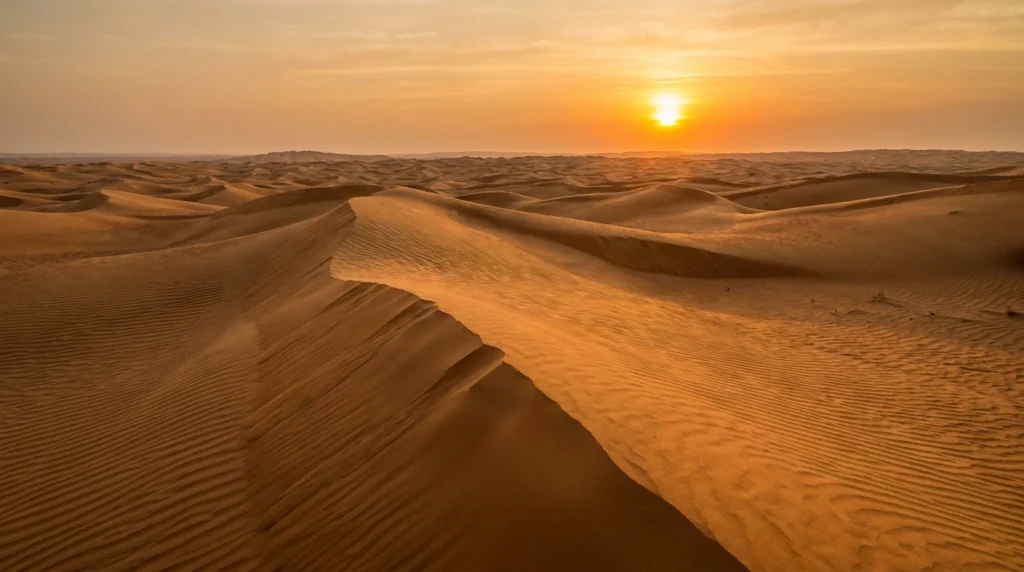
The Sharqiya Sands (the official name since the 2010s; older guidebooks still use Wahiba) cover 12,500 km² between the Hajar Mountains and the Arabian Sea, measuring 180 km north-to-south and 80 km east-to-west. Northern dunes reach 100 m — modest by Empty Quarter standards but spectacular for accessibility, just 3 hours’ drive from Muscat. The 1986 Royal Geographical Society expedition documented the Yal Wahiba (the tribe the sands were named for), Al-Bu-Isa, Hikman, Hishm and Janaba Bedouin tribes still grazing camels and herding goats in the dunes; about 250,000 Bedouin live in Oman today, mostly settled but with active mobile-camp traditions. Stay one night at one of the established mid-range desert camps (Desert Nights, Arabian Oryx Camp, Sama al Wasil, Thousand Nights — all OMR 65–120 / USD $170–310 per couple full board) for the dune-sunset and Bedouin-poetry sequence; book a Bedouin-led 4×4 dune-bashing or camel-trek add-on (OMR 15–30) rather than self-driving in soft sand on day one. The crucial detail: the police checkpoint at Al Mintirib enforces tyre-pressure drops to 1.0–1.2 bar before any vehicle enters the dune track.
Salalah & Dhofar — A Different Country, 1,000 km South
Salalah is the capital of Dhofar Governorate, Oman’s largest and most southerly province (99,300 km², 416,458 residents in 2020), bordered by Yemen to the west and Saudi Arabia to the north. The city itself has 331,949 residents, sits on the Arabian Sea at sea level, and was Sultan Qaboos’s birthplace — the post-1970 Renaissance project began as much in Salalah as in Muscat. The flagship attractions split between the khareef-only window and the year-round programme. Year-round: the Land of Frankincense UNESCO inscription (Wadi Dawkah for the Boswellia sacra trees, Khor Rori / Sumhuram for the 3rd-century-BCE Roman-era trading port, Al-Baleed for the medieval city ruins on the Salalah corniche, Shisr / Ubar for the legendary “Atlantis of the Sands” in the Empty Quarter), the Sultan Qaboos Mosque Salalah, the Mughsail blowholes (limestone-bench geysers shooting 30 m plumes when the swell hits right), the Marneef Cave, and Fazayah Beach 70 km west of the city. Khareef-only: Wadi Darbat waterfall, Ayn Athum springs, Tawi Atayr sinkhole, and the camels-in-cloud belt above Tawi Atayr. Salalah’s banana, coconut and papaya plantations are unique on the Arabian Peninsula, fed by the perennial khareef-recharged aquifer.
Musandam — The Norway of Arabia
The Musandam Governorate is Oman’s geographic curiosity: an exclave at the very tip of the Arabian Peninsula, separated from mainland Oman by 90 km of UAE territory, jutting into the 39-kilometre-narrow Strait of Hormuz that Oman shares with Iran. The peninsula is 1,800 km² with a 2020 population of 49,062, dominated by the limestone Ru’us al Jibal range that tops out at Jebel Harim (2,087 m). The visual signature is the fjord-like khor inlets — geologically false fjords created by tectonic submergence rather than glacial action, but visually identical to Norway and far more dramatic for being set in arid limestone. The capital is Khasab, accessible by SalamAir’s daily 1-hour flight from Muscat or by the Shinas–Khasab fast ferry (5h, OMR 25, since August 2008). The flagship experience is a half-day or full-day dhow cruise out of Khasab harbour through Khor Sham to Telegraph Island (a former British telegraph relay station) — wild Indian Ocean dolphins are virtually guaranteed, snorkelling at Seebi Island is excellent, and the iconic Six Senses Zighy Bay resort sits in a separate hidden khor reachable only by paragliding, mountain track or speedboat. The Kumzari villages at the very tip of the peninsula speak Kumzari, a unique south-western Iranian language closely related to Larestani and Luri.
Sur, Ras al Jinz & the Eastern Coast
Sur is the capital of Ash Sharqiyah South Governorate, 203 km south-east of Muscat (a 2h15m drive on the Highway 17 motorway through the new Hajar tunnel), with 122,533 residents recorded in the 2023 census. The town has the country’s longest continuous maritime tradition: it was a major Indian Ocean dhow port from the 16th century, with sambuk and ghanjah vessels built here sailing as far as China, India and Zanzibar, and a small handful of working dhow yards still hand-build wooden boats today using imported teak and mango wood. The historic forts at Sinesila, Bilad Sur and Al-Ayjah ring the harbour. From Sur it is a 60 km coastal drive to Ras al Jinz — the country’s only legal turtle-watching reserve and one of the most important green-turtle nesting sites in the entire Indian Ocean. Oman’s coast supports an estimated 20,000 nesting green turtles a year across more than 275 beaches, with a single female laying 100–130 eggs per clutch and an incubation period of 55–60 days; the Ras al Jinz visitor centre, opened in 2008, runs strictly-permitted dawn and evening guided walks at OMR 7 per adult that fund ongoing conservation. Continue west on the coast for Wadi Shab and Wadi Tiwi (with their year-round freshwater streams and palm-grove villages), the Bimmah Sinkhole, and the dolomite stalactites of the Hawiyat Najm Park.


Culture & Customs — Ibadi Islam, Dishdasha & the Quiet Sultanate
Oman shares a flag colour, a coffee-and-dates ritual and a Friday-prayer rhythm with every Gulf neighbour, but in temperament it is not Saudi, not Emirati and not Qatari. The country is famously understated about its wealth (no high-rises taller than nine storeys in Muscat by royal decree, white dishdashas instead of black thawbs, almost no public flagship-shopping malls outside Seeb), and the cultural register is one of careful hospitality rather than ostentation — a national habit travellers tend to find disorientingly genuine for about 24 hours and then deeply restful. The 2025 population mix is roughly 60% Omani citizens and 40% expatriates, with Indian, Bangladeshi, Pakistani and Filipino communities running large parts of the urban service economy.
Ibadi Islam — The Quiet Third Branch
Religion is the most distinctive layer. Roughly 95% of Omanis are Muslim, and within that majority Oman is the only country on Earth with an Ibadi-majority population — about 45% Ibadi alongside roughly 45% Sunni and 5% Shi’a. Ibadism emerged as a moderate offshoot of the early Kharijite movement in 7th-century Basra, predates the Sunni–Shi’a split, and has been the predominant Omani tradition since the late 7th century. Three things follow that matter to a traveller. First, the country has no morality police and no government-enforced dress code outside mosques and government buildings — modesty is a respect issue, not an enforcement issue. Second, the religious-pluralism policy is genuine: Sultan Qaboos personally financed Hindu temples in Muscat and Sohar, the Anglican Cathedral on Ruwi Avenue and the Catholic St Peter and Paul churches, and Oman has hosted Christian communities continuously since the 19th century. Third, the Ibadi imams have a 1,200-year tradition of preferring religious moderation, civic competence and consultation over dynastic claim — and that tradition still tints the country’s foreign policy: Oman has remained on diplomatic terms with Iran, Israel, the United States and Yemen simultaneously through every regional crisis of the past 20 years.
National Dress & the Khanjar
Omani men wear the national dishdasha (a cotton ankle-length white robe with embroidered slit at the throat — distinguishable from Saudi and Emirati thawbs by the absence of a collar and the presence of a small ornamental tassel called a furakha at the breast), with either a kummah (an embroidered round cap, daily wear) or a turban-style massar (silk-wool, formal occasions, royal court). On formal days — weddings, Eid prayers, royal events — men add a silver J-curved khanjar dagger worn at the front of the belt. The khanjar predates the late-1700s Wahhabi revival, appears on the national flag, the national emblem, all rial banknotes and the police shoulder patches; it symbolises “manhood, power and authority,” is traditionally gifted to sons reaching adolescence and to grooms at weddings, and is hand-crafted to the future owner’s specifications over weeks of silver-and-bone work. Women wear an abaya (loose black outer robe) over Western or traditional clothing in Muscat and the interior, with a hijab in mosques and conservative households; in Dhofar abayas are colourful and patterned rather than uniformly black, and the Bedouin women of the Sharqiya Sands wear the distinctive battoulah — a stiff metallic face mask the colour of brass. Visitors do not need to copy any of this; respectful coverage of shoulders and knees is enough.
Hospitality, Coffee & the Greeting Protocol
The greeting protocol matters. Men shake right hands; men and women shake hands only if the woman extends hers first; older Omani men sometimes greet close friends with a brief nose-touch (a sign of warm equality, not ritualised performance for tourists). The hospitality ritual is universal: any visit to an Omani home, a tribal camp or a serious souq purchase will produce a tray with kahwa (cardamom-and-saffron coffee, served in a tiny porcelain cup, refilled until you tilt the cup side-to-side), fresh dates from the host’s own palm and a piece of Omani halwa — a gelatinous saffron-rose-cardamom-ghee confection that is the national sweet. Refusing the first cup is acceptable; refusing the entire tray reads as serious rudeness. Always take with the right hand, never with the left.
Ramadan, Photography & the Things That Will Get You Fined
Ramadan is the most visible cultural fact for any traveller arriving between roughly 17 February and 19 March 2026 (dates shift each year by the lunar calendar). Public eating, drinking, smoking and chewing gum are illegal during daylight hours for everyone, including non-Muslims; restaurants close their dining rooms (delivery and takeaway operate), bars and clubs suspend service until sundown, and many tourist attractions reduce hours. Iftar (the sunset meal) is genuinely beautiful: hotels and major mosques run open public iftars where you are welcome regardless of faith. Photography rules: ask before photographing any Omani in a personal capacity; never photograph government buildings, royal palaces (Al Alam is the rare exception, photography from the public road is fine), military installations or the Royal Oman Police; never photograph women without explicit permission, and a “may I take a picture?” earns far better photographs than the alternative. A handful of laws will catch tourists out: cohabitation in hotel rooms is technically illegal for unmarried couples (rarely enforced for foreign passport-holders, never for married ones), public displays of affection beyond hand-holding are inappropriate, same-sex relationships are criminalised under Article 33 of the Penal Code with sentences of 6 months to 3 years, and rude gestures or shouting in public can result in arrest.

A Food Lover’s Guide to Oman
Omani cuisine is the gentlest, most under-spiced of the Arabian Peninsula traditions — the country’s centuries as an Indian Ocean trading hub layered Persian, Indian, Zanzibari, Yemeni and Mediterranean ingredients onto an Arab-Bedouin foundation, and unlike Yemeni or Levantine food, it almost never sets out to dazzle with chilli heat. The protein triangle is chicken, fish and lamb (very rarely camel, despite the postcards); rice is the carbohydrate base; cardamom, saffron, dried lime (loomi), turmeric, rose-water and clove are the dominant aromatics. Pork is forbidden under Islamic dietary law for Muslims, though non-Muslim residents may import it. Pour the tray with kahwa — cardamom-and-saffron coffee in a tiny porcelain cup — and you have the start of every Omani meal worth the name.
The National Dishes — A Quick Field Guide
Five dishes will appear on every restaurant menu in the country and on every wedding-feast spread you may be lucky enough to be invited to. Shuwa is the festival showpiece — lamb or goat marinated for 24 hours in a spice paste of red chilli, garlic, cumin, coriander, cardamom, vinegar and date-palm honey, wrapped in banana or palm leaf, sealed in a sand pit lined with hot coals (an al-tannur oven), and slow-cooked underground for 24–48 hours. It is served only at Eid al-Fitr, Eid al-Adha and weddings; you will not order it from a restaurant menu, but the high-end Muscat hotels (Chedi, W, Shangri-La) run shuwa nights during peak season. Machbous (sometimes majboos) is the daily-driver — saffron-and-loomi-spiced rice cooked in a meat broth with chicken, lamb or kingfish, layered with caramelised onions, served with a fresh tomato-and-coriander relish. Harees is the Ramadan iftar staple — soaked wheat berries pounded with shredded lamb or chicken into a thick porridge, finished with ghee and cinnamon. Mishkak are the country’s universal grilled-meat skewers — beef, chicken or lamb cubes marinated in tamarind and chilli, sold from corner stalls for OMR 0.500–1 a stick. Mashuai is the Sur-and-Salalah coastal classic — whole spit-roasted kingfish or hammour with lemon-rice and the Omani spice rub.
The Coffee, Dates & Halwa Ritual
The hospitality trinity is its own institution. Kahwa (Arabic coffee) is brewed light-roasted, dosed with crushed cardamom and a pinch of saffron, served unsweetened and refilled in a tiny porcelain cup until the guest tilts the cup side-to-side as the polite signal of “enough.” Dates arrive in a separate dish — usually fresh khalas or khanezi varieties from Nizwa palms, sometimes stuffed with peeled almonds, sometimes drizzled with date-palm honey. Omani halwa is the third leg: a translucent gelatinous confection made from corn or wheat starch, ghee, cane sugar, rose-water, cardamom, saffron threads and toasted almonds, slow-cooked in a great copper cauldron over a wood fire for 2–3 hours of continuous stirring. The texture sits somewhere between Turkish lokum and a thick fruit jelly; the colour ranges from pale gold to deep amber, depending on the saffron load. The best halwa in the country is from the artisan kitchens of Barka and Nizwa, sold in 250 g, 500 g and 1 kg pots wrapped in foil and bound with a ribbon — the standard departing-guest present, and an institution. Never refuse the first round; refusing the tray is read as serious rudeness.
What to Drink
Tap water in Muscat, Salalah, Nizwa, Sohar and most major hotels is treated to GCC standards and safe to drink, though most travellers default to bottled mineral water (the local Tanuf brand is the best at OMR 0.150 / USD $0.40 for 1.5L). Fresh juices are ubiquitous and excellent — pomegranate, mango, sugar-cane, lime-and-mint and a Salalah specialty of fresh-coconut-water-with-lime served direct from the husk. Laban (a salted yoghurt drink) accompanies most rice meals. Alcohol is restricted: licensed hotels, resorts and a small number of stand-alone restaurants serve beer (OMR 3–5 / USD $8–13 a pint, mostly Heineken or Stella), wine (OMR 4–8 a glass) and spirits at GCC market prices; off-licence shops are restricted to non-Muslim residents holding a personal liquor permit issued by the Royal Oman Police. Public drinking is illegal anywhere in the country. During Ramadan, even hotel bars usually serve alcohol only after the post-iftar window.
Where to Eat in Muscat & Beyond
The Muscat dining scene is small but well-curated. The Bait Al Bahr at Shangri-La Barr Al Jissah is the country’s most acclaimed seafood restaurant; Ubhar in Bareeq Al Shatti specialises in modernist Omani cuisine (their shuwa-stuffed rolled bread is a signature); Bin Ateeq has three Muscat branches that serve traditional Omani machbous, harees and mishkak in seated tray-on-the-floor majlis style at OMR 5–8 a head. Outside Muscat: Bait Al Aqr in central Nizwa, the Sur Beach Hotel restaurant for kingfish mashuai, and the Salalah corniche cluster (Al Fanar, Al Husn) for Dhofari-Yemeni crossover plates. Street food: Mutrah Corniche shawarma stalls, Salalah’s Hafa Souq for fresh-pomegranate juice, and the small grilled-meat braziers that line every interior-village square — a stick of mishkak, a kahwa and a Mountain Dew is the universal evening snack.
Signature Dishes — Quick Reference
| Dish | What it is | Where it shines |
|---|---|---|
| Shuwa | Spiced lamb or goat slow-cooked underground in a sealed earth oven for 24–48 hours, only on Eid & weddings | Hotel “shuwa nights” at the Chedi or Shangri-La in Muscat; village Eid in Nizwa or Bahla |
| Machbous (Majboos) | Saffron-and-loomi spiced rice with chicken, lamb or kingfish, daily-driver feast dish | Bin Ateeq, Muscat; Bait Al Aqr, Nizwa; any Bedouin desert camp |
| Harees | Wheat-and-meat porridge finished with ghee & cinnamon — Ramadan iftar staple | Hotel iftar buffets during Ramadan, traditional households |
| Mashuai | Whole spit-roasted kingfish or hammour with lemon rice | Sur Beach Hotel; Salalah corniche restaurants |
| Mishkak | Tamarind-and-chilli marinated grilled meat skewers — universal street food | Mutrah Corniche after dark; every interior village square in the evening |
| Madrouba | Rice-and-chicken porridge spiced with cardamom and dried lime | Iftar buffets; traditional Omani-cuisine restaurants |
| Ruz al Mudhroub | Yellow rice with seasoned fried fish — coastal staple | Sur and Salalah seafront restaurants |
| Khabeesa | Dessert pudding of toasted flour, dates, ghee and cardamom | Wedding feasts and traditional kitchens |
| Omani Halwa | Slow-cooked starch-ghee-rosewater-saffron confection — the national sweet | Barka and Nizwa artisan kitchens; gift-wrapped 250 g–1 kg pots |
| Kahwa & Dates | Cardamom-saffron coffee with fresh khalas dates — universal hospitality opener | Every household, hotel lobby and majlis in the country |

Off the Beaten Path — Misfat al Abriyeen, the Empty Quarter & Masirah
Almost every Muscat–Nizwa–Sharqiya–Sur loop travels the same eight roads and stops at the same nine forts. Oman rewards travellers who break that loop: the country’s least-visited corners are easily its most distinctive, and the asphalt has now reached far enough into the interior that you don’t need a Land Cruiser convoy to find them. Five recommendations follow, ranked by how much of a difference they make to a standard fortnight.
Misfat al Abriyeen — The 2,000-Year-Old Mountain Village
Misfat al Abriyeen sits at 900 m elevation in the Al Hamra district of the Western Hajar Mountains, an oasis village of stone-and-mud houses on terraced agricultural shelves where mangoes, pomegranates, figs, lemons and olives still grow under the original gravity-fed falaj — a 2,000-year-old underground irrigation channel that is one of the systems UNESCO inscribed in 2006. Just 962 inhabitants live here as of the 2020 census, the architecture is built from sarooj (the traditional volcanic-ash mortar), and the village earned a “Best Tourism Village” designation from UN Tourism in 2021. The two boutique-heritage guesthouses — Misfah Old House and the Bait Al Hadeeq — sit inside restored 200-year-old village homes with rooftop terraces overlooking the date palms; rooms run OMR 45–80 (USD $117–210) per night including breakfast. Walk the Wadi Al-Saq trail at dawn, eat dates from a hosted falaj-side breakfast, and you will spend less than two hours and emerge fundamentally re-set. The village is 35 km west of Nizwa and 15 km past Al Hamra; the road is sealed and 2WD-accessible, but parking sits 1 km below the village and the rest is a steep cobbled walk.
Bahla & the Mudbrick Citadel
Bahla Fort, 200 km from Muscat and 30 km west of Nizwa at the foot of the Jebel Akhdar massif, was the first Omani site inscribed by UNESCO (1987) and is the largest mudbrick fort still standing in the Arab world. Built between the 12th and 15th centuries by the Banu Nebhan tribe — who controlled the frankincense and trans-Arabian caravan trade from this position — the fort comprises three sections: Al-Qasabah (the oldest), Bait al-Hadith (Ya’aruba dynasty era, 1624–1743) and Bait Al-Jabal (an 18th-century addition). It was on the UNESCO endangered list from 1988 to 2004 because of decay; a contested 1995 restoration replaced original mud-brick with stone-and-cement, and a more sympathetic intervention culminated in a 2012 reopening. The 13 km adjacent oasis wall — partly still standing in mud-brick segments — is the country’s largest piece of medieval defensive engineering. Bahla town has a parallel reputation as Oman’s “city of jinn,” with regional folklore claiming the fort and surrounding pottery quarters are populated by particularly active djinn; locals remain ambivalent about discussing it. Combine Bahla with the smaller-but-more-photogenic Jabreen Castle 7 km south.
Wadi Shab & the Cave Pool
Wadi Shab is the country’s most photographed wadi for good reason: 140 km south-east of Muscat on the Highway 17 coastal motorway toward Sur, the canyon entrance starts with a 1-minute motorboat shuttle across a lily-covered tidal channel (OMR 1 round-trip, paid to the boat operator under the highway overpass). From there it’s a 2.5 km hike with 85 m elevation gain along a date-palm shaded ledge to the first emerald pool; another 30 minutes of swimming and rock-hopping leads to the famous “keyhole” — a narrow rock slit only big enough to put your head through — that opens into a 30-metre-tall enclosed cave with a small interior waterfall. The water sits at a year-round 22 °C, the cave acoustics are extraordinary, and the visit takes a 4–5 hour round trip including swim time. Caveat: people have drowned at Wadi Shab — the keyhole entry requires confident open-water swimming, the cave has no rescue infrastructure, and flash-flood risk during rain is genuine and lethal. Visit October–April, never after rain forecasts, and never alone.
Wadi Bani Khalid & the Bimmah Sinkhole
Wadi Bani Khalid is the country’s most reliable year-round freshwater destination — a series of large limestone-rimmed pools fed by a perennial spring system in the Eastern Hajar foothills, 200 km from Muscat and a comfortable detour off the Sur or Sharqiya routes. Underground aflāj canals link the pools, named springs (ʿAin Hamudah is the largest) feed steady flow, and the karst Kahf Maqal cave system runs beneath the rocky shelves — local guides offer 30-minute caving trips for OMR 5. The Bimmah Sinkhole (Hawiyat Najm Park) sits 90 km closer to Muscat, just off Highway 17 — a 40-metre-deep limestone collapse in the gravel coastal plain, its bottom 20 metres filled with translucent emerald-blue salt-and-fresh-water from a subterranean tidal connection. Free entry, public-park changing rooms, families swimming on Friday afternoons. The Bimmah-and-Bani-Khalid pairing makes the strongest single-day off-piste add-on to a Muscat-Sur drive.
The Empty Quarter Edge — Rub’ al Khali Sand Sea
The Rub’ al Khali — Arabic for “Empty Quarter” and the largest contiguous sand desert on Earth — covers some 650,000 km² of southern Arabia, with dunes up to 250 m high and reddish-orange feldspar-tinted sand stretching 1,000 km long and 500 km wide; the southern Omani edge runs from the Wadi Mughshin oasis south-east of Marmul to the Dhofar foothills near Mughshin. Wilfred Thesiger crossed it on foot with Bedouin companions between 1946 and 1950, the journey he recorded in Arabian Sands (1959), and modern visitors can reach the actual dune edge from Salalah on a permitted day-trip with registered guides via the Shisr (Ubar) ruins — the lost caravan city revealed by NASA satellite imagery in 1992. Critical safety note: deeper Empty Quarter exploration requires registered local guides, satellite communications and a minimum of two vehicles travelling together. The dune temperatures clear 50 °C in summer and there are no fuel stations between Salalah and the Saudi border at Ramlat Khaliya; this is not a place to improvise.
Masirah Island — The Indian Ocean’s Quietest Beach
Masirah is a 95 km-long island in the Arabian Sea, 20 km off the Al Wusta mainland coast and reached by a one-hour ro-ro car ferry from Shannah port (about OMR 5 / USD $13 per vehicle, hourly daylight crossings). With around 12,000 inhabitants and very little tourism infrastructure beyond two basic hotels and a handful of campsites, the island is the world’s largest loggerhead-turtle (Caretta caretta) nesting site, with an estimated 30,000 nests on its 95 km of beaches each season. The east coast is the country’s premier kitesurfing destination — steady south-westerly trade winds from June to September push 25–30-knot lines down the entire shore, with kitesurfers and windsurfers from Europe and South Africa colonising the small Sur Masirah camps for the season. The rest of the year, Masirah is the country’s emptiest holiday option: shipwrecks, deserted dunes, and almost zero crowd.

Practical Information — Currency, Connectivity, Tipping & Emergency Numbers
Oman has the most foreigner-friendly logistical environment in the Gulf, but a handful of details — most of them currency-related — will save you both money and embarrassment if you read them before flying. The 2026 reference table below covers what you’ll actually need.
| Item | Detail |
|---|---|
| Currency | Omani rial (OMR), divided into 1,000 baisa. Pegged to the US dollar at 1 OMR = USD $2.6008 since 1986; the third-highest-valued currency in the world after the Kuwaiti dinar and Bahraini dinar. Banknotes from the previous series became invalid on 1 January 2025; carry only 2020-issue notes. |
| Visa | ~103 nationalities (US, UK, EU, Canada, Australia, NZ) qualify for visa-free 14-day entry with hotel + return ticket + insurance + funds. Otherwise eVisa via evisa.rop.gov.om: 10-day OMR 5 / 30-day OMR 20 / 1-year multi-entry OMR 50. Six-month passport validity required. |
| Plug type | Type G (UK three-pin square), 240V / 50 Hz. Bring a UK adapter; multi-country adapters with US/Schuko prongs will not fit Omani sockets. Hotels rarely have universal sockets. |
| Tap water | Generally safe in Muscat, Salalah, Nizwa, Sohar and major hotels (treated municipal supply); in remote rural areas drink filtered or bottled. Bottled mineral water is OMR 0.150 (USD $0.40) for 1.5L. |
| Language | Arabic is the sole official language; English is functionally universal in tourism, hotels, restaurants, signage and government services. Mehri, Shehri (Jibbali) and Kumzari are minority Modern South Arabian / Iranian languages spoken in Dhofar and Musandam. |
| Mobile / SIM | Two main operators (Omantel, Ooredoo) sell tourist SIMs at the airport for OMR 5 with 10–20 GB data. eSIMs from Airalo or Holafly cover most travellers’ needs. 5G coverage in Muscat, Salalah, Nizwa, Sohar and Sur; 4G everywhere else outside the deepest Sharqiya / Empty Quarter. |
| Tipping | Not expected by Omanis but appreciated by the (largely South Asian) service workforce. Restaurants: 10% if not already on the bill. Taxis: round up to the nearest rial. Hotel porters: OMR 0.500–1 per bag. Desert-camp guides: OMR 3–5 per day. |
| Women travellers | Oman is the safest country in the Arab world for solo female travel. No morality police, female-only hotel floors at most chains, women-only first-class waiting rooms at airports, and almost no street harassment. Conservative dress (shoulders + knees covered) is a respect issue rather than enforcement. The Sultan Qaboos Grand Mosque requires hair cover and full sleeves/ankles. |
| Photography | Ask before photographing any individual, never photograph government buildings, palaces (except Al Alam from the public road), military installations or the Royal Oman Police. Drones require a Civil Aviation Authority permit and are confiscated on arrival without one. |
| Emergency | 9999 — single national number for police, ambulance and fire. Tourist police office in central Muscat (Mutrah Corniche) and Salalah corniche speak fluent English. Major hospitals: Royal Hospital and Sultan Qaboos University Hospital in Muscat, Sultan Qaboos Hospital in Salalah. |

Budget & Costs — What an Omani Trip Actually Costs
Oman sits in the awkward middle of Gulf budgets — meaningfully cheaper than the UAE, broadly comparable to Jordan, more expensive than Egypt or Morocco. The country’s third-strongest currency makes hotel and restaurant pricing look modest in rials but substantial when the credit-card bill posts in dollars or pounds. The good news: petrol is dirt-cheap (about OMR 0.25 / litre, USD $2.50 per US gallon) and government-managed attraction entry fees are nominal (OMR 0.500–2 / USD $1.30–5 at Bahla, Nizwa Fort, Bait Al Zubair, Royal Opera tours). The main cost variables are accommodation, vehicle hire and domestic flights — and the difference between a budget and a luxury Oman trip is roughly a factor of seven.
Budget — USD $80–120 per person per day
Achievable for a self-drive couple sharing a small Suzuki Jimny 4×4 (USD $45/day with discount), camping in the Sharqiya Sands and at the Empty Quarter rim (free), staying in basic Nizwa or Sur hotels (OMR 15–25 / USD $40–65 per double room), eating at workers’ Indian restaurants and Omani machbous halls (OMR 3–6 per meal), and using the Mwasalat coach for the long Muscat–Salalah leg (OMR 7 each way, 12 hours overnight). A camping fortnight in February for two travellers including the Muscat–Nizwa–Sharqiya–Sur–Wadi Shab loop and a four-day Salalah extension can be done at USD $2,500–3,800 per couple all-in, excluding international flights — the equivalent of a five-star weekend in Dubai.
Mid-Range — USD $180–320 per person per day
The realistic majority experience. A 3- or 4-star hotel in Muscat (Park Inn, Hormuz Grand, Centara Muscat — OMR 55–95 / USD $143–247 per double room with breakfast), a mid-grade Mitsubishi Pajero or Ford Explorer 4×4 with full insurance (USD $80–110/day), one or two domestic Oman Air flights (Muscat–Salalah from OMR 25 / USD $65 one-way), restaurant-rather-than-streetfood meals (OMR 15–35 per couple) and the standard Wahiba mid-range desert camp at OMR 90 (USD $235) per couple full board. A two-week mid-range fortnight runs USD $5,500–9,500 per couple all-in including domestic flights. The cost trap at this tier is the Royal Opera House box-tier seats (OMR 30–80 / USD $78–208) and the Six Senses or Anantara dinner bills if you treat yourself for a single mountain night.
Luxury — USD $700+ per person per day
The country’s flagship resorts are extraordinary, and the price tags follow. Six Senses Zighy Bay (Musandam, accessible only by paragliding, mountain track or speedboat) — Pool Villas from OMR 420 (USD $1,090) per night before Ramadan and from OMR 800 in peak winter. Anantara Al Jabal Al Akhdar (Saiq plateau, 2,000 m, infinity pool over Wadi Bani Habib) — from OMR 320 (USD $830) per night. Alila Jabal Akhdar — slightly more accessible at OMR 260 per night. The Chedi Muscat — beachfront, the country’s most acclaimed restaurant kitchen — from OMR 280. Anantara Al Baleed (Salalah) and Al Husn at Shangri-La Barr Al Jissah complete the flagship six. A two-week luxury fortnight with a private guide-driver, three flagship lodges and full board can clear USD $30,000 per couple. The driver is genuinely worth it: experienced Omani-Indian fixers cost OMR 90–130 (USD $235–340) per day and dramatically improve interior access.
Reference costs in 2026 OMR
| Item | Budget | Mid-range | Luxury |
|---|---|---|---|
| Hotel double room/night | OMR 15–35 ($40–90) | OMR 55–110 ($143–286) | OMR 250–800 ($650–2,080) |
| 4×4 rental/day | OMR 17–25 ($45–65, Jimny) | OMR 30–45 ($80–117, Pajero) | OMR 65–95 ($170–250, Land Cruiser 200) |
| Restaurant meal/person | OMR 1.5–4 ($4–10) | OMR 7–15 ($18–40) | OMR 25–60 ($65–155) |
| Beer (hotel/licensed) | — | OMR 3–5 ($8–13) | OMR 5–10 ($13–26) |
| Petrol per litre | OMR 0.235–0.270 ($0.61–0.70) — universal | ||
| Muscat → Salalah flight | OMR 25 one-way ($65) | OMR 35–45 one-way | OMR 70+ business class |
| Mwasalat coach Muscat-Salalah | OMR 7 ($18) | — | — |
| Wahiba desert-camp full board | OMR 50 ($130) | OMR 90–140 ($235–365) | OMR 200+ ($520+, Desert Nights) |
| Khasab dhow cruise (half-day) | OMR 12 ($31) | OMR 20 ($52) | OMR 40+ private ($104) |
| Sultan Qaboos Grand Mosque | Free entry — open Sat-Thu 08:00–11:00 to non-Muslims | ||
| Bahla / Nizwa Fort entry | OMR 0.500 ($1.30) per adult | ||
| Ras al Jinz turtle walk | OMR 7 ($18) per adult, dawn or evening guided | ||
Planning Your First Trip to Oman — Five Numbered Steps
The mistake every first-time visitor makes is treating Oman as a side-trip or layover destination. The country rewards a 12-to-14-day commitment far more than a 4-day Dubai add-on, and the planning sequence below is the one I used personally on each of my three trips.
-
Step 1 — Book the international flight first, then the season
Flights to Muscat from Europe and Asia tend to be cheapest 6–10 weeks ahead and cheapest in February (post-New-Year, pre-Ramadan) and October (post-monsoon). The Heathrow–Muscat round trip on British Airways or Oman Air sits around £550–750 in February economy; from Frankfurt it is €450–650 on Lufthansa or Oman Air; from Dubai it is AED 400–800 on flydubai or SalamAir. Look explicitly for open-jaw fares (in MCT, out SLL) — the saving in road backtrack alone justifies the small fare premium. North-American travellers should price both the JFK/Boston/Toronto–Doha–Muscat (Qatar) and the JFK–Frankfurt–Muscat (Lufthansa-Oman Air) routings; Doha typically saves a transit day in each direction.
-
Step 2 — Apply for the eVisa or confirm visa-free eligibility
If you’re from one of the ~103 visa-free nationalities and your trip is under 14 days, the visa step is a printout — confirmed hotel + return ticket + insurance + funds shown at the airport immigration counter. If you need longer than 14 days, apply for the 30-day eVisa via evisa.rop.gov.om at OMR 20 (USD $52) at least seven days before flight. Print the approval. Confirm passport validity exceeds six months from the planned arrival date and that you have at least one blank page per stamp.
-
Step 3 — Reserve the 4×4 and the desert camp 6–8 weeks ahead
The desert camps in the Sharqiya Sands (Desert Nights, 1000 Nights, Sama al Wasil, Arabian Oryx, Nomadic Desert Camp) routinely sell out 6–8 weeks ahead from October through March, with the Christmas-New-Year fortnight closing 4 months out. The flagship Anantara Al Jabal Al Akhdar and Six Senses Zighy Bay sell out 12 weeks ahead during peak winter. Pair the camp booking with the 4×4 rental at the same point — Sixt, Europcar, Avis, Budget and Mark Rent A Car all run airport desks at MCT; book direct online for the cheapest rates with unlimited mileage explicitly negotiated. Plan to collect the vehicle on day one in Muscat and return it at the airport on departure day; the small premium for picking-up and dropping-off at MCT outside business hours is OMR 5–10 well spent.
-
Step 4 — Sketch a 14-day route and accept that you’ll cut something
The standard 14-day classic loop runs: Day 1–2 Muscat (mosque, opera, Mutrah Souq), Day 3 Nizwa (fort, Friday goat market if dates align), Day 4 Jebel Akhdar (Saiq plateau, Diana’s Point, rose-petal harvest if April), Day 5 Jebel Shams (W6 Balcony Walk dawn), Day 6 Bahla and Misfat al Abriyeen, Day 7 Sharqiya Sands (camp), Day 8 Wadi Bani Khalid + Sur, Day 9 Ras al Jinz turtle dawn, Day 10 Wadi Shab + Bimmah Sinkhole, Day 11 fly Muscat-Salalah, Day 12 Salalah corniche + Land of Frankincense sites, Day 13 Wadi Darbat (khareef season) or Mughsail blowholes, Day 14 fly home. A 21-day extension adds Musandam (Day 15-17 Khasab + dhow cruise + Telegraph Island) or Masirah (Day 15-17 ferry + kitesurf or quiet beach). Ten days is a workable minimum for the north only; under 7 days is a Dubai-add-on and you will leave wanting more.
-
Step 5 — Pack the things people forget
The standard checklist plus four Oman-specific items: a light scarf or pashmina for women entering the Sultan Qaboos Grand Mosque (mandatory hair cover, sleeves, ankles); a fleece for the Sharqiya Sands and Jebel Akhdar nights, where temperatures drop to 5 °C in February; a UK Type-G adapter (multi-country adapters with US/Schuko prongs do not fit Omani sockets); and a head torch for the Ras al Jinz turtle walks (only red filter is permitted on the beach during nesting). Travel insurance covering motor-vehicle excess and regional disruption is the single most important cost outside the flight — given the 2026 regional security context flagged by the FCDO and US State Department, do not skip it.
Frequently Asked Questions
Is Oman safe for travellers in 2026?
Oman remains one of the calmest countries in the Gulf for tourists, with extremely low violent-crime rates and a long-standing reputation for hospitality. The UK FCDO advised exercising increased caution in April 2026 because limited regional drone and missile activity has touched the commercial ports of Duqm, Salalah and Sohar, and the US State Department lifted its advisory to Level 3 (Reconsider Travel) in April 2026 over the same regional escalation. The Yemen border is do-not-travel; central Muscat, the Hajar interior, the Sharqiya Sands and the Salalah corniche are all operating normally for tourism. Stay away from energy and military facilities, monitor flight status before departure, and travel insurance covering regional disruption is essential.
Do I need a visa to visit Oman as a US, UK, EU, Canadian or Australian citizen?
You have two paths. Approximately 103 nationalities, including the United States, United Kingdom, all EU members, Canada, Australia and New Zealand, can enter visa-free for up to 14 days provided they show a confirmed hotel reservation, return ticket, health insurance and proof of funds. For longer stays, the Royal Oman Police eVisa portal at evisa.rop.gov.om issues 30-day single-entry tourist visas for OMR 20 (about USD $52), with approval typically within 1–3 working days. Both options require a passport with at least six months validity beyond your arrival date. GCC nationals enter freely under the GCC freedom-of-movement agreement.
When is the best month to visit Oman?
For the country as a whole, November to March is the unambiguous sweet spot. Daytime temperatures sit at 22–28 °C in the interior, the desert nights drop to a fleece-friendly 8–14 °C, the diving on the Damaniyat Islands is at its clearest, and the green-turtle nesting at Ras al Jinz is in its most active stretch. April and October are good shoulder months for the desert and the mountains. June through early September is the only sensible window for Salalah and the Dhofar coast, when the khareef monsoon greens the hills — but it is also when northern Oman climbs past 45 °C and humidity makes the coast genuinely unpleasant.
Do I really need a 4×4 in Oman?
Not for the standard Muscat–Nizwa–Sur–Salalah self-drive loop. A 2WD sedan can reach Mutrah, the Sultan Qaboos Grand Mosque, Nizwa Fort and souq, the Bahla and Jabreen forts, Wadi Shab car park, Sur, Ras al Jinz turtle reserve and the entire Salalah corniche on sealed road. You will need a 4×4 to drive into the Sharqiya/Wahiba Sands camps (a police checkpoint at Bidiyah enforces this), to climb the Saiq plateau on Jebel Akhdar (also checkpoint-enforced), to summit Jebel Shams or hike the W6 trail above Wadi Ghul, and for any Empty Quarter exploration. For a first trip the strong recommendation is a high-clearance 4×4 — it doubles your itinerary flexibility for roughly USD $30/day extra.
Is alcohol available in Oman?
Yes, but only in licensed hotels, resorts and a small number of stand-alone restaurants holding a liquor licence. Public drinking is illegal, off-licence shops are restricted to non-Muslim residents holding a liquor permit, and importing alcohol over the duty-free 2-litre allowance can lead to confiscation and fines. Restaurant prices for a beer typically run OMR 3–5 (USD $8–13) and a glass of wine OMR 4–8 (USD $10–21) — comparable to Dubai. During Ramadan, even hotel bars usually serve alcohol only after sunset, and many restaurants suspend it altogether for the month.
What’s the dress code, especially for women?
Conservative but not extreme. For women: shoulders and knees covered in public — long sleeves are not required, but spaghetti straps and shorts above the knee are inappropriate outside hotel pool decks and Muscat private resort beaches. A light scarf is useful for the Sultan Qaboos Grand Mosque (mandatory hair cover, sleeves and ankles) and for entering smaller mosques anywhere in the country. Men should avoid shorts in town centres, mosques and government buildings. Beachwear is fine on hotel beaches; topless sunbathing is illegal anywhere. The dress code is a respect issue, not a religious-police one — Oman has no morality police, and enforcement is overwhelmingly by polite reminder.
What is the khareef and is it worth visiting Salalah for it?
The khareef is the Indian Ocean’s south-westerly summer monsoon, which for roughly twelve weeks between mid-June and mid-September douses the Dhofar coast and the Jebel Qara mountains around Salalah in low cloud, fog drip and steady rain. Cold-water upwelling in the Arabian Sea drops sea-surface temperatures, the warm humid air condenses as it crosses the cool water onto the cliffs, and the entire south coast — normally bone-dry desert — turns lush green for a season. The transformation is genuinely spectacular and entirely unlike anywhere else in Arabia: 1,048,000 visitors came in the 21 June – 21 September 2024 window, up 9% on 2023. Yes, it’s worth a dedicated long weekend, especially if you can be in Salalah and northern Oman in the same fortnight to experience the contrast.
Where is the best place to see sea turtles in Oman?
Ras al Jinz Turtle Reserve, 230 km south-east of Muscat and 60 km past Sur, is the only legal place in the country to watch green-turtle nesting and one of the most important rookeries in the entire Indian Ocean — Oman’s coast supports an estimated 20,000 nesting green turtles a year across more than 275 beaches. Nesting peaks May–September; hatchlings emerge October–February. The reserve and visitor centre opened in 2008 and runs guided dawn and evening walks for a fixed fee that funds conservation. Masirah Island, four hours south of Muscat by car-and-ferry, is the world’s largest loggerhead-turtle rookery and offers far smaller crowds.
Is Oman expensive?
Less than the UAE, more than Egypt, broadly comparable to Jordan. A self-drive couple camping in the Sharqiya Sands and using mid-range Nizwa hotels lives on USD $80–120 a day all-in; a 3–4★ hotel circuit with a small 4×4 runs USD $180–320; a luxury Six Senses Zighy or Anantara Jabal Akhdar week with private guide can clear USD $700–1,200 per couple per night. Petrol is dirt cheap (about OMR 0.25/litre, USD $2.50/US gallon), domestic flights are not, and the Omani rial is the third-strongest currency on Earth at USD $2.60 per OMR — meaning hotel and restaurant prices look small in rial but add up fast on the credit-card bill.
Are there any places I should not visit?
Three. The Yemen border in the far south-west is do-not-travel under both UK FCDO and US State Department guidance because of cross-border conflict spillover. The deeper Empty Quarter (Rub’ al Khali) requires registered guides, satellite communications and a minimum of two vehicles travelling together — accidents in the dunes have killed unprepared self-drivers. And during peak khareef (July–August), the Salalah ring road and the Mughsail blowholes are dangerously crowded with day-tripping GCC visitors, with road-traffic accidents the leading cause of tourist injury in Dhofar that month. Otherwise, Oman is one of the most permissive countries in the region for independent travel.
Ready to Explore Oman?
The Sultanate is the rare destination that genuinely punishes brevity — three days will make you want a fortnight, and a fortnight will make you want a year. The single most useful pre-flight commitment is to book the open-jaw flight (in MCT, out SLL or vice-versa) and the Sharqiya Sands desert camp 6–8 weeks ahead; everything else is straightforward. February remains the bullseye month for first-timers, July–August for the khareef-curious. Bring the scarf, the fleece, the head torch and the willingness to slow down — the country quietly rewards travellers who take its time.
Explore More
Muscat is Oman’s flagship city guide — start there, then trace the wider region with our other Middle East & North Africa deep-dives.
- Muscat City Guide — Oman’s capital and the natural first stop
- Dubai City Guide — the glittering neighbour an hour up the Gulf
- Petra City Guide — the rose-red Nabataean city in Jordan
- Cairo City Guide — pyramids, the Nile and ancient Egypt
- Istanbul City Guide — where Europe and Asia meet across the Bosphorus
- Jerusalem City Guide — the layered holy city of three faiths
- All Country Guides
More country guides you might like
Plan your trip to Oman
The booking tools we use ourselves. FFU may earn a commission at no extra cost to you.
Plan & book your trip to Oman
Booking through these searches supports our guides at no extra cost to you.